<?xml version="1.0" encoding="ISO-8859-1"?><article xmlns:mml="http://www.w3.org/1998/Math/MathML" xmlns:xlink="http://www.w3.org/1999/xlink" xmlns:xsi="http://www.w3.org/2001/XMLSchema-instance">
<front>
<journal-meta>
<journal-id>1605-2528</journal-id>
<journal-title><![CDATA[Ecología en Bolivia]]></journal-title>
<abbrev-journal-title><![CDATA[Ecología en Bolivia]]></abbrev-journal-title>
<issn>1605-2528</issn>
<publisher>
<publisher-name><![CDATA[Plural Editores ]]></publisher-name>
</publisher>
</journal-meta>
<article-meta>
<article-id>S1605-25282013000100007</article-id>
<title-group>
<article-title xml:lang="en"><![CDATA[New information about the distribution of Callicebus (Pithecidae, Primates) in northern Beni Department, Bolivia]]></article-title>
<article-title xml:lang="es"><![CDATA[Nueva información acerca de la distribución de Callicebus (Pithecidae, Primates) en el norte del Departamento del Beni, Bolivia]]></article-title>
</title-group>
<contrib-group>
<contrib contrib-type="author">
<name>
<surname><![CDATA[Martínez]]></surname>
<given-names><![CDATA[Jesus]]></given-names>
</name>
<xref ref-type="aff" rid="A01"/>
</contrib>
<contrib contrib-type="author">
<name>
<surname><![CDATA[Wallace]]></surname>
<given-names><![CDATA[Robert B.]]></given-names>
</name>
<xref ref-type="aff" rid="A01"/>
</contrib>
</contrib-group>
<aff id="A01">
<institution><![CDATA[,Wildlife Conservation Society GreaterMadidi-Tambopata Landscape Conservation Program ]]></institution>
<addr-line><![CDATA[San Miguel La Paz]]></addr-line>
<country>Bolivia</country>
</aff>
<pub-date pub-type="pub">
<day>00</day>
<month>04</month>
<year>2013</year>
</pub-date>
<pub-date pub-type="epub">
<day>00</day>
<month>04</month>
<year>2013</year>
</pub-date>
<volume>48</volume>
<numero>1</numero>
<fpage>57</fpage>
<lpage>62</lpage>
<copyright-statement/>
<copyright-year/>
<self-uri xlink:href="http://www.scielo.org.bo/scielo.php?script=sci_arttext&amp;pid=S1605-25282013000100007&amp;lng=en&amp;nrm=iso"></self-uri><self-uri xlink:href="http://www.scielo.org.bo/scielo.php?script=sci_abstract&amp;pid=S1605-25282013000100007&amp;lng=en&amp;nrm=iso"></self-uri><self-uri xlink:href="http://www.scielo.org.bo/scielo.php?script=sci_pdf&amp;pid=S1605-25282013000100007&amp;lng=en&amp;nrm=iso"></self-uri></article-meta>
</front><body><![CDATA[ <p align="right"><font face="Verdana" size="2"><b>NOTA</b></font></p>     <p align="right">&nbsp;</p>     <p align="center"><font face="Verdana" size="4"><b>New information about the distribution of <i>Callicebus </i>(Pithecidae, Primates) in northern Beni Department, Bolivia</b></font></p>     <p align="center">&nbsp;</p>     <p align="center"><font face="Verdana" size="3"><b>Nueva información acerca de la distribución de <i>Callicebus </i>(Pithecidae, Primates) en el norte del Departamento del Beni, Bolivia</b></font></p>     <p align="center">&nbsp;</p>     <p align="center">&nbsp;</p>     <p align="center"><font face="Verdana" size="2"><b>Jesus Martínez<sup>1</sup> &amp; Robert B. Wallace<sup>1,2</sup></b></font></p>     <p align="center"><font face="Verdana" size="2"><sup>1</sup>Wildlife Conservation Society, GreaterMadidi-Tambopata Landscape Conservation Program,</font> <font face="Verdana" size="2">Casilla 3-35181, San Miguel, La Paz, Bolivia.     <br>   Email: <a href="mailto:jmartinez@wcs.org">jmartinez@wcs.org</a> Corresponding author</font>    ]]></body>
<body><![CDATA[<br> <font face="Verdana" size="2"><sup>2</sup>Wildlife Conservation Society, 185th Street and Southern Boulevard, Bronx, Nueva York 10460, USA</font></p>     <p align="center">&nbsp;</p>     <p align="center">&nbsp;</p> <hr noshade>     <p align="center">&nbsp;</p>     <p align="justify"><font face="Verdana" size="2"><i>Callicebus </i>is one of the most diverse genera of primate in the Neotropics, including 30 recognized species of titi monkeys (Van Roosmalen <i>et al. </i>2002, Wallace <i>et al. </i>2006, Defler <i>et al. </i>2010). In Bolivia, the distribution, diet and behavior of titi monkeys is poorly known and even the number and identity of species is unclear (Wallace <i>et al. </i>2006, Martinez &amp; Wallace 2010).</font></p>     <p align="justify"><font face="Verdana" size="2">Two of the six species of titi monkeys recognized for Bolivia are endemic: <i>Callicebus modestus </i>(Beni titi monkey) and <i>Callicebus olallae </i>(Olallae's titi monkey), both locally named as &quot;lucachis&quot; (Hershkovitz 1988, Anderson 1997, Rylands <i>et al. </i>2000, Van Roosmalen <i>et al. </i>2002, Wallace <i>et al. </i>2006, Martinez &amp; Wallace 2010). Both species were categorized as Endangered (Veiga <i>et al. </i>2008 a, b, Tarifa &amp; Aguirre 2009).</font></p>     <p align="justify"><font face="Verdana" size="2">Since original descriptions by Lönnberg (1939), taxonomic studies have consistently maintained these endemic monkeys as full species (Hershkovitz 1990, Kobayashi 1995, van Roosmalen <i>et al. </i>2002). No new field data was available for these species until Felton <i>et al. </i>(2006) and Martinez &amp; Wallace (2007) identified the physical diagnostic characteristics useful for field identification and reported new localities for both <i>Callicebus </i>endemics, establishing the principal limits of their distributional range in a restricted area within the forest patches of the western part of Beni Department, especially for C. <i>olallae </i>that is almost exclusively present along theYacuma river.</font></p>     <p align="justify"><font face="Verdana" size="2">The northern limit remained unclear because ca. 185 km separates the northernmost record of <i>C</i>. <i>modestus </i>and the southernmost record of another species of <i>Callicebus </i>inhabiting the Amazonian forest of the northern region of Beni Department, previously assumed to be <i>Callicebus brunneus </i>(Hershkovitz 1990). Here we present observations of titi monkeys made in September 2008 evaluating the distribution of <i>Callicebus </i>in the northern part of the Beni Department of Bolivia.</font></p>     <p align="justify">&nbsp;</p>     <p align="center"><font face="Verdana" size="3"><b>Methods</b></font></p>     ]]></body>
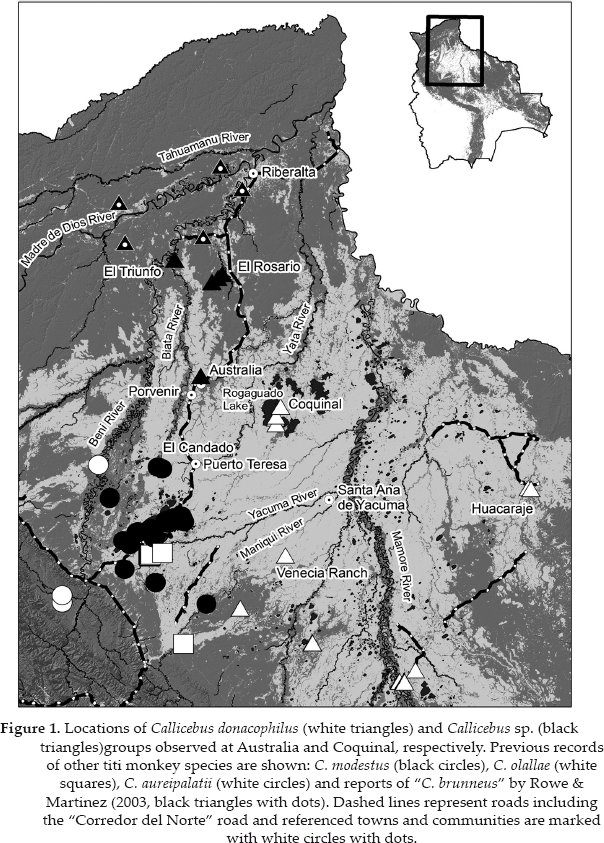
<body><![CDATA[<p align="justify"><font face="Verdana" size="2">We focused our surveys in two areas near the northern and northeastern limits of the documented distributional range for the endemic <i>Callicebus </i>species (Martinez &amp; Wallace 2007, <a href="#f1">Fig. 1</a>). The first survey area was the Australia community (12&deg;47'22.79&quot;S, 66&deg;31'19.29&quot; W) located in Amazonian forest on the road from Puerto Teresa to Riberalta, between the northernmost previous observations of C. <i>modestus </i>at El Candado (13&deg;28'56.83&quot;S, 66&deg;54'0.28&quot;W) and the unidentified <i>Callicebus </i>sp. at El Rosario (11&deg;51'44.72&quot; S, 66&deg;19'42.71&quot; W).</font></p>     <p align="justify"><a name="f1"></a></p>     <p align="center"><img src="/img/revistas/reb/v48n1/a07_figure_01.jpg" width="604" height="843"></p>     <p align="justify"><font face="Verdana" size="2">The second survey area was around the Coquinal community at Rogaguado Lake (12&deg;58'15.24&quot; S, 65&deg;51'33.30&quot; W), located to the northwest of Santa Ana de Yacuma. Anecdotal evidence from two people who had heard <i>Callicebus </i>territorial calls (Y. Janco and M. Herrera <i>pers. comm. </i>2007)</font> <font face="Verdana" size="2">suggested this forest area as potential habitat for <i>Callicebus. </i>Satellite imagery showing forest cover demonstrated that it is a relatively large but isolated forest patch surrounded by savannah and separated from other large forest patches by approximately 30 km (<a href="#f1">Fig. 1</a>).</font></p>     <p align="justify"><font face="Verdana" size="2">We searched for titi monkeys groups at each locality for four days. We consulted with local people about the best potential locations using pictures and recordings of their characteristic territorial calls. To observe <i>Callicebus </i>groups we firstly attempted to determine their location</font> <font face="Verdana" size="2">by their territorial calls early in the morning between 06:00-10:00 h corresponding with the highest vocal activity period (Kinzey 1981, Martinez &amp; Wallace 2007). Vocalization playbacks were also used to promote vocal responses. Complementary searching was made during the afternoon (16:00-18:00 h). Once a group was located from vocalizations, we observed individuals with binoculars (Swift 10 x 42) and attempted to film them using a handheld video recorder (Sony Digital 8 Video Camera TRV 361). For each observed <i>Callicebus </i>group we noted the fur color patterns of the individuals, as well as group size, composition, height in the forest canopy, general habitat description, and geographic location (GPS Garmin III Plus). </font></p>     <p align="justify"><font face="Verdana" size="2">To confirm the field species identifications, we compared video footage and descriptions of pelage with previous descriptions from Bolivian <i>Callicebus </i>species (Lönnberg 1939, Felton <i>et al. </i>2006, Martinez &amp; Wallace 2007, 2010). With the new <i>Callicebus </i>localities we actualized a distribution map for this genus in northern Beni Department.</font></p>     <p align="justify">&nbsp;</p>     <p align="center"><font face="Verdana" size="3"><b>Results</b></font></p>     <p align="justify"><font face="Verdana" size="2">We identified two phenotypes of <i>Callicebus. </i>At Coquinal we observed six of twelve <i>Callicebus donacophilus </i>groups that were detected by vocalizations. Individuals showed characteristic grayish brown agouti pelage dorsally with the tail lighter than the body. This color pattern clearly contrasts with the reddish coloration of the body fur of both <i>C</i>. <i>modestus </i>and <i>C</i>. <i>olallae, </i>with the latter having a dark gray tail pelage. </font></p>     <p align="justify"><font face="Verdana" size="2">The conspicuous white ear tufts and a similar coloration on the mouth area of the face, together with the light grayish coloration of hand and feet pelage were other features useful to distinguish this species from the endemic <i>Callicebus </i>that have relatively small ear tufts with a different gray tone on the fur of hands and feet. Juveniles of <i>C</i>. <i>donacophilus </i>also showed an almost white tail as well as characteristic head coloration patterns where white ear tufts are small and almost</font> <font face="Verdana" size="2">all of the face had abundant grayish fur, with only the eyes and part of the nose and mouth darker(endemic <i>Callicebus </i>juvenile heads have almost the same color pattern as adults). An important observation was the orange coloration in the ventral region of the body, arms and legs on some adult males, apparently a color variation related to the reproductive season (K. Dingess, </font><font face="Verdana" size="2"><i>pers. comm. </i>2007).</font></p>     ]]></body>
<body><![CDATA[<p align="justify"><font face="Verdana" size="2">At Australia we observed only one of the six groups detected. The two adults in this group showed a dark grayish brown fur dorsally and dark tails with a conspicuous white zone near the tip. The face was dark with no ear tufts present and the hair on the forehead had a blackish coloration distinguishable from the rest of the head. The hands were covered with blackish hairs differentiating them from the arms that had a similar color as the body. The pelage color of these individuals is totally different from the endemic titi monkeys but similar to the already observed <i>Callicebus </i>sp. at El Rosario (Martinez &amp; Wallace 2007), the descriptions of Rowe &amp; Martinez (2003) in northern Beni Department, and observations in northwestern Pando Department (L. Porter, <i>pers. comm. </i>2008), suggesting that this species does indeed inhabit the majority of Amazonian forests of northern Bolivia(Martinez &amp; Wallace 2010). Unfortunately, we were unable to obtain photographic or video material during this encounter.</font></p>     <p align="justify"><font face="Verdana" size="2">Currently the identity of this last species remains uncertain (Wallace <i>et al. </i>2006, Martinez &amp; Wallace 2010). Previous <i>Callicebus </i>taxonomic revisions reported <i>C</i>. <i>brunneus </i>(Hershkovitz 1990, Anderson 1997) or <i>C</i>. <i>dubius </i>(Van Roosmalen <i>et</i> <i>al. </i>2002, Salazar-Bravo <i>et al. </i>2003) as the expected titi monkey form in the northern Amazonian forests of Bolivia. However, the descriptions presented above do not correspond to either <i>C</i>. <i>brunneus </i>(Vermeer 2009) or <i>C</i>. <i>dubius </i>(van Roosmalen <i>et al. </i>2002) and as such probably represents a different species (Martínez &amp; Wallace 2010), possibly <i>Callicebus toppini, </i>known from locations north of the Madre de Dios River</font> <font face="Verdana" size="2">in neighboring southeastern Peru(Thomas1914, R. Wallace unpubl. data).</font></p>     <p align="justify"><font face="Verdana" size="2">Group size for both observed species varied between two and four individuals. For <i>C</i>. <i>donacophilus, </i>adult individuals were always present in the groups (62.5% of age composition, n=16), accompanied by juveniles and subadults (25.0% and 12.5% of age composition respectively). The observed <i>Callicebus </i>sp. group had only an adult pair.</font></p>     <p align="justify"><font face="Verdana" size="2">The Australia locality is situated in the southern part of the northern Amazonian forests of Bolivia where the landscape consists of several forest islands with high densities of vines and a dense understory surrounded by natural grasslands. Overall tall forests dominated (canopy reaches ca. 25 m), but forests inhabited by <i>Callicebus </i>were lower in stature (canopy ~15 m) and usually located at the forest borders near grassland, where relatively higher densities of &quot;motacú&quot; palm trees <i>(Attalea phalerata) </i>occurred compared to the taller forest.</font></p>     <p align="justify"><font face="Verdana" size="2">Groups of <i>C</i>. <i>donacophilus </i>at Coquinal also occurred in lower forests (canopy ~13-14 m) near the lakeshore, although the taller forests at Coquinal were relatively low (canopy~15 m). One group of <i>C</i>. <i>donacophilus </i>was observed in secondary forest next to a manioc crop where vines occurred in high densities. All groups of both species were located in the canopy level at an average height of 13.6 m for C. <i>donacophilus </i>and 15 m for the <i>Callicebus </i>sp. group.</font></p>     <p align="justify"><font face="Verdana" size="2">Local people of Coquinal reported the presence of three other primate species <i>Aotus </i>sp., <i>Alouatta caraya, </i>and <i>Sapajus apella, </i>but we did not observe or hear any of these species. At Australia <i>Saimiri boliviensis </i>and <i>S. apella </i>were observed and <i>Alouatta </i>sp. heard. Local people also reported the presence of <i>Aotus </i>sp., and rarely <i>Cebus albifrons.</i></font></p>     <p align="justify">&nbsp;</p>     <p align="center"><font face="Verdana" size="3"><b>Discussion</b></font></p>     <p align="justify"><font face="Verdana" size="2">The new register for the unidentified <i>Callicebus </i>at Australia, further suggests that El Candado to</font> <font face="Verdana" size="2">the south of the Beni Department's Amazonian forest (Martinez &amp; Wallace 2007) may constitute the northern distributional limit of <i>C. modestus. </i>Even though the gallery forest of the Biata river connects the forests of El Candado and Australia, local information from Porvenir (<a href="#f1">Fig. 1</a>) suggests that no titi monkeys are present until El Candado. Also, our field observations in Porvenir zone suggest that this gallery forest area may not be suitable for <i>Callicebus </i>due to low vine densities, and as such this zone may constitute a barrier separating <i>C</i>. <i>modestus </i>from the unidentified <i>Callicebus </i>species.</font></p>     <p align="justify"><font face="Verdana" size="2">The presence of <i>C</i>. <i>donacophilus </i>at Rogaguado lake is somewhat surprising given the relative isolation of this forest from others where this species has been registered. The Amazonian forest north of this lake is the nearest major forest block and it is actually connected by the narrow gallery forest of the Yata river. However, the absence of the <i>Callicebus </i>sp. from Australia at Rogaguado suggests that this gallery forest may not serve as a corridor. The nearest records of <i>C. donacophilus </i>to Coquinal are at Venecia ranch south of the Maniqui river(Anderson 1997) and at the Huacaraje community near Blanco river on the opposite side of the Mamoré river (Martínez &amp; Wallace 2007), perhaps suggesting that historically forest connections existed between Rogaguado and the southern forests (<a href="#f1">Fig. 1</a>). Paleo-geographical studies of the forest-savanna complex including archeological aspects related to ancient grassland management need to be taken into account in future explanations of <i>Callicebus </i>distributions in the Beni Department.</font></p>     ]]></body>
<body><![CDATA[<p align="justify"><font face="Verdana" size="2">Currently local habitants maintain grasslands using fire or &quot;chaqueo&quot; burning on broad extensions of savanna on an annual basis thereby avoiding forest regrowth and maintaining the patchy nature of the landscape. Forest remnants in these areas have shorter trees and a notable absence of vines that provide shelter for these monkeys (Kinzey 1988, Martinez &amp; Wallace 2007, 2010), which does not represent the best habitat for <i>Callicebus.</i></font></p>     <p align="justify"><font face="Verdana" size="2">The new <i>C</i>. <i>donacophilus </i>record (<a href="#f1">Fig. 1</a>) helps to clarify the northeastern distributional limit for <i>C</i>. <i>modestus </i>because of the absence of <i>Callicebus </i>in the heavily fragmented forest outside of the lake system to the east of the Santa Rosa - Riberalta road, as well as previous surveys in similar forest types to the east side of the Mamoré river where <i>Callicebus </i>were also absent (<a href="#f1">Fig. 1</a>; Martinez &amp; Wallace 2007).</font></p>     <p align="justify"><font face="Verdana" size="2">Residents of Coquinal practice subsistence hunting including <i>Sapajus apella, </i>but they do not </font><font face="Verdana" size="2">hunt <i>C</i>. <i>donacophilus. </i>In general, <i>C</i>. <i>donacophilus </i></font><font face="Verdana" size="2">shows a high level of tolerance to human presence (Martínez &amp; Wallace 2010), although children at Coquinal do occasionally throw objects at <i>Callicebus </i>to stop their territorial calls that are considered noisy. Even though the intention seems not be to hurt them, this persecution may produce behavioral changes and the groups nearest to the community ceased calling at the minimum sound of people. Nevertheless, forest conversion for manioc crops is the major threat at Coquinal compared to hunting.</font></p>     <p align="justify"><font face="Verdana" size="2">Local people at Australia reported higher hunting levels, which included titi monkeys. According to older residents, several <i>Callicebus </i>groups inhabited forests immediately adjacent to Australia 20 years ago, but due to hunting pressure towards this species mainly related to obtaining bait for fishing these groups gradually disappeared. This may explain the highly evasive behavior displayed by <i>Callicebus </i>groups and other primate species <i>(S. boliviensis </i>and <i>S. apella), </i>making prolonged observations challenging as previously reported for other nearby areas (Martínez &amp; Wallace 2007).</font></p>     <p align="justify">&nbsp;</p>     <p align="center"><font face="Verdana" size="3"><b>Conclusions</b></font></p>     <p align="justify"><font face="Verdana" size="2">We present a new record for <i>C</i>. <i>donacophilus </i>representing their northernmost distributional limit and an interesting case of population isolation, perhaps related to human activities. Similarly we report a new observation of the still unidentified <i>Callicebus </i>sp. that inhabits the Amazonian forests of northern Bolivia.</font></p>     <p align="justify"><font face="Verdana" size="2">Crucially, this survey also provides us with a more complete picture (<a href="#f1">Fig.1</a>) of the general distribution of the Bolivian endemic titi monkeys, <i>Callicebus olallae </i>and <i>C</i>. <i>modestus. </i>With no new northern localities found for these endemic primates, we can confirm the zone of El Candado community as the northern limit for C. <i>modestus </i>(Martínez&amp; Wallace 2007), allowing us to improve conservation assessments for both endemic species and reinforce conservation initiatives against threats to this primate genus and their habitat. Finer scale distributional evaluations that consider titi monkey presence in different forest types are now required to determine and confirm appropriate conservation activities for the endemic primates and their habitat that are threatened by increasing deforestation levels in Bolivia (Martínez &amp; Wallace 2010).</font></p>     <p align="justify">&nbsp;</p>     <p align="center"><font face="Verdana" size="2"><b>Acknowledgements</b></font></p>     ]]></body>
<body><![CDATA[<p align="justify"><font face="Verdana" size="2">We would like to thank the Wildlife Conservation Society and Primate Conservation Inc. for their financial support. We are also grateful to Yrguens Janco, and the people of Australia and Coquinal (L. Atoyay, L. Atoyay Jr., O. Correa and R. Divibay) for their support during fieldwork. We also thank to Jaime Jiménez and three anonymous reviewers for their comments that helped to improve the quality of this manuscript.</font></p>     <p align="justify">&nbsp;</p>     <p align="center"><font face="Verdana" size="3"><b>References</b></font></p>     <!-- ref --><p align="justify"><font face="Verdana" size="2">Anderson, S. 1997. Mammals of Bolivia: taxonomy and distribution. Bulletin of the American Museum of Natural History 231:1-652.</font>&nbsp;&nbsp;&nbsp;&nbsp;&nbsp;&nbsp;&nbsp;&nbsp;[&#160;<a href="javascript:void(0);" onclick="javascript: window.open('/scielo.php?script=sci_nlinks&ref=020181&pid=S1605-2528201300010000700001&lng=','','width=640,height=500,resizable=yes,scrollbars=1,menubar=yes,');">Links</a>&#160;]<!-- end-ref --><p align="justify"><font face="Verdana" size="2">Defler, R. T., M. L. Bueno &amp; J. Garcia. </font><font face="Verdana" size="2">2010. <i>Callicebus caquetensis: </i>a new and </font><font face="Verdana" size="2">critically endangered titi monkey from southern Caquetá, Colombia. Primate Conservation 25:1-9.</font></p>     <p align="justify"><font face="Verdana" size="2">Felton, A., A. M. Felton, R. B. Wallace &amp; H. Gómez. 2006. Identification, distribution and behavioural observations of the titi</font> <font face="Verdana" size="2">monkeys <i>Callicebus smodestus </i>Lönnberg 1939, and <i>Callicebus olallae </i>Lönnberg 1939. Primate Conservation 20: 40-46.</font></p>     <!-- ref --><p align="justify"><font face="Verdana" size="2">Hershkovitz, P. 1988. Origin, speciation and distribution of South American titi monkeys, genus <i>Callicebus </i>(Family Cebidae, Platyrrhini). Proceedings of the Academy of Natural Sciences of Philadelphia 140(1): 240-272.</font>&nbsp;&nbsp;&nbsp;&nbsp;&nbsp;&nbsp;&nbsp;&nbsp;[&#160;<a href="javascript:void(0);" onclick="javascript: window.open('/scielo.php?script=sci_nlinks&ref=020184&pid=S1605-2528201300010000700004&lng=','','width=640,height=500,resizable=yes,scrollbars=1,menubar=yes,');">Links</a>&#160;]<!-- end-ref --><!-- ref --><p align="justify"><font face="Verdana" size="2">Hershkovitz, P. 1990. Titis, New Worldmonkeys of the genus <i>Callicebus </i>(Cebidae, Platyrrhini): a preliminary taxonomic review.Fieldiana Zoology New series (55): 1-109.</font>&nbsp;&nbsp;&nbsp;&nbsp;&nbsp;&nbsp;&nbsp;&nbsp;[&#160;<a href="javascript:void(0);" onclick="javascript: window.open('/scielo.php?script=sci_nlinks&ref=020185&pid=S1605-2528201300010000700005&lng=','','width=640,height=500,resizable=yes,scrollbars=1,menubar=yes,');">Links</a>&#160;]<!-- end-ref --><!-- ref --><p align="justify"><font face="Verdana" size="2">Kinzey, W. G. 1981. The titi monkeys, genus <i>Callicebus. </i>Pp. 241-276. In: Coimbra-Filho, A.F. &amp; R.A. Mittermeier (eds.) Ecology and Behaviour of Neotropical Primates.Vol 1. Academia Brasileira de Ciencias, Rio de Janeiro.</font>&nbsp;&nbsp;&nbsp;&nbsp;&nbsp;&nbsp;&nbsp;&nbsp;[&#160;<a href="javascript:void(0);" onclick="javascript: window.open('/scielo.php?script=sci_nlinks&ref=020186&pid=S1605-2528201300010000700006&lng=','','width=640,height=500,resizable=yes,scrollbars=1,menubar=yes,');">Links</a>&#160;]<!-- end-ref --><!-- ref --><p align="justify"><font face="Verdana" size="2">Kobayashi, S. 1995. A phylogenetic study of titi monkeys, genus <i>Callicebus, </i>based on cranial measurements: I. Phyletic groups of <i>Callicebus. </i>Primates 36(1): 101-120.</font>&nbsp;&nbsp;&nbsp;&nbsp;&nbsp;&nbsp;&nbsp;&nbsp;[&#160;<a href="javascript:void(0);" onclick="javascript: window.open('/scielo.php?script=sci_nlinks&ref=020187&pid=S1605-2528201300010000700007&lng=','','width=640,height=500,resizable=yes,scrollbars=1,menubar=yes,');">Links</a>&#160;]<!-- end-ref --><!-- ref --><p align="justify"><font face="Verdana" size="2">Lönnberg, E. 1939.Notes on some members of the genus <i>Callicebus. </i>Arkiv Für Zoologi 31(13): 1-18.</font>&nbsp;&nbsp;&nbsp;&nbsp;&nbsp;&nbsp;&nbsp;&nbsp;[&#160;<a href="javascript:void(0);" onclick="javascript: window.open('/scielo.php?script=sci_nlinks&ref=020188&pid=S1605-2528201300010000700008&lng=','','width=640,height=500,resizable=yes,scrollbars=1,menubar=yes,');">Links</a>&#160;]<!-- end-ref --><p align="justify"><font face="Verdana" size="2">Martínez, J. &amp; R. B. Wallace. 2007. Further notes on the distribution of endemic Bolivian titi </font><font face="Verdana" size="2"><i>monkeys,Callicebus modestus and Callicebus </i></font><font face="Verdana" size="2"><i>olallae. </i>Neotropical Primates 14:47-54.</font></p>     <!-- ref --><p align="justify"><font face="Verdana" size="2">Martínez, J. &amp; R. B. Wallace. 2010. Pitheciidae. Pp. 305-330. In: Wallace, R.B., H. Gomez, D. Rumiz&amp;Z.R. Porcel (eds.) Mamíferos Medianos y Grandes de Bolivia: Distribución, Ecología y Conservación. Editorial: Centro de Ecología y Difusión Simón I. Patiño, Santa Cruz.</font>&nbsp;&nbsp;&nbsp;&nbsp;&nbsp;&nbsp;&nbsp;&nbsp;[&#160;<a href="javascript:void(0);" onclick="javascript: window.open('/scielo.php?script=sci_nlinks&ref=020190&pid=S1605-2528201300010000700010&lng=','','width=640,height=500,resizable=yes,scrollbars=1,menubar=yes,');">Links</a>&#160;]<!-- end-ref --><p align="justify"><font face="Verdana" size="2">Rowe, N. &amp;W. Martinez. 2003. <i>Callicebus </i>sightings in Bolivia, Peru and Ecuador. Neotropical Primates11(1): 32-35.</font></p>     <p align="justify"><font face="Verdana" size="2">Rylands, A. B., H. Scheider, A. Langguth, R. A. Mittermeier, C. P. Groves&amp; E-Rodríguez-Luna. 2000. An assessment of the diversity of New World primates. Neotropical Primates 8(2): 61-93.</font></p>     <p align="justify"><font face="Verdana" size="2">Salazar-Bravo, J<i>., </i>T. Tarifa, L.F. Aguirre, E. Yensen &amp; T. L. Yates. 2003. Revised checklist of Bolivian mammals. Occasional Papers, Museum of Texas Tech University 220: 1-27.</font></p>     <!-- ref --><p align="justify"><font face="Verdana" size="2">Tarifa, T. &amp; L. F. Aguirre. 2009. Mamíferos. Pp. 419-573. In: Ministerio de Medio Ambiente y Agua. Libro Rojo de la Fauna Silvestre de Vertebrados de Bolivia, La Paz.</font>&nbsp;&nbsp;&nbsp;&nbsp;&nbsp;&nbsp;&nbsp;&nbsp;[&#160;<a href="javascript:void(0);" onclick="javascript: window.open('/scielo.php?script=sci_nlinks&ref=020194&pid=S1605-2528201300010000700014&lng=','','width=640,height=500,resizable=yes,scrollbars=1,menubar=yes,');">Links</a>&#160;]<!-- end-ref --><!-- ref --><p align="justify"><font face="Verdana" size="2">Thomas, O.1914. On various South-American mammals. Annals and Magazine of Natural History, series 8,13: 345-363.</font>&nbsp;&nbsp;&nbsp;&nbsp;&nbsp;&nbsp;&nbsp;&nbsp;[&#160;<a href="javascript:void(0);" onclick="javascript: window.open('/scielo.php?script=sci_nlinks&ref=020195&pid=S1605-2528201300010000700015&lng=','','width=640,height=500,resizable=yes,scrollbars=1,menubar=yes,');">Links</a>&#160;]<!-- end-ref --><p align="justify"><font face="Verdana" size="2">Van Roosmalen, M. G. M., T. Van Roosmalen &amp; R. A. Mittermeier. 2002. A taxonomic review of the titi monkeys, genus <i>Callicebus </i>Thomas, 1903, with the description of two new species, <i>Callicebus </i></font><font face="Verdana" size="2"><i>bernhardi </i>and <i>Callicebus stephennashi </i></font><font face="Verdana" size="2">from Brazilian Amazonia. Neotropical Primates 10:1-52.</font></p>     <!-- ref --><p align="justify"><font face="Verdana" size="2">Veiga, L. M., R. B. Wallace &amp; J. Martínez. 2008a. <i>Callicebus modestus. </i>In: IUCN 2012. IUCN Red List of Threatened Species. Version 2012.2.&lt;<a href="http://www.iucnredlist.org" target="_blank">www.iucnredlist.org</a>&gt;. Downloaded on 12 November 2012.</font>&nbsp;&nbsp;&nbsp;&nbsp;&nbsp;&nbsp;&nbsp;&nbsp;[&#160;<a href="javascript:void(0);" onclick="javascript: window.open('/scielo.php?script=sci_nlinks&ref=020197&pid=S1605-2528201300010000700017&lng=','','width=640,height=500,resizable=yes,scrollbars=1,menubar=yes,');">Links</a>&#160;]<!-- end-ref --><!-- ref --><p align="justify"><font face="Verdana" size="2">Veiga, L. M., R. B. Wallace &amp; J. Martínez. 2008b. <i>Callicebus olallae. </i>In: IUCN 2012. IUCN Red List of Threatened Species. Version 2012.2.&lt;<a href="http://www.iucnredlist.org" target="_blank">www.iucnredlist.org</a>&gt;. Downloaded on 12 November 2012.</font>&nbsp;&nbsp;&nbsp;&nbsp;&nbsp;&nbsp;&nbsp;&nbsp;[&#160;<a href="javascript:void(0);" onclick="javascript: window.open('/scielo.php?script=sci_nlinks&ref=020198&pid=S1605-2528201300010000700018&lng=','','width=640,height=500,resizable=yes,scrollbars=1,menubar=yes,');">Links</a>&#160;]<!-- end-ref --><!-- ref --><p align="justify"><font face="Verdana" size="2">Vermeer, J. 2009. On the identification of </font><font face="Verdana" size="2"><i>Callicebus cupreus </i>and <i>Callicebus brunneus. </i></font><font face="Verdana" size="2">Neotropical Primates 16(2): 71-73.</font>&nbsp;&nbsp;&nbsp;&nbsp;&nbsp;&nbsp;&nbsp;&nbsp;[&#160;<a href="javascript:void(0);" onclick="javascript: window.open('/scielo.php?script=sci_nlinks&ref=020199&pid=S1605-2528201300010000700019&lng=','','width=640,height=500,resizable=yes,scrollbars=1,menubar=yes,');">Links</a>&#160;]<!-- end-ref --><p align="justify"><font face="Verdana" size="2">Wallace, R. B., H. Gomez, A. Felton &amp; A M. Felton. 2006. On a new species of titi monkey, genus <i>Callicebus </i>Thomas, from western Bolivia (Primates, Cebidae) with preliminary notes on distribution and abundance. Primate Conservation 20: 29-39.</font></p>     <p align="justify">&nbsp;</p>     <p align="justify"><font face="Verdana" size="2"><b>Nota recibida en:</b> Julio de 2012.     <br>   <b> Manejada por:</b> Jaime Jiménez.     <br>   <b> Aceptada en:</b> Diciembre de 2013.</font></p>     <p align="justify">&nbsp;</p>      ]]></body><back>
<ref-list>
<ref id="B1">
<nlm-citation citation-type="journal">
<person-group person-group-type="author">
<name>
<surname><![CDATA[Anderson]]></surname>
<given-names><![CDATA[S.]]></given-names>
</name>
</person-group>
<article-title xml:lang="en"><![CDATA[Mammals of Bolivia: taxonomy and distribution]]></article-title>
<source><![CDATA[Bulletin of the American Museum of Natural History]]></source>
<year>1997</year>
<numero>231</numero>
<issue>231</issue>
<page-range>1-652</page-range></nlm-citation>
</ref>
<ref id="B2">
<nlm-citation citation-type="journal">
<person-group person-group-type="author">
<name>
<surname><![CDATA[Defler]]></surname>
<given-names><![CDATA[R.T.]]></given-names>
</name>
<name>
<surname><![CDATA[Bueno]]></surname>
<given-names><![CDATA[M.L.]]></given-names>
</name>
<name>
<surname><![CDATA[Garcia]]></surname>
<given-names><![CDATA[J.]]></given-names>
</name>
</person-group>
<article-title xml:lang="en"><![CDATA[Callicebus caquetensis: a new and critically endangered titi monkey from southern Caquetá, Colombia]]></article-title>
<source><![CDATA[Primate Conservation]]></source>
<year>2010</year>
<numero>25</numero>
<issue>25</issue>
<page-range>1-9</page-range></nlm-citation>
</ref>
<ref id="B3">
<nlm-citation citation-type="journal">
<person-group person-group-type="author">
<name>
<surname><![CDATA[Felton]]></surname>
<given-names><![CDATA[A.]]></given-names>
</name>
<name>
<surname><![CDATA[Felton]]></surname>
<given-names><![CDATA[A.M.]]></given-names>
</name>
<name>
<surname><![CDATA[Wallace]]></surname>
<given-names><![CDATA[R.B.]]></given-names>
</name>
<name>
<surname><![CDATA[Gómez]]></surname>
<given-names><![CDATA[H.]]></given-names>
</name>
</person-group>
<article-title xml:lang="en"><![CDATA[Identification, distribution and behavioural observations of the titi monkeys Callicebus smodestus Lönnberg 1939, and Callicebus olallae Lönnberg 1939]]></article-title>
<source><![CDATA[Primate Conservation]]></source>
<year>2006</year>
<numero>20</numero>
<issue>20</issue>
<page-range>40-46</page-range></nlm-citation>
</ref>
<ref id="B4">
<nlm-citation citation-type="journal">
<person-group person-group-type="author">
<name>
<surname><![CDATA[Hershkovitz]]></surname>
<given-names><![CDATA[P.]]></given-names>
</name>
</person-group>
<article-title xml:lang="en"><![CDATA[Origin, speciation and distribution of South American titi monkeys, genus Callicebus (Family Cebidae, Platyrrhini)]]></article-title>
<source><![CDATA[Proceedings of the Academy of Natural Sciences of Philadelphia]]></source>
<year>1988</year>
<volume>140</volume>
<numero>1</numero>
<issue>1</issue>
<page-range>240-272</page-range></nlm-citation>
</ref>
<ref id="B5">
<nlm-citation citation-type="journal">
<person-group person-group-type="author">
<name>
<surname><![CDATA[Hershkovitz]]></surname>
<given-names><![CDATA[P.]]></given-names>
</name>
</person-group>
<article-title xml:lang="en"><![CDATA[Titis, New Worldmonkeys of the genus Callicebus (Cebidae, Platyrrhini): a preliminary taxonomic review]]></article-title>
<source><![CDATA[Fieldiana Zoology New series]]></source>
<year>1990</year>
<numero>55</numero>
<issue>55</issue>
<page-range>1-109</page-range></nlm-citation>
</ref>
<ref id="B6">
<nlm-citation citation-type="book">
<person-group person-group-type="author">
<name>
<surname><![CDATA[Kinzey]]></surname>
<given-names><![CDATA[W. G.]]></given-names>
</name>
</person-group>
<article-title xml:lang="en"><![CDATA[The titi monkeys, genus Callicebus]]></article-title>
<person-group person-group-type="editor">
<name>
<surname><![CDATA[Coimbra-Filho]]></surname>
<given-names><![CDATA[A.F.]]></given-names>
</name>
<name>
<surname><![CDATA[Mittermeier]]></surname>
<given-names><![CDATA[R.A.]]></given-names>
</name>
</person-group>
<source><![CDATA[Ecology and Behaviour of Neotropical Primates]]></source>
<year>1981</year>
<volume>1</volume>
<page-range>241-276</page-range><publisher-loc><![CDATA[Rio de Janeiro ]]></publisher-loc>
<publisher-name><![CDATA[Academia Brasileira de Ciencias]]></publisher-name>
</nlm-citation>
</ref>
<ref id="B7">
<nlm-citation citation-type="journal">
<person-group person-group-type="author">
<name>
<surname><![CDATA[Kobayashi]]></surname>
<given-names><![CDATA[S]]></given-names>
</name>
</person-group>
<article-title xml:lang="en"><![CDATA[A phylogenetic study of titi monkeys, genus Callicebus, based on cranial measurements: I. Phyletic groups of Callicebus]]></article-title>
<source><![CDATA[Primates]]></source>
<year>1995</year>
<volume>36</volume>
<numero>1</numero>
<issue>1</issue>
<page-range>101-120</page-range></nlm-citation>
</ref>
<ref id="B8">
<nlm-citation citation-type="journal">
<person-group person-group-type="author">
<name>
<surname><![CDATA[Lönnberg]]></surname>
<given-names><![CDATA[E.]]></given-names>
</name>
</person-group>
<article-title xml:lang="en"><![CDATA[Notes on some members of the genus Callicebus]]></article-title>
<source><![CDATA[Arkiv Für Zoologi]]></source>
<year>1939</year>
<volume>31</volume>
<numero>13</numero>
<issue>13</issue>
<page-range>1-18</page-range></nlm-citation>
</ref>
<ref id="B9">
<nlm-citation citation-type="journal">
<person-group person-group-type="author">
<name>
<surname><![CDATA[Martínez]]></surname>
<given-names><![CDATA[J.]]></given-names>
</name>
<name>
<surname><![CDATA[Wallace]]></surname>
<given-names><![CDATA[R.B.]]></given-names>
</name>
</person-group>
<article-title xml:lang="en"><![CDATA[Further notes on the distribution of endemic Bolivian titi monkeys,Callicebus modestus and Callicebus olallae]]></article-title>
<source><![CDATA[Neotropical Primates]]></source>
<year>2007</year>
<numero>14</numero>
<issue>14</issue>
<page-range>47-54</page-range></nlm-citation>
</ref>
<ref id="B10">
<nlm-citation citation-type="book">
<person-group person-group-type="author">
<name>
<surname><![CDATA[Martínez]]></surname>
<given-names><![CDATA[J.]]></given-names>
</name>
<name>
<surname><![CDATA[Wallace]]></surname>
<given-names><![CDATA[R. B.]]></given-names>
</name>
</person-group>
<article-title xml:lang="en"><![CDATA[Pitheciidae]]></article-title>
<person-group person-group-type="editor">
<name>
<surname><![CDATA[Wallace]]></surname>
<given-names><![CDATA[R.B.]]></given-names>
</name>
<name>
<surname><![CDATA[Gomez]]></surname>
<given-names><![CDATA[H.]]></given-names>
</name>
<name>
<surname><![CDATA[Rumiz]]></surname>
<given-names><![CDATA[D.]]></given-names>
</name>
<name>
<surname><![CDATA[Porcel]]></surname>
<given-names><![CDATA[Z.R.]]></given-names>
</name>
</person-group>
<source><![CDATA[Mamíferos Medianos y Grandes de Bolivia: Distribución, Ecología y Conservación]]></source>
<year>2010</year>
<page-range>305-330</page-range><publisher-loc><![CDATA[Santa Cruz ]]></publisher-loc>
<publisher-name><![CDATA[Centro de Ecología y Difusión Simón I. Patiño]]></publisher-name>
</nlm-citation>
</ref>
<ref id="B11">
<nlm-citation citation-type="journal">
<person-group person-group-type="author">
<name>
<surname><![CDATA[Rowe]]></surname>
<given-names><![CDATA[N.]]></given-names>
</name>
<name>
<surname><![CDATA[Martinez]]></surname>
<given-names><![CDATA[W.]]></given-names>
</name>
</person-group>
<article-title xml:lang="en"><![CDATA[Callicebus sightings in Bolivia, Peru and Ecuador]]></article-title>
<source><![CDATA[Neotropical Primates]]></source>
<year>2003</year>
<volume>11</volume>
<numero>1</numero>
<issue>1</issue>
<page-range>32-35</page-range></nlm-citation>
</ref>
<ref id="B12">
<nlm-citation citation-type="journal">
<person-group person-group-type="author">
<name>
<surname><![CDATA[Rylands]]></surname>
<given-names><![CDATA[A.B.]]></given-names>
</name>
<name>
<surname><![CDATA[Scheider]]></surname>
<given-names><![CDATA[H.]]></given-names>
</name>
<name>
<surname><![CDATA[Langguth]]></surname>
<given-names><![CDATA[A.]]></given-names>
</name>
<name>
<surname><![CDATA[Mittermeier]]></surname>
<given-names><![CDATA[R.A.]]></given-names>
</name>
<name>
<surname><![CDATA[Groves]]></surname>
<given-names><![CDATA[C.P.]]></given-names>
</name>
<name>
<surname><![CDATA[Rodríguez-Luna]]></surname>
<given-names><![CDATA[E.]]></given-names>
</name>
</person-group>
<article-title xml:lang="en"><![CDATA[An assessment of the diversity of New World primates]]></article-title>
<source><![CDATA[Neotropical Primates]]></source>
<year>2000</year>
<volume>8</volume>
<numero>2</numero>
<issue>2</issue>
<page-range>61-93</page-range></nlm-citation>
</ref>
<ref id="B13">
<nlm-citation citation-type="journal">
<person-group person-group-type="author">
<name>
<surname><![CDATA[Salazar-Bravo]]></surname>
<given-names><![CDATA[J.]]></given-names>
</name>
<name>
<surname><![CDATA[Tarifa]]></surname>
<given-names><![CDATA[T.]]></given-names>
</name>
<name>
<surname><![CDATA[Aguirre]]></surname>
<given-names><![CDATA[L.F.]]></given-names>
</name>
<name>
<surname><![CDATA[Yensen]]></surname>
<given-names><![CDATA[E.]]></given-names>
</name>
<name>
<surname><![CDATA[Yates]]></surname>
<given-names><![CDATA[T.L.]]></given-names>
</name>
</person-group>
<article-title xml:lang="en"><![CDATA[Revised checklist of Bolivian mammals]]></article-title>
<source><![CDATA[Occasional Papers, Museum of Texas Tech University]]></source>
<year>2003</year>
<numero>220</numero>
<issue>220</issue>
<page-range>1-27</page-range></nlm-citation>
</ref>
<ref id="B14">
<nlm-citation citation-type="">
<person-group person-group-type="author">
<name>
<surname><![CDATA[Tarifa]]></surname>
<given-names><![CDATA[T.]]></given-names>
</name>
<name>
<surname><![CDATA[Aguirre]]></surname>
<given-names><![CDATA[L. F.]]></given-names>
</name>
</person-group>
<article-title xml:lang="es"><![CDATA[Mamíferos]]></article-title>
<collab>Ministerio de Medio Ambiente y Agua</collab>
<source><![CDATA[Libro Rojo de la Fauna Silvestre de Vertebrados de Bolivia]]></source>
<year>2009</year>
<page-range>419-573</page-range><publisher-loc><![CDATA[La Paz ]]></publisher-loc>
</nlm-citation>
</ref>
<ref id="B15">
<nlm-citation citation-type="journal">
<person-group person-group-type="author">
<name>
<surname><![CDATA[Thomas]]></surname>
<given-names><![CDATA[O]]></given-names>
</name>
</person-group>
<article-title xml:lang="en"><![CDATA[On various South-American mammals]]></article-title>
<source><![CDATA[Annals and Magazine of Natural History, series]]></source>
<year>1914</year>
<numero>8,13</numero>
<issue>8,13</issue>
<page-range>345-363</page-range></nlm-citation>
</ref>
<ref id="B16">
<nlm-citation citation-type="journal">
<person-group person-group-type="author">
<name>
<surname><![CDATA[Van Roosmalen]]></surname>
<given-names><![CDATA[M.G.M.]]></given-names>
</name>
<name>
<surname><![CDATA[Van Roosmalen]]></surname>
<given-names><![CDATA[T.]]></given-names>
</name>
<name>
<surname><![CDATA[Mittermeier]]></surname>
<given-names><![CDATA[R.A.]]></given-names>
</name>
</person-group>
<article-title xml:lang="en"><![CDATA[A taxonomic review of the titi monkeys, genus Callicebus Thomas, 1903, with the description of two new species, Callicebus bernhardi and Callicebus stephennashi from Brazilian Amazonia]]></article-title>
<source><![CDATA[Neotropical Primates]]></source>
<year>2002</year>
<numero>10</numero>
<issue>10</issue>
<page-range>1-52</page-range></nlm-citation>
</ref>
<ref id="B17">
<nlm-citation citation-type="">
<person-group person-group-type="author">
<name>
<surname><![CDATA[Veiga]]></surname>
<given-names><![CDATA[L. M.]]></given-names>
</name>
<name>
<surname><![CDATA[Wallace]]></surname>
<given-names><![CDATA[R. B.]]></given-names>
</name>
<name>
<surname><![CDATA[Martínez]]></surname>
<given-names><![CDATA[J.]]></given-names>
</name>
</person-group>
<article-title xml:lang="en"><![CDATA[Callicebus modestus]]></article-title>
<collab>IUCN 2012</collab>
<source><![CDATA[IUCN Red List of Threatened Species]]></source>
<year>2008</year>
<month>a</month>
</nlm-citation>
</ref>
<ref id="B18">
<nlm-citation citation-type="">
<person-group person-group-type="author">
<name>
<surname><![CDATA[Veiga]]></surname>
<given-names><![CDATA[L. M.]]></given-names>
</name>
<name>
<surname><![CDATA[Wallace]]></surname>
<given-names><![CDATA[R. B.]]></given-names>
</name>
<name>
<surname><![CDATA[Martínez]]></surname>
<given-names><![CDATA[J.]]></given-names>
</name>
</person-group>
<article-title xml:lang="en"><![CDATA[Callicebus olallae]]></article-title>
<collab>IUCN 2012</collab>
<source><![CDATA[IUCN Red List of Threatened Species]]></source>
<year>2008</year>
<month>b</month>
</nlm-citation>
</ref>
<ref id="B19">
<nlm-citation citation-type="journal">
<person-group person-group-type="author">
<name>
<surname><![CDATA[Vermeer]]></surname>
<given-names><![CDATA[J.]]></given-names>
</name>
</person-group>
<article-title xml:lang="en"><![CDATA[On the identification of Callicebus cupreus and Callicebus brunneus]]></article-title>
<source><![CDATA[Neotropical Primates]]></source>
<year>2009</year>
<volume>16</volume>
<numero>2</numero>
<issue>2</issue>
<page-range>71-73</page-range></nlm-citation>
</ref>
<ref id="B20">
<nlm-citation citation-type="journal">
<person-group person-group-type="author">
<name>
<surname><![CDATA[Wallace]]></surname>
<given-names><![CDATA[R.B.]]></given-names>
</name>
<name>
<surname><![CDATA[Gomez]]></surname>
<given-names><![CDATA[H.]]></given-names>
</name>
<name>
<surname><![CDATA[Felton]]></surname>
<given-names><![CDATA[A.]]></given-names>
</name>
<name>
<surname><![CDATA[Felton]]></surname>
<given-names><![CDATA[A.M.]]></given-names>
</name>
</person-group>
<article-title xml:lang="en"><![CDATA[On a new species of titi monkey, genus Callicebus Thomas, from western Bolivia (Primates, Cebidae) with preliminary notes on distribution and abundance]]></article-title>
<source><![CDATA[Primate Conservation]]></source>
<year>2006</year>
<numero>20</numero>
<issue>20</issue>
<page-range>29-39</page-range></nlm-citation>
</ref>
</ref-list>
</back>
</article>
