<?xml version="1.0" encoding="ISO-8859-1"?><article xmlns:mml="http://www.w3.org/1998/Math/MathML" xmlns:xlink="http://www.w3.org/1999/xlink" xmlns:xsi="http://www.w3.org/2001/XMLSchema-instance">
<front>
<journal-meta>
<journal-id>1605-2528</journal-id>
<journal-title><![CDATA[Ecología en Bolivia]]></journal-title>
<abbrev-journal-title><![CDATA[Ecología en Bolivia]]></abbrev-journal-title>
<issn>1605-2528</issn>
<publisher>
<publisher-name><![CDATA[Plural Editores ]]></publisher-name>
</publisher>
</journal-meta>
<article-meta>
<article-id>S1605-25282013000100005</article-id>
<title-group>
<article-title xml:lang="en"><![CDATA[Abundance and species richness of hawkmoths (Lepidoptera: Sphingidae) in the fragmented landscape of Santa Cruz (Bolivia)]]></article-title>
<article-title xml:lang="es"><![CDATA[Abundancia y riqueza de especies de polillas esfíngidas (Lepidoptera: Sphingidae) en el paisaje fragmentado de Santa Cruz (Bolivia)]]></article-title>
</title-group>
<contrib-group>
<contrib contrib-type="author">
<name>
<surname><![CDATA[Karger]]></surname>
<given-names><![CDATA[Dirk Nikolaus]]></given-names>
</name>
<xref ref-type="aff" rid="A01"/>
</contrib>
<contrib contrib-type="author">
<name>
<surname><![CDATA[Abrahamczyk]]></surname>
<given-names><![CDATA[Stefan]]></given-names>
</name>
<xref ref-type="aff" rid="A01"/>
</contrib>
<contrib contrib-type="author">
<name>
<surname><![CDATA[Kessler]]></surname>
<given-names><![CDATA[Michael]]></given-names>
</name>
<xref ref-type="aff" rid="A01"/>
</contrib>
</contrib-group>
<aff id="A01">
<institution><![CDATA[,University of Zurich Institute of Systematic Botany ]]></institution>
<addr-line><![CDATA[Zurich ]]></addr-line>
<country>Switzerland</country>
</aff>
<pub-date pub-type="pub">
<day>00</day>
<month>04</month>
<year>2013</year>
</pub-date>
<pub-date pub-type="epub">
<day>00</day>
<month>04</month>
<year>2013</year>
</pub-date>
<volume>48</volume>
<numero>1</numero>
<fpage>46</fpage>
<lpage>51</lpage>
<copyright-statement/>
<copyright-year/>
<self-uri xlink:href="http://www.scielo.org.bo/scielo.php?script=sci_arttext&amp;pid=S1605-25282013000100005&amp;lng=en&amp;nrm=iso"></self-uri><self-uri xlink:href="http://www.scielo.org.bo/scielo.php?script=sci_abstract&amp;pid=S1605-25282013000100005&amp;lng=en&amp;nrm=iso"></self-uri><self-uri xlink:href="http://www.scielo.org.bo/scielo.php?script=sci_pdf&amp;pid=S1605-25282013000100005&amp;lng=en&amp;nrm=iso"></self-uri></article-meta>
</front><body><![CDATA[ <p align="right"><font face="Verdana" size="2"><b>NOTA</b></font></p>     <p align="right">&nbsp;</p>     <p align="center"><font face="Verdana" size="4"><b>Abundance and species richness of hawkmoths (Lepidoptera:</b></font> <b><font face="Verdana" size="4">Sphingidae) in the fragmented landscape</font> <font face="Verdana" size="4">of Santa Cruz (Bolivia)</font></b></p>     <p align="center">&nbsp;</p>     <p align="center"><font face="Verdana" size="3"><b>Abundancia y riqueza de especies de polillas esfíngidas (Lepidoptera: Sphingidae) en el paisaje fragmentado de Santa Cruz (Bolivia)</b></font></p>     <p align="center">&nbsp;</p>     <p align="center">&nbsp;</p>     <p align="center"><font face="Verdana" size="2"><b>Dirk Nikolaus Karger<sup>1</sup>, Stefan Abrahamczyk<sup>1,2</sup> &amp; Michael Kessler<sup>1</sup></b></font></p>     <p align="center"><font face="Verdana" size="3"><sup>1</sup></font><font face="Verdana" size="2">Institute of Systematic Botany, University of Zurich, Zollikerstrasse 107, 8008 Zurich, Switzerland, Email:</font> <font face="Verdana" size="2"><a href="mailto:dirk.karger@systbot.uzh.ch">dirk.karger@systbot.uzh.ch</a> Author for correspondence</font>    <br> <font face="Verdana" size="2"><sup>2</sup>Department of Biology, Ludwig Maximilian University Munich, Menzinger Strasse 67,</font> <font face="Verdana" size="2">80638 Munich, Germany</font></p>     ]]></body>
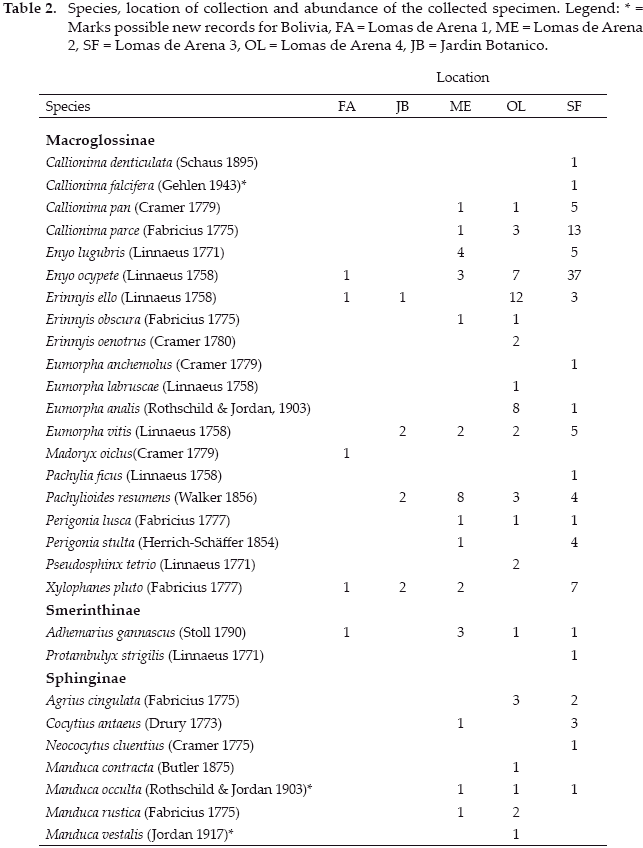
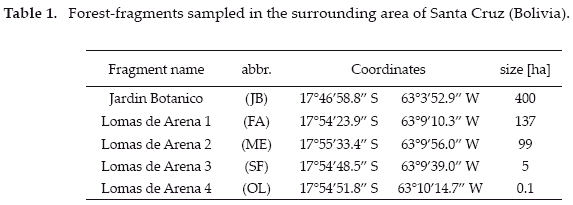
<body><![CDATA[<p align="center">&nbsp;</p>     <p align="center">&nbsp;</p> <hr noshade>     <p align="center">&nbsp;</p>     <p align="justify"><font face="Verdana" size="2">The bosque chiquitano or Chiquitano dry forest in the Department of Santa Cruz (Bolivia) is one of the main ecoregions in the Bolivian lowlands. Although many taxa of the bosque chiquitano are also present in the neighbouring ecoregions of the Gran Chaco and the southwestern Amazon, it is clearly distinguishable by its unique floral and faunal composition and geo-ecological characteristics (Ibisch &amp; Mérida 2004). Bolivia itself belongs to the countries with the highest levels of biodiversity and endemism worldwide (Ibisch &amp; Mérida 2004). Despite its huge biodiversity and unique ecosystems, Bolivia is also threatened by rapid deforestation and conversion of natural landscapes. The area around the Bolivian city of Santa Cruz is especially considered one of the world's main hotspots of deforestation with rates reaching up to 117,000 ha annually (Morales 1996, Achard <i>et al. </i>1998).</font></p>     <p align="justify"><font face="Verdana" size="2">Hawkmoths (Sphingidae) are among the best surveyed Lepidoptera worldwide (Kitching &amp; Cadiou 2000). Detailed information exists about the distribution and ranges for most species (Kitching &amp; Cadiou 2000). There are ca. 1,350 hawkmoth species worldwide distributed on all continents and island groups with the exception of Antarctica. However, the highest diversity of hawkmoth is found in tropical biomes (Kitching &amp; Cadiou 2000). Recent estimations of species richness indicate the presence of 189 species in Bolivia of which at least 111 species occur in the Department of Santa Cruz (Kitching <i>et al. </i>2001). Hawkmoths are of high importance for the ecosystem acting as pollinators but also as important agricultural pests (Kitching &amp; Cadiou 2000). The present work aims to describe the hawkmoth species richness from the bosque chiquitano's area of Santa Cruz.</font></p>     <p align="justify"><font face="Verdana" size="2">We surveyed hawkmoth species richness around Santa Cruz city (17&deg;47'01 S, 63&deg;10'57 W) in the lowlands of Bolivia; at an elevation of 420-450 m. Study sites were located in five forest fragments in and around the Parque Regional Lomas de Arena and the Jardín Botánico Santa Cruz, their sizes are indicated in <a href="#t1">Table 1</a>. The matrix around the forest fragments was mostly farmland and pasture, with slight deviations (partly experimental fields with different crops around the 137 ha forest fragment). To account for any influence of the forested area around the study sites, the forested area was measured using satellite images taken from Google Earth and georeferenced using Spatial Analyst in ESRI ARCVIEW 3.2a. This data was validated with GPS measurements from the field to ensure that satellite images reflected the conditions at the time of the study. Large tree fall gaps, fields or clearings &gt;10 m in diameter within the fragments were subtracted from the forest area.</font></p>     <p align="justify"><a name="t1"></a></p>     <p align="center"><img src="/img/revistas/reb/v48n1/a05_table_01.gif" width="573" height="205"></p>     <p align="justify"><font face="Verdana" size="2">Hawkmoths were collected with a light trap consisting of two 20 W tubular fluorescent light tubes with either two fluorescent ultraviolet or fluorescent white light tubes. Lamps were connected to a 12 V car battery powered by a car engine via a voltage converter to ensure stable voltage output. Lamps where placed 50 cm above ground and 1.5 m in front of a white cloth sheet (3x2 m). Additionally, a white cloth sheet (3 x 2 m) was placed on the ground in front of the vertical sheet. The fluorescent light tubes were placed so that most of the light was directed towards the sheets. This installation was placed at the forest edge with the white sheet facing the forest so that only the light reflected by the sheets was visible from the forest. On the side of the sheet facing away from the forest we placed the car to stabilize the trap under windy conditions and to shield the light towards the surrounding habitat matrix.</font></p>     <p align="justify"><font face="Verdana" size="2">All fragments were surveyed for six days between 18:00 h and 24:00 h, three days each using the ultraviolet and white lamps, respectively. All Sphingidae attracted to the light-trap were caught. Hawkmoths were killed using injections of 1-5 ml of 99% ethanol solution into the metathorax. Location and flight time were noted and the moths were stored for later preparation and species determination. Identifications were made with reference to illustrations and identification keys (D'Abrera 1986, Moré <i>et al. </i>2005). Nomenclature and classification follows Kitching &amp; Cadiou</font> <font face="Verdana" size="2">(2000). The species-area relationship (number of species/fragment size) was analyzed using linear regression in R 2.9.1 (R Development Core Team 2009). Total species richness was estimated using EstimateS (Colwell 2005) (<a href="#t2">Table 2</a>).</font></p>     ]]></body>
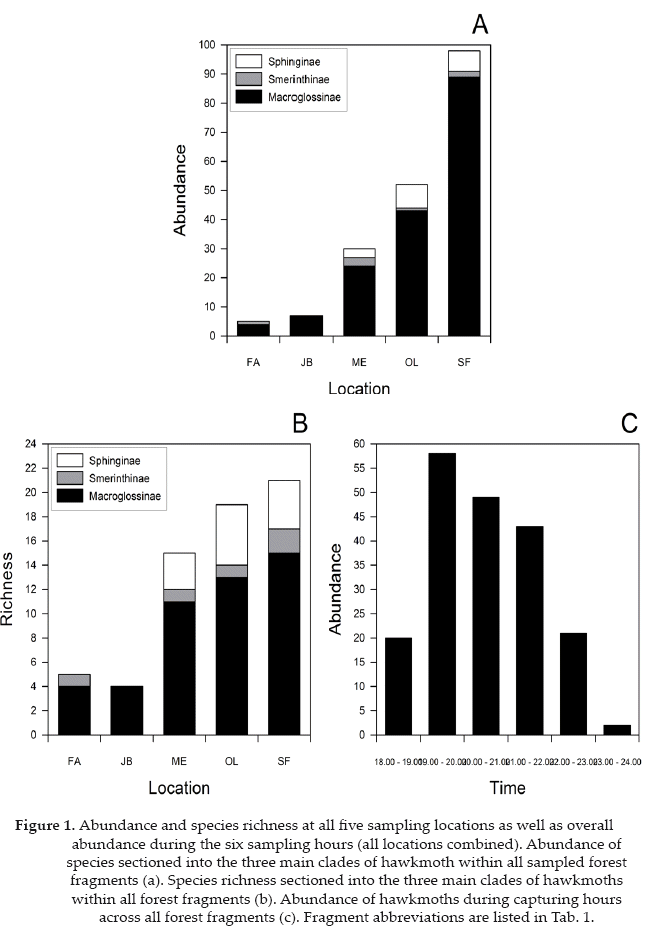
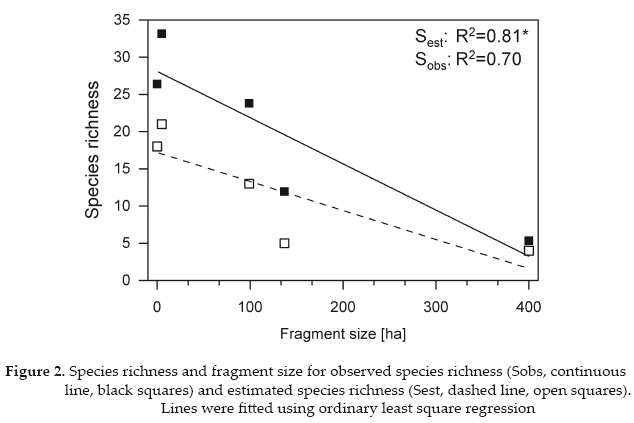
<body><![CDATA[<p align="justify"><a name="t2"></a></p>     <p align="center"><img src="/img/revistas/reb/v48n1/a05_table_02.gif" width="643" height="848"></p>     <p align="justify"><font face="Verdana" size="2">In total, we collected 194 hawkmoths belonging to 29 species and three subfamilies (<a href="#t2">Table 2</a>). The forest fragment SF showed the highest richness and abundance of Sphingidae while the forest fragment FA showed the lowest abundance and richness (<a href="#f1">Figs. 1a-b</a>). Macroglossinae formed the major subfamily of Sphingidae at all sampling sites accounting for the majority of species and individuals. Sphinginae were only present at the sampling sites ME, OL, SF while Smerinthinae were only absent at the sampling site JB.</font></p>     <p align="justify"><a name="f1"></a></p>     <p align="center"><img src="/img/revistas/reb/v48n1/a05_figure_01.gif" width="652" height="926"></p>     <p align="justify"><font face="Verdana" size="2">Most species were captured between 19:00 h and 20:00 h. Towards midnight there was a steady decline in individuals captured, with the minimum number between 23:00 h and 24:00 h (<a href="#f1">Fig. 1c</a>). Abundance of species also steadily declined from 18:00 h to 24:00 h, with the lowest amount of species flying between 23:00 h and 24:00 h.</font></p>     <p align="justify"><font face="Verdana" size="2">The number of species decreased with the area of forest around the sampling sites, although this pattern was only marginally significant (linear regression, R<sup>2</sup> 0.70, p = 0.078) (<a href="#f2">Fig. 2</a>). However, when we corrected species numbers for uneven sampling intensity between the fragments, the species richness-fragment size relationship became significant</font> <font face="Verdana" size="2">(linear regression, R<sup>2</sup> = 0.81, p = 0.038). The number of individuals strongly decreased with increasing forest area, but the relationship was not significant (linear regression, R<sup>2</sup> = 0.50, p= 0.18).</font></p>     <p align="justify"><a name="f2"></a></p>     <p align="center"><img src="/img/revistas/reb/v48n1/a05_figure_02.gif" width="634" height="423"></p>     <p align="justify"><font face="Verdana" size="2">In our rapid assessment, we were able to collect around 26% of the known 112 hawkmoth species from Santa Cruz department (Kitching <i>et al. </i>2001). This represents only a small fraction of the overall diversity of hawkmoth in the department as noted by Kitching <i>et al. </i>(2001). The low amount of species captured might be caused by the limited timeframe of the study, which did not allow us to capture hawkmoths flying during the rainy season or are more active in the mornings. Three of the species collected: <i>Callionima falcifera </i>(Gehlen 1943), <i>Manduca occulta </i>(Rothschild &amp; Jordan 1903), and <i>Manduca vestalis </i>(Jordan 1917) have not been recorded for Bolivia before (Kitching <i>et al. </i>2001). The number of hawkmoth species declined markedly from the small to the large forest fragments (<a href="#f2">Fig. 2</a>). This pattern contradicts the typically observed decline of species richness with increasing fragmentation (e.g., Klein 1989, Creighton <i>et al. </i>2009), although some other studies have also found increasing numbers for other groups than Sphingidae (e.g., hummingbirds: Stouffer &amp; Bierregaard 1995, polyphagous lepidoptera: Tscharntke <i>et al. </i>2002). Probably, these differences reflect the degree to which the studied taxon depends on forest habitats. Forest specialists, particularly if they have difficulty moving between fragments, will show negative richness-fragment size relationships, whereas species that can also or even preferentially survive in open habitats, may be favored by forest fragmentation.</font></p>     ]]></body>
<body><![CDATA[<p align="justify"><font face="Verdana" size="2">Our observations may be explained as a result of the ecology of hawkmoths. Sphingids are strong flyers that forage widely in search of food resources. Forest edges and disturbed forests tend to have a higher abundance of f lowering plants than closed forests (Linhart <i>et al. </i>1987). Accordingly, small forest fragments</font> <font face="Verdana" size="2">are likely to have more food resources for hawkmoths than large patches. Therefore, it might be the case that most of the species caught are mostly non forest species usually living in open habitats, which only forage in the forest.</font></p>     <p align="justify"><font face="Verdana" size="2">Previous studies have found limited responses of sphingids to forest degradation (Schulze &amp; Fiedler 2003, Beck <i>et al. </i>2006). Beck <i>et al. </i>(2006) concluded that species that do not feed as adults are more susceptible to forest degradation than those that feed as adults. In our study, all species recorded belong to the latter group, which may explain the observed pattern. Nevertheless, this does not explain why there are so few species within the large forest fragments. Other factors might play a role here, but due to the limited data we are currently unable to determine any ecological explanation of the observed pattern.</font></p>     <p align="justify"><font face="Verdana" size="2">We found that forest fragmentation in our study area does not lead to a reduction of hawkmoth abundances and diversity; rather, it increases in small fragments. We believe that this mainly reflects the high mobility of these large insects and the higher abundance of their food plants along forest edges and in disturbed forests. It must be borne in mind, however, that our study was limited to adults. To which degree these species depend on forest-inhabiting plants as larvae, and hence, how forest fragmentation negatively influences them, needs further investigation.</font></p>     <p align="justify">&nbsp;</p>     <p align="center"><font face="Verdana" size="2"><b>Acknowledgments</b></font></p>     <p align="justify"><font face="Verdana" size="2">We thank Steffen Reichle, Yuvinca Gareca, Caroli Hamel, Sebastian K. Herzog, Dirk Embert, and Torrey Rodgers for help with the fieldwork. The Botanical Garden of Santa Cruz de la Sierra, Dario Melgar, Fernando Mercardo Bowles, Christian Bomblat, and The Fundación Simón F. Patiño for allowing fieldwork in their premises; and Jürgen Kluge and Rodrigo W. Soria Auza for valuable comments on the manuscript.</font></p>     <p align="justify">&nbsp;</p>     <p align="center"><font face="Verdana" size="3"><b>References</b></font></p>     <!-- ref --><p align="justify"><font face="Verdana" size="2">Achard, F., Eva, H.A. Glinni, P. Mayaux, T. Richards, &amp;H. J. Stibig. 1998. Identification of deforestation hot spot areas in the humid tropics, TREES Series B, European Commission, Luxembourg.100p.</font>&nbsp;&nbsp;&nbsp;&nbsp;&nbsp;&nbsp;&nbsp;&nbsp;[&#160;<a href="javascript:void(0);" onclick="javascript: window.open('/scielo.php?script=sci_nlinks&ref=020003&pid=S1605-2528201300010000500001&lng=','','width=640,height=500,resizable=yes,scrollbars=1,menubar=yes,');">Links</a>&#160;]<!-- end-ref --><p align="justify"><font face="Verdana" size="2">Beck, J., I. Kitching &amp; K. Linsenmair. 2006. Effects of habitat disturbance can be subtle yet significant: Biodiversity of hawkmoth-assemblages (Lepidoptera: Sphingidae) in Southeast-Asia. Biodiversity and Conservation 15: 465-486.</font></p>     ]]></body>
<body><![CDATA[<!-- ref --><p align="justify"><font face="Verdana" size="2">Colwell, R. K. 2005. EstimateS, Version 7.5, statistical estimation of species richness and shared species from samples (Software and User's Guide). Freeware published at <a href="http://viceroy.eeb.uconn.edu/estimates" target="_blank">http://viceroy.eeb.uconn.edu/estimates</a></font>&nbsp;&nbsp;&nbsp;&nbsp;&nbsp;&nbsp;&nbsp;&nbsp;[&#160;<a href="javascript:void(0);" onclick="javascript: window.open('/scielo.php?script=sci_nlinks&ref=020005&pid=S1605-2528201300010000500003&lng=','','width=640,height=500,resizable=yes,scrollbars=1,menubar=yes,');">Links</a>&#160;]<!-- end-ref --><p align="justify"><font face="Verdana" size="2">Creighton, J. C., R. Bastarache, M. V. Lomolino &amp; M.C. Belk. 2009. Effect of forest removal on the abundance of the endangered American burying beetle, <i>Nicrophorus americanus </i>(Coleoptera: Silphidae). Journal of Insect Conservation 13:37-43.</font></p>     <!-- ref --><p align="justify"><font face="Verdana" size="2">D'Abrera, B. 1986. Sphingidae mundi. Hawkmoths of the world. E. W. Classey, Faringdon. 226 p.</font>&nbsp;&nbsp;&nbsp;&nbsp;&nbsp;&nbsp;&nbsp;&nbsp;[&#160;<a href="javascript:void(0);" onclick="javascript: window.open('/scielo.php?script=sci_nlinks&ref=020007&pid=S1605-2528201300010000500005&lng=','','width=640,height=500,resizable=yes,scrollbars=1,menubar=yes,');">Links</a>&#160;]<!-- end-ref --><!-- ref --><p align="justify"><font face="Verdana" size="2">Ibisch, P.L. &amp; G. Mérida (eds.) 2004. Biodiversity: the richness of Bolivia. State of knowledge and conservation. Ministry of Sustainable Development. Editorial FAN, Santa Cruz. 644 p.</font>&nbsp;&nbsp;&nbsp;&nbsp;&nbsp;&nbsp;&nbsp;&nbsp;[&#160;<a href="javascript:void(0);" onclick="javascript: window.open('/scielo.php?script=sci_nlinks&ref=020008&pid=S1605-2528201300010000500006&lng=','','width=640,height=500,resizable=yes,scrollbars=1,menubar=yes,');">Links</a>&#160;]<!-- end-ref --><p align="justify"><font face="Verdana" size="2">Klein, B .C. 1989. Effects of forest fragmentation on dung and carrion beetle communities in Central Amazonia. Ecology 70: 1715-1725.</font></p>     <p align="justify"><font face="Verdana" size="2">Kitching, I.J. &amp;J. M. Cadiou. 2000. Hawkmoths of the world: an annotated and illustrated revisionary checklist (Lepidoptera:</font> <font face="Verdana" size="2">Sphingidae). Cornell University Press, Ithaca. 227 p.</font></p>     <p align="justify"><font face="Verdana" size="2">Kitching, I. <i>J., </i>J. Ledezma &amp; J. Baixeras. 2001. The Sphingidae of Bolivia (Insecta: Lepidoptera). Gayana (Concepción) 65: 79-111.</font></p>     <p align="justify"><font face="Verdana" size="2">Linhart, Y., P. Feinsinger, J. Beach, W. Busby, K. Murray, W. Pounds, S. Kinshman, C. Guindon, &amp; M. Kooiman. 1987. Disturbance and predictability of flowering patterns in bird-pollinated cloud forest plants. Ecology 68: 1696-1710.</font></p>     <!-- ref --><p align="justify"><font face="Verdana" size="2">Morales, I. 1996. Memoria explicativa del monitoreo preliminar del desbosque en el Departamento de Santa Cruz. CORDECRUZ, Santa Cruz.100 p.</font>&nbsp;&nbsp;&nbsp;&nbsp;&nbsp;&nbsp;&nbsp;&nbsp;[&#160;<a href="javascript:void(0);" onclick="javascript: window.open('/scielo.php?script=sci_nlinks&ref=020013&pid=S1605-2528201300010000500011&lng=','','width=640,height=500,resizable=yes,scrollbars=1,menubar=yes,');">Links</a>&#160;]<!-- end-ref --><!-- ref --><p align="justify"><font face="Verdana" size="2">Moré, M., I.J. Kitching &amp; A. Cocucci.2005. Sphingidae: Esfíngidos de Argentina. Hawkmoths of Argentina.L.O.L.A. (Literature of Latin America), Buenos Aires, 166 p.</font>&nbsp;&nbsp;&nbsp;&nbsp;&nbsp;&nbsp;&nbsp;&nbsp;[&#160;<a href="javascript:void(0);" onclick="javascript: window.open('/scielo.php?script=sci_nlinks&ref=020014&pid=S1605-2528201300010000500012&lng=','','width=640,height=500,resizable=yes,scrollbars=1,menubar=yes,');">Links</a>&#160;]<!-- end-ref --><!-- ref --><p align="justify"><font face="Verdana" size="2">R Development Core Team, 2008. R: A language and environment for statistical computing. R Foundation for Statistical Computing. Vienna, Austria. <a href="http://www.R-project.org" target="_blank">http://www.R-project.org</a></font>&nbsp;&nbsp;&nbsp;&nbsp;&nbsp;&nbsp;&nbsp;&nbsp;[&#160;<a href="javascript:void(0);" onclick="javascript: window.open('/scielo.php?script=sci_nlinks&ref=020015&pid=S1605-2528201300010000500013&lng=','','width=640,height=500,resizable=yes,scrollbars=1,menubar=yes,');">Links</a>&#160;]<!-- end-ref --><p align="justify"><font face="Verdana" size="2">Schulze, C. &amp;K. Fiedler. 2003. Hawkmoth diversity in northern Borneo does not reflect the influence of anthropogenic habitat disturbance. Ecotropica 9:99-102.</font></p>     <p align="justify"><font face="Verdana" size="2">Stouffer, P. &amp; R. Bierregaard. 1995. Effects of forest fragmentation on understory hummingbirds in Amazonian Brazil. Conservation Biology 9:1085-1094.</font></p>     <p align="justify"><font face="Verdana" size="2">Tscharntke, T., I. Steff an-Dewenter, A. Kruess&amp; C. Thies. 2002. Characteristics of insect populations on habitat fragments:Amini review. Ecological Research 17:229-239.</font></p>     <p align="justify">&nbsp;</p>     <p align="justify"><font face="Verdana" size="2"><b>Nota recibida en:</b> Noviembre de 2012.     <br>   <b> Manejada por:</b> Diana Silva.     <br>   <b>Aceptada en:</b> Enero de 2013.</font></p>     <p align="justify">&nbsp;</p>      ]]></body><back>
<ref-list>
<ref id="B1">
<nlm-citation citation-type="book">
<person-group person-group-type="author">
<name>
<surname><![CDATA[Achard]]></surname>
<given-names><![CDATA[F.]]></given-names>
</name>
<name>
<surname><![CDATA[Eva]]></surname>
<given-names><![CDATA[H.A.]]></given-names>
</name>
<name>
<surname><![CDATA[Glinni]]></surname>
<given-names><![CDATA[P.]]></given-names>
</name>
<name>
<surname><![CDATA[Mayaux]]></surname>
<given-names><![CDATA[T. Richards]]></given-names>
</name>
<name>
<surname><![CDATA[Stibig]]></surname>
<given-names><![CDATA[H. J.]]></given-names>
</name>
</person-group>
<source><![CDATA[Identification of deforestation hot spot areas in the humid tropics]]></source>
<year>1998</year>
<page-range>100</page-range><publisher-loc><![CDATA[Luxembourg ]]></publisher-loc>
<publisher-name><![CDATA[European Commission]]></publisher-name>
</nlm-citation>
</ref>
<ref id="B2">
<nlm-citation citation-type="journal">
<person-group person-group-type="author">
<name>
<surname><![CDATA[Beck]]></surname>
<given-names><![CDATA[J.]]></given-names>
</name>
<name>
<surname><![CDATA[Kitching]]></surname>
<given-names><![CDATA[I.]]></given-names>
</name>
<name>
<surname><![CDATA[Linsenmair]]></surname>
<given-names><![CDATA[K.]]></given-names>
</name>
</person-group>
<article-title xml:lang="en"><![CDATA[Effects of habitat disturbance can be subtle yet significant: Biodiversity of hawkmoth-assemblages (Lepidoptera: Sphingidae) in Southeast-Asia]]></article-title>
<source><![CDATA[Biodiversity and Conservation]]></source>
<year>2006</year>
<numero>15</numero>
<issue>15</issue>
<page-range>465-486</page-range></nlm-citation>
</ref>
<ref id="B3">
<nlm-citation citation-type="">
<person-group person-group-type="author">
<name>
<surname><![CDATA[Colwell]]></surname>
<given-names><![CDATA[R. K.]]></given-names>
</name>
</person-group>
<source><![CDATA[EstimateS, Version 7.5, statistical estimation of species richness and shared species from samples (Software and User's Guide)]]></source>
<year>2005</year>
</nlm-citation>
</ref>
<ref id="B4">
<nlm-citation citation-type="journal">
<person-group person-group-type="author">
<name>
<surname><![CDATA[Creighton]]></surname>
<given-names><![CDATA[J.C.]]></given-names>
</name>
<name>
<surname><![CDATA[Bastarache]]></surname>
<given-names><![CDATA[R.]]></given-names>
</name>
<name>
<surname><![CDATA[Lomolino]]></surname>
<given-names><![CDATA[M.V.]]></given-names>
</name>
<name>
<surname><![CDATA[Belk.]]></surname>
<given-names><![CDATA[M.C.]]></given-names>
</name>
</person-group>
<article-title xml:lang="en"><![CDATA[Effect of forest removal on the abundance of the endangered American burying beetle_c Nicrophorus americanus (Coleoptera: Silphidae)]]></article-title>
<source><![CDATA[Journal of Insect Conservation]]></source>
<year>2009</year>
<numero>13</numero>
<issue>13</issue>
<page-range>37-43</page-range></nlm-citation>
</ref>
<ref id="B5">
<nlm-citation citation-type="book">
<person-group person-group-type="author">
<name>
<surname><![CDATA[D'Abrera]]></surname>
<given-names><![CDATA[B.]]></given-names>
</name>
</person-group>
<source><![CDATA[Sphingidae mundi. Hawkmoths of the world]]></source>
<year>1986</year>
<page-range>226</page-range><publisher-name><![CDATA[Faringdon]]></publisher-name>
</nlm-citation>
</ref>
<ref id="B6">
<nlm-citation citation-type="book">
<person-group person-group-type="author">
<name>
<surname><![CDATA[Ibisch]]></surname>
<given-names><![CDATA[P.L.]]></given-names>
</name>
<name>
<surname><![CDATA[Mérida]]></surname>
<given-names><![CDATA[G.]]></given-names>
</name>
</person-group>
<source><![CDATA[Biodiversity: the richness of Bolivia. State of knowledge and conservation]]></source>
<year>2004</year>
<page-range>644</page-range><publisher-loc><![CDATA[Santa Cruz ]]></publisher-loc>
<publisher-name><![CDATA[Ministry of Sustainable Development. Editorial FAN]]></publisher-name>
</nlm-citation>
</ref>
<ref id="B7">
<nlm-citation citation-type="journal">
<person-group person-group-type="author">
<name>
<surname><![CDATA[Klein]]></surname>
<given-names><![CDATA[B.C.]]></given-names>
</name>
</person-group>
<article-title xml:lang="en"><![CDATA[Effects of forest fragmentation on dung and carrion beetle communities in Central Amazonia]]></article-title>
<source><![CDATA[Ecology]]></source>
<year>1989</year>
<numero>70</numero>
<issue>70</issue>
<page-range>1715-1725</page-range></nlm-citation>
</ref>
<ref id="B8">
<nlm-citation citation-type="book">
<person-group person-group-type="author">
<name>
<surname><![CDATA[Kitching]]></surname>
<given-names><![CDATA[I.J.]]></given-names>
</name>
<name>
<surname><![CDATA[Cadiou]]></surname>
<given-names><![CDATA[J.M.]]></given-names>
</name>
</person-group>
<source><![CDATA[Hawkmoths of the world: an annotated and illustrated revisionary checklist (Lepidoptera: Sphingidae)]]></source>
<year>2000</year>
<page-range>227</page-range><publisher-loc><![CDATA[Ithaca ]]></publisher-loc>
<publisher-name><![CDATA[Cornell University Press]]></publisher-name>
</nlm-citation>
</ref>
<ref id="B9">
<nlm-citation citation-type="journal">
<person-group person-group-type="author">
<name>
<surname><![CDATA[Kitching]]></surname>
<given-names><![CDATA[I.J.]]></given-names>
</name>
<name>
<surname><![CDATA[Ledezma]]></surname>
<given-names><![CDATA[J.]]></given-names>
</name>
<name>
<surname><![CDATA[Baixeras]]></surname>
<given-names><![CDATA[J.]]></given-names>
</name>
</person-group>
<article-title xml:lang="en"><![CDATA[The Sphingidae of Bolivia (Insecta: Lepidoptera)]]></article-title>
<source><![CDATA[Gayana (Concepción)]]></source>
<year>2001</year>
<numero>65</numero>
<issue>65</issue>
<page-range>79-111</page-range></nlm-citation>
</ref>
<ref id="B10">
<nlm-citation citation-type="journal">
<person-group person-group-type="author">
<name>
<surname><![CDATA[Linhart]]></surname>
<given-names><![CDATA[Y.]]></given-names>
</name>
<name>
<surname><![CDATA[Feinsinger]]></surname>
<given-names><![CDATA[P.]]></given-names>
</name>
<name>
<surname><![CDATA[Beach]]></surname>
<given-names><![CDATA[J.]]></given-names>
</name>
<name>
<surname><![CDATA[Busby]]></surname>
<given-names><![CDATA[W.]]></given-names>
</name>
<name>
<surname><![CDATA[Murray]]></surname>
<given-names><![CDATA[K.]]></given-names>
</name>
<name>
<surname><![CDATA[Pounds]]></surname>
<given-names><![CDATA[W.]]></given-names>
</name>
<name>
<surname><![CDATA[Kinshman]]></surname>
<given-names><![CDATA[S.]]></given-names>
</name>
<name>
<surname><![CDATA[Guindon]]></surname>
<given-names><![CDATA[C.]]></given-names>
</name>
<name>
<surname><![CDATA[Kooiman]]></surname>
<given-names><![CDATA[M.]]></given-names>
</name>
</person-group>
<article-title xml:lang="en"><![CDATA[Disturbance and predictability of flowering patterns in bird-pollinated cloud forest plants]]></article-title>
<source><![CDATA[Ecology]]></source>
<year>1987</year>
<numero>68</numero>
<issue>68</issue>
<page-range>1696-1710</page-range></nlm-citation>
</ref>
<ref id="B11">
<nlm-citation citation-type="book">
<person-group person-group-type="author">
<name>
<surname><![CDATA[Morales]]></surname>
<given-names><![CDATA[I.]]></given-names>
</name>
</person-group>
<source><![CDATA[Memoria explicativa del monitoreo preliminar del desbosque en el Departamento de Santa Cruz]]></source>
<year>1996</year>
<page-range>100</page-range><publisher-loc><![CDATA[Santa Cruz ]]></publisher-loc>
<publisher-name><![CDATA[CORDECRUZ]]></publisher-name>
</nlm-citation>
</ref>
<ref id="B12">
<nlm-citation citation-type="">
<person-group person-group-type="author">
<name>
<surname><![CDATA[Moré]]></surname>
<given-names><![CDATA[M.]]></given-names>
</name>
<name>
<surname><![CDATA[Kitching]]></surname>
<given-names><![CDATA[I.J.]]></given-names>
</name>
<name>
<surname><![CDATA[Cocucci]]></surname>
<given-names><![CDATA[A.]]></given-names>
</name>
</person-group>
<source><![CDATA[Sphingidae: Esfíngidos de Argentina]]></source>
<year>2005</year>
<page-range>166</page-range><publisher-loc><![CDATA[Buenos Aires ]]></publisher-loc>
</nlm-citation>
</ref>
<ref id="B13">
<nlm-citation citation-type="book">
<collab>R Development Core Team</collab>
<source><![CDATA[R: A language and environment for statistical computing]]></source>
<year>2008</year>
<publisher-loc><![CDATA[Vienna ]]></publisher-loc>
<publisher-name><![CDATA[R Foundation for Statistical Computing]]></publisher-name>
</nlm-citation>
</ref>
<ref id="B14">
<nlm-citation citation-type="journal">
<person-group person-group-type="author">
<name>
<surname><![CDATA[Schulze]]></surname>
<given-names><![CDATA[C.]]></given-names>
</name>
<name>
<surname><![CDATA[Fiedler]]></surname>
<given-names><![CDATA[K.]]></given-names>
</name>
</person-group>
<article-title xml:lang="en"><![CDATA[Hawkmoth diversity in northern Borneo does not reflect the influence of anthropogenic habitat disturbance]]></article-title>
<source><![CDATA[Ecotropica]]></source>
<year>2003</year>
<numero>9</numero>
<issue>9</issue>
<page-range>99-102</page-range></nlm-citation>
</ref>
<ref id="B15">
<nlm-citation citation-type="journal">
<person-group person-group-type="author">
<name>
<surname><![CDATA[Stouffer]]></surname>
<given-names><![CDATA[P.]]></given-names>
</name>
<name>
<surname><![CDATA[Bierregaard]]></surname>
<given-names><![CDATA[R.]]></given-names>
</name>
</person-group>
<article-title xml:lang="en"><![CDATA[Effects of forest fragmentation on understory hummingbirds in Amazonian Brazil]]></article-title>
<source><![CDATA[Conservation Biology]]></source>
<year>1995</year>
<numero>9</numero>
<issue>9</issue>
<page-range>1085-1094</page-range></nlm-citation>
</ref>
<ref id="B16">
<nlm-citation citation-type="journal">
<person-group person-group-type="author">
<name>
<surname><![CDATA[Tscharntke]]></surname>
<given-names><![CDATA[T.]]></given-names>
</name>
<name>
<surname><![CDATA[Steffan-Dewenter]]></surname>
<given-names><![CDATA[I.]]></given-names>
</name>
<name>
<surname><![CDATA[Kruess]]></surname>
<given-names><![CDATA[A.]]></given-names>
</name>
<name>
<surname><![CDATA[Thies]]></surname>
<given-names><![CDATA[C.]]></given-names>
</name>
</person-group>
<article-title xml:lang="en"><![CDATA[Characteristics of insect populations on habitat fragments: Amini review]]></article-title>
<source><![CDATA[Ecological Research]]></source>
<year>2002</year>
<numero>17</numero>
<issue>17</issue>
<page-range>229-239</page-range></nlm-citation>
</ref>
</ref-list>
</back>
</article>