<?xml version="1.0" encoding="ISO-8859-1"?><article xmlns:mml="http://www.w3.org/1998/Math/MathML" xmlns:xlink="http://www.w3.org/1999/xlink" xmlns:xsi="http://www.w3.org/2001/XMLSchema-instance">
<front>
<journal-meta>
<journal-id>1605-2528</journal-id>
<journal-title><![CDATA[Ecología en Bolivia]]></journal-title>
<abbrev-journal-title><![CDATA[Ecología en Bolivia]]></abbrev-journal-title>
<issn>1605-2528</issn>
<publisher>
<publisher-name><![CDATA[Plural Editores ]]></publisher-name>
</publisher>
</journal-meta>
<article-meta>
<article-id>S1605-25282013000100003</article-id>
<title-group>
<article-title xml:lang="en"><![CDATA[Ranging patterns by the red-footed tortoise - Geochelone carbonaria (Testudines: Testudinidae) - in the Bolivian Chaco]]></article-title>
<article-title xml:lang="es"><![CDATA[Patrones de desplazamiento de la peta negra - Geochelone carbonaria (Testudines: Testudinidae) - en el Chaco boliviano]]></article-title>
</title-group>
<contrib-group>
<contrib contrib-type="author">
<name>
<surname><![CDATA[Montaño F.]]></surname>
<given-names><![CDATA[Rossy R.]]></given-names>
</name>
<xref ref-type="aff" rid="A01"/>
</contrib>
<contrib contrib-type="author">
<name>
<surname><![CDATA[Cuéllar]]></surname>
<given-names><![CDATA[Erika]]></given-names>
</name>
<xref ref-type="aff" rid="A02"/>
</contrib>
<contrib contrib-type="author">
<name>
<surname><![CDATA[Fitzgerald]]></surname>
<given-names><![CDATA[Lee A.]]></given-names>
</name>
<xref ref-type="aff" rid="A03"/>
</contrib>
<contrib contrib-type="author">
<name>
<surname><![CDATA[Soria]]></surname>
<given-names><![CDATA[Filemón]]></given-names>
</name>
<xref ref-type="aff" rid="A04"/>
</contrib>
<contrib contrib-type="author">
<name>
<surname><![CDATA[Mendoza]]></surname>
<given-names><![CDATA[Florencio]]></given-names>
</name>
<xref ref-type="aff" rid="A04"/>
</contrib>
<contrib contrib-type="author">
<name>
<surname><![CDATA[Peña]]></surname>
<given-names><![CDATA[Romoaldo]]></given-names>
</name>
<xref ref-type="aff" rid="A04"/>
</contrib>
<contrib contrib-type="author">
<name>
<surname><![CDATA[Dosapey]]></surname>
<given-names><![CDATA[Telmo]]></given-names>
</name>
<xref ref-type="aff" rid="A04"/>
</contrib>
<contrib contrib-type="author">
<name>
<surname><![CDATA[Deem]]></surname>
<given-names><![CDATA[Sharon L.]]></given-names>
</name>
<xref ref-type="aff" rid="A05"/>
</contrib>
<contrib contrib-type="author">
<name>
<surname><![CDATA[Noss]]></surname>
<given-names><![CDATA[Andrew J.]]></given-names>
</name>
<xref ref-type="aff" rid="A06"/>
</contrib>
</contrib-group>
<aff id="A01">
<institution><![CDATA[,Universidad Autónoma Gabriel René Moreno Museo de Historia Natural Noel Kempff Mercado ]]></institution>
<addr-line><![CDATA[Santa Cruz ]]></addr-line>
<country>Bolivia</country>
</aff>
<aff id="A02">
<institution><![CDATA[,Zoology Wildlife Conservation Research Unit ]]></institution>
<addr-line><![CDATA[Oxford ]]></addr-line>
<country>England</country>
</aff>
<aff id="A03">
<institution><![CDATA[,Texas A& M University Department of Wildlife and Fisheries Sciences ]]></institution>
<addr-line><![CDATA[Texas ]]></addr-line>
<country>USA</country>
</aff>
<aff id="A04">
<institution><![CDATA[,Capitanía de Alto y Bajo Isoso  ]]></institution>
<addr-line><![CDATA[Santa Cruz ]]></addr-line>
<country>Bolivia</country>
</aff>
<aff id="A05">
<institution><![CDATA[,Institute for Conservation Medicine  ]]></institution>
<addr-line><![CDATA[Saint Louis Missouri]]></addr-line>
<country>USA</country>
</aff>
<aff id="A06">
<institution><![CDATA[,University of Florida Department of Geography ]]></institution>
<addr-line><![CDATA[Gainesville FL]]></addr-line>
</aff>
<pub-date pub-type="pub">
<day>00</day>
<month>04</month>
<year>2013</year>
</pub-date>
<pub-date pub-type="epub">
<day>00</day>
<month>04</month>
<year>2013</year>
</pub-date>
<volume>48</volume>
<numero>1</numero>
<fpage>17</fpage>
<lpage>30</lpage>
<copyright-statement/>
<copyright-year/>
<self-uri xlink:href="http://www.scielo.org.bo/scielo.php?script=sci_arttext&amp;pid=S1605-25282013000100003&amp;lng=en&amp;nrm=iso"></self-uri><self-uri xlink:href="http://www.scielo.org.bo/scielo.php?script=sci_abstract&amp;pid=S1605-25282013000100003&amp;lng=en&amp;nrm=iso"></self-uri><self-uri xlink:href="http://www.scielo.org.bo/scielo.php?script=sci_pdf&amp;pid=S1605-25282013000100003&amp;lng=en&amp;nrm=iso"></self-uri><abstract abstract-type="short" xml:lang="en"><p><![CDATA[In the Bolivian Chaco, the tortoise Geochelone carbonaria is an important reptile to indigenous people for subsistence purposes and in traditional medicine. In Bolivia the species is considered near threatened, while observations suggest it is less abundant near communities and cattle ranches. However, understanding of its biology and ecology is limited. As part of a landscape conservation program with indigenous land and wildlife management, this article describes research on ranging patterns for the species at two long-term research camps in the Kaa-Iya del Gran Chaco National Park. The principal research method is radio-telemetry with 15 individuals over a two-year period. The tortoises occupy home ranges of 50-600 ha, with males using ranges three times larger than females. Individual home ranges overlap, up to 96% between pairs of monitored individuals, with multiple individual ranges overlapping simultaneously, while many males and females shift their ranges between wet and dry seasons. The relatively large ranges for an animal of this size in the Chaco, combined with shifting ranges across seasons, even in protected areas, means that conservation of red-footed tortoises within human-impacted landscapes will require provision of key resources that include appropriate food, water, and shelter where these become scarce. Alternatively, indigenous territories and ranches will need to set aside communal and private reserves exceeding 1,000 ha in order to maintain tortoise populations on their lands.]]></p></abstract>
<abstract abstract-type="short" xml:lang="es"><p><![CDATA[En la región del Chaco boliviano la tortuga negra Geochelone carbonaria es un reptil importante para los pueblos indígenas por motivos de subsistencia y medicina tradicional. Sin embargo, el conocimiento de aspectos biológicos y ecológicos es muy pobre. El presente artículo describe áreas de acción para la especie en dos campamentos de investigación a largo plazo del Parque Nacional Kaa-Iya del Gran Chaco. El método principal empleado ha sido la radio-telemetría en quince individuos durante dos años. Las tortugas ocuparon áreas de acción de 50-600 ha, con territorios ocupados por machos unas tres veces más grandes que los territorios ocupados por hembras. Existe solapamiento territorial entre individuos de ambos sexos, hasta 96% entre individuos observados, con múltiples individuos solapados entre sí, y tanto machos como hembras desplazan sus áreas de acción entre épocas seca y húmeda. Las áreas de acción relativamente grandes para un animal de este tamaño en el Chaco, en combinación con cambios de áreas de acción entre época seca y húmeda, inclusive dentro de áreas protegidas, indica que la conservación de la tortuga negra en paisajes impactados por humanos requerirá de la provisión de recursos claves como son alimentos, agua y refugios adecuados cuando estos mismos escaseen. Como alternativa, los territorios indígenas y las propiedades ganaderas deberán resguardar reservas comunales y privadas superando las 1.000 ha para poder mantener poblaciones de tortugas en sus tierras.]]></p></abstract>
<kwd-group>
<kwd lng="en"><![CDATA[Bolivia]]></kwd>
<kwd lng="en"><![CDATA[Home Range]]></kwd>
<kwd lng="en"><![CDATA[Kaa-Iya]]></kwd>
<kwd lng="en"><![CDATA[Radio-Telemetry]]></kwd>
<kwd lng="en"><![CDATA[Reptiles]]></kwd>
<kwd lng="en"><![CDATA[Seasonal]]></kwd>
<kwd lng="es"><![CDATA[Área de acción]]></kwd>
<kwd lng="es"><![CDATA[Bolivia]]></kwd>
<kwd lng="es"><![CDATA[Estacional]]></kwd>
<kwd lng="es"><![CDATA[Kaa-Iya]]></kwd>
<kwd lng="es"><![CDATA[Radio-telemetría]]></kwd>
<kwd lng="es"><![CDATA[Reptiles]]></kwd>
</kwd-group>
</article-meta>
</front><body><![CDATA[ <p align="center">&nbsp;</p>     <p align="center">&nbsp;</p>     <p align="center"><font face="Verdana" size="4"><b>Ranging patterns by the red-footed tortoise - <i>Geochelone carbonaria </i>(Testudines: Testudinidae) - in the Bolivian Chaco</b></font></p>     <p align="center">&nbsp;</p>     <p align="center"><font face="Verdana" size="3"><b>Patrones de desplazamiento de la peta negra - <i>Geochelone carbonaria </i>(Testudines: Testudinidae) - en el Chaco boliviano</b></font></p>     <p align="center">&nbsp;</p>     <p align="center">&nbsp;</p>     <p align="center"><font face="Verdana" size="2"><b>Rossy R. Montaño F.<sup>1</sup>, Erika Cuéllar<sup>2</sup>, Lee A. Fitzgerald<sup>3</sup>, Filemón Soria<sup>4</sup>, Florencio Mendoza<sup>4</sup>, Romoaldo Peña<sup>4</sup>, Telmo Dosapey<sup>4</sup>, Sharon L. Deem<sup>5</sup> &amp; Andrew J. Noss*<sup>6</sup></b></font></p>     <p align="center"><font face="Verdana" size="3"><sup>1 </sup></font><font face="Verdana" size="2">Museo de Historia Natural Noel Kempff Mercado, Universidad Autónoma Gabriel René Moreno,</font> <font face="Verdana" size="2">Casilla 2489, Santa Cruz, Bolivia, <a href="mailto:rovina7@yahoo.com">rovina7@yahoo.com</a> <sup>    <br> 2</sup>Wildlife Conservation Research Unit, Zoology, University of Oxford, England,</font> <font face="Verdana" size="2"><a href="mailto:erika.cuellar71@gmail.com">erika.cuellar71@gmail.com</a>    ]]></body>
<body><![CDATA[<br> <sup>3</sup>Department of Wildlife and Fisheries Sciences, Texas A&amp;M University,</font> <font face="Verdana" size="2">College Station, Texas, USA, <a href="mailto:lfitzgerald@tamu.edu">lfitzgerald@tamu.edu</a></font>    <br> <font face="Verdana" size="2"><sup>4</sup>Capitanía de Alto y Bajo Isoso, Casilla 3108, Santa Cruz, Bolivia</font>    <br> <font face="Verdana" size="2"><sup>5</sup>Institute for Conservation Medicine, Saint Louis Zoo, One Government Drive,</font> <font face="Verdana" size="2">Saint Louis, Missouri, USA, <a href="mailto:deem@stlzoo.org">deem@stlzoo.org</a></font>    <br> <font face="Verdana" size="2">*<sup>6</sup>Corresponding author: University of Florida, Department of Geography, P.O. Box 117315, Gainesville, FL 32611, 352-338-9016, <a href="mailto:anoss@ufl.edu">anoss@ufl.edu</a></font></p>     <p align="center">&nbsp;</p>     <p align="center">&nbsp;</p> <hr noshade>     <p align="center"><font face="Verdana" size="2"><b>Abstract</b></font></p>     <p align="justify"><font face="Verdana" size="2">In the Bolivian Chaco, the tortoise <i>Geochelone carbonaria </i>is an important reptile to indigenous people for subsistence purposes and in traditional medicine. In Bolivia the species is considered near threatened, while observations suggest it is less abundant near communities and cattle ranches. However, understanding of its biology and ecology is limited. As part of a landscape conservation program with indigenous land and wildlife management, this article describes research on ranging patterns for the species at two long-term research camps in the Kaa-Iya del Gran Chaco National Park. The principal research method is radio-telemetry with 15 individuals over a two-year period. The tortoises occupy home ranges of 50-600 ha, with males using ranges three times larger than females. Individual home ranges overlap, up to 96% between pairs of monitored individuals, with multiple individual ranges overlapping simultaneously, while many males and females shift their ranges between wet and dry seasons. The relatively large ranges for an animal of this size in the Chaco, combined with shifting ranges across seasons, even in protected areas, means that conservation of red-footed tortoises within human-impacted landscapes will require provision of key resources that include appropriate food, water, and shelter where these become scarce. Alternatively, indigenous territories and ranches will need to set aside communal and private reserves exceeding 1,000 ha in order to maintain tortoise populations on their lands. </font></p>     <p align="justify"><font face="Verdana" size="2"><b>Key words:</b> Bolivia, Home Range, Kaa-Iya, Radio-Telemetry, Reptiles, Seasonal.</font></p> <hr noshade>     <p align="center"><font face="Verdana" size="2"><b>Resumen</b></font></p>     ]]></body>
<body><![CDATA[<p align="justify"><font face="Verdana" size="2">En la región del Chaco boliviano la tortuga negra <i>Geochelone carbonaria </i>es un reptil importante para los pueblos indígenas por motivos de subsistencia y medicina tradicional. Sin embargo, el conocimiento de aspectos biológicos y ecológicos es muy pobre. El presente artículo describe áreas</font> <font face="Verdana" size="2">de acción para la especie en dos campamentos de investigación a largo plazo del Parque Nacional Kaa-Iya del Gran Chaco. El método principal empleado ha sido la radio-telemetría en quince individuos durante dos años. Las tortugas ocuparon áreas de acción de 50-600 ha, con territorios ocupados por machos unas tres veces más grandes que los territorios ocupados por hembras. Existe solapamiento territorial entre individuos de ambos sexos, hasta 96% entre individuos observados, con múltiples individuos solapados entre sí, y tanto machos como hembras desplazan sus áreas de acción entre épocas seca y húmeda. Las áreas de acción relativamente grandes para un animal de este tamaño en el Chaco, en combinación con cambios de áreas de acción entre época seca y húmeda, inclusive dentro de áreas protegidas, indica que la conservación de la tortuga negra en paisajes impactados por humanos requerirá de la provisión de recursos claves como son alimentos, agua y refugios adecuados cuando estos mismos escaseen. Como alternativa, los territorios indígenas y las propiedades ganaderas deberán resguardar reservas comunales y privadas superando las 1.000 ha para poder mantener poblaciones de tortugas en sus tierras. </font></p>     <p align="justify"><font face="Verdana" size="2"><b>Palabras clave:</b> Área de acción, Bolivia, Estacional, Kaa-Iya, Radio-telemetría, Reptiles.</font></p> <hr noshade>     <p align="justify">&nbsp;</p>     <p align="justify">&nbsp;</p>     <p align="center"><font face="Verdana" size="3"><b>Introduction</b></font></p>     <p align="justify"><font face="Verdana" size="2">Tortoises worldwide are under threat from a variety of human pressures, for example hunting for meat or eggs by humans, or by their domestic and feral animals; the pet trade; habitat loss and habitat fragmentation; pollution; disease; among others (Buhlmann <i>et al. </i>2009, Rhodin <i>et al. </i>2011). Efforts to manage and conserve tortoises therefore require baseline information on the status of tortoise species across their geographic distribution (Swann <i>et al. </i>2002, Smith <i>et al. </i>2009, Stober &amp; Smith 2010). Ranging behavior can provide information about habitat use: activity, energy balance, resource availability, opportunities for reproduction and social interaction (Nagy &amp; Medica 1986, Moskovits &amp; Kiester 1987, O'Connor <i>et al. </i>1994, Averill-Murray <i>et al. </i>2002). </font></p>     <p align="justify"><font face="Verdana" size="2">The study was part of a larger project to promote indigenous community management of indigenous lands and protected areas in the Bolivian Chaco. The red-footed tortoise <i>Geochelone carbonaria </i>Spix 1824 (Testudines: Testudinidae) is reported as a game species for subsistence and commercial hunters in Venezuela (Aponte <i>et al. </i>2003) and Brazil (Peres 2000, Pezzuti <i>et al. </i>2010). In the Bolivian Chaco, it is an important subsistence resource for the Ayoreo indigenous people (Ayala 1997, Etacore</font> <font face="Verdana" size="2"><i>et al. </i>2000), and its fat is used in traditional medicine by the Isoseño-Guaraní indigenous people (Cuéllar 2000 a, b, Soria &amp; Noss 2000). Preliminary observations and interviews in the Kaa-Iya landscape suggested the species to be much more abundant in protected areas free of hunting and livestock pressure, despite assertions by local Isoseño-Guaraní residents that they did not consume its meat. The species is considered to be near threatened in Bolivia (Cortéz &amp; Rey-Ortíz 2009). It is also important as a prey item for jaguars <i>Panthera onca—a </i>flagship species for the Kaa-Iya landscape—in this region (L. Maffei, 2002, pers. com.) and as a seed disperser (Moskovits &amp; Bjorndal 1990, Strong &amp; Fragoso 2006, Wang <i>et al. </i>2011).</font></p>     <p align="justify"><font face="Verdana" size="2">The few field studies on this species have focused on reproduction, diet, seed dispersal, ranging behavior and abundance. Most research has concentrated in humid Amazonian forests (Medemet <i>al. </i>1979, Moskovits 1985, Moskovits &amp; Kiester 1987, Moskovits 1988, Bjorndal 1989, Moskovits &amp; Bjorndal 1990, Strong &amp; Fragoso 2006), with only one study in seasonally f looded Pantanal savanna (Wang <i>et al. </i>2011) and one in dry forest (Aponte <i>et al. </i>2003). The Gran Chaco dry forest represents the southern distribution limit for <i>Geochelone carbonaria, </i>where it faces the most extreme climatic conditions in terms of winter cold and seasonal drought. We therefore</font> <font face="Verdana" size="2">evaluated ranging patterns at the protected sites in order to promote conservation measures for the species on indigenous and private ranch lands. This study is the first to report ranging behavior at two widely separated sites in the Gran Chaco ecoregion, based on radio-telemetry tracking. A complementary paper reports on activity patterns and burrow use (Noss et al. in press).</font></p>     <p align="justify">&nbsp;</p>     <p align="center"><font face="Verdana" size="3"><b>Study area</b></font></p>     ]]></body>
<body><![CDATA[<p align="justify"><font face="Verdana" size="2">The Kaa-Iya del Gran Chaco National Park covers 34,400 km<sup>2</sup> in eastern Santa Cruz Department (<a href="#f1">Fig. 1</a>). This is the most diverse and best-conserved portion of the Gran Chaco ecoregion (Taber <i>et al. </i>1996), with over 50 reptile species recorded including four chelonians:</font> <font face="Verdana" size="2"><i>Geochelone carbonaria, G. chilensis, Kinosternon scorpioides </i>and <i>Acanthochelys macrochephala</i></font><font face="Verdana" size="2"><i> </i></font><font face="Verdana" size="2">(Gonzáles 1998, 2001). Of these four, G. <i>carbonaria </i>is by far the most abundant and widely distributed across the Kaa-Iya National Park (Montaño 2003, Gonzáles &amp; Montaño 2007, Montaño &amp; Gonzáles 2007, 2008).</font></p>     <p align="justify"><a name="f1"></a></p>     <p align="center"><img src="/img/revistas/reb/v48n1/a03_figure_01.gif" width="630" height="473"></p>     <p align="justify"><font face="Verdana" size="2">We established the Cerro Cortado field camp (19&deg;31'35&quot; S, 62&deg;18'34&quot; W) in 1997 on the boundary between the Kaa-Iya del Gran Chaco National Park and the neighboring Isoso TCO (indigenous territory). We established Ravelo field camp (19&deg;17'43&quot; S, 60&deg;31'10&quot; W) in 2000 in the southeastern portion of the Kaa-Iya National Park, near where Vanzolini (1999) collected his specimens, 15 km from the Paraguay border, and over 170 km from the Cerro Cortado camp. The Chaco alluvial plain lies at an altitude of</font> <font face="Verdana" size="2">approximately 300 m, with isolated hills (Cerro Cortado, Cerro Colorado, Cerro San Miguel) at the study sites that rise 100-200 m above the surrounding plain. Average annual rainfall is 550 mm at Cerro Cortado and 700 mm at Ravelo, with a dry season from May to November.</font></p>     <p align="justify"><font face="Verdana" size="2">The vegetation at Cerro Cortado is a xeric Chaco forest, with low forests and thorn scrub distributed according to soil types (sand versus clay). The canopy is 3-8 m high with a predominance <i>of Acacia praecox </i>(Leguminosae-Mimosoidae), <i>Ruprechtia triflora </i>(Polygonaceae) and <i>Castela coccinea </i>(Simaroubaceae). Emergents</font> <font face="Verdana" size="2">up to 20 m high are <i>Cereus validus, Stetsonia coryne </i>(Cactaceae), <i>Aspidosperma quebracho-blanco, A. pirifolium, Caesalpinia paraguariensis </i></font><font face="Verdana" size="2">(Leguminosae-Caesalpiniaceae), and <i>Ziziphus mistol </i>(Rhamnaceae). The vegetation at Ravelo is a transitional Chaco-Cerrado dry forest, with a canopy 10-15 m high, rich in vines but poor en epiphytes. The most abundant tree species include <i>Astronium urundeuva </i>(Anacardiaceae), </font><font face="Verdana" size="2"><i>Cordiaglabrata </i>(Boraginaceae), <i>Aspidosperma </i>cf. <i>tomentosum, Caesalpinia pluviosa </i>(Leguminosae-Caesalpiniaceae), <i>Anadenanthera macrocarpa </i></font><font face="Verdana" size="2">(Leguminosae-Mimosoideae), and <i>Amburana</i></font> <font face="Verdana" size="2"><i>cearensis </i>(Leguminosae-Papilionoideae). Ground cover at both sites includes numerous species of cactus and bromeliads (Navarro 2004).</font></p>     <p align="justify">&nbsp;</p>     <p align="center"><font face="Verdana" size="3"><b>Methods</b></font></p>     <p align="justify"><font face="Verdana" size="2">Radio-telemetry has been successfully used in several tortoise and turtle species to describe ranging patterns: <i>Kinixys belliana </i>in Tanzania (Bertram 1979), <i>Gopheruspolyphemus </i>in Georgia, USA (Eubanks <i>et al. </i>2003), <i>G. assizii </i>in the southwestern USA(Swann <i>et</i> <i>al. </i>2002), <i>Phrynops rufipes </i>in Brazil(Magnusson <i>et al</i>. 1997), <i>Testudo hermanni </i>in Italy (Mazzotti <i>et al. </i>2002), as well as <i>Geochelone carbonaria </i>and<i> G.denticulata </i>in Brazil (Moskovits &amp; Kiester 1987). In many tortoise studies, telemetry transmitters are attached using epoxy only (Boarman <i>et al. </i>2008). We decided to combine this method with bolts to in order to avoid detachment by tortoises pushing their way through the dense and thorny Chaco vegetation at our study sties, during tracking periods extending over a year. We anesthetized the tortoises in order to minimize pain from drilling the holes through the scutes, which occasionally induces minor bleeding, and to</font> <font face="Verdana" size="2">surgically implant internal thermometers for a parallel study on activity patterns and burrow use. These protocols were approved by the Texas A &amp; M University Institutional Animal Care and Use Committee / Animal Welfare Assurance Program (2000-230).</font></p>     <p align="justify"><font face="Verdana" size="2">We anesthetized the animals using an intramuscular (I.M.) injection of either Telazol&reg; (Tiletamine-Zolazepam, 20 mg/kg) or Ketamine (7.5 mg/kg) with Medetomidine (75 mcg/kg), and Isoflurane&reg; administered using a cotton ball coated with 0.25 ml of liquid Isoflurane&reg; and placed within a syringe case and positioned near the nares as previously described by Deem and Fiorello (2002). When the tortoises were fully anesthetized, veterinarians used glue and bolts to attach a Holohil&reg; or ATS&reg; radio transmitter to the dorsal aspect of the carapace. Tortoises were kept in captivity until full recovery from anesthesia, which ranged between 24-72 hours, and released at their capture location.</font></p>     <p align="justify"><font face="Verdana" size="2">We then obtained daily locations for the tortoises by tracking the radio signals with a Telonics <sup>TM</sup> receiver and a Yagi two-element directional antenna. After locating the animal visually, we took the coordinates of the precise</font> <font face="Verdana" size="2">location with a GPS receiver, and recorded the date, time and the tortoise's activity. We analyzed all GPS locations for each animal using ArcView 3.5, and estimated seasonal (dry versus wet season) and overall home ranges using minimum convex polygons.</font></p>     ]]></body>
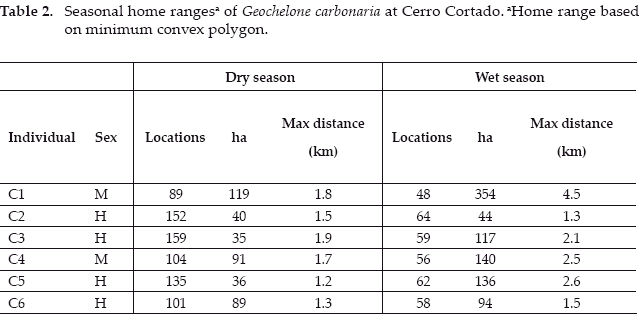
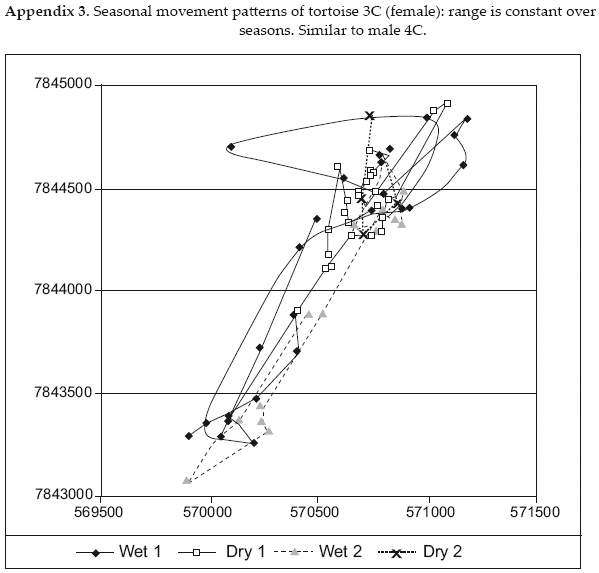
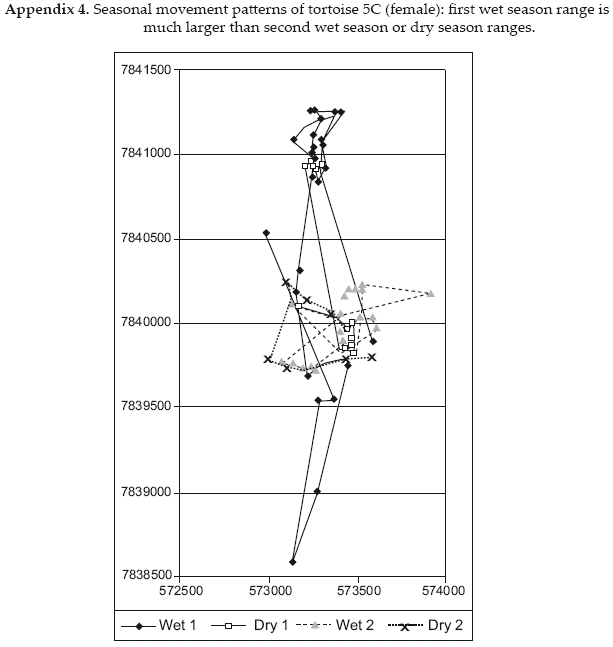
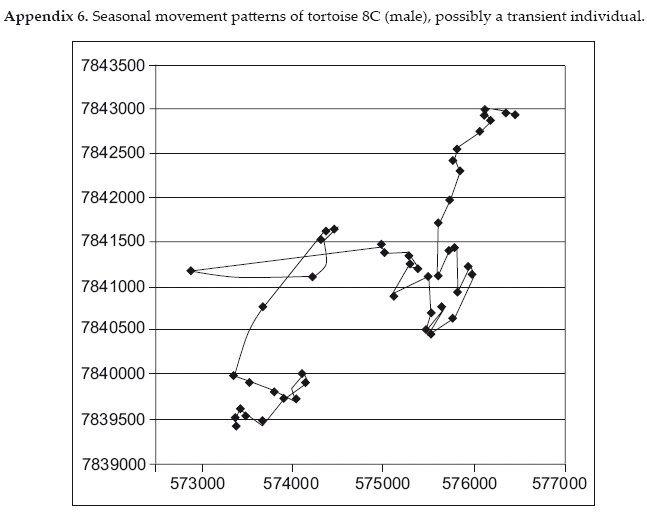
<body><![CDATA[<p align="justify">&nbsp;</p>     <p align="center"><font face="Verdana" size="3"><b>Results</b></font></p>     <p align="justify"><font face="Verdana" size="2">We captured and fixed radio-transmitters on nine individuals (five males and four females) at Cerro Cortado, tracking the animals from January of 2000 to April of 2002 (<a href="#t1">Table 1</a>). Six</font> <font face="Verdana" size="2">animals were tracked continuously for over a year, and four of these for a total of 21 months each. The number of locations per individual ranged from 52-218. In Ravelo we captured six individuals (three males and three females), and followed them from May 2001 to January 2002. However, political difficulties between park authorities and military personnel using the site forced us to abandon work there, and we recorded only 3-12 locations per individual. One animal disappeared (possible radio failure) and another was killed by a predator within the first three months.</font></p>     <p align="justify"><a name="t1"></a></p>     <p align="center"><img src="/img/revistas/reb/v48n1/a03_table_01.gif" width="643" height="593"></p>     <p align="justify"><font face="Verdana" size="2">Tortoises at Cerro Cortado occupy overall home ranges from 50-600 ha (<a href="#t1">Table 1</a>). With only two months of tracking, during the coldest months of the year, the 2 ha observed range for male C7 appears to be an under-estimation. The other four males have home ranges on average three times larger in comparison to four female tortoises	—308 versus 103 ha— though these differences are not statistically significant (Student's one-tailed t test, p&gt;0.1). With the exception of male C1, who eventually disappeared beyond the study area, and C8 who was only tracked for 6 months but described the largest range of any individual tracked, the tortoises appear to maintain home ranges. The maximum observed distance covered by tortoises, again excluding C7, ranged from 1.3-4.6 km (mean 2.5 km, N=8), with males moving further than females (3.25 vs. 1.825 km, Student's one-tailed t-test, p=0.086).</font></p>     <p align="justify"><font face="Verdana" size="2">At Ravelo with very few locations, and fewer months of tracking per individual, observed ranges are less extensive: 5.8-38.0 ha (N=5). Maximum observed distances were also less than at Cerro Cortado, from 0.3-1.2 km (mean 0.75 km). The female R3 disappeared in October of 2001, but was encountered again by accident in January of 2003, within the same area where she had first been captured.</font></p>     <p align="justify"><font face="Verdana" size="2">We found differences in home range from dry to wet season for each of the six tortoises that were radio-tracked for at least 12 months (<a href="#t2">Table 2</a>, Student's one-tailed t-test, p=0.068).</font></p>     <p align="justify"><a name="t2"></a></p>     <p align="center"><img src="/img/revistas/reb/v48n1/a03_table_02.gif" width="642" height="318"></p>     ]]></body>
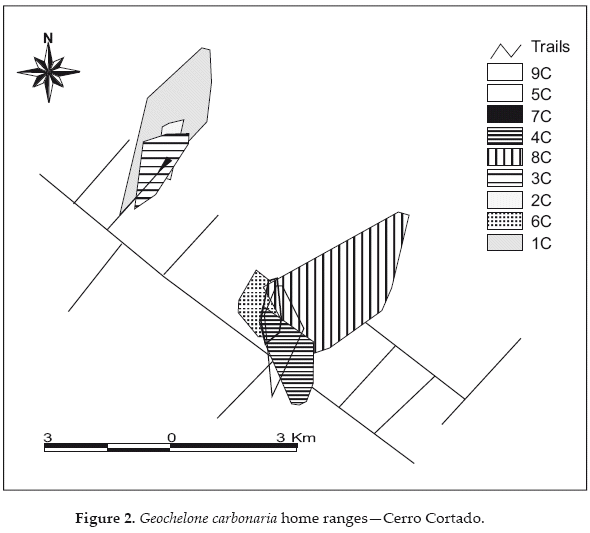
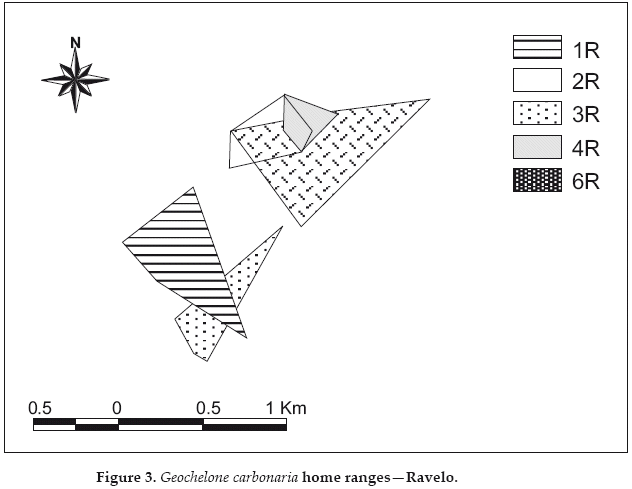
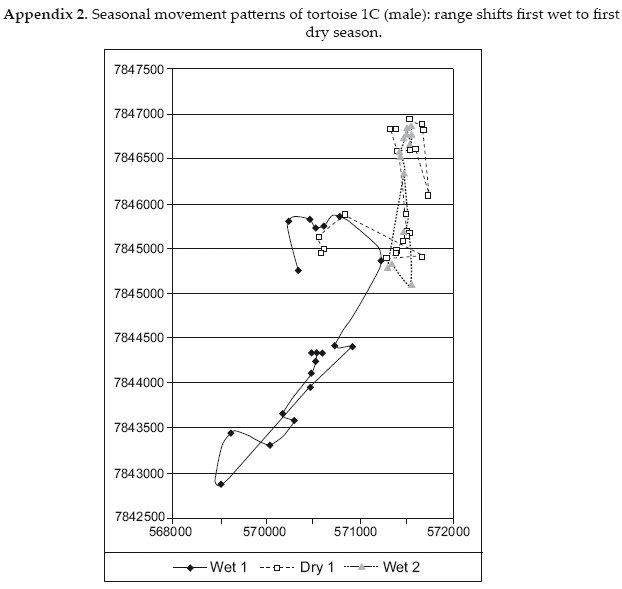
<body><![CDATA[<p align="justify"><font face="Verdana" size="2">Despite registering more locations during the dry season, individual dry season home ranges were only 26-94 percent of wet season ranges for the same individuals. These data coincide with the evidence described above that the animals continue to be active during the dry season, but at a reduced level. It is notable that only in one case, female C5, the dry season range was a reduced portion of the wet season range. All other tortoises shifted to some degree the ranges they used from one season to the other, though individual variation in ranging patterns was great (<a href="#a1">Appendices A1-A6</a>).</font></p>     <p align="justify"><font face="Verdana" size="2">At both sites we observed range overlap among individuals of both sexes (<a href="#f23">Figs. 2-3</a>). For example, at Cerro Cortado we observed overlaps that represented 40-70% of the respective home ranges of females C2 and C2, 23-29% between females C5 and C6, and 5-61% between males C4/C8/C9. The male C9 shared from 80-96% of his range with females C5 and C6 respectively, while females C2 and C3 shared 83-89% of their ranges with male C1, and female C5 shared 78-90% of her range with males C4 and C8 respectively. In total, we observed range overlaps between four and five neighboring animals at the two portions of the Cerro Cortado study site. We also encountered additional tortoises of both sexes within the ranges of individuals wearing radio-transmitters.</font></p>     <p align="justify"><a name="f23"></a></p>     <p align="center"><img src="/img/revistas/reb/v48n1/a03_figure_02.gif" width="590" height="533"></p>     <p align="center">&nbsp;</p>     <p align="center"><a name="f3"></a></p>     <p align="center"><img src="/img/revistas/reb/v48n1/a03_figure_03.gif" width="632" height="489"></p>     <p align="justify"><font face="Verdana" size="2">On 592 occasions, tortoises were located on successive days. On 401 of these occasions the tortoises had not moved at all but remained in the same burrow or shelter. The longest single-day displacement for a tortoise, 1,360 m, was registered for female 6C. Male 4C also registered a single-day displacement of over 1,000 m. The longest single-day displacement for a tortoise at Ravelo was 630 m for male 6R. Including all the days without movement, average daily displacement was higher in the wet season (71 m, SD 160) than in the dry season (19 m, SD 94) (Student's one-tailed t-test, p&lt;0.01), and this pattern was followed by both males and females. However, when tortoises</font> <font face="Verdana" size="2">did move, single-day displacement was higher in the dry season (mean 192 m, SD 238) than in the wet season (mean 167 m, SD 207), though the differences are not statistically significant, and for females 2C and 3C the opposite was true. Males (N=7 individuals, mean 210 m, SD 219) tended to move further than females (N=4 individuals, mean 183 m, SD 250) in the dry season, but females (mean 178 m, SD 242) moved further than males (mean 150 m, SD 139) in the wet season, though neither of these differences is significant.</font></p>     <p align="justify">&nbsp;</p>     <p align="center"><font face="Verdana" size="3"><b>Discussion</b></font></p>     ]]></body>
<body><![CDATA[<p align="justify"><font face="Verdana" size="2">Home ranges are considered to be areas that animals visit during their daily activities, in which they obtain the resources—food, water, minerals—as well as reproductive and social interactions that they require (O'Connor <i>et al. </i>1994). Male red-footed tortoises in the Chaco utilize larger ranges than do females, presumably as males wander in search of females. This is consistent with reports for the same species at an Amazonian site (Moskovits &amp; Kiester 1987), as well as for the desert tortoise <i>Gopherus assizii, </i>with males moving further in the summer which is the mating season (O'Connor <i>et al. </i>1994, Averill-Murray <i>et al. </i>2002). </font></p>     <p align="justify"><font face="Verdana" size="2">As at a more benign Amazonian site (Moskovits &amp; Kiester 1987), individual red-footed tortoises at Cerro Cortado differ significantly in ranging patterns (<a href="#a1">Appendices A1-A6</a>). However, the Chaco's stronger seasonality (temperatures from &lt;0 - +40&deg;C, 6+ months without surface water) may produce more distinct seasonal requirements and induce range shifts as observed in some individuals. Minimum convex polygon home ranges are larger at the Cerro Cortado Chaco site (mean 183 ha, range 2.8-628.9 ha) than at the Ravelo Chaco site (mean 19 ha, range 3.8-38 ha) or the Amazon moist forest of Brazil (mean 26 ha, range 0.63-117.5 ha). This may result in part from the longer period of study in the Cerro Cortado case, 14-21 months for six of the individuals in</font> <font face="Verdana" size="2">contrast to six months in the Ravelo case and a maximum of five months in the Brazil case (Moskovits &amp; Kiester 1987). The larger home range may also result from the drier conditions of Cerro Cortado. This is consistent with findings for <i>Testudo hermanni </i>at the northern edge of its range (Mazzotti <i>et al. </i>2002). We did not find that female tortoises in the Chaco use relatively circular home ranges while males use relatively rectangular, as reported by Moskovits &amp; Kiester (1987). Also contrary to the Brazilian site, we found significant seasonal shifts in home ranges for some individuals.</font></p>     <p align="justify">&nbsp;</p>     <p align="center"><font face="Verdana" size="3"><b>Conclusion</b></font></p>     <p align="justify"><font face="Verdana" size="2">The tortoises occupy home ranges of 50-600 ha, with males using ranges three times larger than females. Individual home ranges overlap, across and between sexes. Tortoises shift their ranges shift ranges from the dry season to the wet season, and use larger ranges in the wet season. These patterns of overlapping ranges, larger male ranges, and larger ranges in the reproductive season are consistent with other tortoises. However, the relatively large ranges for red-footed tortoises in the Chaco, relative to their ranges in Amazonian habitats, may result from the strong seasonal climate in the Chaco. </font></p>     <p align="justify"><font face="Verdana" size="2">Observed ranges are relatively large for an animal of this size in the Chaco, and ranges shift across seasons, in Kaa-Iya's protected areas. Ranges are likely to be even larger within human-impacted landscapes as tortoises seek scarce resources and mates. Indigenous territories and ranches in dry forests where this species occurs will need to provide key resources that include appropriate food, water, and shelter where these become scarce, or alternatively set aside communal and private reserves exceeding 1,000 ha in order to maintain tortoise populations on their lands. Detailed research on tortoise abundance, ranging patterns, resource availability and threats would be required to determine the area necessary to maintain a viable tortoise population in each indigenous</font> <font face="Verdana" size="2">territory or private land. Ideally larger sample sizes would support stronger management decisions, if costs and logistics permit.</font></p>     <p align="justify">&nbsp;</p>     <p align="center"><font face="Verdana" size="2"><b>Acknowledgments</b></font></p>     <p align="justify"><font face="Verdana" size="2">This publication was made possible in part by financial support from the United States Agency for International Development (USAID, Cooperative Agreement No. 511-A-00-01-00005). The opinions expressed here are those of the authors and do not necessarily represent those of USAID. The Wildlife Conservation Society (WCS) and the Capitanía del Alto y Bajo Isoso (CABI) provided further support. CABI's parabiologists and wildlife monitors tracked the tortoises with radios, while also recording data on and marking other tortoises encountered. Lucindo Gonzáles supported the field work and reviewed early versions of the manuscript. Rosa Leny Cuéllar produced the Arcview maps.</font></p>     <p align="justify">&nbsp;</p>     ]]></body>
<body><![CDATA[<p align="center"><font face="Verdana" size="3"><b>References</b></font></p>     <p align="justify"><font face="Verdana" size="2">Aponte, C. G., R. Barreto &amp; J. Terborgh. 2003. Consequences of habitat fragmentation on age structure and life history in a tortoise population. Biotropica 35: 550-554.</font></p>     <!-- ref --><p align="justify"><font face="Verdana" size="2">Averill-Murray, R. C., B. E. Martin, S. J. Bailey &amp; E. B. Wirt. 2002. Activity and behavior of the Sonoran desert tortoise in Arizona. pp. 135-158. In: van Devender, T.R. (ed.) The Sonoran Desert Tortoise: Natural History, Biology, and Conservation. University of Arizona Press, Tucson, Arizona.</font>&nbsp;&nbsp;&nbsp;&nbsp;&nbsp;&nbsp;&nbsp;&nbsp;[&#160;<a href="javascript:void(0);" onclick="javascript: window.open('/scielo.php?script=sci_nlinks&ref=019669&pid=S1605-2528201300010000300002&lng=','','width=640,height=500,resizable=yes,scrollbars=1,menubar=yes,');">Links</a>&#160;]<!-- end-ref --><!-- ref --><p align="justify"><font face="Verdana" size="2">Ayala C., J. M. 1997. Utilización de la fauna silvestre del grupo étnico Ayoréode en la comunidad Tobité, Santa Cruz, Bolivia. Under graduate thesis in biology, Universidad Autónoma Gabriel René Moreno, Santa Cruz. 78 p.</font>&nbsp;&nbsp;&nbsp;&nbsp;&nbsp;&nbsp;&nbsp;&nbsp;[&#160;<a href="javascript:void(0);" onclick="javascript: window.open('/scielo.php?script=sci_nlinks&ref=019670&pid=S1605-2528201300010000300003&lng=','','width=640,height=500,resizable=yes,scrollbars=1,menubar=yes,');">Links</a>&#160;]<!-- end-ref --><p align="justify"><font face="Verdana" size="2">Bertram, B. C. R. 1979. Home range of a hingeback tortoise in the Serengeti. African Journal of Ecology 17: 241-244.</font></p>     <!-- ref --><p align="justify"><font face="Verdana" size="2">Bjorndal, K. A. 1989. Flexibility of digestive responses in two generalist herbivores, the tortoises <i>Geochelone carbonaria </i>and <i>Geochelone denticulata. </i>Oecologia 78: 317-321.</font>&nbsp;&nbsp;&nbsp;&nbsp;&nbsp;&nbsp;&nbsp;&nbsp;[&#160;<a href="javascript:void(0);" onclick="javascript: window.open('/scielo.php?script=sci_nlinks&ref=019672&pid=S1605-2528201300010000300005&lng=','','width=640,height=500,resizable=yes,scrollbars=1,menubar=yes,');">Links</a>&#160;]<!-- end-ref --><p align="justify"><font face="Verdana" size="2">Boarman, W. I., T. Goodlett, G. Goodlett &amp; P. Hamilton. 1998. Review of radio transmitter attachment techniques for turtle research and recommendations for improvement. Herpetological Review 29: 26-33.</font></p>     <p align="justify"><font face="Verdana" size="2">Buhlmann, K. A., T. S. B. Akre, J. B. Iverson, D. Karapatakis, R. A. Mittermeier, A. Georges, A. G. J. Rhodin, P. P. van Dijk &amp; J. W. Gibbons. 2009. A global analysis of tortoise and freshwater turtle distributions with identification of priority conservation areas. Chelonian Conservation and Biology 8:116-149.</font></p>     <!-- ref --><p align="justify"><font face="Verdana" size="2">Cortéz F., C &amp; G. Rey-Ortíz. 2009. <i>Chelonoidis carbonaria </i>(Spix, 1824): Testudines-Testudinidae. pp. 611-612. In: Aguirre, L. F., R. Aguayo, J. Balderrama, C. Cortéz &amp; T. Tarifa (eds.) Libro Rojo de la Fauna Silvestre de Vertebrados de Bolivia. Ministerio de Ambiente y Agua, La Paz.</font>&nbsp;&nbsp;&nbsp;&nbsp;&nbsp;&nbsp;&nbsp;&nbsp;[&#160;<a href="javascript:void(0);" onclick="javascript: window.open('/scielo.php?script=sci_nlinks&ref=019675&pid=S1605-2528201300010000300008&lng=','','width=640,height=500,resizable=yes,scrollbars=1,menubar=yes,');">Links</a>&#160;]<!-- end-ref --><!-- ref --><p align="justify"><font face="Verdana" size="2">Cuéllar, R. L. 2000a. ¿Para qué sirven los animales del monte en Izozog? Capitanía de Alto y Bajo Isoso, Wildlife Conservation Society, Santa Cruz. 29 p.</font>&nbsp;&nbsp;&nbsp;&nbsp;&nbsp;&nbsp;&nbsp;&nbsp;[&#160;<a href="javascript:void(0);" onclick="javascript: window.open('/scielo.php?script=sci_nlinks&ref=019676&pid=S1605-2528201300010000300009&lng=','','width=640,height=500,resizable=yes,scrollbars=1,menubar=yes,');">Links</a>&#160;]<!-- end-ref --><!-- ref --><p align="justify"><font face="Verdana" size="2">Cuéllar, R. L. 2000b. Uso de los animales silvestres por pobladores Izoceños. pp. 471-484. In: Cabrera, E., C. Mercolli &amp; R. Resquin (eds.) Manejo de Fauna Silvestre en Amazonía y Latinoamérica. CITES Paraguay, Fundación Moises Bertoni, University of Florida, Asunción.</font>&nbsp;&nbsp;&nbsp;&nbsp;&nbsp;&nbsp;&nbsp;&nbsp;[&#160;<a href="javascript:void(0);" onclick="javascript: window.open('/scielo.php?script=sci_nlinks&ref=019677&pid=S1605-2528201300010000300010&lng=','','width=640,height=500,resizable=yes,scrollbars=1,menubar=yes,');">Links</a>&#160;]<!-- end-ref --><!-- ref --><p align="justify"><font face="Verdana" size="2">Deem, S. L. &amp; C. V. Fiorello. 2002. Capture and immobilization of free-ranging edentates. In: Heard, D. (ed.) Zoological Restraint and Anesthesia. Document B0135.1202. International Veterinary Information Service (<a href="http://www.ivis.org" target="_blank">www.ivis.org</a>), Ithaca, New York. <a href="http://www.ivis.org/special_books/Heard/deem/chapter_frm.asp?LA=1" target="_blank">http://www.ivis.org/special_books/Heard/deem/chapter_frm.asp?LA=1</a></font>&nbsp;&nbsp;&nbsp;&nbsp;&nbsp;&nbsp;&nbsp;&nbsp;[&#160;<a href="javascript:void(0);" onclick="javascript: window.open('/scielo.php?script=sci_nlinks&ref=019678&pid=S1605-2528201300010000300011&lng=','','width=640,height=500,resizable=yes,scrollbars=1,menubar=yes,');">Links</a>&#160;]<!-- end-ref --><p align="justify"><font face="Verdana" size="2">Etacore, J.<i>, </i>A. Higazi, J. Beneria-Surkin &amp; W. R. Townsend. 2000. Yoca iaá utatai: conocimiento Ayoreo de la comunidad el Porvenir: la peta negra. Publicaciones Proyecto de Investigación No. 9. Confederación de Pueblos Indígenas de Bolivia, Santa Cruz. 30 p.</font></p>     <p align="justify"><font face="Verdana" size="2">Eubanks, J. O., W. K. Michener &amp; C. Guyer, C. 2003. Patterns of movement and burrow use in a population of gopher tortoises </font><font face="Verdana" size="2"><i>(Gopherus polyphemus). </i>Herpetologica </font><font face="Verdana" size="2">59: 311-321.</font></p>     <p align="justify"><font face="Verdana" size="2">Gonzáles A., L. 1998. La herpetofauna del Izozog. Ecología en Bolivia 31: 45-52.</font></p>     <!-- ref --><p align="justify"><font face="Verdana" size="2">Gonzáles A., L. 2001. Los anfíbios y reptiles en una zona del Chaco boreal de Santa Cruz, Bolivia: riqueza, composición y biogeografía. Under graduate thesis in biology, Universidad Autónoma Gabriel René Moreno, Santa Cruz. 41 p.</font>&nbsp;&nbsp;&nbsp;&nbsp;&nbsp;&nbsp;&nbsp;&nbsp;[&#160;<a href="javascript:void(0);" onclick="javascript: window.open('/scielo.php?script=sci_nlinks&ref=019682&pid=S1605-2528201300010000300015&lng=','','width=640,height=500,resizable=yes,scrollbars=1,menubar=yes,');">Links</a>&#160;]<!-- end-ref --><!-- ref --><p align="justify"><font face="Verdana" size="2">Gonzáles, L. &amp; R. Montaño. 2007. La herpetofauna del Parque Nacional Kaa Iya del Gran Chaco y la Tierra Comunitaria de Origen Isoso, Santa Cruz-Bolivia. Technical Report #193. Wildlife Conservation Society, Museo de Historia Natural Noel Kempff Mercado, Santa Cruz. 8 p.</font>&nbsp;&nbsp;&nbsp;&nbsp;&nbsp;&nbsp;&nbsp;&nbsp;[&#160;<a href="javascript:void(0);" onclick="javascript: window.open('/scielo.php?script=sci_nlinks&ref=019683&pid=S1605-2528201300010000300016&lng=','','width=640,height=500,resizable=yes,scrollbars=1,menubar=yes,');">Links</a>&#160;]<!-- end-ref --><p align="justify"><font face="Verdana" size="2">Magnusson, W. E., A. Cardoso de Lima, V. Lopes da Costa. &amp; R.C. Vogt. 1997. Home range of the turtle, <i>Phrynops rufipes, </i>in an isolated reserve in central Amazonia, Brazil. Chelonian Conservation and Biology 2: 494-499.</font></p>     <p align="justify"><font face="Verdana" size="2">Mazzotti, S., A. Pisapia &amp; M. Fasola. 2002. Activity and home range of <i>Testudo hermanni </i>in Northern Italy. Amphibia-Reptilia 23: 305-312.</font></p>     <p align="justify"><font face="Verdana" size="2">Medem, F.O., V. Castaño &amp; M. Lugo-R. 1979. Contribución al conocimiento sobre la reproducción y el crecimiento de los &quot;morrocoyes&quot; <i>(Geochelone carbonaria </i>y <i>G. denticulata; </i>Testudines, Testudinidae). Caldasia 12: 497-511.</font></p>     ]]></body>
<body><![CDATA[<!-- ref --><p align="justify"><font face="Verdana" size="2">Montaño F., R. R. 2003. Caracterización de la herpetofauna de la Salina</font> <font face="Verdana" size="2">Ravelo, Departamento Santa Cruz, Bolivia. Technical Report #90. Wildlife Conservation Society, Santa Cruz. 25 p.</font>&nbsp;&nbsp;&nbsp;&nbsp;&nbsp;&nbsp;&nbsp;&nbsp;[&#160;<a href="javascript:void(0);" onclick="javascript: window.open('/scielo.php?script=sci_nlinks&ref=019687&pid=S1605-2528201300010000300020&lng=','','width=640,height=500,resizable=yes,scrollbars=1,menubar=yes,');">Links</a>&#160;]<!-- end-ref --><!-- ref --><p align="justify"><font face="Verdana" size="2">Montaño, R. &amp; L. Gonzáles. 2007. Diversidad de anfibios y reptiles en el humedal Palmar de las Islas. Technical Report #189. Wildlife Conservation Society, Santa Cruz. 13 p.</font>&nbsp;&nbsp;&nbsp;&nbsp;&nbsp;&nbsp;&nbsp;&nbsp;[&#160;<a href="javascript:void(0);" onclick="javascript: window.open('/scielo.php?script=sci_nlinks&ref=019688&pid=S1605-2528201300010000300021&lng=','','width=640,height=500,resizable=yes,scrollbars=1,menubar=yes,');">Links</a>&#160;]<!-- end-ref --><!-- ref --><p align="justify"><font face="Verdana" size="2">Montaño, R. &amp; L. Gonzáles. 2008. El Humedal Palmar de las Islas: una guía ilustrativa. Wildlife Conservation Society, Santa Cruz. 34 p.</font>&nbsp;&nbsp;&nbsp;&nbsp;&nbsp;&nbsp;&nbsp;&nbsp;[&#160;<a href="javascript:void(0);" onclick="javascript: window.open('/scielo.php?script=sci_nlinks&ref=019689&pid=S1605-2528201300010000300022&lng=','','width=640,height=500,resizable=yes,scrollbars=1,menubar=yes,');">Links</a>&#160;]<!-- end-ref --><!-- ref --><p align="justify"><font face="Verdana" size="2">Moskovits, D. K. 1985. The behavior and ecology of the two Amazonian tortoises, </font><font face="Verdana" size="2"><i>Geochelone carbonaria </i>and <i>Geochelone </i></font><font face="Verdana" size="2"><i>denticulata, </i>in northwestern Brazil. PhD Dissertation in Biology. University of Chicago, Chicago. 328 p.</font>&nbsp;&nbsp;&nbsp;&nbsp;&nbsp;&nbsp;&nbsp;&nbsp;[&#160;<a href="javascript:void(0);" onclick="javascript: window.open('/scielo.php?script=sci_nlinks&ref=019690&pid=S1605-2528201300010000300023&lng=','','width=640,height=500,resizable=yes,scrollbars=1,menubar=yes,');">Links</a>&#160;]<!-- end-ref --><!-- ref --><p align="justify"><font face="Verdana" size="2">Moskovits, D. K. 1988. Sexual dimorphism and population estimates of the two Amazonian tortoises <i>(Geochelone carbonaria </i>and G. <i>denticulata) </i>in northwestern Brazil. Herpetologica 44: 209-217.</font>&nbsp;&nbsp;&nbsp;&nbsp;&nbsp;&nbsp;&nbsp;&nbsp;[&#160;<a href="javascript:void(0);" onclick="javascript: window.open('/scielo.php?script=sci_nlinks&ref=019691&pid=S1605-2528201300010000300024&lng=','','width=640,height=500,resizable=yes,scrollbars=1,menubar=yes,');">Links</a>&#160;]<!-- end-ref --><p align="justify"><font face="Verdana" size="2">Moskovits, D. K. &amp; A. R. Kiester. 1987. Activity levels and ranging behaviour of the two Amazonian tortoises, <i>Geochelone </i></font><font face="Verdana" size="2"><i>carbonaria </i>and <i>Geochelone denticulata, </i>in </font><font face="Verdana" size="2">north-western Brazil. Functional Ecology 1: 203-214.</font></p>     <p align="justify"><font face="Verdana" size="2">Moskovits, D. K. &amp; K. A. Bjorndal. 1990. Diet and food preferences of the tortoises </font><font face="Verdana" size="2"><i>Geochelone carbonaria </i>and G. <i>denticulata </i></font><font face="Verdana" size="2">in northwestern Brazil. Herpetologica 46: 207-218.</font></p>     <p align="justify"><font face="Verdana" size="2">Nagy, K. A. &amp; P. A. Medica. 1986. Physiological ecology of desert tortoises in southern Nevada. Herpetologica 42: 73-92.</font></p>     <!-- ref --><p align="justify"><font face="Verdana" size="2">Navarro, G. 2004. Mapa de Vegetación del Parque Nacional y ANMI Kaa-Iya del Gran Chaco. Wildlife Conservation Society, Santa Cruz. 42 p.</font>&nbsp;&nbsp;&nbsp;&nbsp;&nbsp;&nbsp;&nbsp;&nbsp;[&#160;<a href="javascript:void(0);" onclick="javascript: window.open('/scielo.php?script=sci_nlinks&ref=019695&pid=S1605-2528201300010000300028&lng=','','width=640,height=500,resizable=yes,scrollbars=1,menubar=yes,');">Links</a>&#160;]<!-- end-ref --><p align="justify"><font face="Verdana" size="2">Noss, A. J<i>., </i>R. R. Montaño F., F. Soria, S. L. Deem., C. V. Fiorello &amp; L. A. Fitzgerald. In press. Geochelone carbonaria (Testudines: Testudinidae) activity</font> <font face="Verdana" size="2">patterns and burrow use in the Bolivian Chaco. South American Journal of Herpetology.</font></p>     ]]></body>
<body><![CDATA[<p align="justify"><font face="Verdana" size="2">O'Connor, M. P., L. C. Zimmerman, D. E. Ruby, S. J. Bulova &amp; J. R. Spotila. 1994. Home range size and movements by desert tortoises, <i>Gopherus agassizii, </i>in the eastern Mojave desert. Herpetological Monographs 8: 60-71.</font></p>     <!-- ref --><p align="justify"><font face="Verdana" size="2">Peres, C. A. 2000. Evaluating the impact and sustainability of subsistence hunting at multiple Amazonian forest sites. pp. 31-56. In: Robinson, J.G. &amp; E.L. Bennett (eds.). Hunting for Sustainability in Tropical Forests. Columbia University Press, New York.</font>&nbsp;&nbsp;&nbsp;&nbsp;&nbsp;&nbsp;&nbsp;&nbsp;[&#160;<a href="javascript:void(0);" onclick="javascript: window.open('/scielo.php?script=sci_nlinks&ref=019698&pid=S1605-2528201300010000300031&lng=','','width=640,height=500,resizable=yes,scrollbars=1,menubar=yes,');">Links</a>&#160;]<!-- end-ref --><p align="justify"><font face="Verdana" size="2">Pezzuti, J. C. B., J. P. Lima, D. F. da Silva &amp; A. Begossi. 2010. Uses and taboos of turtles and tortoises along Rio Negro, Amazon Basin. Journal of Ethnobiology 30:153-168.</font></p>     <!-- ref --><p align="justify"><font face="Verdana" size="2">Rhodin, A. G. J., A. D. Walde, B. D. Horne, P. P. van Dijk, T. Blanck &amp; R. Hudson. 2011. Editorial introduction and executive summary. pp.3-16. In: Turtle Conservation Coalition. Turtles in trouble: The world's 25+ most endangered tortoises and freshwater turtles. IUCN/SSC Tortoise and Freshwater Turtle Specialist Group, Lunenburg, Massachusetts.</font>&nbsp;&nbsp;&nbsp;&nbsp;&nbsp;&nbsp;&nbsp;&nbsp;[&#160;<a href="javascript:void(0);" onclick="javascript: window.open('/scielo.php?script=sci_nlinks&ref=019700&pid=S1605-2528201300010000300033&lng=','','width=640,height=500,resizable=yes,scrollbars=1,menubar=yes,');">Links</a>&#160;]<!-- end-ref --><p align="justify"><font face="Verdana" size="2">Smith, L. L., J. M. Linehan, J.M. Stober, M.J. Elliott &amp; J. B. Jensen. 2009. An evaluation of distance sampling for large-scale gopher tortoise surveys in Georgia, USA. Applied Herpetology 6: 355-368.</font></p>     <!-- ref --><p align="justify"><font face="Verdana" size="2">Soria M., F. &amp; A. Noss, A. 2000. Herpetofauna de Cerro Cortado con referencias específicas </font><font face="Verdana" size="2">a <i>Tupinambis </i>spp. y <i>Chelonoidis </i>spp. pp. 361-365. In: Cabrera, E., C. Mercolli &amp; R. Resquin (eds.) Manejo de Fauna Silvestre en Amazonía y Latinoamérica. CITES Paraguay, Fundación Moises Bertoni, University of Florida, Asunción.</font>&nbsp;&nbsp;&nbsp;&nbsp;&nbsp;&nbsp;&nbsp;&nbsp;[&#160;<a href="javascript:void(0);" onclick="javascript: window.open('/scielo.php?script=sci_nlinks&ref=019702&pid=S1605-2528201300010000300035&lng=','','width=640,height=500,resizable=yes,scrollbars=1,menubar=yes,');">Links</a>&#160;]<!-- end-ref --><p align="justify"><font face="Verdana" size="2">Stober, J. M. &amp; L. L. Smith. 2010. Total counts versus line transects for estimating abundance of small gopher tortoise populations. Journal of Wildlife Management 74:1595-1600.</font></p>     <p align="justify"><font face="Verdana" size="2">Strong, J. N. &amp; J. M. V. Fragoso. 2006. Seed dispersal by <i>Geochelone carbonaria </i>and <i>Geochelone denticulata </i>in northwestern Brazil. Biotropica 38: 683-686.</font></p>     <p align="justify"><font face="Verdana" size="2">Swann, D. E., R. C. Averill-Murray &amp; C. R. Schwalbe. 2002. Distance sampling for Sonoran desert tortoises. Journal of Wildlife Management 66: 969-975.</font></p>     <p align="justify"><font face="Verdana" size="2">Taber, A., G. Navarro &amp; M. A. Arribas. 1997. A new park in the Bolivian Gran Chaco—an advance in tropical dry forest conservation and community-based management. Oryx 31:189-198.</font></p>     ]]></body>
<body><![CDATA[<p align="justify"><font face="Verdana" size="2">Vanzolini, P. E. 1999. A note on the reproduction of <i>Geochelone carbonaria </i>and <i>G. denticulata </i>(Testudines, Testudinidae). Revista Brasileña de Biología 59: 593-608.</font></p>     <p align="justify"><font face="Verdana" size="2">Wang, E., C. I. Donatti, V. L. Ferreira, J. Raizer &amp; J. Himmelstein. 2011. Food habits and notes on the biology of <i>Chelonoidis carbonaria </i>(Spix 1824) (Testudinidae, Chelonia) in the southern Pantanal, Brazil. South American Journal of Herpetology 6:11-19.</font></p>     <p align="justify">&nbsp;</p>     <p align="justify"><a name="a1"></a></p>     <p align="center"><img src="/img/revistas/reb/v48n1/a03_app_01.gif" width="635" height="598"></p>     <p align="center">&nbsp;</p>     <p align="center"><img src="/img/revistas/reb/v48n1/a03_app_02.gif" width="622" height="589"></p>     <p align="center">&nbsp;</p>     <p align="center"><img src="/img/revistas/reb/v48n1/a03_app_03.gif" width="599" height="573"></p>     <p align="center">&nbsp;</p>     ]]></body>
<body><![CDATA[<p align="center"><img src="/img/revistas/reb/v48n1/a03_app_04.gif" width="613" height="647"></p>     <p align="center">&nbsp;</p>     <p align="center"><img src="/img/revistas/reb/v48n1/a03_app_05.gif" width="634" height="645"></p>     <p align="center">&nbsp;</p>     <p align="center"><img src="/img/revistas/reb/v48n1/a03_app_06.gif" width="647" height="512"></p>     <p align="justify">&nbsp;</p>     <p align="justify"><font face="Verdana" size="2"><b>Art&iacute;culo recibido en:</b> Octubre de 2012.     <br>     <b>Manejado por:</b> Ignacio de la Riva.     <br>     <b>Aceptado en:</b> Enero de 2013.</font></p>     <p align="justify">&nbsp;</p>     ]]></body>
<body><![CDATA[ ]]></body><back>
<ref-list>
<ref id="B1">
<nlm-citation citation-type="journal">
<person-group person-group-type="author">
<name>
<surname><![CDATA[Aponte]]></surname>
<given-names><![CDATA[C.G.]]></given-names>
</name>
<name>
<surname><![CDATA[Barreto]]></surname>
<given-names><![CDATA[R.]]></given-names>
</name>
<name>
<surname><![CDATA[Terborgh]]></surname>
<given-names><![CDATA[J.]]></given-names>
</name>
</person-group>
<article-title xml:lang="en"><![CDATA[Consequences of habitat fragmentation on age structure and life history in a tortoise population]]></article-title>
<source><![CDATA[Biotropica]]></source>
<year>2003</year>
<volume>35</volume>
<page-range>550-554</page-range></nlm-citation>
</ref>
<ref id="B2">
<nlm-citation citation-type="book">
<person-group person-group-type="author">
<name>
<surname><![CDATA[Averill-Murray]]></surname>
<given-names><![CDATA[R. C.]]></given-names>
</name>
<name>
<surname><![CDATA[Martin]]></surname>
<given-names><![CDATA[B. E.]]></given-names>
</name>
<name>
<surname><![CDATA[Bailey]]></surname>
<given-names><![CDATA[S. J.]]></given-names>
</name>
<name>
<surname><![CDATA[Wirt]]></surname>
<given-names><![CDATA[E. B.]]></given-names>
</name>
</person-group>
<article-title xml:lang="en"><![CDATA[Activity and behavior of the Sonoran desert tortoise in Arizona]]></article-title>
<person-group person-group-type="editor">
<name>
<surname><![CDATA[van Devender]]></surname>
<given-names><![CDATA[T.R.]]></given-names>
</name>
</person-group>
<source><![CDATA[The Sonoran Desert Tortoise: Natural History, Biology, and Conservation]]></source>
<year>2002</year>
<page-range>135-158</page-range><publisher-loc><![CDATA[Tucson^eArizona Arizona]]></publisher-loc>
<publisher-name><![CDATA[University of Arizona Press]]></publisher-name>
</nlm-citation>
</ref>
<ref id="B3">
<nlm-citation citation-type="">
<person-group person-group-type="author">
<name>
<surname><![CDATA[Ayala C.]]></surname>
<given-names><![CDATA[J. M.]]></given-names>
</name>
</person-group>
<source><![CDATA[Utilización de la fauna silvestre del grupo étnico Ayoréode en la comunidad Tobité, Santa Cruz, Bolivia]]></source>
<year>1997</year>
<page-range>78</page-range></nlm-citation>
</ref>
<ref id="B4">
<nlm-citation citation-type="journal">
<person-group person-group-type="author">
<name>
<surname><![CDATA[Bertram]]></surname>
<given-names><![CDATA[B.C.R.]]></given-names>
</name>
</person-group>
<article-title xml:lang="en"><![CDATA[Home range of a hingeback tortoise in the Serengeti]]></article-title>
<source><![CDATA[African Journal of Ecology]]></source>
<year>1979</year>
<volume>17</volume>
<page-range>241-244</page-range></nlm-citation>
</ref>
<ref id="B5">
<nlm-citation citation-type="journal">
<person-group person-group-type="author">
<name>
<surname><![CDATA[Bjorndal]]></surname>
<given-names><![CDATA[K.A]]></given-names>
</name>
</person-group>
<article-title xml:lang="en"><![CDATA[Flexibility of digestive responses in two generalist herbivores, the tortoises Geochelone carbonaria and Geochelone denticulata]]></article-title>
<source><![CDATA[Oecologia]]></source>
<year>1989</year>
<numero>78</numero>
<issue>78</issue>
<page-range>317-321</page-range></nlm-citation>
</ref>
<ref id="B6">
<nlm-citation citation-type="journal">
<person-group person-group-type="author">
<name>
<surname><![CDATA[Boarman]]></surname>
<given-names><![CDATA[W.I.]]></given-names>
</name>
<name>
<surname><![CDATA[Goodlett]]></surname>
<given-names><![CDATA[T.]]></given-names>
</name>
<name>
<surname><![CDATA[Goodlett]]></surname>
<given-names><![CDATA[G.]]></given-names>
</name>
<name>
<surname><![CDATA[Hamilton]]></surname>
<given-names><![CDATA[P.]]></given-names>
</name>
</person-group>
<article-title xml:lang="en"><![CDATA[Review of radio transmitter attachment techniques for turtle research and recommendations for improvement]]></article-title>
<source><![CDATA[Herpetological Review]]></source>
<year>1998</year>
<volume>29</volume>
<page-range>26-33</page-range></nlm-citation>
</ref>
<ref id="B7">
<nlm-citation citation-type="journal">
<person-group person-group-type="author">
<name>
<surname><![CDATA[Buhlmann]]></surname>
<given-names><![CDATA[K.A.]]></given-names>
</name>
<name>
<surname><![CDATA[Akre]]></surname>
<given-names><![CDATA[T.S.B.]]></given-names>
</name>
<name>
<surname><![CDATA[Iverson]]></surname>
<given-names><![CDATA[J.B.]]></given-names>
</name>
<name>
<surname><![CDATA[Karapatakis]]></surname>
<given-names><![CDATA[D.]]></given-names>
</name>
<name>
<surname><![CDATA[Mittermeier]]></surname>
<given-names><![CDATA[R.A.]]></given-names>
</name>
<name>
<surname><![CDATA[Georges]]></surname>
<given-names><![CDATA[A.]]></given-names>
</name>
<name>
<surname><![CDATA[Rhodin]]></surname>
<given-names><![CDATA[A.G.J.]]></given-names>
</name>
<name>
<surname><![CDATA[van Dijk]]></surname>
<given-names><![CDATA[P.P.]]></given-names>
</name>
<name>
<surname><![CDATA[Gibbons]]></surname>
<given-names><![CDATA[J.W.]]></given-names>
</name>
</person-group>
<article-title xml:lang="en"><![CDATA[A global analysis of tortoise and freshwater turtle distributions with identification of priority conservation areas]]></article-title>
<source><![CDATA[Chelonian Conservation and Biology]]></source>
<year>2009</year>
<volume>8</volume>
<page-range>116-149</page-range></nlm-citation>
</ref>
<ref id="B8">
<nlm-citation citation-type="book">
<person-group person-group-type="author">
<name>
<surname><![CDATA[Cortéz F.]]></surname>
<given-names><![CDATA[C.]]></given-names>
</name>
<name>
<surname><![CDATA[Rey-Ortíz]]></surname>
<given-names><![CDATA[G.]]></given-names>
</name>
</person-group>
<article-title xml:lang="en"><![CDATA[Chelonoidis carbonaria (Spix, 1824): Testudines-Testudinidae]]></article-title>
<person-group person-group-type="editor">
<name>
<surname><![CDATA[Aguirre]]></surname>
<given-names><![CDATA[L. F.]]></given-names>
</name>
<name>
<surname><![CDATA[Aguayo]]></surname>
<given-names><![CDATA[R.]]></given-names>
</name>
<name>
<surname><![CDATA[Balderrama]]></surname>
<given-names><![CDATA[J.]]></given-names>
</name>
<name>
<surname><![CDATA[Cortéz]]></surname>
<given-names><![CDATA[C.]]></given-names>
</name>
<name>
<surname><![CDATA[Tarifa]]></surname>
<given-names><![CDATA[T.]]></given-names>
</name>
</person-group>
<source><![CDATA[Libro Rojo de la Fauna Silvestre de Vertebrados de Bolivia]]></source>
<year>2009</year>
<page-range>611-612</page-range><publisher-loc><![CDATA[La Paz ]]></publisher-loc>
<publisher-name><![CDATA[Ministerio de Ambiente y Agua]]></publisher-name>
</nlm-citation>
</ref>
<ref id="B9">
<nlm-citation citation-type="book">
<person-group person-group-type="author">
<name>
<surname><![CDATA[Cuéllar]]></surname>
<given-names><![CDATA[R. L.]]></given-names>
</name>
</person-group>
<source><![CDATA[¿Para qué sirven los animales del monte en Izozog?]]></source>
<year>2000</year>
<month>a</month>
<page-range>29</page-range><publisher-loc><![CDATA[Santa Cruz ]]></publisher-loc>
<publisher-name><![CDATA[Capitanía de Alto y Bajo Isoso, Wildlife Conservation Society]]></publisher-name>
</nlm-citation>
</ref>
<ref id="B10">
<nlm-citation citation-type="book">
<person-group person-group-type="author">
<name>
<surname><![CDATA[Cuéllar]]></surname>
<given-names><![CDATA[R. L.]]></given-names>
</name>
</person-group>
<article-title xml:lang="es"><![CDATA[Uso de los animales silvestres por pobladores Izoceños]]></article-title>
<person-group person-group-type="editor">
<name>
<surname><![CDATA[Cabrera]]></surname>
<given-names><![CDATA[E.]]></given-names>
</name>
<name>
<surname><![CDATA[Mercolli]]></surname>
<given-names><![CDATA[C.]]></given-names>
</name>
<name>
<surname><![CDATA[Resquin]]></surname>
<given-names><![CDATA[R.]]></given-names>
</name>
</person-group>
<source><![CDATA[Manejo de Fauna Silvestre en Amazonía y Latinoamérica]]></source>
<year>2000</year>
<month>b</month>
<page-range>471-484</page-range><publisher-loc><![CDATA[Asunción ]]></publisher-loc>
<publisher-name><![CDATA[CITES Paraguay, Fundación Moises Bertoni, University of Florida]]></publisher-name>
</nlm-citation>
</ref>
<ref id="B11">
<nlm-citation citation-type="book">
<person-group person-group-type="author">
<name>
<surname><![CDATA[Deem]]></surname>
<given-names><![CDATA[S. L.]]></given-names>
</name>
<name>
<surname><![CDATA[Fiorello]]></surname>
<given-names><![CDATA[C. V.]]></given-names>
</name>
</person-group>
<article-title xml:lang="en"><![CDATA[Capture and immobilization of free-ranging edentates]]></article-title>
<person-group person-group-type="editor">
<name>
<surname><![CDATA[Heard]]></surname>
<given-names><![CDATA[D.]]></given-names>
</name>
</person-group>
<source><![CDATA[Zoological Restraint and Anesthesia]]></source>
<year>2002</year>
<publisher-loc><![CDATA[Ithaca^eNew York New York]]></publisher-loc>
<publisher-name><![CDATA[International Veterinary Information Service]]></publisher-name>
</nlm-citation>
</ref>
<ref id="B12">
<nlm-citation citation-type="journal">
<person-group person-group-type="author">
<name>
<surname><![CDATA[Etacore]]></surname>
<given-names><![CDATA[J.]]></given-names>
</name>
<name>
<surname><![CDATA[Higazi]]></surname>
<given-names><![CDATA[A.]]></given-names>
</name>
<name>
<surname><![CDATA[Beneria-Surkin]]></surname>
<given-names><![CDATA[J.]]></given-names>
</name>
<name>
<surname><![CDATA[Townsend]]></surname>
<given-names><![CDATA[W.R.]]></given-names>
</name>
</person-group>
<article-title xml:lang="es"><![CDATA[Yoca iaá utatai: conocimiento Ayoreo de la comunidad el Porvenir: la peta negra]]></article-title>
<source><![CDATA[Publicaciones Proyecto de Investigación]]></source>
<year>2000</year>
<numero>9</numero>
<issue>9</issue>
<page-range>30</page-range><publisher-loc><![CDATA[Santa Cruz ]]></publisher-loc>
<publisher-name><![CDATA[Confederación de Pueblos Indígenas de Bolivia]]></publisher-name>
</nlm-citation>
</ref>
<ref id="B13">
<nlm-citation citation-type="journal">
<person-group person-group-type="author">
<name>
<surname><![CDATA[Eubanks]]></surname>
<given-names><![CDATA[J.O.]]></given-names>
</name>
<name>
<surname><![CDATA[Michener]]></surname>
<given-names><![CDATA[W.K.]]></given-names>
</name>
<name>
<surname><![CDATA[Guyer]]></surname>
<given-names><![CDATA[C.]]></given-names>
</name>
</person-group>
<article-title xml:lang="en"><![CDATA[Patterns of movement and burrow use in a population of gopher tortoises (Gopherus polyphemus)]]></article-title>
<source><![CDATA[Herpetologica]]></source>
<year>2003</year>
<volume>59</volume>
<page-range>311-321</page-range></nlm-citation>
</ref>
<ref id="B14">
<nlm-citation citation-type="journal">
<person-group person-group-type="author">
<name>
<surname><![CDATA[Gonzáles A]]></surname>
<given-names><![CDATA[L.]]></given-names>
</name>
</person-group>
<article-title xml:lang="es"><![CDATA[La herpetofauna del Izozog]]></article-title>
<source><![CDATA[Ecología en Bolivia]]></source>
<year>1998</year>
<volume>31</volume>
<page-range>45-52</page-range></nlm-citation>
</ref>
<ref id="B15">
<nlm-citation citation-type="">
<person-group person-group-type="author">
<name>
<surname><![CDATA[Gonzáles A.]]></surname>
<given-names><![CDATA[L.]]></given-names>
</name>
</person-group>
<source><![CDATA[Los anfíbios y reptiles en una zona del Chaco boreal de Santa Cruz, Bolivia: riqueza, composición y biogeografía]]></source>
<year>2001</year>
<page-range>41</page-range></nlm-citation>
</ref>
<ref id="B16">
<nlm-citation citation-type="journal">
<person-group person-group-type="author">
<name>
<surname><![CDATA[Gonzáles]]></surname>
<given-names><![CDATA[L.]]></given-names>
</name>
<name>
<surname><![CDATA[Montaño]]></surname>
<given-names><![CDATA[R.]]></given-names>
</name>
</person-group>
<article-title xml:lang="en"><![CDATA[La herpetofauna del Parque Nacional Kaa Iya del Gran Chaco y la Tierra Comunitaria de Origen Isoso, Santa Cruz-Bolivia]]></article-title>
<source><![CDATA[Technical Report]]></source>
<year>2007</year>
<numero>193</numero>
<issue>193</issue>
<page-range>8</page-range><publisher-loc><![CDATA[Santa Cruz ]]></publisher-loc>
<publisher-name><![CDATA[Wildlife Conservation Society, Museo de Historia Natural Noel Kempff Mercado]]></publisher-name>
</nlm-citation>
</ref>
<ref id="B17">
<nlm-citation citation-type="journal">
<person-group person-group-type="author">
<name>
<surname><![CDATA[Magnusson]]></surname>
<given-names><![CDATA[W.E.]]></given-names>
</name>
<name>
<surname><![CDATA[Cardoso de Lima]]></surname>
<given-names><![CDATA[A.]]></given-names>
</name>
<name>
<surname><![CDATA[Lopes da Costa]]></surname>
<given-names><![CDATA[V.]]></given-names>
</name>
<name>
<surname><![CDATA[Vogt]]></surname>
<given-names><![CDATA[R.C.]]></given-names>
</name>
</person-group>
<article-title xml:lang="en"><![CDATA[Home range of the turtle, Phrynops rufipes, in an isolated reserve in central Amazonia, Brazil]]></article-title>
<source><![CDATA[Chelonian Conservation and Biology]]></source>
<year>1997</year>
<volume>2</volume>
<page-range>494-499</page-range></nlm-citation>
</ref>
<ref id="B18">
<nlm-citation citation-type="journal">
<person-group person-group-type="author">
<name>
<surname><![CDATA[Mazzotti]]></surname>
<given-names><![CDATA[S.]]></given-names>
</name>
<name>
<surname><![CDATA[Pisapia]]></surname>
<given-names><![CDATA[A.]]></given-names>
</name>
<name>
<surname><![CDATA[Fasola]]></surname>
<given-names><![CDATA[M.]]></given-names>
</name>
</person-group>
<article-title xml:lang="en"><![CDATA[Activity and home range of Testudo hermanni in Northern Italy]]></article-title>
<source><![CDATA[Amphibia-Reptilia]]></source>
<year>2002</year>
<volume>23</volume>
<page-range>305-312</page-range></nlm-citation>
</ref>
<ref id="B19">
<nlm-citation citation-type="journal">
<person-group person-group-type="author">
<name>
<surname><![CDATA[Medem]]></surname>
<given-names><![CDATA[F.O.]]></given-names>
</name>
<name>
<surname><![CDATA[Castaño]]></surname>
<given-names><![CDATA[V.]]></given-names>
</name>
<name>
<surname><![CDATA[Lugo-R]]></surname>
<given-names><![CDATA[M.]]></given-names>
</name>
</person-group>
<article-title xml:lang="es"><![CDATA[Contribución al conocimiento sobre la reproducción y el crecimiento de los "morrocoyes"(Geochelone carbonaria y G. denticulata; Testudines, Testudinidae)]]></article-title>
<source><![CDATA[Caldasia]]></source>
<year>1979</year>
<volume>12</volume>
<page-range>497-511</page-range></nlm-citation>
</ref>
<ref id="B20">
<nlm-citation citation-type="journal">
<person-group person-group-type="author">
<name>
<surname><![CDATA[Montaño F.]]></surname>
<given-names><![CDATA[R. R.]]></given-names>
</name>
</person-group>
<article-title xml:lang="es"><![CDATA[Caracterización de la herpetofauna de la Salina Ravelo, Departamento Santa Cruz, Bolivia]]></article-title>
<source><![CDATA[Technical Report]]></source>
<year>2003</year>
<numero>90</numero>
<issue>90</issue>
<page-range>25</page-range><publisher-loc><![CDATA[Santa Cruz ]]></publisher-loc>
<publisher-name><![CDATA[Wildlife Conservation Society]]></publisher-name>
</nlm-citation>
</ref>
<ref id="B21">
<nlm-citation citation-type="journal">
<person-group person-group-type="author">
<name>
<surname><![CDATA[Montaño]]></surname>
<given-names><![CDATA[R.]]></given-names>
</name>
<name>
<surname><![CDATA[Gonzáles]]></surname>
<given-names><![CDATA[L.]]></given-names>
</name>
</person-group>
<article-title xml:lang="es"><![CDATA[Diversidad de anfibios y reptiles en el humedal Palmar de las Islas]]></article-title>
<source><![CDATA[Technical Report]]></source>
<year>2007</year>
<numero>189</numero>
<issue>189</issue>
<page-range>13</page-range><publisher-loc><![CDATA[Santa Cruz ]]></publisher-loc>
<publisher-name><![CDATA[Wildlife Conservation Society]]></publisher-name>
</nlm-citation>
</ref>
<ref id="B22">
<nlm-citation citation-type="book">
<person-group person-group-type="author">
<name>
<surname><![CDATA[Montaño]]></surname>
<given-names><![CDATA[R.]]></given-names>
</name>
<name>
<surname><![CDATA[Gonzáles]]></surname>
<given-names><![CDATA[L.]]></given-names>
</name>
</person-group>
<source><![CDATA[El Humedal Palmar de las Islas: una guía ilustrativa]]></source>
<year>2008</year>
<page-range>34</page-range><publisher-loc><![CDATA[Santa Cruz ]]></publisher-loc>
<publisher-name><![CDATA[Wildlife Conservation Society]]></publisher-name>
</nlm-citation>
</ref>
<ref id="B23">
<nlm-citation citation-type="">
<person-group person-group-type="author">
<name>
<surname><![CDATA[Moskovits]]></surname>
<given-names><![CDATA[D. K.]]></given-names>
</name>
</person-group>
<source><![CDATA[The behavior and ecology of the two Amazonian tortoises, Geochelone carbonaria and Geochelone denticulata, in northwestern Brazil]]></source>
<year>1985</year>
</nlm-citation>
</ref>
<ref id="B24">
<nlm-citation citation-type="journal">
<person-group person-group-type="author">
<name>
<surname><![CDATA[Moskovits]]></surname>
<given-names><![CDATA[D.K]]></given-names>
</name>
</person-group>
<article-title xml:lang="en"><![CDATA[Sexual dimorphism and population estimates of the two Amazonian tortoises (Geochelone carbonaria and G]]></article-title>
<source><![CDATA[denticulata) in northwestern Brazil. Herpetologica]]></source>
<year>1988</year>
<numero>44</numero>
<issue>44</issue>
<page-range>209-217</page-range></nlm-citation>
</ref>
<ref id="B25">
<nlm-citation citation-type="journal">
<person-group person-group-type="author">
<name>
<surname><![CDATA[Moskovits]]></surname>
<given-names><![CDATA[D.K.]]></given-names>
</name>
<name>
<surname><![CDATA[Kiester]]></surname>
<given-names><![CDATA[A.R.]]></given-names>
</name>
</person-group>
<article-title xml:lang="en"><![CDATA[Activity levels and ranging behaviour of the two Amazonian tortoises, Geochelone carbonaria and Geochelone denticulata, in north-western Brazil]]></article-title>
<source><![CDATA[Functional Ecology]]></source>
<year>1987</year>
<volume>1</volume>
<page-range>203-214</page-range></nlm-citation>
</ref>
<ref id="B26">
<nlm-citation citation-type="journal">
<person-group person-group-type="author">
<name>
<surname><![CDATA[Moskovits]]></surname>
<given-names><![CDATA[D.K.]]></given-names>
</name>
<name>
<surname><![CDATA[Bjorndal]]></surname>
<given-names><![CDATA[K.A.]]></given-names>
</name>
</person-group>
<article-title xml:lang="en"><![CDATA[Diet and food preferences of the tortoises Geochelone carbonaria and G. denticulata in northwestern Brazil]]></article-title>
<source><![CDATA[Herpetologica]]></source>
<year>1990</year>
<volume>46</volume>
<page-range>207-218</page-range></nlm-citation>
</ref>
<ref id="B27">
<nlm-citation citation-type="journal">
<person-group person-group-type="author">
<name>
<surname><![CDATA[Nagy]]></surname>
<given-names><![CDATA[K.A.]]></given-names>
</name>
<name>
<surname><![CDATA[Medica]]></surname>
<given-names><![CDATA[P.A.]]></given-names>
</name>
</person-group>
<article-title xml:lang="en"><![CDATA[Physiological ecology of desert tortoises in southern Nevada]]></article-title>
<source><![CDATA[Herpetologica]]></source>
<year>1986</year>
<volume>42</volume>
<page-range>73-92</page-range></nlm-citation>
</ref>
<ref id="B28">
<nlm-citation citation-type="book">
<person-group person-group-type="author">
<name>
<surname><![CDATA[Navarro]]></surname>
<given-names><![CDATA[G.]]></given-names>
</name>
</person-group>
<source><![CDATA[Mapa de Vegetación del Parque Nacional y ANMI Kaa-Iya del Gran Chaco]]></source>
<year>2004</year>
<page-range>42</page-range><publisher-loc><![CDATA[Santa Cruz ]]></publisher-loc>
<publisher-name><![CDATA[Wildlife Conservation Society]]></publisher-name>
</nlm-citation>
</ref>
<ref id="B29">
<nlm-citation citation-type="journal">
<person-group person-group-type="author">
<name>
<surname><![CDATA[Noss]]></surname>
<given-names><![CDATA[A.J.]]></given-names>
</name>
<name>
<surname><![CDATA[Montaño F.]]></surname>
<given-names><![CDATA[R.R.]]></given-names>
</name>
<name>
<surname><![CDATA[Soria]]></surname>
<given-names><![CDATA[F.]]></given-names>
</name>
<name>
<surname><![CDATA[Deem.]]></surname>
<given-names><![CDATA[S.L.]]></given-names>
</name>
<name>
<surname><![CDATA[Fiorello]]></surname>
<given-names><![CDATA[C.V.]]></given-names>
</name>
<name>
<surname><![CDATA[Fitzgerald]]></surname>
<given-names><![CDATA[L.A.]]></given-names>
</name>
</person-group>
<article-title xml:lang="en"><![CDATA[In press. Geochelone carbonaria (Testudines: Testudinidae) activity patterns and burrow use in the Bolivian Chaco]]></article-title>
<source><![CDATA[South American Journal of Herpetology]]></source>
<year></year>
</nlm-citation>
</ref>
<ref id="B30">
<nlm-citation citation-type="journal">
<person-group person-group-type="author">
<name>
<surname><![CDATA[O'Connor]]></surname>
<given-names><![CDATA[M.P.]]></given-names>
</name>
<name>
<surname><![CDATA[Zimmerman]]></surname>
<given-names><![CDATA[L.C.]]></given-names>
</name>
<name>
<surname><![CDATA[Ruby]]></surname>
<given-names><![CDATA[D.E.]]></given-names>
</name>
<name>
<surname><![CDATA[Bulova]]></surname>
<given-names><![CDATA[S.J.]]></given-names>
</name>
<name>
<surname><![CDATA[Spotila]]></surname>
<given-names><![CDATA[J.R.]]></given-names>
</name>
</person-group>
<article-title xml:lang="en"><![CDATA[Home range size and movements by desert tortoises, Gopherus agassizii, in the eastern Mojave desert]]></article-title>
<source><![CDATA[Herpetological Monographs]]></source>
<year>1994</year>
<volume>8</volume>
<page-range>60-71</page-range></nlm-citation>
</ref>
<ref id="B31">
<nlm-citation citation-type="book">
<person-group person-group-type="author">
<name>
<surname><![CDATA[Peres]]></surname>
<given-names><![CDATA[C. A.]]></given-names>
</name>
</person-group>
<article-title xml:lang="en"><![CDATA[Evaluating the impact and sustainability of subsistence hunting at multiple Amazonian forest sites]]></article-title>
<person-group person-group-type="editor">
<name>
<surname><![CDATA[Robinson]]></surname>
<given-names><![CDATA[J.G.]]></given-names>
</name>
<name>
<surname><![CDATA[Bennett]]></surname>
<given-names><![CDATA[E.L.]]></given-names>
</name>
</person-group>
<source><![CDATA[Hunting for Sustainability in Tropical Forests]]></source>
<year>2000</year>
<page-range>31-56</page-range><publisher-loc><![CDATA[New York ]]></publisher-loc>
<publisher-name><![CDATA[Columbia University Press]]></publisher-name>
</nlm-citation>
</ref>
<ref id="B32">
<nlm-citation citation-type="journal">
<person-group person-group-type="author">
<name>
<surname><![CDATA[Pezzuti]]></surname>
<given-names><![CDATA[J.C.B.]]></given-names>
</name>
<name>
<surname><![CDATA[Lima]]></surname>
<given-names><![CDATA[J.P.]]></given-names>
</name>
<name>
<surname><![CDATA[da Silva]]></surname>
<given-names><![CDATA[D.F.]]></given-names>
</name>
<name>
<surname><![CDATA[Begossi]]></surname>
<given-names><![CDATA[A.]]></given-names>
</name>
</person-group>
<article-title xml:lang="en"><![CDATA[Uses and taboos of turtles and tortoises along Rio Negro, Amazon Basin]]></article-title>
<source><![CDATA[Journal of Ethnobiology]]></source>
<year>2010</year>
<volume>30</volume>
<page-range>153-168</page-range></nlm-citation>
</ref>
<ref id="B33">
<nlm-citation citation-type="book">
<person-group person-group-type="author">
<name>
<surname><![CDATA[Rhodin]]></surname>
<given-names><![CDATA[A. G. J.]]></given-names>
</name>
<name>
<surname><![CDATA[Walde]]></surname>
<given-names><![CDATA[A. D.]]></given-names>
</name>
<name>
<surname><![CDATA[Horne]]></surname>
<given-names><![CDATA[B. D.]]></given-names>
</name>
<name>
<surname><![CDATA[van Dijk]]></surname>
<given-names><![CDATA[P. P.]]></given-names>
</name>
<name>
<surname><![CDATA[Blanck]]></surname>
<given-names><![CDATA[T.]]></given-names>
</name>
<name>
<surname><![CDATA[Hudson]]></surname>
<given-names><![CDATA[R.]]></given-names>
</name>
</person-group>
<article-title xml:lang="en"><![CDATA[Editorial introduction and executive summary]]></article-title>
<collab>Turtle Conservation Coalition</collab>
<source><![CDATA[Turtles in trouble: The world's 25+ most endangered tortoises and freshwater turtles]]></source>
<year>2011</year>
<page-range>3-16</page-range><publisher-loc><![CDATA[Lunenburg^eMassachusetts Massachusetts]]></publisher-loc>
<publisher-name><![CDATA[IUCN/SSC Tortoise and Freshwater Turtle Specialist Group]]></publisher-name>
</nlm-citation>
</ref>
<ref id="B34">
<nlm-citation citation-type="journal">
<person-group person-group-type="author">
<name>
<surname><![CDATA[Smith]]></surname>
<given-names><![CDATA[L.L.]]></given-names>
</name>
<name>
<surname><![CDATA[Linehan]]></surname>
<given-names><![CDATA[J.M.]]></given-names>
</name>
<name>
<surname><![CDATA[Stober]]></surname>
<given-names><![CDATA[J.M.]]></given-names>
</name>
<name>
<surname><![CDATA[Elliott]]></surname>
<given-names><![CDATA[M.J.]]></given-names>
</name>
<name>
<surname><![CDATA[Jensen]]></surname>
<given-names><![CDATA[J.B.]]></given-names>
</name>
</person-group>
<article-title xml:lang="en"><![CDATA[An evaluation of distance sampling for large-scale gopher tortoise surveys in Georgia, USA]]></article-title>
<source><![CDATA[Applied Herpetology]]></source>
<year>2009</year>
<numero>6</numero>
<issue>6</issue>
<page-range>355-368</page-range></nlm-citation>
</ref>
<ref id="B35">
<nlm-citation citation-type="book">
<person-group person-group-type="author">
<name>
<surname><![CDATA[Soria M.]]></surname>
<given-names><![CDATA[F.]]></given-names>
</name>
<name>
<surname><![CDATA[A. Noss]]></surname>
<given-names><![CDATA[A.]]></given-names>
</name>
</person-group>
<article-title xml:lang="es"><![CDATA[Herpetofauna de Cerro Cortado con referencias específicas a Tupinambis spp. y Chelonoidis spp.]]></article-title>
<person-group person-group-type="editor">
<name>
<surname><![CDATA[Cabrera]]></surname>
<given-names><![CDATA[E.]]></given-names>
</name>
<name>
<surname><![CDATA[Mercolli]]></surname>
<given-names><![CDATA[C.]]></given-names>
</name>
<name>
<surname><![CDATA[Resquin]]></surname>
<given-names><![CDATA[R.]]></given-names>
</name>
</person-group>
<source><![CDATA[Manejo de Fauna Silvestre en Amazonía y Latinoamérica]]></source>
<year>2000</year>
<page-range>361-365</page-range><publisher-loc><![CDATA[Asunción ]]></publisher-loc>
<publisher-name><![CDATA[CITES Paraguay, Fundación Moises Bertoni, University of Florida]]></publisher-name>
</nlm-citation>
</ref>
<ref id="B36">
<nlm-citation citation-type="journal">
<person-group person-group-type="author">
<name>
<surname><![CDATA[Stober]]></surname>
<given-names><![CDATA[J.M.]]></given-names>
</name>
<name>
<surname><![CDATA[Smith]]></surname>
<given-names><![CDATA[L.L.]]></given-names>
</name>
</person-group>
<article-title xml:lang="en"><![CDATA[Total counts versus line transects for estimating abundance of small gopher tortoise populations]]></article-title>
<source><![CDATA[Journal of Wildlife Management]]></source>
<year>2010</year>
<numero>74</numero>
<issue>74</issue>
<page-range>1595-1600</page-range></nlm-citation>
</ref>
<ref id="B37">
<nlm-citation citation-type="journal">
<person-group person-group-type="author">
<name>
<surname><![CDATA[Strong]]></surname>
<given-names><![CDATA[J.N.]]></given-names>
</name>
<name>
<surname><![CDATA[Fragoso]]></surname>
<given-names><![CDATA[J.M.V.]]></given-names>
</name>
</person-group>
<article-title xml:lang="en"><![CDATA[Seed dispersal by Geochelone carbonaria and Geochelone denticulata in northwestern Brazil]]></article-title>
<source><![CDATA[Biotropica]]></source>
<year>2006</year>
<numero>38</numero>
<issue>38</issue>
<page-range>683-686</page-range></nlm-citation>
</ref>
<ref id="B38">
<nlm-citation citation-type="journal">
<person-group person-group-type="author">
<name>
<surname><![CDATA[Swann]]></surname>
<given-names><![CDATA[D.E.]]></given-names>
</name>
<name>
<surname><![CDATA[Averill-Murray]]></surname>
<given-names><![CDATA[R.C.]]></given-names>
</name>
<name>
<surname><![CDATA[Schwalbe]]></surname>
<given-names><![CDATA[C.R.]]></given-names>
</name>
</person-group>
<article-title xml:lang="en"><![CDATA[Distance sampling for Sonoran desert tortoises]]></article-title>
<source><![CDATA[Journal of Wildlife Management]]></source>
<year>2002</year>
<numero>66</numero>
<issue>66</issue>
<page-range>969-975</page-range></nlm-citation>
</ref>
<ref id="B39">
<nlm-citation citation-type="journal">
<person-group person-group-type="author">
<name>
<surname><![CDATA[Taber]]></surname>
<given-names><![CDATA[A.]]></given-names>
</name>
<name>
<surname><![CDATA[Navarro]]></surname>
<given-names><![CDATA[G.]]></given-names>
</name>
<name>
<surname><![CDATA[Arribas]]></surname>
<given-names><![CDATA[M.A.]]></given-names>
</name>
</person-group>
<article-title xml:lang="en"><![CDATA[A new park in the Bolivian Gran Chaco-an advance in tropical dry forest conservation and community-based management]]></article-title>
<source><![CDATA[Oryx]]></source>
<year>1997</year>
<numero>31</numero>
<issue>31</issue>
<page-range>189-198</page-range></nlm-citation>
</ref>
<ref id="B40">
<nlm-citation citation-type="journal">
<person-group person-group-type="author">
<name>
<surname><![CDATA[Vanzolini]]></surname>
<given-names><![CDATA[P.E.]]></given-names>
</name>
</person-group>
<article-title xml:lang="en"><![CDATA[A note on the reproduction of Geochelone carbonaria and G]]></article-title>
<source><![CDATA[denticulata (Testudines, Testudinidae). Revista Brasileña de Biología]]></source>
<year>1999</year>
<numero>59</numero>
<issue>59</issue>
<page-range>593-608</page-range></nlm-citation>
</ref>
<ref id="B41">
<nlm-citation citation-type="journal">
<person-group person-group-type="author">
<name>
<surname><![CDATA[Wang]]></surname>
<given-names><![CDATA[E.]]></given-names>
</name>
<name>
<surname><![CDATA[Donatti]]></surname>
<given-names><![CDATA[C.I.]]></given-names>
</name>
<name>
<surname><![CDATA[Ferreira]]></surname>
<given-names><![CDATA[V.L.]]></given-names>
</name>
<name>
<surname><![CDATA[Raizer]]></surname>
<given-names><![CDATA[J.]]></given-names>
</name>
<name>
<surname><![CDATA[Himmelstein]]></surname>
<given-names><![CDATA[J.]]></given-names>
</name>
</person-group>
<article-title xml:lang="en"><![CDATA[Food habits and notes on the biology of Chelonoidis carbonaria (Spix 1824) (Testudinidae, Chelonia) in the southern Pantanal, Brazil]]></article-title>
<source><![CDATA[South American Journal of Herpetology]]></source>
<year>2011</year>
<numero>6</numero>
<issue>6</issue>
<page-range>11-19</page-range></nlm-citation>
</ref>
</ref-list>
</back>
</article>