<?xml version="1.0" encoding="ISO-8859-1"?><article xmlns:mml="http://www.w3.org/1998/Math/MathML" xmlns:xlink="http://www.w3.org/1999/xlink" xmlns:xsi="http://www.w3.org/2001/XMLSchema-instance">
<front>
<journal-meta>
<journal-id>1605-2528</journal-id>
<journal-title><![CDATA[Ecología en Bolivia]]></journal-title>
<abbrev-journal-title><![CDATA[Ecología en Bolivia]]></abbrev-journal-title>
<issn>1605-2528</issn>
<publisher>
<publisher-name><![CDATA[Plural Editores ]]></publisher-name>
</publisher>
</journal-meta>
<article-meta>
<article-id>S1605-25282012000100002</article-id>
<title-group>
<article-title xml:lang="en"><![CDATA[Subandean and adjacent lowland palm communities in Bolivia]]></article-title>
<article-title xml:lang="es"><![CDATA[Comunidades de palmas de bosques subandinos y de las zonas bajas adyacentes en Bolivia]]></article-title>
</title-group>
<contrib-group>
<contrib contrib-type="author">
<name>
<surname><![CDATA[Balslev]]></surname>
<given-names><![CDATA[Henrik]]></given-names>
</name>
<xref ref-type="aff" rid="A01"/>
</contrib>
<contrib contrib-type="author">
<name>
<surname><![CDATA[Pérez Durán]]></surname>
<given-names><![CDATA[Zamir]]></given-names>
</name>
<xref ref-type="aff" rid="A02"/>
</contrib>
<contrib contrib-type="author">
<name>
<surname><![CDATA[Pedersen]]></surname>
<given-names><![CDATA[Dennis]]></given-names>
</name>
<xref ref-type="aff" rid="A01"/>
</contrib>
<contrib contrib-type="author">
<name>
<surname><![CDATA[Eiserhardt]]></surname>
<given-names><![CDATA[Wolf L.]]></given-names>
</name>
<xref ref-type="aff" rid="A01"/>
</contrib>
<contrib contrib-type="author">
<name>
<surname><![CDATA[Sanjinés Asturizaga]]></surname>
<given-names><![CDATA[Adriana]]></given-names>
</name>
<xref ref-type="aff" rid="A01"/>
</contrib>
<contrib contrib-type="author">
<name>
<surname><![CDATA[Paniagua-Zambrana]]></surname>
<given-names><![CDATA[Narel]]></given-names>
</name>
<xref ref-type="aff" rid="A01"/>
</contrib>
</contrib-group>
<aff id="A01">
<institution><![CDATA[,Aarhus University Department of Biosciences Ecoinformatics and Biodiversity]]></institution>
<addr-line><![CDATA[Aarhus ]]></addr-line>
<country>Denmark</country>
</aff>
<aff id="A02">
<institution><![CDATA[,Herbario del Oriente Boliviano Museo de Historia Natural Noel Kempff Mercado ]]></institution>
<addr-line><![CDATA[Santa Cruz ]]></addr-line>
<country>Bolivia</country>
</aff>
<pub-date pub-type="pub">
<day>00</day>
<month>04</month>
<year>2012</year>
</pub-date>
<pub-date pub-type="epub">
<day>00</day>
<month>04</month>
<year>2012</year>
</pub-date>
<volume>47</volume>
<numero>1</numero>
<fpage>7</fpage>
<lpage>36</lpage>
<copyright-statement/>
<copyright-year/>
<self-uri xlink:href="http://www.scielo.org.bo/scielo.php?script=sci_arttext&amp;pid=S1605-25282012000100002&amp;lng=en&amp;nrm=iso"></self-uri><self-uri xlink:href="http://www.scielo.org.bo/scielo.php?script=sci_abstract&amp;pid=S1605-25282012000100002&amp;lng=en&amp;nrm=iso"></self-uri><self-uri xlink:href="http://www.scielo.org.bo/scielo.php?script=sci_pdf&amp;pid=S1605-25282012000100002&amp;lng=en&amp;nrm=iso"></self-uri><abstract abstract-type="short" xml:lang="en"><p><![CDATA[Palm community diversity and abundance was studied in the subandean zone and adjacent lowlands in 65 transects (5 x 500 m) covering 16.25 ha distributed over an area of 700 x 125 km in north-central Bolivia. A total of 38 palm species were found. The most diverse palm community was in lowland evergreen terra firme forest (28 palm species/4080 palm ind./ha, and seven growth forms), followed by the lower montane forest below 800 m elevation (19 palm species/ 2873 ind./ ha, and four growth forms) and lowland evergreen floodplain forests (17 palm species/3400 palms ind./ha, and five growth forms). The montane evergreen forests above 800 meters elevation (16 palm species/2583 palms ind./ha and three growth forms) and lowland seasonal evergreen and semideciduous forests (seven palm species/1207 palm ind./ha and five different growth forms) were the least diverse communities. Small palms were the most common growth form being represented by 18 (47%) species. Of the 38 palm species altogether, 21 (55%) were solitary, 15 (40%) were cespitose, and two (5%) were colonial. The abundant and dominant palm species, both in the canopy and in the understory, are the same as in other Amazonian forests and shared among several forest types in this study. The high species richness of the lowland evergreen terra firme forest is mostly due to a number of rare species that are lacking in other palm communities. The most abundant palm species were in general species with wide distributions shared among several palm communities suggesting that they are ecological generalists. The montane forests have their own set of palm species, such as Dictyocaryum lamarckianum, Euterpe precatoria var. longevaginata, and Geonoma undata, that separate them from other forest types.]]></p></abstract>
<abstract abstract-type="short" xml:lang="es"><p><![CDATA[Se estudió la diversidad de comunidades de palmeras en la zona subandina y en tierras bajas adyacentes en 65 transectos (5 x 500 m), que abarcan 16.25 hectáreas de bosque distribuidas en un área de 700 x 125 km en el centro-norte de Bolivia. Un total de 38 especies de palmeras fueron encontradas en nuestros transectos. La comunidad de palmeras más diversa fue la del bosque de hoja perenne de terra firme (28 especies, 4.080 individuos por hectárea) seguida por los bosques premontanos < 800 m, (19 sp. y 2.873 ind./ha) y los bosques inundable de tierras bajas de hoja perenne (17 especies, 3.400 ind./ha). Los menos diversos fueron los bosques montanos por encima de 800 m (2.583 ind./ha en 16 especies) y los bosques caducifolios de tierras bajas, (1.207 ind./ha y sólo siete especies). De las 38 especies, 21 (55%) fueron solitarias, 15 (40%) fueron cespitosas y dos (5%) fueron coloniales. Las especies abundantes y dominantes, tanto en el dosel como en el sotobosque, son las mismas que en otros bosques de la Amazonia y aparecen en varias formaciones forestales en este estudio. La elevada riqueza de especies del bosque de hoja perenne de terra firme de tierras bajas se debe principalmente a un conjunto de especies raras que no aparecen en otras comunidades de palmeras. Las especies más abundantes fueron, en general, especies con distribuciones amplias y que son compartidas por varias de las comunidades de palmeras, lo que sugiere que son especies generalistas. Los bosques montanos tienen su propio conjunto de especies (tales como Dictyocaryum lamarckianum, Euterpe precatoria var. longevaginata y Geonoma undata) que los define, además de las especies comunes que comparten con otras formaciones forestales.]]></p></abstract>
<kwd-group>
<kwd lng="en"><![CDATA[Palm abundance]]></kwd>
<kwd lng="en"><![CDATA[Arecaceae]]></kwd>
<kwd lng="en"><![CDATA[Community Structure]]></kwd>
<kwd lng="en"><![CDATA[Growth form]]></kwd>
<kwd lng="en"><![CDATA[Species richness]]></kwd>
<kwd lng="es"><![CDATA[Abundancia de palmas]]></kwd>
<kwd lng="es"><![CDATA[Arecaceae]]></kwd>
<kwd lng="es"><![CDATA[Estructura de comunidad]]></kwd>
<kwd lng="es"><![CDATA[Forma de crecimiento]]></kwd>
<kwd lng="es"><![CDATA[Riqueza de especies]]></kwd>
</kwd-group>
</article-meta>
</front><body><![CDATA[ <p align="right"><font face="Verdana" size="2"><b>Art&iacute;culo</b></font></p>     <p align="center">&nbsp;</p>     <p align="center"><font face="Verdana" size="4"><b>Subandean and adjacent lowland palm communities in Bolivia</b></font></p>     <p align="center">&nbsp;</p>     <p align="center"><font face="Verdana" size="3"><b>Comunidades de palmas de bosques subandinos y de las zonas bajas adyacentes en Bolivia</b></font></p>     <p align="center">&nbsp;</p>     <p align="center">&nbsp;</p>     <p align="center"><font face="Verdana" size="2"><b>Henrik Balslev<sup>1</sup>*, Zamir Pérez Durán<sup>2</sup>, Dennis Pedersen<sup>1</sup>, Wolf L. Eiserhardt<sup>1</sup>, Adriana Sanjinés Asturizaga<sup>1,3</sup> &amp; Narel Paniagua-Zambrana<sup>1,3</sup></b></font></p>     <p align="center"><font face="Verdana" size="2"><sup>1 </sup>Department of Biosciences, Ecoinformatics and Biodiversity, Aarhus University, Build. 1540, Ny Munkegade 114, DK-8000 Aarhus C., Denmark *    <br> Autor para correspondencia</font> <font face="Verdana" size="2">Email: <a href="mailto:henrik.balslev@biology.au.dk">henrik.balslev@biology.au.dk</a>     ]]></body>
<body><![CDATA[<br> <sup>2</sup>Museo de Historia Natural Noel Kempff Mercado, Herbario del Oriente Boliviano, Av. Irala 565,</font> <font face="Verdana" size="2">Casilla 2489, Santa Cruz, Bolivia</font>    <br> <font face="Verdana" size="2"><sup>3</sup>Herbario Nacional de Bolivia, Universidad Mayor de San Andrés, Casilla 10077 - Correo Central, La Paz, Bolivia</font></p>     <p align="center">&nbsp;</p>     <p align="center">&nbsp;</p> <hr noshade>     <p align="center"><font face="Verdana" size="2"><b>Abstract</b></font></p>     <p align="justify"><font face="Verdana" size="2">Palm community diversity and abundance was studied in the subandean zone and adjacent lowlands in 65 transects (5 x 500 m) covering 16.25 ha distributed over an area of 700 x 125 km in north-central Bolivia. A total of 38 palm species were found. The most diverse palm community was in lowland evergreen <i>terra firme </i>forest (28 palm species/4080 palm ind./ha, and seven growth forms), followed by the lower montane forest below 800 m elevation (19 palm species/ 2873 ind./ ha, and four growth forms) and lowland evergreen floodplain forests (17 palm species/3400 palms ind./ha, and five growth forms). The montane evergreen forests above 800 meters elevation (16 palm species/2583 palms ind./ha and three growth forms) and lowland seasonal evergreen and semideciduous forests (seven palm species/1207 palm ind./ha and five different growth forms) were the least diverse communities. Small palms were the most common growth form being represented by 18 (47%) species. Of the 38 palm species altogether, 21 (55%) were solitary, 15 (40%) were cespitose, and two (5%) were colonial. The abundant and dominant palm species, both in the canopy and in the understory, are the same as in other Amazonian forests and shared among several forest types in this study. The high species richness of the lowland evergreen <i>terra firme </i>forest is mostly due to a number of rare species that are lacking in other palm communities. The most abundant palm species were in general species with wide distributions shared among several palm communities suggesting that they are ecological generalists. The montane forests have their own set of palm species, such as <i>Dictyocaryum lamarckianum, Euterpe precatoria </i>var. <i>longevaginata, </i>and <i>Geonoma undata, </i>that separate them from other forest types. </font></p>     <p align="justify"><font face="Verdana" size="2"><b>Key words:</b> Palm abundance, Arecaceae, Community Structure, Growth form, Species richness</font></p> <hr noshade>     <p align="center"><font face="Verdana" size="2"><b>Resumen</b></font></p>     <p align="justify"><font face="Verdana" size="2">Se estudió la diversidad de comunidades de palmeras en la zona subandina y en tierras bajas adyacentes en 65 transectos (5 x 500 m), que abarcan 16.25 hectáreas de bosque distribuidas en un área de 700 x 125 km en el centro-norte de Bolivia. Un total de 38 especies de palmeras fueron encontradas en nuestros transectos. La comunidad de palmeras más diversa fue la del bosque de hoja perenne de <i>terra firme </i>(28 especies, 4.080 individuos por hectárea) seguida por los bosques premontanos &lt; 800 m, (19 sp. y 2.873 ind./ha) y los bosques inundable de tierras bajas de hoja</font> <font face="Verdana" size="2">perenne (17 especies, 3.400 ind./ha). Los menos diversos fueron los bosques montanos por encima de 800 m (2.583 ind./ha en 16 especies) y los bosques caducifolios de tierras bajas, (1.207 ind./ha y sólo siete especies). De las 38 especies, 21 (55%) fueron solitarias, 15 (40%) fueron cespitosas y dos (5%) fueron coloniales. Las especies abundantes y dominantes, tanto en el dosel como en el sotobosque, son las mismas que en otros bosques de la Amazonia y aparecen en varias formaciones forestales en este estudio. La elevada riqueza de especies del bosque de hoja perenne de terra firme de tierras bajas se debe principalmente a un conjunto de especies raras que no aparecen en otras comunidades de palmeras. Las especies más abundantes fueron, en general, especies con distribuciones amplias y que son compartidas por varias de las comunidades de palmeras, lo que sugiere que son especies generalistas. Los bosques montanos tienen su propio conjunto de especies (tales como <i>Dictyocaryum lamarckianum, Euterpe precatoria </i>var. <i>longevaginata </i>y <i>Geonoma undata</i>) que los define, además de las especies comunes que comparten con otras formaciones forestales. </font></p>     <p align="justify"><font face="Verdana" size="2"><b>Palabras clave</b>: Abundancia de palmas, Arecaceae, Estructura de comunidad, Forma de crecimiento, Riqueza de especies.</font></p> <hr noshade>     ]]></body>
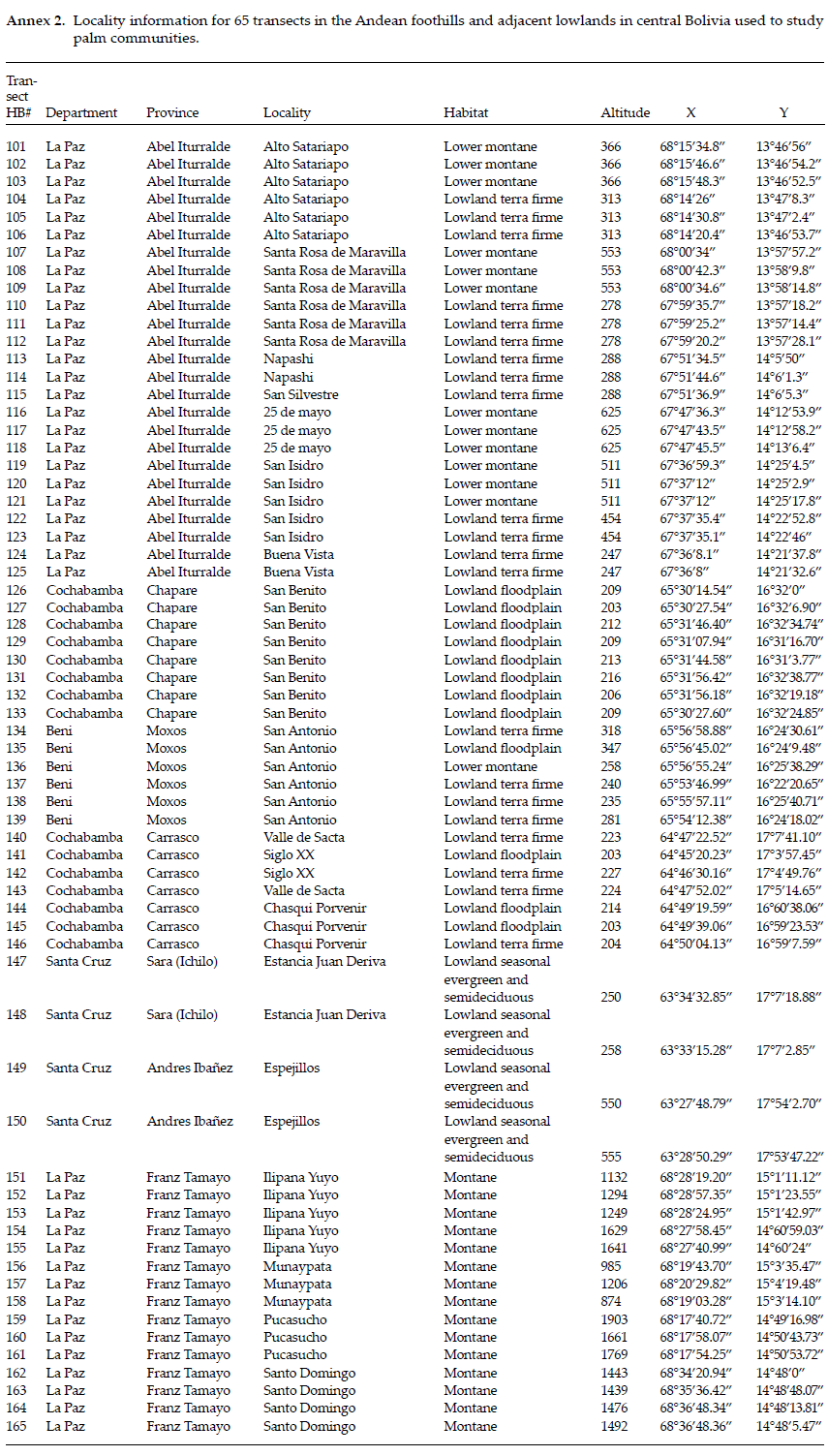
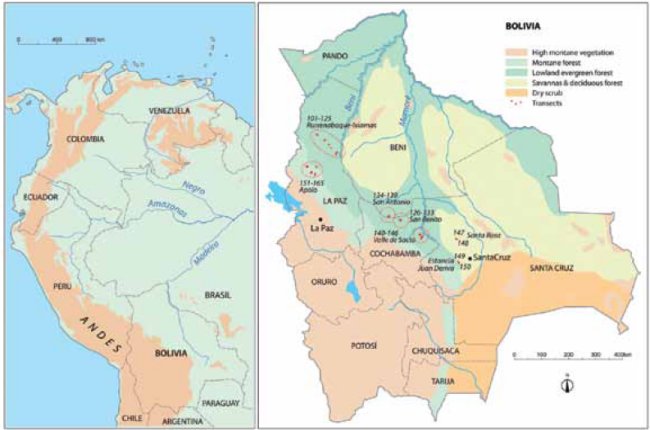
<body><![CDATA[<p>&nbsp;</p>     <p>&nbsp;</p>     <p align="center"><b><font face="Verdana" size="3">Introduction</font></b></p>     <p align="justify"><font face="Verdana" size="2">Palms are emblematic for tropical forests throughout the Americas, Africa, and Southeast Asia. Everywhere palms are conspicuous elements of the vegetation, standing out due to their particular growth form with single woody trunks and terminal crowns of large palmate or pinnate leaves. Palms are also conspicuous in many open vegetation types such as savannas, where they may form large stands of single species, sometimes bordering rivers, or abounding where the ground water comes close to the surface. Palms are ecologically important as so-called keystone species that provide food for humans and animals during prolonged drought periods (Paine 1995, Garibaldi &amp; Turner 2004), and they are ecologically important as structural elements of the tropical forests where they are not only part of the uppermost canopy but also fill in the mid- and under-storey forest; even the forest floor may be covered with small, shrubby palms (Kahn &amp; de Granville 1992, Henderson 2002). Finally, palms may also form climbing growth forms, especially in Southeast Asia, where hundreds of palm species have long, thin stems and depend on surrounding vegetation for support (Henderson 2009). To humans living in tropical forests, palms are possibly the economically most important plant family. Palm leaves are used for thatching</font> <font face="Verdana" size="2">roofs, palm stems are used as poles for house construction, palms provide fibres for weaving fishing nets, hammocks, brooms and much more, and many palm fruits are edible, either for their soft mesocarp or for their oily endosperm (Paniagua-Zambrana <i>et al. </i>2007, Balslev <i>et al. </i>2008, Macía <i>et al. </i>2011). To understand the structure, richness, and composition of palm communities is, therefore, of direct interest to socio-economic stakeholders and to the political decision makers who regulate the use and extraction of products from tropical forests (Millennium Ecosystem Assessment 2006, Balslev 2011).</font></p>     <p align="justify"><font face="Verdana" size="2">The Bolivian palm flora is well known from a taxonomic point of view. It is well described in the <i>Flora de Palmeras de Bolivia </i>(Moraes 2004), which provides keys to the 28 genera and 80 palm species known to occur in Bolivia. The book also has morphological descriptions of each species and notes on their ecology, including maps of their distribution in Bolivia. Another rich source of information about Bolivian palms is <i>Colecciones de las Palmeras de Bolivia </i>(Moreno &amp; Moreno 2006), which is a richly illustrated account of all Bolivian palms with many notes on their morphology, ecology, and usefulness. In contrast, there are only a few studies of Bolivian palm communities. In an inventory of 75 plots of 0.1 ha (total 7.5 ha) covering an altitudinal range of 150-5,700 m</font> <font face="Verdana" size="2">elevation in the Madidi region there were 24 palm species with dbh &ge; 2.5 cm, and they were found in overall densities of 320-470 ind./ha but only up to 3,000 m elevation (Paniagua-Zambrana 2005). A palm community at Río Hondo, also in the Madidi National Park, had nine palm species with dbh &ge; 10 cm in 9.6 ha and a density of 180 ind./ha (Cabrera &amp; Wallace 2007). Some information can be extracted from ethnobotanical or other inventories that were not focussed on palms. In Iturralde province, an ethnobotanical survey included six palm species with dbh &gt; 10 cm and the two 1-ha plots had 207 and 63 individual palms, respectively (De Walt <i>et al. </i>1999).</font></p>     <p align="justify"><font face="Verdana" size="2">To contribute to a more detailed knowledge of Bolivian palm communities we established 65 transects in subandean forests and adjacent lowland forests in central Bolivia. We were particularly interested in answering the following questions: 1) How are the palm communities composed? 2) How rich are the palm communities in species? 3) How abundant are palms in different kinds of forests and what is the relative abundance of each species? 4) Which palm growth forms are present and how are they represented in the different palm communities? 5) How are the architectural types (solitary, cespitose, colonial) represented in the palm communities? And 6) how are different leaf types represented in the palm communities?</font></p>     <p align="justify">&nbsp;</p>     <p align="center"><font face="Verdana" size="3"><b>Study area</b></font></p>     <p align="justify"><font face="Verdana" size="2">Our study area covers ca. 700 x 125 km (<a href="#f1">Fig. 1</a>) in the subandean zone and adjacent lowlands in north-central Bolivia, stretching from the border with Peru to the so-called <i>Codo de los Andes </i>lying at the latitude of the city of Santa Cruz. Politically our study area crosses the departments of Beni, La Paz, Cochabamba, and Santa Cruz. Geographically, our study area is located on the southwest rim of the Amazon basin, where the rivers Mamoré and Beni leave the Andes to flow into the mighty plain.</font></p>     <p align="justify"><a name="f1"></a></p> <table width="650" border="0" align="center">   <tr>     <td colspan="2"><img src="/img/revistas/reb/v47n1/a02_figura_01.jpg" width="650" height="430"></td>   </tr>   <tr>     <td width="66" valign="top"><font face="Verdana" size="2"><b>Figure 1.</b></font></td>     <td width="580" valign="top">         ]]></body>
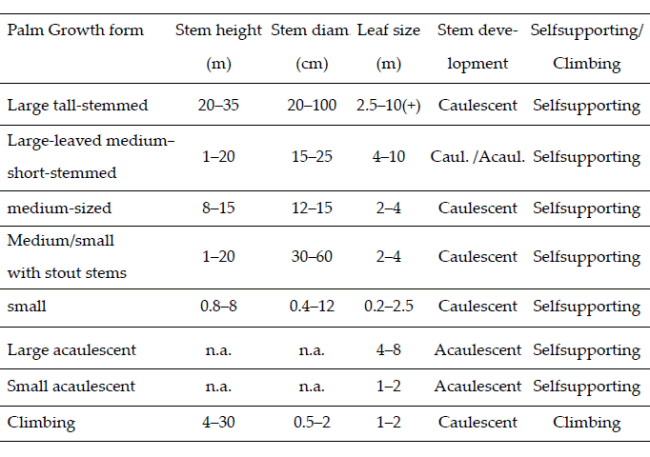
<body><![CDATA[<p align="justify"><font face="Verdana" size="2">Study area in the subandean zone and adjacent lowlands in north-central Bolivia</font> <font face="Verdana" size="2">superimposed on a simplified vegetation map (based on CIA vegetation map of</font> <font face="Verdana" size="2">Bolivia). The transects (red dots) were placed in seven areas indicated with dotted</font> <font face="Verdana" size="2">circles. Twenty-one transects were placed in lowland evergreen <i>terra firme </i>forests</font> <font face="Verdana" size="2">(104-106,110-115,122-125,134,137-140,142-143,146), 17 transects in lowland</font> <font face="Verdana" size="2">evergreen floodplain forests (126-133,135,141,143,145), 4 in lowland seasonal</font> <font face="Verdana" size="2">evergreen and semideciduous forests (147-150), 19 in lower montane forests (101-</font><font face="Verdana" size="2">103,107-109,117-121), and 15 in montane forests (151-165).</font></p>    </td>   </tr> </table>     <p align="justify"><font face="Verdana" size="2">The climate in this area (<a href="http://www.climatediagrams.com" target="_blank">www.climatediagrams.com</a>) is rather wet to the north near the border with Peru, where the precipitation is close to 2,000 mm per year with a short dry season of 2-3 months in June-August during which the monthly precipitation is below 100 mm. In the north temperatures are rather stable at 24-26&deg;C, with the warmest period coinciding with the wettest part of the year. To the south near the city of Santa Cruz the climate is dryer, with around 1,300 mm precipitation per year and with a 6-7 months dry season from April to August/September with less than 100 mm per month. Here the temperatures vary from 20-26&deg;C, again with the warmest period coinciding with the wettest months. Minimum temperature in this area may be a little above freezing point in some winter days, restricting growth of many tropical palms. Along the Andean slope the temperature falls with elevation, usually 0.5&deg;C per 100 meters elevation, so we encounter an average temperature of ca. 16&deg;C at 2,000 m. The precipitation on the slopes varies tremendously depending on topography and winds.</font></p>     <p align="justify"><font face="Verdana" size="2">Our study area borders with and partially overlaps the enormous Madidi National Park, which is known as one of the areas on the planet with the highest biodiversity (Jørgensen <i>et al. </i>2005, Cornejo-Mejía <i>et al. </i>2011) and is located within the great Andean biodiversity hotspot (Myers <i>et al. </i>2000). The vegetation in the low lying parts of our study area covers a gradient from a species rich evergreen rainforest in the humid north to a less species rich seasonal evergreen and semideciduous forest in the seasonal south (Navarro &amp; Ferreira 2004). Away from the rivers, where flooding never occurs, the upland forest is typical Amazonian <i>terra firme, </i>but on the alluvial plain along the rivers the forest is flooded every year in the wet season, which changes its structure to being more open and not as rich in species as the upland forest. Along the slopes of the Andes there are low ranges forming parallel low mountain chains that reach up to 800 m above sea level in the</font> <font face="Verdana" size="2">Andean foreland. These hills are covered with lower montane evergreen forest that is similar to adjacent lowland <i>terra firme, </i>but sometimes not as tall and also usually less species rich because the substrate is rocky and contains less water. Higher up on the slopes the forest changes to true montane forest with a low stature, a very different species composition, and often with many epiphytes covering the branches of trees. This forest reaches up to 3,000 m or more above sea level, but we only visited places up to ca. 2,000 m above sea level. According</font> <font face="Verdana" size="2">to this variation of the vegetation, we have divided our study sites into five categories: 1) lowland evergreen <i>terra firme </i>forest, 2) lowland evergreen floodplain forest, 3) lowland seasonal evergreen and semideciduous forest, 4) lower montane evergreen forest (&lt;800 m), and 5) montane evergreen forest (800-2,000 m).</font></p>     <p align="justify"><font face="Verdana" size="2">We accessed the forest at seven sites (<a href="#f1">Figure 1</a>, <a href="#a2">Annex 2</a>): 1) along the road between San Buenaventura and Ixiamas in Iturralde province in the department of La Paz, where we had access to lowland evergreen <i>terra firme </i>forest</font> <font face="Verdana" size="2">northeast of the road and to lower montane forests southwest of the road; 2) near Apolo in the department of La Paz, where we had access to several sites of montane forests at altitudes of 800-2,000 m; 3) near the village of San Antonio in the Beni department near the border with Cochabamba department, where we had access to both lowland evergreen <i>terra firme </i>and floodplain forest; 4) near the indigenous village of San Benito in the department of Cochabamba at the Isiboro river, where we had access to lowland evergreen floodplain forest; 5) along the Cochabamba-Santa Cruz highway near Valle de Sajta and the lateral road to Puerto Villarroel, where we had access to both lowland evergreen <i>terra firme </i>and floodplain forests; 6) near the village of Santa Rosa 90 km northwest of Santa Cruz, where we had access to lowland seasonal evergreen and semideciduous forest, and 7) in the Espejillos protected area 30 km west of Santa Cruz and Estancia Juan Deriva, where we had access to lowland seasonal evergreen and semideciduous forest.</font></p>     <p align="justify">&nbsp;</p>     <p align="center"><font face="Verdana" size="3"><b>Methods</b></font></p>     <p align="justify"><font face="Verdana" size="2">We installed 65 transects measuring 5 x 500 m (0.25 ha) and collected our data according to a pre-established protocol (Balslev <i>et al. </i>2010) that involves: 1) searching out a forest segment without or with only slight human impact; 2) marking a baseline 500 m long with stakes every five meters, and 3) counting and identifying all palm individuals including seedlings, juveniles, sub-adults and adults in 5 x 5 m subunits. Our protocol (Balslev <i>et al. </i>2011) involves collecting additional ecological data, but that data is not used in this paper. We collected and photographed 172 herbarium vouchers to document species that were difficult to identify or otherwise interesting. These vouchers are deposited in the AAU, LPB, and UASC herbaria and can be seen with photographic images in the Aarhus University Herbarium database (<a href="http://www.aubot.dk" target="_blank">www.aubot.dk</a>, enter collector=Balslev; country=Bolivia; family=Arecaceae). In the</font> <font face="Verdana" size="2">field, the data were written on pre-printed data sheets and subsequently entered into a computerized database. Species occurrence from our data is available through the Global Biodiversity Information Facility portal (<a href="http://www.gbif.org" target="_blank">www.gbif.org</a>).</font></p>     <p align="justify"><font face="Verdana" size="2">From our observations in the field and general knowledge of the palms, we divided all species into three architectural models (Dransfield <i>et al. </i>2008) - cespitose, solitary, and colonial. Our category <i>cespitose </i>is in some other works called clustering, and our category <i>colonial </i>is sometimes called <i>clustering by stolons or rhizomes. </i>We classified all the species into growth forms in a system that considers overall stem size, leaf size, stem development (caulescent <i>versus </i>acaulescent), and whether the stem is self-supporting or climbing (<a href="#t1">Table 1</a>, Balslev <i>et al. </i>2011). Finally, we noted whether the leaves were pinnate or costapalmate - the only two leaf forms represented in our sample.</font></p>     <p align="justify"><a name="t1"></a></p> <table width="650" border="0" align="center">   <tr>     <td width="66" valign="top"><font face="Verdana" size="2"><b>Table 1.</b></font></td>     <td width="580" valign="top">    <p align="justify"><font face="Verdana" size="2">Growth forms of American palms defined by the overall size of their stems and leaves, whether caulescent or acaulescent, and whether climbers or not (Balslev <i>et al. </i>2011).</font></p></td>   </tr>   <tr>     <td colspan="2" valign="top"><img src="/img/revistas/reb/v47n1/a02_tabla_01.gif" alt="" width="650" height="457"></td>   </tr> </table>     ]]></body>
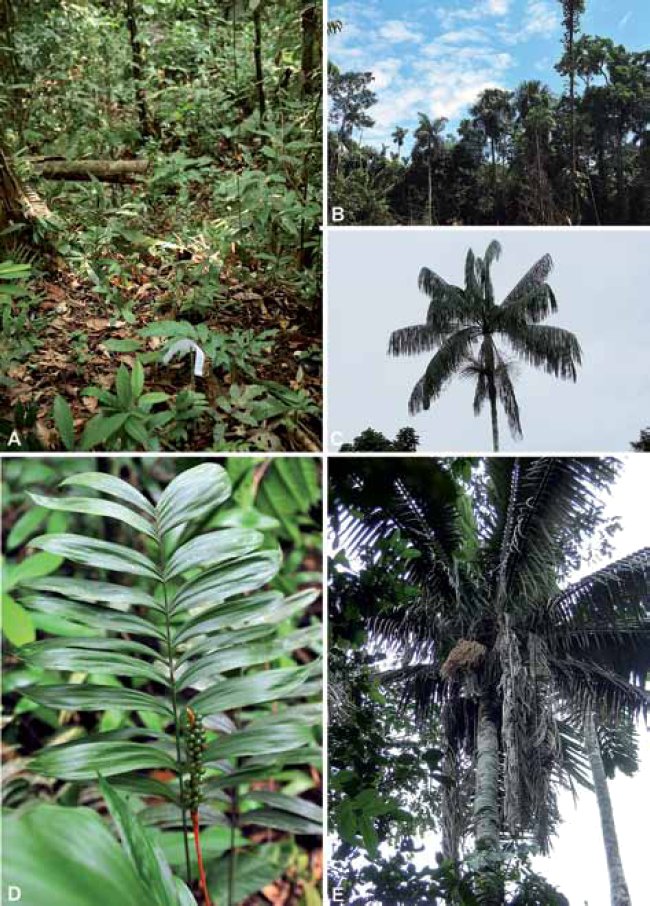
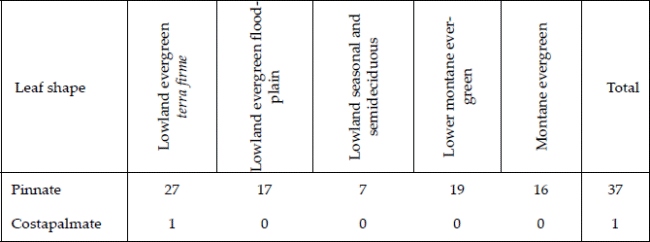
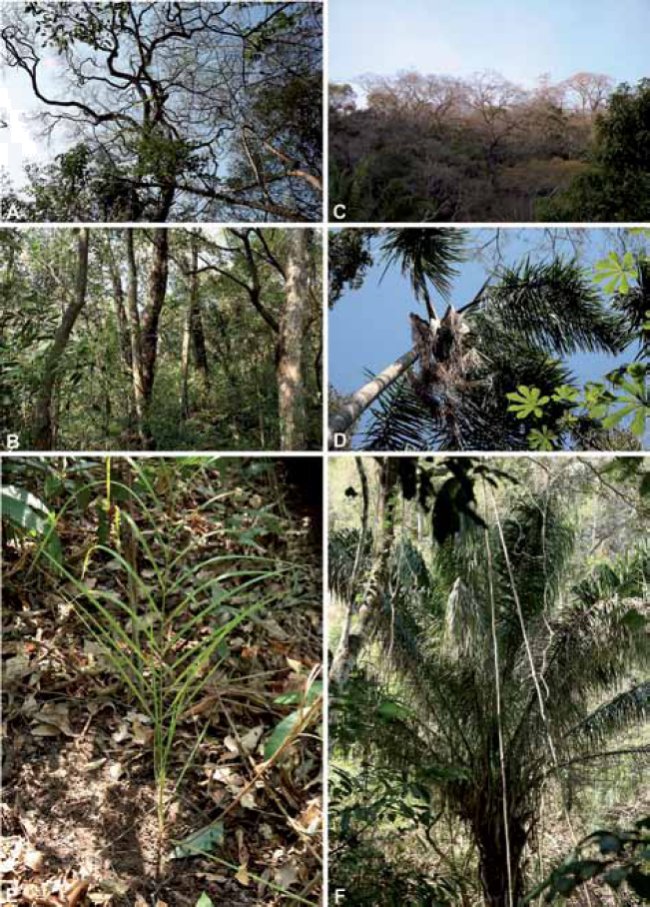
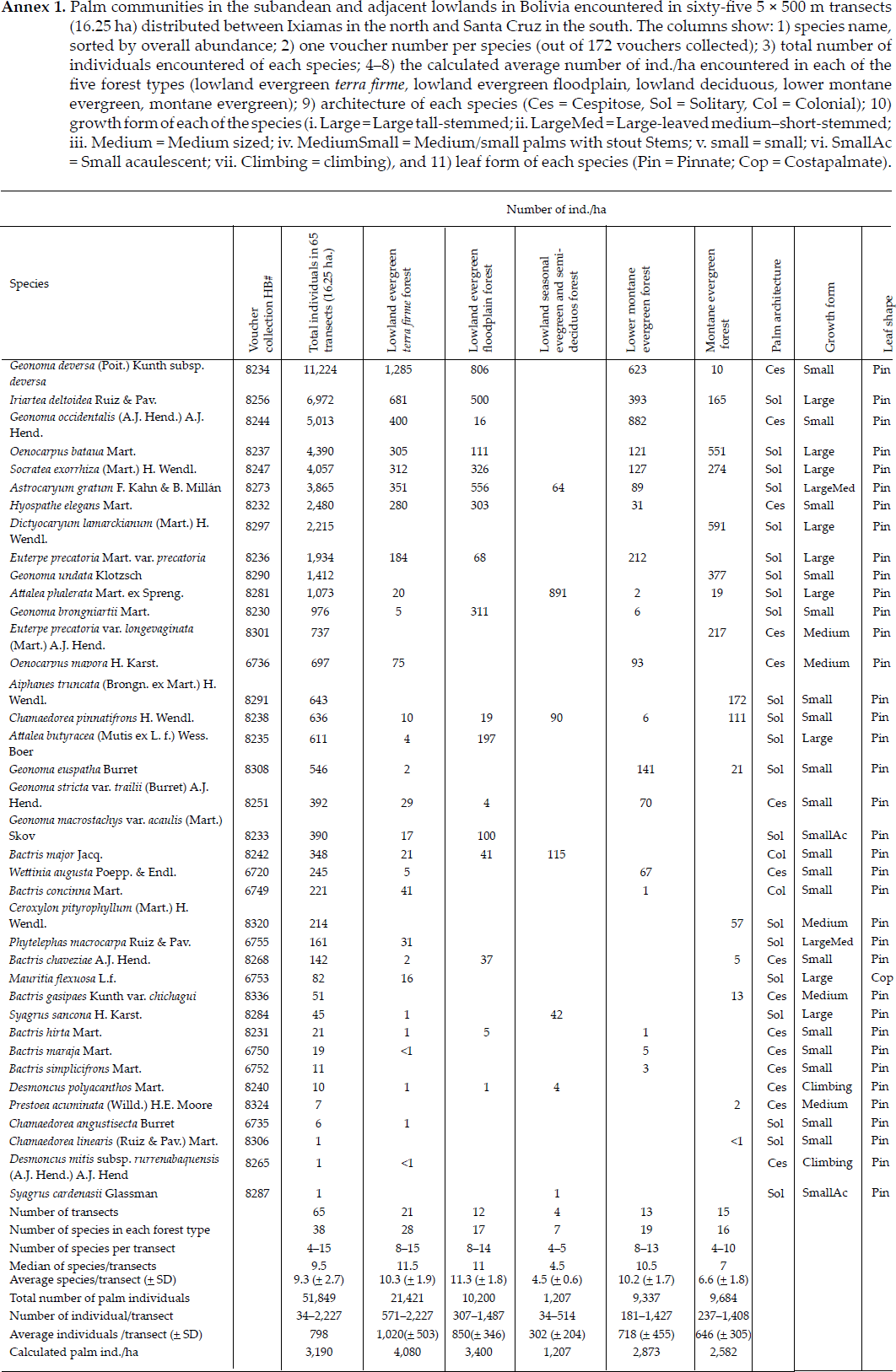
<body><![CDATA[<p align="justify"><font face="Verdana" size="2">One species was encountered with two varieties in our sample <i>(Euterpe precatoria </i>var. <i>precatoria </i>and var. <i>longevaginata); </i>for simplicity of descriptions and discussions, they are counted as if they were two species.</font></p>     <p align="justify">&nbsp;</p>     <p align="center"><font face="Verdana" size="3"><b>Results</b></font></p>     <p align="center"><font face="Verdana" size="2"><b>Palm community composition</b></font></p>     <p align="center">&nbsp;</p>     <p align="center"><font face="Verdana" size="2"><i><b>Lowland evergreen terra firme forest (<a href="#f2">Fig. 2</a>)</b></i></font></p>     <p align="center"><a name="f2"></a></p> <table width="650" border="0" align="center">   <tr>     <td colspan="2"><img src="/img/revistas/reb/v47n1/a02_figura_02.jpg" width="650" height="906"></td>   </tr>   <tr>     <td width="66" valign="top"><font face="Verdana" size="2"><b>Figure 2.</b></font></td>     <td width="580" valign="top">    <p align="justify"><font face="Verdana" size="2">Lowland evergreen <i>terra firme </i>forests and their palms. <b>A-B.</b> Under-storey and tall forest at San Antonio. <b>C.</b> <i>Euterpe precatoria </i>var. <i>precatoria, </i>Valle de Sajta. <b>D.</b> <i>Geonoma </i></font><font face="Verdana" size="2"><i>macrostachys </i>var. <i>acaulis </i>near San Benito. <b>E.</b> <i>Oenocarpus bataua, </i>Valle de Sajta.</font></p></td>   </tr> </table>     <p align="justify"><font face="Verdana" size="2">In the 21 transects (5.25 ha) located in lowland evergreen <i>terra firme </i>forest we encountered 28 species of palms and an average density of 4,080 palm ind./ha (<a href="#a1">Annex 1</a>). Eight species were particularly abundant with over 200 ind./ ha; these included the small palms <i>Geonoma deversa, G. occidentalis, </i>and <i>Hyospathe elegans, </i>that are part of the understorey; a large-leaved medium- to short-stemmed palm, <i>Astrocaryum gratum, </i>which is part of the midstorey, and the large palms <i>Iriartea deltoidea, Oenocarpus bataua, Socratea exorrhiza, </i>and <i>Euterpe precatoria </i>var. <i>precatoria, </i>that form part of the canopy</font> <font face="Verdana" size="2">layer (<a href="#a1">Annex 1</a>). All seven growth forms were represented, but the most common ones were small palms (14 species) and large palms (8 species), whereas the other growth forms were represented by only one or two species each. Of the 28 species 15 were solitary, 11 were cespitose, and two were colonial. Almost all of the species (27) had pinnate leaves; only <i>Mauritia flexuosa </i>had costapalmate leaves (<a href="#t2">Table 2</a>). <i>Mauritia flexuosa </i>is a swamp palm and its occurrence in <i>terra firme </i>forest was in small patches of muddy soil.</font></p>     <p align="justify"><a name="t2"></a></p> <table width="650" border="0" align="center">   <tr>     <td width="66" valign="top"><font face="Verdana" size="2"><b>Table 2.</b></font></td>     <td width="580" valign="top">    ]]></body>
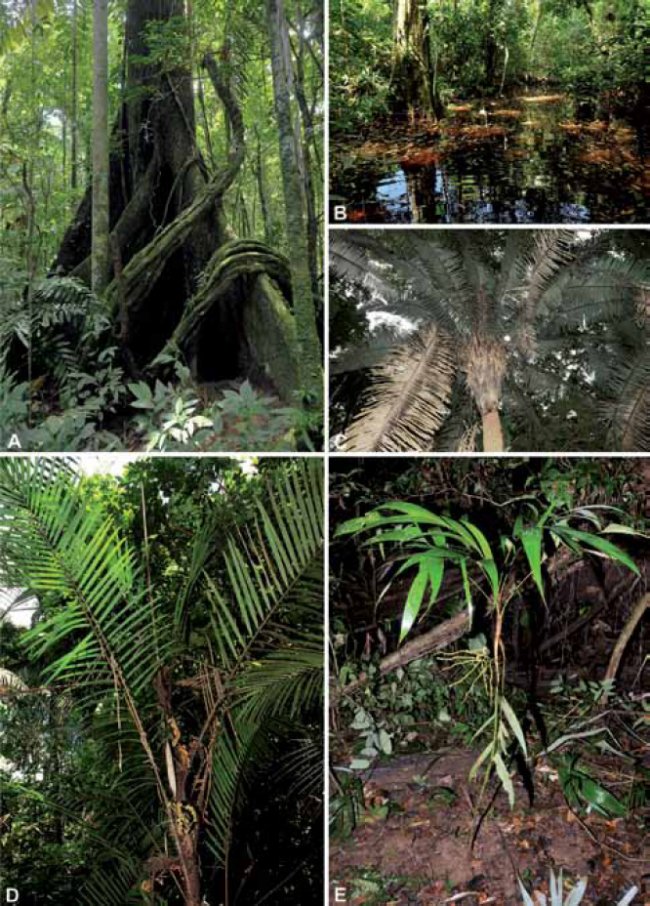
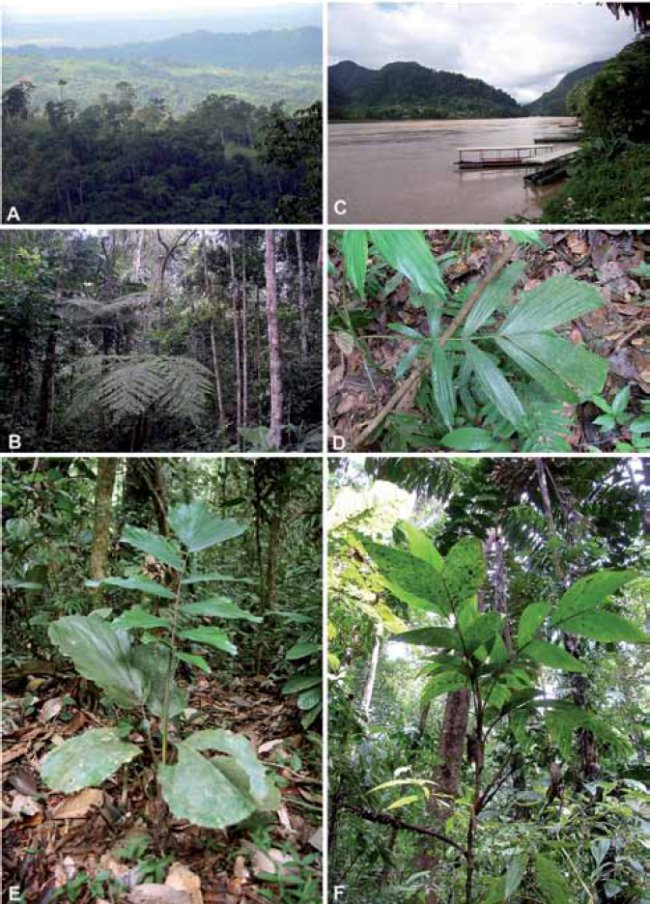
<body><![CDATA[<p align="justify"><font face="Verdana" size="2">Number of species with pinnate and costapalmate leaves in five forest types in the subandean zone and adjacent lowlands in Bolivia. Palm leaf shapes vary much, but in our sample only two leaf forms were present, one of them being the costapalmate leaf represented by only a single species <i>Mauritia flexuosa.</i></font></p></td>   </tr>   <tr>     <td colspan="2" valign="top"><img src="/img/revistas/reb/v47n1/a02_tabla_02.gif" alt="" width="650" height="242"></td>   </tr> </table>     <p align="justify">&nbsp;</p>     <p align="center"><font face="Verdana" size="2"><i><b>Lowland evergreen flood-plain forest (Fig. 3)</b></i></font></p>     <p align="center"><a name="f3"></a></p> <table width="650" border="0" align="center">   <tr>     <td colspan="2"><img src="/img/revistas/reb/v47n1/a02_figura_03.jpg" width="650" height="906"></td>   </tr>   <tr>     <td width="66" valign="top"><font face="Verdana" size="2"><b>Figure 3.</b></font></td>     <td width="580" valign="top">    <p align="justify"><font face="Verdana" size="2">Lowland evergreen floodplain forests and their palms at San Benito. <b>A.</b> View of the</font> <font face="Verdana" size="2">under-storey with a large tree with buttresses and lianas. <b>B.</b> Inundated forest on the</font> <font face="Verdana" size="2">floodplain. <b>C.</b> <i>Astrocaryum gratum, </i>a mid-storey palm. <b>D.</b> <i>Bactris major, </i>a colonial</font> <font face="Verdana" size="2">under-storey palm. <b>E.</b> <i>Geonoma deversa, </i>the most abundant palm species in both</font> <font face="Verdana" size="2">floodplain and <i>terra firme </i>forests.</font></p></td>   </tr> </table>     <p align="justify"><font face="Verdana" size="2">This forest type was surveyed in 12 transects (3 ha) and we encountered 17 palm species with an average density of 3,400 palm ind./ ha The floodplain forest was dominated in the under-storey by the small palms <i>Geonoma deversa, Hyospathe elegans, Geonoma brongniartii, </i>and the acaulescent G. <i>macrostachys </i>var. <i>acaulis; </i>the mid-storey was dominated by <i>Astrocaryum</i></font> <font face="Verdana" size="2"><i>gratum, </i>and the canopy by the large palms <i>Iriartea deltoidea, Oenocarpus bataua, Socratea exorrhiza, </i>and <i>Attalea butyracea. </i>The dominant floodplain species are to a large extent the same as in the <i>terra firme, </i>but G. <i>occidentalis </i>and <i>Euterpe precatoria </i>drop to very low densities and are replaced by G. <i>brongniartii </i>and <i>Attalea butyracea </i>(<a href="#a1">Annex 1</a>). Of the seven growth forms only five were found in the floodplain forests and, as in the <i>terra firme </i>forest, small and large palms were the most common. Of the 17 species nine were solitary, seven were cespitose, and one was colonial. All the floodplain palm species had pinnate leaves (<a href="#t2">Table 2</a>).</font></p>     <p align="justify">&nbsp;</p>     <p align="center"><font face="Verdana" size="2"><i><b>Lowland seasonal evergreen and semideciduous forest (Fig. 4)</b></i></font></p>     <p align="center"><a name="f4"></a></p> <table width="650" border="0" align="center">   <tr>     <td colspan="2"><img src="/img/revistas/reb/v47n1/a02_figura_04.jpg" width="650" height="907"></td>   </tr>   <tr>     <td width="66" valign="top"><font face="Verdana" size="2"><b>Figure 4.</b></font></td>     <td width="580" valign="top">    <p align="justify"><font face="Verdana" size="2">Lowland seasonal evergreen and semideciduous forest at Reserva Estancia Juan Deriva. <b>A-C.</b> Gap, canopy, and understory. <b>D.</b> <i>Syagrus sancona, </i>common in the canopy of seasonal evergreen and semideciduous forests. <b>E.</b> <i>Syagrus cardenasii, </i>an</font> <font face="Verdana" size="2">endemic under-storey palm of Bolivian seasonal evergreen and semideciduous</font> <font face="Verdana" size="2">forests, Agua dulce, Monumento Natural Espejillos, <b>F.</b> <i>Attalea phalerata, </i>a widespread</font> <font face="Verdana" size="2">palm in seasonal evergreen and semideciduous forest.</font></p></td>   </tr> </table>     ]]></body>
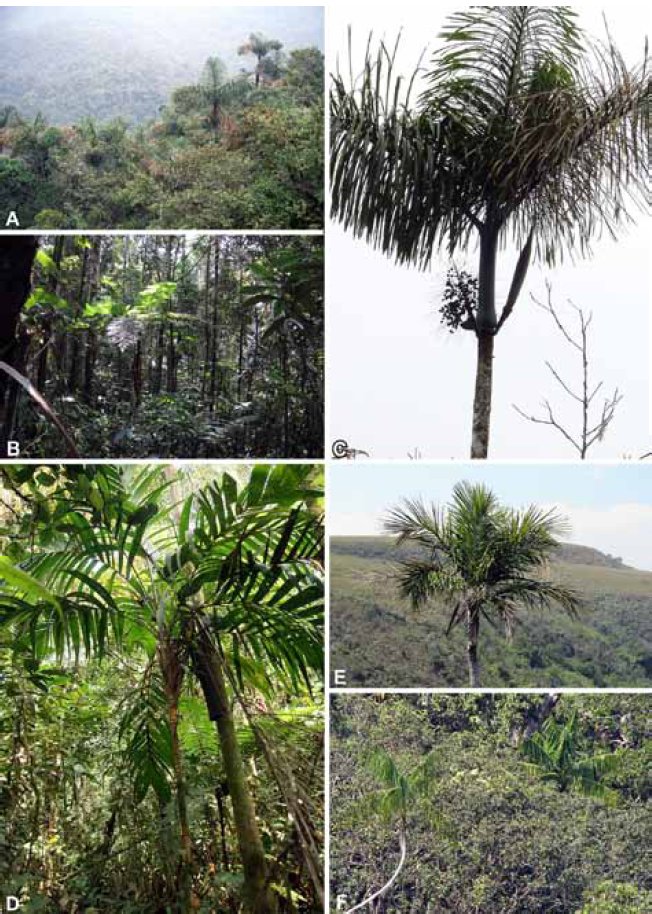
<body><![CDATA[<p align="justify"><font face="Verdana" size="2">Located at the edge of the Amazon basin, in flat landscapes at 200-450 m elevation, this forest type had seven species and an average of 1207 ind./ha The four transects of 0.25 ha each in this forest type were established in places that do</font> <font face="Verdana" size="2">not suffer inundation. The seasonal evergreen and semideciduous forest understory included the small palms <i>Bactris major, Chamaedorea pinnatifrons, </i>and a single record of the small acaulescent <i>Syagrus cardenasii. </i>The seasonal evergreen and semideciduous forest mid-storey had substantial populations of <i>Astrocaryum gratum, </i>and the canopy had abundant <i>Attalea phalerata </i>and some <i>Syagrus sancona. </i>The abundance of <i>Attalea phalerata </i>is an indicator of the lowland seasonal and semideciduous forests. Finally, the climber <i>Desmoncus polyacanthos </i>had some rare occurrences (<a href="#a1">Annex 1</a>). Although there were only seven palms species in the seasonal evergreen and semideciduous forest, they represented five different growth forms with the large and small palms being represented by two species each. There were five solitary species and one each of cespitose and colonial palms. All palm species in the seasonal evergreen and semideciduous forest had pinnate leaves (<a href="#t2">Table 2</a>).</font></p>     <p align="justify">&nbsp;</p>     <p align="center"><font face="Verdana" size="2"><i><b>Lower montane evergreen forest (Fig. 5)</b></i></font></p>     <p align="center"><a name="f5"></a></p> <table width="650" border="0" align="center">   <tr>     <td colspan="2"><img src="/img/revistas/reb/v47n1/a02_figura_05.jpg" width="650" height="904"></td>   </tr>   <tr>     <td width="66" valign="top"><font face="Verdana" size="2"><b>Figure 5.</b></font></td>     <td width="580" valign="top">    <p align="justify"><font face="Verdana" size="2">Lower montane evergreen forest. <b>A.</b> Panorama of the forest in Iturralde province along the San Buenaventura-Ixiamas road. <b>B.</b> Under-storey. <b>C.</b> River Beni near Rurrenabaque. <b>D.</b> Juvenile <i>Socratea exorrhiza, </i><b>E.</b> Juvenile <i>Iriartea deltoidea. </i><b>F.</b> <i>Geonoma</i></font><font face="Verdana" size="2"><i> stricta </i>var. <i>traillii.</i></font></p></td>   </tr> </table>     <p align="justify"><font face="Verdana" size="2">The lower montane forests were studied in 13 transects (3.25 ha) located at elevations of 250-620 m above sea level on the low cordillera that runs parallel to the San Buenaventura-Ixiamas road. There we encountered 19 palm</font> <font face="Verdana" size="2">species and an average density of 2873 ind./ ha The understory was dominated by several small palm species including <i>Geonoma deversa, G. occidentalis, </i>and <i>G. euspatha; </i>the mid-storey had many individuals of <i>Astrocaryum gratum </i>and <i>Oenocarpus mapora; </i>and the canopy was dominated by <i>Iriartea deltoidea, O. bataua, Socratea exorrhiza, </i>and <i>Euterpe precatoria </i>var. <i>precatoria. </i>In addition, there were several less abundant species, particularly small palm species in the under-storey (<a href="#a1">Annex 1</a>). Only four growthforms were represented among the lower montane forest palms; most were small (12 species) or large (five species), whereas large/medium and medium-sized palms were represented by one species each. The lower montane forest had a single colonial species, nine cespitose, and nine solitary species, respectively. All palms had pinnate leaves (<a href="#t2">Table 2</a>).</font></p>     <p align="justify">&nbsp;</p>     <p align="center"><font face="Verdana" size="2"><i><b>Montane evergreen forest (Fig. 6)</b></i></font></p>     <p align="center"><a name="f6"></a></p> <table width="650" border="0" align="center">   <tr>     <td colspan="2"><img src="/img/revistas/reb/v47n1/a02_figura_06.jpg" width="652" height="914"></td>   </tr>   <tr>     <td width="66" valign="top"><font face="Verdana" size="2"><b>Figure 6.</b></font></td>     <td width="580" valign="top">    <p align="justify"><font face="Verdana" size="2">Montane evergreen forests. <b>A.</b> View of forest near Apolo. <b>B.</b> Under-storey of montane</font> <font face="Verdana" size="2">evergreen forest near Apolo, <b>C.</b> <i>Dictyocaryum lamarckianum, </i>a large and abundant</font> <font face="Verdana" size="2">palm in the montane forest, Apolo. <b>D.</b> <i>Geonoma undata, </i>a small under-storey palm,</font> <font face="Verdana" size="2">Pucasucho, near Apolo. <b>E.</b> <i>Ceroxylon pityrophyllum </i>photographed in forest fragments</font> <font face="Verdana" size="2">at Pucasucho, near Apolo. <b>F.</b> <i>Euterpe precatoria </i>var. <i>longevaginata, </i>characteristic of</font> <font face="Verdana" size="2">montane forest, Apolo.</font></p></td>   </tr> </table>     ]]></body>
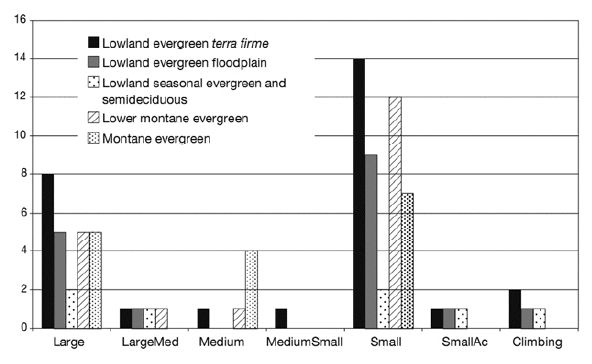
<body><![CDATA[<p align="center">&nbsp;</p>     <p align="justify"><font face="Verdana" size="2">The montane evergreen forest was studied in 15 transects (3.75 ha) in the hills around Apolo at elevations of 850-1,900 m above sea level. There we encountered 16 species and an average density of 2582 ind./ha. The understory was dominated by <i>Geonoma undata, Chamaedorea pinnatifrons, </i>and <i>Aiphanes truncata; </i>the mid-storey had large populations of <i>Oenocarpus</i></font> <font face="Verdana" size="2"><i>mapora </i>and in some locations <i>Ceroxylon pityrophyllum </i>and <i>Bactris gasipaes </i>var. <i>chichagui; </i>whereas the most abundant canopy palms were <i>Iriartea deltoidea, O. bataua, Socratea exorrhiza, Dictyocaryum lamarckianum, </i>and in some places also <i>Attalea phalerata. </i>In addition to these, there were a number of rare, mostly small palm species (<a href="#a1">Annex 1</a>). The palms in the montane forest belonged to three growth forms (large, medium, and small) that were almost equally represented. Most of the montane forest species were solitary (11 species), whereas five were cespitose and none were colonial. All palms in the montane forest had pinnate leaves (<a href="#t2">Table 2</a>).</font></p>     <p align="justify">&nbsp;</p>     <p align="center"><font face="Verdana" size="2"><b>Growth forms</b></font></p>     <p align="justify"><font face="Verdana" size="2">Of the eight growth forms described for tropical American palms (<a href="#t1">Table 1</a>; Balslev <i>et al. </i>2011), we encountered seven in our sample, large acaulescent palms being absent (<a href="#f7">Fig. 7</a>). The growth form with most species was small palms, which included 18 (47%) of the 38 species encountered in our study. The second most common growth form was large palms, which included nine (24%) of the species, and the remaining 11 species belonged to the five remaining growth forms. The different forest types had different representation of the growth forms. Lowland evergreen <i>terra firme </i>forests had all seven growth forms represented among their species; floodplain and seasonal evergreen and semideciduous forest had five growth forms, and lower montane and montane forests had four and three growth forms, respectively (<a href="#f7">Fig. 7</a>).</font></p>     <p align="justify"><a name="f7" id="f7"></a></p> <table width="573" border="0" align="center">   <tr>     <td colspan="2"><img src="/img/revistas/reb/v47n1/a02_figura_07.gif" width="592" height="364"></td>   </tr>   <tr>     <td width="65" valign="top"><font face="Verdana" size="2"><b>Figure 7.</b></font></td>     <td width="498" valign="top">    <p align="justify"><font face="Verdana" size="2">Number of palm species in each growth form (see <a href="#t1">Table 1</a>) in five forest types in the subandean and adjacent lowland forests in Bolivia. Of the eight growth forms defined for American palms (Balslev <i>et al. </i>2011), only seven were encountered in our</font> <font face="Verdana" size="2">study area.</font></p></td>   </tr> </table>     <p align="justify">&nbsp;</p>     <p align="center"><font face="Verdana" size="2"><b>Architecture</b></font></p>     <p align="justify"><font face="Verdana" size="2">Of the three architectural types, solitary palms were represented by 21 species (55%), cespitose palms by 15 species (39%), and colonial palms by two species (5%). Colonial palms were absent in montane forests, but all three architectural types occurred in the remaining four forest types (<a href="#f8">Fig. 8</a>).</font></p>     ]]></body>
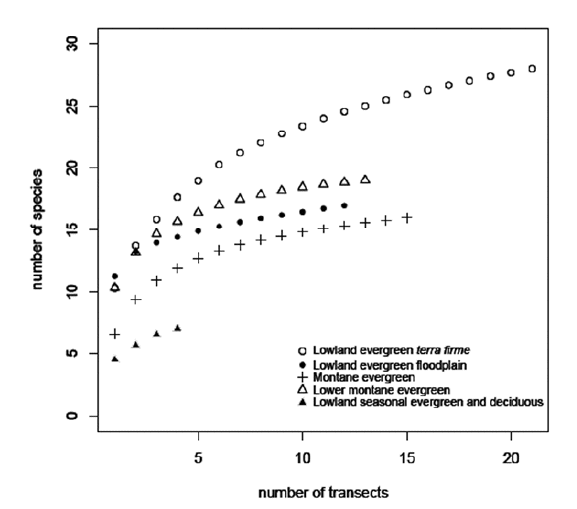
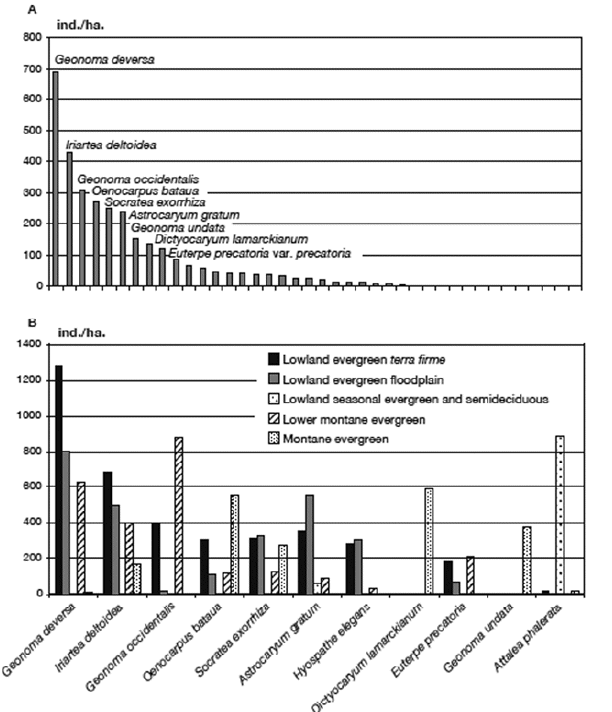
<body><![CDATA[<p align="justify"><a name="f8"></a></p> <table width="573" border="0" align="center">   <tr>     <td colspan="2"><img src="/img/revistas/reb/v47n1/a02_figura_07.gif" width="592" height="364"></td>   </tr>   <tr>     <td width="65" valign="top"><font face="Verdana" size="2"><b>Figure 8.</b></font></td>     <td width="498" valign="top">    <p align="justify"><font face="Verdana" size="2">The number of species of different palm architectural types in the five forest types surveyed in 65 transects (16.25 ha) in the subandean and adjacent lowland forests in</font> <font face="Verdana" size="2">Bolivia.</font></p></td>   </tr> </table>     <p align="justify">&nbsp;</p>     <p align="center"><font face="Verdana" size="2"><b>Species richness</b></font></p>     <p align="justify"><font face="Verdana" size="2">The total palm species richness was 38 species in 19 genera in the 65 transects (16.25 ha) distributed over our 700 x 125 km study area (<a href="#a1">Annex 1</a>). The species rarefaction curves (<a href="#f9">Fig. 9</a>) demonstrate that the lowland evergreen <i>terra firme </i>forest, with 28 species, is the richest among the five forest types and that the lowland seasonal evergreen and semideciduous forest with seven species is the poorest. At the local level we found a mean of 9.5 (range 4-15) palm species in transects (0.25 ha). The mean number of species varied from one forest type to another, lowland evergreen <i>terra firme </i>having the highest mean of 11.5 (8-15) species per transect, while in lowland seasonal evergreen and semideciduous forest the lowest mean was 4.5 (4-5) species per transect.</font></p>     <p align="justify"><a name="f9"></a></p> <table width="573" border="0" align="center">   <tr>     <td colspan="2"><img src="/img/revistas/reb/v47n1/a02_figura_09.gif" width="577" height="509"></td>   </tr>   <tr>     <td width="65" valign="top"><font face="Verdana" size="2"><b>Figure 9.</b></font></td>     <td width="498" valign="top">    <p align="justify"><font face="Verdana" size="2">Rarefaction curves showing the mean (expectation) of palm species richness if <i>x</i> transects randomly sampled from the total number of transects in each of the five forest types studied along the subandean and adjacent lowland forests in Bolivia.</font></p></td>   </tr> </table>     <p align="justify">&nbsp;</p>     <p align="center"><font face="Verdana" size="2"><b>Species abundance</b></font></p>     <p align="justify"><font face="Verdana" size="2">We counted 51,849 individual palms in the 65 transects (16.25 ha) giving an overall average density of 3190 ind./ha. The ranked abundances of the species (<a href="#a1">Annex 1</a>, <a href="#f10">Fig. 10A</a>) show that <i>Geonoma deversa </i>was superabundant in our sample, followed by a group of eight species <i>(Iriartea deltoidea, Geonoma occidentalis, Oenocarpus bataua, Socratea exorrhiza, Astrocaryum gratum, Hyospathe elegans, Dictyocaryum lamarckianum, Euterpe precatoria) </i>that all had &gt;100 ind./ha on average, and finally the long tail of 29 species with &lt;100 ind./ha including three species <i>(Chamaedorea linearis, Desmoncus mitis </i>var. <i>rurrenabaquensis, Syagrus cardenasii) </i>of which only one individual was encountered in the entire inventory. The most abundant species vary greatly in abundance between the five forest types (<a href="#f10">Fig. 10B</a>).</font></p>     ]]></body>
<body><![CDATA[<p align="justify"><a name="f10"></a></p> <table width="650" border="0" align="center">   <tr>     <td colspan="2"><img src="/img/revistas/reb/v47n1/a02_figura_10.gif" width="612" height="712"></td>   </tr>   <tr>     <td width="74" valign="top"><font face="Verdana" size="2"><b>Figure 10.</b></font></td>     <td width="566" valign="top">    <p align="justify"><font face="Verdana" size="2"><b>A.</b> Ranked abundance (ind./ha) of 38 palm species encountered in 65 transects (16.25          ha) in subandean and adjacent lowland forests in Bolivia. <b>B.</b> Abundances of the 11      most common palm species in the five forest types</font></p>    </td>   </tr> </table>     <p align="justify">&nbsp;</p>     <p align="center"><font face="Verdana" size="2"><b>Leaf form</b></font></p>     <p align="justify"><font face="Verdana" size="2">Of the 38 species encountered, all except one, <i>Mauritia flexuosa, </i>have pinnate leaves with</font> <font face="Verdana" size="2">costapalmate leaves being the only exception (<a href="#t2">Table 2</a>).</font></p>     <p align="justify">&nbsp;</p>     <p align="center"><font face="Verdana" size="3"><b>Discussion</b></font></p>     <p align="center"><b><font face="Verdana" size="2">Palm community composition</font></b></p>     <p align="center"><b><font face="Verdana" size="2"><i>Lowland evergreen terra firme forest</i></font></b><font face="Verdana" size="2"><i></i></font></p>     <p align="justify"><font face="Verdana" size="2">This forest type has the highest palm species richness in the study area, the highest density of palms, and most growth forms represented. In terms of local richness (species/transect), it is similar to floodplain and lower montane forests. The relatively high number of species in this forest type compared to the other forest types in our study area is largely due to a long tail of rare species with low abundances. This could suggest that the relatively high species richness</font> <font face="Verdana" size="2">could be an artefact of more intensive sampling of lowland <i>terra firme </i>forest compared to the other forest types in our study (21 transects versus 4, 12, 13, 15). A visual inspection of the rare-faction curve (<a href="#f9">Fig. 9</a>), however, falsifies this hypothesis as there is a widening gap between the species numbers with increasing sampling effort. Compared to lowland evergreen <i>terra firme </i>forest elsewhere in tropical America, its diversity is within the range encountered in those forests (Balslev <i>et al. </i>2011). When compared toother Amazonian <i>terra firme forests </i>(Kahn &amp; Castro 1985, Vormisto <i>et al. </i>2004, Cintra <i>et al. </i>2005, Montufar &amp; Pintaud 2006, Poulsen <i>et al. </i>2006, Costa <i>et al. </i>2009), these Bolivian evergreen <i>terra firme </i>forests are in the lower end of the range of species richness found elsewhere. In terms of composition, the dominant palm species are mostly the same as found elsewhere in the Amazon basin; exceptions to this being </font><font face="Verdana" size="2">the under-storey palm <i>Geonoma occidentalis, </i>which has a south-western distribution in the Amazon basin (Henderson 2011) and <i>Astrocaryum gratum, </i>which belongs to a complex of allopatric species and, therefore, is lacking in most other parts of the Amazon basin (Kahn 2008). The dominant canopy palms include <i>Iriartea deltoidea, Oenocarpus bataua, Socratea exorrhiza, </i>and <i>Euterpe precatoria, </i>which belong</font> <font face="Verdana" size="2">to a group of common and widespread species appearing to underpin the theory of oligarchy in the western Amazon <i>terra firme </i>forests (Macía &amp; Svenning 2005). Their high dominance in several different forest types investigated in this study agrees with the hypothesis that the most widespread Amazonian palms tend to be tall habitat generalists (Ruokolainen &amp; Vormisto 2000).</font></p>     ]]></body>
<body><![CDATA[<p align="justify">&nbsp;</p>     <p align="center"><font face="Verdana" size="2"><i><b>Lowland evergreen flood plain forest</b></i></font></p>     <p align="justify"><font face="Verdana" size="2">This forest type had fewer species than the <i>terra firme </i>forest, and although it was examined in fewer transects (12 vs. 21), the species rarefaction curve (<a href="#f9">Fig. 9</a>) demonstrates that the floodplain forest is truly poorer in species. This pattern agrees well with the situation elsewhere in the Amazon basin, where floodplain forests in general are poorer in species than adjacent <i>terra firme </i>forests due to the fact that many species, including several palms, do not tolerate the annual flooding associated with that habitat (Balslev <i>et al. </i>1987, Kahn &amp; Mejía 1990). It is worth noting, however, that the average local species richness (species/transect) is slightly higher in the floodplain (11.3) than in <i>terra firme </i>(10.3), but the difference is not significant (P=0.083, Mann-Whitney test). The abundant species are the same in the two forest types and the high number of species in the <i>terra firme </i>habitat is due to several rare species that occur with low abundance there. The floodplain, in contrast, does not have this tail of rare species and actually no species was found in the floodplain forest that did not also occur in the <i>terra firme </i>forest, although some species, such as <i>Geonoma brongniartii </i>and <i>Attalea butyracea, </i>were much more abundant on the floodplains. In our sample, the floodplain forest had lower palm density (3,400 ind./ha) than the <i>terra firme </i>forest (4,080 ind./ha), but this seems not to be the rule since some floodplain forests in Bolivia have more individuals than adjacent upland forests (Paniagua-Zambrana 2005).</font></p>     <p align="justify">&nbsp;</p>     <p align="center"><font face="Verdana" size="2"><i><b>Lowland seasonal evergreen and semideciduous forest</b></i></font></p>     <p align="justify"><font face="Verdana" size="2">Within our study area, the lowland seasonal evergreen and semideciduous forest is by far the poorest in terms of species richness having only seven of the 38 species we encountered. It also had much fewer palm ind./ha than the other forest types; it had less than half as many ind./ha (1207) as the second place montane</font> <font face="Verdana" size="2">forest (2,582 ind./ha), and less than one-third as many as the <i>terra firme </i>evergreen lowland forest (4,080 ind./ha). Our sampling inlowland seasonal evergreen and semideciduous forests was less intensive (only four transects), but the rarefaction curve (<a href="#f9">Fig. 9</a>) suggests that species richness really is low compared to the other forest types sampled. The relative species abundances were quite different compared to the other forest types. One species <i>(Syagrus cardenasii) </i>was found only in the seasonal evergreen and semideciduous forest; four species <i>(Attalea phalerata, Bactris major, Syagrus sancona, Desmoncus polyacanthos) </i>were quite abundant in the seasonal evergreen and semideciduous forest but rare in other types, and the remaining two species <i>(Astrocaryum gratum, Chamaedorea pinnatifrons) </i>were more evenly distributed among the other forest types. This shows that the seasonal evergreen and semideciduous forest has a different species composition than the other forest types, especially when the abundance of the species is taken into account. Low species numbers and abundance of palms are also found in other tropical American seasonal evergreen and semideciduous forests. In the seasonal forest at Pinkaití Research Station in central Brazil (Para state), there are 10 species of palms with 167-800 adult ind./ha (Salm <i>et al. </i>2007). On the Yucatan Peninsula, semideciduous and semi-evergreen seasonal forests with 1,100-1,300 mm annual precipitations have 3-4 palm species and 2,167-2,406 palm ind./ha, including all size-classes (Alvarado-Segura <i>et al., </i>unpublished data). In general, palm species richness is highest in aseasonal, wet, and warm areas (Bjorholm <i>et al. </i>2005, Pintaud <i>et al. </i>2008, Eiserhardt <i>et al. </i>2011b). The reduction of palm species richness towards the dryer end and cooler areas is most likely a consequence of their structure, which is based on a single perennial bud with no reserve buds; if the apex is injured, the whole shoots dies (Richards 1996).</font></p>     <p align="justify">&nbsp;</p>     <p align="center"><font face="Verdana" size="2"><i><b>Lower montane evergreen forest</b></i></font></p>     <p align="justify"><font face="Verdana" size="2">This forest type is very similar to the lowland evergreen <i>terra firme </i>forest in our study area (<a href="#a1">Annex 1</a>). The two have similar species composition, abundance ranking of the species, and local diversity (10.2 palm species/transect <i>versus </i>the <i>terr a firme </i>forest 10.3 species/transect). The difference is that lower montane forests have lower palm abundance, <i>i.e., </i>30% less ind./ ha and nine fewer species, mostly because several of the rare <i>terra firme </i>palms drop out on the low hills. On low hills along Río Ucayali in Peru, some 700 km to the northeast, we found a richer palm flora with 36 species (8 transects/ 2 ha) even though the palm abundance there (1,622 ind./ha) was relatively low (Balslev <i>et al. </i>2010). In a lower montane forest in western Ecuador, there were 15 species in a 0.2 ha sample, with a very high density of 3,755 ind./ ha (Borchsenius 1997). The high variability among palm communities in lower montane forests suggests that even though they occupy a similar position in the landscape topography, these forests are not very uniform from one place to another and their palm communities are influenced by a variety of factors.</font></p>     <p align="justify">&nbsp;</p>     ]]></body>
<body><![CDATA[<p align="center"><font face="Verdana" size="2"><i><b>Montane evergreen forest</b></i></font></p>     <p align="justify"><font face="Verdana" size="2">The species richness in the montane forests was low (16) overall and also locally (6.6&plusmn; 1.8 sp./transect), although not as low as in the seasonal evergreen and semideciduous lowland forests. The montane forest share half of their species of palms with forest types at lower </font><font face="Verdana" size="2">elevations <i>(Geonoma deversa, Iriartea deltoidea, Oenocarpus bataua, Socratea exorrhiza, Attalea phalerata, Chamaedorea pinnatifrons, Geonoma euspatha, Bactris chaveziae), </i>but the other </font><font face="Verdana" size="2">half were only found at the high elevations <i>(Dictyocaryum lamarckianum, Geonoma undata, Euterpe precatoria </i>var. <i>longevaginata, Aiphanes truncata, Ceroxylon pityrophyllum, Bactris gasipaes </i>var. <i>chichagui, Prestoea acuminata, Chamaedorea linearis), </i>suggesting that they have a palm flora</font> <font face="Verdana" size="2">distinct from the palm floras of lowland forest types. The coherence of montane forest palm communities again is probably influenced by the peculiar structure of palms with large and single apical meristems that make them vulnerable to frost and other unfavourable conditions that may kill a whole plant by damaging only a single meristem. Some of the montane forest palms are apparently very well adapted to the habitat as witnessed by their high abundances. <i>Dictyocaryum lamarckianum </i>dominates the canopy and has an average of 591 ind./ha, while <i>Geonoma undata </i>dominates the under-storey and has as many as 377 ind./ha. It is also remarkable that the second most abundant palm in the montane forests, <i>Oenocarpus bataua </i>with 551 ind./ha, is also an abundant palm in the evergreen lowland forest types. In Panama, in an evergreen montane forest at 700-1,500 m elevation, there were 24 under-storey palm species in a 0.4 ha sample (Andersen <i>et al. </i>2010); three of the species are shared with the Bolivian montane forests studied here. A Colombian evergreen montane forest in Risaralda located at 1,750-2,250 m above sea level had only 10 palm species in a 2.5-ha sample (Correa-Gómez &amp; Vargas-Ríos 2009); nevertheless, four of the species are shared with our Bolivian sample. In south-eastern Ecuador there were 25 species of palms in 19 transects (4.75 ha) in an evergreen montane forest at 800-1,000 m (Byg <i>et al. </i>2006), seven species of which are shared with the Bolivian sample presented here. As for the lower montane forest, the montane forest palm communities seem to vary considerably on a continental scale, although some species are widespread and turn up in samples taken as far apart as Panama, Colombia, Ecuador, and Bolivia. Our sample of 15 transects in montane evergreen forest was taken within a geographically limited area (max distance between transects 41 km <i>versus </i>700 km for the entire study) which may have limited the species richness and variability encountered in this forest type.</font></p>     <p align="justify">&nbsp;</p>     <p align="center"><font face="Verdana" size="2"><b>Growth forms</b></font></p>     <p align="justify"><font face="Verdana" size="2">The high diversity of small palms in all except the lowland seasonal evergreen and semideciduous forests is similar to palm communities throughout tropical America, which is also true for the second position large palms, and their proportions of the total species number (47% and 24%) fall well within the ranges reported elsewhere (Balslev <i>et al. </i>2011), so this seems to be a general pattern which is corroborated by our results.</font></p>     <p align="justify">&nbsp;</p>     <p align="center"><font face="Verdana" size="2"><b>Architecture</b></font></p>     <p align="justify"><font face="Verdana" size="2">The percentage of cespitose species in our sample (39%) is much below the average of 57% and even below the quartiles encountered in a series of tropical American palm communities (reviewed in Balslev <i>etal. </i>2011). Between the five forest types studied here, there were similar but not equal proportions of cespitose <i>versus </i>solitary and colonial species (<a href="#f8">Figure 8</a>). Although the cespitose life form could be seen as an adaptation to withstand unfavorable climatic conditions (cold, drought) because of the capacity to sprout from the base, that hypothesis is not supported by our data; instead, both seasonal evergreen and semideciduous and montane forests, where such adverse climatic conditions exist, have higher proportions of solitary palm species.</font></p>     <p align="justify">&nbsp;</p>     <p align="center"><font face="Verdana" size="2"><b>Species richness</b></font></p>     ]]></body>
<body><![CDATA[<p align="justify"><font face="Verdana" size="2">In a continental context, the regional species richness of 38 species in 19 genera lies well within the range of 4-47 species encountered in 65 different inventories of tropical American palms, made in sample areas of 0.1-7.2 ha (reviewed by Balslev <i>et al. </i>2011). In the context of the western Amazon basin, the species richness encountered here at the southern edge of the basin is on the lower side. For</font> <font face="Verdana" size="2">instance, the number of species registered here is substantially lower than the 56 species in 21 genera registered in Peru's upper Río Ucayali valley 700 km to the north, which was studied in a smaller area (275 x 60 km) and with only 35 transects (8.75 ha, Balslev <i>et al. </i>2010). It is also much less than the 48 palm species found in 10 transects (2.5 ha) in the Iquitos-Pebas region in Peru (Vormisto <i>et al. </i>2004) some 1,200 km to the north. The rarefaction curves (<a href="#f9">Fig. 9</a>) suggest that more intensive studies in lowland evergreen <i>terra firme </i>forest and in lowland seasonal evergreen and semideciduous forest would reveal more species there than registered in the present study, but that the species numbers would still be lower than further north along the Andes in the western Amazon basin. This agrees with a general pattern of a latitudinal gradient with high palm species richness along the equatorial line and with decreasing richness further north and further south. This pattern has been demonstrated both with the use of transect derived data (Kristiansen <i>et al. </i>2011) and range map derived data (Bjorholm <i>et al. </i>2005). For local species richness the average of 9.3 species/transect in our 65 transects is lower than values found elsewhere in the western Amazon (Kristiansen <i>et al. </i>2011). Overall, our results show that palm species richness in central Bolivia is in the lower end of what is found in the Amazon basin and in particular the western part of this region. Our data are derived from forests on the southern edge of the Amazon basin and a few seasonal evergreen and semideciduous forests bordering the Amazon basin that house forest types that are much less species rich, also when it comes to palms. Since the lower species richness is associated with lower precipitations and lower minimum temperature, this spatial pattern underpins climate as a very strong driver of the distribution of palm diversity, as has been shown for tropical American palms (Eiserhardt <i>et al. </i>2011a).</font></p>     <p align="justify">&nbsp;</p>     <p align="center"><font face="Verdana" size="2"><b>Abundance</b></font></p>     <p align="justify"><font face="Verdana" size="2">The abundances reported here include all individuals of palms, including seedlings, juveniles, sub-adults and adults. A separate analysis of abundances of different age classes in a future study may very well reveal interesting differences between the palm communities studied and the species they are made up of. The abundances of palms in Bolivian forests studied here fall well within the limits reported for palm communities throughout tropical America (reviewed in Balslev <i>et al. </i>2011). Also here, as in almost all other communities, there is an uneven distribution of individuals among the species. The superabundant <i>Geonoma deversa </i>(<a href="#f10">Fig. 10A</a>) had very high densities in the three forest types in the humid lowlands <i>(terra firme, </i>floodplain, lower montane), but disappeared with higher elevations (montane forests) and increasing seasonality (deciduous forests). This species is widely distributed in the Amazon basin (Henderson 2011) and its very high local abundance in some places has made it an attractive palm for thatch (Flores &amp; Ashton 2000, Paniagua-Zambrana <i>et al. </i>2007). The other abundant species (<a href="#f10">Fig. 10B</a>) are mostly widespread in the Amazon basin (Henderson <i>et al. </i>1995), but a few of them are abundant in more limited ecosystems. <i>Geonoma occidentalis </i>is distributed in the south-western Amazon basin (Henderson 2011), where it -as seen in this study- can be quite abundant. Morphologically, <i>Geonoma deversa </i>and G. <i>occidentalis </i>are very similar and they are closely related phylogenetically (Roncal <i>et al. </i>2011), so it is interesting and maybe surprising that they co-occur in many transects. <i>Dictyocaryum </i></font><font face="Verdana" size="2"><i>lamarckianum </i>and <i>Geonoma undata </i>are also </font><font face="Verdana" size="2">among the 10 most abundant species overall even if they are restricted to the montane forest, which reflects their highly dominant position there. <i>Attalea phalerata </i>occurs in four of the forest types investigated here and it is the most abundant species in the lowland seasonal evergreen and semideciduous forest where</font> <font face="Verdana" size="2">it is particularly abundant on humid soils in topographic depressions and in areas with a high freatic level, but only barely present in the other forest types. This species is distributed around the southern edge of the Amazon basin (Henderson 1995) and is obviously adapted to grow under seasonal and man made dry conditions even if it does enter less seasonal forest types in low numbers. In the other extreme, the ten least abundant species all have less than 50, and five of them have less than 10, ind./ha. These rare species are most characteristic of the lowland evergreen <i>terra firme </i>forest where six of them were found, but there are also rare species in the other forest types; two rare species were encountered in the floodplains, three in the lowland seasonal evergreen and semideciduous forest, three in the lower montane forest, and three in the montane forest.</font></p>     <p align="justify">&nbsp;</p>     <p align="center"><font face="Verdana" size="2"><b>Leaf form</b></font></p>     <p align="justify"><font face="Verdana" size="2">The palm leaf has been considered the most complex determinate organ found in plants (Tomlinson 1979), and it is the distinguishing character of the family. Palm leaves are plicate and mostly dissected, they may be induplicate or reduplicate, pinnate, palmate, or costapalmate; the lamina, though mostly dissected, may in some cases be entire, and the pinnate lamina may in some cases be bi-pinnate (Dransfield <i>et al. </i>2008). Considering this variation in palm leaf shapes, it is remarkable that almost all species in our study area have reduplicate pinnate leaves, the only exception being <i>Mauritia flexuosa, </i>which has reduplicate costapalmate leaves. Elsewhere in tropical America, induplicate palmate and costapalmate leaves are found in genera of the subfamily Coryphoideae. This subfamily occurs in South America <i>(Sabal, Trithrinax, </i></font><font face="Verdana" size="2"><i>Cocoothrinax, Itaya, Chelyocarpus, Copernicia), </i></font><font face="Verdana" size="2">but not in our study area. Reduplicate palmate and costapalmate leaves are characteristic of the subtribe Mauritiinae <i>(Lepidocaryum,</i></font> <font face="Verdana" size="2"><i>Mauritiella, Mauritia) </i>of the subfamily </font><font face="Verdana" size="2">Calamoideae, which is distributed in South America, but with only <i>Mauritia </i>represented in our study area. In Central America, where coryphoid palms are common, a much larger proportion of palm species (63%) and individuals are palmate (Balslev <i>et al. </i>2011, Alvarado-Segura, unpublished data). This marked difference can be attributed to broad-scale biogeographic processes. The palmate-leaved coryphoid palms are thought to have reached tropical America through a boreotropic invasion during Paleocene/Eocene (Bjorholm <i>et al. </i>2006).</font></p>     <p align="justify">&nbsp;</p>     <p align="center"><font face="Verdana" size="3"><b>Conclusions</b></font></p>     <p align="justify"><font face="Verdana" size="2">The palm communities along the subandean zone and adjacent lowlands in Bolivia are rich in species and have high abundance of individual palms. The diversity of the communities falls well within the ranges reported for other tropical American palm communities, but they lie in the lower end of the diversity spectrum for the Amazon basin. Our data corroborate the latitudinal gradient in palm richness from the equatorial line towards the south with less rich communities further away from the equatorial line. Among the communities studied, the lowland evergreen <i>terra firme </i>forests were the richest and included a &quot;tail&quot; of rare species that was much less pronounced in the other forest types. The strong influence of climate on the diversity and richness of palm communities was corroborated within our study area, where species richness fell toward higher elevations with colder climates and towards drier and more seasonal areas with seasonal evergreen and semideciduous forests. Particularly the montane forests were qualitatively different with half of their species being restricted to them. Otherwise the dominant species in all communities were generally widespread and with broad ecological amplitudes.</font></p>     ]]></body>
<body><![CDATA[<p align="justify">&nbsp;</p>     <p align="center"><font face="Verdana" size="3"><b>Acknowledgements</b></font></p>     <p align="justify"><font face="Verdana" size="2">We thank the European Commission Framework 7 programme for support to the PALMS project (contract no. 213126 to HB), and the Danish Natural Science Research Council for supporting our palm research (grant no 10-083348 to HB). Francis Kahn kindly reviewed and updated <a href="#t1">Table 1</a>. We thank J.L. Luteyn for reading and commenting on the manuscript.</font></p>     <p align="justify">&nbsp;</p>     <p align="center"><font face="Verdana" size="3"><b>Literature</b></font></p>     <p align="justify"><font face="Verdana" size="2">Andersen, K.M., B.L. Turner &amp; J.W. Dalling. 2010. Soil-based habitat partitioning in understorey palms in lower montane tropical forests. Journal of Biogeography 37: 278-292.</font></p>     <p align="justify"><font face="Verdana" size="2">Balslev, H. 2011. Palm harvest impacts in northwestern South America. The Botanical Review <i>77: </i>370-380.</font></p>     <p align="justify"><font face="Verdana" size="2">Balslev, H., W. Eiserhardt, T. Kristiansen, D. Pedersen &amp; C. Grández. 2010. Palms and palm communities in the upper Ucayali river valley - a little known region in the Amazon basin. Palms — Journal of the International Palm Society 54(2): 57-72.</font></p>     <p align="justify"><font face="Verdana" size="2">Balslev, H., C. Grández, N.Y. Paniagua-Zambrana, A.L. Møller &amp; S. Lykke Hansen. 2008. Palmas (Arecaceae) útiles en los alrededores de Iquitos, Amazonía Peruana. Revista Peruana de Biología 15(1): 121-132.</font></p>     <p align="justify"><font face="Verdana" size="2">Balslev, H., F. Kahn, B. Millan, J.-C., Svening., F. Borchsenius, T. Kristiansen, D. Pedersen &amp; W. Eiserhardt. 2011. Species diversity and growth forms in tropical American palm communities. The Botanical Review <i>77: </i>381-425.</font></p>     ]]></body>
<body><![CDATA[<p align="justify"><font face="Verdana" size="2">Balslev, H., J.L. Luteyn, B. Øllgaard &amp; L.B. Holm-Nielsen. 1987. Composition and structure of adjacent unflooded and floodplain forest in Amazonian Ecuador. Opera Botanica 92: 37-57.</font></p>     <p align="justify"><font face="Verdana" size="2">Bjorholm, S., J.-C. Svenning, W.J. Baker, F. Skov &amp; H. Balslev. 2006. Historical legacies in the geographical diversity patterns of New World palm (Arecaceae) subfamilies. Botanical Journal of the Linnaean Society 151:113-125.</font></p>     <p align="justify"><font face="Verdana" size="2">Bjorholm, S., J.-C. Svenning, F. Skov &amp;H. Balslev. 2005. Environmental and spatial controls of palm (Arecaceae) species richness across the Americas. Global Ecology and Biogeography 14: 423-429.</font></p>     <p align="justify"><font face="Verdana" size="2">Borchsenius, F. 1997. Palm communities in western Ecuador. Principes 41: 93-99.</font></p>     <p align="justify"><font face="Verdana" size="2">Byg, A., J. Vormisto &amp; H. Balslev. 2006. Using the useful: characteristics of used palms in south-eastern Ecuador. Environment, Development and Sustainability 8: 495-506.</font></p>     <p align="justify"><font face="Verdana" size="2">Cabrera, W.H. &amp; R. Wallace. 2007. Densidad y distribución de palmas arborescentes en un bosque preandino - amazónico de Bolivia. Ecología en Bolivia 42(2): 121-135.</font></p>     <p align="justify"><font face="Verdana" size="2">Cintra, R., A. De Carvalho Ximenes, F.R. Gondim &amp; M.S. Kropf. 2005. Forest spatial heterogeneity and palm richness, abundance and community composition in terra firme forest, central Amazon. Revista Brasileira de Botanica 28: 75-84.</font></p>     <p align="justify"><font face="Verdana" size="2">Correa-Gomez, D.F. &amp; O. Vargas-Ríos. 2009. Regeneration of palms in native forests and plantations at Otun-Quimbaya Fauna and Flora Sanctuary (Risaralda, Colombia). Caldasia 31:195-212.</font></p>     <!-- ref --><p align="justify"><font face="Verdana" size="2">Cornejo-Mejía, M., P.M. Jørgensen, M.J. Macía, I. Loza, A. Fuentes &amp; L. Cayola (eds.). 2011. Memorias de los 10 años de investigación botánica realizada en la Región Madidi: &quot;conociendo una de las regiones más biodiversas del mundo&quot;. Herbario Nacional de Bolivia, Missouri Botanical Garden,. La Paz. 30pp.</font>&nbsp;&nbsp;&nbsp;&nbsp;&nbsp;&nbsp;&nbsp;&nbsp;[&#160;<a href="javascript:void(0);" onclick="javascript: window.open('/scielo.php?script=sci_nlinks&ref=017880&pid=S1605-2528201200010000200014&lng=','','width=640,height=500,resizable=yes,scrollbars=1,menubar=yes,');">Links</a>&#160;]<!-- end-ref --><p align="justify"><font face="Verdana" size="2">Costa, F.R.C., J.L. Guillaumet, A.P. Lima &amp; O.S. Pereira. 2009. Gradients within gradients: The mesoscale distribution patterns of</font> <font face="Verdana" size="2">palms in a central Amazonian forest. Journal of Vegetation Science 20: 69-78.</font></p>     ]]></body>
<body><![CDATA[<p align="justify"><font face="Verdana" size="2">De Walt, S., G. Bourdy, L.R. Chávez de Michel &amp; C. Quenevo. 1999. Ethnobotany of the Tacana: Quantitative inventories of two permanent plots of northwestern Bolivia. Economic Botany 53: 237-260.</font></p>     <!-- ref --><p align="justify"><font face="Verdana" size="2">Dransfield, J., N.W. Uhl, C.B. Asmussen, W.J. Baker, M.M. Harley &amp; C.E. Lewis. 2008. Genera palmarum: The evolution and classification of palms. Kew Publishing, London. 732 pp</font>&nbsp;&nbsp;&nbsp;&nbsp;&nbsp;&nbsp;&nbsp;&nbsp;[&#160;<a href="javascript:void(0);" onclick="javascript: window.open('/scielo.php?script=sci_nlinks&ref=017883&pid=S1605-2528201200010000200017&lng=','','width=640,height=500,resizable=yes,scrollbars=1,menubar=yes,');">Links</a>&#160;]<!-- end-ref --><p align="justify"><font face="Verdana" size="2">Eiserhardt, W.L., S. Bjorholm, J.-C. Svenning, T.F. Rangel &amp; H. Balslev. 2011a. Testing the water-energy theory on American palms (Arecaceae) using geographically weighted regression. PLoS ONE 6(11): e27027.</font></p>     <p align="justify"><font face="Verdana" size="2">Eiserhardt, W.L., J.-C. Svenning, W.D. Kissling &amp; H. Balslev. 2011b. Geographical ecology of palms (Arecaceae): determinants of diversity and distributions across spatial scales. Annals of Botany 108:1391-1416.</font></p>     <p align="justify"><font face="Verdana" size="2">Flores, C.F. &amp; P.M. Ashton. 2000. Harvesting impact and economic value of <i>Geonoma deversa, </i>Arecaceae, an understory palm used for roof thatching in the Peruvian Amazon. Economic Botany 54:267-277.</font></p>     <p align="justify"><font face="Verdana" size="2">Garibaldi, A. &amp; N. Turner. 2004. Cultural keystone species: Implications for ecological conservation and restoration. Ecology and Society 9(3): 1 (online) URL: <a href="http://www.ecologyandsociety.org/vol9/iss3/art1" target="_blank">http://www.ecologyandsociety.org/vol9/iss3/art1</a></font></p>     <!-- ref --><p align="justify"><font face="Verdana" size="2">Henderson, A. 1995. Palms of the Amazon. Oxford University Press, Oxford. 362 pp</font>&nbsp;&nbsp;&nbsp;&nbsp;&nbsp;&nbsp;&nbsp;&nbsp;[&#160;<a href="javascript:void(0);" onclick="javascript: window.open('/scielo.php?script=sci_nlinks&ref=017888&pid=S1605-2528201200010000200022&lng=','','width=640,height=500,resizable=yes,scrollbars=1,menubar=yes,');">Links</a>&#160;]<!-- end-ref --><p align="justify"><font face="Verdana" size="2">Henderson, A. 2002. Evolution and ecology of palms. The New York Botanical Garden Press, Bonx. 259 pp.</font></p>     <p align="justify"><font face="Verdana" size="2">Henderson, A. 2009. Palms of southern Asia. Princeton University Press, New Jersey. 199 pp.</font></p>     <p align="justify"><font face="Verdana" size="2">Henderson, A. 2011. A revision of <i>Geonoma </i>(Arecaceae). Phytotaxa 17:1-271.</font></p>     ]]></body>
<body><![CDATA[<p align="justify"><font face="Verdana" size="2">Henderson, A., G. Galeano &amp; R. Bernal. 1995. Field guide to the palms of the Americas.</font> <font face="Verdana" size="2">Princeton University Press, New Jersey. 353 pp.</font></p>     <p align="justify"><font face="Verdana" size="2">Jørgensen, P.M., M.J. Macía, A. Fuentes, S.G. Beck, M. Kessler, N. Paniagua, R. Seidel, C. Maldonado, A. Araujo-Murakami, L. Cayola, T. Consiglio, T.J. Killeen, W.H. Cabrera, F. Bascopé, D. De la Quintana, T. Miranda, F. Canqui &amp; V. Cardona-Peña. 2005. Lista anotada de las plantas vasculares registradas en la región de Madidi. Ecología en Bolivia 40(3): 70-169.</font></p>     <p align="justify"><font face="Verdana" size="2">Kahn, F. 2008. The genus <i>Astrocaryum. </i>Revista Peruana de Biologia 15(supl. 1): 31-48.</font></p>     <p align="justify"><font face="Verdana" size="2">Kahn, F. &amp; A. de Castro. 1985. The palm community in a forest of central Amazonia, Brazil. Biotropica 17:210-216.</font></p>     <p align="justify"><font face="Verdana" size="2">Kahn, F. &amp; J.-J. de Granville. 1992. Palms in Forest Ecosystems of Amazonia. Ecological Studies 95. Springer-Verlag, Berlin, Heidelberg, New York.</font></p>     <p align="justify"><font face="Verdana" size="2">Kahn, F. &amp; K. Mejía. 1990. Palm communities in wetland forest ecosystems in Peruvian Amazonia. Forest Ecology and Management 33/44:169-179.</font></p>     <p align="justify"><font face="Verdana" size="2">Kristiansen, T., J.-C. Svenning, D. Pedersen, W.L. Eiserhardt, C. Grández &amp; H. Balslev. 2011. Local and regional palm (Arecaceae) species richness patterns and their cross-scale determinants in the western Amazon. Journal of Ecology 99: 1001-1015.</font></p>     <p align="justify"><font face="Verdana" size="2">Macía, M.J., P.J. Armesilla, R. Cámara-Leret, N. Paniagua-Zambrana, S. Villalba, H. Balslev &amp; M. Pardo-de-Santayana. 2011 Palm uses in northwestern South America: A quantitative review. The Botanical Review <i>77:</i>462-570.</font></p>     <p align="justify"><font face="Verdana" size="2">Macía, M.J. &amp; J.-C. Svenning. 2005. Oligarchic dominance in western Amazonian plant communities. Journal of Tropical Ecology 21: 613-626.</font></p>     <!-- ref --><p align="justify"><font face="Verdana" size="2">Millennium Ecosystem Assessment. 2006. Ecosystems and Human Well-being. Our Human Planet: Summary for Decision Makers. Island Press, Washington. 137 pp.</font>&nbsp;&nbsp;&nbsp;&nbsp;&nbsp;&nbsp;&nbsp;&nbsp;[&#160;<a href="javascript:void(0);" onclick="javascript: window.open('/scielo.php?script=sci_nlinks&ref=017901&pid=S1605-2528201200010000200035&lng=','','width=640,height=500,resizable=yes,scrollbars=1,menubar=yes,');">Links</a>&#160;]<!-- end-ref --><p align="justify"><font face="Verdana" size="2">Montufar, R. &amp; J.C. Pintaud. 2006. Variation in species composition, abundance and microhabitat preferences among western Amazonian terra firme palm communities. Botanical Journal of the Linnean Society 151:127-140.</font></p>     <p align="justify"><font face="Verdana" size="2">Moraes Ramírez, M. 2004. Flora de palmeras de Bolivia. Herbario Nacional de Bolivia, Instituto de Ecología, Carrera de Biología, Universidad Mayor de San Andrés, Plural Editores, La Paz. 262 pp</font></p>     <!-- ref --><p align="justify"><font face="Verdana" size="2">Moreno Suárez, L.R. &amp; O.I. Moreno Suarez. 2006. Colecciones de las palmas de Bolivia. Editorial FAN, Santa Cruz. 575 pp.</font>&nbsp;&nbsp;&nbsp;&nbsp;&nbsp;&nbsp;&nbsp;&nbsp;[&#160;<a href="javascript:void(0);" onclick="javascript: window.open('/scielo.php?script=sci_nlinks&ref=017904&pid=S1605-2528201200010000200038&lng=','','width=640,height=500,resizable=yes,scrollbars=1,menubar=yes,');">Links</a>&#160;]<!-- end-ref --><p align="justify"><font face="Verdana" size="2">Myers, N., R.A. Mittermeier, C.G. Mittermeier, G.A.B. de Fonseca &amp; J. Kent. 2000. Biodiversity hotspots for conservation priorities. Nature 403: 853-858.</font></p>     <p align="justify"><font face="Verdana" size="2">Navarro, G. &amp; W. Ferreira. 2004. Zonas de vegetación potencial de Bolivia: Una base para el análisis de vacíos de conservación. Revista Boliviana de Ecología y Conservación Ambiental 15: 1-40.</font></p>     <p align="justify"><font face="Verdana" size="2">Paine, R.T. 1995. A conversation on refining the concept of keystone species. Conservation Biology 9(4): 962-964.</font></p>     <p align="justify"><font face="Verdana" size="2">Paniagua-Zambrana, N.Y. 2005. Diversidad, densidad, distribución y uso de las palmas en la región del Madidi, noreste del departamento de La Paz (Bolivia). Ecología en Bolivia 40(3): 265-280.</font></p>     <p align="justify"><font face="Verdana" size="2">Paniagua-Zambrana, N.Y., A. Byg, J.-C. Svenning, M. Moraes, C. Grández &amp; H. Balslev. 2007. Diversity of palm uses in the western Amazon. Biodiversity and Conservation 16: 2771-2787.</font></p>     <p align="justify"><font face="Verdana" size="2">Pintaud, J.-C., G. Galeano, H. Balslev, R. Bernal, F. Borchsenius, E. Ferreira, J.-J. de Granville, K. Mejía, B. Millán, M. Moraes, L. Noblick, F.W. Stauffer &amp; F. Kahn. 2008. Las palmeras de América del Sur: diversidad, distribución e historia evolutiva. Revista Peruana de Biología 15(supl. 1): 7-29</font></p>     <p align="justify"><font face="Verdana" size="2">Poulsen, A.D., H. Tuomisto &amp; H. Balslev. 2006. Edaphic and floristic variation within a 1-ha plot of lowland Amazonian rain forest. Biotropica 38: 468-478.</font></p>     ]]></body>
<body><![CDATA[<p align="justify"><font face="Verdana" size="2">Richards, P.W. 1996. The tropical rain forest. Cambridge University Press, Cambridge. 575 pp.</font></p>     <p align="justify"><font face="Verdana" size="2">Roncal, J., A. Blach-Overgaard, F. Borchsenius, H. Balslev &amp; J.-C. Svenning. 2011. A dated phylogeny complements macroecological analysis to explain diversity patterns in Geonoma(Arecaceae). Biotropica 43(3): 324-334.</font></p>     <p align="justify"><font face="Verdana" size="2">Ruokolainen, K. &amp; J. Vormisto. 2000. The most widespread Amazonian palms tend to</font> <font face="Verdana" size="2">be tall and habitat generalists. Basic and</font> <font face="Verdana" size="2">Applied Ecology 1: 97-108. </font></p>     <p align="justify"><font face="Verdana" size="2">Salm, R., N. V. de Salles, W.J. Alonso &amp; C. Schuck-</font><font face="Verdana" size="2">Paim. 2007. Cross-scale determinants</font> <font face="Verdana" size="2">of palm species distributions. Acta</font> <font face="Verdana" size="2">Amazonica 37(1): 17-26. </font></p>     <p align="justify"><font face="Verdana" size="2">Tomlinson, P.B. 1979. Systematics and ecology</font> <font face="Verdana" size="2">of the Palmae. Annual Review of E cology</font> <font face="Verdana" size="2">and Systematics 10: 85-107. </font></p>     <p align="justify"><font face="Verdana" size="2">Vormisto, J., J.-C. Svenning, P. Hall &amp;H. Balslev.</font> <font face="Verdana" size="2">2004. Diversity and dominance in palm</font> <font face="Verdana" size="2">(Arecaceae) communities in terra firme</font> <font face="Verdana" size="2">forests in the western Amazon basin.</font> <font face="Verdana" size="2">Journal of Ecology 92: 577-588.</font></p>     <p align="justify">&nbsp;</p>     <p align="justify"><font size="2" face="Verdana, Arial, Helvetica, sans-serif">Art&iacute;culo recibido en: Enero de 2012.    <br>   Manejado por: Ramiro L&oacute;pez    <br> Aceptado en: Marzo de 2012.</font></p>     ]]></body>
<body><![CDATA[<p align="justify">&nbsp;</p>     <p align="justify"><a name="a1"></a></p>     <p align="justify">&nbsp;</p> <table width="650" border="0" align="center">   <tr>     <td width="66" valign="top"><font size="2" face="Verdana, Arial, Helvetica, sans-serif"><b>Annex 1.</b></font></td>     <td width="580" valign="top">    <p align="justify"><font size="2" face="Verdana, Arial, Helvetica, sans-serif">Palm communities in the subandean and adjacent lowlands in Bolivia encountered in sixty-five 5 &times; 500 m transects    (16.25 ha) distributed between Ixiamas in the north and Santa Cruz in the south. The columns show: 1) species name,    sorted by overall abundance; 2) one voucher number per species (out of 172 vouchers collected); 3) total number of    individuals encountered of each species; 4&ndash;8) the calculated average number of ind./ha encountered in each of the    five forest types (lowland evergreen <i>terra firme</i>, lowland evergreen floodplain, lowland deciduous, lower montane    evergreen, montane evergreen); 9) architecture of each species (Ces = Cespitose, Sol = Solitary, Col = Colonial); 10)    growth form of each of the species (i. Large = Large tall-stemmed; ii. LargeMed = Large-leaved medium&ndash;short-stemmed;    iii. Medium = Medium sized; iv. MediumSmall = Medium/small palms with stout Stems; v. small = small; vi. SmallAc  = Small acaulescent; vii. Climbing = climbing), and 11) leaf form of each species (Pin = Pinnate; Cop = Costapalmate).</font></p></td>   </tr>   <tr>     <td colspan="2" valign="top"><a href="/img/revistas/reb/v47n1/a02_anexo_01.gif"><img src="/img/revistas/reb/v47n1/a02_anexo_01_.gif" width="650" height="863" title="Click para agrandar la imagen"></a></td>   </tr> </table>     <p align="justify">&nbsp;</p>     <p align="center">&nbsp;</p>     <p align="center"><a name="a2"></a></p> <table width="650" border="0" align="center">   <tr>     <td width="66" valign="top"><font size="2" face="Verdana, Arial, Helvetica, sans-serif"><b>Annex 2.</b></font></td>     <td width="580" valign="top">    <p align="justify"><font face="Verdana" size="2">Locality information for 65 transects in the Andean foothills and adjacent lowlands in central Bolivia used to study palm communities.</font></p></td>   </tr>   <tr>     <td colspan="2" valign="top"><a href="/img/revistas/reb/v47n1/a02_anexo_02.gif"><img src="/img/revistas/reb/v47n1/a02_anexo_02_.gif" width="650" height="1103" title="Click para agrandar la imagen"></a></td>   </tr> </table>     <p align="justify">&nbsp;</p>      ]]></body><back>
<ref-list>
<ref id="B1">
<nlm-citation citation-type="journal">
<person-group person-group-type="author">
<name>
<surname><![CDATA[Andersen]]></surname>
<given-names><![CDATA[K.M.]]></given-names>
</name>
<name>
<surname><![CDATA[Turner]]></surname>
<given-names><![CDATA[B.L.]]></given-names>
</name>
<name>
<surname><![CDATA[Dalling]]></surname>
<given-names><![CDATA[J.W.]]></given-names>
</name>
</person-group>
<article-title xml:lang="en"><![CDATA[Soil-based habitat partitioning in understorey palms in lower montane tropical forests]]></article-title>
<source><![CDATA[Journal of Biogeography]]></source>
<year>2010</year>
<volume>37</volume>
<page-range>278-292</page-range></nlm-citation>
</ref>
<ref id="B2">
<nlm-citation citation-type="journal">
<person-group person-group-type="author">
<name>
<surname><![CDATA[Balslev]]></surname>
<given-names><![CDATA[H.]]></given-names>
</name>
</person-group>
<article-title xml:lang="en"><![CDATA[Palm harvest impacts in northwestern South America]]></article-title>
<source><![CDATA[The Botanical Review]]></source>
<year>2011</year>
<volume>77</volume>
<page-range>370-380</page-range></nlm-citation>
</ref>
<ref id="B3">
<nlm-citation citation-type="journal">
<person-group person-group-type="author">
<name>
<surname><![CDATA[Balslev]]></surname>
<given-names><![CDATA[H.]]></given-names>
</name>
<name>
<surname><![CDATA[Eiserhardt]]></surname>
<given-names><![CDATA[W.]]></given-names>
</name>
<name>
<surname><![CDATA[Kristiansen]]></surname>
<given-names><![CDATA[T.]]></given-names>
</name>
<name>
<surname><![CDATA[Pedersen]]></surname>
<given-names><![CDATA[D.]]></given-names>
</name>
<name>
<surname><![CDATA[Grández]]></surname>
<given-names><![CDATA[C.]]></given-names>
</name>
</person-group>
<article-title xml:lang="en"><![CDATA[Palms and palm communities in the upper Ucayali river valley - a little known region in the Amazon basin]]></article-title>
<source><![CDATA[Palms - Journal of the International Palm Society]]></source>
<year>2010</year>
<volume>54</volume>
<numero>2</numero>
<issue>2</issue>
<page-range>57-72</page-range></nlm-citation>
</ref>
<ref id="B4">
<nlm-citation citation-type="journal">
<person-group person-group-type="author">
<name>
<surname><![CDATA[Balslev]]></surname>
<given-names><![CDATA[H.]]></given-names>
</name>
<name>
<surname><![CDATA[Grández]]></surname>
<given-names><![CDATA[C.]]></given-names>
</name>
<name>
<surname><![CDATA[Paniagua-Zambrana]]></surname>
<given-names><![CDATA[N.Y.]]></given-names>
</name>
<name>
<surname><![CDATA[Møller]]></surname>
<given-names><![CDATA[A.L.]]></given-names>
</name>
<name>
<surname><![CDATA[Lykke Hansen]]></surname>
<given-names><![CDATA[S.]]></given-names>
</name>
</person-group>
<article-title xml:lang="es"><![CDATA[Palmas (Arecaceae) útiles en los alrededores de Iquitos, Amazonía Peruana]]></article-title>
<source><![CDATA[Revista Peruana de Biología]]></source>
<year>2008</year>
<volume>15</volume>
<numero>1</numero>
<issue>1</issue>
<page-range>121-132</page-range></nlm-citation>
</ref>
<ref id="B5">
<nlm-citation citation-type="journal">
<person-group person-group-type="author">
<name>
<surname><![CDATA[Balslev]]></surname>
<given-names><![CDATA[H.]]></given-names>
</name>
<name>
<surname><![CDATA[Kahn]]></surname>
<given-names><![CDATA[F.]]></given-names>
</name>
<name>
<surname><![CDATA[Millan]]></surname>
<given-names><![CDATA[B.]]></given-names>
</name>
<name>
<surname><![CDATA[Svening]]></surname>
<given-names><![CDATA[J.-C.]]></given-names>
</name>
<name>
<surname><![CDATA[Borchsenius]]></surname>
<given-names><![CDATA[F.]]></given-names>
</name>
<name>
<surname><![CDATA[Kristiansen]]></surname>
<given-names><![CDATA[T.]]></given-names>
</name>
<name>
<surname><![CDATA[Pedersen]]></surname>
<given-names><![CDATA[D.]]></given-names>
</name>
<name>
<surname><![CDATA[Eiserhardt]]></surname>
<given-names><![CDATA[W.]]></given-names>
</name>
</person-group>
<article-title xml:lang="en"><![CDATA[Species diversity and growth forms in tropical American palm communities]]></article-title>
<source><![CDATA[The Botanical Review]]></source>
<year>2011</year>
<volume>77</volume>
<page-range>381-425</page-range></nlm-citation>
</ref>
<ref id="B6">
<nlm-citation citation-type="journal">
<person-group person-group-type="author">
<name>
<surname><![CDATA[Balslev]]></surname>
<given-names><![CDATA[H.]]></given-names>
</name>
<name>
<surname><![CDATA[Luteyn]]></surname>
<given-names><![CDATA[J.L.]]></given-names>
</name>
<name>
<surname><![CDATA[Øllgaard]]></surname>
<given-names><![CDATA[B.]]></given-names>
</name>
<name>
<surname><![CDATA[Holm-Nielsen]]></surname>
<given-names><![CDATA[L.B.]]></given-names>
</name>
</person-group>
<article-title xml:lang="en"><![CDATA[Composition and structure of adjacent unflooded and floodplain forest in Amazonian Ecuador]]></article-title>
<source><![CDATA[Opera Botanica]]></source>
<year>1987</year>
<volume>92</volume>
<page-range>37-57</page-range></nlm-citation>
</ref>
<ref id="B7">
<nlm-citation citation-type="journal">
<person-group person-group-type="author">
<name>
<surname><![CDATA[Bjorholm]]></surname>
<given-names><![CDATA[S.]]></given-names>
</name>
<name>
<surname><![CDATA[Svenning]]></surname>
<given-names><![CDATA[J.-C.]]></given-names>
</name>
<name>
<surname><![CDATA[Baker]]></surname>
<given-names><![CDATA[W.J.]]></given-names>
</name>
<name>
<surname><![CDATA[Skov]]></surname>
<given-names><![CDATA[F.]]></given-names>
</name>
<name>
<surname><![CDATA[Balslev]]></surname>
<given-names><![CDATA[H.]]></given-names>
</name>
</person-group>
<article-title xml:lang="en"><![CDATA[Historical legacies in the geographical diversity patterns of New World palm (Arecaceae) subfamilies]]></article-title>
<source><![CDATA[Botanical Journal of the Linnaean Society]]></source>
<year>2006</year>
<volume>151</volume>
<page-range>113-125</page-range></nlm-citation>
</ref>
<ref id="B8">
<nlm-citation citation-type="journal">
<person-group person-group-type="author">
<name>
<surname><![CDATA[Bjorholm]]></surname>
<given-names><![CDATA[S.]]></given-names>
</name>
<name>
<surname><![CDATA[Svenning]]></surname>
<given-names><![CDATA[J.-C.]]></given-names>
</name>
<name>
<surname><![CDATA[Skov]]></surname>
<given-names><![CDATA[F.]]></given-names>
</name>
<name>
<surname><![CDATA[Balslev]]></surname>
<given-names><![CDATA[H.]]></given-names>
</name>
</person-group>
<article-title xml:lang="en"><![CDATA[Environmental and spatial controls of palm (Arecaceae) species richness across the Americas]]></article-title>
<source><![CDATA[Global Ecology and Biogeography]]></source>
<year>2005</year>
<volume>14</volume>
<page-range>423-429</page-range></nlm-citation>
</ref>
<ref id="B9">
<nlm-citation citation-type="journal">
<person-group person-group-type="author">
<name>
<surname><![CDATA[Borchsenius]]></surname>
<given-names><![CDATA[F.]]></given-names>
</name>
</person-group>
<article-title xml:lang="en"><![CDATA[Palm communities in western Ecuador]]></article-title>
<source><![CDATA[Principes]]></source>
<year>1997</year>
<volume>41</volume>
<page-range>93-99</page-range></nlm-citation>
</ref>
<ref id="B10">
<nlm-citation citation-type="journal">
<person-group person-group-type="author">
<name>
<surname><![CDATA[Byg]]></surname>
<given-names><![CDATA[A.]]></given-names>
</name>
<name>
<surname><![CDATA[Vormisto]]></surname>
<given-names><![CDATA[J.]]></given-names>
</name>
<name>
<surname><![CDATA[Balslev]]></surname>
<given-names><![CDATA[H.]]></given-names>
</name>
</person-group>
<article-title xml:lang="en"><![CDATA[Using the useful: characteristics of used palms in south-eastern Ecuador]]></article-title>
<source><![CDATA[Environment, Development and Sustainability]]></source>
<year>2006</year>
<volume>8</volume>
<page-range>495-506</page-range></nlm-citation>
</ref>
<ref id="B11">
<nlm-citation citation-type="journal">
<person-group person-group-type="author">
<name>
<surname><![CDATA[Cabrera]]></surname>
<given-names><![CDATA[W.H.]]></given-names>
</name>
<name>
<surname><![CDATA[Wallace]]></surname>
<given-names><![CDATA[R.]]></given-names>
</name>
</person-group>
<article-title xml:lang="es"><![CDATA[Densidad y distribución de palmas arborescentes en un bosque preandino - amazónico de Bolivia]]></article-title>
<source><![CDATA[Ecología en Bolivia]]></source>
<year>2007</year>
<volume>42</volume>
<numero>2</numero>
<issue>2</issue>
<page-range>121-135</page-range></nlm-citation>
</ref>
<ref id="B12">
<nlm-citation citation-type="journal">
<person-group person-group-type="author">
<name>
<surname><![CDATA[Cintra]]></surname>
<given-names><![CDATA[R.]]></given-names>
</name>
<name>
<surname><![CDATA[De Carvalho Ximenes]]></surname>
<given-names><![CDATA[A.]]></given-names>
</name>
<name>
<surname><![CDATA[Gondim]]></surname>
<given-names><![CDATA[F.R.]]></given-names>
</name>
<name>
<surname><![CDATA[Kropf]]></surname>
<given-names><![CDATA[M.S.]]></given-names>
</name>
</person-group>
<article-title xml:lang="en"><![CDATA[Forest spatial heterogeneity and palm richness, abundance and community composition in terra firme forest, central Amazon]]></article-title>
<source><![CDATA[Revista Brasileira de Botanica]]></source>
<year>2005</year>
<volume>28</volume>
<page-range>75-84</page-range></nlm-citation>
</ref>
<ref id="B13">
<nlm-citation citation-type="journal">
<person-group person-group-type="author">
<name>
<surname><![CDATA[Correa-Gomez]]></surname>
<given-names><![CDATA[D.F.]]></given-names>
</name>
<name>
<surname><![CDATA[Vargas-Ríos]]></surname>
<given-names><![CDATA[O.]]></given-names>
</name>
</person-group>
<article-title xml:lang="en"><![CDATA[Regeneration of palms in native forests and plantations at Otun-Quimbaya Fauna and Flora Sanctuary (Risaralda, Colombia)]]></article-title>
<source><![CDATA[Caldasia]]></source>
<year>2009</year>
<volume>31</volume>
<page-range>195-212</page-range></nlm-citation>
</ref>
<ref id="B14">
<nlm-citation citation-type="book">
<person-group person-group-type="author">
<name>
<surname><![CDATA[Cornejo-Mejía]]></surname>
<given-names><![CDATA[M.]]></given-names>
</name>
<name>
<surname><![CDATA[Jørgensen]]></surname>
<given-names><![CDATA[P.M.]]></given-names>
</name>
<name>
<surname><![CDATA[Macía]]></surname>
<given-names><![CDATA[M.J.]]></given-names>
</name>
<name>
<surname><![CDATA[Loza]]></surname>
<given-names><![CDATA[I.]]></given-names>
</name>
<name>
<surname><![CDATA[Fuentes]]></surname>
<given-names><![CDATA[A.]]></given-names>
</name>
<name>
<surname><![CDATA[Cayola]]></surname>
<given-names><![CDATA[L.]]></given-names>
</name>
</person-group>
<source><![CDATA[Memorias de los 10 años de investigación botánica realizada en la Región Madidi: conociendo una de las regiones más biodiversas del mundo]]></source>
<year>2011</year>
<page-range>30</page-range><publisher-loc><![CDATA[La Paz ]]></publisher-loc>
<publisher-name><![CDATA[Herbario Nacional de Bolivia, Missouri Botanical Garden]]></publisher-name>
</nlm-citation>
</ref>
<ref id="B15">
<nlm-citation citation-type="journal">
<person-group person-group-type="author">
<name>
<surname><![CDATA[Costa]]></surname>
<given-names><![CDATA[F.R.C.]]></given-names>
</name>
<name>
<surname><![CDATA[Guillaumet]]></surname>
<given-names><![CDATA[J.L.]]></given-names>
</name>
<name>
<surname><![CDATA[Lima]]></surname>
<given-names><![CDATA[A.P.]]></given-names>
</name>
<name>
<surname><![CDATA[Pereira]]></surname>
<given-names><![CDATA[O.S.]]></given-names>
</name>
</person-group>
<article-title xml:lang="en"><![CDATA[Gradients within gradients: The mesoscale distribution patterns of palms in a central Amazonian forest]]></article-title>
<source><![CDATA[Journal of Vegetation Science]]></source>
<year>2009</year>
<volume>20</volume>
<page-range>69-78</page-range></nlm-citation>
</ref>
<ref id="B16">
<nlm-citation citation-type="journal">
<person-group person-group-type="author">
<name>
<surname><![CDATA[De Walt]]></surname>
<given-names><![CDATA[S.]]></given-names>
</name>
<name>
<surname><![CDATA[Bourdy]]></surname>
<given-names><![CDATA[G.]]></given-names>
</name>
<name>
<surname><![CDATA[Chávez de Michel]]></surname>
<given-names><![CDATA[L.R.]]></given-names>
</name>
<name>
<surname><![CDATA[Quenevo]]></surname>
<given-names><![CDATA[C.]]></given-names>
</name>
</person-group>
<article-title xml:lang="en"><![CDATA[Ethnobotany of the Tacana: Quantitative inventories of two permanent plots of northwestern Bolivia]]></article-title>
<source><![CDATA[Economic Botany]]></source>
<year>1999</year>
<volume>53</volume>
<page-range>237-260</page-range></nlm-citation>
</ref>
<ref id="B17">
<nlm-citation citation-type="book">
<person-group person-group-type="author">
<name>
<surname><![CDATA[Dransfield]]></surname>
<given-names><![CDATA[J.]]></given-names>
</name>
<name>
<surname><![CDATA[Uhl]]></surname>
<given-names><![CDATA[N.W.]]></given-names>
</name>
<name>
<surname><![CDATA[Asmussen]]></surname>
<given-names><![CDATA[C.B.]]></given-names>
</name>
<name>
<surname><![CDATA[Baker]]></surname>
<given-names><![CDATA[W.J.]]></given-names>
</name>
<name>
<surname><![CDATA[Harley]]></surname>
<given-names><![CDATA[M.M.]]></given-names>
</name>
<name>
<surname><![CDATA[Lewis]]></surname>
<given-names><![CDATA[C.E.]]></given-names>
</name>
</person-group>
<source><![CDATA[Genera palmarum: The evolution and classification of palms]]></source>
<year>2008</year>
<page-range>732</page-range><publisher-loc><![CDATA[London ]]></publisher-loc>
<publisher-name><![CDATA[Kew Publishing]]></publisher-name>
</nlm-citation>
</ref>
<ref id="B18">
<nlm-citation citation-type="journal">
<person-group person-group-type="author">
<name>
<surname><![CDATA[Eiserhardt]]></surname>
<given-names><![CDATA[W.L.]]></given-names>
</name>
<name>
<surname><![CDATA[Bjorholm]]></surname>
<given-names><![CDATA[S.]]></given-names>
</name>
<name>
<surname><![CDATA[Svenning]]></surname>
<given-names><![CDATA[J.-C.]]></given-names>
</name>
<name>
<surname><![CDATA[Rangel]]></surname>
<given-names><![CDATA[T.F.]]></given-names>
</name>
<name>
<surname><![CDATA[Balslev]]></surname>
<given-names><![CDATA[H.]]></given-names>
</name>
</person-group>
<article-title xml:lang="en"><![CDATA[Testing the water-energy theory on American palms (Arecaceae) using geographically weighted regression]]></article-title>
<source><![CDATA[PLoS ONE]]></source>
<year>2011</year>
<month>a</month>
<volume>6</volume>
<numero>11</numero>
<issue>11</issue>
<page-range>e27027</page-range></nlm-citation>
</ref>
<ref id="B19">
<nlm-citation citation-type="journal">
<person-group person-group-type="author">
<name>
<surname><![CDATA[Eiserhardt]]></surname>
<given-names><![CDATA[W.L.]]></given-names>
</name>
<name>
<surname><![CDATA[Svenning]]></surname>
<given-names><![CDATA[J.-C.]]></given-names>
</name>
<name>
<surname><![CDATA[Kissling]]></surname>
<given-names><![CDATA[W.D.]]></given-names>
</name>
<name>
<surname><![CDATA[Balslev]]></surname>
<given-names><![CDATA[H.]]></given-names>
</name>
</person-group>
<article-title xml:lang="en"><![CDATA[Geographical ecology of palms (Arecaceae): determinants of diversity and distributions across spatial scales]]></article-title>
<source><![CDATA[Annals of Botany]]></source>
<year>2011</year>
<month>b</month>
<volume>108</volume>
<page-range>1391-1416</page-range></nlm-citation>
</ref>
<ref id="B20">
<nlm-citation citation-type="journal">
<person-group person-group-type="author">
<name>
<surname><![CDATA[Flores]]></surname>
<given-names><![CDATA[C.F.]]></given-names>
</name>
<name>
<surname><![CDATA[Ashton]]></surname>
<given-names><![CDATA[P.M.]]></given-names>
</name>
</person-group>
<article-title xml:lang="en"><![CDATA[Harvesting impact and economic value of Geonoma deversa, Arecaceae, an understory palm used for roof thatching in the Peruvian Amazon]]></article-title>
<source><![CDATA[Economic Botany]]></source>
<year>2000</year>
<volume>54</volume>
<page-range>267-277</page-range></nlm-citation>
</ref>
<ref id="B21">
<nlm-citation citation-type="journal">
<person-group person-group-type="author">
<name>
<surname><![CDATA[Garibaldi]]></surname>
<given-names><![CDATA[A.]]></given-names>
</name>
<name>
<surname><![CDATA[Turner]]></surname>
<given-names><![CDATA[N.]]></given-names>
</name>
</person-group>
<article-title xml:lang="en"><![CDATA[Cultural keystone species: Implications for ecological conservation and restoration]]></article-title>
<source><![CDATA[Ecology and Society]]></source>
<year>2004</year>
<volume>9</volume>
<numero>3</numero>
<issue>3</issue>
<page-range>1</page-range></nlm-citation>
</ref>
<ref id="B22">
<nlm-citation citation-type="book">
<person-group person-group-type="author">
<name>
<surname><![CDATA[Henderson]]></surname>
<given-names><![CDATA[A.]]></given-names>
</name>
</person-group>
<source><![CDATA[Palms of the Amazon]]></source>
<year>1995</year>
<page-range>362</page-range><publisher-loc><![CDATA[Oxford ]]></publisher-loc>
<publisher-name><![CDATA[Oxford University Press]]></publisher-name>
</nlm-citation>
</ref>
<ref id="B23">
<nlm-citation citation-type="book">
<person-group person-group-type="author">
<name>
<surname><![CDATA[Henderson]]></surname>
<given-names><![CDATA[A.]]></given-names>
</name>
</person-group>
<source><![CDATA[Evolution and ecology of palms]]></source>
<year>2002</year>
<page-range>259</page-range><publisher-loc><![CDATA[Bonx ]]></publisher-loc>
<publisher-name><![CDATA[The New York Botanical Garden Press]]></publisher-name>
</nlm-citation>
</ref>
<ref id="B24">
<nlm-citation citation-type="book">
<person-group person-group-type="author">
<name>
<surname><![CDATA[Henderson]]></surname>
<given-names><![CDATA[A.]]></given-names>
</name>
</person-group>
<source><![CDATA[Palms of southern Asia]]></source>
<year>2009</year>
<page-range>199</page-range><publisher-loc><![CDATA[New Jersey ]]></publisher-loc>
<publisher-name><![CDATA[Princeton University Press]]></publisher-name>
</nlm-citation>
</ref>
<ref id="B25">
<nlm-citation citation-type="journal">
<person-group person-group-type="author">
<name>
<surname><![CDATA[Henderson]]></surname>
<given-names><![CDATA[A.]]></given-names>
</name>
</person-group>
<article-title xml:lang="en"><![CDATA[A revision of Geonoma (Arecaceae)]]></article-title>
<source><![CDATA[Phytotaxa]]></source>
<year>2011</year>
<volume>17</volume>
<page-range>1-271</page-range></nlm-citation>
</ref>
<ref id="B26">
<nlm-citation citation-type="book">
<person-group person-group-type="author">
<name>
<surname><![CDATA[Henderson]]></surname>
<given-names><![CDATA[A.]]></given-names>
</name>
<name>
<surname><![CDATA[Galeano]]></surname>
<given-names><![CDATA[G.]]></given-names>
</name>
<name>
<surname><![CDATA[Bernal]]></surname>
<given-names><![CDATA[R.]]></given-names>
</name>
</person-group>
<source><![CDATA[Field guide to the palms of the Americas]]></source>
<year>1995</year>
<page-range>353</page-range><publisher-loc><![CDATA[New Jersey ]]></publisher-loc>
<publisher-name><![CDATA[Princeton University Press]]></publisher-name>
</nlm-citation>
</ref>
<ref id="B27">
<nlm-citation citation-type="journal">
<person-group person-group-type="author">
<name>
<surname><![CDATA[Jørgensen]]></surname>
<given-names><![CDATA[P.M.]]></given-names>
</name>
<name>
<surname><![CDATA[Macía]]></surname>
<given-names><![CDATA[M.J.]]></given-names>
</name>
<name>
<surname><![CDATA[Fuentes]]></surname>
<given-names><![CDATA[A.]]></given-names>
</name>
<name>
<surname><![CDATA[Beck]]></surname>
<given-names><![CDATA[S.G.]]></given-names>
</name>
<name>
<surname><![CDATA[Kessler]]></surname>
<given-names><![CDATA[M.]]></given-names>
</name>
<name>
<surname><![CDATA[Paniagua]]></surname>
<given-names><![CDATA[N.]]></given-names>
</name>
<name>
<surname><![CDATA[Seidel]]></surname>
<given-names><![CDATA[R.]]></given-names>
</name>
<name>
<surname><![CDATA[Maldonado]]></surname>
<given-names><![CDATA[C.]]></given-names>
</name>
<name>
<surname><![CDATA[Araujo-Murakami]]></surname>
<given-names><![CDATA[A.]]></given-names>
</name>
<name>
<surname><![CDATA[Cayola]]></surname>
<given-names><![CDATA[L.]]></given-names>
</name>
<name>
<surname><![CDATA[Consiglio]]></surname>
<given-names><![CDATA[T.]]></given-names>
</name>
<name>
<surname><![CDATA[Killeen]]></surname>
<given-names><![CDATA[T.J.]]></given-names>
</name>
<name>
<surname><![CDATA[Cabrera]]></surname>
<given-names><![CDATA[W.H.]]></given-names>
</name>
<name>
<surname><![CDATA[Bascopé]]></surname>
<given-names><![CDATA[F.]]></given-names>
</name>
<name>
<surname><![CDATA[De la Quintana]]></surname>
<given-names><![CDATA[D.]]></given-names>
</name>
<name>
<surname><![CDATA[Miranda]]></surname>
<given-names><![CDATA[T.]]></given-names>
</name>
<name>
<surname><![CDATA[Canqui]]></surname>
<given-names><![CDATA[F.]]></given-names>
</name>
<name>
<surname><![CDATA[Cardona-Peña]]></surname>
<given-names><![CDATA[V.]]></given-names>
</name>
</person-group>
<article-title xml:lang="es"><![CDATA[Lista anotada de las plantas vasculares registradas en la región de Madidi]]></article-title>
<source><![CDATA[Ecología en Bolivia]]></source>
<year>2005</year>
<volume>40</volume>
<numero>3</numero>
<issue>3</issue>
<page-range>70-169</page-range></nlm-citation>
</ref>
<ref id="B28">
<nlm-citation citation-type="journal">
<person-group person-group-type="author">
<name>
<surname><![CDATA[Kahn]]></surname>
<given-names><![CDATA[F.]]></given-names>
</name>
</person-group>
<article-title xml:lang="en"><![CDATA[The genus Astrocaryum]]></article-title>
<source><![CDATA[Revista Peruana de Biologia]]></source>
<year>2008</year>
<volume>15</volume>
<numero>^s1</numero>
<issue>^s1</issue>
<supplement>1</supplement>
<page-range>31-48</page-range></nlm-citation>
</ref>
<ref id="B29">
<nlm-citation citation-type="journal">
<person-group person-group-type="author">
<name>
<surname><![CDATA[Kahn]]></surname>
<given-names><![CDATA[F.]]></given-names>
</name>
<name>
<surname><![CDATA[de Castro]]></surname>
<given-names><![CDATA[A.]]></given-names>
</name>
</person-group>
<article-title xml:lang="en"><![CDATA[The palm community in a forest of central Amazonia, Brazil]]></article-title>
<source><![CDATA[Biotropica]]></source>
<year>1985</year>
<volume>17</volume>
<page-range>210-216</page-range></nlm-citation>
</ref>
<ref id="B30">
<nlm-citation citation-type="journal">
<person-group person-group-type="author">
<name>
<surname><![CDATA[Kahn]]></surname>
<given-names><![CDATA[F.]]></given-names>
</name>
<name>
<surname><![CDATA[de Granville]]></surname>
<given-names><![CDATA[J.-J.]]></given-names>
</name>
</person-group>
<article-title xml:lang="en"><![CDATA[Palms in Forest Ecosystems of Amazonia]]></article-title>
<source><![CDATA[Ecological Studies]]></source>
<year>1992</year>
<numero>95</numero>
<issue>95</issue>
<publisher-loc><![CDATA[Berlin, Heidelberg, New York ]]></publisher-loc>
<publisher-name><![CDATA[Springer-Verlag]]></publisher-name>
</nlm-citation>
</ref>
<ref id="B31">
<nlm-citation citation-type="journal">
<person-group person-group-type="author">
<name>
<surname><![CDATA[Kahn]]></surname>
<given-names><![CDATA[F.]]></given-names>
</name>
<name>
<surname><![CDATA[Mejía]]></surname>
<given-names><![CDATA[K.]]></given-names>
</name>
</person-group>
<article-title xml:lang="en"><![CDATA[Palm communities in wetland forest ecosystems in Peruvian Amazonia]]></article-title>
<source><![CDATA[Forest Ecology and Management]]></source>
<year>1990</year>
<volume>33/44</volume>
<page-range>169-179</page-range></nlm-citation>
</ref>
<ref id="B32">
<nlm-citation citation-type="journal">
<person-group person-group-type="author">
<name>
<surname><![CDATA[Kristiansen]]></surname>
<given-names><![CDATA[T.]]></given-names>
</name>
<name>
<surname><![CDATA[Svenning]]></surname>
<given-names><![CDATA[J.-C.]]></given-names>
</name>
<name>
<surname><![CDATA[Pedersen]]></surname>
<given-names><![CDATA[D.]]></given-names>
</name>
<name>
<surname><![CDATA[Eiserhardt]]></surname>
<given-names><![CDATA[W.L.]]></given-names>
</name>
<name>
<surname><![CDATA[Grández]]></surname>
<given-names><![CDATA[C.]]></given-names>
</name>
<name>
<surname><![CDATA[Balslev]]></surname>
<given-names><![CDATA[H.]]></given-names>
</name>
</person-group>
<article-title xml:lang="en"><![CDATA[Local and regional palm (Arecaceae) species richness patterns and their cross-scale determinants in the western Amazon]]></article-title>
<source><![CDATA[Journal of Ecology]]></source>
<year>2011</year>
<volume>99</volume>
<page-range>1001-1015</page-range></nlm-citation>
</ref>
<ref id="B33">
<nlm-citation citation-type="journal">
<person-group person-group-type="author">
<name>
<surname><![CDATA[Macía]]></surname>
<given-names><![CDATA[M.J.]]></given-names>
</name>
<name>
<surname><![CDATA[Armesilla]]></surname>
<given-names><![CDATA[P.J.]]></given-names>
</name>
<name>
<surname><![CDATA[Cámara-Leret]]></surname>
<given-names><![CDATA[R.]]></given-names>
</name>
<name>
<surname><![CDATA[Paniagua-Zambrana]]></surname>
<given-names><![CDATA[N.]]></given-names>
</name>
<name>
<surname><![CDATA[Villalba]]></surname>
<given-names><![CDATA[S.]]></given-names>
</name>
<name>
<surname><![CDATA[Balslev]]></surname>
<given-names><![CDATA[H.]]></given-names>
</name>
<name>
<surname><![CDATA[Pardo-de-Santayana]]></surname>
<given-names><![CDATA[M.]]></given-names>
</name>
</person-group>
<article-title xml:lang="en"><![CDATA[Palm uses in northwestern South America: A quantitative review]]></article-title>
<source><![CDATA[The Botanical Review]]></source>
<year>2011</year>
<volume>77</volume>
<page-range>462-570</page-range></nlm-citation>
</ref>
<ref id="B34">
<nlm-citation citation-type="journal">
<person-group person-group-type="author">
<name>
<surname><![CDATA[Macía]]></surname>
<given-names><![CDATA[M.J.]]></given-names>
</name>
<name>
<surname><![CDATA[Svenning]]></surname>
<given-names><![CDATA[J.-C.]]></given-names>
</name>
</person-group>
<article-title xml:lang="en"><![CDATA[Oligarchic dominance in western Amazonian plant communities]]></article-title>
<source><![CDATA[Journal of Tropical Ecology]]></source>
<year>2005</year>
<volume>21</volume>
<page-range>613-626</page-range></nlm-citation>
</ref>
<ref id="B35">
<nlm-citation citation-type="book">
<collab>Millennium Ecosystem Assessment</collab>
<source><![CDATA[Ecosystems and Human Well-being. Our Human Planet: Summary for Decision Makers]]></source>
<year>2006</year>
<page-range>137</page-range><publisher-loc><![CDATA[Washington ]]></publisher-loc>
<publisher-name><![CDATA[Island Press]]></publisher-name>
</nlm-citation>
</ref>
<ref id="B36">
<nlm-citation citation-type="journal">
<person-group person-group-type="author">
<name>
<surname><![CDATA[Montufar]]></surname>
<given-names><![CDATA[R.]]></given-names>
</name>
<name>
<surname><![CDATA[Pintaud]]></surname>
<given-names><![CDATA[J.C.]]></given-names>
</name>
</person-group>
<article-title xml:lang="en"><![CDATA[Variation in species composition, abundance and microhabitat preferences among western Amazonian terra firme palm communities]]></article-title>
<source><![CDATA[Botanical Journal of the Linnean Society]]></source>
<year>2006</year>
<volume>151</volume>
<page-range>127-140</page-range></nlm-citation>
</ref>
<ref id="B37">
<nlm-citation citation-type="book">
<person-group person-group-type="author">
<name>
<surname><![CDATA[Moraes Ramírez]]></surname>
<given-names><![CDATA[M.]]></given-names>
</name>
</person-group>
<source><![CDATA[Flora de palmeras de Bolivia]]></source>
<year>2004</year>
<page-range>262</page-range><publisher-loc><![CDATA[La Paz ]]></publisher-loc>
<publisher-name><![CDATA[Herbario Nacional de Bolivia, Instituto de Ecología, Carrera de Biología, Universidad Mayor de San Andrés, Plural Editores]]></publisher-name>
</nlm-citation>
</ref>
<ref id="B38">
<nlm-citation citation-type="book">
<person-group person-group-type="author">
<name>
<surname><![CDATA[Moreno Suárez]]></surname>
<given-names><![CDATA[L.R.]]></given-names>
</name>
<name>
<surname><![CDATA[Moreno Suarez]]></surname>
<given-names><![CDATA[O.I.]]></given-names>
</name>
</person-group>
<source><![CDATA[Colecciones de las palmas de Bolivia]]></source>
<year>2006</year>
<page-range>575</page-range><publisher-loc><![CDATA[Santa Cruz ]]></publisher-loc>
<publisher-name><![CDATA[Editorial FAN]]></publisher-name>
</nlm-citation>
</ref>
<ref id="B39">
<nlm-citation citation-type="journal">
<person-group person-group-type="author">
<name>
<surname><![CDATA[Myers]]></surname>
<given-names><![CDATA[N.]]></given-names>
</name>
<name>
<surname><![CDATA[Mittermeier]]></surname>
<given-names><![CDATA[R.A.]]></given-names>
</name>
<name>
<surname><![CDATA[Mittermeier]]></surname>
<given-names><![CDATA[C.G.]]></given-names>
</name>
<name>
<surname><![CDATA[de Fonseca]]></surname>
<given-names><![CDATA[G.A.B.]]></given-names>
</name>
<name>
<surname><![CDATA[Kent]]></surname>
<given-names><![CDATA[J.]]></given-names>
</name>
</person-group>
<article-title xml:lang="en"><![CDATA[Biodiversity hotspots for conservation priorities]]></article-title>
<source><![CDATA[Nature]]></source>
<year>2000</year>
<volume>403</volume>
<page-range>853-858</page-range></nlm-citation>
</ref>
<ref id="B40">
<nlm-citation citation-type="journal">
<person-group person-group-type="author">
<name>
<surname><![CDATA[Navarro]]></surname>
<given-names><![CDATA[G.]]></given-names>
</name>
<name>
<surname><![CDATA[Ferreira]]></surname>
<given-names><![CDATA[W.]]></given-names>
</name>
</person-group>
<article-title xml:lang="es"><![CDATA[Zonas de vegetación potencial de Bolivia: Una base para el análisis de vacíos de conservación]]></article-title>
<source><![CDATA[Revista Boliviana de Ecología y Conservación Ambiental]]></source>
<year>2004</year>
<volume>15</volume>
<page-range>1-40</page-range></nlm-citation>
</ref>
<ref id="B41">
<nlm-citation citation-type="journal">
<person-group person-group-type="author">
<name>
<surname><![CDATA[Paine]]></surname>
<given-names><![CDATA[R.T.]]></given-names>
</name>
</person-group>
<article-title xml:lang="en"><![CDATA[A conversation on refining the concept of keystone species]]></article-title>
<source><![CDATA[Conservation Biology]]></source>
<year>1995</year>
<volume>9</volume>
<numero>4</numero>
<issue>4</issue>
<page-range>962-964</page-range></nlm-citation>
</ref>
<ref id="B42">
<nlm-citation citation-type="journal">
<person-group person-group-type="author">
<name>
<surname><![CDATA[Paniagua-Zambrana]]></surname>
<given-names><![CDATA[N.Y.]]></given-names>
</name>
</person-group>
<article-title xml:lang="es"><![CDATA[Diversidad, densidad, distribución y uso de las palmas en la región del Madidi, noreste del departamento de La Paz (Bolivia)]]></article-title>
<source><![CDATA[Ecología en Bolivia]]></source>
<year>2005</year>
<volume>40</volume>
<numero>3</numero>
<issue>3</issue>
<page-range>265-280</page-range></nlm-citation>
</ref>
<ref id="B43">
<nlm-citation citation-type="journal">
<person-group person-group-type="author">
<name>
<surname><![CDATA[Paniagua-Zambrana]]></surname>
<given-names><![CDATA[N.Y.]]></given-names>
</name>
<name>
<surname><![CDATA[Byg]]></surname>
<given-names><![CDATA[A.]]></given-names>
</name>
<name>
<surname><![CDATA[Svenning]]></surname>
<given-names><![CDATA[J.-C.]]></given-names>
</name>
<name>
<surname><![CDATA[Moraes]]></surname>
<given-names><![CDATA[M.]]></given-names>
</name>
<name>
<surname><![CDATA[Grandes]]></surname>
<given-names><![CDATA[C.]]></given-names>
</name>
<name>
<surname><![CDATA[Balslev]]></surname>
<given-names><![CDATA[H.]]></given-names>
</name>
</person-group>
<article-title xml:lang="en"><![CDATA[Diversity of palm uses in the western Amazon]]></article-title>
<source><![CDATA[Biodiversity and Conservation]]></source>
<year>2007</year>
<volume>16</volume>
<page-range>2771-2787</page-range></nlm-citation>
</ref>
<ref id="B44">
<nlm-citation citation-type="journal">
<person-group person-group-type="author">
<name>
<surname><![CDATA[Pintaud]]></surname>
<given-names><![CDATA[J.-C.]]></given-names>
</name>
<name>
<surname><![CDATA[Galeano]]></surname>
<given-names><![CDATA[G.]]></given-names>
</name>
<name>
<surname><![CDATA[Balslev]]></surname>
<given-names><![CDATA[H.]]></given-names>
</name>
<name>
<surname><![CDATA[Bernal]]></surname>
<given-names><![CDATA[R.]]></given-names>
</name>
<name>
<surname><![CDATA[Borchsenius]]></surname>
<given-names><![CDATA[F.]]></given-names>
</name>
<name>
<surname><![CDATA[Ferreira]]></surname>
<given-names><![CDATA[E.]]></given-names>
</name>
<name>
<surname><![CDATA[de Granville]]></surname>
<given-names><![CDATA[J.-J.]]></given-names>
</name>
<name>
<surname><![CDATA[Mejía]]></surname>
<given-names><![CDATA[K.]]></given-names>
</name>
<name>
<surname><![CDATA[Millán]]></surname>
<given-names><![CDATA[B.]]></given-names>
</name>
<name>
<surname><![CDATA[Moraes]]></surname>
<given-names><![CDATA[M.]]></given-names>
</name>
<name>
<surname><![CDATA[Noblick]]></surname>
<given-names><![CDATA[L.]]></given-names>
</name>
<name>
<surname><![CDATA[Stauffer]]></surname>
<given-names><![CDATA[F.W.]]></given-names>
</name>
<name>
<surname><![CDATA[Kahn]]></surname>
<given-names><![CDATA[F.]]></given-names>
</name>
</person-group>
<article-title xml:lang="es"><![CDATA[Las palmeras de América del Sur: diversidad, distribución e historia evolutiva]]></article-title>
<source><![CDATA[Revista Peruana de Biología]]></source>
<year>2008</year>
<volume>15</volume>
<numero>^s1</numero>
<issue>^s1</issue>
<supplement>1</supplement>
<page-range>7-29</page-range></nlm-citation>
</ref>
<ref id="B45">
<nlm-citation citation-type="journal">
<person-group person-group-type="author">
<name>
<surname><![CDATA[Poulsen]]></surname>
<given-names><![CDATA[A.D.]]></given-names>
</name>
<name>
<surname><![CDATA[Tuomisto]]></surname>
<given-names><![CDATA[H.]]></given-names>
</name>
<name>
<surname><![CDATA[Balslev]]></surname>
<given-names><![CDATA[H.]]></given-names>
</name>
</person-group>
<article-title xml:lang="en"><![CDATA[Edaphic and floristic variation within a 1-ha plot of lowland Amazonian rain forest]]></article-title>
<source><![CDATA[Biotropica]]></source>
<year>2006</year>
<volume>38</volume>
<page-range>468-478</page-range></nlm-citation>
</ref>
<ref id="B46">
<nlm-citation citation-type="book">
<person-group person-group-type="author">
<name>
<surname><![CDATA[Richards]]></surname>
<given-names><![CDATA[P.W.]]></given-names>
</name>
</person-group>
<source><![CDATA[The tropical rain forest]]></source>
<year>1996</year>
<page-range>575</page-range><publisher-loc><![CDATA[Cambridge ]]></publisher-loc>
<publisher-name><![CDATA[Cambridge University Press]]></publisher-name>
</nlm-citation>
</ref>
<ref id="B47">
<nlm-citation citation-type="journal">
<person-group person-group-type="author">
<name>
<surname><![CDATA[Roncal]]></surname>
<given-names><![CDATA[J.]]></given-names>
</name>
<name>
<surname><![CDATA[Blach-Overgaard]]></surname>
<given-names><![CDATA[A.]]></given-names>
</name>
<name>
<surname><![CDATA[Borchsenius]]></surname>
<given-names><![CDATA[F.]]></given-names>
</name>
<name>
<surname><![CDATA[Balslev]]></surname>
<given-names><![CDATA[H.]]></given-names>
</name>
<name>
<surname><![CDATA[Svenning]]></surname>
<given-names><![CDATA[J.-C.]]></given-names>
</name>
</person-group>
<article-title xml:lang="en"><![CDATA[A dated phylogeny complements macroecological analysis to explain diversity patterns in Geonoma(Arecaceae)]]></article-title>
<source><![CDATA[Biotropica]]></source>
<year>2011</year>
<volume>43</volume>
<numero>3</numero>
<issue>3</issue>
<page-range>324-334</page-range></nlm-citation>
</ref>
<ref id="B48">
<nlm-citation citation-type="journal">
<person-group person-group-type="author">
<name>
<surname><![CDATA[Ruokolainen]]></surname>
<given-names><![CDATA[K.]]></given-names>
</name>
<name>
<surname><![CDATA[Vormisto]]></surname>
<given-names><![CDATA[J.]]></given-names>
</name>
</person-group>
<article-title xml:lang="en"><![CDATA[The most widespread Amazonian palms tend to be tall and habitat generalists]]></article-title>
<source><![CDATA[Basic and Applied Ecology]]></source>
<year>2000</year>
<volume>1</volume>
<page-range>97-108</page-range></nlm-citation>
</ref>
<ref id="B49">
<nlm-citation citation-type="journal">
<person-group person-group-type="author">
<name>
<surname><![CDATA[Salm]]></surname>
<given-names><![CDATA[R.]]></given-names>
</name>
<name>
<surname><![CDATA[de Salles]]></surname>
<given-names><![CDATA[N.V.]]></given-names>
</name>
<name>
<surname><![CDATA[Alonso]]></surname>
<given-names><![CDATA[W.J.]]></given-names>
</name>
<name>
<surname><![CDATA[Schuck-Paim]]></surname>
<given-names><![CDATA[C.]]></given-names>
</name>
</person-group>
<article-title xml:lang="en"><![CDATA[Cross-scale determinants of palm species distributions]]></article-title>
<source><![CDATA[Acta Amazonica]]></source>
<year>2007</year>
<volume>37</volume>
<numero>1</numero>
<issue>1</issue>
<page-range>17-26</page-range></nlm-citation>
</ref>
<ref id="B50">
<nlm-citation citation-type="journal">
<person-group person-group-type="author">
<name>
<surname><![CDATA[Tomlinson]]></surname>
<given-names><![CDATA[P.B.]]></given-names>
</name>
</person-group>
<article-title xml:lang="en"><![CDATA[Systematics and ecology of the Palmae]]></article-title>
<source><![CDATA[Annual Review of Ecology and Systematics]]></source>
<year>1979</year>
<volume>10</volume>
<page-range>85-107</page-range></nlm-citation>
</ref>
<ref id="B51">
<nlm-citation citation-type="journal">
<person-group person-group-type="author">
<name>
<surname><![CDATA[Vormisto]]></surname>
<given-names><![CDATA[J.]]></given-names>
</name>
<name>
<surname><![CDATA[Svenning]]></surname>
<given-names><![CDATA[J.-C.]]></given-names>
</name>
<name>
<surname><![CDATA[Hall]]></surname>
<given-names><![CDATA[P.]]></given-names>
</name>
<name>
<surname><![CDATA[Balslev]]></surname>
<given-names><![CDATA[H.]]></given-names>
</name>
</person-group>
<article-title xml:lang="en"><![CDATA[Diversity and dominance in palm (Arecaceae) communities in terra firme forests in the western Amazon basin]]></article-title>
<source><![CDATA[Journal of Ecology]]></source>
<year>2004</year>
<volume>92</volume>
<page-range>577-588</page-range></nlm-citation>
</ref>
</ref-list>
</back>
</article>