<?xml version="1.0" encoding="ISO-8859-1"?><article xmlns:mml="http://www.w3.org/1998/Math/MathML" xmlns:xlink="http://www.w3.org/1999/xlink" xmlns:xsi="http://www.w3.org/2001/XMLSchema-instance">
<front>
<journal-meta>
<journal-id>1605-2528</journal-id>
<journal-title><![CDATA[Ecología en Bolivia]]></journal-title>
<abbrev-journal-title><![CDATA[Ecología en Bolivia]]></abbrev-journal-title>
<issn>1605-2528</issn>
<publisher>
<publisher-name><![CDATA[Plural Editores ]]></publisher-name>
</publisher>
</journal-meta>
<article-meta>
<article-id>S1605-25282009000100008</article-id>
<title-group>
<article-title xml:lang="en"><![CDATA[Range extension for the endangered Cochabamba Mountain-Finch (Compsospiza garleppi) in Bolivia and new avifaunal records for Potosí department]]></article-title>
<article-title xml:lang="es"><![CDATA[Extensión del rango de distribución de la ave amenazada, monterita de Cochabamba (Poospiza garleppi) en Bolivia y nuevos registros de avifauna para el departamento de Potosí]]></article-title>
</title-group>
<contrib-group>
<contrib contrib-type="author">
<name>
<surname><![CDATA[Balderrama]]></surname>
<given-names><![CDATA[José Antonio]]></given-names>
</name>
<xref ref-type="aff" rid="A01"/>
</contrib>
</contrib-group>
<aff id="A01">
<institution><![CDATA[,Universidad Mayor de San Simón Centro de Biodiversidad y Genética ]]></institution>
<addr-line><![CDATA[Cochabamba ]]></addr-line>
<country>Bolivia</country>
</aff>
<pub-date pub-type="pub">
<day>00</day>
<month>05</month>
<year>2009</year>
</pub-date>
<pub-date pub-type="epub">
<day>00</day>
<month>05</month>
<year>2009</year>
</pub-date>
<volume>44</volume>
<numero>1</numero>
<fpage>67</fpage>
<lpage>69</lpage>
<copyright-statement/>
<copyright-year/>
<self-uri xlink:href="http://www.scielo.org.bo/scielo.php?script=sci_arttext&amp;pid=S1605-25282009000100008&amp;lng=en&amp;nrm=iso"></self-uri><self-uri xlink:href="http://www.scielo.org.bo/scielo.php?script=sci_abstract&amp;pid=S1605-25282009000100008&amp;lng=en&amp;nrm=iso"></self-uri><self-uri xlink:href="http://www.scielo.org.bo/scielo.php?script=sci_pdf&amp;pid=S1605-25282009000100008&amp;lng=en&amp;nrm=iso"></self-uri></article-meta>
</front><body><![CDATA[ <P   align="right" ><font size="2" face="Verdana, Arial, Helvetica, sans-serif"><b>Nota</b></b></font></P >     <P   align="right" >&nbsp;</P >     <P   align="center" ><font size="4" face="Verdana, Arial, Helvetica, sans-serif"><b>Range extension for the endangered Cochabamba Mountain-Finch (<i>Compsospiza garleppi</i>) in Bolivia and new avifaunal records for Potos&iacute; department </b></font></P >     <P   align="center" >&nbsp;</P >     <P   align="center" ><font size="3" face="Verdana, Arial, Helvetica, sans-serif"><b>Extensi&oacute;n del rango de distribuci&oacute;n de la ave amenazada, monterita de Cochabamba (<i>Poospiza garleppi</i>) en Bolivia y nuevos registros de avifauna para el departamento de Potos&iacute; </b></font></P >     <P   align="center" >&nbsp;</P >     <P   align="center" >&nbsp;</P >     <P   align="center" ><font size="2" face="Verdana, Arial, Helvetica, sans-serif"><b>Jos&eacute; Antonio Balderrama </b></font></P >     <P   align="center" ><font size="2" face="Verdana, Arial, Helvetica, sans-serif">Centro de Biodiversidad y Gen&eacute;tica, Universidad Mayor de San Sim&oacute;n</B>,  Casilla N&ordm; 538, Cochabamba, Bolivia.  E-mail: <a href="mailto:tangara_sp@hotmail.com">tangara_sp@hotmail.com</a></font></P >     <P   align="center" >&nbsp;</P >     ]]></body>
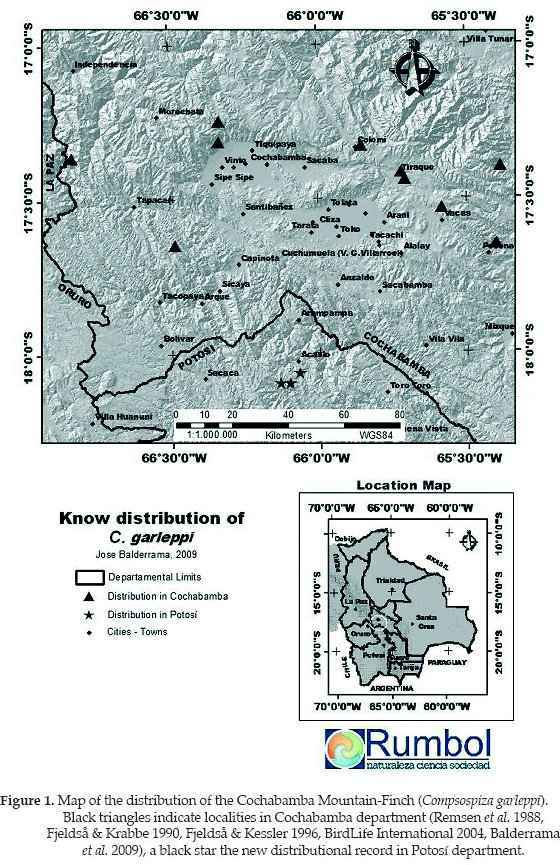
<body><![CDATA[<P   align="center" >&nbsp;</P > <hr noshade>     <P   align="justify" >&nbsp;</P >     <P   align="justify" ><font size="2" face="Verdana, Arial, Helvetica, sans-serif">The Cochabamba Mountain-Finch (<i>Compsospiza garleppi</i>) is an endemic bird of Bolivia, inhabiting open woodlands in the transitional zone between dry inter-Andean valleys and Puna from 2,700 m to 3,900 m (Hennessey <i><i>et al</i></i>. 2003, BirdLife International 2009). It is also found in crops surrounded by native vegetation (Fjelds&aring; &amp; Krabbe 1990, Balderrama <i>et al</i>. 2009). The Cochabamba Mountain-Finch is currently considered as Endangered (BirdLife International 2004, 2009) due to its restricted distribution and ongoing habitat fragmentation. It is also considered as zoogeographic endemic to the Central Andes (Stotz <i>et al</i>. 1996, Hennessey <i>et al</i>. 2003), and it is found in Endemic Bird Area 056 (High Andes of Bolivia and Argentina; Stattersfield <i>et al</i>. 1998, Hennessey <i>et al</i>. 2003). The Tunari National Park is the only protected area where it occurs (Hjarsen 1997, Balderrama &amp; Ramirez 2001, Hennessey <i>et al</i>. 2003, BirdLife International 2009). </font></P >     <P   align="justify" >&nbsp;</P >     <P   align="center" ><font size="3" face="Verdana, Arial, Helvetica, sans-serif"><b>Known distribution </b></font></P >     <P   align="justify" ><font size="2" face="Verdana, Arial, Helvetica, sans-serif"></B>The Cochabamba Mountain-Finch principally is restricted to mountains surrounding Cochabamba city (Cochabamba department; Fjelds&aring; &amp; Krabbe 1990). The easternmost distributional records were reported from 98-120 km east of Cochabamba city on the road to Santa Cruz (Remsen <i>et al</i>. 1988). According to BirdLife International (2004), the species is documented from 10-11 localities (Remsen <i>et al</i>. 1988, Fjelds&aring; &amp; Krabbe 1990, Fjelds&aring; &amp; Kessler 1996, Balderrama <i>et al</i>. 2009). Its estimated distributional range (Extent of Occurrence) is 3,700 km<Sup>2</Sup> (BirdLife International 2009). </font></P >     <P   align="justify" >&nbsp;</P >     <P   align="center" ><font size="3" face="Verdana, Arial, Helvetica, sans-serif"><b>New distributional record </b></font></P >     <P   align="justify" ><font size="2" face="Verdana, Arial, Helvetica, sans-serif"></B>I conducted bird censuses in <i>Polylepis</i> woodlands of Llallahuani (18&ordm;03&rsquo;56&rdquo;S, 66&ordm;04&rsquo;11&rdquo;W, altitude 3,300 m, 6 km by road south of Acasio) in extreme northern Potos&iacute; department (SW Bolivia) in December 2005. This locality contains several small <i>Polylepis</i> <i>neglecta</i> forest fragments (totaling ca. 10 ha) that are highly disturbed by agricultural activities, with many open areas and presence of livestock, especially sheep. </font></P >     <P   align="justify" ><font size="2" face="Verdana, Arial, Helvetica, sans-serif">On 9 December 2005, I observed five Cochabamba Mountain-Finch individuals, two presumed pairs and one lone individual (two individuals were videotaped; video deposited at the Centro de Biodiversidad y Gen&eacute;tica). These observations constitute the first record of the species for Potos&iacute; department and the southernmost record of the Cochabamba Mountain-Finch, which was thought to be restricted to the Tunari basin in Cochabamba department (Fjelds&aring; &amp; Krabbe 1990, Hennessey <i>et al</i>. 2003, BirdLife International 2004). The population documented in Llallahuani is somewhat isolated from populations in Cochabamba department (<a href="#f1">Fig. 1</a>), presumably due to the lack of suitable habitat in interjacent areas. </font></P >     ]]></body>
<body><![CDATA[<P   align="center" ><a name="f1"></a><img src="/img/revistas/reb/v44n1/figura_a08_1.jpg" width="560" height="865"></P >     <P   align="justify" ><font size="2" face="Verdana, Arial, Helvetica, sans-serif">Recent surveys (27-29 November 2008) in the same area in northern Potos&iacute; department permitted us to record nine additional Cochabamba Mountain-Finch individuals in two other <i>Polylepis</i> fragments in La Porta and Sikiri (5 ha and 3 ha, respectively). La Porta (18&ordm;06&rsquo;32&rdquo;S, 66&ordm;06&rsquo;17&rdquo;W; 3,500 m), where seven individuals were observed, is somewhat disturbed by agricultural activities, with some open areas and presence of livestock. Sikiri (18&ordm;05&rsquo;51&rdquo;S, 66&ordm;08&rsquo;28&rdquo;W; 3,500 m) on the other hand, where only two individuals were observed, is highly disturbed by agricultural activities, close to a road and with clear evidence of continuous logging. </font></P >     <P   align="justify" ><font size="2" face="Verdana, Arial, Helvetica, sans-serif">I also found three other restricted-range  species in the same sites: Maquis Canastero (<i>Asthenes heterura</i>), Bolivian Warbling-Finch (<i>Poospiza boliviana</i>) and Bolivian Blackbird (<i>Oreopsar bolivianus</i>). Observations of Puna Tapaculo (<i>Scytalopus simonsi</i>), Cinereous Conebill (<i>Conirostrum cinereum</i>), Rusty Flowerpiercer (<i>Diglossa sittoides</i>) and Bolivian Warbling-Finch are first records for Potos&iacute; department (Hennessey <i>et al</i>. 2003). Moreover, Stripe-crowned Spinetail (<i>Cranioleuca pyrrhophia</i>) reaches its highest altitudinal record in this area (Hennessey <i>et al</i>. 2003). </font></P >     <P   align="justify" ><font size="2" face="Verdana, Arial, Helvetica, sans-serif">Further surveys near Acasio may find the Cochabamba Mountain-Finch in additional <i>Polylepis</i> fragments, and this area could potentially be declared an Important Bird Area (IBA) in Bolivia (Soria-Auza &amp; Hennessey 2005), in part also due to the presence of at least three other restricted-range species. </font></P >     <P   align="justify" >&nbsp;</P >     <P   align="center" ><font size="3" face="Verdana, Arial, Helvetica, sans-serif"><b>Acknowledgments </b></font></P >     <P   align="justify" ><font size="2" face="Verdana, Arial, Helvetica, sans-serif"></B>Financial support was provided by the American Bird Conservancy, project &ldquo;Conservation Status of <i>Polylepis</i> Woodlands, Bolivia&rdquo;. Latest field work was supported by Rufford Small Grants. I am grateful to N. de la Barra, M. Mercado and L. Alvares for their support during field work; to S.K. Herzog and D. Rejas for improving the English; and to H. Arnal, S.K. Herzog, P.A. Hosner and N. Krabbe for their comments on the manuscript. </font></P >     <P   align="justify" >&nbsp;</P >     <P   align="center" ><font size="3" face="Verdana, Arial, Helvetica, sans-serif"><b>References </b></font></P >     <!-- ref --><P   align="justify" ><font size="2" face="Verdana, Arial, Helvetica, sans-serif"></B>Balderrama, J. A. &amp; M. Ramirez. 2001. Diversidad y endemismo de aves en dos fragmentos de Bosques de <i>Polylepis</i> besseri en el Parque Nacional Tunari (Cochabamba - Bolivia). Rev. Bol. Ecol. 9: 45-60. </font></P >     &nbsp;&nbsp;&nbsp;&nbsp;&nbsp;&nbsp;&nbsp;&nbsp;[&#160;<a href="javascript:void(0);" onclick="javascript: window.open('/scielo.php?script=sci_nlinks&ref=013398&pid=S1605-2528200900010000800001&lng=','','width=640,height=500,resizable=yes,scrollbars=1,menubar=yes,');">Links</a>&#160;]<!-- end-ref --><!-- ref --><P   align="justify" ><font size="2" face="Verdana, Arial, Helvetica, sans-serif">Balderrama, J. A., M. Crespo &amp; L. F. Aguirre. 2009. Gu&iacute;a ilustrada de campo: Las aves del Parque Nacional Tunari. Centro de Biodiversidad y Gen&eacute;tica, Universidad Mayor de San Sim&oacute;n, Cochabamba. 208 p. </font></P >    &nbsp;&nbsp;&nbsp;&nbsp;&nbsp;&nbsp;&nbsp;&nbsp;[&#160;<a href="javascript:void(0);" onclick="javascript: window.open('/scielo.php?script=sci_nlinks&ref=013399&pid=S1605-2528200900010000800002&lng=','','width=640,height=500,resizable=yes,scrollbars=1,menubar=yes,');">Links</a>&#160;]<!-- end-ref --><!-- ref --><P   align="justify" ><font size="2" face="Verdana, Arial, Helvetica, sans-serif">BirdLife International. 2004. Threatened birds of the world 2004. CD-Rom, Cambridge. </font></P >    &nbsp;&nbsp;&nbsp;&nbsp;&nbsp;&nbsp;&nbsp;&nbsp;[&#160;<a href="javascript:void(0);" onclick="javascript: window.open('/scielo.php?script=sci_nlinks&ref=013400&pid=S1605-2528200900010000800003&lng=','','width=640,height=500,resizable=yes,scrollbars=1,menubar=yes,');">Links</a>&#160;]<!-- end-ref --><!-- ref --><P   align="justify" ><font size="2" face="Verdana, Arial, Helvetica, sans-serif">BirdLife International. 2009. Species factsheet: <i>Poospiza garleppi</i>. Downloaded from http://www.birdlife.org on 11/6/2009. </font></P >     &nbsp;&nbsp;&nbsp;&nbsp;&nbsp;&nbsp;&nbsp;&nbsp;[&#160;<a href="javascript:void(0);" onclick="javascript: window.open('/scielo.php?script=sci_nlinks&ref=013401&pid=S1605-2528200900010000800004&lng=','','width=640,height=500,resizable=yes,scrollbars=1,menubar=yes,');">Links</a>&#160;]<!-- end-ref --><!-- ref --><P   align="justify" ><font size="2" face="Verdana, Arial, Helvetica, sans-serif">Fjelds&aring;, J. &amp; M. Kessler. 1996. Conserving the biological diversity of <i>Polylepis</i> woodlands of the highland of Peru and Bolivia. A contribution to sustainable natural resource management in the Andes. NORDECO, Copenhagen. 250 p. </font></P >     &nbsp;&nbsp;&nbsp;&nbsp;&nbsp;&nbsp;&nbsp;&nbsp;[&#160;<a href="javascript:void(0);" onclick="javascript: window.open('/scielo.php?script=sci_nlinks&ref=013402&pid=S1605-2528200900010000800005&lng=','','width=640,height=500,resizable=yes,scrollbars=1,menubar=yes,');">Links</a>&#160;]<!-- end-ref --><!-- ref --><P   align="justify" ><font size="2" face="Verdana, Arial, Helvetica, sans-serif">Fjelds&aring;, J. &amp; N. Krabbe. 1990. Birds of the high Andes. Apollo Books, Svendborg. 876 p. </font></P >     &nbsp;&nbsp;&nbsp;&nbsp;&nbsp;&nbsp;&nbsp;&nbsp;[&#160;<a href="javascript:void(0);" onclick="javascript: window.open('/scielo.php?script=sci_nlinks&ref=013403&pid=S1605-2528200900010000800006&lng=','','width=640,height=500,resizable=yes,scrollbars=1,menubar=yes,');">Links</a>&#160;]<!-- end-ref --><!-- ref --><P   align="justify" ><font size="2" face="Verdana, Arial, Helvetica, sans-serif">Hennessey, A.B., S.K. Herzog &amp; F. Sagot. 2003. Lista anotada de las aves de Bolivia. 5ta ed. Asociaci&oacute;n Armon&iacute;a - BirdLife International, Santa Cruz. 238 p. </font></P >    &nbsp;&nbsp;&nbsp;&nbsp;&nbsp;&nbsp;&nbsp;&nbsp;[&#160;<a href="javascript:void(0);" onclick="javascript: window.open('/scielo.php?script=sci_nlinks&ref=013404&pid=S1605-2528200900010000800007&lng=','','width=640,height=500,resizable=yes,scrollbars=1,menubar=yes,');">Links</a>&#160;]<!-- end-ref --><!-- ref --><P   align="justify" ><font size="2" face="Verdana, Arial, Helvetica, sans-serif">Hjarsen, T. 1997. Bird fauna and vegetation in natural woodlands and Eucalyptus plantations in the high Andes in Bolivia. Implications for development of sustainable agroforestry techniques. Proceedings of the IUFRO, Conference on Silviculture and Improvements of Eucalyptus. EMBRAPA 4: 89-94. </font></P >    &nbsp;&nbsp;&nbsp;&nbsp;&nbsp;&nbsp;&nbsp;&nbsp;[&#160;<a href="javascript:void(0);" onclick="javascript: window.open('/scielo.php?script=sci_nlinks&ref=013405&pid=S1605-2528200900010000800008&lng=','','width=640,height=500,resizable=yes,scrollbars=1,menubar=yes,');">Links</a>&#160;]<!-- end-ref --><!-- ref --><P   align="justify" ><font size="2" face="Verdana, Arial, Helvetica, sans-serif">Soria-Auza, R.W. &amp; A.B. Hennessey. 2005. &Aacute;reas importantes para la conservaci&oacute;n de las aves en Bolivia. pp. 57-116. En: BirdLife International y Conservation International. &Aacute;reas importantes para la conservaci&oacute;n e las aves en los Andes tropicales: sitios prioritarios para la conservaci&oacute;n de la biodiversidad. BirdLife International, Quito. </font></P >    &nbsp;&nbsp;&nbsp;&nbsp;&nbsp;&nbsp;&nbsp;&nbsp;[&#160;<a href="javascript:void(0);" onclick="javascript: window.open('/scielo.php?script=sci_nlinks&ref=013406&pid=S1605-2528200900010000800009&lng=','','width=640,height=500,resizable=yes,scrollbars=1,menubar=yes,');">Links</a>&#160;]<!-- end-ref --><!-- ref --><P   align="justify" ><font size="2" face="Verdana, Arial, Helvetica, sans-serif">Stotz, D., J. Fitzpatrick, T.A Parker III &amp; D. Moskowits. 1996. Neotropical birds: ecology and conservation. University of Chicago Press, Chicago. 478 p. </font></P >     &nbsp;&nbsp;&nbsp;&nbsp;&nbsp;&nbsp;&nbsp;&nbsp;[&#160;<a href="javascript:void(0);" onclick="javascript: window.open('/scielo.php?script=sci_nlinks&ref=013407&pid=S1605-2528200900010000800010&lng=','','width=640,height=500,resizable=yes,scrollbars=1,menubar=yes,');">Links</a>&#160;]<!-- end-ref --><!-- ref --><P   align="justify" ><font size="2" face="Verdana, Arial, Helvetica, sans-serif">Statters&#64257;eld, A. J., M. J. Crosby, A. J. Long &amp; D. C. Wege. 1998. Endemic bird areas of the world. Priorities for conservation status N&deg; 7, Birdlife International, Cambridge. 846 p. </font></P >     &nbsp;&nbsp;&nbsp;&nbsp;&nbsp;&nbsp;&nbsp;&nbsp;[&#160;<a href="javascript:void(0);" onclick="javascript: window.open('/scielo.php?script=sci_nlinks&ref=013408&pid=S1605-2528200900010000800011&lng=','','width=640,height=500,resizable=yes,scrollbars=1,menubar=yes,');">Links</a>&#160;]<!-- end-ref --><P   >&nbsp;</P >     <P   ><font size="2" face="Verdana, Arial, Helvetica, sans-serif">Nota recibida en: Diciembre de 2008.     <br>   Manejado por: Sebasti&aacute;n Herzog.     <br> Aceptado en: Junio de 2009. </font></P >      ]]></body><back>
<ref-list>
<ref id="B1">
<nlm-citation citation-type="journal">
<person-group person-group-type="author">
<name>
<surname><![CDATA[Balderrama]]></surname>
<given-names><![CDATA[J. A.]]></given-names>
</name>
<name>
<surname><![CDATA[Ramirez]]></surname>
<given-names><![CDATA[M.]]></given-names>
</name>
</person-group>
<article-title xml:lang="es"><![CDATA[Diversidad y endemismo de aves en dos fragmentos de Bosques de Polylepis besseri en el Parque Nacional Tunari (Cochabamba - Bolivia)]]></article-title>
<source><![CDATA[Rev. Bol. Ecol.]]></source>
<year>2001</year>
<volume>9</volume>
<page-range>45-60</page-range></nlm-citation>
</ref>
<ref id="B2">
<nlm-citation citation-type="">
<person-group person-group-type="author">
<name>
<surname><![CDATA[Balderrama]]></surname>
<given-names><![CDATA[J. A.]]></given-names>
</name>
<name>
<surname><![CDATA[Crespo]]></surname>
<given-names><![CDATA[M.]]></given-names>
</name>
<name>
<surname><![CDATA[Aguirre]]></surname>
<given-names><![CDATA[L. F.]]></given-names>
</name>
</person-group>
<source><![CDATA[Guía ilustrada de campo: Las aves del Parque Nacional Tunari. Centro de Biodiversidad y Genética]]></source>
<year>2009</year>
<page-range>208</page-range><publisher-loc><![CDATA[Cochabamba ]]></publisher-loc>
</nlm-citation>
</ref>
<ref id="B3">
<nlm-citation citation-type="">
<collab>BirdLife International</collab>
<source><![CDATA[Threatened birds of the world 2004]]></source>
<year>2004</year>
<publisher-loc><![CDATA[Cambridge ]]></publisher-loc>
</nlm-citation>
</ref>
<ref id="B4">
<nlm-citation citation-type="">
<collab>BirdLife International</collab>
<source><![CDATA[Species factsheet: Poospiza garleppi]]></source>
<year>2009</year>
</nlm-citation>
</ref>
<ref id="B5">
<nlm-citation citation-type="book">
<person-group person-group-type="author">
<name>
<surname><![CDATA[Fjeldså]]></surname>
<given-names><![CDATA[J.]]></given-names>
</name>
<name>
<surname><![CDATA[Kessler]]></surname>
<given-names><![CDATA[M.]]></given-names>
</name>
</person-group>
<source><![CDATA[Conserving the biological diversity of Polylepis woodlands of the highland of Peru and Bolivia. A contribution to sustainable natural resource management in the Andes]]></source>
<year>1996</year>
<page-range>250</page-range><publisher-loc><![CDATA[Copenhagen ]]></publisher-loc>
<publisher-name><![CDATA[NORDECO]]></publisher-name>
</nlm-citation>
</ref>
<ref id="B6">
<nlm-citation citation-type="book">
<person-group person-group-type="author">
<name>
<surname><![CDATA[Fjeldså]]></surname>
<given-names><![CDATA[J.]]></given-names>
</name>
<name>
<surname><![CDATA[Krabbe]]></surname>
<given-names><![CDATA[N.]]></given-names>
</name>
</person-group>
<source><![CDATA[Birds of the high Andes]]></source>
<year>1990</year>
<page-range>876</page-range><publisher-loc><![CDATA[Svendborg ]]></publisher-loc>
<publisher-name><![CDATA[Apollo Books]]></publisher-name>
</nlm-citation>
</ref>
<ref id="B7">
<nlm-citation citation-type="book">
<person-group person-group-type="author">
<name>
<surname><![CDATA[Hennessey]]></surname>
<given-names><![CDATA[A.B.]]></given-names>
</name>
<name>
<surname><![CDATA[Herzog]]></surname>
<given-names><![CDATA[S.K.]]></given-names>
</name>
<name>
<surname><![CDATA[Sagot]]></surname>
<given-names><![CDATA[F.]]></given-names>
</name>
</person-group>
<source><![CDATA[Lista anotada de las aves de Bolivia]]></source>
<year>2003</year>
<edition>5</edition>
<page-range>238</page-range><publisher-loc><![CDATA[Santa Cruz ]]></publisher-loc>
<publisher-name><![CDATA[Asociación Armonía - BirdLife International]]></publisher-name>
</nlm-citation>
</ref>
<ref id="B8">
<nlm-citation citation-type="journal">
<person-group person-group-type="author">
<name>
<surname><![CDATA[Hjarsen]]></surname>
<given-names><![CDATA[T.]]></given-names>
</name>
</person-group>
<article-title xml:lang="en"><![CDATA[Bird fauna and vegetation in natural woodlands and Eucalyptus plantations in the high Andes in Bolivia. Implications for development of sustainable agroforestry techniques. Proceedings of the IUFRO: Conference on Silviculture and Improvements of Eucalyptus]]></article-title>
<source><![CDATA[EMBRAPA]]></source>
<year>1997</year>
<volume>4</volume>
<page-range>89-94</page-range></nlm-citation>
</ref>
<ref id="B9">
<nlm-citation citation-type="book">
<person-group person-group-type="author">
<name>
<surname><![CDATA[Soria-Auza]]></surname>
<given-names><![CDATA[R.W.]]></given-names>
</name>
<name>
<surname><![CDATA[Hennessey]]></surname>
<given-names><![CDATA[A.B.]]></given-names>
</name>
</person-group>
<article-title xml:lang="es"><![CDATA[Áreas importantes para la conservación de las aves en Bolivia]]></article-title>
<collab>BirdLife International y Conservation International</collab>
<source><![CDATA[Áreas importantes para la conservación e las aves en los Andes tropicales: sitios prioritarios para la conservación de la biodiversidad]]></source>
<year>2005</year>
<page-range>57-116</page-range><publisher-loc><![CDATA[Quito ]]></publisher-loc>
<publisher-name><![CDATA[BirdLife International]]></publisher-name>
</nlm-citation>
</ref>
<ref id="B10">
<nlm-citation citation-type="book">
<person-group person-group-type="author">
<name>
<surname><![CDATA[Stotz]]></surname>
<given-names><![CDATA[D.]]></given-names>
</name>
<name>
<surname><![CDATA[Fitzpatrick]]></surname>
<given-names><![CDATA[J.]]></given-names>
</name>
<name>
<surname><![CDATA[Parker III]]></surname>
<given-names><![CDATA[T.A]]></given-names>
</name>
<name>
<surname><![CDATA[Moskowits]]></surname>
<given-names><![CDATA[D.]]></given-names>
</name>
</person-group>
<source><![CDATA[Neotropical birds: ecology and conservation]]></source>
<year>1996</year>
<page-range>478</page-range><publisher-loc><![CDATA[Chicago ]]></publisher-loc>
<publisher-name><![CDATA[University of Chicago Press]]></publisher-name>
</nlm-citation>
</ref>
<ref id="B11">
<nlm-citation citation-type="book">
<person-group person-group-type="author">
<name>
<surname><![CDATA[Statterseld]]></surname>
<given-names><![CDATA[A. J.]]></given-names>
</name>
<name>
<surname><![CDATA[Crosby]]></surname>
<given-names><![CDATA[M. J.]]></given-names>
</name>
<name>
<surname><![CDATA[Long]]></surname>
<given-names><![CDATA[A. J.]]></given-names>
</name>
<name>
<surname><![CDATA[Wege]]></surname>
<given-names><![CDATA[D. C.]]></given-names>
</name>
</person-group>
<source><![CDATA[Endemic bird areas of the world. Priorities for conservation status N° 7]]></source>
<year>1998</year>
<page-range>846</page-range><publisher-loc><![CDATA[Cambridge ]]></publisher-loc>
<publisher-name><![CDATA[Birdlife International]]></publisher-name>
</nlm-citation>
</ref>
</ref-list>
</back>
</article>