<?xml version="1.0" encoding="ISO-8859-1"?><article xmlns:mml="http://www.w3.org/1998/Math/MathML" xmlns:xlink="http://www.w3.org/1999/xlink" xmlns:xsi="http://www.w3.org/2001/XMLSchema-instance">
<front>
<journal-meta>
<journal-id>1605-2528</journal-id>
<journal-title><![CDATA[Ecología en Bolivia]]></journal-title>
<abbrev-journal-title><![CDATA[Ecología en Bolivia]]></abbrev-journal-title>
<issn>1605-2528</issn>
<publisher>
<publisher-name><![CDATA[Plural Editores ]]></publisher-name>
</publisher>
</journal-meta>
<article-meta>
<article-id>S1605-25282008000200002</article-id>
<title-group>
<article-title xml:lang="en"><![CDATA[Tree community patterns along a deciduous to evergreen forest gradient in central Bolivia]]></article-title>
<article-title xml:lang="es"><![CDATA[Patrones de comunidades de árboles en un gradiente de bosque semideciduo a bosque siempreverde en Bolivia central]]></article-title>
</title-group>
<contrib-group>
<contrib contrib-type="author">
<name>
<surname><![CDATA[Linares-Palomino]]></surname>
<given-names><![CDATA[R.]]></given-names>
</name>
<xref ref-type="aff" rid="A01"/>
</contrib>
<contrib contrib-type="author">
<name>
<surname><![CDATA[Cardona]]></surname>
<given-names><![CDATA[V.]]></given-names>
</name>
<xref ref-type="aff" rid="A01"/>
</contrib>
<contrib contrib-type="author">
<name>
<surname><![CDATA[soto]]></surname>
<given-names><![CDATA[D.]]></given-names>
</name>
<xref ref-type="aff" rid="A01"/>
</contrib>
<contrib contrib-type="author">
<name>
<surname><![CDATA[Herzog]]></surname>
<given-names><![CDATA[S.K.]]></given-names>
</name>
<xref ref-type="aff" rid="A01"/>
</contrib>
<contrib contrib-type="author">
<name>
<surname><![CDATA[Kessler]]></surname>
<given-names><![CDATA[M.]]></given-names>
</name>
<xref ref-type="aff" rid="A01"/>
</contrib>
</contrib-group>
<aff id="A01">
<institution><![CDATA[,University of Göttingen, Untere Karspüle 2 Albrecht-von-Haller-Institute for Plant Sciences Department of Systematic Botany]]></institution>
<addr-line><![CDATA[Göttingen ]]></addr-line>
<country>Alemania</country>
</aff>
<aff id="A02">
<institution><![CDATA[,University of Universidad Mayor de San Andrés Instituto de Ecología Herbario Nacional de Bolivia]]></institution>
<addr-line><![CDATA[La Paz ]]></addr-line>
<country>Bolivia</country>
</aff>
<aff id="A03">
<institution><![CDATA[,Museo Noel Kempff Mercado Herbario del Oriente Boliviano ]]></institution>
<addr-line><![CDATA[Santa Cruz ]]></addr-line>
<country>Bolivia</country>
</aff>
<aff id="A04">
<institution><![CDATA[,Asociación Armonía - BirdLife International  ]]></institution>
<addr-line><![CDATA[Santa Cruz ]]></addr-line>
<country>Bolivia</country>
</aff>
<aff id="A05">
<institution><![CDATA[,University of Zürich Institute of Systematic Botany ]]></institution>
<addr-line><![CDATA[Zürich ]]></addr-line>
<country>Suiza</country>
</aff>
<pub-date pub-type="pub">
<day>00</day>
<month>08</month>
<year>2008</year>
</pub-date>
<pub-date pub-type="epub">
<day>00</day>
<month>08</month>
<year>2008</year>
</pub-date>
<volume>43</volume>
<numero>2</numero>
<fpage>99</fpage>
<lpage>110</lpage>
<copyright-statement/>
<copyright-year/>
<self-uri xlink:href="http://www.scielo.org.bo/scielo.php?script=sci_arttext&amp;pid=S1605-25282008000200002&amp;lng=en&amp;nrm=iso"></self-uri><self-uri xlink:href="http://www.scielo.org.bo/scielo.php?script=sci_abstract&amp;pid=S1605-25282008000200002&amp;lng=en&amp;nrm=iso"></self-uri><self-uri xlink:href="http://www.scielo.org.bo/scielo.php?script=sci_pdf&amp;pid=S1605-25282008000200002&amp;lng=en&amp;nrm=iso"></self-uri><abstract abstract-type="short" xml:lang="en"><p><![CDATA[We studied trees with a diameter at breast height &#8805; 10 cm on three one-hectare plots in the Refugio Los Volcanes seasonal forests (1,000-1,400 m elevation), located in the Andean foothills of central Bolivia. The plots included local variants of deciduous, semi-deciduous and evergreen forest vegetation. We recorded a total of 115 species and 43 families. The most diverse plot was the semi-deciduous forest plot with 70 species, 56 genera and 31 families, whereas the evergreen forest plot had slightly lower richness values (63 species, 49 genera, 31 families). The deciduous forest plot had much lower numbers (44 species, 38 genera and 21 families) and shared only 19 and 15 species with the semi-deciduous and evergreen forest plots, respectively. Between 34% and 50% of the species in the study plots were locally rare species, i.e., species with only one or two individuals per plot. On the other hand, a high percentage of the total number of individuals and basal area was contributed by a few dominant species in each plot. Pachystroma longifolium (Nees) I.M. Johnst. (Euphorbiaceae) was the only species among the three most important species in each of the three plots. Leguminosae was the most important family in the deciduous and semi-deciduous plots. The evergreen forest plot contained different dominant families compared to the other two plots. The species richness values we found in this study were similar to other tree inventories in comparable seasonal forest ecosystems in Bolivia. Species and familial composition, however, were contrastingly different, except for the well-known fact that Leguminosae is the numerically most important family in seasonally dry Neotropical forest ecosystems. Phytogeographically, the tree fora of Los Volcanes is heterogeneous, being composed of elements belonging to seasonal forests as well as to humid tropical forests.]]></p></abstract>
<abstract abstract-type="short" xml:lang="es"><p><![CDATA[Estudiamos tres parcelas de una hectárea cada una incluyendo todos los árboles con diámetro a la altura del pecho de 10 cm o más en el ecosistema estacional del Refugio Los Volcanes (1.000- 1.400 m de altitud), situado en el centro de Bolivia. Las parcelas incluyeron variantes locales de bosques deciduos, semideciduos y siempreverdes. Encontramos un total de 115 especies y 43 familias. La parcela más diversa fue la semidecidua con 70 especies, 56 géneros y 31 familias; con bosque siempreverde tuvo valores de diversidad similares o ligeramente más bajos (63 especies, 49 géneros, 31 familias); mientras la que presenta bosque deciduo tuvo valores mucho más bajos (44 especies, 38 géneros y 21 familias) y compartía sólo 19 y 15 especies con las parcelas en el bosque semideciduo y siempreverde, respectivamente. Entre un 34% y 50% de las especies en las parcelas eran localmente raras con sólo uno o dos individuos por parcela. Por otro lado, un alto porcentaje del número total de individuos y del área basal era contribuido por unas pocas especies dominantes en cada parcela. Pachystroma longifolium (Nees) I.M. Johnst. (Euphorbiaceae) fue la única especie que estaba entre las tres especies más dominantes en cada una de las tres parcelas. Leguminosae fue la familia más importante en las parcelas de bosque deciduo y semideciduo. El bosque siempreverde contenía un conjunto de familias dominantes distintas a las otras parcelas. Los valores de riqueza de especies fueron similares a otros estudios de inventarios forestales en ecosistemas estacionales comparables realizados en Bolivia. La composición de especies y familias por otro lado, fue diferente, exceptuando el hecho bien conocido que Leguminosae es la familia dominante en bosques estacionalmente secos del Neotrópico. Fitogeográficamente, la flora arbórea de las parcelas de Los Volcanes es heterogénea, estando compuesta de elementos de bosques estacionalmente secos así como de los bosques tropicales húmedos.]]></p></abstract>
<kwd-group>
<kwd lng="en"><![CDATA[Amboró National Park]]></kwd>
<kwd lng="en"><![CDATA[seasonal forest]]></kwd>
<kwd lng="en"><![CDATA[tree density]]></kwd>
<kwd lng="en"><![CDATA[tree dominance]]></kwd>
<kwd lng="en"><![CDATA[tree inventory.]]></kwd>
<kwd lng="es"><![CDATA[Amboró]]></kwd>
<kwd lng="es"><![CDATA[Bosque estaciona]]></kwd>
<kwd lng="es"><![CDATA[Densidad de árboles]]></kwd>
<kwd lng="es"><![CDATA[Dominancia de árboles]]></kwd>
<kwd lng="es"><![CDATA[Inventario forestal]]></kwd>
</kwd-group>
</article-meta>
</front><body><![CDATA[ <p align="right"><font size="2" face="Verdana"><strong>Original </strong></font></p>     <p align=center><font size="4" face="Verdana"><b>Tree community patterns along a deciduous to   evergreen forest    <br> gradient in central Bolivia</b></font></p>     <p align=center><font size="4" face="Verdana"><b>Patrones de comunidades de   árboles en un gradiente de bosque    <br>   semideciduo   a bosque siempreverde en Bolivia central</b></font></p>     <p align=center><font size="3" face="Verdana"><b>R.   Linares-Palomino, V. Cardona, D. soto,   S.K. Herzog, M. Kessler</b></font></p>     <p align=center><font size="2" face="Verdana"><sup>1</sup>Department of Systematic   Botany, Albrecht-von-Haller-Institute for Plant Sciences,    <br>   University of Göttingen,   Untere Karspüle 2, 37073-Göttingen, Alemania</font></p>     <p align=center><font size="2" face="Verdana">    <br>   2 Herbario Nacional de   Bolivia, Instituto de Ecología, Universidad Mayor de San Andrés,    ]]></body>
<body><![CDATA[<br>   Casilla   10077, La Paz, Bolivia</font></p>     <p align=center><font size="2" face="Verdana">    <br>   <sup>3</sup>Herbario del Oriente   Boliviano, Museo Noel Kempff Mercado, Santa Cruz, Bolivia</font></p>     <p align=center><font size="2" face="Verdana">    <br>   <sup>4</sup>Asociación Armonía -   BirdLife International, Casilla 3566, Santa Cruz, Bolivia</font></p>     <p align=center><font size="2" face="Verdana">    <br>   <sup>5</sup>Present address: Institute   of Systematic Botany, University of Zürich,    <br>   Zollikerstrasse   107, CH-8008 Zürich, Suiza    <br>   * Autor de correspondencia:   e-mail: r.linaresp@yahoo.co.uk</font></p> <hr>     <p align=center><font size="2" face="Verdana"><b>Abstract</b></font></p>     ]]></body>
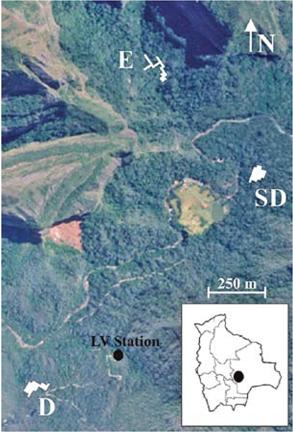
<body><![CDATA[<p><font size="2" face="Verdana">We studied trees with a diameter at breast height &#8805; 10 cm on   three one-hectare plots in the Refugio Los   Volcanes seasonal forests (1,000-1,400 m elevation), located in the Andean   foothills of central Bolivia. The   plots included local variants of deciduous, semi-deciduous and evergreen forest vegetation. We recorded a total of 115   species and 43 families. The most diverse plot was the semi-deciduous forest plot with 70 species, 56   genera and 31 families, whereas the evergreen forest plot had slightly lower richness values (63 species, 49 genera,   31 families). The deciduous forest plot had much lower numbers (44   species, 38 genera and 21 families) and shared only 19 and 15 species with the semi-deciduous and evergreen forest plots,   respectively. Between 34% and 50% of   the species in the study plots were locally rare species, i.e., species with   only one or two individuals per plot.   On the other hand, a high percentage of the total number of individuals and basal area was contributed by a few dominant   species in each plot. <i>Pachystroma   longifolium </i>(Nees) I.M. Johnst. (Euphorbiaceae) was the   only species among the three most important species in each of the three plots. Leguminosae was the   most important family in the deciduous and semi-deciduous plots. The evergreen forest plot   contained different dominant families compared to the other two plots. The species richness values we found in this study were   similar to other tree inventories in   comparable seasonal forest ecosystems in Bolivia. Species and familial   composition, however, were contrastingly different, except for the well-known   fact that Leguminosae is the numerically most important family in seasonally dry Neotropical forest ecosystems.   Phytogeographically, the tree fora of Los Volcanes is heterogeneous,   being composed of elements belonging to seasonal forests as well as to humid   tropical forests.</font></p>     <p><font size="2" face="Verdana"><b>Keywords: </b>Amboró National Park, seasonal forest, tree density, tree   dominance, tree inventory.</font></p>     <p align=center><font size="2" face="Verdana"><b>Resumen</b></font></p>     <p><font size="2" face="Verdana">Estudiamos   tres parcelas de una hectárea cada una incluyendo todos los árboles con   diámetro a la altura   del pecho de 10 cm o más en el ecosistema estacional del Refugio Los Volcanes   (1.000-</font></p>     <p><font size="2" face="Verdana">1.400 m de   altitud), situado en el centro de Bolivia. Las parcelas incluyeron variantes   locales de bosques deciduos, semideciduos y   siempreverdes. Encontramos un total de 115 especies y 43 familias. La parcela   más diversa fue la semidecidua con 70 especies, 56 géneros y 31 familias; con   bosque siempreverde tuvo valores de diversidad similares o ligeramente más   bajos (63 especies, 49 géneros, 31   familias); mientras la que presenta bosque deciduo tuvo valores mucho más bajos (44 especies, 38 géneros y 21 familias)   y compartía sólo 19 y 15 especies con las parcelas en el bosque semideciduo y siempreverde, respectivamente. Entre   un 34% y 50% de las especies en las parcelas eran localmente raras con   sólo uno o dos individuos por parcela. Por otro   lado, un alto porcentaje del número total de individuos y del área basal era   contribuido por unas pocas especies dominantes en cada parcela. <i>Pachystroma longifolium </i>(Nees)   I.M. Johnst. (Euphorbiaceae) fue la única especie que estaba entre las tres   especies más dominantes en cada una de las   tres parcelas. Leguminosae fue la familia más importante en las parcelas de   bosque deciduo y semideciduo. El bosque siempreverde contenía un conjunto de   familias dominantes distintas a las otras   parcelas. Los valores de riqueza de especies fueron similares a otros estudios   de inventarios forestales en ecosistemas estacionales comparables realizados en   Bolivia. La composición de especies y familias por otro lado, fue diferente,   exceptuando el hecho bien conocido que   Leguminosae es la familia dominante en bosques estacionalmente secos del   Neotrópico. Fitogeográficamente, la flora arbórea de las parcelas de Los   Volcanes es heterogénea, estando compuesta de elementos de bosques   estacionalmente secos así como de los bosques tropicales húmedos.</font></p>     <p><font size="2" face="Verdana"><b>Palabras   clave: </b>Amboró,   Bosque estacional, Densidad de árboles, Dominancia de árboles, Inventario   forestal.</font></p> <hr>     <p align=center><font size="2" face="Verdana"><b>Introduction</b></font></p>     <p><font size="2" face="Verdana">The Amboró National Park located in the Santa Cruz department (Bolivia) must be one of the most biodiverse   protected areas in the world with vegetation types such as lowland humid   evergreen forests, inter-Andean dry forests, high altitude cloud forests and   puna vegetation from which more than 3,000 plant species have been reported to date (Nee 2004). The southeastern   part of the national park is mainly composed of deciduous vegetation and previous classifications have   tended to include it in single broad categories. Navarro <i>et al. </i>(1996) for example, included this area in the ‘subhumid to humid deciduous forest of southeastern Amboró’, a   vegetation type usually found between 900-1,100 m and where the dominant tree   species are <i>Aspidosperma cylindrocarpum </i>(Apocynaceae), <i>Cariniana estrellensis </i>(Lecythidaceae), <i>Cedrela lilloi </i>(Meliaceae),</font></p>     <p><font size="2" face="Verdana"><i>Gallesia integrifolia </i>(Phytolaccaceae), <i>Pachystroma longifolium </i>(Euphorbiaceae), <i>Pogonopus tubulosus </i>(Rubiaceae), and <i>Tabebuia lapacho </i>(Bignoniaceae). More recently, Navarro &amp; Maldonado (2002) assigned the vegetation in this area to the   ‘upper central subandean Cerrado   semideciduous forest’, found between 1,000-1,900   m and with <i>P.   longifolium </i>and <i>C. estrellensis </i>dominating the 1,000-1,300 m range. Based on visual inspections of the area, however, we observed substantial variations of the   vegetation within these broad categories. During   a multidisciplinary study on the ecology of animals and plants at the   Refugio Los Volcanes (hereafter LV, an area adjacent to the south of Amboró   National Park), we observed that the dominant zonal vegetation in the area was indeed semi-deciduous forest (about 30-50% deciduous trees), mainly found on the shaded south-facing slopes. Local   differences in topography and aspect, however, seemed to lead to ecologically</font></p>     <p><font size="2" face="Verdana">relevant   differences in water availability. Consequently, steep, sunny and north-facing   slopes were occupied by deciduous forest (70-90% deciduous), whereas the fat,   shaded valleys with groundwater supply supported evergreen forest (10-20% deciduous). In order to test these visual   observations we established three permanent   one-hectare plots along the deciduous to evergreen seasonal forests   vegetation gradient of LV. Our aims were to   characterise the forest types within the LV area, to understand the   relationship between these distinct types   using quantitative tree inventories and to investigate the wider   biogeographic affinities (within Bolivia and beyond) of the LV forest.</font></p>     ]]></body>
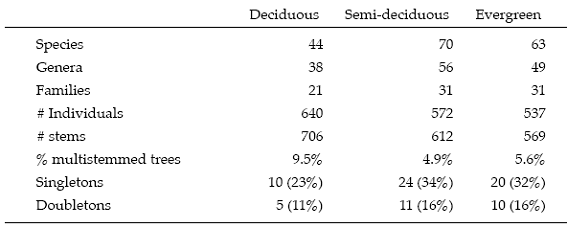
<body><![CDATA[<p align=center><font size="2" face="Verdana"><b>study   area</b></font></p>     <p><font size="2" face="Verdana">The study was carried out at the Refugio Los Volcanes (1,000-1,400 m altitude) in Santa Cruz, Bolivia. LV is   located at about 18°06’ S and 63°36’ W, adjacent to the southern border of Amboró National Park, on the transition from the   humid inner tropics to the seasonally dry subtropics   (Fig. 1). The geological substrate of the study area consists primarily   of red sandstone and locally of loamy sedimentary rocks (lutite). Annual   precipitation is about 1,200-1,400 mm, with   a three month dry season from July to October. The deciduous forest plot (18°   06’ 48’’S, 63° 36’ 10’’W) was located at an average altitude of 1,150 m on a   sunny north­facing slope. The semi-deciduous forest plot (18° 06’ 13’’S, 63° 35’ 44’’W, 1,300 m northeast of the deciduous forest plot) was located at an   average altitude of 1,070 m on a south­facing   slope shaded by a rock-wall toward the southeast. The evergreen forest   plot (18° 06’ 03’’S, 63° 35’ 58’’W, 500 m   northwest of the semi-deciduous forest plot) was located at an average   altitude of 1,100 m in a ravine with loose   soils and permanent groundwater supply provided   by a small watercourse that divided the plot into two parts with steep   slopes on both sides of the creek.</font></p>     <p align=center><font size="2" face="Verdana"><b>Methods</b></font></p>     <p><font size="2" face="Verdana">We established one permanent plot of 1 ha in each forest type in   2002-2003. We subdivided each plot into 25   adjacent 20 m x 20 m subplots, which where laid out in such a way as to include only a homogeneous representation of   the forest type under study (i.e., avoiding secondary vegetation or other   forest types). Thus, our plots are not the traditional square 100 m x 100 m inventory plots, but have rather   irregular shapes (Fig. 1). We recorded diameter at breast height (dbh) for each   tree with a diameter of 10 cm or more. Voucher specimens of all species were collected for later taxonomic determination and are deposited at USZ (Santa Cruz) and LPB (La Paz) (herbarium acronyms   following Holmgren &amp; Holmgren 1998). Identification of the most common species was done directly in the field whenever   possible. Vouchered specimens were identified at USZ and LPB using local   (e.g. Jardim <i>et al. </i>2003)   and national tree floras (Killeen <i>et al. </i>1993), as well as by comparison with   reference collections and   expert identification from local and visiting botanists   at the mentioned herbaria. Sterile specimens   that could not be completely identified were sorted into morphospecies.</font></p>     <p><font size="2" face="Verdana">We calculated relative density, relative   dominance (using basal area) and relative frequency   for each species in order to estimate the importance value index (IVI)   following Curtis &amp; McIntosh (1951). To   calculate the family value index   (FVI) we followed Mori <i>et al. </i>(1983) and used relative density, relative dominance and relative diversity (number of species per family). We constructed smoothed individual based species accumulation curves by randomly adding individuals to the species accumulation curve. This procedure was repeated 100 times and   we used the mean and 1.96 standard deviations   to plot the curve and 95% confidence intervals (Magurran 2004).</font></p>     <p align=center><font size="2" face="Verdana"><img width=293 height=433 src="/img/revistas/reb/v43n2/v43n2a2_006.jpg" v:shapes="_x0000_i1025"></font></p>     <p><font size="2" face="Verdana"><b>Figure 1. </b>Study area in Refugio Los Volcanes, Santa Cruz (inset   shows location within Bolivia). Plot shape and approximate location are given by D (deciduous forest), SD   (semi deciduous forest) and E (evergreen forest).</font></p>     <p align=center><font size="2" face="Verdana"><b>Results    <br>   </b>Diversity and density</font></p>     <p><font size="2" face="Verdana">We recorded 115 tree species from 43 families on the three 1-ha plots (Appendix 1). The semi­deciduous   and evergreen forest plots were the most species-rich (Table 1). In contrast,   density values were much higher on the deciduous forest   plot, where multi-stemmed trees were about   twice as common as on the other two plots. A higher percentage of species represented by a single individual   (singleton) and by two</font></p>     ]]></body>
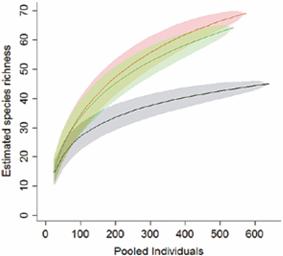
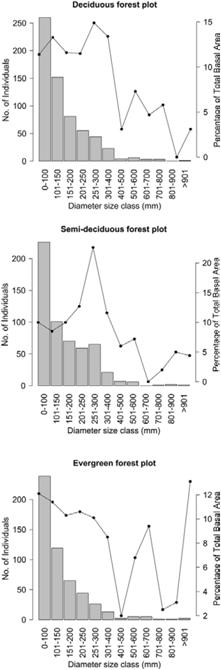
<body><![CDATA[<p><font size="2" face="Verdana">individuals (doubletons) was found in   the semi­deciduous and   evergreen forest plots (Table 1). Overall, locally rare species represented by   one or two individuals accounted for 34-50% of the species   on our study plots.</font></p>     <p><font size="2" face="Verdana">We found no   lianas or hemi-epiphytes with a dbh &#8805;10 cm on the deciduous forest plot. The semi­deciduous forest plot contained five individuals of hemi-epiphytes <i>(Ficus </i>sp., <i>F. obtusifolia </i>Kunth in Humb., Bonpl. &amp; Kunth and <i>F.   trigona </i>L. f., Moraceae) and two of lianas <i>(Machaerium </i>cf. <i>punctatum </i>(Poir.) Pers., Leguminosae and <i>Celtis iguanaea </i>(Jacq.)   Sarg., Ulmaceae). The evergreen</font></p>     <p align="center"><img width=567 height=228 src="/img/revistas/reb/v43n2/v43n2a2_009.gif" v:shapes="_x0000_i1026"> </p>     <p align="center"><font size="2" face="Verdana">forest plot   contained eight individuals of hemi­epiphytes <i>(Ficus </i>cf. <i>eximia </i>Schott in Spreng., <i>F. maxima </i>Mill., <i>F. obtusifolia </i>Kunth in Humb., Bonpl. &amp; Kunth, <i>F. pertusa </i>L. f. and <i>F.   trigona </i>L. f., Moraceae) and no lianas.</font></p>     <p><font size="2" face="Verdana">Individual based   species accumulation curves showed that when up to ca. 180 individuals are sampled randomly from each plot,   confidence intervals of the estimatedspecies   richness values overlap, indicating that the observed differences could have arisen by chance (Fig. 2). Increased random sampling of individuals, however, revealed clear differences between the deciduous forest plot and the two   other forest plots. Nevertheless, irrespective of increased sampling these two latter forest types showed very similar estimated species richness values   up to the total individuals sampled.</font></p>     <p align=center><font size="2" face="Verdana"><img width=283 height=256 src="/img/revistas/reb/v43n2/v43n2a2_011.jpg" v:shapes="_x0000_i1027"></font></p>     <p><font size="2" face="Verdana"><b>Figure 2. </b>Individual based species accumulation curves of the deciduous (black),   semi-deciduous (red) and   evergreen (green) forest plots. Lines indicate estimated species richness   values by given number of individuals;   polygons indicate a 95% confdence interval.</font></p>     <p align=center><font size="2" face="Verdana"><b>Diameter distribution in size classes</b></font></p>     <p><font size="2" face="Verdana">The range of dbh values increased from the deciduous forest plot (10-83 cm) to the evergreen forest plot (10-162 cm), with   intermediate values on the semi-deciduous forest   plot (10-125 cm). Basal area was highest on the semi-deciduous and   deciduous forest plots with 27.7 <sub>m</sub>2 and 27.5 m<sup>2</sup>,   respectively. The evergreen forest plot had a somewhat lower basal area with 24.2 m<sup>2</sup>. All   three plots showed a left-skewed “inverted J” distribution of the number   of individuals per dbh size class (Fig. 3).   Nevertheless, there were differences in the dbh size class that   contributed most to total basal area (Fig. 3). Dbh size classes from 10-50 cm   contributed most on the deciduous forest plot (with 11.4 to 14.9% of total   basal area per size class). On the semi-deciduous forest plot, the 30-40 cm dbh   size class contributed with 22.6% of total basal area. On the evergreen forest   plot low dbh size classes, as well as high dbh classes, were responsible for   most of the total basal area (dbh size classes 10-15 cm and 15-20 cm contributed with 12.1% and 11.4% of total basal   area, respectively. The dbh size class of 100 cm or more contributed with   13.1%).</font></p>     <p align=center><font size="2" face="Verdana"><b>Dominant species and families</b></font></p>     ]]></body>
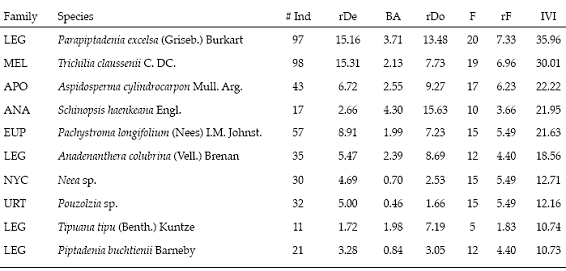
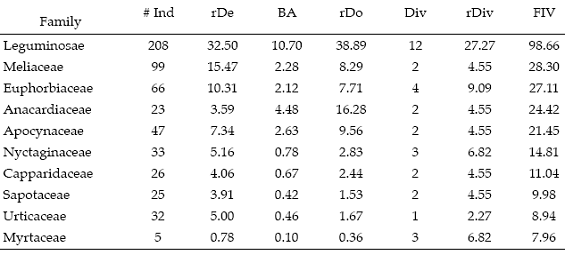
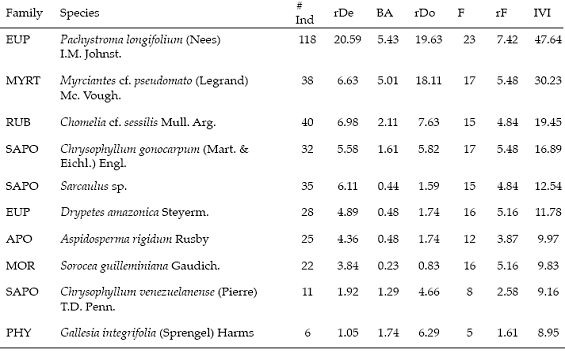
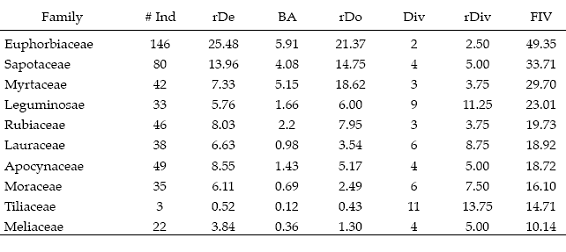
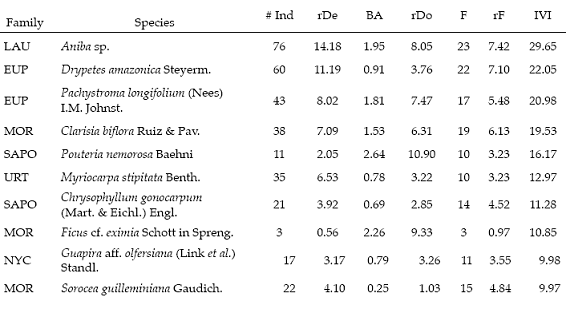
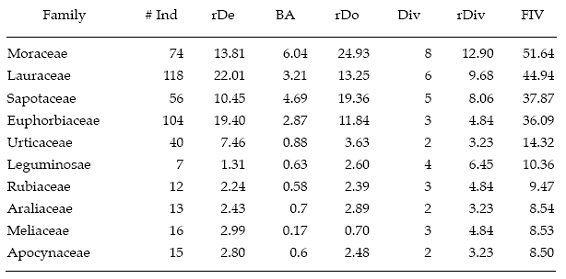
<body><![CDATA[<p><font size="2" face="Verdana">The   deciduous forest plot (Table 2) was dominated   by <i>Parapiptadenia   excelsa </i>(Griseb.) Burkart (Leguminosae) and <i>Trichilia claussenii </i>C. DC. (Meliaceae). Both had the highest number of individuals (97 and 98, respectively) and together contributed to more than   30% of the total number of   individuals on the plots   and to 24% of total basal area (8% and 16%, respectively). Other important and   dominant species were <i>Aspidosperma cylindrocarpon </i>Mull. Arg. (Apocynaceae), <i>Schinopsis haenkeana </i>Engl. (Anacardiaceae), <i>Pachystroma longifolium </i>(Nees) I.M. Johnst. (Euphorbiaceae), and <i>Anadenanthera colubrina </i>(Vell.) Brenan (Leguminosae). They</font></p>     <p><font size="2" face="Verdana">contributed   with 24% of the total number of individuals and 41% of   total basal area. Together these six species   represented the 54% of all   individuals and 62% of total basal area. The most important family was   Leguminosae with 32% of the individuals, 12 species   and 39% of the basal area, followed by   Meliaceae and Euphorbiaceae. These three families contributed with 58%   of the number of individuals, 54% of basal area and 40% of species richness   (Table 2).</font></p>     <p><font size="2" face="Verdana">The semi-deciduous forest plot (Table 3)   was dominated by <i>Pachystroma longifolium </i>and <i>Myrciantes </i>cf. <i>pseudomato </i>(Legrand) Mc. Vough.   (Myrtaceae). <i>Pachystroma   longifolium </i>had the highest number of individuals   (118, 21% of the total), and both species had the highest basal area,   comprising 38% of total basal area. Other important species in terms of density were <i>Chomelia </i>cf. <i>sessilis </i>Mull. Arg. (Rubiaceae) and <i>Chrysophyllum gonocarpum </i>(Mart. &amp; Eichl.) Engl. (Sapotaceae).   The most important family   was Euphorbiaceae, in   which only two species contributed 25% of the   individuals and 21% of basal area, followed   by Sapotaceae and Myrtaceae. These three families comprised 47% of the   number of individuals, 55% of basal area and 13% of species richness (Table 4).</font></p>     <p><font size="2" face="Verdana">The evergreen forest plot (Table 5) was dominated by <i>Aniba </i>sp. (Lauraceae), with 76 individuals (14% of the   total) and 8% of total basal area. <i>Drypetes amazonica </i>Steyerm. (Euphorbiaceae), <i>Pachystroma longifolium </i>and <i>Clarisia biflora </i>Ruiz &amp; Pav. (Moraceae)   were also important. These four species contributed 40% of the total number of   individuals and 26% of total basal area. The most   important family was Moraceae with 74 individuals (14% of the total),   25% of total basal area and eight species, followed by Lauraceae, Sapotaceae   and Euphorbiaceae. These four families represented 66% of the individuals, 70%   of basal area and 35% of species richness (Table 6).</font></p>     <p align=center><font size="2" face="Verdana"><img width=221 height=670 src="/img/revistas/reb/v43n2/v43n2a2_015.jpg" v:shapes="_x0000_i1028"> </font></p>     <p><font size="2" face="Verdana"><b>Figure 3. </b>Number of individuals (bars) and percentage contribution of total   basal area (lines) per diameter size class   on three 1-hectare forest plots in central Bolivia. Note different scales   of the ordinates for each graph.</font></p>     <p><font size="2" face="Verdana"><b>Table 2. </b>Ten most dominant woody plants with dbh &#8805;10cm in   the deciduous forest plot according to importance value indices (species are   ranked by descending importance value index). Legend: # Ind = no. of individuals, rDe = relative   density, BA = basal area, rDo = relative dominance,   F = frequency, rF = relative frequency, IVI = importance value indices.</font></p>     <p align="center"><font size="2" face="Verdana"><img width=566 height=271 src="/img/revistas/reb/v43n2/v43n2a2_017.gif" v:shapes="_x0000_i1029"> </font></p>     <p align="center"><font size="2" face="Verdana"><b>Table 3. </b>Ten most dominant families of woody plants with dbh &#8805;10cm   in the deciduous forest plot according to   family value indices (families are ranked by descending family importance value). Legend: # Ind = no. of individuals, rDe =   relative density, BA = basal area, rDo =   relative dominance, Div = species diversity, rDiv = relative diversity, FIV = family   importance value.</font></p>     <p align="center"><font size="2" face="Verdana"><img width=565 height=255 src="/img/revistas/reb/v43n2/v43n2a2_019.gif" v:shapes="_x0000_i1030"> </font></p>     ]]></body>
<body><![CDATA[<p align="center"><font size="2" face="Verdana"><b>Table 4. </b>Ten most dominant woody plants with dbh &#8805;10cm in   the semi-deciduous forest plot according to importance value indices (species are ranked by   descending importance value index). Legend: # Ind = no. of individuals, rDe = relative density, BA = basal   area, rDo = relative dominance, F = frequency, rF =   relative frequency, IVI = importance value indices.</font></p>     <p align="center"><font size="2" face="Verdana"><img width=565 height=357 src="/img/revistas/reb/v43n2/v43n2a2_022.gif" v:shapes="_x0000_i1031"> </font></p>     <p align="center"><font size="2" face="Verdana"><b>Table 5. </b>Ten   most dominant families of woody plants with dbh &#8805;10cm in the   semi-deciduous forest plot according to   family value indices (families are ranked by descending family importance value). Legend: # Ind = no. of   individuals, rDe = relative density, BA = basal area, rDo = relative dom   inance, Div = species diversity, rDiv = relative diversity, FIV = family   importance value.</font></p>     <p align="center"><font size="2" face="Verdana"><img width=566 height=252 src="/img/revistas/reb/v43n2/v43n2a2_024.gif" v:shapes="_x0000_i1032"></font></p>     <p align=center><font size="2" face="Verdana"><b>Discussion</b></font></p>     <p align=center><font size="2" face="Verdana"><strong>Effect of plot shape on species richness and community composition estimations</strong></font></p>     <p><font size="2" face="Verdana">Spatial distribution patterns of plant species in tropical forests have been reported to show mostly clumped distributions (e.g., Condit <i>et al. </i>2000). Within this scenario, longer and narrower rectangular plots are prone to capture more species than square plots of similar area,   because the former could include a potentially more heterogeneous area   (Condit <i>et al. </i>1996, Laurance <i>et al. </i>1998). Nevertheless, small and statistically non-significant   differences were found in a study comparing tree diversity in square plots versus rectangular plots in Central Amazonia   (Laurance <i>et al. </i>1998). Given the patchy and fragmented nature of the deciduous</font></p>     <p><font size="2" face="Verdana">and evergreen forests in our study area, it was impossible   to survey all vegetation types in regular   square or rectangular plots. Rather, we tried to survey as environmentally homogeneous an area as   possible, leading to our irregular plot shape design. We acknowledge that plot   shape has influenced our results, especially those   of the transect-like evergreen forest plot. The extent of this   influence, however, seems to be variable,   as can be seen from the species accumulation   curves. It significantly decreased in   the irregularly shaped deciduous forest plot when the hectare was   completely surveyed, suggesting that   sampling was representative. In contrast, the species accumulation   curves did not level off in the more-or-less regularly shaped semi-deciduous plot and in the long and transect-like evergreen forest plot, suggesting, that   sampling, irrespective of plot shape, was incomplete.</font></p>     <p><font size="2" face="Verdana"><b>Table 6. </b>Ten most dominant woody plants with dbh &#8805;10cm in   the evergreen forest plot according to importance value indices (species are ranked by descending importance   value index). Legend: # Ind =   no. of individuals, rDe = relative density, BA = basal area, rDo = relative dominance,   F = frequency, rF = relative frequency, IVI = importance value indices.</font></p>     <p align=center> <font size="2" face="Verdana"><img width=566 height=309 src="/img/revistas/reb/v43n2/v43n2a2_028.gif" v:shapes="_x0000_i1033"> </font></p>     ]]></body>
<body><![CDATA[<p><font size="2" face="Verdana"><b>Table 7. </b>Ten most dominant families of woody plants with dbh &#8805;10cm   in the evergreen forest plot according to   family value indices (families are ranked by descending family importance value). Legend: # Ind = no. of individuals, rDe =   relative density, BA = basal area, rDo =   relative dominance, Div = species diversity, rDiv = relative diversity, FIV =   family importance value.</font></p>     <p align="center"><font size="2" face="Verdana"><img width=566 height=279 src="/img/revistas/reb/v43n2/v43n2a2_030.gif" v:shapes="_x0000_i1034"></font></p>     <p><font size="2" face="Verdana">Local variation of tree diversity, dominance and structure at Los Volcanes      > </font></p>     <p><font size="2" face="Verdana">There were obvious differences in the diversity and floristic composition between the deciduous forest plot and the two other plots, which   where rather similar in diversity and structure. Not only was the deciduous   forest plot poorer in terms of generic and familial diversity, it also shared fewer species with the semi-deciduous and the   evergreen forest plot. The deciduous forest plot shared 19 species with   the semi-deciduous and 15 with the evergreen forest plot, whereas the latter   two shared 39 species. Eleven species were   present in all three plots and represented a selection of the tree   species characteristic of the Amboró region like <i>Aspidosperma cylindrocarpum, Gallesia integrifolia </i>and <i>Pachystroma longifolium </i>(Navarro <i>et al. </i>1996).   Few of these species were dominant and abundant on each of the plots, such as <i>Chrysophyllum   gonocarpum. </i>On the contrary, most were locally rare species, at   least at the hectare-scale, with abundances</font></p>     <p><font size="2" face="Verdana">of one individual per hectare (e.g., <i>Cariniana estrellensis </i>(Raddi)   Kuntze, <i>Swartzia   jorori </i>Harms, <i>Eugenia sp.).</i></font></p>     <p><font size="2" face="Verdana">Differences in diversity and   composition between the three plots,   especially between the deciduous forest plot and the two other, was mirrored by several environmental factors. For   example, soil humidity and pH increased from the deciduous forest plot to the evergreen forest plot (Lendzion 2003). Therefore, even though   there is a dominant regional flora, small-scale environmental variations   produce significant differences in the   composition and dominance of the   local tree flora. This fact has already been shown for terrestrial herbs   at LV (Lendzion 2003) and for woody species   in seasonal forests elsewhere (Oliveira-Filho <i>et al. </i>1998, Balvanera <i>et al. </i>2002).</font></p>     <p><font size="2" face="Verdana">Lianas have been   considered important components of tropical   forests (Medina 1995), constituting   in some cases 20% or more of the local flora (Gentry 1995, Schnitzer   &amp; Bongers 2002). In this study, however, we were not able to record lianas with a dbh &#8805; 10 cm in   the deciduous and evergreen forest plots. Only</font></p>     <p align="center"><font size="2" face="Verdana">the semi-deciduous forest plot contained two individuals belonging   to two tree species <i>(Machaerium </i>cf. <i>punctatum </i>and <i>Celtis iguanaea), </i>which   occasionally also grow as lianas, with a dbh &#8805;10 cm. This agrees with another study in Bolivian   deciduous forests that found similar low   levels of liana diversity and density using the same sampling methodology   (Cayola <i>et al. </i>2005).   Nonetheless, this does not mean that the LV forests are devoid of vines and   climbers. In fact, most of the liana diversity and abundance in each of   the studied forest plots is found in dbh   classes below 10 cm (Hoffmann 2004), so that our results have to be interpreted as a sampling artefact.</font></p>      <p><font size="2" face="Verdana">In   mountainous areas, with forest growing on steep slopes,   one of the factors than can influence and produce low basal area values are landslides (Chazdon 2003). Since the humid forest   plot was located on steeper slopes than the   other two plots and additionally had rather   loose soils, we suggest that an increased frequency of localized   landslides could have produced the lower   basal area as compared to the other two plots.</font></p>     <p align=center><font size="2" face="Verdana">The Los Volcanes forests in a    ]]></body>
<body><![CDATA[<br>   Bolivian context</font></p>     <p><font size="2" face="Verdana">Our inventory on the deciduous forest plot contained species   richness and densities of trees with dbh &#8805;   10 cm within the range of other inventories   in Bolivian seasonal forests (Table 8). It was much richer and denser than that   of the Santa Cruz Botanical Garden (inventoried by Uslar <i>et al. </i>2004),   which is located in a slightly drier   lowland area (350 m). Our plots in the semi-deciduous and evergreen   forest variants, although much more species-rich, were less dense than the San   Rafael (1,500 m, Vargas 1995) and Río   Tuichi (880 m, Cayola <i>et al. </i>2005) plots.</font></p>     <p><font size="2" face="Verdana">The dominant and most diverse family in seasonal deciduous forests in the Neotropics is usually Leguminosae (Gentry 1995, Pennington<i>et al. </i>2006). There is, however, ample variation as to which are the   next most diverse and dominant families.   This is confirmed by several other   inventories in Bolivian deciduous forests (Killeen <i>et al. </i>1998,   Kessler &amp; Helme 1999, Fuentes Claros <i>et al. </i>2004) and by our study, where we had six different families following Leguminosae   in importance. In nearby Santa Cruz (Uslar <i>et al. </i>2004) Leguminosae was   the dominant family (seven species), all other families with only one or two species (Table 8). In the adjacent Amboró National Park (Vargas 1995),   they were Lauraceae and Myrtaceae. Finally,   the Tuichi valley dry forests inventory in La Paz department (Cayola <i>et al. </i>2005) reported also Myrtaceae   and Bombacaceae as important. The   dominant families on the evergreen forest plot in LV showed contrasting   results with Moraceae, Lauraceae and Sapotaceae as the most diverse families   (Table 8). The diversity of Moraceae, whose members are prominent components of   tropical rain forests, already suggests the prevalence of different local   environmental conditions on this plot.</font></p>     <p><font size="2" face="Verdana">In contrast, species composition and densities of trees with dbh &#8805; 10 cm on the LV   plots differed from   other tree inventories in Bolivia with similar annual rainfall and similar seasonal vegetation. For instance, the Santa Cruz plot in the deciduous Chiquitania forests (Uslar <i>et al. </i>2004)   reported <i>Aspidospermum cylindrocarpon </i>(Apocynaceae), <i>Myrciaria cauliflora </i>(Myrtaceae) and <i>Phyllostylon rhamnoides </i>(Ulmaceae) as the most   abundant species (Table 8). The Rio San Rafael   plot in Amboró contained <i>Nectandra </i>sp. (Lauraceae), <i>Casearia </i>sp.   (Flacourtiaceae) and <i>Chrysophyllum </i>cf. <i>gonocarpum </i>(Sapotaceae) as the most frequent species (Vargas   1995). The three most common species in the   Tuichi plot were <i>Phyllostylon rhamnoides </i>(Ulmaceae), <i>Trichilia catigua </i>(Meliaceae) and <i>Anadenanthera colubrina </i>(Leguminosae) (Cayola <i>et al. </i>2005). At LV, the most   abundant species were <i>Trichilia claussenii,   Parapiptadenia excelsa </i>and <i>Pachystroma longifolium </i>on the deciduous forest plot, <i>Pachystroma   longifolium, Chomelia </i>cf. <i>sessilis</i> and <i>Myrciantes </i>cf. <i>pseudo-mato </i>on the semi­deciduous forest plot, and <i>Aniba </i>sp., <i>Drypetes amazonica </i>and <i>Pachystroma longifolium </i>on the evergreen forest plot (Table 8). </font></p>     <p><font size="2" face="Verdana">In terms of   basal area, our deciduous and   semi-deciduous forest inventories reached similar values of around 27 m2, which is comparable to other seasonal forest inventories in Bolivia,   except for the Tuichi plot in La Paz (20 m<sup>2</sup>)   and our evergreen forest plot in LV (24.2 m<sup>2</sup>). Murphy &amp;   Lugo (1986) stated that seasonal forests   were less complex structurally than wet tropical forests, with basal   area values in the range from 17 <sub>m</sub>2 to   40 m<sup>2</sup>. Several other studies have reaffirmed this statement (e.g., Lopes <i>et al. </i>2008). Basal area values of the   LV plots, however, were also within the range of other tree inventories in several vegetation types in South America,   using the same diameter cut-off, and particularly within Bolivia. For instance,   basal area values of several 1-ha inventories in humid tropical forests ranged   between 21.4 <sub>m</sub>2 (Beni,   Bolivia) and 39.2 m2 (Amboró,   Bolivia) (Smith &amp; Killeen 1998).</font></p>     <p align=center><font size="2" face="Verdana"><b>Phytogeography   of the Los Volcanes    <br>   species</b></font></p>     <p><font size="2" face="Verdana">Based on the distribution of over 70 plant taxa,   Prado &amp; Gibbs (1993) proposed the existence   of a Pleistocenic arc of seasonal forest   formations. The extant fragments of this   arc are mainly located in three nuclei: the Caatinga nucleus in   northeastern Brazil; the Misiones nucleus   comprising the area from the Bolivia-Brazil   border in Corumbá southwards to the Paraguay-Paraná river confluence and   eastward to Santa Catarina in Brazil; and the piedmont   nucleus extending from Santa Cruz de   la Sierra in Bolivia southward to Tucumán and the sierras of Catamarca   in Argentina. Because our study area is   located within the area of the piedmont nucleus (cf. Prado 2000), we   examined the distribution patterns of the 115 species found at LV. We recorded</font></p>     <p><font size="2" face="Verdana"><i>Anadenanthera colubrina, Myracrodruon urundeuva </i>Allemao and <i>Celtis iguanaea </i>in our plots, all of which have been   reported as characteristic   to the wider Pleistocenic arc formation (Prado &amp;   Gibbs 1993). We also found <i>Diatenopteryx   sorbifolia </i>Radlk., classifed as a restricted Arc species since it only   occurs in the Misiones and Piedmont   nuclei. Navarro &amp; Maldonado   (2002), who considered the area around LV as transitional between the Brasilian-Parana biogeographic region and the Bolivian-Tucuman   biogeographic province, also noted this affinity with the seasonal vegetation   in the Misiones and piedmont nuclei. In total, we identified 21 species as typical of Bolivian seasonal forest formations. More   complex and widespread distribution patterns   are attributed to <i>Cordia alliodora </i>(Ruiz &amp; Pav.) Cham. and <i>Ximenia   americana </i>L., the later occurring in diverse vegetation types throughout   the Neotropics.</font></p>     <p><font size="2" face="Verdana">On a local scale, the forests at LV   shared only 21% (24 species) of all recorded tree species with the inventories in Santa Cruz, San Rafael and   Tuichi. As expected, the deciduous forest   plot shared most species (10 species, 23%) with the nearby (65 km) deciduous forests in the Santa Cruz Botanical Garden   and less than 12% with the other two inventories   (43 km to San Rafael, 660 km to Tuichi). In contrast, the semi-deciduous forest plot shared only 13% of its species   with the inventory in the Santa Cruz Botanical Garden, and less than 10% of its species were also present in the other two inventories. The evergreen forest shared even fewer species   with any of the other seasonal forest inventories (less than 11%). Low   percentages of shared species between seasonal forest inventories, irrespective   of geographical distance, have also been reported for the seasonally dry forest in Mexico and attributed to   the existence of processes of high local diversification, possibly due to   particular historical processes (Trejo &amp;   Dirzo 2002). Inde ed, the complex   vegetational arrangement</font></p>     ]]></body>
<body><![CDATA[<p><font size="2" face="Verdana">of the area - a region where four major   biomes come into contact:   the humid vegetation from Amazonia, the seasonal   subtropical lowland vegetation from the Chaco, the subtropical highland vegetation from the Andes and the   seasonal vegetation of the Chiquitanía (Ibisch <i>et al. </i>2003) - would have provided an optimal   setting for the extraordinary floristic diversification   in the Santa Cruz region. Thus, even   though we are comparing seasonal forest with similar rainfall, dry   season length or at similar altitude, their low floristic similarity seems to be strongly influenced by the biome they are closest to. The San Rafael plot   in Amboró National Park will be more likely influenced by the Andean biome, the   Tuichi plot by the northern Bolivian Andes and Amazonia and Santa Cruz   Botanical Garden by the Chiquitania and the   Chaco. In similar fashion, the different vegetation types reported at LV   have probably been influenced by all these   major biomes, and it is the varied local environmental characteristics that   have allowed the co-existence of species with differing ecological   requirements.</font></p>     <p align=center><font size="2" face="Verdana"><b>Acknowledgements</b></font></p>     <p><font size="2" face="Verdana">We thank the reviewers and the handling editor for suggestions and critique that improved the original manuscript. We thank the owner   of Los Volcanes, A.   Schwiening, for allowing us to work on his land. SKH   and MK are indebted to the Colección   Boliviana de Fauna and the Dirección General   de Biodiversidad for research permits. We   thank the curators of the Herbario Nacional de Bolivia (LPB) and Herbario   del Oriente Boliviano (USZ) for providing us   with working facilities and allowing   access to their collections. We are   grateful to C. Hamel and M. Valverde for help in field and to J.   Lendzion for providing both unpublished   soil and environmental data from the   plots. Financial support was provided by   the Deutsche Forschungsgemeinschaft (DFG) and the German Academic   Exchange Service (DAAD).</font></p>     <p align=center><font size="2" face="Verdana"><b>References</b></font></p>     <!-- ref --><p><font size="2" face="Verdana">1.- Balvanera, P., E. Lott, G. Segura, C. Siebe &amp; A. Islas. 2002. Patterns of -diversity in a   Mexican tropical dry forest. Journal of Vegetation Science 13: 145-158. </font>&nbsp;&nbsp;&nbsp;&nbsp;&nbsp;&nbsp;&nbsp;&nbsp;[&#160;<a href="javascript:void(0);" onclick="javascript: window.open('/scielo.php?script=sci_nlinks&ref=010824&pid=S1605-2528200800020000200001&lng=','','width=640,height=500,resizable=yes,scrollbars=1,menubar=yes,');">Links</a>&#160;]<!-- end-ref --><!-- ref --><p><font size="2" face="Verdana">2.- Cayola, L., A. Fuentes &amp; P. M.   Jørgensen. 2005. Estructura y composición forística de un bosque seco subandino yungueño en el valle del Tuichi, Área Natural de Manejo Integrado   Madidi, La Paz (Bolivia). Ecología en Bolivia 40:   396-417. </font>&nbsp;&nbsp;&nbsp;&nbsp;&nbsp;&nbsp;&nbsp;&nbsp;[&#160;<a href="javascript:void(0);" onclick="javascript: window.open('/scielo.php?script=sci_nlinks&ref=010825&pid=S1605-2528200800020000200002&lng=','','width=640,height=500,resizable=yes,scrollbars=1,menubar=yes,');">Links</a>&#160;]<!-- end-ref --><!-- ref --><p><font size="2" face="Verdana">3.- Chazdon, R. L. 2003. Tropical forest   recovery: legacies of human impact and natural   disturbances. Perspectives in Plant Ecology, Evolution and Systematics 6:   51-71. </font>&nbsp;&nbsp;&nbsp;&nbsp;&nbsp;&nbsp;&nbsp;&nbsp;[&#160;<a href="javascript:void(0);" onclick="javascript: window.open('/scielo.php?script=sci_nlinks&ref=010826&pid=S1605-2528200800020000200003&lng=','','width=640,height=500,resizable=yes,scrollbars=1,menubar=yes,');">Links</a>&#160;]<!-- end-ref --><!-- ref --><p><font size="2" face="Verdana">4.- Condit, R., S. P. Hubbell, J. V. LaFrankie, R. Sukumar, N. Manokaran, R. B. Foster &amp; P. S.&nbsp; Ashton. 1996. Species-area and species­individual   relationships for tropical trees: A   comparison of three 50-ha plots. Journal of Ecology 84: 549-562.</font>&nbsp;&nbsp;&nbsp;&nbsp;&nbsp;&nbsp;&nbsp;&nbsp;[&#160;<a href="javascript:void(0);" onclick="javascript: window.open('/scielo.php?script=sci_nlinks&ref=010827&pid=S1605-2528200800020000200004&lng=','','width=640,height=500,resizable=yes,scrollbars=1,menubar=yes,');">Links</a>&#160;]<!-- end-ref --><!-- ref --><p><font size="2" face="Verdana">5.- Condit, R., P. S.   Ashton, P. Baker, S. Bunyavejchewin, S. Gunatilleke, N. Gunatilleke, S. P.   Hubbell, R. B. Foster, A. Itoh, J. V. LaFrankie, H. S. Lee, E. Losos, N.   Manokaran, R. Sukumar &amp; T. Yamakura.   2000. Spatial patterns in the distribution   of tropical tree species. Science 288: 1414-1418.</font>&nbsp;&nbsp;&nbsp;&nbsp;&nbsp;&nbsp;&nbsp;&nbsp;[&#160;<a href="javascript:void(0);" onclick="javascript: window.open('/scielo.php?script=sci_nlinks&ref=010828&pid=S1605-2528200800020000200005&lng=','','width=640,height=500,resizable=yes,scrollbars=1,menubar=yes,');">Links</a>&#160;]<!-- end-ref --><!-- ref --><p><font size="2" face="Verdana">6.- Curtis, J.   T. &amp; R. P. Mcintosh. 1951.   An upland forest continuum in the prairie-forest border region of Wisconsin. Ecology 32: 476-496. </font>&nbsp;&nbsp;&nbsp;&nbsp;&nbsp;&nbsp;&nbsp;&nbsp;[&#160;<a href="javascript:void(0);" onclick="javascript: window.open('/scielo.php?script=sci_nlinks&ref=010829&pid=S1605-2528200800020000200006&lng=','','width=640,height=500,resizable=yes,scrollbars=1,menubar=yes,');">Links</a>&#160;]<!-- end-ref --><!-- ref --><p><font size="2" face="Verdana">7.- Fuentes   Claros, A., A. Araujo Murakami, H. Cabrera   Condarco, F. Canqui, L. Cayola, C. Maldonado &amp; N. Paniagua. 2004.   Estructura composición y variabilidad del   bosque subandino xérico en un sector del valle del río Tuichi, ANMI   Madidi, La Paz (Bolivia). Revista Boliviana de Ecología y Conservación Ambiental 15: 41-62. </font>&nbsp;&nbsp;&nbsp;&nbsp;&nbsp;&nbsp;&nbsp;&nbsp;[&#160;<a href="javascript:void(0);" onclick="javascript: window.open('/scielo.php?script=sci_nlinks&ref=010830&pid=S1605-2528200800020000200007&lng=','','width=640,height=500,resizable=yes,scrollbars=1,menubar=yes,');">Links</a>&#160;]<!-- end-ref --><!-- ref --><p><font size="2" face="Verdana">8.- Gentry, A. H. 1995. Diversity and foristic composition of neotropical dry forests. </font><font size="2" face="Verdana">pp. 146-194. In: S. H. Bullock, H. A.   Mooney &amp; E. Medina (eds.). Seasonally Dry   Tropical Forests. Cambridge University Press, Cambridge. </font>&nbsp;&nbsp;&nbsp;&nbsp;&nbsp;&nbsp;&nbsp;&nbsp;[&#160;<a href="javascript:void(0);" onclick="javascript: window.open('/scielo.php?script=sci_nlinks&ref=010831&pid=S1605-2528200800020000200008&lng=','','width=640,height=500,resizable=yes,scrollbars=1,menubar=yes,');">Links</a>&#160;]<!-- end-ref --><!-- ref --><p><font size="2" face="Verdana">9.- Holmgren, P. K.   &amp; N. H. Holmgren. 1998. [continuously updated]. Index herbariorum: a global directory of public herbaria and associated staff. New York Botanical Garden‘s Virtual Herbarium. http://sweetgum.nybg.org/ih/. Cited 5   February 2008.</font>&nbsp;&nbsp;&nbsp;&nbsp;&nbsp;&nbsp;&nbsp;&nbsp;[&#160;<a href="javascript:void(0);" onclick="javascript: window.open('/scielo.php?script=sci_nlinks&ref=010832&pid=S1605-2528200800020000200009&lng=','','width=640,height=500,resizable=yes,scrollbars=1,menubar=yes,');">Links</a>&#160;]<!-- end-ref --><!-- ref --><p><font size="2" face="Verdana">10.- Hoffmann, D. 2004. Lianen dreier Waldtypen im Übergang der Tropen zu   den Subtropen in Zentralbolivien. Diploma thesis,   Halle-Wittenberg University, Halle. 107 p.</font>&nbsp;&nbsp;&nbsp;&nbsp;&nbsp;&nbsp;&nbsp;&nbsp;[&#160;<a href="javascript:void(0);" onclick="javascript: window.open('/scielo.php?script=sci_nlinks&ref=010833&pid=S1605-2528200800020000200010&lng=','','width=640,height=500,resizable=yes,scrollbars=1,menubar=yes,');">Links</a>&#160;]<!-- end-ref --><!-- ref --><p><font size="2" face="Verdana">11.- Ibisch, P.   L., S. G. Beck, B. Gerkmann &amp; A. Carretero. 2003.   Ecoregiones y ecosistemas. pp. 47-88. In: P.   L. Ibisch &amp; G. Mérida (eds.).   Biodiversidad: La Riqueza de Bolivia. Estado de Conocimiento y Conservación. Ministerio de Desarrollo Sostenible y Planifcación, Editorial FAN, Santa   Cruz.</font>&nbsp;&nbsp;&nbsp;&nbsp;&nbsp;&nbsp;&nbsp;&nbsp;[&#160;<a href="javascript:void(0);" onclick="javascript: window.open('/scielo.php?script=sci_nlinks&ref=010834&pid=S1605-2528200800020000200011&lng=','','width=640,height=500,resizable=yes,scrollbars=1,menubar=yes,');">Links</a>&#160;]<!-- end-ref --><!-- ref --><p><font size="2" face="Verdana">12.- Jardim,   A., T. J. Killeen &amp; A. Fuentes. 2003. Guía de los árboles y arbustos del   bosque seco Chiquitano, Bolivia. Editorial FAN, Santa Cruz. 324 p.</font>&nbsp;&nbsp;&nbsp;&nbsp;&nbsp;&nbsp;&nbsp;&nbsp;[&#160;<a href="javascript:void(0);" onclick="javascript: window.open('/scielo.php?script=sci_nlinks&ref=010835&pid=S1605-2528200800020000200012&lng=','','width=640,height=500,resizable=yes,scrollbars=1,menubar=yes,');">Links</a>&#160;]<!-- end-ref --><!-- ref --><p><font size="2" face="Verdana">13.- Kessler, M. &amp; N. Helme. 1999.   Floristic diversity and   phytogeography of the central Tuichi Valley, an isolated dry forest locality in the   Bolivian Andes. Candollea 54: 341-366.</font>&nbsp;&nbsp;&nbsp;&nbsp;&nbsp;&nbsp;&nbsp;&nbsp;[&#160;<a href="javascript:void(0);" onclick="javascript: window.open('/scielo.php?script=sci_nlinks&ref=010836&pid=S1605-2528200800020000200013&lng=','','width=640,height=500,resizable=yes,scrollbars=1,menubar=yes,');">Links</a>&#160;]<!-- end-ref --><!-- ref --><p><font size="2" face="Verdana">14.- Killeen, T. J., A.   Jardim, F. Mamani, N. Rojas, &amp; P. Saravia. 1998. Diversity, composition and structure of a   tropical semideciduous forest   in the Chiquitanía region of Santa Cruz, Bolivia. Journal of Tropical Ecology 14:   803-827.</font>&nbsp;&nbsp;&nbsp;&nbsp;&nbsp;&nbsp;&nbsp;&nbsp;[&#160;<a href="javascript:void(0);" onclick="javascript: window.open('/scielo.php?script=sci_nlinks&ref=010837&pid=S1605-2528200800020000200014&lng=','','width=640,height=500,resizable=yes,scrollbars=1,menubar=yes,');">Links</a>&#160;]<!-- end-ref --><!-- ref --><p><font size="2" face="Verdana">15.- Killeen, T. J., E. García &amp; S. G. Beck. 1993. Guía de árboles   de Bolivia. Herbario Nacional de Bolivia/Missouri Botanical   Garden, Edit. Quipus srl, La Paz. 958 p.</font>&nbsp;&nbsp;&nbsp;&nbsp;&nbsp;&nbsp;&nbsp;&nbsp;[&#160;<a href="javascript:void(0);" onclick="javascript: window.open('/scielo.php?script=sci_nlinks&ref=010838&pid=S1605-2528200800020000200015&lng=','','width=640,height=500,resizable=yes,scrollbars=1,menubar=yes,');">Links</a>&#160;]<!-- end-ref --><!-- ref --><p><font size="2" face="Verdana">16.- Laurance,   W. F., L. V. Ferreira, J. M Rankin de Merona &amp; R.   W. Hutchings. 1998. Infuence of plot shape on estimates of tree diversity and community   composition in Central Amazonia. Biotropica 30: 662-665.</font>&nbsp;&nbsp;&nbsp;&nbsp;&nbsp;&nbsp;&nbsp;&nbsp;[&#160;<a href="javascript:void(0);" onclick="javascript: window.open('/scielo.php?script=sci_nlinks&ref=010839&pid=S1605-2528200800020000200016&lng=','','width=640,height=500,resizable=yes,scrollbars=1,menubar=yes,');">Links</a>&#160;]<!-- end-ref --><!-- ref --><p><font size="2" face="Verdana">17.- Lendzion,   J. 2003. Krautfora dreier Waldtypen im Übergang der   Tropen zu den Subtropen in Zentralbolivien.   Diploma thesis, Göttingen   University, Göttingen. 101 p.</font>&nbsp;&nbsp;&nbsp;&nbsp;&nbsp;&nbsp;&nbsp;&nbsp;[&#160;<a href="javascript:void(0);" onclick="javascript: window.open('/scielo.php?script=sci_nlinks&ref=010840&pid=S1605-2528200800020000200017&lng=','','width=640,height=500,resizable=yes,scrollbars=1,menubar=yes,');">Links</a>&#160;]<!-- end-ref --><!-- ref --><p><font size="2" face="Verdana">18.- Lopes, C. G. R., E. M. N. Ferraz &amp;   E. L. Araujo. 2008. Physiognomic-structural   characterization of dry- and humid­forest   fragments (Atlantic Coastal Forest)   in Pernambuco State, NE Brazil. Plant Ecology 198: 1-18.</font>&nbsp;&nbsp;&nbsp;&nbsp;&nbsp;&nbsp;&nbsp;&nbsp;[&#160;<a href="javascript:void(0);" onclick="javascript: window.open('/scielo.php?script=sci_nlinks&ref=010841&pid=S1605-2528200800020000200018&lng=','','width=640,height=500,resizable=yes,scrollbars=1,menubar=yes,');">Links</a>&#160;]<!-- end-ref --><!-- ref --><p><font size="2" face="Verdana">19.- Magurran, A. E. 2004. Measuring biological diversity. Blackwell Publishing, Oxford. 256 p.</font>&nbsp;&nbsp;&nbsp;&nbsp;&nbsp;&nbsp;&nbsp;&nbsp;[&#160;<a href="javascript:void(0);" onclick="javascript: window.open('/scielo.php?script=sci_nlinks&ref=010842&pid=S1605-2528200800020000200019&lng=','','width=640,height=500,resizable=yes,scrollbars=1,menubar=yes,');">Links</a>&#160;]<!-- end-ref --><!-- ref --><p><font size="2" face="Verdana">20- Medina, E. 1995. Diversity of life   forms of higher plants in Neotropical dry forests. pp. 221- 242. In: S. H. Bullock, H. A. Mooney   &amp; E. Medina (eds.). Seasonally Dry Tropical   Forests. Cambridge University Press, Cambridge.</font>&nbsp;&nbsp;&nbsp;&nbsp;&nbsp;&nbsp;&nbsp;&nbsp;[&#160;<a href="javascript:void(0);" onclick="javascript: window.open('/scielo.php?script=sci_nlinks&ref=010843&pid=S1605-2528200800020000200020&lng=','','width=640,height=500,resizable=yes,scrollbars=1,menubar=yes,');">Links</a>&#160;]<!-- end-ref --><!-- ref --><p><font size="2" face="Verdana">21.- Mori, S. A., B. M. Boom, A. M. de Carvalho &amp; T. S. dos Santos. 1983. Southern Bahian   moist forests. Botanical Review 49: 155-232.</font>&nbsp;&nbsp;&nbsp;&nbsp;&nbsp;&nbsp;&nbsp;&nbsp;[&#160;<a href="javascript:void(0);" onclick="javascript: window.open('/scielo.php?script=sci_nlinks&ref=010844&pid=S1605-2528200800020000200021&lng=','','width=640,height=500,resizable=yes,scrollbars=1,menubar=yes,');">Links</a>&#160;]<!-- end-ref --><!-- ref --><p><font size="2" face="Verdana">22.- Murphy, P. G. &amp; A. E. Lugo. 1986. Ecology of tropical dry forest. Annual Review of Ecology and   Systematics 17: 67-68.</font>&nbsp;&nbsp;&nbsp;&nbsp;&nbsp;&nbsp;&nbsp;&nbsp;[&#160;<a href="javascript:void(0);" onclick="javascript: window.open('/scielo.php?script=sci_nlinks&ref=010845&pid=S1605-2528200800020000200022&lng=','','width=640,height=500,resizable=yes,scrollbars=1,menubar=yes,');">Links</a>&#160;]<!-- end-ref --><!-- ref --><p><font size="2" face="Verdana">23.- Navarro G., I. Vargas, A. Jardim, M.   Toledo &amp; N. de la   Barra. 1996. Clasifcación y   diagnóstico para la conservación de   la vegetación de la región del   Parque Nacional Amboró. Santa Cruz,   Bolivia. Universidad Complutense, Fundación Amigos de la   Naturaleza, Museo de Historia Natural Noel   Kempff Mercado, Universidad Mayor de San Simón, New York Botanical Garden. Santa Cruz. 78 p.</font>&nbsp;&nbsp;&nbsp;&nbsp;&nbsp;&nbsp;&nbsp;&nbsp;[&#160;<a href="javascript:void(0);" onclick="javascript: window.open('/scielo.php?script=sci_nlinks&ref=010846&pid=S1605-2528200800020000200023&lng=','','width=640,height=500,resizable=yes,scrollbars=1,menubar=yes,');">Links</a>&#160;]<!-- end-ref --><!-- ref --><p><font size="2" face="Verdana">24.- Navarro G. &amp; M.   Maldonado. 2002. Geografía ecológica de Bolivia: Vegetación   y ambientes acuáticos. Fundación Simón I. Patiño, Cochabamba. 719 p.</font>&nbsp;&nbsp;&nbsp;&nbsp;&nbsp;&nbsp;&nbsp;&nbsp;[&#160;<a href="javascript:void(0);" onclick="javascript: window.open('/scielo.php?script=sci_nlinks&ref=010847&pid=S1605-2528200800020000200024&lng=','','width=640,height=500,resizable=yes,scrollbars=1,menubar=yes,');">Links</a>&#160;]<!-- end-ref --><!-- ref --><p><font size="2" face="Verdana">25.- Nee, M.   2004. Flora de la región del Parque   Nacional Amboró. Bolivia. Vol. 2: Magnoliidae, Hamamelidae y Caryophyllidae. FAN. Santa Cruz. 208 p.</font>&nbsp;&nbsp;&nbsp;&nbsp;&nbsp;&nbsp;&nbsp;&nbsp;[&#160;<a href="javascript:void(0);" onclick="javascript: window.open('/scielo.php?script=sci_nlinks&ref=010848&pid=S1605-2528200800020000200025&lng=','','width=640,height=500,resizable=yes,scrollbars=1,menubar=yes,');">Links</a>&#160;]<!-- end-ref --><!-- ref --><p><font size="2" face="Verdana">26.- Oliveira-Filho, A. T.,   N. Curi, E. A. Vilela &amp; D. A.   Carvalho. 1998. Effects   of canopy gaps, topography   and soils on the distribution of woody species in a   central Brazilian deciduous dry forest. Biotropica 30: 362-375. </font>&nbsp;&nbsp;&nbsp;&nbsp;&nbsp;&nbsp;&nbsp;&nbsp;[&#160;<a href="javascript:void(0);" onclick="javascript: window.open('/scielo.php?script=sci_nlinks&ref=010849&pid=S1605-2528200800020000200026&lng=','','width=640,height=500,resizable=yes,scrollbars=1,menubar=yes,');">Links</a>&#160;]<!-- end-ref --><!-- ref --><p><font size="2" face="Verdana">27.- Pennington, R. T., G. P. Lewis &amp; J. A. Ratter. 2006. An overview of the plant diversity, biogeography   and conservation of neotropical savannas and   seasonally dry forests. In: R. T.   Pennington, G. P. Lewis &amp; J. A.   Ratter (eds.). pp. 1-29. Neotropical Savannas and Seasonally Dry   Forests: Plant Diversity, Biogeography and Conservation. CRC Press, Miami.</font>&nbsp;&nbsp;&nbsp;&nbsp;&nbsp;&nbsp;&nbsp;&nbsp;[&#160;<a href="javascript:void(0);" onclick="javascript: window.open('/scielo.php?script=sci_nlinks&ref=010850&pid=S1605-2528200800020000200027&lng=','','width=640,height=500,resizable=yes,scrollbars=1,menubar=yes,');">Links</a>&#160;]<!-- end-ref --><!-- ref --><p><font size="2" face="Verdana">28.- Prado, D. E. 2000. Seasonally dry   forests of tropical South America: from   forgotten ecosystems to a new phytogeographic unit. Edinburgh Journal of   Botany 57: 437-461.</font>&nbsp;&nbsp;&nbsp;&nbsp;&nbsp;&nbsp;&nbsp;&nbsp;[&#160;<a href="javascript:void(0);" onclick="javascript: window.open('/scielo.php?script=sci_nlinks&ref=010851&pid=S1605-2528200800020000200028&lng=','','width=640,height=500,resizable=yes,scrollbars=1,menubar=yes,');">Links</a>&#160;]<!-- end-ref --><!-- ref --><p><font size="2" face="Verdana">29.- Prado, D. E. &amp; P. E. Gibbs. 1993. Patterns of species distributions in the dry seasonal forests of South America. Annals of the Missouri Botanical Garden 80: 902-927. <br clear=all> </font>&nbsp;&nbsp;&nbsp;&nbsp;&nbsp;&nbsp;&nbsp;&nbsp;[&#160;<a href="javascript:void(0);" onclick="javascript: window.open('/scielo.php?script=sci_nlinks&ref=010852&pid=S1605-2528200800020000200029&lng=','','width=640,height=500,resizable=yes,scrollbars=1,menubar=yes,');">Links</a>&#160;]<!-- end-ref --><!-- ref --><p><font size="2" face="Verdana">30.- Schnitzer, S. A. &amp; F. Bongers.   2002. The ecology of lianas and their role in forests. Trends in Ecology and Evolution 17: 223-230. </font>&nbsp;&nbsp;&nbsp;&nbsp;&nbsp;&nbsp;&nbsp;&nbsp;[&#160;<a href="javascript:void(0);" onclick="javascript: window.open('/scielo.php?script=sci_nlinks&ref=010853&pid=S1605-2528200800020000200030&lng=','','width=640,height=500,resizable=yes,scrollbars=1,menubar=yes,');">Links</a>&#160;]<!-- end-ref --><!-- ref --><p><font size="2" face="Verdana">31.- Smith, D. N. &amp; T. J. Killeen.   1998. A comparison of the structure and composition of montane and lowland tropical forest in the   Serranía Pilón Lajas, Beni, Bolivia. pp. 681-700. In F. Dallmeier &amp; J. A.   Comiskey (eds.). Forest Biodiversity Research,   Monitoring and Modeling, Vol. 21. The Parthenon Publishing Group, New   York.</font>&nbsp;&nbsp;&nbsp;&nbsp;&nbsp;&nbsp;&nbsp;&nbsp;[&#160;<a href="javascript:void(0);" onclick="javascript: window.open('/scielo.php?script=sci_nlinks&ref=010854&pid=S1605-2528200800020000200031&lng=','','width=640,height=500,resizable=yes,scrollbars=1,menubar=yes,');">Links</a>&#160;]<!-- end-ref --><!-- ref --><p><font size="2" face="Verdana">32.- Trejo, I. &amp; R. Dirzo. 2002. Floristic diversity of Mexican seasonally dry tropical   forests. Biodiversity and   Conservation 11: 2063- 2048.</font>&nbsp;&nbsp;&nbsp;&nbsp;&nbsp;&nbsp;&nbsp;&nbsp;[&#160;<a href="javascript:void(0);" onclick="javascript: window.open('/scielo.php?script=sci_nlinks&ref=010855&pid=S1605-2528200800020000200032&lng=','','width=640,height=500,resizable=yes,scrollbars=1,menubar=yes,');">Links</a>&#160;]<!-- end-ref --><!-- ref --><p><font size="2" face="Verdana">33.- Uslar, Y. V., B. Mostacedo &amp; M.   Saldias. 2004. Composición, estructura y dinámica de un   bosque seco semideciduo en Santa Cruz, Bolivia. Ecología en Bolivia 39: 25-43.</font>&nbsp;&nbsp;&nbsp;&nbsp;&nbsp;&nbsp;&nbsp;&nbsp;[&#160;<a href="javascript:void(0);" onclick="javascript: window.open('/scielo.php?script=sci_nlinks&ref=010856&pid=S1605-2528200800020000200033&lng=','','width=640,height=500,resizable=yes,scrollbars=1,menubar=yes,');">Links</a>&#160;]<!-- end-ref --><!-- ref --><p><font size="2" face="Verdana">34.- Vargas,   I. 1995. Estructura y composición de cuatro sitios boscosos en el Parque Nacional Amboró. Tesis de grado, Carrera de Agronomía, Universidad Autónoma Gabriel René Moreno, Santa Cruz. 78 p.</font>&nbsp;&nbsp;&nbsp;&nbsp;&nbsp;&nbsp;&nbsp;&nbsp;[&#160;<a href="javascript:void(0);" onclick="javascript: window.open('/scielo.php?script=sci_nlinks&ref=010857&pid=S1605-2528200800020000200034&lng=','','width=640,height=500,resizable=yes,scrollbars=1,menubar=yes,');">Links</a>&#160;]<!-- end-ref --><p>&nbsp;</p>     <p><font size="2" face="Verdana">Art&iacute;culo   recibido en: Junio de 2008. </font></p>     ]]></body>
<body><![CDATA[<p><font size="2" face="Verdana">Manejado por: M&oacute;nica Moraes. </font></p>     <p><font size="2" face="Verdana">Aceptado en: Septiembre de 2008. </font></p>      ]]></body><back>
<ref-list>
<ref id="B1">
<label>1</label><nlm-citation citation-type="journal">
<person-group person-group-type="author">
<name>
<surname><![CDATA[Balvanera]]></surname>
<given-names><![CDATA[P.]]></given-names>
</name>
<name>
<surname><![CDATA[Lott]]></surname>
<given-names><![CDATA[E.]]></given-names>
</name>
<name>
<surname><![CDATA[Segura]]></surname>
<given-names><![CDATA[G.]]></given-names>
</name>
<name>
<surname><![CDATA[Siebe]]></surname>
<given-names><![CDATA[C.]]></given-names>
</name>
<name>
<surname><![CDATA[Islas]]></surname>
<given-names><![CDATA[A.]]></given-names>
</name>
</person-group>
<article-title xml:lang="en"><![CDATA[Patterns of -diversity in a Mexican tropical dry forest]]></article-title>
<source><![CDATA[Journal of Vegetation Science]]></source>
<year>2002</year>
<volume>13</volume>
<page-range>145-158</page-range></nlm-citation>
</ref>
<ref id="B2">
<label>2</label><nlm-citation citation-type="journal">
<person-group person-group-type="author">
<name>
<surname><![CDATA[Cayola]]></surname>
<given-names><![CDATA[L.]]></given-names>
</name>
<name>
<surname><![CDATA[Fuentes]]></surname>
<given-names><![CDATA[A.]]></given-names>
</name>
<name>
<surname><![CDATA[Jørgensen]]></surname>
<given-names><![CDATA[P. M.]]></given-names>
</name>
</person-group>
<article-title xml:lang="es"><![CDATA[Estructura y composición forística de un bosque seco subandino yungueño en el valle del Tuichi, Área Natural de Manejo Integrado Madidi, La Paz (Bolivia)]]></article-title>
<source><![CDATA[Ecología en Bolivia]]></source>
<year>2005</year>
<volume>40</volume>
<page-range>396-417</page-range></nlm-citation>
</ref>
<ref id="B3">
<label>3</label><nlm-citation citation-type="journal">
<person-group person-group-type="author">
<name>
<surname><![CDATA[Chazdon]]></surname>
<given-names><![CDATA[R. L.]]></given-names>
</name>
</person-group>
<article-title xml:lang="en"><![CDATA[Tropical forest recovery: legacies of human impact and natural disturbances]]></article-title>
<source><![CDATA[Perspectives in Plant Ecology, Evolution and Systematics]]></source>
<year>2003</year>
<volume>6</volume>
<page-range>51-71</page-range></nlm-citation>
</ref>
<ref id="B4">
<label>4</label><nlm-citation citation-type="journal">
<person-group person-group-type="author">
<name>
<surname><![CDATA[Condit]]></surname>
<given-names><![CDATA[R.]]></given-names>
</name>
<name>
<surname><![CDATA[Hubbell]]></surname>
<given-names><![CDATA[S. P.]]></given-names>
</name>
<name>
<surname><![CDATA[LaFrankie]]></surname>
<given-names><![CDATA[J. V.]]></given-names>
</name>
<name>
<surname><![CDATA[Sukumar]]></surname>
<given-names><![CDATA[R.]]></given-names>
</name>
<name>
<surname><![CDATA[Manokaran]]></surname>
<given-names><![CDATA[N.]]></given-names>
</name>
<name>
<surname><![CDATA[Foster]]></surname>
<given-names><![CDATA[R. B.]]></given-names>
</name>
<name>
<surname><![CDATA[Ashton]]></surname>
<given-names><![CDATA[P. S.]]></given-names>
</name>
</person-group>
<article-title xml:lang="en"><![CDATA[Species-area and species­individual relationships for tropical trees: A comparison of three 50-ha plots.]]></article-title>
<source><![CDATA[Journal of Ecology]]></source>
<year>1996</year>
<volume>84</volume>
<page-range>549-562</page-range></nlm-citation>
</ref>
<ref id="B5">
<label>5</label><nlm-citation citation-type="journal">
<person-group person-group-type="author">
<name>
<surname><![CDATA[Condit]]></surname>
<given-names><![CDATA[R.]]></given-names>
</name>
<name>
<surname><![CDATA[Ashton]]></surname>
<given-names><![CDATA[P. S.]]></given-names>
</name>
<name>
<surname><![CDATA[Baker]]></surname>
<given-names><![CDATA[P.]]></given-names>
</name>
<name>
<surname><![CDATA[Bunyavejchewin]]></surname>
<given-names><![CDATA[S.]]></given-names>
</name>
<name>
<surname><![CDATA[Gunatilleke]]></surname>
<given-names><![CDATA[S.]]></given-names>
</name>
<name>
<surname><![CDATA[Gunatilleke]]></surname>
<given-names><![CDATA[N.]]></given-names>
</name>
<name>
<surname><![CDATA[Hubbell]]></surname>
<given-names><![CDATA[S. P.]]></given-names>
</name>
<name>
<surname><![CDATA[Foster]]></surname>
<given-names><![CDATA[R. B.]]></given-names>
</name>
<name>
<surname><![CDATA[Itoh]]></surname>
<given-names><![CDATA[A.]]></given-names>
</name>
<name>
<surname><![CDATA[LaFrankie]]></surname>
<given-names><![CDATA[J. V.]]></given-names>
</name>
<name>
<surname><![CDATA[Lee]]></surname>
<given-names><![CDATA[H. S.]]></given-names>
</name>
<name>
<surname><![CDATA[Losos]]></surname>
<given-names><![CDATA[E.]]></given-names>
</name>
<name>
<surname><![CDATA[Manokaran]]></surname>
<given-names><![CDATA[N.]]></given-names>
</name>
<name>
<surname><![CDATA[Sukuma]]></surname>
<given-names><![CDATA[R.]]></given-names>
</name>
<name>
<surname><![CDATA[Yamakura]]></surname>
<given-names><![CDATA[T.]]></given-names>
</name>
</person-group>
<article-title xml:lang="en"><![CDATA[Spatial patterns in the distribution of tropical tree species]]></article-title>
<source><![CDATA[Science]]></source>
<year>2000</year>
<volume>288</volume>
<page-range>1414-1418</page-range></nlm-citation>
</ref>
<ref id="B6">
<label>6</label><nlm-citation citation-type="journal">
<person-group person-group-type="author">
<name>
<surname><![CDATA[Curtis]]></surname>
<given-names><![CDATA[J. T.]]></given-names>
</name>
<name>
<surname><![CDATA[Mcintosh]]></surname>
<given-names><![CDATA[R. P.]]></given-names>
</name>
</person-group>
<article-title xml:lang="en"><![CDATA[An upland forest continuum in the prairie-forest border region of Wisconsin.]]></article-title>
<source><![CDATA[Ecology]]></source>
<year>1951</year>
<volume>32</volume>
<page-range>476-496</page-range></nlm-citation>
</ref>
<ref id="B7">
<label>7</label><nlm-citation citation-type="journal">
<person-group person-group-type="author">
<name>
<surname><![CDATA[Fuentes Claros]]></surname>
<given-names><![CDATA[A.]]></given-names>
</name>
<name>
<surname><![CDATA[Araujo Murakami]]></surname>
<given-names><![CDATA[A.]]></given-names>
</name>
<name>
<surname><![CDATA[Cabrera Condarco]]></surname>
<given-names><![CDATA[H.]]></given-names>
</name>
<name>
<surname><![CDATA[Canqui]]></surname>
<given-names><![CDATA[F.]]></given-names>
</name>
<name>
<surname><![CDATA[Cayola]]></surname>
<given-names><![CDATA[L.]]></given-names>
</name>
<name>
<surname><![CDATA[Maldonado]]></surname>
<given-names><![CDATA[C.]]></given-names>
</name>
<name>
<surname><![CDATA[Paniagua]]></surname>
<given-names><![CDATA[N.]]></given-names>
</name>
</person-group>
<article-title xml:lang="es"><![CDATA[Estructura composición y variabilidad del bosque subandino xérico en un sector del valle del río Tuichi, ANMI Madidi, La Paz (Bolivia).]]></article-title>
<source><![CDATA[Revista Boliviana de Ecología y Conservación Ambiental]]></source>
<year>2004</year>
<volume>15</volume>
<page-range>41-62</page-range></nlm-citation>
</ref>
<ref id="B8">
<label>8</label><nlm-citation citation-type="">
<person-group person-group-type="author">
<name>
<surname><![CDATA[Gentry]]></surname>
<given-names><![CDATA[A. H.]]></given-names>
</name>
</person-group>
<article-title xml:lang="en"><![CDATA[Diversity and foristic composition of neotropical dry forests.]]></article-title>
<person-group person-group-type="editor">
<name>
<surname><![CDATA[Bullock]]></surname>
<given-names><![CDATA[S. H.]]></given-names>
</name>
<name>
<surname><![CDATA[Mooney]]></surname>
<given-names><![CDATA[H. A.]]></given-names>
</name>
<name>
<surname><![CDATA[Medina]]></surname>
<given-names><![CDATA[E.]]></given-names>
</name>
</person-group>
<source><![CDATA[Seasonally Dry Tropical Forests: Cambridge University Press, Cambridge]]></source>
<year>1995</year>
<page-range>146-194</page-range></nlm-citation>
</ref>
<ref id="B9">
<label>9</label><nlm-citation citation-type="book">
<person-group person-group-type="author">
<name>
<surname><![CDATA[Holmgren]]></surname>
<given-names><![CDATA[P. K.]]></given-names>
</name>
<name>
<surname><![CDATA[Holmgren]]></surname>
<given-names><![CDATA[N. H.]]></given-names>
</name>
</person-group>
<article-title xml:lang="en"><![CDATA[[continuously updated].]]></article-title>
<source><![CDATA[Index herbariorum: a global directory of public herbaria and associated staff.]]></source>
<year>1998</year>
<month>Ci</month>
<day>te</day>
<publisher-name><![CDATA[New York Botanical Garden‘s Virtual Herbarium.]]></publisher-name>
</nlm-citation>
</ref>
<ref id="B10">
<label>10</label><nlm-citation citation-type="">
<person-group person-group-type="author">
<name>
<surname><![CDATA[Hoffmann]]></surname>
<given-names><![CDATA[D.]]></given-names>
</name>
</person-group>
<source><![CDATA[Lianen dreier Waldtypen im Übergang der Tropen zu den Subtropen in Zentralbolivien]]></source>
<year>2004</year>
<page-range>107</page-range></nlm-citation>
</ref>
<ref id="B11">
<label>11</label><nlm-citation citation-type="book">
<person-group person-group-type="author">
<name>
<surname><![CDATA[Ibisch]]></surname>
<given-names><![CDATA[P. L.]]></given-names>
</name>
<name>
<surname><![CDATA[Beck]]></surname>
<given-names><![CDATA[S. G.]]></given-names>
</name>
<name>
<surname><![CDATA[Gerkmann]]></surname>
<given-names><![CDATA[B.]]></given-names>
</name>
<name>
<surname><![CDATA[Carretero]]></surname>
<given-names><![CDATA[A.]]></given-names>
</name>
</person-group>
<article-title xml:lang="es"><![CDATA[Ecoregiones y ecosistemas]]></article-title>
<person-group person-group-type="editor">
<name>
<surname><![CDATA[Ibisch]]></surname>
<given-names><![CDATA[P. L.]]></given-names>
</name>
<name>
<surname><![CDATA[Mérida]]></surname>
<given-names><![CDATA[G.]]></given-names>
</name>
</person-group>
<source><![CDATA[Biodiversidad: La Riqueza de Bolivia. Estado de Conocimiento y Conservación. Ministerio de Desarrollo Sostenible y Planifcación,]]></source>
<year>2003</year>
<page-range>47-88</page-range><publisher-loc><![CDATA[Santa Cruz ]]></publisher-loc>
<publisher-name><![CDATA[Editorial FAN]]></publisher-name>
</nlm-citation>
</ref>
<ref id="B12">
<label>12</label><nlm-citation citation-type="book">
<person-group person-group-type="author">
<name>
<surname><![CDATA[Jardim]]></surname>
<given-names><![CDATA[A.]]></given-names>
</name>
<name>
<surname><![CDATA[Killeen]]></surname>
<given-names><![CDATA[T. J.]]></given-names>
</name>
<name>
<surname><![CDATA[Fuentes]]></surname>
<given-names><![CDATA[A.]]></given-names>
</name>
</person-group>
<article-title xml:lang="es"><![CDATA[Guía de los árboles y arbustos del bosque seco Chiquitano, Bolivia.]]></article-title>
<source><![CDATA[]]></source>
<year>2003</year>
<page-range>324</page-range><publisher-loc><![CDATA[Santa Cruz ]]></publisher-loc>
<publisher-name><![CDATA[Editorial FAN]]></publisher-name>
</nlm-citation>
</ref>
<ref id="B13">
<label>13</label><nlm-citation citation-type="journal">
<person-group person-group-type="author">
<name>
<surname><![CDATA[Kessler]]></surname>
<given-names><![CDATA[M.]]></given-names>
</name>
<name>
<surname><![CDATA[Helme]]></surname>
<given-names><![CDATA[N.]]></given-names>
</name>
</person-group>
<article-title xml:lang="en"><![CDATA[Floristic diversity and phytogeography of the central Tuichi Valley, an isolated dry forest locality in the Bolivian Andes]]></article-title>
<source><![CDATA[Candollea]]></source>
<year>1999</year>
<volume>54</volume>
<page-range>341-366</page-range></nlm-citation>
</ref>
<ref id="B14">
<label>14</label><nlm-citation citation-type="journal">
<person-group person-group-type="author">
<name>
<surname><![CDATA[Killeen]]></surname>
<given-names><![CDATA[T. J.]]></given-names>
</name>
<name>
<surname><![CDATA[Jardim]]></surname>
<given-names><![CDATA[A.]]></given-names>
</name>
<name>
<surname><![CDATA[Mamani]]></surname>
<given-names><![CDATA[F.]]></given-names>
</name>
<name>
<surname><![CDATA[Rojas]]></surname>
<given-names><![CDATA[N.]]></given-names>
</name>
<name>
<surname><![CDATA[Saravia]]></surname>
<given-names><![CDATA[P.]]></given-names>
</name>
</person-group>
<article-title xml:lang="en"><![CDATA[Diversity, composition and structure of a tropical semideciduous forest in the Chiquitanía region of Santa Cruz, Bolivia.]]></article-title>
<source><![CDATA[Journal of Tropical Ecology]]></source>
<year>1998</year>
<volume>14</volume>
<page-range>803-827</page-range></nlm-citation>
</ref>
<ref id="B15">
<label>15</label><nlm-citation citation-type="book">
<person-group person-group-type="author">
<name>
<surname><![CDATA[Killeen]]></surname>
<given-names><![CDATA[T. J.]]></given-names>
</name>
<name>
<surname><![CDATA[García]]></surname>
<given-names><![CDATA[E.]]></given-names>
</name>
<name>
<surname><![CDATA[Beck]]></surname>
<given-names><![CDATA[S. G.]]></given-names>
</name>
</person-group>
<article-title xml:lang="es"><![CDATA[Guía de árboles de Bolivia: Herbario Nacional de Bolivia/Missouri Botanical Garden]]></article-title>
<source><![CDATA[]]></source>
<year>1993</year>
<page-range>958</page-range><publisher-loc><![CDATA[La Paz ]]></publisher-loc>
<publisher-name><![CDATA[Edit. Quipus srl]]></publisher-name>
</nlm-citation>
</ref>
<ref id="B16">
<label>16</label><nlm-citation citation-type="journal">
<person-group person-group-type="author">
<name>
<surname><![CDATA[Laurance]]></surname>
<given-names><![CDATA[W. F.]]></given-names>
</name>
<name>
<surname><![CDATA[Ferreira]]></surname>
<given-names><![CDATA[L. V.]]></given-names>
</name>
<name>
<surname><![CDATA[M Rankin de Merona]]></surname>
<given-names><![CDATA[J.]]></given-names>
</name>
<name>
<surname><![CDATA[Hutchings]]></surname>
<given-names><![CDATA[R. W.]]></given-names>
</name>
</person-group>
<article-title xml:lang="en"><![CDATA[Infuence of plot shape on estimates of tree diversity and community composition in Central Amazonia]]></article-title>
<source><![CDATA[Biotropica]]></source>
<year>1998</year>
<volume>30</volume>
<page-range>662-665</page-range></nlm-citation>
</ref>
<ref id="B17">
<label>17</label><nlm-citation citation-type="">
<person-group person-group-type="author">
<name>
<surname><![CDATA[Lendzion]]></surname>
<given-names><![CDATA[J.]]></given-names>
</name>
</person-group>
<article-title xml:lang="en"><![CDATA[Krautfora dreier Waldtypen im Übergang der Tropen zu den Subtropen in Zentralbolivien]]></article-title>
<source><![CDATA[Diploma thesis, Göttingen University, Göttingen]]></source>
<year>2003</year>
<page-range>101</page-range></nlm-citation>
</ref>
<ref id="B18">
<label>18</label><nlm-citation citation-type="journal">
<person-group person-group-type="author">
<name>
<surname><![CDATA[Lopes]]></surname>
<given-names><![CDATA[C. G. R.]]></given-names>
</name>
<name>
<surname><![CDATA[Ferraz]]></surname>
<given-names><![CDATA[E. M. N.]]></given-names>
</name>
<name>
<surname><![CDATA[Araujo]]></surname>
<given-names><![CDATA[E. L.]]></given-names>
</name>
</person-group>
<article-title xml:lang="en"><![CDATA[Physiognomic-structural characterization of dry- and humid­forest fragments (Atlantic Coastal Forest) in Pernambuco State, NE Brazil]]></article-title>
<source><![CDATA[Plant Ecology]]></source>
<year>2008</year>
<volume>198</volume>
<page-range>1-18</page-range></nlm-citation>
</ref>
<ref id="B19">
<label>19</label><nlm-citation citation-type="book">
<person-group person-group-type="author">
<name>
<surname><![CDATA[Magurran]]></surname>
<given-names><![CDATA[A. E.]]></given-names>
</name>
</person-group>
<source><![CDATA[Measuring biological diversity. Blackwell Publishing]]></source>
<year>2004</year>
<page-range>256</page-range><publisher-name><![CDATA[Oxford]]></publisher-name>
</nlm-citation>
</ref>
<ref id="B20">
<label>20</label><nlm-citation citation-type="">
<person-group person-group-type="author">
<name>
<surname><![CDATA[Medina]]></surname>
<given-names><![CDATA[E.]]></given-names>
</name>
</person-group>
<article-title xml:lang="en"><![CDATA[Diversity of life forms of higher plants in Neotropical dry forests.]]></article-title>
<person-group person-group-type="editor">
<name>
<surname><![CDATA[Bullock]]></surname>
<given-names><![CDATA[S. H.]]></given-names>
</name>
<name>
<surname><![CDATA[Mooney]]></surname>
<given-names><![CDATA[H. A.]]></given-names>
</name>
<name>
<surname><![CDATA[Medina]]></surname>
<given-names><![CDATA[E.]]></given-names>
</name>
</person-group>
<source><![CDATA[Seasonally Dry Tropical Forests: Cambridge University Press]]></source>
<year>1995</year>
<page-range>221- 242</page-range><publisher-loc><![CDATA[Cambridge ]]></publisher-loc>
</nlm-citation>
</ref>
<ref id="B21">
<label>21</label><nlm-citation citation-type="journal">
<person-group person-group-type="author">
<name>
<surname><![CDATA[Mori]]></surname>
<given-names><![CDATA[S. A.]]></given-names>
</name>
<name>
<surname><![CDATA[Boom]]></surname>
<given-names><![CDATA[B. M.]]></given-names>
</name>
<name>
<surname><![CDATA[de Carvalho]]></surname>
<given-names><![CDATA[A. M.]]></given-names>
</name>
<name>
<surname><![CDATA[dos Santos]]></surname>
<given-names><![CDATA[T. S.]]></given-names>
</name>
</person-group>
<article-title xml:lang="en"><![CDATA[Southern Bahian moist forests]]></article-title>
<source><![CDATA[Botanical Review]]></source>
<year>1983</year>
<volume>49</volume>
<page-range>155-232</page-range></nlm-citation>
</ref>
<ref id="B22">
<label>22</label><nlm-citation citation-type="journal">
<person-group person-group-type="author">
<name>
<surname><![CDATA[Murphy]]></surname>
<given-names><![CDATA[P. G.]]></given-names>
</name>
<name>
<surname><![CDATA[Lugo]]></surname>
<given-names><![CDATA[A. E.]]></given-names>
</name>
</person-group>
<article-title xml:lang="en"><![CDATA[Ecology of tropical dry forest]]></article-title>
<source><![CDATA[Annual Review of Ecology and Systematics]]></source>
<year>1986</year>
<volume>17</volume>
<page-range>67-68</page-range></nlm-citation>
</ref>
<ref id="B23">
<label>23</label><nlm-citation citation-type="book">
<person-group person-group-type="author">
<name>
<surname><![CDATA[Navarro]]></surname>
<given-names><![CDATA[G.]]></given-names>
</name>
<name>
<surname><![CDATA[Vargas]]></surname>
<given-names><![CDATA[I.]]></given-names>
</name>
<name>
<surname><![CDATA[Jardim]]></surname>
<given-names><![CDATA[A.]]></given-names>
</name>
<name>
<surname><![CDATA[Toledo]]></surname>
<given-names><![CDATA[M.]]></given-names>
</name>
<name>
<surname><![CDATA[de la Barra]]></surname>
<given-names><![CDATA[N.]]></given-names>
</name>
</person-group>
<source><![CDATA[Clasifcación y diagnóstico para la conservación de la vegetación de la región del Parque Nacional Amboró. Santa Cruz, Bolivia.]]></source>
<year>1996</year>
<page-range>78</page-range><publisher-loc><![CDATA[Santa Cruz ]]></publisher-loc>
<publisher-name><![CDATA[Universidad ComplutenseFundación Amigos de la NaturalezaMuseo de Historia Natural Noel Kempff MercadoUniversidad Mayor de San SimónNew York Botanical Garden]]></publisher-name>
</nlm-citation>
</ref>
<ref id="B24">
<label>24</label><nlm-citation citation-type="book">
<person-group person-group-type="author">
<name>
<surname><![CDATA[Navarro]]></surname>
<given-names><![CDATA[G.]]></given-names>
</name>
<name>
<surname><![CDATA[Maldonado]]></surname>
<given-names><![CDATA[M.]]></given-names>
</name>
</person-group>
<source><![CDATA[Geografía ecológica de Bolivia: Vegetación y ambientes acuáticos]]></source>
<year>2002</year>
<page-range>719</page-range><publisher-loc><![CDATA[Cochabamba ]]></publisher-loc>
<publisher-name><![CDATA[Fundación Simón I. Patiño]]></publisher-name>
</nlm-citation>
</ref>
<ref id="B25">
<label>25</label><nlm-citation citation-type="book">
<person-group person-group-type="author">
<name>
<surname><![CDATA[Nee]]></surname>
<given-names><![CDATA[M.]]></given-names>
</name>
</person-group>
<source><![CDATA[Flora de la región del Parque Nacional Amboró]]></source>
<year>2004</year>
<page-range>208</page-range><publisher-loc><![CDATA[Santa Cruz ]]></publisher-loc>
<publisher-name><![CDATA[Magnoliidae, Hamamelidae y Caryophyllidae. FAN.]]></publisher-name>
</nlm-citation>
</ref>
<ref id="B26">
<label>26</label><nlm-citation citation-type="journal">
<person-group person-group-type="author">
<name>
<surname><![CDATA[Oliveira-Filho]]></surname>
<given-names><![CDATA[A. T.]]></given-names>
</name>
<name>
<surname><![CDATA[Curi]]></surname>
<given-names><![CDATA[N.]]></given-names>
</name>
<name>
<surname><![CDATA[Vilela]]></surname>
<given-names><![CDATA[E. A.]]></given-names>
</name>
<name>
<surname><![CDATA[Carvalho]]></surname>
<given-names><![CDATA[D. A.]]></given-names>
</name>
</person-group>
<article-title xml:lang="en"><![CDATA[Effects of canopy gaps, topography and soils on the distribution of woody species in a central Brazilian deciduous dry forest]]></article-title>
<source><![CDATA[Biotropica]]></source>
<year>1998</year>
<volume>30</volume>
<page-range>362-375</page-range></nlm-citation>
</ref>
<ref id="B27">
<label>27</label><nlm-citation citation-type="book">
<person-group person-group-type="author">
<name>
<surname><![CDATA[Pennington]]></surname>
<given-names><![CDATA[R. T.]]></given-names>
</name>
<name>
<surname><![CDATA[Lewis]]></surname>
<given-names><![CDATA[G. P.]]></given-names>
</name>
<name>
<surname><![CDATA[Ratter]]></surname>
<given-names><![CDATA[J. A.]]></given-names>
</name>
</person-group>
<article-title xml:lang="en"><![CDATA[An overview of the plant diversity, biogeography and conservation of neotropical savannas and seasonally dry forests]]></article-title>
<person-group person-group-type="editor">
<name>
<surname><![CDATA[Pennington]]></surname>
<given-names><![CDATA[R. T.]]></given-names>
</name>
<name>
<surname><![CDATA[Lewis]]></surname>
<given-names><![CDATA[G. P.]]></given-names>
</name>
<name>
<surname><![CDATA[Ratter]]></surname>
<given-names><![CDATA[J. A.]]></given-names>
</name>
</person-group>
<source><![CDATA[Neotropical Savannas and Seasonally Dry Forests: Plant Diversity, Biogeography and Conservation.]]></source>
<year>2006</year>
<page-range>1-29</page-range><publisher-loc><![CDATA[Miami ]]></publisher-loc>
<publisher-name><![CDATA[CRC Press]]></publisher-name>
</nlm-citation>
</ref>
<ref id="B28">
<label>28</label><nlm-citation citation-type="journal">
<person-group person-group-type="author">
<name>
<surname><![CDATA[Prado]]></surname>
<given-names><![CDATA[D. E.]]></given-names>
</name>
</person-group>
<article-title xml:lang="en"><![CDATA[Seasonally dry forests of tropical South America: from forgotten ecosystems to a new phytogeographic unit.]]></article-title>
<source><![CDATA[Edinburgh Journal of Botany]]></source>
<year>2000</year>
<volume>57</volume>
<page-range>437-461</page-range></nlm-citation>
</ref>
<ref id="B29">
<label>29</label><nlm-citation citation-type="journal">
<person-group person-group-type="author">
<name>
<surname><![CDATA[Prado]]></surname>
<given-names><![CDATA[D. E.]]></given-names>
</name>
<name>
<surname><![CDATA[Gibbs]]></surname>
<given-names><![CDATA[P. E.]]></given-names>
</name>
</person-group>
<article-title xml:lang="en"><![CDATA[Patterns of species distributions in the dry seasonal forests of South America]]></article-title>
<source><![CDATA[Annals of the Missouri Botanical Garden]]></source>
<year>1993</year>
<volume>80</volume>
<page-range>902-927</page-range></nlm-citation>
</ref>
<ref id="B30">
<label>30</label><nlm-citation citation-type="journal">
<person-group person-group-type="author">
<name>
<surname><![CDATA[Schnitzer]]></surname>
<given-names><![CDATA[S. A.]]></given-names>
</name>
<name>
<surname><![CDATA[Bongers]]></surname>
<given-names><![CDATA[F.]]></given-names>
</name>
</person-group>
<article-title xml:lang="en"><![CDATA[The ecology of lianas and their role in forests]]></article-title>
<source><![CDATA[Trends in Ecology and Evolution]]></source>
<year>2002</year>
<volume>17</volume>
<page-range>223-230</page-range></nlm-citation>
</ref>
<ref id="B31">
<label>31</label><nlm-citation citation-type="book">
<person-group person-group-type="author">
<name>
<surname><![CDATA[Smith]]></surname>
<given-names><![CDATA[D. N.]]></given-names>
</name>
<name>
<surname><![CDATA[Killeen]]></surname>
<given-names><![CDATA[T. J.]]></given-names>
</name>
</person-group>
<article-title xml:lang="en"><![CDATA[A comparison of the structure and composition of montane and lowland tropical forest in the Serranía Pilón Lajas, Beni, Bolivia.]]></article-title>
<person-group person-group-type="editor">
<name>
<surname><![CDATA[Dallmeier]]></surname>
<given-names><![CDATA[F.]]></given-names>
</name>
<name>
<surname><![CDATA[Comiskey]]></surname>
<given-names><![CDATA[J. A.]]></given-names>
</name>
</person-group>
<source><![CDATA[Forest Biodiversity Research, Monitoring and Modeling]]></source>
<year>1998</year>
<volume>21</volume>
<page-range>681-700</page-range><publisher-loc><![CDATA[New York ]]></publisher-loc>
<publisher-name><![CDATA[The Parthenon Publishing Group]]></publisher-name>
</nlm-citation>
</ref>
<ref id="B32">
<label>32</label><nlm-citation citation-type="journal">
<person-group person-group-type="author">
<name>
<surname><![CDATA[Trejo]]></surname>
<given-names><![CDATA[I.]]></given-names>
</name>
<name>
<surname><![CDATA[Dirzo]]></surname>
<given-names><![CDATA[R.]]></given-names>
</name>
</person-group>
<article-title xml:lang="en"><![CDATA[Floristic diversity of Mexican seasonally dry tropical forests]]></article-title>
<source><![CDATA[Biodiversity and Conservation]]></source>
<year>2002</year>
<volume>11</volume>
<page-range>2063- 2048</page-range></nlm-citation>
</ref>
<ref id="B33">
<label>33</label><nlm-citation citation-type="journal">
<person-group person-group-type="author">
<name>
<surname><![CDATA[Uslar]]></surname>
<given-names><![CDATA[Y. V.]]></given-names>
</name>
<name>
<surname><![CDATA[Mostacedo]]></surname>
<given-names><![CDATA[B.]]></given-names>
</name>
<name>
<surname><![CDATA[Saldias]]></surname>
<given-names><![CDATA[M.]]></given-names>
</name>
</person-group>
<article-title xml:lang="es"><![CDATA[Composición, estructura y dinámica de un bosque seco semideciduo en Santa Cruz, Bolivia]]></article-title>
<source><![CDATA[Ecología en Bolivia]]></source>
<year>2004</year>
<volume>39</volume>
<page-range>25-43</page-range></nlm-citation>
</ref>
<ref id="B34">
<label>34</label><nlm-citation citation-type="">
<person-group person-group-type="author">
<name>
<surname><![CDATA[Vargas]]></surname>
<given-names><![CDATA[I.]]></given-names>
</name>
</person-group>
<source><![CDATA[Estructura y composición de cuatro sitios boscosos en el Parque Nacional Amboró]]></source>
<year>1995</year>
<page-range>78</page-range></nlm-citation>
</ref>
</ref-list>
</back>
</article>