<?xml version="1.0" encoding="ISO-8859-1"?><article xmlns:mml="http://www.w3.org/1998/Math/MathML" xmlns:xlink="http://www.w3.org/1999/xlink" xmlns:xsi="http://www.w3.org/2001/XMLSchema-instance">
<front>
<journal-meta>
<journal-id>1605-2528</journal-id>
<journal-title><![CDATA[Ecología en Bolivia]]></journal-title>
<abbrev-journal-title><![CDATA[Ecología en Bolivia]]></abbrev-journal-title>
<issn>1605-2528</issn>
<publisher>
<publisher-name><![CDATA[Plural Editores ]]></publisher-name>
</publisher>
</journal-meta>
<article-meta>
<article-id>S1605-25282008000100007</article-id>
<title-group>
<article-title xml:lang="en"><![CDATA[An albino Gray-bellied Flowerpiercer (Diglossa carbonaria) in the high Andes of Bolivia]]></article-title>
<article-title xml:lang="es"><![CDATA[Una diglosa carbonosa albina (Diglossa carbonaria) en los altos Andes de Bolivia]]></article-title>
</title-group>
<contrib-group>
<contrib contrib-type="author">
<name>
<surname><![CDATA[Jennifer]]></surname>
<given-names><![CDATA[R]]></given-names>
</name>
<xref ref-type="aff" rid="A01"/>
</contrib>
<contrib contrib-type="author">
<name>
<surname><![CDATA[Cahill]]></surname>
<given-names><![CDATA[A.]]></given-names>
</name>
<xref ref-type="aff" rid="A01"/>
</contrib>
</contrib-group>
<aff id="A01">
<institution><![CDATA[,, Universidad Mayor de San simón Centro de Biodiversidad y Genética ]]></institution>
<addr-line><![CDATA[Cochabamba ]]></addr-line>
</aff>
<aff id="A02">
<institution><![CDATA[,University of Antwerp Evolutionary Ecology Group, Department of Biology ]]></institution>
<addr-line><![CDATA[ ]]></addr-line>
</aff>
<pub-date pub-type="pub">
<day>00</day>
<month>00</month>
<year>2008</year>
</pub-date>
<pub-date pub-type="epub">
<day>00</day>
<month>00</month>
<year>2008</year>
</pub-date>
<volume>43</volume>
<numero>1</numero>
<fpage>53</fpage>
<lpage>57</lpage>
<copyright-statement/>
<copyright-year/>
<self-uri xlink:href="http://www.scielo.org.bo/scielo.php?script=sci_arttext&amp;pid=S1605-25282008000100007&amp;lng=en&amp;nrm=iso"></self-uri><self-uri xlink:href="http://www.scielo.org.bo/scielo.php?script=sci_abstract&amp;pid=S1605-25282008000100007&amp;lng=en&amp;nrm=iso"></self-uri><self-uri xlink:href="http://www.scielo.org.bo/scielo.php?script=sci_pdf&amp;pid=S1605-25282008000100007&amp;lng=en&amp;nrm=iso"></self-uri></article-meta>
</front><body><![CDATA[ <p align=center> <font size="2"><b><font size="4" face="Verdana">An   albino Gray-bellied Flowerpiercer </font></b><font size="4" face="Verdana"><b><i>(Diglossa carbonaria)    <br>   </i>in the high Andes of Bolivia </b></font></font></p>     <p align=center><font size="4" face="Verdana"><b>Una diglosa carbonosa albina <i>(Diglossa carbonaria)    <br>   </i>en los altos   Andes de Bolivia </b></font></p>     <p align=center><font size="3" face="Verdana"><b>Jennifer R. , A. Cahill </b></font></p>     <p align="center"><font size="2" face="Verdana"><strong>Centro de Biodiversidad y   Genética, Universidad Mayor de San simón, Casilla 538, Cochabamba,    <br>   Bolivia, jcahill@fcyt.umss.edu.bo </strong></font></p>     <p align="center"><font size="2" face="Verdana"><strong>    <br> Evolutionary Ecology Group, Department of Biology,   University of Antwerp, B-2610 Antwerp, Belgium </strong></font></p> <font size="2" face="Verdana"> <hr> </font> </p>     <p><font size="2" face="Verdana">In   February 2003 I observed a bird that appeared to be a completely white flowerpiercer <i>(Diglossa </i>sp.) foraging on the shrub <i>Brachiotum microdon </i>(Melastomataceae)   along the edge of a 34.9-ha <i>Polylepis</i> forest   fragment in Sacha Loma, Cochabamba   department (Bolivia). The bird moved normally   within the fragment, mostly through the central part containing a 10-ha boulder   field. When flying across this area it became camouflaged against the   background of grey boulders. I caught the albino, after 4 hrs of effort,   with a 12-m mist net placed transversally in the boulder field. </font></p>     ]]></body>
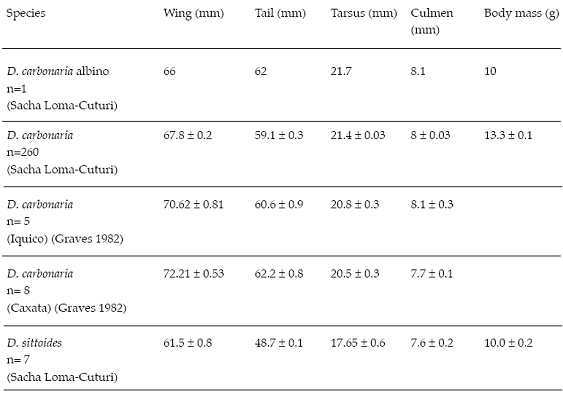
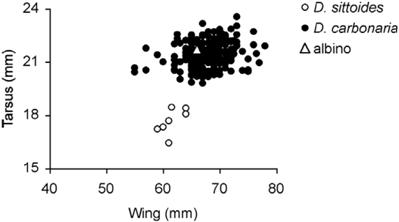
<body><![CDATA[<p><font size="2" face="Verdana">On the basis of culmen morphology (mainly   the hooked maxilla) it was apparent that the bird   was a <i>Diglossa</i> flowerpiercer.   However, its albinism condition was total (complete absence of melanin) according to albino reports in the   literature (Sage 1962, Dyck 1985, Møller   &amp; Mousseau 2001). The skin and feathers lacked   pigmentation, the eyes were pinkish red and the culmen   was pink, probably presenting this   color just from the blood in capillaries as it lacked pigmentation. The legs and feet also were pinkish with no   pigmentation. Analyzing the bird’s plumage attributes (Ralph <i>et al. </i>1993),   no signs of juvenal plumage were found. A skull   inspection indicated complete ossification, and I concluded that it was   an adult. Morphological measurements are given in Table 1. </font></p>     <p><font size="2" face="Verdana">Over the course of five years as part of a ringing program (following   procedures of Ralph <i>et al. </i>1993) to study forest specialists in 12 <i>Polylepis</i> forest fragments (2 – 47 ha) (3,500 – 3,900 m altitude) in Sacha Loma (17<sup>º</sup> 44´ S, 65<sup>º</sup> 34´ W) and   Cuturi (17 <sup>º</sup> 42´ S, 65<sup>º</sup> 33´ W)   near the city of Cochabamba, we captured 260 Gray-bellied Flowerpiercers <i>(D. carbonaria), </i>the morphometric   data of which are given in Table 1. A previous study (Graves 1982) of the same species in Iquico and Caxata in Bolivia’s depto. La Paz presented similar results (Table 1). Measurements of the albino flowerpiercer were very similar to those of the   Gray-bellied Flowerpiercer (Table 1) and fell well inside the range of values for wing and tarsus   length of that species (Fig. 1). The only exception was body mass, which was about 3 g lighter than   the average for normally pigmented individuals of the Gray-bellied Flowerpiercer (Table 1).   Only 10% of this species captured individuals had a body mass of 10–11   g. </font></p>     <p><font size="2" face="Verdana">Only one other <i>Diglossa</i> species   was captured with a very low frequency in Sacha Loma   and Cuturi over the 5-year period. Seven   individuals of the Rusty Flowerpiercer <i>(D. sittoides) </i>captured exclusively   during the rainy season (Nov–Mar) had considerably smaller (and mostly non­overlapping) measurements than the Gray-bellied Flowerpiercer and the albino captured in Sacha Loma (Table 1, Fig. 1). Given those notably smaller   measurements of the Rusty Flowerpiercer and, based on   capture rates, the higher probability of the albino being a Gray-bellied Flowerpiercer (97% </font></p>     <p align=center><font size="2" face="Verdana"><b>Table 1: </b>Selected measurements of a complete albino Gray-bellied Flowerpiercer <i>(D. carbonaria) </i>from Sacha-Loma-Cuturi and   normally pigmented from three localities in the Bolivian Andes.   Values are means   ± SE. </font></p>     <p align="center"><font size="2" face="Verdana"> <img width=563 height=394 src="/img/revistas/reb/v43n1/43n1a7_005.gif" v:shapes="_x0000_i1025"> </font></p>     <p align="center"><font size="2" face="Verdana">of all flowerpiercer captures), I concluded that the albino was assignable to the latter   species. Furthermore, the assignation of the albino to other species of flowerpiercers   present above 3000 m in Cochabamba <i>(D. mystacalis </i>and <i>D. cyanea) </i>also   was discarded as these species of humid Yungas forest   were never caught or reported in the Sacha Loma – Cuturi area. </font></p>     <p><font size="2" face="Verdana">Partial or incomplete albinism has been observed in many species of birds (Gross 1965),   including a Giant Conebill <i>(Oreomanes   fraseri) </i>in <i>Polylepis</i> forest in Peru (Servat 2002). However,   total or true albinos (Bruckner 1941) such as those registered in Sharp-tailed Sparrow <i>(Passerherbulus caudacutus) </i>(Wayne   1921), Mallard <i>(Anas platyrhynchos) </i>(Sprunt 1931), </font></p>     <p><font size="2" face="Verdana">Red-winged Blackbird <i>(Agelaius phoeniceus) </i>(Nero 1954), Northern Bobwhite <i>(Colinus virginianus) </i>(Menzel 1962) and Herring gull <i>(Larus argentatus) </i>(Gross 1964) are rare in wild birds (7% of 1847 cases of some type of   albinism according to Gross 1965). There are   apparently no previous records of total or partial albinism for the   Gray-bellied Flowerpiercer or other species in the   genus <i>Diglossa, </i>although population and   speciation studies have examined the plumage colors of many <i>Diglossa</i> museum specimens   (e.g., Graves 1982, Vuilleumier 1984). In fact,   reports of cases of albinism in Neotropical   birds seem very scarce (Hosner &amp; Lebbin 2006). According to van Grouw (2006), the reason that adult   albinos </font></p>     <p align=center><font size="2" face="Verdana"> <img width=399 height=222 src="/img/revistas/reb/v43n1/43n1a7_008.jpg" v:shapes="_x0000_i1026"> </font></p>     <p><font size="2" face="Verdana"><b>Fig.   1: </b>Wing versus tarsus length of one   complete albino Gray-bellied Flowerpiercers <i>(Diglossa carbonaria); </i>and seven Rusty Flowerpiercers <i>(D. sittoides) </i>captured in <i>Polylepis</i> forest in Sacha Loma-Cuturi. </font></p>     ]]></body>
<body><![CDATA[<p><font size="2" face="Verdana">are so rarely observed in the wild is that   they have bad eyesight, imperfect flight and are therefore more susceptible to   predation early on in life. Because partial albinism may be due to germline mutations (Møler &amp; Mousseau 2001), diet, senility, shock, disease or   injury (Sage 1962), and because complete   albinism is most likely a result of   inherited genetic factors which condition lack of tyrosinase   and, consequently, melanin (Bruckner 1941,   Sage 1962, Bensch <i>et al. </i>2000), it is most   probable that the albino flowerpiercer in Sacha Loma was   homozygous for this condition. With 76% of Gray-bellied Flowerpiercer recaptures in different months and years recorded in the same fragments, it   is tempting to propose a link between this unusual   plumage condition and inbreeding as a consequence of small isolated <i>Polylepis</i> fragments and low dispersal. </font></p>     <p><font size="2" face="Verdana">It is   evident that in very isolated populations a recessive   gene may gain a much higher frequency of expression than in a population where gene flow is maintained over a large area   (Sage 1962, Gross 1965). From the nectarivorous feeding habits of the Gray-bellied Flowerpiercer(Ridgely &amp; Tudor 1989, Fjeldså   &amp; Krabbe 1990) it could be assumed that   the species presents long distance dispersal in response to local and regional   flowering seasons. However, Herzog <i>et al. </i>(2003) indicated that it is a   year-round resident in Sacha Loma <i>Polylepis</i> forest fragments, probably shifting to a more insectivorous diet during the dry season when flower nectar is   scarce. Naoki (1998) further suggested that   morphological and behavioral adaptations   of flowerpiercers allow them to use almost any   flowers and to be resident on the same   territory throughout the year. Therefore, seasonal shifts in feeding   habits combined with restricted movements that are largely confined to isolated   and patchily distributed <i>Polylepis</i> fragments could bring about reduced gene flow and increased homozygosity   in the population. </font></p>     <p><font size="2" face="Verdana">Furthermore, the Gray-bellied Flowerpiercer is a restricted-range species (Stattersfield <i>et al. </i>1998, Hennessey <i>et   al. </i>2003) not widely distributed in the high Andes. It is probably endemic   to the Andes of Bolivia (Ridgely &amp; Tudor 1989, Fjeldså   &amp; Krabbe 1990, Stotz <i>et   al. </i>1996), although it also may occur in northwest </font></p>     <p><font size="2" face="Verdana">Argentina   (Moschione &amp; San Cristobal   1993). Such   a small geographic distribution could also be explained by a tendency   for short distance dispersal. In a study on the zoogeography of Andean birds Vuilleumier (1984) concluded that the Gray-bellied Flowerpiercer presents partially continuous and partially disjunct populations in Bolivia. </font></p>     <p><font size="2" face="Verdana">This anecdotal   record calls attention to the implications of fragmentation and   isolation effects on birds dependent on <i>Polylepis</i> forests in the high Andes. </font></p>     <p align=center><font size="2" face="Verdana"><b>Acknowledgments </b></font></p>     <p><font size="2" face="Verdana">The albino was found during a bird   ringing field trip, funded by the Flemish   Interuniversity Cooperation (VLIR-IUC,   Belgium) and the Centro de Biodiversidad y Genética, Universidad   Mayor de San Simon. I thank J.V. Remsen and S.K. Herzog for comments on the manuscript. </font></p>     <p align=center><font size="2" face="Verdana"><b>References </b></font></p>     <!-- ref --><p><font size="2" face="Verdana">1.- Bensch, S., Hansson, B., Hasselquist, D. &amp; B. Nielsen.   2000. Partial albinism in a semi-isolated   population of Great Reed Warblers. Hereditas   133: 167-170. </font>&nbsp;&nbsp;&nbsp;&nbsp;&nbsp;&nbsp;&nbsp;&nbsp;[&#160;<a href="javascript:void(0);" onclick="javascript: window.open('/scielo.php?script=sci_nlinks&ref=012365&pid=S1605-2528200800010000700001&lng=','','width=640,height=500,resizable=yes,scrollbars=1,menubar=yes,');">Links</a>&#160;]<!-- end-ref --><!-- ref --><p><font size="2" face="Verdana">2.- Bruckner, J.   H. 1941. Inheritance of white plumage in <i>Phasianus.</i> Auk 58: 536-542. </font>&nbsp;&nbsp;&nbsp;&nbsp;&nbsp;&nbsp;&nbsp;&nbsp;[&#160;<a href="javascript:void(0);" onclick="javascript: window.open('/scielo.php?script=sci_nlinks&ref=012366&pid=S1605-2528200800010000700002&lng=','','width=640,height=500,resizable=yes,scrollbars=1,menubar=yes,');">Links</a>&#160;]<!-- end-ref --><!-- ref --><p><font size="2" face="Verdana">3.- Dyck, J. 1985. Plumage abnormal.   Pp. 472 – 474 in Campbell,   B. &amp; E. Lack (eds. ). A Dictionary of Birds. Poyser, Calton. </font>&nbsp;&nbsp;&nbsp;&nbsp;&nbsp;&nbsp;&nbsp;&nbsp;[&#160;<a href="javascript:void(0);" onclick="javascript: window.open('/scielo.php?script=sci_nlinks&ref=012367&pid=S1605-2528200800010000700003&lng=','','width=640,height=500,resizable=yes,scrollbars=1,menubar=yes,');">Links</a>&#160;]<!-- end-ref --><!-- ref --><p><font size="2" face="Verdana">4.- Fjeldså, J. &amp; N. Krabbe.   1990. Birds of the high Andes. Apollo   Books, Zoological Museum, University of Copenhagen &amp; Svendborg,   Copenhagen. 876 p. </font>&nbsp;&nbsp;&nbsp;&nbsp;&nbsp;&nbsp;&nbsp;&nbsp;[&#160;<a href="javascript:void(0);" onclick="javascript: window.open('/scielo.php?script=sci_nlinks&ref=012368&pid=S1605-2528200800010000700004&lng=','','width=640,height=500,resizable=yes,scrollbars=1,menubar=yes,');">Links</a>&#160;]<!-- end-ref --><!-- ref --><p><font size="2" face="Verdana">5.- Graves, G.   R. 1982. Speciation in the Carbonated Flower-piercer <i>(Diglossa   carbonaria) </i>complex of the Andes. Condor: 84: 1-14. </font>&nbsp;&nbsp;&nbsp;&nbsp;&nbsp;&nbsp;&nbsp;&nbsp;[&#160;<a href="javascript:void(0);" onclick="javascript: window.open('/scielo.php?script=sci_nlinks&ref=012369&pid=S1605-2528200800010000700005&lng=','','width=640,height=500,resizable=yes,scrollbars=1,menubar=yes,');">Links</a>&#160;]<!-- end-ref --><!-- ref --><p><font size="2" face="Verdana">6.- Gross, A.   O. 1964. Albinism in the Herring Gull. Auk 81: 551-552. </font>&nbsp;&nbsp;&nbsp;&nbsp;&nbsp;&nbsp;&nbsp;&nbsp;[&#160;<a href="javascript:void(0);" onclick="javascript: window.open('/scielo.php?script=sci_nlinks&ref=012370&pid=S1605-2528200800010000700006&lng=','','width=640,height=500,resizable=yes,scrollbars=1,menubar=yes,');">Links</a>&#160;]<!-- end-ref --><!-- ref --><p><font size="2" face="Verdana">7.- Gross, A. O. 1965. The   incidence of albinism in North American   birds. Bird Banding 36:   67-71. </font>&nbsp;&nbsp;&nbsp;&nbsp;&nbsp;&nbsp;&nbsp;&nbsp;[&#160;<a href="javascript:void(0);" onclick="javascript: window.open('/scielo.php?script=sci_nlinks&ref=012371&pid=S1605-2528200800010000700007&lng=','','width=640,height=500,resizable=yes,scrollbars=1,menubar=yes,');">Links</a>&#160;]<!-- end-ref --><!-- ref --><p><font size="2" face="Verdana">8.- van Grouw, H. 2006. Not every white bird is an albino: sense   and nonsense about colour aberrations   in birds. Dutch Birding 28: 79-89. </font>&nbsp;&nbsp;&nbsp;&nbsp;&nbsp;&nbsp;&nbsp;&nbsp;[&#160;<a href="javascript:void(0);" onclick="javascript: window.open('/scielo.php?script=sci_nlinks&ref=012372&pid=S1605-2528200800010000700008&lng=','','width=640,height=500,resizable=yes,scrollbars=1,menubar=yes,');">Links</a>&#160;]<!-- end-ref --><!-- ref --><p><font size="2" face="Verdana">9.- Hennessey,   A.B., S.K. Herzog &amp; F. Sagot. 2003. Lista anotada de las aves de Bolivia.   Asociación Armonía/BirdLife International,   Santa Cruz de la Sierra, Bolivia. </font>&nbsp;&nbsp;&nbsp;&nbsp;&nbsp;&nbsp;&nbsp;&nbsp;[&#160;<a href="javascript:void(0);" onclick="javascript: window.open('/scielo.php?script=sci_nlinks&ref=012373&pid=S1605-2528200800010000700009&lng=','','width=640,height=500,resizable=yes,scrollbars=1,menubar=yes,');">Links</a>&#160;]<!-- end-ref --><!-- ref --><p><font size="2" face="Verdana">10.- Herzog, S. K., Soria,   R. &amp; E. Matthysen. 2003. Seasonal variation in avian community composition in a High- Andean <i>Polylepis</i> (Rosaceae) forest fragment. Wilson   Bulletin 115: 438-447. </font>&nbsp;&nbsp;&nbsp;&nbsp;&nbsp;&nbsp;&nbsp;&nbsp;[&#160;<a href="javascript:void(0);" onclick="javascript: window.open('/scielo.php?script=sci_nlinks&ref=012374&pid=S1605-2528200800010000700010&lng=','','width=640,height=500,resizable=yes,scrollbars=1,menubar=yes,');">Links</a>&#160;]<!-- end-ref --><!-- ref --><p><font size="2" face="Verdana">11.- Hosner, P. A. &amp; D. J. Lebbin.   2006. Observations of   plumage pigment aberrations of birds in Ecuador,   including Ramphastidae. Boletín   SAO 16: 01. </font>&nbsp;&nbsp;&nbsp;&nbsp;&nbsp;&nbsp;&nbsp;&nbsp;[&#160;<a href="javascript:void(0);" onclick="javascript: window.open('/scielo.php?script=sci_nlinks&ref=012375&pid=S1605-2528200800010000700011&lng=','','width=640,height=500,resizable=yes,scrollbars=1,menubar=yes,');">Links</a>&#160;]<!-- end-ref --><!-- ref --><p><font size="2" face="Verdana">12.- Menzel K. E.   1962. Total albinism in a Nebraska   Bobwhite.   The Wilson Bulletin, 74: 99. </font>&nbsp;&nbsp;&nbsp;&nbsp;&nbsp;&nbsp;&nbsp;&nbsp;[&#160;<a href="javascript:void(0);" onclick="javascript: window.open('/scielo.php?script=sci_nlinks&ref=012376&pid=S1605-2528200800010000700012&lng=','','width=640,height=500,resizable=yes,scrollbars=1,menubar=yes,');">Links</a>&#160;]<!-- end-ref --><!-- ref --><p><font size="2" face="Verdana">13.- Møller, A. P. &amp; T. A. Mousseau.   2001. Albinism and   phenotype of barn swallows <i>(Hirundo rustica) </i>from Chernobyl. Evolution 55:   2097-2104. </font>&nbsp;&nbsp;&nbsp;&nbsp;&nbsp;&nbsp;&nbsp;&nbsp;[&#160;<a href="javascript:void(0);" onclick="javascript: window.open('/scielo.php?script=sci_nlinks&ref=012377&pid=S1605-2528200800010000700013&lng=','','width=640,height=500,resizable=yes,scrollbars=1,menubar=yes,');">Links</a>&#160;]<!-- end-ref --><!-- ref --><p><font size="2" face="Verdana">14.- Moschione, F. N. &amp; J. San Cristobal.   1993. Registro del Payador Negro <i>Diglossa carbonaria </i>para la Argentina. Hornero 13: 307. </font>&nbsp;&nbsp;&nbsp;&nbsp;&nbsp;&nbsp;&nbsp;&nbsp;[&#160;<a href="javascript:void(0);" onclick="javascript: window.open('/scielo.php?script=sci_nlinks&ref=012378&pid=S1605-2528200800010000700014&lng=','','width=640,height=500,resizable=yes,scrollbars=1,menubar=yes,');">Links</a>&#160;]<!-- end-ref --><!-- ref --><p><font size="2" face="Verdana">15.- Naoki, K. 1998. Seasonal   change of fower use by the Slaty   Flowerpiercer <i>(Diglossa plumbea).</i> The Wilson Bulletin,   110: 393- 397. </font>&nbsp;&nbsp;&nbsp;&nbsp;&nbsp;&nbsp;&nbsp;&nbsp;[&#160;<a href="javascript:void(0);" onclick="javascript: window.open('/scielo.php?script=sci_nlinks&ref=012379&pid=S1605-2528200800010000700015&lng=','','width=640,height=500,resizable=yes,scrollbars=1,menubar=yes,');">Links</a>&#160;]<!-- end-ref --><!-- ref --><p><font size="2" face="Verdana">16.- Ralph,   C. J., Geupel, G. R., Pyle, P., Martin, T. E. &amp; D. F. DeSante. 1993. Handbook of feld methods for monitoring landbirds.   Gen. Tech. Rep.   PSW-GTR-144. Albany, CA: Pacifc Southwest   Research Station, Forest Service, U.S. Department of Agriculture, USA. </font>&nbsp;&nbsp;&nbsp;&nbsp;&nbsp;&nbsp;&nbsp;&nbsp;[&#160;<a href="javascript:void(0);" onclick="javascript: window.open('/scielo.php?script=sci_nlinks&ref=012380&pid=S1605-2528200800010000700016&lng=','','width=640,height=500,resizable=yes,scrollbars=1,menubar=yes,');">Links</a>&#160;]<!-- end-ref --><!-- ref --><p><font size="2" face="Verdana">17.- Ridgely R.   S. &amp; G. Tudor. 1989. The birds of South America, Volume I. The Oscine Passerines. Oxford University   Press, Oxford, UK, 516 pp. </font>&nbsp;&nbsp;&nbsp;&nbsp;&nbsp;&nbsp;&nbsp;&nbsp;[&#160;<a href="javascript:void(0);" onclick="javascript: window.open('/scielo.php?script=sci_nlinks&ref=012381&pid=S1605-2528200800010000700017&lng=','','width=640,height=500,resizable=yes,scrollbars=1,menubar=yes,');">Links</a>&#160;]<!-- end-ref --><p><font size="2" face="Verdana">18.- Sage, B. 1962. Albinism and melanism in birds. British   Birds 55: 201-225. </font></p>     <p><font size="2" face="Verdana">18.- Servat, G. P. 2002. A case of partial   albinism in Giant Conebill, <i>Oreomanes fraseri.</i> Cotinga 18: 80. </font></p>     <!-- ref --><p><font size="2" face="Verdana">19.- Stattersfeld, A.J., M.J. Crosby, A.J. Long &amp; D.C. Wege. 1998.   Endemic bird areas of the world: priorities for bird conservation. BirdLife International, Cambridge. </font>&nbsp;&nbsp;&nbsp;&nbsp;&nbsp;&nbsp;&nbsp;&nbsp;[&#160;<a href="javascript:void(0);" onclick="javascript: window.open('/scielo.php?script=sci_nlinks&ref=012384&pid=S1605-2528200800010000700019&lng=','','width=640,height=500,resizable=yes,scrollbars=1,menubar=yes,');">Links</a>&#160;]<!-- end-ref --><p><font size="2" face="Verdana">20.- Stotz, D. F, J.   W. Fitzpatrick, T. Parker III, &amp; D. K. Moskovits. 1996. Neotropical   birds. The University of Chicago   Press. Chicago, USA. Sprunt J. R. A. 1931. Total albinism in the Mallard     <br>   <i>(Anas plathyrhynchos).</i>Auk 48: 414.</font></p>     ]]></body>
<body><![CDATA[<!-- ref --><p><font size="2" face="Verdana">21.- Vuilleumier, F.   1984. Zoogeography of Andean Birds: Two major barriers; and speciation and taxonomy of the <i>Diglossa carbonaria </i>superspecies. National Geographic   Society Research Reports 16: 713-731. </font>&nbsp;&nbsp;&nbsp;&nbsp;&nbsp;&nbsp;&nbsp;&nbsp;[&#160;<a href="javascript:void(0);" onclick="javascript: window.open('/scielo.php?script=sci_nlinks&ref=012387&pid=S1605-2528200800010000700021&lng=','','width=640,height=500,resizable=yes,scrollbars=1,menubar=yes,');">Links</a>&#160;]<!-- end-ref --><p>&nbsp;</p>     <p>&nbsp;</p>     <p><font size="2" face="Verdana">Nota   recibida en: Octubre de 2007 </font></p>     <p><font size="2" face="Verdana">Manejada por: Sebastian Herzog </font></p>     <p><font size="2" face="Verdana">Aceptada   en: Febrero de 2008 </font></p>      ]]></body><back>
<ref-list>
<ref id="B1">
<label>1</label><nlm-citation citation-type="journal">
<person-group person-group-type="author">
<name>
<surname><![CDATA[Bensch]]></surname>
<given-names><![CDATA[S.]]></given-names>
</name>
<name>
<surname><![CDATA[Hansson]]></surname>
<given-names><![CDATA[B.]]></given-names>
</name>
<name>
<surname><![CDATA[Hasselquist]]></surname>
<given-names><![CDATA[D.]]></given-names>
</name>
<name>
<surname><![CDATA[Nielsen]]></surname>
<given-names><![CDATA[B.]]></given-names>
</name>
</person-group>
<source><![CDATA[Partial albinism in a semi-isolated population of Great Reed Warblers]]></source>
<year>2000</year>
<volume>133</volume>
<page-range>167-170</page-range><publisher-name><![CDATA[Hereditas]]></publisher-name>
</nlm-citation>
</ref>
<ref id="B2">
<label>2</label><nlm-citation citation-type="journal">
<person-group person-group-type="author">
<name>
<surname><![CDATA[Bruckner]]></surname>
<given-names><![CDATA[J. H.]]></given-names>
</name>
</person-group>
<source><![CDATA[Inheritance of white plumage in Phasianus]]></source>
<year>1941</year>
<volume>58</volume>
<page-range>536-542</page-range><publisher-name><![CDATA[Auk]]></publisher-name>
</nlm-citation>
</ref>
<ref id="B3">
<label>3</label><nlm-citation citation-type="">
<person-group person-group-type="author">
<name>
<surname><![CDATA[Dyck]]></surname>
<given-names><![CDATA[J.]]></given-names>
</name>
<name>
<surname><![CDATA[Campbell]]></surname>
<given-names><![CDATA[B.]]></given-names>
</name>
<name>
<surname><![CDATA[Lack]]></surname>
<given-names><![CDATA[E.]]></given-names>
</name>
</person-group>
<source><![CDATA[Plumage abnormal]]></source>
<year>1985</year>
<page-range>472 - 474</page-range></nlm-citation>
</ref>
<ref id="B4">
<label>4</label><nlm-citation citation-type="book">
<person-group person-group-type="author">
<name>
<surname><![CDATA[Fjeldså]]></surname>
<given-names><![CDATA[J.]]></given-names>
</name>
<name>
<surname><![CDATA[Krabbe]]></surname>
<given-names><![CDATA[N.]]></given-names>
</name>
</person-group>
<source><![CDATA[Birds of the high Andes]]></source>
<year>1990</year>
<page-range>876</page-range><publisher-name><![CDATA[Apollo Books, Zoological Museum, University of Copenhagen & Svendborg, Copenhagen]]></publisher-name>
</nlm-citation>
</ref>
<ref id="B5">
<label>5</label><nlm-citation citation-type="journal">
<person-group person-group-type="author">
<name>
<surname><![CDATA[Graves]]></surname>
<given-names><![CDATA[G. R.]]></given-names>
</name>
</person-group>
<source><![CDATA[Speciation in the Carbonated Flower-piercer (Diglossa carbonaria) complex of the Andes]]></source>
<year>1982</year>
<volume>84</volume>
<page-range>1-14</page-range><publisher-name><![CDATA[Condor]]></publisher-name>
</nlm-citation>
</ref>
<ref id="B6">
<label>6</label><nlm-citation citation-type="journal">
<person-group person-group-type="author">
<name>
<surname><![CDATA[Gross]]></surname>
<given-names><![CDATA[A. O.]]></given-names>
</name>
</person-group>
<source><![CDATA[Albinism in the Herring Gull]]></source>
<year>1964</year>
<volume>81</volume>
<page-range>551-552</page-range><publisher-name><![CDATA[Auk]]></publisher-name>
</nlm-citation>
</ref>
<ref id="B7">
<label>7</label><nlm-citation citation-type="book">
<person-group person-group-type="author">
<name>
<surname><![CDATA[Gross]]></surname>
<given-names><![CDATA[A. O.]]></given-names>
</name>
</person-group>
<source><![CDATA[The incidence of albinism in North American birds]]></source>
<year>1965</year>
<volume>36</volume>
<page-range>67-71</page-range><publisher-name><![CDATA[Bird Banding]]></publisher-name>
</nlm-citation>
</ref>
<ref id="B8">
<label>8</label><nlm-citation citation-type="">
<person-group person-group-type="author">
<name>
<surname><![CDATA[van Grouw]]></surname>
<given-names><![CDATA[H.]]></given-names>
</name>
</person-group>
<source><![CDATA[Not every white bird is an albino: sense and nonsense about colour aberrations in birds]]></source>
<year>2006</year>
<volume>Dutch Birding</volume><volume>28</volume>
<page-range>79-89</page-range></nlm-citation>
</ref>
<ref id="B9">
<label>9</label><nlm-citation citation-type="">
<person-group person-group-type="author">
<name>
<surname><![CDATA[Hennessey]]></surname>
<given-names><![CDATA[A.B.]]></given-names>
</name>
<name>
<surname><![CDATA[Herzog]]></surname>
<given-names><![CDATA[S.K.]]></given-names>
</name>
<name>
<surname><![CDATA[Sagot]]></surname>
<given-names><![CDATA[F.]]></given-names>
</name>
</person-group>
<source><![CDATA[Lista anotada de las aves de Bolivia: Asociación Armonía/BirdLife International]]></source>
<year>2003</year>
<publisher-loc><![CDATA[Santa Cruz de la Sierra ]]></publisher-loc>
</nlm-citation>
</ref>
<ref id="B10">
<label>10</label><nlm-citation citation-type="book">
<person-group person-group-type="author">
<name>
<surname><![CDATA[Herzog]]></surname>
<given-names><![CDATA[S. K.]]></given-names>
</name>
<name>
<surname><![CDATA[Soria]]></surname>
<given-names><![CDATA[R.]]></given-names>
</name>
<name>
<surname><![CDATA[Matthysen]]></surname>
<given-names><![CDATA[E.]]></given-names>
</name>
</person-group>
<source><![CDATA[Seasonal variation in avian community composition in a High- Andean Polylepis (Rosaceae) forest fragment]]></source>
<year>2003</year>
<volume>115</volume>
<page-range>438-447</page-range><publisher-name><![CDATA[Wilson Bulletin]]></publisher-name>
</nlm-citation>
</ref>
<ref id="B11">
<label>11</label><nlm-citation citation-type="book">
<person-group person-group-type="author">
<name>
<surname><![CDATA[Hosner]]></surname>
<given-names><![CDATA[P. A.]]></given-names>
</name>
<name>
<surname><![CDATA[Lebbin]]></surname>
<given-names><![CDATA[D. J.]]></given-names>
</name>
</person-group>
<source><![CDATA[Observations of plumage pigment aberrations of birds in Ecuador, including Ramphastidae]]></source>
<year>2006</year>
<volume>16</volume>
<page-range>01</page-range><publisher-name><![CDATA[Boletín SAO]]></publisher-name>
</nlm-citation>
</ref>
<ref id="B12">
<label>12</label><nlm-citation citation-type="book">
<person-group person-group-type="author">
<name>
<surname><![CDATA[Menzel]]></surname>
<given-names><![CDATA[K. E.]]></given-names>
</name>
</person-group>
<source><![CDATA[Total albinism in a Nebraska Bobwhite]]></source>
<year>1962</year>
<volume>74</volume>
<page-range>99</page-range><publisher-name><![CDATA[The Wilson Bulletin]]></publisher-name>
</nlm-citation>
</ref>
<ref id="B13">
<label>13</label><nlm-citation citation-type="book">
<person-group person-group-type="author">
<name>
<surname><![CDATA[Møller]]></surname>
<given-names><![CDATA[A. P.]]></given-names>
</name>
<name>
<surname><![CDATA[Mousseau]]></surname>
<given-names><![CDATA[T. A.]]></given-names>
</name>
</person-group>
<source><![CDATA[Albinism and phenotype of barn swallows (Hirundo rustica) from Chernobyl]]></source>
<year>2001</year>
<volume>55</volume>
<page-range>2097-2104</page-range><publisher-name><![CDATA[Evolution]]></publisher-name>
</nlm-citation>
</ref>
<ref id="B14">
<label>14</label><nlm-citation citation-type="book">
<person-group person-group-type="author">
<name>
<surname><![CDATA[Moschione]]></surname>
<given-names><![CDATA[F. N.]]></given-names>
</name>
<name>
<surname><![CDATA[San Cristobal]]></surname>
<given-names><![CDATA[J.]]></given-names>
</name>
</person-group>
<source><![CDATA[Registro del Payador Negro Diglossa carbonaria para la Argentina]]></source>
<year>1993</year>
<volume>13</volume>
<page-range>307</page-range><publisher-name><![CDATA[Hornero]]></publisher-name>
</nlm-citation>
</ref>
<ref id="B15">
<label>15</label><nlm-citation citation-type="book">
<person-group person-group-type="author">
<name>
<surname><![CDATA[Naoki]]></surname>
<given-names><![CDATA[K.]]></given-names>
</name>
</person-group>
<source><![CDATA[Seasonal change of fower use by the Slaty Flowerpiercer (Diglossa plumbea)]]></source>
<year>1998</year>
<volume>110</volume>
<page-range>393- 397</page-range><publisher-name><![CDATA[The Wilson Bulletin]]></publisher-name>
</nlm-citation>
</ref>
<ref id="B16">
<label>16</label><nlm-citation citation-type="book">
<person-group person-group-type="author">
<name>
<surname><![CDATA[Ralph]]></surname>
<given-names><![CDATA[C. J.]]></given-names>
</name>
<name>
<surname><![CDATA[Geupel]]></surname>
<given-names><![CDATA[G. R.]]></given-names>
</name>
<name>
<surname><![CDATA[Pyle]]></surname>
<given-names><![CDATA[P.]]></given-names>
</name>
<name>
<surname><![CDATA[Martin]]></surname>
<given-names><![CDATA[T. E.]]></given-names>
</name>
<name>
<surname><![CDATA[DeSante]]></surname>
<given-names><![CDATA[D. F.]]></given-names>
</name>
</person-group>
<source><![CDATA[Handbook of feld methods for monitoring landbirds. Gen. Tech. Rep. PSW-GTR-144. Albany, CA: Pacifc Southwest Research Station, Forest Service, U.S]]></source>
<year>1993</year>
<publisher-name><![CDATA[Department of Agriculture]]></publisher-name>
</nlm-citation>
</ref>
<ref id="B17">
<label>17</label><nlm-citation citation-type="book">
<person-group person-group-type="author">
<name>
<surname><![CDATA[Ridgely]]></surname>
<given-names><![CDATA[R. S.]]></given-names>
</name>
<name>
<surname><![CDATA[Tudor]]></surname>
<given-names><![CDATA[G.]]></given-names>
</name>
</person-group>
<source><![CDATA[The birds of South America, Volume I. The Oscine Passerines]]></source>
<year>1989</year>
<page-range>516</page-range><publisher-name><![CDATA[Oxford University Press, Oxford, UK,]]></publisher-name>
</nlm-citation>
</ref>
<ref id="B18">
<label>18</label><nlm-citation citation-type="book">
<person-group person-group-type="author">
<name>
<surname><![CDATA[Sage]]></surname>
<given-names><![CDATA[B.]]></given-names>
</name>
</person-group>
<source><![CDATA[Albinism and melanism in birds]]></source>
<year>1962</year>
<volume>55</volume>
<page-range>201-225</page-range><publisher-name><![CDATA[British Birds]]></publisher-name>
</nlm-citation>
</ref>
<ref id="B19">
<label>19</label><nlm-citation citation-type="">
<person-group person-group-type="author">
<name>
<surname><![CDATA[Stattersfeld]]></surname>
<given-names><![CDATA[A.J.]]></given-names>
</name>
<name>
<surname><![CDATA[Crosby]]></surname>
<given-names><![CDATA[M.J.]]></given-names>
</name>
<name>
<surname><![CDATA[Long]]></surname>
<given-names><![CDATA[A.J.]]></given-names>
</name>
<name>
<surname><![CDATA[Wege]]></surname>
<given-names><![CDATA[D.C.]]></given-names>
</name>
</person-group>
<source><![CDATA[Endemic bird areas of the world: priorities for bird conservation: BirdLife International]]></source>
<year>1998</year>
<publisher-loc><![CDATA[Cambridge ]]></publisher-loc>
</nlm-citation>
</ref>
<ref id="B20">
<label>20</label><nlm-citation citation-type="book">
<article-title xml:lang="en"><![CDATA[Total albinism in the Mallard (Anas plathyrhynchos)]]></article-title>
<person-group person-group-type="author">
<name>
<surname><![CDATA[Stotz]]></surname>
<given-names><![CDATA[D. F]]></given-names>
</name>
<name>
<surname><![CDATA[Fitzpatrick]]></surname>
<given-names><![CDATA[J. W.]]></given-names>
</name>
<name>
<surname><![CDATA[Parker III]]></surname>
<given-names><![CDATA[T.]]></given-names>
</name>
<name>
<surname><![CDATA[Moskovits]]></surname>
<given-names><![CDATA[D. K.]]></given-names>
</name>
</person-group>
<source><![CDATA[Neotropical birds: The University of Chicago Press]]></source>
<year>1996</year>
<page-range>1931</page-range><page-range>414</page-range><publisher-loc><![CDATA[^eChicago Chicago]]></publisher-loc>
<publisher-name><![CDATA[Sprunt J. R. A.]]></publisher-name>
</nlm-citation>
</ref>
<ref id="B21">
<label>21</label><nlm-citation citation-type="book">
<person-group person-group-type="author">
<name>
<surname><![CDATA[Vuilleumier]]></surname>
<given-names><![CDATA[F.]]></given-names>
</name>
</person-group>
<source><![CDATA[Zoogeography of Andean Birds: Two major barriers; and speciation and taxonomy of the Diglossa carbonaria superspecies]]></source>
<year>1984</year>
<volume>16</volume>
<page-range>713-731</page-range><publisher-name><![CDATA[National Geographic Society Research Reports]]></publisher-name>
</nlm-citation>
</ref>
</ref-list>
</back>
</article>
