<?xml version="1.0" encoding="ISO-8859-1"?><article xmlns:mml="http://www.w3.org/1998/Math/MathML" xmlns:xlink="http://www.w3.org/1999/xlink" xmlns:xsi="http://www.w3.org/2001/XMLSchema-instance">
<front>
<journal-meta>
<journal-id>1605-2528</journal-id>
<journal-title><![CDATA[Ecología en Bolivia]]></journal-title>
<abbrev-journal-title><![CDATA[Ecología en Bolivia]]></abbrev-journal-title>
<issn>1605-2528</issn>
<publisher>
<publisher-name><![CDATA[Plural Editores ]]></publisher-name>
</publisher>
</journal-meta>
<article-meta>
<article-id>S1605-25282004001000005</article-id>
<title-group>
<article-title xml:lang="en"><![CDATA[Effects of air pollutants on morphology and reproduction in four lichen species in Córdoba, Argentina]]></article-title>
<article-title xml:lang="es"><![CDATA[Efectos de contaminación del aire sobre la morfología y reproducción en cuatro especies de líquenes]]></article-title>
</title-group>
<contrib-group>
<contrib contrib-type="author">
<name>
<surname><![CDATA[Estrabou]]></surname>
<given-names><![CDATA[Cecilia]]></given-names>
</name>
<xref ref-type="aff" rid="A01"/>
</contrib>
<contrib contrib-type="author">
<name>
<surname><![CDATA[Stiefkens]]></surname>
<given-names><![CDATA[Laura]]></given-names>
</name>
<xref ref-type="aff" rid="A03"/>
</contrib>
<contrib contrib-type="author">
<name>
<surname><![CDATA[Hadid]]></surname>
<given-names><![CDATA[Miriam]]></given-names>
</name>
<xref ref-type="aff" rid="A03"/>
</contrib>
<contrib contrib-type="author">
<name>
<surname><![CDATA[Rodríguez]]></surname>
<given-names><![CDATA[Juan M.]]></given-names>
</name>
<xref ref-type="aff" rid="A01"/>
</contrib>
<contrib contrib-type="author">
<name>
<surname><![CDATA[Pérez]]></surname>
<given-names><![CDATA[Adriana]]></given-names>
</name>
<xref ref-type="aff" rid="A04"/>
</contrib>
</contrib-group>
<aff id="A01">
<institution><![CDATA[,Universidad Nacional de Córdoba Facultad de Ciencias Exactas, Físicas y Naturales Centro de Ecología y Recursos Naturales Renovables Dr. Ricardo Luti]]></institution>
<addr-line><![CDATA[Córdoba ]]></addr-line>
<country>Argentina</country>
</aff>
<aff id="A03">
<institution><![CDATA[,Universidad Nacional de Córdoba Facultad de Ciencias Exactas, Físicas y Naturales Cátedra de Morfología Vegetal]]></institution>
<addr-line><![CDATA[Córdoba ]]></addr-line>
<country>Argentina</country>
</aff>
<aff id="A04">
<institution><![CDATA[,Universidad Nacional de Córdoba Facultad de Ciencias Exactas, Físicas y Naturales Consejo Nacional de Investigaciones Científicas y Técnicas]]></institution>
<addr-line><![CDATA[Córdoba ]]></addr-line>
<country>Argentina</country>
</aff>
<pub-date pub-type="pub">
<day>00</day>
<month>10</month>
<year>2004</year>
</pub-date>
<pub-date pub-type="epub">
<day>00</day>
<month>10</month>
<year>2004</year>
</pub-date>
<volume>39</volume>
<numero>2</numero>
<fpage>33</fpage>
<lpage>45</lpage>
<copyright-statement/>
<copyright-year/>
<self-uri xlink:href="http://www.scielo.org.bo/scielo.php?script=sci_arttext&amp;pid=S1605-25282004001000005&amp;lng=en&amp;nrm=iso"></self-uri><self-uri xlink:href="http://www.scielo.org.bo/scielo.php?script=sci_abstract&amp;pid=S1605-25282004001000005&amp;lng=en&amp;nrm=iso"></self-uri><self-uri xlink:href="http://www.scielo.org.bo/scielo.php?script=sci_pdf&amp;pid=S1605-25282004001000005&amp;lng=en&amp;nrm=iso"></self-uri><abstract abstract-type="short" xml:lang="en"><p><![CDATA[The effects of contamination on morphological and reproductive parameters of four lichen species in two urban areas and a control site were studied. The four lichen species studied have all been previously identified as tolerant, resistant and sensitive to air pollution respectively. These species were sampled and collected from the bark of Melia azedarach L. (&#8220;paraíso&#8221;), situated in the cities of Córdoba, Río Cuarto and Río Ceballos. About 50 specimens for each species were removed. The following features were analyzed in each specimen: thallus color, cover and number of apothecia, soredia, necrosis of the thallus, changes in thallus size, thickness of lower and upper cortex, algae number and a fertility index was built. In Ramalina celastri, a sensitive species, darkening and reduction of thallus size, the presence of particulate matter and necrotic areas are some of the visible effects of air pollution. Physcia endochrysea, a resistant species, only shows minor changes in polluted areas. In resistant species, the fertility rate shows a marked reduction in polluted areas. In Canomaculina pilosa, a tolerant species, a reduction in thallus size and darkening of both the thallus and soredia is evident. Necrotic areas are particularly obvious with this species as well. Physcia undulata exhibits the fewest alterations and greatest growth in urban areas. The most variable feature was the thickness in the upper and the lower cortex. Algae number measured in lacunae along with he fertility index resulted good indicators.]]></p></abstract>
<abstract abstract-type="short" xml:lang="es"><p><![CDATA[Se estudiaron los efectos de la contaminación sobre los parámetros reproductivos y morfológicos de cuatro especies liquénicas en dos áreas urbanas y un sitio control. Las cuatro especies liquénicas estudiadas fueron previamente identificadas como resistente, tolerante y sensible a la contaminación, respectivamente. Las especies fueron censadas y colectadas sobre corteza de Melia azedarach L. (&#8220;paraíso&#8221;), situados en las ciudades de Córdoba, Río Cuarto y Río Ceballos. Alrededor de 50 ejemplares fueron removidos para cada especie. Los siguientes caracteres fueron analizados en cada ejemplar: color del talo, cobertura y número de apotecios, soredios, necrosis del talo, cambios en el tamaño del talo, espesor de corteza superior e inferior, número de algas y se generó un índice de fertilidad. En Ramalina celastri, especie sensible, la disminución del talo hasta la mitad de lo normal, su oscurecimiento, la presencia de material particulado y áreas necrosadas son algunos de los efectos más visibles de la contaminación. Physcia endochrysea, una especie resistente, presentó sólo pequeños cambios en áreas contaminadas. En especies resistentes la tasa de fertilidad muestra una marcada reducción en áreas contaminadas. En Canomaculina pilosa, una especie tolerante, se ve una reducción del talo y oscurecimiento del mismo y de los soredios. Asimismo se destacan áreas necróticas. Physcia undulata es la especie resistente con menores cambios y mayor desarrollo en áreas urbanas. El espesor de corteza superior e inferior es el carácter más variable. El índice de fertilidad resultó un buen indicador al igual que el número de algas que se refleja en espacios lacunares.]]></p></abstract>
<kwd-group>
<kwd lng="en"><![CDATA[bioindicators]]></kwd>
<kwd lng="en"><![CDATA[air quality]]></kwd>
<kwd lng="en"><![CDATA[lichenized fungi]]></kwd>
<kwd lng="es"><![CDATA[bioindicadores]]></kwd>
<kwd lng="es"><![CDATA[calidad del aire]]></kwd>
<kwd lng="es"><![CDATA[hongos liquenizados]]></kwd>
</kwd-group>
</article-meta>
</front><body><![CDATA[ <P   align="right" ><font size="2" face="Verdana, Arial, Helvetica, sans-serif"><b>Art&iacute;culo</b></font></P >     <P   align="" >&nbsp;</P >     <P   align="center" ><font size="4" face="Verdana, Arial, Helvetica, sans-serif"><b>Effects of air pollutants on morphology and reproduction in four lichen species in C&oacute;rdoba, Argentina </b></font></P >     <P   align="center" >&nbsp;</P >     <P   align="center" ><font size="3" face="Verdana, Arial, Helvetica, sans-serif"><b>Efectos de contaminaci&oacute;n del aire sobre la morfolog&iacute;a y reproducci&oacute;n en cuatro especies de l&iacute;quenes </b></font></P >     <P   align="center" >&nbsp;</P >     <P   align="center" >&nbsp;</P >     <P   align="center" ><font size="2" face="Verdana, Arial, Helvetica, sans-serif"><b>Cecilia Estrabou<Sup>1,2</Sup>, Laura Stiefkens<Sup>3</Sup>,  Miriam Hadid<Sup>3</Sup>, Juan M. Rodr&iacute;guez<Sup>1</Sup> &amp; Adriana P&eacute;rez<Sup><Sup>4 </Sup></Sup></b></font></P >     <P   align="center" ><font size="2" face="Verdana, Arial, Helvetica, sans-serif"><Sup>1</Sup>Centro de Ecolog&iacute;a y Recursos Naturales Renovables Dr. Ricardo Luti. Facultad de Ciencias Exactas,  F&iacute;sicas y Naturales. Universidad Nacional de C&oacute;rdoba. Av. V&eacute;lez Sarsfield 299,  X5000JJC, C&oacute;rdoba, Argentina.</font>    <br> <font size="2" face="Verdana, Arial, Helvetica, sans-serif"><Sup>2</Sup>Corresponding author. E-mail: <a href="mailto:cestrabou@hotmail.com">cestrabou@hotmail.com</a> </font>    ]]></body>
<body><![CDATA[<br> <font size="2" face="Verdana, Arial, Helvetica, sans-serif"><Sup>3</Sup>C&aacute;tedra de Morfolog&iacute;a Vegetal.    Fac. Cs. Ex., F&iacute;s. y N. Universidad Nacional de C&oacute;rdoba. Av. V&eacute;lez Sarsfield 299,  X5000JJC, C&oacute;rdoba, Argentina. </font>    <br> <font size="2" face="Verdana, Arial, Helvetica, sans-serif"><Sup>4</Sup>Consejo Nacional de Investigaciones Cient&iacute;ficas y T&eacute;cnicas. Fac. Cs. Ex., F&iacute;s. y N. Universidad Nacional  de C&oacute;rdoba. Av. V&eacute;lez Sarsfield 299, X5000JJC, C&oacute;rdoba, Argentina. </font></P >     <P   align="center" >&nbsp;</P >     <P   align="center" >&nbsp;</P > <hr noshade>     <p align="center"><font size="2" face="Verdana, Arial, Helvetica, sans-serif"><b>Abstract </b></font></p>     <P   align="justify" ><font size="2" face="Verdana, Arial, Helvetica, sans-serif">The effects of contamination on morphological and reproductive parameters of four lichen species in two urban areas and a control site were studied. The four lichen species studied have all been previously identified as tolerant, resistant and sensitive to air pollution respectively. These species were sampled and collected from the bark of <I>Melia azedarach </I>L. (&ldquo;para&iacute;so&rdquo;), situated in the cities of C&oacute;rdoba, R&iacute;o Cuarto and R&iacute;o Ceballos. About 50 specimens for each species were removed. The following features were analyzed in each specimen: thallus color, cover and number of apothecia, soredia, necrosis of the thallus, changes in thallus size, thickness of lower and upper cortex, algae number and a fertility index was built. </font></P >    <P   align="justify" ><font size="2" face="Verdana, Arial, Helvetica, sans-serif">In <I>Ramalina celastri, </I>a sensitive species, darkening and reduction of thallus size, the presence of particulate matter and necrotic areas are some of the visible effects of air pollution. <I>Physcia endochrysea, </I>a resistant species, only shows minor changes in polluted areas. In resistant species, the fertility rate shows a marked reduction in polluted areas. In <I>Canomaculina pilosa</I>, a tolerant species, a reduction in thallus size and darkening of both the thallus and soredia is evident. Necrotic areas are particularly obvious with this species as well. <I>Physcia undulata </I>exhibits the fewest alterations and greatest growth in urban areas. The most variable feature was the thickness in the upper and the lower cortex. Algae number measured in lacunae along with he fertility index resulted good indicators. </font></P >    <P   align="justify" ><font size="2" face="Verdana, Arial, Helvetica, sans-serif"><b>Key words:</b> bioindicators, air quality, lichenized fungi. </font></P > <hr noshade>     <P   align="center" ><font size="2" face="Verdana, Arial, Helvetica, sans-serif"><b>Resumen </b></font></P >     <P   align="justify" ><font size="2" face="Verdana, Arial, Helvetica, sans-serif">Se estudiaron los efectos de la contaminaci&oacute;n sobre los par&aacute;metros reproductivos y morfol&oacute;gicos  de cuatro especies liqu&eacute;nicas en dos &aacute;reas urbanas y un sitio control. Las cuatro especies  liqu&eacute;nicas estudiadas fueron previamente identificadas como resistente, tolerante y sensible a la contaminaci&oacute;n, respectivamente. Las especies fueron censadas y colectadas sobre corteza de <I>Melia azedarach </I>L. (&ldquo;para&iacute;so&rdquo;), situados en las ciudades de C&oacute;rdoba, R&iacute;o Cuarto y R&iacute;o Ceballos. Alrededor de 50 ejemplares fueron removidos para cada especie. Los siguientes caracteres fueron analizados en cada ejemplar: color del talo, cobertura y n&uacute;mero de apotecios, soredios, necrosis del talo, cambios en el tama&ntilde;o del talo, espesor de corteza superior e inferior, n&uacute;mero de algas y se gener&oacute; un &iacute;ndice de fertilidad. </font></P >     ]]></body>
<body><![CDATA[<P   align="justify" ><font size="2" face="Verdana, Arial, Helvetica, sans-serif">En <I>Ramalina celastri</I>, especie sensible, la disminuci&oacute;n del talo hasta la mitad de lo normal, su oscurecimiento, la presencia de material particulado y &aacute;reas necrosadas son algunos de los efectos m&aacute;s visibles de la contaminaci&oacute;n. <I>Physcia endochrysea</I>, una especie resistente, present&oacute; s&oacute;lo peque&ntilde;os cambios en &aacute;reas contaminadas. En especies resistentes la tasa de fertilidad muestra una marcada reducci&oacute;n en &aacute;reas contaminadas. En <I>Canomaculina pilosa</I>, una especie tolerante, se ve una reducci&oacute;n del talo y oscurecimiento del mismo y de los soredios. Asimismo se destacan &aacute;reas necr&oacute;ticas. </font></P >    <P   align="justify" ><font size="2" face="Verdana, Arial, Helvetica, sans-serif"><I>Physcia undulata </I>es la especie resistente con menores cambios y mayor desarrollo en &aacute;reas urbanas. El espesor de corteza superior e inferior es el car&aacute;cter m&aacute;s variable. El &iacute;ndice de fertilidad result&oacute; un buen indicador al igual que el n&uacute;mero de algas que se refleja en espacios lacunares. </font></P >    <P   align="justify" ><font size="2" face="Verdana, Arial, Helvetica, sans-serif"><b>Palabras clave:</b> bioindicadores, calidad del aire, hongos liquenizados. </font></P > <hr noshade>     <P   align="center" >&nbsp;</P >     <P   align="center" >&nbsp;</P >     <P   align="center" ><font size="3" face="Verdana, Arial, Helvetica, sans-serif"><b>Introduction</b></font></P >     <P   align="justify" ><font size="2" face="Verdana, Arial, Helvetica, sans-serif">    <br>   Previous studies have shown the sensitivity of   epiphytic lichens (Richardson 1988). One   definition for sensitivity by Dobben &amp; Braak   (1999): the decrease in abundance of a species   with increasing pollutant concentration.</font></P >     <P   align="justify" ><font size="2" face="Verdana, Arial, Helvetica, sans-serif"> Responses of lichens to air pollution include a   decrease in species numbers (Follmann 1973),   species coverage (Barkman 1958), and   reproduction changes by the reduction in size   and numbers of apothecia and vegetative   reproductive structures both in size and in   number (LeBlanc &amp; De Sloover 1970).</font></P >     <P   align="justify" ><font size="2" face="Verdana, Arial, Helvetica, sans-serif"> Additionally, changes in lichen form, color and   structure become evident (Le Blanc &amp; Rao 1973).   A decrease in respiration and photosynthesis   (Wirth &amp; Turk 1975) are another response. In   Argentina, a list of urban epiphytic lichens for   Buenos Aires City is documented by Scutari &amp; Theinhardt (2001). Recent research on air   pollution and lichens is reviewed in the recent   book edited by Nimis et al. (2002). </font></P >     ]]></body>
<body><![CDATA[<P   align="justify" ><font size="2" face="Verdana, Arial, Helvetica, sans-serif">The aim of this study was to explore the   effects of air pollution on lichen species in the   city of C&oacute;rdoba, Argentina, in terms of their   reproductive and morphological parameters.   These parameters include changes to apothecia   and soredia, change in thallus size and necrosis   of the thallus. In addition, changes in cortex   thickness, algae quantity, and lacunae in tissues   were looked at the four species studied <i>Canomaculina pilosa</i> (Stizemb.) Elix &amp; Hale   (<i>Parmeliaceae</i>), <i>Physcia undulata Moberg, Physcia   endochrysea</i> Krempelh. (cf. Scutari 1995)   (<i>Physciaceae</i>), and <i>Ramalina celastri</i> (Sprengel)   Krog et Swinscow (<i>Ramalinaceae</i>) all lichenized   Ascomycotina. These species have been   assessed to be sensitive, tolerant and resistant   to air pollution by Estrabou (1998). The species   selected for this study are the only lichens   found growing in the urban areas under study.</font></P >     <P   align="justify" >&nbsp;</P >     <P   align="center" >  <font size="3" face="Verdana, Arial, Helvetica, sans-serif"><b>Study areas</b></font></P >     <P   align="justify" ><font size="2" face="Verdana, Arial, Helvetica, sans-serif">   The four lichen species studied have all been   previously identified as tolerant, resistant and   sensitive to air pollution. These species were   collected from the bark of <i>Melia azedarach</i> L.   (&ldquo;para&iacute;so&rdquo;), situated in the cities of C&oacute;rdoba,R&iacute;o Cuarto and R&iacute;o Ceballos. C&oacute;rdoba city (population of 1.200.000 in the 1991 census) is located in the center of the Argentine Republic, 31&deg; 24&rsquo; S, 64&deg; 11&rsquo; W. The city is at 440 m and has an irregular topography. The climate is subhumid, with an average annual precipitation of 790 mm, concentrated principally in the summer. Mean annual temperature is 17.4 &deg;C and prevailing winds come from the northern and southern directions. Emissions of air pollutants increased by 50% between 1973 and 1983, reaching 287 metric tons of total pollutants/day. C&oacute;rdoba is one of the most polluted cities in the country (Ca&ntilde;as et al. 1997; Table 1). R&iacute;o Ceballos (the control site) is a small village on the hills of Sierras Chicas, at 31&deg; 10&rsquo; S, 64&deg; 20&rsquo; W, 36 km away from C&oacute;rdoba city, with an mean annual temperature of 13&deg;C, and an average annual precipitation of 779 mm. Nearby hills are covered by an open forest (V&aacute;zquez et al. 1979). R&iacute;o Cuarto is an industrial city with 137,000 inhabitants (Geimonat 1996) and show moderated level of pollution. Located 300 km away to the south-east from C&oacute;rdoba city, with an average annual precipitation of 800 mm. </font></P >     <P   align="justify" >&nbsp;</P >     <P   align="center" ><font size="3" face="Verdana, Arial, Helvetica, sans-serif"><b>Methods </b></font></P >     <P   align="justify" ><font size="2" face="Verdana, Arial, Helvetica, sans-serif">Five wayside trees selected from downtown to northwest were sampled in each place. Trees were selected taking the first five ones on the right side of the street. On each selected tree, at 1.5 meters from the base, one 30 x 30 cm<Sup>2 </Sup>(Estrabou 1998) was used to assess presence and coverage of each species. All specimens of the four species present were taken from each square (usually around 10). </font></P >     <P   align="justify" ><font size="2" face="Verdana, Arial, Helvetica, sans-serif">For each sample, (about 50 specimens for <I>P. undulate </I>and <I>P. endochrysea </I>and about 30 for <I>C. pilosa </I>and <I>R. celastri</I>) the following features were analyzed using an Olympus VM stereomicroscope: thallus color, presence of apothecia, soredia, necrosis of the thallus, and changes in thallus size and other external features (e.g., insect eaten areas, lobe size, branching). </font></P >    <P   align="justify" ><font size="2" face="Verdana, Arial, Helvetica, sans-serif">The following formula was designed to calculate the fertility rate (<i>F</i>)</font></P >     <P   align="center" ><img src="/img/revistas/reb/v39n2/ecuacion_a05_1.gif" width="128" height="51"></P >     ]]></body>
<body><![CDATA[<P   align="justify" ><font size="2" face="Verdana, Arial, Helvetica, sans-serif">Where n = total number of spores, N = number of apothecia (in a 25 mm<Sup>2 </Sup>thallus square), and C = proportion of apothecia covering the square. </font></P >     <P   align="justify" ><font size="2" face="Verdana, Arial, Helvetica, sans-serif">The total number of apothecia present in a 25 mm<Sup>2 </Sup>section of a thallus was counted and their coverage in percentage was estimated using a 25 mm<Sup>2 </Sup>grid. To determine the number of apothecial spores, an apothecium of about 1.15 mm diameter was selected from each sample, chopped up on a slide and macerated in a drop of distilled water. Fifty &micro;l of this suspension was removed with an automatic pipette and placed in a Neubauer counting chamber. The number of spores present in each slot was then counted. </font></P >     <P   align="justify" ><font size="2" face="Verdana, Arial, Helvetica, sans-serif">To analyze the cortex thickness and algae density, transverse sections were made from a small piece of lichen thallus and fixed in FAA (mixture of formaldehyde, ethanol and acetic acid). The samples were dehydrated in an ethanol series of increasing strength and left in butanol overnight. Later, they were cleared in two changes of xylol and included in &ldquo;paramat&rdquo; Sections 10 to 15 &micro;m thickness were cut with a Minot rotary microtome. Hematoxylin was used as a stain and the slides were set with Canada Balsam. The resulting transverse sections were then analyzed using a Bausch &amp; Lomb RD microscope: lower and upper cortex thickness, algae quantity present in a 3.674 &micro;m<Sup>2 </Sup>area in the medulla, lacunae in tissues and presence of epinecral tissues. </font></P >    <P   align="justify" ><font size="2" face="Verdana, Arial, Helvetica, sans-serif">Photographs of thalli, soredia, apothecia and other structures were taken using a Leica stereoscopic lens, Wild Apozoom 400076 and Zeiss photomicroscope. </font></P >     <P   align="justify" ><font size="2" face="Verdana, Arial, Helvetica, sans-serif">The algae numbers per &micro;m<Sup>2 </Sup>were compared statistically using SPSS (release 6.0 ) between the three study sites. This program was also used to determine the soredial cover from the three study sites. Analysis of variance was carried out in order to determine significant differences (Scheff&eacute;, 1959; Sokal &amp; Rohlf 1981). Comparisons of means were carried out using Tukey&rsquo;s HSD test. </font></P >     <P   align="justify" >&nbsp;</P >     <P   align="center" ><font size="3" face="Verdana, Arial, Helvetica, sans-serif"><b>Results </b></font></P >     <P   align="justify" ><font size="2" face="Verdana, Arial, Helvetica, sans-serif"><a href="#t1">Table 1</a> shows data of air pollutants taken in downtown C&oacute;rdoba, during 11 fortnights in April (autumn) provided by Sistema de Monitoreo del Aire de la Ciudad de C&oacute;rdoba and analyzed by Mart&iacute;nez (1997). Data are compatible with values proposed by the Environmental Protection Agency. The statistical analysis was carried out using the means values for each variable and per hour.</font></P >     <P   align="center" ><a name="t1"></a><a href="/img/revistas/reb/v39n2/tabla_a05_1.gif"><img src="/img/revistas/reb/v39n2/tabla_a05_1_.gif" width="400" height="263" border="0"></a></P >     <P   align="center" >&nbsp;</P >     ]]></body>
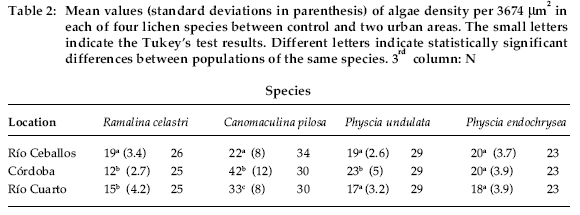
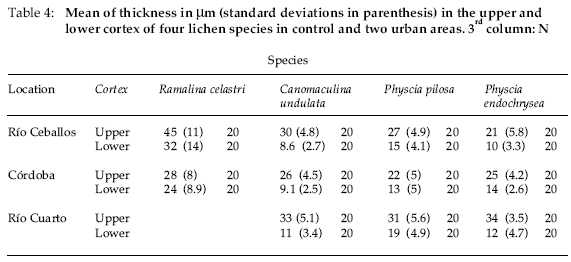
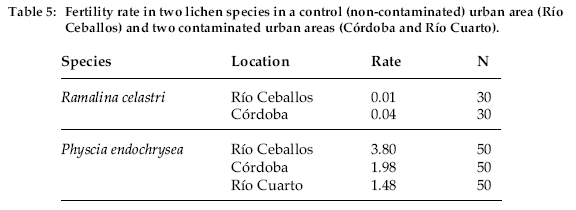
<body><![CDATA[<P   align="center" ><font size="2" face="Verdana, Arial, Helvetica, sans-serif"><I><b>Ramalina celastri </b></I></font></P >     <P   align="justify" ><font size="2" face="Verdana, Arial, Helvetica, sans-serif">In the control area the specimens showed a normal condition. The average density of algae was greater in the control area than in the polluted areas (<a href="#t2">Table 2</a>) (<a href="#f2">Figure 1a</a>).</font></P >     <P   align="center" ><font size="2" face="Verdana, Arial, Helvetica, sans-serif"><a name="t2"></a><img src="/img/revistas/reb/v39n2/tabla_a05_2.gif" width="580" height="215"></font></P >     <P   align="center" ><font size="2" face="Verdana, Arial, Helvetica, sans-serif"><a name="f1"></a><img src="/img/revistas/reb/v39n2/figura_a05_1.gif" width="569" height="602">    <br> </font></P >     <P   align="justify" ><font size="2" face="Verdana, Arial, Helvetica, sans-serif">The upper cortex thickness showed a mean of 45 &micro;m (<a href="#t4">Table 4</a>) in the control area. </font></P >     <P   align="center" ><font size="2" face="Verdana, Arial, Helvetica, sans-serif"><a name="t4"></a><img src="/img/revistas/reb/v39n2/tabla_a05_4.gif" width="571" height="262"></font></P >     <P   align="justify" ><font size="2" face="Verdana, Arial, Helvetica, sans-serif">Pseudocyphellae were absent while numerous pedicellate apothecia occur on older thalli, up to 0.1 cm in diameter. Apothecia present had white convex discs, and straight ascospores (10-16 x 4-7 &micro;m). The fertility rate was 0.01 (<a href="#t5">Table 5</a>).</font></P >     <P   align="center" ><font size="2" face="Verdana, Arial, Helvetica, sans-serif"><a name="t5"></a><img src="/img/revistas/reb/v39n2/tabla_a05_5.gif" width="576" height="210"></font></P >     <P   align="justify" ><font size="2" face="Verdana, Arial, Helvetica, sans-serif">In C&oacute;rdoba City, the thalli were no more than 2 to 3 cm long. The green color was darker in parts of the thallus, with extensive areas even darker (gray or black) close to the point of attachment. These changes in color were observed to be from the deposition of particulate matter as well as from small areas of necrosis. </font></P >    ]]></body>
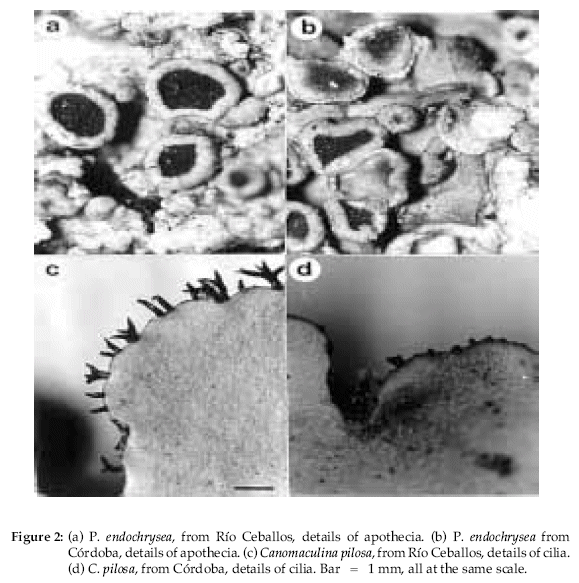
<body><![CDATA[<P   align="justify" ><font size="2" face="Verdana, Arial, Helvetica, sans-serif">The ramifications branch off close to the base and are generally narrow up to 0.5 cm wide with numerous secondary small branches, and the ribs along the ramifications were quite noticeable. The medulla had more lacunae than those found in the control rural area (<a href="#f1">Figure 1b</a>). In addition, the algal layer was attached to the upper cortex giving the appearance of epinecral tissue. This diminished the number of algae per mm<Sup>2</Sup>. The upper surface was thicker compared to the control area, a mean of 28.5 &micro;m, the lower cortex presented a less variation (<a href="#t4">Table 4</a>). Thallus edges had evidence of insect damage and the apothecia were partly necrotic, eaten by insects or empty. The number of apothecia per unit area was greater than in the control area but the number of spores decreased. There were deposits of particulate matter on the discs. The fertility rate increased to 0.04 (<a href="#t5">Table 5</a>) in the urban areas. </font></P >     <P   align="justify" ><font size="2" face="Verdana, Arial, Helvetica, sans-serif">In the city of R&iacute;o Cuarto, no samples with this species were found, but samples collected in outlying areas were similar in structure to those in the control area. </font></P >     <P   align="justify" >&nbsp;</P >     <P   align="center" ><font size="2" face="Verdana, Arial, Helvetica, sans-serif"><I><b>Physcia endochrysea </b></I></font></P >     <P   align="justify" ><font size="2" face="Verdana, Arial, Helvetica, sans-serif">It is absent both in R&iacute;o Cuarto city and downtown areas of C&oacute;rdoba where pollution indexes are higher. It appears about 1.5 km from downtown on the trunks of wayside trees. </font></P >     <P   align="justify" ><font size="2" face="Verdana, Arial, Helvetica, sans-serif">In the control area, thalli of this species ranged from 2 to 4 cm in diameter, orbicular with a glaucous-greenish color. The upper surface was plain or farinose, epruinous with imbricate lobes and rounded points. There was no epinecral layer on the upper cortex. The upper cortex thickness presented a mean of 21.4 &micro;m and the lower one of 10 &micro;m (<a href="#t4">Table 4</a>). This species has a white medulla with patches of darker colors. The average alga quantity per mm<Sup>2 </Sup>did not vary between the three sites (<a href="#t2">Table 2</a>), and there were no lacunae present (<a href="#f1">figure 1c</a>). The numerous apothecia are laminar, sessile, black with plain discs (<a href="#f2">figure 2a</a>). The ascospores are brown, 1-septate. The fertility rate was 1.48 for the R&iacute;o Ceballos site (<a href="#t5">Table 5</a>).</font></P >     <P   align="center" ><font size="2" face="Verdana, Arial, Helvetica, sans-serif"><a name="f2"></a><img src="/img/revistas/reb/v39n2/Ifigura_a05_2.gif" width="579" height="583"></font></P >     <P   align="justify" ><font size="2" face="Verdana, Arial, Helvetica, sans-serif">In the city of C&oacute;rdoba the thalli were greenish-gray to mineral gray, tightly attached to the substrate becoming difficult to distinguish on the trunk. The lobes were rarely imbricate, tightened to the substrate with barely defined edges. Eaten or necrosed apothecia (<a href="#f2">figure 2b</a>) were observed, the fertility rate was lower in C&oacute;rdoba compared to the control rural area (<a href="#t5">Table 5</a>). Lacunae (<a href="#f2">figure 2d</a>) and reduced epinecral tissues (<a href="#f1">figure 1e</a>) were observed. The mean of the upper cortex thickness was 25 &micro;m whereas the lower one was slightly thinner (<a href="#t4">Table 4</a>). </font></P >     <P   align="justify" ><font size="2" face="Verdana, Arial, Helvetica, sans-serif">In the city of R&iacute;o Cuarto the thalli were greenish-gray with well-defined edges. A less differentiated epinecral tissue was observed. Well-developed apothecia were observed, but were folded so that the epithecium was hidden. Deposits of particulate material were observed as well. The fertility rate decreased to 1.48 (<a href="#t5">Table 5</a>). In many cases the apothecial surface was covered with deposited material and soot and the upper cortex was thicker than C&oacute;rdoba and control site while the lower cortex did not change (<a href="#t4">Table 4</a>). </font></P >     <P   align="justify" >&nbsp;</P >     ]]></body>
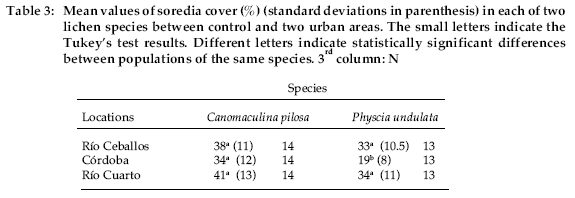
<body><![CDATA[<P   align="center" ><font size="2" face="Verdana, Arial, Helvetica, sans-serif"><I><b>Canomaculina pilosa </b></I></font></P >     <P   align="justify" ><font size="2" face="Verdana, Arial, Helvetica, sans-serif">This species is common in C&oacute;rdoba City (Estrabou 1999), but the urban area thalli exhibit morphological changes and a decreased cover. According to Estrabou (1998) it is tolerant to pollution. </font></P >     <P   align="justify" ><font size="2" face="Verdana, Arial, Helvetica, sans-serif">In the control area, this foliose species has thalli up to 15 cm diameter, greenish-gray or mineral gray, tightly attached to the substrate, apically rounded sub-irregular lobes, strong, plain or branched, with crenate edges (<a href="#f2">figure 2c</a>), densely ciliate with short cilia ranging 0.2 &ndash; 1.5 mm. Lacunae were not observed in the medulla. Algae numbers (<a href="#t2">Table 2</a>) were greater in the two polluted areas than in the control rural area (<a href="#f3">figure 3 a, b</a>). The upper surface is white-spotted and plain. The upper and the lower cortex did not vary between the three sites (<a href="#t4">Table 4</a>). The lower surface was black with simple and branched rhizinae. Orbicular soralia were dispersed and coalescent at maturity. Apothecia and pycnidia were not observed. The soredial cover of this species did not vary at the three sites (<a href="#t3">Table 3</a>).</font></P >     <P   align="center" ><font size="2" face="Verdana, Arial, Helvetica, sans-serif"><a name="t3"></a><img src="/img/revistas/reb/v39n2/tabla_a05_3.gif" width="575" height="198"></font></P >     <P   align="justify" ><font size="2" face="Verdana, Arial, Helvetica, sans-serif">In C&oacute;rdoba City, thallus size decreased considerably, rarely reaching 5 cm in diameter. The thallus color is darker, with soot observed on the upper surface and on the soredia. Frequently, necrosed soredia were noticed as well. The thallus had no insect damage, but the soredia did. In spite of this, there were no variations in soredial cover (<a href="#t3">Table 3</a>). Cilia were drastically reduced in size (<a href="#f2">figure 2d</a>). Wide lacunae were present between the medulla and the upper cortex but the upper and the lower cortices did not show thickness changes. The average number of algae was the greatest in the urban site (<a href="#t2">Table 2</a>). </font></P >     <P   align="justify" ><font size="2" face="Verdana, Arial, Helvetica, sans-serif">In R&iacute;o Cuarto City, the thalli examined had darker centers, 5 to 7 cm in diameter with frequent peripheral necrosis. Darkening was due to the deposition of particulate matter. The necrosis appeared first on the ridges where the surface was more exposed and extended over the whole thallus later. Although the soredia were not necrosed, they were eaten by insects. </font></P >    <P   align="justify" ><font size="2" face="Verdana, Arial, Helvetica, sans-serif"> Their substrate coverage was higher than at C&oacute;rdoba and R&iacute;o Ceballos. As in Cordoba, the cilia size was considerably reduced but the lacunae in the medulla were fewer than in C&oacute;rdoba. The upper and the lower cortex were compared to the other sites but the difference was not significant (<a href="#t4">Table 4</a>). </font></P >     <P   align="justify" >&nbsp;</P >     <P   align="center" ><font size="2" face="Verdana, Arial, Helvetica, sans-serif"><I><b>Physcia undulata </b></I></font></P >     <P   align="justify" ><font size="2" face="Verdana, Arial, Helvetica, sans-serif">This species is frequent in C&oacute;rdoba City but is rare in rural areas. Being a nitrophilous species, it inhabits road-side tree trunks in areas of heavy traffic. The thallus is up to 4 cm diameter, irregular to orbicular and loosely attached, mineral gray with deposits of white crystals giving it a &ldquo;frosted&rdquo; appearance (cf. Moberg 1968). The lobes are up to 2 mm wide, rounded with abundant marginal soralia giving the thallus an appearance of uneven edges. The soredial cover in R&iacute;o Ceballos and R&iacute;o Cuarto was similar but lower than in C&oacute;rdoba (<a href="#t3">Table 3</a>). Apothecia were not seen. The quantity of algae (<a href="#t2">Table 2</a>) was greater in C&oacute;rdoba City than at the other two sites. The lower cortex thickness was similar at all sites (T<a href="#t4">able 4</a>). In C&oacute;rdoba City there was no reduction in thallus size but the color appeared darker, even though no soot deposit was observed. Insect eaten thalli and soredia were often observed. There were fewer soredia present than at the other two sites (<a href="#t3">Table 3</a>), the quantity of algae was smaller (Table 2) and the upper cortex thickness was reduced (<a href="#t4">Table 4</a>). </font></P >     ]]></body>
<body><![CDATA[<P   align="justify" ><font size="2" face="Verdana, Arial, Helvetica, sans-serif">At the urban sites in R&iacute;o Cuarto City as in Cordoba, there were few morphological changes but some soot deposits were observed. Soredia were also covered with particulate matter and were considerably darker. Larger lacunae were observed in R&iacute;o Cuarto than in C&oacute;rdoba City. </font></P >     <P   align="justify" >&nbsp;</P >     <P   align="center" ><font size="3" face="Verdana, Arial, Helvetica, sans-serif"><b>Discussion and conclusions </b></font></P >     <P   align="justify" ><font size="2" face="Verdana, Arial, Helvetica, sans-serif">In the urban areas of Cordoba there is a low lichen diversity but a variable reproductive capacity, especially in the few toxitolerant or resistant species. In extreme environmental conditions, such as the Gobi Desert, there is an increase in the number of apothecia, but the number of spores is often reduced (Gorbushina et al., 2000). In the present study, a reduction in the number of apothecia and coverage and the same number of spores was observed in the pollution sensitive species <I>Ramalina celastri</I>, whereas in urban areas, resistant species like <I>Physcia </I>increased the number of apothecia and coverage and decreased the number of spores. </font></P >    <P   align="justify" ><font size="2" face="Verdana, Arial, Helvetica, sans-serif">Vegetative structures respond in various ways to air pollution (D&eacute;ruelle 1978). Mykhaylova (2000) explained the response of lichens to stress factors in terms of slower growth rates with no or reduced soralia. In the present study, the pollution tolerant species showed no change in the cover of soredia, whereas the resistant species exhibited a decrease in C&oacute;rdoba city like in <I>P. undulata</I>. D&eacute;ruelle (1978) summarizes macroscopic changes in lichen thalli in response to pollution as a decrease in thallus size, presence of soot, necrosed areas and changes in form. It is clear that not all lichens respond in the same way and that further investigations are warranted. </font></P >    <P   align="justify" ><font size="2" face="Verdana, Arial, Helvetica, sans-serif">The cortex thickness did not present a clear pattern in this study. The variations found need further study to interpret them in relation to air pollution. Some species showed a thicker upper cortex in urban areas (<I>P. endochrysea</I>), other in control site (<I>R. celastri</I>) while <I>C. pilosa </I>and <I>P. undulata</I> were variable. In the sensitive species <I>R. celastri, </I>there were more algae per unit area in the rural area and fewer in the polluted ones. Gonz&aacute;lez &amp; Pignata (1999) demonstrates that the phaeophytin/a to chlorophyll/a ratio in <I>Ramalina ecklonii </I>(Sprengel) G. Meyer &amp; Flotow (this species is a synonym of <I>R. celastri</I>) increases near industrial plants in the city of C&oacute;rdoba, which decreases the number of algae. </font></P >     <P   align="justify" ><font size="2" face="Verdana, Arial, Helvetica, sans-serif">In the tolerant species, <I>C. pilosa</I>, there was an increase in algal density in Cordoba City. The resistant species <I>P. endochrysea </I>showed very little change and <I>P. undulata </I>showed a reduction in algal quantity in C&oacute;rdoba. It is probably due to the effects of SO<Sub>2 </Sub>over the phaeophytin/a &ndash; chlorophyll/a ratio and as well the algal destruction. The deposition of particulate and soot probably decrease the photosynthesis ratio and inhibit normal thalli development. </font></P >     <P   align="justify" >&nbsp;</P >     <P   align="center" ><font size="3" face="Verdana, Arial, Helvetica, sans-serif"><b>Acknowledgements </b></font></P >     <P   align="justify" ><font size="2" face="Verdana, Arial, Helvetica, sans-serif">To Mr. D. Reynoso for expert technical help and to the Secretary of Science and Technology of University of C&oacute;rdoba for financial support. </font></P >     ]]></body>
<body><![CDATA[<P   align="justify" >&nbsp;</P >     <P   align="center" ><font size="3" face="Verdana, Arial, Helvetica, sans-serif"><b>References</b></font></P >     <!-- ref --><P   align="justify" ><font size="2" face="Verdana, Arial, Helvetica, sans-serif">Barkman, J. J. 1958. Phytosociology and ecology of cryptogramic epiphytes. Van Gorcum, Assen. 628 p. </font></P >    &nbsp;&nbsp;&nbsp;&nbsp;&nbsp;&nbsp;&nbsp;&nbsp;[&#160;<a href="javascript:void(0);" onclick="javascript: window.open('/scielo.php?script=sci_nlinks&ref=003555&pid=S1605-2528200400100000500001&lng=','','width=640,height=500,resizable=yes,scrollbars=1,menubar=yes,');">Links</a>&#160;]<!-- end-ref --><P   align="justify" ><font size="2" face="Verdana, Arial, Helvetica, sans-serif">Ca&ntilde;as, M., Orellana, L. &amp; M. L. Pignata. 1997. Chemical response of the lichens <I>Parmotrema austrosinense </I>and <I>P. conferendum </I>transplanted to urban and non-polluted environments. Annales Botanici Fennici 34: 27-34. </font></P >    <!-- ref --><P   align="justify" ><font size="2" face="Verdana, Arial, Helvetica, sans-serif">D&eacute;ruelle, S. 1978. Les lichen et la pollution atmosph&eacute;rique. Bulletin D&acute;&Eacute;cologie, 9 (2): 87-128. </font></P >    &nbsp;&nbsp;&nbsp;&nbsp;&nbsp;&nbsp;&nbsp;&nbsp;[&#160;<a href="javascript:void(0);" onclick="javascript: window.open('/scielo.php?script=sci_nlinks&ref=003557&pid=S1605-2528200400100000500003&lng=','','width=640,height=500,resizable=yes,scrollbars=1,menubar=yes,');">Links</a>&#160;]<!-- end-ref --><P   align="justify" ><font size="2" face="Verdana, Arial, Helvetica, sans-serif">Dobben, H. F.&amp; C. J. F. ter Braak. 1999. Ranking of lichen sensitivity to air pollution using survey data: a comparision of indicator scales. Lichenologist 31 (1): 27-39. </font></P >    <!-- ref --><P   align="justify" ><font size="2" face="Verdana, Arial, Helvetica, sans-serif">Estrabou, C. 1998. Lichen species identification and distribution according tolerance to airborne contamination in the city of C&oacute;rdoba, Argentina, pp. 165-169. En:M.P. Marcelli &amp; M.R.D. Seaward (eds.). Lichenology in Latin America: History, Current Knowledge and Applications. M. R. D. CETESB, Sao Paulo. </font></P >    &nbsp;&nbsp;&nbsp;&nbsp;&nbsp;&nbsp;&nbsp;&nbsp;[&#160;<a href="javascript:void(0);" onclick="javascript: window.open('/scielo.php?script=sci_nlinks&ref=003559&pid=S1605-2528200400100000500005&lng=','','width=640,height=500,resizable=yes,scrollbars=1,menubar=yes,');">Links</a>&#160;]<!-- end-ref --><P   align="justify" ><font size="2" face="Verdana, Arial, Helvetica, sans-serif">Estrabou, C. 1999. La familia <I>Parmeliaceae </I>(Ascomycetes liquenizados) sensu stricto de la provincia de C&oacute;rdoba: estudio sistem&aacute;tico-biogeogr&aacute;fico&rdquo;. Ph. D. Thesis, Fac. Cs. Ex., F&iacute;s. y Naturales. Universidad Nacional de C&oacute;rdoba, Argentina. 185 p. </font></P >    <!-- ref --><P   align="justify" ><font size="2" face="Verdana, Arial, Helvetica, sans-serif">Follmann, G. 1973. &Uuml;ber den R&uuml;ckgang der Flechtenflora in Stadtgebiet von Kassel (Nordhessen, Bundesrepublik, Deutschland). Philippia 1: 241-257. </font></P >    &nbsp;&nbsp;&nbsp;&nbsp;&nbsp;&nbsp;&nbsp;&nbsp;[&#160;<a href="javascript:void(0);" onclick="javascript: window.open('/scielo.php?script=sci_nlinks&ref=003561&pid=S1605-2528200400100000500007&lng=','','width=640,height=500,resizable=yes,scrollbars=1,menubar=yes,');">Links</a>&#160;]<!-- end-ref --><!-- ref --><P   align="justify" ><font size="2" face="Verdana, Arial, Helvetica, sans-serif">Geimonat, A. F. 1996. La regi&oacute;n del Sur Cordob&eacute;s. Reflexiones para su desarrollo. Universidad Nacional de R&iacute;o Cuarto. C&oacute;rdoba. 94 p. </font></P >     &nbsp;&nbsp;&nbsp;&nbsp;&nbsp;&nbsp;&nbsp;&nbsp;[&#160;<a href="javascript:void(0);" onclick="javascript: window.open('/scielo.php?script=sci_nlinks&ref=003562&pid=S1605-2528200400100000500008&lng=','','width=640,height=500,resizable=yes,scrollbars=1,menubar=yes,');">Links</a>&#160;]<!-- end-ref --><P   align="justify" ><font size="2" face="Verdana, Arial, Helvetica, sans-serif">Gonz&aacute;lez, C. M. &amp; M. L. Pignata. 1999. Effects of pollutants emitted by different urbanindustrial sources on the chemical response of the transplanted <I>Ramalina ecklonii </I>(Spreng.) Mey &amp; Flot. Toxicological Environmental Chemistry 69: 61-73. </font></P >     <!-- ref --><P   align="justify" ><font size="2" face="Verdana, Arial, Helvetica, sans-serif">Gorbushina, A. A; M. Galun &amp; N. S. Golubkave. 2000. Symbiotic (lichenised) and free living fungi on desert rocks: propagation strategies and similarity of vegetative life forms. 4<Sup>th </Sup>IAL Symposium. Progress and problems in lichenology at the turn of the millenium. Barcelona. 98 p. </font></P >    &nbsp;&nbsp;&nbsp;&nbsp;&nbsp;&nbsp;&nbsp;&nbsp;[&#160;<a href="javascript:void(0);" onclick="javascript: window.open('/scielo.php?script=sci_nlinks&ref=003564&pid=S1605-2528200400100000500010&lng=','','width=640,height=500,resizable=yes,scrollbars=1,menubar=yes,');">Links</a>&#160;]<!-- end-ref --><P   align="justify" ><font size="2" face="Verdana, Arial, Helvetica, sans-serif">LeBlanc, F. &amp; J. De Sloover. 1970<I>. </I>Relation between industrialization and the distribution and growth of epiphytic lichens and mosses in Montreal<I>. </I>Canadian Journal of Botany 48: 14851469. </font></P >    <P   align="justify" ><font size="2" face="Verdana, Arial, Helvetica, sans-serif">LeBlanc, F. &amp; D. N. Rao. 1973. Effects of sulphur dioxide on lichens and mosses transplants. Ecology 54: 612-617. </font></P >    <!-- ref --><P   align="justify" ><font size="2" face="Verdana, Arial, Helvetica, sans-serif">Mart&iacute;nez, G. 1997. Respuesta qu&iacute;mica de una especie liqu&eacute;nica a contaminantes atmosf&eacute;ricos y variables ambientales registradas por el S.I.M.A. Municipalidad de C&oacute;rdoba. Tesis para optar el t&iacute;tulo de Bi&oacute;logo. Departamento de Qu&iacute;mica. Facultad de Ciencias Exactas, F&iacute;sicas yNaturales. Universidad Nacional de C&oacute;rdoba. 120 p. </font></P >    &nbsp;&nbsp;&nbsp;&nbsp;&nbsp;&nbsp;&nbsp;&nbsp;[&#160;<a href="javascript:void(0);" onclick="javascript: window.open('/scielo.php?script=sci_nlinks&ref=003567&pid=S1605-2528200400100000500013&lng=','','width=640,height=500,resizable=yes,scrollbars=1,menubar=yes,');">Links</a>&#160;]<!-- end-ref --><!-- ref --><P   align="justify" ><font size="2" face="Verdana, Arial, Helvetica, sans-serif">Moberg, R. 	1968. The genus <I>Physcia </I>in East Africa. Nord. J. Bot. 6: 843-864. </font></P >    &nbsp;&nbsp;&nbsp;&nbsp;&nbsp;&nbsp;&nbsp;&nbsp;[&#160;<a href="javascript:void(0);" onclick="javascript: window.open('/scielo.php?script=sci_nlinks&ref=003568&pid=S1605-2528200400100000500014&lng=','','width=640,height=500,resizable=yes,scrollbars=1,menubar=yes,');">Links</a>&#160;]<!-- end-ref --><!-- ref --><P   align="justify" ><font size="2" face="Verdana, Arial, Helvetica, sans-serif">Mykhaylova, I. 2000. Populations of <I>Hypogymnia physodes </I>(L.) Nyl. under the stress conditions their structure and functioning. 4<Sup>th</Sup>IAL Symposium. Progress and problems in lichenology at the turn of the millenium. Barcelona. 98 p. </font></P >     &nbsp;&nbsp;&nbsp;&nbsp;&nbsp;&nbsp;&nbsp;&nbsp;[&#160;<a href="javascript:void(0);" onclick="javascript: window.open('/scielo.php?script=sci_nlinks&ref=003569&pid=S1605-2528200400100000500015&lng=','','width=640,height=500,resizable=yes,scrollbars=1,menubar=yes,');">Links</a>&#160;]<!-- end-ref --><!-- ref --><P   align="justify" ><font size="2" face="Verdana, Arial, Helvetica, sans-serif">Nimis, P. L, C. Scheidegger &amp; P. A. Wolseley. 2002. Monitoring with lichens -Monitoring lichens. (Nato Science Series. IV. Earth and Environmental Sciences Vol. 7). Kluwer Academic Publishers, Dordrecht, Boston, Londres. 408 p. </font></P >     &nbsp;&nbsp;&nbsp;&nbsp;&nbsp;&nbsp;&nbsp;&nbsp;[&#160;<a href="javascript:void(0);" onclick="javascript: window.open('/scielo.php?script=sci_nlinks&ref=003570&pid=S1605-2528200400100000500016&lng=','','width=640,height=500,resizable=yes,scrollbars=1,menubar=yes,');">Links</a>&#160;]<!-- end-ref --><!-- ref --><P   align="justify" ><font size="2" face="Verdana, Arial, Helvetica, sans-serif">Richardson, D. H. S. 1988. Understanding the pollution sensitivity of lichens. Bot. J. Linn. Society<I>.</I> 96: 31-43. </font></P >    &nbsp;&nbsp;&nbsp;&nbsp;&nbsp;&nbsp;&nbsp;&nbsp;[&#160;<a href="javascript:void(0);" onclick="javascript: window.open('/scielo.php?script=sci_nlinks&ref=003571&pid=S1605-2528200400100000500017&lng=','','width=640,height=500,resizable=yes,scrollbars=1,menubar=yes,');">Links</a>&#160;]<!-- end-ref --><!-- ref --><P   align="justify" ><font size="2" face="Verdana, Arial, Helvetica, sans-serif">Scheff&eacute;, H. 1959. The analysis of variance. John Wiley, Nueva York. 210 p. </font></P >     &nbsp;&nbsp;&nbsp;&nbsp;&nbsp;&nbsp;&nbsp;&nbsp;[&#160;<a href="javascript:void(0);" onclick="javascript: window.open('/scielo.php?script=sci_nlinks&ref=003572&pid=S1605-2528200400100000500018&lng=','','width=640,height=500,resizable=yes,scrollbars=1,menubar=yes,');">Links</a>&#160;]<!-- end-ref --><!-- ref --><P   align="justify" ><font size="2" face="Verdana, Arial, Helvetica, sans-serif">Scutari, N. C. 1995. Los macrol&iacute;quenes de Buenos Aires, I: <I>Dirinaria, Heterodermia</I> e <I>Hyperphyscia </I>(<I>Physciaceae,</I>Ascomicotina). Darwiniana. 33 (1-4): 149-176. </font></P >    &nbsp;&nbsp;&nbsp;&nbsp;&nbsp;&nbsp;&nbsp;&nbsp;[&#160;<a href="javascript:void(0);" onclick="javascript: window.open('/scielo.php?script=sci_nlinks&ref=003573&pid=S1605-2528200400100000500019&lng=','','width=640,height=500,resizable=yes,scrollbars=1,menubar=yes,');">Links</a>&#160;]<!-- end-ref --><!-- ref --><P   align="justify" ><font size="2" face="Verdana, Arial, Helvetica, sans-serif">Scutari, N. C. &amp; N. I. Theinhardt. 2001. Identification of urban lichens in the field: a case study for Buenos Aires City (Argentina). Mycotaxon 80: 427-445. </font></P >    &nbsp;&nbsp;&nbsp;&nbsp;&nbsp;&nbsp;&nbsp;&nbsp;[&#160;<a href="javascript:void(0);" onclick="javascript: window.open('/scielo.php?script=sci_nlinks&ref=003574&pid=S1605-2528200400100000500020&lng=','','width=640,height=500,resizable=yes,scrollbars=1,menubar=yes,');">Links</a>&#160;]<!-- end-ref --><!-- ref --><P   align="justify" ><font size="2" face="Verdana, Arial, Helvetica, sans-serif">Sokal, R.R. &amp; F. J. Rohlf. 1981. The principles and practice of statistics in biological research. Freeman, San Francisco. 832 p. </font></P >    &nbsp;&nbsp;&nbsp;&nbsp;&nbsp;&nbsp;&nbsp;&nbsp;[&#160;<a href="javascript:void(0);" onclick="javascript: window.open('/scielo.php?script=sci_nlinks&ref=003575&pid=S1605-2528200400100000500021&lng=','','width=640,height=500,resizable=yes,scrollbars=1,menubar=yes,');">Links</a>&#160;]<!-- end-ref --><!-- ref --><P   align="justify" ><font size="2" face="Verdana, Arial, Helvetica, sans-serif">V&aacute;zquez, J., R. Miatello &amp; M. Roqu&eacute; 1979. Geograf&iacute;a f&iacute;sica de la provincia de C&oacute;rdoba. Ed. Boldt. Buenos Aires. 368 p. </font></P >    &nbsp;&nbsp;&nbsp;&nbsp;&nbsp;&nbsp;&nbsp;&nbsp;[&#160;<a href="javascript:void(0);" onclick="javascript: window.open('/scielo.php?script=sci_nlinks&ref=003576&pid=S1605-2528200400100000500022&lng=','','width=640,height=500,resizable=yes,scrollbars=1,menubar=yes,');">Links</a>&#160;]<!-- end-ref --><P   align="justify" ><font size="2" face="Verdana, Arial, Helvetica, sans-serif">Wirth, V. &amp; R. Turk. 1975. Zur SO<Sub>2 </Sub>Resistenz von Flechten verschiedener Wuchsform. Flora 164: 133-143. </font></P >     <P   align="justify" >&nbsp;</P >     <P   align="justify" ><font size="2" face="Verdana, Arial, Helvetica, sans-serif">Art&iacute;culo recibido en: Septiembre de 2003. </font></P >     <P   align="justify" ><font size="2" face="Verdana, Arial, Helvetica, sans-serif">Manejado por: Renate Seidel </font></P >     <P   align="justify" ><font size="2" face="Verdana, Arial, Helvetica, sans-serif">Aceptado en: Octubre de 2004. </font></P >      ]]></body><back>
<ref-list>
<ref id="B1">
<nlm-citation citation-type="book">
<person-group person-group-type="author">
<name>
<surname><![CDATA[Barkman]]></surname>
<given-names><![CDATA[J. J.]]></given-names>
</name>
</person-group>
<source><![CDATA[Phytosociology and ecology of cryptogramic epiphytes]]></source>
<year>1958</year>
<page-range>628</page-range><publisher-loc><![CDATA[Assen ]]></publisher-loc>
<publisher-name><![CDATA[Van Gorcum]]></publisher-name>
</nlm-citation>
</ref>
<ref id="B2">
<nlm-citation citation-type="journal">
<person-group person-group-type="author">
<name>
<surname><![CDATA[Cañas]]></surname>
<given-names><![CDATA[M.]]></given-names>
</name>
<name>
<surname><![CDATA[Orellana]]></surname>
<given-names><![CDATA[L.]]></given-names>
</name>
<name>
<surname><![CDATA[Pignata]]></surname>
<given-names><![CDATA[M.L.]]></given-names>
</name>
</person-group>
<article-title xml:lang="en"><![CDATA[Chemical response of the lichens Parmotrema austrosinense and P]]></article-title>
<source><![CDATA[conferendum transplanted to urban and non-polluted environments. Annales Botanici Fennici]]></source>
<year>1997</year>
<volume>34</volume>
<page-range>27-34</page-range></nlm-citation>
</ref>
<ref id="B3">
<nlm-citation citation-type="journal">
<person-group person-group-type="author">
<name>
<surname><![CDATA[Déruelle]]></surname>
<given-names><![CDATA[S.]]></given-names>
</name>
</person-group>
<article-title xml:lang="fr"><![CDATA[Les lichen et la pollution atmosphérique]]></article-title>
<source><![CDATA[Bulletin D´Écologie]]></source>
<year>1978</year>
<volume>9</volume>
<numero>2</numero>
<issue>2</issue>
<page-range>87-128</page-range></nlm-citation>
</ref>
<ref id="B4">
<nlm-citation citation-type="journal">
<person-group person-group-type="author">
<name>
<surname><![CDATA[Dobben]]></surname>
<given-names><![CDATA[H.F.]]></given-names>
</name>
<name>
<surname><![CDATA[ter Braak]]></surname>
<given-names><![CDATA[C.J.F.]]></given-names>
</name>
</person-group>
<article-title xml:lang="en"><![CDATA[Ranking of lichen sensitivity to air pollution using survey data: a comparision of indicator scales]]></article-title>
<source><![CDATA[Lichenologist]]></source>
<year>1999</year>
<volume>31</volume>
<numero>1</numero>
<issue>1</issue>
<page-range>27-39</page-range></nlm-citation>
</ref>
<ref id="B5">
<nlm-citation citation-type="book">
<person-group person-group-type="author">
<name>
<surname><![CDATA[Estrabou]]></surname>
<given-names><![CDATA[C.]]></given-names>
</name>
</person-group>
<article-title xml:lang="en"><![CDATA[Lichen species identification and distribution according tolerance to airborne contamination in the city of Córdoba, Argentina]]></article-title>
<person-group person-group-type="editor">
<name>
<surname><![CDATA[Marcelli]]></surname>
<given-names><![CDATA[M.P.]]></given-names>
</name>
<name>
<surname><![CDATA[Seaward]]></surname>
<given-names><![CDATA[M.R.D.]]></given-names>
</name>
</person-group>
<source><![CDATA[Lichenology in Latin America: History, Current Knowledge and Applications]]></source>
<year>1998</year>
<page-range>165-169</page-range><publisher-loc><![CDATA[Sao Paulo ]]></publisher-loc>
<publisher-name><![CDATA[M. R. D. CETESB]]></publisher-name>
</nlm-citation>
</ref>
<ref id="B6">
<nlm-citation citation-type="">
<person-group person-group-type="author">
<name>
<surname><![CDATA[Estrabou]]></surname>
<given-names><![CDATA[C.]]></given-names>
</name>
</person-group>
<source><![CDATA[La familia Parmeliaceae (Ascomycetes liquenizados) sensu stricto de la provincia de Córdoba: estudio sistemático-biogeográfico]]></source>
<year>1999</year>
<page-range>185</page-range></nlm-citation>
</ref>
<ref id="B7">
<nlm-citation citation-type="journal">
<person-group person-group-type="author">
<name>
<surname><![CDATA[Follmann]]></surname>
<given-names><![CDATA[G.]]></given-names>
</name>
</person-group>
<article-title xml:lang="de"><![CDATA[Über den Rückgang der Flechtenflora in Stadtgebiet von Kassel (Nordhessen, Bundesrepublik, Deutschland)]]></article-title>
<source><![CDATA[Philippia]]></source>
<year>1973</year>
<volume>1</volume>
<page-range>241-257</page-range></nlm-citation>
</ref>
<ref id="B8">
<nlm-citation citation-type="book">
<person-group person-group-type="author">
<name>
<surname><![CDATA[Geimonat]]></surname>
<given-names><![CDATA[A. F.]]></given-names>
</name>
</person-group>
<source><![CDATA[La región del Sur Cordobés. Reflexiones para su desarrollo]]></source>
<year>1996</year>
<page-range>94</page-range><publisher-loc><![CDATA[Córdoba ]]></publisher-loc>
<publisher-name><![CDATA[Universidad Nacional de Río Cuarto]]></publisher-name>
</nlm-citation>
</ref>
<ref id="B9">
<nlm-citation citation-type="journal">
<person-group person-group-type="author">
<name>
<surname><![CDATA[González]]></surname>
<given-names><![CDATA[C.M.]]></given-names>
</name>
<name>
<surname><![CDATA[Pignata]]></surname>
<given-names><![CDATA[M.L.]]></given-names>
</name>
</person-group>
<article-title xml:lang="en"><![CDATA[Effects of pollutants emitted by different urbanindustrial sources on the chemical response of the transplanted Ramalina ecklonii (Spreng.) Mey & Flot]]></article-title>
<source><![CDATA[Toxicological Environmental Chemistry]]></source>
<year>1999</year>
<volume>69</volume>
<page-range>61-73</page-range></nlm-citation>
</ref>
<ref id="B10">
<nlm-citation citation-type="confpro">
<person-group person-group-type="author">
<name>
<surname><![CDATA[Gorbushina]]></surname>
<given-names><![CDATA[A. A.]]></given-names>
</name>
<name>
<surname><![CDATA[Galun]]></surname>
<given-names><![CDATA[M.]]></given-names>
</name>
<name>
<surname><![CDATA[Golubkave]]></surname>
<given-names><![CDATA[N. S.]]></given-names>
</name>
</person-group>
<source><![CDATA[Symbiotic (lichenised) and free living fungi on desert rocks: propagation strategies and similarity of vegetative life forms]]></source>
<year>2000</year>
<conf-name><![CDATA[4 IAL Symposium. Progress and problems in lichenology at the turn of the millenium]]></conf-name>
<conf-loc>Barcelona </conf-loc>
<page-range>98</page-range></nlm-citation>
</ref>
<ref id="B11">
<nlm-citation citation-type="journal">
<person-group person-group-type="author">
<name>
<surname><![CDATA[LeBlanc]]></surname>
<given-names><![CDATA[F.]]></given-names>
</name>
<name>
<surname><![CDATA[De Sloover]]></surname>
<given-names><![CDATA[J.]]></given-names>
</name>
</person-group>
<article-title xml:lang="en"><![CDATA[Relation between industrialization and the distribution and growth of epiphytic lichens and mosses in Montreal]]></article-title>
<source><![CDATA[Canadian Journal of Botany]]></source>
<year>1970</year>
<volume>48</volume>
<page-range>1485-1469</page-range></nlm-citation>
</ref>
<ref id="B12">
<nlm-citation citation-type="journal">
<person-group person-group-type="author">
<name>
<surname><![CDATA[LeBlanc]]></surname>
<given-names><![CDATA[F.]]></given-names>
</name>
<name>
<surname><![CDATA[Rao]]></surname>
<given-names><![CDATA[D.N.]]></given-names>
</name>
</person-group>
<article-title xml:lang="en"><![CDATA[Effects of sulphur dioxide on lichens and mosses transplants]]></article-title>
<source><![CDATA[Ecology]]></source>
<year>1973</year>
<volume>54</volume>
<page-range>612-617</page-range></nlm-citation>
</ref>
<ref id="B13">
<nlm-citation citation-type="">
<person-group person-group-type="author">
<name>
<surname><![CDATA[Martínez]]></surname>
<given-names><![CDATA[G.]]></given-names>
</name>
</person-group>
<source><![CDATA[Respuesta química de una especie liquénica a contaminantes atmosféricos y variables ambientales registradas por el S.I.M.A. Municipalidad de Córdoba]]></source>
<year>1997</year>
<page-range>120</page-range></nlm-citation>
</ref>
<ref id="B14">
<nlm-citation citation-type="journal">
<person-group person-group-type="author">
<name>
<surname><![CDATA[Moberg]]></surname>
<given-names><![CDATA[R.]]></given-names>
</name>
</person-group>
<article-title xml:lang="en"><![CDATA[The genus Physcia in East Africa]]></article-title>
<source><![CDATA[Nord. J. Bot.]]></source>
<year>1968</year>
<volume>6</volume>
<page-range>843-864</page-range></nlm-citation>
</ref>
<ref id="B15">
<nlm-citation citation-type="confpro">
<person-group person-group-type="author">
<name>
<surname><![CDATA[Mykhaylova]]></surname>
<given-names><![CDATA[I.]]></given-names>
</name>
</person-group>
<source><![CDATA[Populations of Hypogymnia physodes (L.) Nyl. under the stress conditions their structure and functioning]]></source>
<year>2000</year>
<conf-name><![CDATA[4 IAL Symposium. Progress and problems in lichenology at the turn of the millenium]]></conf-name>
<conf-loc>Barcelona </conf-loc>
<page-range>98</page-range></nlm-citation>
</ref>
<ref id="B16">
<nlm-citation citation-type="book">
<person-group person-group-type="author">
<name>
<surname><![CDATA[Nimis]]></surname>
<given-names><![CDATA[P. L]]></given-names>
</name>
<name>
<surname><![CDATA[Scheidegger]]></surname>
<given-names><![CDATA[C.]]></given-names>
</name>
<name>
<surname><![CDATA[Wolseley]]></surname>
<given-names><![CDATA[P. A.]]></given-names>
</name>
</person-group>
<source><![CDATA[Monitoring with lichens -Monitoring lichens]]></source>
<year>2002</year>
<page-range>408</page-range><publisher-loc><![CDATA[Dordrecht, Boston^eLondres Londres]]></publisher-loc>
<publisher-name><![CDATA[Kluwer Academic Publishers]]></publisher-name>
</nlm-citation>
</ref>
<ref id="B17">
<nlm-citation citation-type="journal">
<person-group person-group-type="author">
<name>
<surname><![CDATA[Richardson]]></surname>
<given-names><![CDATA[D.H.S.]]></given-names>
</name>
</person-group>
<article-title xml:lang="en"><![CDATA[Understanding the pollution sensitivity of lichens]]></article-title>
<source><![CDATA[Bot. J. Linn. Society.]]></source>
<year>1988</year>
<volume>96</volume>
<page-range>31-43</page-range></nlm-citation>
</ref>
<ref id="B18">
<nlm-citation citation-type="book">
<person-group person-group-type="author">
<name>
<surname><![CDATA[Scheffé]]></surname>
<given-names><![CDATA[H.]]></given-names>
</name>
</person-group>
<source><![CDATA[The analysis of variance]]></source>
<year>1959</year>
<page-range>210</page-range><publisher-loc><![CDATA[Nueva York ]]></publisher-loc>
<publisher-name><![CDATA[John Wiley]]></publisher-name>
</nlm-citation>
</ref>
<ref id="B19">
<nlm-citation citation-type="journal">
<person-group person-group-type="author">
<name>
<surname><![CDATA[Scutari]]></surname>
<given-names><![CDATA[N.C.]]></given-names>
</name>
</person-group>
<article-title xml:lang="es"><![CDATA[Los macrolíquenes de Buenos Aires, I: Dirinaria, Heterodermia e Hyperphyscia (Physciaceae,Ascomicotina)]]></article-title>
<source><![CDATA[Darwiniana.]]></source>
<year>1995</year>
<volume>33</volume>
<numero>1-4</numero>
<issue>1-4</issue>
<page-range>149-176</page-range></nlm-citation>
</ref>
<ref id="B20">
<nlm-citation citation-type="journal">
<person-group person-group-type="author">
<name>
<surname><![CDATA[Scutari]]></surname>
<given-names><![CDATA[N. C.]]></given-names>
</name>
<name>
<surname><![CDATA[Theinhardt]]></surname>
<given-names><![CDATA[N. I.]]></given-names>
</name>
</person-group>
<article-title xml:lang="en"><![CDATA[Identification of urban lichens in the field: a case study for Buenos Aires City (Argentina)]]></article-title>
<source><![CDATA[Mycotaxon]]></source>
<year>2001</year>
<volume>80</volume>
<page-range>427-445</page-range></nlm-citation>
</ref>
<ref id="B21">
<nlm-citation citation-type="book">
<person-group person-group-type="author">
<name>
<surname><![CDATA[Sokal]]></surname>
<given-names><![CDATA[R.R.]]></given-names>
</name>
<name>
<surname><![CDATA[Rohlf]]></surname>
<given-names><![CDATA[F. J.]]></given-names>
</name>
</person-group>
<source><![CDATA[The principles and practice of statistics in biological research]]></source>
<year>1981</year>
<page-range>832</page-range><publisher-loc><![CDATA[San Francisco ]]></publisher-loc>
<publisher-name><![CDATA[Freeman]]></publisher-name>
</nlm-citation>
</ref>
<ref id="B22">
<nlm-citation citation-type="book">
<person-group person-group-type="author">
<name>
<surname><![CDATA[Vázquez]]></surname>
<given-names><![CDATA[J.]]></given-names>
</name>
<name>
<surname><![CDATA[Miatello]]></surname>
<given-names><![CDATA[R.]]></given-names>
</name>
<name>
<surname><![CDATA[Roqué]]></surname>
<given-names><![CDATA[M.]]></given-names>
</name>
</person-group>
<source><![CDATA[Geografía física de la provincia de Córdoba]]></source>
<year>1979</year>
<page-range>368</page-range><publisher-loc><![CDATA[Buenos Aires ]]></publisher-loc>
<publisher-name><![CDATA[Boldt]]></publisher-name>
</nlm-citation>
</ref>
<ref id="B23">
<nlm-citation citation-type="journal">
<person-group person-group-type="author">
<name>
<surname><![CDATA[Wirth]]></surname>
<given-names><![CDATA[V.]]></given-names>
</name>
<name>
<surname><![CDATA[Turk]]></surname>
<given-names><![CDATA[R.]]></given-names>
</name>
</person-group>
<article-title xml:lang="de"><![CDATA[Zur SO2 Resistenz von Flechten verschiedener Wuchsform]]></article-title>
<source><![CDATA[Flora]]></source>
<year>1975</year>
<volume>164</volume>
<page-range>133-143</page-range></nlm-citation>
</ref>
</ref-list>
</back>
</article>