<?xml version="1.0" encoding="ISO-8859-1"?><article xmlns:mml="http://www.w3.org/1998/Math/MathML" xmlns:xlink="http://www.w3.org/1999/xlink" xmlns:xsi="http://www.w3.org/2001/XMLSchema-instance">
<front>
<journal-meta>
<journal-id>1605-2528</journal-id>
<journal-title><![CDATA[Ecología en Bolivia]]></journal-title>
<abbrev-journal-title><![CDATA[Ecología en Bolivia]]></abbrev-journal-title>
<issn>1605-2528</issn>
<publisher>
<publisher-name><![CDATA[Plural Editores ]]></publisher-name>
</publisher>
</journal-meta>
<article-meta>
<article-id>S1605-25282004001000003</article-id>
<title-group>
<article-title xml:lang="en"><![CDATA[Ectoparasites (Crustacea: Branchiura) of Pseudoplatystoma fasciatum (surubí) and P. tigrinum (chuncuina) in Bolivian whitewater floodplains]]></article-title>
<article-title xml:lang="es"><![CDATA[Ectoparásitos (Crustacea: Branchiura) de Pseudoplatystoma fasciatum (surubí) y P. tigrinum (chuncuina) en planicies de aguas blancas en Bolivia]]></article-title>
</title-group>
<contrib-group>
<contrib contrib-type="author">
<name>
<surname><![CDATA[Mamani]]></surname>
<given-names><![CDATA[M.]]></given-names>
</name>
<xref ref-type="aff" rid="A01"/>
</contrib>
<contrib contrib-type="author">
<name>
<surname><![CDATA[Hamel]]></surname>
<given-names><![CDATA[C.]]></given-names>
</name>
<xref ref-type="aff" rid="A02"/>
</contrib>
<contrib contrib-type="author">
<name>
<surname><![CDATA[Van Damme]]></surname>
<given-names><![CDATA[P.A.]]></given-names>
</name>
<xref ref-type="aff" rid="A03"/>
</contrib>
</contrib-group>
<aff id="A01">
<institution><![CDATA[,Universidad Mayor de San Simón Unidad de Limnología y Recursos Acuáticos (ULRA) ]]></institution>
<addr-line><![CDATA[Cochabamba ]]></addr-line>
<country>Bolivia</country>
</aff>
<aff id="A02">
<institution><![CDATA[,Asociación Armonía  ]]></institution>
<addr-line><![CDATA[Santa Cruz ]]></addr-line>
<country>Bolivia</country>
</aff>
<aff id="A03">
<institution><![CDATA[,Asociation FaunAgua  ]]></institution>
<addr-line><![CDATA[ ]]></addr-line>
<country>Bolivia</country>
</aff>
<pub-date pub-type="pub">
<day>00</day>
<month>10</month>
<year>2004</year>
</pub-date>
<pub-date pub-type="epub">
<day>00</day>
<month>10</month>
<year>2004</year>
</pub-date>
<volume>39</volume>
<numero>2</numero>
<fpage>9</fpage>
<lpage>20</lpage>
<copyright-statement/>
<copyright-year/>
<self-uri xlink:href="http://www.scielo.org.bo/scielo.php?script=sci_arttext&amp;pid=S1605-25282004001000003&amp;lng=en&amp;nrm=iso"></self-uri><self-uri xlink:href="http://www.scielo.org.bo/scielo.php?script=sci_abstract&amp;pid=S1605-25282004001000003&amp;lng=en&amp;nrm=iso"></self-uri><self-uri xlink:href="http://www.scielo.org.bo/scielo.php?script=sci_pdf&amp;pid=S1605-25282004001000003&amp;lng=en&amp;nrm=iso"></self-uri><abstract abstract-type="short" xml:lang="en"><p><![CDATA[The ectoparasites of Pseudoplatystoma fasciatum (surubí) and P. tigrinum (chuncuina) from Río Ichilo, from oxbow lakes in the Río Ichilo floodplain and from Río Beni were studied. Sampling was carried out between August 1996 and February 1997 and in August and September 1999. Overall, the ectoparasites from the skin, the branchial cavity, the fins and the gills of 163 P. fasciatum and of 42 P. tigrinum were collected. All fish were found to be infested with ectoparasites. Seven species of Branchiura were recorded, all belonging to the family Argulidae: Argulus juparanaensis, A. pestifer, A. elongatus, A. nattereri, Dolops discoidalis, D. carvalhoi and Dipteropeltis hirundo. The data of 1996-1997 show that P. fasciatum and P. tigrinum harbour the same parasite species, D. hirundo being the only species that was not recorded on the latter, and the infestation levels on both hosts were similar. In general, A. juparanaensis, A. pestifer and D. carvalhoi were the most common species on both fish species. There was a marked difference between the parasite community of P. fasciatum in the Río Ichilo (dominated by Argulus species) and oxbow lakes (dominated by Dolops carvalhoi). For this fish species, the similarity between ectoparasite communities from different rivers (Ichilo and Beni) was higher than the similarity between ectoparasite communities from different habitats (river channel and oxbow lakes in the Ichilo basin). The relevance of these results for the ecology of the fish host species is discussed.]]></p></abstract>
<abstract abstract-type="short" xml:lang="es"><p><![CDATA[Los ectoparásitos de Pseudoplatystoma fasciatum (surubí) y P. tigrinum (chuncuina) en el Río Ichilo, en lagunas de várzea del Río Ichilo y en el Río Beni fueron estudiados. El muestreo se llevó a cabo entre agosto de 1996 y febrero de 1997 y en los meses de agosto y septiembre de 1999. Las muestras fueron tomadas de la piel, cavidad branquial, agallas y aletas de 163 individuos de P. fasciatum y 42 de P. tigrinum. Todos los peces se encontraron infestados con ectoparásitos. Se encontraron siete especies de Branchiura (ectoparásitos) que corresponden a la familia Argulidae: Argulus juparanaensis, A. pestifer, A. elongatus, A. nattereri, Dolops discoidalis, D. carvalhoi y Dipteropeltis hirundo. Los datos de 1996-1997 mostraron que P. fasciatum y P. tigrinum tienen las mismas especies, con excepción de D. hirundo la cual no fue encontrada en la última. A. juparanaensis, A. pestifer y D. carvalhoi fueron las especies más comunes. Sin embargo, hubo una marcada diferencia entre las comunidades de Branchiura de ríos y de lagunas de varzea en P. fasciatum. Se observó que la similitud entre comunidades de ectoparásitos originando de diferentes ríos (Ichilo y Beni) fue mayor que la similitud entre comunidades de río y comunidades de laguna de várzea. Se discute el significado de los resultados para la ecología de los huéspedes.]]></p></abstract>
<kwd-group>
<kwd lng="en"><![CDATA[Argulus]]></kwd>
<kwd lng="en"><![CDATA[dolops]]></kwd>
<kwd lng="en"><![CDATA[branchiura]]></kwd>
<kwd lng="en"><![CDATA[ectoparasites]]></kwd>
<kwd lng="en"><![CDATA[Bolivia]]></kwd>
<kwd lng="en"><![CDATA[Pseudoplatystoma]]></kwd>
<kwd lng="es"><![CDATA[Argulus]]></kwd>
<kwd lng="es"><![CDATA[dolops]]></kwd>
<kwd lng="es"><![CDATA[branchiura]]></kwd>
<kwd lng="es"><![CDATA[ectoparásitos]]></kwd>
<kwd lng="es"><![CDATA[Bolivia]]></kwd>
<kwd lng="es"><![CDATA[Pseudoplatystoma]]></kwd>
</kwd-group>
</article-meta>
</front><body><![CDATA[ <P   align="right" ><font size="2" face="Verdana, Arial, Helvetica, sans-serif"><b>Art&iacute;culo</b></font></P >     <P   align="justify" >&nbsp;</P >     <P   align="center" ><font size="4" face="Verdana, Arial, Helvetica, sans-serif"><b>Ectoparasites (Crustacea: Branchiura) of <I>Pseudoplatystoma fasciatum</I> (surub&iacute;) and <I>P. tigrinum</I> (chuncuina) in Bolivian whitewater floodplains</b></font></P >     <P   align="center" >&nbsp;</P >     <P   align="center" ><font size="3" face="Verdana, Arial, Helvetica, sans-serif"><b>Ectopar&aacute;sitos (Crustacea: Branchiura) de <I>Pseudoplatystoma fasciatum</I> (surub&iacute;) y <I>P. tigrinum</I> (chuncuina) en planicies de aguas blancas en Bolivia </b></font></P >     <P   align="center" >&nbsp;</P >     <P   align="center" >&nbsp;</P >     <P   align="center" ><font size="2" face="Verdana, Arial, Helvetica, sans-serif"><b>M. Mamani<Sup>1</Sup>, C. Hamel<Sup>1,2</Sup> &amp; P.A. Van Damme<Sup>1,3,4 </Sup></b></font></P >     <P   align="center" ><font size="2" face="Verdana, Arial, Helvetica, sans-serif"><Sup>1</Sup>Unidad de Limnolog&iacute;a y Recursos Acu&aacute;ticos (ULRA),  Universidad Mayor de San Sim&oacute;n, Cochabamba, Bolivia</font>    <br> <font size="2" face="Verdana, Arial, Helvetica, sans-serif"><Sup>2</Sup>Present address: Asociaci&oacute;n Armon&iacute;a, Santa Cruz, Bolivia </font>    ]]></body>
<body><![CDATA[<br> <font size="2" face="Verdana, Arial, Helvetica, sans-serif"><Sup>3</Sup>Asociation FaunAgua, Bolivia, email: <a href="mailto:Paul.vandamme@bo.net">Paul.vandamme@bo.net</a> </font>    <br> <font size="2" face="Verdana, Arial, Helvetica, sans-serif"><Sup>4</Sup>Laboratory of Aquatic Ecology, Katholieke Universiteit Leuven, Belgium. </font></P >     <P   align="center" >&nbsp;</P >     <P   align="center" >&nbsp;</P > <hr noshade>      <p align="center"><font size="2" face="Verdana, Arial, Helvetica, sans-serif"><b>Abstract </b> </font> </p>     <P   align="justify" ><font size="2" face="Verdana, Arial, Helvetica, sans-serif">The ectoparasites of <I>Pseudoplatystoma fasciatum </I>(surub&iacute;) and <I>P. tigrinum </I>(chuncuina) from R&iacute;o Ichilo, from oxbow lakes in the R&iacute;o Ichilo floodplain and from R&iacute;o Beni were studied. Sampling was carried out between August 1996 and February 1997 and in August and September 1999. Overall, the ectoparasites from the skin, the branchial cavity, the fins and the gills of 163 <I>P. fasciatum </I>and of 42 <I>P. tigrinum </I>were collected. All fish were found to be infested with ectoparasites. Seven species of Branchiura were recorded, all belonging to the family Argulidae: <I>Argulus juparanaensis, A. pestifer, A. elongatus, A. nattereri, Dolops discoidalis, D. carvalhoi </I>and <I>Dipteropeltis hirundo. </I>The data of 1996-1997 show that<I> P. fasciatum </I>and<I> P. tigrinum</I> harbour the same parasite species, <I>D. hirundo </I>being the only species that was not recorded on the latter, and the infestation levels on both hosts were similar. In general, <I>A. juparanaensis, A. pestifer </I>and <I>D. carvalhoi </I>were the most common species on both fish species. There was a marked difference between the parasite community of <I>P. fasciatum </I>in the R&iacute;o Ichilo (dominated by <I>Argulus </I>species) and oxbow lakes (dominated by <I>Dolops carvalhoi</I>). For this fish species, the similarity between ectoparasite communities from different rivers (Ichilo and Beni) was higher than the similarity between ectoparasite communities from different habitats (river channel and oxbow lakes in the Ichilo basin). The relevance of these results for the ecology of the fish host species is discussed. </font></P >    <P   align="justify" ><font size="2" face="Verdana, Arial, Helvetica, sans-serif"><b>keywords:</b> <I>Argulus</I>, <I>dolops</I>, branchiura, ectoparasites, Bolivia, <I>Pseudoplatystoma. </I></font></P > <hr noshade>      <p align="center"><font size="2" face="Verdana, Arial, Helvetica, sans-serif"><b>Resumen </b> </font> </p>     <P   align="justify" ><font size="2" face="Verdana, Arial, Helvetica, sans-serif">Los ectopar&aacute;sitos de <I>Pseudoplatystoma fasciatum </I>(surub&iacute;) y <I>P. tigrinum </I>(chuncuina) en el R&iacute;o Ichilo, en lagunas de v&aacute;rzea del R&iacute;o Ichilo y en el R&iacute;o Beni fueron estudiados. El muestreo se llev&oacute; a cabo entre agosto de 1996 y febrero de 1997 y en los meses de agosto y septiembre de 1999. Las muestras fueron tomadas de la piel, cavidad branquial, agallas y aletas de 163 individuos de <I>P. fasciatum</I> y 42 de <I>P. tigrinum</I>. Todos los peces se encontraron infestados con ectopar&aacute;sitos. Se encontraron siete especies de Branchiura (ectopar&aacute;sitos) que corresponden a la familia Argulidae: <I>Argulus juparanaensis, A. pestifer, A. elongatus, A. nattereri, Dolops discoidalis, D. carvalhoi</I> y <I>Dipteropeltis hirundo</I>. Los datos de 1996-1997 mostraron que <I>P. fasciatum</I> y <I>P. tigrinum </I>tienen las mismas especies, con excepci&oacute;n de <I>D. hirundo </I>la cual no fue encontrada en la &uacute;ltima. <I>A. juparanaensis, A. pestifer </I>y<I> D. carvalhoi </I>fueron las especies m&aacute;s comunes. Sin embargo, hubo una marcada diferencia entre las comunidades de Branchiura de r&iacute;os y de lagunas de varzea en <I>P</I>. <I>fasciatum</I>. Se observ&oacute; que la similitud entre comunidades de ectopar&aacute;sitos originando de diferentes r&iacute;os (Ichilo y Beni) fue mayor que la similitud entre comunidades de r&iacute;o y comunidades de laguna de v&aacute;rzea. Se discute el significado de los resultados para la ecolog&iacute;a de los hu&eacute;spedes. </font></P >     <P   align="justify" ><font size="2" face="Verdana, Arial, Helvetica, sans-serif"><b>Palabras clave:</b> <I>Argulus</I>, <I>dolops</I>, branchiura, ectopar&aacute;sitos, Bolivia, <I>Pseudoplatystoma. </I></font></P > <hr noshade>     ]]></body>
<body><![CDATA[<p align="center">&nbsp;</p>     <p align="center">&nbsp;</p>     <p align="center"><font size="3" face="Verdana, Arial, Helvetica, sans-serif"><b>Introduction </b> </font></p>     <P   align="justify" ><font size="2" face="Verdana, Arial, Helvetica, sans-serif"><I>Pseudoplatystoma fasciatum </I>Linnaeus 1840 <I>(</I>surub&iacute;) and <I>P. tigrinum </I>Valenciennes 1840 (chuncuina), belonging to the family Pimelodidae (Siluriformes), are widespread fish species in Latin America. They colonized almost all possible habitats in the Amazon: they are common both in the lower and the upper Amazon and reach the headwaters of black and white water rivers (Rodr&iacute;guez 1992). They can be found in river channels, in inundated forests and in floodplain lakes (Barthem &amp; Goulding 1997). In the Mamor&eacute; river basin, they migrate upstream between July and October to spawn in the headwaters of the Ichilo river around January (Mu&ntilde;oz &amp; Van Damme 1998). The growth and migration patterns of these fish species in the Bolivian Amazon was recently studied by Loubens and Panfili (2000). </font></P >    <P   align="justify" ><font size="2" face="Verdana, Arial, Helvetica, sans-serif"><I>Pseudoplatystoma </I>species are carnivores that exert a strong pressure on lower food chain links (Barthem &amp; Goulding 1997; Agudelo C&oacute;rdoba et al. 2000) and probably play a key role in aquatic habitats of the Amazon basin. They undertake complex lateral migrations between rivers, lakes and river floodplains as well as longitudinal movements along river channels (Barthem &amp;Goulding 1997). The latter authors argue that more detailed studies are needed to understand how environmental factors affect the distribution and migration patterns of these pimelodid fish species. </font></P >    <P   align="justify" ><font size="2" face="Verdana, Arial, Helvetica, sans-serif">Disease caused by parasite infestation is one of the environmental factors that may affect pimelodid fish biology and regulate fish abundance. According to various authors, ectoparasites have the potential to exert a strong effect on the behaviour and biology of their fish hosts (Scott &amp; Dobson 1989, Dobson 1988). In Bolivia, the most notorious ectoparasites of Amazon fish species belong to the order Branchiura. </font></P >    <P   align="justify" ><font size="2" face="Verdana, Arial, Helvetica, sans-serif">Notwithstanding their wide distribution, the branchiuran parasites of fish species in the Bolivian Amazon are poorly known. Most of the previous research was carried out in Brasil and Paraguay by Thatcher (1990). In Bolivia, Hugghins (1970) described the Branchiura of six host species collected in the Mamor&eacute; river. Thatcher (1990) reported 8 Branchiuran species on <I>P. fasciatum </I>in the Brazilian Amazon and concluded that this is the fish host species with the highest number of recorded Branchiura species so far. </font></P >    <P   align="justify" ><font size="2" face="Verdana, Arial, Helvetica, sans-serif">In the present study, we explore the Branchiuran parasite community on two pimelodid fish species (<I>P. tigrinum </I>and <I>P. fasciatum</I>) from the Bolivian Amazon. Besides the elaboration of a parasite species list, we focus on the distribution patterns of the parasite species in the host populations and on the habitat characteristics that may affect parasite occurrence. </font></P >    <P   align="justify" >&nbsp;</P >     <P   align="center" ><font size="3" face="Verdana, Arial, Helvetica, sans-serif"><b>Study area</b></font></P >     ]]></body>
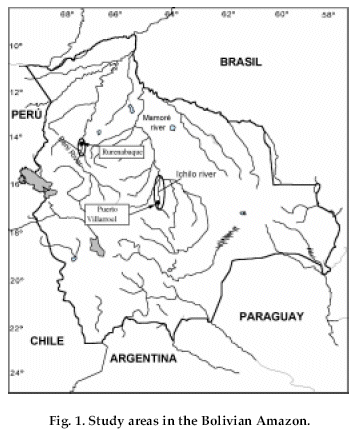
<body><![CDATA[<P   align="justify" ><font size="2" face="Verdana, Arial, Helvetica, sans-serif">    <br>   The Ichilo and Beni rivers form part of the   Madeira river basin. The r&iacute;o Ichilo represents   the border between the departments of   Cochabamba and Santa Cruz, situated in the   center of Bolivia. After its confluence with the   R&iacute;o Grande, its name changes to Mamor&eacute; (<a href="#f1">Fig.   1</a>). The R&iacute;o Beni originates in the department of    La Paz and flows in northeast direction before   it joins the R&iacute;o Mamor&eacute; in Guayaramer&iacute;n (<a href="#f1">Fig.1</a>).</font></P >     <P   align="center" ><font size="2" face="Verdana, Arial, Helvetica, sans-serif"><a name="f1"></a><img src="/img/revistas/reb/v39n2/figura_a03_1.gif" width="361" height="433"></font></P >     <P   align="justify" ><font size="2" face="Verdana, Arial, Helvetica, sans-serif"> Both rivers have high discharge rates and   have extensive white-water floodplains,   characterized by inundated forest and oxbow   lakes (Navarro &amp; Maldonado 2003). Both rivers   are important for commercial fisheries, with   Puerto Villarroel (R&iacute;o Ichilo) and Rurrenabaque   (R&iacute;o Beni) being the most important fishery ports.</font></P >     <P   align="justify" >&nbsp;</P >     <P   align="center" ><font size="3" face="Verdana, Arial, Helvetica, sans-serif"><b>  Methods</b></font></P >     <P   align="justify" ><font size="2" face="Verdana, Arial, Helvetica, sans-serif">  The results presented in this study were   obtained during two fish sampling campaigns.   During the first sampling campaign, between   August 1996 and February 1997, 82 P. <i>fasciatum</i>  and 42 P. <i>tigrinum</i> were collected in the R&iacute;o   Ichilo basin (in the river channel and oxbow   lakes). During the second sampling campaign,   in August and September 1999, 75 P. <i>fasciatum</i> were collected in the R&iacute;o Ichilo, in oxbow lakes   of the Ichilo basin, and in the R&iacute;o Beni.   Fishes were captured using gill nets and   immediately after capture samples of   ectoparasites were taken with pincets from the   skin, the gill cavity, the gills and the fins. The parasites were fixed and conserved in alcohol 85 %. After parasite collection, the total length of the hosts was measured with an ichthyometer. Fish weight was measured with a balance of 50 kg capacity and a sensitivity of &plusmn; 0.5 kg. </font></P >     <P   align="justify" ><font size="2" face="Verdana, Arial, Helvetica, sans-serif">In the laboratory, the ectoparasites were separated, counted and determined to species level with a binocular. Identification guides from Lemos de Castro (1986) and Thatcher (1990) were used for this purpose. </font></P >     <P   align="justify" ><font size="2" face="Verdana, Arial, Helvetica, sans-serif">For each parasite species, the following parameters were calculated (according to Margolis et al. 1981): </font></P >     <p align="center"><img src="/img/revistas/reb/v39n2/tabla_a03_0.gif" width="454" height="89"></p>     ]]></body>

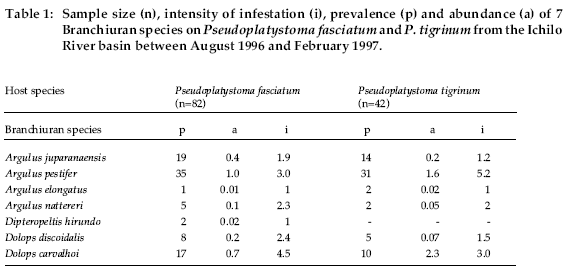
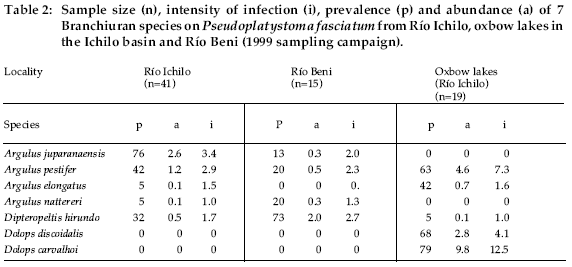
<body><![CDATA[<P   align="justify" ><font size="2" face="Verdana, Arial, Helvetica, sans-serif">The Dispersion index (DI) was calculated as variance / abundance (Elliot 1977). </font></P >     <P   align="justify" ><font size="2" face="Verdana, Arial, Helvetica, sans-serif">Principal Components Analysis (PCA) was used to represent fish individuals in the plane formed by the two first principal components. Factor loadings were calculated using the program STATISTICA. Subsequently, the correlation between factor scores and fish length was calculated (Pla 1986, Ludwig &amp; Reynolds 1988). </font></P >     <P   align="justify" >&nbsp;</P >     <P   align="center" ><font size="3" face="Verdana, Arial, Helvetica, sans-serif"><b>Results </b></font></P >     <P   align="justify" ><font size="2" face="Verdana, Arial, Helvetica, sans-serif">Seven Branchiura species were recorded, four of which belong to the genus <I>Argulus (A. elongatus </I>Heller 1857<I>, A. pestifer </I>Ringuelet 1948<I>, A. nattereri </I>Heller 1857<I>, A. juparanaensis </I>Lemos de Castro 1950<I>), </I>two belong to the genus <I>Dolops </I>(D. <I>discoidalis </I>Bouvier 1899, <I>D. carvalhoi </I>Lemos de Castro 1949) and one belongs to the genus <I>Dipteropeltis (D. hirundo </I>Calman 1912<I>). </I></font></P >     <P   align="justify" ><font size="2" face="Verdana, Arial, Helvetica, sans-serif">The prevalence, abundance and intensity of infestation of the 7 species of Branchiura recorded from <I>Pseudoplatystoma fasciatum </I>and <I>P. tigrinum </I>from the R&iacute;o Ichilo basin in 19961997 are presented in <a href="#t1">Table 1</a>. <I>Argulus pestifer</I>, <I>A. juparanaensis </I>and <I>Dolops carvalhoi </I>were the most abundant parasite species in both hosts. The infection intensities in both species were similar, <I>Dipteropeltis hirundo </I>being the only branchiuran species that was not recorded from <I>P. tigrinum. </I></font></P >     <P   align="center" ><font size="2" face="Verdana, Arial, Helvetica, sans-serif"><a name="t1"></a><img src="/img/revistas/reb/v39n2/tabla_a03_1.gif" width="572" height="275"></font></P >     <P   align="justify" ><font size="2" face="Verdana, Arial, Helvetica, sans-serif">The infestation intensities, prevalences and abundances of parasites on <I>P. fasciatum </I>from the R&iacute;o Ichilo, oxbow lakes in the Ichilo basin and the R&iacute;o Beni in 1999 are presented in <a href="#t2">Table 2</a>. In general, fish from oxbow lakes were more heavily infected (18 parasites/fish) than river fish (R&iacute;o Ichilo: 4.5 parasites/fish; R&iacute;o Beni: 3.1 parasites/fish). However, there were two Branchiuran species which were never recorded in oxbow lakes: <I>Argulus juparanaensis </I>and <I>A. nattereri. </I></font></P >     <P   align="center" ><font size="2" face="Verdana, Arial, Helvetica, sans-serif"><i><a name="t2"></a><img src="/img/revistas/reb/v39n2/tabla_a03_2.gif" width="572" height="267"></i></font></P >     <P   align="justify" ><font size="2" face="Verdana, Arial, Helvetica, sans-serif">In the Ichilo, the most abundant species was <I>A. juparanaensis</I>, whereas it was <I>Dipteropeltis hirundo </I>in the Beni. In oxbow lakes of the R&iacute;o Ichilo basin, <I>D. carvalhoi </I>(prevalence 79%) was the most common species, followed by <I>D. discoidales </I>(prevalence 68 %), two species which were never recorded in rivers. </font></P >     ]]></body>
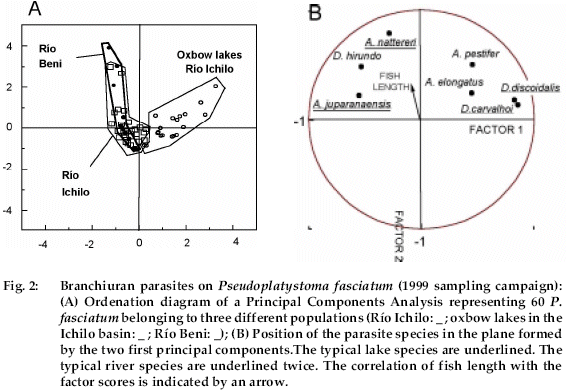
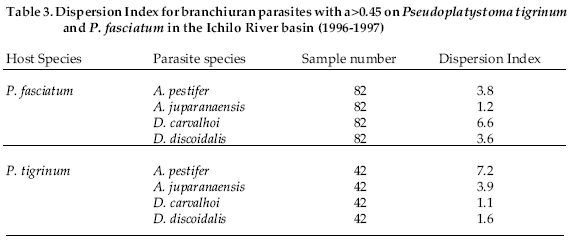
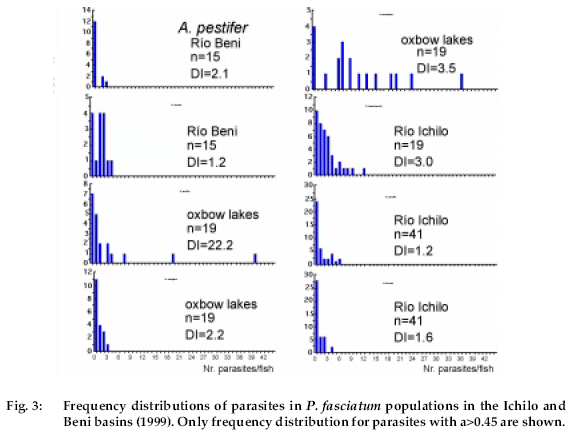
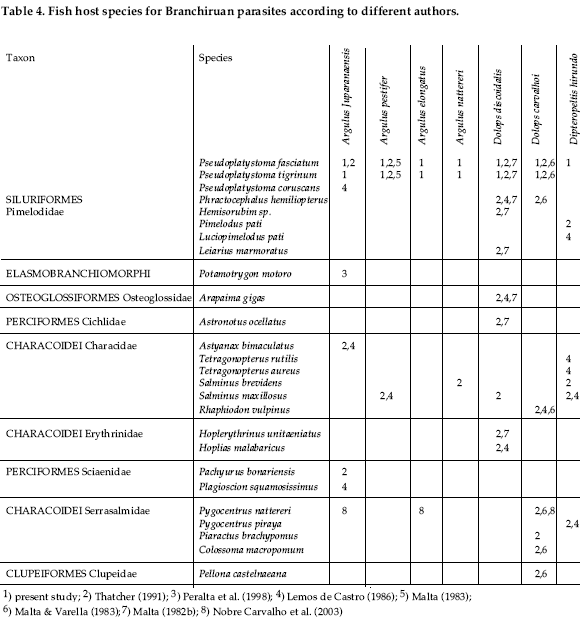
<body><![CDATA[<P   align="justify" ><font size="2" face="Verdana, Arial, Helvetica, sans-serif"><a href="#f2">Figure 2A</a> shows the plane formed by the two first principal components of a PCA analysis of parasites abundances on <I>P. fasciatum </I>from the 1999 sampling campaign. There was a remarkable superposition of the fish populations of rivers Ichilo and Beni, whereas the lake fish populations were clearly separated from the riverine populations along the first axis. In <a href="#f2">figure 2B</a>, the loadings of the Branchiuran species, relative to the two first principal components, are shown. The length of the fish was correlated significantly with the second principal component (Pearson Correlation, p &lt; 0.05).</font></P >     <P   align="center" ><font size="2" face="Verdana, Arial, Helvetica, sans-serif"><a name="f2"></a><img src="/img/revistas/reb/v39n2/figura_a03_2.gif" width="568" height="392"></font></P >     <P   align="justify" ><font size="2" face="Verdana, Arial, Helvetica, sans-serif"><a href="#t3">Table 3</a> and <a href="#f3">Figure 3</a> show that the Dispersion Index for most parasite species is generally significantly larger than 1, illustrating the aggregation of the parasites on a few host individuals. Some species (for example <I>D. hirundo</I>) have Dispersion Indices close to one and show truncated dispersion patterns.</font></P >     <P   align="center" ><font size="2" face="Verdana, Arial, Helvetica, sans-serif"><a name="t3"></a><img src="/img/revistas/reb/v39n2/tabla_a03_3.gif" width="571" height="245"></font></P >     <P   align="center" ><font size="2" face="Verdana, Arial, Helvetica, sans-serif"><a name="f3"></a><img src="/img/revistas/reb/v39n2/figura_a03_3.gif" width="575" height="436"></font></P >     <P   align="justify" ><font size="2" face="Verdana, Arial, Helvetica, sans-serif">In <a href="#t4">Table 4</a>, all the recorded host species for the branchiuran parasites species that were recorded during the present study are listed. It can be seen that three of the <I>Argulus </I>species (<I>A. pestifer, A. elongatus, A. nattereri</I>) have the highest host specificity, whereas <I>Dolops </I>species in general seem to be less specific. </font></P >     <P   align="center" ><a name="t4" id="t4"></a><img src="/img/revistas/reb/v39n2/tabla_a03_4.gif" width="580" height="622"></P >     <P   align="justify" >&nbsp;</P >     <P   align="center" ><font size="3" face="Verdana, Arial, Helvetica, sans-serif"><b>Discussion </b></font></P >     <P   align="justify" ><font size="2" face="Verdana, Arial, Helvetica, sans-serif"><I>Pseudoplatystoma fasciatum </I>and <I>P. tigrinum</I> are very similar species that speciated about two million years ago (Coronel et al. 2004). In <a href="#t3">Table 3</a>, it is shown that the branchiuran parasite communities of these two species have a similar composition, making it highly probable that the speciation within the Branchiura has occurred a lot earlier than within host species. Possibly, speciation within the Branchiura has occurred on the ancestor of <I>P. tigrinum</I> and <I>P. fasciatum</I>, and these host species inherited the same parasite species. However, we need studies on the phylogeny of branchiuran parasite species to test these hypotheses. </font></P >     ]]></body>
<body><![CDATA[<P   align="justify" ><font size="2" face="Verdana, Arial, Helvetica, sans-serif">In general, in the case of fish parasites with a relatively high to very high host specificity (such as monogean ectoparasites, for example), related host species have a higher probability to possess a similar parasite fauna than unrelated host species (Boeger &amp; Kritsky 1997, Poulin 2002). However, in the particular case of branchiurans, which are known by their frequent host switching and rather low host specificity (Thatcher 1991), there are other influencing factors: for this group, the similarity of parasite fauna may be more related to (dis)similarity in host behaviour than to genetic similarity. Indeed, if we look at host checklists for branchiuran parasites (<a href="#t4">Table 4</a>), both genetical and ecological factors may be involved to various degrees. </font></P >     <P   align="justify" ><font size="2" face="Verdana, Arial, Helvetica, sans-serif"><I>Pseudoplatystoma fasciatum </I>and <I>P. tigrinum, </I>are infestated with a remarkably high number of branchiuran parasites species (see also Malta 1984), whereas other fish species of the same family, such as <I>Brachyplatystoma sp</I>., do not have branchiuran parasite species (<a href="#t3">Table 3</a>) (Thatcher 1990, Van Damme unpublished data). This difference is probably related with the biology of the host species. The presence of a high number of Branchiura on <I>P. fasciatum </I>and <I>P. tigrinum </I>may be a consequence of their life style, both species displaying a characteristic &ldquo;sit-and-wait&rdquo; behavior, staying at any time in close contact with the sediment of rivers or oxbow lakes (Barthem &amp; Goulding 1997). As a consequence of this life style, they are probably very vulnerable to infestation with the infective (larval) stages of Branchiuran parasites. This probably also explains why species with amore pelagic life style, such as <I>Brachyplatystoma spp</I>. do not harbour branchiuran parasites. The pelagic environment is probably less suitable for Branchiuran species as a result of high current velocities. </font></P >     <P   align="justify" ><font size="2" face="Verdana, Arial, Helvetica, sans-serif">Moreover, it is probable that host species that occupy a variety of different habitats are infected with more parasite species. This might be one of the reasons why <I>Pseudoplatystoma </I>species, which can be found in all possible habitats of the floodplain (river, inundated forest, oxbow lakes, streams) (Barthem &amp; Goulding 1997), have relatively more parasite species. An alternative explication may be that host species found in different habitats are made up of different populations, which may have favored parasitic speciation, and a consequent increase in parasite species richness. </font></P >    <P   align="justify" ><font size="2" face="Verdana, Arial, Helvetica, sans-serif">Apart from the abovementioned factors, host density, which in the case of <I>Pseudoplatystoma </I>spp. is thought to be different in lakes and rivers, might also influence the success of parasite transmission. However, there are not enough data to validate this assumption. </font></P >    <P   align="justify" ><font size="2" face="Verdana, Arial, Helvetica, sans-serif">Consequently, we suggest that pimelodid fish species that occupy a variety of different habitats and/or that display a sit-and-wait &ldquo;benthic&rdquo; behaviour have more parasite species. There seems to be a gradient <I>Pseudoplatystoma-Phractocephalus-Brachyplatystoma. </I>However, the same is not necessarily true for characids, where for example a species such as <I>Salminus maxillosus</I>, a pelagic species &ldquo;por excelencia&rdquo;, does have a quite high number of Branchiuran parasite species (Thatcher 1990). Besides the mentioned ecological factors, genetical factores may also play an important role. </font></P >     <P   align="justify" ><font size="2" face="Verdana, Arial, Helvetica, sans-serif">The <I>P. fasciatum </I>of oxbow lakes of the R&iacute;o Ichilo River basin had a higher load of Branchiuran parasites than riverine fishes. However, species diversity in the two habitats is equal. <I>Dolops </I>species seem to be more common in oxbow lakes (<I>D. discoidales</I> and <I>D. carvalhoi </I>exclusively occurring in lakes during the 1999 campaign), whereas the genus <I>Argulus </I>has both riverine species (<I>A. juparanensis </I>and <I>A. nattereri) </I>and species with a preference towards lakes (<I>A. pestifer </I>and <I>A. elongatus</I>). The latter may explain why Malta (1982a) hardly found <I>A. juparanensis </I>in Brazilian oxbow lakes. </font></P >     <P   align="justify" ><font size="2" face="Verdana, Arial, Helvetica, sans-serif">The observation that parasite community structure on <I>P. fasciatum </I>in lakes and rivers is different may suggest that fish host populations are (genetically) different. However, it is known that <I>P. fasciatum </I>spawn in the river channels (Barthem &amp; Goulding 1997, Mu&ntilde;oz &amp; Van Damme 1998), and lake fish probably move to the river channel during the spawning season. The previous makes it more plausible that the Branchiuran parasites lose hold when the host moves from one to another habitat, for example because they can not resist high current velocities. If this is so, Branchiura would be bad indicators of the origin or migration patterns of their hosts. </font></P >     <P   align="justify" ><font size="2" face="Verdana, Arial, Helvetica, sans-serif">Thatcher (1990) found that <I>A. pestifer </I>infestin<I>g Pseudoplatystoma </I>species in the Brazilian Amazon was found in high numbers during the low water season (novemberdecember), whereas all the other species were more common in June and July, when the water level was higher. Malta (1983) observed similar seasonal patterns for <I>A. pestifer</I> in a Brazilian oxbow lake. The abundance of <I>Dolops carvalhoi </I>was also related to water levels, maximum peaks of infestation occurring during high water (Malta &amp; Varella 1983). The same seasonal pattern was found for <I>Dolops discoidales </I>by Malta (1982b). This type of seasonality may also have affected parasite abundance during the present study. </font></P >     <P   align="justify" ><font size="2" face="Verdana, Arial, Helvetica, sans-serif">The species-rich Branchiuran parasite community on <I>P. fasciatum </I>offers an excellent opportunity to study host-parasite interactions, parasite isolation effects, and gene fluxes between parasite populations. Moreover, we recommend studying the impact of these abundant parasites on their fish host populations. Branchiuran parasites (as most other parasites) generally show an overdispersed distribution in their host populations (Anderson &amp; Gordon 1982). This phenomenon, confirmed during the present study (<a href="#f3">Fig. 3</a>; <a href="#t3">Table 3</a>), suggests that some of these parasites may be controlling host population size. The observation that some parasite species seem to show truncated distributions (<I>D. hirundo </I>in Table 3 and Figure 3), suggesting host mortality at high parasite densities, should be investigated in more detail. </font></P >     <P   align="justify" >&nbsp;</P >     ]]></body>
<body><![CDATA[<P   align="center" ><font size="3" face="Verdana, Arial, Helvetica, sans-serif"><b>Acknowledgements </b></font></P >     <P   align="justify" ><font size="2" face="Verdana, Arial, Helvetica, sans-serif">We thank Simon Claus, Jorge Coronel and Huascar Mu&ntilde;oz for assistance during field sampling. This study was realized in the framework of the project PROLIMCO (Own Initiative, Flemish University Council) and the Inter-university Cooperation (I.U.C.) between the Flemish University Council and the San Sim&oacute;n University of Cochabamba. Two anonymous referees are acknowledged for comments on an earlier version of the manuscript. </font></P >     <P   align="justify" >&nbsp;</P >     <P   align="center" ><font size="3" face="Verdana, Arial, Helvetica, sans-serif"><b>References </b></font></P >     <!-- ref --><P   align="justify" ><font size="2" face="Verdana, Arial, Helvetica, sans-serif">Agudelo C&oacute;rdoba, E., Salinas Coy, Y., S&aacute;ncez P&aacute;ez, C.L., Mu&ntilde;oz-Sosa, D.L., Alonso Gonz&aacute;lez, J.C., Arteaga D&iacute;az, M.E., Rodr&iacute;guez Prieto, O.J., Anzola Potes, N.R., Acosta Mu&ntilde;oz, L.E., N&uacute;&ntilde;ez Avellaneda, M. &amp; Vald&eacute;s Carrillo, H. 2000. Bagres de la Amazon&iacute;a Colombiana: un recurso sin fronteras. SINCHI, Bogot&aacute;. 253 p. </font></P >    &nbsp;&nbsp;&nbsp;&nbsp;&nbsp;&nbsp;&nbsp;&nbsp;[&#160;<a href="javascript:void(0);" onclick="javascript: window.open('/scielo.php?script=sci_nlinks&ref=003234&pid=S1605-2528200400100000300001&lng=','','width=640,height=500,resizable=yes,scrollbars=1,menubar=yes,');">Links</a>&#160;]<!-- end-ref --><!-- ref --><P   align="justify" ><font size="2" face="Verdana, Arial, Helvetica, sans-serif">Anderson, R.M. &amp; Gordon, D.M. 1982. Processes influencing the distribution of parasite numbers within host populations with special emphasis on parasite-induced host mortalities. Parasitology 85: 373-398. </font></P >    &nbsp;&nbsp;&nbsp;&nbsp;&nbsp;&nbsp;&nbsp;&nbsp;[&#160;<a href="javascript:void(0);" onclick="javascript: window.open('/scielo.php?script=sci_nlinks&ref=003235&pid=S1605-2528200400100000300002&lng=','','width=640,height=500,resizable=yes,scrollbars=1,menubar=yes,');">Links</a>&#160;]<!-- end-ref --><!-- ref --><P   align="justify" ><font size="2" face="Verdana, Arial, Helvetica, sans-serif">Barthem, R. &amp; Goulding, M. 1997. The catfish connection. Ecology, migration and conservation of Amazon predators. Ed. Columbia University, Nueva York, USA. 144 p. </font></P >    &nbsp;&nbsp;&nbsp;&nbsp;&nbsp;&nbsp;&nbsp;&nbsp;[&#160;<a href="javascript:void(0);" onclick="javascript: window.open('/scielo.php?script=sci_nlinks&ref=003236&pid=S1605-2528200400100000300003&lng=','','width=640,height=500,resizable=yes,scrollbars=1,menubar=yes,');">Links</a>&#160;]<!-- end-ref --><P   align="justify" ><font size="2" face="Verdana, Arial, Helvetica, sans-serif">Bouvier, E.L. 1899. Les crustaces parasites du genre <I>Dolops </I>Audouin. Bulletin de la Societe Philomathique de Paris. 8(10)23:53-81. </font></P >    <!-- ref --><P   align="justify" ><font size="2" face="Verdana, Arial, Helvetica, sans-serif">Boeger, W.A. &amp; Kritsky, D.C. 1977. Coevolution of the Monogenoidea (Platyhelminthes) based on a revised hypothesis of parasite phylogeny. International Journal for Parasitology 27: 1495-1511. </font></P >    &nbsp;&nbsp;&nbsp;&nbsp;&nbsp;&nbsp;&nbsp;&nbsp;[&#160;<a href="javascript:void(0);" onclick="javascript: window.open('/scielo.php?script=sci_nlinks&ref=003238&pid=S1605-2528200400100000300005&lng=','','width=640,height=500,resizable=yes,scrollbars=1,menubar=yes,');">Links</a>&#160;]<!-- end-ref --><!-- ref --><P   align="justify" ><font size="2" face="Verdana, Arial, Helvetica, sans-serif">Calman, W.T. 1912. On <I>Dipteropeltis</I>, a new genus of the crustacean Order Branchiura. Proceedings of the Zoological Society of London. 763-766, pl.84. </font></P >    &nbsp;&nbsp;&nbsp;&nbsp;&nbsp;&nbsp;&nbsp;&nbsp;[&#160;<a href="javascript:void(0);" onclick="javascript: window.open('/scielo.php?script=sci_nlinks&ref=003239&pid=S1605-2528200400100000300006&lng=','','width=640,height=500,resizable=yes,scrollbars=1,menubar=yes,');">Links</a>&#160;]<!-- end-ref --><P   align="justify" ><font size="2" face="Verdana, Arial, Helvetica, sans-serif">Coronel, J.S., Maes, G.E., Claus, S., Van Damme, P.A., Volckaert, A.M. &amp;P.A. Van Damme 2004. Differential population history in the migratory catfishes <I>Brachyplatystoma flavicans </I>and <I>Pseudoplatystoma fasciatum </I>(Pimelodidae) from the Bolivian Amazon assessed with nuclear and mitochondrial DNA markers. Journal of Fish Biology 65: 859-868. </font></P >    <!-- ref --><P   align="justify" ><font size="2" face="Verdana, Arial, Helvetica, sans-serif">Dobson, A.P. 1988. The population biology of parasite-induced changes in host behavior. The Quarterly Review of Biology 63(2): 139-159. </font></P >     &nbsp;&nbsp;&nbsp;&nbsp;&nbsp;&nbsp;&nbsp;&nbsp;[&#160;<a href="javascript:void(0);" onclick="javascript: window.open('/scielo.php?script=sci_nlinks&ref=003241&pid=S1605-2528200400100000300008&lng=','','width=640,height=500,resizable=yes,scrollbars=1,menubar=yes,');">Links</a>&#160;]<!-- end-ref --><!-- ref --><P   align="justify" ><font size="2" face="Verdana, Arial, Helvetica, sans-serif">Elliot, J.M. 1977. Some methods for the statistical analysis of samples of benthic invertebrates. Freshwater Biological Association, Scientific Publication 25. 156 p. </font></P >     &nbsp;&nbsp;&nbsp;&nbsp;&nbsp;&nbsp;&nbsp;&nbsp;[&#160;<a href="javascript:void(0);" onclick="javascript: window.open('/scielo.php?script=sci_nlinks&ref=003242&pid=S1605-2528200400100000300009&lng=','','width=640,height=500,resizable=yes,scrollbars=1,menubar=yes,');">Links</a>&#160;]<!-- end-ref --><!-- ref --><P   align="justify" ><font size="2" face="Verdana, Arial, Helvetica, sans-serif">Heller, C. 1857. Beitraege zur Kenntniss der Siphonostomen. Sitzungsberichten der Kaiserlichen Akademie der Wissenschaften in Wien, Mathematische-naturwissenschaftliche Klasse 25(1): 89-108, pls. I-III. </font></P >    &nbsp;&nbsp;&nbsp;&nbsp;&nbsp;&nbsp;&nbsp;&nbsp;[&#160;<a href="javascript:void(0);" onclick="javascript: window.open('/scielo.php?script=sci_nlinks&ref=003243&pid=S1605-2528200400100000300010&lng=','','width=640,height=500,resizable=yes,scrollbars=1,menubar=yes,');">Links</a>&#160;]<!-- end-ref --><!-- ref --><P   align="justify" ><font size="2" face="Verdana, Arial, Helvetica, sans-serif">Hugghins, E.J. 1970. Argulids (Crustacea: Branchiura) from Ecuador and Bolivia. Journal of Parasitology. 56(5):1003. </font></P >    &nbsp;&nbsp;&nbsp;&nbsp;&nbsp;&nbsp;&nbsp;&nbsp;[&#160;<a href="javascript:void(0);" onclick="javascript: window.open('/scielo.php?script=sci_nlinks&ref=003244&pid=S1605-2528200400100000300011&lng=','','width=640,height=500,resizable=yes,scrollbars=1,menubar=yes,');">Links</a>&#160;]<!-- end-ref --><!-- ref --><P   align="justify" ><font size="2" face="Verdana, Arial, Helvetica, sans-serif">Lemos de Castro, A. 1949. Contribuci&oacute;n al conocimiento de crust&aacute;ceos Argulideos de Brasil (Branchiura, Argulidae), con descripci&oacute;n de una nueva especie. Mus. Nac. R&iacute;o de Janeiro, Zool. 93: 1-7. </font></P >    &nbsp;&nbsp;&nbsp;&nbsp;&nbsp;&nbsp;&nbsp;&nbsp;[&#160;<a href="javascript:void(0);" onclick="javascript: window.open('/scielo.php?script=sci_nlinks&ref=003245&pid=S1605-2528200400100000300012&lng=','','width=640,height=500,resizable=yes,scrollbars=1,menubar=yes,');">Links</a>&#160;]<!-- end-ref --><!-- ref --><P   align="justify" ><font size="2" face="Verdana, Arial, Helvetica, sans-serif">Lemos de Castro, A. 1986. Branchiura. Manual de Identificacao de Invertebrados Limnicos do Brasil. Ministerio da Ciencia e Tecnologia, Conselho Nacional de Ciencia e Tecnologia, Coordenacao Editorial, Brasilia D.F. 30:1-23. </font></P >    &nbsp;&nbsp;&nbsp;&nbsp;&nbsp;&nbsp;&nbsp;&nbsp;[&#160;<a href="javascript:void(0);" onclick="javascript: window.open('/scielo.php?script=sci_nlinks&ref=003246&pid=S1605-2528200400100000300013&lng=','','width=640,height=500,resizable=yes,scrollbars=1,menubar=yes,');">Links</a>&#160;]<!-- end-ref --><!-- ref --><P   ><font size="2" face="Verdana, Arial, Helvetica, sans-serif">Loubens, G. &amp; Panfili, J. 2000. Biologie de <I>Pseudoplatystoma fasciatum</I> et <I>P. tigrinum </I>(Teleostei : Pimelodidae) dans le bassin du Mamor&eacute; (Amazonie Bolivienne). Ichthyol. Explor. Freshwaters 11: 13-34. </font></P >    &nbsp;&nbsp;&nbsp;&nbsp;&nbsp;&nbsp;&nbsp;&nbsp;[&#160;<a href="javascript:void(0);" onclick="javascript: window.open('/scielo.php?script=sci_nlinks&ref=003247&pid=S1605-2528200400100000300014&lng=','','width=640,height=500,resizable=yes,scrollbars=1,menubar=yes,');">Links</a>&#160;]<!-- end-ref --><!-- ref --><P   align="justify" ><font size="2" face="Verdana, Arial, Helvetica, sans-serif">Ludwig, J.A. &amp; Reynolds, J.F. 1988. Statistical ecology: A primer on methods and computing. A Wiley-Interscience Publication, Nueva York. 327 p. </font></P >    &nbsp;&nbsp;&nbsp;&nbsp;&nbsp;&nbsp;&nbsp;&nbsp;[&#160;<a href="javascript:void(0);" onclick="javascript: window.open('/scielo.php?script=sci_nlinks&ref=003248&pid=S1605-2528200400100000300015&lng=','','width=640,height=500,resizable=yes,scrollbars=1,menubar=yes,');">Links</a>&#160;]<!-- end-ref --><P   align="justify" ><font size="2" face="Verdana, Arial, Helvetica, sans-serif">Malta, J.C.O. 1982a. Os argul&iacute;deos (Crustacea: Branchiura) da Amazonia Brasileira, 2. Aspectos da Ecologia de <I>Dolops geayi </I>Bouvier, 1897 e <I>Argulus juparanaensis </I>Castro, 1950. Acta Amazonica 12 (4): 701-706. </font></P >    ]]></body>
<body><![CDATA[<!-- ref --><P   align="justify" ><font size="2" face="Verdana, Arial, Helvetica, sans-serif">Malta, J.C.O. 1982b. Os argul&iacute;deos (Crust&aacute;cea: Branchiura) da Amazonia Brasileira. Aspectos da ecolog&iacute;a de <I>Dolops discoidalis </I>Bouvier, 1899 e <I>Dolops bidentata</I>Bouvier, 1899. Acta Amazonica 12(3): 521-528. </font></P >     &nbsp;&nbsp;&nbsp;&nbsp;&nbsp;&nbsp;&nbsp;&nbsp;[&#160;<a href="javascript:void(0);" onclick="javascript: window.open('/scielo.php?script=sci_nlinks&ref=003250&pid=S1605-2528200400100000300017&lng=','','width=640,height=500,resizable=yes,scrollbars=1,menubar=yes,');">Links</a>&#160;]<!-- end-ref --><P   align="justify" ><font size="2" face="Verdana, Arial, Helvetica, sans-serif">Malta, J.C.O. 1983. Os argul&iacute;deos (crustacea: branchiura) da Amazonia brasileira. 4. Aspectos da ecologia de <I>Argulus multicolor </I>Stekhoven, 1937 e <I>Argulus pestifer</I>Ringuelet, 1948. Acta Amazonica 13: 489-496. </font></P >     <P   align="justify" ><font size="2" face="Verdana, Arial, Helvetica, sans-serif">Malta, J.C.O. 1983 &amp; A. Varella 1983. Os argul&iacute;deos (crustacea: branchiura) da Amazonia Brasileira. Aspectos da ecolog&iacute;a de <I>Dolops striata </I>Bouvier, 1899 e <I>Dolops carvalhoi </I>Castro, 1949. Acta Amazonica 13: 299-306. </font></P >    <!-- ref --><P   align="justify" ><font size="2" face="Verdana, Arial, Helvetica, sans-serif">Malta, J.C.O. 1984. Os peixes de um lago de v&aacute;rzea da Amazonia Central (Lago Janauac&aacute;, rio Solimoes) e suas relacoes com os crustaceos ectoparasitas (Branchiura: Argulidae). Acta Amazonica 14 (3/4): 355-372. </font></P >     &nbsp;&nbsp;&nbsp;&nbsp;&nbsp;&nbsp;&nbsp;&nbsp;[&#160;<a href="javascript:void(0);" onclick="javascript: window.open('/scielo.php?script=sci_nlinks&ref=003253&pid=S1605-2528200400100000300020&lng=','','width=640,height=500,resizable=yes,scrollbars=1,menubar=yes,');">Links</a>&#160;]<!-- end-ref --><!-- ref --><P   align="justify" ><font size="2" face="Verdana, Arial, Helvetica, sans-serif">Margolis, L., Esch, G.W., Colmes, J.C., Curie, A.M. &amp; Schad, G.A. 1981. The use of ecological terms in parasitology. J. Parasitol. 68: 133. </font></P >     &nbsp;&nbsp;&nbsp;&nbsp;&nbsp;&nbsp;&nbsp;&nbsp;[&#160;<a href="javascript:void(0);" onclick="javascript: window.open('/scielo.php?script=sci_nlinks&ref=003254&pid=S1605-2528200400100000300021&lng=','','width=640,height=500,resizable=yes,scrollbars=1,menubar=yes,');">Links</a>&#160;]<!-- end-ref --><!-- ref --><P   align="justify" ><font size="2" face="Verdana, Arial, Helvetica, sans-serif">Mu&ntilde;oz, H. &amp; Van Damme, P.A. 1998. Par&aacute;metros de reproducci&oacute;n de 4 especies de peces comerciales (<I>Pseudoplatystoma fasciatum, P. tigrinum, Colossoma macropomum</I> y <I>Piaractus brachypomus</I>) en la cuenca del r&iacute;o Ichilo (Cochabamba, Bolivia). Revista Boliviana de Ecolog&iacute;a y Conservaci&oacute;n Ambiental. 4: 39-54. </font></P >     &nbsp;&nbsp;&nbsp;&nbsp;&nbsp;&nbsp;&nbsp;&nbsp;[&#160;<a href="javascript:void(0);" onclick="javascript: window.open('/scielo.php?script=sci_nlinks&ref=003255&pid=S1605-2528200400100000300022&lng=','','width=640,height=500,resizable=yes,scrollbars=1,menubar=yes,');">Links</a>&#160;]<!-- end-ref --><!-- ref --><P   align="justify" ><font size="2" face="Verdana, Arial, Helvetica, sans-serif">Navarro, G. &amp; Maldonado, M. 2002. Geograf&iacute;a ecol&oacute;gica de Bolivia: Vegetaci&oacute;n y ambientes acu&aacute;ticos. Fundaci&oacute;n Simon I. Pati&ntilde;o, Cochabamba. 719 p. </font></P >     &nbsp;&nbsp;&nbsp;&nbsp;&nbsp;&nbsp;&nbsp;&nbsp;[&#160;<a href="javascript:void(0);" onclick="javascript: window.open('/scielo.php?script=sci_nlinks&ref=003256&pid=S1605-2528200400100000300023&lng=','','width=640,height=500,resizable=yes,scrollbars=1,menubar=yes,');">Links</a>&#160;]<!-- end-ref --><P   align="justify" ><font size="2" face="Verdana, Arial, Helvetica, sans-serif">Nobre Carvalho, L., Del-Claro K. &amp; R. Massato Takemoto 2003. Host-parasite interaction between branchiurans (Crustacea: Argulidae) and piranhas (Osteichthyes: Serrasalminae) in the Pantanal wetland of Brazil. Environmental Biology of Fishes 67 (3): 289-296. </font></P >     <P   align="justify" ><font size="2" face="Verdana, Arial, Helvetica, sans-serif">Peralta, L., Solano, A., Carvalho, J.R., Matos, E. &amp; Serra-Freire, N.M. 1998. Ocorrencia de <I>Argulus juparanaensis </I>Lemos de Castro, 1950 (Branchiura, Argulidae) em arraia de fogo <I>Potamotrygon motoro </I>(M&uuml;ller &amp; Henlz, 1841) (Rajifores: Potamotrygonidae) no Igarap&eacute; do Slito. Entomolog&iacute;a y Vectores. 5 (1): 49-54. </font></P >     <!-- ref --><P   align="justify" ><font size="2" face="Verdana, Arial, Helvetica, sans-serif">Pla, L.E. 1986. An&aacute;lisis multivariado: M&eacute;todo de componentes principales. Monograf&iacute;a N&ordm; 27. Serie de Matem&aacute;tica. OEA. Washington. 95 p. </font></P >    &nbsp;&nbsp;&nbsp;&nbsp;&nbsp;&nbsp;&nbsp;&nbsp;[&#160;<a href="javascript:void(0);" onclick="javascript: window.open('/scielo.php?script=sci_nlinks&ref=003259&pid=S1605-2528200400100000300026&lng=','','width=640,height=500,resizable=yes,scrollbars=1,menubar=yes,');">Links</a>&#160;]<!-- end-ref --><!-- ref --><P   align="justify" ><font size="2" face="Verdana, Arial, Helvetica, sans-serif">Poulin, R. 2002. The evolution of monogenean diversity. International Journal for Parasitology 32: 245-254. </font></P >    &nbsp;&nbsp;&nbsp;&nbsp;&nbsp;&nbsp;&nbsp;&nbsp;[&#160;<a href="javascript:void(0);" onclick="javascript: window.open('/scielo.php?script=sci_nlinks&ref=003260&pid=S1605-2528200400100000300027&lng=','','width=640,height=500,resizable=yes,scrollbars=1,menubar=yes,');">Links</a>&#160;]<!-- end-ref --><!-- ref --><P   align="justify" ><font size="2" face="Verdana, Arial, Helvetica, sans-serif">Ringuelet, R. 1948. Argul&iacute;dos del Museo de la Plata. Revista Mus. La Plata 5 (33): 81</font></P >     &nbsp;&nbsp;&nbsp;&nbsp;&nbsp;&nbsp;&nbsp;&nbsp;[&#160;<a href="javascript:void(0);" onclick="javascript: window.open('/scielo.php?script=sci_nlinks&ref=003261&pid=S1605-2528200400100000300028&lng=','','width=640,height=500,resizable=yes,scrollbars=1,menubar=yes,');">Links</a>&#160;]<!-- end-ref --><!-- ref --><P   align="justify" ><font size="2" face="Verdana, Arial, Helvetica, sans-serif">Rodr&iacute;guez, C. 1992. Bagres, malleros y cuerderos en el bajo r&iacute;o Caquet&aacute;. Ed. Tropenbos. Bogot&aacute;. 152 p. </font></P >    &nbsp;&nbsp;&nbsp;&nbsp;&nbsp;&nbsp;&nbsp;&nbsp;[&#160;<a href="javascript:void(0);" onclick="javascript: window.open('/scielo.php?script=sci_nlinks&ref=003262&pid=S1605-2528200400100000300029&lng=','','width=640,height=500,resizable=yes,scrollbars=1,menubar=yes,');">Links</a>&#160;]<!-- end-ref --><P   align="justify" ><font size="2" face="Verdana, Arial, Helvetica, sans-serif">Scott, M.E. &amp; A. Dobson 1989. The role of parasites in regulating host abundance. Parasitology Today 5: 176-183. </font></P >    <!-- ref --><P   align="justify" ><font size="2" face="Verdana, Arial, Helvetica, sans-serif">Thatcher, V.E. 1990. Limnolog&iacute;a et ecologia Regionalis Sistematis Fluminis Amazonas. Eds. Melonc y Kunk, W. Brasil. 11: 263-266. </font></P >     &nbsp;&nbsp;&nbsp;&nbsp;&nbsp;&nbsp;&nbsp;&nbsp;[&#160;<a href="javascript:void(0);" onclick="javascript: window.open('/scielo.php?script=sci_nlinks&ref=003264&pid=S1605-2528200400100000300031&lng=','','width=640,height=500,resizable=yes,scrollbars=1,menubar=yes,');">Links</a>&#160;]<!-- end-ref --><!-- ref --><P   align="justify" ><font size="2" face="Verdana, Arial, Helvetica, sans-serif">Thatcher, V.E. 1991. Amazon fish parasites. Amazoniana 11 (3/4): 263-572.</font></P >     &nbsp;&nbsp;&nbsp;&nbsp;&nbsp;&nbsp;&nbsp;&nbsp;[&#160;<a href="javascript:void(0);" onclick="javascript: window.open('/scielo.php?script=sci_nlinks&ref=003265&pid=S1605-2528200400100000300032&lng=','','width=640,height=500,resizable=yes,scrollbars=1,menubar=yes,');">Links</a>&#160;]<!-- end-ref --><P   align="justify" >&nbsp;</P >     <P   ><font size="2" face="Verdana, Arial, Helvetica, sans-serif">Art&iacute;culo recibido en: Enero de 2004 </font></P >     <P   ><font size="2" face="Verdana, Arial, Helvetica, sans-serif">Manejado por: Robert Wallace </font></P >     <P   ><font size="2" face="Verdana, Arial, Helvetica, sans-serif">Aceptada en: Octubre de 2004. </font></P >     ]]></body>
<body><![CDATA[ ]]></body><back>
<ref-list>
<ref id="B1">
<nlm-citation citation-type="book">
<person-group person-group-type="author">
<name>
<surname><![CDATA[Agudelo Córdoba]]></surname>
<given-names><![CDATA[E.]]></given-names>
</name>
<name>
<surname><![CDATA[Salinas Coy]]></surname>
<given-names><![CDATA[Y.]]></given-names>
</name>
<name>
<surname><![CDATA[Sáncez Páez]]></surname>
<given-names><![CDATA[C.L.]]></given-names>
</name>
<name>
<surname><![CDATA[Muñoz-Sosa]]></surname>
<given-names><![CDATA[D.L.]]></given-names>
</name>
<name>
<surname><![CDATA[Alonso González]]></surname>
<given-names><![CDATA[J.C.]]></given-names>
</name>
<name>
<surname><![CDATA[Arteaga Díaz]]></surname>
<given-names><![CDATA[M.E.]]></given-names>
</name>
<name>
<surname><![CDATA[Rodríguez Prieto]]></surname>
<given-names><![CDATA[O.J.]]></given-names>
</name>
<name>
<surname><![CDATA[Anzola Potes]]></surname>
<given-names><![CDATA[N.R.]]></given-names>
</name>
<name>
<surname><![CDATA[Acosta Muñoz]]></surname>
<given-names><![CDATA[L.E.]]></given-names>
</name>
<name>
<surname><![CDATA[Núñez Avellaneda]]></surname>
<given-names><![CDATA[M.]]></given-names>
</name>
<name>
<surname><![CDATA[Valdés Carrillo]]></surname>
<given-names><![CDATA[H.]]></given-names>
</name>
</person-group>
<source><![CDATA[Bagres de la Amazonía Colombiana: un recurso sin fronteras]]></source>
<year>2000</year>
<page-range>253</page-range><publisher-loc><![CDATA[Bogotá ]]></publisher-loc>
<publisher-name><![CDATA[SINCHI]]></publisher-name>
</nlm-citation>
</ref>
<ref id="B2">
<nlm-citation citation-type="journal">
<person-group person-group-type="author">
<name>
<surname><![CDATA[Anderson]]></surname>
<given-names><![CDATA[R.M.]]></given-names>
</name>
<name>
<surname><![CDATA[Gordon]]></surname>
<given-names><![CDATA[D.M.]]></given-names>
</name>
</person-group>
<article-title xml:lang="en"><![CDATA[Processes influencing the distribution of parasite numbers within host populations with special emphasis on parasite-induced host mortalities]]></article-title>
<source><![CDATA[Parasitology]]></source>
<year>1982</year>
<volume>85</volume>
<page-range>373-398</page-range></nlm-citation>
</ref>
<ref id="B3">
<nlm-citation citation-type="book">
<person-group person-group-type="author">
<name>
<surname><![CDATA[Barthem]]></surname>
<given-names><![CDATA[R.]]></given-names>
</name>
<name>
<surname><![CDATA[Goulding]]></surname>
<given-names><![CDATA[M.]]></given-names>
</name>
</person-group>
<source><![CDATA[The catfish connection. Ecology, migration and conservation of Amazon predators]]></source>
<year>1997</year>
<page-range>144</page-range><publisher-loc><![CDATA[Nueva York ]]></publisher-loc>
<publisher-name><![CDATA[Columbia University]]></publisher-name>
</nlm-citation>
</ref>
<ref id="B4">
<nlm-citation citation-type="journal">
<person-group person-group-type="author">
<name>
<surname><![CDATA[Bouvier]]></surname>
<given-names><![CDATA[E.L.]]></given-names>
</name>
</person-group>
<article-title xml:lang="en"><![CDATA[Les crustaces parasites du genre Dolops Audouin]]></article-title>
<source><![CDATA[Bulletin de la Societe Philomathique de Paris]]></source>
<year>1899</year>
<volume>8</volume>
<numero>10</numero>
<issue>10</issue>
<page-range>53-81</page-range></nlm-citation>
</ref>
<ref id="B5">
<nlm-citation citation-type="journal">
<person-group person-group-type="author">
<name>
<surname><![CDATA[Boeger]]></surname>
<given-names><![CDATA[W.A.]]></given-names>
</name>
<name>
<surname><![CDATA[Kritsky]]></surname>
<given-names><![CDATA[D.C.]]></given-names>
</name>
</person-group>
<article-title xml:lang="en"><![CDATA[Coevolution of the Monogenoidea (Platyhelminthes) based on a revised hypothesis of parasite phylogeny]]></article-title>
<source><![CDATA[International Journal for Parasitology]]></source>
<year>1977</year>
<volume>27</volume>
<page-range>1495-1511</page-range></nlm-citation>
</ref>
<ref id="B6">
<nlm-citation citation-type="">
<person-group person-group-type="author">
<name>
<surname><![CDATA[Calman]]></surname>
<given-names><![CDATA[W.T.]]></given-names>
</name>
</person-group>
<source><![CDATA[On Dipteropeltis, a new genus of the crustacean Order Branchiura. Proceedings of the Zoological Society of London]]></source>
<year>1912</year>
<page-range>763-766</page-range></nlm-citation>
</ref>
<ref id="B7">
<nlm-citation citation-type="journal">
<person-group person-group-type="author">
<name>
<surname><![CDATA[Coronel]]></surname>
<given-names><![CDATA[J.S.]]></given-names>
</name>
<name>
<surname><![CDATA[Maes]]></surname>
<given-names><![CDATA[G.E.]]></given-names>
</name>
<name>
<surname><![CDATA[Claus]]></surname>
<given-names><![CDATA[S.]]></given-names>
</name>
<name>
<surname><![CDATA[Van Damme]]></surname>
<given-names><![CDATA[P.A.]]></given-names>
</name>
<name>
<surname><![CDATA[Volckaert]]></surname>
<given-names><![CDATA[A.M.]]></given-names>
</name>
<name>
<surname><![CDATA[Van Damme]]></surname>
<given-names><![CDATA[P.A.]]></given-names>
</name>
</person-group>
<article-title xml:lang="en"><![CDATA[Differential population history in the migratory catfishes Brachyplatystoma flavicans and Pseudoplatystoma fasciatum (Pimelodidae) from the Bolivian Amazon assessed with nuclear and mitochondrial DNA markers]]></article-title>
<source><![CDATA[Journal of Fish Biology]]></source>
<year>2004</year>
<volume>65</volume>
<page-range>859-868</page-range></nlm-citation>
</ref>
<ref id="B8">
<nlm-citation citation-type="journal">
<person-group person-group-type="author">
<name>
<surname><![CDATA[Dobson]]></surname>
<given-names><![CDATA[A.P.]]></given-names>
</name>
</person-group>
<article-title xml:lang="en"><![CDATA[The population biology of parasite-induced changes in host behavior]]></article-title>
<source><![CDATA[The Quarterly Review of Biology]]></source>
<year>1988</year>
<volume>63</volume>
<numero>2</numero>
<issue>2</issue>
<page-range>139-159</page-range></nlm-citation>
</ref>
<ref id="B9">
<nlm-citation citation-type="book">
<person-group person-group-type="author">
<name>
<surname><![CDATA[Elliot]]></surname>
<given-names><![CDATA[J.M.]]></given-names>
</name>
</person-group>
<source><![CDATA[Some methods for the statistical analysis of samples of benthic invertebrates]]></source>
<year>1977</year>
<page-range>156</page-range><publisher-name><![CDATA[Freshwater Biological Association]]></publisher-name>
</nlm-citation>
</ref>
<ref id="B10">
<nlm-citation citation-type="journal">
<person-group person-group-type="author">
<name>
<surname><![CDATA[Heller]]></surname>
<given-names><![CDATA[C.]]></given-names>
</name>
</person-group>
<article-title xml:lang="de"><![CDATA[Beitraege zur Kenntniss der Siphonostomen_ Sitzungsberichten der Kaiserlichen Akademie der Wissenschaften in Wien]]></article-title>
<source><![CDATA[Mathematische-naturwissenschaftliche Klasse]]></source>
<year>1857</year>
<volume>25</volume>
<numero>1</numero>
<issue>1</issue>
<page-range>89-108</page-range></nlm-citation>
</ref>
<ref id="B11">
<nlm-citation citation-type="journal">
<person-group person-group-type="author">
<name>
<surname><![CDATA[Hugghins]]></surname>
<given-names><![CDATA[E.J.]]></given-names>
</name>
</person-group>
<article-title xml:lang="en"><![CDATA[Argulids (Crustacea: Branchiura) from Ecuador and Bolivia]]></article-title>
<source><![CDATA[Journal of Parasitology]]></source>
<year>1970</year>
<volume>56</volume>
<numero>5</numero>
<issue>5</issue>
<page-range>1003</page-range></nlm-citation>
</ref>
<ref id="B12">
<nlm-citation citation-type="journal">
<person-group person-group-type="author">
<name>
<surname><![CDATA[Lemos de Castro]]></surname>
<given-names><![CDATA[A.]]></given-names>
</name>
</person-group>
<article-title xml:lang="es"><![CDATA[Contribución al conocimiento de crustáceos Argulideos de Brasil (Branchiura, Argulidae), con descripción de una nueva especie]]></article-title>
<source><![CDATA[Mus Nac Río de Janeiro, Zool]]></source>
<year>1949</year>
<volume>93</volume>
<page-range>1-7</page-range></nlm-citation>
</ref>
<ref id="B13">
<nlm-citation citation-type="book">
<person-group person-group-type="author">
<name>
<surname><![CDATA[Castro]]></surname>
<given-names><![CDATA[A.]]></given-names>
</name>
</person-group>
<source><![CDATA[Branchiura. Manual de Identificacao de Invertebrados Limnicos do Brasil]]></source>
<year>1986</year>
<volume>30</volume>
<page-range>1-23</page-range><publisher-loc><![CDATA[Brasilia^eD.F. D.F.]]></publisher-loc>
<publisher-name><![CDATA[Ministerio da Ciencia e Tecnologia, Conselho Nacional de Ciencia e Tecnologia]]></publisher-name>
</nlm-citation>
</ref>
<ref id="B14">
<nlm-citation citation-type="journal">
<person-group person-group-type="author">
<name>
<surname><![CDATA[Loubens]]></surname>
<given-names><![CDATA[G.]]></given-names>
</name>
<name>
<surname><![CDATA[Panfili]]></surname>
<given-names><![CDATA[J.]]></given-names>
</name>
</person-group>
<article-title xml:lang="fr"><![CDATA[Biologie de Pseudoplatystoma fasciatum et P. tigrinum (Teleostei: Pimelodidae) dans le bassin du Mamoré (Amazonie Bolivienne)]]></article-title>
<source><![CDATA[Ichthyol Explor Freshwaters]]></source>
<year>2000</year>
<volume>11</volume>
<page-range>13-34</page-range></nlm-citation>
</ref>
<ref id="B15">
<nlm-citation citation-type="book">
<person-group person-group-type="author">
<name>
<surname><![CDATA[Ludwig]]></surname>
<given-names><![CDATA[J.A.]]></given-names>
</name>
<name>
<surname><![CDATA[Reynolds]]></surname>
<given-names><![CDATA[J.F.]]></given-names>
</name>
</person-group>
<source><![CDATA[Statistical ecology: A primer on methods and computing]]></source>
<year>1988</year>
<page-range>327</page-range><publisher-loc><![CDATA[Nueva York ]]></publisher-loc>
<publisher-name><![CDATA[A Wiley-Interscience Publication]]></publisher-name>
</nlm-citation>
</ref>
<ref id="B16">
<nlm-citation citation-type="journal">
<person-group person-group-type="author">
<name>
<surname><![CDATA[Malta]]></surname>
<given-names><![CDATA[J.C.O.]]></given-names>
</name>
</person-group>
<article-title xml:lang="pt"><![CDATA[Os argulídeos (Crustácea: Branchiura) da Amazonia Brasileira, 2. Aspectos da Ecologia de Dolops geayi Bouvier, 1897 e Argulus juparanaensis Castro, 1950]]></article-title>
<source><![CDATA[Acta Amazonica]]></source>
<year>1982</year>
<month>a</month>
<volume>12</volume>
<numero>4</numero>
<issue>4</issue>
<page-range>701-706</page-range></nlm-citation>
</ref>
<ref id="B17">
<nlm-citation citation-type="journal">
<person-group person-group-type="author">
<name>
<surname><![CDATA[Malta]]></surname>
<given-names><![CDATA[J.C.O.]]></given-names>
</name>
</person-group>
<article-title xml:lang="pt"><![CDATA[Os argulídeos (Crustácea: Branchiura) da Amazonia Brasileira]]></article-title>
<source><![CDATA[Aspectos da ecología de Dolops discoidalis Bouvier, 1899 e Dolops bidentataBouvier, 1899. Acta Amazonica]]></source>
<year>1982</year>
<month>b</month>
<volume>12</volume>
<numero>3</numero>
<issue>3</issue>
<page-range>521-528</page-range></nlm-citation>
</ref>
<ref id="B18">
<nlm-citation citation-type="journal">
<person-group person-group-type="author">
<name>
<surname><![CDATA[Malta]]></surname>
<given-names><![CDATA[J.C.O.]]></given-names>
</name>
</person-group>
<article-title xml:lang="pt"><![CDATA[Os argulídeos (crustácea: branchiura) da Amazonia brasileira. 4. Aspectos da ecologia de Argulus multicolor Stekhoven, 1937 e Argulus pestiferRinguelet, 1948]]></article-title>
<source><![CDATA[Acta Amazonica]]></source>
<year>1983</year>
<volume>13</volume>
<page-range>489-496</page-range></nlm-citation>
</ref>
<ref id="B19">
<nlm-citation citation-type="journal">
<person-group person-group-type="author">
<name>
<surname><![CDATA[Malta]]></surname>
<given-names><![CDATA[J.C.O.]]></given-names>
</name>
<name>
<surname><![CDATA[Varella]]></surname>
<given-names><![CDATA[A.]]></given-names>
</name>
</person-group>
<article-title xml:lang="pt"><![CDATA[Os argulídeos (crustácea: branchiura) da Amazonia Brasileira. Aspectos da ecología de Dolops striata Bouvier, 1899 e Dolops carvalhoi Castro, 1949]]></article-title>
<source><![CDATA[Acta Amazonica]]></source>
<year>1983</year>
<volume>13</volume>
<page-range>299-306</page-range></nlm-citation>
</ref>
<ref id="B20">
<nlm-citation citation-type="journal">
<person-group person-group-type="author">
<name>
<surname><![CDATA[Malta]]></surname>
<given-names><![CDATA[J.C.O.]]></given-names>
</name>
</person-group>
<article-title xml:lang="pt"><![CDATA[Os peixes de um lago de várzea da Amazonia Central (Lago Janauacá, rio Solimoes) e suas relacoes com os crustaceos ectoparasitas (Branchiura: Argulidae)]]></article-title>
<source><![CDATA[Acta Amazonica]]></source>
<year>1984</year>
<volume>14</volume>
<numero>3/4</numero>
<issue>3/4</issue>
<page-range>355-372</page-range></nlm-citation>
</ref>
<ref id="B21">
<nlm-citation citation-type="journal">
<person-group person-group-type="author">
<name>
<surname><![CDATA[Margolis]]></surname>
<given-names><![CDATA[L.]]></given-names>
</name>
<name>
<surname><![CDATA[Esch]]></surname>
<given-names><![CDATA[G.W.]]></given-names>
</name>
<name>
<surname><![CDATA[Colmes]]></surname>
<given-names><![CDATA[J.C.]]></given-names>
</name>
<name>
<surname><![CDATA[Curie]]></surname>
<given-names><![CDATA[A.M.]]></given-names>
</name>
<name>
<surname><![CDATA[Schad]]></surname>
<given-names><![CDATA[G.A.]]></given-names>
</name>
</person-group>
<article-title xml:lang="en"><![CDATA[The use of ecological terms in parasitology]]></article-title>
<source><![CDATA[J. Parasitol.]]></source>
<year>1981</year>
<volume>68</volume>
<page-range>133</page-range></nlm-citation>
</ref>
<ref id="B22">
<nlm-citation citation-type="journal">
<person-group person-group-type="author">
<name>
<surname><![CDATA[Muñoz]]></surname>
<given-names><![CDATA[H.]]></given-names>
</name>
<name>
<surname><![CDATA[Van-Damme]]></surname>
<given-names><![CDATA[P.A.]]></given-names>
</name>
</person-group>
<article-title xml:lang="es"><![CDATA[Parámetros de reproducción de 4 especies de peces comerciales (Pseudoplatystoma fasciatum, P. tigrinum, Colossoma macropomum y Piaractus brachypomus) en la cuenca del río Ichilo (Cochabamba, Bolivia)]]></article-title>
<source><![CDATA[Revista Boliviana de Ecología y Conservación Ambiental.]]></source>
<year>1998</year>
<volume>4</volume>
<page-range>39-54</page-range></nlm-citation>
</ref>
<ref id="B23">
<nlm-citation citation-type="book">
<person-group person-group-type="author">
<name>
<surname><![CDATA[Navarro]]></surname>
<given-names><![CDATA[G.]]></given-names>
</name>
<name>
<surname><![CDATA[Maldonado]]></surname>
<given-names><![CDATA[M.]]></given-names>
</name>
</person-group>
<source><![CDATA[Geografía ecológica de Bolivia: Vegetación y ambientes acuáticos]]></source>
<year>2002</year>
<page-range>719</page-range><publisher-loc><![CDATA[Cochabamba ]]></publisher-loc>
<publisher-name><![CDATA[Fundación Simon I. Patiño]]></publisher-name>
</nlm-citation>
</ref>
<ref id="B24">
<nlm-citation citation-type="journal">
<person-group person-group-type="author">
<name>
<surname><![CDATA[Nobre Carvalho]]></surname>
<given-names><![CDATA[L.]]></given-names>
</name>
<name>
<surname><![CDATA[Del-Claro]]></surname>
<given-names><![CDATA[K.]]></given-names>
</name>
<name>
<surname><![CDATA[Massato_Takemoto]]></surname>
<given-names><![CDATA[R.]]></given-names>
</name>
</person-group>
<article-title xml:lang="en"><![CDATA[Host-parasite interaction between branchiurans (Crustacea-- Argulidae) and piranhas (Osteichthyes-- Serrasalminae) in the Pantanal wetland of Brazil]]></article-title>
<source><![CDATA[Environmental Biology of Fishes]]></source>
<year>2003</year>
<volume>67</volume>
<numero>3</numero>
<issue>3</issue>
<page-range>289-296</page-range></nlm-citation>
</ref>
<ref id="B25">
<nlm-citation citation-type="journal">
<person-group person-group-type="author">
<name>
<surname><![CDATA[Peralta]]></surname>
<given-names><![CDATA[L.]]></given-names>
</name>
<name>
<surname><![CDATA[Carvalho]]></surname>
<given-names><![CDATA[A.]]></given-names>
</name>
<name>
<surname><![CDATA[Matos]]></surname>
<given-names><![CDATA[E.]]></given-names>
</name>
<name>
<surname><![CDATA[Serra-Freire]]></surname>
<given-names><![CDATA[N.M.]]></given-names>
</name>
</person-group>
<article-title xml:lang="pt"><![CDATA[Ocorrencia de Argulus juparanaensis Lemos de Castro, 1950 (Branchiura, Argulidae) em arraia de fogo Potamotrygon motoro (Müller & Henlz, 1841) (Rajifores-- Potamotrygonidae) no Igarapé do Slito]]></article-title>
<source><![CDATA[Entomología y Vectores]]></source>
<year>1998</year>
<volume>5</volume>
<numero>1</numero>
<issue>1</issue>
<page-range>49-54</page-range></nlm-citation>
</ref>
<ref id="B26">
<nlm-citation citation-type="book">
<person-group person-group-type="author">
<name>
<surname><![CDATA[Pla]]></surname>
<given-names><![CDATA[L.E.]]></given-names>
</name>
</person-group>
<source><![CDATA[Análisis multivariado: Método de componentes principales]]></source>
<year>1986</year>
<page-range>95</page-range><publisher-loc><![CDATA[Washington ]]></publisher-loc>
<publisher-name><![CDATA[OEA]]></publisher-name>
</nlm-citation>
</ref>
<ref id="B27">
<nlm-citation citation-type="journal">
<person-group person-group-type="author">
<name>
<surname><![CDATA[Poulin]]></surname>
<given-names><![CDATA[R.]]></given-names>
</name>
</person-group>
<article-title xml:lang="en"><![CDATA[The evolution of monogenean diversity]]></article-title>
<source><![CDATA[International Journal for Parasitology]]></source>
<year>2002</year>
<volume>32</volume>
<page-range>245-254</page-range></nlm-citation>
</ref>
<ref id="B28">
<nlm-citation citation-type="journal">
<person-group person-group-type="author">
<name>
<surname><![CDATA[Ringuelet]]></surname>
<given-names><![CDATA[R.]]></given-names>
</name>
</person-group>
<article-title xml:lang="es"><![CDATA[Argulídos del Museo de la Plata]]></article-title>
<source><![CDATA[Revista Mus. La Plata]]></source>
<year>1948</year>
<volume>5</volume>
<numero>33</numero>
<issue>33</issue>
<page-range>81</page-range></nlm-citation>
</ref>
<ref id="B29">
<nlm-citation citation-type="book">
<person-group person-group-type="author">
<name>
<surname><![CDATA[Rodríguez]]></surname>
<given-names><![CDATA[C.]]></given-names>
</name>
</person-group>
<source><![CDATA[Bagres, malleros y cuerderos en el bajo río Caquetá]]></source>
<year>1992</year>
<page-range>152</page-range><publisher-loc><![CDATA[Bogotá ]]></publisher-loc>
<publisher-name><![CDATA[Tropenbos]]></publisher-name>
</nlm-citation>
</ref>
<ref id="B30">
<nlm-citation citation-type="journal">
<person-group person-group-type="author">
<name>
<surname><![CDATA[Scott]]></surname>
<given-names><![CDATA[M.E.]]></given-names>
</name>
<name>
<surname><![CDATA[Dobson]]></surname>
<given-names><![CDATA[A.]]></given-names>
</name>
</person-group>
<article-title xml:lang="en"><![CDATA[The role of parasites in regulating host abundance]]></article-title>
<source><![CDATA[Parasitology Today]]></source>
<year>1989</year>
<volume>5</volume>
<page-range>176-183</page-range></nlm-citation>
</ref>
<ref id="B31">
<nlm-citation citation-type="book">
<person-group person-group-type="author">
<name>
<surname><![CDATA[Thatcher]]></surname>
<given-names><![CDATA[V.E.]]></given-names>
</name>
</person-group>
<source><![CDATA[Limnología et ecologia Regionalis Sistematis Fluminis Amazonas]]></source>
<year>1990</year>
<volume>11</volume>
<page-range>263-266</page-range><publisher-name><![CDATA[Melonc y Kunk]]></publisher-name>
</nlm-citation>
</ref>
<ref id="B32">
<nlm-citation citation-type="journal">
<person-group person-group-type="author">
<name>
<surname><![CDATA[Thatcher]]></surname>
<given-names><![CDATA[V.E.]]></given-names>
</name>
</person-group>
<article-title xml:lang="en"><![CDATA[Amazon fish parasites]]></article-title>
<source><![CDATA[Amazoniana]]></source>
<year>1991</year>
<volume>11</volume>
<numero>3/4</numero>
<issue>3/4</issue>
<page-range>263-572</page-range></nlm-citation>
</ref>
</ref-list>
</back>
</article>