<?xml version="1.0" encoding="ISO-8859-1"?><article xmlns:mml="http://www.w3.org/1998/Math/MathML" xmlns:xlink="http://www.w3.org/1999/xlink" xmlns:xsi="http://www.w3.org/2001/XMLSchema-instance">
<front>
<journal-meta>
<journal-id>1562-3823</journal-id>
<journal-title><![CDATA[Revista Boliviana de Física]]></journal-title>
<abbrev-journal-title><![CDATA[Revista Boliviana de Física]]></abbrev-journal-title>
<issn>1562-3823</issn>
<publisher>
<publisher-name><![CDATA[Sociedad Boliviana de Física]]></publisher-name>
</publisher>
</journal-meta>
<article-meta>
<article-id>S1562-38232022000200004</article-id>
<title-group>
<article-title xml:lang="en"><![CDATA[Localized two-dimensional patterns morphology of a generalized nonlinear Schrodinger equation]]></article-title>
<article-title xml:lang="es"><![CDATA[Morfología de patrones localizados bidimensionales de una ecuación de Schrodinger no-lineal generalizada]]></article-title>
</title-group>
<contrib-group>
<contrib contrib-type="author">
<name>
<surname><![CDATA[URZAGASTI]]></surname>
<given-names><![CDATA[DETERLINO]]></given-names>
</name>
<xref ref-type="aff" rid="A01"/>
</contrib>
</contrib-group>
<aff id="A01">
<institution><![CDATA[,Universidad Mayor de San Andrés  ]]></institution>
<addr-line><![CDATA[ ]]></addr-line>
</aff>
<pub-date pub-type="pub">
<day>00</day>
<month>12</month>
<year>2022</year>
</pub-date>
<pub-date pub-type="epub">
<day>00</day>
<month>12</month>
<year>2022</year>
</pub-date>
<volume>41</volume>
<numero>41</numero>
<fpage>24</fpage>
<lpage>30</lpage>
<copyright-statement/>
<copyright-year/>
<self-uri xlink:href="http://www.scielo.org.bo/scielo.php?script=sci_arttext&amp;pid=S1562-38232022000200004&amp;lng=en&amp;nrm=iso"></self-uri><self-uri xlink:href="http://www.scielo.org.bo/scielo.php?script=sci_abstract&amp;pid=S1562-38232022000200004&amp;lng=en&amp;nrm=iso"></self-uri><self-uri xlink:href="http://www.scielo.org.bo/scielo.php?script=sci_pdf&amp;pid=S1562-38232022000200004&amp;lng=en&amp;nrm=iso"></self-uri><abstract abstract-type="short" xml:lang="es"><p><![CDATA[Resumen Se realiza una clasificación morfológica cualitativa sobre una muestra de cientos de patrones bidimensionales encontrados al resolver numéricamente una ecuación nolineal generalizada de Schrödinger dentro de una región de parámetros donde coexisten estos patrones con soluciones homogéneas no triviales. Los patrones hallados van desde aquellos muy simples a otros más complejos. Aparte de la forma, cada patrón es caracterizado también por su contenido caótico. Asimismo se observa la interacción de los distintos tipos de patrones]]></p></abstract>
<abstract abstract-type="short" xml:lang="en"><p><![CDATA[Abstract A qualitative morphological classification is performed on a sample of hundreds of two-dimensional patterns found by numerically solving a nonlinear generalized Schrödinger equation within a region of parameters where these patterns coexist with non-trivial homogeneous solutions. The patterns found range from those very simple to others more complex. Apart from the shape, each pattern is also characterized by its chaotic content. Likewise, the interaction of the different pattern types is observed]]></p></abstract>
<kwd-group>
<kwd lng="es"><![CDATA[Ecuaciones de amplitud]]></kwd>
<kwd lng="es"><![CDATA[dinámica disipativa]]></kwd>
<kwd lng="es"><![CDATA[sistemas dinámicos]]></kwd>
<kwd lng="es"><![CDATA[formación de patrones]]></kwd>
<kwd lng="en"><![CDATA[Amplitude equations]]></kwd>
<kwd lng="en"><![CDATA[dissipative dynamics]]></kwd>
<kwd lng="en"><![CDATA[dynamical systems]]></kwd>
<kwd lng="en"><![CDATA[pattern formation]]></kwd>
</kwd-group>
</article-meta>
</front><body><![CDATA[ <p align="justify"><font face="Verdana, Arial, Helvetica, sans-serif" size="2"><a href="https://doi.org/10.53287/hity1826bi37c" target="_blank">https://doi.org/10.53287/hity1826bi37c</a></font></p>     <p align="right"><font size="2" face="Verdana, Arial, Helvetica, sans-serif"><strong>A.ART&Iacute;CULOS</strong></font></p>     <p align="right">&nbsp;</p>     <p align="center"><font size="4" face="Verdana, Arial, Helvetica, sans-serif"><strong>Localized  two-dimensional patterns     <br>   morphology  of a generalized nonlinear     <br> Schr&ouml;dinger  equation</strong></font></p>     <p align="center">&nbsp;</p>     <p align="center"><font size="3" face="Verdana, Arial, Helvetica, sans-serif"><strong>Morfolog&iacute;a de patrones localizados bidimensionales     <br> de una ecuaci&oacute;n  de Schr&ouml;dinger no-lineal generalizada</strong></font></p>     <p align="center">&nbsp;</p>     ]]></body>
<body><![CDATA[<p align="center">&nbsp;</p>     <p align="center"><font size="2" face="Verdana, Arial, Helvetica, sans-serif"><strong>DETERLINO URZAGASTI<sup>&dagger;</sup></strong><sup></sup></font><font face="Verdana, Arial, Helvetica, sans-serif" size="2"><strong><sup><a href="" target="_self" onClick="javascript: w = window.open('https://orcid.org/0000-000l-7387-9499','','width=640,height=500,resizable=yes,scrollbars=1,menubar=yes,');"><img src="/img/revistas/rbf/v41n41/id_orcid.png" width="16" height="16" border="0"></a></sup></strong></font>    <br>   <font size="2" face="Verdana, Arial, Helvetica, sans-serif">Planetario Max Schreier, P.O.Box 316 4 Universidad Mayor de San Andr&eacute;s,    <br>    La Paz, Bolivia</font>    <br>   <font face="Verdana, Arial, Helvetica, sans-serif" size="2"><sup>&dagger;</sup> Email: <a href="mailto:durzagasti@fcpn.edu.bo">durzagasti@fcpn.edu.bo</a>.</font>    <br>   <font face="Verdana, Arial, Helvetica, sans-serif" size="2"><strong>Recibido</strong> 4 de diciembre de 2022&nbsp;&nbsp;&nbsp;&nbsp; <strong>Aceptado</strong> 22 de diciembre de 2022</font></p>     <p align="justify">&nbsp;</p>     <p align="justify">&nbsp;</p> <hr>     <p align="justify"><font size="2"><b><font face="Verdana, Arial, Helvetica, sans-serif">Resumen</font></b></font></p>     <p align="justify"><font size="2" face="Verdana, Arial, Helvetica, sans-serif">Se realiza una clasificaci&oacute;n morfol&oacute;gica cualitativa sobre una muestra de cientos de patrones bidimensionales encontrados al resolver num&eacute;ricamente una ecuaci&oacute;n nolineal generalizada de Schr&ouml;dinger dentro de una regi&oacute;n de par&aacute;metros donde coexisten estos patrones con soluciones homog&eacute;neas no triviales. Los patrones hallados van desde aquellos muy simples a otros m&aacute;s complejos. Aparte de la forma, cada patr&oacute;n es caracterizado tambi&eacute;n por su contenido ca&oacute;tico. Asimismo se observa la interacci&oacute;n de los distintos tipos de patrones.</font></p>     ]]></body>
<body><![CDATA[<p align="justify"><font size="2" face="Verdana, Arial, Helvetica, sans-serif"><b>Descriptores:</b> Ecuaciones de amplitud; din&aacute;mica disipativa; sistemas din&aacute;micos; formaci&oacute;n de patrones.</font> <font size="2" face="Verdana, Arial, Helvetica, sans-serif"> </font> </p> <hr>     <p align="justify"><font size="2" face="Verdana, Arial, Helvetica, sans-serif"><b>C&oacute;digo(s) PACS: </b></font><font size="2" face="Verdana, Arial, Helvetica, sans-serif">05.90.+m</font> <font size="2" face="Verdana, Arial, Helvetica, sans-serif"> </font> </p> <hr>     <p align="justify"><font size="2"><b><font face="Verdana, Arial, Helvetica, sans-serif">Abstract<br />   </font></b></font><font size="2"><font face="Verdana, Arial, Helvetica, sans-serif"><br />     A qualitative morphological classification is performed on a sample of hundreds of two-dimensional patterns found by numerically solving a nonlinear generalized Schr&ouml;dinger equation within a region of parameters where these patterns coexist with non-trivial homogeneous solutions. The patterns found range from those very simple to others more complex. Apart from the shape, each pattern is also characterized by its chaotic content. Likewise, the interaction of the different pattern types is observed.</font></font></p>     <p align="justify"><font size="2" face="Verdana, Arial, Helvetica, sans-serif"><b>Subject headings: </b>Amplitude equations; dissipative dynamics; dynamical systems; pattern formation.</font></p> <hr>     <p align="justify">&nbsp;</p>     <p align="justify">&nbsp;</p>     <p align="justify"><strong><font size="3" face="Verdana, Arial, Helvetica, sans-serif"> 1&nbsp;&nbsp;Introduction</font></strong></p>     <p align="justify"><font size="2" face="Verdana, Arial, Helvetica, sans-serif"> </font><font size="2" face="Verdana, Arial, Helvetica, sans-serif">Localized patterns in two dimensions, that is, of finite area, are observed in many physical contexts. To mention just a few, we can say that they are present in  Bose-Einstein condensates as well as in optical, magnetic, and mechanical systems. Given the large number of works in this field, we will refer the reader to the publications&nbsp;<a href="#Aranson-2-2002" id="CITEAranson-2-2002" class="tth_citation">&nbsp;Aranson &amp; Kramer, [2002]</a>,<a href="#Dangelmayr-2004" id="CITEDangelmayr-2004" class="tth_citation">&nbsp;Dangelmayr &amp; Oprea, [2004]</a>,<a href="#Pismen-2006" id="CITEPismen-2006" class="tth_citation">&nbsp;Pismen, [2006</a>] and references therein, where different qualitative and quantitative analyzes are presented, as well as their comparison with experimental results.</font>     <p align="justify"><font size="2" face="Verdana, Arial, Helvetica, sans-serif">Some years ago, patterns in two dimensions that appear when a generalized nonlinear Schr&ouml;dinger equation is solved numerically have been studied in depth&nbsp;( ). The present manuscript presents results of a morphological analysis of a large set of simulations carried out solving the same equation and in the same region of parameters given in&nbsp;<a href="#urza-05-2017" id="CITEurza-05-2017" class="tth_citation">&nbsp;Urzagasti et&nbsp;al., [2017</a>].</font>     <p align="justify"><font size="2" face="Verdana, Arial, Helvetica, sans-serif">The working equation for the complex amplitude <i>A</i> reads</font>     ]]></body>
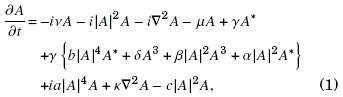
<body><![CDATA[<p align="center"><font size="2" face="Verdana, Arial, Helvetica, sans-serif"> <img src="/img/revistas/rbf/v41n41/a04_figura01.gif" width="343" height="97"><br clear="all" />   </font>     <p align="justify"><font size="2" face="Verdana, Arial, Helvetica, sans-serif">Details of the meaning of all terms can be found in&nbsp;<a href="#urza-05-2017" class="tth_citeref">&nbsp;Urzagasti et&nbsp;al., [2017</a>]. However, we can mention that it contains a dissipative term with coefficient &micro;, a detuning term to approach the parametric resonance, &#957;, and a forcing term, with coefficient &gamma;. Regarding the other terms, we can highlight that the equation is rich in nonlinearity and this allows the coexistence of the structures that we seek to classify morphologically with the non-trivial homogeneous background.</font></p>     <p align="justify"><font size="2" face="Verdana, Arial, Helvetica, sans-serif">Likewise, the connection with physics in different scenarios is given in detail in&nbsp;<a href="#urza-05-2017" class="tth_citeref">&nbsp;Urzagasti et&nbsp;al., [2017</a>]. This important aspect, that of the universality of the working equation, is the main motivation of this work.</font></p>     <p align="justify">&nbsp;</p>     <p align="center"><a name="f1"></a><img src="/img/revistas/rbf/v41n41/a04_figura02.gif" width="513" height="484"></p>     <p align="center"><font size="2" face="Verdana, Arial, Helvetica, sans-serif"><strong>Figure 1:</strong> Localized circular-like patterns.</font></p>     <p align="center"><a name="f2"></a><img src="/img/revistas/rbf/v41n41/a04_figura03.gif" width="550" height="491"></p>     <p align="center"><font size="2" face="Verdana, Arial, Helvetica, sans-serif"><strong>Figure 2:</strong> Localized regular patterns.</font></p>     <p align="center"><a name="f3"></a><img src="/img/revistas/rbf/v41n41/a04_figura04.gif" width="630" height="489"></p>     <p align="center"><font size="2" face="Verdana, Arial, Helvetica, sans-serif"><strong>Figure 3:</strong> Localized chain-like patterns.</font></p>     ]]></body>
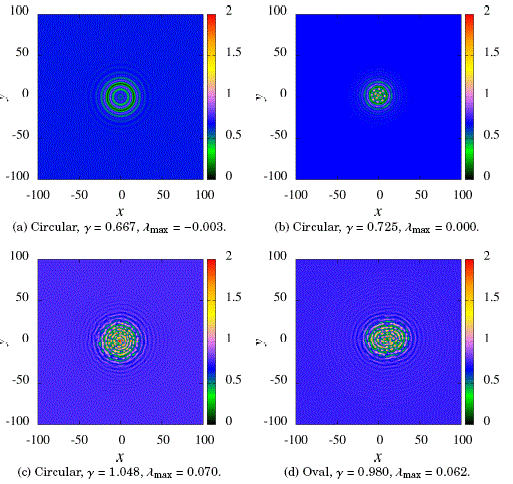
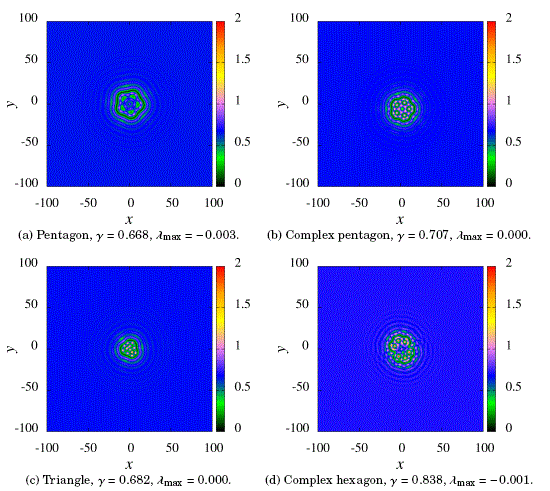
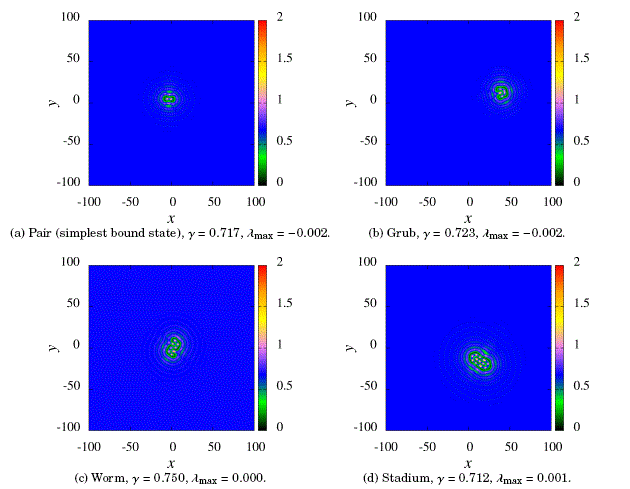
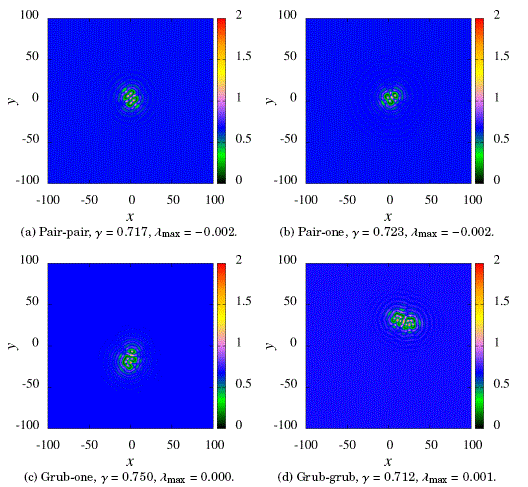
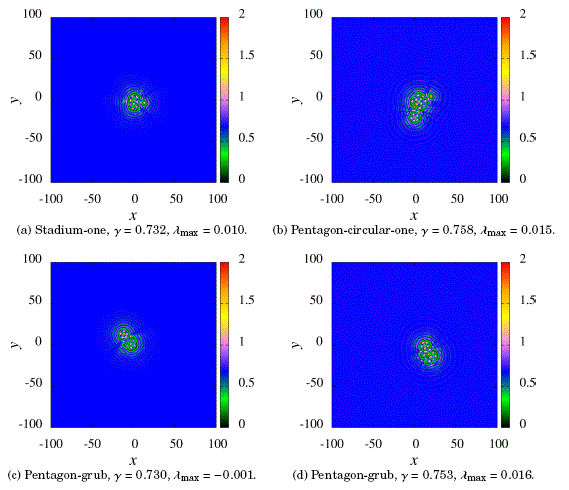
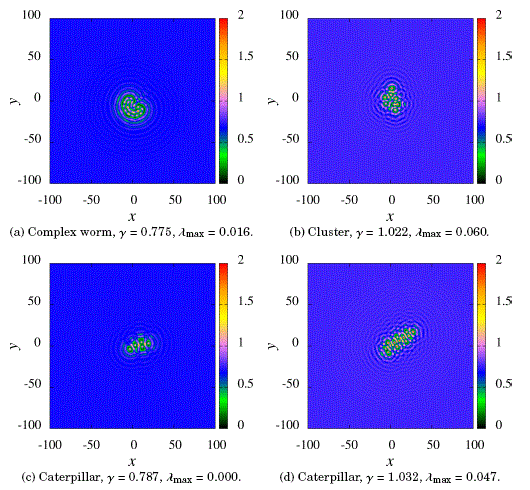
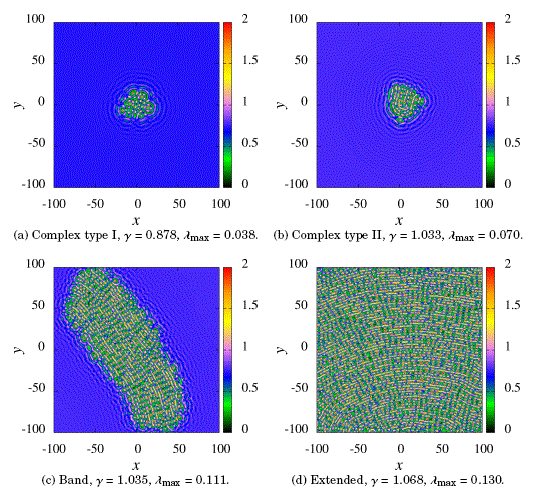
<body><![CDATA[<p>&nbsp;</p>     <p align="justify"><font size="3" face="Verdana, Arial, Helvetica, sans-serif"> <strong>2&nbsp;&nbsp;Results</strong></font></p>     <p align="justify"><font size="2" face="Verdana, Arial, Helvetica, sans-serif"> </font><font size="2" face="Verdana, Arial, Helvetica, sans-serif">We show some examples of the basic structures we have found in our simulations at &#957; = &#8722;0.05, for the detuning parameter, and for different values of the &gamma; driving parameter after a simulation time interval of &Delta;<i>t</i>=5.6&times;10<sup>3</sup> has elapsed. We have worked 359 objects, for which we have performed some kind of basic  morphological clasification by direct inspection of the final results. The initial condition for all the simulations was the same pulse with circular symmetry. All the figures below corresponding to these examples map with a color code the modulus of the amplitude (lAl) at the final instant. To determine the chaotic content, we use as an indicator the maximum Lyapunov exponent,  &lambda;<sub>max</sub>, which is obtained numerically using the techniques described in&nbsp;<a href="#urza-05-2017" class="tth_citeref">&nbsp;Urzagasti et&nbsp;al., [2017</a>].</font>     <p align="justify"><font size="2" face="Verdana, Arial, Helvetica, sans-serif">To begin, in <a href="#f1">Fig.&nbsp;1</a> we show different circular-like structures. In the stationary regime these structures are isotropic, while in the quasi-stationary and chaotic cases they are clustered and composed of concentric chains of peaks. There are some exceptions to the circular shape as the oval object shown in box (d) of the same Figure.</font>     <p align="justify"><font size="2" face="Verdana, Arial, Helvetica, sans-serif">In <a href="#f2">Fig.&nbsp;2</a> we show some regular in shape patterns that are found in both the stationary and quasi-stationary regimes. In particular, the object shown in box (d) is an exceptional stationary case in the chaotic zone above &gamma; = 0.8.</font>     <p align="justify"><font size="2" face="Verdana, Arial, Helvetica, sans-serif"><a href="#f3">Figure&nbsp;3</a> shows some simple chain-like structures. We point out that grub and stadium structures tend to move away from their initial position.</font>     <p align="justify"><font size="2" face="Verdana, Arial, Helvetica, sans-serif">The simplest structures appear interacting for some parameters. Examples of the resulting clusters are shown in <a href="#f4">Fig.&nbsp;4</a>. Again, we remark how the structures involving grubs move away from the initial central position.</font>     <p align="justify"><font size="2" face="Verdana, Arial, Helvetica, sans-serif">Also, there are interacting systems that involve more complex structures such as circles, pentagons, and stadiums. Some examples are shown in&nbsp;<a href="#f5">Fig.&nbsp;5</a>. Note that in the case of pentagon-grub structure there are a stationary version as well as a chaotic one.</font>     <p align="justify"><font size="2" face="Verdana, Arial, Helvetica, sans-serif">We found even more complex structures such as those shown in <a href="#f6">Fig.&nbsp;6</a>. We remark that the caterpillar structure appears in both the cuasistationary and chaotic cases.</font>     <p align="justify"><font size="2" face="Verdana, Arial, Helvetica, sans-serif">Finally, we distinguish two general types of big complexes: complex type I, which are composed of several kinds of interacting complexes shuch as the one shown in box (a) of <a href="#f7">Fig.&nbsp;7</a>, and complex type II which are built from several interacting chains of peaks and that have a tassel-like structure as it is shown in the example in box (b) of the same Figure. <a href="#f7">Figure&nbsp;7</a> also shows the very big and very chaotic structures that appear as a band-like and extended pattern structures in box (c) and (d), respectively.</font>     ]]></body>
<body><![CDATA[<p align="justify">     <p align="center"><a name="f4"></a><img src="/img/revistas/rbf/v41n41/a04_figura05.gif" width="528" height="487">     <p align="center"><font size="2" face="Verdana, Arial, Helvetica, sans-serif"><strong>Figure 4:</strong> Localized clusters of simple patterns.</font></p>     <p align="center"><a name="f5"></a><img src="/img/revistas/rbf/v41n41/a04_figura06.gif" width="569" height="490"></p>     <p align="center"><font size="2" face="Verdana, Arial, Helvetica, sans-serif"><strong>Figure 5:</strong> Localized clusters with more complex patterns.</font></p>     <p align="center"><a name="f6"></a><img src="/img/revistas/rbf/v41n41/a04_figura07.gif" width="530" height="490"></p>     <p align="center"><font size="2" face="Verdana, Arial, Helvetica, sans-serif"><strong>Figure 6:</strong> Localized complexes.</font></p>     <p align="center"><a name="f7"></a><img src="/img/revistas/rbf/v41n41/a04_figura08.gif" width="534" height="490"></p>     <p align="center"><font size="2" face="Verdana, Arial, Helvetica, sans-serif"><strong>Figure 7:</strong> Localized and extended big complexes.</font></p>     <p align="justify">&nbsp;</p>     ]]></body>
<body><![CDATA[<p align="justify"><font size="3" face="Verdana, Arial, Helvetica, sans-serif"> <strong>3&nbsp;&nbsp;Concluding remarks</strong></font></p>     <p align="justify"> <font size="2" face="Verdana, Arial, Helvetica, sans-serif">In summary, we have found several types of structures whose complexity is determined by their extension and by their number of walls, trenches, and soliton pulses. After an exhaustive review of the results of hundreds of simulations, only a few types of structures were found, namely: circular, oval, triangular, pentagonal, and hexagonal patterns; bound states of solitons, grubs, worms, and caterpillars; stadiums, clusters; complex irregular structures (here called type I complexes), complex tassel-like structures (here called type II complexes), and bands, which are extensive band-shaped structures.</font></p>     <p align="justify"><font size="2" face="Verdana, Arial, Helvetica, sans-serif">In general, the greater the complexity, the greater the chaotic content; however, there are exceptions. In particular, less complex structures can be both chaotic and periodic.</font></p>     <p align="justify"><font size="2" face="Verdana, Arial, Helvetica, sans-serif">It should be noted that some less complex objects acquire movement. We do not have an explanation of the cause of this interesting effect, nor of the causes for the formation of different patterns for very close values of the forcing parameter. These problems, which are outside the scope of this manuscript, are raised for further study.</font></p>     <p align="justify">&nbsp;</p>     <p align="justify"><font size="2" face="Verdana, Arial, Helvetica, sans-serif"><b><font size="3">Conflicto de intereses</font></b></font></p>     <p align="justify"><font size="2" face="Verdana, Arial, Helvetica, sans-serif">El autor declara que no hay conflicto de intereses respecto a la publicaci&oacute;n de este documento.</font></p>     <p align="justify">&nbsp;</p>     <p align="justify"><strong><font size="3" face="Verdana, Arial, Helvetica, sans-serif">References</font></strong></p>     <p align="justify"><font size="2" face="Verdana, Arial, Helvetica, sans-serif"><a href="#CITEAranson-2-2002" id="Aranson-2-2002">[Aranson &amp; Kramer 2002]</a></font>     ]]></body>
<body><![CDATA[<!-- ref --><p align="justify"><font size="2" face="Verdana, Arial, Helvetica, sans-serif"> Aranson, I.&nbsp;S. &amp; Kramer, L. 2002, <i>Rev. Mod. Phys.</i>, 74, 99 </font>     &nbsp;&nbsp;&nbsp;&nbsp;&nbsp;&nbsp;&nbsp;&nbsp;[&#160;<a href="javascript:void(0);" onclick="javascript: window.open('/scielo.php?script=sci_nlinks&ref=251847&pid=S1562-3823202200020000400001&lng=','','width=640,height=500,resizable=yes,scrollbars=1,menubar=yes,');">Links</a>&#160;]<!-- end-ref --><p align="justify"><font size="2" face="Verdana, Arial, Helvetica, sans-serif"><a href="#CITEDangelmayr-2004" id="Dangelmayr-2004">[Dangelmayr &amp; Oprea 2004]</a></font>     <!-- ref --><p align="justify"><font size="2" face="Verdana, Arial, Helvetica, sans-serif"> Dangelmayr, G. &amp; Oprea, I. 2004, Dynamics and Bifurcation of Patterns in   Dissipative Systems (WORLD SCIENTIFIC) </font> <font size="2" face="Verdana,    &nbsp;&nbsp;&nbsp;&nbsp;&nbsp;&nbsp;&nbsp;&nbsp;[&#160;<a href="javascript:void(0);" onclick="javascript: window.open('/scielo.php?script=sci_nlinks&ref=251849&pid=S1562-3823202200020000400002&lng=','','width=640,height=500,resizable=yes,scrollbars=1,menubar=yes,');">Links</a>&#160;]<!-- end-ref --> Arial, Helvetica, sans-serif"> </font>     <p align="justify"><font size="2" face="Verdana, Arial, Helvetica, sans-serif"><a href="#CITEPismen-2006" id="Pismen-2006">[Pismen 2006]</a></font>     <!-- ref --><p align="justify"><font size="2" face="Verdana, Arial, Helvetica, sans-serif"> Pismen, L.&nbsp;M. 2006, Patterns and Interfaces in Dissipative Dynamics (Springer   Berlin, Heidelberg) </font> <font size="2" face="Verdana,    &nbsp;&nbsp;&nbsp;&nbsp;&nbsp;&nbsp;&nbsp;&nbsp;[&#160;<a href="javascript:void(0);" onclick="javascript: window.open('/scielo.php?script=sci_nlinks&ref=251852&pid=S1562-3823202200020000400003&lng=','','width=640,height=500,resizable=yes,scrollbars=1,menubar=yes,');">Links</a>&#160;]<!-- end-ref --> Arial, Helvetica, sans-serif"> </font>     <p align="justify"><font size="2" face="Verdana, Arial, Helvetica, sans-serif"><a href="#CITEurza-05-2017" id="urza-05-2017">[Urzagasti et&nbsp;al. 2017]</a></font>     <!-- ref --><p align="justify"><font size="2" face="Verdana, Arial, Helvetica, sans-serif"> Urzagasti, D., Laroze, D., &amp; Pleiner, H. 2017, <i>Phys. Rev. E</i>, 95, 052216</font>     &nbsp;&nbsp;&nbsp;&nbsp;&nbsp;&nbsp;&nbsp;&nbsp;[&#160;<a href="javascript:void(0);" onclick="javascript: window.open('/scielo.php?script=sci_nlinks&ref=251855&pid=S1562-3823202200020000400004&lng=','','width=640,height=500,resizable=yes,scrollbars=1,menubar=yes,');">Links</a>&#160;]<!-- end-ref --><p align="justify">&nbsp;</p>     ]]></body>
<body><![CDATA[<p align="justify">&nbsp;</p>      ]]></body><back>
<ref-list>
<ref id="B1">
<nlm-citation citation-type="journal">
<source><![CDATA[Rev. Mod. Phys]]></source>
<year></year>
<volume>74</volume>
<page-range>99</page-range></nlm-citation>
</ref>
<ref id="B2">
<nlm-citation citation-type="">
<person-group person-group-type="author">
<name>
<surname><![CDATA[Dangelmayr]]></surname>
<given-names><![CDATA[G]]></given-names>
</name>
<name>
<surname><![CDATA[Oprea]]></surname>
<given-names><![CDATA[I]]></given-names>
</name>
</person-group>
<source><![CDATA[Dynamics and Bifurcation of Patterns in Dissipative Systems]]></source>
<year>2004</year>
</nlm-citation>
</ref>
<ref id="B3">
<nlm-citation citation-type="">
<person-group person-group-type="author">
<name>
<surname><![CDATA[Pismen]]></surname>
<given-names><![CDATA[L. M]]></given-names>
</name>
</person-group>
<source><![CDATA[Patterns and Interfaces in Dissipative Dynamics]]></source>
<year>2006</year>
</nlm-citation>
</ref>
<ref id="B4">
<nlm-citation citation-type="journal">
<source><![CDATA[Phys. Rev. E]]></source>
<year></year>
<volume>95</volume>
<page-range>052216</page-range></nlm-citation>
</ref>
</ref-list>
</back>
</article>