<?xml version="1.0" encoding="ISO-8859-1"?><article xmlns:mml="http://www.w3.org/1998/Math/MathML" xmlns:xlink="http://www.w3.org/1999/xlink" xmlns:xsi="http://www.w3.org/2001/XMLSchema-instance">
<front>
<journal-meta>
<journal-id>1562-3823</journal-id>
<journal-title><![CDATA[Revista Boliviana de Física]]></journal-title>
<abbrev-journal-title><![CDATA[Revista Boliviana de Física]]></abbrev-journal-title>
<issn>1562-3823</issn>
<publisher>
<publisher-name><![CDATA[Sociedad Boliviana de Física]]></publisher-name>
</publisher>
</journal-meta>
<article-meta>
<article-id>S1562-38232021000100004</article-id>
<title-group>
<article-title xml:lang="en"><![CDATA[Effective Hamiltonian for a tight-binding square lattice and its relation to a two-mesh LC circuit with discrete charge]]></article-title>
<article-title xml:lang="es"><![CDATA[Hamiltoniano efectivo de una red cuadrada de enlace fuerte y su relación con un circuito LC de dos mallas con carga discreta]]></article-title>
</title-group>
<contrib-group>
<contrib contrib-type="author">
<name>
<surname><![CDATA[Mamani C]]></surname>
<given-names><![CDATA[Evaristo]]></given-names>
</name>
</contrib>
<contrib contrib-type="author">
<name>
<surname><![CDATA[Calcina-Nogales]]></surname>
<given-names><![CDATA[Marcelo]]></given-names>
</name>
</contrib>
<contrib contrib-type="author">
<name>
<surname><![CDATA[Sanjinés Castedo]]></surname>
<given-names><![CDATA[Diego]]></given-names>
</name>
</contrib>
</contrib-group>
<aff id="A">
<institution><![CDATA[,  ]]></institution>
<addr-line><![CDATA[ ]]></addr-line>
</aff>
<pub-date pub-type="pub">
<day>00</day>
<month>11</month>
<year>2021</year>
</pub-date>
<pub-date pub-type="epub">
<day>00</day>
<month>11</month>
<year>2021</year>
</pub-date>
<volume>38</volume>
<numero>38</numero>
<fpage>15</fpage>
<lpage>26</lpage>
<copyright-statement/>
<copyright-year/>
<self-uri xlink:href="http://www.scielo.org.bo/scielo.php?script=sci_arttext&amp;pid=S1562-38232021000100004&amp;lng=en&amp;nrm=iso"></self-uri><self-uri xlink:href="http://www.scielo.org.bo/scielo.php?script=sci_abstract&amp;pid=S1562-38232021000100004&amp;lng=en&amp;nrm=iso"></self-uri><self-uri xlink:href="http://www.scielo.org.bo/scielo.php?script=sci_pdf&amp;pid=S1562-38232021000100004&amp;lng=en&amp;nrm=iso"></self-uri><abstract abstract-type="short" xml:lang="es"><p><![CDATA[Resumen En este trabajo consideramos una función hamiltoniana de enlace fuerte extendida a primeros y segundos vecinos para una partícula cargada que se transporta por saltos (hopping) en una red cuadrada en presencia de un campo estático arbitrario y un campo uniforme rápidamente oscilante con frecuencia &#969;. La aplicación del método semiclásico y el método de Kapitza de promediación temporal hasta O(&#969;-2) conduce a una función hamiltoniana efectiva (independiente del tiempo) con elementos de salto que dependen de los parámetros de los campos externos. Controlando dichos parámetros podemos manipular las interacciones de tal forma de emular un sistema físico diferente, en este caso, un circuito LC de dos mallas con carga discreta]]></p></abstract>
<abstract abstract-type="short" xml:lang="en"><p><![CDATA[Abstract We consider an extended tight-binding Hamiltonian function comprising nearest and next-to-nearest neighbor interactions for a charged particle hopping in a square lattice in the presence of a static arbitrary field and a rapidly oscillating uniform field with frequency &#969;. The application of the semiclassical method and the Kapitza's method for time-averaging up to O(&#969;-2) yields an effective (time independent) Hamiltonian function with long range hopping elements that depend on the parameters of the external fields. By controlling these parameters we can engineer the interactions in such a way as to emulate a different physical system, namely, a two-mesh LC circuit with discrete charge]]></p></abstract>
<kwd-group>
<kwd lng="es"><![CDATA[Método de enlace fuerte]]></kwd>
<kwd lng="es"><![CDATA[modelo semiclásico]]></kwd>
<kwd lng="es"><![CDATA[sistemas mesoscópicos]]></kwd>
<kwd lng="en"><![CDATA[Tight-binding method]]></kwd>
<kwd lng="en"><![CDATA[semiclassical model]]></kwd>
<kwd lng="en"><![CDATA[mesoscopic systems]]></kwd>
</kwd-group>
</article-meta>
</front><body><![CDATA[ <p align="right"><font size="2" face="Verdana, Arial, Helvetica, sans-serif"><strong>A. ART&Iacute;CULOS</strong></font></p>     <p align="right">&nbsp;</p>     <p align="center"><strong><font size="4" face="Verdana, Arial, Helvetica, sans-serif">Effective Hamiltonian for a tight-binding square lattice and its relation     <br> to a two-mesh LC circuit with discrete charge</font></strong></p>     <p align="center">&nbsp;</p>     <p align="center"><strong><font size="3" face="Verdana, Arial, Helvetica, sans-serif"> Hamiltoniano efectivo de una red cuadrada de enlace fuerte y su relaci&oacute;n con un     <br> circuito LC de dos mallas con carga discreta</font></strong></p>     <p align="center">&nbsp;</p>     <p align="center">&nbsp;</p>     <p align="center"><font size="2" face="Verdana, Arial, Helvetica, sans-serif"><strong>Evaristo Mamani C.<a href="" target="_self" onClick="javascript: w = window.open('https://orcid.org/0000-0002-3484-8582','','width=640,height=500,resizable=yes,scrollbars=1,menubar=yes,');"><img src="/img/revistas/rbf/v38n38/id_orcid.png" width="16" height="16" border="0"></a>, Marcelo Calcina-Nogales <a href="" target="_self" onClick="javascript: w = window.open('https://orcid.org/0000-0002-7926-8215','','width=640,height=500,resizable=yes,scrollbars=1,menubar=yes,');"><img src="/img/revistas/rbf/v38n38/id_orcid.png" width="16" height="16" border="0"></a>, Diego Sanjin&eacute;s Castedo<a href="" target="_self" onClick="javascript: w = window.open('https://orcid.org/0000-0001-6832-9513','','width=640,height=500,resizable=yes,scrollbars=1,menubar=yes,');"><img src="/img/revistas/rbf/v38n38/id_orcid.png" width="16" height="16" border="0"></a></strong><sup><strong>&dagger;</strong></sup></font>    ]]></body>
<body><![CDATA[<br>   <font size="2" face="Verdana, Arial, Helvetica, sans-serif">Instituto de Investigaciones F&iacute;sicas, Universidad Mayor de San Andr&eacute;s    <br>   Campus Universitario, c. 27 Cota-Cota, Casilla de Correos 8635    <br>   La Paz - Bolivia    <br>   <sup>&dagger;</sup><a href="mailto:diegosanjinescastedo@gmail.com">diegosanjinescastedo@gmail.com</a>    <br>   <strong>Recibido</strong> 2 de septiembre de 2021; <strong>aceptado</strong> 18 de noviembre de 2021</font></p>      <p>&nbsp;</p>     <p>&nbsp;</p> <hr>     <p align="justify"><font size="2" face="Verdana, Arial, Helvetica, sans-serif"><b>Resumen<br />   </b><br />   En este trabajo consideramos una funci&oacute;n hamiltoniana de enlace fuerte extendida a primeros y segundos vecinos para una part&iacute;cula cargada que se transporta por saltos (<i>hopping</i>) en una red cuadrada en presencia de un campo est&aacute;tico arbitrario y un campo uniforme r&aacute;pidamente oscilante con frecuencia &omega;. La aplicaci&oacute;n del m&eacute;todo semicl&aacute;sico y el m&eacute;todo de Kapitza de promediaci&oacute;n temporal hasta <i>O</i>(&omega;<sup>-2</sup>) conduce a una funci&oacute;n  hamiltoniana efectiva (independiente del tiempo) con elementos de salto que dependen de los par&aacute;metros de los campos externos. Controlando dichos par&aacute;metros podemos manipular las interacciones de tal forma de emular un sistema f&iacute;sico diferente, en este caso, un circuito LC de dos mallas con carga discreta. </font></p>     <p align="justify"><font size="2" face="Verdana, Arial, Helvetica, sans-serif"><b>Descriptores:</b> M&eacute;todo de enlace fuerte  -  modelo semicl&aacute;sico  -  sistemas mesosc&oacute;picos.</font></p> <hr>     <p><font size="2" face="Verdana, Arial, Helvetica, sans-serif"><b>C&oacute;digo(s) PACS: </b>31.15.aq, 03.65.Sq , 73.23.-b </font></p> <hr>     ]]></body>
<body><![CDATA[<p align="justify"><font size="2" face="Verdana, Arial, Helvetica, sans-serif"><strong>Abstract</strong></font></p>     <p align="justify"><font size="2" face="Verdana, Arial, Helvetica, sans-serif">We consider an extended tight-binding Hamiltonian function comprising nearest and next-to-nearest neighbor interactions for a charged particle hopping in a square lattice in the presence of a static arbitrary field and a rapidly oscillating uniform field with frequency &omega;. The application of the semiclassical method and the Kapitza's method for time-averaging up to <i>O</i>(&omega;<sup>-2</sup>) yields an effective (time independent) Hamiltonian function with long range hopping elements that depend on the parameters of the external fields. By controlling these parameters we can engineer the interactions in such a way as to emulate a different physical system, namely, a two-mesh LC circuit with discrete charge. </font></p>     <p align="justify"><font size="2" face="Verdana, Arial, Helvetica, sans-serif"><b>Subject headings: </b>Tight-binding method  -  semiclassical model  -  mesoscopic systems.</font></p> <hr>     <p>&nbsp;</p>     <p>&nbsp;</p>     <p><strong><font size="3" face="Verdana, Arial, Helvetica, sans-serif">1.&nbsp;Introduction</font></strong></p>     <p align="justify"><font size="2" face="Verdana, Arial, Helvetica, sans-serif">The study of effective Hamiltonians in solid state physics, derived with time-averaging procedures (originally due to P. L. Kapitza for the study of the inverted pendulum <a href="#Kapitza" name="CITEKapitza">Kapitza, [1965</a>,<a href="#Landau" name="CITELandau">Landau, [1985</a>] applied to tight-binding lattices, has recently acquired interest given the feasibility of managing (engineering) the hopping elements when the lattice is subject to external and rapidly oscillating driving fields. Some of the effects relevant for transport phenomena include, for example: dynamic localization, coherent control of tunneling, metal-insulator transitions, atomic motion in atom traps, effective next-to-nearest neighbor interactions and effective Bloch oscillation <a href="#Dunlap" name="CITEDunlap">Dunlap, [1986</a>,<a href="#Rahav" name="CITERahav">Rahav, [2003</a>,<a href="#Bandyo" name="CITEBandyo">Bandyopadhyay, [2008</a>,<a href="#Itin4" name="CITEItin4">Itin, [2014</a>,<a href="#Itin5" name="CITEItin5">Itin, [2015</a>,<a href="#Mamani7" name="CITEMamani7">Mamani, [2017</a>]. The idea of using an <i>extended</i> tight-binding Hamiltonian with a kinetic energy of the form <img src="/img/revistas/rbf/v38n38/a04_figura01.gif" width="120" height="20" align="absmiddle"> can be traced back to the work of Dunlap and Kenkre, <a href="#Dunlap" name="CITEDunlap">Dunlap, [1986</a>] where their results concerning dynamic localization are extended to long-range interactions in a 1D lattice with hopping elements <i>A</i><sub><i>n</i></sub> and lattice constant <i>a</i>. The case where all the interactions are considered led to the new concept of <i>exact</i> dynamic localization in the presence of an AC electric field <a href="#Dignam" name="CITEDignam">Dignam, [2002</a>]. Such a concept of "band engineering" with long-range interactions has been also investigated (theoretically and experimentally<a href="#tthFtNtAAB" name="tthFrefAAB"><sup>1</sup></a> in optical lattices; <a href="#Longhi" name="CITELonghi">Longhi, [2010</a>,<a href="#Madison" name="CITEMadison">Madison et&nbsp;al., [1998</a>] reported the first observation of dynamical suppression of the band due to an external AC field in an optical lattice whereby the bandwidth shrinks to zero and the Bloch states become localized when the field amplitude meets a condition that was also derived in Mamani <i>et al.</i> <a href="#Mamani7" name="CITEMamani7">Mamani, [2017</a>] using the semiclassical method.<a href="#tthFtNtAAC" name="tthFrefAAC"><sup>2</sup></a> More recent investigations in layered graphene systems show that the effects derived from an extended tight-binding Hamiltonian can be considered as improvements to the usual nearest neighbor model results <a href="#Reich" name="CITEReich">Reich, [2002</a>,<a href="#Kundu" name="CITEKundu">Kundu, [2011</a>,<a href="#Wright" name="CITEWright">Wright, [2009</a>,<a href="#Kadirko" name="CITEKadirko">Kadirko, [2013</a>].    </font></p>     <p align="justify"><font size="2" face="Verdana, Arial, Helvetica, sans-serif">In this work we use an extended tight-binding Hamiltonian where the long-range interactions correspond to a <i>bidimensional</i> system, namely, an square lattice; then, we set about establishing a formal equivalence between that lattice and a two-mesh LC circuit with discrete charge by means of deriving and comparing their corresponding effective Hamiltonians (the case of a 1D lattice and its relation to the single-mesh LC circuit with discrete charge has been already studied by Mamani <i>et al.</i> <a href="#Mamani8" name="CITEMamani8">Mamani, [2018</a>]. We show that such an equivalence is possible by managing the parameters of the driving oscillating field (with frequency &omega;) acting upon the square lattice such that the nearest neighbor interactions become effectively suppressed leaving the remanent next-to-nearest neighbor (2nd neighbor) interactions as the dominant ones at order &omega;<sup>0</sup> plus the 3rd neighbor interactions at order &omega;<sup>-2</sup>. The theoretical framework for the study of quantum circuits with discrete charge is referred to <a href="#Chen6" name="CITEChen6">Chen and Li, [1996</a>] wherein the fundamental commutator <img src="/img/revistas/rbf/v38n38/a04_figura02.gif" width="78" height="23" align="absmiddle"> is defined: <i>nq</i><sub><i>e</i></sub> are the discrete eigenvalues of the electric charge operator <img src="/img/revistas/rbf/v38n38/a04_figura03.gif" width="12" height="17" align="absmiddle"> (<i>n</i> is an integer and <i>q</i><sub><i>e</i></sub> is the elementary electronic charge), the flux operator <img src="/img/revistas/rbf/v38n38/a04_figura04.gif" width="94" height="22" align="absmiddle"> is the conjugate of <img src="/img/revistas/rbf/v38n38/a04_figura03.gif" width="12" height="17" align="absmiddle"> and the substitution <img src="/img/revistas/rbf/v38n38/a04_figura05.gif" width="169" height="21" align="absmiddle"> takes into account the discrete nature of the electric charge <a href="#Flores5" name="CITEFlores5">Flores, [2005</a>,<a href="#Calcina" name="CITECalcina">Calcina-Nogales, [2013</a>,<a href="#Flores2" name="CITEFlores2">Flores, [2002</a>]. The physical phenomena associated to these kind of systems have been reported: persistent currents, Bloch oscillations in quantum circuits, Coulomb blockade, current magnification, voltage and current engineering <a href="#Chen6" name="CITEChen6">Chen and Li, [1996</a>,<a href="#Flores5" name="CITEFlores5">Flores, [2005</a>,<a href="#Flores2" name="CITEFlores2">Flores, [2002</a>,<a href="#Chen5" name="CITEChen5">Chen, [2005</a>,<a href="#CalcinaN" name="CITECalcinaN">Calcina-Nogales, [2020</a>], etc. These cases demonstrate the feasibility of modeling the physics of mesoscopic devices within the conceptual framework referred to above.</font></p>     <p align="justify"><font size="2" face="Verdana, Arial, Helvetica, sans-serif">Although the one-dimensional and the square tight-binding lattices do not exist as such (to our knowledge), it seems that the reported discrete-charge mesoscopic systems would be soon technicaly feasible, thus, permitting the posibility of testing the predictions deduced from comparing both systems. In this sense, the semiclassical method together with the time-averaging techniques provide an easier and more straightforward way of deriving an effective Hamiltonian, as we could in fact verify in the derivation of the quantum effective Hamiltonian of the two-mesh LC circuit <a href="#CalcinaN" name="CITECalcinaN">Calcina-Nogales, [2020</a>]. Besides, the semiclassical method also provides a bifurcation condition already studied in the one-dimensional lattice <a href="#Mamani8" name="CITEMamani8">Mamani, [2018</a>] and suggested in the two-dimensional case (in this work) that could be useful for predicting the transition between different electronic dynamical regimes.    </font></p>     <p align="justify"><font size="2" face="Verdana, Arial, Helvetica, sans-serif">The organization of our work is the following: in Section 2 we derive the effective Hamiltonian for a square lattice using the time-averaging technique and extending the procedures we have already used for the one-dimensional lattice <a href="#Mamani7" name="CITEMamani7">Mamani, [2017</a>]; in Section 3 we apply the results of the previous section to the managing of the effective Hamiltonian hopping elements so as to emulate case of the two-mesh LC circuit with discrete charge; finally, in Section 4 we present the most important concluding remarks and point out some directions for future research.</font></p> <font face="Verdana, Arial, Helvetica, sans-serif">     ]]></body>

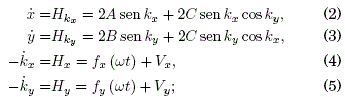
<body><![CDATA[<p>&nbsp;</p> </font>     <p><font size="3" face="Verdana, Arial, Helvetica, sans-serif"><strong>2.&nbsp;Derivation of the effective Hamiltonian for the square lattice</strong></font></p>     <p align="justify"><font face="Verdana, Arial, Helvetica, sans-serif"><font size="2">Consider the extended tight-binding Hamiltonian function with nearest-neighbor and next-to-nearest neighbor interactions for an independent test particle with charge <i>q</i><sub><i>e</i></sub> (i.e., we do not consider any possible interaction with like particles whatsoever neither the particle affects the distribution of the external electric fields acting upon it) which hops in a square lattice with cells of side <i>a</i> under the action of external electric fields,</font></font></p>     <p align="center"><img src="/img/revistas/rbf/v38n38/a04_figura06.gif" width="360" height="47"></p>     <p align="justify"><font size="2" face="Verdana, Arial, Helvetica, sans-serif">The tight-binding band in the Hamiltonian (1) has the standard form <img src="/img/revistas/rbf/v38n38/a04_figura07.gif" width="184" height="18" align="absmiddle"> where <b>k</b>=(<i>k</i><sub><i>x</i></sub>,<i>k</i><sub><i>y</i></sub>) and  <b>R</b><sub><i>m</i>,<i>n</i></sub>=<i>a</i>(<i>m</i>,<i>n</i>); the hopping elements are <i>A</i> = &gamma;<sub>0,&#177;1</sub>= &gamma;<sub>&#177;1,0</sub> for the nearest neighbors and <i>C</i> = <i><img src="/img/revistas/rbf/v38n38/a04_figura09.gif" width="109" height="18" align="absmiddle"></i> for the next-to-nearest neighbors. In the following derivation, and in order to deal with a more compact notation, we take unitary numerical values for the lattice constant <i>a</i> and for the physical constants <i>q</i><sub><i>e</i></sub>, &#295;. <i>V</i>(<b>r)</b> is an external arbitrary static potencial energy at <b>r</b>=(<i>x</i>,<i>y</i>) and <b>f</b>(&omega;<i>t</i>)=(<i>f</i><sub><i>x</i></sub>,<i>f</i><sub><i>y</i></sub>) is the rapidly oscillating external driving field with frequency &omega; &gt;&gt; 1/<i>T</i>, where <i>T</i> is the particle's characteristic period of oscillation in the absence of the driving field. Without loss of generality and for the sake of simplicity, we will suppose that the external electric field <b>f</b>(&omega;<i>t</i>) is an even function of <i>t</i>.</font></p>     <p align="justify"><font size="2" face="Verdana, Arial, Helvetica, sans-serif">Although the quantum Hamiltonian corresponding to  with <i>V</i>(<b>r</b>)=0 has the spatial divergent potential <b>r</b> &#183;<b>f</b>(&omega;<i>t</i>), the problem of finding its eigenfunctions has been already widely treated in terms of the vector potential representation <a href="#Houston" name="CITEHouston">Houston, [1940</a>,<a href="#Krieger" name="CITEKrieger">Krieger, [1986</a>,<a href="#Kittel" name="CITEKittel">Kittel, [1987</a>,<a href="#Rossi" name="CITERossi">Rossi, [1997</a>] whereby the electric field is <b>f</b>(&omega;<i>t</i>)= &#8706;<b>g</b>/&#8706;<i>t</i>, such that the momentum operator is shifted as <b>p</b> &rarr; <b>p</b>+ <b>g</b> within the kinetic energy operator. As a consequence, the "acceleration theorem" &#8706;<b>k</b>/&#8706;<i>t</i>=<b>f</b>(&omega;<i>t</i>) is derived strictly quantum-mechanically in agreement with the semiclassical approach considered in our work.<a href="#tthFtNtAAD" name="tthFrefAAD"><sup>3</sup></a> For the case of <i>V</i>(<b>r</b>)  &ne; 0 in , the gauge substitution <b>g </b>&rarr; <b>g</b>+ &#8711;<i>V</i>(<b>r</b>)<i>t</i> is made and the resulting acceleration theorem becomes &#8706;<b>k</b>/&#8706;<i>t</i>=<b>f</b>(&omega;<i>t</i>)-&#8711;<i>V</i>(<b>r</b>).    </font></p>     <p align="justify"><font size="2" face="Verdana, Arial, Helvetica, sans-serif">We use now the Hamilton's equations which yield the time derivatives of the position and the momentum:</font></p>     <p align="center"><img src="/img/revistas/rbf/v38n38/a04_figura10.gif" width="345" height="97"></p>     <p align="justify"><font size="2" face="Verdana, Arial, Helvetica, sans-serif">we set the notation <i>V</i><sub><i>x</i></sub>, <i>V</i><sub><i>y</i></sub>, <i>V</i><sub><i>xx</i></sub>, <i>V</i><sub><i>yy</i></sub>, <i>V</i><sub><i>xy</i></sub>=<i>V</i><sub><i>yx</i></sub> and <i>H</i><sub><i>k</i><sub><i>x</i></sub></sub>, <i>H</i><sub><i>k</i><sub><i>y</i></sub></sub>, <i>H</i><sub><i>x</i></sub>, <i>H</i><sub><i>y</i></sub> for the derivatives of <i>V</i>(<b>r</b>) and <i>H</i>(<b>r</b>,<b>k</b>;<i>t</i>) respectively; this notation will apply only to the Hamiltonian and potential energy functions hereafter. It will be convenient also to use the generic symbol <i>z</i> for either of the coordinates <i>x</i>,<i>y</i> where a simplified expression could be written. Let us now apply the canonical transformations between the momenta: (<i>z</i>,<i>k</i><sub><i>z</i></sub>)&rarr;(<i>z</i>,<i>k</i>&rsquo;<sub><i>z</i></sub>) given by <i>k</i>&rsquo;<sub><i>z</i></sub> &equiv; <i>k</i><sub><i>z</i></sub>+<i>g</i><sub><i>z</i></sub>, whereby the "displaced momentum" <i>k</i>&rsquo;<sub><i>z</i></sub> is defined along with the time integral of the external field, <i><img src="/img/revistas/rbf/v38n38/a04_figura11.gif" width="123" height="24" align="absmiddle"> </i>; this is the realization of the vector potential representation that yielded <b>k</b> &rarr; <b>k</b>+ <b>g</b> as  projected onto the square lattice and which was already referred to. The substitution of these transformations in  (2)-(5) yields:</font></p>     <p align="center"><font size="2" face="Verdana, Arial, Helvetica, sans-serif"><img src="/img/revistas/rbf/v38n38/a04_figura12.gif" width="395" height="139"></font></p>     ]]></body>


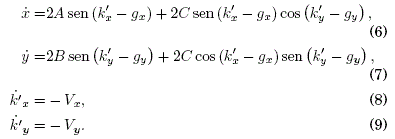
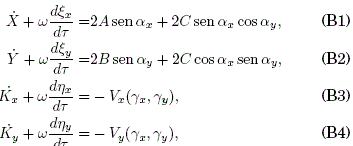
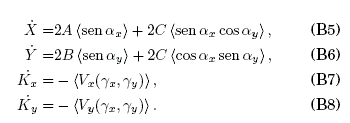
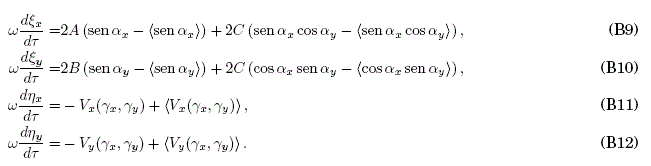
<body><![CDATA[<p align="justify"><font size="2" face="Verdana, Arial, Helvetica, sans-serif">Due to the action of the combined static and oscillating fields, -&#8711;<i>V</i>(<i>x</i>,<i>y</i>) and <b>f</b>(&omega;<i>t</i>), the particle will move with small oscillations around a slow varying trajectory. Thus, we introduce the "slow" <i>Z</i>(<i>t</i>), <i>K</i><sub><i>z</i></sub>(<i>t</i>) coordinates and the "fast" &xi;<sub><i>z</i></sub>(&tau;), &eta;<sub><i>z</i></sub>(&tau;) coordinates in the direct and reciprocal spaces respectively; the fast coordinates are considered perturbations of the slow coordinates: </font></p>     <p align="center"><img src="/img/revistas/rbf/v38n38/a04_figura13.gif" width="360" height="29"></p>     <p align="justify"><font size="2" face="Verdana, Arial, Helvetica, sans-serif">where &tau; &equiv; &omega;<i>t</i> is such that the time-average of &xi;<sub><i>z</i></sub>(&tau;), &eta;<sub><i>z</i></sub>(&tau;), vanish in the time interval with period <i>T</i>=2&pi;/&omega; while <i>Z</i>(<i>t</i>), <i>K</i><sub><i>z</i></sub>(<i>t</i>), remain almost constant in the same interval, i.e.,  <font size="4">&lang;</font> &xi;<sub><i>z</i></sub> <font size="4">&rang;</font> = <font size="4">&lang;</font> &eta;<sub><i>z</i></sub> <font size="4">&rang;</font> =0, and  <font size="4">&lang;</font> <i>Z</i> <font size="4">&rang;</font> =<i>Z</i>(<i>t</i>),  <font size="4">&lang;</font> <i>K</i><sub><i>z</i></sub> <font size="4">&rang;</font> =<i>K</i><sub><i>z</i></sub>(<i>t</i>). We have used the definition of the time-average as <img src="/img/revistas/rbf/v38n38/a04_figura14.gif" width="133" height="25" align="absmiddle"></font></p>     <p align="justify"><font size="2" face="Verdana, Arial, Helvetica, sans-serif">The set of transformations    </font></p>     <p align="center"><img src="/img/revistas/rbf/v38n38/a04_figura15.gif" width="375" height="27"></p>     <p align="justify"><font size="2" face="Verdana, Arial, Helvetica, sans-serif">is canonical since the structure of Hamilton's equations is preserved <a href="#Landau" name="CITELandau">Landau, [1985</a>]:</font></p>     <p align="center"><img src="/img/revistas/rbf/v38n38/a04_figura16.gif" width="391" height="55"></p>     <p align="justify"><font size="2" face="Verdana, Arial, Helvetica, sans-serif">this is so as a consequence of the invariance of the Poisson brackets: [<i>k</i><sub><i>z</i></sub>,<i>z</i>]=[<i>k</i>&rsquo;<sub><i>z</i></sub>,<i>z</i>]=[<i>K</i><sub><i>z</i></sub>,<i>Z</i>]=1 which yields <i>H</i>(<i>x</i>,<i>y</i>,<i>k</i>&rsquo;<sub><i>x</i></sub>,<i>k</i>&rsquo;<sub><i>y</i></sub>;<i>t</i>)=<i>H</i>(<i>x</i>,<i>y</i>,<i>k</i><sub><i>x</i></sub>,<i>k</i><sub><i>y</i></sub>;<i>t</i>)+&#8706;<i>F</i>(<i>x</i>,<i>y</i>,<i>k</i>&rsquo;<sub><i>x</i></sub>,<i>k</i>&rsquo;<sub><i>y</i></sub>;<i>t</i>)/&#8706;<i>t</i> for some generating function <i>F</i>(<i>x</i>,<i>y</i>,<i>k</i>&rsquo;<sub><i>x</i></sub>,<i>k</i>&rsquo;<sub><i>y</i></sub>;<i>t</i>) that can be readily calculated, and the time-averaging which gets us from <i>H</i>(<i>x</i>,<i>y</i>,<i>k</i>&rsquo;<sub><i>x</i></sub>,<i>k</i>&rsquo;<sub><i>y</i></sub>;<i>t</i>) to <i>H</i>(<i>X</i>,<i>Y</i>,<i>K</i><sub><i>x</i></sub>,<i>K</i><sub><i>y</i></sub>). The resulting shift of the time dependence from the <b>r</b> &#183;<b>f</b>(&tau;) term in <i>H</i>(<i>x</i>,<i>y</i>,<i>k</i><sub><i>x</i></sub>,<i>k</i><sub><i>y</i></sub>;<i>t</i>) into the arguments of the kinetic energy operators in <i>H</i>(<i>x</i>,<i>y</i>,<i>k</i>&rsquo;<sub><i>x</i></sub>,<i>k</i>&rsquo;<sub><i>y</i></sub>;<i>t</i>) is not only a convenient transformation (in order to get time-averages efficiently) but it is also a necessary one to render <b>k</b>=(<i>k</i><sub><i>x</i></sub>,<i>k</i><sub><i>y</i></sub>) as a "good quantum number" <a href="#Kittel" name="CITEKittel">Kittel, [1987</a>]. Now, <i>H</i>(<i>X</i>,<i>Y</i>,<i>K</i><sub><i>x</i></sub>,<i>K</i><sub><i>y</i></sub>) &equiv; <i>H</i><sup><i>eff</i></sup> is the form of the effective Hamiltonian that, as a result of the Hamilton's equations, represents a constant of motion and whose explicit construction will be possible giving the resulting Eq.(<a href="#eqrb:154">7</a>) at the end of this section. In this work we will restrict the potential energy to the quadratic form of the position coordinates <i>V</i>(<i>x</i>,<i>y</i>)=<i>c</i><sub>1</sub> <i>x</i><sup>2</sup>+<i>c</i><sub>2</sub> <i>y</i><sup>2</sup>+<i>c</i><sub>3</sub> <i>xy</i> since it is this kind of function that yields the correct physical interpretation for <i>H</i><sup><i>eff</i></sup> as a tight-binding Hamiltonian (the physical realization of such <i>V</i>(<i>x</i>,<i>y</i>) onto the square lattice plane would be achieved -in principle- by placing the plane inside a dielectric cylinder shell with an specific surface charge distribution); otherwise, if <i>V</i>(<i>x</i>,<i>y</i>) had the form of a higher degree polynomial function, <i>H</i><sup><i>eff</i></sup> could still be a valid Hamiltonian but not with the form of a tight-binding one <a href="#Mamani7" name="CITEMamani7">Mamani, [2017</a>].    </font></p>     <p align="justify"><font size="2" face="Verdana, Arial, Helvetica, sans-serif">By replacing the time-derivatives of the terms in (12) into the system (6)-(9) we obtain the system (B1)-(B4) in Appendix B wherein we applied the time-average techniques that yield the system for the effective dynamical coordinates: </font></p>     <p align="center"><img src="/img/revistas/rbf/v38n38/a04_figura17.gif" width="398" height="327"></p>     ]]></body>

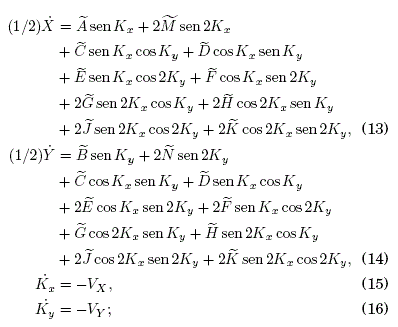
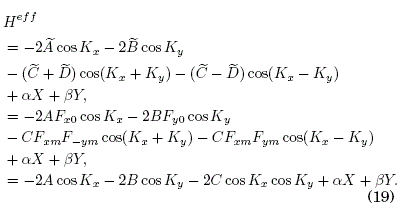
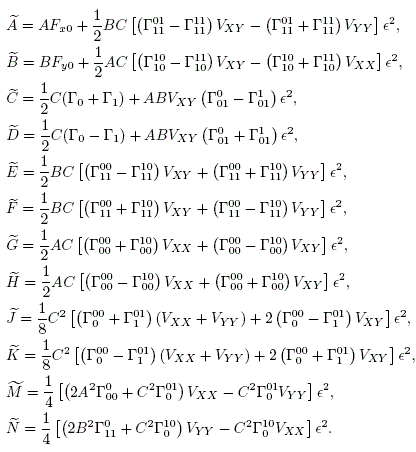
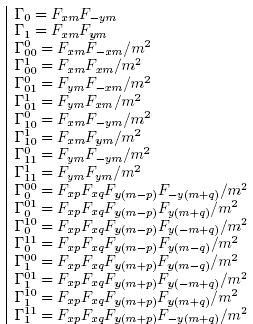
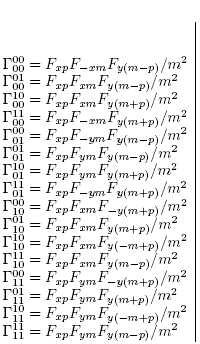
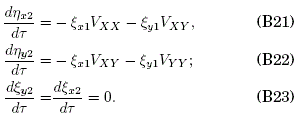
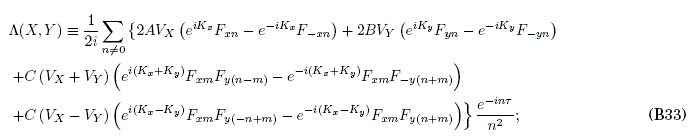
<body><![CDATA[<p align="justify"><font size="2" face="Verdana, Arial, Helvetica, sans-serif">the list of the "tilde" symbols used in (13) and (14) is defined in the Appendix A.    We now set up about constructing the effective Hamiltonian <i>H</i><sup><i>eff</i></sup> &equiv; <i>H</i>(<i>X</i>,<i>Y</i>,<i>K</i><sub><i>x</i></sub>,<i>K</i><sub><i>y</i></sub>) from the system -. The Hamilton equations in the space of the effective coordinates <i>Z</i>,&nbsp;&nbsp;<i>K</i><sub><i>z</i></sub> must be satisfied:</font></p>     <p align="center"><img src="/img/revistas/rbf/v38n38/a04_figura18.gif" width="288" height="40"></p>     <p align="justify"><font size="2" face="Verdana, Arial, Helvetica, sans-serif">the expression for <img src="/img/revistas/rbf/v38n38/a04_figura19.gif" width="12" height="16" align="absmiddle"><i> </i>in (17) is substituted from (13), (14) and combined together with (15), (16) to give  </font></p>     <p align="center"><img src="/img/revistas/rbf/v38n38/a04_figura20.gif" width="385" height="182"></p>     <p align="justify"><font size="2" face="Verdana, Arial, Helvetica, sans-serif">where &Omega; is a constant term independent of the dynamical coordinates <i>Z</i>,&nbsp;&nbsp;<i>K</i><sub><i>z</i></sub>. It is now clear that the "tilde" symbols referred to in (13) and (14) constitute the effective hopping elements characteristic of the effective tight-binding Hamiltonian <i>H</i><sup><i>eff</i></sup> in (18).    </font></p>     <p align="justify"><font size="2" face="Verdana, Arial, Helvetica, sans-serif">As a first crosscheck calculation of (18) we can test it for the case of the null electric field <b>f</b>=0 and a linear static potential <i>V</i>(<i>X</i>,<i>Y</i>)=&alpha;<i>X</i>+&beta;<i>Y</i> (dropping the constant term &Omega;):</font></p>     <p align="center"><img src="/img/revistas/rbf/v38n38/a04_figura21.gif" width="402" height="211"></p>     <p align="justify"><font size="2" face="Verdana, Arial, Helvetica, sans-serif">By using Hamilton's equations <img src="/img/revistas/rbf/v38n38/a04_figura22.gif" width="170" height="23" align="absmiddle"> in (17) for <i>Z</i>=<i>X</i>,<i>Y</i>, we obtain</font></p>     <p align="center"><img src="/img/revistas/rbf/v38n38/a04_figura23.gif" width="321" height="54"></p>     <p align="justify"><font size="2" face="Verdana, Arial, Helvetica, sans-serif">which describe, as expected, a 2D Bloch oscillation with period <i>T</i>=2<i>p</i>&pi;/&alpha;&nbsp;&nbsp;(<i>p</i>=<i>min</i>(<i>n</i>,<i>m</i>)) for the rational quotient &alpha;/&beta; = <i>n</i>/<i>m</i>.</font></p>     ]]></body>
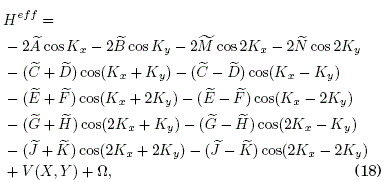
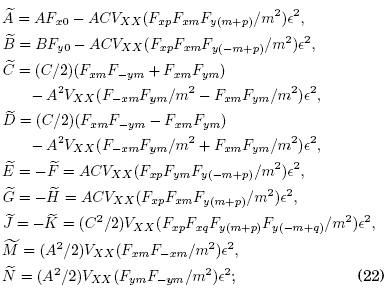
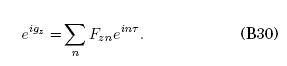
<body><![CDATA[<p align="justify">&nbsp;</p>     <p><font size="3" face="Verdana, Arial, Helvetica, sans-serif"><strong>3. &nbsp;Interactions engineering and relation to an LC circuit</strong></font></p>     <p align="justify"><font size="2" face="Verdana, Arial, Helvetica, sans-serif">With the explicit form of the effective Hamiltonian <i>H</i><sup><i>eff</i></sup> in (18) in terms of the Fourier components <i>f</i><sub><i>zn</i></sub> of the electric field <i>via</i> (B31), we may ask now which components will yield specific values of the effective hopping elements in <i>H</i><sup><i>eff</i></sup> that determine thus the transport properties of the particle in a square lattice when acted upon by the external fields. This is the "interactions engineering" scheme considered in this paper, particularly, as an extension of the one-dimensional case investigated by Mamani <i>et al.</i> <a href="#Mamani7" name="CITEMamani7">Mamani, [2017</a>]. For the purpose of illustrating such interactions engineering, we choose as a case study the emulation of an LC circuit with discrete charge that has an effective Hamiltonian of the form (as we will see later in this section)    </font></p>     <p align="center"><img src="/img/revistas/rbf/v38n38/a04_figura24.gif" width="386" height="43"></p>     <p align="justify"><font size="2" face="Verdana, Arial, Helvetica, sans-serif">where the static potential is the quadratic form <i>V</i>(<i>X</i>,<i>Y</i>)  &infin; <i>X</i><sup>2</sup>+<i>Y</i><sup>2</sup>+(<i>X</i>-<i>Y</i>)<sup>2</sup> such that its second derivatives are <i>V</i><sub><i>XX</i></sub>=<i>V</i><sub><i>YY</i></sub>=-2 <i>V</i><sub><i>XY</i></sub>. In this case, and for the square lattice with <i>A</i>=<i>B</i>, the effective hopping elements become (Appendix A):</font></p>     <p align="center"><img src="/img/revistas/rbf/v38n38/a04_figura25.gif" width="388" height="291"></p>     <p align="justify">  <font size="2" face="Verdana, Arial, Helvetica, sans-serif">sums are performed on the terms with the repeated indices <i>m</i>,&nbsp;&nbsp;<i>p</i>,&nbsp;&nbsp;<i>q</i> and the variable <i>m</i>. Since our perturbative calculations were performed consistently up to second order in &isin; &equiv; &nbsp;1/&omega;, the effective hopping elements in (22) can be expressed as combinations of the zeroth (dominant) and 2nd order terms: <img src="/img/revistas/rbf/v38n38/a04_figura26.gif" width="110" height="21" align="absmiddle"><img src="/img/revistas/rbf/v38n38/a04_figura27.gif" width="392" height="21" align="absmiddle"><img src="/img/revistas/rbf/v38n38/a04_figura28.gif" width="343" height="20" align="absmiddle">.</font></p>     <p align="justify"><font size="2" face="Verdana, Arial, Helvetica, sans-serif">Now, the <i>F</i><sub><i>zm</i></sub> terms in (22) depend on the specific oscillating electric field <b>f</b>=(<i>f</i><sub><i>x</i></sub>,<i>f</i><sub><i>y</i></sub>) through its Fourier components. For the purpose sought in this work, we find that those components should be  </font></p>     <p align="center"><font size="2" face="Verdana, Arial, Helvetica, sans-serif"><img src="/img/revistas/rbf/v38n38/a04_figura29.gif" width="327" height="44"></font></p>     <p><font size="2" face="Verdana, Arial, Helvetica, sans-serif">Then, the expression for <i>F</i><sub><i>zm</i></sub> in (B31) readily becomes    </font></p>     ]]></body>



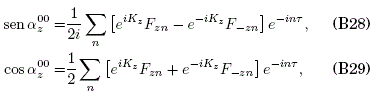
<body><![CDATA[<p align="center"><img src="/img/revistas/rbf/v38n38/a04_figura30.gif" width="308" height="50"></p>     <p align="justify"><font size="2" face="Verdana, Arial, Helvetica, sans-serif">notice the property <i>F</i><sub>(-<i>z</i>)<i>m</i></sub>=<i> F</i><sub><i>z</i>(-<i>m</i>)</sub>  &equiv; <i>F</i><sub>-<i>zm</i></sub>. In order to solve the infinite sum in (24) and verify its convergence, we use the integral representation for <i>J</i><sub><i>n</i></sub>(<i>z</i>):  </font></p>     <p align="center"><img src="/img/revistas/rbf/v38n38/a04_figura31.gif" width="314" height="49"></p>     <p align="justify"><font size="2" face="Verdana, Arial, Helvetica, sans-serif">Replacing this <i>J</i><sub><i>n</i></sub>(<i>z</i>) in <i>F</i><sub><i>zm</i></sub> and using <img src="/img/revistas/rbf/v38n38/a04_figura32.gif" width="323" height="25" align="absmiddle"> we obtain</font></p>     <p align="center"><img src="/img/revistas/rbf/v38n38/a04_figura33.gif" width="380" height="49"></p>     <p align="justify"><font size="2" face="Verdana, Arial, Helvetica, sans-serif">Now, we set <i>f</i><sub><i>x</i>2</sub>= <i>f</i><sub><i>y</i>1</sub>= 0 in (23) as the condition to find the required form of <i>H</i><sub><i>LC</i></sub> (<img src="/img/revistas/rbf/v38n38/a04_figura34.gif" width="60" height="20" align="absmiddle">  in this case) with the parameters <i>f</i><sub><i>x</i>1</sub>,&nbsp;&nbsp;<i>f</i><sub><i>y</i>2</sub> such that:  </font></p>     <p align="center"><img src="/img/revistas/rbf/v38n38/a04_figura36.gif" width="381" height="71"></p>     <p align="justify"><font size="2" face="Verdana, Arial, Helvetica, sans-serif">then, we chose from the set of solutions {<i>f</i><sub><i>x</i>1</sub>,<i>f</i><sub><i>y</i>2</sub>} of  those which satisfy the condition that <img src="/img/revistas/rbf/v38n38/a04_figura37.gif" width="129" height="20" align="absmiddle"> should be negligible as compared to <img src="/img/revistas/rbf/v38n38/a04_figura38.gif" width="21" height="18" align="texttop"><i> </i>and <img src="/img/revistas/rbf/v38n38/a04_figura39.gif" width="15" height="17" align="texttop">. One way of doing this is to calculate the euclidian norm  </font></p>     <p align="center"><img src="/img/revistas/rbf/v38n38/a04_figura40.gif" width="384" height="52"></p>     <p><font size="2" face="Verdana, Arial, Helvetica, sans-serif">such that <img src="/img/revistas/rbf/v38n38/a04_figura41.gif" width="85" height="22" align="absmiddle"> attains a minimum value for negative values of <img src="/img/revistas/rbf/v38n38/a04_figura42.gif" width="65" height="20" align="top"> Thus, with this condition and those of (27) fulfilled, the effective Hamiltonian in (18) becomes  </font></p>     ]]></body>


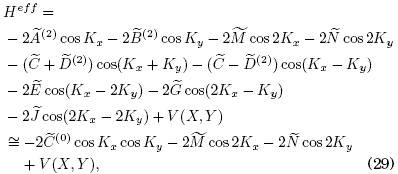
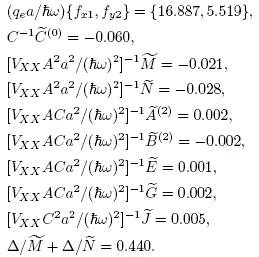
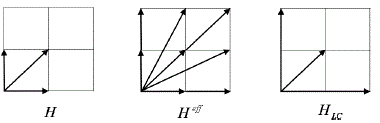
<body><![CDATA[<p align="center"><img src="/img/revistas/rbf/v38n38/a04_figura43.gif" width="398" height="174"></p>     <p align="justify"><font size="2" face="Verdana, Arial, Helvetica, sans-serif">thus attaining the required approximation <img src="/img/revistas/rbf/v38n38/a04_figura44.gif" width="88" height="17" align="absmiddle">. <a href="#f1">Fig. 1</a> shows an schematic representation of the interactions in the square lattice (from left to right): the time-dependent Hamiltonian <i>H</i> in (1) is transformed into the effective Hamiltonian in <i>H</i><sup><i>eff</i></sup> (18) (with all the reparametrized and induced interactions) by the action of the external oscillating and static fields and, finaly, by choosing specific values of the those fields ("interactions engineering"), the Hamiltonian <i>H</i><sub><i>LC</i></sub> in (29) is obtained.</font></p>     <p align="center"><a name="f1"></a><img src="/img/revistas/rbf/v38n38/a04_figura35.gif" width="380" height="123"></p>     <p align="center"><font size="2" face="Verdana, Arial, Helvetica, sans-serif">Figure 1: Representations of the interactions in the square lattice (from left to right): the time-dependent     <br> Hamiltonian <i>H</i> in , the effective Hamiltonian <i>H</i><sup><i>eff</i></sup> in , the Hamiltonian <i>H</i><sub><i>LC</i></sub> in  obtained by choosing specific     <br> values of the external fields (interactions engineering).</font></p>     <p align="justify"><font size="2" face="Verdana, Arial, Helvetica, sans-serif">The numerical results found from (27) and (28) within the interval 0 &lt; <i>f</i><sub><i>x</i>1</sub>,<i>f</i><sub><i>y</i>2</sub> &lt; 100 (with physical units restored) are</font></p>     <p align="center"><img src="/img/revistas/rbf/v38n38/a04_figura46.gif" width="259" height="257"></p>     <p align="justify"><font size="2" face="Verdana, Arial, Helvetica, sans-serif">We expect that <i>V</i><sub><i>XX</i></sub> <i>A</i><sup>2</sup><i>a</i><sup>2</sup>/(&#295; &omega;)<sup>2</sup> has an upper bound in order to have consistent results, i.e., <img src="/img/revistas/rbf/v38n38/a04_figura48.gif" width="29" height="18" align="absmiddle"> dominant with respect to <img src="/img/revistas/rbf/v38n38/a04_figura38.gif" width="21" height="18" align="absmiddle">and <img src="/img/revistas/rbf/v38n38/a04_figura39.gif" width="15" height="17" align="texttop">. This is of course the case when <img src="/img/revistas/rbf/v38n38/a04_figura47.gif" width="57" height="11" align="absmiddle"> but, as we will see at the end of this section, &omega; must also have an upper bound if an analogy between the square lattice and the LC circuit is to be achieved. We think that values of the physical parameters can be found that meet reasonably such a requirement.</font></p>     <p align="center"><a name="f2"></a><img src="/img/revistas/rbf/v38n38/a04_figura45.gif" width="330" height="233"></p>     ]]></body>
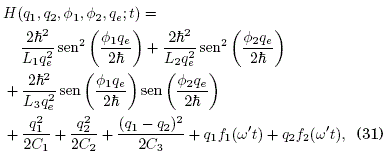
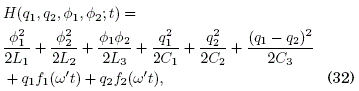
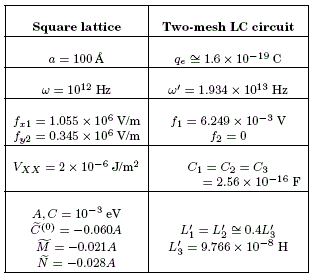
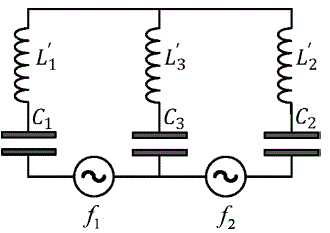
<body><![CDATA[<p align="center"><font size="2" face="Verdana, Arial, Helvetica, sans-serif">Figure 2: Two-mesh LC circuit.</font></p>     <p align="justify"><font size="2" face="Verdana, Arial, Helvetica, sans-serif">We now set up about describing the LC circuit depicted in <a href="#f2">Fig. 2</a>. Following the construction of the quantum Hamiltonian operator for a two-ring system <a href="#Flores2" name="CITEFlores2">Flores, [2002</a>], we can construct the Hamiltonian function of a two-mesh LC circuit with discrete charge <i>q</i><sub><i>e</i></sub> as</font></p>     <p align="center"><img src="/img/revistas/rbf/v38n38/a04_figura49.gif" width="390" height="153"></p>     <p align="justify"><font size="2" face="Verdana, Arial, Helvetica, sans-serif">which follows from the replacement of the magnetic flux as <img src="/img/revistas/rbf/v38n38/a04_figura50.gif" width="180" height="20" align="absmiddle"> in the corresponding continuous-charge Hamiltonian function</font></p>     <p align="center"><img src="/img/revistas/rbf/v38n38/a04_figura52.gif" width="359" height="91"></p>     <p align="justify"><font size="2" face="Verdana, Arial, Helvetica, sans-serif">where we have defined: 1/<i>L</i><sub>1</sub> &equiv; (<i>L</i><sub>2</sub>&rsquo;+<i>L</i><sub>3</sub>&rsquo;)/&#933;, 1/<i>L</i><sub>2</sub> &equiv; (<i>L</i><sub>1</sub>&rsquo;+<i>L</i><sub>3</sub>&rsquo;)/&#933; and 1/<i>L</i><sub>3</sub> &equiv; 2 <i>L</i><sub>3</sub>&rsquo;/&#933;, with &#933; &equiv; (1/2)&#8721;<sub><i>i</i>  &ne; <i>j</i></sub> <i>L</i><sub><i>i</i></sub>&rsquo;<i>L</i><sub><i>j</i></sub>&rsquo;; as can be readily checked the flux &phi;<sub><i>i</i></sub> remains invariant in the limit <i>q</i><sub><i>e</i></sub> &rarr; 0 yielding, as required, <i>H</i>(<i>q</i><sub>1</sub>,<i>q</i><sub>2</sub>,&phi;<sub>1</sub>,&phi;<sub>2</sub>,<i>q</i><sub><i>e</i></sub>;<i>t</i>) &rarr;  <i>H</i>(<i>q</i><sub>1</sub>,<i>q</i><sub>2</sub>,&phi;<sub>1</sub>,&phi;<sub>2</sub>;<i>t</i>). In this case, the term &phi;<sub>1</sub> &phi;<sub>2</sub>/(2 <i>L</i><sub>3</sub>) in (32) is derived from the energy term (1/2)<i>L</i>&rsquo;<sub>3</sub>(&#183;<i>q</i><sub>1</sub>-&#183;<i>q</i><sub>2</sub>)<sup>2</sup> according to the Kirchhoff's laws. The mutual inductance terms corresponding to this circuit are &phi;<sub>1</sub> &phi;<sub>2</sub>/<i>M</i><sub>12</sub>, &phi;<sub>1</sub> &phi;<sub>3</sub>/<i>M</i><sub>13</sub> and &phi;<sub>2</sub> &phi;<sub>3</sub>/<i>M</i><sub>23</sub> but we have not considered them in (32) since we did not specify the form of the couplings among <i>L</i>&rsquo;<sub>1</sub>, <i>L</i>&rsquo;<sub>2</sub> and <i>L</i>&rsquo;<sub>3</sub>. In fact, the "mesoscopic" character of this circuit lies upon the discrete nature and small quantity (about 10) of the elementary electric charges being allocated in the capacitors and not necessarily upon the small size of the circuit which would imply couplings among the inductors.<a href="#tthFtNtAAE" name="tthFrefAAE"><sup>4</sup></a></font></p>     <p align="center"><img src="/img/revistas/rbf/v38n38/a04_figura51.gif" width="313" height="276"></p>     <p align="center"><font size="2" face="Verdana, Arial, Helvetica, sans-serif">Table 1: Numerical values of the physical parameters. The values of <i>a</i>, &omega;, <i>A</i>, <i>C</i> were chosen so as to     <br> resemble typical values in a GaAs-type semiconductor superlattice; <i>f</i><sub>2</sub>=0 was suggested so as to     <br> facilitate the calculations. The other values result from comparing the terms and arguments of the     ]]></body>

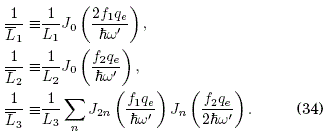
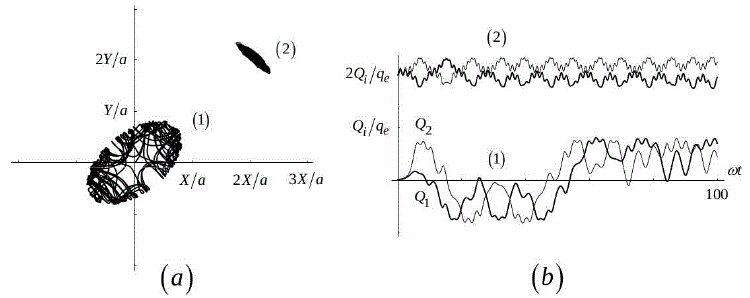
<body><![CDATA[<br> effective Hamiltonians  and , and from the corresponding algebraic and numerical manipulations.</font></p>     <p align="justify"><font size="2" face="Verdana, Arial, Helvetica, sans-serif">Following the standard quantum time-average techniques <a href="#Rahav" name="CITERahav">Rahav, [2003</a>,<a href="#CalcinaN" name="CITECalcinaN">Calcina-Nogales, [2020</a>] and setting the canonical transformations &phi;<sub>1</sub>=&#934;<sub>1</sub>+&pi;&#295;/<i>q</i><sub><i>e</i></sub> and &phi;<sub>2</sub>=&#934;<sub>2</sub>+&pi;&#295;/<i>q</i><sub><i>e</i></sub>, we obtain from (32) the effective Hamiltonian function<a href="#tthFtNtAAF" name="tthFrefAAF"><sup>5</sup></a></font></p>     <p align="center"><img src="/img/revistas/rbf/v38n38/a04_figura53.gif" width="327" height="154"></p>     <p><font size="2" face="Verdana, Arial, Helvetica, sans-serif">where, for the case of the AC source voltages <i>f</i><sub>1</sub>(&omega;&rsquo;<i>t</i>)=2 <i>f</i><sub>1</sub> cos(&omega;&rsquo;<i>t</i>) and <i>f</i><sub>2</sub>(&omega;&rsquo;<i>t</i>)=2 <i>f</i><sub>2</sub> cos(2 &omega;&rsquo;<i>t</i>), we obtain</font></p>     <p align="center"><img src="/img/revistas/rbf/v38n38/a04_figura54.gif" width="329" height="136"></p>     <p align="justify"><font size="2" face="Verdana, Arial, Helvetica, sans-serif">By comparing the terms and arguments of <i>H</i>(<i>Q</i><sub>1</sub>,<i>Q</i><sub>2</sub>,&#934;<sub>1</sub>,&#934;<sub>2</sub>) in  with those of <i>H</i><sub><i>LC</i></sub>(<i>X</i>,<i>Y</i>,<i>K</i><sub><i>x</i></sub>,<i>K</i><sub><i>y</i></sub>) in  we can verify, as expected, that the required form of <i>H</i><sub><i>LC</i></sub> is attained for static potential energies <i>V</i>(<i>Q</i><sub>1</sub>,<i>Q</i><sub>2</sub>) and <i>V</i>(<i>X</i>,<i>Y</i>) whose second derivatives are related as <i>V</i><sub><i>Q</i><sub>1</sub> <i>Q</i><sub>1</sub></sub>/<i>V</i><sub><i>XX</i></sub>=<i>V</i><sub><i>Q</i><sub>2</sub> <i>Q</i><sub>2</sub></sub>/<i>V</i><sub><i>YY</i></sub>=<i>V</i><sub><i>Q</i><sub>1</sub> <i>Q</i><sub>2</sub></sub>/<i>V</i><sub><i>XY</i></sub>=(<i>a</i>/<i>q</i><sub><i>e</i></sub>)<sup>2</sup> . Specifically, by choosing equal capacitances in , we should have that <i>V</i><sub><i>XX</i></sub>=2(<i>q</i><sub><i>e</i></sub>/<i>a</i>)<sup>2</sup>/<i>C</i><sub>1</sub>.</font></p>     <p align="center"><a name="f3"></a><img src="/img/revistas/rbf/v38n38/a04_figura65.gif" width="750" height="298"></p>     <p align="center"><font size="2" face="Verdana, Arial, Helvetica, sans-serif">Figure 3: Cases of electronic motion in: (a) the effective position XY plane, and (b) the two-mesh LC circuit. In case     <br> (a) the displacements are measured in units of the lattice constant <i>a</i>=100 A; in case (b) the capacitors' electric charges are     <br> measured in units of the electron's charge <i>q</i><sub><i>e</i></sub>, the time is measured in units of the frequency inverse 1/&omega; = 10<sup>-12</sup> s.     ]]></body>
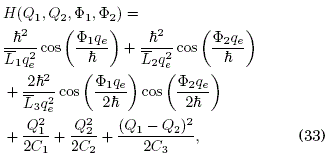
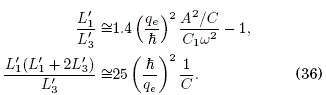
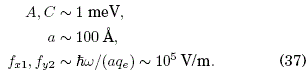
<body><![CDATA[<br> Cases (1) and (2) in both (a) and (b) correspond to oscillations with zero and positive time-averages, respectively. Cases (1)     <br> and (2) in (b) resemble very much the AC and DC regimes, respectively, deduced in the one-mesh LC circuit <a href="#Mamani8" name="CITEMamani8">Mamani, [2018</a>]     <br> as a consequence of a bifurcation condition.</font></p>     <p align="justify"><font size="2" face="Verdana, Arial, Helvetica, sans-serif">From the numerical values of <i>f</i><sub><i>x</i>1</sub>, <i>f</i><sub><i>y</i>2</sub>, <img src="/img/revistas/rbf/v38n38/a04_figura38.gif" width="21" height="18">, <img src="/img/revistas/rbf/v38n38/a04_figura39.gif" width="15" height="17"> and <img src="/img/revistas/rbf/v38n38/a04_figura55.gif" width="64" height="18" align="absmiddle"> found in , we may now express the equivalence among the coefficients of <i>H</i>(<i>Q</i><sub>1</sub>,<i>Q</i><sub>2</sub>,&#934;<sub>1</sub>,&#934;<sub>2</sub>) and <i>H</i><sub><i>LC</i></sub>(<i>X</i>,<i>Y</i>,<i>K</i><sub><i>x</i></sub>,<i>K</i><sub><i>y</i></sub>) in the compact notation that comprises the three equations</font></p>     <p align="center"><img src="/img/revistas/rbf/v38n38/a04_figura56.gif" width="292" height="42"></p>     <p align="justify"><font size="2" face="Verdana, Arial, Helvetica, sans-serif">whence the the source voltage amplitudes <i>f</i><sub>1</sub>, <i>f</i><sub>2</sub> and the inductances can be found. We may take <i>L</i>&rsquo;<sub>1</sub>=<i>L</i>&rsquo;<sub>2</sub> for simplicity, thus, from <img src="/img/revistas/rbf/v38n38/a04_figura57.gif" width="175" height="18" align="absmiddle"> in , we have that <i><img src="/img/revistas/rbf/v38n38/a04_figura58.gif" width="237" height="16" align="absmiddle"></i> which is satisfied for an infinte set of solutions, for example, (<i>q</i><sub><i>e</i></sub>/&#295;&omega;&rsquo;) <i>f</i><sub>1</sub>=0.517 and (<i>q</i><sub><i>e</i></sub>/&#295;&omega;&rsquo;) <i>f</i><sub>2</sub>=0 (although <i>f</i><sub>2</sub>=0 was so chosen just to facilitate the calculations, such a value still deserves a further phyisical interpretation). For these values, and by setting <img src="/img/revistas/rbf/v38n38/a04_figura59.gif" width="142" height="24" align="absmiddle">, <img src="/img/revistas/rbf/v38n38/a04_figura60.gif" width="151" height="22" align="absbottom"> in the Hamiltonians (21), (33), respetively, we find</font></p>     <p align="center"><img src="/img/revistas/rbf/v38n38/a04_figura61.gif" width="326" height="95"></p>     <p align="justify"><font size="2" face="Verdana, Arial, Helvetica, sans-serif">As we can see, the term (<i>q</i><sub><i>e</i></sub>/&#295;)<sup>2</sup> (<i>A</i><sup>2</sup>/<i>C</i>)/(<i>C</i><sub>1</sub> &omega;<sup>2</sup>) has to have a lower bound to yield positive inductances; such a bound will be determined by the characteristics of the square lattice which, in this work, can be thought of as a 2D semiconductor superlattice of the GaAs type (and whose 1D version was where Bloch oscillations were first observed). Thus, we may take as typical values:</font></p>     <p align="center"><img src="/img/revistas/rbf/v38n38/a04_figura62.gif" width="308" height="76"></p>     <p align="justify"><font size="2" face="Verdana, Arial, Helvetica, sans-serif">From the latter we have an estimation of &omega; <img src="/img/revistas/rbf/v38n38/a04_figura87.gif" width="13" height="7"> 10<sup>12</sup> Hz. Since <i>V</i><sub><i>XX</i></sub> (<i>Aa</i>/&#295; &omega;)<sup>2</sup>=(<i>A</i> <i>q</i><sub><i>e</i></sub>/&#295;)<sup>2</sup>/(<i>C</i><sub>1</sub> &omega;<sup>2</sup>) <img src="/img/revistas/rbf/v38n38/a04_figura87.gif" width="13" height="7"> 10<sup>-22</sup> J should hold in (30), we have then the estimation of <i>C</i><sub>1</sub><img src="/img/revistas/rbf/v38n38/a04_figura87.gif" width="13" height="7"> 10<sup>-16</sup> F. With these values, we have therefore from (36) that <i><img src="/img/revistas/rbf/v38n38/a04_figura63.gif" width="181" height="17" align="absmiddle"> </i>H. Finally, an estimation of the sources frequency &omega;&rsquo; can be made by assuming that a maximum of just few electrons is to be alloted in a (small) mesoscopic capacitor, which is other way for interpreting the meaning of "discrete charge" LC circuit. We may take then <i>Q</i><sub>1,<i>max</i></sub>=10 <i>q</i><sub><i>e</i></sub>, which, together with <i><img src="/img/revistas/rbf/v38n38/a04_figura64.gif" width="378" height="16"> </i>V and &omega;&rsquo;&#160;<img src="/img/revistas/rbf/v38n38/a04_figura87.gif" width="13" height="7">&#160;10<sup>13</sup> Hz. More precise values for the results of our numerical simulations and from comparing the terms and arguments of the effective Hamiltonians (33) and (21) are summarized in Table 1 .      </font></p>     ]]></body>


<body><![CDATA[<p align="justify"><font size="2" face="Verdana, Arial, Helvetica, sans-serif">We may now validate the consistency of the semiclassical model invoked in our work: the value of the frequency &omega; = 10<sup>12</sup> Hz corresponds to an external field wavelength &#955;&#160;<img src="/img/revistas/rbf/v38n38/a04_figura87.gif" width="13" height="7">&#160;10<sup>-3</sup> m, while the lattice constant is <i>a</i>=100 A. The quantum wavepacket size can be taken from Mamani <i>et al.</i> <a href="#Mamani7" name="CITEMamani7">Mamani, [2017</a>], where the semiclassical method has proved to be consistent with the formal quantum approach for a wavepacket initial width &Delta;<i>x</i>=10 <i>a</i>. We have therefore that &#955; &gt;&gt; &Delta;<i>x</i> &gt;&gt; <i>a</i>, as required for the validity of the semiclassical method (see, for example <a href="#Ashcroft" name="CITEAshcroft">Ashcroft and Mermin, [1976</a>]), and which in turn implies that the intensity of the external electric field &#124;<b>f</b>&#124; &#160;<img src="/img/revistas/rbf/v38n38/a04_figura87.gif" width="13" height="7">&#160;10<sup>6</sup> V/m is low enough for a single-band tight-binding model Hamiltonian to hold.</font></p>     <p align="justify"><font size="2" face="Verdana, Arial, Helvetica, sans-serif">By solving numerically the system of equations (17) for <i>X</i>(<i>t</i>), <i>Y</i>(<i>t</i>), <i>Q</i><sub>1</sub>(<i>t</i>), <i>Q</i><sub>2</sub>(<i>t</i>), with the values reported in Table 1, we may relate the electronic dynamics in both equivalent systems, the square lattice and the two-mesh LC circuit. Since we have managed the electric fields and the voltage sources in the former and latter systems, respectively, so as to have <i>H</i><sub><i>LC</i></sub>(<i>X</i>,<i>Y</i>,<i>K</i><sub><i>x</i></sub>,<i>K</i><sub><i>y</i></sub>) &cong; <i>H</i><sub><i>LC</i></sub>(<i>Q</i><sub>1</sub>,<i>Q</i><sub>2</sub>,&#934;<sub>1</sub>,&#934;<sub>2</sub>), then their common energies are 0.218 meV, corresponding to the initial values <i>X</i>(0)=<i>Y</i>(0)=0.02 <i>a</i> of the effective position coordinates. We observe in <a href="#f3">Fig. 3(a(1))</a> a predominately diagonal oscillating motion -although not a simple one- of the particle's position about the origin of the effective position XY plane of the square lattice, which corresponds also to a predominately symmetric distribution of oscillating charges in the two-mesh LC circuit, as seen in <a href="#f3">Fig. 3(b(1))</a>, in accordance with the diagram for <i>H</i><sub><i>LC</i></sub> in <a href="#f1">Fig. 1</a>, where the diagonal hopping element is the dominant one. Such a behavior, however, may change abruptly -as a function of the total energy, for example- giving rise to a DC regime or a supression of the mesh currents, as it does in the one-dimensional case of the  one-mesh LC circuit <a href="#Mamani8" name="CITEMamani8">Mamani, [2018</a>], where we have showed that a bifurcation condition on the &#183; <i>Q</i>-<i>Q</i> phase diagram can be associated to such an abrupt change. <a href="#f3">Figs. 3(a(2))</a> and <a href="#f3">3(b(2))</a> show position and charge oscillations with positive time-averages corresponding to an energy of 2.707 meV, contrasting with those of <a href="#f3">Figs. 3(a(1))</a> and <a href="#f3">3(b(1))</a>. The extension of the one-dimensional bifurcation condition to the two-dimensional case of the two-mesh circuit and its relation to the particle's propagation in the square lattice is an interesting issue worth to be treated elsewhere.</font></p>     <p align="justify">&nbsp;</p>     <p><font size="3" face="Verdana, Arial, Helvetica, sans-serif"><strong>4.&nbsp;Conclusions</strong></font></p>     <p align="justify"><font size="2" face="Verdana, Arial, Helvetica, sans-serif">We have established the formal equivalence between two physical systems by means of the interactions engineering scheme developed in this paper. Those systems are: (i) a square lattice wherein an tight-binding electron propagates under the combined action of an external high-frequency and homogeneous electric field and a quadratic static potential, and (ii) a two-mesh LC circuit with discrete charge. Such formal equivalence is attained by describing both systems by effective Hamiltonian functions having the same form and whose parameters can be numerically calculated when the Hamiltonian terms are correspondingly compared among them; for deriving such effective Hamiltonians we have used perturbative expansions up to &omega;<sup>-2</sup> when <img src="/img/revistas/rbf/v38n38/a04_figura47.gif" width="57" height="11" align="absmiddle">. Interestingly, we have found that the sought equivalence between the square lattice and the LC circuit is achieved when we choose specific values of the oscillating electric field acting upon the lattice so that the 1st neighbor interactions (<img src="/img/revistas/rbf/v38n38/a04_figura66.gif" width="131" height="21" align="absmiddle">) are suppressed and the remaining 2nd neighbor interactions (<img src="/img/revistas/rbf/v38n38/a04_figura67.gif" width="94" height="16" align="absmiddle">) and 3rd neighbor interactions (<img src="/img/revistas/rbf/v38n38/a04_figura38.gif" width="21" height="18">,<img src="/img/revistas/rbf/v38n38/a04_figura39.gif" width="15" height="17">, order &omega;<sup>-2</sup>) become comparable (see Table 1).    </font></p>     <p align="justify"><font size="2" face="Verdana, Arial, Helvetica, sans-serif">We now suggest some interesting issues that could be worth exploring further: (a) In a previous work we have investigated the relation between a single-mesh LC circuit (with discrete charge) and a charged particle hopping in a one-dimensional lattice <a href="#Mamani8" name="CITEMamani8">Mamani, [2018</a>]; in the present work we have extended such an analogy to a two-mesh LC circuit and a square lattice. Thus, it seems natural to inquire whether the extension to a three-mesh LC circuit and a cubic lattice would be valid, mainly, because the one-dimensional and the square lattices do not exist as such (to our knowledge), but the three dimensional cubic lattice does exist (although not with the superlattice parameters specified in Table 1). (b) Another natural extension of our work would be considering a rectangular lattice where, for example, the sides have an incommensurate ratio of <img src="/img/revistas/rbf/v38n38/a04_figura68.gif" width="24" height="18" align="absmiddle"> In fact, this latter case would be the best suited for simulating the dynamics of a hopping electron in graphene. (c) Finally, and motivated by the results in <a href="#f3">Fig. 3(a)</a> for the square lattice, we may suggest that the "AC regime" would indicate a quantum regime where the electronic probability densities corresponding to neighbor lattice sites overlap, which indicates in turn a higher electric conductivity, as compared to the "DC regime". Thus, a higher and a lower conducting regimes could be separated by a semiclassical bifurcation condition.</font></p>     <p>&nbsp;</p>     <p align="justify"><font size="3" face="Verdana, Arial, Helvetica, sans-serif"><strong>Footnotes:</strong></font></p>     <p align="justify"><font size="2" face="Verdana, Arial, Helvetica, sans-serif"><a name="tthFtNtAAB"></a><a href="#tthFrefAAB"><sup>1</sup></a>Many of the current theoretical models do not take into account some real physical effects (for simplicity), such as interband transitions, dispersion of the hopping particle by thermal collisions and phononic interactions, loss of crystal periodicity, etc., due which the particle's wavepacket usually decoheres rapidly and the observation -for example- of Bloch oscillations is restricted to a few complete periods (c.f.: <a href="#Lyssenko" name="CITELyssenko">Lyssenko et&nbsp;al., [1997</a>,<a href="#Madison" name="CITEMadison">Madison et&nbsp;al., [1998</a>]). In the absence of such effects, the wavepacket's width may oscillate and eventually be restored to its initial value, as shown, e. g., by Dignam and de Sterke in the exact dynamic localization effect <a href="#Dignam" name="CITEDignam">Dignam, [2002</a>].</font></p>     <p align="justify"><font size="2" face="Verdana, Arial, Helvetica, sans-serif"><a name="tthFtNtAAC"></a><a href="#tthFrefAAC"><sup>2</sup></a>A concise and pedagogical justification of the semiclassical method for a general periodic potential can be found, for example, in Ch. 12 of <a href="#Ashcroft" name="CITEAshcroft">Ashcroft and Mermin, [1976</a>]</font></p>     ]]></body>

<body><![CDATA[<p align="justify"><font size="2" face="Verdana, Arial, Helvetica, sans-serif"> <a name="tthFtNtAAD"></a><a href="#tthFrefAAD"><sup>3</sup></a>In this sense, the semiclassical method provides <i>exact</i> results that coincide with the quantum ones, as we could verify in the above mentioned references and also in Dignam and de Sterke,<a href="#Dignam" name="CITEDignam">Dignam, [2002</a>] wherein a study of <i>exact</i> dynamical localization is carried on (we have work in progress in this direction). </font></p>     <p align="justify"><font size="2" face="Verdana, Arial, Helvetica, sans-serif"><a name="tthFtNtAAE"></a><a href="#tthFrefAAE"><sup>4</sup></a>Interestingly, the phenomenon of current magnification referred to by Flores and Utreras <a href="#Flores2" name="CITEFlores2">Flores, [2002</a>] for two coupled inductances would also occur in the two-mesh circuit with three inductances studied in our work; progress is being carried on by us in that direction. </font></p>     <p align="justify"><font size="2" face="Verdana, Arial, Helvetica, sans-serif"><a name="tthFtNtAAF"></a><a href="#tthFrefAAF"><sup>5</sup></a>The resulting Hamiltonian operator corresponds to the Hamiltonian function obtained with the semiclassical scheme, as was already done in the case of the single-mesh LC circuit <a href="#Mamani8" name="CITEMamani8">Mamani, [2018</a>].</font></p>     <p align="justify">&nbsp;</p>     <p><strong><font size="3" face="Verdana, Arial, Helvetica, sans-serif">References</font></strong></p>     <p><font size="2" face="Verdana, Arial, Helvetica, sans-serif"><a href="#CITEAshcroft" name="Ashcroft">[Ashcroft and Mermin 1976]</a></font></p>     <!-- ref --><p><font size="2" face="Verdana, Arial, Helvetica, sans-serif"> &nbsp;&nbsp;&nbsp;&nbsp;Ashcroft N. &amp; Mermin N. D. 1976, <i>Solid State Physics</i> (Saunders College, Philadelphia).    &nbsp;&nbsp;&nbsp;&nbsp;&nbsp;&nbsp;&nbsp;&nbsp;[&#160;<a href="javascript:void(0);" onclick="javascript: window.open('/scielo.php?script=sci_nlinks&ref=249424&pid=S1562-3823202100010000400001&lng=','','width=640,height=500,resizable=yes,scrollbars=1,menubar=yes,');">Links</a>&#160;]<!-- end-ref -->    </font></p>     <p><font size="2" face="Verdana, Arial, Helvetica, sans-serif"><a href="#CITEBandyo" name="Bandyo">[Bandyopadhyay 2008]</a></font></p>     <!-- ref --><p><font size="2" face="Verdana, Arial, Helvetica, sans-serif"> &nbsp;&nbsp;&nbsp;&nbsp;Bandyopadhyay M. &amp; Dattagupta S. 2008, <i>Pramana J. Phys.</i> <b>70</b>, 381.    &nbsp;&nbsp;&nbsp;&nbsp;&nbsp;&nbsp;&nbsp;&nbsp;[&#160;<a href="javascript:void(0);" onclick="javascript: window.open('/scielo.php?script=sci_nlinks&ref=249427&pid=S1562-3823202100010000400002&lng=','','width=640,height=500,resizable=yes,scrollbars=1,menubar=yes,');">Links</a>&#160;]<!-- end-ref -->    </font></p>     <p><font size="2" face="Verdana, Arial, Helvetica, sans-serif"><a href="#CITECalcina" name="Calcina">[Calcina-Nogales 2013]</a></font></p>     <!-- ref --><p><font size="2" face="Verdana, Arial, Helvetica, sans-serif">   &nbsp;&nbsp;&nbsp;&nbsp;Calcina-Nogales M. 2003, <i>Mod. Phys. Lett. B</i> <b>27</b>, 1350138.    &nbsp;&nbsp;&nbsp;&nbsp;&nbsp;&nbsp;&nbsp;&nbsp;[&#160;<a href="javascript:void(0);" onclick="javascript: window.open('/scielo.php?script=sci_nlinks&ref=249430&pid=S1562-3823202100010000400003&lng=','','width=640,height=500,resizable=yes,scrollbars=1,menubar=yes,');">Links</a>&#160;]<!-- end-ref -->    </font></p>     <p><font size="2" face="Verdana, Arial, Helvetica, sans-serif"><a href="#CITECalcinaN" name="CalcinaN">[Calcina-Nogales 2020]</a></font></p>     <!-- ref --><p><font size="2" face="Verdana, Arial, Helvetica, sans-serif"> &nbsp;&nbsp;&nbsp;&nbsp;Calcina-Nogales M., Mamani E. &amp; Sanjin&eacute;s D. 2020, <i>preprint</i>.    &nbsp;&nbsp;&nbsp;&nbsp;&nbsp;&nbsp;&nbsp;&nbsp;[&#160;<a href="javascript:void(0);" onclick="javascript: window.open('/scielo.php?script=sci_nlinks&ref=249433&pid=S1562-3823202100010000400004&lng=','','width=640,height=500,resizable=yes,scrollbars=1,menubar=yes,');">Links</a>&#160;]<!-- end-ref -->    </font></p>     <p><font size="2" face="Verdana, Arial, Helvetica, sans-serif"><a href="#CITEChen6" name="Chen6">[Chen and Li 1996]</a></font></p>     <!-- ref --><p><font size="2" face="Verdana, Arial, Helvetica, sans-serif"> &nbsp;&nbsp;&nbsp;&nbsp;Chen B. &amp; Li Y. Q 1996, <i>Phys. Rev. B</i> <b>53</b>, 4027.    &nbsp;&nbsp;&nbsp;&nbsp;&nbsp;&nbsp;&nbsp;&nbsp;[&#160;<a href="javascript:void(0);" onclick="javascript: window.open('/scielo.php?script=sci_nlinks&ref=249436&pid=S1562-3823202100010000400005&lng=','','width=640,height=500,resizable=yes,scrollbars=1,menubar=yes,');">Links</a>&#160;]<!-- end-ref -->    </font></p>     ]]></body>
<body><![CDATA[<p><font size="2" face="Verdana, Arial, Helvetica, sans-serif"><a href="#CITEChen5" name="Chen5">[Chen 2005]</a></font></p>     <!-- ref --><p><font size="2" face="Verdana, Arial, Helvetica, sans-serif">   &nbsp;&nbsp;&nbsp;&nbsp;Chen B. 2005, <i>Phys. Lett. A</i> <b>335</b>, 103.    &nbsp;&nbsp;&nbsp;&nbsp;&nbsp;&nbsp;&nbsp;&nbsp;[&#160;<a href="javascript:void(0);" onclick="javascript: window.open('/scielo.php?script=sci_nlinks&ref=249439&pid=S1562-3823202100010000400006&lng=','','width=640,height=500,resizable=yes,scrollbars=1,menubar=yes,');">Links</a>&#160;]<!-- end-ref -->    </font></p>     <p><font size="2" face="Verdana, Arial, Helvetica, sans-serif"><a href="#CITEDignam" name="Dignam">[Dignam 2002]</a></font></p>     <!-- ref --><p><font size="2" face="Verdana, Arial, Helvetica, sans-serif"> &nbsp;&nbsp;&nbsp;&nbsp;Dignam M. M. &amp; de Sterke C. M. 2002, <i>Phys. Rev. Lett.</i> <b>88</b>, 4, 046806.    &nbsp;&nbsp;&nbsp;&nbsp;&nbsp;&nbsp;&nbsp;&nbsp;[&#160;<a href="javascript:void(0);" onclick="javascript: window.open('/scielo.php?script=sci_nlinks&ref=249442&pid=S1562-3823202100010000400007&lng=','','width=640,height=500,resizable=yes,scrollbars=1,menubar=yes,');">Links</a>&#160;]<!-- end-ref -->    </font></p>     <p><font size="2" face="Verdana, Arial, Helvetica, sans-serif"><a href="#CITEDunlap" name="Dunlap">[Dunlap 1986]</a></font></p>     <!-- ref --><p><font size="2" face="Verdana, Arial, Helvetica, sans-serif"> &nbsp;&nbsp;&nbsp;&nbsp;Dunlap D. H. &amp; Kenkre V. M. 1986, <i>Phys. Rev. B</i> <b>34</b>, 3625-3633.    &nbsp;&nbsp;&nbsp;&nbsp;&nbsp;&nbsp;&nbsp;&nbsp;[&#160;<a href="javascript:void(0);" onclick="javascript: window.open('/scielo.php?script=sci_nlinks&ref=249445&pid=S1562-3823202100010000400008&lng=','','width=640,height=500,resizable=yes,scrollbars=1,menubar=yes,');">Links</a>&#160;]<!-- end-ref -->    </font></p>     <p><font size="2" face="Verdana, Arial, Helvetica, sans-serif"><a href="#CITEFlores2" name="Flores2">[Flores 2002]</a></font></p>     ]]></body>
<body><![CDATA[<!-- ref --><p><font size="2" face="Verdana, Arial, Helvetica, sans-serif">&nbsp;&nbsp;&nbsp;&nbsp;Flores J. C. &amp; Utreras-D&iacute;az C. A. 2002, <i>Phys. Rev. B</i> <b>66</b>, 153410.    &nbsp;&nbsp;&nbsp;&nbsp;&nbsp;&nbsp;&nbsp;&nbsp;[&#160;<a href="javascript:void(0);" onclick="javascript: window.open('/scielo.php?script=sci_nlinks&ref=249448&pid=S1562-3823202100010000400009&lng=','','width=640,height=500,resizable=yes,scrollbars=1,menubar=yes,');">Links</a>&#160;]<!-- end-ref -->    </font></p>     <p><font size="2" face="Verdana, Arial, Helvetica, sans-serif"><a href="#CITEFlores5" name="Flores5">[Flores 2005]</a></font></p>     <!-- ref --><p><font size="2" face="Verdana, Arial, Helvetica, sans-serif">&nbsp;&nbsp;&nbsp;&nbsp;Flores J. C. &amp; Lazo E. 2005, <i>IEEE</i> <b>4</b>, 688.    &nbsp;&nbsp;&nbsp;&nbsp;&nbsp;&nbsp;&nbsp;&nbsp;[&#160;<a href="javascript:void(0);" onclick="javascript: window.open('/scielo.php?script=sci_nlinks&ref=249451&pid=S1562-3823202100010000400010&lng=','','width=640,height=500,resizable=yes,scrollbars=1,menubar=yes,');">Links</a>&#160;]<!-- end-ref -->    </font></p>     <p><font size="2" face="Verdana, Arial, Helvetica, sans-serif"><a href="#CITEHouston" name="Houston">[Houston 1940]</a></font></p>     <!-- ref --><p><font size="2" face="Verdana, Arial, Helvetica, sans-serif">&nbsp;&nbsp;&nbsp;&nbsp;Houston W. V. 1940, <i>Phys. Rev.</i> <b>57</b>, 184.    &nbsp;&nbsp;&nbsp;&nbsp;&nbsp;&nbsp;&nbsp;&nbsp;[&#160;<a href="javascript:void(0);" onclick="javascript: window.open('/scielo.php?script=sci_nlinks&ref=249454&pid=S1562-3823202100010000400011&lng=','','width=640,height=500,resizable=yes,scrollbars=1,menubar=yes,');">Links</a>&#160;]<!-- end-ref -->    </font></p>     <p><font size="2" face="Verdana, Arial, Helvetica, sans-serif"><a href="#CITEItin4" name="Itin4">[Itin 2014]</a></font></p>     <!-- ref --><p><font size="2" face="Verdana, Arial, Helvetica, sans-serif">&nbsp;&nbsp;&nbsp;&nbsp;Itin A. P. &amp; Neishtadt A. 2014, <i>Phys. Lett. A</i> <b>378</b>, 822.    &nbsp;&nbsp;&nbsp;&nbsp;&nbsp;&nbsp;&nbsp;&nbsp;[&#160;<a href="javascript:void(0);" onclick="javascript: window.open('/scielo.php?script=sci_nlinks&ref=249457&pid=S1562-3823202100010000400012&lng=','','width=640,height=500,resizable=yes,scrollbars=1,menubar=yes,');">Links</a>&#160;]<!-- end-ref -->    </font></p>     <p><font size="2" face="Verdana, Arial, Helvetica, sans-serif"><a href="#CITEItin5" name="Itin5">[Itin 2015]</a></font></p>     <!-- ref --><p><font size="2" face="Verdana, Arial, Helvetica, sans-serif"> &nbsp;&nbsp;&nbsp;&nbsp;Itin A. P. &amp; Katsnelson M. I. 2015, <i>Phys. Rev. Lett.</i> <b>115</b>, 075301.    &nbsp;&nbsp;&nbsp;&nbsp;&nbsp;&nbsp;&nbsp;&nbsp;[&#160;<a href="javascript:void(0);" onclick="javascript: window.open('/scielo.php?script=sci_nlinks&ref=249460&pid=S1562-3823202100010000400013&lng=','','width=640,height=500,resizable=yes,scrollbars=1,menubar=yes,');">Links</a>&#160;]<!-- end-ref -->    </font></p>     <p><font size="2" face="Verdana, Arial, Helvetica, sans-serif"><a href="#CITEKadirko" name="Kadirko">[Kadirko 2013]</a></font></p>     <!-- ref --><p><font size="2" face="Verdana, Arial, Helvetica, sans-serif"> &nbsp;&nbsp;&nbsp;&nbsp;Kadirko V., Ziegler K. &amp; Kogan E. 2013, <i>Graphene</i> <b>2</b>, 97.    &nbsp;&nbsp;&nbsp;&nbsp;&nbsp;&nbsp;&nbsp;&nbsp;[&#160;<a href="javascript:void(0);" onclick="javascript: window.open('/scielo.php?script=sci_nlinks&ref=249463&pid=S1562-3823202100010000400014&lng=','','width=640,height=500,resizable=yes,scrollbars=1,menubar=yes,');">Links</a>&#160;]<!-- end-ref -->    </font></p>     <p><font size="2" face="Verdana, Arial, Helvetica, sans-serif"><a href="#CITEKapitza" name="Kapitza">[Kapitza 1965]</a></font></p>     <!-- ref --><p><font size="2" face="Verdana, Arial, Helvetica, sans-serif">   &nbsp;&nbsp;&nbsp;&nbsp;Kapitza P. L. 1965, in <i>Collected Papers of P. L. Kapitza</i>, edited by ter Haar D. (Pergamon Press, Oxford); Kapitza P. L. 1951, <i>Zh. Eksp. Teor. Fiz.</i> <b>21</b>, 588.    &nbsp;&nbsp;&nbsp;&nbsp;&nbsp;&nbsp;&nbsp;&nbsp;[&#160;<a href="javascript:void(0);" onclick="javascript: window.open('/scielo.php?script=sci_nlinks&ref=249466&pid=S1562-3823202100010000400015&lng=','','width=640,height=500,resizable=yes,scrollbars=1,menubar=yes,');">Links</a>&#160;]<!-- end-ref -->    </font></p>     ]]></body>
<body><![CDATA[<p><font size="2" face="Verdana, Arial, Helvetica, sans-serif"><a href="#CITEKittel" name="Kittel">[Kittel 1987]</a></font></p>     <!-- ref --><p><font size="2" face="Verdana, Arial, Helvetica, sans-serif">   &nbsp;&nbsp;&nbsp;&nbsp;Kittel C. 1987, <i>Quantum Theory of Solids</i> (John Wiley and Sons, New York).    &nbsp;&nbsp;&nbsp;&nbsp;&nbsp;&nbsp;&nbsp;&nbsp;[&#160;<a href="javascript:void(0);" onclick="javascript: window.open('/scielo.php?script=sci_nlinks&ref=249469&pid=S1562-3823202100010000400016&lng=','','width=640,height=500,resizable=yes,scrollbars=1,menubar=yes,');">Links</a>&#160;]<!-- end-ref -->    </font></p>     <p><font size="2" face="Verdana, Arial, Helvetica, sans-serif"><a href="#CITEKrieger" name="Krieger">[Krieger 1986]</a></font></p>     <!-- ref --><p><font size="2" face="Verdana, Arial, Helvetica, sans-serif"> &nbsp;&nbsp;&nbsp;&nbsp;Krieger J. B. &amp; Iafrate G. J. 1986, <i>Phys. Rev. B</i> <b>33</b>, 5494.    &nbsp;&nbsp;&nbsp;&nbsp;&nbsp;&nbsp;&nbsp;&nbsp;[&#160;<a href="javascript:void(0);" onclick="javascript: window.open('/scielo.php?script=sci_nlinks&ref=249472&pid=S1562-3823202100010000400017&lng=','','width=640,height=500,resizable=yes,scrollbars=1,menubar=yes,');">Links</a>&#160;]<!-- end-ref -->    </font></p>     <p><font size="2" face="Verdana, Arial, Helvetica, sans-serif"><a href="#CITEKundu" name="Kundu">[Kundu 2011]</a></font></p>     <!-- ref --><p><font size="2" face="Verdana, Arial, Helvetica, sans-serif">   &nbsp;&nbsp;&nbsp;&nbsp;Kundu R. 2011, <i>Mod. Phys. Lett. B</i> <b>25</b>, 163.    &nbsp;&nbsp;&nbsp;&nbsp;&nbsp;&nbsp;&nbsp;&nbsp;[&#160;<a href="javascript:void(0);" onclick="javascript: window.open('/scielo.php?script=sci_nlinks&ref=249475&pid=S1562-3823202100010000400018&lng=','','width=640,height=500,resizable=yes,scrollbars=1,menubar=yes,');">Links</a>&#160;]<!-- end-ref -->    </font></p>     <p><font size="2" face="Verdana, Arial, Helvetica, sans-serif"><a href="#CITELandau" name="Landau">[Landau 1985]</a></font></p>     ]]></body>
<body><![CDATA[<!-- ref --><p><font size="2" face="Verdana, Arial, Helvetica, sans-serif"> &nbsp;&nbsp;&nbsp;&nbsp;Landau L. D. &amp; Lifschitz E. M. 1985, <i>Mec&aacute;nica</i> (Revert&eacute;, Barcelona).    &nbsp;&nbsp;&nbsp;&nbsp;&nbsp;&nbsp;&nbsp;&nbsp;[&#160;<a href="javascript:void(0);" onclick="javascript: window.open('/scielo.php?script=sci_nlinks&ref=249478&pid=S1562-3823202100010000400019&lng=','','width=640,height=500,resizable=yes,scrollbars=1,menubar=yes,');">Links</a>&#160;]<!-- end-ref --> </font></p>     <p><font size="2" face="Verdana, Arial, Helvetica, sans-serif"><a href="#CITELonghi" name="Longhi">[Longhi 2010]</a></font></p>     <!-- ref --><p><font size="2" face="Verdana, Arial, Helvetica, sans-serif"> &nbsp;&nbsp;&nbsp;&nbsp;Longhi S., Dreisow F., Heinrich M., Pertsch T., T&#252;nnermann A., Nolte S. &amp; Szameit A. 2010, <i>Phys. Rev. A</i> <b>82</b>, 053813.    &nbsp;&nbsp;&nbsp;&nbsp;&nbsp;&nbsp;&nbsp;&nbsp;[&#160;<a href="javascript:void(0);" onclick="javascript: window.open('/scielo.php?script=sci_nlinks&ref=249481&pid=S1562-3823202100010000400020&lng=','','width=640,height=500,resizable=yes,scrollbars=1,menubar=yes,');">Links</a>&#160;]<!-- end-ref -->    </font></p>     <p><font size="2" face="Verdana, Arial, Helvetica, sans-serif"><a href="#CITELyssenko" name="Lyssenko">[Lyssenko et&nbsp;al. 1997]</a></font></p>     <!-- ref --><p><font size="2" face="Verdana, Arial, Helvetica, sans-serif"> &nbsp;&nbsp;&nbsp;&nbsp;Lyssenko V., Valusis G. &amp; L&ouml;ser F. 1997, <i>Phys. Rev. Lett.</i> <b>79</b>, 301.    &nbsp;&nbsp;&nbsp;&nbsp;&nbsp;&nbsp;&nbsp;&nbsp;[&#160;<a href="javascript:void(0);" onclick="javascript: window.open('/scielo.php?script=sci_nlinks&ref=249484&pid=S1562-3823202100010000400021&lng=','','width=640,height=500,resizable=yes,scrollbars=1,menubar=yes,');">Links</a>&#160;]<!-- end-ref -->    </font></p>     <p><font size="2" face="Verdana, Arial, Helvetica, sans-serif"><a href="#CITEMadison" name="Madison">[Madison et&nbsp;al. 1998]</a></font></p>     <!-- ref --><p><font size="2" face="Verdana, Arial, Helvetica, sans-serif"> &nbsp;&nbsp;&nbsp;&nbsp;Madison K. W., Fischer M. C., Diener R. B., Niu Q. &amp; Raizen M. G. 1998, <i>Phys. Rev. Lett.</i> <b>81</b>, 23, 5093.    &nbsp;&nbsp;&nbsp;&nbsp;&nbsp;&nbsp;&nbsp;&nbsp;[&#160;<a href="javascript:void(0);" onclick="javascript: window.open('/scielo.php?script=sci_nlinks&ref=249487&pid=S1562-3823202100010000400022&lng=','','width=640,height=500,resizable=yes,scrollbars=1,menubar=yes,');">Links</a>&#160;]<!-- end-ref -->    </font></p>     <p><font size="2" face="Verdana, Arial, Helvetica, sans-serif"><a href="#CITEMamani7" name="Mamani7">[Mamani 2017]</a></font></p>     <!-- ref --><p><font size="2" face="Verdana, Arial, Helvetica, sans-serif"> &nbsp;&nbsp;&nbsp;&nbsp;Mamani E., Calcina-Nogales M. &amp; Sanjin&eacute;s D. 2017, <i>Int. J. Mod. Phys. B</i> <b>31</b>, 1750116.    &nbsp;&nbsp;&nbsp;&nbsp;&nbsp;&nbsp;&nbsp;&nbsp;[&#160;<a href="javascript:void(0);" onclick="javascript: window.open('/scielo.php?script=sci_nlinks&ref=249490&pid=S1562-3823202100010000400023&lng=','','width=640,height=500,resizable=yes,scrollbars=1,menubar=yes,');">Links</a>&#160;]<!-- end-ref -->    </font></p>     <p><font size="2" face="Verdana, Arial, Helvetica, sans-serif"><a href="#CITEMamani8" name="Mamani8">[Mamani 2018]</a></font></p>     <!-- ref --><p><font size="2" face="Verdana, Arial, Helvetica, sans-serif"> &nbsp;&nbsp;&nbsp;&nbsp;Mamani E., Calcina-Nogales M. &amp; Sanjin&eacute;s D. 2018, <i>Rev. Mex. Fis.</i> <b>64</b>, 456-463.    &nbsp;&nbsp;&nbsp;&nbsp;&nbsp;&nbsp;&nbsp;&nbsp;[&#160;<a href="javascript:void(0);" onclick="javascript: window.open('/scielo.php?script=sci_nlinks&ref=249493&pid=S1562-3823202100010000400024&lng=','','width=640,height=500,resizable=yes,scrollbars=1,menubar=yes,');">Links</a>&#160;]<!-- end-ref -->    </font></p>     <p><font size="2" face="Verdana, Arial, Helvetica, sans-serif"><a href="#CITERahav" name="Rahav">[Rahav 2003]</a></font></p>     <!-- ref --><p><font size="2" face="Verdana, Arial, Helvetica, sans-serif"> &nbsp;&nbsp;&nbsp;&nbsp;Rahav S., Gilary I. &amp; Fishman S. 2003, <i>Phys. Rev. A</i> <b>68</b>, 013820.    &nbsp;&nbsp;&nbsp;&nbsp;&nbsp;&nbsp;&nbsp;&nbsp;[&#160;<a href="javascript:void(0);" onclick="javascript: window.open('/scielo.php?script=sci_nlinks&ref=249496&pid=S1562-3823202100010000400025&lng=','','width=640,height=500,resizable=yes,scrollbars=1,menubar=yes,');">Links</a>&#160;]<!-- end-ref -->    </font></p>     ]]></body>
<body><![CDATA[<p><font size="2" face="Verdana, Arial, Helvetica, sans-serif"><a href="#CITEReich" name="Reich">[Reich 2002]</a></font></p>     <!-- ref --><p><font size="2" face="Verdana, Arial, Helvetica, sans-serif"> &nbsp;&nbsp;&nbsp;&nbsp;Reich S., Maultzsch J., Thomsen C. &amp; Ordej&oacute;n P. 2002, <i>Phys. Rev. B</i> <b>66</b>, 035412.    &nbsp;&nbsp;&nbsp;&nbsp;&nbsp;&nbsp;&nbsp;&nbsp;[&#160;<a href="javascript:void(0);" onclick="javascript: window.open('/scielo.php?script=sci_nlinks&ref=249499&pid=S1562-3823202100010000400026&lng=','','width=640,height=500,resizable=yes,scrollbars=1,menubar=yes,');">Links</a>&#160;]<!-- end-ref -->    </font></p>     <p><font size="2" face="Verdana, Arial, Helvetica, sans-serif"><a href="#CITERossi" name="Rossi">[Rossi 1997]</a></font></p>     <!-- ref --><p><font size="2" face="Verdana, Arial, Helvetica, sans-serif">   &nbsp;&nbsp;&nbsp;&nbsp;Rossi F. 1997, <i>Bloch oscillations and Wannier-Stark localization in semiconductor superlattices</i> (Theory of transport properties of semiconductor nanostructures, ed. E. Schoell, Chapman and Hall, London).    &nbsp;&nbsp;&nbsp;&nbsp;&nbsp;&nbsp;&nbsp;&nbsp;[&#160;<a href="javascript:void(0);" onclick="javascript: window.open('/scielo.php?script=sci_nlinks&ref=249502&pid=S1562-3823202100010000400027&lng=','','width=640,height=500,resizable=yes,scrollbars=1,menubar=yes,');">Links</a>&#160;]<!-- end-ref -->    </font></p>     <p><font size="2" face="Verdana, Arial, Helvetica, sans-serif"><a href="#CITEWright" name="Wright">[Wright 2009]</a></font></p>     <!-- ref --><p><font size="2" face="Verdana, Arial, Helvetica, sans-serif"> &nbsp;&nbsp;&nbsp;&nbsp;Wright A. R., Liu F. &amp; Zhang C. 2009, <i>Nanotechnology</i> <b>20</b>, No. 40.    &nbsp;&nbsp;&nbsp;&nbsp;&nbsp;&nbsp;&nbsp;&nbsp;[&#160;<a href="javascript:void(0);" onclick="javascript: window.open('/scielo.php?script=sci_nlinks&ref=249505&pid=S1562-3823202100010000400028&lng=','','width=640,height=500,resizable=yes,scrollbars=1,menubar=yes,');">Links</a>&#160;]<!-- end-ref --></font></p>     <p>&nbsp;</p>     ]]></body>
<body><![CDATA[<p><font size="3" face="Verdana, Arial, Helvetica, sans-serif"><b>Appendix</b></font></p>     <p><font size="2" face="Verdana, Arial, Helvetica, sans-serif"><strong>A&nbsp;Definitions of the effective hopping elements</strong></font></p>     <p align="justify"><font size="2" face="Verdana, Arial, Helvetica, sans-serif">The "tilde" symbols used in (13) and (14) that constitute the effective hopping elements of <i>H</i><sup><i>eff</i></sup> in (18) are defined as: </font></p>     <p align="center"><img src="/img/revistas/rbf/v38n38/a04_figura69.gif" width="416" height="452"></p>     <p align="justify"><font size="2" face="Verdana, Arial, Helvetica, sans-serif">The definitions of the "&#915;" symbols used above are:</font></p>     <p align="center"><img src="/img/revistas/rbf/v38n38/a04_figura70.gif" width="253" height="324"><img src="/img/revistas/rbf/v38n38/a04_figura71.gif" width="200" height="344"></p>     <p align="justify"><font size="2" face="Verdana, Arial, Helvetica, sans-serif">Sums are performed on the terms with the repeated indices <i>m</i>,&nbsp;&nbsp;<i>p</i>,&nbsp;&nbsp;<i>q</i> and the variable <i>m</i>.</font></p>     <p align="justify"><strong><font size="2" face="Verdana, Arial, Helvetica, sans-serif">B&nbsp;Time-average derivation of the effective dynamical coordinates</font></strong></p>     <p><font size="2" face="Verdana, Arial, Helvetica, sans-serif">In this Appendix we apply the time-average techniques that yield the system for the effective dynamical coordinates (13)-(16). This is done by replacing the time-derivatives of the terms in (10) into the system (6)-(9) yielding:</font></p>     <p align="center"><img src="/img/revistas/rbf/v38n38/a04_figura72.gif" width="353" height="146"></p>     ]]></body>
<body><![CDATA[<p align="justify"><font size="2" face="Verdana, Arial, Helvetica, sans-serif">where we have defined &alpha;<sub><i>z</i></sub> &equiv; <i>K</i><sub><i>z</i></sub>+&eta;<sub><i>z</i></sub>-<i>g</i><sub><i>z</i></sub>, &gamma;<sub><i>z</i></sub> &equiv; <i>Z</i>+&xi;<sub><i>z</i></sub>. We will use later &alpha;<sub><i>z</i></sub><sup>0</sup> &equiv; <i>K</i><sub><i>z</i></sub>+&eta;<sub><i>z</i>0</sub>-<i>g</i><sub><i>z</i></sub> which results from evaluating &alpha;<sub><i>z</i></sub> for &isin; = 0, and &alpha;<sub><i>z</i></sub><sup>00</sup> &equiv; <i>K</i><sub><i>z</i></sub>-<i>g</i><sub><i>z</i></sub> which results from evaluating &alpha;<sub><i>z</i></sub><sup>0</sup> for &eta;<sub><i>z</i>0</sub>=0. The application of the time-average properties to the system (B1)-(B4) yields:</font></p>     <p align="center"><img src="/img/revistas/rbf/v38n38/a04_figura73.gif" width="350" height="123"></p>     <p align="justify"><font size="2" face="Verdana, Arial, Helvetica, sans-serif">Combining (B5)-(B8) and (B1)-(B4) one obtains a system for the fast coordinates:</font></p>     <p align="center"><img src="/img/revistas/rbf/v38n38/a04_figura74.gif" width="651" height="166"></p>     <p align="justify"><font size="2" face="Verdana, Arial, Helvetica, sans-serif">The solutions of (B9)-(B12) are to be substituted in (B5)-(B8) in order to have a system of differential equations for the slow coordinates <i>Z</i>,&nbsp;&nbsp;<i>K</i><sub><i>z</i></sub>. To achieve that, and since the frequency &omega; is large, we expand the fast coordinates &xi;<sub><i>z</i></sub>,&nbsp;&nbsp;&eta;<sub><i>z</i></sub> as power series of the small parameter &isin; &equiv; <i>t</i>/&tau; = 1/&omega; up to the order of &isin;<sup>2</sup> with coeficients &xi;<sub><i>zi</i></sub>,&nbsp;&nbsp;&eta;<sub><i>zi</i></sub>. The substitution of these series in two of the trigonometric functions and in the derivatives <i>V</i><sub><i>x</i></sub>, <i>V</i><sub><i>y</i></sub> in (B5)-(B8) leads to</font></p>     <p align="center"><img src="/img/revistas/rbf/v38n38/a04_figura75.gif" width="643" height="113"></p>     <p align="justify"><font size="2" face="Verdana, Arial, Helvetica, sans-serif">where &gamma;<sub><i>z</i>0</sub> &equiv; <i>Z</i>+&xi;<sub><i>z</i>0</sub>; the superscript "0" in the derivatives of the potential energy means that its argument is &gamma;<sub><i>z</i>0</sub> and the abscence of a superscript means that the argument is <i>Z</i>. Substituting (B13)-(B16) in (B9)-(B12), and comparing the terms in the same powers of &isin;, one obtains: </font></p>     <p align="justify"><font size="2" face="Verdana, Arial, Helvetica, sans-serif">(i) For &isin;<sup>0</sup>, </font></p>     <p align="center"><img src="/img/revistas/rbf/v38n38/a04_figura76.gif" width="313" height="35"></p>     <p align="justify"><font size="2" face="Verdana, Arial, Helvetica, sans-serif">(ii) For &isin;<sup>1</sup>,</font></p>     ]]></body>
<body><![CDATA[<p align="center"><img src="/img/revistas/rbf/v38n38/a04_figura77.gif" width="663" height="121"></p>     <p align="justify"><font size="2" face="Verdana, Arial, Helvetica, sans-serif">(iii) For &isin;<sup>2</sup>,</font></p>     <p align="center"><img src="/img/revistas/rbf/v38n38/a04_figura78.gif" width="299" height="115"></p>     <p align="justify"><font size="2" face="Verdana, Arial, Helvetica, sans-serif">The convenient solutions for (B17), (B20) and (B23) are chosen as &xi;<sub><i>x</i>0</sub>=&eta;<sub><i>x</i>0</sub>=&xi;<sub><i>y</i>0</sub>=&eta;<sub><i>y</i>0</sub>=0, &eta;<sub><i>z</i>1</sub>=0 and &xi;<sub><i>z</i>2</sub>=0, respectively. The resulting right-hand side of the system (B5)-(B8) stands now as:</font></p>     <p align="center"><img src="/img/revistas/rbf/v38n38/a04_figura79.gif" width="798" height="146"></p>     <p align="justify"><font size="2" face="Verdana, Arial, Helvetica, sans-serif">where &alpha;<sub><i>z</i></sub><sup>00</sup> depends on <i>K</i><sub><i>z</i></sub> and on the external fields, while &eta;<sub><i>z</i>2</sub> is to be found by solving (B18), (B19), (B21) and (B22). The result will be the sought system of differential equations for the slow coordinates <i>Z</i>,&nbsp;&nbsp;<i>K</i><sub><i>z</i></sub> whose solution will permit us to deduce the effective Hamiltonian function <i>H</i>(<i>X</i>,<i>Y</i>,<i>K</i><sub><i>x</i></sub>,<i>K</i><sub><i>y</i></sub>). </font></p>     <p align="justify"><font size="2" face="Verdana, Arial, Helvetica, sans-serif">Let us express the trigonometric functions in (B24), (B25) in complex form:</font></p>     <p align="center"><img src="/img/revistas/rbf/v38n38/a04_figura80.gif" width="374" height="96"></p>     <p align="justify"><font size="2" face="Verdana, Arial, Helvetica, sans-serif">where we have used the following Fourier expansion given that <i>g</i><sub><i>z</i></sub>(&tau;) is a periodic real and odd function of <i>t</i>, corresponding to the real and even function <i>f</i><sub><i>z</i></sub>(&tau;):</font></p>     <p align="center"><img src="/img/revistas/rbf/v38n38/a04_figura81.gif" width="287" height="66"></p>     ]]></body>
<body><![CDATA[<p align="justify"><font size="2" face="Verdana, Arial, Helvetica, sans-serif">For the external field <i><img src="/img/revistas/rbf/v38n38/a04_figura82.gif" width="205" height="26" align="absmiddle"></i> the coefficients <i>F</i><sub><i>zn</i></sub> are</font></p>     <p align="center"><img src="/img/revistas/rbf/v38n38/a04_figura83.gif" width="647" height="44"></p>     <p align="justify"><font size="2" face="Verdana, Arial, Helvetica, sans-serif">Substituting now (B28), (B29) in (B18), (B19), and solving these along with (B21), (B22) for &eta;<sub><i>z</i>2</sub> we find:</font></p>     <p align="center"><img src="/img/revistas/rbf/v38n38/a04_figura84.gif" width="238" height="41"></p>     <p align="justify"><font size="2" face="Verdana, Arial, Helvetica, sans-serif">where</font></p>     <p align="center"><img src="/img/revistas/rbf/v38n38/a04_figura85.gif" width="691" height="139"></p>     <p align="justify"><font size="2" face="Verdana, Arial, Helvetica, sans-serif">a sum in &#923; is performed on the terms with the repeated index <i>m</i>. Substituting now (B32), (B28) and (B29) in (B24) and (B25), and performing the time-average operations with <img src="/img/revistas/rbf/v38n38/a04_figura86.gif" width="131" height="22" align="absmiddle">, we obtain the system for the effective dynamical coordinates <i>X</i>,&nbsp;&nbsp;<i>Y</i>,&nbsp;&nbsp;<i>K</i><sub><i>x</i></sub>,&nbsp;&nbsp;<i>K</i><sub><i>y</i></sub> given in (B13)-(B16)</font></p>     <p align="justify">&nbsp;</p>     <p align="justify">&nbsp;</p>      ]]></body><back>

<ref-list>
<ref id="B1">
<nlm-citation citation-type="book">
<person-group person-group-type="author">
<name>
<surname><![CDATA[Ashcroft]]></surname>
<given-names><![CDATA[N]]></given-names>
</name>
<name>
<surname><![CDATA[Mermin]]></surname>
<given-names><![CDATA[N. D]]></given-names>
</name>
</person-group>
<source><![CDATA[Solid State Physics]]></source>
<year>1976</year>
<publisher-name><![CDATA[Saunders College]]></publisher-name>
</nlm-citation>
</ref>
<ref id="B2">
<nlm-citation citation-type="journal">
<source><![CDATA[Pramana J. Phys]]></source>
<year></year>
<numero>70</numero>
<issue>70</issue>
<page-range>381</page-range></nlm-citation>
</ref>
<ref id="B3">
<nlm-citation citation-type="journal">
<source><![CDATA[Mod. Phys. Lett. B]]></source>
<year></year>
<numero>27</numero>
<issue>27</issue>
</nlm-citation>
</ref>
<ref id="B4">
<nlm-citation citation-type="">
<person-group person-group-type="author">
<name>
<surname><![CDATA[Calcina-Nogales]]></surname>
<given-names><![CDATA[M]]></given-names>
</name>
<name>
<surname><![CDATA[Mamani]]></surname>
<given-names><![CDATA[E]]></given-names>
</name>
<name>
<surname><![CDATA[Sanjinés]]></surname>
<given-names><![CDATA[D]]></given-names>
</name>
</person-group>
<source><![CDATA[preprint]]></source>
<year>2020</year>
</nlm-citation>
</ref>
<ref id="B5">
<nlm-citation citation-type="journal">
<source><![CDATA[Phys. Rev. B]]></source>
<year></year>
<numero>53</numero>
<issue>53</issue>
</nlm-citation>
</ref>
<ref id="B6">
<nlm-citation citation-type="journal">
<source><![CDATA[Phys. Lett. A]]></source>
<year></year>
<numero>335</numero>
<issue>335</issue>
<page-range>103</page-range></nlm-citation>
</ref>
<ref id="B7">
<nlm-citation citation-type="journal">
<source><![CDATA[Phys. Rev. Lett]]></source>
<year></year>
<numero>88</numero>
<issue>88</issue>
<page-range>4</page-range></nlm-citation>
</ref>
<ref id="B8">
<nlm-citation citation-type="journal">
<source><![CDATA[Phys. Rev. B]]></source>
<year></year>
<numero>34</numero>
<issue>34</issue>
<page-range>3625-3633</page-range></nlm-citation>
</ref>
<ref id="B9">
<nlm-citation citation-type="journal">
<source><![CDATA[Phys. Rev. B]]></source>
<year></year>
<numero>66</numero>
<issue>66</issue>
</nlm-citation>
</ref>
<ref id="B10">
<nlm-citation citation-type="journal">
<source><![CDATA[IEEE]]></source>
<year></year>
<numero>4</numero>
<issue>4</issue>
<page-range>688</page-range></nlm-citation>
</ref>
<ref id="B11">
<nlm-citation citation-type="journal">
<source><![CDATA[Phys. Rev]]></source>
<year></year>
<numero>57</numero>
<issue>57</issue>
<page-range>184</page-range></nlm-citation>
</ref>
<ref id="B12">
<nlm-citation citation-type="journal">
<source><![CDATA[Phys. Lett. A]]></source>
<year></year>
<numero>378</numero>
<issue>378</issue>
<page-range>822</page-range></nlm-citation>
</ref>
<ref id="B13">
<nlm-citation citation-type="journal">
<source><![CDATA[Phys. Rev. Lett]]></source>
<year></year>
<numero>115</numero>
<issue>115</issue>
</nlm-citation>
</ref>
<ref id="B14">
<nlm-citation citation-type="journal">
<source><![CDATA[Graphene]]></source>
<year></year>
<numero>2</numero>
<issue>2</issue>
<page-range>97</page-range></nlm-citation>
</ref>
<ref id="B15">
<nlm-citation citation-type="book">
<person-group person-group-type="author">
<name>
<surname><![CDATA[Kapitza]]></surname>
<given-names><![CDATA[P. L]]></given-names>
</name>
</person-group>
<source><![CDATA[Collected Papers]]></source>
<year>1965</year>
<publisher-name><![CDATA[Pergamon Press]]></publisher-name>
</nlm-citation>
</ref>
<ref id="B16">
<nlm-citation citation-type="book">
<person-group person-group-type="author">
<name>
<surname><![CDATA[Kittel]]></surname>
<given-names><![CDATA[C]]></given-names>
</name>
</person-group>
<source><![CDATA[Quantum Theory of Solids]]></source>
<year>1987</year>
<publisher-name><![CDATA[John Wiley and Sons]]></publisher-name>
</nlm-citation>
</ref>
<ref id="B17">
<nlm-citation citation-type="journal">
<source><![CDATA[Phys. Rev. B]]></source>
<year></year>
<numero>33</numero>
<issue>33</issue>
</nlm-citation>
</ref>
<ref id="B18">
<nlm-citation citation-type="journal">
<source><![CDATA[Phys. Lett. B]]></source>
<year></year>
<numero>25</numero>
<issue>25</issue>
<page-range>163</page-range></nlm-citation>
</ref>
<ref id="B19">
<nlm-citation citation-type="">
<person-group person-group-type="author">
<name>
<surname><![CDATA[Landau]]></surname>
<given-names><![CDATA[L. D]]></given-names>
</name>
<name>
<surname><![CDATA[Lifschitz]]></surname>
<given-names><![CDATA[E. M]]></given-names>
</name>
</person-group>
<source><![CDATA[Mecánica]]></source>
<year>1985</year>
</nlm-citation>
</ref>
<ref id="B20">
<nlm-citation citation-type="journal">
<source><![CDATA[Phys. Rev. A]]></source>
<year></year>
<numero>82</numero>
<issue>82</issue>
</nlm-citation>
</ref>
<ref id="B21">
<nlm-citation citation-type="journal">
<source><![CDATA[Phys. Rev. Lett]]></source>
<year></year>
<numero>79</numero>
<issue>79</issue>
<page-range>301</page-range></nlm-citation>
</ref>
<ref id="B22">
<nlm-citation citation-type="journal">
<source><![CDATA[Phys. Rev. Lett]]></source>
<year></year>
<numero>23</numero>
<issue>23</issue>
</nlm-citation>
</ref>
<ref id="B23">
<nlm-citation citation-type="journal">
<source><![CDATA[Int. J. Mod. Phys]]></source>
<year></year>
<numero>31</numero>
<issue>31</issue>
</nlm-citation>
</ref>
<ref id="B24">
<nlm-citation citation-type="journal">
<source><![CDATA[Rev. Mex. Fis]]></source>
<year></year>
<numero>64</numero>
<issue>64</issue>
<page-range>456-463</page-range></nlm-citation>
</ref>
<ref id="B25">
<nlm-citation citation-type="journal">
<source><![CDATA[Phys. Rev. A]]></source>
<year></year>
<numero>68</numero>
<issue>68</issue>
</nlm-citation>
</ref>
<ref id="B26">
<nlm-citation citation-type="journal">
<source><![CDATA[Phys. Rev. B]]></source>
<year></year>
<numero>66</numero>
<issue>66</issue>
</nlm-citation>
</ref>
<ref id="B27">
<nlm-citation citation-type="">
<person-group person-group-type="author">
<name>
<surname><![CDATA[Rossi]]></surname>
<given-names><![CDATA[F]]></given-names>
</name>
</person-group>
<source><![CDATA[Bloch oscillations and Wannier-Stark localization in semiconductor superlattices]]></source>
<year>1997</year>
</nlm-citation>
</ref>
<ref id="B28">
<nlm-citation citation-type="journal">
<source><![CDATA[Nanotechnology]]></source>
<year></year>
<numero>40</numero>
<issue>40</issue>
</nlm-citation>
</ref>
</ref-list>
</back>
</article>