<?xml version="1.0" encoding="ISO-8859-1"?><article xmlns:mml="http://www.w3.org/1998/Math/MathML" xmlns:xlink="http://www.w3.org/1999/xlink" xmlns:xsi="http://www.w3.org/2001/XMLSchema-instance">
<front>
<journal-meta>
<journal-id>1562-3823</journal-id>
<journal-title><![CDATA[Revista Boliviana de Física]]></journal-title>
<abbrev-journal-title><![CDATA[Revista Boliviana de Física]]></abbrev-journal-title>
<issn>1562-3823</issn>
<publisher>
<publisher-name><![CDATA[Sociedad Boliviana de Física]]></publisher-name>
</publisher>
</journal-meta>
<article-meta>
<article-id>S1562-38232012000400016</article-id>
<title-group>
<article-title xml:lang="en"><![CDATA[Determination of the seasonal variation of the nitrogen dioxide and ozone vertical column density at Río Gallegos, Santa Cruz province, Argentina, using a zenith-sky DOAS system]]></article-title>
</title-group>
<contrib-group>
<contrib contrib-type="author">
<name>
<surname><![CDATA[Raponi]]></surname>
<given-names><![CDATA[Marcelo]]></given-names>
</name>
</contrib>
<contrib contrib-type="author">
<name>
<surname><![CDATA[Wolfram]]></surname>
<given-names><![CDATA[Elian]]></given-names>
</name>
</contrib>
<contrib contrib-type="author">
<name>
<surname><![CDATA[Quel]]></surname>
<given-names><![CDATA[Eduardo]]></given-names>
</name>
</contrib>
</contrib-group>
<aff id="A01">
<institution><![CDATA[,Villa Martelli, Buenos Aires, ARGENTINA CEILAP (CITEDEF-CONICET), Centro de Investigaciones en Láseres y Aplicaciones]]></institution>
<addr-line><![CDATA[ ]]></addr-line>
</aff>
<aff id="A02">
<institution><![CDATA[,Bogotá, COLOMBIA Universidad Nacional de Colombia Departamento de Ingeniería Química y Ambiental]]></institution>
<addr-line><![CDATA[Bogotá ]]></addr-line>
<country>COLOMBIA</country>
</aff>
<aff id="A03">
<institution><![CDATA[,ARGENTINA CIOp (CONICET La Plata-CIC) Buenos Aires Centro de Investigaciones Ópticas]]></institution>
<addr-line><![CDATA[Buenos Aires ]]></addr-line>
<country>ARGENTINA</country>
</aff>
<pub-date pub-type="pub">
<day>00</day>
<month>00</month>
<year>2012</year>
</pub-date>
<pub-date pub-type="epub">
<day>00</day>
<month>00</month>
<year>2012</year>
</pub-date>
<volume>20</volume>
<numero>20</numero>
<fpage>45</fpage>
<lpage>47</lpage>
<copyright-statement/>
<copyright-year/>
<self-uri xlink:href="http://www.scielo.org.bo/scielo.php?script=sci_arttext&amp;pid=S1562-38232012000400016&amp;lng=en&amp;nrm=iso"></self-uri><self-uri xlink:href="http://www.scielo.org.bo/scielo.php?script=sci_abstract&amp;pid=S1562-38232012000400016&amp;lng=en&amp;nrm=iso"></self-uri><self-uri xlink:href="http://www.scielo.org.bo/scielo.php?script=sci_pdf&amp;pid=S1562-38232012000400016&amp;lng=en&amp;nrm=iso"></self-uri><abstract abstract-type="short" xml:lang="en"><p><![CDATA[Stratospheric ozone (O3) plays a critical role in the atmosphere by absorbing most of the biologically damaging solar UV radiation before it reaches the Earth’s surface. Nitrogen dioxide (NO2) is a key trace gas in the ozone photochemical. The systematic sensing of NO2 and other minority gases is essential in order to understand the stratospheric O3 destruction and formation processes. We present the study carried out on the seasonal variation of the O3 and NO2 vertical column density (VCD), using a zenith-sky DOAS (Differential Optical Absorption Spectroscopy). This system is composed of a spectral analyzer (portable spectrometer HR4000, Ocean Optics), two optical fibers (400 µm of core, 25 cm and 6 m of longitude) and an automatic mechanical shutter. NO2 and O3 VCD are derived from solar spectra acquired during twilights (87° - 91° zenithal angles). The data retrieved by our instrument are compared with those coming from the SAOZ spectrometer (Systeme d'Analyse par Observation Zenithale, Laboratoire Atmosphères, Milieux, Observations Spatiales (LATMOS), France). Both systems are located in Rio Gallegos, Santa Cruz province, Argentine (51° 36’ S; 69° 19’ W, 15 m asl), in the CEILAP-RG remote sensing station.]]></p></abstract>
<kwd-group>
<kwd lng="en"><![CDATA[zenith-sky DOAS]]></kwd>
<kwd lng="en"><![CDATA[NO2]]></kwd>
<kwd lng="en"><![CDATA[O3]]></kwd>
<kwd lng="en"><![CDATA[OMI]]></kwd>
<kwd lng="en"><![CDATA[SAOZ]]></kwd>
</kwd-group>
</article-meta>
</front><body><![CDATA[ <p align="center"><font size="4" face="Verdana"><strong>Determination   of the seasonal variation of the nitrogen dioxide and ozone vertical column   density at Río Gallegos, Santa Cruz province, Argentina, using a zenith-sky   DOAS system</strong></font></p>     <p align="center">&nbsp;</p>     <p align="center"><font size="3"><strong><font face="Verdana">Marcelo   Raponi, Elian Wolfram, Eduardo Quel</font></strong></font></p>     <p align="center"><font size="3"><strong><font face="Verdana">Centro   de Investigaciones en Láseres y Aplicaciones, CEILAP (CITEDEF-CONICET),   UMI-IFAECI-CNRS 3351 Juan B. de La Salle 4397, B1603ALO, Villa Martelli, Buenos   Aires, ARGENTINA</font></strong></font></p>     <p align="center"><font size="3"><strong><font face="Verdana">Tel:   +541147098100 ext 1410, Fax: +541147098122, E-mail: mraponi@citedef.gob.ar</font></strong></font></p>     <p align="center">&nbsp;</p>     <p align="center">&nbsp;</p>     <p align="center"><font size="3"><strong><font face="Verdana">Rodrigo   Jiménez</font></strong></font></p>     <p align="center"><font size="3"><strong><font face="Verdana">Grupo   de Investigación en Calidad del Aire, Departamento de Ingeniería Química y   Ambiental, Universidad Nacional de Colombia</font></strong></font></p>     <p align="center"><font size="3"><strong><font face="Verdana">Bogotá,   COLOMBIA</font></strong></font></p>     ]]></body>
<body><![CDATA[<p align="center">&nbsp;</p>     <p align="center">&nbsp;</p>     <p align="center"><font size="3"><strong><font face="Verdana">Jorge   Tocho</font></strong></font></p>     <p align="center"><font size="3"><strong><font face="Verdana">Centro   de Investigaciones Ópticas, CIOp (CONICET La Plata-CIC) Buenos Aires, ARGENTINA</font></strong></font><strong></strong></p><hr>     <p><font size="2" face="Verdana"><b>SUMMARY</b></font></p>     <p><font size="2" face="Verdana">Stratospheric ozone (O3) plays a   critical role in the atmosphere by absorbing most of the biologically damaging   solar UV radiation before it reaches the Earth’s surface. Nitrogen dioxide (NO2) is a key trace   gas in the ozone photochemical. The systematic sensing of NO2 and other   minority gases is essential in order to understand the stratospheric O3 destruction and   formation processes. We present the study carried out on the seasonal variation   of the O3 and NO2 vertical column density (VCD), using a zenith-sky DOAS   (Differential Optical Absorption Spectroscopy). This system is composed of a   spectral analyzer (portable spectrometer HR4000, Ocean Optics), two optical   fibers (400 µm of core, 25 cm and 6 m of longitude) and an automatic mechanical   shutter. NO2 and O3 VCD are derived from solar spectra acquired during   twilights (87° - 91° zenithal angles). The data retrieved by our instrument are   compared with those coming from the SAOZ spectrometer (Systeme d'Analyse par   Observation Zenithale, Laboratoire Atmosphères, Milieux, Observations Spatiales   (LATMOS), France). Both systems are located in Rio Gallegos, Santa Cruz   province, Argentine (51° 36’ S; 69° 19’ W, 15 m asl), in the CEILAP-RG remote   sensing station.</font></p>     <p><font size="2" face="Verdana"><b>Key words: </b>zenith-sky DOAS, NO2, O3, OMI, SAOZ</font></p><hr>     <p><font size="2" face="Verdana"><b>INTRODUCTION</b></font></p>     <p><font size="2" face="Verdana">Stratospheric ozone (O3) plays a   critical role in the atmosphere by absorbing most of the biologically damaging   solar UV radiation before it reaches the Earth’s surface. The most important   nitrogen species emitted to the atmosphere are nitrous oxide (N2O), nitrogen   oxides (NOx = NO+NO2) and ammonium (NH3). N2O is an important greenhouse gas which is naturally   emitted by earth and sea bacteria, and also produced by human activities,   mainly agriculture. It is a very stable molecule which is transported to the   stratosphere. In the middle and upper stratosphere N2O is converted to   NO by reaction with excited oxygen atoms O (1D) produced mainly by UV photolysis of O3 (Fish and Jones,   1995).</font></p>     <p><font size="2" face="Verdana">During daylight a balance between NO   and NO2 concentrations is established through the reaction of the former with O3 and the rapid   photolysis and reaction with atomic oxygen of the latter. At night, NO2 is converted   first to NO3 and via a three-body reaction to the N2O5 reservoir. This   causes a build-up of N2O5 during the night followed by a slow release during the   following day through photolysis. The diurnal variation of NO2 therefore   comprises a maximum immediately after sunset, followed by a slow decrease   throughout the night and a sharp drop to minimum at sunrise.</font></p>     ]]></body>
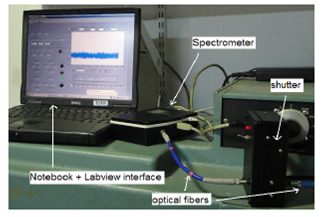
<body><![CDATA[<p><font size="2" face="Verdana">As well as the diurnal variation   there is a seasonal variation in stratospheric NO2 at mid-latitudes due to the   combined effects of photochemistry and atmospheric transport (Gil et al.,   2007).</font></p>     <p><font size="2" face="Verdana">The development of remote sensing   systems for monitoring of trace gases is fundamental to understand the dynamic   processes that occur in the stratosphere. The LIDAR Division (CEILAP-CITEDEF)   has in Río Gallegos, Santa Cruz province (51º 36’ S; 69º 19’ W; 15 m asl) a   remote sensing station (CEILAP-RG) where systematically are carry out   measurements of several atmospheric parameter (<u>www.division-lidar.com.ar</u>),   as for example: the concentration in vertical column O3 and of NO2, the O3 concentration   discriminated in height (O3 profile obtained by LIDAR, between 15 and 45 km),   aerosol optical thickness, solar irradiance (UV-A, UV-B, NIR), etc. It is   necessary to highlight that Río Gallegos city is affected every spring by a   significant decrease of the stratospheric O3   that produces an increment of the UV solar   radiations that arrive to the surface.</font></p>     <p><font size="2" face="Verdana"><b>MATERIALS AND METHOD</b></font></p>     <p><font size="2" face="Verdana">We present the development of a   compact atmospheric remote sensing system, able to determine the VCD (Vertical   Column Density) of multiple trace gases.   It is a low-cost and portable zenith-sky DOAS system (Figure 1) - hereafter   referred to as ERO-DOAS - composed of a mini-spectrometer (HR4000, Ocean   Optics), two optical &#64257;bers (400 µm of core, 6 m and 25 cm of longitude)   and a home-made external shutter (Raponi et al., 2011).</font></p>     <p><font size="2" face="Verdana"><img width=323 height=217 id="Imagen 1" src="/img/revistas/rbf/v20n20/v20n20a16-image001.png"></font></p>     <p><font size="2" face="Verdana"><b>Figure 1. The zenith-sky DOAS   system’s components: a notebook, the software designed using Labview®, the   spectrometer (HR4000), an automatic shutter and the optical fibers.</b></font></p>     <p><font size="2" face="Verdana">HR4000 allow us to+ measure solar   spectral irradiance in the UV-visible range (290-650 nm). It is a simple   spectrograph equipped with a fixed diffraction grating (600 grooves/mm blazed   at 400 nm) and a 3648-pixel lineal array CCD. We developed an automatic shutter   to determine the dark current of each measurement, and to remove this noise to   the twilight spectra. A software development using Labview® controls the start   and the end of spectral measurements, the retrieval of acquired spectra and the   shutter. The computer internal clock is daily updated to avoid possible time   shifts and to maintain accuracy on zenithal and azimuth angles calculations.</font></p>     <p><font size="2" face="Verdana">The software sets the CCD   integration time to maximize signal/noise ratio. The dark (current) spectra are   measured with the same integration time than the twilight spectra measured   immediately before. This ensures that the subtracted dark noise is similar to   the one actually measured over the illuminated period.</font></p>     <p><font size="2" face="Verdana">The instrumental function and the   system resolution were determined using low pressure lamps spectra provided by   the Physics Laboratory of Instituto Tecnológico de Buenos Aires (ITBA). We retrieved   the spectrometer instrument function from a helium lamp. The full width at half   maximum (FWHM) of the Voigt profile fitted to the He line was 1.03 nm at ~447   nm. The lamp spectra were also used to recalibrate ERO’s wavelength mapping.   This recalibration shows a shift of about -1.55 nm from the original (nominal)   manufacturer calibration.</font></p>     <p><font size="2" face="Verdana">The analysis of visible spectra   based on the DOAS concept presents the advantage of allowing for simultaneous   retrieval of VCDs of different species, over a wide range of meteorological   conditions. NO2 and O3 VCDs are retrieved from zenithal solar spectra (in the   visible range) acquired on “twilight” conditions (zenithal angle between 87°   and 91°) applying the DOAS (Differential Optical Absorption Spectroscopy) technique.</font></p>     ]]></body>
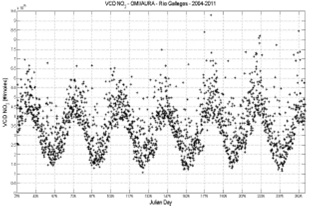
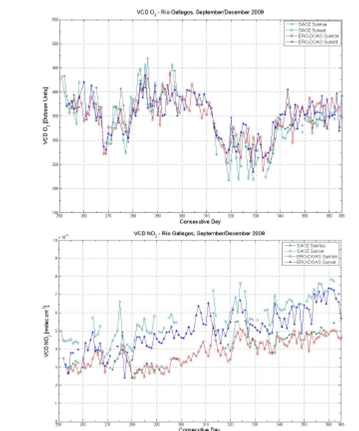
<body><![CDATA[<p><font size="2" face="Verdana"><b>RESULTS</b></font></p>     <p><font size="2" face="Verdana">We present a study on the O3 and NO2 VCDs seasonal   variation at Río Gallegos. In Figure 2 we can observe the NO2 VCD seasonal   variation at Río Gallegos during 2004-2011, retrieved by OMI/AURA. The   concentration ranging from 6x10¹⁵ molec/cm2 in summer to 1.6x10¹⁵   molec/cm2 in winter and early spring.</font></p>     <p><font size="2" face="Verdana"><img width=319 height=206 id="Imagen 2" src="/img/revistas/rbf/v20n20/v20n20a16-image002.png"></font></p>     <p><font size="2" face="Verdana">Figure 2. NO2   VCD variability at Río Gallegos, Santa Cruz province, Argentina,   retrieved by OMI-AURA, from 2004 to 2011.</font></p>     <p><font size="2" face="Verdana">Figure 3 show the NO2 and O3 vertical column   densities obtained with a SAOZ spectrometer (Système d'Analyse par Observation   Zenithale), LATMOS (Laboratoire Atmosphères, Milieux, Observations Spatiales),   France, located in the CEILAP-RG station, during 2009.</font></p>     <p><font size="2" face="Verdana"><img width=323 height=194 id="Imagen 3" src="/img/revistas/rbf/v20n20/v20n20a16-image003.png"></font></p>     <p><font size="2" face="Verdana"><b>Figure 3:   NO2 and O3 </b>VCD seasonal variation   during 2009, retrieved by SAOZ spectrometer at Río Gallegos.</font></p>     <p><font size="2" face="Verdana">In the case of the O3 VCD significant   differences are not observed among the concentrations at sunrise and at sunset,   as us we waited. In the case of NO2, to be a gas with a comparatively short photochemical   time of life, it presents a significant variability during the day. For that   reason, an important difference among the concentrations measured during the   twilights, exist.</font></p>     <p><font size="2" face="Verdana">In Figure 4 we compare the O3 and NO2 VCD retrieved by   ERO-DOAS and SAOZ spectrometer (both of them located in CEILAP-RG station),   during September/December 2009.</font></p>     <p><font size="2" face="Verdana"><img width=359 height=431 id="Imagen 4" src="/img/revistas/rbf/v20n20/v20n20a16-image004.png"></font></p>     ]]></body>
<body><![CDATA[<p><font size="2" face="Verdana">Figure 4. O3 and   NO2 VCD retrieved by   ERO-DOAS and SAOZ instruments at Río Gallegos, during September/December 2009.</font></p>     <p><font size="2" face="Verdana">For the ozone there is a good   agreement among the instruments with an average relative difference about 13%.   In the case of NO2, we observe a better agreement among results at   sunrise than at sunset between SAOZ and ERO-DOAS data.</font></p>     <p><font size="2" face="Verdana"><b>CONCLUSIONS</b></font></p>     <p><font size="2" face="Verdana">Our zenith-sky DOAS system has the   capability of sensing automatically several chemical species and the advantage   of being portable (which offers the possibility to move the instrument to carry   out measurements campaigns). We observe in both ground-based instruments a   strong daily variability of the NO2 VCD (sunrise vs. sunset). This variability is probably   associated with the NOx vertical distribution, the temperature in the high   layers of the atmosphere and maybe the variability of other active species. In   the case of the O3 the daily variability of the gas is low, reason why the   comparison between the sunrise and sunset data is very good.</font></p>     <p><font size="2" face="Verdana"><b>ACKNOWLEDGMENTS</b></font></p>     <p><font size="2" face="Verdana">The authors acknowledge to the   Japanese International Collaboration Agency (JICA) for funding the acquisition   of the HR4000 spectrometer and to SAOZ network and OMI/AURA for the data at Río   Gallegos.</font></p>     <p><font size="2" face="Verdana"><b>REFERENCES</b></font></p>     <!-- ref --><p><font size="2" face="Verdana">1.- Fish, D., and R. Jones (1995),   Rotational Raman scattering and ring effect in zenith sky spectra, <i>Geophys.   Res. Lett., </i>22 (7), 811-14.</font>&nbsp;&nbsp;&nbsp;&nbsp;&nbsp;&nbsp;&nbsp;&nbsp;[&#160;<a href="javascript:void(0);" onclick="javascript: window.open('/scielo.php?script=sci_nlinks&ref=229714&pid=S1562-3823201200040001600001&lng=','','width=640,height=500,resizable=yes,scrollbars=1,menubar=yes,');">Links</a>&#160;]<!-- end-ref --><!-- ref --><p><font size="2" face="Verdana">2.- Gil, M., M. Yela, L. Gunn, A.   Richter, I. Alonso, M. Chipperfield, E. Cuevas, J. Iglesias, M. Navarro, O.   Puentedura and S. Rodríguez (2007), NO2 climatology in the northern subtropical region:   diurnal, seasonal and interannual variability, <i>Atmos. Chem. Phys. Discuss. </i>7,   15067-103.</font>&nbsp;&nbsp;&nbsp;&nbsp;&nbsp;&nbsp;&nbsp;&nbsp;[&#160;<a href="javascript:void(0);" onclick="javascript: window.open('/scielo.php?script=sci_nlinks&ref=229715&pid=S1562-3823201200040001600002&lng=','','width=640,height=500,resizable=yes,scrollbars=1,menubar=yes,');">Links</a>&#160;]<!-- end-ref --><!-- ref --><p><font size="2" face="Verdana">3.- Raponi M., R. Jiménez, E.   Wolfram, J. Tocho, E. Quel (2011), Remote sensing of stratospheric NO2 over the   Argentinean Antarctica using a DOAS mini-spectrometer, <i>Óptica Pura y   Aplicada</i>, 44 (1), 77-82.</font>&nbsp;&nbsp;&nbsp;&nbsp;&nbsp;&nbsp;&nbsp;&nbsp;[&#160;<a href="javascript:void(0);" onclick="javascript: window.open('/scielo.php?script=sci_nlinks&ref=229716&pid=S1562-3823201200040001600003&lng=','','width=640,height=500,resizable=yes,scrollbars=1,menubar=yes,');">Links</a>&#160;]<!-- end-ref --> ]]></body><back>
<ref-list>
<ref id="B1">
<label>1</label><nlm-citation citation-type="journal">
<person-group person-group-type="author">
<name>
<surname><![CDATA[Fish]]></surname>
<given-names><![CDATA[D.]]></given-names>
</name>
<name>
<surname><![CDATA[Jones]]></surname>
<given-names><![CDATA[R.]]></given-names>
</name>
</person-group>
<article-title xml:lang="en"><![CDATA[Rotational Raman scattering and ring effect in zenith sky spectra]]></article-title>
<source><![CDATA[Geophys. Res. Lett.]]></source>
<year>1995</year>
<volume>22</volume>
<numero>7</numero>
<issue>7</issue>
<page-range>811-14</page-range></nlm-citation>
</ref>
<ref id="B2">
<label>2</label><nlm-citation citation-type="journal">
<person-group person-group-type="author">
<name>
<surname><![CDATA[Gil]]></surname>
<given-names><![CDATA[M.]]></given-names>
</name>
<name>
<surname><![CDATA[Yela]]></surname>
<given-names><![CDATA[M.]]></given-names>
</name>
<name>
<surname><![CDATA[Gunn]]></surname>
<given-names><![CDATA[L.]]></given-names>
</name>
<name>
<surname><![CDATA[Richter]]></surname>
<given-names><![CDATA[A.]]></given-names>
</name>
<name>
<surname><![CDATA[Alonso]]></surname>
<given-names><![CDATA[I.]]></given-names>
</name>
<name>
<surname><![CDATA[Chipperfield]]></surname>
<given-names><![CDATA[M.]]></given-names>
</name>
<name>
<surname><![CDATA[Cuevas]]></surname>
<given-names><![CDATA[E.]]></given-names>
</name>
<name>
<surname><![CDATA[Iglesias]]></surname>
<given-names><![CDATA[J.]]></given-names>
</name>
<name>
<surname><![CDATA[Navarro]]></surname>
<given-names><![CDATA[M.]]></given-names>
</name>
<name>
<surname><![CDATA[Puentedura]]></surname>
<given-names><![CDATA[O.]]></given-names>
</name>
<name>
<surname><![CDATA[Rodríguez]]></surname>
<given-names><![CDATA[S.]]></given-names>
</name>
</person-group>
<article-title xml:lang="en"><![CDATA[NO2 climatology in the northern subtropical region: diurnal, seasonal and interannual variability]]></article-title>
<source><![CDATA[Atmos. Chem. Phys. Discuss.]]></source>
<year>2007</year>
<volume>7</volume>
<page-range>15067-103</page-range></nlm-citation>
</ref>
<ref id="B3">
<label>3</label><nlm-citation citation-type="journal">
<person-group person-group-type="author">
<name>
<surname><![CDATA[Raponi]]></surname>
<given-names><![CDATA[M.]]></given-names>
</name>
<name>
<surname><![CDATA[Jiménez]]></surname>
<given-names><![CDATA[R.]]></given-names>
</name>
<name>
<surname><![CDATA[Wolfram]]></surname>
<given-names><![CDATA[E.]]></given-names>
</name>
<name>
<surname><![CDATA[Tocho]]></surname>
<given-names><![CDATA[J.]]></given-names>
</name>
<name>
<surname><![CDATA[Quel]]></surname>
<given-names><![CDATA[E.]]></given-names>
</name>
</person-group>
<article-title xml:lang="en"><![CDATA[Remote sensing of stratospheric NO2 over the Argentinean Antarctica using a DOAS mini-spectrometer]]></article-title>
<source><![CDATA[Óptica Pura y Aplicada]]></source>
<year>2011</year>
<volume>44</volume>
<numero>1</numero>
<issue>1</issue>
<page-range>77-82</page-range></nlm-citation>
</ref>
</ref-list>
</back>
</article>