<?xml version="1.0" encoding="ISO-8859-1"?><article xmlns:mml="http://www.w3.org/1998/Math/MathML" xmlns:xlink="http://www.w3.org/1999/xlink" xmlns:xsi="http://www.w3.org/2001/XMLSchema-instance">
<front>
<journal-meta>
<journal-id>1562-3823</journal-id>
<journal-title><![CDATA[Revista Boliviana de Física]]></journal-title>
<abbrev-journal-title><![CDATA[Revista Boliviana de Física]]></abbrev-journal-title>
<issn>1562-3823</issn>
<publisher>
<publisher-name><![CDATA[Sociedad Boliviana de Física]]></publisher-name>
</publisher>
</journal-meta>
<article-meta>
<article-id>S1562-38232012000400015</article-id>
<title-group>
<article-title xml:lang="en"><![CDATA[Aerosol transport to the Andean region: A new GAW station]]></article-title>
</title-group>
<contrib-group>
<contrib contrib-type="author">
<name>
<surname><![CDATA[Andrade]]></surname>
<given-names><![CDATA[M.]]></given-names>
</name>
</contrib>
<contrib contrib-type="author">
<name>
<surname><![CDATA[Mamani]]></surname>
<given-names><![CDATA[R.]]></given-names>
</name>
</contrib>
<contrib contrib-type="author">
<name>
<surname><![CDATA[Velarde]]></surname>
<given-names><![CDATA[F.]]></given-names>
</name>
</contrib>
<contrib contrib-type="author">
<name>
<surname><![CDATA[Biggeman]]></surname>
<given-names><![CDATA[D.]]></given-names>
</name>
</contrib>
<contrib contrib-type="author">
<name>
<surname><![CDATA[Zaratti]]></surname>
<given-names><![CDATA[F.]]></given-names>
</name>
</contrib>
<contrib contrib-type="author">
<name>
<surname><![CDATA[Forno]]></surname>
<given-names><![CDATA[R.]]></given-names>
</name>
</contrib>
</contrib-group>
<aff id="A01">
<institution><![CDATA[,La Paz, Bolivia Universidad Mayor de San Andrés Campus Universitario Instituto de Investigaciones Físicas]]></institution>
<addr-line><![CDATA[La Paz ]]></addr-line>
<country>Bolivia</country>
</aff>
<pub-date pub-type="pub">
<day>00</day>
<month>00</month>
<year>2012</year>
</pub-date>
<pub-date pub-type="epub">
<day>00</day>
<month>00</month>
<year>2012</year>
</pub-date>
<volume>20</volume>
<numero>20</numero>
<fpage>42</fpage>
<lpage>44</lpage>
<copyright-statement/>
<copyright-year/>
<self-uri xlink:href="http://www.scielo.org.bo/scielo.php?script=sci_arttext&amp;pid=S1562-38232012000400015&amp;lng=en&amp;nrm=iso"></self-uri><self-uri xlink:href="http://www.scielo.org.bo/scielo.php?script=sci_abstract&amp;pid=S1562-38232012000400015&amp;lng=en&amp;nrm=iso"></self-uri><self-uri xlink:href="http://www.scielo.org.bo/scielo.php?script=sci_pdf&amp;pid=S1562-38232012000400015&amp;lng=en&amp;nrm=iso"></self-uri><abstract abstract-type="short" xml:lang="en"><p><![CDATA[The importance of particulate matter transport over the Andean glaciers has recently grown because new studies have suggested that at least part of the local warming at the Himalayas might be due to transport of particles to this region. In the Andean region the rapid retreat of glaciers and a moderate increase in temperature suggest that particulate matter product of biomass burning could also be playing a role in the observed glacier recession. Satellite imagery from MODIS, measurements from photometers as well as in-situ measurements were used to try to characterize some optical and chemical properties of particulate matter arriving to the Andean region. Backward trajectories and electronic microscopy were also used for this purpose. Preliminary results are reported here. In addition, the implementation of a new GAW station at Chacaltaya (5200 masl; 16°21’S, 68°07’W) is discussed in this context.]]></p></abstract>
<kwd-group>
<kwd lng="en"><![CDATA[aerosol]]></kwd>
<kwd lng="en"><![CDATA[aerosol transport]]></kwd>
</kwd-group>
</article-meta>
</front><body><![CDATA[ <p align="center"><font size="2" face="Verdana"><strong><font size="4">Aerosol transport to the Andean region: A new GAW station</font></strong></font></p>     <p align="center">&nbsp;</p>     <p align="center">&nbsp;</p>     <p align="center"><strong><font size="3" face="Verdana">Andrade   M., R. Mamani, F. Velarde, D. Biggeman, F. Zaratti y R. Forno</font></strong></p>     <p align="center"><strong><font size="2" face="Verdana">Laboratorio   de Física de la Atmósfera, Instituto de Investigaciones Físicas, Universidad   Mayor de San Andrés Campus Universitario, Cota-Cota, La Paz, Bolivia</font></strong></p>     <p align="center"><strong><font size="2" face="Verdana">Tel/Fax:   +591-2-2799155, E-mail: mandrade@fiumsa.edu.bo</font></strong><font size="2" face="Verdana"></font></p><hr>     <p><font size="2" face="Verdana"><b>SUMMARY</b></font></p>     <p><font size="2" face="Verdana">The importance of particulate matter   transport over the Andean glaciers has recently grown because new studies have   suggested that at least part of the local warming at the Himalayas might be due   to transport of particles to this region. In the Andean region the rapid   retreat of glaciers and a moderate increase in temperature suggest that   particulate matter product of biomass burning could also be playing a role in   the observed glacier recession. Satellite imagery from MODIS, measurements from   photometers as well as in-situ measurements were used to try to characterize   some optical and chemical properties of particulate matter arriving to the   Andean region. Backward trajectories and electronic microscopy were also used   for this purpose. Preliminary results are reported here. In addition, the   implementation of a new GAW station at Chacaltaya (5200 masl; 16°21’S, 68°07’W)   is discussed in this context.</font></p>     <p><font size="2" face="Verdana"><b>Key words: </b>aerosol, aerosol transport.</font></p><hr>     <p><font size="2" face="Verdana"><b>INTRODUCTION</b></font></p>     ]]></body>
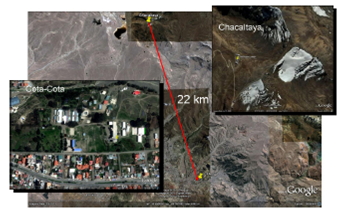
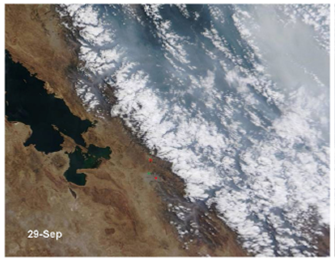
<body><![CDATA[<p><font size="2" face="Verdana">The effects of   anthropogenic atmospheric aerosols upon glaciers have been object of great   interest due to the observed rapid melting of the latter in different parts of   the world (Hansen and Nazarenko, 2003, Hegerl   et al., 2007). Studies in Asia, especially over the   Himalayas (Xu et al., 2009; Lau et al., 2010) suggest that aerosols transported   to this region might be playing an important role both in changing albedo   properties of snow and ice as well as increasing local temperature of the   atmosphere, contributing in this way to the rapid receding of the Himalayan   glaciers.</font></p>     <p><font size="2" face="Verdana">Similarly, a fast   decrease in area and volume of the ice mass in the Andean glaciers has been   reported by different studies (Francou et al., 2003; Vuille et al., 2008).   Regular field measurements at Bolivian glaciers began at the beginning of the   1990’s. These measurements showed a rapid decrease of all glaciers where   studies were conducted. At the moment some of these glaciers have already disappeared   completely (Chacaltaya, for example). Despite some controversy about their   contribution, the importance of these ice masses is directly related to the   water supply of both humans and ecosystems, especially in the dry season when   glaciers act as water reservoirs.</font></p>     <p><font size="2" face="Verdana">Although a positive trend in both   the seasonal mean aerosol optical depth (AOD) and fire data recorded by   satellite instruments has been reported between 1998 and 2005 (Koren et al.,   2007), the observations showed a decline between 2006 and 2009. This decline   has been linked to policy shifts (Koren et al., 2007) especially because the   analysis of particular years show no especial conditions that could explain the   reduction of biomass burning and its associated production of smoke (Torres et   al., 2010). In contrast to this latest trend, biomass burning has been   particularly intense in 2010.</font></p>     <p><font size="2" face="Verdana"><b>REMOTE OBSERVATIONS</b></font></p>     <p><font size="2" face="Verdana">Observations of aerosol optical   depth (AOD) using a sunphotometer CIMEL obtained at the Atmospheric Physics   Laboratory, APL, (3420 masl; 16º32’S, 68º04’W) in the city of La Paz, Bolivia   show that during biomass burning season AOD could reach unusual high values for   this region (~0.80 at 340 nm; yearly mean values are on the order of 0.15).   Satellite imagery from MODIS (Moderate Resolution Imaging Spectroradiometer)   show that smoke produced at the Bolivian lowlands and neighbor countries can   reach high altitude locations over the Bolivian Andes. Carbon monoxide   measurements by the MOPITT (Measurements of Pollution in the Troposphere) sensor   flying aboard NASA's Terra spacecraft show large concentrations at the surface   east of the Andes and give some indication of possible transport to the high   lands as well.</font></p>     <p><font size="2" face="Verdana"><img width=335 height=264 id="Imagen 1" src="/img/revistas/rbf/v20n20/v20n20a15-image001.png"></font></p>     <p><font size="2" face="Verdana"><b>Figure 1.   Smoke transported over the Andes mountains on September 29, 2010. Image   obtained by a MODIS sensor onboard of NASA’s Terra satellite.</b></font></p>     <p><font size="2" face="Verdana"><b>IN-SITU OBSERVATIONS</b></font></p>     <p><font size="2" face="Verdana">With the aim of studying transport   of aerosol particles produced by biomass burning east of the Andes, a set of   experiments have been conducted. Using a MOUDI cascade impactor to examine   surface air aerosols with different aerodynamic sizes, samples were collected   under clean conditions (June, 2010) and in the middle of the biomass burning   season (September, 2010) at Chacaltaya (5200 masl; 16°21’S, 68°07’W) and   Cota-Cota, La Paz (3420 msal; 16°32'20.71&quot;S, 68° 3'58.69&quot;W )..</font></p>     <p><font size="2" face="Verdana"><img width=347 height=211 id="Imagen 2" src="/img/revistas/rbf/v20n20/v20n20a15-image002.png"></font></p>     ]]></body>
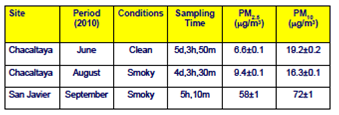
<body><![CDATA[<p><font size="2" face="Verdana">Figure 2. GoogleEarth images show the locations on the Andes   mountains where samples were collected. Cota-Cota is located in the outskirts   of La Paz, whereas Chacaltaya is on a relatively pristine environment. Air   masses arriving from the Amazon basin, the Altiplano, and also from La Paz   metropolitan region are observed at Chacaltaya..</font></p>     <p><font size="2" face="Verdana">In order to better understand the   type of particles collected at high altitude locations, samples at regions near   the biomass fires (522 masl; 16°16'S, 62°30’W) were also collected. The   analyses show a small increment in PM2.5 concentration at Chacaltaya between   clean and smoky conditions. In contrast, the concentration was almost 5-times   larger in regions near the fires (Table I). Analyses performed by X-Ray   techniques as well as by electronic microscopy on the samples collected at   stages 6 to 8, where aerodynamic size particle varies from 0.56 mm   to 0.18 mm, show that under clean conditions there is no trace   of potassium whereas during biomass season traces of potassium are present not   only in La Paz and Chacaltaya (the Andean region) but near the area where fires   are produced. The presence of potassium has been reported in aerosols from   biomass burning (Andreae, 1983). More analyses are needed in order to identify   other elements, size and shape of the aerosols as well as other physical and   chemical properties.</font></p>     <p><font size="2" face="Verdana"><img width=339 height=115 id="Imagen 3" src="/img/revistas/rbf/v20n20/v20n20a15-image003.png"></font></p>     <p><font size="2" face="Verdana"><b>Table 1. Summary of results   obtained from mass analysis.</b></font></p>     <p><font size="2" face="Verdana">In addition, HYSPLIT (Hybrid Single   Particle Lagrangian Integrated Trajectory Model) a computer model for computing   simple air parcel trajectories was used to estimate the possible sources of the   air sampled at different locations by tracing its backward trajectories. As   expected, the results suggest that air masses arriving at the surface or   passing near the surface have their origin not far from the sampling sites,   whereas air transported at higher altitudes usually travels much larger   distances and could have its origin in regions completely free of influence of   biomass burning.</font></p>     <p><font size="2" face="Verdana"><b>A NEW GAW STATION</b></font></p>     <p><font size="2" face="Verdana">After submission of a project by a   consortium of European institutions and Universidad Mayor de San Andres to the   World Meteorological Organization, Chacaltaya has been designated a Global   Atmosphere Watch (GAW) regional station. This high altitude station is located   in a strategic place because air masses from distinct origin arrive at   different times of the year. For instance, air masses from the Amazon region   are typically transported from the eastern side of the continent during   (Southern Hemisphere) summer time but air masses are transported from the   Altiplano region during winter time.</font></p>     <p><font size="2" face="Verdana">The new station will begin taking   measurements of optical properties, size distribution and other properties of   aerosols arriving to this site as well as measuring concentrations of CO2, surface ozone   and carbon monoxide. In addition chemical properties of aerosols will also be   studied at Chacaltaya. In this case, sampling will be performed at the mountain   summit (5380 masl) using a high-volume sampler.</font></p>     <p><font size="2" face="Verdana">At the same time, the recently   implemented LIDAR system at the APL will be upgraded in order to study the   boundary layer around or above Chacaltaya. In this case, simulations are being   performed in order to optimize the system.</font></p>     <p><font size="2" face="Verdana">The new station is expected to begin   regular operations by December of 2011.</font></p>     ]]></body>
<body><![CDATA[<p><font size="2" face="Verdana"><b>CONCLUSIONS</b></font></p>     <p><font size="2" face="Verdana">We presented results of a   preliminary study showing transport of particulate matter produced by biomass   burning to the Andean region. Remote and in-stu observations show that smoke   goes across the Andean mountains and is likely deposited over the glaciers   present on that region. The net effects of such process will be object of study   by the new GAW station at Chacaltaya.</font></p>     <p><font size="2" face="Verdana"><b>ACKNOWLEDGMENTS</b></font></p>     <p><font size="2" face="Verdana">This work has been partially funded   by the Danish cooperation through a project carried out by Universidad Mayor de   San Andrés. We thank SwissContact Bolivia for its strong support during the   field campaigns.</font></p>     <p><font size="2" face="Verdana"><b>REFERENCES</b></font></p>     <!-- ref --><p><font size="2" face="Verdana">1.- Andreae, M.O. (1983), Soot   carbon and excess fine potassium: Long-range transport of 13 combustion-derived   aerosols, Science, 220, 1148-1151.</font>&nbsp;&nbsp;&nbsp;&nbsp;&nbsp;&nbsp;&nbsp;&nbsp;[&#160;<a href="javascript:void(0);" onclick="javascript: window.open('/scielo.php?script=sci_nlinks&ref=229736&pid=S1562-3823201200040001500001&lng=','','width=640,height=500,resizable=yes,scrollbars=1,menubar=yes,');">Links</a>&#160;]<!-- end-ref --><!-- ref --><p><font size="2" face="Verdana">2.- Francou, B., Vuille, P. Wagnon,   J. Mendoza, and J. Sicart (2003), Tropical climate change recorded by a glacier   of the central Andes during the last decades of the 20th century: Chacaltaya,   Bolivia, 16°S, J. Geophys. Res., 108 (D5), 4154, doi:10.1029/2002JD002959.</font>&nbsp;&nbsp;&nbsp;&nbsp;&nbsp;&nbsp;&nbsp;&nbsp;[&#160;<a href="javascript:void(0);" onclick="javascript: window.open('/scielo.php?script=sci_nlinks&ref=229737&pid=S1562-3823201200040001500002&lng=','','width=640,height=500,resizable=yes,scrollbars=1,menubar=yes,');">Links</a>&#160;]<!-- end-ref --><!-- ref --><p><font size="2" face="Verdana">3.- Hegerl, G.C., F. W. Zwiers, P.   Braconnot, N.P. Gillett, Y. Luo, J.A. Marengo Orsini, N. Nicholls, J.E. Penner   and P.A. Stott, 2007: Understanding and Attributing Climate Change. In: Climate   Change 2007: The Physical Science Basis. Contribution of Working Group I to the   Fourth Assessment Report of the Intergovernmental Panel on Climate Change   [Solomon, S., D. Qin, M. Manning, Z. Chen, M. Marquis, K.B. Averyt, M. Tignor   and H.L. Miller (eds.)]. Cambridge University Press, Cambridge, United Kingdom   and New York, NY, USA.Hansen J, Nazarenko L (2004) Soot climate forcing via   snow and ice albedos. Proc Natl Acad Sci USA 101:423–428.</font>&nbsp;&nbsp;&nbsp;&nbsp;&nbsp;&nbsp;&nbsp;&nbsp;[&#160;<a href="javascript:void(0);" onclick="javascript: window.open('/scielo.php?script=sci_nlinks&ref=229738&pid=S1562-3823201200040001500003&lng=','','width=640,height=500,resizable=yes,scrollbars=1,menubar=yes,');">Links</a>&#160;]<!-- end-ref --><p><font size="2" face="Verdana">4.- Koren, I., L. A. Remer, and K.   Longo (2007), Reversal of trend of biomass burning in the Amazon, Geophys. Res.   Lett., 34, L20404, doi:10.1029/2007GL031530.</font></p>     <p><font size="2" face="Verdana">5.- Lau ,W. K. M., Maeng-KiKim,   Kyu-MyongKim and Woo- Seop Lee, Enhanced surface warming and accelerated snow   melt in the Himalayas and Tibetan Plateau induced by absorbing aerosols,   Environ. Res. Lett. 5, 2010.</font></p>     ]]></body>
<body><![CDATA[<p><font size="2" face="Verdana">6.- Vuille M., B. Francou, P.   Wagnon, I. Juen, G. Kaser, B. Mark, and R. Bradley. Climate change and tropical   andean glaciers: Past, present and future. Earth-Science Reviews, 89(3-4):79–   96, August 2008.</font></p>      ]]></body><back>
<ref-list>
<ref id="B1">
<label>1</label><nlm-citation citation-type="">
<person-group person-group-type="author">
<name>
<surname><![CDATA[Andreae]]></surname>
<given-names><![CDATA[M.O.]]></given-names>
</name>
</person-group>
<article-title xml:lang="en"><![CDATA[Soot carbon and excess fine potassium]]></article-title>
<source><![CDATA[Long-range transport of 13 combustion-derived aerosols: Science]]></source>
<year>1983</year>
<page-range>1148-1151</page-range></nlm-citation>
</ref>
<ref id="B2">
<label>2</label><nlm-citation citation-type="journal">
<person-group person-group-type="author">
<name>
<surname><![CDATA[Francou]]></surname>
<given-names><![CDATA[B.]]></given-names>
</name>
<name>
<surname><![CDATA[Wagnon]]></surname>
<given-names><![CDATA[P.]]></given-names>
</name>
<name>
<surname><![CDATA[Mendoza]]></surname>
<given-names><![CDATA[J.]]></given-names>
</name>
<name>
<surname><![CDATA[Sicart]]></surname>
<given-names><![CDATA[J.]]></given-names>
</name>
</person-group>
<article-title xml:lang="en"><![CDATA[Tropical climate change recorded by a glacier of the central Andes during the last decades of the 20th century: Chacaltaya, Bolivia, 16°S]]></article-title>
<source><![CDATA[J. Geophys. Res.]]></source>
<year>2003</year>
<volume>108</volume>
<numero>5</numero>
<issue>5</issue>
<page-range>4154</page-range></nlm-citation>
</ref>
<ref id="B3">
<label>3</label><nlm-citation citation-type="">
<person-group person-group-type="author">
<name>
<surname><![CDATA[Hegerl]]></surname>
<given-names><![CDATA[G.C.]]></given-names>
</name>
<name>
<surname><![CDATA[Zwiers]]></surname>
<given-names><![CDATA[F. W.]]></given-names>
</name>
<name>
<surname><![CDATA[Braconnot]]></surname>
<given-names><![CDATA[P.]]></given-names>
</name>
<name>
<surname><![CDATA[Gillett]]></surname>
<given-names><![CDATA[N.P.]]></given-names>
</name>
<name>
<surname><![CDATA[Luo]]></surname>
<given-names><![CDATA[Y.]]></given-names>
</name>
<name>
<surname><![CDATA[Marengo Orsini]]></surname>
<given-names><![CDATA[J.A.]]></given-names>
</name>
<name>
<surname><![CDATA[Nicholls]]></surname>
<given-names><![CDATA[N.]]></given-names>
</name>
<name>
<surname><![CDATA[Penner]]></surname>
<given-names><![CDATA[J.E.]]></given-names>
</name>
<name>
<surname><![CDATA[Stott]]></surname>
<given-names><![CDATA[P.A.]]></given-names>
</name>
</person-group>
<article-title xml:lang="en"><![CDATA[Understanding and Attributing Climate Change. In: Climate Change 2007]]></article-title>
<source><![CDATA[The Physical Science Basis: Contribution of Working Group I to the Fourth Assessment Report of the Intergovernmental Panel on Climate Change]]></source>
<year>2007</year>
</nlm-citation>
</ref>
<ref id="B4">
<label>4</label><nlm-citation citation-type="">
<person-group person-group-type="author">
<name>
<surname><![CDATA[Solomon]]></surname>
<given-names><![CDATA[S.]]></given-names>
</name>
<name>
<surname><![CDATA[Qin]]></surname>
<given-names><![CDATA[D.]]></given-names>
</name>
<name>
<surname><![CDATA[Manning]]></surname>
<given-names><![CDATA[M.]]></given-names>
</name>
<name>
<surname><![CDATA[Chen]]></surname>
<given-names><![CDATA[Z.]]></given-names>
</name>
<name>
<surname><![CDATA[Marquis]]></surname>
<given-names><![CDATA[M.]]></given-names>
</name>
<name>
<surname><![CDATA[Averyt]]></surname>
<given-names><![CDATA[K.B.]]></given-names>
</name>
<name>
<surname><![CDATA[Tignor]]></surname>
<given-names><![CDATA[M.]]></given-names>
</name>
<name>
<surname><![CDATA[Miller]]></surname>
<given-names><![CDATA[H.L.]]></given-names>
</name>
</person-group>
<article-title xml:lang="en"><![CDATA[Cambridge University Press, Cambridge: United Kingdom and New York, NY, USA.Hansen J, Nazarenko L]]></article-title>
<source><![CDATA[Soot climate forcing via snow and ice albedos: Proc Natl Acad Sci USA 101]]></source>
<year>2004</year>
<page-range>423-428</page-range></nlm-citation>
</ref>
<ref id="B5">
<label>5</label><nlm-citation citation-type="journal">
<person-group person-group-type="author">
<name>
<surname><![CDATA[Koren]]></surname>
<given-names><![CDATA[I.]]></given-names>
</name>
<name>
<surname><![CDATA[Remer]]></surname>
<given-names><![CDATA[L. A.]]></given-names>
</name>
<name>
<surname><![CDATA[Longo]]></surname>
<given-names><![CDATA[K.]]></given-names>
</name>
</person-group>
<article-title xml:lang="en"><![CDATA[Reversal of trend of biomass burning in the Amazon]]></article-title>
<source><![CDATA[Geophys. Res. Lett.]]></source>
<year>2007</year>
<volume>34</volume>
</nlm-citation>
</ref>
<ref id="B6">
<label>6</label><nlm-citation citation-type="journal">
<person-group person-group-type="author">
<name>
<surname><![CDATA[Lau]]></surname>
<given-names><![CDATA[W. K. M.]]></given-names>
</name>
<name>
<surname><![CDATA[Kyu-MyongKim]]></surname>
<given-names><![CDATA[Maeng-KiKim]]></given-names>
</name>
<name>
<surname><![CDATA[Woo- Seop]]></surname>
<given-names><![CDATA[Lee]]></given-names>
</name>
</person-group>
<article-title xml:lang="en"><![CDATA[Enhanced surface warming and accelerated snow melt in the Himalayas and Tibetan Plateau induced by absorbing aerosols]]></article-title>
<source><![CDATA[Environ. Res. Lett.]]></source>
<year></year>
<volume>5</volume>
<page-range>2010</page-range></nlm-citation>
</ref>
<ref id="B7">
<label>7</label><nlm-citation citation-type="journal">
<person-group person-group-type="author">
<name>
<surname><![CDATA[Vuille]]></surname>
<given-names><![CDATA[M.]]></given-names>
</name>
<name>
<surname><![CDATA[Francou]]></surname>
<given-names><![CDATA[B.]]></given-names>
</name>
<name>
<surname><![CDATA[Wagnon]]></surname>
<given-names><![CDATA[P.]]></given-names>
</name>
<name>
<surname><![CDATA[Juen]]></surname>
<given-names><![CDATA[I.]]></given-names>
</name>
<name>
<surname><![CDATA[Kaser]]></surname>
<given-names><![CDATA[G.]]></given-names>
</name>
<name>
<surname><![CDATA[Mark]]></surname>
<given-names><![CDATA[B.]]></given-names>
</name>
<name>
<surname><![CDATA[Bradley]]></surname>
<given-names><![CDATA[R.]]></given-names>
</name>
</person-group>
<article-title xml:lang="en"><![CDATA[Climate change and tropical andean glaciers: Past, present and future]]></article-title>
<source><![CDATA[Earth-Science Reviews]]></source>
<year>Augu</year>
<month>st</month>
<day> 2</day>
<volume>89</volume>
<numero>3-4</numero>
<issue>3-4</issue>
<page-range>79- 96</page-range></nlm-citation>
</ref>
</ref-list>
</back>
</article>