<?xml version="1.0" encoding="ISO-8859-1"?><article xmlns:mml="http://www.w3.org/1998/Math/MathML" xmlns:xlink="http://www.w3.org/1999/xlink" xmlns:xsi="http://www.w3.org/2001/XMLSchema-instance">
<front>
<journal-meta>
<journal-id>1562-3823</journal-id>
<journal-title><![CDATA[Revista Boliviana de Física]]></journal-title>
<abbrev-journal-title><![CDATA[Revista Boliviana de Física]]></abbrev-journal-title>
<issn>1562-3823</issn>
<publisher>
<publisher-name><![CDATA[Sociedad Boliviana de Física]]></publisher-name>
</publisher>
</journal-meta>
<article-meta>
<article-id>S1562-38232012000400010</article-id>
<title-group>
<article-title xml:lang="en"><![CDATA[Comparison of AOD measurements and forecasts of Saharan dust events at Camagüey, Cuba.]]></article-title>
</title-group>
<contrib-group>
<contrib contrib-type="author">
<name>
<surname><![CDATA[Antuña]]></surname>
<given-names><![CDATA[Juan Carlos]]></given-names>
</name>
</contrib>
<contrib contrib-type="author">
<name>
<surname><![CDATA[Cachorro]]></surname>
<given-names><![CDATA[Victoria]]></given-names>
</name>
</contrib>
<contrib contrib-type="author">
<name>
<surname><![CDATA[Estevan]]></surname>
<given-names><![CDATA[René]]></given-names>
</name>
</contrib>
<contrib contrib-type="author">
<name>
<surname><![CDATA[de Frutos]]></surname>
<given-names><![CDATA[Ángel]]></given-names>
</name>
</contrib>
<contrib contrib-type="author">
<name>
<surname><![CDATA[Barja]]></surname>
<given-names><![CDATA[Boris]]></given-names>
</name>
</contrib>
<contrib contrib-type="author">
<name>
<surname><![CDATA[Benouna]]></surname>
<given-names><![CDATA[Yasmine]]></given-names>
</name>
</contrib>
<contrib contrib-type="author">
<name>
<surname><![CDATA[Torres]]></surname>
<given-names><![CDATA[Benjamín]]></given-names>
</name>
</contrib>
<contrib contrib-type="author">
<name>
<surname><![CDATA[Fuertes]]></surname>
<given-names><![CDATA[David]]></given-names>
</name>
</contrib>
<contrib contrib-type="author">
<name>
<surname><![CDATA[González]]></surname>
<given-names><![CDATA[Ramiro]]></given-names>
</name>
</contrib>
<contrib contrib-type="author">
<name>
<surname><![CDATA[Toledano]]></surname>
<given-names><![CDATA[Carlos]]></given-names>
</name>
</contrib>
<contrib contrib-type="author">
<name>
<surname><![CDATA[Kallos]]></surname>
<given-names><![CDATA[George]]></given-names>
</name>
</contrib>
<contrib contrib-type="author">
<name>
<surname><![CDATA[Christos]]></surname>
<given-names><![CDATA[Spyrou]]></given-names>
</name>
</contrib>
</contrib-group>
<aff id="A01">
<institution><![CDATA[,Cuba Camagüey Centro Meteorológico de Camagüey]]></institution>
<addr-line><![CDATA[ ]]></addr-line>
<country>Cuba</country>
</aff>
<aff id="A02">
<institution><![CDATA[,España Universidad de Valladolid Grupo de Óptica Atmosférica]]></institution>
<addr-line><![CDATA[ ]]></addr-line>
<country>España</country>
</aff>
<aff id="A03">
<institution><![CDATA[,Greece University of Athens Department of Applied Physics]]></institution>
<addr-line><![CDATA[ ]]></addr-line>
</aff>
<pub-date pub-type="pub">
<day>00</day>
<month>00</month>
<year>2012</year>
</pub-date>
<pub-date pub-type="epub">
<day>00</day>
<month>00</month>
<year>2012</year>
</pub-date>
<volume>20</volume>
<numero>20</numero>
<fpage>27</fpage>
<lpage>29</lpage>
<copyright-statement/>
<copyright-year/>
<self-uri xlink:href="http://www.scielo.org.bo/scielo.php?script=sci_arttext&amp;pid=S1562-38232012000400010&amp;lng=en&amp;nrm=iso"></self-uri><self-uri xlink:href="http://www.scielo.org.bo/scielo.php?script=sci_abstract&amp;pid=S1562-38232012000400010&amp;lng=en&amp;nrm=iso"></self-uri><self-uri xlink:href="http://www.scielo.org.bo/scielo.php?script=sci_pdf&amp;pid=S1562-38232012000400010&amp;lng=en&amp;nrm=iso"></self-uri><abstract abstract-type="short" xml:lang="en"><p><![CDATA[The SKIRON model AOD forecasts for Saharan dust clouds arriving to Camagüey, Cuba, during July 2009 were evaluated. For such a goal AOD measurements from a surface sunphotometer were used. Additional information from MODIS was also available for the comparison. The results demonstrate the capabilities for developing an alert and tracking system for Saharan dust events across the Atlantic.]]></p></abstract>
<kwd-group>
<kwd lng="en"><![CDATA[Saharan dust]]></kwd>
<kwd lng="en"><![CDATA[aerosols]]></kwd>
<kwd lng="en"><![CDATA[AOD]]></kwd>
<kwd lng="en"><![CDATA[SKIRON model]]></kwd>
</kwd-group>
</article-meta>
</front><body><![CDATA[ <p align="center"><font size="4" face="Verdana"><strong>Comparison of AOD measurements and forecasts   of Saharan dust events at Camagüey, Cuba.</strong></font></p>     <p align="center">&nbsp;</p>     <p align="center"><strong><font size="3" face="Verdana">Juan   Carlos Antuña(1), Victoria Cachorro(2), René Estevan(1), Ángel de Frutos(2), Boris Barja(1), Yasmine Benouna(2), Benjamín Torres(2), David Fuertes(2), Ramiro González(2),Carlos Toledano(2), George Kallos(3) and Spyrou Christos(3)</font></strong></p>     <p align="center"><strong><font size="2" face="Verdana">(1)Grupo de Óptica   Atmosférica de Camagüey, Centro Meteorológico de Camagüey, Camagüey, Cuba</font></strong></p>     <p align="center"><strong><font size="2" face="Verdana">(2)Grupo de Óptica   Atmosférica, Universidad de Valladolid, España</font></strong></p>     <p align="center"><strong><font size="2" face="Verdana">(3)Department of Applied Physics,   University of Athens, Greece</font></strong></p>     <p align="center"><strong><font size="2" face="Verdana">E-mail:   anadelia@caonao.cu</font><font size="2" face="Verdana"></font></strong></p><hr>     <p><font size="2" face="Verdana"><b>SUMMARY</b></font></p>     <p><font size="2" face="Verdana">The SKIRON model AOD forecasts for   Saharan dust clouds arriving to Camagüey, Cuba, during July 2009 were   evaluated. For such a goal AOD measurements from a surface sunphotometer were   used. Additional information from MODIS was also available for the comparison.   The results demonstrate the capabilities for developing an alert and tracking   system for Saharan dust events across the Atlantic.</font></p>     <p><font size="2" face="Verdana"><b>Key words: </b>Saharan dust, aerosols, AOD, SKIRON model</font></p><hr>     ]]></body>
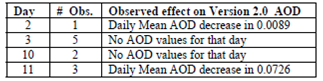
<body><![CDATA[<p><font size="2" face="Verdana"><b>INTRODUCTION</b></font></p>     <p><font size="2" face="Verdana">Recent studies using state of the   art satellite information showed that every year 240 ± 80 Tg of dust are   transported from Africa in the latitude band 20°S – 30°N. From that amount 50 ±   15 Tg are deposited in the Amazon basin and 50 </font><font size="2" face="Verdana">± 25 Tg arrive to the Caribbean   (Kaufman et al., 2005). Those enormous amounts of aerosols have an important   impact in human activities</font></p>     <p><font size="2" face="Verdana">The GOAC team, in cooperation with   scientists from several institutions is developing a service for alert-tracking   the Saharan dust transported over the Atlantic to the Wider Caribbean. The core   idea of the service is to provide, to each one of the countries of the Wider   Caribbean local notices of the future arrival of Saharan dust to his area   combined with updates of the current position of the dust air masses. It will   combine existing numerical modelling of the Saharan dust transport with   satellite and surface observations. Those sources of information are the SKIRON   model AOD forecasts, the derived AOD from MODIS (both from Terra and Aqua) and   the derived sun photometer AOD. The purpose of the present comparison is to   have a preliminary estimation of the magnitudes of the differences between the   AOD sun-photometer measurements at Camagüey and the coincident AOD forecasted by   SKIRON in the presence of several Saharan dust events.</font></p>     <p><font size="2" face="Verdana"><b>DATASETS</b></font></p>     <p><font size="2" face="Verdana">The sun photometer CIMEL CE-318   installed at the Camagüey (21.42º N, 77.84º W, 128 meters over sea level) is   part of the Iberian Network for Aerosol Measurements (RIMA) which is federated into   the Aerosol Robotic Network (AERONET). It was installed as result of a   cooperation agreement for joint aerosol research between the University of   Valladolid (UVA), Spain, and the Cuban Meteorological Institute (INSMET). The   research are conducted by the Grupo de Óptica Atmosférica (GOA-UVA) and the   Grupo de Óptica Atmosférica de Camagüey (GOAC-INSMET), formerly the Camagüey   Lidar Station. The sun-photometer was operative from October 7th 2008. After   the post calibration of the CIMEL # 353 and the reprocessing of the dataset the   produced AOD by AERONET Version 2.0 showed very little changes with respect to   the Version 1.5.</font></p>     <p><font size="2" face="Verdana">From the total of 746 instantaneous   AOD measurements that passed the quality control and were processed in the   Version 1.5 for the entire month of July 2009, only 11 did not passed the   quality control required for version 2.0, representing only the 1.5% of the   observations reported before. The rest of the AOD values (98.5%) did not   changed in the Version 2.0 with respect to the Version 1.5. Table 1 lists the   day’s data has been discarded in Version 2.0 and its effects respect to Version   1.5.</font></p>     <p><font size="2" face="Verdana"><b>Table No. 1: Daily distribution   and observed effect on the AOD values of discarded observations per day in   Version 2.0 with respect to Version 1.5. Period July 1st to 31st 2009.</b></font></p>     <p><font size="2" face="Verdana"><img width=323 height=81 id="Imagen 1" src="/img/revistas/rbf/v20n20/v20n20a10-image001.png"></font></p>     <p><font size="2" face="Verdana">Saharan dust events were measured by   first time with the sun-photometer installed at Camagüey, Cuba, in July 2009.</font></p>     <p><font size="2" face="Verdana">Those had been already studied [<i>Estevan   et al., </i>2011]. We selected that period of time because of the presence of   several events in the course of the month</font></p>     ]]></body>
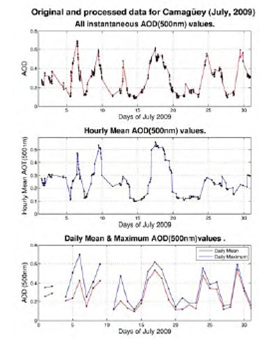
<body><![CDATA[<p><font size="2" face="Verdana">The SKIROM model has been   operational for more than 10 years. Recently a new upgraded version has been   released (Kallos et al., 2009). For the present comparison we have used the   SKIRON griddled (0.1° x 0.1°) daily hourly forecasts of AOD at 500 nm, from   July 1st to 31st, 2009. For the purposes of the comparison we selected   the AOD values in the area of 0.5º x 0.5º around the Camagüey sunphotometer   site. That grid box covers and area of 2874.5 km2. (&#8710;X = 51.7 km and &#8710;Y = 55.6 km).</font></p>     <p><font size="2" face="Verdana"><b>RESULTS AND DISCUSION</b></font></p>     <p><font size="2" face="Verdana"><b>Camagüey AOD measurements</b></font></p>     <p><font size="2" face="Verdana">The Camagüey AOD dataset (Version   2.0) for July 2009 consists of 735 instantaneous measurements. The data was   processed attending to three different criteria:</font></p>     <p><font size="2" face="Verdana">1.Hourly mean AOD <b>(H-AODCMG): </b>For each hour, each   day the mean AOD value was calculated, resulting in 239 H-<b>AODCMG </b>values.</font></p>     <p><font size="2" face="Verdana">2.Daily mean AOD <b>(D-AODCMG): </b>For each day the mean   AOD value was calculated, resulting 29 <b>D- AODCMG </b>values.</font></p>     <p><font size="2" face="Verdana">3.Daily maximum <b>AOD (DMx-AODCMG): </b>For each day the   maximum AOD value was calculated, resulting in 29 AOD{max} values. Also the   time of the occurrence of the <b>DMx-AODCMG </b>values were registered.</font></p>     <p><font size="2" face="Verdana">The figure 1 depicts on the top   panel the set of instantaneous measurements for the whole period of study (black   dots). In the middle panel appear the hourly mean values. In the bottom daily   means and maximum are plotted.</font></p>     <p><font size="2" face="Verdana"><b>SKIRON forecasts dataset:</b></font></p>     <p><font size="2" face="Verdana">Different magnitudes of the AOD were   calculated:</font></p>     ]]></body>
<body><![CDATA[<p><font size="2" face="Verdana">1.Hourly mean AOD (<b>H-AODSK</b>): Average of the AOD   over the selected grid box for each one of the 24 hours each day. (744 values)</font></p>     <p><font size="2" face="Verdana">2.Hourly maximum AOD (<b>HMx-AODSK</b>): Maximum value of   the AOD over the selected grid box for each one of the 24 hours each day. (744   values)</font></p>     <p><font size="2" face="Verdana">3.Daily means AOD (<b>D-AODSK</b>): Average of the AOD   over the selected grid box and over the 24 hours each day. (31 values)</font></p>     <p><font size="2" face="Verdana">4.Daily coincident maximum AOD (<b>DMx-AODSK</b>):   Maximum value of the forecasted AOD over the selected grid box for each one of   the 24 hours each day for the same hour the daily maximum AOD at Camagüey was   registered. (31 VALUES)</font></p>     <p><font size="2" face="Verdana"><img width=275 height=339 id="Imagen 2" src="/img/revistas/rbf/v20n20/v20n20a10-image002.png"></font></p>     <p><font size="2" face="Verdana"><b>Figure 1. Results of the   processing of AOD sun- photometer measurements at Camagüey.</b></font></p>     <p><font size="2" face="Verdana"><b>Comparison</b></font></p>     <p><font size="2" face="Verdana">The figure 2 shows the differences   between the hourly mean AOD measured at Camagüey (<b>H-AODCMG</b>) by   sunphotometer and the hourly mean AOD (<b>H-AODSK</b>) forecasted by SKIRON.   The last values were selected considering the values nearest in time to the   hour the sunphotometer measurement was conducted (239 pair of values). Those   differences are depicted in blue. For illustrative purposes the values of <b>H-AODCMG </b>are also plotted (green).</font></p>     <p><font size="2" face="Verdana"><img width=279 height=215 id="Imagen 3" src="/img/revistas/rbf/v20n20/v20n20a10-image003.png"></font></p>     <p><font size="2" face="Verdana">The higher differences in figure 2   are associated with the maximum values of the AOD registered by sunphotometer   at Camagüey caused by Saharan aerosols, all then negatives. This is a   consequence of the Saharan aerosols AOD values forecasted by SKIRON being   higher than the measured ones. In the cases of the lower AOD values measured,   in absence of Saharan aerosols, the differences are mainly positive, revealing   that in that case the AOD values forecasted by SKIRON being lower than the   measured ones. In several cases the forecasted AOD values are very little,   almost zero, producing differences of the same magnitude than the measured AOD.   This feature is produced by the fact that SKIRON do not takes into account the   background aerosols (and its corresponding AOD) produced by local sources.</font></p>     ]]></body>
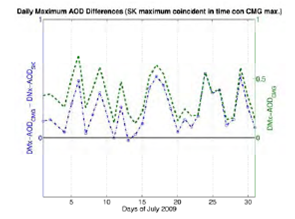
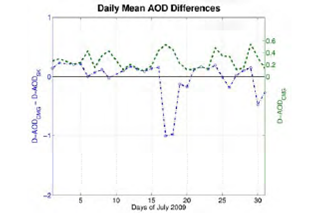
<body><![CDATA[<p><font size="2" face="Verdana">Figure 3 shows the difference   between the daily mean AOD measured (<b>D-AODCMG</b>) and the daily mean AOD   forecasted by SKIRON (<b>D-AODSK</b>). In general there is a decrease of the differences,   with less negative cases, but the main features discussed in figure 2 remain.</font></p>     <p><font size="2" face="Verdana"><img width=311 height=213 id="Imagen 4" src="/img/revistas/rbf/v20n20/v20n20a10-image004.png"></font></p>     <p><font size="2" face="Verdana">Figure 3: Daily mean AOD differences.</font></p>     <p><font size="2" face="Verdana">Figure 4 shows the difference between the measured daily   maximum AOD (DMx-AODCMG) and the forecasted daily maximum AOD (HMx-AODSK). It   resembles almost the same behavior that the hourly mean AOD differences in   figure 2.</font></p>     <p><font size="2" face="Verdana"><img width=295 height=219 id="Imagen 5" src="/img/revistas/rbf/v20n20/v20n20a10-image005.png"></font></p>     <p><font size="2" face="Verdana"><b>Figure 5: Daily maximum AOD   differences. Forecasted AOD maximum determined at the same hour than the   maximum measured AOD.</b></font></p>     <p><font size="2" face="Verdana"><b>CONCLUSIONS</b></font></p>     <p><font size="2" face="Verdana">From the former results several   preliminary conclusions have been obtained. The daily average values of the   sunphotometer measured and modeled forecasted AOD show the better agreement,   but still notable differences are present. The lack of background aerosols AOD   in the forecast produces additional differences in the absence of Saharan dust.   In the case of the long range transport of Saharan aerosols the forecasted AOD   values are higher than the measured ones.</font></p>     <p><font size="2" face="Verdana">Current work is in progress to   improve the comparisons and to conduct also comparisons with coincident MODIS   AOD observations.</font></p>     <p><font size="2" face="Verdana"><b>REFERENCES</b></font></p>     ]]></body>
<body><![CDATA[<!-- ref --><p><font size="2" face="Verdana">1.- Estevan, R., J. C. Antuña, B.   Barja, V. E. Cachorro, Á. M. de Frutos, A. Berjón, C. Toledano, B. Torres, R.   Rodrígo, T. A. Hernández y C. E. Hernández, 2011: Preliminary results of aerosols   measurements with sun photometer at Camagüey, Cuba. Opt. Pura Apl., 44 (1),   99-106.</font>&nbsp;&nbsp;&nbsp;&nbsp;&nbsp;&nbsp;&nbsp;&nbsp;[&#160;<a href="javascript:void(0);" onclick="javascript: window.open('/scielo.php?script=sci_nlinks&ref=229385&pid=S1562-3823201200040001000001&lng=','','width=640,height=500,resizable=yes,scrollbars=1,menubar=yes,');">Links</a>&#160;]<!-- end-ref --><!-- ref --><p><font size="2" face="Verdana">2.- Kallos, G. C. Spyrou, M.   Astitha, C. Mitsakou, S. Solomos, J. Kushta, I. Pytharoulis, P. Katsafados, E.   Mavromatidis, N. Papantoniou and G. Vlastou, 2009: Ten-year operational dust   forecasting - Recent model development and future plans. IOP Conf. Series:   Earth and Environmental Science, 7, 012012, doi:10.1088/1755-1307/7/1/012012.</font>&nbsp;&nbsp;&nbsp;&nbsp;&nbsp;&nbsp;&nbsp;&nbsp;[&#160;<a href="javascript:void(0);" onclick="javascript: window.open('/scielo.php?script=sci_nlinks&ref=229386&pid=S1562-3823201200040001000002&lng=','','width=640,height=500,resizable=yes,scrollbars=1,menubar=yes,');">Links</a>&#160;]<!-- end-ref --><!-- ref --><p><font size="2" face="Verdana">3.- Kaufman, Y. J., Koren, I.,   Remer, L. A., Tanr´e, D., Ginoux, P., and Fan, S., 2005: Dust transport and   deposition observed from the Terra-Moderate Resolution Imaging   Spectroradiometer (MODIS) spacecraft over the Atlantic Ocean, J. Geophys. Res.,   110, D10S12, doi:10.1029/2003JD004436</font>&nbsp;&nbsp;&nbsp;&nbsp;&nbsp;&nbsp;&nbsp;&nbsp;[&#160;<a href="javascript:void(0);" onclick="javascript: window.open('/scielo.php?script=sci_nlinks&ref=229387&pid=S1562-3823201200040001000003&lng=','','width=640,height=500,resizable=yes,scrollbars=1,menubar=yes,');">Links</a>&#160;]<!-- end-ref --> ]]></body><back>
<ref-list>
<ref id="B1">
<label>1</label><nlm-citation citation-type="journal">
<person-group person-group-type="author">
<name>
<surname><![CDATA[Estevan]]></surname>
<given-names><![CDATA[R.]]></given-names>
</name>
<name>
<surname><![CDATA[Antuña]]></surname>
<given-names><![CDATA[J. C.]]></given-names>
</name>
<name>
<surname><![CDATA[Barja]]></surname>
<given-names><![CDATA[B.]]></given-names>
</name>
<name>
<surname><![CDATA[Cachorro]]></surname>
<given-names><![CDATA[V. E.]]></given-names>
</name>
<name>
<surname><![CDATA[de Frutos]]></surname>
<given-names><![CDATA[Á. M.]]></given-names>
</name>
<name>
<surname><![CDATA[Berjón]]></surname>
<given-names><![CDATA[A.]]></given-names>
</name>
<name>
<surname><![CDATA[Toledano]]></surname>
<given-names><![CDATA[C.]]></given-names>
</name>
<name>
<surname><![CDATA[Torres]]></surname>
<given-names><![CDATA[B.]]></given-names>
</name>
<name>
<surname><![CDATA[Rodrígo]]></surname>
<given-names><![CDATA[R.]]></given-names>
</name>
<name>
<surname><![CDATA[Hernández]]></surname>
<given-names><![CDATA[T. A.]]></given-names>
</name>
<name>
<surname><![CDATA[Hernández]]></surname>
<given-names><![CDATA[C. E.]]></given-names>
</name>
</person-group>
<article-title xml:lang="en"><![CDATA[Preliminary results of aerosols measurements with sun photometer at Camagüey, Cuba.]]></article-title>
<source><![CDATA[Opt. Pura Apl.]]></source>
<year>2011</year>
<volume>44</volume>
<numero>1</numero>
<issue>1</issue>
<page-range>99-106</page-range></nlm-citation>
</ref>
<ref id="B2">
<label>2</label><nlm-citation citation-type="journal">
<person-group person-group-type="author">
<name>
<surname><![CDATA[Kallos]]></surname>
<given-names><![CDATA[G.]]></given-names>
</name>
<name>
<surname><![CDATA[Spyrou]]></surname>
<given-names><![CDATA[C.]]></given-names>
</name>
<name>
<surname><![CDATA[Astitha]]></surname>
<given-names><![CDATA[M.]]></given-names>
</name>
<name>
<surname><![CDATA[Mitsakou]]></surname>
<given-names><![CDATA[C.]]></given-names>
</name>
<name>
<surname><![CDATA[Solomos]]></surname>
<given-names><![CDATA[S.]]></given-names>
</name>
<name>
<surname><![CDATA[Kushta]]></surname>
<given-names><![CDATA[J.]]></given-names>
</name>
<name>
<surname><![CDATA[Pytharoulis]]></surname>
<given-names><![CDATA[I.]]></given-names>
</name>
<name>
<surname><![CDATA[Katsafados]]></surname>
<given-names><![CDATA[P.]]></given-names>
</name>
<name>
<surname><![CDATA[Mavromatidis]]></surname>
<given-names><![CDATA[E.]]></given-names>
</name>
<name>
<surname><![CDATA[Papantoniou]]></surname>
<given-names><![CDATA[N.]]></given-names>
</name>
<name>
<surname><![CDATA[Vlastou]]></surname>
<given-names><![CDATA[G.]]></given-names>
</name>
</person-group>
<article-title xml:lang="en"><![CDATA[Ten-year operational dust forecasting - Recent model development and future plans. IOP Conf. Series]]></article-title>
<source><![CDATA[Earth and Environmental Science]]></source>
<year>2009</year>
<volume>7</volume>
</nlm-citation>
</ref>
<ref id="B3">
<label>3</label><nlm-citation citation-type="journal">
<person-group person-group-type="author">
<name>
<surname><![CDATA[Kaufman]]></surname>
<given-names><![CDATA[Y. J.]]></given-names>
</name>
<name>
<surname><![CDATA[Koren]]></surname>
<given-names><![CDATA[I.]]></given-names>
</name>
<name>
<surname><![CDATA[Remer]]></surname>
<given-names><![CDATA[L. A.]]></given-names>
</name>
<name>
<surname><![CDATA[Tanr´e]]></surname>
<given-names><![CDATA[D.]]></given-names>
</name>
<name>
<surname><![CDATA[Ginoux]]></surname>
<given-names><![CDATA[P.]]></given-names>
</name>
<name>
<surname><![CDATA[Fan]]></surname>
<given-names><![CDATA[S.]]></given-names>
</name>
</person-group>
<article-title xml:lang="en"><![CDATA[Dust transport and deposition observed from the Terra-Moderate Resolution Imaging Spectroradiometer (MODIS) spacecraft over the Atlantic Ocean]]></article-title>
<source><![CDATA[J. Geophys. Res.]]></source>
<year>2005</year>
<volume>110</volume>
</nlm-citation>
</ref>
</ref-list>
</back>
</article>