<?xml version="1.0" encoding="ISO-8859-1"?><article xmlns:mml="http://www.w3.org/1998/Math/MathML" xmlns:xlink="http://www.w3.org/1999/xlink" xmlns:xsi="http://www.w3.org/2001/XMLSchema-instance">
<front>
<journal-meta>
<journal-id>1562-3823</journal-id>
<journal-title><![CDATA[Revista Boliviana de Física]]></journal-title>
<abbrev-journal-title><![CDATA[Revista Boliviana de Física]]></abbrev-journal-title>
<issn>1562-3823</issn>
<publisher>
<publisher-name><![CDATA[Sociedad Boliviana de Física]]></publisher-name>
</publisher>
</journal-meta>
<article-meta>
<article-id>S1562-38232012000400008</article-id>
<title-group>
<article-title xml:lang="en"><![CDATA[Southern Brazil: analysis of aerosols from different sources through the sensors MODIS and CALIOP]]></article-title>
</title-group>
<contrib-group>
<contrib contrib-type="author">
<name>
<surname><![CDATA[Glauber Lopes]]></surname>
<given-names><![CDATA[Mariano]]></given-names>
</name>
</contrib>
</contrib-group>
<aff id="A01">
<institution><![CDATA[,Brazil Professor - Meteorology Department at Universidade Federal de Pelotas ]]></institution>
<addr-line><![CDATA[ ]]></addr-line>
<country>Brazil</country>
</aff>
<aff id="A02">
<institution><![CDATA[,Brazil PhD student - National Institute for Space Research - Space Geophysics Division ]]></institution>
<addr-line><![CDATA[ ]]></addr-line>
<country>Brazil</country>
</aff>
<aff id="A03">
<institution><![CDATA[,Brazil Graduation student - Meteorology Department at Universidade Federal de Pelotas ]]></institution>
<addr-line><![CDATA[ ]]></addr-line>
<country>Brazil</country>
</aff>
<pub-date pub-type="pub">
<day>00</day>
<month>00</month>
<year>2012</year>
</pub-date>
<pub-date pub-type="epub">
<day>00</day>
<month>00</month>
<year>2012</year>
</pub-date>
<volume>20</volume>
<numero>20</numero>
<fpage>21</fpage>
<lpage>23</lpage>
<copyright-statement/>
<copyright-year/>
<self-uri xlink:href="http://www.scielo.org.bo/scielo.php?script=sci_arttext&amp;pid=S1562-38232012000400008&amp;lng=en&amp;nrm=iso"></self-uri><self-uri xlink:href="http://www.scielo.org.bo/scielo.php?script=sci_abstract&amp;pid=S1562-38232012000400008&amp;lng=en&amp;nrm=iso"></self-uri><self-uri xlink:href="http://www.scielo.org.bo/scielo.php?script=sci_pdf&amp;pid=S1562-38232012000400008&amp;lng=en&amp;nrm=iso"></self-uri><abstract abstract-type="short" xml:lang="en"><p><![CDATA[Aerosols in the atmosphere directly and indirectly influence the climate of a region. However, studies related to the effects of aerosols in some areas are scarce. The southern region of Brazil is located next to major known sources of particulate matter (Brazilian savanna, Amazonia and southeastern Brazil). Thus, it has the peculiarity of having the contribution of the transport of aerosols from other sources with optical characteristics very different from each other, also with the influence of regional aerosols. This paper aims to present a project to analyze the impact of aerosols in the atmosphere over the Southern region using satellite data from Terra/Aqua (MODIS) and CALIPSO (CALIOP sensor) in the period from 2007 to 2010. With the measurements of aerosol optical depth, the atmosphere in the region will be classified into different groups. We also intend to analyze the vertical profile of aerosols and transport patterns of particulate matter from sources close to the study area, the latter with FNL data from NCEP with 1.0 ° of space resolution and time resolution of 6h. Through the preliminary results it is clear that the optical depth of aerosols in the years 2009 and 2010 reached a maximum during the winter period, probably due to fires that occur in a large part of South America]]></p></abstract>
<kwd-group>
<kwd lng="en"><![CDATA[aerosol]]></kwd>
<kwd lng="en"><![CDATA[MODIS]]></kwd>
<kwd lng="en"><![CDATA[southern Brazil]]></kwd>
<kwd lng="en"><![CDATA[CALIPSO]]></kwd>
</kwd-group>
</article-meta>
</front><body><![CDATA[ <p align="center"><font size="4" face="Verdana"><strong>Southern   Brazil: analysis of aerosols from different sources through the sensors MODIS   and CALIOP</strong></font></p>     <p align="center">&nbsp;</p>     <p align="center"><strong><font size="2" face="Verdana">Glauber   Lopes Mariano</font></strong></p>     <p align="center"><strong><font size="2" face="Verdana">Professor   - Meteorology Department at Universidade Federal de Pelotas</font></strong></p>     <p align="center"><strong><font size="2" face="Verdana">Pelotas-RS,   Brazil</font></strong></p>     <p align="center"><strong><font size="2" face="Verdana">Tel:   +55 5332757321 , E-mail: glauber.mariano@ufpel.edu.br</font></strong></p>     <p align="center">&nbsp;</p>     <p align="center"><strong><font size="2" face="Verdana">Ericka   Voss Chagas Mariano</font></strong></p>     <p align="center"><strong><font size="2" face="Verdana">PhD   student – National Institute for Space Research – Space Geophysics Division</font></strong></p>     <p align="center"><strong><font size="2" face="Verdana">São   José dos Campos-SP, Brazil</font></strong></p>     ]]></body>
<body><![CDATA[<p align="center"><strong><font size="2" face="Verdana">E-mail:   erickavoss@gmail.com</font></strong></p>     <p align="center">&nbsp;</p>     <p align="center"><strong><font size="2" face="Verdana">Renã   Moreira</font></strong></p>     <p align="center"><strong><font size="2" face="Verdana">Graduation   student - Meteorology Department at Universidade Federal de Pelotas</font></strong></p>     <p align="center"><strong><font size="2" face="Verdana">Pelotas-RS,   Brazil</font></strong></p>     <p align="center"><strong><font size="2" face="Verdana">Tel:   +55 5332757321, E-mail: rena543@gmail.com</font></strong></p><hr>     <p><font size="2" face="Verdana"><b>SUMMARY</b></font></p>     <p><font size="2" face="Verdana">Aerosols in the atmosphere directly   and indirectly influence the climate of a region. However, studies related to   the effects of aerosols in some areas are scarce. The southern region of Brazil   is located next to major known sources of particulate matter (Brazilian   savanna, Amazonia and southeastern Brazil). Thus, it has the peculiarity of   having the contribution of the transport of aerosols from other sources with   optical characteristics very different from each other, also with the influence   of regional aerosols. This paper aims to present a project to analyze the   impact of aerosols in the atmosphere over the Southern region using satellite data   from Terra/Aqua (MODIS) and CALIPSO (CALIOP sensor) in the period from 2007 to   2010. With the measurements of aerosol optical depth, the atmosphere in the   region will be classified into different groups. We also intend to analyze the   vertical profile of aerosols and transport patterns of particulate matter from   sources close to the study area, the latter with FNL data from NCEP with 1.0 °   of space resolution and time resolution of 6h. Through the preliminary results   it is clear that the optical depth of aerosols in the years 2009 and 2010   reached a maximum during the winter period, probably due to fires that occur in   a large part of South America</font></p>     <p><font size="2" face="Verdana"><b>Key words: </b>aerosol, MODIS, southern Brazil, CALIPSO</font></p><hr>     <p><font size="2" face="Verdana"><b>INTRODUCTION</b></font></p>     ]]></body>
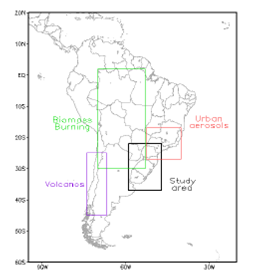
<body><![CDATA[<p><font size="2" face="Verdana">The atmospheric aerosol consists of   solid and liquid particles suspended in the atmosphere and have direct and   indirect impacts on climate. The direct influence of aerosols on climate is the   ability to absorb or reflect solar radiation, which depends on the chemical   properties and particle size, resulting in a heating or cooling of the   atmosphere. The indirect effects of aerosols refer to their ability to act as   cloud condensation nuclei, changing the properties of clouds (Seinfeld and   Pandis, 1998).</font></p>     <p><font size="2" face="Verdana">The southern region of Brazil,   besides the aerosols emitted locally by natural and anthropogenic sources,   suffers from the advection of pollutants originated at the major regions of   aerosol production (e.g. the Amazon region, central and southeastern Brazil)   due to the circulation present in the region (e.g. Freitas et al., 2006)   (figure 1). This causes an impact on both the quantity of aerosols in the   region and in the net radiation at the surface.</font></p>     <p><font size="2" face="Verdana">Some preliminary studies in the   project scope using data from the MODIS sensor have shown the influence and impact   of some types of aerosols in the atmosphere of southern Brazil, highlighting   burning aerosols and volcanic ash resulting from the eruption of Puyehue,   Chile, in June 2011.</font></p>     <p><font size="2" face="Verdana">One way to study and evaluate the   impacts induced by the aerosols is to analyze its vertical distribution and   impact of their presence through variables such as aerosol optical depth (AOD),   in addition to the backscatter and absorption coefficients as used in a series   of recent studies for the state of São Paulo (Landulfo et al., 2010, Mariano et   al., 2010a and Mariano et al., 2010b).</font></p>     <p><font size="2" face="Verdana">Therefore, it is necessary to deepen   the knowledge of the impacts that aerosols originating from local sources and   advected from other regions in the Southern Brazil have in the local   atmosphere, in order to understand its influence on solar radiation and   consequent improvement of meteorological models.</font></p>     <p><font size="2" face="Verdana"><b>METHOD AND RESULTS</b></font></p>     <p><font size="2" face="Verdana"><b>MODIS sensor</b></font></p>     <p><font size="2" face="Verdana">The MODIS sensor is onboard the   polar orbiting satellites Terra and Aqua launched in 1999 and 2002,   respectively. The sensor was the first designed to obtain global observations   of aerosols with moderate resolution (between 250m and 1000m depending on the   wavelength used).</font></p>     <p><font size="2" face="Verdana"><img width=263 height=275 src="/img/revistas/rbf/v20n20/v20n20a08-image002.png" v:shapes="Imagen_x0020_2"></font></p>     <p><font size="2" face="Verdana"><b>Figure 1. </b>Aerosol type and study area</font></p>     ]]></body>
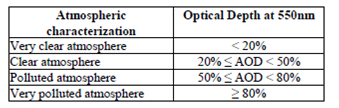
<body><![CDATA[<p><font size="2" face="Verdana">General and operational   characteristics of the sensor can be found at Barnes et al. (1998). It is   noteworthy that the same has 36 spectral bands between 0.4 and 14.5 µm,   allowing the generation of several products related to aerosol optical depth   over the ocean and land with a resolution of 10x10 km (at nadir), and to the   size distribution and type of aerosol over the continent.</font></p>     <p><font size="2" face="Verdana"><b>CALIOP sensor</b></font></p>     <p><font size="2" face="Verdana">The satellite Cloud-Aerosol Lidar   and Infrared Pathfinder Satellite Observations (CALIPSO) has an on-board LIDAR   system operating at two wavelengths (1064 and 532nm), called the Cloud-Aerosol   LIDAR with Orthogonal Polarization (CALIOP). The spatial resolution of the   sensor depends on the altitude – from the surface to 8.2 km the horizontal   resolution is 333 m and 30 m vertically, while between 8.2 and 20.2 km is 1000   m and 60 m, horizontal and vertical resolution, respectively.</font></p>     <p><font size="2" face="Verdana"><b>DATA AND STUDY REGION</b></font></p>     <p><font size="2" face="Verdana">The data used will be from MODIS   (TERRA and AQUA satellites) and the CALIOP sensor (CALIPSO satellite) in the   period from 2007 to 2010, to analyze the impact of different types of aerosol   in the optical depth and backscatter and   absorption coefficients.</font></p>     <p><font size="2" face="Verdana">The MODIS sensor data analyzed in   the project consists of the product aerosol level 2 and 3, respectively MOD04   and MOD08. These two levels of data are generated globally every day, offering   several properties related to aerosols such as optical depth over ocean/continent   and Angstrom exponent over land. The data spatial resolution is 10x10 km (at   nadir) for products of level 2 and 1.0 º for level 3.</font></p>     <p><font size="2" face="Verdana">Concerning the vertical profile of   aerosols and some of its optical properties, data from the CALIOP sensor in the   so called level 1B and level 2, that provide information of the perpendicular   and total backscattering attenuated coefficient at 532 nm and 1064nm, and the   extinction coefficient at 532 and 1064 nm and values of Lidar Ratio, will be   used.</font></p>     <p><font size="2" face="Verdana">It is intended to also use the   information obtained by the CALIOP sensor on the observed particle type (also   called vertical mask), and aerosol subtype. To obtain the synoptic patterns   that cause the transport of aerosols of known major sources such as the Amazon   Region, Midwest and Southeast regions of Brazil to the Southern Region, the   final analysis (FNL) of the National Centers for Environmental Prediction   (NCEP) for the same period mentioned above will be used. These analyses have   spatial and temporal resolutions of 1x1 degrees and 6 h, respectively, and 26   vertical levels.</font></p>     <p><font size="2" face="Verdana">Initially, it is intended to   separate, by seasons, the optical depth obtained in four different groups for   the study area, as shown in Table 1. Thus, 100% refers to the maximum AOD found   during the study period, in southern Brazil (black area at Figure 01).</font></p>     <p><font size="2" face="Verdana"><b>Table 1</b>. Characterization of the atmosphere according to the   values of the maximum aerosol optical depth (2007-2010) at 550nm</font></p>     ]]></body>
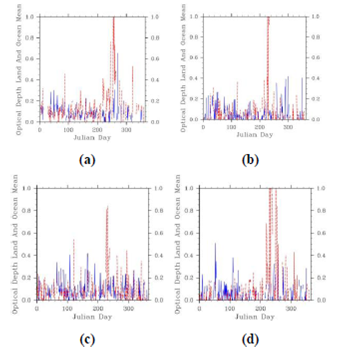
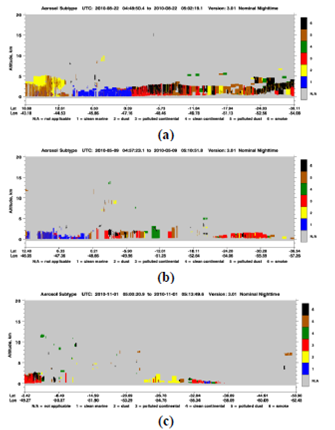
<body><![CDATA[<p><font size="2" face="Verdana"><img width=339 height=108 src="/img/revistas/rbf/v20n20/v20n20a08-image004.png" v:shapes="Imagen_x0020_3"></font></p>     <p><font size="2" face="Verdana"><b>RESULTS</b></font></p>     <p><font size="2" face="Verdana">A preliminary analysis of the aerosol optical depth in the years 2009   and 2010 for São Paulo, Pelotas, Chuí and Foz do  Iguaçu can be seen in Figure 2. Note an   increase of the values during the winter of the region in both years. Possibly, this increase is   due to the entrance of burning plumes that occurred in central Brazil and at   the Amazon. It was noticed that the maximum values found during the study   period was: 1.2 (São Paulo), 3.2 (Pelotas), 2.4 (Chuí) and 4.2 (Foz do Iguaçu).</font></p>     <p><font size="2" face="Verdana"><img width=343 height=347 src="/img/revistas/rbf/v20n20/v20n20a08-image006.png" v:shapes="Imagen_x0020_4"></font></p>     <p><font size="2" face="Verdana"><b>Figure 2. </b>Aerosol optical depth at 2009 (blue) and 2010 (dashed   red) to São Paulo(a), Pelotas (b), Chuí (c) and Foz do Iguaçu (d) obtained by   the MODIS sensor</font></p>     <p><font size="2" face="Verdana">The reason for the apparent low   value of optical depth for the city of São Paulo may have been resultant of the   choice for the point of extraction of values from the MODIS sensor data. This   indicates that one should choose an area representative of São Paulo and then   extract the maximum value of this region.</font></p>     <p><font size="2" face="Verdana">Figure 3 shows three examples of   types of aerosols over the southern region of Brazil (being better   distinguished between latitudes 28° S and 35º S). It can be noted, over the   study area, smoke aerosol (Figure 3a), polluted continental (Figure 3b) and   dust and polluted dust (Figure 3c).</font></p>     <p><font size="2" face="Verdana"><img width=335 height=430 src="/img/revistas/rbf/v20n20/v20n20a08-image008.png" v:shapes="Imagen_x0020_5"></font></p>     <p><font size="2" face="Verdana"><b>Figure 3. </b>Aerosol Subtype by CALIOP sensor for 08/22/2010(a),   09/05/2010 (b) and 11/01/2010 (c)</font></p>     <p><font size="2" face="Verdana"><b>CONCLUSIONS</b></font></p>     ]]></body>
<body><![CDATA[<p><font size="2" face="Verdana">The study area, as well as other   regions that are not known large emitters of aerosol lack studies on the   spatial-temporal variability of aerosols, not considering the importance of the   advection of these aerosols from other regions. It is believed that this work   can contribute directly to these issues, especially in the Southern region of   Brazil due to the likely influence of several major known sources of aerosols:   fires in the Amazon and the Brazilian savanna, anthropogenic aerosols in   metropolitan areas of São Paulo, Rio de Janeiro, among others.</font></p>     <p><font size="2" face="Verdana">The information obtained may also   contribute to atmospheric modeling, because of the greater understanding of   aerosol- solar radiation interaction on the region, and thus provide a basis for   improvement of numerical models for weather forecasts, climate and air quality.</font></p>     <p><font size="2" face="Verdana"><b>ACKNOWLEDGMENTS</b></font></p>     <p><font size="2" face="Verdana">The authors would like to thank the   Research Foundation of the State of Rio Grande do Sul (FAPERGS) for the   approval of the project for this study. To the post-graduate program in   Meteorology at the Federal University of Pelotas and the WLMLA organizing   committee for their support for the participation on the event.</font></p>     <p><font size="2" face="Verdana"><b>REFERENCES</b></font></p>     <p><font size="2" face="Verdana">1.- BARNES, W.L., T. S. PAGANO, E   V.V. SALOMONSON. Prelaunch characteristics of the Moderate Resolution Imaging   Spectroradiometer (MODIS) on EOS-AM1. IEEE Trans. Geosci. Remote Sensing, vol.   36, p. 1088–1100, 1998</font></p>     <p><font size="2" face="Verdana">FREITAS, S.R.; LONGO, K.; SILVA   DIAS, M.A.; SILVA DIAS, P.L; CHATFIELD, R.; FAZENDA, A.;RODRIGUES, L.F. The   Coupled aerosol and tracer transport model to the brasilian developments on the   regional atmospheric modeling system: Validation using direct and remote   sensing observations. Proceedings of 8 ICSHMO, Foz do Iguaçu, Brazil, April   24-28, p. 101-107, 2006.</font></p>     <p><font size="2" face="Verdana">2.- LANDULFO, E. ; LOPES, F. J. ;   MARIANO, G. L. ; TORRES, A.S. ; JESUS, W.C. ; NAKAEMA, W. M. ; JORGE, M.P.P.M ;   MARANI, R.L. . Study of the Properties of Aerosols and the Air Quality Index   Using a Backscatter Lidar System and Aeronet Sunphotometer in the City of São   Paulo, Brazil. Journal of the Air and Waste Management Association, v. 60, p.   1, 2010.</font></p>     <p><font size="2" face="Verdana">3.- MARIANO, G.L. ; LOPES, F. J. ;   STEFFENS, J. ; MARTINS, M.P.P. ; LANDULFO, E. ; HELD, G. ; ANJOS, S. . Aerosols   Monitoring in Rio Claro, Brazil: Using LIDAR and Air Pollution Analyzers.   Optica Pura y Aplicada, v. 44, p. 55-64, 2011.</font></p>     <p><font size="2" face="Verdana">4.- MARIANO, G.L. ; LOPES, F.J.S. ;   JORGE, M.P.P.M. ; LANDULFO, E. . Assessment of biomass burnings activity with   the synergy of sunphotometric and LIDAR measurements in São Paulo, Brazil.   Atmospheric Research (Print), v. 98, p. 486-499, 2010a.</font></p>     ]]></body>
<body><![CDATA[<p><font size="2" face="Verdana">5.- MARIANO, G.L. Efeitos das   queimadas na atmosfera do estado de São Paulo – Análise de fontes próximas e   distantes através de Lidar. Tese (doutorado em Meteorologia). Instituto   Nacional de Pesquisas Espaciais, São José dos Campos-SP, 2010b.</font></p>     <p><font size="2" face="Verdana">6.- SEINFELD, J.H.; PANDIS, S.N.   Atmospheric Chemistry and Physics: From Air Pollution to Climate Change. New   York: John Wiley &amp; Sons, Inc., 1360p. 1998.</font></p>      ]]></body><back>
<ref-list>
<ref id="B1">
<label>1</label><nlm-citation citation-type="journal">
<person-group person-group-type="author">
<name>
<surname><![CDATA[BARNES]]></surname>
<given-names><![CDATA[W.L.]]></given-names>
</name>
<name>
<surname><![CDATA[PAGANO]]></surname>
<given-names><![CDATA[T. S.]]></given-names>
</name>
<name>
<surname><![CDATA[SALOMONSON]]></surname>
<given-names><![CDATA[E V.V.]]></given-names>
</name>
</person-group>
<article-title xml:lang="en"><![CDATA[Prelaunch characteristics of the Moderate Resolution Imaging Spectroradiometer (MODIS) EOS-AM1]]></article-title>
<source><![CDATA[IEEE Trans. Geosci. Remote Sensing]]></source>
<year>1998</year>
<volume>36</volume>
<page-range>1088-1100</page-range></nlm-citation>
</ref>
<ref id="B2">
<label>2</label><nlm-citation citation-type="journal">
<person-group person-group-type="author">
<name>
<surname><![CDATA[FREITAS]]></surname>
<given-names><![CDATA[S.R.]]></given-names>
</name>
<name>
<surname><![CDATA[LONGO]]></surname>
<given-names><![CDATA[K.]]></given-names>
</name>
<name>
<surname><![CDATA[SILVA DIAS]]></surname>
<given-names><![CDATA[M.A.]]></given-names>
</name>
<name>
<surname><![CDATA[SILVA DIAS]]></surname>
<given-names><![CDATA[P.L]]></given-names>
</name>
<name>
<surname><![CDATA[CHATFIELD]]></surname>
<given-names><![CDATA[R.]]></given-names>
</name>
<name>
<surname><![CDATA[FAZENDA]]></surname>
<given-names><![CDATA[A.]]></given-names>
</name>
<name>
<surname><![CDATA[RODRIGUES]]></surname>
<given-names><![CDATA[L.F.]]></given-names>
</name>
</person-group>
<article-title xml:lang="en"><![CDATA[The Coupled aerosol and tracer transport model to the brasilian developments on the regional atmospheric modeling system: Validation using direct and remote sensing observations]]></article-title>
<source><![CDATA[Proceedings of 8 ICSHMO]]></source>
<year>2006</year>
<page-range>101-107</page-range><publisher-name><![CDATA[Foz do Iguaçu]]></publisher-name>
</nlm-citation>
</ref>
<ref id="B3">
<label>3</label><nlm-citation citation-type="journal">
<person-group person-group-type="author">
<name>
<surname><![CDATA[LANDULFO]]></surname>
<given-names><![CDATA[E.]]></given-names>
</name>
<name>
<surname><![CDATA[LOPES]]></surname>
<given-names><![CDATA[F. J.]]></given-names>
</name>
<name>
<surname><![CDATA[MARIANO]]></surname>
<given-names><![CDATA[G. L.]]></given-names>
</name>
<name>
<surname><![CDATA[TORRES]]></surname>
<given-names><![CDATA[A.S.]]></given-names>
</name>
<name>
<surname><![CDATA[JESUS]]></surname>
<given-names><![CDATA[W.C.]]></given-names>
</name>
<name>
<surname><![CDATA[NAKAEMA]]></surname>
<given-names><![CDATA[W. M.]]></given-names>
</name>
<name>
<surname><![CDATA[JORGE]]></surname>
<given-names><![CDATA[M.P.P.M]]></given-names>
</name>
<name>
<surname><![CDATA[MARANI]]></surname>
<given-names><![CDATA[R.L.]]></given-names>
</name>
</person-group>
<article-title xml:lang="en"><![CDATA[Study of the Properties of Aerosols and the Air Quality Index Using a Backscatter Lidar System and Aeronet Sunphotometer in the City of São Paulo, Brazil]]></article-title>
<source><![CDATA[Journal of the Air and Waste Management Association]]></source>
<year>2010</year>
<volume>60</volume>
<page-range>1</page-range></nlm-citation>
</ref>
<ref id="B4">
<label>4</label><nlm-citation citation-type="journal">
<person-group person-group-type="author">
<name>
<surname><![CDATA[MARIANO]]></surname>
<given-names><![CDATA[G.L.]]></given-names>
</name>
<name>
<surname><![CDATA[LOPES]]></surname>
<given-names><![CDATA[F. J.]]></given-names>
</name>
<name>
<surname><![CDATA[STEFFENS]]></surname>
<given-names><![CDATA[J.]]></given-names>
</name>
<name>
<surname><![CDATA[MARTINS]]></surname>
<given-names><![CDATA[M.P.P.]]></given-names>
</name>
<name>
<surname><![CDATA[LANDULFO]]></surname>
<given-names><![CDATA[E.]]></given-names>
</name>
<name>
<surname><![CDATA[HELD]]></surname>
<given-names><![CDATA[G.]]></given-names>
</name>
<name>
<surname><![CDATA[ANJOS]]></surname>
<given-names><![CDATA[S.]]></given-names>
</name>
</person-group>
<article-title xml:lang="en"><![CDATA[Aerosols Monitoring in Rio Claro, Brazil]]></article-title>
<source><![CDATA[Using LIDAR and Air Pollution Analyzers]]></source>
<year>2011</year>
<volume>44</volume>
<page-range>55-64</page-range></nlm-citation>
</ref>
<ref id="B5">
<label>5</label><nlm-citation citation-type="journal">
<person-group person-group-type="author">
<name>
<surname><![CDATA[MARIANO]]></surname>
<given-names><![CDATA[G.L.]]></given-names>
</name>
<name>
<surname><![CDATA[LOPES]]></surname>
<given-names><![CDATA[F.J.S.]]></given-names>
</name>
<name>
<surname><![CDATA[JORGE]]></surname>
<given-names><![CDATA[M.P.P.M.]]></given-names>
</name>
<name>
<surname><![CDATA[LANDULFO]]></surname>
<given-names><![CDATA[E.]]></given-names>
</name>
</person-group>
<article-title xml:lang="en"><![CDATA[Assessment of biomass burnings activity with the synergy of sunphotometric and LIDAR measurements in São Paulo, Brazil]]></article-title>
<source><![CDATA[Atmospheric Research (Print)]]></source>
<year>2010</year>
<volume>98</volume>
<page-range>486-499</page-range></nlm-citation>
</ref>
<ref id="B6">
<label>6</label><nlm-citation citation-type="book">
<person-group person-group-type="author">
<name>
<surname><![CDATA[MARIANO]]></surname>
<given-names><![CDATA[G.L.]]></given-names>
</name>
</person-group>
<article-title xml:lang="en"><![CDATA[Efeitos das queimadas na atmosfera do estado de São Paulo - Análise de fontes próximas e distantes através de Lidar]]></article-title>
<source><![CDATA[Tese (doutorado em Meteorologia)]]></source>
<year>2010</year>
<publisher-name><![CDATA[Instituto Nacional de Pesquisas Espaciais, São José dos Campos-SP]]></publisher-name>
</nlm-citation>
</ref>
<ref id="B7">
<label>7</label><nlm-citation citation-type="book">
<person-group person-group-type="author">
<name>
<surname><![CDATA[SEINFELD]]></surname>
<given-names><![CDATA[J.H.]]></given-names>
</name>
<name>
<surname><![CDATA[PANDIS]]></surname>
<given-names><![CDATA[S.N.]]></given-names>
</name>
</person-group>
<article-title xml:lang="en"><![CDATA[Atmospheric Chemistry and Physics]]></article-title>
<source><![CDATA[From Air Pollution to Climate Change]]></source>
<year>1998</year>
<page-range>1360</page-range><publisher-loc><![CDATA[New York ]]></publisher-loc>
<publisher-name><![CDATA[John Wiley & Sons, Inc.]]></publisher-name>
</nlm-citation>
</ref>
</ref-list>
</back>
</article>