<?xml version="1.0" encoding="ISO-8859-1"?><article xmlns:mml="http://www.w3.org/1998/Math/MathML" xmlns:xlink="http://www.w3.org/1999/xlink" xmlns:xsi="http://www.w3.org/2001/XMLSchema-instance">
<front>
<journal-meta>
<journal-id>1562-3823</journal-id>
<journal-title><![CDATA[Revista Boliviana de Física]]></journal-title>
<abbrev-journal-title><![CDATA[Revista Boliviana de Física]]></abbrev-journal-title>
<issn>1562-3823</issn>
<publisher>
<publisher-name><![CDATA[Sociedad Boliviana de Física]]></publisher-name>
</publisher>
</journal-meta>
<article-meta>
<article-id>S1562-38232012000400002</article-id>
<title-group>
<article-title xml:lang="en"><![CDATA[Optimized data-gluing method for mixed analog/photon-counting lidar signals]]></article-title>
</title-group>
<contrib-group>
<contrib contrib-type="author">
<name>
<surname><![CDATA[Lange]]></surname>
<given-names><![CDATA[Diego]]></given-names>
</name>
</contrib>
<contrib contrib-type="author">
<name>
<surname><![CDATA[Kumar]]></surname>
<given-names><![CDATA[Dhiraj]]></given-names>
</name>
</contrib>
<contrib contrib-type="author">
<name>
<surname><![CDATA[Rocadenbosch]]></surname>
<given-names><![CDATA[Francesc]]></given-names>
</name>
</contrib>
<contrib contrib-type="author">
<name>
<surname><![CDATA[Sicard]]></surname>
<given-names><![CDATA[Michaël]]></given-names>
</name>
</contrib>
<contrib contrib-type="author">
<name>
<surname><![CDATA[Comerón]]></surname>
<given-names><![CDATA[Adolfo]]></given-names>
</name>
</contrib>
</contrib-group>
<aff id="A01">
<institution><![CDATA[,Barcelona, Spain. Universitat Politècnica de Catalunya (UPC) Dept. of Signal Theory and Communications (TSC)]]></institution>
<addr-line><![CDATA[Barcelona ]]></addr-line>
<country>Spain.</country>
</aff>
<aff id="A02">
<institution><![CDATA[,Barcelona, Spain. Universitat Politècnica de Catalunya (UPC) Centre de Recerca de l'Aeronàutica i de l'Espai (CRAE),]]></institution>
<addr-line><![CDATA[Barcelona ]]></addr-line>
<country>Spain.</country>
</aff>
<pub-date pub-type="pub">
<day>00</day>
<month>00</month>
<year>2012</year>
</pub-date>
<pub-date pub-type="epub">
<day>00</day>
<month>00</month>
<year>2012</year>
</pub-date>
<volume>20</volume>
<numero>20</numero>
<fpage>4</fpage>
<lpage>6</lpage>
<copyright-statement/>
<copyright-year/>
<self-uri xlink:href="http://www.scielo.org.bo/scielo.php?script=sci_arttext&amp;pid=S1562-38232012000400002&amp;lng=en&amp;nrm=iso"></self-uri><self-uri xlink:href="http://www.scielo.org.bo/scielo.php?script=sci_abstract&amp;pid=S1562-38232012000400002&amp;lng=en&amp;nrm=iso"></self-uri><self-uri xlink:href="http://www.scielo.org.bo/scielo.php?script=sci_pdf&amp;pid=S1562-38232012000400002&amp;lng=en&amp;nrm=iso"></self-uri><abstract abstract-type="short" xml:lang="en"><p><![CDATA[In atmospheric LIDAR (Light Detection and Ranging) remote sensing, the dynamic range of the return power signals can span up to five orders of magnitude. Modern acquisition systems such as those based on LicelTM transient recorders combine a dual acquisition mode in which the return signal is recorded simultaneously in both analog (analog-to-digital (AD) conversion) and photon-counting (PC) modes. Although both data records can be analyzed separately, their combination obtained through gluing gives the advantage of the high linearity of the AD conversion for high light-level signals (especially in the near range) and the high sensitivity of the PC mode for low light-level signals (in the far range). Recently, eruptions of volcanoes such as Eyjafjalla (Iceland) in 2010, Grímsvötn (Iceland Puyehue (Argentina) Nabro (Eritrea) and Mount Lokon (Indonesia) in 2011 have yielded emergency situations with a strong economical cost due to human evacuation and/or air traffic interruption. Volcanic aerosols are first injected in the troposphere and often reach the stratosphere where they can reside for several years. The mixed analog/photo-counting acquisition approach is particularly suitable for the detection of volcanic aerosols in both the troposphere (near/mid range) and the stratosphere (far range). In this line, a case study showing volcanic aerosols from the Nabro volcano (Eritrea, 2011) in the stratosphere and simultaneously Saharan dust in the troposphere over the multi-spectral Barcelona lidar station during the period 27 June - 1 July 2011 is presented. The benefits of the proposed gluing technique will be shown through the comparison of analog, PC, and glued backscatter-coefficient time series. Existing gluing algorithms solve the fitting coefficients by matching both analog and PC data over a predefined spatial range (or equivalently, over a predefined upper and lower counting rate) depending on which kind of photodetector (usually a photomultiplier) is being used. In this work, an enhanced data-gluing formulation is presented. The method automatically finds the spatial range where both analog and PC signals are more similar based on Euclidian distance minimization over piece-wise range intervals along the whole acquisition spatial range.]]></p></abstract>
<kwd-group>
<kwd lng="en"><![CDATA[Lidar]]></kwd>
<kwd lng="en"><![CDATA[volcanic eruptions]]></kwd>
<kwd lng="en"><![CDATA[tropospheric and stratospheric aerosols]]></kwd>
<kwd lng="en"><![CDATA[gluing]]></kwd>
</kwd-group>
</article-meta>
</front><body><![CDATA[ <p align="center"><font size="4" face="Verdana"><b>Optimized   data-gluing method for mixed analog/photon-counting lidar   signals</b></font></p>     <p align="center">&nbsp;</p>     <p align="center">&nbsp;</p>     <p align="center"><font size="3" face="Verdana"><b>Diego   Lange(1,2), Dhiraj   Kumar(1,2), Francesc   Rocadenbosch(1,2), Michaël   Sicard(1,2), Adolfo   Comerón(1)</b></font></p>     <p align="center">&nbsp;</p>     <p align="center"><font size="2" face="Verdana">(1)Remote Sensing   Laboratory (RSLab), Dept. of Signal Theory and Communications (TSC),   Universitat Politècnica de Catalunya </font><font size="2" face="Verdana">(UPC),   Barcelona, Spain.</font></p>     <p align="center"><font size="2" face="Verdana">(2)Institut   d'Estudis Espacials de Catalunya (IEEC) - Centre de Recerca de l'Aeronàutica i   de l'Espai (CRAE), Universitat Politècnica </font><font size="2" face="Verdana">de   Catalunya (UPC), Barcelona, Spain.</font></p>     <p align="center"><font size="2" face="Verdana">Tel: (+34)934016849, Fax: (+34)934017200, E-mail: <a href="mailto:roca@tsc.upc.edu">roca@tsc.upc.edu</a></font></p><hr>     <p><font size="2" face="Verdana"><b>SUMMARY</b></font></p>     <p><font size="2" face="Verdana">In   atmospheric LIDAR (Light Detection and Ranging) remote sensing, the dynamic   range of the return power signals can span up   to five orders of magnitude. Modern acquisition systems such as those based on   LicelTM   transient   recorders combine a dual acquisition   mode in which the return signal is recorded simultaneously in both analog   (analog-to-digital (AD) conversion) and photon-counting   (PC) modes. Although both data records can be analyzed separately, their   combination obtained through gluing gives   the advantage of the high linearity of the AD conversion for high light-level   signals (especially in the near range) and the high   sensitivity of the PC mode for low light-level signals (in the far range).</font></p>     ]]></body>
<body><![CDATA[<p><font size="2" face="Verdana">Recently,   eruptions of volcanoes such as Eyjafjalla (Iceland) in 2010, Grímsvötn (Iceland   Puyehue (Argentina) Nabro (Eritrea) and   Mount Lokon (Indonesia) in 2011 have yielded emergency situations with a strong   economical cost due to human evacuation and/or   air traffic interruption. Volcanic aerosols are first injected in the   troposphere and often reach the stratosphere where they can   reside for several years. The mixed analog/photo-counting acquisition approach   is particularly suitable for the detection of volcanic   aerosols in both the troposphere (near/mid range) and the stratosphere (far   range).</font></p>     <p><font size="2" face="Verdana">In   this line, a case study showing volcanic aerosols from the Nabro volcano   (Eritrea, 2011) in the stratosphere and simultaneously   Saharan dust in the troposphere over the multi-spectral Barcelona lidar station   during the period 27 June – 1 July 2011   is presented. The benefits of the proposed gluing technique will be shown   through the comparison of analog, PC, and glued backscatter-coefficient   time series.</font></p>     <p><font size="2" face="Verdana">Existing   gluing algorithms solve the fitting coefficients by matching both analog and PC   data over a predefined spatial range (or equivalently,   over a predefined upper and lower counting rate) depending on which kind of   photodetector (usually a photomultiplier)   is being used. In this work, an enhanced data-gluing formulation is presented.   The method automatically finds the   spatial range where both analog and PC signals are more similar based on   Euclidian distance minimization over piece-wise </font><font size="2" face="Verdana">range   intervals along the whole acquisition spatial range.</font></p>     <p><font size="2" face="Verdana"><b>Key words: </b>Lidar, volcanic   eruptions, tropospheric and stratospheric aerosols, gluing.</font></p><hr>     <p><font size="2" face="Verdana"><b>1. INTRODUCTION</b></font></p>     <p><font size="2" face="Verdana">Today, an important research line in   the field of signal processing of atmospheric-lidar signals is the   pre-processing and multi-spectral inversion of atmospheric elastic/Raman   signals, and in co-operation with passive sensors (WMO GAW, 2007; Ansmann et   al., 1992). Key data products range from simple range-corrected atmospheric   quick-looks to the retrieval of aerosol microphysical parameters (Böckmann,   2001).</font></p>     <p><font size="2" face="Verdana">In Europe, EARLINET is the   ground-based atmospheric lidar observation network at continental scale   (Matthias et al., 2004; Böckmann et al., 2004; Pappalardo et al., 2004). In the   RSLAB (Remote Sensing Laboratory), an important effort within EARLINET has been   the development of a scanning 2+1 elastic/Raman lidar system (1997-2007) and   the ongoing development of the 3+2+1 multi-spectral (UV-VIS-NIR) lidar system   since 2003 (Kumar et al., 2006). The acquisition system in reception is based   on LicelTM TR40-80 transient recorders, which provide simultaneous analog/PC   acquisition of lidar signals by combining a 40-Msps, 12-bit ADC with a 250-MHz photon counter. Licel transient recorders have   a parallel analog and PC detection chain. The combination (i.e., gluing) of   both analog and PC signals gives the high linearity of the analog signal for   strong signals and the high sensitivity of the photon counting for weak optical   signals (Licel, 2007). Thus, the dynamic range of clean-data glued lidar   signals can reach up to 5 orders of magnitude. To glue both signals, the PC   channel must also be dead-time corrected (Whiteman, 2003; Hamamatsu, 1998).</font></p>     <p><font size="2" face="Verdana"><b>2. ENHANCED GLUING ALGORITHM</b></font></p>     <p><font size="2" face="Verdana">The basic gluing algorithm proposed   by LicelTM (2007) combines analog- and PC-recorded signals in a <i>fixed </i>fitting   range interval [<i>RA </i>,<i>RB </i>], where both analog and PC signals are valid and have a high signal to   noise ratio. Licel’s gluing algorithm minimizes the error norm between the   dead-timecorrected photon-counted (PC) signal, <i>Vpc </i>, and a scaled and offset version of the analog signal, <i>Va </i>, for the solving parameters <i>a </i>(scaling) and <i>b </i>(offset) in the fitting interval [<i>RA </i>,<i>RB </i>]. That is,</font></p>     <p><font size="2" face="Verdana"><img border=0 width=315 height=38 id="Imagen 1" src="/img/revistas/rbf/v20n20/v20n20a02-image001.png"></font></p>     ]]></body>
<body><![CDATA[<p><font size="2" face="Verdana">where the error vector is defined as</font></p>     <p><font size="2" face="Verdana"><img border=0 width=211 height=28 id="Imagen 2" src="/img/revistas/rbf/v20n20/v20n20a02-image002.png"></font></p>     <p><font size="2" face="Verdana">with <i><img border=0 width=67 height=22 id="Imagen 3" src="/img/revistas/rbf/v20n20/v20n20a02-image003.png"></i>, the   scaled-and-offset analog signal.</font></p>     <p><font size="2" face="Verdana">For a typical mini-PMT the fitting   interval corresponds to the range interval where the PC signal is in the   0.5-to-10-MHz region.   In Eq.(1) the residual error norm <img border=0 width=31 height=30 id="Imagen 4" src="/img/revistas/rbf/v20n20/v20n20a02-image004.png">is an indicator of the quality of the   fitting. Besides, <img border=0 width=59 height=29 id="Imagen 5" src="/img/revistas/rbf/v20n20/v20n20a02-image005.png"> so   that the scaling parameter <i>a </i>is the dominant parameter in the residual.</font></p>     <p><font size="2" face="Verdana">The enhanced   gluing method proposes a fine-tuning automatic-search algorithm to find the   best fitting range interval <i>I </i>ensuring minimum residual error norm.   Towards this goal a two-step procedure is followed:</font></p>     <p><font size="2" face="Verdana">1)&nbsp;&nbsp;&nbsp;&nbsp;&nbsp;&nbsp; First, the   central point of the best fitting range interval, <i>Ii </i>, is obtained. To do that, the modified form of Eq.(1)   above <img border=0 width=299 height=44 id="Imagen 6" src="/img/revistas/rbf/v20n20/v20n20a02-image006.png"></font></p>     <p><font size="2" face="Verdana">is solved for <img border=0 width=99 height=26 id="Imagen 7" src="/img/revistas/rbf/v20n20/v20n20a02-image007.png">along successive adjacent   fitting range intervals <img border=0 width=71 height=24 id="Imagen 8" src="/img/revistas/rbf/v20n20/v20n20a02-image008.png"> of constant length (&#916;<i>R</i>=   100m) centered at the range <i>Ri </i>.   In practice, <i>Ri  </i>is   incremented   in steps of &#916;<i>R </i>along the   measurement range.</font></p>     <p><font size="2" face="Verdana">When   the scaling parameter <i>ai </i>is plotted as   function of the central range of the fitting interval, <i>Ri </i>, a parabolic   behaviour is   obtained. The parabolic behaviour of the error norm is in accordance with the   foundations of maximum-likelihood classical   estimation methods (Barlow, 1989). The minimum of the parabola, yields the   sough-after central point, <i>Ropt </i>, of the best   fitting interval along the measurement range.</font></p>     <p><font size="2" face="Verdana">2) Once <i>Ropt </i>has been determined, the end points of the best fitting   range interval, <i>RAopt </i>and <i>RBopt </i>(i.e., left and right to the central point <i>Ropt </i>) are computed from the intercept points between the   error parabola and a threshold level 1% above the minimum of the parabola   (i.e., <i>a </i>=1.01<i>aopt </i>, in Fig. 2). The 1% criterion has been determined by   experiment and yields a typical fitting length, <i>RBopt </i>-<i>RAopt </i>, of about 1.5 km, which is</font></p>     <p><font size="2" face="Verdana">approximately the same fitting   length as in the basic gluing algorithm of Eq.(1).</font></p>     ]]></body>

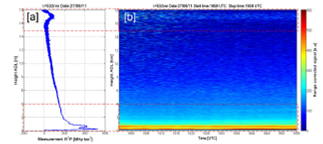
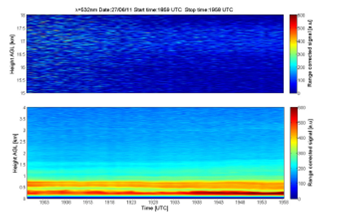
<body><![CDATA[<p><font size="2" face="Verdana"><i>Because <img border=0 width=67 height=28 id="Imagen 9" src="/img/revistas/rbf/v20n20/v20n20a02-image009.png">also holds for Eq. (3), the error norm, <img border=0 width=43 height=31 id="Imagen 10" src="/img/revistas/rbf/v20n20/v20n20a02-image010.png"></i>is also minimum when so is the scaling   parameter <i>i a </i>,   thus guaranteeing an optimal fitting.</font></p>     <p><font size="2" face="Verdana"><b>3. CONCLUDING RESULTS</b></font></p>     <p><font size="2" face="Verdana">Saharan dust intrusion episodes are   frequent in the Iberian Peninsula (Pérez et al., 2006) and occur at   low-troposphere heights. Because of the high intensity of the lidar returns in   the near-range range, these dust episodes are nicely recorded by the analog   channel and poorly recorded by the PC channel, which saturates due to the large   number of counts in the near- range. The opposite situation occurs when   monitoring volcanic eruptions (Guerrero et al., 2010), which inject volcanic   aerosols up in the stratosphere. At such heights, the lidar returns are too   faint to be properly recorded within the sensitivity of the analog channel   (only a few ADC levels are “moved” and with a very poor signal-to-noise ratio   (SNR)).</font></p>     <p><font size="2" face="Verdana">In Fig, 1, the analog signal is very   noisy at the high range around 17 km so that volcanic aerosols cannot be   distinguished from noise. PC signal fails to display aerosol layers below about   3 km. In contrast, the glued quick look of Fig. 2 and Fig. 3 evidences with a   good signal-to-noise ratio both Saharan dust layers in the 0-4 km subplot (low   range) and volcanic aerosols in the 15-18 km subplot (high range).</font></p>     <p><font size="2" face="Verdana"><b>4. ACKNOWLEDGMENTS</b></font></p>     <p><font size="2" face="Verdana">This work was supported by the   European Union under the project ACTRIS (Aerosols, clouds, and Trace gases   Research Infrastructure Network) ref. nº FP7- INFRA-2010-1.1.16, the European   Space Agency under the project 21487/08/NL/HE, the Spanish Ministry of Science   and Innovation (MICINN) and FEDER (European Regional Development) funds under   the project TEC2009-09106 and Complementary Actions CGL2009-08031-E/CLI   (“Charmex”) and CGL2008-01330- E/CLI.</font></p>     <p><font size="2" face="Verdana">MAEC – AECID (Spanish Ministry of   Foreign Affairs and Cooperation) and Generalitat Catalunya/AGAUR are   respectively thanked for Mr. D. Lange’s and Mr. D. Kumar’s pre-doctoral   fellowships.</font></p>     <p><font size="2" face="Verdana"><b>5. REFERENCES</b></font></p>     <!-- ref --><p><font size="2" face="Verdana">1.- Ansmann A., Wandinger U., Riebesell M., Weitkamp C., and   Michaelis W., “Independent measurement of extinction and backscatter profiles   in cirrus clouds by using a combined Raman elastic-backscatter lidar,” <i>App.   Opt. </i><b>31</b>(33), 7113-7131 (1992).</font>&nbsp;&nbsp;&nbsp;&nbsp;&nbsp;&nbsp;&nbsp;&nbsp;[&#160;<a href="javascript:void(0);" onclick="javascript: window.open('/scielo.php?script=sci_nlinks&ref=228866&pid=S1562-3823201200040000200001&lng=','','width=640,height=500,resizable=yes,scrollbars=1,menubar=yes,');">Links</a>&#160;]<!-- end-ref --><!-- ref --><p><font size="2" face="Verdana">2.- Barlow R. J., “Estimation,&quot; in Statistics: A Guide   To The Use Of Statistical Methods In The Physical Sciences (eds. F. Mandl, R.   J. Ellison, and D. J. Sandiford) (Wiley, Chichester, England), Chap. 5, pp.   68-96 (1989).</font>&nbsp;&nbsp;&nbsp;&nbsp;&nbsp;&nbsp;&nbsp;&nbsp;[&#160;<a href="javascript:void(0);" onclick="javascript: window.open('/scielo.php?script=sci_nlinks&ref=228867&pid=S1562-3823201200040000200002&lng=','','width=640,height=500,resizable=yes,scrollbars=1,menubar=yes,');">Links</a>&#160;]<!-- end-ref --><!-- ref --><p><font size="2" face="Verdana">3.- Böckmann C., “Hybrid regularization method for the   ill-posed inversion of multiwavelength lidar data in the retrieval of aerosol   size distributions,&quot; <i>App. Opt.</i>, <b>40</b>(9), 1329–1342 (2001).</font>&nbsp;&nbsp;&nbsp;&nbsp;&nbsp;&nbsp;&nbsp;&nbsp;[&#160;<a href="javascript:void(0);" onclick="javascript: window.open('/scielo.php?script=sci_nlinks&ref=228868&pid=S1562-3823201200040000200003&lng=','','width=640,height=500,resizable=yes,scrollbars=1,menubar=yes,');">Links</a>&#160;]<!-- end-ref --><!-- ref --><p><font size="2" face="Verdana">4.- Böckmann C., Wandinger U., Ansmann A., Bösenberg J.,   Amiridis V., Boselli A., Delaval A., De Tomasi F., Frioud M., Hågård A., Horvat   M., Iarlori M., Komguem L., Kreipl S., Larchevêque G., Matthias V., Papayannis   A., Pappalardo G., Rocadenbosch F., Rodriguez J.A., Schneider J., Shcherbakov   V., Wiegner M., “Aerosol lidar intercomparison in the framework of EARLINET. 2.   Aerosol backscatter algorithms”, <i>App. Opt., </i><b>43</b>(4), 977-989   (2004).</font>&nbsp;&nbsp;&nbsp;&nbsp;&nbsp;&nbsp;&nbsp;&nbsp;[&#160;<a href="javascript:void(0);" onclick="javascript: window.open('/scielo.php?script=sci_nlinks&ref=228869&pid=S1562-3823201200040000200004&lng=','','width=640,height=500,resizable=yes,scrollbars=1,menubar=yes,');">Links</a>&#160;]<!-- end-ref --><!-- ref --><p><font size="2" face="Verdana">5.- Guerrero-Rascado J. L., Sicard M., Molero F.,   Navas-Guzmán F., Preißler J., Kumar D., Bravo-Aranda J. A., Tomás S., Reba M.   N., Alados-Arboledas L., Comerón A., Pujadas M., Rocadenbosch F., Wagner F.,   and Silva A. M., “Monitoring of the Eyjafjalla Volcanic Plume at Four Lidar   Stations over the Iberian Peninsula: 6 to 8 May 2010”, IV Reunión Española de   Ciencia y Tecnología del aerosol – RECTA 2010, C15/1-C15/6.</font>&nbsp;&nbsp;&nbsp;&nbsp;&nbsp;&nbsp;&nbsp;&nbsp;[&#160;<a href="javascript:void(0);" onclick="javascript: window.open('/scielo.php?script=sci_nlinks&ref=228870&pid=S1562-3823201200040000200005&lng=','','width=640,height=500,resizable=yes,scrollbars=1,menubar=yes,');">Links</a>&#160;]<!-- end-ref --><!-- ref --><p><font size="2" face="Verdana">6.- Hamamatsu Photonics, “Photon Counting Using   Photomultiplier Tubes,” <i>AN-TPHO9001E02 </i>(Japan, May. 1998).</font>&nbsp;&nbsp;&nbsp;&nbsp;&nbsp;&nbsp;&nbsp;&nbsp;[&#160;<a href="javascript:void(0);" onclick="javascript: window.open('/scielo.php?script=sci_nlinks&ref=228871&pid=S1562-3823201200040000200006&lng=','','width=640,height=500,resizable=yes,scrollbars=1,menubar=yes,');">Links</a>&#160;]<!-- end-ref --><!-- ref --><p><font size="2" face="Verdana">7.- Kumar D., Sicard M., Tomás S., Muñoz C., Rocadenbosch   F., Comerón A., 2006, “Engineering of a water-vapor, Raman, elastic-backscatter   lidar at the Technical University of Catalonia (Spain)” in <i>Proc. SPIE Europe</i> <i>Remote Sensing</i>,   Vol. 6367 SPIE, Sweden, p. 63670U-1/12.</font>&nbsp;&nbsp;&nbsp;&nbsp;&nbsp;&nbsp;&nbsp;&nbsp;[&#160;<a href="javascript:void(0);" onclick="javascript: window.open('/scielo.php?script=sci_nlinks&ref=228872&pid=S1562-3823201200040000200007&lng=','','width=640,height=500,resizable=yes,scrollbars=1,menubar=yes,');">Links</a>&#160;]<!-- end-ref --><!-- ref --><p><font size="2" face="Verdana">8.- Licel GmbH, “Analysis Example: Gluing Analog and Photon   Counting Data”, Sect. 9.4 in “Licel Ethernet Controller – Installation and   Reference Manual”, Oct. 14, (2007).</font>&nbsp;&nbsp;&nbsp;&nbsp;&nbsp;&nbsp;&nbsp;&nbsp;[&#160;<a href="javascript:void(0);" onclick="javascript: window.open('/scielo.php?script=sci_nlinks&ref=228873&pid=S1562-3823201200040000200008&lng=','','width=640,height=500,resizable=yes,scrollbars=1,menubar=yes,');">Links</a>&#160;]<!-- end-ref --><!-- ref --><p><font size="2" face="Verdana">9.- Matthias V., Bösenberg J., Freudenthaler V., Amodeo A.,   Balis D., Chaikovsky A., Chourdakis G., Comeron A., Delaval A., De Tomasi F.,   Eixmann R., Hågård A., Komguem L., Kreipl S., Matthey R., Mattis I., Rizi V.,   Rodriguez J.A., Simeonov V., Wang X., “Aerosol lidar inter-comparison in the   framework of the EARLINET project. 1 – Instruments”, <i>App. Opt., </i><b>43</b>(4), 961-976   (2004).</font>&nbsp;&nbsp;&nbsp;&nbsp;&nbsp;&nbsp;&nbsp;&nbsp;[&#160;<a href="javascript:void(0);" onclick="javascript: window.open('/scielo.php?script=sci_nlinks&ref=228874&pid=S1562-3823201200040000200009&lng=','','width=640,height=500,resizable=yes,scrollbars=1,menubar=yes,');">Links</a>&#160;]<!-- end-ref --><!-- ref --><p><font size="2" face="Verdana">10.- D., Chaikovsky A., Chourdakis G., Comeron A., Delaval   A., De Tomasi F., Eixmann R., Hågård A., Komguem L., Kreipl S., Matthey R.,   Mattis I., Rizi V., Rodriguez J.A., Simeonov V., Wang X., “Aerosol lidar   inter-comparison in the framework of the EARLINET project. 1 – Instruments”, <i>App.   Opt., </i><b>43</b>(4), 961-976 (2004).</font>&nbsp;&nbsp;&nbsp;&nbsp;&nbsp;&nbsp;&nbsp;&nbsp;[&#160;<a href="javascript:void(0);" onclick="javascript: window.open('/scielo.php?script=sci_nlinks&ref=228875&pid=S1562-3823201200040000200010&lng=','','width=640,height=500,resizable=yes,scrollbars=1,menubar=yes,');">Links</a>&#160;]<!-- end-ref --><!-- ref --><p><font size="2" face="Verdana">11.- Pappalardo G., Amodeo A., Pandolfi M., Wandinger U.,   Ansmann A., Bosenberg J., Matthias V., Amiridis V., De Tomasi F., Frioud M.,   Iarlori M., Komguem L., Papayannis A., Rocadenbosch F., Wang X., “Aerosol lidar   intercomparison in the framework of the EARLINET project. 3 - Raman lidar   algorithm for aerosol extinction, backscatter and lidar ratio”, <i>App. Opt., </i><b>43</b>(28),   5370-5385 (2004).</font>&nbsp;&nbsp;&nbsp;&nbsp;&nbsp;&nbsp;&nbsp;&nbsp;[&#160;<a href="javascript:void(0);" onclick="javascript: window.open('/scielo.php?script=sci_nlinks&ref=228876&pid=S1562-3823201200040000200011&lng=','','width=640,height=500,resizable=yes,scrollbars=1,menubar=yes,');">Links</a>&#160;]<!-- end-ref --><!-- ref --><p><font size="2" face="Verdana">12.- Pérez C., Nickovic S., Baldasano J. M., Sicard M.,   Rocadenbosch F., and Cachorro V. E., “A long Saharan dust event over the   western Mediterranean: Lidar, Sun photometer observations, and regional dust   modeling”, <i>Journal of   Geophysical Research</i>, Vol. 111, D15214 (1- 16) (2006).</font>&nbsp;&nbsp;&nbsp;&nbsp;&nbsp;&nbsp;&nbsp;&nbsp;[&#160;<a href="javascript:void(0);" onclick="javascript: window.open('/scielo.php?script=sci_nlinks&ref=228877&pid=S1562-3823201200040000200012&lng=','','width=640,height=500,resizable=yes,scrollbars=1,menubar=yes,');">Links</a>&#160;]<!-- end-ref --><!-- ref --><p><font size="2" face="Verdana">13.- Whiteman N. David, “Examination of the traditional   Raman lidar technique I. Evaluating the temperature dependent lidar equations”, <i>App. Opt. </i><b>42</b>(15), 2571-2592 (2003).</font>&nbsp;&nbsp;&nbsp;&nbsp;&nbsp;&nbsp;&nbsp;&nbsp;[&#160;<a href="javascript:void(0);" onclick="javascript: window.open('/scielo.php?script=sci_nlinks&ref=228878&pid=S1562-3823201200040000200013&lng=','','width=640,height=500,resizable=yes,scrollbars=1,menubar=yes,');">Links</a>&#160;]<!-- end-ref --><!-- ref --><p><font size="2" face="Verdana">14.- WMO GAW, 2007, Plan for the implementation of the GAW   Aerosol Lidar Observation Network (GALION) (Hamburg, Germany, 27-29 March 2007)   (<i>WMO TD nº 1443</i>).</font>&nbsp;&nbsp;&nbsp;&nbsp;&nbsp;&nbsp;&nbsp;&nbsp;[&#160;<a href="javascript:void(0);" onclick="javascript: window.open('/scielo.php?script=sci_nlinks&ref=228879&pid=S1562-3823201200040000200014&lng=','','width=640,height=500,resizable=yes,scrollbars=1,menubar=yes,');">Links</a>&#160;]<!-- end-ref --><p><font size="2" face="Verdana"><img border=0 width=319 height=181 id="Imagen 11" src="/img/revistas/rbf/v20n20/v20n20a02-image011.png"></font></p>     <p><font size="2" face="Verdana"><b>Figure 1. Comparison among analog, PC, and glued   signals. (Blue) Analog raw signal, </b><i>Va </i><b>.   (Red) Scaled-and-</b></font></p>     <p><font size="2" face="Verdana"><b>offset analog   signal, </b><i>Va</i>' = <i>aVa </i>+<i>b </i>. <b>(Black dotted) PC</b></font></p>     <p><font size="2" face="Verdana"><b>signal. (Green)   Glued analog-PC signal. Note that below 2.6km (corresponding to a 10-MHz count   in the PC channel) the glued signal follows the analog signal while above this   range it follows the PC signal.</b></font></p>     <p><font size="2" face="Verdana"><img border=0 width=323 height=144 id="Imagen 12" src="/img/revistas/rbf/v20n20/v20n20a02-image012.png"></font></p>     <p><font size="2" face="Verdana"><b>Figure 2. Time series monitoring   the evolution of a vertical profile of volcanic aerosols in the stratosphere   (about 17km) and several Saharan dust layers in the troposphere (below 3.5km),   532nm channel. (a) Range-corrected profile for the glued signal. (b) Glued   signal time series.</b></font></p>     <p><font size="2" face="Verdana"><img border=0 width=351 height=214 id="Imagen 13" src="/img/revistas/rbf/v20n20/v20n20a02-image013.png"></font></p>     <p><font size="2" face="Verdana"><b>Figure 3.   Glued signals zoomed in the low range (0-4 km) and in the far range (15-18 km).</b></font></p>     ]]></body>
<body><![CDATA[ ]]></body><back>
<ref-list>
<ref id="B1">
<label>1</label><nlm-citation citation-type="journal">
<person-group person-group-type="author">
<name>
<surname><![CDATA[Ansmann]]></surname>
<given-names><![CDATA[A.]]></given-names>
</name>
<name>
<surname><![CDATA[Wandinger]]></surname>
<given-names><![CDATA[U.]]></given-names>
</name>
<name>
<surname><![CDATA[Riebesell]]></surname>
<given-names><![CDATA[M.]]></given-names>
</name>
<name>
<surname><![CDATA[Weitkamp]]></surname>
<given-names><![CDATA[C.]]></given-names>
</name>
<name>
<surname><![CDATA[Michaelis]]></surname>
<given-names><![CDATA[W.]]></given-names>
</name>
</person-group>
<article-title xml:lang="en"><![CDATA[Independent measurement of extinction and backscatter profiles in cirrus clouds by using a combined Raman elastic-backscatter lidar]]></article-title>
<source><![CDATA[App. Opt.]]></source>
<year>1992</year>
<volume>31</volume>
<page-range>33</page-range><page-range>7113-7131</page-range></nlm-citation>
</ref>
<ref id="B2">
<label>2</label><nlm-citation citation-type="book">
<person-group person-group-type="author">
<name>
<surname><![CDATA[Barlow]]></surname>
<given-names><![CDATA[R. J.]]></given-names>
</name>
</person-group>
<article-title xml:lang="en"><![CDATA[“Estimation," in Statistics]]></article-title>
<person-group person-group-type="editor">
<name>
<surname><![CDATA[Mandl]]></surname>
<given-names><![CDATA[F.]]></given-names>
</name>
<name>
<surname><![CDATA[Ellison]]></surname>
<given-names><![CDATA[R. J.]]></given-names>
</name>
<name>
<surname><![CDATA[Sandiford]]></surname>
<given-names><![CDATA[D. J.]]></given-names>
</name>
</person-group>
<source><![CDATA[A Guide To The Use Of Statistical Methods In The Physical Sciences]]></source>
<year>1989</year>
<volume>5</volume>
<page-range>68-96</page-range><publisher-name><![CDATA[Wiley, Chichester, England]]></publisher-name>
</nlm-citation>
</ref>
<ref id="B3">
<label>3</label><nlm-citation citation-type="journal">
<person-group person-group-type="author">
<name>
<surname><![CDATA[Böckmann]]></surname>
<given-names><![CDATA[C.]]></given-names>
</name>
</person-group>
<article-title xml:lang="en"><![CDATA[Hybrid regularization method for the ill-posed inversion of multiwavelength lidar data in the retrieval of aerosol size distributions]]></article-title>
<source><![CDATA[App. Opt.]]></source>
<year>2001</year>
<volume>40</volume>
<numero>9</numero>
<issue>9</issue>
<page-range>1329-1342</page-range></nlm-citation>
</ref>
<ref id="B4">
<label>4</label><nlm-citation citation-type="journal">
<person-group person-group-type="author">
<name>
<surname><![CDATA[Böckmann]]></surname>
<given-names><![CDATA[C.]]></given-names>
</name>
<name>
<surname><![CDATA[Wandinger]]></surname>
<given-names><![CDATA[U.]]></given-names>
</name>
<name>
<surname><![CDATA[Ansmann]]></surname>
<given-names><![CDATA[A.]]></given-names>
</name>
<name>
<surname><![CDATA[Bösenberg]]></surname>
<given-names><![CDATA[J.]]></given-names>
</name>
<name>
<surname><![CDATA[Amiridis]]></surname>
<given-names><![CDATA[V.]]></given-names>
</name>
<name>
<surname><![CDATA[Boselli]]></surname>
<given-names><![CDATA[A.]]></given-names>
</name>
<name>
<surname><![CDATA[Delaval]]></surname>
<given-names><![CDATA[A.]]></given-names>
</name>
<name>
<surname><![CDATA[De Tomasi]]></surname>
<given-names><![CDATA[F.]]></given-names>
</name>
<name>
<surname><![CDATA[Frioud]]></surname>
<given-names><![CDATA[M.]]></given-names>
</name>
<name>
<surname><![CDATA[Hågård]]></surname>
<given-names><![CDATA[A.]]></given-names>
</name>
<name>
<surname><![CDATA[Horvat]]></surname>
<given-names><![CDATA[M.]]></given-names>
</name>
<name>
<surname><![CDATA[Iarlori]]></surname>
<given-names><![CDATA[M.]]></given-names>
</name>
<name>
<surname><![CDATA[Komguem]]></surname>
<given-names><![CDATA[L.]]></given-names>
</name>
<name>
<surname><![CDATA[Kreipl]]></surname>
<given-names><![CDATA[S.]]></given-names>
</name>
<name>
<surname><![CDATA[Larchevêque]]></surname>
<given-names><![CDATA[G.]]></given-names>
</name>
<name>
<surname><![CDATA[Matthias]]></surname>
<given-names><![CDATA[V.]]></given-names>
</name>
<name>
<surname><![CDATA[Papayannis]]></surname>
<given-names><![CDATA[A.]]></given-names>
</name>
<name>
<surname><![CDATA[Pappalardo]]></surname>
<given-names><![CDATA[G.]]></given-names>
</name>
<name>
<surname><![CDATA[Rocadenbosch]]></surname>
<given-names><![CDATA[F.]]></given-names>
</name>
<name>
<surname><![CDATA[Rodriguez]]></surname>
<given-names><![CDATA[J.A.]]></given-names>
</name>
<name>
<surname><![CDATA[Schneider]]></surname>
<given-names><![CDATA[J.]]></given-names>
</name>
<name>
<surname><![CDATA[Shcherbakov]]></surname>
<given-names><![CDATA[V.]]></given-names>
</name>
<name>
<surname><![CDATA[Wiegner]]></surname>
<given-names><![CDATA[M.]]></given-names>
</name>
</person-group>
<article-title xml:lang="en"><![CDATA[“Aerosol lidar intercomparison in the framework of EARLINET. 2. Aerosol backscatter algorithms”]]></article-title>
<source><![CDATA[App. Opt.]]></source>
<year>2004</year>
<volume>43</volume>
<numero>4</numero>
<issue>4</issue>
<page-range>977-989</page-range></nlm-citation>
</ref>
<ref id="B5">
<label>5</label><nlm-citation citation-type="confpro">
<person-group person-group-type="author">
<name>
<surname><![CDATA[Guerrero-Rascado]]></surname>
<given-names><![CDATA[J. L.]]></given-names>
</name>
<name>
<surname><![CDATA[Sicard]]></surname>
<given-names><![CDATA[M.]]></given-names>
</name>
<name>
<surname><![CDATA[Molero]]></surname>
<given-names><![CDATA[F.]]></given-names>
</name>
<name>
<surname><![CDATA[Navas-Guzmán]]></surname>
<given-names><![CDATA[F.]]></given-names>
</name>
<name>
<surname><![CDATA[Preißler]]></surname>
<given-names><![CDATA[J.]]></given-names>
</name>
<name>
<surname><![CDATA[Kumar]]></surname>
<given-names><![CDATA[D.]]></given-names>
</name>
<name>
<surname><![CDATA[Bravo-Aranda]]></surname>
<given-names><![CDATA[J. A.]]></given-names>
</name>
<name>
<surname><![CDATA[Tomás]]></surname>
<given-names><![CDATA[S.]]></given-names>
</name>
<name>
<surname><![CDATA[Reba]]></surname>
<given-names><![CDATA[M. N.]]></given-names>
</name>
<name>
<surname><![CDATA[Alados-Arboledas]]></surname>
<given-names><![CDATA[L.]]></given-names>
</name>
<name>
<surname><![CDATA[Comerón]]></surname>
<given-names><![CDATA[A.]]></given-names>
</name>
<name>
<surname><![CDATA[Pujadas]]></surname>
<given-names><![CDATA[M.]]></given-names>
</name>
<name>
<surname><![CDATA[Rocadenbosch]]></surname>
<given-names><![CDATA[F.]]></given-names>
</name>
<name>
<surname><![CDATA[Wagner]]></surname>
<given-names><![CDATA[F.]]></given-names>
</name>
<name>
<surname><![CDATA[Silva]]></surname>
<given-names><![CDATA[A. M.]]></given-names>
</name>
</person-group>
<article-title xml:lang="en"><![CDATA[“Monitoring of the Eyjafjalla Volcanic Plume at Four Lidar Stations over the Iberian Peninsula: 6 to 8 May 2010”]]></article-title>
<source><![CDATA[]]></source>
<year></year>
<conf-name><![CDATA[ IV Reunión Española de Ciencia y Tecnología del aerosol - RECTA 2010]]></conf-name>
<conf-loc> </conf-loc>
</nlm-citation>
</ref>
<ref id="B6">
<label>6</label><nlm-citation citation-type="">
<collab>Hamamatsu Photonics</collab>
<source><![CDATA[“Photon Counting Using Photomultiplier Tubes,” AN-TPHO9001E02]]></source>
<year>May.</year>
<month> 1</month>
<day>99</day>
</nlm-citation>
</ref>
<ref id="B7">
<label>7</label><nlm-citation citation-type="journal">
<person-group person-group-type="author">
<name>
<surname><![CDATA[Kumar]]></surname>
<given-names><![CDATA[D.]]></given-names>
</name>
<name>
<surname><![CDATA[Sicard]]></surname>
<given-names><![CDATA[M.]]></given-names>
</name>
<name>
<surname><![CDATA[Tomás]]></surname>
<given-names><![CDATA[S.]]></given-names>
</name>
<name>
<surname><![CDATA[Muñoz]]></surname>
<given-names><![CDATA[C.]]></given-names>
</name>
<name>
<surname><![CDATA[Rocadenbosch]]></surname>
<given-names><![CDATA[F.]]></given-names>
</name>
<name>
<surname><![CDATA[Comerón]]></surname>
<given-names><![CDATA[A.]]></given-names>
</name>
</person-group>
<article-title xml:lang="en"><![CDATA[“Engineering of a water-vapor, Raman, elastic-backscatter lidar at the Technical University of Catalonia (Spain)”]]></article-title>
<source><![CDATA[Proc. SPIE Europe Remote Sensing]]></source>
<year>2006</year>
<volume>6367</volume>
<page-range>63670</page-range><publisher-loc><![CDATA[Sweden ]]></publisher-loc>
<publisher-name><![CDATA[SPIE]]></publisher-name>
</nlm-citation>
</ref>
<ref id="B8">
<label>8</label><nlm-citation citation-type="">
<collab>Licel GmbH</collab>
<article-title xml:lang="en"><![CDATA[Analysis Example: Gluing Analog and Photon Counting Data: Sect. 9.4]]></article-title>
<source><![CDATA[Licel Ethernet Controller - Installation and Reference Manual: Oct.]]></source>
<year>2007</year>
<volume>14</volume>
</nlm-citation>
</ref>
<ref id="B9">
<label>9</label><nlm-citation citation-type="journal">
<person-group person-group-type="author">
<name>
<surname><![CDATA[Matthias]]></surname>
<given-names><![CDATA[V.]]></given-names>
</name>
<name>
<surname><![CDATA[Bösenberg]]></surname>
<given-names><![CDATA[J.]]></given-names>
</name>
<name>
<surname><![CDATA[Freudenthaler]]></surname>
<given-names><![CDATA[V.]]></given-names>
</name>
<name>
<surname><![CDATA[Amodeo]]></surname>
<given-names><![CDATA[A.]]></given-names>
</name>
<name>
<surname><![CDATA[Balis]]></surname>
<given-names><![CDATA[D.]]></given-names>
</name>
<name>
<surname><![CDATA[Chaikovsky]]></surname>
<given-names><![CDATA[A.]]></given-names>
</name>
<name>
<surname><![CDATA[Chourdakis]]></surname>
<given-names><![CDATA[G.]]></given-names>
</name>
<name>
<surname><![CDATA[Comeron]]></surname>
<given-names><![CDATA[A.]]></given-names>
</name>
<name>
<surname><![CDATA[Delaval]]></surname>
<given-names><![CDATA[A.]]></given-names>
</name>
<name>
<surname><![CDATA[De Tomasi]]></surname>
<given-names><![CDATA[F.]]></given-names>
</name>
<name>
<surname><![CDATA[Eixmann]]></surname>
<given-names><![CDATA[R.]]></given-names>
</name>
<name>
<surname><![CDATA[Hågård]]></surname>
<given-names><![CDATA[A.]]></given-names>
</name>
<name>
<surname><![CDATA[Komguem]]></surname>
<given-names><![CDATA[L.]]></given-names>
</name>
<name>
<surname><![CDATA[Kreipl]]></surname>
<given-names><![CDATA[S.]]></given-names>
</name>
<name>
<surname><![CDATA[Matthey]]></surname>
<given-names><![CDATA[R.]]></given-names>
</name>
<name>
<surname><![CDATA[Mattis]]></surname>
<given-names><![CDATA[I.]]></given-names>
</name>
<name>
<surname><![CDATA[Rizi]]></surname>
<given-names><![CDATA[V.]]></given-names>
</name>
<name>
<surname><![CDATA[Rodriguez]]></surname>
<given-names><![CDATA[J.A.]]></given-names>
</name>
<name>
<surname><![CDATA[Simeonov]]></surname>
<given-names><![CDATA[V.]]></given-names>
</name>
<name>
<surname><![CDATA[Wang]]></surname>
<given-names><![CDATA[X.]]></given-names>
</name>
</person-group>
<article-title xml:lang="en"><![CDATA[“Aerosol lidar inter-comparison in the framework of the EARLINET project. 1 - Instruments”]]></article-title>
<source><![CDATA[App. Opt.]]></source>
<year>2004</year>
<volume>43</volume>
<numero>4</numero>
<issue>4</issue>
<page-range>961-976</page-range></nlm-citation>
</ref>
<ref id="B10">
<label>10</label><nlm-citation citation-type="journal">
<person-group person-group-type="author">
<name>
<surname><![CDATA[Chaikovsky]]></surname>
<given-names><![CDATA[A.]]></given-names>
</name>
<name>
<surname><![CDATA[Chourdakis]]></surname>
<given-names><![CDATA[G.]]></given-names>
</name>
<name>
<surname><![CDATA[Comeron]]></surname>
<given-names><![CDATA[A.]]></given-names>
</name>
<name>
<surname><![CDATA[Delaval]]></surname>
<given-names><![CDATA[A.]]></given-names>
</name>
<name>
<surname><![CDATA[De Tomasi]]></surname>
<given-names><![CDATA[F.]]></given-names>
</name>
<name>
<surname><![CDATA[Eixmann]]></surname>
<given-names><![CDATA[R.]]></given-names>
</name>
<name>
<surname><![CDATA[Hågård]]></surname>
<given-names><![CDATA[A.]]></given-names>
</name>
<name>
<surname><![CDATA[Komguem]]></surname>
<given-names><![CDATA[L.]]></given-names>
</name>
<name>
<surname><![CDATA[Kreipl]]></surname>
<given-names><![CDATA[S.]]></given-names>
</name>
<name>
<surname><![CDATA[Matthey]]></surname>
<given-names><![CDATA[R.]]></given-names>
</name>
<name>
<surname><![CDATA[Mattis]]></surname>
<given-names><![CDATA[I.]]></given-names>
</name>
<name>
<surname><![CDATA[Rizi]]></surname>
<given-names><![CDATA[V.]]></given-names>
</name>
<name>
<surname><![CDATA[Rodriguez]]></surname>
<given-names><![CDATA[J.A.]]></given-names>
</name>
<name>
<surname><![CDATA[Simeonov]]></surname>
<given-names><![CDATA[V.]]></given-names>
</name>
<name>
<surname><![CDATA[Wang]]></surname>
<given-names><![CDATA[X.]]></given-names>
</name>
</person-group>
<article-title xml:lang="en"><![CDATA[“Aerosol lidar inter-comparison in the framework of the EARLINET project. 1 - Instruments”]]></article-title>
<source><![CDATA[App. Opt.]]></source>
<year>2004</year>
<volume>43</volume>
<numero>4</numero>
<issue>4</issue>
<page-range>961-976</page-range></nlm-citation>
</ref>
<ref id="B11">
<label>11</label><nlm-citation citation-type="journal">
<person-group person-group-type="author">
<name>
<surname><![CDATA[Pappalardo]]></surname>
<given-names><![CDATA[G.]]></given-names>
</name>
<name>
<surname><![CDATA[Amodeo]]></surname>
<given-names><![CDATA[A.]]></given-names>
</name>
<name>
<surname><![CDATA[Pandolfi]]></surname>
<given-names><![CDATA[M.]]></given-names>
</name>
<name>
<surname><![CDATA[Wandinger]]></surname>
<given-names><![CDATA[U.]]></given-names>
</name>
<name>
<surname><![CDATA[Ansmann]]></surname>
<given-names><![CDATA[A.]]></given-names>
</name>
<name>
<surname><![CDATA[Bosenberg]]></surname>
<given-names><![CDATA[J.]]></given-names>
</name>
<name>
<surname><![CDATA[Matthias]]></surname>
<given-names><![CDATA[V.]]></given-names>
</name>
<name>
<surname><![CDATA[Amiridis]]></surname>
<given-names><![CDATA[V.]]></given-names>
</name>
<name>
<surname><![CDATA[De Tomasi]]></surname>
<given-names><![CDATA[F.]]></given-names>
</name>
<name>
<surname><![CDATA[Frioud]]></surname>
<given-names><![CDATA[M.]]></given-names>
</name>
<name>
<surname><![CDATA[Iarlori]]></surname>
<given-names><![CDATA[M.]]></given-names>
</name>
<name>
<surname><![CDATA[Komguem]]></surname>
<given-names><![CDATA[L.]]></given-names>
</name>
<name>
<surname><![CDATA[Papayannis]]></surname>
<given-names><![CDATA[A.]]></given-names>
</name>
<name>
<surname><![CDATA[Rocadenbosch]]></surname>
<given-names><![CDATA[F.]]></given-names>
</name>
<name>
<surname><![CDATA[Wang]]></surname>
<given-names><![CDATA[X.]]></given-names>
</name>
</person-group>
<article-title xml:lang="en"><![CDATA[“Aerosol lidar intercomparison in the framework of the EARLINET project. 3 - Raman lidar algorithm for aerosol extinction, backscatter and lidar ratio”]]></article-title>
<source><![CDATA[App. Opt.]]></source>
<year>2004</year>
<volume>43</volume>
<numero>28</numero>
<issue>28</issue>
<page-range>5370-5385</page-range></nlm-citation>
</ref>
<ref id="B12">
<label>12</label><nlm-citation citation-type="journal">
<person-group person-group-type="author">
<name>
<surname><![CDATA[Pérez]]></surname>
<given-names><![CDATA[C.]]></given-names>
</name>
<name>
<surname><![CDATA[Nickovic]]></surname>
<given-names><![CDATA[S.]]></given-names>
</name>
<name>
<surname><![CDATA[Baldasano]]></surname>
<given-names><![CDATA[J. M.]]></given-names>
</name>
<name>
<surname><![CDATA[Sicard]]></surname>
<given-names><![CDATA[M.]]></given-names>
</name>
<name>
<surname><![CDATA[Rocadenbosch]]></surname>
<given-names><![CDATA[F.]]></given-names>
</name>
<name>
<surname><![CDATA[Cachorro]]></surname>
<given-names><![CDATA[V. E.]]></given-names>
</name>
</person-group>
<article-title xml:lang="en"><![CDATA[“A long Saharan dust event over the western Mediterranean: Lidar, Sun photometer observations, and regional dust modeling”]]></article-title>
<source><![CDATA[Journal of Geophysical Research]]></source>
<year>2006</year>
<volume>111</volume>
<page-range>1- 16</page-range></nlm-citation>
</ref>
<ref id="B13">
<label>13</label><nlm-citation citation-type="journal">
<person-group person-group-type="author">
<name>
<surname><![CDATA[Whiteman]]></surname>
<given-names><![CDATA[N. David]]></given-names>
</name>
</person-group>
<article-title xml:lang="en"><![CDATA[“Examination of the traditional Raman lidar technique I. Evaluating the temperature dependent lidar equations”]]></article-title>
<source><![CDATA[App. Opt.]]></source>
<year>2003</year>
<volume>42</volume>
<numero>15</numero>
<issue>15</issue>
<page-range>2571-2592</page-range></nlm-citation>
</ref>
<ref id="B14">
<label>14</label><nlm-citation citation-type="">
<collab>WMO GAW</collab>
<source><![CDATA[Plan for the implementation of the GAW Aerosol Lidar Observation Network (GALION) (Hamburg, Germany, 27-29 March 2007) (WMO TD nº 1443)]]></source>
<year>2007</year>
</nlm-citation>
</ref>
</ref-list>
</back>
</article>