<?xml version="1.0" encoding="ISO-8859-1"?><article xmlns:mml="http://www.w3.org/1998/Math/MathML" xmlns:xlink="http://www.w3.org/1999/xlink" xmlns:xsi="http://www.w3.org/2001/XMLSchema-instance">
<front>
<journal-meta>
<journal-id>1562-3823</journal-id>
<journal-title><![CDATA[Revista Boliviana de Física]]></journal-title>
<abbrev-journal-title><![CDATA[Revista Boliviana de Física]]></abbrev-journal-title>
<issn>1562-3823</issn>
<publisher>
<publisher-name><![CDATA[Sociedad Boliviana de Física]]></publisher-name>
</publisher>
</journal-meta>
<article-meta>
<article-id>S1562-38232012000400001</article-id>
<title-group>
<article-title xml:lang="en"><![CDATA[One year of Cloud Optical Depth measurements with sunphotometer in Camagüey, Cuba.]]></article-title>
</title-group>
<contrib-group>
<contrib contrib-type="author">
<name>
<surname><![CDATA[Barja]]></surname>
<given-names><![CDATA[Boris]]></given-names>
</name>
</contrib>
<contrib contrib-type="author">
<name>
<surname><![CDATA[Benouna]]></surname>
<given-names><![CDATA[Yasmine]]></given-names>
</name>
</contrib>
<contrib contrib-type="author">
<name>
<surname><![CDATA[Toledano]]></surname>
<given-names><![CDATA[Carlos]]></given-names>
</name>
</contrib>
<contrib contrib-type="author">
<name>
<surname><![CDATA[Antuña]]></surname>
<given-names><![CDATA[Juan Carlos]]></given-names>
</name>
</contrib>
<contrib contrib-type="author">
<name>
<surname><![CDATA[Cachorro]]></surname>
<given-names><![CDATA[Victoria]]></given-names>
</name>
</contrib>
<contrib contrib-type="author">
<name>
<surname><![CDATA[Hernández]]></surname>
<given-names><![CDATA[Carlos]]></given-names>
</name>
</contrib>
<contrib contrib-type="author">
<name>
<surname><![CDATA[de Frutos]]></surname>
<given-names><![CDATA[Ángel]]></given-names>
</name>
</contrib>
<contrib contrib-type="author">
<name>
<surname><![CDATA[Estevan]]></surname>
<given-names><![CDATA[René]]></given-names>
</name>
</contrib>
</contrib-group>
<aff id="A01">
<institution><![CDATA[,CUBA Atmospheric Optics Group of Camagüey ]]></institution>
<addr-line><![CDATA[ ]]></addr-line>
<country>CUBA</country>
</aff>
<aff id="A02">
<institution><![CDATA[,Valladolid University of Valladolid Atmospheric Optics Group]]></institution>
<addr-line><![CDATA[ ]]></addr-line>
</aff>
<pub-date pub-type="pub">
<day>00</day>
<month>00</month>
<year>2012</year>
</pub-date>
<pub-date pub-type="epub">
<day>00</day>
<month>00</month>
<year>2012</year>
</pub-date>
<volume>20</volume>
<numero>20</numero>
<fpage>1</fpage>
<lpage>3</lpage>
<copyright-statement/>
<copyright-year/>
<self-uri xlink:href="http://www.scielo.org.bo/scielo.php?script=sci_arttext&amp;pid=S1562-38232012000400001&amp;lng=en&amp;nrm=iso"></self-uri><self-uri xlink:href="http://www.scielo.org.bo/scielo.php?script=sci_abstract&amp;pid=S1562-38232012000400001&amp;lng=en&amp;nrm=iso"></self-uri><self-uri xlink:href="http://www.scielo.org.bo/scielo.php?script=sci_pdf&amp;pid=S1562-38232012000400001&amp;lng=en&amp;nrm=iso"></self-uri><abstract abstract-type="short" xml:lang="en"><p><![CDATA[One year of Cloud Optical Depth (COD) measurements obtained with the radiometer (sunphotometer Cimel CE - 318) are presented. As the first step a validation method is proposed in order to confirm the cloud in the measurement. This method is based in the cloud information derived from the actinometrical observations and radar data. In the second step of the work, the statistical results from the one year of the COD measurements in Camagüey are analyzed. The results show the high quality of COD measurements at Camagüey. The analysis of the COD frequency shows one peak close to 15. Similar behavior occurs each month. The mean COD average value for the entire period is 27.2, with a standard deviation of 17.3. The mean monthly minimum and maximum value of COD occur in December and May, respectively. The diurnal cycle of the mean hourly COD values shows an increase in the afternoon hours. In the afternoon the number of cases measured decrease. The preliminary results shown in this paper constitute the first report of such measurements in the country.]]></p></abstract>
<kwd-group>
<kwd lng="en"><![CDATA[Cloud optical depth (COD)]]></kwd>
<kwd lng="en"><![CDATA[sunphotometer]]></kwd>
<kwd lng="en"><![CDATA[Camagüey]]></kwd>
<kwd lng="en"><![CDATA[Cuba]]></kwd>
</kwd-group>
</article-meta>
</front><body><![CDATA[ <p align="center"><font size="4" face="Verdana"><strong>One year of Cloud Optical Depth measurements with sunphotometer in Camagüey, Cuba.</strong></font></p>     <p align="center">&nbsp;</p>     <p align="center"><strong><font size="3" face="Verdana">Boris   Barja(1), Yasmine Benouna(2), Carlos Toledano(2), Juan Carlos Antuña(1), Victoria Cachorro(2), Carlos Hernández(1), Ángel de Frutos(2) and René Estevan(1).</font></strong></p>     <p align="center"><strong><font size="2" face="Verdana">(1)Atmospheric Optics   Group of Camagüey, Carretera a Nuevitas km 7 ½ Camagüey, CUBA Tel: +53   32262397, e-mail: bbarja@gmail.com</font></strong></p>     <p align="center"><strong><font size="2" face="Verdana">(2) Atmospheric   Optics Group, University of Valladolid, Valladolid, Spain</font><font size="2" face="Verdana"></font></strong></p><hr>     <p><font size="2" face="Verdana"><b>SUMMARY</b></font></p>     <p><font size="2" face="Verdana">One year of Cloud Optical Depth (COD)   measurements obtained with the radiometer (sunphotometer Cimel CE – 318) are   presented. As the first step a validation method is proposed in order to   confirm the cloud in the measurement. This method is based in the cloud   information derived from the actinometrical observations and radar data. In the   second step of the work, the statistical results from the one year of the COD   measurements in Camagüey are analyzed. The results show the high quality of COD   measurements at Camagüey. The analysis of the COD frequency shows one peak   close to 15. Similar behavior occurs each month. The mean COD average value for   the entire period is 27.2, with a standard deviation of 17.3. The mean monthly   minimum and maximum value of COD occur in December and May, respectively. The   diurnal cycle of the mean hourly COD values shows an increase in the afternoon   hours. In the afternoon the number of cases measured decrease. The preliminary   results shown in this paper constitute the first report of such measurements in   the country.</font></p>     <p><font size="2" face="Verdana"><b>Key words: </b>Cloud optical depth (COD), sunphotometer, Camagüey,   Cuba.</font></p><hr>     <p><font size="2" face="Verdana"><b>INTRODUCTION</b></font></p>     <p><font size="2" face="Verdana">Clouds are a key point in the climatic   system. They interact with the solar and terrestrial radiation and in turn are   essential in the determination of the atmospheric radiation budget. The   intensity of these processes is related with the optical and microphysical   properties of the clouds. Thus, the study of the cloud optical properties is   very important in order to understand their behavior and their climatic effect.   These properties are identified by the optical depth (COD), singe scattering   albedo ( ), and the asymmetric factor (g) of the cloud drops. Cloud optical   depth (COD) is a fundamental value in the determination of the radiative energy   balance in the Earth. Nevertheless, this property is very difficult to measure   with ground remote sensing technique using the traditional methods. Better   representation of the COD in the atmospheric general circulation and climatic   models is a challenge in the atmospheric sciences. By those reasons it is   necessary the increase of the COD measurement sites and the exactitude of the   measurement.</font></p>     ]]></body>
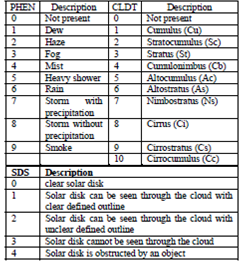
<body><![CDATA[<p><font size="2" face="Verdana">There are two principal operational   networks with the primary objective of the measurements of the cloud   characteristics from the ground: the first one is of the Atmospheric Radiation   Measurement Program (ARM) (Stokes and Schwartz, 1994), the second one is the network   for measurement of clouds (Cloudnet) (Illingworth <i>et al.</i>, 2007). But the   number of the measurement sites of these networks is limited in order to obtain   ground based global scale measurements.</font></p>     <p><font size="2" face="Verdana">Aerosol Robotic Network (AERONET) is   designed for the measurements of the optical and microphysical properties of   the aerosols (Holben et al., 1998). AEROENT have more than 250 measurement   sites over the world with sun radiometers that make sun direct irradiances and   sky radiance measurements. When the cloud is in the instrument field of view   the measurement is not useful for the aerosols properties determination. Then   it is possible to set the sunphotometer to the ‘cloud mode’ (Chiu <i>et al.</i>,   2010), completing a set of the radiance measurements in the zenith to obtain   COD values.</font></p>     <p><font size="2" face="Verdana">In the Atmospheric Optics Group of   Camagüey (GOAC) a sunphotometer CIMEL CE-138 was installed. This instrument is   part of the collaboration between the Atmospheric Optics Group (GOA) from   Valladolid University, Spain and GOAC. Aerosols and clouds measurements with   sunphotometer began in October 2008 and June 2010, respectively.</font></p>     <p><font size="2" face="Verdana">The objective of the present work is   to evaluate in a first approach the strength of the COD measurements from the   sunphotometer. The question to answer is: Does the COD sunphotometer   measurement match the actinometric cloud reports? Reported cloud information in   the hourly actinometric measurements is used in the validation algorithm. The   second objective of the work is to obtain a preliminary COD statistics for non   precipitating clouds during the first year of measurements at Camagüey.</font></p>     <p><font size="2" face="Verdana"><b>INSTRUMENT   AND METHODS</b></font></p>     <p><font size="2" face="Verdana">The data employed   in the present work is from the sunphotometer Cimel CE-318 installed in   Camagüey (21.42º N, 77.84º W, 128 m asl), Cuba. AERONET employed this   radiometer for the measurement of sun direct irradiance and sky radiance with a   field of view of 1.2º in the wavelengths of 340 nm, 380 nm, 440 nm, 675 nm 870   nm, y 1020 nm. (Holben <i>et al. </i>1998).</font></p>     <p><font size="2" face="Verdana">When the cloud is   in the instrument field of view the measurement is not useful for the aerosols   properties determination. Chiu <i>et al. </i>(2010) proposed recently the use   of these conditions to make 10 radiance measurements in the zenith in each   wavelength, named ‘cloud mode’. This is based in the suggestion of the use of   two wavelength measurements in the red and near infrared spectrum to retrieve   COD values over the vegetated surface (Chiu <i>et al.</i>, 2010).</font></p>     <p><font size="2" face="Verdana">The method for   the COD determination employed in AERONET is explained in details by Chiu et   al., (2010). Nevertheless some points are given here. There is no one to one   relationship between zenith radiances and COD. So, two wavelengths radiance   measurements (470 nm and 879 nm) are employed to reduce the ambiguity. With the   radiance in these two wavelengths, some radiative transfer calculations, and   satellite data the COD value is obtained (Chiu <i>et al., </i>2010). The   reported COD value is the average of the 10 instantaneous values. The dataset   used in the present study is from June 2010 to May 2011, with 2277 values.</font></p>     <p><font size="2" face="Verdana">An algorithm is   proposed to ‘evaluate’ the COD measurements. This approach is intended to   determine the ‘correct’ COD measurements. The evidences of this ‘correctness’   is obtained from the reports on clouds in the hourly actinometric observations.</font></p>     <p><font size="2" face="Verdana">The   characteristics of the cloudiness used in the algorithm are: the solar disk   state (SDS), covered sky fraction by cloud (SFT), covered sky fraction by low   cloud types (SFL), atmospheric phenomena occurring at the time of observation   (PHEN), cloud types present in the sky (CLDT), cloud types present in the   zenith direction (CLDZ). The factors PHEN, CLDT, CLDZ and SDS are described in   Table 1. Note that the actinometric measurements are made in the direction of   the Sun and radiometric observations are in the zenith direction. The covered   sky fractions are evaluated in base to 10 parts.</font></p>     ]]></body>
<body><![CDATA[<p><font size="2" face="Verdana">The steps of the   algorithm are described below:</font></p>     <p><font size="2" face="Verdana">1. Evaluate the   direct coincident actinometric report with COD measurement, by times difference   ( t) of 10 minutes.</font></p>     <p><font size="2" face="Verdana">2. If the first   step is satisfied the cloudiness characteristics are evaluated.</font></p>     <p><font size="2" face="Verdana">2.1.If SDS is   different of 1, the sunphotometer can be decided to enter in the `cloud mode´.   But it does not mean that there are clouds in the zenith. Thus it is necessary   to evaluate the SFT, SDL, CLDT and CLDZ..</font></p>     <p><font size="2" face="Verdana">2.1.1.For the SDS from   2 to 4.</font></p>     <p><font size="2" face="Verdana">2.1.1.1.If SFT is between   1 and 3 and the COD measurement time is between 15:00 GMT and 19:00 GMT, the   COD is selected as ‘correct’.</font></p>     <p><font size="2" face="Verdana">2.1.1.2.If SFT is between   4 and 10 and the SFL is equal to SFT, the COD is selected as ‘correct’.</font></p>     <p><font size="2" face="Verdana">2.2.Always the COD   values are compared with CLDT and CLDZ to evaluate the correspondence of the   value.</font></p>     <p><font size="2" face="Verdana"><b>Table 1.   Parameter codification for atmospheric phenomena (PHEN), cloud types (CLDT and   CLDZ) and solar disk stateSDS.</b></font></p>     <p><font size="2" face="Verdana"><img width=247 height=266 id="Imagen 1" src="/img/revistas/rbf/v20n20/v20n20a01-image001.png"></font></p>     ]]></body>
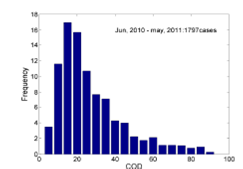
<body><![CDATA[<p><font size="2" face="Verdana">3.   If the first step is not satisfied, it is necessary to compare cloudiness   characteristics from the actinometric observations before and after the COD   measurement time.</font></p>     <p><font size="2" face="Verdana">3.1.If the cloudiness   characteristics indicative of the presence of cloud (CLDT&gt;5, CLDZ&gt;0,   SFL&gt;4, PHEN&gt;4) are similar in both actinometric observations, the COD is   selected as ‘correct’.</font></p>     <p><font size="2" face="Verdana">3.2.CLDT and CLDZ are   compared in both actinometric observations to evaluate the COD value with the   limits shown in the point 2.2.</font></p>     <p><font size="2" face="Verdana">A set of COD   values is obtained with the COD selected as ‘correct’. The features of the COD   true values are analyzed for the complete period from June 2010 to May 2011, as   well as in monthly and hourly basis.</font></p>     <p><font size="2" face="Verdana"><b>RESULTS AND   DISCUSIONS</b></font></p>     <p><font size="2" face="Verdana">The set of   original COD measurements in the period consists of 2277 values. After applying   the ‘evaluation’ algorithm 2250 COD values are selected as ‘correct’,   representing the 98.8 % of the cases. Only 25 cases were rejected and 2 cases   can not be compared because the actinometric measurements were not conducted.   The rejected cases were related with low values of COD and the absence of cloud   in the zenith. It can be seen the agreement between the sunphotometer COD   measurements and the actinometric reports of clouds.</font></p>     <p><font size="2" face="Verdana">The   extreme values of COD, values lower than 3 and higher than 90, are discarded   from the dataset, following the criteria of Chiu <i>et al., </i>(2010). A total   1797 COD values are selected after the application of this criteria,   representing a 79.9 % of the ‘correct’ values. This dataset is used for the   statistical analysis. The mean value of COD is 27.2, with a standard deviation   of 17.3.</font></p>     <p><font size="2" face="Verdana"><img width=243 height=169 id="Imagen 2" src="/img/revistas/rbf/v20n20/v20n20a01-image002.png"></font></p>     <p><font size="2" face="Verdana"><b>Figure 1. COD frequency   distribution for the period from June 2010 to May 2011, in Camagüey</b></font></p>     <p><font size="2" face="Verdana">In the Figure 1 the COD frequency   distribution is shown with an interval of 5 units of COD. The maximum frequency   of 17 % is found in the interval centered at 15. The COD frequency values   increase from COD value 3 to the maximum in 15 and then the values decrease for   higher values of COD. This result shows a similar frequency distribution than   the report from Chiu <i>et al., </i>(2010) for three years of data from   November, 2004 to June, 2008 at the ARM measurement site of Oklahoma in the   United States of America. The authors show for Oklahoma maximum frequency of 24   % at COD value near to 23. Also, they show the increase of the frequency from   minimum values of COD to 23 and then the frequency values decrease for higher   values of COD (Chiu <i>et al., </i>2010). The results for Camagüey and Oklahoma   sites show similar behavior of the COD, with different magnitude values. The   data sets for both sites have some differences, based in the extent of the   datasets and different geographical location.</font></p>     ]]></body>
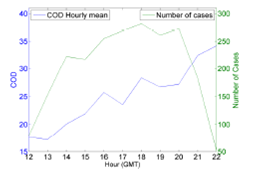
<body><![CDATA[<p><font size="2" face="Verdana">Figure 2 shows the behavior of the   monthly mean of COD values and the number of cases in each month for the   measurement period. The COD monthly mean maximum value of 34.2 is in the month   of May, 2011. The minimum value of COD of 19.8 is in December, 2010. The number   of cases reaches their maximum of 274 and minimum of 99 in October, 2010 and   February, 2011, respectively. This result shows May with the maximum monthly   mean value</font></p>     <p><font size="2" face="Verdana">The mean COD daily behavior is shown   in the Figure 3. The COD hourly mean values increase with the hour during the   day. Maximum value of COD hourly mean value is 34.2 at the 22 GMT; the minimum   value of 17.2 is at 13 GMT. This result is in relation with the development of   the cloudiness during the day. The number of cases has a maximum of 282 at 18   GMT. In the first and last hour there are the minimum values of number of   cases. At these times in some months of the year there are no measurements with   the sunphotometer.</font></p>     <p><font size="2" face="Verdana"><b>CONCLUSIONS</b></font></p>     <p><font size="2" face="Verdana">This is the first report on cloud   optical depth ground measured in our country. The COD frequency distribution   shows a maximum at the interval centered in 15. The frequency distribution of   COD agrees with other reports. There is a monthly COD maximum of 34.2 in May.   Nevertheless, the maximum value of the number of cases occurs in October. Monthly   and hourly mean values of COD show the concordance with the natural behavior of   the clouds in our region.</font></p>     <p><font size="2" face="Verdana"><img width=251 height=173 id="Imagen 3" src="/img/revistas/rbf/v20n20/v20n20a01-image003.png"></font></p>     <p><font size="2" face="Verdana"><b>Figure 2. COD Monthly means for   the period from June 2010 to May 2011.</b></font></p>     <p><font size="2" face="Verdana"><b><img width=267 height=169 id="Imagen 4" src="/img/revistas/rbf/v20n20/v20n20a01-image004.png"></b></font></p>     <p><font size="2" face="Verdana"><b>Figure 3. COD Hourly means for   the period from June 2010 to May 2011.</b></font></p>     <p><font size="2" face="Verdana"><b>REFERENCES</b></font></p>     <!-- ref --><p><font size="2" face="Verdana">1.- Chiu, J. C., C.-H.   Huang, A. Marshak, I. Slutsker, D. M. Giles, B. N. Holben, Y. Knyazikhin, and   W. J. Wiscombe (2010), Cloud optical depth retrievals from the Aerosol Robotic   Network (AERONET) cloud mode observations, <i>J. Geophys. Res</i>., 115,   D14202, doi:10.1029/2009JD013121.</font>&nbsp;&nbsp;&nbsp;&nbsp;&nbsp;&nbsp;&nbsp;&nbsp;[&#160;<a href="javascript:void(0);" onclick="javascript: window.open('/scielo.php?script=sci_nlinks&ref=228816&pid=S1562-3823201200040000100001&lng=','','width=640,height=500,resizable=yes,scrollbars=1,menubar=yes,');">Links</a>&#160;]<!-- end-ref --><!-- ref --><p><font size="2" face="Verdana">2.- Holben,   B. N., Eck, T. F., Slutsker, I., Tanré, D.,   Buis, J. P., Setzer, A., Vermote, E. F., Reagan, J. A., Kaufman, Y. J.,   Nakajima, T., Lavenu, F., Jankowiak, I., and Smirnov, A. (1998), AERONET: A   federated instrument network and data archive for aerosol characterization, <i>Remote   Sens. Environ</i>., 66, 1–16.</font>&nbsp;&nbsp;&nbsp;&nbsp;&nbsp;&nbsp;&nbsp;&nbsp;[&#160;<a href="javascript:void(0);" onclick="javascript: window.open('/scielo.php?script=sci_nlinks&ref=228817&pid=S1562-3823201200040000100002&lng=','','width=640,height=500,resizable=yes,scrollbars=1,menubar=yes,');">Links</a>&#160;]<!-- end-ref --><!-- ref --><p><font size="2" face="Verdana">3.- Illingworth, A. J., et al. (2007), Cloudnet: Continuous   evaluation of cloud profiles in seven operational models using ground based   observations, Bull. Am. Meteorol. Soc., 88, 883–898.</font>&nbsp;&nbsp;&nbsp;&nbsp;&nbsp;&nbsp;&nbsp;&nbsp;[&#160;<a href="javascript:void(0);" onclick="javascript: window.open('/scielo.php?script=sci_nlinks&ref=228818&pid=S1562-3823201200040000100003&lng=','','width=640,height=500,resizable=yes,scrollbars=1,menubar=yes,');">Links</a>&#160;]<!-- end-ref --><!-- ref --><p><font size="2" face="Verdana">4.- Stokes, G. M., and S. E. Schwartz (1994), The   Atmospheric Radiation Measurement (ARM) Program: Programmatic background and   design of the cloud and radiation test bed, <i>Bull. Am. Meteorol. Soc</i>.,   75, 1201–1221.</font><font size="2" face="Verdana"></font>&nbsp;&nbsp;&nbsp;&nbsp;&nbsp;&nbsp;&nbsp;&nbsp;[&#160;<a href="javascript:void(0);" onclick="javascript: window.open('/scielo.php?script=sci_nlinks&ref=228819&pid=S1562-3823201200040000100004&lng=','','width=640,height=500,resizable=yes,scrollbars=1,menubar=yes,');">Links</a>&#160;]<!-- end-ref --> ]]></body><back>
<ref-list>
<ref id="B1">
<label>1</label><nlm-citation citation-type="journal">
<person-group person-group-type="author">
<name>
<surname><![CDATA[Chiu]]></surname>
<given-names><![CDATA[J. C.]]></given-names>
</name>
<name>
<surname><![CDATA[Huang]]></surname>
<given-names><![CDATA[C.-H.]]></given-names>
</name>
<name>
<surname><![CDATA[Marshak]]></surname>
<given-names><![CDATA[A.]]></given-names>
</name>
<name>
<surname><![CDATA[Slutsker]]></surname>
<given-names><![CDATA[I.]]></given-names>
</name>
<name>
<surname><![CDATA[Giles]]></surname>
<given-names><![CDATA[D. M.]]></given-names>
</name>
<name>
<surname><![CDATA[Holben]]></surname>
<given-names><![CDATA[B. N.]]></given-names>
</name>
<name>
<surname><![CDATA[Knyazikhin]]></surname>
<given-names><![CDATA[Y.]]></given-names>
</name>
<name>
<surname><![CDATA[Wiscombe]]></surname>
<given-names><![CDATA[W. J.]]></given-names>
</name>
</person-group>
<article-title xml:lang="en"><![CDATA[Cloud optical depth retrievals from the Aerosol Robotic Network (AERONET) cloud mode observations]]></article-title>
<source><![CDATA[J. Geophys. Res.]]></source>
<year>2010</year>
</nlm-citation>
</ref>
<ref id="B2">
<label>2</label><nlm-citation citation-type="journal">
<person-group person-group-type="author">
<name>
<surname><![CDATA[Holben]]></surname>
<given-names><![CDATA[B. N.]]></given-names>
</name>
<name>
<surname><![CDATA[Eck]]></surname>
<given-names><![CDATA[T. F.]]></given-names>
</name>
<name>
<surname><![CDATA[Slutsker]]></surname>
<given-names><![CDATA[I.]]></given-names>
</name>
<name>
<surname><![CDATA[Tanré]]></surname>
<given-names><![CDATA[D.]]></given-names>
</name>
<name>
<surname><![CDATA[Buis]]></surname>
<given-names><![CDATA[J. P.]]></given-names>
</name>
<name>
<surname><![CDATA[Setzer]]></surname>
<given-names><![CDATA[A.]]></given-names>
</name>
<name>
<surname><![CDATA[Vermote]]></surname>
<given-names><![CDATA[E. F.]]></given-names>
</name>
<name>
<surname><![CDATA[Reagan]]></surname>
<given-names><![CDATA[J. A.]]></given-names>
</name>
<name>
<surname><![CDATA[Kaufman]]></surname>
<given-names><![CDATA[Y. J.]]></given-names>
</name>
<name>
<surname><![CDATA[Nakajima]]></surname>
<given-names><![CDATA[T.]]></given-names>
</name>
<name>
<surname><![CDATA[Lavenu]]></surname>
<given-names><![CDATA[F.]]></given-names>
</name>
<name>
<surname><![CDATA[Jankowiak]]></surname>
<given-names><![CDATA[I.]]></given-names>
</name>
<name>
<surname><![CDATA[Smirnov]]></surname>
<given-names><![CDATA[A.]]></given-names>
</name>
</person-group>
<article-title xml:lang="en"><![CDATA[AERONET]]></article-title>
<source><![CDATA[A federated instrument network and data archive for aerosol characterization]]></source>
<year>1998</year>
<volume>66</volume>
<page-range>1-16</page-range></nlm-citation>
</ref>
<ref id="B3">
<label>3</label><nlm-citation citation-type="journal">
<person-group person-group-type="author">
<name>
<surname><![CDATA[Illingworth]]></surname>
<given-names><![CDATA[A. J.]]></given-names>
</name>
</person-group>
<article-title xml:lang="en"><![CDATA[Cloudnet]]></article-title>
<source><![CDATA[Continuous evaluation of cloud profiles in seven operational models using ground based observations]]></source>
<year>2007</year>
<volume>88</volume>
<page-range>883-898</page-range></nlm-citation>
</ref>
<ref id="B4">
<label>4</label><nlm-citation citation-type="journal">
<person-group person-group-type="author">
<name>
<surname><![CDATA[Stokes]]></surname>
<given-names><![CDATA[G. M.]]></given-names>
</name>
<name>
<surname><![CDATA[Schwartz]]></surname>
<given-names><![CDATA[S. E.]]></given-names>
</name>
</person-group>
<article-title xml:lang="en"><![CDATA[The Atmospheric Radiation Measurement (ARM) Program]]></article-title>
<source><![CDATA[Programmatic background and design of the cloud and radiation test bed]]></source>
<year>1994</year>
<volume>75</volume>
<page-range>1201-1221</page-range><publisher-name><![CDATA[Bull. Am. Meteorol. Soc.]]></publisher-name>
</nlm-citation>
</ref>
</ref-list>
</back>
</article>