<?xml version="1.0" encoding="ISO-8859-1"?><article xmlns:mml="http://www.w3.org/1998/Math/MathML" xmlns:xlink="http://www.w3.org/1999/xlink" xmlns:xsi="http://www.w3.org/2001/XMLSchema-instance">
<front>
<journal-meta>
<journal-id>0250-5460</journal-id>
<journal-title><![CDATA[Revista Boliviana de Química]]></journal-title>
<abbrev-journal-title><![CDATA[Rev. Bol. Quim]]></abbrev-journal-title>
<issn>0250-5460</issn>
<publisher>
<publisher-name><![CDATA[Universidad Mayor de San Andrés]]></publisher-name>
</publisher>
</journal-meta>
<article-meta>
<article-id>S0250-54602020000300004</article-id>
<title-group>
<article-title xml:lang="en"><![CDATA[Assessment of the microbiological quality by means of selective chromophoric indicators and Malta extract of drinks of Amazonian fruits traded in Cobija, Bolivia]]></article-title>
<article-title xml:lang="es"><![CDATA[Evaluación de la calidad microbiológica mediante indicadores cromofóricos selectivos y extracto de Malta de bebidas de frutas Amazónicas comercializadas en Cobija, Bolivia]]></article-title>
</title-group>
<contrib-group>
<contrib contrib-type="author">
<name>
<surname><![CDATA[Surco Almendras]]></surname>
<given-names><![CDATA[Juan Carlos]]></given-names>
</name>
<xref ref-type="aff" rid="A01"/>
</contrib>
<contrib contrib-type="author">
<name>
<surname><![CDATA[Alvarado Kirigin]]></surname>
<given-names><![CDATA[Juan Antonio]]></given-names>
</name>
<xref ref-type="aff" rid="A02"/>
</contrib>
</contrib-group>
<aff id="A01">
<institution><![CDATA[,Laboratorio de Aguas y Alimentos Universidad Amazónica de Pando ]]></institution>
<addr-line><![CDATA[ ]]></addr-line>
</aff>
<aff id="A02">
<institution><![CDATA[,Facultad de Ciencias Puras , Universitaria Cota Cota  ]]></institution>
<addr-line><![CDATA[ ]]></addr-line>
</aff>
<pub-date pub-type="pub">
<day>30</day>
<month>12</month>
<year>2020</year>
</pub-date>
<pub-date pub-type="epub">
<day>30</day>
<month>12</month>
<year>2020</year>
</pub-date>
<volume>37</volume>
<numero>3</numero>
<fpage>176</fpage>
<lpage>184</lpage>
<copyright-statement/>
<copyright-year/>
<self-uri xlink:href="http://www.scielo.org.bo/scielo.php?script=sci_arttext&amp;pid=S0250-54602020000300004&amp;lng=en&amp;nrm=iso"></self-uri><self-uri xlink:href="http://www.scielo.org.bo/scielo.php?script=sci_abstract&amp;pid=S0250-54602020000300004&amp;lng=en&amp;nrm=iso"></self-uri><self-uri xlink:href="http://www.scielo.org.bo/scielo.php?script=sci_pdf&amp;pid=S0250-54602020000300004&amp;lng=en&amp;nrm=iso"></self-uri><abstract abstract-type="short" xml:lang="en"><p><![CDATA[Abstract Handcrañed son drinks made from Amazonian fruits and commercialized in Cobija, Bolivia have a high consumption index among local inhabitants, this, due to their flavor and natural refreshing features and their low-cost. To the best of our knowledge, to the present date, there are not reports on the microbiological quality of such drinks, which are not usually pasteurized. The survey among the personnel and the retail establishments on the hygienic conditions of elaboration was carried out through the use of an observation questionnaire. The results showed that 69% of the establishments did not comply with Good Hygienic Manufacturing and Handling Practices. Samples of each of the retail establishments were carried out during 3 weeks, completing a total of 78 samples of water and fruit drinks. Subsequently, the pH of each sample was determined. It was observed that the fruit waters present valúes that are below the limits established by the Bolivian Norm NB 512 (6.5 to 9.5). Fruit soft drinks have valúes that are within the limit allowed by the Peruvian Technical Standard NTP 203.110-111, which establishes that the pH must be less than 4.50. The contamination by microorganisms of water and fruit soft drinks was determined by using the Filter Membrane (CFU) method NB 31003. The results obtained in samples of water and fruit soft drinks indicated that they were contaminated with the presence of 92 % of total coliforms, 69% of Escherichia coli and 81% of fiingi and yeasts, exceeding the limits allowed by NB 512 and NTP 203.110-111]]></p></abstract>
<abstract abstract-type="short" xml:lang="es"><p><![CDATA[Resumen Los refrescos elaborados artesanalmente a base de frutas amazónicas y comercializados en Cobija, Bolivia son consumidos por la mayoría de la población, por su sabor y acción refrescante natural, además son de bajo costo. Es importante conocer la calidad de este alimento por no ser pasteurizado, lo cual nos motivó a realizar esta investigación. Se realizó la evaluación de las condiciones higiénicas del personal y de los establecimientos de expendio, mediante el uso de un cuestionario de observación. Según los resultados obtenidos, el 69% de los establecimientos no cumple con las Buenas Prácticas de Higiene de Elaboración y Manipulación. Se realizaron muéstreos de cada uno de los establecimientos de expendio durante 3 semanas, completándose un total de 78 muestras de aguas y refrescos de frutas. Posteriormente, se determinó el pH de cada muestra. Se observó que los aguas de frutas presentan valores que están por debajo de los límites que establece la Norma Boliviana NB 512 (6,5 a 9,5). Los refrescos de frutas presentan valores que están dentro del límite permitido por la Norma Técnica Peruana NTP 203.110-111, que establece que el pH debe ser inferior a 4,50. La presencia de microorganismos indicadores de contaminación en aguas y refrescos de frutas se determinó mediante el método de la Membrana Filtrante (UFC) NB 31003. Los resultados obtenidos en muestras de aguas y refrescos de frutas, indicaron que estaban contaminadas con la presencia en un 92% de coliformes totales, 69% de Escherichia coli y 81% de Hongos y levaduras excediendo los límites permitidos por la NB 512 y NTP 203.110-111]]></p></abstract>
<kwd-group>
<kwd lng="en"><![CDATA[Microbiological]]></kwd>
<kwd lng="en"><![CDATA[Artisanal drink]]></kwd>
<kwd lng="en"><![CDATA[Amazonian]]></kwd>
<kwd lng="en"><![CDATA[Fruits]]></kwd>
<kwd lng="en"><![CDATA[Chromophore]]></kwd>
<kwd lng="en"><![CDATA[Malt extract]]></kwd>
<kwd lng="es"><![CDATA[Microbiologica]]></kwd>
<kwd lng="es"><![CDATA[Bebida artesanal]]></kwd>
<kwd lng="es"><![CDATA[Amazónico]]></kwd>
<kwd lng="es"><![CDATA[Cromóforo]]></kwd>
<kwd lng="es"><![CDATA[Extracto de malta]]></kwd>
</kwd-group>
</article-meta>
</front><body><![CDATA[ <p align="right"><font size="2" face="Verdana, Arial, Helvetica, sans-serif"><strong>DOI:</strong> 10.34098/2078-3949.37.3.5</font>    <br> <font size="2" face="Verdana, Arial, Helvetica, sans-serif"><strong>FULL ORIGINAL ARTICLES</strong></font></p>     <p align="right">&nbsp;</p>     <p align="center"><font size="2" face="Verdana, Arial, Helvetica, sans-serif"><strong><font size="4">Assessment  of the microbiological quality by means of selective chromophoric     <br> indicators  and Malta extract of drinks of Amazonian fruits traded in Cobija, Bolivia</font></strong></font></p>     <p align="center">&nbsp;</p>     <p align="center"><strong><font size="3" face="Verdana, Arial, Helvetica, sans-serif">Evaluaci&oacute;n de la calidad microbiol&oacute;gica mediante indicadores  cromof&oacute;ricos selectivos y     <br> extracto de Malta de bebidas de frutas Amaz&oacute;nicas  comercializadas en Cobija, Bolivia</font></strong></p>     <p align="center">&nbsp;</p>     <p align="center">&nbsp;</p>     ]]></body>
<body><![CDATA[<p align="center"><strong><font face="Verdana, Arial, Helvetica, sans-serif" size="2">Juan Carlos Surco Almendras<sup>1</sup>, Juan Antonio Alvarado Kirigin<sup>2,*</sup></font></strong><font face="Verdana, Arial, Helvetica, sans-serif" size="2"></font>    <br> <font face="Verdana, Arial, Helvetica, sans-serif" size="2"><sup>1</sup> Laboratorio de Aguas y Alimentos, Área de Ciencias Biológicas y Naturales, Universidad Amazónica de Pando,    <br>  Cobija, Pando, Bolivia, <a href="mailto:jucarsur@hotmail.com">jucarsur@hotmail.com</a>, <a href="https://www.uap.edu.bo/" target="_blank">https://www.uap.edu.bo/</a>    <br> </font><font face="Verdana, Arial, Helvetica, sans-serif" size="2"><sup>2</sup>Centro de Estudios e Investigaciones en Química de Alimentos, Instituto de Investigaciones Químicas IIQ,    <br>  Chemical Sciences Department, Facultad de Ciencias Puras y Naturales FCPN,    <br>  Universidad Mayor de San Andrés UMSA, P.O. Box 303, Calle Andrés Bello s/n,    <br>  Ciudad Universitaria Cota Cota, phone +59122772269, La Paz, Bolivia, jaalvarado@umsa.bo, www.umsa.bo</font>    <br> <font face="Verdana, Arial, Helvetica, sans-serif" size="2">*Correspond&iexcl;ng author: </font><font face="Verdana, Arial, Helvetica, sans-serif" size="2" color="#0000E4"><u>jucarsur@hotmail.com</u>. <u>jaalvkir@gmail.com    <br> </u></font><font size="2" face="Verdana, Arial, Helvetica, sans-serif"><strong>Received </strong>12 13 2019 <strong>Accepted</strong> 08 01 2020 <strong>Published</strong> 08 30 2020</font></p>     <p align="justify">&nbsp;</p>     ]]></body>
<body><![CDATA[<p align="justify">&nbsp;</p> <hr>     <p align="justify"><font face="Verdana, Arial, Helvetica, sans-serif" size="2"><b>Abstract</b></font></p>     <p align="justify"><font face="Verdana, Arial, Helvetica, sans-serif" size="2">Handcrañed son drinks made from Amazonian fruits and commercialized in Cobija, Bolivia have a high consumption index among local inhabitants, this, due to their flavor and natural refreshing features and their low-cost. To the best of our knowledge, to the present date, there are not reports on the microbiological quality of such drinks, which are not usually pasteurized. The survey among the personnel and the retail establishments on the hygienic conditions of elaboration was carried out through the use of an observation questionnaire. The results showed that 69% of the establishments did not comply with Good Hygienic Manufacturing and Handling Practices. Samples of each of the retail establishments were carried out during 3 weeks, completing a total of 78 samples of water and fruit drinks. Subsequently, the pH of each sample was determined. It was observed that the fruit waters present valúes that are below the limits established by the Bolivian Norm NB 512 (6.5 to 9.5). Fruit soft drinks have valúes that are within the limit allowed by the Peruvian Technical Standard NTP 203.110-111, which establishes that the pH must be less than 4.50. The contamination by microorganisms of water and fruit soft drinks was determined by using the Filter Membrane (CFU) method NB 31003. The results obtained in samples of water and fruit soft drinks indicated that they</font> <font face="Verdana, Arial, Helvetica, sans-serif" size="2">were contaminated with the presence of 92 % of total coliforms, 69% of <i>Escherichia coli </i>and 81% of fiingi and yeasts, exceeding the limits allowed by NB 512 and NTP 203.110-111.</font></p>     <p align="justify"><font face="Verdana, Arial, Helvetica, sans-serif" size="2"><b>Keywords. </b><i>Microbiological, Artisanal drink, Amazonian, Fruits, Chromophore, Malt extract.</i></font></p> <hr>     <p align="justify"><font face="Verdana, Arial, Helvetica, sans-serif" size="2"><strong>Resumen</strong></font></p>     <p align="justify"><font face="Verdana, Arial, Helvetica, sans-serif" size="2">Los refrescos elaborados artesanalmente a base de frutas amazónicas y comercializados en Cobija, Bolivia son consumidos por la mayoría de la población, por su sabor y acción refrescante natural, además son de bajo costo. Es importante conocer la calidad de este alimento por no ser pasteurizado, lo cual nos motivó a realizar esta investigación. Se realizó la evaluación de las condiciones higiénicas del personal y de los establecimientos de expendio, mediante el uso de un cuestionario de observación. Según los resultados obtenidos, el 69% de los establecimientos no cumple con las Buenas Prácticas de Higiene de Elaboración y Manipulación. Se realizaron muéstreos de cada uno de los establecimientos de expendio durante 3 semanas, completándose un total de 78 muestras de aguas y refrescos de frutas. Posteriormente, se determinó el pH de cada muestra. Se observó que los aguas de frutas presentan valores que están por debajo de los límites que establece la Norma Boliviana NB 512 (6,5 a 9,5). Los refrescos de frutas presentan valores que están dentro del límite permitido por la Norma Técnica Peruana NTP 203.110-111, que establece que el pH debe ser inferior a 4,50. La presencia de microorganismos indicadores de contaminación en aguas y refrescos de frutas se determinó mediante el método de la Membrana Filtrante (UFC) NB 31003. Los resultados obtenidos en muestras de aguas y refrescos de frutas, indicaron que estaban contaminadas con la presencia en un 92% de coliformes totales, 69% de <i>Escherichia coli </i>y 81% de Hongos y levaduras excediendo los límites permitidos por la NB 512 y NTP 203.110-111.</font></p>     <p align="justify"><font face="Verdana, Arial, Helvetica, sans-serif" size="2"><b>Palabras clave. </b><i>Microbiologica, Bebida artesanal, Amaz&oacute;nico, Crom&oacute;foro, Extracto de malta.</i></font></p> <hr>     <p align="justify">&nbsp;</p>     <p align="justify">&nbsp;</p>     <p align="justify"><font face="Verdana, Arial, Helvetica, sans-serif" size="3"><strong>INTRODUCTION</strong></font></p>     ]]></body>
<body><![CDATA[<p align="justify"><font face="Verdana, Arial, Helvetica, sans-serif" size="2">The investigations driven so far, have determined that a significant fraction of foodborne infections and intoxications of bacterial origin were caused by fruit drinks made in the street, with water and fruits contaminated mainly with total coliform bacteria and <i>Escherichia coli. </i>Its quality is also affected by the poor hygiene habits in the fruits processing and bad hygiene of the operators. The waters and soft drinks are produced after direct manipulation or with the help of hand tools, through an artisanal production process [7]. Of every ten consumers at least nine have had infection problems and this leads us to a greater number of consumers exposed to diseases, either by or homemade fruit waters or drinks. Many of the diseases have their origin in the same handling of food, so it is necessary to prevent and take necessary measures, because the consuming population is exposed to various derived health problems. Cobija, the capital city of the department Pando (Bolivia), is not the exception, this situation is aggravated because of the quality of the water distributed by the public service that does not comply with the necessary pureness to warrant its consumption without the risk of threatening for the health of the population.</font></p>     <p align="justify"><strong><font face="Verdana, Arial, Helvetica, sans-serif" size="2"><i>Fruit waters and fruit drinks (handmade drinks) of Asaí, Copoazú, Carambola and Murucuyá</i></font></strong></p>     <p align="justify"><font face="Verdana, Arial, Helvetica, sans-serif" size="2">They are fruit waters and fruit drinks that give a good nutritional contribution, since they are prepared based on the juice of fresh fruits and vegetables or the edible part of them. Large amounts of vitamins, minerals, fiber and important substances make them extraordinary alimentary sources [8].</font></p>     <p align="justify"><font face="Verdana, Arial, Helvetica, sans-serif" size="2"><i><strong>Definition und prepurution of fruit wuters</strong></i></font></p>     <p align="justify"><font face="Verdana, Arial, Helvetica, sans-serif" size="2">Fruit waters are defined as non-alcoholic drinks that are prepared with the mixture of water with sugar and fruit pulp. They are usually served cold, but not frozen. The abundant use of ice and drink at a very low temperature is more recent, since among Latin-americans it is not customary to fill or put many ice on the glass where the drink is served. For this quality they are called &quot;refrescos&quot;, i.e. refreshing beverages [3].</font></p>     <p align="justify"><font face="Verdana, Arial, Helvetica, sans-serif" size="2"><i><strong>Definition und prepurution of fruit drinks</strong></i></font></p>     <p align="justify"><font face="Verdana, Arial, Helvetica, sans-serif" size="2">Fruit drinks are defined as drinks that contain a percentage of fruit that barely reaches 10%, is squeezed with a juicer or, in more rare cases, handled with pressure processes. The homogenates are obtained by processing the fruits and / or vegetables in a blender, to obtain a puré juice, which is obtained removing the pulp and fiber by filtering [6].</font></p>     <p align="justify"><font face="Verdana, Arial, Helvetica, sans-serif" size="2"><i><strong>Chromogenic Media</strong></i></font></p>     <p align="justify"><font face="Verdana, Arial, Helvetica, sans-serif" size="2">Chromogenic media are chemical substances that added to the médium give a colored precipitate that demonstrates the presence of a specific enzyme. If there is a visible color change inthe colonies it is due to the fact that the detected microorganism has an enzyme system that uses the substrate [17].</font></p>     <p align="justify"><font face="Verdana, Arial, Helvetica, sans-serif" size="2">The advantage of using chromogenic media are that they allow the identification of a specific microorganism one per time, avoiding a number of steps that make identification work more tedious, managing to quickly visualize different species inthe same analyzed sample [12].</font></p>     ]]></body>
<body><![CDATA[<p align="justify"><font face="Verdana, Arial, Helvetica, sans-serif" size="2"><i><strong>Chromocult médium for total coliforms and Escherichia coli</strong></i></font></p>     <p align="justify"><font face="Verdana, Arial, Helvetica, sans-serif" size="2">Chromocult médium is a selective agar for the growth of total coliforms and E. coli in water and food samples. Accelerated reproduction of two chromogenic substrates is guaranteed by the joint action of selective peptones, pyruvate and phosphate buffer:</font></p>     <blockquote>       <p align="justify"><font face="Verdana, Arial, Helvetica, sans-serif" size="2">• The Salmon-Gal substrate is separated by the &beta;-D-galactosidase enzyme, characteristic of coliforms and causes a red colorationof coliformcolonies [11].</font></p>       <p align="justify"><font face="Verdana, Arial, Helvetica, sans-serif" size="2">• The formation of the characteristic &beta;-D-Glucoronidase for <i>E. coli </i>takes place by means of the X-Glucuronide substrate, which when cut by the enzyme produces a blue coloration [11].</font></p> </blockquote>     <p align="justify"><font face="Verdana, Arial, Helvetica, sans-serif" size="2"><i><strong>Malt Extract</strong></i></font></p>     <p align="justify"><font face="Verdana, Arial, Helvetica, sans-serif" size="2">The malt extract is particularly suitable for the isolation, cultivation of yeasts and fungi that can be found in foods, since it contains a high concentration of maltose and other saccharides as energy sources [12]</font></p>     <p align="justify">&nbsp;</p>     <p align="justify"><font face="Verdana, Arial, Helvetica, sans-serif" size="3"><b>EXPERIMENTAL</b></font></p>     <p align="justify"><font face="Verdana, Arial, Helvetica, sans-serif" size="2">The research used the analytical method. In 13 retail outlets, it was collected once a week three times at the same sampling point: 39 fruit water samples and 39 fruit drink samples making a total of 78 samples. The pH valué was determined and the degree of contamination was identified by microbiological analysis, with selective culture media using the Membrane Method NB 31003.</font></p>     ]]></body>
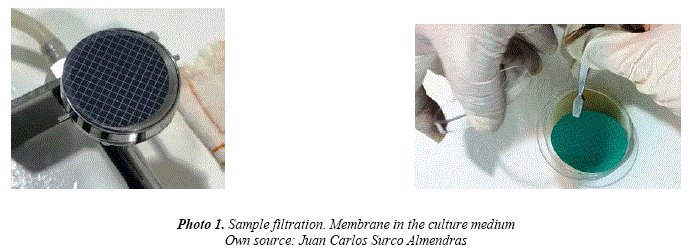
<body><![CDATA[<p align="justify"><font face="Verdana, Arial, Helvetica, sans-serif" size="2">The evaluation of whether fruit waters are suitable for human consumption was determined according to Bolivian Standard NB 512, by meausirng the pH valúes and the presence and / or absence of total Coliforms, <i>Escherichia coli, </i>Fungi and Yeasts. Inthe case of pH valúes and microbiological analysis of fruit drinks, its suitability for human consumption was determined using the Peruvian Technical Standard NTP 203.110-111 (615-2003, SA / DM) inthe absence of a corresponding Bolivian Technical Standard.</font></p>     <p align="justify"><font face="Verdana, Arial, Helvetica, sans-serif" size="2"><i><strong>pH determination of fruit waters and fruit drinks</strong></i></font></p>     <p align="justify"><font face="Verdana, Arial, Helvetica, sans-serif" size="2">The pH valúes of the fruit waters and fruit drinks of: copoazú, passion fruit, asaí and carambola were determined according to the procedure of NB 31001.</font></p>     <p align="justify"><font face="Verdana, Arial, Helvetica, sans-serif" size="2"><i><strong>Evaluation of the microbiological quality of fruit waters and fruit drinks</strong></i></font></p>     <p align="justify"><font face="Verdana, Arial, Helvetica, sans-serif" size="2">Samples from the different sampling points were treated to determine the presence or absence of microorganisms according to the Filtering Membrane Technique as described below:</font></p>     <p align="justify"><font face="Verdana, Arial, Helvetica, sans-serif" size="2"><i><strong>Membrane Filtration Technique</strong></i></font></p>     <p align="justify"><font face="Verdana, Arial, Helvetica, sans-serif" size="2">1. Autoclaved to sterilize: material, distilled water (to dilute fruit drinks and culture media).</font></p>     <p align="justify"><font face="Verdana, Arial, Helvetica, sans-serif" size="2">2. The sample of water and fruit drink is filtered through a 0.45 um pore diameter membrane, validated according to the standard. See <a href="#p1">Photo 1</a></font></p>     <p align="justify"><font face="Verdana, Arial, Helvetica, sans-serif" size="2">3. The membrane is placed face up on a píate containing the specific culture médium: Chromocult (chromophore) for total coliforms and <i>E. coli; </i>malt extract for fungi and yeasts.</font></p>     <p align="center"><img src="/img/revistas/rbq/v37n3/a04_figura01.gif" width="693" height="249"><a name="p1"></a></p>     ]]></body>
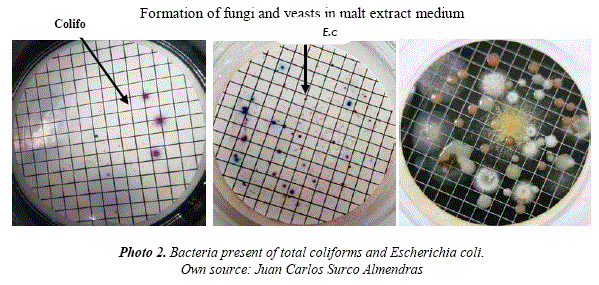
<body><![CDATA[<p align="justify"><font face="Verdana, Arial, Helvetica, sans-serif" size="2">4. The píate is incubated with the fílter membrane for 24-36 hours at 20&deg; C.</font></p>     <p align="justify"><font face="Verdana, Arial, Helvetica, sans-serif" size="2">5. After 24 to 36 hours, the colonies formed are counted:</font></p>     <p align="justify"><font face="Verdana, Arial, Helvetica, sans-serif" size="2">The characteristic enzyme of total coliforms, &beta;-D-Galactosidase is fixed inthe Salmon-GAL substrate and is the cause of the red color. The characteristic enzyme of E.coli, &beta;-D-Glucuronidase is fixed inthe X-Glucuronide substrate and causes the colonies to have a dark blue or violet color. See <a href="#p2">Photo 2</a>.</font></p>     <p align="center"><img src="/img/revistas/rbq/v37n3/a04_figura02.gif" width="599" height="285"><a name="p2"></a></p>     <p align="justify"><font face="Verdana, Arial, Helvetica, sans-serif" size="2"><i>Statistical treatment ofpH determination and microbiological count data</i></font></p>     <p align="justify"><font face="Verdana, Arial, Helvetica, sans-serif" size="2">The Stat Graphics plus 5.0 program, 1999-2000, was used to determine the mínimum, máximum, average and typical deviation valúes.</font></p>     <p align="justify">&nbsp;</p>     <p align="justify"><font face="Verdana, Arial, Helvetica, sans-serif" size="3"><b>RESULTS AND DISCUSSION</b></font></p>     <p align="justify"><font face="Verdana, Arial, Helvetica, sans-serif" size="2"><i><strong>General data of the Questionnaire</strong></i></font></p>     <p align="center"><img src="/img/revistas/rbq/v37n3/a04_figura03.gif" width="508" height="443"><a name="t1"></a></p>     ]]></body>
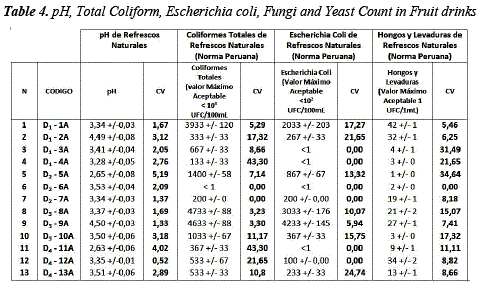
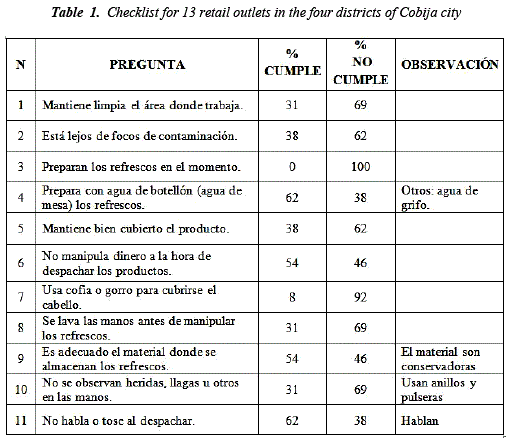
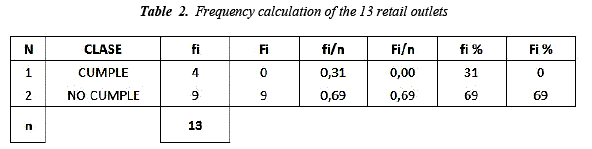
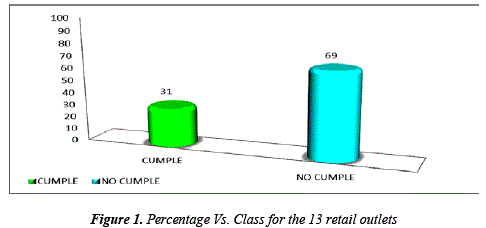
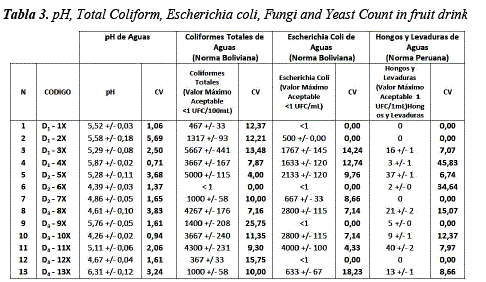
<body><![CDATA[<p align="justify"><font size="2" face="Verdana, Arial, Helvetica, sans-serif">For the data in <a href="#t1">Table 1</a> the calculation of frequency (<a href="#t2">table 2</a>) and graph (<a href="#f1">figure 1</a>) was performed.</font></p>     <p align="center"><img src="/img/revistas/rbq/v37n3/a04_figura04.gif" width="592" height="149"><a name="t2"></a></p>     <p align="center"><img src="/img/revistas/rbq/v37n3/a04_figura05.gif" width="486" height="228"><a name="f1"></a></p>     <p align="justify"><font face="Verdana, Arial, Helvetica, sans-serif" size="2"><b>General Data: </b>pH, Total Coliform Count, Escherichia coli, Fungí and Yeast from fruit waters and fruits drinks</font></p>     <p align="center"><img src="/img/revistas/rbq/v37n3/a04_figura06.gif" width="486" height="282"><a name="t3"></a></p>     <p align="center"><img src="/img/revistas/rbq/v37n3/a04_figura07.gif" width="486" height="282"></p>     <p align="center"><img src="/img/revistas/rbq/v37n3/a04_figura08.gif" width="658" height="280"><img src="/img/revistas/rbq/v37n3/a04_figura09.gif" width="634" height="263"></p>     <p align="center">&nbsp;</p>     <p align="justify"><font face="Verdana, Arial, Helvetica, sans-serif" size="3"><strong>DISCUSSION</strong></font></p>     <p align="justify"><font face="Verdana, Arial, Helvetica, sans-serif" size="2"><i><strong>Status of the retail outlets</strong></i></font></p>     ]]></body>
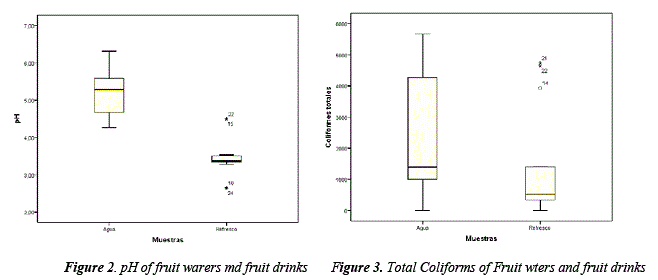
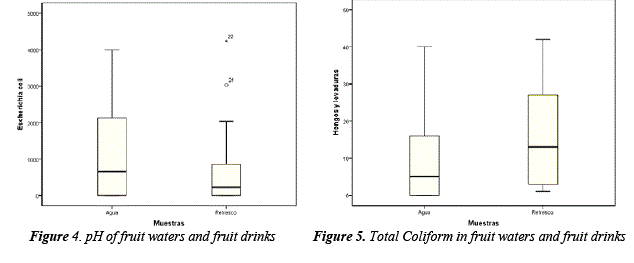
<body><![CDATA[<p align="justify"><font face="Verdana, Arial, Helvetica, sans-serif" size="2">The bad manipulation of the fruits, the fact of carrying rings, clocks, nails with enamel in the hands of the manipulators , without the use of appropriate clothing, indícate that 69% of the retail outlets under study do not comply with Good Hygiene Practices of elaboration and manipulation as detailed in the Peruvian Technical Standard.</font></p>     <p align="justify"><font face="Verdana, Arial, Helvetica, sans-serif" size="2"><i><strong>pH</strong></i></font></p>     <p align="justify"><font face="Verdana, Arial, Helvetica, sans-serif" size="2">The CV (coefficient of variation) expressed as a percentage determines the degree of accuracy ofthe data processing ofthe valúes for all measurements [4]. The CV ofthe pH gave valúes less than 7% obtaining the accuracy range. The Bolivian Standard NB 512, establishes the permissible limits of pH within the range of 6.5 to 9.5 with respect to fruit waters, the results indicate that the pH varied from 4.26 to 6.31 with a general average of 5.19, which compared to the standard are below the allowed parameters, so they are not suitable for human consumption. The Peruvian Technical Standard 203.110 (2003), establishes that the pH should be lower than 4.5 with respect to specific requirements for fruit drinks, the results indicate that the pH varied from 2.63 to 4.50 with a general average of 3.45, which compared to the norm are between the allowed limit.</font></p>     <p align="justify"><font face="Verdana, Arial, Helvetica, sans-serif" size="2"><i><strong>Microbiological characteristics of fruit water and fruit soda</strong></i></font></p>     <p align="justify"><font face="Verdana, Arial, Helvetica, sans-serif" size="2">The CV of Total Coliforms, Escherichia coli, Fungi and Water Yeasts respectively have 23%, 46% and 46% valúes respectively that are in the precisión range. The results in <a href="#t3">Table 3</a> indicate that 8%, 31% and 31% ofthe samples of Total Coliforms, Escherichia coli, Fungi and Yeasts respectively do not show contamination according to the NB.</font></p>     <p align="justify"><font face="Verdana, Arial, Helvetica, sans-serif" size="2">The CV of Total Coliforms, <i>Escherichia coli, </i>Fungi and Water Yeasts respectively have 23%, 46% and 46% valúes that are in the precisión range. The results of <a href="#t3">table 3</a> indicate that 8%, 31% and 31% ofthe samples do not show contamination of Total Coliforms, <i>Escherichia coli, </i>Fungi and Yeasts respectively according to the NB.</font></p>     <p align="justify">&nbsp;</p>     <p align="justify"><font face="Verdana, Arial, Helvetica, sans-serif" size="3"><strong>CONCLUSIONS</strong></font></p>     <p align="justify"><font face="Verdana, Arial, Helvetica, sans-serif" size="2">There is a significant correlation between the hygiene conditions and the microbial load, this allows us to generalize that assorted fruit sodas will not meet the established microbiological quality, that is, if the hygiene conditions are bad, the product will also be. The sanitary hygienic conditions ofthe retail outlets of fruit drinks are significantly related to microbial load, so that, the greater the deficiency in the hygienic conditions, the lower the microbiological quality of the fruit drinks, in such a way that it does not comply with the parameters proposed by the Peruvian Technical Standard. Temperature and humidity are indicators of the quality of fruit water and fruit drinks, which influences microbial behavior, favoring the proliferation of microorganisms; although the norms do not establish parameters for these variables. It is concluded that fruit drinks prepared with water in conditions of insufficient hygiene constitute a risk to the health of consumers.</font></p>     <p align="justify"><font face="Verdana, Arial, Helvetica, sans-serif" size="2"><i><strong>Social recommendation</strong></i></font></p>     ]]></body>
<body><![CDATA[<p align="justify"><font face="Verdana, Arial, Helvetica, sans-serif" size="2">It is recommended to the local municipal communes through their authorities and officials, that apart from carrying out inspections and cleaning programs in the retail outlets of fruit drinks, should develop educational interventions that contribute to improve the conditions in which they are prepared and ensure its quality, raising the quality of the service they provide as they are labor sources.</font></p>     <p align="justify">&nbsp;</p>     <p align="justify"><font face="Verdana, Arial, Helvetica, sans-serif" size="3"><strong>REFERENCES</strong></font></p>     <!-- ref --><p align="justify"><font size="2" face="Verdana, Arial, Helvetica, sans-serif">1. Agustín, G.C. Frutales Nativos Amazónicos, Ediciones IIAP. <b>2010, </b>Iquitos, Perú. <A href=http://www.iiap.org.pe/Archivos/publicaciones/Publicacion target="_blank">http://www.iiap.org.pe/Archivos/publicaciones/Publicacion1484.pdf</A>. </font>Access date: August 2019.&nbsp;&nbsp;&nbsp;&nbsp;&nbsp;&nbsp;&nbsp;&nbsp;[&#160;<a href="javascript:void(0);" onclick="javascript: window.open('/scielo.php?script=sci_nlinks&ref=701739&pid=S0250-5460202000030000400001&lng=','','width=640,height=500,resizable=yes,scrollbars=1,menubar=yes,');">Links</a>&#160;]<!-- end-ref --><!-- ref --><p align="justify"><font face="Verdana, Arial, Helvetica, sans-serif" size="2">2. Ávila Pineda G.T., Fonseca, M.M. <b>2008. </b>Calidad microbiológica de jugos preparados en hogares de bienestar familiar en la zona norte de      Cundimarca,      BSc      dissertation, <i>Pontificia      Universidad     Javeriana,      </i>Bogotá      Colombia,      retrievde      from      : <a href="https://www.javeriana.edu.co/web/biblos//tesis/ciencias/tesisl05.pdf" target="_blank">https://www.javeriana.edu.co/web/biblos//tesis/ciencias/tesisl05.pdf</a>, access date: June 2019</font>&nbsp;&nbsp;&nbsp;&nbsp;&nbsp;&nbsp;&nbsp;&nbsp;[&#160;<a href="javascript:void(0);" onclick="javascript: window.open('/scielo.php?script=sci_nlinks&ref=701740&pid=S0250-5460202000030000400002&lng=','','width=640,height=500,resizable=yes,scrollbars=1,menubar=yes,');">Links</a>&#160;]<!-- end-ref --><p align="justify"><font size="2" face="Verdana, Arial, Helvetica, sans-serif">3. Bebidas de México: Aguas frescas. (2012, Junio 10). Retrieved septiembre martes, <b>2019</b>, <A href=http://www.absolut-mexico.com/bebidas-de- target="_blank">http://www.absolut-mexico.com/bebidas-de-mexico-aguas-frescas/</A>.</font> access date: June 2019</p>     <!-- ref --><p align="justify"><font face="Verdana, Arial, Helvetica, sans-serif" size="2">4. Bowman, D.T. 2001, Common use of the CV: a statistical aberration in crop performance triáis (Contemporary Issue). <i>J. Cotton Sci. 5, </i>137-141.</font>&nbsp;&nbsp;&nbsp;&nbsp;&nbsp;&nbsp;&nbsp;&nbsp;[&#160;<a href="javascript:void(0);" onclick="javascript: window.open('/scielo.php?script=sci_nlinks&ref=701742&pid=S0250-5460202000030000400003&lng=','','width=640,height=500,resizable=yes,scrollbars=1,menubar=yes,');">Links</a>&#160;]<!-- end-ref --><!-- ref --><p align="justify"><font face="Verdana, Arial, Helvetica, sans-serif" size="2">5. Codex alimentarius, Normas Codex sobre requisitos generales. Higiene de los alimentos., 57-59. (s.f). Suiza. Secretaría, Comisión del Codex Alimentarius, Programa Conjunto FAO/OMS sobre Normas Alimentarias, FAO, Viale delle Terme di Caracalla, 00100 Roma, Italia,   Fax:   +(39)   0657054593,   Correo   electrónico: </font><font face="Verdana, Arial, Helvetica, sans-serif" size="2" color="#0000E4"><u><a href="codextgifao.org" target="_blank">codextgifao.org</a></u>.   <A href=http://www.fao.org/ag/agn/cdfruits target="_blank"><u>http://www.fao.org/ag/agn/cdfruits es/others/docs/cac-rcpl-1969.pdf</u></A>. </font><font face="Verdana, Arial, Helvetica, sans-serif" size="2">Access date: June 2019.</font>&nbsp;&nbsp;&nbsp;&nbsp;&nbsp;&nbsp;&nbsp;&nbsp;[&#160;<a href="javascript:void(0);" onclick="javascript: window.open('/scielo.php?script=sci_nlinks&ref=701743&pid=S0250-5460202000030000400004&lng=','','width=640,height=500,resizable=yes,scrollbars=1,menubar=yes,');">Links</a>&#160;]<!-- end-ref --><!-- ref --><p align="justify"><font face="Verdana, Arial, Helvetica, sans-serif" size="2">6. Expogourmet    megazine. 2019,     <a href="https://www.expogourmetmagazine.com/n-/es/16000/nectar-zumo-concentrado-o-zumo-natural-de-naranja-cuales-son-sus-diferencias" target="_blank">https://www.expogourmetmagazine.com/n-/es/16000/nectar-zumo-concentrado-o-zumo-natural-de-naranja-cuales-son-sus-diferencias</a> , access date June 2019</font>&nbsp;&nbsp;&nbsp;&nbsp;&nbsp;&nbsp;&nbsp;&nbsp;[&#160;<a href="javascript:void(0);" onclick="javascript: window.open('/scielo.php?script=sci_nlinks&ref=701744&pid=S0250-5460202000030000400005&lng=','','width=640,height=500,resizable=yes,scrollbars=1,menubar=yes,');">Links</a>&#160;]<!-- end-ref --><!-- ref --><p align="justify"><font face="Verdana, Arial, Helvetica, sans-serif" size="2">7. FAO. 2009. Sistemas de calidad e inocuidad de los alimentos. Manual de capacitación sobre higiene de los alimentos y sobre el sistema de Análisis de Peligros y de Puntos Críticos de Control (APPCC). Roma, Italia. FAO, Viale delle Terme di Caracalla, 00100 Roma, Italia,   Fax:   +(39)   0657054593,   Correo   electrónico: </font><font face="Verdana, Arial, Helvetica, sans-serif" size="2" color="#0000E4"><u><a href="codextgifao.org" target="_blank">codextgifao.org</a></u>.   <A href=http://www.fao.org/ag/agn/cdfruits target="_blank"><u>http://www.fao.org/ag/agn/cdfruits es/others/docs/cac-rcpl-1969.pdf</u></A>. </font><font face="Verdana, Arial, Helvetica, sans-serif" size="2">Access date: June 2019</font>&nbsp;&nbsp;&nbsp;&nbsp;&nbsp;&nbsp;&nbsp;&nbsp;[&#160;<a href="javascript:void(0);" onclick="javascript: window.open('/scielo.php?script=sci_nlinks&ref=701745&pid=S0250-5460202000030000400006&lng=','','width=640,height=500,resizable=yes,scrollbars=1,menubar=yes,');">Links</a>&#160;]<!-- end-ref --><!-- ref --><p align="justify"><font face="Verdana, Arial, Helvetica, sans-serif" size="2">8. Gabin, M.C. 2007, Normas para la Higiene y adecuada manipulación de los alimentos AR. Consultado 17 jul. 2009.</font>&nbsp;&nbsp;&nbsp;&nbsp;&nbsp;&nbsp;&nbsp;&nbsp;[&#160;<a href="javascript:void(0);" onclick="javascript: window.open('/scielo.php?script=sci_nlinks&ref=701746&pid=S0250-5460202000030000400007&lng=','','width=640,height=500,resizable=yes,scrollbars=1,menubar=yes,');">Links</a>&#160;]<!-- end-ref --><!-- ref --><p align="justify"><font size="2" face="Verdana, Arial, Helvetica, sans-serif">9. Bureau of Standards Jamaica. 2010,    Final Draft Jamaican Standard Specification Fruit and Vegetable juices and drinks, and fruit nectars. Kingston, Jamaica, <A href=http://www.puntofocal.gov.ar/notific target="_blank"><font face="Times New Roman" size="2" color="#0000E4"><u>http://www.puntofocal.gov.ar/notificotrosmiembros/grdl5t.pdf</u></A>. </font>Access date: November 2019.&nbsp;&nbsp;&nbsp;&nbsp;&nbsp;&nbsp;&nbsp;&nbsp;[&#160;<a href="javascript:void(0);" onclick="javascript: window.open('/scielo.php?script=sci_nlinks&ref=701747&pid=S0250-5460202000030000400008&lng=','','width=640,height=500,resizable=yes,scrollbars=1,menubar=yes,');">Links</a>&#160;]<!-- end-ref --><!-- ref --><p align="justify"><font face="Verdana, Arial, Helvetica, sans-serif" size="2">10. Nishimoto, N., Yoshizaki, K., Miyasaka, N., Yamamoto, K., Kawai, S., Takeuchi, T., Hashimoto, J., Azuma, J., Kishimoto, T. 2004. Treatment    of   rheumatoid    arthritis    with    humanized    anti-interleukin-6    receptor   antibody:    a    multicenter,    double- blind, placebo-control I ed trial <i>, Arthritis &amp; Rheumatis, 50, </i>(6), 1761-1769. DOI: 10.1002/art.20303</font>&nbsp;&nbsp;&nbsp;&nbsp;&nbsp;&nbsp;&nbsp;&nbsp;[&#160;<a href="javascript:void(0);" onclick="javascript: window.open('/scielo.php?script=sci_nlinks&ref=701748&pid=S0250-5460202000030000400009&lng=','','width=640,height=500,resizable=yes,scrollbars=1,menubar=yes,');">Links</a>&#160;]<!-- end-ref --><!-- ref --><p align="justify"><font face="Verdana, Arial, Helvetica, sans-serif" size="2">11. Merck. 1998, Manual de medios de cultivo.</font>&nbsp;&nbsp;&nbsp;&nbsp;&nbsp;&nbsp;&nbsp;&nbsp;[&#160;<a href="javascript:void(0);" onclick="javascript: window.open('/scielo.php?script=sci_nlinks&ref=701749&pid=S0250-5460202000030000400010&lng=','','width=640,height=500,resizable=yes,scrollbars=1,menubar=yes,');">Links</a>&#160;]<!-- end-ref --><!-- ref --><p align="justify"><font face="Verdana, Arial, Helvetica, sans-serif" size="2">12. Moreno, C. (s.f). <A href=http://www.britanialab.com/esp/productos/b04/chromobit.htm>http://www.britanialab.com/esp/productos/b04/chromobit.htm</A>. Recuperado el 21 de Abril de 2008.</font>&nbsp;&nbsp;&nbsp;&nbsp;&nbsp;&nbsp;&nbsp;&nbsp;[&#160;<a href="javascript:void(0);" onclick="javascript: window.open('/scielo.php?script=sci_nlinks&ref=701750&pid=S0250-5460202000030000400011&lng=','','width=640,height=500,resizable=yes,scrollbars=1,menubar=yes,');">Links</a>&#160;]<!-- end-ref --><!-- ref --><p align="justify"><font face="Verdana, Arial, Helvetica, sans-serif" size="2">13. Norma Boliviana NB, Instituto Boliviano de Normalización y Calidad (IBNORCA), 2015</font>&nbsp;&nbsp;&nbsp;&nbsp;&nbsp;&nbsp;&nbsp;&nbsp;[&#160;<a href="javascript:void(0);" onclick="javascript: window.open('/scielo.php?script=sci_nlinks&ref=701751&pid=S0250-5460202000030000400012&lng=','','width=640,height=500,resizable=yes,scrollbars=1,menubar=yes,');">Links</a>&#160;]<!-- end-ref --><p align="justify"><font face="Verdana, Arial, Helvetica, sans-serif" size="2">14. Norma Técnica Peruana NTP 203.111 (615-2003 SA/DM).</font></p>     <!-- ref --><p align="justify"><font face="Verdana, Arial, Helvetica, sans-serif" size="2">15. Organización Mundial de la Salud. 2015. (s.f). Apéndice a la Tercera Edición. Vol 1</font>&nbsp;&nbsp;&nbsp;&nbsp;&nbsp;&nbsp;&nbsp;&nbsp;[&#160;<a href="javascript:void(0);" onclick="javascript: window.open('/scielo.php?script=sci_nlinks&ref=701753&pid=S0250-5460202000030000400013&lng=','','width=640,height=500,resizable=yes,scrollbars=1,menubar=yes,');">Links</a>&#160;]<!-- end-ref --><!-- ref --><p align="justify"><font face="Verdana, Arial, Helvetica, sans-serif" size="2">16. Rojas, T., Castillo, Z. 2003, Supervivencia de un Aislado de <i>Escherichia coli </i>en Jugos de Naranja no Pasteurizados de expendio comercial, <i>Rev. Soc. Ven. Microbiol, 23(1), </i>16-20.</font>&nbsp;&nbsp;&nbsp;&nbsp;&nbsp;&nbsp;&nbsp;&nbsp;[&#160;<a href="javascript:void(0);" onclick="javascript: window.open('/scielo.php?script=sci_nlinks&ref=701754&pid=S0250-5460202000030000400014&lng=','','width=640,height=500,resizable=yes,scrollbars=1,menubar=yes,');">Links</a>&#160;]<!-- end-ref --><!-- ref --><p align="justify"><font face="Verdana, Arial, Helvetica, sans-serif" size="2">17. Tortora, G. Introducción a la microbiología, Editorial Acribia S.A., 1993, Zaragoza, España.</font>&nbsp;&nbsp;&nbsp;&nbsp;&nbsp;&nbsp;&nbsp;&nbsp;[&#160;<a href="javascript:void(0);" onclick="javascript: window.open('/scielo.php?script=sci_nlinks&ref=701755&pid=S0250-5460202000030000400015&lng=','','width=640,height=500,resizable=yes,scrollbars=1,menubar=yes,');">Links</a>&#160;]<!-- end-ref --><p align="justify">&nbsp;</p>     <p align="justify">&nbsp;</p>      ]]></body><back>
<ref-list>
<ref id="B1">
<nlm-citation citation-type="book">
<person-group person-group-type="author">
<name>
<surname><![CDATA[Agustín]]></surname>
<given-names><![CDATA[G.C]]></given-names>
</name>
</person-group>
<source><![CDATA[Frutales Nativos Amazónicos]]></source>
<year>2010</year>
<publisher-loc><![CDATA[Iquitos ]]></publisher-loc>
<publisher-name><![CDATA[Ediciones IIAP]]></publisher-name>
</nlm-citation>
</ref>
<ref id="B2">
<nlm-citation citation-type="book">
<person-group person-group-type="author">
<name>
<surname><![CDATA[Ávila Pineda]]></surname>
<given-names><![CDATA[G.T]]></given-names>
</name>
<name>
<surname><![CDATA[Fonseca]]></surname>
<given-names><![CDATA[M.M]]></given-names>
</name>
</person-group>
<source><![CDATA[Calidad microbiológica de jugos preparados en hogares de bienestar familiar en la zona norte de Cundimarca, BSc dissertation]]></source>
<year>2008</year>
<publisher-loc><![CDATA[Bogotá ]]></publisher-loc>
<publisher-name><![CDATA[Pontificia Universidad Javeriana]]></publisher-name>
</nlm-citation>
</ref>
<ref id="B3">
<nlm-citation citation-type="journal">
<person-group person-group-type="author">
<name>
<surname><![CDATA[Bowman]]></surname>
<given-names><![CDATA[D.T]]></given-names>
</name>
</person-group>
<article-title xml:lang="en"><![CDATA[Common use of the CV: a statistical aberration in crop performance triáis (Contemporary Issue)]]></article-title>
<source><![CDATA[J. Cotton Sci]]></source>
<year>2001</year>
<numero>5</numero>
<issue>5</issue>
<page-range>137-141</page-range></nlm-citation>
</ref>
<ref id="B4">
<nlm-citation citation-type="">
<collab>Codex alimentarius</collab>
<source><![CDATA[Normas Codex sobre requisitos generales. Higiene de los alimentos., 57-59. (s.f). Suiza. Secretaría, Comisión del Codex Alimentarius, Programa Conjunto FAO/OMS sobre Normas Alimentarias, FAO, Viale delle Terme di Caracalla,]]></source>
<year></year>
<publisher-loc><![CDATA[Roma ]]></publisher-loc>
</nlm-citation>
</ref>
<ref id="B5">
<nlm-citation citation-type="">
<collab>Expogourmet megazine</collab>
<source><![CDATA[]]></source>
<year>2019</year>
</nlm-citation>
</ref>
<ref id="B6">
<nlm-citation citation-type="">
<collab>FAO</collab>
<source><![CDATA[Sistemas de calidad e inocuidad de los alimentos. Manual de capacitación sobre higiene de los alimentos y sobre el sistema de Análisis de Peligros y de Puntos Críticos de Control (APPCC). Roma, Italia. FAO, Viale delle Terme di Caracalla]]></source>
<year>2009</year>
<publisher-loc><![CDATA[Roma ]]></publisher-loc>
</nlm-citation>
</ref>
<ref id="B7">
<nlm-citation citation-type="">
<person-group person-group-type="author">
<name>
<surname><![CDATA[Gabin]]></surname>
<given-names><![CDATA[M.C]]></given-names>
</name>
</person-group>
<source><![CDATA[Normas para la Higiene y adecuada manipulación de los alimentos AR]]></source>
<year>2007</year>
</nlm-citation>
</ref>
<ref id="B8">
<nlm-citation citation-type="">
<collab>Bureau of Standards Jamaica</collab>
<source><![CDATA[Final Draft Jamaican Standard Specification Fruit and Vegetable juices and drinks, and fruit nectars.]]></source>
<year>2010</year>
<publisher-loc><![CDATA[Kingston ]]></publisher-loc>
</nlm-citation>
</ref>
<ref id="B9">
<nlm-citation citation-type="journal">
<person-group person-group-type="author">
<name>
<surname><![CDATA[Nishimoto]]></surname>
<given-names><![CDATA[N]]></given-names>
</name>
<name>
<surname><![CDATA[Yoshizaki]]></surname>
<given-names><![CDATA[K]]></given-names>
</name>
<name>
<surname><![CDATA[Miyasaka]]></surname>
<given-names><![CDATA[N]]></given-names>
</name>
<name>
<surname><![CDATA[Yamamoto]]></surname>
<given-names><![CDATA[K]]></given-names>
</name>
<name>
<surname><![CDATA[Kawai]]></surname>
<given-names><![CDATA[S]]></given-names>
</name>
<name>
<surname><![CDATA[Takeuchi]]></surname>
<given-names><![CDATA[T]]></given-names>
</name>
<name>
<surname><![CDATA[Hashimoto]]></surname>
<given-names><![CDATA[J]]></given-names>
</name>
<name>
<surname><![CDATA[Azuma]]></surname>
<given-names><![CDATA[J]]></given-names>
</name>
<name>
<surname><![CDATA[Kishimoto]]></surname>
<given-names><![CDATA[T]]></given-names>
</name>
</person-group>
<article-title xml:lang="en"><![CDATA[Treatment of rheumatoid arthritis with humanized anti-interleukin-6 receptor antibody: a multicenter, double- blind, placebo-control I ed trial]]></article-title>
<source><![CDATA[Arthritis & Rheumatis]]></source>
<year>2004</year>
<volume>50</volume>
<numero>6</numero>
<issue>6</issue>
<page-range>1761-1769</page-range></nlm-citation>
</ref>
<ref id="B10">
<nlm-citation citation-type="">
<person-group person-group-type="author">
<name>
<surname><![CDATA[Merck]]></surname>
</name>
</person-group>
<article-title xml:lang="en"><![CDATA[Manual de medios de cultivo]]></article-title>
<source><![CDATA[]]></source>
<year>1998</year>
</nlm-citation>
</ref>
<ref id="B11">
<nlm-citation citation-type="">
<person-group person-group-type="author">
<name>
<surname><![CDATA[Moreno]]></surname>
<given-names><![CDATA[C]]></given-names>
</name>
</person-group>
<source><![CDATA[]]></source>
<year></year>
</nlm-citation>
</ref>
<ref id="B12">
<nlm-citation citation-type="">
<collab>Norma Boliviana NB</collab>
<source><![CDATA[Instituto Boliviano de Normalización y Calidad (IBNORCA)]]></source>
<year>2015</year>
</nlm-citation>
</ref>
<ref id="B13">
<nlm-citation citation-type="">
<collab>Organización Mundial de la Salud</collab>
<source><![CDATA[Apéndice a la Tercera Edición]]></source>
<year>2015</year>
<volume>1</volume>
</nlm-citation>
</ref>
<ref id="B14">
<nlm-citation citation-type="journal">
<person-group person-group-type="author">
<name>
<surname><![CDATA[Rojas]]></surname>
<given-names><![CDATA[T]]></given-names>
</name>
<name>
<surname><![CDATA[Castillo]]></surname>
<given-names><![CDATA[Z]]></given-names>
</name>
</person-group>
<article-title xml:lang="en"><![CDATA[Supervivencia de un Aislado de Escherichia coli en Jugos de Naranja no Pasteurizados de expendio comercial]]></article-title>
<source><![CDATA[Rev. Soc. Ven. Microbiol]]></source>
<year>2003</year>
<volume>23</volume>
<numero>1</numero>
<issue>1</issue>
<page-range>16-20</page-range></nlm-citation>
</ref>
<ref id="B15">
<nlm-citation citation-type="book">
<person-group person-group-type="author">
<name>
<surname><![CDATA[Tortora]]></surname>
<given-names><![CDATA[G]]></given-names>
</name>
</person-group>
<source><![CDATA[Introducción a la microbiología]]></source>
<year>1993</year>
<publisher-loc><![CDATA[Zaragoza ]]></publisher-loc>
<publisher-name><![CDATA[Editorial Acribia S.A]]></publisher-name>
</nlm-citation>
</ref>
</ref-list>
</back>
</article>