<?xml version="1.0" encoding="ISO-8859-1"?><article xmlns:mml="http://www.w3.org/1998/Math/MathML" xmlns:xlink="http://www.w3.org/1999/xlink" xmlns:xsi="http://www.w3.org/2001/XMLSchema-instance">
<front>
<journal-meta>
<journal-id>0250-5460</journal-id>
<journal-title><![CDATA[Revista Boliviana de Química]]></journal-title>
<abbrev-journal-title><![CDATA[Rev. Bol. Quim]]></abbrev-journal-title>
<issn>0250-5460</issn>
<publisher>
<publisher-name><![CDATA[Universidad Mayor de San Andrés]]></publisher-name>
</publisher>
</journal-meta>
<article-meta>
<article-id>S0250-54602020000300002</article-id>
<title-group>
<article-title xml:lang="en"><![CDATA[Evaluation of the antioxidant activity of the aqueous and methanolic extracts of seeds of Persea Americana Mill, variety hass, from the state Aragua in Venezuela]]></article-title>
<article-title xml:lang="en"><![CDATA[Evaluación de la actividad antioxidante de los extractos acuoso y metanólico de semillas de Persea Americana Mill, variedad hass, provenientes del estado Aragua en Venezuela]]></article-title>
</title-group>
<contrib-group>
<contrib contrib-type="author">
<name>
<surname><![CDATA[Pacheco-Coello]]></surname>
<given-names><![CDATA[Franklin]]></given-names>
</name>
<xref ref-type="aff" rid="A01"/>
</contrib>
<contrib contrib-type="author">
<name>
<surname><![CDATA[Seijas-Perdomo]]></surname>
<given-names><![CDATA[Desirée]]></given-names>
</name>
</contrib>
</contrib-group>
<aff id="A01">
<institution><![CDATA[,School of Health Sciences  ]]></institution>
<addr-line><![CDATA[ ]]></addr-line>
</aff>
<pub-date pub-type="pub">
<day>30</day>
<month>12</month>
<year>2020</year>
</pub-date>
<pub-date pub-type="epub">
<day>30</day>
<month>12</month>
<year>2020</year>
</pub-date>
<volume>37</volume>
<numero>3</numero>
<fpage>142</fpage>
<lpage>147</lpage>
<copyright-statement/>
<copyright-year/>
<self-uri xlink:href="http://www.scielo.org.bo/scielo.php?script=sci_arttext&amp;pid=S0250-54602020000300002&amp;lng=en&amp;nrm=iso"></self-uri><self-uri xlink:href="http://www.scielo.org.bo/scielo.php?script=sci_abstract&amp;pid=S0250-54602020000300002&amp;lng=en&amp;nrm=iso"></self-uri><self-uri xlink:href="http://www.scielo.org.bo/scielo.php?script=sci_pdf&amp;pid=S0250-54602020000300002&amp;lng=en&amp;nrm=iso"></self-uri><abstract abstract-type="short" xml:lang="en"><p><![CDATA[Abstract The high content of bioactive compounds in Persea americana seed has generated great interest worldwide due to its various potentialities, in which its antioxidant capacity stands out. The objective of the study was to evalúate the antioxidant activity of the aqueous and methanolic extracts of Persea americana Mili seeds, variety Hass, sold in supermarkets in the city of Maracay, Venezuela. The total phenol content of the extract was determined through the Folin-Ciocalteau method to then evalúate the antioxidant activity by three chemical methods (DPPH, FRAP and ABTS). A higher concentration of total phenolic compounds was obtained in the methanolic extract, with a statistical difference with respect to the aqueous extract. The antioxidant activity was higher in the methanolic extract in the three methods used (p <0.05). These results show the high antioxidant power of the avocado seed, considered as a waste product, which allows proposing strategies that allow its use for medicinal purposes.]]></p></abstract>
<abstract abstract-type="short" xml:lang="es"><p><![CDATA[Resumen El alto contenido de compuestos bioactivos en la semilla de Persea americana, ha originado un gran interés a nivel mundial por sus diversas potencialidades, en la que destaca su capacidad antioxidante. El estudio tuvo como objetivo evaluar la actividad antioxidante de los extractos acuoso y metanólico de semillas de Persea americana Mili, variedad Hass, comercializadas en supermercados de la ciudad de Maracay, Venezuela. Se determinó el contenido de fenoles totales del extracto a través del método Folin-Ciocalteau para luego evaluar la actividad antioxidante por tres métodos químicos (DPPH, FRAP y ABTS). Se obtuvo una mayor concentración de compuestos fenólieos totales en el extracto metanólico, con diferencia estadística respecto al extracto acuoso. La actividad antioxidante fue superior en el extracto metanólico en los tres métodos empleados (p<0.05). Estos resultados muestran el alto poder antioxidante de la semilla de aguacate, considerada como producto de desecho, lo que permite proponer estrategias que permitan su uso con fines medicinales.]]></p></abstract>
<kwd-group>
<kwd lng="en"><![CDATA[Avocado]]></kwd>
<kwd lng="en"><![CDATA[Antioxidant]]></kwd>
<kwd lng="en"><![CDATA[Total phenols]]></kwd>
<kwd lng="en"><![CDATA[FRAP]]></kwd>
<kwd lng="en"><![CDATA[DPPH]]></kwd>
<kwd lng="en"><![CDATA[ABTS]]></kwd>
<kwd lng="es"><![CDATA[Palta]]></kwd>
<kwd lng="es"><![CDATA[Antioxidante]]></kwd>
<kwd lng="es"><![CDATA[Fenoles totales]]></kwd>
<kwd lng="es"><![CDATA[FRAP]]></kwd>
<kwd lng="es"><![CDATA[DPPH]]></kwd>
<kwd lng="es"><![CDATA[ABTS]]></kwd>
</kwd-group>
</article-meta>
</front><body><![CDATA[ <p align="right"><font size="2" face="Verdana, Arial, Helvetica, sans-serif"><strong>DOI: </strong>10.34098/2078-3949.37.3.2<strong>    <br> FULL ORIGINAL ARTICLES</strong></font></p>     <p align="right">&nbsp;</p>     <p align="center"><font size="4" face="Verdana, Arial, Helvetica, sans-serif"><strong>Evaluation  of the antioxidant activity of the aqueous and methanolic extracts of     <br> seeds of  Persea Americana Mill, variety hass, from the state Aragua in Venezuela</strong></font></p>     <p align="center">&nbsp;</p>     <p align="center"><strong><font size="3" face="Verdana, Arial, Helvetica, sans-serif">Evaluaci&oacute;n de la actividad antioxidante de los extractos  acuoso y metan&oacute;lico de semillas de    <br>  Persea Americana Mill, variedad hass,  provenientes del estado Aragua en Venezuela</font></strong><font size="3" face="Verdana, Arial, Helvetica, sans-serif"></font></p>     <p align="center">&nbsp;</p>     <p align="center">&nbsp;</p>     ]]></body>
<body><![CDATA[<p align="center"><font face="Verdana, Arial, Helvetica, sans-serif" size="2"><strong>Franklin Pacheco-Coello<SUP>*</SUP>, Desirée Seijas-Perdomo</strong></font>    <br>   <font face="Verdana, Arial, Helvetica, sans-serif" size="2"><SUP>*</SUP>School of Health Sciences, Department of Basic Sciences, Laboratory of Chemistry and Instrumental Analysis,    <br>    Laboratory of Heavy Metals and Organic Solvents, Agro-Industrial Biotechnology Section     <br>   of the &quot;Dr. Francisco J. Triana Alonso&quot; Biomedical Research Institute (BIOMED-UC)     <br>   University of Carabobo, Postal Code 2103, phone +2446004000,     <br>   Ruiz Pineda Street, La Morita II, Santa Rita Sector, Aragua State, Venezuela</font>    <br> <a href="mailto:pachecofranklin74@qmail.com"><font size="2" face="Verdana, Arial, Helvetica, sans-serif">pachecofranklin74@qmail.com</font></a>    <br> <strong><font face="Verdana, Arial, Helvetica, sans-serif" size="2">Received</font></strong><font face="Verdana, Arial, Helvetica, sans-serif" size="2"> 07 14 2020 <strong>Accepted </strong>08 13 2020 <strong>Published</strong> 08   30   2020</font></p>     <p align="justify">&nbsp;</p>     <p align="justify">&nbsp;</p> <hr>     ]]></body>
<body><![CDATA[<p align="justify"><font face="Verdana, Arial, Helvetica, sans-serif" size="2"><b>Abstract</b></font></p>     <p align="justify"><font face="Verdana, Arial, Helvetica, sans-serif" size="2">The high content of bioactive compounds in Persea americana seed has generated great interest worldwide due to its various potentialities, in which its antioxidant capacity stands out. The objective of the study was to evalúate the antioxidant activity of the aqueous and methanolic extracts of <i>Persea americana </i>Mili seeds, variety Hass, sold in supermarkets in the city of Maracay, Venezuela. The total phenol content of the extract was determined through the Folin-Ciocalteau method to then evalúate the antioxidant activity by three chemical methods (DPPH, FRAP and ABTS). A higher concentration of total phenolic compounds was obtained in the methanolic extract, with a statistical difference with respect to the aqueous extract. The antioxidant activity was higher in the methanolic extract in the three methods used (p &lt;0.05). These results show the high antioxidant power of the avocado seed, considered as a waste product, which allows proposing strategies that allow its use for medicinal purposes.</font></p>     <p align="justify"><font face="Verdana, Arial, Helvetica, sans-serif" size="2"><b>Keywords. </b><i>Avocado, Antioxidant, Total phenols, FRAP, DPPH, ABTS.</i></font></p> <hr>     <p align="justify"><font face="Verdana, Arial, Helvetica, sans-serif" size="2"><b>Resumen</b></font></p>     <p align="justify"><font face="Verdana, Arial, Helvetica, sans-serif" size="2">El alto contenido de compuestos bioactivos en la semilla de <i>Persea americana, </i>ha originado un gran interés a nivel mundial por sus diversas potencialidades, en la que destaca su capacidad antioxidante. El estudio tuvo como objetivo evaluar la actividad antioxidante de los extractos acuoso y metanólico de semillas de <i>Persea americana </i>Mili, variedad Hass, comercializadas en supermercados de la ciudad de Maracay, Venezuela. Se determinó el contenido de fenoles totales del extracto a través del método Folin-Ciocalteau para luego evaluar la actividad antioxidante por tres métodos químicos (DPPH, FRAP y ABTS). Se obtuvo una mayor concentración de compuestos fenólieos totales en el extracto metanólico, con diferencia estadística respecto al extracto acuoso. La actividad antioxidante fue superior en el extracto metanólico en los tres métodos empleados (p&lt;0.05). Estos resultados muestran el alto poder antioxidante de la semilla de aguacate, considerada como producto de desecho, lo que permite proponer estrategias que permitan su uso con fines medicinales.</font></p>     <p align="justify"><font face="Verdana, Arial, Helvetica, sans-serif" size="2"><b>Palabras clave. </b><i>Palta, Antioxidante, Fenoles totales, FRAP, DPPH, ABTS. </i></font></p> <hr>     <p align="justify">&nbsp;</p>     <p align="justify">&nbsp;</p>     <p align="justify"><font face="Verdana, Arial, Helvetica, sans-serif" size="3"><b>INTRODUCCIÓN</b></font></p>     <p align="justify"><font face="Verdana, Arial, Helvetica, sans-serif" size="2">Avocado is an evergreen tree belonging to the order Ranales, family Lauraceae and genus <i>Persea, </i>native to Central America and México that can now be found in most tropical and subtropical regions of the world, such as in Colombia, Perú and Venezuela [1,2]. Among the species is the <i>Persea americana </i>classified by Miller, which developed several subspecies due to its geographical isolation, which originated different botanical types [3,4]. Avocado consumption has increased because it is increasingly valued by consumers, not only for its unique taste and texture but also for its health benefits [5,6].</font></p>     ]]></body>
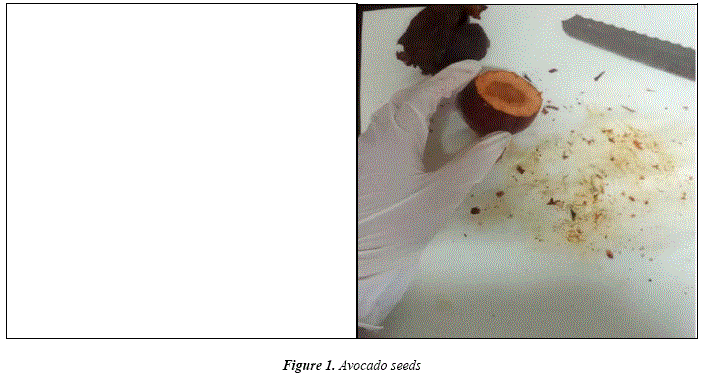
<body><![CDATA[<p align="justify"><font face="Verdana, Arial, Helvetica, sans-serif" size="2">The separation, isolation and characterization of phenolic compounds infoods, specifically in avocado waste, not only ulereases the possibility of increasing the number of phytochemicals that canimprove the quality of life of people, but also the alternative of using waste by-produets (epicarp and seed) at industrial level and thus achieve a comprehensive use of this fruit [7]. Seeds have been found to possess insecticidal, fungicidal and antimicrobial activities with a high content of phenolic compounds, which play an important role in potential health effeets [8]. Therefore, the purpose of the present study was to evalúate the antioxidant capacity of the aqueous and methanolic extraets of avocado seed <i>(Persea americana </i>Mili, variety Hass) by three chemical methods.</font></p>     <p align="justify">&nbsp;</p>     <p align="justify"><font face="Verdana, Arial, Helvetica, sans-serif" size="3"><b>EXPERIMENTAL</b></font></p>     <p align="justify"><font face="Verdana, Arial, Helvetica, sans-serif" size="2"><i><strong>Origin ofplant material (PM)</strong></i></font></p>     <p align="justify"><font face="Verdana, Arial, Helvetica, sans-serif" size="2">The seeds were obtained from avocados sold in a super market in the city of Maracay, Aragua state, Venezuela. </font></p>     <p align="justify"><font face="Verdana, Arial, Helvetica, sans-serif" size="2"><i><strong>Sample preparation for extraction</strong></i></font></p>     <p align="justify"><font face="Verdana, Arial, Helvetica, sans-serif" size="2">To obtain the aleo ho lie extract, 10 g ofplant material were weighed and previously crushed, placing them in a 400 mL beaker with 300 mL of 70% v/v methanol/water. It was macerated and left to rest for 24 h, and then it was subjected to microwave radiation for 15 s with a power of 125 MHz. The extraets were filtered, using Whatman filter paper number 4. The extract was leñ to macérate for 24 h, filtering with Whatman filter paper number 4 [9].</font></p>     <p align="justify"><font face="Verdana, Arial, Helvetica, sans-serif" size="2"><i><strong>Determination of total phenolics</strong></i></font></p>     <p align="justify"><font face="Verdana, Arial, Helvetica, sans-serif" size="2">For the determination of total phenolics, 50 &mu;L of the aleo ho lie extract were mixed with 250 &mu;L of the Folin-Ciocalteu 1 N reagent (Analytical grade, Merck). It was leñ to stand for 8 minutes and then 750 &mu;L of 20% Na<sub>2</sub>CO<sub>3</sub> and 950 &mu;L of distilled water were added. Was incubated for 30 min at room temperature and the absorbance was read on a Génesis 20 UV/VIS spectrophotometer (Thermo Scientific, Waltham, Massachusetts, USA). A calibration curve for Gallic Acid (Sigma-Aldrich, Germany) was prepared with concentrations of 50, 100, 200, 300, 400, 500 and 1000 ppm The results were expressed in mg of Gallic Acid Equivalents (GAE) / g of PM [10].</font></p>     <p align="justify"><font face="Verdana, Arial, Helvetica, sans-serif" size="2"><i><strong>Ferric-Reducing Antioxidant Power (FRAP) Assay</strong></i></font></p>     ]]></body>
<body><![CDATA[<p align="justify"><font face="Verdana, Arial, Helvetica, sans-serif" size="2">The FRAP test was used to determine the reducing capacity of infiisions [11]: 100 &mu;L of infusión were mixed with 3 mL of FRAP reagent consisting of a mixture of 300 mM sodium acétate and acetic acid buffer, 10 mM TPTZ solution (2,4,6-tri(2-pyridyl)-s-triazine), and 20 mM FeCl<sub>3</sub> solution, inavolume ratio of 10:1:1.</font></p>     <p align="center"><img src="/img/revistas/rbq/v37n3/a02_figura01.gif" width="706" height="380"></p>     <p align="justify"><font face="Verdana, Arial, Helvetica, sans-serif" size="2">The reaction was carried out at room temperatura for 4 min, and absorbance was recorded at 593 nm using a Génesis 20 UV/VIS spectrophotometer (Thermo Scientific, Waltham, Massachusetts, USA). FeSÜ4 was used as standard, and the results were expressed as umol Fe <sup>2+</sup>/g PM.</font></p>     <p align="justify"><font face="Verdana, Arial, Helvetica, sans-serif" size="2"><i><strong>Free radical 2,2-diphenyl-1-picrylhydrazyl (DPPH) Assay</strong></i></font></p>     <p align="justify"><font face="Verdana, Arial, Helvetica, sans-serif" size="2">100 &mu;L of sample and 2.9 mL DPPH (100 mM solution of DPPH in 80 % methanol) (Sigma Aldrich) were placed together in a quartz cell. Absorbance (Génesis 20 UV/VIS spectrophotometer) was monitored every 5 min for 30 min at a wavelength of 515 nm. The reference absorbance (A<sub>0</sub>) was obtained by substituting the sample volume for 80 % methanol. The percentage of DPPH reduction was obtained with the equation DPPH (%) = (A<sub>0</sub>-A<sub>n</sub>) 100/ A<sub>0</sub>, where A<sub>0</sub> and A<sub>n</sub> were the reference and sample absorbance, respectively [12]. The data were used to determine the IC50 parameter, which represents the concentration (&mu;g.mL<sup>-1</sup>) of phenolic compounds required to reduce the DPPH free radicáis by 50% [5].</font></p>     <p align="justify"><font face="Verdana, Arial, Helvetica, sans-serif" size="2"><i><strong>2,2'-Azino-bis (3-ethylbenzothiazoline-6-sulfonic acid Assay (ABTS)</strong></i></font></p>     <p align="justify"><font face="Verdana, Arial, Helvetica, sans-serif" size="2">This test is based on the ability of antioxidants to sequester the catión radical ABTS <sup><strong>.</strong>+</sup>(7 mM with K<sub>2</sub>S<sub>2</sub>O<sub>8</sub> at 2.45 mM)[13]. The reaction mixture was kept in the dark at room temperature for 14 h. After time, the ABT<strong><sup>.</sup></strong><sup>+</sup> solution was diluted with ethanol to obtain an absorbance of 0.70&plusmn;0.02 at 734 nm, using a Génesis 20 UV/VIS spectrophotometer (Thermo Scientific, Waltham, Massachusetts, USA). Subsequently, 250 &mu;L of ABTS+ solution diluted with methanol was added to 10 &mu;L of sample. Radical reduction was monitored for 5 min at 734 nm, using ascorbic acid (Vitamin C) as standard. The results were expressed inmg/mL<sup>-1</sup>.</font></p>     <p align="justify"><font face="Verdana, Arial, Helvetica, sans-serif" size="2"><i><strong>Statistical analysis</strong></i></font></p>     <p align="justify"><font face="Verdana, Arial, Helvetica, sans-serif" size="2">All determinations were made fivefold and the valúes were expressed as the means &plusmn; the standard deviation. Statistical differences were determined by analysis of variance (ANOVA) by using the Statistic 9.0 program for Windows.</font></p>     <p align="justify">&nbsp;</p>     ]]></body>
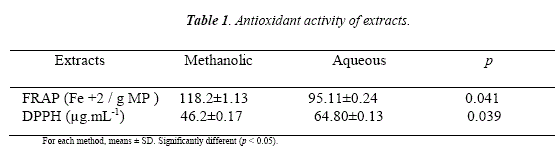
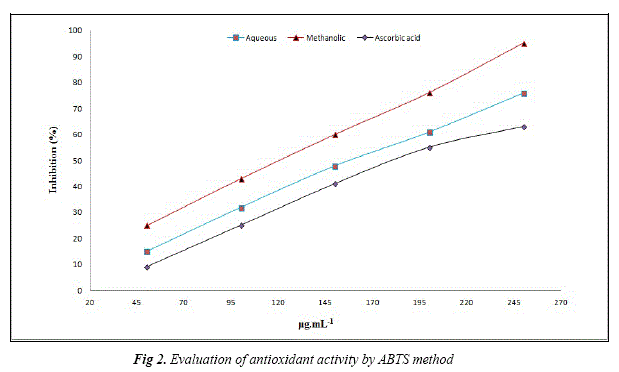
<body><![CDATA[<p align="justify"><font face="Verdana, Arial, Helvetica, sans-serif" size="3"><b>RESULTS AND DISCUSSION</b></font></p>     <p align="justify"><font face="Verdana, Arial, Helvetica, sans-serif" size="2"><i><strong>Total Phenolics of the extracts</strong></i></font></p>     <p align="justify"><font face="Verdana, Arial, Helvetica, sans-serif" size="2">Prior to the evaluation of the antioxidant activity of the extracts, the concentration of total Phenolics was determined in triplícate, obtaining a concentration of 26.32&plusmn;2.45 mg GAE/g PM in the aqueous extract and 57, 32 &plusmn;2.45 mg GAE/g PM for the methanolic extract, observing a statistical difference (p=0.035). The difference observed is similar to that reported in several studies carried out with <i>Persea americana </i>Mili, which indicate that the extraction of phenolic compounds is influenced by the type of solvent used [14,15]</font></p>     <p align="justify"><font face="Verdana, Arial, Helvetica, sans-serif" size="2"><i><strong>Antioxidant activity</strong></i></font></p>     <p align="justify"><font face="Verdana, Arial, Helvetica, sans-serif" size="2">The antioxidant capacity was determínate as recommended by several studies, which indicate that at least two methods should be used to evalúate the antioxidant activity of an extract [16-18]. The antioxidant effect by the DPPH and FRAP method is shown in <a href="#t1">Table 1</a>. The antioxidant capacity observed by the DPPH and FRAP methods shows that the extracts possess an important source of antioxidant compounds, a conclusión specially valid when compared to other studies worldwide, which indicate that avocado seeds can be used as a functional food ingredient or as an antioxidant additive [19,20].</font></p>     <p align="center"><img src="/img/revistas/rbq/v37n3/a02_figura02.gif" width="560" height="151"><a name="t1"></a></p>     <p align="center"><img src="/img/revistas/rbq/v37n3/a02_figura03.gif" width="619" height="372"><a name="f2"></a></p>     <p align="justify"><font face="Verdana, Arial, Helvetica, sans-serif" size="2">Among the methods used to determine the capacity of an antioxidant to capture free radicáis, the ABTS radical is one of the most applied, as it is considered highly sensitive, practica!, fast and very stable [21]. The ABTS assay showed</font> <font face="Verdana, Arial, Helvetica, sans-serif" size="2">higher inhibition in the methanolic extract with statistical difference fromthe aqueous extract (<a href="#f2">Figure 2</a>). These results coincide with what was reported in Bogotá Colombia, whose study consisted in determining the phenolic profile of avocado byproducts, among them the seed, indicating that the extracts showed an antioxidant capacity (ABTS method) related to their content of bioactive compounds, considering these byproducts for pharmaceutical and industrial use [15].</font></p>     <p align="justify">&nbsp;</p>     <p align="justify"><font face="Verdana, Arial, Helvetica, sans-serif" size="3"><strong>CONCLUSIONS</strong></font></p>     ]]></body>
<body><![CDATA[<p align="justify"><font face="Verdana, Arial, Helvetica, sans-serif" size="2">We may conclude that the seed of <i>Persea americana </i>Mili variety Hass, constitutes an excellent source of phenolic compounds with high antioxidant power, conditioned to the way in which these are extracted from the plant material. Finally, this study supports and extends what has been found in several countries where avocado is a daily food, with high projection of exportation from South America to the Asian continent.</font></p>     <p align="justify">&nbsp;</p>     <p align="justify"><font face="Verdana, Arial, Helvetica, sans-serif" size="3"><strong>REFERENCES</strong></font></p>     <!-- ref --><p align="justify"><font face="Verdana, Arial, Helvetica, sans-serif" size="2">1. Bernal, J. Manual técnico, actualización tecnológica y buenas prácticas agrícolas en el cultivo de aguacate. 2da Edición, <b>2014, </b>Medellín, Colombia., 1-410.</font>&nbsp;&nbsp;&nbsp;&nbsp;&nbsp;&nbsp;&nbsp;&nbsp;[&#160;<a href="javascript:void(0);" onclick="javascript: window.open('/scielo.php?script=sci_nlinks&ref=701406&pid=S0250-5460202000030000200001&lng=','','width=640,height=500,resizable=yes,scrollbars=1,menubar=yes,');">Links</a>&#160;]<!-- end-ref --><!-- ref --><p align="justify"><font face="Verdana, Arial, Helvetica, sans-serif" size="2">2. Geering, A. <b>2018, </b>A review of the status of Avocado sunblotch viroid in Australia, <i>Australasian Plant Pathology, 47, </i>555-559. </font><font face="Verdana, Arial, Helvetica, sans-serif" size="2" color="#000000">DOI:</font><font face="Verdana, Arial, Helvetica, sans-serif" size="2" color="#0C69AF"><u><a href="https//doi.org/10.1007/sl3313-018-0592-6" target="_blank">https//doi.org/10.1007/sl3313-018-0592-6</a></u></font>&nbsp;&nbsp;&nbsp;&nbsp;&nbsp;&nbsp;&nbsp;&nbsp;[&#160;<a href="javascript:void(0);" onclick="javascript: window.open('/scielo.php?script=sci_nlinks&ref=701407&pid=S0250-5460202000030000200002&lng=','','width=640,height=500,resizable=yes,scrollbars=1,menubar=yes,');">Links</a>&#160;]<!-- end-ref --><!-- ref --><p align="justify"><font face="Verdana, Arial, Helvetica, sans-serif" size="2">3. Gómez-López,  V. <b>2002,  </b>Fruit characterization of high oil content avocado varieties, <i>Scientia agrícola, 59, </i>403-406.  DOI: </font><font face="Verdana, Arial, Helvetica, sans-serif" size="2" color="#0C69AF"><u><a href="https//doi.org/10.1590/S0103-90162002000200030" target="_blank">https//doi.org/10.1590/S0103-90162002000200030</a></u></font>&nbsp;&nbsp;&nbsp;&nbsp;&nbsp;&nbsp;&nbsp;&nbsp;[&#160;<a href="javascript:void(0);" onclick="javascript: window.open('/scielo.php?script=sci_nlinks&ref=701408&pid=S0250-5460202000030000200003&lng=','','width=640,height=500,resizable=yes,scrollbars=1,menubar=yes,');">Links</a>&#160;]<!-- end-ref --><!-- ref --><p align="justify"><font face="Verdana, Arial, Helvetica, sans-serif" size="2">4. Shafer, A., Wolf, J., Alves, P., Bergstrom, L., Bruford, M., Brannstrom, I., Colling, G, Dalén, L., De Meester, L., Ekblom, R., Fawcett, K., Fior, S., Hajibabaei, M., Hill, J., Hoezel, A.,  Hoglund , J., Jensen, E., Krause, J. <b>2015, </b>Genomics and the challenging translation into conservation practice, <i>TrendsEcol. Evol, 30, </i>78-87. DOI: </font><font face="Verdana, Arial, Helvetica, sans-serif" size="2" color="#0C69AF"><u><a href="https//doi.org/10.1016/i.tree.2014.11.009" target="_blank">https//doi.org/10.1016/i.tree.2014.11.009</a></u>.</font>&nbsp;&nbsp;&nbsp;&nbsp;&nbsp;&nbsp;&nbsp;&nbsp;[&#160;<a href="javascript:void(0);" onclick="javascript: window.open('/scielo.php?script=sci_nlinks&ref=701409&pid=S0250-5460202000030000200004&lng=','','width=640,height=500,resizable=yes,scrollbars=1,menubar=yes,');">Links</a>&#160;]<!-- end-ref --><!-- ref --><p align="justify"><font face="Verdana, Arial, Helvetica, sans-serif" size="2">5. Giffoni, J., Salles, E., Aguiar   R.,   Nogueira R.,   Costa, J. <b>2009,   </b>Chemical composition,toxicity and larvicidal and antifungal activities of <i>Persea Americana </i>(avocado) seed extracts, <i>Revista da Sociedade Brasileira de Medicina Tropical, 42 </i>(2), 110-113. DOI<u>: </u></font><font face="Verdana, Arial, Helvetica, sans-serif" size="2" color="#0C69AF"><u><a href="https//doi.org/10.1590/S0037-86822009000200003" target="_blank">https//doi.org/10.1590/S0037-86822009000200003</a></u></font>&nbsp;&nbsp;&nbsp;&nbsp;&nbsp;&nbsp;&nbsp;&nbsp;[&#160;<a href="javascript:void(0);" onclick="javascript: window.open('/scielo.php?script=sci_nlinks&ref=701410&pid=S0250-5460202000030000200005&lng=','','width=640,height=500,resizable=yes,scrollbars=1,menubar=yes,');">Links</a>&#160;]<!-- end-ref --><!-- ref --><p align="justify"><font face="Verdana, Arial, Helvetica, sans-serif" size="2">6. Haminiuk, C,   Maciel, G.,   Plata-Oviedo, M.,    Peralta, R. <b>2012,    </b>Phenolic compounds in fruits -an overview. <i>International Journal of Food Science and Technology, 47 (10), </i>1-22. DOI: </font><font face="Verdana, Arial, Helvetica, sans-serif" size="2" color="#0C69AF"><u><a href="https//doi.org/10.1111/i.l365-2621.2012.03067.x" target="_blank">https//doi.org/10.1111/i.l365-2621.2012.03067.x</a></u></font>&nbsp;&nbsp;&nbsp;&nbsp;&nbsp;&nbsp;&nbsp;&nbsp;[&#160;<a href="javascript:void(0);" onclick="javascript: window.open('/scielo.php?script=sci_nlinks&ref=701411&pid=S0250-5460202000030000200006&lng=','','width=640,height=500,resizable=yes,scrollbars=1,menubar=yes,');">Links</a>&#160;]<!-- end-ref --><!-- ref --><p align="justify"><font face="Verdana, Arial, Helvetica, sans-serif" size="2">7. Rodríguez-Carpena, J.G., Morcuende, D., Andrade, M.J., Kylli, P., Estévez, M. <b>2011, </b>Avocado <i>(Persea americana </i>Mili.) phenolics in vitro antioxidant and antimicrobial activities, and inhibition of lipid and protein oxidation in porcine patties, <i>J. Agrie. FoodChem, 59, </i>5625-5635. DOI: </font><font face="Verdana, Arial, Helvetica, sans-serif" size="2" color="#0C69AF"><u><a href="https://doi.org/10.1021/ifl048832" target="_blank">https://doi.org/10.1021/ifl048832</a></u></font>&nbsp;&nbsp;&nbsp;&nbsp;&nbsp;&nbsp;&nbsp;&nbsp;[&#160;<a href="javascript:void(0);" onclick="javascript: window.open('/scielo.php?script=sci_nlinks&ref=701412&pid=S0250-5460202000030000200007&lng=','','width=640,height=500,resizable=yes,scrollbars=1,menubar=yes,');">Links</a>&#160;]<!-- end-ref --><!-- ref --><p align="justify"><font face="Verdana, Arial, Helvetica, sans-serif" size="2">8. Chouhan, S., Sharma, K.,Guleria, S. <b>2017, </b>Antimicrobial Activity of Some Essential Oils—Present Status and Future Perspectives, <i>Medicines, 4, </i>58. DOI: </font><font face="Verdana, Arial, Helvetica, sans-serif" size="2" color="#0C69AF"><u><a href="https//doi.org/10.3390/medicines4030058" target="_blank">https//doi.org/10.3390/medicines4030058</a></u></font>&nbsp;&nbsp;&nbsp;&nbsp;&nbsp;&nbsp;&nbsp;&nbsp;[&#160;<a href="javascript:void(0);" onclick="javascript: window.open('/scielo.php?script=sci_nlinks&ref=701413&pid=S0250-5460202000030000200008&lng=','','width=640,height=500,resizable=yes,scrollbars=1,menubar=yes,');">Links</a>&#160;]<!-- end-ref --><!-- ref --><p align="justify"><font face="Verdana, Arial, Helvetica, sans-serif" size="2">9. Pabón, L., Venegas, J., Rendón, M., Arias, R., Hernández P. <b>2013, </b>Actividad antioxidante y antibacteriana de extractos de hojas de cuatro especies agroforestales de la Orinoquía colombiana, <i>Revista Cubana de Plantas Medicinales, 18(1), </i>57-70</font>&nbsp;&nbsp;&nbsp;&nbsp;&nbsp;&nbsp;&nbsp;&nbsp;[&#160;<a href="javascript:void(0);" onclick="javascript: window.open('/scielo.php?script=sci_nlinks&ref=701414&pid=S0250-5460202000030000200009&lng=','','width=640,height=500,resizable=yes,scrollbars=1,menubar=yes,');">Links</a>&#160;]<!-- end-ref --><!-- ref --><p align="justify"><font face="Verdana, Arial, Helvetica, sans-serif" size="2">10. Ayala-Zavala,  J.F.,  Silva-Espinoza,  A.B.,  Cruz-Valenzuela,  R.M.,  Villegas-Ochoa,  M.A. <b>2013, </b>Antioxidant and antifungal potential of metanol extracts <i>of Phenillus sp, Revista Iberoamericana deMicolología, 29 </i>(3), 132-138.</font>&nbsp;&nbsp;&nbsp;&nbsp;&nbsp;&nbsp;&nbsp;&nbsp;[&#160;<a href="javascript:void(0);" onclick="javascript: window.open('/scielo.php?script=sci_nlinks&ref=701415&pid=S0250-5460202000030000200010&lng=','','width=640,height=500,resizable=yes,scrollbars=1,menubar=yes,');">Links</a>&#160;]<!-- end-ref --><!-- ref --><p align="justify"><font face="Verdana, Arial, Helvetica, sans-serif" size="2">11. Benzie, I.F.F., Strain, J.J. <b>1996, </b>The ferric reducing ability of plasma (FRAP) as a measure of &quot;Antioxidant power&quot;: The FRAP assay, Analytical Biochemistry, 239, 70-76<b>.</b></font>&nbsp;&nbsp;&nbsp;&nbsp;&nbsp;&nbsp;&nbsp;&nbsp;[&#160;<a href="javascript:void(0);" onclick="javascript: window.open('/scielo.php?script=sci_nlinks&ref=701416&pid=S0250-5460202000030000200011&lng=','','width=640,height=500,resizable=yes,scrollbars=1,menubar=yes,');">Links</a>&#160;]<!-- end-ref --><!-- ref --><p align="justify"><font face="Verdana, Arial, Helvetica, sans-serif" size="2">12. Soler-Rivas, C, Espín, J.C.,    Wichers, H.J. <b>2000, </b>An easy and fast test to compare total free radical scavenger capacity of foodstuffs, <i>Phytochemical Analysis, 11(2), </i>330-338.</font>&nbsp;&nbsp;&nbsp;&nbsp;&nbsp;&nbsp;&nbsp;&nbsp;[&#160;<a href="javascript:void(0);" onclick="javascript: window.open('/scielo.php?script=sci_nlinks&ref=701417&pid=S0250-5460202000030000200012&lng=','','width=640,height=500,resizable=yes,scrollbars=1,menubar=yes,');">Links</a>&#160;]<!-- end-ref --><!-- ref --><p align="justify"><font face="Verdana, Arial, Helvetica, sans-serif" size="2">13. Re, R., Pellegrini, N., Proteggente, A., Pannala, A., Yang, M., &amp; Rice - Evans, C. <b>1999, </b>Antioxidant activity applying an improved   ABTS   radical   catión   decolorization   assay, <i>Free   Radical   Biology   and  Medicine,   26,    </i>1231-1237.    DOI: </font><font face="Verdana, Arial, Helvetica, sans-serif" size="2" color="#0C69AF"><u><a href="https://doi.org/10.1016/S0891-5849(98)00315-3" target="_blank">https://doi.org/10.1016/S0891-5849(98)00315-3</a></u>.</font>&nbsp;&nbsp;&nbsp;&nbsp;&nbsp;&nbsp;&nbsp;&nbsp;[&#160;<a href="javascript:void(0);" onclick="javascript: window.open('/scielo.php?script=sci_nlinks&ref=701418&pid=S0250-5460202000030000200013&lng=','','width=640,height=500,resizable=yes,scrollbars=1,menubar=yes,');">Links</a>&#160;]<!-- end-ref --><!-- ref --><p align="justify"><font face="Verdana, Arial, Helvetica, sans-serif" size="2">14. Kim, D., Chun, O., Kim, Y., Moon, H.,   Lee, L. <b>2003, </b>Quantification of polyphenolics and their antioxidant capacity in fresh plums, <i>Journal ofAgricultural and Food Chemistry, 51(22), </i>6509-6515. DOI: </font><font face="Verdana, Arial, Helvetica, sans-serif" size="2" color="#0C69AF"><u><a href="https://doi.org/10.1021/if0343074" target="_blank">https://doi.org/10.1021/if0343074</a></u></font>&nbsp;&nbsp;&nbsp;&nbsp;&nbsp;&nbsp;&nbsp;&nbsp;[&#160;<a href="javascript:void(0);" onclick="javascript: window.open('/scielo.php?script=sci_nlinks&ref=701419&pid=S0250-5460202000030000200014&lng=','','width=640,height=500,resizable=yes,scrollbars=1,menubar=yes,');">Links</a>&#160;]<!-- end-ref --><!-- ref --><p align="justify"><font face="Verdana, Arial, Helvetica, sans-serif" size="2">15. Rosero, J., Cruz, N.,   Osorio, C, Hurtado, N. <b>2019, </b>Analysis of phenolic composition of byproducts (seeds and peéis) of Avocado <i>(Persea americana </i>Mili.) cultivated in Colombia, <i>Molecules, 24 </i>(17), 23-45. DOI:   </font><font face="Verdana, Arial, Helvetica, sans-serif" size="2" color="#0C69AF"><u><a href="https://doi.org/10.3390/molecules24173209" target="_blank">https://doi.org/10.3390/molecules24173209</a></u></font>&nbsp;&nbsp;&nbsp;&nbsp;&nbsp;&nbsp;&nbsp;&nbsp;[&#160;<a href="javascript:void(0);" onclick="javascript: window.open('/scielo.php?script=sci_nlinks&ref=701420&pid=S0250-5460202000030000200015&lng=','','width=640,height=500,resizable=yes,scrollbars=1,menubar=yes,');">Links</a>&#160;]<!-- end-ref --><!-- ref --><p align="justify"><font face="Verdana, Arial, Helvetica, sans-serif" size="2" color="#333333">16. Higdon, J.,  Frei, B. <b>2003, </b>Tea catechins and polyphenols: health effeets, metabolism, and Antioxidant Functions, <i>CriticalReviews in Food Science andNutrition, 43(1), </i>89-143. </font><font face="Verdana, Arial, Helvetica, sans-serif" size="2">DOI: </font><font face="Verdana, Arial, Helvetica, sans-serif" size="2" color="#0C69AF"><u><a href="https://doi/org/10.1080/10408690390826464" target="_blank">https://doi/org/10.1080/10408690390826464</a></u></font>&nbsp;&nbsp;&nbsp;&nbsp;&nbsp;&nbsp;&nbsp;&nbsp;[&#160;<a href="javascript:void(0);" onclick="javascript: window.open('/scielo.php?script=sci_nlinks&ref=701421&pid=S0250-5460202000030000200016&lng=','','width=640,height=500,resizable=yes,scrollbars=1,menubar=yes,');">Links</a>&#160;]<!-- end-ref --><!-- ref --><p align="justify"><font face="Verdana, Arial, Helvetica, sans-serif" size="2">17. Liu, Q., Tang, G.Y., Zhao, C.N., Liu, F.A., Siu, Y.U. 2019, Antioxidant activities, phenolic profiles, and organic acid contents of fruit vinegars, Antioxidants, 8(6), 8-78. DOI: </font><font face="Verdana, Arial, Helvetica, sans-serif" size="2" color="#0C69AF"><u><a href="https://doi.org/10.3390/antiox8040078" target="_blank">https://doi.org/10.3390/antiox8040078</a></u></font>&nbsp;&nbsp;&nbsp;&nbsp;&nbsp;&nbsp;&nbsp;&nbsp;[&#160;<a href="javascript:void(0);" onclick="javascript: window.open('/scielo.php?script=sci_nlinks&ref=701422&pid=S0250-5460202000030000200017&lng=','','width=640,height=500,resizable=yes,scrollbars=1,menubar=yes,');">Links</a>&#160;]<!-- end-ref --><!-- ref --><p align="justify"><font face="Verdana, Arial, Helvetica, sans-serif" size="2">18. Xu, D.P., Li, Y., Meng, X., Tang, Y.U. <b>2017, </b>Natural antioxidants in foods and medicinal plants: Extraction, assessment and resources, <i>Journal ofMolecular Sciences, 18(3), </i>118-124. DOI: </font><font face="Verdana, Arial, Helvetica, sans-serif" size="2" color="#0C69AF"><u><a href="https://dx.doi.org/10.3390%2Fiimsl8010096" target="_blank">https://dx.doi.org/10.3390%2Fiimsl8010096</a></u>.</font>&nbsp;&nbsp;&nbsp;&nbsp;&nbsp;&nbsp;&nbsp;&nbsp;[&#160;<a href="javascript:void(0);" onclick="javascript: window.open('/scielo.php?script=sci_nlinks&ref=701423&pid=S0250-5460202000030000200018&lng=','','width=640,height=500,resizable=yes,scrollbars=1,menubar=yes,');">Links</a>&#160;]<!-- end-ref --><!-- ref --><p align="justify"><font face="Verdana, Arial, Helvetica, sans-serif" size="2">19. Kosiñska, A., Karamac, M., Estrella, I., Hernández, T., Bartolomé, B.,    Dykes, G. <b>2012, </b>Phenolic compound profiles and antioxidant capacity of <i>Persea americana </i>Mili. Peéis and Seeds of Two Varieties, <i>Journal of Agriculture Food Chemistry, 60, </i>4613- 4619. DOI: </font><font face="Verdana, Arial, Helvetica, sans-serif" size="2" color="#0C69AF"><u><a href="https://doi/org/dx.doi.org/10.1021/if300090p|" target="_blank">https://doi/org/dx.doi.org/10.1021/if300090p</a></u><a href="https://doi/org/dx.doi.org/10.1021/if300090p|">|</a></font>&nbsp;&nbsp;&nbsp;&nbsp;&nbsp;&nbsp;&nbsp;&nbsp;[&#160;<a href="javascript:void(0);" onclick="javascript: window.open('/scielo.php?script=sci_nlinks&ref=701424&pid=S0250-5460202000030000200019&lng=','','width=640,height=500,resizable=yes,scrollbars=1,menubar=yes,');">Links</a>&#160;]<!-- end-ref --><!-- ref --><p align="justify"><font face="Verdana, Arial, Helvetica, sans-serif" size="2">20. Dabas, D., Shegog, R., Ziegler, G., Lambert, G. <b>2013, </b>Avocado <i>(Persea americana) </i>seed as a source of bioactive phytochemicals, <i>CurrentPharmaceutical Design, 19, </i>6133-6140. DOI: </font><font face="Verdana, Arial, Helvetica, sans-serif" size="2" color="#0C69AF"><u><a href="https://doi.org/10.2174/1381612811319340007" target="_blank">https://doi.org/10.2174/1381612811319340007</a></u></font>&nbsp;&nbsp;&nbsp;&nbsp;&nbsp;&nbsp;&nbsp;&nbsp;[&#160;<a href="javascript:void(0);" onclick="javascript: window.open('/scielo.php?script=sci_nlinks&ref=701425&pid=S0250-5460202000030000200020&lng=','','width=640,height=500,resizable=yes,scrollbars=1,menubar=yes,');">Links</a>&#160;]<!-- end-ref --><!-- ref --><p align="justify"><font face="Verdana, Arial, Helvetica, sans-serif" size="2">21.    Arnao, M.B. 2000, Some methodological problems in the determination of antioxidant activity using chromogen radicáis: a practical case, <i>Trends Food Sci. Technol, 11, </i>419-421. DOI: </font><font face="Verdana, Arial, Helvetica, sans-serif" size="2" color="#0C69AF"><u><a href="https://doi.org/10.1016/S0924-2244(01)00027-9" target="_blank">https://doi.org/10.1016/S0924-2244(01)00027-9</a></u></font>&nbsp;&nbsp;&nbsp;&nbsp;&nbsp;&nbsp;&nbsp;&nbsp;[&#160;<a href="javascript:void(0);" onclick="javascript: window.open('/scielo.php?script=sci_nlinks&ref=701426&pid=S0250-5460202000030000200021&lng=','','width=640,height=500,resizable=yes,scrollbars=1,menubar=yes,');">Links</a>&#160;]<!-- end-ref --><p align="justify">&nbsp;</p>     <p align="justify">&nbsp;</p>      ]]></body><back>
<ref-list>
<ref id="B1">
<nlm-citation citation-type="">
<person-group person-group-type="author">
<name>
<surname><![CDATA[Bernal]]></surname>
<given-names><![CDATA[J]]></given-names>
</name>
</person-group>
<source><![CDATA[Manual técnico, actualización tecnológica y buenas prácticas agrícolas en el cultivo de aguacate]]></source>
<year>2014</year>
<edition>2da</edition>
<page-range>1-410</page-range><publisher-loc><![CDATA[Medellín ]]></publisher-loc>
</nlm-citation>
</ref>
<ref id="B2">
<nlm-citation citation-type="journal">
<person-group person-group-type="author">
<name>
<surname><![CDATA[Geering]]></surname>
<given-names><![CDATA[A]]></given-names>
</name>
</person-group>
<article-title xml:lang="en"><![CDATA[A review of the status of Avocado sunblotch viroid in Australia]]></article-title>
<source><![CDATA[Australasian Plant Pathology]]></source>
<year>2018</year>
<numero>47</numero>
<issue>47</issue>
<page-range>555-559</page-range></nlm-citation>
</ref>
<ref id="B3">
<nlm-citation citation-type="journal">
<person-group person-group-type="author">
<name>
<surname><![CDATA[Gómez-López,]]></surname>
<given-names><![CDATA[V]]></given-names>
</name>
</person-group>
<article-title xml:lang="en"><![CDATA[Fruit characterization of high oil content avocado varieties]]></article-title>
<source><![CDATA[Scientia agrícola]]></source>
<year>2002</year>
<numero>59</numero>
<issue>59</issue>
<page-range>403-406</page-range></nlm-citation>
</ref>
<ref id="B4">
<nlm-citation citation-type="journal">
<person-group person-group-type="author">
<name>
<surname><![CDATA[Shafer]]></surname>
<given-names><![CDATA[A]]></given-names>
</name>
<name>
<surname><![CDATA[Wolf]]></surname>
<given-names><![CDATA[J]]></given-names>
</name>
<name>
<surname><![CDATA[Alves]]></surname>
<given-names><![CDATA[P]]></given-names>
</name>
<name>
<surname><![CDATA[Bergstrom]]></surname>
<given-names><![CDATA[L]]></given-names>
</name>
<name>
<surname><![CDATA[Bruford]]></surname>
<given-names><![CDATA[M]]></given-names>
</name>
<name>
<surname><![CDATA[Brannstrom]]></surname>
<given-names><![CDATA[I]]></given-names>
</name>
<name>
<surname><![CDATA[Colling]]></surname>
<given-names><![CDATA[G]]></given-names>
</name>
<name>
<surname><![CDATA[Dalén]]></surname>
<given-names><![CDATA[L]]></given-names>
</name>
<name>
<surname><![CDATA[De Meester]]></surname>
<given-names><![CDATA[L]]></given-names>
</name>
<name>
<surname><![CDATA[Ekblom]]></surname>
<given-names><![CDATA[R]]></given-names>
</name>
<name>
<surname><![CDATA[Fawcett]]></surname>
<given-names><![CDATA[K]]></given-names>
</name>
<name>
<surname><![CDATA[Fior]]></surname>
<given-names><![CDATA[S]]></given-names>
</name>
<name>
<surname><![CDATA[Hajibabaei]]></surname>
<given-names><![CDATA[M]]></given-names>
</name>
<name>
<surname><![CDATA[Hill]]></surname>
<given-names><![CDATA[J]]></given-names>
</name>
<name>
<surname><![CDATA[Hoezel]]></surname>
<given-names><![CDATA[A]]></given-names>
</name>
<name>
<surname><![CDATA[Hoglund]]></surname>
<given-names><![CDATA[J]]></given-names>
</name>
<name>
<surname><![CDATA[Jensen]]></surname>
<given-names><![CDATA[E]]></given-names>
</name>
<name>
<surname><![CDATA[Krause]]></surname>
<given-names><![CDATA[J]]></given-names>
</name>
</person-group>
<article-title xml:lang="en"><![CDATA[Genomics and the challenging translation into conservation practice, TrendsEcol]]></article-title>
<source><![CDATA[Evol]]></source>
<year>2015</year>
<numero>30</numero>
<issue>30</issue>
<page-range>78-87</page-range></nlm-citation>
</ref>
<ref id="B5">
<nlm-citation citation-type="journal">
<person-group person-group-type="author">
<name>
<surname><![CDATA[Giffoni]]></surname>
<given-names><![CDATA[J]]></given-names>
</name>
<name>
<surname><![CDATA[Salles]]></surname>
<given-names><![CDATA[E]]></given-names>
</name>
<name>
<surname><![CDATA[Aguiar]]></surname>
<given-names><![CDATA[R]]></given-names>
</name>
<name>
<surname><![CDATA[Nogueira]]></surname>
<given-names><![CDATA[R]]></given-names>
</name>
<name>
<surname><![CDATA[Costa]]></surname>
<given-names><![CDATA[J]]></given-names>
</name>
</person-group>
<article-title xml:lang="en"><![CDATA[Chemical composition,toxicity and larvicidal and antifungal activities of Persea Americana (avocado) seed extracts]]></article-title>
<source><![CDATA[Revista da Sociedade Brasileira de Medicina Tropical]]></source>
<year>2009</year>
<volume>42</volume>
<numero>2</numero>
<issue>2</issue>
<page-range>110-113</page-range></nlm-citation>
</ref>
<ref id="B6">
<nlm-citation citation-type="journal">
<person-group person-group-type="author">
<name>
<surname><![CDATA[Haminiuk]]></surname>
<given-names><![CDATA[C]]></given-names>
</name>
<name>
<surname><![CDATA[Maciel]]></surname>
<given-names><![CDATA[G]]></given-names>
</name>
<name>
<surname><![CDATA[Plata-Oviedo]]></surname>
<given-names><![CDATA[M]]></given-names>
</name>
<name>
<surname><![CDATA[Peralta]]></surname>
<given-names><![CDATA[R]]></given-names>
</name>
</person-group>
<article-title xml:lang="en"><![CDATA[Phenolic compounds in fruits -an overview]]></article-title>
<source><![CDATA[International Journal of Food Science and Technology]]></source>
<year>2012</year>
<volume>47</volume>
<numero>10</numero>
<issue>10</issue>
<page-range>1-22</page-range></nlm-citation>
</ref>
<ref id="B7">
<nlm-citation citation-type="journal">
<person-group person-group-type="author">
<name>
<surname><![CDATA[Rodríguez-Carpena]]></surname>
<given-names><![CDATA[J.G]]></given-names>
</name>
<name>
<surname><![CDATA[Morcuende]]></surname>
<given-names><![CDATA[D]]></given-names>
</name>
<name>
<surname><![CDATA[Andrade]]></surname>
<given-names><![CDATA[M.J]]></given-names>
</name>
<name>
<surname><![CDATA[Kylli]]></surname>
<given-names><![CDATA[P]]></given-names>
</name>
<name>
<surname><![CDATA[Estévez]]></surname>
<given-names><![CDATA[M]]></given-names>
</name>
</person-group>
<article-title xml:lang="en"><![CDATA[Avocado (Persea americana Mili.) phenolics in vitro antioxidant and antimicrobial activities, and inhibition of lipid and protein oxidation in porcine patties]]></article-title>
<source><![CDATA[J. Agrie. FoodChem]]></source>
<year>2011</year>
<numero>59</numero>
<issue>59</issue>
<page-range>5625-5635</page-range></nlm-citation>
</ref>
<ref id="B8">
<nlm-citation citation-type="journal">
<person-group person-group-type="author">
<name>
<surname><![CDATA[Chouhan]]></surname>
<given-names><![CDATA[S]]></given-names>
</name>
<name>
<surname><![CDATA[Sharma]]></surname>
<given-names><![CDATA[K]]></given-names>
</name>
<name>
<surname><![CDATA[Guleria]]></surname>
<given-names><![CDATA[S]]></given-names>
</name>
</person-group>
<article-title xml:lang="en"><![CDATA[Antimicrobial Activity of Some Essential Oils-Present Status and Future Perspectives]]></article-title>
<source><![CDATA[Medicines]]></source>
<year>2017</year>
<volume>4</volume>
<numero>58</numero>
<issue>58</issue>
</nlm-citation>
</ref>
<ref id="B9">
<nlm-citation citation-type="journal">
<person-group person-group-type="author">
<name>
<surname><![CDATA[Pabón]]></surname>
<given-names><![CDATA[L]]></given-names>
</name>
<name>
<surname><![CDATA[Venegas]]></surname>
<given-names><![CDATA[J]]></given-names>
</name>
<name>
<surname><![CDATA[Rendón]]></surname>
<given-names><![CDATA[M]]></given-names>
</name>
<name>
<surname><![CDATA[Arias]]></surname>
<given-names><![CDATA[R]]></given-names>
</name>
<name>
<surname><![CDATA[Hernández]]></surname>
<given-names><![CDATA[P]]></given-names>
</name>
</person-group>
<article-title xml:lang="es"><![CDATA[Actividad antioxidante y antibacteriana de extractos de hojas de cuatro especies agroforestales de la Orinoquía colombiana]]></article-title>
<source><![CDATA[Revista Cubana de Plantas Medicinales]]></source>
<year>2013</year>
<volume>18</volume>
<numero>1</numero>
<issue>1</issue>
<page-range>57-70</page-range></nlm-citation>
</ref>
<ref id="B10">
<nlm-citation citation-type="journal">
<person-group person-group-type="author">
<name>
<surname><![CDATA[Ayala-Zavala]]></surname>
<given-names><![CDATA[J.F]]></given-names>
</name>
<name>
<surname><![CDATA[Silva-Espinoza]]></surname>
<given-names><![CDATA[A.B]]></given-names>
</name>
<name>
<surname><![CDATA[Cruz-Valenzuela]]></surname>
<given-names><![CDATA[R.M]]></given-names>
</name>
<name>
<surname><![CDATA[Villegas-Ochoa]]></surname>
<given-names><![CDATA[M.A]]></given-names>
</name>
</person-group>
<article-title xml:lang="en"><![CDATA[Antioxidant and antifungal potential of metanol extracts of Phenillus sp]]></article-title>
<source><![CDATA[Revista Iberoamericana deMicolología]]></source>
<year>2013</year>
<volume>29</volume>
<numero>3</numero>
<issue>3</issue>
<page-range>132-138</page-range></nlm-citation>
</ref>
<ref id="B11">
<nlm-citation citation-type="">
<person-group person-group-type="author">
<name>
<surname><![CDATA[Benzie, I.]]></surname>
<given-names><![CDATA[F.F]]></given-names>
</name>
<name>
<surname><![CDATA[Strain]]></surname>
<given-names><![CDATA[J.J]]></given-names>
</name>
</person-group>
<source><![CDATA[he ferric reducing ability of plasma (FRAP) as a measure of "Antioxidant power": The FRAP assay, Analytical Biochemistry]]></source>
<year>1996</year>
<volume>239</volume>
<page-range>70-76</page-range></nlm-citation>
</ref>
<ref id="B12">
<nlm-citation citation-type="journal">
<person-group person-group-type="author">
<name>
<surname><![CDATA[Soler-Rivas]]></surname>
<given-names><![CDATA[C]]></given-names>
</name>
<name>
<surname><![CDATA[Espín]]></surname>
<given-names><![CDATA[J.C]]></given-names>
</name>
<name>
<surname><![CDATA[Wichers]]></surname>
<given-names><![CDATA[H.J]]></given-names>
</name>
</person-group>
<article-title xml:lang="en"><![CDATA[An easy and fast test to compare total free radical scavenger capacity of foodstuffs]]></article-title>
<source><![CDATA[Phytochemical Analysis]]></source>
<year>2000</year>
<volume>11</volume>
<numero>2</numero>
<issue>2</issue>
<page-range>330-338</page-range></nlm-citation>
</ref>
<ref id="B13">
<nlm-citation citation-type="journal">
<person-group person-group-type="author">
<name>
<surname><![CDATA[Re]]></surname>
<given-names><![CDATA[R]]></given-names>
</name>
<name>
<surname><![CDATA[Pellegrini]]></surname>
<given-names><![CDATA[N]]></given-names>
</name>
<name>
<surname><![CDATA[Proteggente]]></surname>
<given-names><![CDATA[A]]></given-names>
</name>
<name>
<surname><![CDATA[Pannala]]></surname>
<given-names><![CDATA[A]]></given-names>
</name>
<name>
<surname><![CDATA[Yang,]]></surname>
<given-names><![CDATA[M]]></given-names>
</name>
<name>
<surname><![CDATA[Rice - Evans]]></surname>
<given-names><![CDATA[C]]></given-names>
</name>
</person-group>
<article-title xml:lang="en"><![CDATA[Antioxidant activity applying an improved ABTS radical catión decolorization assay]]></article-title>
<source><![CDATA[Free Radical Biology and Medicine]]></source>
<year>1999</year>
<numero>26</numero>
<issue>26</issue>
<page-range>1231-1237</page-range></nlm-citation>
</ref>
<ref id="B14">
<nlm-citation citation-type="journal">
<person-group person-group-type="author">
<name>
<surname><![CDATA[Kim]]></surname>
<given-names><![CDATA[D]]></given-names>
</name>
<name>
<surname><![CDATA[Chun]]></surname>
<given-names><![CDATA[O]]></given-names>
</name>
<name>
<surname><![CDATA[Kim]]></surname>
<given-names><![CDATA[Y]]></given-names>
</name>
<name>
<surname><![CDATA[Moon]]></surname>
<given-names><![CDATA[H]]></given-names>
</name>
<name>
<surname><![CDATA[Lee]]></surname>
<given-names><![CDATA[L]]></given-names>
</name>
</person-group>
<article-title xml:lang="en"><![CDATA[Quantification of polyphenolics and their antioxidant capacity in fresh plums]]></article-title>
<source><![CDATA[Journal ofAgricultural and Food Chemistry]]></source>
<year>2003</year>
<volume>51</volume>
<numero>22</numero>
<issue>22</issue>
<page-range>6509-6515</page-range></nlm-citation>
</ref>
<ref id="B15">
<nlm-citation citation-type="journal">
<person-group person-group-type="author">
<name>
<surname><![CDATA[Rosero]]></surname>
<given-names><![CDATA[J]]></given-names>
</name>
<name>
<surname><![CDATA[Cruz]]></surname>
<given-names><![CDATA[N]]></given-names>
</name>
<name>
<surname><![CDATA[Osorio]]></surname>
<given-names><![CDATA[C]]></given-names>
</name>
<name>
<surname><![CDATA[Hurtado]]></surname>
<given-names><![CDATA[N]]></given-names>
</name>
</person-group>
<article-title xml:lang="en"><![CDATA[Analysis of phenolic composition of byproducts (seeds and peéis) of Avocado (Persea americana Mili.) cultivated in Colombia]]></article-title>
<source><![CDATA[Molecules]]></source>
<year>2019</year>
<volume>24</volume>
<numero>17</numero>
<issue>17</issue>
<page-range>23-45</page-range></nlm-citation>
</ref>
<ref id="B16">
<nlm-citation citation-type="journal">
<person-group person-group-type="author">
<name>
<surname><![CDATA[Higdon]]></surname>
<given-names><![CDATA[J]]></given-names>
</name>
<name>
<surname><![CDATA[Frei]]></surname>
<given-names><![CDATA[B]]></given-names>
</name>
</person-group>
<article-title xml:lang="en"><![CDATA[Tea catechins and polyphenols: health effeets, metabolism, and Antioxidant Functions]]></article-title>
<source><![CDATA[CriticalReviews in Food Science andNutrition]]></source>
<year>2003</year>
<volume>43</volume>
<numero>1</numero>
<issue>1</issue>
<page-range>89-143</page-range></nlm-citation>
</ref>
<ref id="B17">
<nlm-citation citation-type="journal">
<person-group person-group-type="author">
<name>
<surname><![CDATA[Liu]]></surname>
<given-names><![CDATA[Q]]></given-names>
</name>
<name>
<surname><![CDATA[Tang]]></surname>
<given-names><![CDATA[G.Y]]></given-names>
</name>
<name>
<surname><![CDATA[Zhao]]></surname>
<given-names><![CDATA[C.N]]></given-names>
</name>
<name>
<surname><![CDATA[Liu]]></surname>
<given-names><![CDATA[F.A]]></given-names>
</name>
<name>
<surname><![CDATA[Siu]]></surname>
<given-names><![CDATA[Y.U]]></given-names>
</name>
</person-group>
<article-title xml:lang="en"><![CDATA[Antioxidant activities, phenolic profiles, and organic acid contents of fruit vinegars]]></article-title>
<source><![CDATA[Antioxidants]]></source>
<year>2019</year>
<volume>8</volume>
<numero>6</numero>
<issue>6</issue>
<page-range>8-78</page-range></nlm-citation>
</ref>
<ref id="B18">
<nlm-citation citation-type="journal">
<person-group person-group-type="author">
<name>
<surname><![CDATA[Xu]]></surname>
<given-names><![CDATA[D.P]]></given-names>
</name>
<name>
<surname><![CDATA[Li]]></surname>
<given-names><![CDATA[Y]]></given-names>
</name>
<name>
<surname><![CDATA[Meng]]></surname>
<given-names><![CDATA[X]]></given-names>
</name>
<name>
<surname><![CDATA[Tang]]></surname>
<given-names><![CDATA[Y.U]]></given-names>
</name>
</person-group>
<article-title xml:lang="en"><![CDATA[Natural antioxidants in foods and medicinal plants: Extraction, assessment and resources]]></article-title>
<source><![CDATA[Journal ofMolecular Sciences]]></source>
<year>2017</year>
<volume>18</volume>
<numero>3</numero>
<issue>3</issue>
<page-range>118-124</page-range></nlm-citation>
</ref>
<ref id="B19">
<nlm-citation citation-type="journal">
<person-group person-group-type="author">
<name>
<surname><![CDATA[Kosiñska]]></surname>
<given-names><![CDATA[A]]></given-names>
</name>
<name>
<surname><![CDATA[Karamac]]></surname>
<given-names><![CDATA[M]]></given-names>
</name>
<name>
<surname><![CDATA[Estrella]]></surname>
<given-names><![CDATA[I]]></given-names>
</name>
<name>
<surname><![CDATA[Hernández]]></surname>
<given-names><![CDATA[T]]></given-names>
</name>
<name>
<surname><![CDATA[Bartolomé]]></surname>
<given-names><![CDATA[B]]></given-names>
</name>
<name>
<surname><![CDATA[Dykes]]></surname>
<given-names><![CDATA[G]]></given-names>
</name>
</person-group>
<article-title xml:lang="en"><![CDATA[Phenolic compound profiles and antioxidant capacity of Persea americana Mili. Peéis and Seeds of Two Varieties]]></article-title>
<source><![CDATA[Journal of Agriculture Food Chemistry]]></source>
<year>2012</year>
<numero>60</numero>
<issue>60</issue>
<page-range>4613- 4619</page-range></nlm-citation>
</ref>
<ref id="B20">
<nlm-citation citation-type="journal">
<person-group person-group-type="author">
<name>
<surname><![CDATA[Dabas]]></surname>
<given-names><![CDATA[D]]></given-names>
</name>
<name>
<surname><![CDATA[Shegog]]></surname>
<given-names><![CDATA[R]]></given-names>
</name>
<name>
<surname><![CDATA[Ziegler]]></surname>
<given-names><![CDATA[G]]></given-names>
</name>
<name>
<surname><![CDATA[Lambert]]></surname>
<given-names><![CDATA[G]]></given-names>
</name>
</person-group>
<article-title xml:lang="en"><![CDATA[Avocado (Persea americana) seed as a source of bioactive phytochemicals]]></article-title>
<source><![CDATA[CurrentPharmaceutical Design]]></source>
<year>2013</year>
<numero>19</numero>
<issue>19</issue>
<page-range>6133-6140</page-range></nlm-citation>
</ref>
<ref id="B21">
<nlm-citation citation-type="journal">
<person-group person-group-type="author">
<name>
<surname><![CDATA[Arnao]]></surname>
<given-names><![CDATA[M.B]]></given-names>
</name>
</person-group>
<article-title xml:lang="en"><![CDATA[Some methodological problems in the determination of antioxidant activity using chromogen radicáis: a practical case]]></article-title>
<source><![CDATA[Trends Food Sci. Technol]]></source>
<year>2000</year>
<numero>11</numero>
<issue>11</issue>
<page-range>419-421</page-range></nlm-citation>
</ref>
</ref-list>
</back>
</article>