<?xml version="1.0" encoding="ISO-8859-1"?><article xmlns:mml="http://www.w3.org/1998/Math/MathML" xmlns:xlink="http://www.w3.org/1999/xlink" xmlns:xsi="http://www.w3.org/2001/XMLSchema-instance">
<front>
<journal-meta>
<journal-id>0250-5460</journal-id>
<journal-title><![CDATA[Revista Boliviana de Química]]></journal-title>
<abbrev-journal-title><![CDATA[Rev. Bol. Quim]]></abbrev-journal-title>
<issn>0250-5460</issn>
<publisher>
<publisher-name><![CDATA[Universidad Mayor de San Andrés]]></publisher-name>
</publisher>
</journal-meta>
<article-meta>
<article-id>S0250-54602020000100004</article-id>
<title-group>
<article-title xml:lang="en"><![CDATA[Determination of total phenolic compounds and evaluation of the antioxidant activity of commercial and artisanal green tea traded in Maracay, Venezuela]]></article-title>
<article-title xml:lang="es"><![CDATA[Determinación de compuestos fenólicos totales y evaluación de la actividad antioxidante de té verde comercial y artesanal comercializados en Maracay, Venezuela]]></article-title>
</title-group>
<contrib-group>
<contrib contrib-type="author">
<name>
<surname><![CDATA[Pacheco-Coello]]></surname>
<given-names><![CDATA[Franklin]]></given-names>
</name>
</contrib>
<contrib contrib-type="author">
<name>
<surname><![CDATA[Peraza-Matrero]]></surname>
<given-names><![CDATA[María]]></given-names>
</name>
</contrib>
<contrib contrib-type="author">
<name>
<surname><![CDATA[Orosco-Vargas]]></surname>
<given-names><![CDATA[Corymar]]></given-names>
</name>
</contrib>
<contrib contrib-type="author">
<name>
<surname><![CDATA[Ramirez-Azuaje]]></surname>
<given-names><![CDATA[Doralys]]></given-names>
</name>
</contrib>
<contrib contrib-type="author">
<name>
<surname><![CDATA[Pinto-Catari]]></surname>
<given-names><![CDATA[Ibis]]></given-names>
</name>
</contrib>
</contrib-group>
<aff id="A">
<institution><![CDATA[,  ]]></institution>
<addr-line><![CDATA[ ]]></addr-line>
</aff>
<pub-date pub-type="pub">
<day>30</day>
<month>04</month>
<year>2020</year>
</pub-date>
<pub-date pub-type="epub">
<day>30</day>
<month>04</month>
<year>2020</year>
</pub-date>
<volume>37</volume>
<numero>1</numero>
<fpage>28</fpage>
<lpage>33</lpage>
<copyright-statement/>
<copyright-year/>
<self-uri xlink:href="http://www.scielo.org.bo/scielo.php?script=sci_arttext&amp;pid=S0250-54602020000100004&amp;lng=en&amp;nrm=iso"></self-uri><self-uri xlink:href="http://www.scielo.org.bo/scielo.php?script=sci_abstract&amp;pid=S0250-54602020000100004&amp;lng=en&amp;nrm=iso"></self-uri><self-uri xlink:href="http://www.scielo.org.bo/scielo.php?script=sci_pdf&amp;pid=S0250-54602020000100004&amp;lng=en&amp;nrm=iso"></self-uri><abstract abstract-type="short" xml:lang="en"><p><![CDATA[Abstract Tea is considered one of the most consumed beverages in the world, due to its pleasant sensory properties, extensive health benefits and unique socio-cultural characteristics. The present study aimed to determine and compare the concentration of total phenolics, flavonoids and antioxidant capacity of green tea Ínfusions. Two commercial brands of green tea and an artisanal or non-commercial green tea from China were used. Colorimetric methods were used for the determination of total and flavonoid and phenolics and the DPPH and FRAP methods for antioxidant activity. Of the three Ínfusions, the highest concentration of total phenolics, flavonoids and antioxidant capacity was observed in the infusión of artisanal green tea from China, with a statistically significant difference (p&#8804;0.05). Its accessibility makes tea a good altemative for the consumption of substances with functional properties.]]></p></abstract>
<abstract abstract-type="short" xml:lang="es"><p><![CDATA[Resumen El té se considera una de las bebidas más consumidas en el mundo, debido a sus agradables propiedades sensoriales, amplios beneficios para la salud y características socioculturales únicas. El presente estudio tuvo como objetivo determinar y comparar la concentración de fenoles totales, flavonoides y capacidad antioxidante de las infusiones de té verde. Se emplearon dos marcas comerciales de té verde y un té verde artesanal o no comercial de China. Se utilizaron métodos colorimétricos para la determinación de fenoles totales y flavonoides y los métodos DPPH y FRAP para la actividad antioxidante. De las tres infusiones, la concentración más alta de fenoles totales, flavonoides y capacidad antioxidante se observó en la infusión de té verde artesanal de China, con una diferencia estadísticamente significativa (p&#8804;0.05). Su accesibilidad hace del té una buena alternativa para el consumo de sustancias con propiedades funcionales.]]></p></abstract>
<kwd-group>
<kwd lng="en"><![CDATA[Polyphenols]]></kwd>
<kwd lng="en"><![CDATA[Flavonoids]]></kwd>
<kwd lng="en"><![CDATA[ínfusions]]></kwd>
<kwd lng="en"><![CDATA[FRAP]]></kwd>
<kwd lng="en"><![CDATA[DPPH]]></kwd>
<kwd lng="es"><![CDATA[Polifenoles]]></kwd>
<kwd lng="es"><![CDATA[Flavonoides]]></kwd>
<kwd lng="es"><![CDATA[Infusiones]]></kwd>
<kwd lng="es"><![CDATA[FRAP]]></kwd>
<kwd lng="es"><![CDATA[DPPH]]></kwd>
</kwd-group>
</article-meta>
</front><body><![CDATA[ <p align="right"><font color="#800000" size="2" face="Verdana, Arial, Helvetica, sans-serif"><a href="https://doi.org/10.34098/2078-3949.37.1.2" target="_blank">https://doi.org/10.34098/2078-3949.37.1.4</a></font><font size="2" face="Verdana, Arial, Helvetica, sans-serif">    <br>     <strong>FULL ORIGINAL ARTICLES</strong></font></p>     <p align="right">&nbsp;</p>     <p align="center"><font size="4" face="Verdana, Arial, Helvetica, sans-serif"><strong>Determination  of total phenolic  compounds and evaluation  of the antioxidant    <br> activity of  commercial and artisanal green tea traded in Maracay, Venezuela</strong></font></p>     <p align="center">&nbsp;</p>     <p align="center"><font size="3" face="Verdana, Arial, Helvetica, sans-serif"><strong>Determinaci&oacute;n de compuestos fen&oacute;licos totales y evaluaci&oacute;n de la actividad antioxidante de t&eacute;     <br> verde comercial y artesanal comercializados en Maracay, Venezuela</strong></font></p>     <p align="center">&nbsp;</p>     <p align="center">&nbsp;</p>     ]]></body>
<body><![CDATA[<p align="center"><font face="Verdana, Arial, Helvetica, sans-serif" size="2"><strong>Franklin Pacheco-Coello*, Mar&iacute;a Peraza-Matrero, Corymar Orosco-Vargas, Doralys Ramirez-Azuaje, Ibis Pinto-Catari</strong>    <br>   </font><font face="Verdana, Arial, Helvetica, sans-serif" size="2">School of Health Sciences, Department of Basic Sciences, Laboratory of Chemistry and Instrumental Analysis,     <br>   Laboratory of Heavy Metals and Organic Solvents, University of Carabobo, Postal Code 2103,    <br>    phone +2446004000, Ruiz Pineda Street, La Morita II,     <br>   Santa Rita Sector, Aragua State, Venezuela</font>    <br> <font face="Verdana, Arial, Helvetica, sans-serif" size="2">*Correspond&iexcl;ng author: </font><font face="Verdana, Arial, Helvetica, sans-serif" size="2" color="#0C69AF"><u><a href="mailto:pachecofranklin74@gmail.com">pachecofranklin74@gmail.com</a>    <br> </u></font><font face="Verdana, Arial, Helvetica, sans-serif" size="2"><strong>Received </strong>01 08 2020 <strong>Accepted</strong> 04 14 2020 <strong>Published</strong> 04 30 2020</font></p>     <p align="center">&nbsp;</p>     <p align="center">&nbsp;</p> <hr>     <p align="justify"><font face="Verdana, Arial, Helvetica, sans-serif" size="2"><b>Abstract</b></font></p>     ]]></body>
<body><![CDATA[<p align="justify"><font face="Verdana, Arial, Helvetica, sans-serif" size="2">Tea is considered one of the most consumed beverages in the world, due to its pleasant sensory properties, extensive health benefits and unique socio-cultural characteristics. The present study aimed to determine and compare the concentration of total phenolics, flavonoids and antioxidant capacity of green tea Ínfusions. Two commercial brands of green tea and an artisanal or non-commercial green tea from China were used. Colorimetric methods were used for the determination of total and flavonoid and phenolics and the DPPH and FRAP methods for antioxidant activity. Of the three Ínfusions, the highest concentration of total phenolics, flavonoids and antioxidant capacity was observed in the infusión of artisanal green tea from China, with a statistically significant difference (p&le;0.05). Its accessibility makes tea a good altemative for the consumption of substances with functional properties.</font></p>     <p align="justify"><font face="Verdana, Arial, Helvetica, sans-serif" size="2"><b>Keywords: </b>Polyphenols, Flavonoids, &iacute;nfusions, FRAP, DPPH.</font></p> <hr>     <p align="justify"><font face="Verdana, Arial, Helvetica, sans-serif" size="2"><b>Resumen</b></font></p>     <p align="justify"><font face="Verdana, Arial, Helvetica, sans-serif" size="2">El té se considera una de las bebidas más consumidas en el mundo, debido a sus agradables propiedades sensoriales, amplios beneficios para la salud y características socioculturales únicas. El presente estudio tuvo como objetivo determinar y comparar la concentración de fenoles totales, flavonoides y capacidad antioxidante de las infusiones de </font><font face="Verdana, Arial, Helvetica, sans-serif" size="2">té verde. Se emplearon dos marcas comerciales de té verde y un té verde artesanal o no comercial de China. Se utilizaron métodos colorimétricos para la determinación de fenoles totales y flavonoides y los métodos DPPH y FRAP para la actividad antioxidante. De las tres infusiones, la concentración más alta de fenoles totales, flavonoides y capacidad antioxidante se observó en la infusión de té verde artesanal de China, con una diferencia estadísticamente significativa (p&le;0.05). Su accesibilidad hace del té una buena alternativa para el consumo de sustancias con propiedades funcionales.</font></p>     <p align="justify"><font face="Verdana, Arial, Helvetica, sans-serif" size="2"><b>Palabras clave: </b>Polifenoles, Flavonoides, Infusiones, FRAP, DPPH.</font></p> <hr>     <p align="justify">&nbsp;</p>     <p align="justify">&nbsp;</p>     <p align="justify"><font face="Verdana, Arial, Helvetica, sans-serif" size="3"><b>INTRODUCTION</b></font></p>     <p align="justify"><font face="Verdana, Arial, Helvetica, sans-serif" size="2">Tea is generally made from the leaves of <i>Camellia sinensis, </i>and is a very popular soft drink all over the world. Based on the fermentation degrees in an increasing order, tea can be classified into six categories, including green (unfermented), yellow (slight-fermented), white (mild-fermented), oolong (semi-fermented), black (deep-fermented), and dark (post-fermented) teas [1].</font></p>     <p align="justify"><font face="Verdana, Arial, Helvetica, sans-serif" size="2">The consumption of tea has been correlated with low incidence of chronic pathologies, such as cardiovascular disease and cáncer [2]. However, although the molecules involved in this effect have been shown to have anti-inflammatory and antioxidant effects, and to improve endothelial function, no clear-cut conclusión has been reached on their mechanism of action [1]. The health benefits ascribed to the consumption of teas are thought to be associated with their high content of bioactive ingredients such as polyphenols. The latter are secondary plant metabolites and include the subclasses of flavonoids, flavones, flavonols, flavanols, isoflavones, flavanones, chalcones and anthocyanidins [3]. Within the polyphenols, the tea flavanols, catechins (flavan-3-ols) and theaflavins, have been identified as the bioactive phytochemicals of green tea and shown to be responsible for their antioxidant activity [4]. Apart from their antioxidant activity, tea flavanols could also have other activities of pharmacological interest [5,6], such as the ability to lower glucose, lipid and uric acid concentrations [7-9]. These activities could be mediated by their effects on various enzymes and transporters [8].</font></p>     ]]></body>
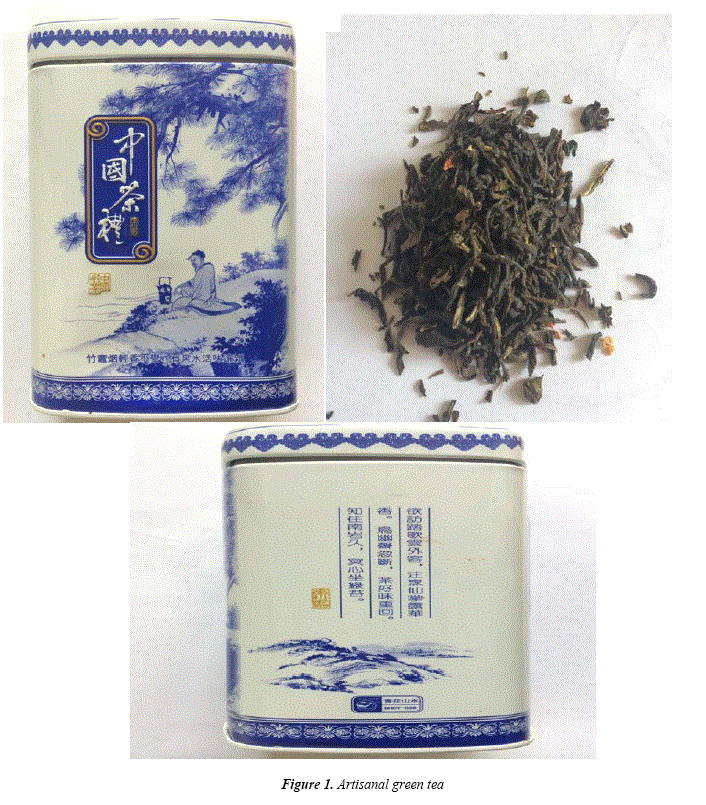
<body><![CDATA[<p align="justify"><font face="Verdana, Arial, Helvetica, sans-serif" size="2">Knowing the various properties of tea, the present study aimed to make an analysis of the concentration of total phenolics, flavonoids and the antioxidant activity of the infusions of two brands of commercial teas and one artisanal from China.</font></p>     <p align="justify">&nbsp;</p>     <p align="justify"><font face="Verdana, Arial, Helvetica, sans-serif" size="3"><b>EXPERIMENTAL</b></font></p>     <p align="justify"><font face="Verdana, Arial, Helvetica, sans-serif" size="2"><i><strong>Origin of plant material (PM)</strong></i></font></p>     <p align="justify"><font face="Verdana, Arial, Helvetica, sans-serif" size="2">Two brands of green tea (PM) traded in Venezuela obtained from a super market in the city of Maracay (10&deg;14'49&quot;N 67&deg;35'45&quot;W), and an original artisanal brand of green tea from China was used (<a href="#f1">Figure 1</a> A,B,C). The brands used were the following: Lipton (Brand 1), McCormick (Brand 2).</font></p>     <p align="justify"><font face="Verdana, Arial, Helvetica, sans-serif" size="2"><i><strong>Sampie preparation for extr action</strong></i></font></p>     <p align="justify"><font face="Verdana, Arial, Helvetica, sans-serif" size="2"><i>2 </i>grams of plant material were weighed. This was poured into a 400 mL Beaker, to which 200 mL of distilled water previously heated to the boiling point was added. The sample was slightly stirred for 4 min and filtered using WhatmanNo. 4 paper [10].</font></p>     <p align="justify"><font face="Verdana, Arial, Helvetica, sans-serif" size="2"><i><strong>Determination of total phenolics</strong></i></font></p>     <p align="justify"><font face="Verdana, Arial, Helvetica, sans-serif" size="2">For the determination of total phenolics, 50 &mu;L were mixed with 250 &mu;L of the Folin-Ciocalteu 1 N reagent (Analytical grade, Merck). It was left to stand for 8 minutes and then 750 &mu;L of 20% Na2CÜ3 and 950 &mu;L of distilled water were added.. Was incubated for 30 min at room temperature and the absorbance was read on a Génesis 20 UV/VIS spectrophotometer (Thermo Scientific, Waltham, Massachusetts, USA). A calibration curve for Gallic Acid (Sigma-Aldrich, Germany) was prepared with concentrations of 50, 100, 200, 300, 400, 500 and 1000 ppm. The results were expressed in mg of Gallic Acid Equivalents (GAE) / g of PM [11].</font></p>     <p align="justify"><font face="Verdana, Arial, Helvetica, sans-serif" size="2"><i>Determination of flavonoids</i></font></p>      ]]></body>
<body><![CDATA[<p align="justify"><font face="Verdana, Arial, Helvetica, sans-serif" size="2"><i>A </i>volume of 100 &mu;L of sample was mixed with 30 &mu;L of 5% w/v NaNO<sub>2</sub>, 30 &mu;L of 10% w/v A1C1<sub>3</sub>, 200 &mu;L of 1 M NaOH and adjusted with distilled water to a final volume of 1 mL. The reading was performed at 510 nm in a Génesis 20 UV / VIS spectrophotometer and was compared with a standard curve with standard (+)-catechin. The results were expressed in mg of Catechin Equivalents (CE) / g of PM [12].</font></p>      <p align="center"><img src="/img/revistas/rbq/v37n1/a04_figura01.gif" width="706" height="805"><a name="f1"></a></p>      <p align="justify"><strong><font size="2" face="Verdana, Arial, Helvetica, sans-serif"><em>Ferric-Reducing Antioxidant Power (FRAP) Assay</em></font></strong></p>     <p align="justify"><font face="Verdana, Arial, Helvetica, sans-serif" size="2">The FRAP test was used to determine the reducing capacity of tea infusions [13]: 100 &mu;L of infusión were mixed with 3 mL of FRAP reagent consisting of a mixture of 300 mM sodium acétate and acetic acid buffer, TPTZ solution (2,4,6-tri(2-pyridyl)-s-triazine) of 10 mM, and 20 mMFeCl<sub>3</sub> solution, inavolume ratio of 10:1:1. The reactionwas carried out at room temperature for 4 min, and absorbance was recorded at 593 nm using a Génesis 20 UV/VIS spectrophotometer (Thermo Scientific, Waltham, Massachusetts, USA). FeSÜ4 was used as standard, and the results were expressed as umol Fe <sup>2+</sup>/g PM.</font></p>     <p align="justify"><font face="Verdana, Arial, Helvetica, sans-serif" size="2"><i><strong>Free radical 2,2-diphenyl-l-picrylhydrazyl (DPPH) Assay</strong></i></font></p>     <p align="justify"><font face="Verdana, Arial, Helvetica, sans-serif" size="2">100 &mu;L of sample and 2.9 mL DPPH (100 mM solution of DPPH in 80 % methanol) (Sigma Aldrich) were placed together in a quartz cell. Absorbance (Génesis 20 UV/VIS spectrophotometer) was monitored every 5 min for 30 min at a wavelength of 515 nm. The reference absorbance (A<sub>0</sub>) was obtained by substituting the sample volume for 80 % methanol. The percentage of DPPH reduction was obtained with the equation DPPH (%) = (A<sub>0</sub>-A<sub>n</sub>) 100/ A<sub>0</sub>, where A<sub>0</sub> and A<sub>n</sub> were the reference and sample absorbance, respectively [14]. The data were used to determine the IC<sub>50</sub> parameter, which represents the concentration (&mu;g.mL<sup>-1</sup>) of phenolic compounds required to reduce the DPPH free radicáis by 50 % [15].</font></p>     <p align="justify"><font face="Verdana, Arial, Helvetica, sans-serif" size="2"><i><strong>Statistical analysis</strong></i></font></p>     <p align="justify"><font face="Verdana, Arial, Helvetica, sans-serif" size="2">All determinations were made fivefold and the valúes were expressed as the means &plusmn; the standard deviation. Statistical differences were determined by analysis of variance (ANOVA) by using the Statistic 9.0 program for Windows.</font></p>     <p align="justify">&nbsp;</p>     <p align="justify"><font face="Verdana, Arial, Helvetica, sans-serif" size="3"><b>RESULTS AND DISCUSSION</b></font></p>     ]]></body>
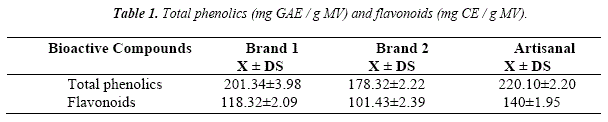
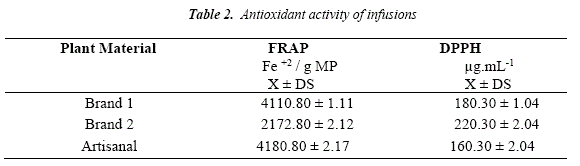
<body><![CDATA[<p align="justify"><font face="Verdana, Arial, Helvetica, sans-serif" size="2"><i><strong>Totalphenolics andflavonoids ofthe infusions</strong></i></font></p>     <p align="justify"><font face="Verdana, Arial, Helvetica, sans-serif" size="2">Green tea showed the highest antioxidant capacity and total phenolic content, which could be due to the minimized oxidation degree of young leaves and the inactivated enzymes during the steaming process [16,17].</font></p>     <p align="justify"><font face="Verdana, Arial, Helvetica, sans-serif" size="2">The content of total phenolics and flavonoids was found to be higher in China's artisanal green tea leaves and lower in the mark 2 (p=0.029 and p=0.031, respectively). There was no significant difference (p &ge;0.05) for both total and flavonoid phenolics between artisanal green tea from China and brand 1. The mean and the standard deviation of the concentrations of teas are expressed in <a href="#t1">Table 1.</a> The difference in the concentration of teas is related to that signaled by various studies which indicate that factors such as the way of cultivation, the place of production, planting conditions, harvest time, leaf quality and manufacturing process, determine the content of bioactive compounds and therefore their antioxidant capacity [18,19].</font></p>     <p align="justify"><font face="Verdana, Arial, Helvetica, sans-serif" size="2">Other studies indicate that the content of total phenolic compounds is variable in different types of green tea, in addition that the comparison with other studies is difficult because there are conditioning factors for the low or high yield of an infusión, whether commercial or not [20,21].</font></p>     <p align="center"><img src="/img/revistas/rbq/v37n1/a04_figura02.gif" width="608" height="122"><a name="t1"></a></p>     <p align="justify"><font face="Verdana, Arial, Helvetica, sans-serif" size="2"><i><strong>Antioxidant activity</strong></i></font></p>     <p align="justify"><font face="Verdana, Arial, Helvetica, sans-serif" size="2">On the other hand, several studies mention that it is difficult to fully evalúate the antioxidant activities of natural tea compounds simply by using a single method of determination [22-24]. For the FRAP method, the statistical analysis showed an important difference between artisanal tea and green tea Brand 2 (p = 0.019). Of the IC<sub>50</sub> obtained (concentration in &mu;g.mL<sup>1</sup> of phenolic compounds required to reduce 50% of the free DPPH radical) of </font><font face="Verdana, Arial, Helvetica, sans-serif" size="2">teas infusions, a greater antioxidant power was observed in the infusión of artisanal tea, with statistical difference when compared with the brand 2 (p = 0.028, <a href="#t2">Table 2</a>).</font></p>     <p align="justify"><font face="Verdana, Arial, Helvetica, sans-serif" size="2">Although the results of the teas were different, no statistical difference was observed between the brand 1 and the artisanal one, possibly due to the fact that the green tea leaves of that brand come from Sri Lanka, one of the countries with the highest production of green tea in the world.</font></p>     <p align="center"><img src="/img/revistas/rbq/v37n1/a04_figura03.gif" width="580" height="166"><a name="t2"></a></p>     <p align="justify"><font face="Verdana, Arial, Helvetica, sans-serif" size="2">In a study conducted by researchers of the University of Shanghai, it's reported that the 30 infusions of green tea from different regions of China had a high antioxidant power and were rich in phenolic compounds, varying from one región to another. The authors pointed out that tea is a good dietary source of natural antioxidants, especially phenolic compounds that have a good potential to become a functional beverage [25].</font></p>     ]]></body>
<body><![CDATA[<p align="justify">&nbsp;</p>     <p align="justify"><font face="Verdana, Arial, Helvetica, sans-serif" size="3"><strong>CONCLUSIONS</strong></font></p>     <p align="justify"><font face="Verdana, Arial, Helvetica, sans-serif" size="2">There are differences in the contení of bioactive compounds and their antioxidant activity between the Chinese artisanal tea and the brand 2, currently traded in Venezuela, with a more important antioxidant activity in the artisanal sample. All three tea varieties studied herein are excellent alternatives for the consumption of bioactive compounds, with great healthbenefits.</font></p>     <p align="justify">&nbsp;</p>     <p align="justify"><font face="Verdana, Arial, Helvetica, sans-serif" size="3"><b>REFERENCES</b></font></p>     <!-- ref --><p align="justify"><font face="Verdana, Arial, Helvetica, sans-serif" size="2">1.&nbsp; Hashimoto, T., Goto, M., Sakakibara, H., Oi, N., Okamoto, M. <b>2007. </b>Yellow tea is more potent than other types of tea in suppressing liver toxicity induced by carbón tetrachloride in rats, <i>Phytother Research 21, </i>668-670.</font>&nbsp;&nbsp;&nbsp;&nbsp;&nbsp;&nbsp;&nbsp;&nbsp;[&#160;<a href="javascript:void(0);" onclick="javascript: window.open('/scielo.php?script=sci_nlinks&ref=699267&pid=S0250-5460202000010000400001&lng=','','width=640,height=500,resizable=yes,scrollbars=1,menubar=yes,');">Links</a>&#160;]<!-- end-ref --><!-- ref --><p align="justify"><font face="Verdana, Arial, Helvetica, sans-serif" size="2">2.&nbsp;  Tang, J,, Zhen, J.S., Fan, L., Jin, Y., Cai, W. <b>2015, </b>Tea consumption and mortality of all cancers, CVD and all causes: a meta-analysis of eighteen prospective cohort studies, 5nfe/í <i>Journal ofNutrition, 114(1), </i>673-683.</font>&nbsp;&nbsp;&nbsp;&nbsp;&nbsp;&nbsp;&nbsp;&nbsp;[&#160;<a href="javascript:void(0);" onclick="javascript: window.open('/scielo.php?script=sci_nlinks&ref=699268&pid=S0250-5460202000010000400002&lng=','','width=640,height=500,resizable=yes,scrollbars=1,menubar=yes,');">Links</a>&#160;]<!-- end-ref --><!-- ref --><p align="justify"><font face="Verdana, Arial, Helvetica, sans-serif" size="2">3.&nbsp; Del Rio, D., Rodríguez-Mateos, A., Spencer, J., Tognolini, M., Borges, G., Crozier, A. <b>2013, </b>Dietary (poly)phenolics in human health: structures, bioavailability, and evidence of protective effects against chronic diseases, <i>Antioxidants Redox Signaling, 18(1), </i>1818-1892.</font>&nbsp;&nbsp;&nbsp;&nbsp;&nbsp;&nbsp;&nbsp;&nbsp;[&#160;<a href="javascript:void(0);" onclick="javascript: window.open('/scielo.php?script=sci_nlinks&ref=699269&pid=S0250-5460202000010000400003&lng=','','width=640,height=500,resizable=yes,scrollbars=1,menubar=yes,');">Links</a>&#160;]<!-- end-ref --><!-- ref --><p align="justify"><font face="Verdana, Arial, Helvetica, sans-serif" size="2">4.&nbsp; Di Lorenzo, A., Nabavi, S.F., Sureda, A.,.    Moghaddam, A.H., Khanjani, S., Arcidiaco, P., Nabavi, S.M., Daglia, M. <b>2016, </b>Antidepressive-like eects and antioxidant activity of green tea and GABA green tea in a mouse model of post-stroke depression, <i>Molecular Nutrition &amp; Food Research, 60, </i>566-579.</font>&nbsp;&nbsp;&nbsp;&nbsp;&nbsp;&nbsp;&nbsp;&nbsp;[&#160;<a href="javascript:void(0);" onclick="javascript: window.open('/scielo.php?script=sci_nlinks&ref=699270&pid=S0250-5460202000010000400004&lng=','','width=640,height=500,resizable=yes,scrollbars=1,menubar=yes,');">Links</a>&#160;]<!-- end-ref --><!-- ref --><p align="justify"><font face="Verdana, Arial, Helvetica, sans-serif" size="2">5.&nbsp; Liu, K., Zhou, R., Wang, B., Chen, K., Shi, L. Y., Zhu, J.D. <b>2013, </b>Effect of green tea on glucose control and insulin sensitivity: a meta-analysis of 17 randomized controlled triáis, <i>American Journal qfClinical Nutrition, </i>98,340-348.</font>&nbsp;&nbsp;&nbsp;&nbsp;&nbsp;&nbsp;&nbsp;&nbsp;[&#160;<a href="javascript:void(0);" onclick="javascript: window.open('/scielo.php?script=sci_nlinks&ref=699271&pid=S0250-5460202000010000400005&lng=','','width=640,height=500,resizable=yes,scrollbars=1,menubar=yes,');">Links</a>&#160;]<!-- end-ref --><!-- ref --><p align="justify"><font face="Verdana, Arial, Helvetica, sans-serif" size="2">6.&nbsp;  Zheng, X.X., Xu, Y.L., Li, S.H., Liu, X.X., Hui, R., Huang XH. <b>2013, </b>Effects of green tea catechins with or without caffeine on glycemic control in adults: a meta-analysis of randomized controlled triáis, <i>American Journal of Clinical Nutrition, </i>97(1), 750-762</font>&nbsp;&nbsp;&nbsp;&nbsp;&nbsp;&nbsp;&nbsp;&nbsp;[&#160;<a href="javascript:void(0);" onclick="javascript: window.open('/scielo.php?script=sci_nlinks&ref=699272&pid=S0250-5460202000010000400006&lng=','','width=640,height=500,resizable=yes,scrollbars=1,menubar=yes,');">Links</a>&#160;]<!-- end-ref --><!-- ref --><p align="justify"><font face="Verdana, Arial, Helvetica, sans-serif" size="2">7.&nbsp; Onakpoya, I., Spencer, E., Heneghan, C, Thompson, M. <b>2014, </b>The effect of green tea on blood pressure and lipid profile: a systematic review and meta-analysis of randomized clinical triáis, <i>Nutrition, Metabolism &amp; Cardiovascular, 24, </i>823-836.</font>&nbsp;&nbsp;&nbsp;&nbsp;&nbsp;&nbsp;&nbsp;&nbsp;[&#160;<a href="javascript:void(0);" onclick="javascript: window.open('/scielo.php?script=sci_nlinks&ref=699273&pid=S0250-5460202000010000400007&lng=','','width=640,height=500,resizable=yes,scrollbars=1,menubar=yes,');">Links</a>&#160;]<!-- end-ref --><!-- ref --><p align="justify"><font face="Verdana, Arial, Helvetica, sans-serif" size="2">8.&nbsp; Peluso, I., Teichner, A., Manafikhi, H., Palmery, M. <b>2015, </b>Camellia sinensis in asymptomatic hyperuricaemia: a meta-analysis of tea or tea extract effects onuric acid levéis, <i>Critical Reviews in Food Science and Nutrition, 23(4), </i>143-155.</font>&nbsp;&nbsp;&nbsp;&nbsp;&nbsp;&nbsp;&nbsp;&nbsp;[&#160;<a href="javascript:void(0);" onclick="javascript: window.open('/scielo.php?script=sci_nlinks&ref=699274&pid=S0250-5460202000010000400008&lng=','','width=640,height=500,resizable=yes,scrollbars=1,menubar=yes,');">Links</a>&#160;]<!-- end-ref --><!-- ref --><p align="justify"><font face="Verdana, Arial, Helvetica, sans-serif" size="2">9.&nbsp; Kim, Y.H., Won, Y.S., Yang, X., Kumazoe, M., Yamashita, S., Hará, A., Takagaki, A., Goto, K., Nanjo, F., Tachibana, H. <b>2016, </b>Green tea catechin metabolites exert immunoregulatory effects on CD<sup>4+</sup> T cell and natural killer cell activities, <i>Journal of Agricultural and Food Chemistry, 64, </i>3591-3597.</font>&nbsp;&nbsp;&nbsp;&nbsp;&nbsp;&nbsp;&nbsp;&nbsp;[&#160;<a href="javascript:void(0);" onclick="javascript: window.open('/scielo.php?script=sci_nlinks&ref=699275&pid=S0250-5460202000010000400009&lng=','','width=640,height=500,resizable=yes,scrollbars=1,menubar=yes,');">Links</a>&#160;]<!-- end-ref --><!-- ref --><p align="justify"><font face="Verdana, Arial, Helvetica, sans-serif" size="2">10.&nbsp;Horzic, D., Komes, D., Belscak, A., Kovacevic, K., Ivekovic, D., Karlovic, D. <b>2009, </b>The composition of polyphenolics and methylxanthines inteas andherbal infusions, <i>Food Chemistry, 115, </i>441-448.</font>&nbsp;&nbsp;&nbsp;&nbsp;&nbsp;&nbsp;&nbsp;&nbsp;[&#160;<a href="javascript:void(0);" onclick="javascript: window.open('/scielo.php?script=sci_nlinks&ref=699276&pid=S0250-5460202000010000400010&lng=','','width=640,height=500,resizable=yes,scrollbars=1,menubar=yes,');">Links</a>&#160;]<!-- end-ref --><!-- ref --><p align="justify"><font face="Verdana, Arial, Helvetica, sans-serif" size="2">11.&nbsp;  Ayala-Zavala, JF., Silva-Espinoza, A.B., Cruz-Valenzuela, R.M., Villegas-Ochoa, M.A. <b>2013, </b>Antioxidant and antifungal potential of metanol extracts of <i>Phenillus sp, Revista Iberoamericana deMicolología, 29(3), </i>132-138.</font>&nbsp;&nbsp;&nbsp;&nbsp;&nbsp;&nbsp;&nbsp;&nbsp;[&#160;<a href="javascript:void(0);" onclick="javascript: window.open('/scielo.php?script=sci_nlinks&ref=699277&pid=S0250-5460202000010000400011&lng=','','width=640,height=500,resizable=yes,scrollbars=1,menubar=yes,');">Links</a>&#160;]<!-- end-ref --><!-- ref --><p align="justify"><font face="Verdana, Arial, Helvetica, sans-serif" size="2">12.&nbsp;  Marinova, D., Ribarova, F., Atanassova, M. <b>2005, </b>Total phenolics and total flavonoids in bulgarian fruits and vegetables, <i>Journal ofthe University of Chemical Technology and Metallurgy, 40(3), </i>255-260.</font>&nbsp;&nbsp;&nbsp;&nbsp;&nbsp;&nbsp;&nbsp;&nbsp;[&#160;<a href="javascript:void(0);" onclick="javascript: window.open('/scielo.php?script=sci_nlinks&ref=699278&pid=S0250-5460202000010000400012&lng=','','width=640,height=500,resizable=yes,scrollbars=1,menubar=yes,');">Links</a>&#160;]<!-- end-ref --><!-- ref --><p align="justify"><font face="Verdana, Arial, Helvetica, sans-serif" size="2">13.&nbsp;  Benzie, I.F.F., Strain, J.J. <b>1996, </b>The ferric reducing ability of plasma (FRAP) as a measure of &quot;Antioxidant power&quot;: The FRAP assay, <i>Analytical Biochemistry,239, </i>70-76.</font>&nbsp;&nbsp;&nbsp;&nbsp;&nbsp;&nbsp;&nbsp;&nbsp;[&#160;<a href="javascript:void(0);" onclick="javascript: window.open('/scielo.php?script=sci_nlinks&ref=699279&pid=S0250-5460202000010000400013&lng=','','width=640,height=500,resizable=yes,scrollbars=1,menubar=yes,');">Links</a>&#160;]<!-- end-ref --><!-- ref --><p align="justify"><font face="Verdana, Arial, Helvetica, sans-serif" size="2">14.&nbsp; Soler-Rivas, C,   Espín, J.C.,   Wichers, H.J. <b>2000, </b>An easy and fast test to compare total free radical scavenger capacity of foodstuffs, <i>PhytochemicalAnalysis, 11(2), </i>330-338.</font>&nbsp;&nbsp;&nbsp;&nbsp;&nbsp;&nbsp;&nbsp;&nbsp;[&#160;<a href="javascript:void(0);" onclick="javascript: window.open('/scielo.php?script=sci_nlinks&ref=699280&pid=S0250-5460202000010000400014&lng=','','width=640,height=500,resizable=yes,scrollbars=1,menubar=yes,');">Links</a>&#160;]<!-- end-ref --><!-- ref --><p align="justify"><font face="Verdana, Arial, Helvetica, sans-serif" size="2">15.&nbsp;  Einbond, S.L., Reynertson, A.K., Xiao-Dong, L., Fing, Y.U. <b>2004, </b>Anthocyanin antioxidants from edible fruits, <i>Food Chemistry, 84 </i>(1), 23-28.</font>&nbsp;&nbsp;&nbsp;&nbsp;&nbsp;&nbsp;&nbsp;&nbsp;[&#160;<a href="javascript:void(0);" onclick="javascript: window.open('/scielo.php?script=sci_nlinks&ref=699281&pid=S0250-5460202000010000400015&lng=','','width=640,height=500,resizable=yes,scrollbars=1,menubar=yes,');">Links</a>&#160;]<!-- end-ref --><!-- ref --><p align="justify"><font face="Verdana, Arial, Helvetica, sans-serif" size="2">16.&nbsp;  Lin Y.S., Tsai, Y.J., Tsay, J.S., Lin, J.K., Siah, L.U. <b>2003, </b>Factors affecting the levéis of tea polyphenolics and caffeine in tea leaves, <i>Journal of </i>Agricultural <i>and </i>Food Chemistry, 57, 1864-1873.</font>&nbsp;&nbsp;&nbsp;&nbsp;&nbsp;&nbsp;&nbsp;&nbsp;[&#160;<a href="javascript:void(0);" onclick="javascript: window.open('/scielo.php?script=sci_nlinks&ref=699282&pid=S0250-5460202000010000400016&lng=','','width=640,height=500,resizable=yes,scrollbars=1,menubar=yes,');">Links</a>&#160;]<!-- end-ref --><!-- ref --><p align="justify"><font face="Verdana, Arial, Helvetica, sans-serif" size="2">17.&nbsp; Scoparo, C.T., De Souza, L.M., Rattmann, Y.D., Kiatkoski, E.C., Dartora, N., Iacomini, M. <b>2016, </b>The protective effect of green and black teas <i>(Camellia sinensis) </i>and their identified compounds against murine sepsis, <i>Food Research International, 83, </i>102— 111.</font>&nbsp;&nbsp;&nbsp;&nbsp;&nbsp;&nbsp;&nbsp;&nbsp;[&#160;<a href="javascript:void(0);" onclick="javascript: window.open('/scielo.php?script=sci_nlinks&ref=699283&pid=S0250-5460202000010000400017&lng=','','width=640,height=500,resizable=yes,scrollbars=1,menubar=yes,');">Links</a>&#160;]<!-- end-ref --><!-- ref --><p align="justify"><font face="Verdana, Arial, Helvetica, sans-serif" size="2">18.&nbsp;  Bi, W., He, C.N., Ma, Y. Y., Shen, J., Zhang, L.H. <b>2016, </b>Investigation of free amino acid, total phenolics, antioxidant activity and purine alkaloids to assess the health properties of non-Camelliatea, <i>Acta Pharmaceutica Sínica, 6, </i>170-181.</font>&nbsp;&nbsp;&nbsp;&nbsp;&nbsp;&nbsp;&nbsp;&nbsp;[&#160;<a href="javascript:void(0);" onclick="javascript: window.open('/scielo.php?script=sci_nlinks&ref=699284&pid=S0250-5460202000010000400018&lng=','','width=640,height=500,resizable=yes,scrollbars=1,menubar=yes,');">Links</a>&#160;]<!-- end-ref --><!-- ref --><p align="justify"><font face="Verdana, Arial, Helvetica, sans-serif" size="2">19.&nbsp;  Raudonis, R., Raudone, L., Jakstas, V.,  anulis. V. <b>2012, </b>Comparative evaluation of post-column free radical scavenging and ferric reducing antioxidant power assays for screening of antioxidants in strawberries, <i>Journal of ChromatographyJ23 </i>(3), 8-15.</font>&nbsp;&nbsp;&nbsp;&nbsp;&nbsp;&nbsp;&nbsp;&nbsp;[&#160;<a href="javascript:void(0);" onclick="javascript: window.open('/scielo.php?script=sci_nlinks&ref=699285&pid=S0250-5460202000010000400019&lng=','','width=640,height=500,resizable=yes,scrollbars=1,menubar=yes,');">Links</a>&#160;]<!-- end-ref --><!-- ref --><p align="justify"><font face="Verdana, Arial, Helvetica, sans-serif" size="2">20.&nbsp;  De Feria F. Tesis de grado, Characterization of phenolic composition and antioxidant capacity of different tea brands <i>(Camellia sinensis) </i>traded in Chile, Pontificia Universidad Católica de Chile, Santiago, Chile, <b>2011.</b></font>&nbsp;&nbsp;&nbsp;&nbsp;&nbsp;&nbsp;&nbsp;&nbsp;[&#160;<a href="javascript:void(0);" onclick="javascript: window.open('/scielo.php?script=sci_nlinks&ref=699286&pid=S0250-5460202000010000400020&lng=','','width=640,height=500,resizable=yes,scrollbars=1,menubar=yes,');">Links</a>&#160;]<!-- end-ref --><!-- ref --><p align="justify"><font face="Verdana, Arial, Helvetica, sans-serif" size="2">21.&nbsp;  Hartley, L., Flowers, N., Holmes, J., Clarke, A., Stranges S., Hooper, L. <b>2013, </b>Green and black tea for the primary prevention of cardiovascular disease, <i>Cochrane Datábase ofSystematicReviews, 18(6), </i>324-335.</font>&nbsp;&nbsp;&nbsp;&nbsp;&nbsp;&nbsp;&nbsp;&nbsp;[&#160;<a href="javascript:void(0);" onclick="javascript: window.open('/scielo.php?script=sci_nlinks&ref=699287&pid=S0250-5460202000010000400021&lng=','','width=640,height=500,resizable=yes,scrollbars=1,menubar=yes,');">Links</a>&#160;]<!-- end-ref --><!-- ref --><p align="justify"><font face="Verdana, Arial, Helvetica, sans-serif" size="2">22.&nbsp;  Higdon, J. V., Frei, B. <b>2003, </b>Tea catechins and polyphenolics: Health effects, metabolism, and antioxidant functions, <i>Food Science, 43, </i>89-143.</font>&nbsp;&nbsp;&nbsp;&nbsp;&nbsp;&nbsp;&nbsp;&nbsp;[&#160;<a href="javascript:void(0);" onclick="javascript: window.open('/scielo.php?script=sci_nlinks&ref=699288&pid=S0250-5460202000010000400022&lng=','','width=640,height=500,resizable=yes,scrollbars=1,menubar=yes,');">Links</a>&#160;]<!-- end-ref --><!-- ref --><p align="justify"><font face="Verdana, Arial, Helvetica, sans-serif" size="2">23.&nbsp;  Liu, Q., Tang, G.Y., Zhao, C.N., Liu, F.A., Siu, Y.U. <b>2019, </b>Antioxidant activities, phenolic profiles, and organic acid contents of fruit vinegars, <i>Antioxidants, </i>8(6),8-78.</font>&nbsp;&nbsp;&nbsp;&nbsp;&nbsp;&nbsp;&nbsp;&nbsp;[&#160;<a href="javascript:void(0);" onclick="javascript: window.open('/scielo.php?script=sci_nlinks&ref=699289&pid=S0250-5460202000010000400023&lng=','','width=640,height=500,resizable=yes,scrollbars=1,menubar=yes,');">Links</a>&#160;]<!-- end-ref --><!-- ref --><p align="justify"><font face="Verdana, Arial, Helvetica, sans-serif" size="2">24.&nbsp;  Xu,   D.P.,   Li,   Y.,   Meng,   X.,   Tang,   Y.U. <b>2017,   </b>Natural   antioxidants   in   foods   and   medicinal   plants:   Extraction, assessmentandresources, <i>Journal of Molecular Sciences, </i>18(3),118-124.</font>&nbsp;&nbsp;&nbsp;&nbsp;&nbsp;&nbsp;&nbsp;&nbsp;[&#160;<a href="javascript:void(0);" onclick="javascript: window.open('/scielo.php?script=sci_nlinks&ref=699290&pid=S0250-5460202000010000400024&lng=','','width=640,height=500,resizable=yes,scrollbars=1,menubar=yes,');">Links</a>&#160;]<!-- end-ref --><!-- ref --><p align="justify"><font face="Verdana, Arial, Helvetica, sans-serif" size="2">25.&nbsp;  Zhao, C.N.,  Tang, G.Y., Cao, S.Y. <b>2019, </b>Phenolic Profiles and Antioxidant Activities of 30 Tea Infusions from Green, Black, Oolong, White, Yellow and Dark Teas, <i>Antioxidants, 8(1), </i>200-215.</font>&nbsp;&nbsp;&nbsp;&nbsp;&nbsp;&nbsp;&nbsp;&nbsp;[&#160;<a href="javascript:void(0);" onclick="javascript: window.open('/scielo.php?script=sci_nlinks&ref=699291&pid=S0250-5460202000010000400025&lng=','','width=640,height=500,resizable=yes,scrollbars=1,menubar=yes,');">Links</a>&#160;]<!-- end-ref --><p align="justify">&nbsp;</p>     <p align="justify">&nbsp;</p>      ]]></body><back>
<ref-list>
<ref id="B1">
<nlm-citation citation-type="journal">
<person-group person-group-type="author">
<name>
<surname><![CDATA[Hashimoto]]></surname>
<given-names><![CDATA[T]]></given-names>
</name>
<name>
<surname><![CDATA[Goto]]></surname>
<given-names><![CDATA[M]]></given-names>
</name>
<name>
<surname><![CDATA[Sakakibara]]></surname>
<given-names><![CDATA[H]]></given-names>
</name>
<name>
<surname><![CDATA[Oi]]></surname>
<given-names><![CDATA[N]]></given-names>
</name>
<name>
<surname><![CDATA[Okamoto]]></surname>
<given-names><![CDATA[M]]></given-names>
</name>
</person-group>
<article-title xml:lang="en"><![CDATA[Yellow tea is more potent than other types of tea in suppressing liver toxicity induced by carbón tetrachloride in rats]]></article-title>
<source><![CDATA[Phytother Research]]></source>
<year>2007</year>
<numero>21</numero>
<issue>21</issue>
<page-range>668-670</page-range></nlm-citation>
</ref>
<ref id="B2">
<nlm-citation citation-type="journal">
<person-group person-group-type="author">
<name>
<surname><![CDATA[Tang]]></surname>
<given-names><![CDATA[J]]></given-names>
</name>
<name>
<surname><![CDATA[Zhen]]></surname>
<given-names><![CDATA[J.S]]></given-names>
</name>
<name>
<surname><![CDATA[Fan]]></surname>
<given-names><![CDATA[L]]></given-names>
</name>
<name>
<surname><![CDATA[Jin]]></surname>
<given-names><![CDATA[Y]]></given-names>
</name>
<name>
<surname><![CDATA[Cai]]></surname>
<given-names><![CDATA[W]]></given-names>
</name>
</person-group>
<article-title xml:lang="en"><![CDATA[Tea consumption and mortality of all cancers, CVD and all causes: a meta-analysis of eighteen prospective cohort studies]]></article-title>
<source><![CDATA[5nfe/í Journal ofNutrition]]></source>
<year>2015</year>
<volume>114</volume>
<numero>1</numero>
<issue>1</issue>
<page-range>673-683</page-range></nlm-citation>
</ref>
<ref id="B3">
<nlm-citation citation-type="journal">
<person-group person-group-type="author">
<name>
<surname><![CDATA[Del Rio]]></surname>
<given-names><![CDATA[D]]></given-names>
</name>
<name>
<surname><![CDATA[Rodríguez-Mateos]]></surname>
<given-names><![CDATA[A]]></given-names>
</name>
<name>
<surname><![CDATA[Spencer]]></surname>
<given-names><![CDATA[J]]></given-names>
</name>
<name>
<surname><![CDATA[Tognolini]]></surname>
<given-names><![CDATA[M]]></given-names>
</name>
<name>
<surname><![CDATA[Borges]]></surname>
<given-names><![CDATA[G]]></given-names>
</name>
<name>
<surname><![CDATA[Crozier]]></surname>
<given-names><![CDATA[A]]></given-names>
</name>
</person-group>
<article-title xml:lang="en"><![CDATA[Dietary (poly)phenolics in human health: structures, bioavailability, and evidence of protective effects against chronic diseases]]></article-title>
<source><![CDATA[Antioxidants Redox Signaling,]]></source>
<year>2013</year>
<volume>18</volume>
<numero>1</numero>
<issue>1</issue>
<page-range>1818-1892</page-range></nlm-citation>
</ref>
<ref id="B4">
<nlm-citation citation-type="journal">
<person-group person-group-type="author">
<name>
<surname><![CDATA[Di Lorenzo]]></surname>
<given-names><![CDATA[A]]></given-names>
</name>
<name>
<surname><![CDATA[Nabavi]]></surname>
<given-names><![CDATA[S.F]]></given-names>
</name>
<name>
<surname><![CDATA[Sureda]]></surname>
<given-names><![CDATA[A]]></given-names>
</name>
<name>
<surname><![CDATA[Moghaddam]]></surname>
<given-names><![CDATA[A.H]]></given-names>
</name>
<name>
<surname><![CDATA[Khanjani]]></surname>
<given-names><![CDATA[S]]></given-names>
</name>
<name>
<surname><![CDATA[Arcidiaco]]></surname>
<given-names><![CDATA[P]]></given-names>
</name>
<name>
<surname><![CDATA[Nabavi]]></surname>
<given-names><![CDATA[S.M]]></given-names>
</name>
<name>
<surname><![CDATA[Daglia]]></surname>
<given-names><![CDATA[M]]></given-names>
</name>
</person-group>
<article-title xml:lang="en"><![CDATA[Antidepressive-like eects and antioxidant activity of green tea and GABA green tea in a mouse model of post-stroke depression]]></article-title>
<source><![CDATA[Molecular Nutrition & Food Research]]></source>
<year>2016</year>
<numero>60</numero>
<issue>60</issue>
<page-range>566-579</page-range></nlm-citation>
</ref>
<ref id="B5">
<nlm-citation citation-type="journal">
<person-group person-group-type="author">
<name>
<surname><![CDATA[Liu]]></surname>
<given-names><![CDATA[K]]></given-names>
</name>
<name>
<surname><![CDATA[Zhou]]></surname>
<given-names><![CDATA[R]]></given-names>
</name>
<name>
<surname><![CDATA[Wang]]></surname>
<given-names><![CDATA[B]]></given-names>
</name>
<name>
<surname><![CDATA[Chen]]></surname>
<given-names><![CDATA[K]]></given-names>
</name>
<name>
<surname><![CDATA[Shi]]></surname>
<given-names><![CDATA[L]]></given-names>
</name>
<name>
<surname><![CDATA[Zhu]]></surname>
<given-names><![CDATA[J.D]]></given-names>
</name>
</person-group>
<article-title xml:lang="en"><![CDATA[Effect of green tea on glucose control and insulin sensitivity: a meta-analysis of 17 randomized controlled triáis]]></article-title>
<source><![CDATA[American Journal qfClinical Nutrition]]></source>
<year>2013</year>
<numero>98</numero>
<issue>98</issue>
<page-range>340-348</page-range></nlm-citation>
</ref>
<ref id="B6">
<nlm-citation citation-type="journal">
<person-group person-group-type="author">
<name>
<surname><![CDATA[Zheng]]></surname>
<given-names><![CDATA[X.X]]></given-names>
</name>
<name>
<surname><![CDATA[Xu]]></surname>
<given-names><![CDATA[Y.L]]></given-names>
</name>
<name>
<surname><![CDATA[Li]]></surname>
<given-names><![CDATA[S.H]]></given-names>
</name>
<name>
<surname><![CDATA[Liu]]></surname>
<given-names><![CDATA[X.X]]></given-names>
</name>
<name>
<surname><![CDATA[Hui]]></surname>
<given-names><![CDATA[R]]></given-names>
</name>
<name>
<surname><![CDATA[Huang]]></surname>
<given-names><![CDATA[XH]]></given-names>
</name>
</person-group>
<article-title xml:lang="en"><![CDATA[Effects of green tea catechins with or without caffeine on glycemic control in adults: a meta-analysis of randomized controlled triáis]]></article-title>
<source><![CDATA[American Journal of Clinical Nutrition]]></source>
<year>2013</year>
<volume>97</volume>
<numero>1</numero>
<issue>1</issue>
<page-range>750-762</page-range></nlm-citation>
</ref>
<ref id="B7">
<nlm-citation citation-type="journal">
<person-group person-group-type="author">
<name>
<surname><![CDATA[Onakpoya]]></surname>
<given-names><![CDATA[I]]></given-names>
</name>
<name>
<surname><![CDATA[Spencer]]></surname>
<given-names><![CDATA[E]]></given-names>
</name>
<name>
<surname><![CDATA[Heneghan]]></surname>
<given-names><![CDATA[C]]></given-names>
</name>
<name>
<surname><![CDATA[Thompson]]></surname>
<given-names><![CDATA[M]]></given-names>
</name>
</person-group>
<article-title xml:lang="en"><![CDATA[The effect of green tea on blood pressure and lipid profile: a systematic review and meta-analysis of randomized clinical triáis]]></article-title>
<source><![CDATA[Nutrition, Metabolism & Cardiovascular]]></source>
<year>2014</year>
<numero>24</numero>
<issue>24</issue>
<page-range>823-836</page-range></nlm-citation>
</ref>
<ref id="B8">
<nlm-citation citation-type="journal">
<person-group person-group-type="author">
<name>
<surname><![CDATA[Peluso]]></surname>
<given-names><![CDATA[I]]></given-names>
</name>
<name>
<surname><![CDATA[Teichner]]></surname>
<given-names><![CDATA[A]]></given-names>
</name>
<name>
<surname><![CDATA[Manafikhi]]></surname>
<given-names><![CDATA[H]]></given-names>
</name>
<name>
<surname><![CDATA[Palmery]]></surname>
<given-names><![CDATA[M]]></given-names>
</name>
</person-group>
<article-title xml:lang="en"><![CDATA[Camellia sinensis in asymptomatic hyperuricaemia: a meta-analysis of tea or tea extract effects onuric acid levéis]]></article-title>
<source><![CDATA[Critical Reviews in Food Science and Nutrition]]></source>
<year>2015</year>
<volume>23</volume>
<numero>4</numero>
<issue>4</issue>
<page-range>143-155</page-range></nlm-citation>
</ref>
<ref id="B9">
<nlm-citation citation-type="journal">
<person-group person-group-type="author">
<name>
<surname><![CDATA[Kim]]></surname>
<given-names><![CDATA[Y.H]]></given-names>
</name>
<name>
<surname><![CDATA[Won]]></surname>
<given-names><![CDATA[Y.S]]></given-names>
</name>
<name>
<surname><![CDATA[Yang]]></surname>
<given-names><![CDATA[X]]></given-names>
</name>
<name>
<surname><![CDATA[Kumazoe]]></surname>
<given-names><![CDATA[M]]></given-names>
</name>
<name>
<surname><![CDATA[Yamashita]]></surname>
<given-names><![CDATA[S]]></given-names>
</name>
<name>
<surname><![CDATA[Hará]]></surname>
<given-names><![CDATA[A]]></given-names>
</name>
<name>
<surname><![CDATA[Takagaki]]></surname>
<given-names><![CDATA[A]]></given-names>
</name>
<name>
<surname><![CDATA[Goto]]></surname>
<given-names><![CDATA[K]]></given-names>
</name>
<name>
<surname><![CDATA[Nanjo]]></surname>
<given-names><![CDATA[F]]></given-names>
</name>
<name>
<surname><![CDATA[Tachibana]]></surname>
<given-names><![CDATA[H]]></given-names>
</name>
</person-group>
<article-title xml:lang="en"><![CDATA[Green tea catechin metabolites exert immunoregulatory effects on CD4+ T cell and natural killer cell activities]]></article-title>
<source><![CDATA[Journal of Agricultural and Food Chemistry]]></source>
<year>2016</year>
<numero>64</numero>
<issue>64</issue>
<page-range>3591-3597</page-range></nlm-citation>
</ref>
<ref id="B10">
<nlm-citation citation-type="journal">
<person-group person-group-type="author">
<name>
<surname><![CDATA[Horzic]]></surname>
<given-names><![CDATA[D]]></given-names>
</name>
<name>
<surname><![CDATA[Komes]]></surname>
<given-names><![CDATA[D]]></given-names>
</name>
<name>
<surname><![CDATA[Belscak]]></surname>
<given-names><![CDATA[A]]></given-names>
</name>
<name>
<surname><![CDATA[Kovacevic]]></surname>
<given-names><![CDATA[K]]></given-names>
</name>
<name>
<surname><![CDATA[Ivekovic]]></surname>
<given-names><![CDATA[D]]></given-names>
</name>
<name>
<surname><![CDATA[Karlovic]]></surname>
<given-names><![CDATA[D]]></given-names>
</name>
</person-group>
<article-title xml:lang="en"><![CDATA[The composition of polyphenolics and methylxanthines inteas andherbal infusions]]></article-title>
<source><![CDATA[Food Chemistry]]></source>
<year>2009</year>
<numero>115</numero>
<issue>115</issue>
<page-range>441-448</page-range></nlm-citation>
</ref>
<ref id="B11">
<nlm-citation citation-type="journal">
<person-group person-group-type="author">
<name>
<surname><![CDATA[Ayala-Zavala]]></surname>
<given-names><![CDATA[JF]]></given-names>
</name>
<name>
<surname><![CDATA[Silva-Espinoza]]></surname>
<given-names><![CDATA[A.B]]></given-names>
</name>
<name>
<surname><![CDATA[Cruz-Valenzuela]]></surname>
<given-names><![CDATA[R.M]]></given-names>
</name>
<name>
<surname><![CDATA[Villegas-Ochoa]]></surname>
<given-names><![CDATA[M.A]]></given-names>
</name>
</person-group>
<article-title xml:lang="en"><![CDATA[Antioxidant and antifungal potential of metanol extracts of Phenillus sp]]></article-title>
<source><![CDATA[Revista Iberoamericana deMicolología]]></source>
<year>2013</year>
<volume>29</volume>
<numero>3</numero>
<issue>3</issue>
<page-range>132-138</page-range></nlm-citation>
</ref>
<ref id="B12">
<nlm-citation citation-type="journal">
<person-group person-group-type="author">
<name>
<surname><![CDATA[Marinova]]></surname>
<given-names><![CDATA[D]]></given-names>
</name>
<name>
<surname><![CDATA[Ribarova]]></surname>
<given-names><![CDATA[F]]></given-names>
</name>
<name>
<surname><![CDATA[Atanassova]]></surname>
<given-names><![CDATA[M]]></given-names>
</name>
</person-group>
<article-title xml:lang="en"><![CDATA[Total phenolics and total flavonoids in bulgarian fruits and vegetables]]></article-title>
<source><![CDATA[Journal ofthe University of Chemical Technology and Metallurgy]]></source>
<year>2005</year>
<volume>40</volume>
<numero>3</numero>
<issue>3</issue>
<page-range>255-260</page-range></nlm-citation>
</ref>
<ref id="B13">
<nlm-citation citation-type="journal">
<person-group person-group-type="author">
<name>
<surname><![CDATA[Benzie]]></surname>
<given-names><![CDATA[I.F.F]]></given-names>
</name>
<name>
<surname><![CDATA[Strain]]></surname>
<given-names><![CDATA[J.J]]></given-names>
</name>
</person-group>
<article-title xml:lang="en"><![CDATA[The ferric reducing ability of plasma (FRAP) as a measure of "Antioxidant power"]]></article-title>
<source><![CDATA[Analytical Biochemistry]]></source>
<year>1996</year>
<numero>239</numero>
<issue>239</issue>
<page-range>70-76</page-range></nlm-citation>
</ref>
<ref id="B14">
<nlm-citation citation-type="journal">
<person-group person-group-type="author">
<name>
<surname><![CDATA[Soler-Rivas]]></surname>
<given-names><![CDATA[C]]></given-names>
</name>
<name>
<surname><![CDATA[Espín]]></surname>
<given-names><![CDATA[J.C]]></given-names>
</name>
<name>
<surname><![CDATA[Wichers]]></surname>
<given-names><![CDATA[H.J]]></given-names>
</name>
</person-group>
<article-title xml:lang="en"><![CDATA[An easy and fast test to compare total free radical scavenger capacity of foodstuffs]]></article-title>
<source><![CDATA[PhytochemicalAnalysis]]></source>
<year>2000</year>
<volume>11</volume>
<numero>2</numero>
<issue>2</issue>
<page-range>330-338</page-range></nlm-citation>
</ref>
<ref id="B15">
<nlm-citation citation-type="journal">
<person-group person-group-type="author">
<name>
<surname><![CDATA[Einbond]]></surname>
<given-names><![CDATA[S.L]]></given-names>
</name>
<name>
<surname><![CDATA[Reynertson]]></surname>
<given-names><![CDATA[A.K]]></given-names>
</name>
<name>
<surname><![CDATA[Xiao-Dong]]></surname>
<given-names><![CDATA[L]]></given-names>
</name>
<name>
<surname><![CDATA[Fing]]></surname>
<given-names><![CDATA[Y.U]]></given-names>
</name>
</person-group>
<article-title xml:lang="en"><![CDATA[Anthocyanin antioxidants from edible fruits]]></article-title>
<source><![CDATA[Food Chemistry]]></source>
<year>2004</year>
<volume>84</volume>
<numero>1</numero>
<issue>1</issue>
<page-range>23-28</page-range></nlm-citation>
</ref>
<ref id="B16">
<nlm-citation citation-type="journal">
<person-group person-group-type="author">
<name>
<surname><![CDATA[Lin]]></surname>
<given-names><![CDATA[Y.S]]></given-names>
</name>
<name>
<surname><![CDATA[Tsai]]></surname>
<given-names><![CDATA[Y.J]]></given-names>
</name>
<name>
<surname><![CDATA[Tsay]]></surname>
<given-names><![CDATA[J.S]]></given-names>
</name>
<name>
<surname><![CDATA[Lin]]></surname>
<given-names><![CDATA[J.K]]></given-names>
</name>
<name>
<surname><![CDATA[Siah]]></surname>
<given-names><![CDATA[L.U]]></given-names>
</name>
</person-group>
<article-title xml:lang="en"><![CDATA[Factors affecting the levéis of tea polyphenolics and caffeine in tea leaves]]></article-title>
<source><![CDATA[Journal of Agricultural and Food Chemistry]]></source>
<year>2003</year>
<numero>57</numero>
<issue>57</issue>
<page-range>1864-1873</page-range></nlm-citation>
</ref>
<ref id="B17">
<nlm-citation citation-type="journal">
<person-group person-group-type="author">
<name>
<surname><![CDATA[Scoparo]]></surname>
<given-names><![CDATA[C.T]]></given-names>
</name>
<name>
<surname><![CDATA[De Souza]]></surname>
<given-names><![CDATA[L.M]]></given-names>
</name>
<name>
<surname><![CDATA[Rattmann]]></surname>
<given-names><![CDATA[Y.D]]></given-names>
</name>
<name>
<surname><![CDATA[Kiatkoski]]></surname>
<given-names><![CDATA[E.C]]></given-names>
</name>
<name>
<surname><![CDATA[Dartora]]></surname>
<given-names><![CDATA[N]]></given-names>
</name>
<name>
<surname><![CDATA[Iacomini]]></surname>
<given-names><![CDATA[M]]></given-names>
</name>
</person-group>
<article-title xml:lang="en"><![CDATA[The protective effect of green and black teas (Camellia sinensis) and their identified compounds against murine sepsis]]></article-title>
<source><![CDATA[Food Research International]]></source>
<year>2016</year>
<numero>83</numero>
<issue>83</issue>
<page-range>102- 111</page-range></nlm-citation>
</ref>
<ref id="B18">
<nlm-citation citation-type="journal">
<person-group person-group-type="author">
<name>
<surname><![CDATA[Bi]]></surname>
<given-names><![CDATA[W]]></given-names>
</name>
<name>
<surname><![CDATA[He]]></surname>
<given-names><![CDATA[C.N]]></given-names>
</name>
<name>
<surname><![CDATA[Ma]]></surname>
<given-names><![CDATA[Y. Y]]></given-names>
</name>
<name>
<surname><![CDATA[Shen]]></surname>
<given-names><![CDATA[J]]></given-names>
</name>
<name>
<surname><![CDATA[Zhang]]></surname>
<given-names><![CDATA[L.H]]></given-names>
</name>
</person-group>
<article-title xml:lang="en"><![CDATA[Investigation of free amino acid, total phenolics, antioxidant activity and purine alkaloids to assess the health properties of non-Camelliatea]]></article-title>
<source><![CDATA[Acta Pharmaceutica Sínica]]></source>
<year>2016</year>
<numero>6</numero>
<issue>6</issue>
<page-range>170-181</page-range></nlm-citation>
</ref>
<ref id="B19">
<nlm-citation citation-type="journal">
<person-group person-group-type="author">
<name>
<surname><![CDATA[Raudonis]]></surname>
<given-names><![CDATA[R]]></given-names>
</name>
<name>
<surname><![CDATA[Raudone]]></surname>
<given-names><![CDATA[L]]></given-names>
</name>
<name>
<surname><![CDATA[Jakstas]]></surname>
<given-names><![CDATA[V]]></given-names>
</name>
<name>
<surname><![CDATA[anulis]]></surname>
<given-names><![CDATA[V]]></given-names>
</name>
</person-group>
<article-title xml:lang="en"><![CDATA[Comparative evaluation of post-column free radical scavenging and ferric reducing antioxidant power assays for screening of antioxidants in strawberries]]></article-title>
<source><![CDATA[Journal of ChromatographyJ]]></source>
<year>2012</year>
<volume>23</volume>
<numero>3</numero>
<issue>3</issue>
<page-range>8-15</page-range></nlm-citation>
</ref>
<ref id="B20">
<nlm-citation citation-type="book">
<person-group person-group-type="author">
<name>
<surname><![CDATA[De Feria]]></surname>
<given-names><![CDATA[F]]></given-names>
</name>
</person-group>
<source><![CDATA[Tesis de grado, Characterization of phenolic composition and antioxidant capacity of different tea brands (Camellia sinensis) traded in Chile,]]></source>
<year>2011</year>
<publisher-loc><![CDATA[Santiago ]]></publisher-loc>
<publisher-name><![CDATA[Pontificia Universidad Católica de Chile]]></publisher-name>
</nlm-citation>
</ref>
<ref id="B21">
<nlm-citation citation-type="journal">
<person-group person-group-type="author">
<name>
<surname><![CDATA[Hartley]]></surname>
<given-names><![CDATA[L]]></given-names>
</name>
<name>
<surname><![CDATA[Flowers]]></surname>
<given-names><![CDATA[N]]></given-names>
</name>
<name>
<surname><![CDATA[Holmes]]></surname>
<given-names><![CDATA[J]]></given-names>
</name>
<name>
<surname><![CDATA[Clarke]]></surname>
<given-names><![CDATA[A]]></given-names>
</name>
<name>
<surname><![CDATA[Stranges]]></surname>
<given-names><![CDATA[S]]></given-names>
</name>
<name>
<surname><![CDATA[Hooper]]></surname>
<given-names><![CDATA[L]]></given-names>
</name>
</person-group>
<article-title xml:lang="en"><![CDATA[Green and black tea for the primary prevention of cardiovascular disease]]></article-title>
<source><![CDATA[Cochrane Datábase ofSystematicReviews]]></source>
<year>2013</year>
<volume>18</volume>
<numero>6</numero>
<issue>6</issue>
<page-range>324-335</page-range></nlm-citation>
</ref>
<ref id="B22">
<nlm-citation citation-type="journal">
<person-group person-group-type="author">
<name>
<surname><![CDATA[Higdon]]></surname>
<given-names><![CDATA[J. V.]]></given-names>
</name>
<name>
<surname><![CDATA[Frei]]></surname>
<given-names><![CDATA[B]]></given-names>
</name>
</person-group>
<article-title xml:lang="en"><![CDATA[Tea catechins and polyphenolics: Health effects, metabolism, and antioxidant functions]]></article-title>
<source><![CDATA[Food Science]]></source>
<year>2003</year>
<numero>43</numero>
<issue>43</issue>
<page-range>89-143</page-range></nlm-citation>
</ref>
<ref id="B23">
<nlm-citation citation-type="journal">
<person-group person-group-type="author">
<name>
<surname><![CDATA[Liu]]></surname>
<given-names><![CDATA[Q]]></given-names>
</name>
<name>
<surname><![CDATA[Tang]]></surname>
<given-names><![CDATA[G.Y]]></given-names>
</name>
<name>
<surname><![CDATA[Zhao]]></surname>
<given-names><![CDATA[C.N]]></given-names>
</name>
<name>
<surname><![CDATA[Liu]]></surname>
<given-names><![CDATA[F.A]]></given-names>
</name>
<name>
<surname><![CDATA[Siu]]></surname>
<given-names><![CDATA[Y.U]]></given-names>
</name>
</person-group>
<article-title xml:lang="en"><![CDATA[Antioxidant activities, phenolic profiles, and organic acid contents of fruit vinegars]]></article-title>
<source><![CDATA[Antioxidants]]></source>
<year>2019</year>
<volume>8</volume>
<numero>6</numero>
<issue>6</issue>
<page-range>8-78</page-range></nlm-citation>
</ref>
<ref id="B24">
<nlm-citation citation-type="journal">
<person-group person-group-type="author">
<name>
<surname><![CDATA[Xu]]></surname>
<given-names><![CDATA[D.P]]></given-names>
</name>
<name>
<surname><![CDATA[Li]]></surname>
<given-names><![CDATA[Y]]></given-names>
</name>
<name>
<surname><![CDATA[Meng]]></surname>
<given-names><![CDATA[X]]></given-names>
</name>
<name>
<surname><![CDATA[Tang]]></surname>
<given-names><![CDATA[Y.U]]></given-names>
</name>
</person-group>
<article-title xml:lang="en"><![CDATA[Natural antioxidants in foods and medicinal plants: Extraction, assessmentandresources]]></article-title>
<source><![CDATA[Journal of Molecular Sciences]]></source>
<year>2017</year>
<volume>18</volume>
<numero>3</numero>
<issue>3</issue>
<page-range>118-124</page-range></nlm-citation>
</ref>
<ref id="B25">
<nlm-citation citation-type="journal">
<person-group person-group-type="author">
<name>
<surname><![CDATA[Zhao]]></surname>
<given-names><![CDATA[C.N]]></given-names>
</name>
<name>
<surname><![CDATA[Tang]]></surname>
<given-names><![CDATA[G.Y]]></given-names>
</name>
<name>
<surname><![CDATA[Cao]]></surname>
<given-names><![CDATA[S.Y]]></given-names>
</name>
</person-group>
<article-title xml:lang="en"><![CDATA[Phenolic Profiles and Antioxidant Activities of 30 Tea Infusions from Green, Black, Oolong, White, Yellow and Dark Teas]]></article-title>
<source><![CDATA[Antioxidants]]></source>
<year>2019</year>
<volume>8</volume>
<numero>1</numero>
<issue>1</issue>
<page-range>200-215</page-range></nlm-citation>
</ref>
</ref-list>
</back>
</article>