<?xml version="1.0" encoding="ISO-8859-1"?><article xmlns:mml="http://www.w3.org/1998/Math/MathML" xmlns:xlink="http://www.w3.org/1999/xlink" xmlns:xsi="http://www.w3.org/2001/XMLSchema-instance">
<front>
<journal-meta>
<journal-id>0250-5460</journal-id>
<journal-title><![CDATA[Revista Boliviana de Química]]></journal-title>
<abbrev-journal-title><![CDATA[Rev. Bol. Quim]]></abbrev-journal-title>
<issn>0250-5460</issn>
<publisher>
<publisher-name><![CDATA[Universidad Mayor de San Andrés]]></publisher-name>
</publisher>
</journal-meta>
<article-meta>
<article-id>S0250-54602020000100001</article-id>
<title-group>
<article-title xml:lang="en"><![CDATA[Comparative characterizing analysis of essential oils of five species of the genus baccharis, collected in three counties at la Paz, Bolivia]]></article-title>
<article-title xml:lang="es"><![CDATA[Análisis comparativo de caracterización de aceites esenciales de cinco especies del género baccharis, colectadas en tres condados de la Paz, Bolivia]]></article-title>
</title-group>
<contrib-group>
<contrib contrib-type="author">
<name>
<surname><![CDATA[Ramos Paredes]]></surname>
<given-names><![CDATA[Silvia E]]></given-names>
</name>
</contrib>
<contrib contrib-type="author">
<name>
<surname><![CDATA[Tarqui]]></surname>
<given-names><![CDATA[Santiago]]></given-names>
</name>
</contrib>
<contrib contrib-type="author">
<name>
<surname><![CDATA[Gutiérrez]]></surname>
<given-names><![CDATA[Ever]]></given-names>
</name>
</contrib>
<contrib contrib-type="author">
<name>
<surname><![CDATA[Oña]]></surname>
<given-names><![CDATA[Eduardo]]></given-names>
</name>
</contrib>
<contrib contrib-type="author">
<name>
<surname><![CDATA[Flores]]></surname>
<given-names><![CDATA[Yonny]]></given-names>
</name>
</contrib>
<contrib contrib-type="author">
<name>
<surname><![CDATA[Almanza]]></surname>
<given-names><![CDATA[Giovanna R.]]></given-names>
</name>
</contrib>
</contrib-group>
<aff id="A">
<institution><![CDATA[,  ]]></institution>
<addr-line><![CDATA[ ]]></addr-line>
</aff>
<pub-date pub-type="pub">
<day>30</day>
<month>04</month>
<year>2020</year>
</pub-date>
<pub-date pub-type="epub">
<day>30</day>
<month>04</month>
<year>2020</year>
</pub-date>
<volume>37</volume>
<numero>1</numero>
<fpage>1</fpage>
<lpage>11</lpage>
<copyright-statement/>
<copyright-year/>
<self-uri xlink:href="http://www.scielo.org.bo/scielo.php?script=sci_arttext&amp;pid=S0250-54602020000100001&amp;lng=en&amp;nrm=iso"></self-uri><self-uri xlink:href="http://www.scielo.org.bo/scielo.php?script=sci_abstract&amp;pid=S0250-54602020000100001&amp;lng=en&amp;nrm=iso"></self-uri><self-uri xlink:href="http://www.scielo.org.bo/scielo.php?script=sci_pdf&amp;pid=S0250-54602020000100001&amp;lng=en&amp;nrm=iso"></self-uri><abstract abstract-type="short" xml:lang="en"><p><![CDATA[Abstract The essential oils from the leaves of five species of the gemís Baccharis, namely Baccharis boliviensis, B. densiflora, B. latifolia, B. papilllosa and B. tola collected in three counties, Cota-Cota, Mecapaca and Carpani at La Paz, Bolivia, were extracted using hydrodistillation procedures and subsequently analyzed by GC/MS. Four of the species were collected in two places of the La Paz valley, in order to establish the changes in composition in function of the place of origin. B. densiflora was collected only in one place because of the scarcely availability of the plant material in the other collecting sites. The essential oils obtained from the five species are composed mainly by monoterpenes, and a less percentage of sesquiterpenes, in addition, few non terpenic components were detected. The only exception was B. latifolia that showed almost the same amount of sesquiterpenes and monoterpenes. The samples of a same species collected at two different sites showed, as a rule, similar GC/MS profiles with the exception of B. tola that showed higher amounts of hydrocarbon sesquiterpenes and lower quantities of cyclic monoterpenes from Carpani to Cota Cota. The analysis of the identified compounds showed that some of them were present in good quantities in all the samples of essential oils examined, like for instance, (&#946;-myrcene, D-limonene, &#945;-thujene, D-&#945;-pinene, sabinene, L-&#946;-pinene and &#945;-muurolene.]]></p></abstract>
<abstract abstract-type="short" xml:lang="es"><p><![CDATA[Resumen Los aceites esenciales de las hojas de cinco especies del género Baccharis, a saber, Baccharis boliviensis, B. densiflora, B. latifolia, B. papilllosa y B. tola, recogidas en tres condados, Cota-Cota, Mecapaca y Carpani en La Paz, Bolivia, se extrajeron mediante procedimientos de hidrodestilación y posteriormente se analizaron por GC/MS. Cuatro de las especies fueron recolectadas en dos lugares del valle de La Paz, a fin de establecer los cambios en la composición en función del lugar de origen. B. densiflora se recolectó solo en un lugar debido a la escasa disponibilidad del material vegetal en los otros sitios de recolección. El aceite esencial obtenido de las cinco especies está compuesto principalmente por monoterpenos, y un menor porcentaje de sesquiterpenos, además, se detectaron pocos componentes no terpénicos. La única excepción fue B. latifolia que mostró casi la misma cantidad de sesquiterpenos y monoterpenos. Las muestras de una misma especie recolectadas en dos sitios diferentes mostraron, por regla general, perfiles GC/MS similares con la excepción de B. tola que mostró mayores cantidades de sesquiterpenos hidrocarbonados y menor cantidad de monoterpenos cíclicos de Carpani a Cota Cota. El análisis de los compuestos identificados mostró que algunos de ellos estaban presentes en buenas cantidades en todas las muestras de aceites esenciales examinadas, como por ejemplo, &#946;-mirceno, D-limoneno, &#945;-tujeno, D-&#945;-pineno, sabineno, L-&#946;-pineno y &#945;-muuroleno.]]></p></abstract>
<kwd-group>
<kwd lng="en"><![CDATA[Monoterpenes]]></kwd>
<kwd lng="en"><![CDATA[Sesquiterpenes]]></kwd>
<kwd lng="en"><![CDATA[Essential oil]]></kwd>
<kwd lng="en"><![CDATA[Baccharis]]></kwd>
<kwd lng="en"><![CDATA[B. boliviensis]]></kwd>
<kwd lng="en"><![CDATA[B. densiflora]]></kwd>
<kwd lng="en"><![CDATA[B. latifolia]]></kwd>
<kwd lng="en"><![CDATA[B. papilllosa]]></kwd>
<kwd lng="en"><![CDATA[B. tola]]></kwd>
<kwd lng="es"><![CDATA[Monoterpenos]]></kwd>
<kwd lng="es"><![CDATA[Sesquiterpenos]]></kwd>
<kwd lng="es"><![CDATA[Aceite esencial]]></kwd>
<kwd lng="es"><![CDATA[Baccharis]]></kwd>
<kwd lng="es"><![CDATA[B. boliviensis]]></kwd>
<kwd lng="es"><![CDATA[B. densiflora]]></kwd>
<kwd lng="es"><![CDATA[B. latifolia]]></kwd>
<kwd lng="es"><![CDATA[B. papilllosa]]></kwd>
<kwd lng="es"><![CDATA[B. tola]]></kwd>
</kwd-group>
</article-meta>
</front><body><![CDATA[ <p align="right"><font color="#800000" size="2" face="Verdana, Arial, Helvetica, sans-serif"><a href="https://doi.org/10.34098/2078-3949.37.1.2" target="_blank">https://doi.org/10.34098/2078-3949.37.1.1</a></font><font face="Verdana, Arial, Helvetica, sans-serif" size="2">    <br> <strong>FULL ORIGINAL ARTICLES</strong></font></p>     <p align="right">&nbsp;</p>     <p align="center"><font size="4" face="Verdana, Arial, Helvetica, sans-serif"><strong>Comparative characterizing  analysis of  essential oils of five species of the genus baccharis,     <br> collected  in three counties at  la Paz, Bolivia</strong></font></p>     <p align="center">&nbsp;</p>     <p align="center"><strong><font size="3" face="Verdana, Arial, Helvetica, sans-serif">An&aacute;lisis comparativo de caracterizaci&oacute;n de aceites esenciales de cinco especies del g&eacute;nero    <br> </font></strong><font size="3"><strong><font face="Verdana, Arial, Helvetica, sans-serif">baccharis, colectadas en tres condados de la Paz, Bolivia</font></strong></font></p>     <p align="center">&nbsp;</p>     <p align="center">&nbsp;</p>     ]]></body>
<body><![CDATA[<p align="center"><font face="Verdana, Arial, Helvetica, sans-serif" size="2"><strong>Silvia E. Ramos Paredes, Santiago Tarqui, Ever Guti&eacute;rrez&dagger;, Eduardo O&ntilde;a, Yonny Flores, Giovanna R. Almanza*</strong></font>    <br>   <font face="Verdana, Arial, Helvetica, sans-serif" size="2">Laboratorio de Bioorg&aacute;nica, Instituto de Investigaciones Qu&iacute;micas IIQ, Carrera de Ciencias Qu&iacute;micas,     <br>   Facultad de Ciencias Puras y Naturales FCPN, Universidad Mayor de San Andr&eacute;s UMSA,     <br>   P.O. Box 303, Calle Andr&eacute;s Bello s/n, Ciudad Universitaria Cota Cota,     <br>   phone +59122792238, La Paz, www.iiq.umsa.bo    <br>   *Correspond&iexcl;ng author: </font><a href="mailto:aiovvalmanza@amail.com"><font size="2" face="Verdana, Arial, Helvetica, sans-serif">aiovvalmanza@amail.com</font>    <br>   </a><font face="Verdana, Arial, Helvetica, sans-serif" size="2"><strong>Received</strong> 12 09 2019 <strong>Accepted</strong> 04 07 2020   <strong>Published</strong> 04 30 2020</font></p>     <p align="center">&nbsp;</p>     <p align="center">&nbsp;</p> <hr>     <p align="justify"><font face="Verdana, Arial, Helvetica, sans-serif" size="2"><b>Abstract</b></font></p>     ]]></body>
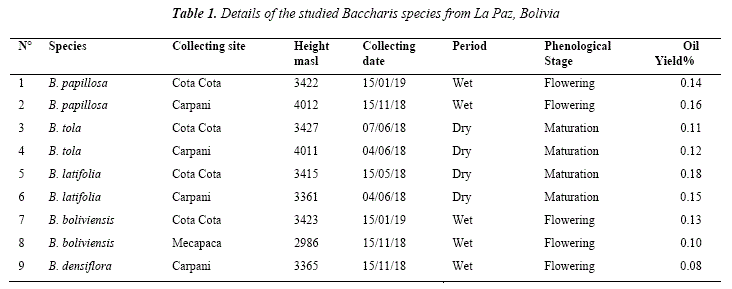
<body><![CDATA[<p align="justify"><font face="Verdana, Arial, Helvetica, sans-serif" size="2">The essential oils from the leaves of five species of the gemís <i>Baccharis, </i>namely <i>Baccharis boliviensis, B. densiflora, B. latifolia, B. papilllosa </i>and <i>B. tola </i>collected in three counties, Cota-Cota, Mecapaca and Carpani at La Paz, Bolivia, were extracted using hydrodistillation procedures and subsequently analyzed by GC/MS. Four of the species were collected in two places of the La Paz valley, in order to establish the changes in composition in function of the place of origin. <i>B. densiflora </i>was collected only in one place because of the scarcely availability of the plant material in the other collecting sites. The essential oils obtained from the five species are composed mainly by monoterpenes, and a less percentage of sesquiterpenes, in addition, few non terpenic components were detected. The only exception was <i>B. latifolia </i>that showed almost the same amount of sesquiterpenes and monoterpenes. The samples of a same species collected at two different sites showed, as a rule, similar GC/MS profiles with the exception of <i>B. tola </i>that showed higher amounts of hydrocarbon sesquiterpenes and lower quantities of cyclic monoterpenes from Carpani to Cota Cota. The analysis of the identified compounds showed that some of them were present in good quantities in all the samples of essential oils examined, like for instance, (&beta;-myrcene, D-limonene, &alpha;-thujene, D-&alpha;-pinene, sabinene, L-&beta;-pinene and &alpha;-muurolene.</font></p>     <p align="justify"><font face="Verdana, Arial, Helvetica, sans-serif" size="2"><b>Keywords: </b>Monoterpenes, Sesquiterpenes, Essential oil, Baccharis, B. boliviensis, B. densiflora, B. latifolia, B. papilllosa, B. tola.</font></p> <hr>     <p align="justify"><font face="Verdana, Arial, Helvetica, sans-serif" size="2"><b>Resumen</b></font></p>     <p align="justify"><font face="Verdana, Arial, Helvetica, sans-serif" size="2">Los aceites esenciales de las hojas de cinco especies del género <i>Baccharis, </i>a saber, <i>Baccharis boliviensis, B. densiflora, B. latifolia, B. papilllosa </i>y <i>B. tola, </i>recogidas en tres condados, Cota-Cota, Mecapaca y Carpani en La Paz, Bolivia, se extrajeron mediante procedimientos de hidrodestilación y posteriormente se analizaron por GC/MS. Cuatro de las especies fueron recolectadas en dos lugares del valle de La Paz, a fin de establecer los cambios en la composición en función del lugar de origen. <i>B. densiflora </i>se recolectó solo en un lugar debido a la escasa disponibilidad del material vegetal en los otros sitios de recolección. El aceite esencial obtenido de las cinco especies está compuesto principalmente por monoterpenos, y un menor porcentaje de sesquiterpenos, además, se detectaron pocos componentes no terpénicos. La única excepción fue <i>B. latifolia </i>que mostró casi la misma cantidad de sesquiterpenos y monoterpenos. Las muestras de una misma especie recolectadas en dos sitios diferentes mostraron, por regla general, perfiles GC/MS similares con la excepción de <i>B. tola </i>que mostró mayores cantidades de sesquiterpenos hidrocarbonados y menor cantidad de monoterpenos cíclicos de Carpani a Cota Cota. El análisis de los compuestos identificados mostró que algunos de ellos estaban presentes en buenas cantidades en todas las muestras de aceites esenciales examinadas, como por ejemplo, &beta;-mirceno, D-limoneno, &alpha;-tujeno, D-&alpha;-pineno, sabineno, L-&beta;-pineno y &alpha;-muuroleno.</font></p>     <p align="justify"><font face="Verdana, Arial, Helvetica, sans-serif" size="2"><b>Palabras clave: </b>Monoterpenos, Sesquiterpenos, Aceite esencial, Baccharis, B. boliviensis, B. densiflora, B. latifolia, B. papilllosa, B. tola.</font></p> <hr>     <p align="justify">&nbsp;</p>     <p align="justify">&nbsp;</p>     <p align="justify"><font face="Verdana, Arial, Helvetica, sans-serif" size="3"><b>INTRODUCTION</b></font></p>     <p align="justify"><font face="Verdana, Arial, Helvetica, sans-serif" size="2"><i>Baccharis </i>is the largest genus in the Asteraceae family, with more than 500 species distributed in all Americas [1], with wider incidence in Brazil, Bolivia, Argentina, Colombia, Chile and México [2]. The five species employed in the present investigation proceeded form the valley of La Paz, Bolivia: <i>Baccharis latifolia, B. densiflora, B. boliviensis, B. tola </i>and <i>B. papulosa, </i>all of them are well-reputed in folk Bolivian medicine for the treatment of rheumatism, liver diseases, infectious problems, wounds and ulcers [1,3,4]; they were previously reported by our research group for their flavonoid contents [5-9]. The first four were collected in two places of the La Paz valley at different dates, to see the changes in composition due of the change of environment. <i>B. densiflora </i>was collected only in one place because of the scarcely availability of the plant material in the other collecting sites</font></p>     <p align="justify"><font face="Verdana, Arial, Helvetica, sans-serif" size="2">The essential oils are the odoriferous principies found in several parts of the plant, they have the function of adapting the plant organism to the environment, chemically they are complex and highly variable mixtures of constituents thatbelong, almost exclusively, to two groups characterized by different biogenetic origins: the group of terpenoids and the group of aromatic compounds derived from phenylpropane, much less frequent [10]. Biologically, these compounds act in the defense of the plant against the attack of predators, attraction of pollination agents, protection against water loss and as inhibitors of germination [11,12]. Economically, they're in food, cosmetic and cleaning producís industries, also in medicine thanks to their many therapeutic properties. However, despite of their many beneficial characteristics, toxic effects of those substances can'tbe discarded [13].</font></p>     ]]></body>
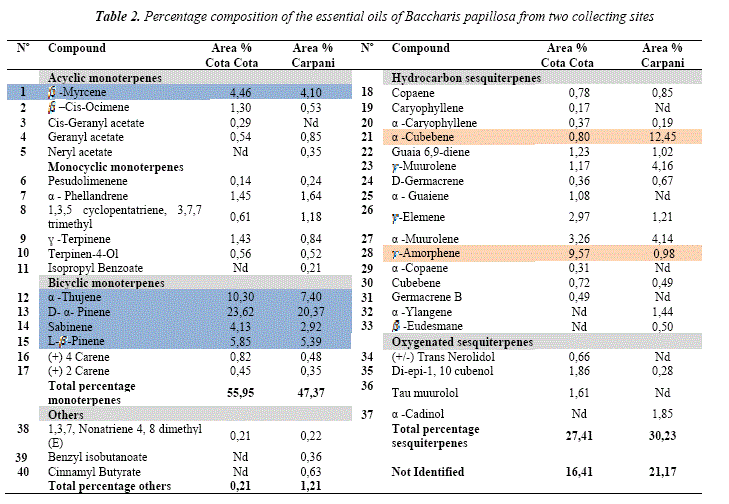
<body><![CDATA[<p align="justify"><font face="Verdana, Arial, Helvetica, sans-serif" size="2">Their presence depends of several different factors, such as: soil conditions, geographic location, vegetative cycle and the process of obtaining [10,14,15].</font></p>     <p align="justify"><font face="Verdana, Arial, Helvetica, sans-serif" size="2">There are several studies of essential oils from <i>Baccharis </i>species, reporting more than one hundred constituents in some Latin American species [16-18]. The compounds that appear most frequently in these species are: sabinene, &alpha;- and &beta;-pinene, myrcene, limonene, &delta;-cadinene, nerolidol, terpinen-4-ol, &alpha;-tujeno, &alpha;-fellandreno, &beta;-Cimeno and elemol. In particular, Bolivian researchers identified about 100 compounds in the essential oil of <i>B. latifolia, </i>from specimens collected in three locations in Cochabamba, where the major monoterpenes were &alpha;-pinene, limonene, &beta;-tujeno, pinocarvenol, verbenol, mirtenol, mirtenal and carvone, in addition to important sesquiterpenes such as germacrene D and ledol [19], among others.</font></p>     <p align="justify">&nbsp;</p>     <p align="justify"><font face="Verdana, Arial, Helvetica, sans-serif" size="3"><b>RESULTS AND DISCUSSION</b></font></p>     <p align="justify"><font face="Verdana, Arial, Helvetica, sans-serif" size="2">The essential oils of five <i>Baccharis </i>species of high bioavailability in the Valley of La Paz-Bolivia, were obtained. The oils were extracted by hydrodistillation technique, with yields among 0.08 and 0.18% (<a href="#t1">Table 1</a>). From the first four species the oils were obtained from two collection sites with different environmental characteristics. The collections were done in the same phenological stage and the same period of the year to have data about the effect of the environmental change on the production of essential oils. From <i>Baccharis densiflora, </i>the study could not be carried out at two collection sites because there were not two sites with a significant presence of this species among the collection sites.</font></p>     <p align="center"><img src="/img/revistas/rbq/v37n1/a01_figura01.gif" width="732" height="289"><a name="t1"></a></p>     <p align="justify"><font face="Verdana, Arial, Helvetica, sans-serif" size="2">Below are the tables with the results of the analyses obtained in the GC/MS equipment of each oil, divided into types of compounds and by species</font></p>     <p align="center"><img src="/img/revistas/rbq/v37n1/a01_figura02.gif" width="729" height="504"><a name="t2"></a></p>     <p align="justify"><font face="Verdana, Arial, Helvetica, sans-serif" size="2">The essential oil of <i>Baccharis papulosa </i>was obtained in two collecting sites of La Paz: University campus of Cota Cota, a metropolitan región, and Carpani a rural community near of La Paz city. Both samples were taken in wet station and flowering phenological stage (<a href="#t1">Table 1</a>), giving a yield of 0,14% (Cota Cota) and 0,16% (Carpani). The GC/MS analysis (<a href="#t2">Table 2</a>) show a similar profile for both with monoterpenes as major components 55,95% (Cota Cota) and 47,37% (Carpani), followed by sesquiterpenes 27,41% (Cota Cota) and 30,23% (Carpani). A total </font><font face="Verdana, Arial, Helvetica, sans-serif" size="2">of 40 compounds were identified, constituting 83,57% of total essential oil obtained in Cota Cota and 78,81% in Carpani. The main compounds of the essential oils of both samples were the monoterpenes: &beta;-myrcene, &alpha;-thujene, D &alpha;-pinene, sabinene and L-&beta;-pinene. The major difference between both samples was in the sesquiterpenes where we can see the &alpha;-cubebene as the main component in the sample from Carpani (12,45%) but not in Cota Cota (0,80%), and the &gamma;-amorphene as the main component in the sample from Cota Cota (9,57%) but not in Carpani (0,98%). Therefore, the difference in the environmental conditions of both places affect mainly the biosynthesis of hydrocarbon sesquiterpenoids.</font></p>     <p align="center"><img src="/img/revistas/rbq/v37n1/a01_figura03.gif" width="734" height="678"><a name="t3"></a></p>     ]]></body>
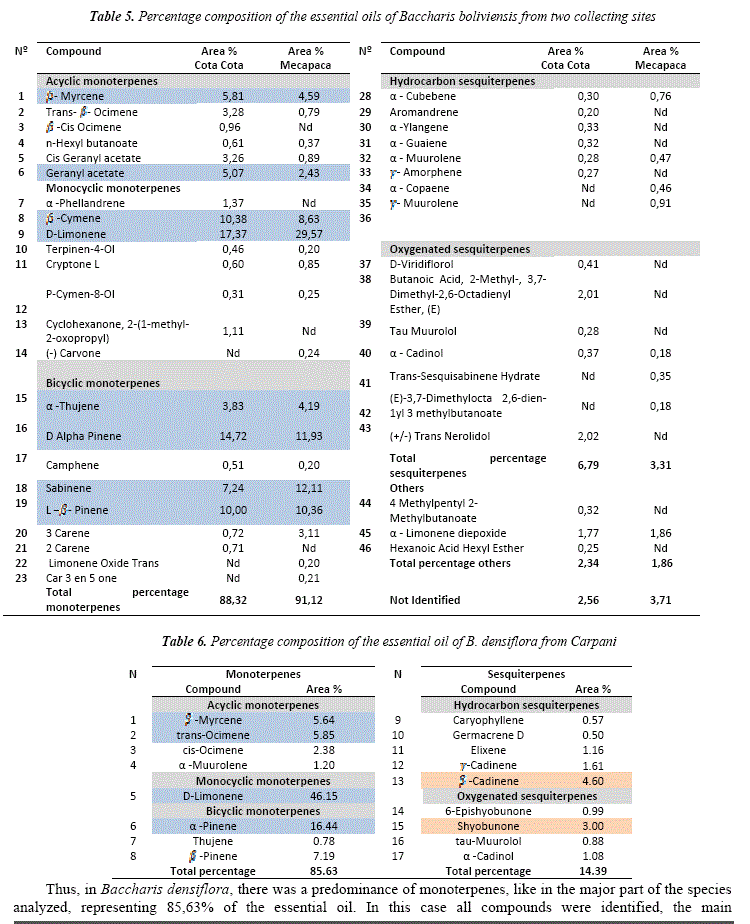
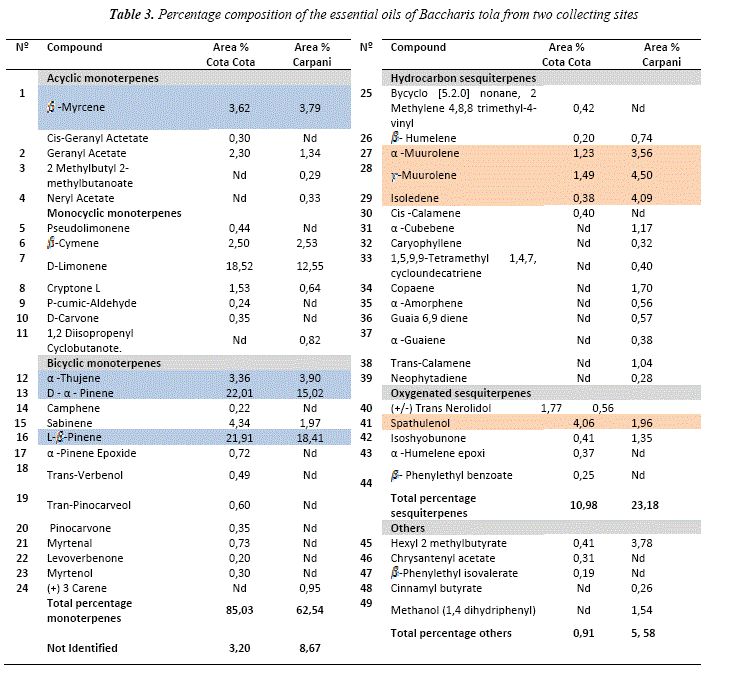
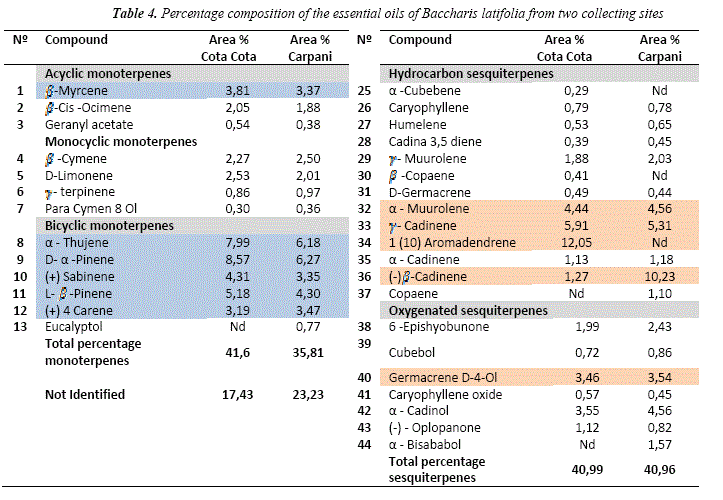
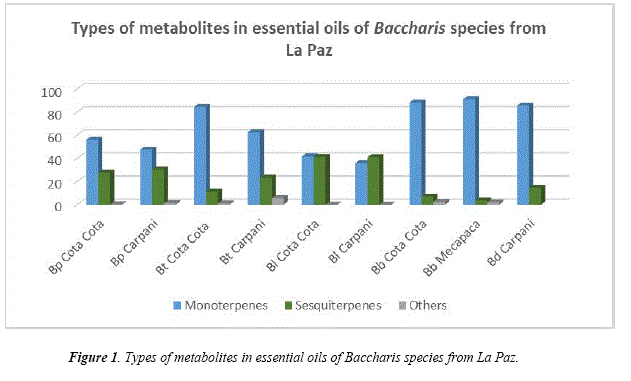
<body><![CDATA[<p align="justify"><font face="Verdana, Arial, Helvetica, sans-serif" size="2">The essential oil of <i>Baccahris tola </i>was obtained in the same collecting sites than <i>B. papulosa: </i>Cota Cota and Carpani, but in the dry season, when the plants are in maturation phenological stage (<a href="#t1">Table 1</a>). The oil yields were very similar 0,11% (Cota Cota) and 0,12% (Carpani) but the GC/MS analysis (<a href="#t3">Table 3</a>) shows bigger differences than in <i>B. papulosa. </i>Both oils have monoterpenes as main components and sesquiterpenes as second major metabolites, but the sample collected in Cota Cota has 85,03% of monoterpenes and 10,98% of sesquiterpenes, while the sample from Carpani has 62,54% of monoterpenes and 23,19% of sesquiterpenes. So, the environmental conditions in Carpani seems to stimulate the production of sesquiterpenes instead of some monoterpenes. The main monoterpenes inboth samples were: &beta;-myrcene, D-limonene, &alpha;-thuiene, D-&alpha;-pinene and L-&beta;-pinene, in general with </font><font face="Verdana, Arial, Helvetica, sans-serif" size="2">bigger concentration in the oil obtained of the sample from Cota Cota. Respect of sesquiterpenes the main components were: &alpha;-muurolene, &gamma;-muurolene, isoledene and spathulenol, in the first three there were major production in Carpani than in Cota Cota, and in the last one there was major production in Cota Cota. In total 49 compounds were identified representing more than 90% of the analyzed oils from <i>B. tola.</i></font></p>     <p align="center"><img src="/img/revistas/rbq/v37n1/a01_figura04.gif" width="723" height="500"><a name="t4"></a></p>     <p align="justify"><font face="Verdana, Arial, Helvetica, sans-serif" size="2">The samples of <i>Baccharis latifolia </i>also were collected in the same sites: Cota Cota and Carpani in dry season. The oilyields were a little bigger than those ofthe other <i>Baccharis </i>studied, 0,18% (Cota Cota) and 0,15% (Carpani). The GC/MS analysis (<a href="#t4">Table 4</a>) showed a different profile than those of the other <i>Baccharis, </i>with a similar percentage of monoterpenes and sesquiterpenes (Cota Cota, monoterpenes 41,6% and sesquiterpenes 40,99%; Carpani, monoterpenes 35,81% and sesquiterpenes 40,96%). So, this was the species with major production of sesquiterpenes. The composition of the essential oils from both sites was very similar with the exception of sesquiterpenes l(10)-aromadendrene which represents 12,05% in the oil from Cota Cota and it was not identified in the oil from Carpani, and (-) &beta;-cadinene which represents 1,27% in the oil from Cota Cota and 10,23% in the oil from Carpani. The major identified components were: &beta;-myrcene, &alpha;-thujene, D-&alpha;-pinene, (+) sabinene, L-&beta;-pinene, (+) 4-carene, &alpha;-muurolene, &gamma;-cadinene, 1 (1O)-aromadendrene, &beta;-cadinene and germacrene D-4-ol, among 44 compounds identified in the oil from <i>B. latifolia, </i>which represents 82,49% of the essential oil obtained from Cota Cota and 76,77% from Carpani.</font></p>     <p align="justify"><font face="Verdana, Arial, Helvetica, sans-serif" size="2">The samples of <i>B. boliviensis </i>were collected in the University Campus of Cota Cota (3300 m.a.s.l.) and in Mecapaca (3000 m.a.s.l.), a different site wetter and at lower meters above sea level than the other two sites. The oil yield of the sample from Cota Cota (0,13%) was higger than that of Mecapaca (0,10%). The GC/MS profile of the essential oil from both species were very similar with a clear predominance of monoterpenes: 88,32% (Cota Cota) and 91,12% (Mecapaca). A total of 46 compounds were identified representing more than 95% ofthe analyzed oil from <i>B. boliviensis. </i>The main components in both samples were: &beta;-myrcene, geranyl acétate, &beta;-cymene, D-limonene, &alpha;-thujene, D-&alpha;- pinene, sabinene and L-&beta;-pinene, showing some quantitative differences especially in geranyl acétate, D-limonene and sabinene.</font></p>     <p align="justify"><font face="Verdana, Arial, Helvetica, sans-serif" size="2">Finally, <i>Baccharis densiflora </i>(Syn <i>B. pentlandii) </i>was collected only in Carpani. Its essential oil yield was the lowest (0,08%) and its GC/MS profile was the simplest, with a total of 17 compounds identified.</font></p>     <p align="center"><img src="/img/revistas/rbq/v37n1/a01_figura05.gif" width="750" height="924"></p>     <p align="justify"><font face="Verdana, Arial, Helvetica, sans-serif" size="2">Thus, in <i>Baccharis densiflora, </i>there was a predominance of monoterpenes, like in the major part of the species analyzed, representing 85,63% of the essential oil.  In this case all compounds were identified, the main</font></p>     <p align="justify"><font face="Verdana, Arial, Helvetica, sans-serif" size="2">monoterpenes were: &beta;-myrcene, trans-ocimene, D-limonene, and &alpha;- pinene, among them ít was remarkable the presence of D-limonene which represents almost half of the essential oil (46,15%). On the other hand, there was 14,39% of sesquiterpenes and the main were &beta;-cadinene and shyobunone.</font></p>     <p align="justify"><font face="Verdana, Arial, Helvetica, sans-serif" size="2">Making a global analysis of all <i>Baccharis </i>species under study, we conclude that their oils were composed mainly by monoterpenes, and the only exception was <i>B. latifolia </i>that had almost the same amount of sesquiterpenes. It was also observed that there were few compounds that are not terpenoids (<a href="#f1">Figure 1</a>) with the exception <i>B. tola </i>from Carpani which contained 5.58% of non-terpenic compounds.</font></p>     <p align="center"><img src="/img/revistas/rbq/v37n1/a01_figura06.gif" width="631" height="381"><a name="f1"></a></p>     ]]></body>
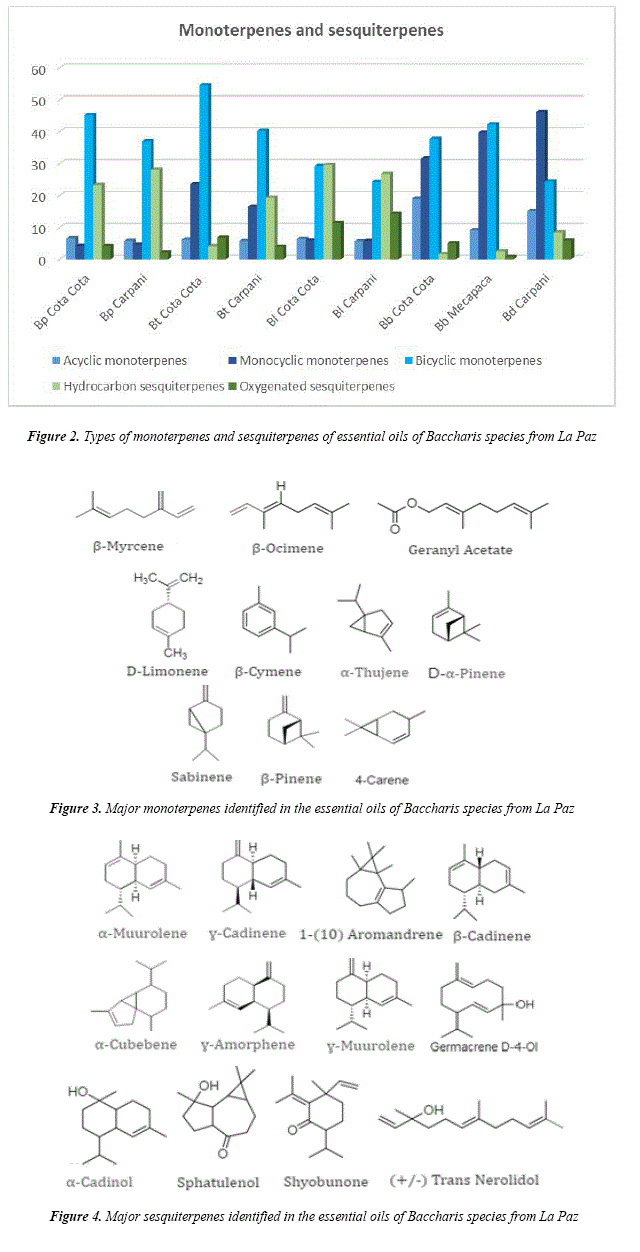
<body><![CDATA[<p align="justify"><font face="Verdana, Arial, Helvetica, sans-serif" size="2"><a href="#f2">Figure 2</a> shows the types of monoterpenes and sesquiterpenes identified in the essential oils. In this graphic we can see similar profiles for the same species collected in two sites, but with some exceptions: <i>Baccharis tola </i>which clearly showed bigger quantities of hydrocarbon sesquiterpenes and lower quantities of monocyclic and bicyclic monoterpenes in Carpani than in Cota Cota. So, the environmental conditions in Carpani seern to stimulate the production of hydrocarbon sesquiterpenes instead of some cyclic monoterpenes in this species. There were also some differences in the production of sesquiterpenes in the samples of <i>B. boliviensis, </i>the sample from Cota Cota had more quantity of oxygenated sesquiterpenes than hydrocarbon sesquiterpenes, and the sample from Mecapaca had less oxygenated sesquiterpenes and more hydrocarbon sesquiterpenes.</font></p>     <p align="justify"><font face="Verdana, Arial, Helvetica, sans-serif" size="2">Among the essential oils of the <i>Baccharis </i>studied, only that of <i>B. latifolia </i>has been previously studied (Loayza, 1995). In such previous study, the samples were collected in three localities of Cochabamba, Bolivia. The GC/MS profiles were similar with large quantities of sesquiterpenes and monoterpenes. They showed some similar major components, like &alpha;-thujene and &alpha;-pinene, but also there were some components very different in percentage, like germacrone (41,85%), &gamma;-elemene (10,29%) and D-limonene (22,15%) in the essential oil from Montepunco (2850 m.a.s.l.), probably due to very different environmental conditions compared to the collecting sites of La Paz.</font></p>     <p align="justify"><font face="Verdana, Arial, Helvetica, sans-serif" size="2">The analysis of the identified compounds in all five species studied, shows that there were some of them present in good quantities in almost all the essential oils studied, like the monoterpenes: &beta;-myrcene, D-limonene, &alpha;-thujene, D-&alpha;-pinene, sabinene and L-&beta;-pinene. Those compounds and others identified were isolated in other species and showed good pharmacological activities like &beta;-myrcene, which showed anti-inflammatory, antiseptic, antispasmodic and analgesic properties [20-22] or D-limonene, which presented immunostimulant activity, apoptotic of breast cáncer cells, and effectiveness against the bacteria that cause acné [23]. There are several studies about the antimicrobial activities of essential oils, showing that specific compounds cannot explain these properties due to complex mixtures of terpenes, mainly those with aromatic rings and phenolic hydroxyl groups [24]. Nevertheless, some of them have strong antibacterial activity proven like &alpha;-pinene, &beta;-pinene and D-limonene [25-27]. In addition, some others like &alpha;-pinene, 3-carene and &beta;-cymene can inhibit acetylcholinesterase (AChE) showing a potential</font></p>     <p align="justify"><font face="Verdana, Arial, Helvetica, sans-serif" size="2">against Alzheimer [28]. Regarding sesquiterpenes, they were present in lower quantities but some of them were remarkable like &alpha;-cubebene, which stimulates the production of chemokines (CXCL8 or IL-8) in human neutrophils [29], or trans-nerolidol, which was identified as antiulcer constituent from the essential oil of <i>Baccharis dracunculifolia </i>[30].</font></p>     <p align="center">F<img src="/img/revistas/rbq/v37n1/a01_figura07.gif" width="640" height="1252"></p>     <p align="center"><a name="f2"></a></p>     <p align="justify"><font face="Verdana, Arial, Helvetica, sans-serif" size="3"><b>EXPERIMENTAL </b></font></p>     <p align="justify"><font face="Verdana, Arial, Helvetica, sans-serif" size="2"><b><i>Plant material.</i></b></font></p>     <p align="justify"><font face="Verdana, Arial, Helvetica, sans-serif" size="2">The plant material was collected around the city of La Paz according to the details shown in table 1, so <i>Baccharis boliviensis </i>was collected from the community of Mecapaca (K 0606505 UTM 8157314) and University Campus of Cota Cota (K 0599543 UTM 8171528), <i>B. densiflora </i>of the Community of Carpani (K 0602947, UTM 8181212) and Cota Cota University Campus, <i>B. latifolia </i>of the Community of Carpani (K 0603029, UTM 8182407) and University Campus of Cota Cota, <i>B. papulosa </i>of the Community of Carpani and University Campus of Cota Cota, <i>B. tola </i>of the Community of Carpani and Cota Cota University Campus and finally <i>B. densiflora </i>of the Community of Carpani. The collected material was identified by Esther Valenzuela from JBLP (Botanic Garden of the National Herbarium of Bolivia), where samples of the collected specimens are deposited.</font></p>     <p align="justify"><font face="Verdana, Arial, Helvetica, sans-serif" size="2"><b><i>Essential oils extraction</i></b></font></p>     ]]></body>
<body><![CDATA[<p align="justify"><font face="Verdana, Arial, Helvetica, sans-serif" size="2">The essential oil was extracted from 5 Kg of fresh leaves of each species by hydrodistillation, the extraction was carried out for 3 hours, and the oil obtained was separated, dried with anhydrous magnesium sulphate and stored at 4 &deg; C for further analysis by GC MS [31]</font></p>     <p align="justify"><font face="Verdana, Arial, Helvetica, sans-serif" size="2"><b><i>GC/MS conditions for analysis</i></b></font></p>     <p align="justify"><font face="Verdana, Arial, Helvetica, sans-serif" size="2">1 uL of each oil was dissolved in 98% N-Hexane up to 2 mL, then filtered with 0.2 &mu;m PTFE and subsequently analyzed in the GC-MS.</font></p>     <p align="justify"><font face="Verdana, Arial, Helvetica, sans-serif" size="2">The composition of the oils was determined in a GC 2010 PLUS gas chromatograph coupled to a QP 2020 mass spectrometric detector, both SHIMADZU. The compounds separation was performed by a column of Sil MS RESTEK with 5% diphenyl and 95% dimethyl polysiloxane (30 m x 0.25 mm and 0.25 um film thickness). The injection volume was 1 &mu;L at a total flow of 15.6 mL/min, and the column flow was of 0.60 mL/min. The temperature of the injector was 280 &deg; C, the initial temperature was 40 &deg;C, maintained for 2 min, subsequently the temperature was increased up to 210 &deg;C with a speed of 2 &deg;C/min, for 5 min, the ionization temperature used was of 230 &deg; C and the interface temperature was of 280 &deg;C.</font></p>     <p align="justify"><font face="Verdana, Arial, Helvetica, sans-serif" size="2">The identification of the compounds was achieved by comparison of their mass spectra with a library data base (NIST14). Also mass spectra of the peaks were compared with published spectrometric data. Spectra were considered coincident if the similarity index was higher than 95%. The percentage of compounds was calculated from the peak áreas of the chromatograms [32].</font></p>     <p align="justify">&nbsp;</p>     <p align="justify"><font face="Verdana, Arial, Helvetica, sans-serif" size="3"><strong>ACKNOWLEDGEMENTS</strong></font></p>     <p align="justify"><font face="Verdana, Arial, Helvetica, sans-serif" size="2">We are indebted to SIDA Swedish Agency for the grant to Silvia Ramos as part of the project &quot;Biomolecules of industrial and medicinal interest. Anticancer&quot;. We are also indebted with the funds IDH for UMSA, for the financial support of the project &quot;Influence of meteorological and ecological variations in the production of secondary metabolites with phytotherapeutic and cosmeceutical potential of <i>Baccharis </i>sp., La Paz&quot;. Finally, we would like to thank Prof. Esther Valenzuela, Patricia Casillas and Juan Carlos Peñaranda from the JBLP, for the identification of the plant material.</font></p>     <p align="justify">&nbsp;</p>     <p align="justify"><font face="Verdana, Arial, Helvetica, sans-serif" size="3"><b>REFERENCES</b></font><font face="Verdana, Arial, Helvetica, sans-serif" size="2"><b></b></font></p>     ]]></body>
<body><![CDATA[<!-- ref --><p align="justify"><font face="Verdana, Arial, Helvetica, sans-serif" size="2">1.&nbsp;  Verdi, L.G., Brighente, I.M.C., Pizzolatti, M.G. <b>2005, </b>Género <i>Baccharis </i>(Asteraceae): aspectos químicos, económicos e biológicos. <i>Quim. Nova, 28(1), </i>85-94.</font>&nbsp;&nbsp;&nbsp;&nbsp;&nbsp;&nbsp;&nbsp;&nbsp;[&#160;<a href="javascript:void(0);" onclick="javascript: window.open('/scielo.php?script=sci_nlinks&ref=698132&pid=S0250-5460202000010000100001&lng=','','width=640,height=500,resizable=yes,scrollbars=1,menubar=yes,');">Links</a>&#160;]<!-- end-ref --><!-- ref --><p align="justify"><font face="Verdana, Arial, Helvetica, sans-serif" size="2">2.&nbsp;  Abad, M.J., Bermejo, P. <b>2007, </b><i>Baccharis </i>(Compositae): a review update, <i>Arkivoc, VII, </i>76-96.</font>&nbsp;&nbsp;&nbsp;&nbsp;&nbsp;&nbsp;&nbsp;&nbsp;[&#160;<a href="javascript:void(0);" onclick="javascript: window.open('/scielo.php?script=sci_nlinks&ref=698133&pid=S0250-5460202000010000100002&lng=','','width=640,height=500,resizable=yes,scrollbars=1,menubar=yes,');">Links</a>&#160;]<!-- end-ref --><!-- ref --><p align="justify"><font face="Verdana, Arial, Helvetica, sans-serif" size="2">3.&nbsp;  Abad, M.J., Bessa, A.L., Bailarín, B., Aragón, O., Gonzales, E., Bermejo, P. <b>2006, </b>Anti-inflammatory activity of four Bolivian <i>Baccharis </i>species (Compositae), <i>JEthnopharmacol, 103, </i>338-344.</font>&nbsp;&nbsp;&nbsp;&nbsp;&nbsp;&nbsp;&nbsp;&nbsp;[&#160;<a href="javascript:void(0);" onclick="javascript: window.open('/scielo.php?script=sci_nlinks&ref=698134&pid=S0250-5460202000010000100003&lng=','','width=640,height=500,resizable=yes,scrollbars=1,menubar=yes,');">Links</a>&#160;]<!-- end-ref --><!-- ref --><p align="justify"><font face="Verdana, Arial, Helvetica, sans-serif" size="2">4.&nbsp;  Salcedo, L., Almanza, G.R. <b>2011. </b>Uso de <i>Baccharis latifolia </i>(Chuca) en La Paz, Bolivia, <i>Biofarbo 19(1), </i>59-63.</font>&nbsp;&nbsp;&nbsp;&nbsp;&nbsp;&nbsp;&nbsp;&nbsp;[&#160;<a href="javascript:void(0);" onclick="javascript: window.open('/scielo.php?script=sci_nlinks&ref=698135&pid=S0250-5460202000010000100004&lng=','','width=640,height=500,resizable=yes,scrollbars=1,menubar=yes,');">Links</a>&#160;]<!-- end-ref --><!-- ref --><p align="justify"><font face="Verdana, Arial, Helvetica, sans-serif" size="2">5.&nbsp;  Enríquez, S., Quispe, R.E., Amurrio, P., Peñaranda, J.C., Calle, A., Orsag, V., Almanza G. R. <b>2018. </b>Flavonoid contents in leaves of <i>Baccharis latifolia, </i>according to the type of leaf, and its dependence on the physicochemical properties of soils, <i>Rev Bol Quim, 35(5), </i>146-154</font>&nbsp;&nbsp;&nbsp;&nbsp;&nbsp;&nbsp;&nbsp;&nbsp;[&#160;<a href="javascript:void(0);" onclick="javascript: window.open('/scielo.php?script=sci_nlinks&ref=698136&pid=S0250-5460202000010000100005&lng=','','width=640,height=500,resizable=yes,scrollbars=1,menubar=yes,');">Links</a>&#160;]<!-- end-ref --><!-- ref --><p align="justify"><font face="Verdana, Arial, Helvetica, sans-serif" size="2">6.&nbsp;  Calle, A., San Martin, A., Melgarejo, M., Flores, Y., Almanza G.R. <b>2017. </b>Evaluation of flavonoid contents and antibacterial activity of five Bolivian <i>Baccharis </i>species, <i>Rev Bol Quim, 34(4), </i>111-121.</font>&nbsp;&nbsp;&nbsp;&nbsp;&nbsp;&nbsp;&nbsp;&nbsp;[&#160;<a href="javascript:void(0);" onclick="javascript: window.open('/scielo.php?script=sci_nlinks&ref=698137&pid=S0250-5460202000010000100006&lng=','','width=640,height=500,resizable=yes,scrollbars=1,menubar=yes,');">Links</a>&#160;]<!-- end-ref --><!-- ref --><p align="justify"><font face="Verdana, Arial, Helvetica, sans-serif" size="2">7.&nbsp;  Escobar, Z., Flores, Y., Tejeda, L., Alvarado, J.A., Sterner, O., Almanza, G.R. <b>2009. </b>Phenolic compounds from <i>Baccharis </i></font><font face="Verdana, Arial, Helvetica, sans-serif" size="2"><i>papulosa </i>subsp. <i>papulosa, Rev Bol Quim. 26(2), </i>111-117.</font>&nbsp;&nbsp;&nbsp;&nbsp;&nbsp;&nbsp;&nbsp;&nbsp;[&#160;<a href="javascript:void(0);" onclick="javascript: window.open('/scielo.php?script=sci_nlinks&ref=698138&pid=S0250-5460202000010000100007&lng=','','width=640,height=500,resizable=yes,scrollbars=1,menubar=yes,');">Links</a>&#160;]<!-- end-ref --><!-- ref --><p align="justify"><font face="Verdana, Arial, Helvetica, sans-serif" size="2">8.&nbsp;  Tarqui, S., Flores, Y., Almanza, G.R. <b>2012. </b>Polyoxygenated flavonoids from <i>Baccharis pentlandii, Rev Bol Quim. </i>29(1): 10-14.</font>&nbsp;&nbsp;&nbsp;&nbsp;&nbsp;&nbsp;&nbsp;&nbsp;[&#160;<a href="javascript:void(0);" onclick="javascript: window.open('/scielo.php?script=sci_nlinks&ref=698139&pid=S0250-5460202000010000100008&lng=','','width=640,height=500,resizable=yes,scrollbars=1,menubar=yes,');">Links</a>&#160;]<!-- end-ref --><!-- ref --><p align="justify"><font face="Verdana, Arial, Helvetica, sans-serif" size="2">9.&nbsp;  Calle, A., Yupanqui, J., Flores, Y., Almanza, G.R. <b>2012. </b>Flavonoids of <i>Baccharis boliviensis, Rev Bol Quim. 29(2), </i>158-163.</font>&nbsp;&nbsp;&nbsp;&nbsp;&nbsp;&nbsp;&nbsp;&nbsp;[&#160;<a href="javascript:void(0);" onclick="javascript: window.open('/scielo.php?script=sci_nlinks&ref=698140&pid=S0250-5460202000010000100009&lng=','','width=640,height=500,resizable=yes,scrollbars=1,menubar=yes,');">Links</a>&#160;]<!-- end-ref --><!-- ref --><p align="justify"><font face="Verdana, Arial, Helvetica, sans-serif" size="2">10.&nbsp;  Fabiane, K.C., Ferronatto, R., Dos Santos, A.C., Onofre, S.B. <b>2008. </b>Physicochemical characteristics of the essential oils <i>oí Baccharis dracunculifolia </i>and   <i>Baccharis   uncinella   </i>D.C.   (Asteraceae),   <i>Revista   Brasileira   de   Farmacognosia,   Brazilian   Journal   of Pharmacognosy, 18(2), </i>197-203.</font>&nbsp;&nbsp;&nbsp;&nbsp;&nbsp;&nbsp;&nbsp;&nbsp;[&#160;<a href="javascript:void(0);" onclick="javascript: window.open('/scielo.php?script=sci_nlinks&ref=698141&pid=S0250-5460202000010000100010&lng=','','width=640,height=500,resizable=yes,scrollbars=1,menubar=yes,');">Links</a>&#160;]<!-- end-ref --><!-- ref --><p align="justify"><font face="Verdana, Arial, Helvetica, sans-serif" size="2">11.&nbsp;  Feresin, G.E., Tapia, A., López, S.N., Zacchino, S.A. <b>2001. </b>Antimicrobial activity of plants used in traditional medicine of San Juan province, Argentine, <i>J. Ethnopharmacol, 78, </i>103-107.</font>&nbsp;&nbsp;&nbsp;&nbsp;&nbsp;&nbsp;&nbsp;&nbsp;[&#160;<a href="javascript:void(0);" onclick="javascript: window.open('/scielo.php?script=sci_nlinks&ref=698142&pid=S0250-5460202000010000100011&lng=','','width=640,height=500,resizable=yes,scrollbars=1,menubar=yes,');">Links</a>&#160;]<!-- end-ref --><!-- ref --><p align="justify"><font face="Verdana, Arial, Helvetica, sans-serif" size="2">12.&nbsp;  Jassim, S.A.A., Naji, M.A.A. <b>2003. </b>Review: Novel antiviral agents: a medicinal plant preservative, <i>J ApplMicrobiol 95, </i>412-427.</font>&nbsp;&nbsp;&nbsp;&nbsp;&nbsp;&nbsp;&nbsp;&nbsp;[&#160;<a href="javascript:void(0);" onclick="javascript: window.open('/scielo.php?script=sci_nlinks&ref=698143&pid=S0250-5460202000010000100012&lng=','','width=640,height=500,resizable=yes,scrollbars=1,menubar=yes,');">Links</a>&#160;]<!-- end-ref --><!-- ref --><p align="justify"><font face="Verdana, Arial, Helvetica, sans-serif" size="2">13.&nbsp;  Grassmann, J., Hippeli, S., Dornisch, K., Rohnert, U., Beuscher, N., Elstner, E.F. <b>2000. </b>Antioxidant properties of essential oils. Possible explanations for their antiinflamatory effects, <i>Arzneimittel-Forsch, 50, </i>135-139</font>&nbsp;&nbsp;&nbsp;&nbsp;&nbsp;&nbsp;&nbsp;&nbsp;[&#160;<a href="javascript:void(0);" onclick="javascript: window.open('/scielo.php?script=sci_nlinks&ref=698144&pid=S0250-5460202000010000100013&lng=','','width=640,height=500,resizable=yes,scrollbars=1,menubar=yes,');">Links</a>&#160;]<!-- end-ref --><!-- ref --><p align="justify"><font face="Verdana, Arial, Helvetica, sans-serif" size="2">14.&nbsp;  Oliveira, R.N., Dias, I.J.M., Cámara, C.A.G. <b>2005. </b>Estudo comparativo do óleo essencial de Eugenia <i>punicifolia </i>(HBK) DC. de diferentes localidades de Pernambuco, <i>Rev Bras Farmacogn, 15, </i>39-43</font>&nbsp;&nbsp;&nbsp;&nbsp;&nbsp;&nbsp;&nbsp;&nbsp;[&#160;<a href="javascript:void(0);" onclick="javascript: window.open('/scielo.php?script=sci_nlinks&ref=698145&pid=S0250-5460202000010000100014&lng=','','width=640,height=500,resizable=yes,scrollbars=1,menubar=yes,');">Links</a>&#160;]<!-- end-ref --><!-- ref --><p align="justify"><font face="Verdana, Arial, Helvetica, sans-serif" size="2">15.&nbsp;  Tavares, E.S., Juliao, L.S., Lopes, D., Bizzo, H.R., Lage, C.L.S., Leitao, S.G. <b>2005. </b>Análise do óleo essencial de folhas de tres quimiotipos de <i>Lippia alba </i>(Mili.) N.E.Br. (Verbenaceae) cultivados em condicoes semelhantes, <i>Rev Bras Farmacogn 15, </i>1-5</font>&nbsp;&nbsp;&nbsp;&nbsp;&nbsp;&nbsp;&nbsp;&nbsp;[&#160;<a href="javascript:void(0);" onclick="javascript: window.open('/scielo.php?script=sci_nlinks&ref=698146&pid=S0250-5460202000010000100015&lng=','','width=640,height=500,resizable=yes,scrollbars=1,menubar=yes,');">Links</a>&#160;]<!-- end-ref --><!-- ref --><p align="justify"><font face="Verdana, Arial, Helvetica, sans-serif" size="2">16.&nbsp;  Malizia, R.A.; Cardell, D.A.; Molli, J.S.; González, S.; Guerra, P.E.; Grau, R.J.J. <b>2005. </b>Volatile Constituents of Leaf Oils from the Genus Baccharis. Part I: B. racemosa (Ruiz et Pav.) DC and B. linearis (Ruiz et Pav.) Pers. Species from Argentina, <i>Essent. Oil. Res., 17(1), </i>103-106.</font>&nbsp;&nbsp;&nbsp;&nbsp;&nbsp;&nbsp;&nbsp;&nbsp;[&#160;<a href="javascript:void(0);" onclick="javascript: window.open('/scielo.php?script=sci_nlinks&ref=698147&pid=S0250-5460202000010000100016&lng=','','width=640,height=500,resizable=yes,scrollbars=1,menubar=yes,');">Links</a>&#160;]<!-- end-ref --><!-- ref --><p align="justify"><font face="Verdana, Arial, Helvetica, sans-serif" size="2">17.&nbsp;  Concha, J., Cavieres, L.A., Sotes, G. J., Hernández, V. <b>2014. </b>Essential oil composition <i>oí Baccharis linearis </i>(Ruiz &amp; Pav.) Pers. and <i>Baccharis paniculata </i>DC leaves from Chile, <i>American Journal of Essential Oils and Natural Products, 1 </i>(4), 6-8.</font>&nbsp;&nbsp;&nbsp;&nbsp;&nbsp;&nbsp;&nbsp;&nbsp;[&#160;<a href="javascript:void(0);" onclick="javascript: window.open('/scielo.php?script=sci_nlinks&ref=698148&pid=S0250-5460202000010000100017&lng=','','width=640,height=500,resizable=yes,scrollbars=1,menubar=yes,');">Links</a>&#160;]<!-- end-ref --><!-- ref --><p align="justify"><font face="Verdana, Arial, Helvetica, sans-serif" size="2">18.&nbsp;  Ferracini, V.L., Paraiba, L.C., Leitao Filho, H.F., Da Silva, A. G., Nascimento, L.R., Marsaioli, A.J. <b>1995. </b>Essential Oils of Seven Brazilian <i>Baccharis </i>Species, <i>Journal of Essential Oil Research, </i>7(4), 355-367.</font>&nbsp;&nbsp;&nbsp;&nbsp;&nbsp;&nbsp;&nbsp;&nbsp;[&#160;<a href="javascript:void(0);" onclick="javascript: window.open('/scielo.php?script=sci_nlinks&ref=698149&pid=S0250-5460202000010000100018&lng=','','width=640,height=500,resizable=yes,scrollbars=1,menubar=yes,');">Links</a>&#160;]<!-- end-ref --><!-- ref --><p align="justify"><font face="Verdana, Arial, Helvetica, sans-serif" size="2">19.&nbsp; Loayza, I., Abujder, D., Aranda, R., Jakupovic, J., Collin, G., Deslauriers, H., Jean, F. <b>1995. </b>Essential oils <i>oí Baccharis salicifolia, B. latifolia </i>and <i>B. dracunculifolia. Phytochemistry, 38(2), </i>381-389.</font>&nbsp;&nbsp;&nbsp;&nbsp;&nbsp;&nbsp;&nbsp;&nbsp;[&#160;<a href="javascript:void(0);" onclick="javascript: window.open('/scielo.php?script=sci_nlinks&ref=698150&pid=S0250-5460202000010000100019&lng=','','width=640,height=500,resizable=yes,scrollbars=1,menubar=yes,');">Links</a>&#160;]<!-- end-ref --><!-- ref --><p align="justify"><font face="Verdana, Arial, Helvetica, sans-serif" size="2">20.&nbsp;  Akono Ntonga, P., Baldovini, N., Mouray, E., Mambu, L., Belong, P., Grellier, P. <b>2014. </b>Activity of <i>Ocimum basilicum, Ocimum canum, </i>and <i>Cymbopogon citratus </i>essential oils against <i>Plasmodium falciparum </i>and mature-stage larvae of <i>Anopheles funestus </i>s.s., <i>Parasite, 21, </i>33-41</font>&nbsp;&nbsp;&nbsp;&nbsp;&nbsp;&nbsp;&nbsp;&nbsp;[&#160;<a href="javascript:void(0);" onclick="javascript: window.open('/scielo.php?script=sci_nlinks&ref=698151&pid=S0250-5460202000010000100020&lng=','','width=640,height=500,resizable=yes,scrollbars=1,menubar=yes,');">Links</a>&#160;]<!-- end-ref --><!-- ref --><p align="justify"><font face="Verdana, Arial, Helvetica, sans-serif" size="2">21.&nbsp;  González-Zúñiga, J, González-Sánchez, H., González-Palomares, S., Rosales-Reyes, T., Andrade-González, I. <b>2011. </b>Microextracción en fase sólida de compuestos volátiles en albahaca <i>(Ocimum basilicum </i>L.), <i>Acta Universitaria, 21(1), </i>17-22.</font>&nbsp;&nbsp;&nbsp;&nbsp;&nbsp;&nbsp;&nbsp;&nbsp;[&#160;<a href="javascript:void(0);" onclick="javascript: window.open('/scielo.php?script=sci_nlinks&ref=698152&pid=S0250-5460202000010000100021&lng=','','width=640,height=500,resizable=yes,scrollbars=1,menubar=yes,');">Links</a>&#160;]<!-- end-ref --><!-- ref --><p align="justify"><font face="Verdana, Arial, Helvetica, sans-serif" size="2">22.&nbsp;  Sajjadi,  S. <b>2006.  </b>Analysis of the essential oils of two cultivated basil <i>(Ocimum  basilicum </i>L.) from Irán, <i>DARU Journal of Pharmaceutical Sciences, 14(3), </i>128-130.</font>&nbsp;&nbsp;&nbsp;&nbsp;&nbsp;&nbsp;&nbsp;&nbsp;[&#160;<a href="javascript:void(0);" onclick="javascript: window.open('/scielo.php?script=sci_nlinks&ref=698153&pid=S0250-5460202000010000100022&lng=','','width=640,height=500,resizable=yes,scrollbars=1,menubar=yes,');">Links</a>&#160;]<!-- end-ref --><!-- ref --><p align="justify"><font face="Verdana, Arial, Helvetica, sans-serif" size="2">23.&nbsp;  Wright, K.L., Duncan, M., Sharkey, K.A. <b>2008, </b>Receptores cannabinoides CB2 en el tracto gastrointestinal: un sistema regulador en estados de inflamación, <i>Br JPharmacol., 153(2), </i>263-70.</font>&nbsp;&nbsp;&nbsp;&nbsp;&nbsp;&nbsp;&nbsp;&nbsp;[&#160;<a href="javascript:void(0);" onclick="javascript: window.open('/scielo.php?script=sci_nlinks&ref=698154&pid=S0250-5460202000010000100023&lng=','','width=640,height=500,resizable=yes,scrollbars=1,menubar=yes,');">Links</a>&#160;]<!-- end-ref --><!-- ref --><p align="justify"><font face="Verdana, Arial, Helvetica, sans-serif" size="2">24.&nbsp;  Belletti, N., Ndagihimana, M., Sisto, C, Guerzoni, M.E., Lanciotti, R., Gardini, F. <b>2004. </b>Evaluation of the antimicrobial activity of citrus essences on <i>Saccharomyces cerevisae, Journal ofAgricultural and Food Chemistry, 52, </i>6932-6938.</font>&nbsp;&nbsp;&nbsp;&nbsp;&nbsp;&nbsp;&nbsp;&nbsp;[&#160;<a href="javascript:void(0);" onclick="javascript: window.open('/scielo.php?script=sci_nlinks&ref=698155&pid=S0250-5460202000010000100024&lng=','','width=640,height=500,resizable=yes,scrollbars=1,menubar=yes,');">Links</a>&#160;]<!-- end-ref --><!-- ref --><p align="justify"><font face="Verdana, Arial, Helvetica, sans-serif" size="2">25.&nbsp;  Magiatis, P., Melliou, E., Skaltsounis, A. L., Chinou, I.B., Mitaku, S. <b>1999. </b>Chemical composition and antimicrobial activity of the essential oils <i>of Pistacia lentiscus </i>var. <i>Chia, Planta Medica, 65, </i>749-752.</font>&nbsp;&nbsp;&nbsp;&nbsp;&nbsp;&nbsp;&nbsp;&nbsp;[&#160;<a href="javascript:void(0);" onclick="javascript: window.open('/scielo.php?script=sci_nlinks&ref=698156&pid=S0250-5460202000010000100025&lng=','','width=640,height=500,resizable=yes,scrollbars=1,menubar=yes,');">Links</a>&#160;]<!-- end-ref --><!-- ref --><p align="justify"><font face="Verdana, Arial, Helvetica, sans-serif" size="2">26.&nbsp;  Filipowicz, N., Kamiñski, M., Kurlenda, J., Asztemborska, M. <b>2003, </b>Antibacterial and antifungal activity of juniper berry oil and its selected components, <i>Phytotherapy Research, </i>7 7, 227-231</font>&nbsp;&nbsp;&nbsp;&nbsp;&nbsp;&nbsp;&nbsp;&nbsp;[&#160;<a href="javascript:void(0);" onclick="javascript: window.open('/scielo.php?script=sci_nlinks&ref=698157&pid=S0250-5460202000010000100026&lng=','','width=640,height=500,resizable=yes,scrollbars=1,menubar=yes,');">Links</a>&#160;]<!-- end-ref --><p align="justify"><font face="Verdana, Arial, Helvetica, sans-serif" size="2">27.&nbsp;  Silva, A.C.R.D., Lopes, P.M., Azevedo, M.M.B.D., Costa, D.C.M., Alviano, C.S., Alviano, D.S. <b>2012, </b>Biological activities of &alpha;-pinene and &beta;-pinene enantiomers, <i>Maléenles, 17(6), </i>6305-6316.</font></p>     <!-- ref --><p align="justify"><font face="Verdana, Arial, Helvetica, sans-serif" size="2">28.&nbsp;  Miyazawa, M., Yamafuji, C. <b>2005, </b>Inhibición de la actividad acetilcolinesterasa por monoterpenoides bicíclicos, <i>J Agrie Food Chem, 53(5), </i>1765-1768.</font>&nbsp;&nbsp;&nbsp;&nbsp;&nbsp;&nbsp;&nbsp;&nbsp;[&#160;<a href="javascript:void(0);" onclick="javascript: window.open('/scielo.php?script=sci_nlinks&ref=698159&pid=S0250-5460202000010000100028&lng=','','width=640,height=500,resizable=yes,scrollbars=1,menubar=yes,');">Links</a>&#160;]<!-- end-ref --><!-- ref --><p align="justify"><font face="Verdana, Arial, Helvetica, sans-serif" size="2">29.&nbsp;  Guo, L.Y., Hung, T.M., Bae, K.H., Shin, E.M., Zhou, H.Y., Hong Y.N., Kang, S.S., Kim, H.P., Kim, Y.S. <b>2008, </b>Anti-inflammatory effeets of schisandrin isolated from the fruit of <i>Schisandra chinensis </i>Baill, <i>Eur J Pharmacol, </i>597(1-3): 293-299</font>&nbsp;&nbsp;&nbsp;&nbsp;&nbsp;&nbsp;&nbsp;&nbsp;[&#160;<a href="javascript:void(0);" onclick="javascript: window.open('/scielo.php?script=sci_nlinks&ref=698160&pid=S0250-5460202000010000100029&lng=','','width=640,height=500,resizable=yes,scrollbars=1,menubar=yes,');">Links</a>&#160;]<!-- end-ref --><!-- ref --><p align="justify"><font face="Verdana, Arial, Helvetica, sans-serif" size="2">30.&nbsp;  Klopell, F., Lemos, M., Sousa, J.P., Comunello, E., Maistro E.L., Bastos J.K., De Andrade S. <b>2014, </b>Nerolidol, an Antiulcer Constituent from the Essential Oil <i>oíBaccharis dracunculifolia </i>DC (Asteraceae), <i>Zeitschrift filr Naturforschung C, </i>62(7-8), 537-542.</font>&nbsp;&nbsp;&nbsp;&nbsp;&nbsp;&nbsp;&nbsp;&nbsp;[&#160;<a href="javascript:void(0);" onclick="javascript: window.open('/scielo.php?script=sci_nlinks&ref=698161&pid=S0250-5460202000010000100030&lng=','','width=640,height=500,resizable=yes,scrollbars=1,menubar=yes,');">Links</a>&#160;]<!-- end-ref --><!-- ref --><p align="justify"><font face="Verdana, Arial, Helvetica, sans-serif" size="2">31.&nbsp;Cyted. <b>1995. </b>Manual De Técnicas De Investigación. Proyecto X-l Búsqueda De Principios Bioactivos En Plantas De La Región, 82-85.</font>&nbsp;&nbsp;&nbsp;&nbsp;&nbsp;&nbsp;&nbsp;&nbsp;[&#160;<a href="javascript:void(0);" onclick="javascript: window.open('/scielo.php?script=sci_nlinks&ref=698162&pid=S0250-5460202000010000100031&lng=','','width=640,height=500,resizable=yes,scrollbars=1,menubar=yes,');">Links</a>&#160;]<!-- end-ref --><!-- ref --><p align="justify"><font face="Verdana, Arial, Helvetica, sans-serif" size="2">32.&nbsp;  Adams, R.P., <b>2001, </b>Identification of Essential Oil Components by Gas Chromatography/Quadrupole Mass Spectrometry, Allured Publishing Corporation, Carol Stream, Illinois, USA.</font>&nbsp;&nbsp;&nbsp;&nbsp;&nbsp;&nbsp;&nbsp;&nbsp;[&#160;<a href="javascript:void(0);" onclick="javascript: window.open('/scielo.php?script=sci_nlinks&ref=698163&pid=S0250-5460202000010000100032&lng=','','width=640,height=500,resizable=yes,scrollbars=1,menubar=yes,');">Links</a>&#160;]<!-- end-ref --><p align="justify">&nbsp;</p>     <p align="justify">&nbsp;</p>      ]]></body><back>
<ref-list>
<ref id="B1">
<nlm-citation citation-type="journal">
<person-group person-group-type="author">
<name>
<surname><![CDATA[Verdi]]></surname>
<given-names><![CDATA[L.G]]></given-names>
</name>
<name>
<surname><![CDATA[Brighente]]></surname>
<given-names><![CDATA[I.M.C.]]></given-names>
</name>
<name>
<surname><![CDATA[Pizzolatti]]></surname>
<given-names><![CDATA[M.G]]></given-names>
</name>
</person-group>
<article-title xml:lang="es"><![CDATA[Género Baccharis (Asteraceae): aspectos químicos, económicos e biológicos]]></article-title>
<source><![CDATA[Quim. Nova]]></source>
<year>2005</year>
<volume>28</volume>
<numero>1</numero>
<issue>1</issue>
<page-range>85-94</page-range></nlm-citation>
</ref>
<ref id="B2">
<nlm-citation citation-type="journal">
<person-group person-group-type="author">
<name>
<surname><![CDATA[Abad]]></surname>
<given-names><![CDATA[M.J]]></given-names>
</name>
<name>
<surname><![CDATA[Bermejo]]></surname>
<given-names><![CDATA[P]]></given-names>
</name>
</person-group>
<article-title xml:lang="en"><![CDATA[Baccharis (Compositae): a review update]]></article-title>
<source><![CDATA[Arkivoc]]></source>
<year>2007</year>
<numero>VII</numero>
<issue>VII</issue>
<page-range>76-96</page-range></nlm-citation>
</ref>
<ref id="B3">
<nlm-citation citation-type="journal">
<person-group person-group-type="author">
<name>
<surname><![CDATA[Abad]]></surname>
<given-names><![CDATA[M.J]]></given-names>
</name>
<name>
<surname><![CDATA[Bessa]]></surname>
<given-names><![CDATA[A.L.]]></given-names>
</name>
<name>
<surname><![CDATA[Bailarín]]></surname>
<given-names><![CDATA[B]]></given-names>
</name>
<name>
<surname><![CDATA[Aragón]]></surname>
<given-names><![CDATA[O]]></given-names>
</name>
<name>
<surname><![CDATA[Gonzales]]></surname>
<given-names><![CDATA[E]]></given-names>
</name>
<name>
<surname><![CDATA[Bermejo]]></surname>
<given-names><![CDATA[P]]></given-names>
</name>
</person-group>
<article-title xml:lang="en"><![CDATA[Anti-inflammatory activity of four Bolivian Baccharis species (Compositae)]]></article-title>
<source><![CDATA[JEthnopharmacol]]></source>
<year>2006</year>
<numero>103</numero>
<issue>103</issue>
<page-range>338-344</page-range></nlm-citation>
</ref>
<ref id="B4">
<nlm-citation citation-type="journal">
<person-group person-group-type="author">
<name>
<surname><![CDATA[Salcedo]]></surname>
<given-names><![CDATA[L]]></given-names>
</name>
<name>
<surname><![CDATA[Almanza]]></surname>
<given-names><![CDATA[G.R]]></given-names>
</name>
</person-group>
<article-title xml:lang="es"><![CDATA[Uso de Baccharis latifolia (Chuca) en La Paz, Bolivia]]></article-title>
<source><![CDATA[Biofarbo]]></source>
<year>2011</year>
<volume>19</volume>
<numero>1</numero>
<issue>1</issue>
<page-range>59-63</page-range></nlm-citation>
</ref>
<ref id="B5">
<nlm-citation citation-type="journal">
<person-group person-group-type="author">
<name>
<surname><![CDATA[Enríquez]]></surname>
<given-names><![CDATA[S]]></given-names>
</name>
<name>
<surname><![CDATA[Quispe]]></surname>
<given-names><![CDATA[R.E]]></given-names>
</name>
<name>
<surname><![CDATA[Amurrio]]></surname>
<given-names><![CDATA[P]]></given-names>
</name>
<name>
<surname><![CDATA[Peñaranda]]></surname>
<given-names><![CDATA[J.C]]></given-names>
</name>
<name>
<surname><![CDATA[Calle]]></surname>
<given-names><![CDATA[A]]></given-names>
</name>
<name>
<surname><![CDATA[Orsag]]></surname>
<given-names><![CDATA[V]]></given-names>
</name>
<name>
<surname><![CDATA[Almanza]]></surname>
<given-names><![CDATA[G. R]]></given-names>
</name>
</person-group>
<article-title xml:lang="en"><![CDATA[Flavonoid contents in leaves of Baccharis latifolia, according to the type of leaf, and its dependence on the physicochemical properties of soils]]></article-title>
<source><![CDATA[Rev Bol Quim]]></source>
<year>2018</year>
<volume>35</volume>
<numero>5</numero>
<issue>5</issue>
<page-range>146-154</page-range></nlm-citation>
</ref>
<ref id="B6">
<nlm-citation citation-type="journal">
<person-group person-group-type="author">
<name>
<surname><![CDATA[Calle]]></surname>
<given-names><![CDATA[A]]></given-names>
</name>
<name>
<surname><![CDATA[San Martin]]></surname>
<given-names><![CDATA[A]]></given-names>
</name>
<name>
<surname><![CDATA[Melgarejo]]></surname>
<given-names><![CDATA[M]]></given-names>
</name>
<name>
<surname><![CDATA[Flores]]></surname>
<given-names><![CDATA[Y]]></given-names>
</name>
<name>
<surname><![CDATA[Almanza]]></surname>
<given-names><![CDATA[G.R]]></given-names>
</name>
</person-group>
<article-title xml:lang="en"><![CDATA[Evaluation of flavonoid contents and antibacterial activity of five Bolivian Baccharis species]]></article-title>
<source><![CDATA[Rev Bol Quim]]></source>
<year>2017</year>
<volume>34</volume>
<numero>4</numero>
<issue>4</issue>
<page-range>111-121</page-range></nlm-citation>
</ref>
<ref id="B7">
<nlm-citation citation-type="journal">
<person-group person-group-type="author">
<name>
<surname><![CDATA[Escobar]]></surname>
<given-names><![CDATA[Z]]></given-names>
</name>
<name>
<surname><![CDATA[Flores]]></surname>
<given-names><![CDATA[Y]]></given-names>
</name>
<name>
<surname><![CDATA[Tejeda]]></surname>
<given-names><![CDATA[L]]></given-names>
</name>
<name>
<surname><![CDATA[Alvarado]]></surname>
<given-names><![CDATA[J.A]]></given-names>
</name>
<name>
<surname><![CDATA[Sterner]]></surname>
<given-names><![CDATA[O]]></given-names>
</name>
<name>
<surname><![CDATA[Almanza]]></surname>
<given-names><![CDATA[G.R]]></given-names>
</name>
</person-group>
<article-title xml:lang="en"><![CDATA[Phenolic compounds from Baccharis papulosa subsp. papulosa]]></article-title>
<source><![CDATA[Rev Bol Quim.]]></source>
<year>2009</year>
<volume>26</volume>
<numero>2</numero>
<issue>2</issue>
<page-range>111-117</page-range></nlm-citation>
</ref>
<ref id="B8">
<nlm-citation citation-type="journal">
<person-group person-group-type="author">
<name>
<surname><![CDATA[Tarqui]]></surname>
<given-names><![CDATA[S]]></given-names>
</name>
<name>
<surname><![CDATA[Flores]]></surname>
<given-names><![CDATA[Y]]></given-names>
</name>
<name>
<surname><![CDATA[Almanza]]></surname>
<given-names><![CDATA[G.R]]></given-names>
</name>
</person-group>
<article-title xml:lang="en"><![CDATA[Polyoxygenated flavonoids from Baccharis pentlandii]]></article-title>
<source><![CDATA[Rev Bol Quim]]></source>
<year>2012</year>
<volume>29</volume>
<numero>1</numero>
<issue>1</issue>
<page-range>10-14</page-range></nlm-citation>
</ref>
<ref id="B9">
<nlm-citation citation-type="journal">
<person-group person-group-type="author">
<name>
<surname><![CDATA[Calle]]></surname>
<given-names><![CDATA[A]]></given-names>
</name>
<name>
<surname><![CDATA[Yupanqui]]></surname>
<given-names><![CDATA[J]]></given-names>
</name>
<name>
<surname><![CDATA[Flores]]></surname>
<given-names><![CDATA[Y]]></given-names>
</name>
<name>
<surname><![CDATA[Almanza]]></surname>
<given-names><![CDATA[G.R]]></given-names>
</name>
</person-group>
<article-title xml:lang="en"><![CDATA[Flavonoids of Baccharis boliviensis]]></article-title>
<source><![CDATA[Rev Bol Quim]]></source>
<year>2012</year>
<volume>29</volume>
<numero>2</numero>
<issue>2</issue>
<page-range>158-163</page-range></nlm-citation>
</ref>
<ref id="B10">
<nlm-citation citation-type="journal">
<person-group person-group-type="author">
<name>
<surname><![CDATA[Fabiane]]></surname>
<given-names><![CDATA[K.C]]></given-names>
</name>
<name>
<surname><![CDATA[Ferronatto]]></surname>
<given-names><![CDATA[R]]></given-names>
</name>
<name>
<surname><![CDATA[Dos Santos]]></surname>
<given-names><![CDATA[A.C]]></given-names>
</name>
<name>
<surname><![CDATA[Onofre]]></surname>
<given-names><![CDATA[S.B]]></given-names>
</name>
</person-group>
<article-title xml:lang="en"><![CDATA[Physicochemical characteristics of the essential oils oí Baccharis dracunculifolia and Baccharis uncinella D.C. (Asteraceae)]]></article-title>
<source><![CDATA[Revista Brasileira de Farmacognosia, Brazilian Journal of Pharmacognosy]]></source>
<year>2008</year>
<volume>18</volume>
<numero>2</numero>
<issue>2</issue>
<page-range>197-203</page-range></nlm-citation>
</ref>
<ref id="B11">
<nlm-citation citation-type="journal">
<person-group person-group-type="author">
<name>
<surname><![CDATA[Feresin]]></surname>
<given-names><![CDATA[G.E]]></given-names>
</name>
<name>
<surname><![CDATA[Tapia]]></surname>
<given-names><![CDATA[A]]></given-names>
</name>
<name>
<surname><![CDATA[López]]></surname>
<given-names><![CDATA[S.N]]></given-names>
</name>
<name>
<surname><![CDATA[Zacchino]]></surname>
<given-names><![CDATA[S.A]]></given-names>
</name>
</person-group>
<article-title xml:lang="en"><![CDATA[Antimicrobial activity of plants used in traditional medicine of San Juan province, Argentine]]></article-title>
<source><![CDATA[J. Ethnopharmacol]]></source>
<year>2001</year>
<numero>78</numero>
<issue>78</issue>
<page-range>103-107</page-range></nlm-citation>
</ref>
<ref id="B12">
<nlm-citation citation-type="journal">
<person-group person-group-type="author">
<name>
<surname><![CDATA[Jassim]]></surname>
<given-names><![CDATA[S.A.A]]></given-names>
</name>
<name>
<surname><![CDATA[Naji]]></surname>
<given-names><![CDATA[M.A.A]]></given-names>
</name>
</person-group>
<article-title xml:lang="en"><![CDATA[Review: Novel antiviral agents: a medicinal plant preservative]]></article-title>
<source><![CDATA[J ApplMicrobiol]]></source>
<year>2003</year>
<numero>95</numero>
<issue>95</issue>
<page-range>412-427</page-range></nlm-citation>
</ref>
<ref id="B13">
<nlm-citation citation-type="journal">
<person-group person-group-type="author">
<name>
<surname><![CDATA[Grassmann]]></surname>
<given-names><![CDATA[J]]></given-names>
</name>
<name>
<surname><![CDATA[Hippeli]]></surname>
<given-names><![CDATA[S]]></given-names>
</name>
<name>
<surname><![CDATA[Dornisch]]></surname>
<given-names><![CDATA[K]]></given-names>
</name>
<name>
<surname><![CDATA[Rohnert]]></surname>
<given-names><![CDATA[U]]></given-names>
</name>
<name>
<surname><![CDATA[Beuscher]]></surname>
<given-names><![CDATA[N]]></given-names>
</name>
<name>
<surname><![CDATA[Elstner]]></surname>
<given-names><![CDATA[E.F]]></given-names>
</name>
</person-group>
<article-title xml:lang="en"><![CDATA[Antioxidant properties of essential oils. Possible explanations for their antiinflamatory effects]]></article-title>
<source><![CDATA[Arzneimittel-Forsch]]></source>
<year>2000</year>
<numero>50</numero>
<issue>50</issue>
<page-range>135-139</page-range></nlm-citation>
</ref>
<ref id="B14">
<nlm-citation citation-type="journal">
<person-group person-group-type="author">
<name>
<surname><![CDATA[Oliveira]]></surname>
<given-names><![CDATA[R.N]]></given-names>
</name>
<name>
<surname><![CDATA[Dias]]></surname>
<given-names><![CDATA[I.J.M]]></given-names>
</name>
<name>
<surname><![CDATA[Cámara]]></surname>
<given-names><![CDATA[C.A.G]]></given-names>
</name>
</person-group>
<article-title xml:lang="es"><![CDATA[Estudo comparativo do óleo essencial de Eugenia punicifolia (HBK) DC. de diferentes localidades de Pernambuco]]></article-title>
<source><![CDATA[Rev Bras Farmacogn]]></source>
<year>2005</year>
<numero>15</numero>
<issue>15</issue>
<page-range>39-43</page-range></nlm-citation>
</ref>
<ref id="B15">
<nlm-citation citation-type="journal">
<person-group person-group-type="author">
<name>
<surname><![CDATA[Tavares]]></surname>
<given-names><![CDATA[E.S]]></given-names>
</name>
<name>
<surname><![CDATA[Juliao]]></surname>
<given-names><![CDATA[L.S]]></given-names>
</name>
<name>
<surname><![CDATA[Lopes]]></surname>
<given-names><![CDATA[D]]></given-names>
</name>
<name>
<surname><![CDATA[Bizzo]]></surname>
<given-names><![CDATA[H.R]]></given-names>
</name>
<name>
<surname><![CDATA[Lage]]></surname>
<given-names><![CDATA[C.L.S]]></given-names>
</name>
<name>
<surname><![CDATA[Leitao]]></surname>
<given-names><![CDATA[S.G]]></given-names>
</name>
</person-group>
<article-title xml:lang="en"><![CDATA[Análise do óleo essencial de folhas de tres quimiotipos de Lippia alba (Mili.) N.E.Br. (Verbenaceae) cultivados em condicoes semelhantes]]></article-title>
<source><![CDATA[Rev Bras Farmacogn]]></source>
<year>2005</year>
<numero>15</numero>
<issue>15</issue>
<page-range>1-5</page-range></nlm-citation>
</ref>
<ref id="B16">
<nlm-citation citation-type="journal">
<person-group person-group-type="author">
<name>
<surname><![CDATA[Malizia]]></surname>
<given-names><![CDATA[R.A]]></given-names>
</name>
<name>
<surname><![CDATA[Cardell]]></surname>
<given-names><![CDATA[D.A]]></given-names>
</name>
<name>
<surname><![CDATA[Molli]]></surname>
<given-names><![CDATA[J.S]]></given-names>
</name>
<name>
<surname><![CDATA[González]]></surname>
<given-names><![CDATA[S]]></given-names>
</name>
<name>
<surname><![CDATA[Guerra]]></surname>
<given-names><![CDATA[P.E]]></given-names>
</name>
<name>
<surname><![CDATA[Grau]]></surname>
<given-names><![CDATA[R.J.J]]></given-names>
</name>
</person-group>
<article-title xml:lang="en"><![CDATA[Volatile Constituents of Leaf Oils from the Genus Baccharis. Part I: B. racemosa (Ruiz et Pav.) DC and B. linearis (Ruiz et Pav.) Pers. Species from Argentina]]></article-title>
<source><![CDATA[Essent. Oil. Res]]></source>
<year>2005</year>
<volume>17</volume>
<numero>1</numero>
<issue>1</issue>
<page-range>103-106</page-range></nlm-citation>
</ref>
<ref id="B17">
<nlm-citation citation-type="journal">
<person-group person-group-type="author">
<name>
<surname><![CDATA[Concha]]></surname>
<given-names><![CDATA[J]]></given-names>
</name>
<name>
<surname><![CDATA[Cavieres]]></surname>
<given-names><![CDATA[L.A]]></given-names>
</name>
<name>
<surname><![CDATA[Sotes]]></surname>
<given-names><![CDATA[G. J]]></given-names>
</name>
<name>
<surname><![CDATA[Hernández]]></surname>
<given-names><![CDATA[V]]></given-names>
</name>
</person-group>
<article-title xml:lang="en"><![CDATA[Essential oil composition oí Baccharis linearis (Ruiz & Pav.) Pers. and Baccharis paniculata DC leaves from Chile]]></article-title>
<source><![CDATA[American Journal of Essential Oils and Natural Products]]></source>
<year>2014</year>
<volume>1</volume>
<numero>4</numero>
<issue>4</issue>
<page-range>6-8</page-range></nlm-citation>
</ref>
<ref id="B18">
<nlm-citation citation-type="journal">
<person-group person-group-type="author">
<name>
<surname><![CDATA[Ferracini]]></surname>
<given-names><![CDATA[V.L]]></given-names>
</name>
<name>
<surname><![CDATA[Paraiba]]></surname>
<given-names><![CDATA[L.C]]></given-names>
</name>
<name>
<surname><![CDATA[Leitao Filho]]></surname>
<given-names><![CDATA[H.F]]></given-names>
</name>
<name>
<surname><![CDATA[Da Silva]]></surname>
<given-names><![CDATA[A. G]]></given-names>
</name>
<name>
<surname><![CDATA[Nascimento]]></surname>
<given-names><![CDATA[L.R]]></given-names>
</name>
<name>
<surname><![CDATA[Marsaioli]]></surname>
<given-names><![CDATA[A.J]]></given-names>
</name>
</person-group>
<article-title xml:lang="en"><![CDATA[Essential Oils of Seven Brazilian Baccharis Species]]></article-title>
<source><![CDATA[Journal of Essential Oil Research]]></source>
<year>1995</year>
<volume>7</volume>
<numero>4</numero>
<issue>4</issue>
<page-range>355-367</page-range></nlm-citation>
</ref>
<ref id="B19">
<nlm-citation citation-type="journal">
<person-group person-group-type="author">
<name>
<surname><![CDATA[Loayza]]></surname>
<given-names><![CDATA[I]]></given-names>
</name>
<name>
<surname><![CDATA[Abujder]]></surname>
<given-names><![CDATA[D]]></given-names>
</name>
<name>
<surname><![CDATA[Aranda]]></surname>
<given-names><![CDATA[R]]></given-names>
</name>
<name>
<surname><![CDATA[Jakupovic]]></surname>
<given-names><![CDATA[J]]></given-names>
</name>
<name>
<surname><![CDATA[Collin]]></surname>
<given-names><![CDATA[G]]></given-names>
</name>
<name>
<surname><![CDATA[Deslauriers]]></surname>
<given-names><![CDATA[H]]></given-names>
</name>
<name>
<surname><![CDATA[Jean]]></surname>
<given-names><![CDATA[F]]></given-names>
</name>
</person-group>
<article-title xml:lang="en"><![CDATA[Essential oils oí Baccharis salicifolia, B. latifolia and B. dracunculifolia]]></article-title>
<source><![CDATA[Phytochemistry]]></source>
<year>1995</year>
<volume>38</volume>
<numero>2</numero>
<issue>2</issue>
<page-range>381-389</page-range></nlm-citation>
</ref>
<ref id="B20">
<nlm-citation citation-type="journal">
<person-group person-group-type="author">
<name>
<surname><![CDATA[Akono Ntonga]]></surname>
<given-names><![CDATA[P]]></given-names>
</name>
<name>
<surname><![CDATA[Baldovini]]></surname>
<given-names><![CDATA[N]]></given-names>
</name>
<name>
<surname><![CDATA[Mouray]]></surname>
<given-names><![CDATA[E]]></given-names>
</name>
<name>
<surname><![CDATA[Mambu]]></surname>
<given-names><![CDATA[L]]></given-names>
</name>
<name>
<surname><![CDATA[Belong]]></surname>
<given-names><![CDATA[P]]></given-names>
</name>
<name>
<surname><![CDATA[Grellier]]></surname>
<given-names><![CDATA[P]]></given-names>
</name>
</person-group>
<article-title xml:lang="en"><![CDATA[Activity of Ocimum basilicum, Ocimum canum, and Cymbopogon citratus essential oils against Plasmodium falciparum and mature-stage larvae of Anopheles funestus s.]]></article-title>
<source><![CDATA[Parasite]]></source>
<year>2014</year>
<numero>21</numero>
<issue>21</issue>
<page-range>33-41</page-range></nlm-citation>
</ref>
<ref id="B21">
<nlm-citation citation-type="journal">
<person-group person-group-type="author">
<name>
<surname><![CDATA[González-Zúñiga]]></surname>
<given-names><![CDATA[J]]></given-names>
</name>
<name>
<surname><![CDATA[González-Sánchez]]></surname>
<given-names><![CDATA[H]]></given-names>
</name>
<name>
<surname><![CDATA[González-Palomares]]></surname>
<given-names><![CDATA[S]]></given-names>
</name>
<name>
<surname><![CDATA[Rosales-Reyes]]></surname>
<given-names><![CDATA[T]]></given-names>
</name>
<name>
<surname><![CDATA[Andrade-González]]></surname>
<given-names><![CDATA[I]]></given-names>
</name>
</person-group>
<article-title xml:lang="es"><![CDATA[Microextracción en fase sólida de compuestos volátiles en albahaca (Ocimum basilicum L.)]]></article-title>
<source><![CDATA[Acta Universitaria]]></source>
<year>2011</year>
<volume>21</volume>
<numero>1</numero>
<issue>1</issue>
<page-range>17-22</page-range></nlm-citation>
</ref>
<ref id="B22">
<nlm-citation citation-type="journal">
<person-group person-group-type="author">
<name>
<surname><![CDATA[Sajjadi]]></surname>
<given-names><![CDATA[S]]></given-names>
</name>
</person-group>
<article-title xml:lang="en"><![CDATA[Analysis of the essential oils of two cultivated basil (Ocimum basilicum L.) from Irán]]></article-title>
<source><![CDATA[DARU Journal of Pharmaceutical Sciences]]></source>
<year>2006</year>
<volume>14</volume>
<numero>3^s128-130</numero>
<issue>3^s128-130</issue>
<supplement>128-130</supplement>
</nlm-citation>
</ref>
<ref id="B23">
<nlm-citation citation-type="journal">
<person-group person-group-type="author">
<name>
<surname><![CDATA[Wright]]></surname>
<given-names><![CDATA[K.L]]></given-names>
</name>
<name>
<surname><![CDATA[Duncan]]></surname>
<given-names><![CDATA[M]]></given-names>
</name>
<name>
<surname><![CDATA[Sharkey]]></surname>
<given-names><![CDATA[K.A]]></given-names>
</name>
</person-group>
<article-title xml:lang="es"><![CDATA[Receptores cannabinoides CB2 en el tracto gastrointestinal: un sistema regulador en estados de inflamación]]></article-title>
<source><![CDATA[Br JPharmacol]]></source>
<year>2008</year>
<volume>153</volume>
<numero>2</numero>
<issue>2</issue>
<page-range>263-70</page-range></nlm-citation>
</ref>
<ref id="B24">
<nlm-citation citation-type="journal">
<person-group person-group-type="author">
<name>
<surname><![CDATA[Belletti]]></surname>
<given-names><![CDATA[N]]></given-names>
</name>
<name>
<surname><![CDATA[Ndagihimana]]></surname>
<given-names><![CDATA[M]]></given-names>
</name>
<name>
<surname><![CDATA[Sisto]]></surname>
<given-names><![CDATA[C]]></given-names>
</name>
<name>
<surname><![CDATA[Guerzoni]]></surname>
<given-names><![CDATA[M.E]]></given-names>
</name>
<name>
<surname><![CDATA[Lanciotti]]></surname>
<given-names><![CDATA[R]]></given-names>
</name>
<name>
<surname><![CDATA[Gardini]]></surname>
<given-names><![CDATA[F]]></given-names>
</name>
</person-group>
<article-title xml:lang="en"><![CDATA[Evaluation of the antimicrobial activity of citrus essences on Saccharomyces cerevisae]]></article-title>
<source><![CDATA[Journal ofAgricultural and Food Chemistry]]></source>
<year>2004</year>
<numero>52</numero>
<issue>52</issue>
<page-range>6932-6938</page-range></nlm-citation>
</ref>
<ref id="B25">
<nlm-citation citation-type="book">
<person-group person-group-type="author">
<name>
<surname><![CDATA[Magiatis]]></surname>
<given-names><![CDATA[P]]></given-names>
</name>
<name>
<surname><![CDATA[Melliou]]></surname>
<given-names><![CDATA[E]]></given-names>
</name>
<name>
<surname><![CDATA[Skaltsounis]]></surname>
<given-names><![CDATA[A. L]]></given-names>
</name>
<name>
<surname><![CDATA[Chinou]]></surname>
<given-names><![CDATA[I.B]]></given-names>
</name>
<name>
<surname><![CDATA[Mitaku]]></surname>
<given-names><![CDATA[S]]></given-names>
</name>
</person-group>
<source><![CDATA[Chemical composition and antimicrobial activity of the essential oils of Pistacia lentiscus]]></source>
<year>1999</year>
<volume>65</volume>
<page-range>749-752</page-range><publisher-name><![CDATA[var. Chia, Planta Medica]]></publisher-name>
</nlm-citation>
</ref>
<ref id="B26">
<nlm-citation citation-type="journal">
<person-group person-group-type="author">
<name>
<surname><![CDATA[Filipowicz]]></surname>
<given-names><![CDATA[N]]></given-names>
</name>
<name>
<surname><![CDATA[Kamiñski]]></surname>
<given-names><![CDATA[M]]></given-names>
</name>
<name>
<surname><![CDATA[Kurlenda]]></surname>
<given-names><![CDATA[J]]></given-names>
</name>
<name>
<surname><![CDATA[Asztemborska]]></surname>
<given-names><![CDATA[M]]></given-names>
</name>
</person-group>
<article-title xml:lang="en"><![CDATA[Antibacterial and antifungal activity of juniper berry oil and its selected components]]></article-title>
<source><![CDATA[Phytotherapy Research]]></source>
<year>2003</year>
<volume>7</volume>
<numero>7</numero>
<issue>7</issue>
<page-range>227-231</page-range></nlm-citation>
</ref>
<ref id="B27">
<nlm-citation citation-type="journal">
<person-group person-group-type="author">
<name>
<surname><![CDATA[Silva]]></surname>
<given-names><![CDATA[A.C.R.D]]></given-names>
</name>
<name>
<surname><![CDATA[Lopes]]></surname>
<given-names><![CDATA[P.M]]></given-names>
</name>
<name>
<surname><![CDATA[Azevedo]]></surname>
<given-names><![CDATA[M.M.B.D]]></given-names>
</name>
<name>
<surname><![CDATA[Costa]]></surname>
<given-names><![CDATA[D.C.M]]></given-names>
</name>
<name>
<surname><![CDATA[Alviano]]></surname>
<given-names><![CDATA[C.S]]></given-names>
</name>
<name>
<surname><![CDATA[Alviano]]></surname>
<given-names><![CDATA[D.S]]></given-names>
</name>
</person-group>
<article-title xml:lang="en"><![CDATA[Biological activities of &#945;-pinene and &#946;-pinene enantiomers]]></article-title>
<source><![CDATA[Maléenles]]></source>
<year>2012</year>
<volume>17</volume>
<numero>6</numero>
<issue>6</issue>
<page-range>6305-6316</page-range></nlm-citation>
</ref>
<ref id="B28">
<nlm-citation citation-type="journal">
<person-group person-group-type="author">
<name>
<surname><![CDATA[Miyazawa]]></surname>
<given-names><![CDATA[M]]></given-names>
</name>
<name>
<surname><![CDATA[Yamafuji]]></surname>
<given-names><![CDATA[C]]></given-names>
</name>
</person-group>
<article-title xml:lang="en"><![CDATA[Inhibición de la actividad acetilcolinesterasa por monoterpenoides bicíclicos]]></article-title>
<source><![CDATA[J Agrie Food Chem]]></source>
<year>2005</year>
<volume>53</volume>
<numero>5</numero>
<issue>5</issue>
<page-range>1765-1768</page-range></nlm-citation>
</ref>
<ref id="B29">
<nlm-citation citation-type="journal">
<person-group person-group-type="author">
<name>
<surname><![CDATA[Guo]]></surname>
<given-names><![CDATA[L.Y]]></given-names>
</name>
<name>
<surname><![CDATA[Hung]]></surname>
<given-names><![CDATA[T.M]]></given-names>
</name>
<name>
<surname><![CDATA[Bae]]></surname>
<given-names><![CDATA[K.H]]></given-names>
</name>
<name>
<surname><![CDATA[Shin]]></surname>
<given-names><![CDATA[E.M]]></given-names>
</name>
<name>
<surname><![CDATA[Zhou]]></surname>
<given-names><![CDATA[H.Y]]></given-names>
</name>
<name>
<surname><![CDATA[Hong]]></surname>
<given-names><![CDATA[Y.N]]></given-names>
</name>
<name>
<surname><![CDATA[Kang]]></surname>
<given-names><![CDATA[S.S]]></given-names>
</name>
<name>
<surname><![CDATA[Kim]]></surname>
<given-names><![CDATA[H.P]]></given-names>
</name>
<name>
<surname><![CDATA[Kim]]></surname>
<given-names><![CDATA[Y.S]]></given-names>
</name>
</person-group>
<article-title xml:lang="en"><![CDATA[Anti-inflammatory effeets of schisandrin isolated from the fruit of Schisandra chinensis Baill]]></article-title>
<source><![CDATA[Eur J Pharmacol]]></source>
<year>2008</year>
<volume>597</volume>
<numero>1-3</numero>
<issue>1-3</issue>
<page-range>293-299</page-range></nlm-citation>
</ref>
<ref id="B30">
<nlm-citation citation-type="journal">
<person-group person-group-type="author">
<name>
<surname><![CDATA[Klopell]]></surname>
<given-names><![CDATA[F]]></given-names>
</name>
<name>
<surname><![CDATA[Lemos]]></surname>
<given-names><![CDATA[M]]></given-names>
</name>
<name>
<surname><![CDATA[Sousa]]></surname>
<given-names><![CDATA[J.P]]></given-names>
</name>
<name>
<surname><![CDATA[Comunello]]></surname>
<given-names><![CDATA[E]]></given-names>
</name>
<name>
<surname><![CDATA[Maistro]]></surname>
<given-names><![CDATA[E.L]]></given-names>
</name>
<name>
<surname><![CDATA[Bastos]]></surname>
<given-names><![CDATA[J.K]]></given-names>
</name>
<name>
<surname><![CDATA[De Andrade]]></surname>
<given-names><![CDATA[S]]></given-names>
</name>
</person-group>
<article-title xml:lang="en"><![CDATA[Nerolidol, an Antiulcer Constituent from the Essential Oil oíBaccharis dracunculifolia DC (Asteraceae)]]></article-title>
<source><![CDATA[Zeitschrift filr Naturforschung C]]></source>
<year>2014</year>
<numero>62</numero><numero>7-8</numero>
<issue>62</issue><issue>7-8</issue>
<page-range>537-542</page-range></nlm-citation>
</ref>
<ref id="B31">
<nlm-citation citation-type="">
<collab>Cyted</collab>
<source><![CDATA[Manual De Técnicas De Investigación. Proyecto X-l Búsqueda De Principios Bioactivos En Plantas De La Región]]></source>
<year>1995</year>
<page-range>82-85</page-range></nlm-citation>
</ref>
<ref id="B32">
<nlm-citation citation-type="">
<person-group person-group-type="author">
<name>
<surname><![CDATA[Adams]]></surname>
<given-names><![CDATA[R.P]]></given-names>
</name>
</person-group>
<article-title xml:lang="en"><![CDATA[Identification of Essential Oil Components by Gas Chromatography/Quadrupole Mass Spectrometry, Allured Publishing Corporation, Carol Stream, Illinois, USA]]></article-title>
<source><![CDATA[]]></source>
<year>2001</year>
</nlm-citation>
</ref>
</ref-list>
</back>
</article>