<?xml version="1.0" encoding="ISO-8859-1"?><article xmlns:mml="http://www.w3.org/1998/Math/MathML" xmlns:xlink="http://www.w3.org/1999/xlink" xmlns:xsi="http://www.w3.org/2001/XMLSchema-instance">
<front>
<journal-meta>
<journal-id>0250-5460</journal-id>
<journal-title><![CDATA[Revista Boliviana de Química]]></journal-title>
<abbrev-journal-title><![CDATA[Rev. Bol. Quim]]></abbrev-journal-title>
<issn>0250-5460</issn>
<publisher>
<publisher-name><![CDATA[Universidad Mayor de San Andrés]]></publisher-name>
</publisher>
</journal-meta>
<article-meta>
<article-id>S0250-54602019000300001</article-id>
<title-group>
<article-title xml:lang="en"><![CDATA[Density functional theory: computer-assisted study of ¹H and 13C NMR spectra of 4-Hydroxy-3-(3'-methyl-2'-butenyl) Acetophenone isolated from Senecio Graveolens and its microwave-assisted synthetic derívate, 4'-Hydroxy-3'-(3-Methyl-2-Butenyl) chalcone]]></article-title>
<article-title xml:lang="es"><![CDATA[Teoría funcional de la densidad: estudio asistido por computadora de los espectros de RMN ¹H y 13C del 4-hidroxi-3-(3'-metil-2'-butenil) acetofenona aislada de Senecio Graveolens y su derivado sintetizado por microondas, 4'-hidroxi-3'-(3-metil-2-butenil) chalcona]]></article-title>
</title-group>
<contrib-group>
<contrib contrib-type="author">
<name>
<surname><![CDATA[A. Bravo]]></surname>
<given-names><![CDATA[José]]></given-names>
</name>
<xref ref-type="aff" rid="A01"/>
</contrib>
<contrib contrib-type="author">
<name>
<surname><![CDATA[L. Vila]]></surname>
<given-names><![CDATA[José]]></given-names>
</name>
<xref ref-type="aff" rid="A02"/>
</contrib>
</contrib-group>
<aff id="A01">
<institution><![CDATA[,Universidad Mayor de San Andres UMSA Chemical Sciences Institute, IIQ ]]></institution>
<addr-line><![CDATA[ ]]></addr-line>
</aff>
<aff id="A02">
<institution><![CDATA[,Universidad Mayor de San Andres UMSA Chemical Sciences Institute, IIQ ]]></institution>
<addr-line><![CDATA[ ]]></addr-line>
</aff>
<pub-date pub-type="pub">
<day>00</day>
<month>08</month>
<year>2019</year>
</pub-date>
<pub-date pub-type="epub">
<day>00</day>
<month>08</month>
<year>2019</year>
</pub-date>
<volume>36</volume>
<numero>3</numero>
<fpage>104</fpage>
<lpage>114</lpage>
<copyright-statement/>
<copyright-year/>
<self-uri xlink:href="http://www.scielo.org.bo/scielo.php?script=sci_arttext&amp;pid=S0250-54602019000300001&amp;lng=en&amp;nrm=iso"></self-uri><self-uri xlink:href="http://www.scielo.org.bo/scielo.php?script=sci_abstract&amp;pid=S0250-54602019000300001&amp;lng=en&amp;nrm=iso"></self-uri><self-uri xlink:href="http://www.scielo.org.bo/scielo.php?script=sci_pdf&amp;pid=S0250-54602019000300001&amp;lng=en&amp;nrm=iso"></self-uri><abstract abstract-type="short" xml:lang="en"><p><![CDATA[Abstract The spectral computer-assisted study of ¹H and 13C NMR chemical shifts (8), and some other molecular properties of 4-hydroxy-3-(3-methyl-2-butenyl)acetophenone 1 and 4'-hydroxy-3'-(3-methyl-2-butenyl)chalcone 2 was carried out by using the density functional theory. Compound 1 was isolated from Senecio graveolens and its synthetic derivative 2 obtained by microwave irradiation of 1 with benzaldehyde, as previously published by the authors. The calculations yielded reliable results that are in good correlation with the corresponding experimental data. This is a good basis for collaboration between experimental and quantum chemists. Following current trends in NMR data description for small molecules, for its human- and computer-accessible 2D correlation data computer reading and storing, we summarized the ID and 2D NMR experimental data of 1 and 2.]]></p></abstract>
<abstract abstract-type="short" xml:lang="es"><p><![CDATA[Resumen Utilizando la teoría funcional de la densidad, se realizó el estudio espectral asistido por computadora de los desplazamientos (8) químicos de RMN lH y 13C, y de algunas otras propiedades moleculares de la 4-hidroxi-3-(3-metil-2-butenil)acetofenona 1 y de la 4'-hidroxi-3'-(3-metil-2-butenil)chalcona 2. El compuesto 1 fue aislado en un trabajo previo de las partes áreas de Senecio graveolens y su derivado sintético 2 fue obtenido por irradiación con microondas de 1 con benzaldehído, tal como lo publicaron previamente los autores. Los cálculos arrojaron resultados confiables que están en buena correlación con los datos experimentales. Esta es una buena base para la colaboración entre químicos experimentales y cuánticos. Siguiendo las tendencias actuales en la descripción de datos de RMN para moléculas pequeñas, para su lectura y almacenamiento de datos de correlación 2D accesibles por computadora y humanos, resumimos los datos experimentales de RMN ID y 2D de 1 y 2.]]></p></abstract>
<kwd-group>
<kwd lng="en"><![CDATA[NMR spectra]]></kwd>
<kwd lng="en"><![CDATA[Spartan 19 software]]></kwd>
<kwd lng="en"><![CDATA[Quantum chemistry]]></kwd>
<kwd lng="en"><![CDATA[Chemical shifts]]></kwd>
<kwd lng="es"><![CDATA[RMN espectros]]></kwd>
<kwd lng="es"><![CDATA[Software Spartan 19]]></kwd>
<kwd lng="es"><![CDATA[Química cuántica]]></kwd>
<kwd lng="es"><![CDATA[Desplazamientos químicos]]></kwd>
</kwd-group>
</article-meta>
</front><body><![CDATA[ <p align="right"><font size="2" face="Verdana, Arial, Helvetica, sans-serif"><b>FULL ORIGINAL ARTICLE</b></font></p>     <p align="right">&nbsp;</p>     <p align="center"><font size="4" face="Verdana, Arial, Helvetica, sans-serif"><b>Density  functional theory:computer-assisted study of <sup>1</sup>H and <sup>13</sup>C NMR spectra  of 4-Hydroxy-3-(3'-methyl-2'-butenyl)     <br>   Acetophenone isolated from Senecio Graveolens  and its microwave-assisted synthetic der&iacute;vate,     <br> 4'-Hydroxy-3'-(3-Methyl-2-Butenyl) chalcone</b></font></p>     <p align="center">&nbsp;</p>     <p align="center"><font size="2" face="Verdana, Arial, Helvetica, sans-serif"><b><font size="3">Teor&iacute;a funcional de la densidad: estudio asistido  por computadora de los espectros de RMN </font></b></font><font size="3"><b><font face="Verdana, Arial, Helvetica, sans-serif"><sup>1</sup>H y <sup>13</sup>C del      <br> 4-hidroxi-3-(3'-metil-2'-butenil) acetofenona aislada de Senecio Graveolens y  su derivado sintetizado     <br> por microondas, 4'-hidroxi-3'-(3-metil-2-butenil) chalcona</font></b><font face="Verdana, Arial, Helvetica, sans-serif"></font></font></p>     <p align="center">&nbsp;</p>     ]]></body>
<body><![CDATA[<p align="center">&nbsp;</p>     <p align="center"><font size="2" face="Verdana, Arial, Helvetica, sans-serif"><b>Jos&eacute; A. Bravo <sup>1</sup>, Jos&eacute; L. Vila <sup>2,*</sup></b>    <br> </font><font size="2" face="Verdana, Arial, Helvetica, sans-serif"><sup>1</sup> Natural Product Laboratory, Phytochemistry, Chemical Sciences Department, Chemical Sciences Institute, IIQ, School of Pure and     <br>   Natural Sciences FCPN, Universidad Mayor de San Andres UMSA, P.O. Box 303, Calle Andr&eacute;s Bello s/n, Ciudad Universitaria     <br>   Cota Cota, phone +59122792238, La Paz, Bolivia, <a href="mailto:jabravo@umsa.bo">jabravo@umsa.bo</a>, <a href="mailto:joseabravo@outlook.com">joseabravo@outlook.com</a>, <a href="www.umsa.bo" target="_blank">www.umsa.bo</a>    <br>   <sup>2</sup> Natural Product Laboratory, Green Chemistry, Chemical Sciences Department, Chemical Sciences Institute, IIQ, School of Pur&eacute; and     <br>   Natural Sciences    FCPN, Universidad Mayor de San Andres UMSA, P.O. Box 303, Calle Andr&eacute;s Bello s/n, Ciudad     <br>   Universitaria Cota Cota,    phone +59122772269, La Paz, Bolivia, <a href="mailto:jlvila@umsa.bo">jlvila@umsa.bo</a>, <a href="www.umsa.bo" target="_blank">www.umsa.bo</a>    <br>   <sup><b>*</b></sup><b> Corresponding author:</b><a href="mailto:joselu62@hotmail.com">joselu62@hotmail.com</a>    <br> <b>Received:</b> 05/14/2019 <b>Accepted:</b> 08/15/2019 <b>Published:</b> 08/30/2019</font></p>     ]]></body>
<body><![CDATA[<p align="center">&nbsp;</p>     <p align="center">&nbsp;</p> <hr>     <p align="justify"><font size="2" face="Verdana, Arial, Helvetica, sans-serif"><b>Abstract</b></font></p>     <p align="justify"><font size="2" face="Verdana, Arial, Helvetica, sans-serif">The spectral computer-assisted study of <sup>1</sup>H and <sup>13</sup>C NMR chemical shifts (8), and some other molecular properties of 4-hydroxy-3-(3-methyl-2-butenyl)acetophenone 1 and 4'-hydroxy-3'-(3-methyl-2-butenyl)chalcone 2 was carried out by using the density functional theory. Compound 1 was isolated from <i>Senecio graveolens </i>and its synthetic derivative 2 obtained by microwave irradiation of 1 with benzaldehyde, as previously published by the authors. The calculations yielded reliable results that are in good correlation with the corresponding experimental data. This is a good basis for collaboration between experimental and quantum chemists. Following current trends in NMR data description for small molecules, for its human- and computer-accessible 2D correlation data computer reading and storing, we summarized the ID and 2D NMR experimental data of 1 and 2.</font></p>     <p align="justify"><font size="2" face="Verdana, Arial, Helvetica, sans-serif"><b>Keywords: </b><i>NMR spectra, Spartan 19 software, Quantum chemistry, Chemical shifts.</i></font></p> <hr>     <p align="justify"><font size="2" face="Verdana, Arial, Helvetica, sans-serif"><b>Resumen</b></font></p>     <p align="justify"><font size="2" face="Verdana, Arial, Helvetica, sans-serif">Utilizando la teor&iacute;a funcional de la densidad, se realiz&oacute; el estudio espectral asistido por computadora de los desplazamientos (8) qu&iacute;micos de RMN <i><sup>l</sup>H </i>y <sup>13</sup>C, y de algunas otras propiedades moleculares de la 4-hidroxi-3-(3-metil-2-butenil)acetofenona 1 y de la 4'-hidroxi-3'-(3-metil-2-butenil)chalcona 2. El compuesto 1 fue aislado en un trabajo previo de las partes &aacute;reas de <i>Senecio graveolens </i>y su derivado sint&eacute;tico 2 fue obtenido por irradiaci&oacute;n con microondas de 1 con benzaldeh&iacute;do, tal como lo publicaron previamente los autores. Los c&aacute;lculos arrojaron resultados confiables que est&aacute;n en buena correlaci&oacute;n con los datos experimentales. Esta es una buena base para la colaboraci&oacute;n entre qu&iacute;micos experimentales y cu&aacute;nticos. Siguiendo las tendencias actuales en la descripci&oacute;n de datos de RMN para mol&eacute;culas peque&ntilde;as, para su lectura y almacenamiento de datos de correlaci&oacute;n 2D accesibles por computadora y humanos, resumimos los datos experimentales de RMN ID y 2D de 1 y 2.</font></p>     <p align="justify"><font size="2" face="Verdana, Arial, Helvetica, sans-serif"><b>Palabras clave: </b><i>RMN espectros, Software Spartan 19, Qu&iacute;mica cu&aacute;ntica, Desplazamientos qu&iacute;micos.</i></font></p> <hr>     <p align="justify">&nbsp;</p>     <p align="justify">&nbsp;</p>     ]]></body>
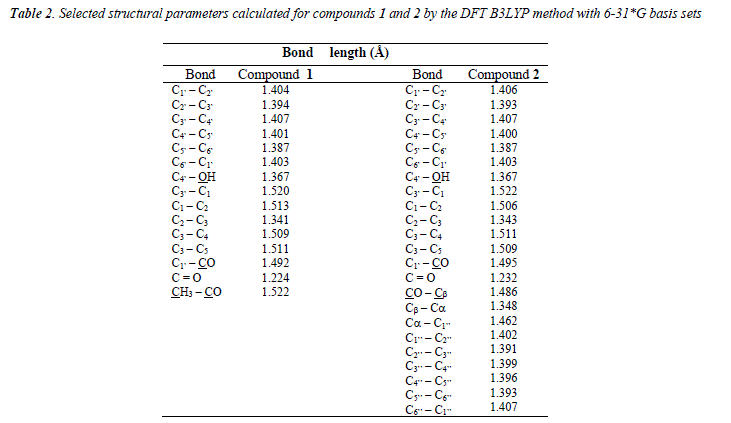
<body><![CDATA[<p align="justify"><b><font size="3" face="Verdana, Arial, Helvetica, sans-serif">INTRODUCTION</font></b></p>     <p align="justify"><font size="2" face="Verdana, Arial, Helvetica, sans-serif">Density functional theory (DFT, density functional theory) are calculations <i>ab initio </i>and semiempirical, based on the Schrodinger equation, being one of the most popular and successful quantum mechanical approaches to matter [1]. Density functional theory (DFT) has become the dominant tool in chemistry and physics for calculations of electronic structure [2,3].</font></p>     <p align="justify"><font size="2" face="Verdana, Arial, Helvetica, sans-serif">The present article is a supplementary subject in the structural study of natural compounds and their hemi-synthetic derivatives published before by the authors as for instance in the synthesis of the new 4'-hydroxy-3'-(3-methyl-2-butenyl)chalcone by microwave-assisted condensation of 4-hydroxy-3-(3'-methyl-2'-butenyl)acetophenone isolated from <i>Senecio graveolens </i>and benzaldehyde [4].</font></p>     <p align="justify"><font size="2" face="Verdana, Arial, Helvetica, sans-serif">The natural compound 1, 4-Hydroxy-3-(3'-methyl-2'-butenyl)acetophenone isolated from <i>Senecio graveolens </i>[4] was studied with regard to the vibrational and electronic properties which were determined by combining experimental data and quantum calculations [5]. This structural study of 1, was based on normal analysis and vibrational spectra [6].</font></p>     <p align="justify"><font size="2" face="Verdana, Arial, Helvetica, sans-serif">In recent years, DFT calculations have been used extensively for a wide variety of molecular properties, such as equilibrium structure, charge distribution, NMR spectra, providing thus reliable results that are in good correlation with experimental data [7,8].</font></p>     <p align="justify"><font size="2" face="Verdana, Arial, Helvetica, sans-serif">We have taken an advantage of the <sup>:</sup>H and <sup>13</sup>C NMR spectra of 1 and 2 previously acquired [4]. The geometry was optimized at the B3LYP level for 1 and 2, and used to perform theoretical calculations on the structures (<a href="#f1">Fig. 1</a>).</font></p>     <p align="center"><a name="f1"></a><img src="/img/revistas/rbq/v36n3/a01_figura01.gif" width="739" height="222"></p>     <p align="justify"><font size="2" face="Verdana, Arial, Helvetica, sans-serif">Correlation coefficients were used to compare the experimentally observed change and that calculated theoretically for the natural compound and its synthetic derivative.</font></p>     <p align="justify">&nbsp;</p>     <p align="justify"><font size="3" face="Verdana, Arial, Helvetica, sans-serif"><b>RESULTS AND DISCUSSION</b></font></p>     ]]></body>
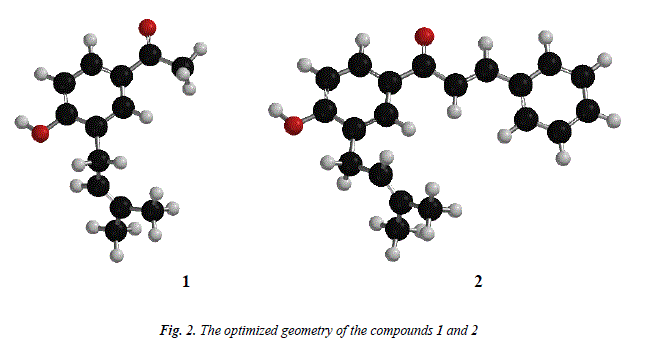
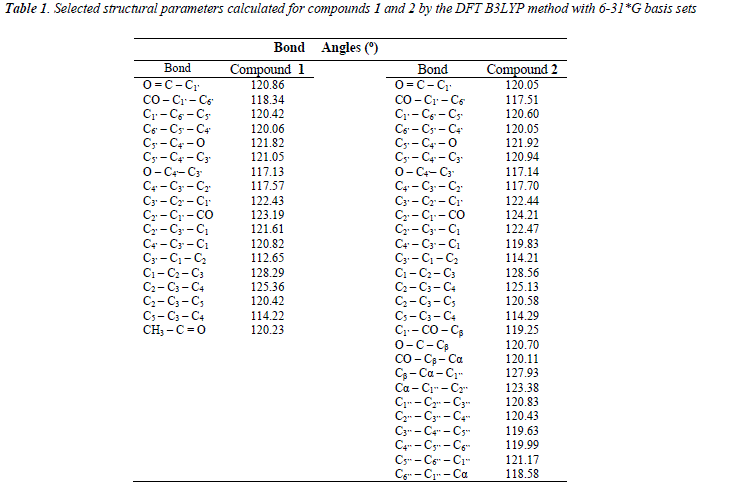
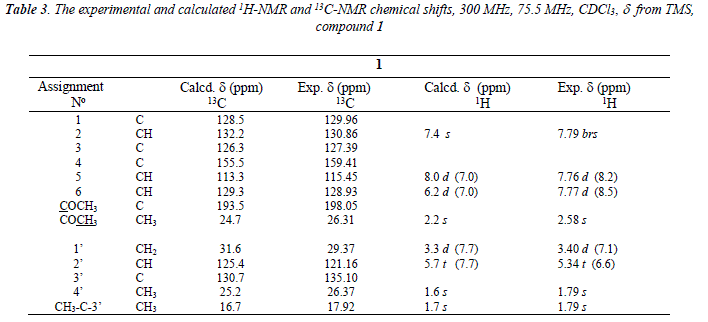
<body><![CDATA[<p align="justify"><font size="2" face="Verdana, Arial, Helvetica, sans-serif"><i><b>Theoretical calculations</b></i></font></p>     <p align="justify"><font size="2" face="Verdana, Arial, Helvetica, sans-serif">Calculations were done using the <i>Spartan 18 software. </i>This method was used for calculating <sup>1</sup>H-NMR and <sup>13</sup>C-NMR chemical shifts at the B3LYP/6-31*G level for 1 and 2.</font></p>     <p align="justify"><font size="2" face="Verdana, Arial, Helvetica, sans-serif">The optimized structural parameters, bond lengths and bond angles for the thermodynamically preferred geometry of compounds 1 and 2 (that were determined at the B3LYP/6-3P*G level) are exposed in <a href="#t1">Tables 1</a> and <a href="#t2">2</a> showing bond lengths C-C, C-H and C-0 calculated, in accordance with the atom numbering of <a href="#f1">Fig. 1</a> and the 3D structures of <a href="#f2">Fig. 2</a>,</font></p>     <p align="center"><a name="f2"></a><img src="/img/revistas/rbq/v36n3/a01_figura02.gif" width="649" height="346"></p>     <p align="justify"><font size="2" face="Verdana, Arial, Helvetica, sans-serif"><i>Bond Angles</i></font></p>     <p align="justify"><font size="2" face="Verdana, Arial, Helvetica, sans-serif">The bond angles calculated are very similar to each other in these molecules. An investigation of the bond angles O=C-C1', C<sub>2</sub>-C<sub>1</sub>-CO, CO-C<sub>1</sub> -C<sub>6</sub>, C<sub>1</sub>-CO-C<sub>&beta;</sub>, O-C-C<sub>&beta;</sub> and CO-C<sub>&beta;</sub>-C<font size="3" face="Times New Roman, Times, serif">&alpha;</font> showed that these atoms possess a hybrid configuration sp<sup>2</sup> trigonal planar.</font></p>     <p align="justify"><font size="2" face="Verdana, Arial, Helvetica, sans-serif"><i>Bond Lengths</i></font></p>     <p align="justify"><font size="2" face="Verdana, Arial, Helvetica, sans-serif">From the structural data, it was observed that the C-C and C-0 bond distances calculated are found to be nearly the same for both, 1 and 2. The influence of the substituent on the molecular parameters, particularly the bond distance of <u>C</u>H<sub>3</sub>-<u>C</u>O of 1 and <u>C</u>O-<u>C</u><sub>&beta;</sub> of 2, seem to be negligibly small.</font></p>     <p align="justify"><font size="2" face="Verdana, Arial, Helvetica, sans-serif"><i>Comparison of the experimentally measured and theoretically computed chemical shifts</i></font></p>     <p align="justify"><font size="2" face="Verdana, Arial, Helvetica, sans-serif">Chemical shifts calculated using the B3LYP level with the 6-31*G basis sets can be utilized to eliminate the uncertainties in the fundamental assignments of 1 and 2.</font></p>     ]]></body>
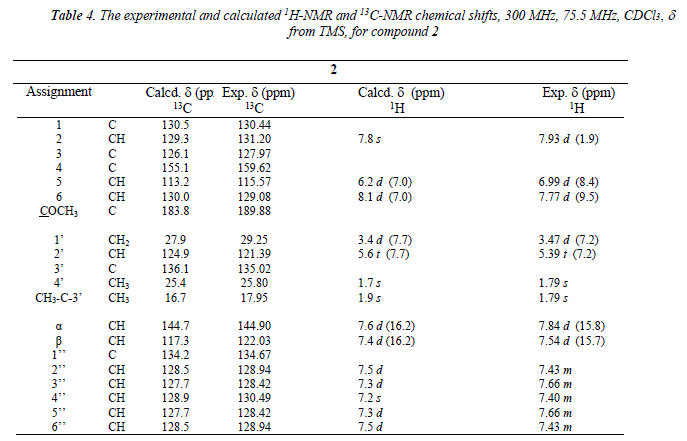
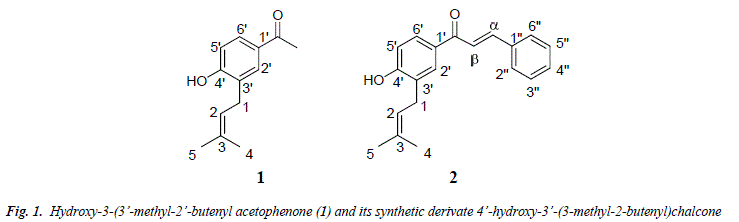
<body><![CDATA[<p align="justify"><font size="2" face="Verdana, Arial, Helvetica, sans-serif">Comparison of experimental signals of <sup>1</sup>H-NMR and <sup>13</sup>C-NMR (in ppm) with computed values of compounds 1 and 2 are shown in <a href="#t3">Tables 3</a> and <a href="#t4">4</a>. From the perusal of these tables it is concluded that there is a good correlation ship between the experimental and theoretical chemical shifts, being therefore an excellent predictive ability of the method applied in the case of compounds 1 and 2.</font></p>     <p align="center"><a name="t1"></a><img src="/img/revistas/rbq/v36n3/a01_figura03.gif" width="730" height="489"></p>     <p align="center"><a name="t2"></a><img src="/img/revistas/rbq/v36n3/a01_figura04.gif" width="731" height="423"></p>     <p align="center"><a name="t3"></a><img src="/img/revistas/rbq/v36n3/a01_figura05.gif" width="708" height="322"></p>     <p align="center"><a name="t4"></a><img src="/img/revistas/rbq/v36n3/a01_figura06.gif" width="687" height="441"></p>     <p align="justify">&nbsp;</p>     <p align="justify"><font size="3" face="Verdana, Arial, Helvetica, sans-serif"><b>EXPERIMENTAL</b></font></p>     <p align="justify"><font size="2" face="Verdana, Arial, Helvetica, sans-serif"><i>Plant material</i></font></p>     <p align="justify"><font size="2" face="Verdana, Arial, Helvetica, sans-serif">The plant material description can be found in the experimental section of the previously published work by the authors [4]. For making easier access to such information, we reproduced it entirely here with permission given by Rev. Bol. Quim. The species <i>Senecio graveolens </i>(Asteraceae) was collected in the municipal county of Tinquipaya, Tom&aacute;s Fr&iacute;as province, Department of Potos&iacute;; GPS coordinates: 19&deg;13'6&quot; SW (southwest) y 65&deg;49'35&quot; W (west), a 3,800 m.a.s.l. in September 2016. Characteristic climate: cold (2 &deg;C to 12 &deg;C). The plant was taxonomically identified at the National Herbarium of Bolivia (LPB). A specimen voucher is deposited at LPB under the code YQC-1.</font></p>     <p align="justify"><font size="2" face="Verdana, Arial, Helvetica, sans-serif"><i>Isolation of compound 1</i></font></p>     ]]></body>
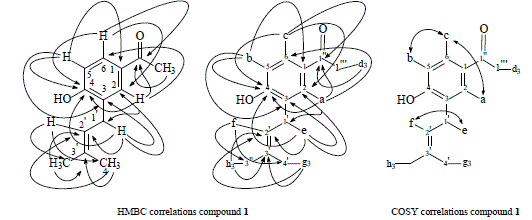
<body><![CDATA[<p align="justify"><font size="2" face="Verdana, Arial, Helvetica, sans-serif">Similarly, to the plant material description, the isolation procedure of 1 can be found in the previous work by the authors [4]. We reproduced it here for access reasons with permission given by Rev. Bol. Quim. The leaves of the vegetal sample were dried at room temperature and were ground to afford a final weight of 15000g (15kg). This mass was entirely treated with a two-step process of solid-liquid extraction with 30 L of ethanol (96&deg;) in 5 containers of 10L each for 14 days each step. Filtiation and solvent evaporation (56&deg;C) of the first ethanol extraction was done at reduced pressure until reaching 10% of the original volume of EtOH solution (3 L). No dry extract was obtained. No precipitate like crystals were noticed during the concentration of the first ethanol extract. The first extract was kept indefinitely in refrigerator at 4&deg;C for further treatment. No weighing was done with the vegetal material after the first extraction and corresponding drying. Thus, the same original mass of vegetal material (after the first extraction) was extracted with EtOH 96&deg; for the second time under the same conditions as the first one. During concentration (56&deg;C) at reduced pressure orange-like colored crystals appeared quantitatively. In this later process the solvent volume was reduced approximately until the 10% of its original amount. Crystals were filtered from the solution (4.9 g, 0.03% of original sample). Silica-gel TLC assays were run in EtOAc/EtOH 1:1 at prudential stages of the process showing the presence of a major spot corresponding to compound 1 as the major constituent of the EtOH-2 extract. 4.9 g of 1 were submitted to re-crystallization for 24 hrs in cold EtOH (0&deg;C) twice. After each 24 hrs crystals were filtered and washed with cold EtOH (0&deg;C) in a B&uuml;chner funnel. The TLC assay (EtOAc/EtOH 1:1) over the re-crystallized 1 showed still impurity. A semi-micro silica gel (0.98 g) liquid chromatography in a Pasteur pipette was performed with 1, EtOAc was used to dissolve the sample before separation in column. The first 24 fractions (5 mL each) extracted from column were eluted with of EtOAc giving rise to an orange-like colored pure compound according to TLC assay (EtOAc) corresponding to compound 1. This was recrystallized in CH<sub>2</sub>Cl<sub>2</sub>. Other 23 fractions (5 mL each) were extracted from column by solvent EtOH giving rise to a second black compound according to TLC analysis (EtOAc/EtOH 1:1).</font></p>     <p align="justify"><font size="2" face="Verdana, Arial, Helvetica, sans-serif"><i>Microwave-assisted condensation synthesis of compound 2</i></font></p>     <p align="justify"><font size="2" face="Verdana, Arial, Helvetica, sans-serif">This experiment was performed when obtaining compound 2 as described by the authors in a previous paper [4], we reproduced it here with permission given by Rev. Bol. Quim. for easier access for the reader. NaOH (10% [0.2 g/2mL]) with EtOH 95% (2mL) and compound 1 (crystals, 488 mg) were stirred in heating plate at 35 &deg;C in a 50 mL flask. Once the crystals of 1 dissolved, benzaldehyde (2.5 mL) was added to the reaction mixture. Mixture was irradiated under microwave conditions (170 Watts) four times during 10 min each with cooling intervals of 10 s. Water (25 mL) and AcOH (2.0 mL) were added to the reacting mixture. Two phases were formed after agitation and they were separated in a separation funnel. The organic layer was washed with distilled water thrice and separated in layers each time. The organic layer was put at 4&deg;C in freezer overnight. A solid precipitate appeared in the bottom of the flask. Once separated by filtration it was washed with hexane and dichloromethane in a silica gel Pasteur pipette. Yellow crystals were obtained that weighed 525 mg. The reaction yield was calculated as 71%.</font></p>     <p align="justify"><font size="2" face="Verdana, Arial, Helvetica, sans-serif"><i>Physicochemical data of compounds 1 and 2 (originally from [4] with permission given by Rev. Bol. Quim.) </i></font></p>     <p align="justify"><font size="2" face="Verdana, Arial, Helvetica, sans-serif"><i>Compound 1: 4-Hydroxy-3-(3 '-methyl-2 '-butenyljacetophenone </i></font></p>     <p align="justify"><font size="2" face="Verdana, Arial, Helvetica, sans-serif">MP: 94-95&deg;C uncorrected; NMR; see <a href="#t3">Table 3</a>. </font></p>     <p align="justify"><font size="2" face="Verdana, Arial, Helvetica, sans-serif"><i>Compound 2: 4 '-hydroxy-3 '-(3-methyl-2-butenyl) chalcone</i></font></p>     <p align="justify"><font size="2" face="Verdana, Arial, Helvetica, sans-serif">MP: 106-107 &deg;C uncorrected; NMR see <a href="#t4">Table 4</a>; FTIR (solid): v<sub>max</sub> [cm<sup>-1</sup>] 827 (ArC-H &delta; oop), 977 (ArC-H &delta; ip, &delta; oop), 1131 (ArC-H &delta; ip, C-0 st), [1250, 1283, 1334 (C-0 st)], 1564 (C=C st), 1648 (C=O st), [3243, 3463, 3629 (O-H st)]; UV (EtOH<sub>50&ordm;c</sub>) <font size="3" face="Times New Roman, Times, serif">&gamma;</font><sub>max</sub> (log &epsilon;<i>) </i>nm: 263.0 (3.62) nm; ESI-MS/MS <i>m/z </i>69, 131, 238, 294 [(M+H)<sup>+</sup>]; <i>m/z </i>85, 151, 294 [(M+H)<sup>+</sup>], 316 [(M+H+Na)<sup>+</sup>], 332 [(M+H+K)<sup>+</sup>], 608 [(2M+H+Na)<sup>+</sup>].</font></p>     <p align="justify"><font size="2" face="Verdana, Arial, Helvetica, sans-serif"><i>Computational details</i></font></p>     <p align="justify"><font size="2" face="Verdana, Arial, Helvetica, sans-serif">The DFT calculations were performed on an Intel (R), Pentium (R) Dual Core personal computer using the Spartan'18. Geometries of the compounds were first optimized at 6-311++G(d,p) basis set. Optimized structural parameters in gas phase were used in the vibrational frequency calculations at DFT level to confirm the structure as minima. Using Gauss View 4.1.2 molecular visualization program, the vibrational frequency assignments and other parameters were made. For NMR calculations, the calculated chemical shifts were obtained by GIAO method using the B3LYP/6- 31++G(d,p) level of theory using TMS as reference.</font></p>     ]]></body>
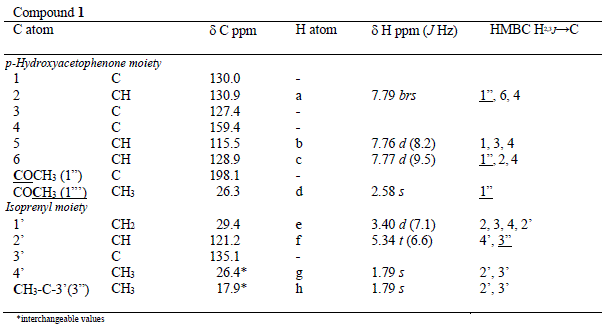
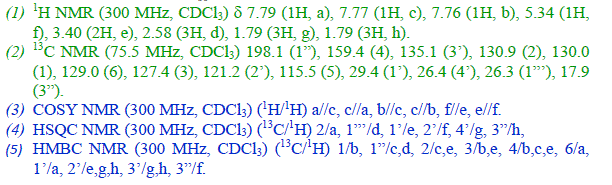
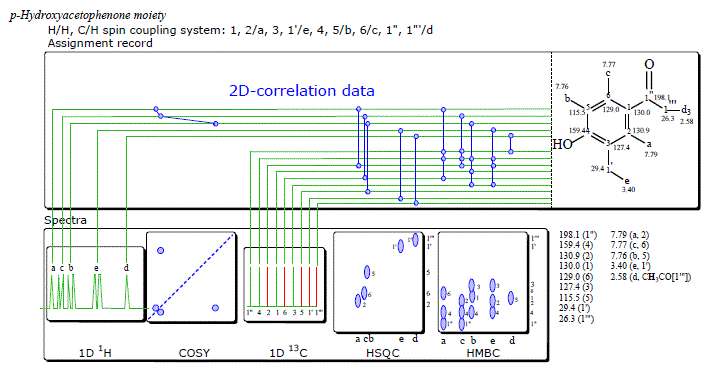
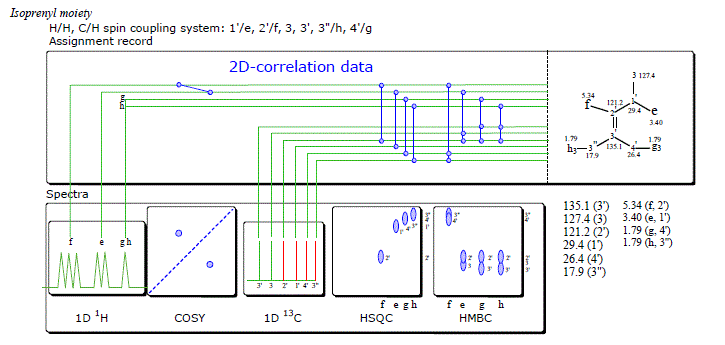
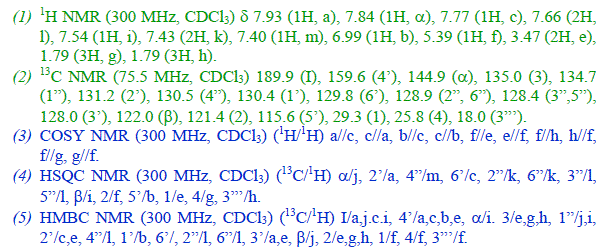
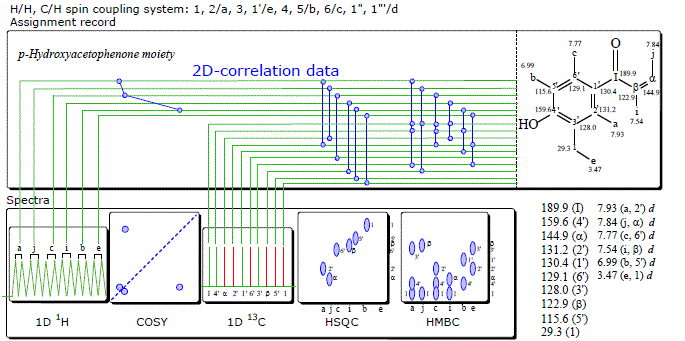
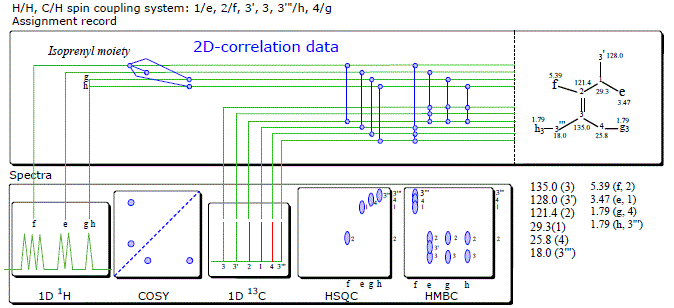
<body><![CDATA[<p align="justify"><font size="2" face="Verdana, Arial, Helvetica, sans-serif"><i>NMR measurements</i></font></p>     <p align="justify"><font size="2" face="Verdana, Arial, Helvetica, sans-serif">All equipment belongs to Department of Chemical Sciences UMSA; NMR spectrometer: Bruker DRX300, (300 MHz, 75 MHz), TMS used as internal standard. The chemical shifts, ppm, are referred to TMS as an internal standard. The following measurement techniques were used: standard 1H-, attached proton test (APT), correlation spectroscopy (COSY), and heteronuclear m&uacute;ltiple quantum correlation (HMQC) and heteronuclear m&uacute;ltiple bond correlation (HMBC) spectroscopy.</font></p>     <p align="justify"><font size="2" face="Verdana, Arial, Helvetica, sans-serif"><i>Computer-readable graphical description of prot&oacute;n, carb&oacute;n, COSY, HMQC and HMBC, for some simple coupling systems of compounds 1 and 2 [4,9]</i></font></p>     <p align="justify"><font size="2" face="Verdana, Arial, Helvetica, sans-serif"><i>Compound 1</i></font></p>     <p align="center"><font size="2" face="Verdana, Arial, Helvetica, sans-serif"><i>NMR data of compound 1, HMBC correlations (excerptfrom [4] with permission given by Rev. Bol. Quim.)</i></font></p>     <p align="center"><font size="2" face="Verdana, Arial, Helvetica, sans-serif"><img src="/img/revistas/rbq/v36n3/a01_figura07.gif" width="609" height="324"></font></p>     <p align="center"><img src="/img/revistas/rbq/v36n3/a01_figura08.gif" width="532" height="220"></p>     <p align="center"><img src="/img/revistas/rbq/v36n3/a01_figura09.gif" width="612" height="185"></p>     <p align="center"><img src="/img/revistas/rbq/v36n3/a01_figura10.gif" width="726" height="382"></p>     <p align="center"><img src="/img/revistas/rbq/v36n3/a01_figura11.gif" width="725" height="345"></p>     ]]></body>
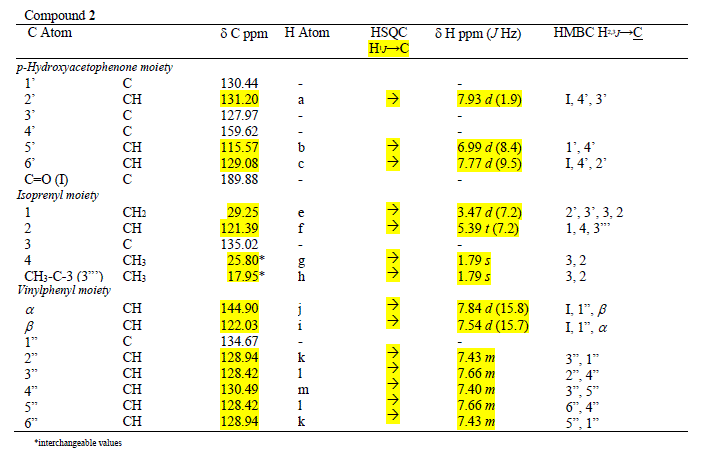
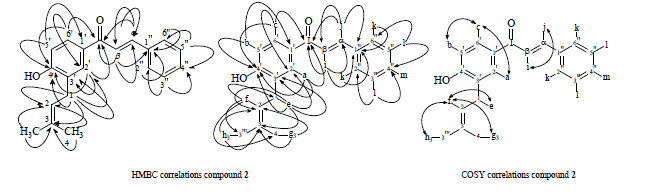
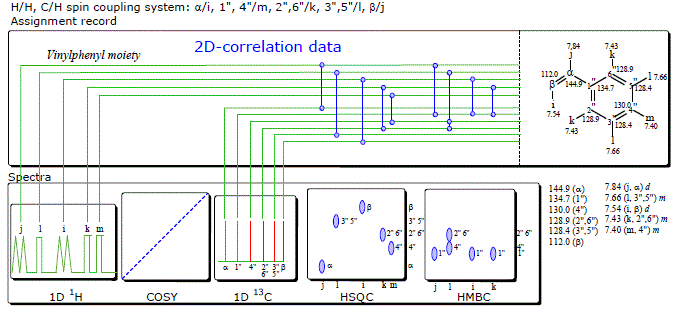
<body><![CDATA[<p align="justify"><font size="2" face="Verdana, Arial, Helvetica, sans-serif"><i>Compound 2</i></font></p>     <p align="center"><font size="2" face="Verdana, Arial, Helvetica, sans-serif"><i>NMR data of compound 2, HMBC and HSQC spectra (excerpt from [4] with permission given by Rev. Bol. Quim.)</i></font></p>     <p align="center"><img src="/img/revistas/rbq/v36n3/a01_figura12.gif" width="704" height="450"></p>     <p align="center"><img src="/img/revistas/rbq/v36n3/a01_figura13.gif" width="648" height="196"></p>     <p align="center"><img src="/img/revistas/rbq/v36n3/a01_figura14.gif" width="613" height="249"></p>     <p align="center"><img src="/img/revistas/rbq/v36n3/a01_figura15.gif" width="685" height="341"></p>     <p align="center"><img src="/img/revistas/rbq/v36n3/a01_figura16.gif" width="674" height="308"></p>     <p align="center"><img src="/img/revistas/rbq/v36n3/a01_figura17.gif" width="681" height="309"></p>     <p align="center">&nbsp;</p>     <p align="justify"><font size="3" face="Verdana, Arial, Helvetica, sans-serif"><b>CONCLUSIONS</b></font></p>     ]]></body>
<body><![CDATA[<p align="justify"><font size="2" face="Verdana, Arial, Helvetica, sans-serif">Selected structural parameters of the geometries of the 4-Hydroxy-3-(3'-methyl-2'-butenyl) acetophenone (1), a natural product isolated from <i>Senecio graveolens, </i>and its MW-obtained der&iacute;vate, 4'-hydroxy-3'-(3-methyl-2-butenyl)chalcone (2) were obtained by DFT calculations. The optimized geometry was computed by DFT B3LYP/6-31*G methods using Spartan 18 software. <sup>1</sup>H-NMR and <sup>13</sup>C-NMR chemical shifts were calculated and the assignments were compared with the experimental val&uacute;es.</font></p>     <p align="justify">&nbsp;</p>     <p align="justify"><font size="3" face="Verdana, Arial, Helvetica, sans-serif"><b>REFERENCES</b></font></p>     <!-- ref --><p align="justify"><font size="2" face="Verdana, Arial, Helvetica, sans-serif">1.&nbsp; Capelle, K. 2006, A bird's-eye view of density-functional theory, <i>Brazilian Journal of Physics, 36(4A), </i>1318-1343.</font>&nbsp;&nbsp;&nbsp;&nbsp;&nbsp;&nbsp;&nbsp;&nbsp;[&#160;<a href="javascript:void(0);" onclick="javascript: window.open('/scielo.php?script=sci_nlinks&ref=697351&pid=S0250-5460201900030000100001&lng=','','width=640,height=500,resizable=yes,scrollbars=1,menubar=yes,');">Links</a>&#160;]<!-- end-ref --><!-- ref --><p align="justify"><font size="2" face="Verdana, Arial, Helvetica, sans-serif">2.&nbsp; Parr, R.G., Yang, W. Density-functional theory of atoms and molecules, Oxford University Press, 1989, New York, Oxford.</font>&nbsp;&nbsp;&nbsp;&nbsp;&nbsp;&nbsp;&nbsp;&nbsp;[&#160;<a href="javascript:void(0);" onclick="javascript: window.open('/scielo.php?script=sci_nlinks&ref=697352&pid=S0250-5460201900030000100002&lng=','','width=640,height=500,resizable=yes,scrollbars=1,menubar=yes,');">Links</a>&#160;]<!-- end-ref --><!-- ref --><p align="justify"><font size="2" face="Verdana, Arial, Helvetica, sans-serif">3.&nbsp; Dreizler, R.M., Gross, E.K.U. Density functional theory an approach to the quantum many-body problem, Springer, 1990, Berlin.</font>&nbsp;&nbsp;&nbsp;&nbsp;&nbsp;&nbsp;&nbsp;&nbsp;[&#160;<a href="javascript:void(0);" onclick="javascript: window.open('/scielo.php?script=sci_nlinks&ref=697353&pid=S0250-5460201900030000100003&lng=','','width=640,height=500,resizable=yes,scrollbars=1,menubar=yes,');">Links</a>&#160;]<!-- end-ref --><!-- ref --><p align="justify"><font size="2" face="Verdana, Arial, Helvetica, sans-serif">4.&nbsp; Ibieta Jim&eacute;nez, G., Bravo, J.A., Quispe Coro, Y., Sol&iacute;s, O., Vila, J.L. 2017, Synthesis of the new 4'-hydroxy-3'-(3-methyl-2-butenyl)chalcone by microwave-assisted condensation of 4-hydroxy-3-(3'-methyl-2'-butenyl)acetophenone isolated from <i>Senecio graveolens </i>and benzaldehyde, <i>Bolivian Journal of Chemistry, 34 </i>(3), 89-103.</font>&nbsp;&nbsp;&nbsp;&nbsp;&nbsp;&nbsp;&nbsp;&nbsp;[&#160;<a href="javascript:void(0);" onclick="javascript: window.open('/scielo.php?script=sci_nlinks&ref=697354&pid=S0250-5460201900030000100004&lng=','','width=640,height=500,resizable=yes,scrollbars=1,menubar=yes,');">Links</a>&#160;]<!-- end-ref --><!-- ref --><p align="justify"><font size="2" face="Verdana, Arial, Helvetica, sans-serif">5.&nbsp; Gil, D.M., Lizarraga, E., Echeverr&iacute;a, G.A, Piro, O.E., Catal&aacute;n, C.A.N., Altabef, A.B. 2017, A combined experimental and theoretical study of the supramolecular self-assembly of the natural benzopyran 2,2-dimethyl-3-hydroxy-6-acetyl-chromane and its isomeric benzofuran 10,11-dihydro-10-hydroxytremetone, <i>Journal o/Molecular Structure, 1146, </i>164-178.</font>&nbsp;&nbsp;&nbsp;&nbsp;&nbsp;&nbsp;&nbsp;&nbsp;[&#160;<a href="javascript:void(0);" onclick="javascript: window.open('/scielo.php?script=sci_nlinks&ref=697355&pid=S0250-5460201900030000100005&lng=','','width=640,height=500,resizable=yes,scrollbars=1,menubar=yes,');">Links</a>&#160;]<!-- end-ref --><!-- ref --><p align="justify"><font size="2" face="Verdana, Arial, Helvetica, sans-serif">6.&nbsp; Lizarraga, E., Romano, E., Rudyk, R.A., Nazareno Catal&aacute;n, C.A., Brandan, S.A. 2012, Structural study, coordinated normal analysis and vibrational spectra of 4-hydroxy-3-(3-methyl-2-butenyl)acetophenone, <i>Spectrochimica Acta Part A: Molecular and Biomolecular Spectroscopy, 97, </i>202-208.</font>&nbsp;&nbsp;&nbsp;&nbsp;&nbsp;&nbsp;&nbsp;&nbsp;[&#160;<a href="javascript:void(0);" onclick="javascript: window.open('/scielo.php?script=sci_nlinks&ref=697356&pid=S0250-5460201900030000100006&lng=','','width=640,height=500,resizable=yes,scrollbars=1,menubar=yes,');">Links</a>&#160;]<!-- end-ref --><!-- ref --><p align="justify"><font size="2" face="Verdana, Arial, Helvetica, sans-serif">7.&nbsp; Koch, W., Holthausen, M.C. A Chemist's Guide to Density Functional Theory, Wiley-VCH Verlag GmbH, 2<sup>nd</sup> ed., 2001, Weinheim.</font>&nbsp;&nbsp;&nbsp;&nbsp;&nbsp;&nbsp;&nbsp;&nbsp;[&#160;<a href="javascript:void(0);" onclick="javascript: window.open('/scielo.php?script=sci_nlinks&ref=697357&pid=S0250-5460201900030000100007&lng=','','width=640,height=500,resizable=yes,scrollbars=1,menubar=yes,');">Links</a>&#160;]<!-- end-ref --><!-- ref --><p align="justify"><font size="2" face="Verdana, Arial, Helvetica, sans-serif">8.&nbsp; Spirtovic-halilovic, S., Salihovic, M., Trifunovic, S., Roca, S., Veljovicl, E., Osmanovic, A., Vinkovic, M., Zavrsnik, D. Garc&iacute;a-Molano,  J.F.,  Carvajal-Rodr&iacute;guez,  D.C. 2014, Density functional theory:   1H-  and  13C-NMR spectra of some  coumarin derivatives, <i>J. Serb. Chem. Soc, </i>79(11) 1405-1411.</font>&nbsp;&nbsp;&nbsp;&nbsp;&nbsp;&nbsp;&nbsp;&nbsp;[&#160;<a href="javascript:void(0);" onclick="javascript: window.open('/scielo.php?script=sci_nlinks&ref=697358&pid=S0250-5460201900030000100008&lng=','','width=640,height=500,resizable=yes,scrollbars=1,menubar=yes,');">Links</a>&#160;]<!-- end-ref --><!-- ref --><p align="justify"><font size="2" face="Verdana, Arial, Helvetica, sans-serif">9.&nbsp; Jeannerat, D. 2017, Human- and computer-accessible 2D correlation data for a more reliable structure determination of organic compounds</font><font size="2" face="Verdana, Arial, Helvetica, sans-serif">. Future roles of researchers, software developers, spectrometer managers, journal editors, reviewers, publisher and database managers toward artificial-intelligence analysis of NMR spectra, <i>Magn. Reson. Chem., 55, </i>7-14.</font>&nbsp;&nbsp;&nbsp;&nbsp;&nbsp;&nbsp;&nbsp;&nbsp;[&#160;<a href="javascript:void(0);" onclick="javascript: window.open('/scielo.php?script=sci_nlinks&ref=697359&pid=S0250-5460201900030000100009&lng=','','width=640,height=500,resizable=yes,scrollbars=1,menubar=yes,');">Links</a>&#160;]<!-- end-ref --><p align="justify">&nbsp;</p>     <p align="justify">&nbsp;</p>      ]]></body><back>
<ref-list>
<ref id="B1">
<label>1</label><nlm-citation citation-type="journal">
<person-group person-group-type="author">
<name>
<surname><![CDATA[Capelle]]></surname>
<given-names><![CDATA[K.]]></given-names>
</name>
</person-group>
<article-title xml:lang="en"><![CDATA[A bird's-eye view of density-functional theory]]></article-title>
<source><![CDATA[Brazilian Journal of Physics]]></source>
<year>2006</year>
<volume>36</volume>
<numero>4A</numero>
<issue>4A</issue>
<page-range>1318-1343</page-range></nlm-citation>
</ref>
<ref id="B2">
<label>2</label><nlm-citation citation-type="book">
<person-group person-group-type="author">
<name>
<surname><![CDATA[Parr]]></surname>
<given-names><![CDATA[R.G.]]></given-names>
</name>
<name>
<surname><![CDATA[Yang]]></surname>
<given-names><![CDATA[W.]]></given-names>
</name>
</person-group>
<source><![CDATA[Density-functional theory of atoms and molecules]]></source>
<year>1989</year>
<publisher-loc><![CDATA[New York ]]></publisher-loc>
<publisher-name><![CDATA[Oxford University Press]]></publisher-name>
</nlm-citation>
</ref>
<ref id="B3">
<label>3</label><nlm-citation citation-type="book">
<person-group person-group-type="author">
<name>
<surname><![CDATA[Dreizler]]></surname>
<given-names><![CDATA[R.M.]]></given-names>
</name>
<name>
<surname><![CDATA[Gross]]></surname>
<given-names><![CDATA[E.K.U.]]></given-names>
</name>
</person-group>
<source><![CDATA[Density functional theory an approach to the quantum many-body problem]]></source>
<year>1990</year>
<publisher-loc><![CDATA[^eBerlin Berlin]]></publisher-loc>
<publisher-name><![CDATA[Springer]]></publisher-name>
</nlm-citation>
</ref>
<ref id="B4">
<label>4</label><nlm-citation citation-type="journal">
<person-group person-group-type="author">
<name>
<surname><![CDATA[Ibieta Jiménez]]></surname>
<given-names><![CDATA[G.]]></given-names>
</name>
<name>
<surname><![CDATA[Bravo]]></surname>
<given-names><![CDATA[J.A]]></given-names>
</name>
<name>
<surname><![CDATA[Quispe Coro]]></surname>
<given-names><![CDATA[Y.]]></given-names>
</name>
<name>
<surname><![CDATA[Solís]]></surname>
<given-names><![CDATA[O.]]></given-names>
</name>
<name>
<surname><![CDATA[Vila]]></surname>
<given-names><![CDATA[J.L.]]></given-names>
</name>
</person-group>
<article-title xml:lang="en"><![CDATA[Synthesis of the new 4'-hydroxy-3'-(3-methyl-2-butenyl)chalcone by microwave-assisted condensation of 4-hydroxy-3-(3'-methyl-2'-butenyl)acetophenone isolated from Senecio graveolens and benzaldehyde]]></article-title>
<source><![CDATA[Bolivian Journal of Chemistry]]></source>
<year>2017</year>
<volume>34</volume>
<numero>3</numero>
<issue>3</issue>
<page-range>89-103</page-range></nlm-citation>
</ref>
<ref id="B5">
<label>5</label><nlm-citation citation-type="journal">
<person-group person-group-type="author">
<name>
<surname><![CDATA[Gil]]></surname>
<given-names><![CDATA[D.M.]]></given-names>
</name>
<name>
<surname><![CDATA[Lizarraga]]></surname>
<given-names><![CDATA[E.]]></given-names>
</name>
<name>
<surname><![CDATA[Echeverría]]></surname>
<given-names><![CDATA[G.A]]></given-names>
</name>
<name>
<surname><![CDATA[Piro]]></surname>
<given-names><![CDATA[O.E.]]></given-names>
</name>
<name>
<surname><![CDATA[Catalán]]></surname>
<given-names><![CDATA[C.A.N.]]></given-names>
</name>
<name>
<surname><![CDATA[Altabef]]></surname>
<given-names><![CDATA[A.B.]]></given-names>
</name>
</person-group>
<article-title xml:lang="en"><![CDATA[A combined experimental and theoretical study of the supramolecular self-assembly of the natural benzopyran 2,2-dimethyl-3-hydroxy-6-acetyl-chromane and its isomeric benzofuran 10,11-dihydro-10-hydroxytremetone]]></article-title>
<source><![CDATA[Journal o/Molecular Structure]]></source>
<year>2017</year>
<numero>1146</numero>
<issue>1146</issue>
<page-range>164-178</page-range></nlm-citation>
</ref>
<ref id="B6">
<label>6</label><nlm-citation citation-type="">
<person-group person-group-type="author">
<name>
<surname><![CDATA[Lizarraga]]></surname>
<given-names><![CDATA[E.]]></given-names>
</name>
<name>
<surname><![CDATA[Romano]]></surname>
<given-names><![CDATA[E.]]></given-names>
</name>
<name>
<surname><![CDATA[Rudyk]]></surname>
<given-names><![CDATA[R.A.]]></given-names>
</name>
<name>
<surname><![CDATA[Nazareno Catalán]]></surname>
<given-names><![CDATA[C.A.]]></given-names>
</name>
<name>
<surname><![CDATA[Brandan]]></surname>
<given-names><![CDATA[S.A.]]></given-names>
</name>
</person-group>
<source><![CDATA[Structural study, coordinated normal analysis and vibrational spectra of 4-hydroxy-3-(3-methyl-2-butenyl)acetophenone, Spectrochimica Acta Part A: Molecular and Biomolecular Spectroscopy]]></source>
<year>2012</year>
<page-range>202-208</page-range></nlm-citation>
</ref>
<ref id="B7">
<label>7</label><nlm-citation citation-type="">
<person-group person-group-type="author">
<name>
<surname><![CDATA[Koch]]></surname>
<given-names><![CDATA[W.]]></given-names>
</name>
<name>
<surname><![CDATA[Holthausen]]></surname>
<given-names><![CDATA[M.C.]]></given-names>
</name>
</person-group>
<source><![CDATA[A Chemist's Guide to Density Functional Theory, Wiley-VCH Verlag GmbH]]></source>
<year>2001</year>
<edition>2nd ed</edition>
<publisher-loc><![CDATA[Weinheim ]]></publisher-loc>
</nlm-citation>
</ref>
<ref id="B8">
<label>8</label><nlm-citation citation-type="journal">
<person-group person-group-type="author">
<name>
<surname><![CDATA[Spirtovic-halilovic]]></surname>
<given-names><![CDATA[S.]]></given-names>
</name>
<name>
<surname><![CDATA[Salihovic]]></surname>
<given-names><![CDATA[M.]]></given-names>
</name>
<name>
<surname><![CDATA[Trifunovic]]></surname>
<given-names><![CDATA[S.]]></given-names>
</name>
<name>
<surname><![CDATA[Roca]]></surname>
<given-names><![CDATA[S.]]></given-names>
</name>
<name>
<surname><![CDATA[Veljovicl]]></surname>
<given-names><![CDATA[E.]]></given-names>
</name>
<name>
<surname><![CDATA[Osmanovic]]></surname>
<given-names><![CDATA[A.]]></given-names>
</name>
<name>
<surname><![CDATA[Vinkovic]]></surname>
<given-names><![CDATA[M.]]></given-names>
</name>
<name>
<surname><![CDATA[Zavrsnik]]></surname>
<given-names><![CDATA[D.]]></given-names>
</name>
<name>
<surname><![CDATA[García-Molano]]></surname>
<given-names><![CDATA[J.F.]]></given-names>
</name>
<name>
<surname><![CDATA[Carvajal-Rodríguez]]></surname>
<given-names><![CDATA[D.C.]]></given-names>
</name>
</person-group>
<article-title xml:lang="en"><![CDATA[Density functional theory: 1H- and 13C-NMR spectra of some coumarin derivatives]]></article-title>
<source><![CDATA[J. Serb. Chem. Soc]]></source>
<year>2014</year>
<volume>79</volume>
<numero>11</numero>
<issue>11</issue>
<page-range>1405-1411</page-range></nlm-citation>
</ref>
<ref id="B9">
<label>9</label><nlm-citation citation-type="journal">
<person-group person-group-type="author">
<name>
<surname><![CDATA[Jeannerat]]></surname>
<given-names><![CDATA[D.]]></given-names>
</name>
</person-group>
<article-title xml:lang="en"><![CDATA[Human- and computer-accessible 2D correlation data for a more reliable structure determination of organic compounds]]></article-title>
<source><![CDATA[Magn. Reson. Chem.]]></source>
<year>2017</year>
<numero>55</numero>
<issue>55</issue>
<page-range>7-14</page-range></nlm-citation>
</ref>
</ref-list>
</back>
</article>