<?xml version="1.0" encoding="ISO-8859-1"?><article xmlns:mml="http://www.w3.org/1998/Math/MathML" xmlns:xlink="http://www.w3.org/1999/xlink" xmlns:xsi="http://www.w3.org/2001/XMLSchema-instance">
<front>
<journal-meta>
<journal-id>0250-5460</journal-id>
<journal-title><![CDATA[Revista Boliviana de Química]]></journal-title>
<abbrev-journal-title><![CDATA[Rev. Bol. Quim]]></abbrev-journal-title>
<issn>0250-5460</issn>
<publisher>
<publisher-name><![CDATA[Universidad Mayor de San Andrés]]></publisher-name>
</publisher>
</journal-meta>
<article-meta>
<article-id>S0250-54602018000100001</article-id>
<title-group>
<article-title xml:lang="en"><![CDATA[Molecular kitchen Chemistry; Bolivian traditional Gastronomy; Molecular chuflay]]></article-title>
<article-title xml:lang="es"><![CDATA[Química de la cocina molecular; Gastronomía tradicional Boliviana; chuflay molecular]]></article-title>
</title-group>
<contrib-group>
<contrib contrib-type="author">
<name>
<surname><![CDATA[Ortíz]]></surname>
<given-names><![CDATA[Jimena]]></given-names>
</name>
<xref ref-type="aff" rid="A01"/>
</contrib>
<contrib contrib-type="author">
<name>
<surname><![CDATA[Bravo]]></surname>
<given-names><![CDATA[José A]]></given-names>
</name>
<xref ref-type="aff" rid="A02"/>
</contrib>
<contrib contrib-type="author">
<name>
<surname><![CDATA[L. Vila¹]]></surname>
<given-names><![CDATA[José]]></given-names>
</name>
<xref ref-type="aff" rid="A01"/>
</contrib>
</contrib-group>
<aff id="A01">
<institution><![CDATA[,Universidad Mayor de San Andrés UMSA Sciences Department, School of Puré and Natural Sciences FCPN ]]></institution>
<addr-line><![CDATA[La Paz ]]></addr-line>
<country>Bolivia</country>
</aff>
<aff id="A02">
<institution><![CDATA[,Universidad Mayor de San Andrés UMSA Phytochemistry, Chemical Sciences Department, ]]></institution>
<addr-line><![CDATA[ ]]></addr-line>
</aff>
<pub-date pub-type="pub">
<day>30</day>
<month>04</month>
<year>2018</year>
</pub-date>
<pub-date pub-type="epub">
<day>30</day>
<month>04</month>
<year>2018</year>
</pub-date>
<volume>35</volume>
<numero>1</numero>
<fpage>1</fpage>
<lpage>5</lpage>
<copyright-statement/>
<copyright-year/>
<self-uri xlink:href="http://www.scielo.org.bo/scielo.php?script=sci_arttext&amp;pid=S0250-54602018000100001&amp;lng=en&amp;nrm=iso"></self-uri><self-uri xlink:href="http://www.scielo.org.bo/scielo.php?script=sci_abstract&amp;pid=S0250-54602018000100001&amp;lng=en&amp;nrm=iso"></self-uri><self-uri xlink:href="http://www.scielo.org.bo/scielo.php?script=sci_pdf&amp;pid=S0250-54602018000100001&amp;lng=en&amp;nrm=iso"></self-uri><abstract abstract-type="short" xml:lang="en"><p><![CDATA[Abstract This is a brief experimental description and theoretical approach to preparation of "chuflay", a Bolivian drink socially widely diffused under a spherification process. The physical presentation of the beverage is under the form of spherical capsule obtained through the gelification of alginate molecules (alginic acid salt) and calcium ions, by the spherification process of the alcoholic chuflay.]]></p></abstract>
<abstract abstract-type="short" xml:lang="es"><p><![CDATA[Resumen Encapsular en forma de esfera la bebida tradicional boliviana denominada "Chuflay", mediante un proceso de esferificación que consiste en una gelificación entre moléculas de alginato y iones calcio.]]></p></abstract>
<kwd-group>
<kwd lng="en"><![CDATA[Molecular Kitchen Chemistry]]></kwd>
<kwd lng="en"><![CDATA[Bolivian Gastronomy]]></kwd>
<kwd lng="en"><![CDATA[Chuflay]]></kwd>
</kwd-group>
</article-meta>
</front><body><![CDATA[ <p align="right"><font size="2" face="Verdana"><b>SHORT REPORTS </b></font></p>     <p align="justify">&nbsp;</p>     <p align="center"><font size="2" face="Verdana"><b><font size="4">Molecular  kitchen Chemistry; Bolivian traditional Gastronomy; Molecular chuflay</font></b></font></p>     <p align="center">&nbsp;</p>     <p align="center"><font size="3"><b><font face="Verdana"> Qu&iacute;mica de la cocina molecular; Gastronom&iacute;a tradicional Boliviana;  chuflay molecular</font></b><font face="Verdana"></font></font></p>     <p align="center">&nbsp;</p>     <p align="center"><font face="Verdana" size="2">    <br>   <b>Jimena Ortíz<sup>1</sup>, José A. Bravo<sup>2</sup>, José L. Vila<sup>1</sup></b>    <br> </font><font face="Verdana" size="2"><sup>1</sup>Natural Product Laboratory, Green Chemistry, Chemical Sciences Department, School of Puré and Natural Sciences FCPN, Universidad Mayor de San Andrés UMSA, P.O. Box 303, Calle Andrés Bello s/n, Ciudad Universitaria Cota Cota, phone +59122772269, La Paz, Bolivia, <a href="mailto:jlvila@umsa.bo">jlvila@umsa.bo</a>, <a href="www.umsa.bo" target="_blank">www.umsa.bo</a></font>    <br> <font face="Verdana" size="2"><sup>2</sup>Natural Product Laboratory, Phytochemistry, Chemical Sciences Department, School of Puré and Natural Sciences FCPN, Universidad Mayor de San Andrés UMSA, P.O. Box 303, Calle Andrés Bello s/n, Ciudad Universitaria Cota Cota, phone +59122792238, La Paz, Bolivia, <a href="mailto:jabravo@umsa.bo">jabravo@umsa.bo</a>, <a href="mailto:joseabravo@outlook.com">joseabravo@outlook.com</a>, <a href="www.umsa.bo" target="_blank">www.umsa.bo</a></font>    ]]></body>
<body><![CDATA[<br> <font face="Verdana" size="2"><b>Received</b> 12 06 2017 <b>Accepted</b> 04 06 2018 <b>Published</b> 04   30   2018</font></p>     <p align="center">&nbsp;</p>     <p align="center">&nbsp;</p> <hr> <font face="Verdana" size="2"><b>Abstract</b></font>     <p align="justify"><font face="Verdana" size="2">This is a brief experimental description and theoretical approach to preparation of &quot;chuflay&quot;, a Bolivian drink socially widely diffused under a spherification process. The physical presentation of the beverage is under the form of spherical capsule obtained through the gelification of alginate molecules (alginic acid salt) and calcium ions, by the spherification process of the alcoholic chuflay.</font></p>     <p align="justify"><font face="Verdana" size="2"><b>Keywords: </b><i>Molecular Kitchen Chemistry, Bolivian Gastronomy, Chuflay. </i></font></p>     <p align="justify"><font face="Verdana" size="2"><b>*Corresponding author:</b><a href="mailto:joselu62@hotmaii.com ">joselu62@hotmaii.com </a></font></p> <hr>     <p align="justify"><font face="Verdana" size="2"><b>Resumen</b></font></p>     <p align="justify"><font face="Verdana" size="2">Encapsular en forma de esfera la bebida tradicional boliviana denominada &quot;Chuflay&quot;, mediante un proceso de esferificación que consiste en una gelificación entre moléculas de alginato y iones calcio.</font></p> <hr>     <p align="justify">&nbsp;</p>     <p align="justify">&nbsp;</p>     ]]></body>
<body><![CDATA[<p align="justify"><font face="Verdana" size="3"><b>INTRODUCTION</b></font></p>     <p align="justify"><font face="Verdana" size="2">Since not long ago, chemistry tools can be applied in a novel field: kitchen and gastronomy. This gives naissance to a new scientific discipline known as molecular kitchen chemistry or molecular gastronomy, being considered as a subdiscipline of food science; its aim is to study transformations, physical or chemical of food ingredients after or during cooking [1,2]. The term &quot;molecular and physical gastronomy&quot; was given to the new discipline by Nicholas Kurti and Hervé This [3 15].</font></p>     <p align="justify"><font face="Verdana" size="2">Due to the use of plenty of synthetic substances as flavoring or conservative agents in foods, there seem to be some kind of divorce between chemistry and alimentation, being nowadays the green food much more sought over those products currently offered in the market, submitted to previous physicochemical or chemical processes, it is worth to say: processed foods [16]. However, the relationship between science and food goes further and more recently a bridge between chemistry physics and gastronomy has been established through the development of molecular gastronomy [17-25].</font></p>     <p align="justify"><font face="Verdana" size="2">During the last years an important evolution in kitchen and gastronomy took place around the world but more precisely in western European countries namely, France and Spain, with a well reputed culinary development through the centuries until nowadays. These changes are now supported by science, and many recipes have been modified with regard to their methodology by using chemistry laboratory techniques implying the use of highly precise measured masses and volumes, temperatures, times and the using of new products and innovation with new techniques with the aim of assuring reproducibility in the culinary preparations [26].</font></p>     <p align="justify"><font face="Verdana" size="2">This is the commencement of the discipline called Molecular Gastronomy, whose final goal is the application of scientific knowledge to gastronomic preparations to afford new forms and textures in foods and demónstrate their scientific basis. Molecular gastronomy's aim is not oriented toward the molecular structure or its transformations due to industrial processes but instead the scientific study of culinary processes already known in order to understand them from a molecular stand point; on the other hand, molecular kitchen as well proposes new techniques taking advantage of scientific knowledge that has not previously applied in kitchen [27-44].</font></p>     <p align="justify"><font face="Verdana" size="2"><i>Traditional Bolivian gastronomy: The Chuflay [45]</i></font></p>     <p align="justify"><font face="Verdana" size="2">The Bolivian traditional gastronomy's social beverage widely diffused named as &quot;chuflay &quot; was born between the end and the beginning of the XIX and XX centuries respectively in Bolivia. It was the preferred drink by British workers of the installation of the occidental railroad net in Bolivia. Its composition was a mixture of Gin and Gingerale (named also as &quot;Gin &amp; Gin&quot;). Due to its mediterranean country condition, furnishing in drinks and foods, which were all imported from England for the British workers of the Bolivian Railway Company, used to be scarce eventually. Thus gin started to be replaced by a Bolivian alcoholic drink &quot;agua ardiente&quot; (burning water) produced by distillation of muscatel grapes in the valleys of southern Bolivia [45].</font></p>     <p align="justify"><font face="Verdana" size="2">The new combination, &quot;singani&quot; (burning water) and ginger ale was named &quot;short fly&quot;, this was the term given to any temporary rail, usually extended over water soak áreas of the rail or any other shortcut due to any other inconvenient in the terrain [45,46]. The term short fly obeys in its meaning to the rapid effect on the brain to become drunk experimented by the consumers. Native Spanish speakers soon transformed the sound of the English expression &quot;short fly&quot; into: &quot;chuflay&quot; as aphonetical adaptation of the term [45,47]. See <a href="#f1">Figure 1</a>.</font></p>     <p align="center"><a name="f1"></a><img src="/img/revistas/rbq/v35n1/a01_figura01.gif" width="401" height="293"></p>     <p align="justify"><font face="Verdana" size="2">The present short report explains the process of spherification of the alcoholic traditional drink from Bolivia named chuflay in order to present it as Chuflay Capsules. The process is a gelification between alginate molecules and calcium ions.</font></p>     ]]></body>
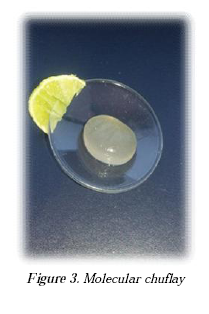
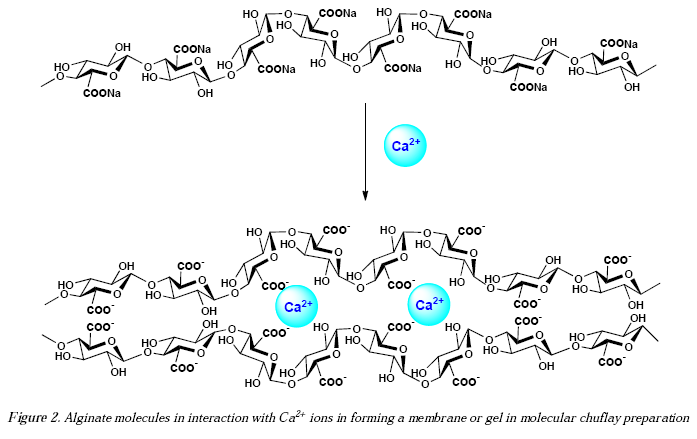
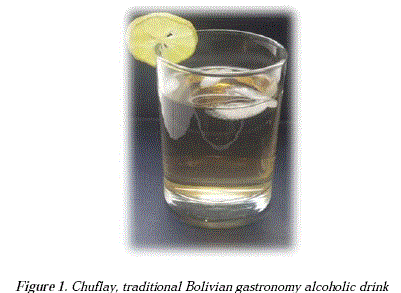
<body><![CDATA[<p align="justify">&nbsp;</p>     <p align="justify"><font face="Verdana" size="3"><b>RESULTS AND DISCUSSION</b></font></p>     <p align="justify"><font face="Verdana" size="2">Spherification and gelification are produced by the link between solubilized alginate molecules and calcium ions. This is called ionic gelification, external or internal, depending on the corresponding position of the calcium ions (alginate gummies).</font></p>     <p align="justify"><font face="Verdana" size="2">Our molecular chuflay was obtained by external gelification. The process implies the migration of calcium ions from the inner part of the sphere toward the wall where they link to the alginate present in the solution. The formation of the membrane or gel starts at the interphase of both liquids, advancing toward the inner part while the surface becomes saturated in calcium ions pushing out other ions from the molecular structure of alginate. The whole process depends strongly on the appropriate concentration of calcium ions and the composition of the alginate.</font></p>     <p align="justify"><font face="Verdana" size="2">The gelification process is possible when alginate interacts with a calcium solution at low temperatures. Firstly, alginate (in its alginic acid sodium salt form, [NaC6H7O]<sub>n</sub>, or additive E-401), which is a purified substance present in cell walls of algae, interacts with calcium ions forming unions where the latter act as bridges between carboxyl groups of alginate as shown in <a href="#f2">Figure 2</a>.</font></p>     <p align="center"><a name="f2"></a><img src="/img/revistas/rbq/v35n1/a01_figura02.gif" width="697" height="439"></p>     <p align="justify"><font face="Verdana" size="2">Usually, alginate forms gels are mostly temperature-independent and stable in time. However, exposing for longer periods to heat treatments or extreme pH variations provoke degradation of the membrane (gel). Another aspect to be taken into account concerns its full dependence on pH of the solution. Thus, alginate is only effective at pH valúes in the range 4-7.</font></p>     <p align="justify">&nbsp;</p>     <p align="justify"><font face="Verdana" size="3"><b>EXPERIMENTAL</b></font></p>     <p align="justify"><font face="Verdana" size="2">The preparation of chuflay in laboratory included the distillate singani Casa Real (2oz) and Gingerale (500mL) added with lemon extract (0.5g). The solution was added of calcium gluconolactate (5g), the all was mixed in a rotatory magnetic mixer until the obtaining of a homogeneous mixture (solution A). A sodium alginate (2.5g) aqueous solution (deionized water 500mL) was prepared by mixing in a rotatory magnetic mixer until the obtaining of the corresponding homogenous mixture (solution B). The transfer of solution A (chuflay) by means of Pasteur pipette was done over the beaker with solution B. After 10 minutes, spheres containing molecular chuflay appeared in the very interior of the liquid (<a href="#f3">Figure 3</a>). Spheres were transferred by means of a tea spoon and poured into a beaker containing distilled water.</font></p>     ]]></body>
<body><![CDATA[<p align="center"><a name="f3"></a><img src="/img/revistas/rbq/v35n1/a01_figura03.gif" width="209" height="314"></p>     <p align="justify"><font face="Verdana" size="3"><b>REFERENCES</b></font></p>     <!-- ref --><p align="justify"><font face="Verdana" size="2">1.&nbsp; &nbsp; &nbsp; This, H. <b>2006, </b>Food for tomorrow? How the scientific discipline of molecular gastronomy could change the way we eat, <i>EMBO Reports, EuropeanMolecularBiology Organization, </i>7(11), 1062-1066, doi:10.1038/sj.embor.7400850, PMC 1679779.    &nbsp;&nbsp;&nbsp;&nbsp;&nbsp;&nbsp;&nbsp;&nbsp;[&#160;<a href="javascript:void(0);" onclick="javascript: window.open('/scielo.php?script=sci_nlinks&ref=692429&pid=S0250-5460201800010000100001&lng=','','width=640,height=500,resizable=yes,scrollbars=1,menubar=yes,');">Links</a>&#160;]<!-- end-ref --></font></p>     <!-- ref --><p align="justify"><font face="Verdana" size="2">2.&nbsp; &nbsp; &nbsp; &nbsp;Cassi,   D. <b>2011,   </b>Science   and   cooking:   the   era  of  molecular   cuisine, <i>EMBO  Reports,   European  Molecular Biology Organization, 12, </i>191-196, doi:10.1038/embor.2011.18, PMC 3059914 , PMID 21331098.    &nbsp;&nbsp;&nbsp;&nbsp;&nbsp;&nbsp;&nbsp;&nbsp;[&#160;<a href="javascript:void(0);" onclick="javascript: window.open('/scielo.php?script=sci_nlinks&ref=692431&pid=S0250-5460201800010000100002&lng=','','width=640,height=500,resizable=yes,scrollbars=1,menubar=yes,');">Links</a>&#160;]<!-- end-ref --></font></p>     <!-- ref --><p align="justify"><font face="Verdana" size="2" color="#222222">3.&nbsp; &nbsp; &nbsp; This, H. <b>1987, </b>Combat d'ingénieur pour le goüt. <i>Centraliens, 491, </i>19-20.    &nbsp;&nbsp;&nbsp;&nbsp;&nbsp;&nbsp;&nbsp;&nbsp;[&#160;<a href="javascript:void(0);" onclick="javascript: window.open('/scielo.php?script=sci_nlinks&ref=692433&pid=S0250-5460201800010000100003&lng=','','width=640,height=500,resizable=yes,scrollbars=1,menubar=yes,');">Links</a>&#160;]<!-- end-ref --></font></p>     <!-- ref --><p align="justify"><font face="Verdana" size="2" color="#222222">4.&nbsp; &nbsp; &nbsp; This, H.. Les secrets de la casserole, Belin, <b>1993, </b>Paris.    &nbsp;&nbsp;&nbsp;&nbsp;&nbsp;&nbsp;&nbsp;&nbsp;[&#160;<a href="javascript:void(0);" onclick="javascript: window.open('/scielo.php?script=sci_nlinks&ref=692435&pid=S0250-5460201800010000100004&lng=','','width=640,height=500,resizable=yes,scrollbars=1,menubar=yes,');">Links</a>&#160;]<!-- end-ref --></font></p>     ]]></body>
<body><![CDATA[<!-- ref --><p align="justify"><font face="Verdana" size="2" color="#222222">5.&nbsp; &nbsp; &nbsp; This, H. <i>La cuisson: usages, tradition et science. </i>In: <i>La cuisson des aliments (7Rencontres Scientifique et Technologiques des Industries Alimentaires), </i><b>1994, </b><i>Agora!</i></font>&nbsp;&nbsp;&nbsp;&nbsp;&nbsp;&nbsp;&nbsp;&nbsp;[&#160;<a href="javascript:void(0);" onclick="javascript: window.open('/scielo.php?script=sci_nlinks&ref=692437&pid=S0250-5460201800010000100005&lng=','','width=640,height=500,resizable=yes,scrollbars=1,menubar=yes,');">Links</a>&#160;]<!-- end-ref --><!-- ref --><p align="justify"><font face="Verdana" size="2" color="#222222">6.&nbsp; &nbsp; &nbsp; This, H. La gastronomie moléculaire et physique, Ph.D. thesis, <b>1995, </b>University of Paris-VI.    &nbsp;&nbsp;&nbsp;&nbsp;&nbsp;&nbsp;&nbsp;&nbsp;[&#160;<a href="javascript:void(0);" onclick="javascript: window.open('/scielo.php?script=sci_nlinks&ref=692438&pid=S0250-5460201800010000100006&lng=','','width=640,height=500,resizable=yes,scrollbars=1,menubar=yes,');">Links</a>&#160;]<!-- end-ref --></font></p>     <!-- ref --><p align="justify"><font face="Verdana" size="2" color="#222222">7.&nbsp; &nbsp; &nbsp; This, H. Révélations gastronomiques, Belin, <b>1995, </b>Paris.    &nbsp;&nbsp;&nbsp;&nbsp;&nbsp;&nbsp;&nbsp;&nbsp;[&#160;<a href="javascript:void(0);" onclick="javascript: window.open('/scielo.php?script=sci_nlinks&ref=692440&pid=S0250-5460201800010000100007&lng=','','width=640,height=500,resizable=yes,scrollbars=1,menubar=yes,');">Links</a>&#160;]<!-- end-ref --></font></p>     <!-- ref --><p align="justify"><font face="Verdana" size="2" color="#222222">8.&nbsp; &nbsp; &nbsp; This, H. <b>1997, </b>From chocolate béarnaise to &quot;chocolate Chantilly&quot;, <i>The ChemicalIntelligencer, 3, </i>52-57.    &nbsp;&nbsp;&nbsp;&nbsp;&nbsp;&nbsp;&nbsp;&nbsp;[&#160;<a href="javascript:void(0);" onclick="javascript: window.open('/scielo.php?script=sci_nlinks&ref=692442&pid=S0250-5460201800010000100008&lng=','','width=640,height=500,resizable=yes,scrollbars=1,menubar=yes,');">Links</a>&#160;]<!-- end-ref --></font></p>     <!-- ref --><p align="justify"><font face="Verdana" size="2" color="#222222">9.&nbsp; &nbsp; &nbsp; This, H. <b>1997, </b>Pommes soufflées, <i>La Bonne Cuisine, 136, </i>68-71.    &nbsp;&nbsp;&nbsp;&nbsp;&nbsp;&nbsp;&nbsp;&nbsp;[&#160;<a href="javascript:void(0);" onclick="javascript: window.open('/scielo.php?script=sci_nlinks&ref=692444&pid=S0250-5460201800010000100009&lng=','','width=640,height=500,resizable=yes,scrollbars=1,menubar=yes,');">Links</a>&#160;]<!-- end-ref --></font></p>     <!-- ref --><p align="justify"><font face="Verdana" size="2" color="#222222">10.&nbsp; &nbsp; This, H. La casserole des enfants, Belin, <b>1998, </b>Paris.    &nbsp;&nbsp;&nbsp;&nbsp;&nbsp;&nbsp;&nbsp;&nbsp;[&#160;<a href="javascript:void(0);" onclick="javascript: window.open('/scielo.php?script=sci_nlinks&ref=692446&pid=S0250-5460201800010000100010&lng=','','width=640,height=500,resizable=yes,scrollbars=1,menubar=yes,');">Links</a>&#160;]<!-- end-ref --></font></p>     <!-- ref --><p align="justify"><font face="Verdana" size="2" color="#222222">11.&nbsp; &nbsp; This, H. <b>1998, </b>A chocolate foam, <i>The Chemical Intelligencer, 4, </i>27-31.    &nbsp;&nbsp;&nbsp;&nbsp;&nbsp;&nbsp;&nbsp;&nbsp;[&#160;<a href="javascript:void(0);" onclick="javascript: window.open('/scielo.php?script=sci_nlinks&ref=692448&pid=S0250-5460201800010000100011&lng=','','width=640,height=500,resizable=yes,scrollbars=1,menubar=yes,');">Links</a>&#160;]<!-- end-ref --></font></p>     <!-- ref --><p align="justify"><font face="Verdana" size="2" color="#222222">12.&nbsp; &nbsp; This, H. <b>1999, </b>Questions of temperature, <i>Int. J. Sci. Wine Win., 7, </i>98-102.    &nbsp;&nbsp;&nbsp;&nbsp;&nbsp;&nbsp;&nbsp;&nbsp;[&#160;<a href="javascript:void(0);" onclick="javascript: window.open('/scielo.php?script=sci_nlinks&ref=692450&pid=S0250-5460201800010000100012&lng=','','width=640,height=500,resizable=yes,scrollbars=1,menubar=yes,');">Links</a>&#160;]<!-- end-ref --></font></p>     <!-- ref --><p align="justify"><font face="Verdana" size="2">13.&nbsp; &nbsp; </font><font face="Verdana" size="2" color="#222222">This, H. <b>2001, </b>Comptes rendus des séminaires de gastronomie moléculaire, no. 7, </font><font face="Verdana" size="2" ><u><a href="www.sfc.fr." target="_blank">www.sfc.fr</a></u><a href="www.sfc.fr.">.</a> </font><font face="Verdana" size="2" color="#222222">access date: 04/23/2018.    &nbsp;&nbsp;&nbsp;&nbsp;&nbsp;&nbsp;&nbsp;&nbsp;[&#160;<a href="javascript:void(0);" onclick="javascript: window.open('/scielo.php?script=sci_nlinks&ref=692452&pid=S0250-5460201800010000100013&lng=','','width=640,height=500,resizable=yes,scrollbars=1,menubar=yes,');">Links</a>&#160;]<!-- end-ref --></font></p>     <!-- ref --><p align="justify"><font face="Verdana" size="2" color="#222222">14.&nbsp; &nbsp; This, H. <b>2001, </b>La révolution de la gastronomie moléculaire, <i>Chocolat et Confiserie, 381,A3-A6.    &nbsp;&nbsp;&nbsp;&nbsp;&nbsp;&nbsp;&nbsp;&nbsp;[&#160;<a href="javascript:void(0);" onclick="javascript: window.open('/scielo.php?script=sci_nlinks&ref=692454&pid=S0250-5460201800010000100014&lng=','','width=640,height=500,resizable=yes,scrollbars=1,menubar=yes,');">Links</a>&#160;]<!-- end-ref --></i></font></p>     <!-- ref --><p align="justify"><font face="Verdana" size="2" color="#222222">15.&nbsp; &nbsp; This, H., Kurti, N. <b>1994, </b>Physics and chemistry in the kitchen, <i>Scientific American, 270, </i>44-50.    &nbsp;&nbsp;&nbsp;&nbsp;&nbsp;&nbsp;&nbsp;&nbsp;[&#160;<a href="javascript:void(0);" onclick="javascript: window.open('/scielo.php?script=sci_nlinks&ref=692456&pid=S0250-5460201800010000100015&lng=','','width=640,height=500,resizable=yes,scrollbars=1,menubar=yes,');">Links</a>&#160;]<!-- end-ref --></font></p>     <!-- ref --><p align="justify"><font face="Verdana" size="2" color="#222222">16.&nbsp; &nbsp; </font><font face="Verdana" size="2">Adria, F., Blumenthal, H., Keller, T., &amp; McGee, H. (2006, Sunday, lOth December). Statement on the 'new cookery'. <i>The Observer <A href=http://www.guardian.co.uk/uk/2006/dec/10/foodanddrink.obsfoodmonthly target="_blank">http://www.guardian.co.uk/uk/2006/dec/10/foodanddrink.obsfoodmonthly</A></font>&nbsp;&nbsp;&nbsp;&nbsp;&nbsp;&nbsp;&nbsp;&nbsp;[&#160;<a href="javascript:void(0);" onclick="javascript: window.open('/scielo.php?script=sci_nlinks&ref=692458&pid=S0250-5460201800010000100016&lng=','','width=640,height=500,resizable=yes,scrollbars=1,menubar=yes,');">Links</a>&#160;]<!-- end-ref --><!-- ref --><p align="justify"><font face="Verdana" size="2">17.&nbsp; &nbsp; </font><font face="Verdana" size="2" color="#222222">This, H. <i>Surfactants in the kitchen: recent advances in molecular gastronomy. </i>In : <i>Actes des Journées Tunisiennes sur les Tensíoactífs et Leurs  Usages </i>(j  ttu/  Tunis: <i>LaSociété de Promotion de la  Chímíe Industrielle et I'Instituí National Agronomique de Tunisie, </i><b>2001.    &nbsp;&nbsp;&nbsp;&nbsp;&nbsp;&nbsp;&nbsp;&nbsp;[&#160;<a href="javascript:void(0);" onclick="javascript: window.open('/scielo.php?script=sci_nlinks&ref=692459&pid=S0250-5460201800010000100017&lng=','','width=640,height=500,resizable=yes,scrollbars=1,menubar=yes,');">Links</a>&#160;]<!-- end-ref --></b></font></p>     <!-- ref --><p align="justify"><font face="Verdana" size="2" color="#222222">18.&nbsp; &nbsp; This, H. <b>2002, </b>Bassines en cuivre et confitare, <i>Sci. Ouest, 191, </i>7.    &nbsp;&nbsp;&nbsp;&nbsp;&nbsp;&nbsp;&nbsp;&nbsp;[&#160;<a href="javascript:void(0);" onclick="javascript: window.open('/scielo.php?script=sci_nlinks&ref=692461&pid=S0250-5460201800010000100018&lng=','','width=640,height=500,resizable=yes,scrollbars=1,menubar=yes,');">Links</a>&#160;]<!-- end-ref --></font></p>     <!-- ref --><p align="justify"><font face="Verdana" size="2" color="#222222">19.&nbsp; &nbsp; This, H. <b>2002, </b>Cuisine et émulsions, <i>Revue Genérale des Route, 809, </i>59-65.    &nbsp;&nbsp;&nbsp;&nbsp;&nbsp;&nbsp;&nbsp;&nbsp;[&#160;<a href="javascript:void(0);" onclick="javascript: window.open('/scielo.php?script=sci_nlinks&ref=692463&pid=S0250-5460201800010000100019&lng=','','width=640,height=500,resizable=yes,scrollbars=1,menubar=yes,');">Links</a>&#160;]<!-- end-ref --></font></p>     <!-- ref --><p align="justify"><font face="Verdana" size="2">20.&nbsp; &nbsp; </font><font face="Verdana" size="2" color="#222222">This, H. <b>2002, </b>Molecular gastronomy, <i>Angewandte Chemíe </i>(International Edition in English), <i>41, </i>83-88.    &nbsp;&nbsp;&nbsp;&nbsp;&nbsp;&nbsp;&nbsp;&nbsp;[&#160;<a href="javascript:void(0);" onclick="javascript: window.open('/scielo.php?script=sci_nlinks&ref=692465&pid=S0250-5460201800010000100020&lng=','','width=640,height=500,resizable=yes,scrollbars=1,menubar=yes,');">Links</a>&#160;]<!-- end-ref --></font></p>     ]]></body>
<body><![CDATA[<!-- ref --><p align="justify"><font face="Verdana" size="2" color="#222222">21.&nbsp; &nbsp; This, H. Traite élémentaire de cuisine, Belin, <b>2002, </b>Paris.    &nbsp;&nbsp;&nbsp;&nbsp;&nbsp;&nbsp;&nbsp;&nbsp;[&#160;<a href="javascript:void(0);" onclick="javascript: window.open('/scielo.php?script=sci_nlinks&ref=692467&pid=S0250-5460201800010000100021&lng=','','width=640,height=500,resizable=yes,scrollbars=1,menubar=yes,');">Links</a>&#160;]<!-- end-ref --></font></p>     <!-- ref --><p align="justify"><font face="Verdana" size="2" color="#222222">22.&nbsp; &nbsp; This, H. <b>2003, </b>La gastronomie moléculaire, <i>Sci. Aliments, 23, </i>187-198.    &nbsp;&nbsp;&nbsp;&nbsp;&nbsp;&nbsp;&nbsp;&nbsp;[&#160;<a href="javascript:void(0);" onclick="javascript: window.open('/scielo.php?script=sci_nlinks&ref=692469&pid=S0250-5460201800010000100022&lng=','','width=640,height=500,resizable=yes,scrollbars=1,menubar=yes,');">Links</a>&#160;]<!-- end-ref --></font></p>     <!-- ref --><p align="justify"><font face="Verdana" size="2" color="#222222">23.&nbsp; &nbsp; This, H. <b>2004, </b>Molecular gastronomy (I), <i>World Food Ingred., 3, </i>22-35.    &nbsp;&nbsp;&nbsp;&nbsp;&nbsp;&nbsp;&nbsp;&nbsp;[&#160;<a href="javascript:void(0);" onclick="javascript: window.open('/scielo.php?script=sci_nlinks&ref=692471&pid=S0250-5460201800010000100023&lng=','','width=640,height=500,resizable=yes,scrollbars=1,menubar=yes,');">Links</a>&#160;]<!-- end-ref --></font></p>     <!-- ref --><p align="justify"><font face="Verdana" size="2">24.&nbsp; &nbsp; </font><font face="Verdana" size="2" color="#222222">This, H. <b>2004, </b>Molecular gastronomy (II): the paradox of culinary innovation, <i>World Food Ingred., 4, </i>33-39.    &nbsp;&nbsp;&nbsp;&nbsp;&nbsp;&nbsp;&nbsp;&nbsp;[&#160;<a href="javascript:void(0);" onclick="javascript: window.open('/scielo.php?script=sci_nlinks&ref=692473&pid=S0250-5460201800010000100024&lng=','','width=640,height=500,resizable=yes,scrollbars=1,menubar=yes,');">Links</a>&#160;]<!-- end-ref --></font></p>     <!-- ref --><p align="justify"><font face="Verdana" size="2" color="#222222">25.&nbsp; &nbsp; This, H., Bram, G. <b>1998, </b>Liebig et la cuisson de la viande: une remise a jour d'idées anciennes, <i>C. R. Acad. Sci, París, Serie He, </i>675-680.    &nbsp;&nbsp;&nbsp;&nbsp;&nbsp;&nbsp;&nbsp;&nbsp;[&#160;<a href="javascript:void(0);" onclick="javascript: window.open('/scielo.php?script=sci_nlinks&ref=692475&pid=S0250-5460201800010000100025&lng=','','width=640,height=500,resizable=yes,scrollbars=1,menubar=yes,');">Links</a>&#160;]<!-- end-ref --></font></p>     ]]></body>
<body><![CDATA[<!-- ref --><p align="justify"><font face="Verdana" size="2" color="#222222">26.&nbsp; &nbsp; Mans, C, Castells, P. <b>2011, </b>La nueva comida científica, <i>Investigación y Ciencia, </i>56-63.    &nbsp;&nbsp;&nbsp;&nbsp;&nbsp;&nbsp;&nbsp;&nbsp;[&#160;<a href="javascript:void(0);" onclick="javascript: window.open('/scielo.php?script=sci_nlinks&ref=692477&pid=S0250-5460201800010000100026&lng=','','width=640,height=500,resizable=yes,scrollbars=1,menubar=yes,');">Links</a>&#160;]<!-- end-ref --></font></p>     <!-- ref --><p align="justify"><font face="Verdana" size="2">27.&nbsp; &nbsp; Aguilera,J. <b>2005, </b>Whyfood microstructure?, <i>Journal of Food Engineering, 67, </i>3-11.    &nbsp;&nbsp;&nbsp;&nbsp;&nbsp;&nbsp;&nbsp;&nbsp;[&#160;<a href="javascript:void(0);" onclick="javascript: window.open('/scielo.php?script=sci_nlinks&ref=692479&pid=S0250-5460201800010000100027&lng=','','width=640,height=500,resizable=yes,scrollbars=1,menubar=yes,');">Links</a>&#160;]<!-- end-ref --></font></p>     <!-- ref --><p align="justify"><font face="Verdana" size="2">28.&nbsp; &nbsp; Arboleya, J.C., Olabarrieta, I., Aduriz, A. L., Lasa, D., Vergara, J., Sanmartín, E., et al. <b>2008, </b>From the Chef s Mind to the Dish: How Scientific Approaches Facilítate the Creative Process, <i>FoodBiophysics, 3, </i>261-268.    &nbsp;&nbsp;&nbsp;&nbsp;&nbsp;&nbsp;&nbsp;&nbsp;[&#160;<a href="javascript:void(0);" onclick="javascript: window.open('/scielo.php?script=sci_nlinks&ref=692481&pid=S0250-5460201800010000100028&lng=','','width=640,height=500,resizable=yes,scrollbars=1,menubar=yes,');">Links</a>&#160;]<!-- end-ref --></font></p>     <!-- ref --><p align="justify"><font face="Verdana" size="2">29.&nbsp; &nbsp; Blanck, J. <b>2007, </b>Molecular Gastronomy: Overview of a Controversial Food Science Discipline, <i>Journal of Agrícultural &amp; Food Information, 8(3), </i>77-85.    &nbsp;&nbsp;&nbsp;&nbsp;&nbsp;&nbsp;&nbsp;&nbsp;[&#160;<a href="javascript:void(0);" onclick="javascript: window.open('/scielo.php?script=sci_nlinks&ref=692483&pid=S0250-5460201800010000100029&lng=','','width=640,height=500,resizable=yes,scrollbars=1,menubar=yes,');">Links</a>&#160;]<!-- end-ref --></font></p>     <!-- ref --><p align="justify"><font face="Verdana" size="2">30.&nbsp; &nbsp; &nbsp;Chossat, V., Gergaud, 0. <b>2003, </b>Expert Opinión and Gastronomy: The Recipe for Success, <i>Journal of Cultural Economics, 27(2), </i>127-141.    &nbsp;&nbsp;&nbsp;&nbsp;&nbsp;&nbsp;&nbsp;&nbsp;[&#160;<a href="javascript:void(0);" onclick="javascript: window.open('/scielo.php?script=sci_nlinks&ref=692485&pid=S0250-5460201800010000100030&lng=','','width=640,height=500,resizable=yes,scrollbars=1,menubar=yes,');">Links</a>&#160;]<!-- end-ref --></font></p>     ]]></body>
<body><![CDATA[<!-- ref --><p align="justify"><font face="Verdana" size="2">31.&nbsp; &nbsp; Donald, A. <b>2004, </b>Food for Thought, <i>NatureMaterials, 3, </i>579-581.    &nbsp;&nbsp;&nbsp;&nbsp;&nbsp;&nbsp;&nbsp;&nbsp;[&#160;<a href="javascript:void(0);" onclick="javascript: window.open('/scielo.php?script=sci_nlinks&ref=692487&pid=S0250-5460201800010000100031&lng=','','width=640,height=500,resizable=yes,scrollbars=1,menubar=yes,');">Links</a>&#160;]<!-- end-ref --></font></p>     <!-- ref --><p align="justify"><font face="Verdana" size="2">32.&nbsp; &nbsp; Edwards-Stuart, R., Valverde, J. <b>2008, </b>Food Quality, an issue of molecule-based science, <i>European Food Research and Technology, 227, </i>965-967.    &nbsp;&nbsp;&nbsp;&nbsp;&nbsp;&nbsp;&nbsp;&nbsp;[&#160;<a href="javascript:void(0);" onclick="javascript: window.open('/scielo.php?script=sci_nlinks&ref=692489&pid=S0250-5460201800010000100032&lng=','','width=640,height=500,resizable=yes,scrollbars=1,menubar=yes,');">Links</a>&#160;]<!-- end-ref --></font></p>     <!-- ref --><p align="justify"><font face="Verdana" size="2">33.&nbsp; &nbsp; &nbsp;Hayllar, B., Griffin, T. 2005, The Precinct Experience: a phenomenological approach, <i>Tourism Management, 26, </i>517-528.    &nbsp;&nbsp;&nbsp;&nbsp;&nbsp;&nbsp;&nbsp;&nbsp;[&#160;<a href="javascript:void(0);" onclick="javascript: window.open('/scielo.php?script=sci_nlinks&ref=692491&pid=S0250-5460201800010000100033&lng=','','width=640,height=500,resizable=yes,scrollbars=1,menubar=yes,');">Links</a>&#160;]<!-- end-ref --></font></p>     <!-- ref --><p align="justify"><font face="Verdana" size="2">34.&nbsp; &nbsp; Kurti, N., Kurti, G., But the Crackling Is Superb: An Anthology on Food and Drink by Fellows and Foreign Members of the Royal Society, Institute of Physics Publishing, <b>1988, </b>Oxford.    &nbsp;&nbsp;&nbsp;&nbsp;&nbsp;&nbsp;&nbsp;&nbsp;[&#160;<a href="javascript:void(0);" onclick="javascript: window.open('/scielo.php?script=sci_nlinks&ref=692493&pid=S0250-5460201800010000100034&lng=','','width=640,height=500,resizable=yes,scrollbars=1,menubar=yes,');">Links</a>&#160;]<!-- end-ref --></font></p>     <!-- ref --><p align="justify"><font face="Verdana" size="2">35.&nbsp; &nbsp; Kvale, S. <b>1983, </b>The Qualitative Research Interview: A Phenomenological and Hermeneutical. Mode of Understanding, <i>Journal of Phenomenological Psychology, 14(4), </i>171-196.    &nbsp;&nbsp;&nbsp;&nbsp;&nbsp;&nbsp;&nbsp;&nbsp;[&#160;<a href="javascript:void(0);" onclick="javascript: window.open('/scielo.php?script=sci_nlinks&ref=692495&pid=S0250-5460201800010000100035&lng=','','width=640,height=500,resizable=yes,scrollbars=1,menubar=yes,');">Links</a>&#160;]<!-- end-ref --></font></p>     ]]></body>
<body><![CDATA[<!-- ref --><p align="justify"><font face="Verdana" size="2">36.&nbsp; &nbsp; Morrison, A., O'Gorman, K. D. <b>2008, </b>Hospitality Studies and Hospitality Management: A Symbiotic Relationship, <i>International Journal of HospítalítyManagement, 27(2), </i>214-227.    &nbsp;&nbsp;&nbsp;&nbsp;&nbsp;&nbsp;&nbsp;&nbsp;[&#160;<a href="javascript:void(0);" onclick="javascript: window.open('/scielo.php?script=sci_nlinks&ref=692497&pid=S0250-5460201800010000100036&lng=','','width=640,height=500,resizable=yes,scrollbars=1,menubar=yes,');">Links</a>&#160;]<!-- end-ref --></font></p>     <!-- ref --><p align="justify"><font face="Verdana" size="2">37.&nbsp; &nbsp; &nbsp;Ottenbacher, M., Harrington, R. J. <b>2007. </b>The Innovation Development Process of Michelin Starred Chefs, <i>International Journal of Contemporary Hospitality Management, 19(6),</i>444-460.    &nbsp;&nbsp;&nbsp;&nbsp;&nbsp;&nbsp;&nbsp;&nbsp;[&#160;<a href="javascript:void(0);" onclick="javascript: window.open('/scielo.php?script=sci_nlinks&ref=692499&pid=S0250-5460201800010000100037&lng=','','width=640,height=500,resizable=yes,scrollbars=1,menubar=yes,');">Links</a>&#160;]<!-- end-ref --></font></p>     <!-- ref --><p align="justify"><font face="Verdana" size="2">38.&nbsp; &nbsp; Rodgers, S. <b>2008, </b>Technological innovation supporting different food production philosophies in the food service sectors. <i>International Journal of Contemporary Hospítalíty Management, 20(\), </i><b>19-34</b>.    &nbsp;&nbsp;&nbsp;&nbsp;&nbsp;&nbsp;&nbsp;&nbsp;[&#160;<a href="javascript:void(0);" onclick="javascript: window.open('/scielo.php?script=sci_nlinks&ref=692501&pid=S0250-5460201800010000100038&lng=','','width=640,height=500,resizable=yes,scrollbars=1,menubar=yes,');">Links</a>&#160;]<!-- end-ref --></font></p>     <!-- ref --><p align="justify"><font face="Verdana" size="2">39.&nbsp; &nbsp; Slavkin, H. <b>1999, </b>Toward 'Molecular Gastronomy,' or What's in a Taste?, <i>Journal of the American Dental Association, 130, </i>1497-1500.    &nbsp;&nbsp;&nbsp;&nbsp;&nbsp;&nbsp;&nbsp;&nbsp;[&#160;<a href="javascript:void(0);" onclick="javascript: window.open('/scielo.php?script=sci_nlinks&ref=692503&pid=S0250-5460201800010000100039&lng=','','width=640,height=500,resizable=yes,scrollbars=1,menubar=yes,');">Links</a>&#160;]<!-- end-ref --></font></p>     <!-- ref --><p align="justify"><font face="Verdana" size="2">40.&nbsp; &nbsp; Svejenova,  S.,  Mazza,  C,  Planellas,  M. <b>2007,   </b>Cooking Up  Change in  Haute Cuisine:  FerranAdriá as an Institutional Entrepreneur, <i>Journal of OrganizationalBehavíor, 28(5), </i>539-561.    &nbsp;&nbsp;&nbsp;&nbsp;&nbsp;&nbsp;&nbsp;&nbsp;[&#160;<a href="javascript:void(0);" onclick="javascript: window.open('/scielo.php?script=sci_nlinks&ref=692505&pid=S0250-5460201800010000100040&lng=','','width=640,height=500,resizable=yes,scrollbars=1,menubar=yes,');">Links</a>&#160;]<!-- end-ref --></font></p>     ]]></body>
<body><![CDATA[<!-- ref --><p align="justify"><font face="Verdana" size="2">41.&nbsp; &nbsp; Thompson, C, Locander, W., Pollio, H. <b>1989, </b>Putting consumer experience back into consumer research: The philosophy and method of existential phenomenology, <i>Journal of Consumer Research, 16, </i>133-146.    &nbsp;&nbsp;&nbsp;&nbsp;&nbsp;&nbsp;&nbsp;&nbsp;[&#160;<a href="javascript:void(0);" onclick="javascript: window.open('/scielo.php?script=sci_nlinks&ref=692507&pid=S0250-5460201800010000100041&lng=','','width=640,height=500,resizable=yes,scrollbars=1,menubar=yes,');">Links</a>&#160;]<!-- end-ref --></font></p>     <!-- ref --><p align="justify"><font face="Verdana" size="2">42.&nbsp; &nbsp; Thompson, C. J. <b>1997, </b>Interpreting Consumers: A Hermeneutical Framework for Deriving Marketing Insights from the Texts of Consumere' Consumption Stories, <i>Journal of Marketing Research, 34(4), </i>428-455.    &nbsp;&nbsp;&nbsp;&nbsp;&nbsp;&nbsp;&nbsp;&nbsp;[&#160;<a href="javascript:void(0);" onclick="javascript: window.open('/scielo.php?script=sci_nlinks&ref=692509&pid=S0250-5460201800010000100042&lng=','','width=640,height=500,resizable=yes,scrollbars=1,menubar=yes,');">Links</a>&#160;]<!-- end-ref --></font></p>     <!-- ref --><p align="justify"><font face="Verdana" size="2">43.&nbsp; &nbsp; Van der Linden, E., McClements, D.,   Ubbink, J. <b>2008, </b>Molecular Gastronomy: A Food Fad or an Interface for Science-based Cooking? <i>FoodBiophysics, 3, </i>246-254.    &nbsp;&nbsp;&nbsp;&nbsp;&nbsp;&nbsp;&nbsp;&nbsp;[&#160;<a href="javascript:void(0);" onclick="javascript: window.open('/scielo.php?script=sci_nlinks&ref=692511&pid=S0250-5460201800010000100043&lng=','','width=640,height=500,resizable=yes,scrollbars=1,menubar=yes,');">Links</a>&#160;]<!-- end-ref --></font></p>     <!-- ref --><p align="justify"><font face="Verdana" size="2">44.&nbsp; &nbsp; Vega, C, Ubbink, J. <b>2008, </b>Molecular gastronomy: a food fad or science supporting innovative cuisine? <i>Trenas in Food Science &amp; Technology, 19, </i>372-382.    &nbsp;&nbsp;&nbsp;&nbsp;&nbsp;&nbsp;&nbsp;&nbsp;[&#160;<a href="javascript:void(0);" onclick="javascript: window.open('/scielo.php?script=sci_nlinks&ref=692513&pid=S0250-5460201800010000100044&lng=','','width=640,height=500,resizable=yes,scrollbars=1,menubar=yes,');">Links</a>&#160;]<!-- end-ref --></font></p>     <p align="justify"><font face="Verdana" size="2">45.&nbsp; &nbsp; <u><a href="https://es,wikipedia,org/wiki/Chuflay#cite note-1." target="_blank">https://es,wikipedia,org/wiki/Chuflay#cite note-1</a></u><a href="https://es,wikipedia,org/wiki/Chuflay#cite note-1.">.</a></font> <font face="Verdana" size="2" color="#222222">access date: 04/23/2018.</font></p>     <p align="justify"><font size="2" face="Verdana">46.&nbsp; &nbsp;<A href=http://www.modelrailroadforums.com/forum/showthread.php?t=9838 target="_blank">http://www.modelrailroadforums.com/forum/showthread.php?t=9838</A>. </font><font color="#222222">access date: 04/23/2018.</font></p>     ]]></body>
<body><![CDATA[<!-- ref --><p align="justify"><font face="Verdana" size="2">47.&nbsp; &nbsp; Rocha-Monroy, R., Crítica a la Sazón Pura, Editorial El País, <b>2004, </b>Cochabamba.    &nbsp;&nbsp;&nbsp;&nbsp;&nbsp;&nbsp;&nbsp;&nbsp;[&#160;<a href="javascript:void(0);" onclick="javascript: window.open('/scielo.php?script=sci_nlinks&ref=692517&pid=S0250-5460201800010000100045&lng=','','width=640,height=500,resizable=yes,scrollbars=1,menubar=yes,');">Links</a>&#160;]<!-- end-ref --></font></p>      <p align="justify">&nbsp;</p>      <p align="justify">&nbsp;</p>      ]]></body><back>
<ref-list>
<ref id="B1">
<label>1</label><nlm-citation citation-type="journal">
<person-group person-group-type="author">
<name>
<surname><![CDATA[This]]></surname>
<given-names><![CDATA[H]]></given-names>
</name>
</person-group>
<article-title xml:lang="en"><![CDATA[Food for tomorrow? How the scientific discipline of molecular gastronomy could change the way we eat]]></article-title>
<source><![CDATA[EMBO Reports, EuropeanMolecularBiology Organization]]></source>
<year>2006</year>
<volume>7</volume>
<numero>11</numero>
<issue>11</issue>
<page-range>1062-1066</page-range></nlm-citation>
</ref>
<ref id="B2">
<label>2</label><nlm-citation citation-type="journal">
<person-group person-group-type="author">
<name>
<surname><![CDATA[Cassi]]></surname>
<given-names><![CDATA[D]]></given-names>
</name>
</person-group>
<article-title xml:lang="en"><![CDATA[Science and cooking: the era of molecular cuisine]]></article-title>
<source><![CDATA[EMBO Reports, European Molecular Biology Organization]]></source>
<year>2011</year>
<numero>12</numero>
<issue>12</issue>
<page-range>191-196</page-range></nlm-citation>
</ref>
<ref id="B3">
<label>3</label><nlm-citation citation-type="journal">
<person-group person-group-type="author">
<name>
<surname><![CDATA[This]]></surname>
<given-names><![CDATA[H]]></given-names>
</name>
</person-group>
<article-title xml:lang="fr"><![CDATA[Combat d'ingénieur pour le goüt]]></article-title>
<source><![CDATA[Centraliens]]></source>
<year>1987</year>
<numero>491</numero>
<issue>491</issue>
<page-range>19-20</page-range></nlm-citation>
</ref>
<ref id="B4">
<label>4</label><nlm-citation citation-type="">
<person-group person-group-type="author">
<name>
<surname><![CDATA[This]]></surname>
<given-names><![CDATA[H]]></given-names>
</name>
</person-group>
<article-title xml:lang="fr"><![CDATA[Les secrets de la casserole]]></article-title>
<source><![CDATA[]]></source>
<year>1993</year>
</nlm-citation>
</ref>
<ref id="B5">
<label>5</label><nlm-citation citation-type="book">
<person-group person-group-type="author">
<name>
<surname><![CDATA[This]]></surname>
<given-names><![CDATA[H]]></given-names>
</name>
</person-group>
<source><![CDATA[La cuisson: usages, tradition et science. In: La cuisson des aliments (7Rencontres Scientifique et Technologiques des Industries Alimentaires)]]></source>
<year>1994</year>
<publisher-name><![CDATA[Agora]]></publisher-name>
</nlm-citation>
</ref>
<ref id="B6">
<label>6</label><nlm-citation citation-type="book">
<person-group person-group-type="author">
<name>
<surname><![CDATA[This]]></surname>
<given-names><![CDATA[H]]></given-names>
</name>
</person-group>
<source><![CDATA[La gastronomie moléculaire et physique]]></source>
<year>1995</year>
<publisher-name><![CDATA[University of Paris-VI]]></publisher-name>
</nlm-citation>
</ref>
<ref id="B7">
<label>7</label><nlm-citation citation-type="">
<person-group person-group-type="author">
<name>
<surname><![CDATA[This]]></surname>
<given-names><![CDATA[H]]></given-names>
</name>
</person-group>
<source><![CDATA[Révélations gastronomiques]]></source>
<year>1995</year>
<publisher-loc><![CDATA[Belin ]]></publisher-loc>
</nlm-citation>
</ref>
<ref id="B8">
<label>8</label><nlm-citation citation-type="journal">
<person-group person-group-type="author">
<name>
<surname><![CDATA[This]]></surname>
<given-names><![CDATA[H]]></given-names>
</name>
</person-group>
<article-title xml:lang="fr"><![CDATA[From chocolate béarnaise to "chocolate Chantilly",]]></article-title>
<source><![CDATA[The ChemicalIntelligencer]]></source>
<year>1997</year>
<volume>3</volume>
<page-range>52-57</page-range></nlm-citation>
</ref>
<ref id="B9">
<label>9</label><nlm-citation citation-type="journal">
<person-group person-group-type="author">
<name>
<surname><![CDATA[This]]></surname>
<given-names><![CDATA[H]]></given-names>
</name>
</person-group>
<article-title xml:lang="fr"><![CDATA[Pommes soufflées]]></article-title>
<source><![CDATA[La Bonne Cuisine,]]></source>
<year>1997</year>
<numero>136</numero>
<issue>136</issue>
<page-range>68-71</page-range></nlm-citation>
</ref>
<ref id="B10">
<label>10</label><nlm-citation citation-type="">
<person-group person-group-type="author">
<name>
<surname><![CDATA[This]]></surname>
<given-names><![CDATA[H]]></given-names>
</name>
</person-group>
<source><![CDATA[La casserole des enfants]]></source>
<year>1998</year>
<publisher-loc><![CDATA[Belin ]]></publisher-loc>
</nlm-citation>
</ref>
<ref id="B11">
<label>11</label><nlm-citation citation-type="journal">
<person-group person-group-type="author">
<name>
<surname><![CDATA[This]]></surname>
<given-names><![CDATA[H]]></given-names>
</name>
</person-group>
<article-title xml:lang="fr"><![CDATA[A chocolate foam]]></article-title>
<source><![CDATA[The Chemical Intelligencer]]></source>
<year>1998</year>
<volume>4</volume>
<page-range>27-31</page-range></nlm-citation>
</ref>
<ref id="B12">
<label>12</label><nlm-citation citation-type="journal">
<person-group person-group-type="author">
<name>
<surname><![CDATA[This]]></surname>
<given-names><![CDATA[H]]></given-names>
</name>
</person-group>
<article-title xml:lang="en"><![CDATA[Questions of temperature]]></article-title>
<source><![CDATA[Int. J. Sci. Wine Win.]]></source>
<year>1999</year>
<numero>7</numero>
<issue>7</issue>
<page-range>98-102.</page-range></nlm-citation>
</ref>
<ref id="B13">
<label>13</label><nlm-citation citation-type="">
<person-group person-group-type="author">
<name>
<surname><![CDATA[This,]]></surname>
<given-names><![CDATA[H]]></given-names>
</name>
</person-group>
<source><![CDATA[Comptes rendus des séminaires de gastronomie moléculaire]]></source>
<year>2001</year>
<volume>7</volume>
</nlm-citation>
</ref>
<ref id="B14">
<label>14</label><nlm-citation citation-type="journal">
<person-group person-group-type="author">
<name>
<surname><![CDATA[This]]></surname>
<given-names><![CDATA[H]]></given-names>
</name>
</person-group>
<article-title xml:lang="fr"><![CDATA[La révolution de la gastronomie moléculaire]]></article-title>
<source><![CDATA[Chocolat et Confiserie]]></source>
<year>2001</year>
<numero>381</numero>
<issue>381</issue>
<page-range>A3-A6</page-range></nlm-citation>
</ref>
<ref id="B15">
<label>15</label><nlm-citation citation-type="journal">
<person-group person-group-type="author">
<name>
<surname><![CDATA[This]]></surname>
<given-names><![CDATA[H]]></given-names>
</name>
<name>
<surname><![CDATA[Kurti]]></surname>
<given-names><![CDATA[N]]></given-names>
</name>
</person-group>
<article-title xml:lang="en"><![CDATA[Physics and chemistry in the kitchen]]></article-title>
<source><![CDATA[Scientific American]]></source>
<year>1994</year>
<numero>270</numero>
<issue>270</issue>
<page-range>44-50</page-range></nlm-citation>
</ref>
<ref id="B16">
<label>16</label><nlm-citation citation-type="">
<person-group person-group-type="author">
<name>
<surname><![CDATA[Adria]]></surname>
<given-names><![CDATA[F]]></given-names>
</name>
<name>
<surname><![CDATA[Blumenthal]]></surname>
<given-names><![CDATA[H]]></given-names>
</name>
<name>
<surname><![CDATA[Keller]]></surname>
<given-names><![CDATA[T]]></given-names>
</name>
<name>
<surname><![CDATA[McGee]]></surname>
<given-names><![CDATA[H]]></given-names>
</name>
</person-group>
<source><![CDATA[Statement on the 'new cookery'. The Observer]]></source>
<year>2006</year>
</nlm-citation>
</ref>
<ref id="B17">
<label>17</label><nlm-citation citation-type="">
<person-group person-group-type="author">
<name>
<surname><![CDATA[This]]></surname>
<given-names><![CDATA[H]]></given-names>
</name>
</person-group>
<source><![CDATA[Surfactants in the kitchen: recent advances in molecular gastronomy. In: Actes des Journées Tunisiennes sur les Tensíoactífs et Leurs Usages (j ttu/ Tunis: LaSociété de Promotion de la Chímíe Industrielle et I'Instituí National Agronomique de Tunisie]]></source>
<year>2001</year>
</nlm-citation>
</ref>
<ref id="B18">
<label>18</label><nlm-citation citation-type="journal">
<person-group person-group-type="author">
<name>
<surname><![CDATA[This]]></surname>
<given-names><![CDATA[H]]></given-names>
</name>
</person-group>
<article-title xml:lang="fr"><![CDATA[Bassines en cuivre et confitare]]></article-title>
<source><![CDATA[Sci. Ouest]]></source>
<year>2002</year>
<numero>191</numero>
<issue>191</issue>
<page-range>7</page-range></nlm-citation>
</ref>
<ref id="B19">
<label>19</label><nlm-citation citation-type="journal">
<person-group person-group-type="author">
<name>
<surname><![CDATA[This]]></surname>
<given-names><![CDATA[H]]></given-names>
</name>
</person-group>
<article-title xml:lang="fr"><![CDATA[Cuisine et émulsions]]></article-title>
<source><![CDATA[Revue Genérale des Route]]></source>
<year>2002</year>
<numero>809</numero>
<issue>809</issue>
<page-range>59-65</page-range></nlm-citation>
</ref>
<ref id="B20">
<label>20</label><nlm-citation citation-type="journal">
<person-group person-group-type="author">
<name>
<surname><![CDATA[This]]></surname>
<given-names><![CDATA[H]]></given-names>
</name>
</person-group>
<article-title xml:lang="en"><![CDATA[Molecular gastronomy]]></article-title>
<source><![CDATA[Angewandte Chemíe (International Edition in English)]]></source>
<year>2002</year>
<numero>41</numero>
<issue>41</issue>
<page-range>83-88</page-range></nlm-citation>
</ref>
<ref id="B21">
<label>21</label><nlm-citation citation-type="">
<person-group person-group-type="author">
<name>
<surname><![CDATA[This]]></surname>
<given-names><![CDATA[H]]></given-names>
</name>
</person-group>
<source><![CDATA[Traite élémentaire de cuisine,]]></source>
<year>2002</year>
<publisher-loc><![CDATA[Belin ]]></publisher-loc>
</nlm-citation>
</ref>
<ref id="B22">
<label>22</label><nlm-citation citation-type="journal">
<person-group person-group-type="author">
<name>
<surname><![CDATA[This]]></surname>
<given-names><![CDATA[H]]></given-names>
</name>
</person-group>
<article-title xml:lang="fr"><![CDATA[La gastronomie moléculaire,]]></article-title>
<source><![CDATA[Sci. Aliments]]></source>
<year>2003</year>
<numero>23,</numero>
<issue>23,</issue>
<page-range>187-198</page-range></nlm-citation>
</ref>
<ref id="B23">
<label>23</label><nlm-citation citation-type="journal">
<person-group person-group-type="author">
<name>
<surname><![CDATA[This]]></surname>
<given-names><![CDATA[H]]></given-names>
</name>
</person-group>
<article-title xml:lang="en"><![CDATA[Molecular gastronomy (I),]]></article-title>
<source><![CDATA[World Food Ingred.]]></source>
<year>2004</year>
<numero>3</numero>
<issue>3</issue>
<page-range>22-35</page-range></nlm-citation>
</ref>
<ref id="B24">
<label>24</label><nlm-citation citation-type="journal">
<person-group person-group-type="author">
<name>
<surname><![CDATA[This]]></surname>
<given-names><![CDATA[H]]></given-names>
</name>
</person-group>
<article-title xml:lang="en"><![CDATA[Molecular gastronomy (II): the paradox of culinary innovation]]></article-title>
<source><![CDATA[World Food Ingred]]></source>
<year>2004</year>
<numero>4</numero>
<issue>4</issue>
<page-range>33-39</page-range></nlm-citation>
</ref>
<ref id="B25">
<label>25</label><nlm-citation citation-type="journal">
<person-group person-group-type="author">
<name>
<surname><![CDATA[This]]></surname>
<given-names><![CDATA[H]]></given-names>
</name>
<name>
<surname><![CDATA[Bram]]></surname>
<given-names><![CDATA[G]]></given-names>
</name>
</person-group>
<article-title xml:lang="fr"><![CDATA[Liebig et la cuisson de la viande: une remise a jour d'idées anciennes, C. R. Acad]]></article-title>
<source><![CDATA[Sci, París, Serie He,]]></source>
<year>1998</year>
<page-range>675-680.</page-range></nlm-citation>
</ref>
<ref id="B26">
<label>26</label><nlm-citation citation-type="">
<person-group person-group-type="author">
<name>
<surname><![CDATA[Mans,]]></surname>
<given-names><![CDATA[C]]></given-names>
</name>
<name>
<surname><![CDATA[Castells]]></surname>
<given-names><![CDATA[P]]></given-names>
</name>
</person-group>
<article-title xml:lang="es"><![CDATA[La nueva comida científica, Investigación y Ciencia,]]></article-title>
<source><![CDATA[]]></source>
<year>2011</year>
<page-range>56-63</page-range></nlm-citation>
</ref>
<ref id="B27">
<label>27</label><nlm-citation citation-type="journal">
<person-group person-group-type="author">
<name>
<surname><![CDATA[Aguilera]]></surname>
<given-names><![CDATA[J]]></given-names>
</name>
</person-group>
<article-title xml:lang="en"><![CDATA[Whyfood microstructure?]]></article-title>
<source><![CDATA[Journal of Food Engineering]]></source>
<year>2005</year>
<numero>67</numero>
<issue>67</issue>
<page-range>3-11</page-range></nlm-citation>
</ref>
<ref id="B28">
<label>28</label><nlm-citation citation-type="journal">
<person-group person-group-type="author">
<name>
<surname><![CDATA[Arboleya]]></surname>
<given-names><![CDATA[J.C]]></given-names>
</name>
<name>
<surname><![CDATA[Olabarrieta]]></surname>
<given-names><![CDATA[I]]></given-names>
</name>
<name>
<surname><![CDATA[Aduriz]]></surname>
<given-names><![CDATA[A. L]]></given-names>
</name>
<name>
<surname><![CDATA[Lasa]]></surname>
<given-names><![CDATA[D]]></given-names>
</name>
<name>
<surname><![CDATA[Vergara]]></surname>
<given-names><![CDATA[J]]></given-names>
</name>
<name>
<surname><![CDATA[Sanmartín]]></surname>
<given-names><![CDATA[E]]></given-names>
</name>
</person-group>
<article-title xml:lang="en"><![CDATA[From the Chef s Mind to the Dish:: How Scientific Approaches Facilítate the Creative Process]]></article-title>
<source><![CDATA[FoodBiophysics]]></source>
<year>2008</year>
<numero>3</numero>
<issue>3</issue>
<page-range>261-268</page-range></nlm-citation>
</ref>
<ref id="B29">
<label>29</label><nlm-citation citation-type="journal">
<person-group person-group-type="author">
<name>
<surname><![CDATA[Blanck,]]></surname>
<given-names><![CDATA[J]]></given-names>
</name>
</person-group>
<article-title xml:lang="en"><![CDATA[Molecular Gastronomy: Overview of a Controversial Food Science Discipline]]></article-title>
<source><![CDATA[Journal of Agrícultural & Food Information]]></source>
<year>2007</year>
<volume>8</volume>
<numero>3</numero>
<issue>3</issue>
<page-range>77-85</page-range></nlm-citation>
</ref>
<ref id="B30">
<label>30</label><nlm-citation citation-type="journal">
<person-group person-group-type="author">
<name>
<surname><![CDATA[Chossat]]></surname>
<given-names><![CDATA[V]]></given-names>
</name>
<name>
<surname><![CDATA[Gergaud,]]></surname>
<given-names><![CDATA[0]]></given-names>
</name>
</person-group>
<article-title xml:lang="en"><![CDATA[Expert Opinión and Gastronomy:: The Recipe for Success,]]></article-title>
<source><![CDATA[Journal of Cultural Economics,]]></source>
<year>2003</year>
<volume>27</volume>
<numero>2</numero>
<issue>2</issue>
<page-range>127-141</page-range></nlm-citation>
</ref>
<ref id="B31">
<label>31</label><nlm-citation citation-type="journal">
<person-group person-group-type="author">
<name>
<surname><![CDATA[Donald,]]></surname>
<given-names><![CDATA[A]]></given-names>
</name>
</person-group>
<article-title xml:lang="en"><![CDATA[Food for Thought,]]></article-title>
<source><![CDATA[NatureMaterials]]></source>
<year>2004</year>
<numero>3</numero>
<issue>3</issue>
<page-range>579-581</page-range></nlm-citation>
</ref>
<ref id="B32">
<label>32</label><nlm-citation citation-type="journal">
<person-group person-group-type="author">
<name>
<surname><![CDATA[Edwards-Stuart]]></surname>
<given-names><![CDATA[R]]></given-names>
</name>
<name>
<surname><![CDATA[Valverde]]></surname>
<given-names><![CDATA[J]]></given-names>
</name>
</person-group>
<article-title xml:lang="en"><![CDATA[Food Quality, an issue of molecule-based science]]></article-title>
<source><![CDATA[European Food Research and Technology]]></source>
<year>2008</year>
<numero>227</numero>
<issue>227</issue>
<page-range>965-967</page-range></nlm-citation>
</ref>
<ref id="B33">
<label>33</label><nlm-citation citation-type="journal">
<person-group person-group-type="author">
<name>
<surname><![CDATA[Hayllar]]></surname>
<given-names><![CDATA[B]]></given-names>
</name>
<name>
<surname><![CDATA[Griffin]]></surname>
<given-names><![CDATA[T]]></given-names>
</name>
</person-group>
<article-title xml:lang="en"><![CDATA[The Precinct Experience: a phenomenological approach]]></article-title>
<source><![CDATA[Tourism Management,]]></source>
<year>2005</year>
<numero>26</numero>
<issue>26</issue>
<page-range>517-528.</page-range></nlm-citation>
</ref>
<ref id="B34">
<label>34</label><nlm-citation citation-type="book">
<person-group person-group-type="author">
<name>
<surname><![CDATA[Kurti]]></surname>
<given-names><![CDATA[N]]></given-names>
</name>
<name>
<surname><![CDATA[Kurti]]></surname>
<given-names><![CDATA[G]]></given-names>
</name>
</person-group>
<source><![CDATA[But the Crackling Is Superb: An Anthology on Food and Drink by Fellows and Foreign Members of the Royal Society]]></source>
<year>1988</year>
<publisher-name><![CDATA[Institute of Physics Publishing]]></publisher-name>
</nlm-citation>
</ref>
<ref id="B35">
<label>35</label><nlm-citation citation-type="journal">
<person-group person-group-type="author">
<name>
<surname><![CDATA[Kvale]]></surname>
<given-names><![CDATA[S]]></given-names>
</name>
</person-group>
<article-title xml:lang="en"><![CDATA[The Qualitative Research Interview: A Phenomenological and Hermeneutical. Mode of Understanding]]></article-title>
<source><![CDATA[Journal of Phenomenological Psychology,]]></source>
<year>1983</year>
<volume>14</volume>
<numero>4</numero>
<issue>4</issue>
<page-range>171-196</page-range></nlm-citation>
</ref>
<ref id="B36">
<label>36</label><nlm-citation citation-type="journal">
<person-group person-group-type="author">
<name>
<surname><![CDATA[Morrison]]></surname>
<given-names><![CDATA[A]]></given-names>
</name>
<name>
<surname><![CDATA[O'Gorman]]></surname>
<given-names><![CDATA[K. D]]></given-names>
</name>
</person-group>
<article-title xml:lang="en"><![CDATA[Hospitality Studies and Hospitality Management: A Symbiotic Relationship]]></article-title>
<source><![CDATA[International Journal of HospítalítyManagement,]]></source>
<year>2008</year>
<volume>27</volume>
<numero>2</numero>
<issue>2</issue>
<page-range>214-227</page-range></nlm-citation>
</ref>
<ref id="B37">
<label>37</label><nlm-citation citation-type="journal">
<person-group person-group-type="author">
<name>
<surname><![CDATA[Ottenbacher]]></surname>
<given-names><![CDATA[M]]></given-names>
</name>
<name>
<surname><![CDATA[Harrington]]></surname>
<given-names><![CDATA[R. J]]></given-names>
</name>
</person-group>
<article-title xml:lang="en"><![CDATA[The Innovation Development Process of Michelin Starred Chefs]]></article-title>
<source><![CDATA[International Journal of Contemporary Hospitality Management]]></source>
<year>2007</year>
<volume>19</volume>
<numero>6</numero>
<issue>6</issue>
<page-range>444-460</page-range></nlm-citation>
</ref>
<ref id="B38">
<label>38</label><nlm-citation citation-type="journal">
<person-group person-group-type="author">
<name>
<surname><![CDATA[Rodgers]]></surname>
<given-names><![CDATA[S]]></given-names>
</name>
</person-group>
<article-title xml:lang="en"><![CDATA[Technological innovation supporting different food production philosophies in the food service sectors]]></article-title>
<source><![CDATA[International Journal of Contemporary Hospítalíty Management]]></source>
<year>2008</year>
<numero>20</numero>
<issue>20</issue>
<page-range>19-34</page-range></nlm-citation>
</ref>
<ref id="B39">
<label>39</label><nlm-citation citation-type="journal">
<person-group person-group-type="author">
<name>
<surname><![CDATA[Slavkin]]></surname>
<given-names><![CDATA[H]]></given-names>
</name>
</person-group>
<article-title xml:lang="en"><![CDATA[Toward 'Molecular Gastronomy,' or What's in a Taste?,]]></article-title>
<source><![CDATA[Journal of the American Dental Association]]></source>
<year>1999</year>
<numero>130</numero>
<issue>130</issue>
<page-range>1497-1500.</page-range></nlm-citation>
</ref>
<ref id="B40">
<label>40</label><nlm-citation citation-type="journal">
<person-group person-group-type="author">
<name>
<surname><![CDATA[Svejenova]]></surname>
<given-names><![CDATA[S]]></given-names>
</name>
<name>
<surname><![CDATA[Mazza,]]></surname>
<given-names><![CDATA[C]]></given-names>
</name>
<name>
<surname><![CDATA[Planellas]]></surname>
<given-names><![CDATA[M]]></given-names>
</name>
</person-group>
<article-title xml:lang="en"><![CDATA[Cooking Up Change in Haute Cuisine: FerranAdriá as an Institutional Entrepreneur]]></article-title>
<source><![CDATA[Journal of OrganizationalBehavíor,]]></source>
<year>2007</year>
<month>,</month>
<volume>28</volume>
<numero>5</numero>
<issue>5</issue>
<page-range>539-561</page-range></nlm-citation>
</ref>
<ref id="B41">
<label>41</label><nlm-citation citation-type="journal">
<person-group person-group-type="author">
<name>
<surname><![CDATA[Thompson]]></surname>
<given-names><![CDATA[C]]></given-names>
</name>
<name>
<surname><![CDATA[Locander]]></surname>
<given-names><![CDATA[W]]></given-names>
</name>
<name>
<surname><![CDATA[Pollio]]></surname>
<given-names><![CDATA[H]]></given-names>
</name>
</person-group>
<article-title xml:lang="en"><![CDATA[Putting consumer experience back into consumer research: The philosophy and method of existential phenomenology]]></article-title>
<source><![CDATA[Journal of Consumer Research]]></source>
<year>1989</year>
<numero>16</numero>
<issue>16</issue>
<page-range>133-146</page-range></nlm-citation>
</ref>
<ref id="B42">
<label>42</label><nlm-citation citation-type="journal">
<person-group person-group-type="author">
<name>
<surname><![CDATA[Thompson]]></surname>
<given-names><![CDATA[C. J]]></given-names>
</name>
</person-group>
<article-title xml:lang="en"><![CDATA[Interpreting Consumers: A Hermeneutical Framework for Deriving Marketing Insights from the Texts of Consumere' Consumption Stories]]></article-title>
<source><![CDATA[Journal of Marketing Research]]></source>
<year>1997</year>
<volume>34</volume>
<numero>4</numero>
<issue>4</issue>
<page-range>428-455</page-range></nlm-citation>
</ref>
<ref id="B43">
<label>43</label><nlm-citation citation-type="journal">
<person-group person-group-type="author">
<name>
<surname><![CDATA[Van der Linden]]></surname>
<given-names><![CDATA[E]]></given-names>
</name>
<name>
<surname><![CDATA[McClements]]></surname>
<given-names><![CDATA[D]]></given-names>
</name>
<name>
<surname><![CDATA[Ubbink,]]></surname>
<given-names><![CDATA[J]]></given-names>
</name>
</person-group>
<article-title xml:lang="en"><![CDATA[Molecular Gastronomy: A Food Fad or an Interface for Science-based Cooking?]]></article-title>
<source><![CDATA[FoodBiophysics]]></source>
<year>2008</year>
<month>,</month>
<volume>3</volume>
<numero>246-254</numero>
<issue>246-254</issue>
</nlm-citation>
</ref>
<ref id="B44">
<label>44</label><nlm-citation citation-type="journal">
<person-group person-group-type="author">
<name>
<surname><![CDATA[Vega]]></surname>
<given-names><![CDATA[C]]></given-names>
</name>
<name>
<surname><![CDATA[Ubbink]]></surname>
<given-names><![CDATA[J]]></given-names>
</name>
</person-group>
<article-title xml:lang="en"><![CDATA[Molecular gastronomy: a food fad or science supporting innovative cuisine?]]></article-title>
<source><![CDATA[Trenas in Food Science & Technology,]]></source>
<year>2008</year>
<numero>19</numero>
<issue>19</issue>
<page-range>372-382</page-range></nlm-citation>
</ref>
<ref id="B45">
<label>47</label><nlm-citation citation-type="book">
<person-group person-group-type="author">
<name>
<surname><![CDATA[Rocha-Monroy]]></surname>
<given-names><![CDATA[R]]></given-names>
</name>
</person-group>
<source><![CDATA[Crítica a la Sazón Pura]]></source>
<year>2004</year>
<publisher-loc><![CDATA[Cochabamba ]]></publisher-loc>
<publisher-name><![CDATA[Editorial El País,]]></publisher-name>
</nlm-citation>
</ref>
</ref-list>
</back>
</article>