<?xml version="1.0" encoding="ISO-8859-1"?><article xmlns:mml="http://www.w3.org/1998/Math/MathML" xmlns:xlink="http://www.w3.org/1999/xlink" xmlns:xsi="http://www.w3.org/2001/XMLSchema-instance">
<front>
<journal-meta>
<journal-id>0250-5460</journal-id>
<journal-title><![CDATA[Revista Boliviana de Química]]></journal-title>
<abbrev-journal-title><![CDATA[Rev. Bol. Quim]]></abbrev-journal-title>
<issn>0250-5460</issn>
<publisher>
<publisher-name><![CDATA[Universidad Mayor de San Andrés]]></publisher-name>
</publisher>
</journal-meta>
<article-meta>
<article-id>S0250-54602015000300003</article-id>
<title-group>
<article-title xml:lang="es"><![CDATA[Cinética de la absorción de cromo(III) por algas Nostoc sp.]]></article-title>
<article-title xml:lang="en"><![CDATA[Kinetics of chromium(III) uptake by nostoc sp. algae]]></article-title>
</title-group>
<contrib-group>
<contrib contrib-type="author">
<name>
<surname><![CDATA[Coronel C.]]></surname>
<given-names><![CDATA[Edgar]]></given-names>
</name>
<xref ref-type="aff" rid="A01"/>
</contrib>
<contrib contrib-type="author">
<name>
<surname><![CDATA[Varela N.]]></surname>
<given-names><![CDATA[Miriam]]></given-names>
</name>
<xref ref-type="aff" rid="A02"/>
</contrib>
</contrib-group>
<aff id="A01">
<institution><![CDATA[,Universidad Mayor de San Andrés Facultad de Ciencias Puras y Naturales Department of Chemistry]]></institution>
<addr-line><![CDATA[ ]]></addr-line>
</aff>
<aff id="A02">
<institution><![CDATA[,Universidad Mayor de San Andrés Facultad de Ingeniería Department of Chemical Engineering]]></institution>
<addr-line><![CDATA[ ]]></addr-line>
</aff>
<pub-date pub-type="pub">
<day>11</day>
<month>09</month>
<year>2015</year>
</pub-date>
<pub-date pub-type="epub">
<day>11</day>
<month>09</month>
<year>2015</year>
</pub-date>
<volume>32</volume>
<numero>3</numero>
<fpage>60</fpage>
<lpage>64</lpage>
<copyright-statement/>
<copyright-year/>
<self-uri xlink:href="http://www.scielo.org.bo/scielo.php?script=sci_arttext&amp;pid=S0250-54602015000300003&amp;lng=en&amp;nrm=iso"></self-uri><self-uri xlink:href="http://www.scielo.org.bo/scielo.php?script=sci_abstract&amp;pid=S0250-54602015000300003&amp;lng=en&amp;nrm=iso"></self-uri><self-uri xlink:href="http://www.scielo.org.bo/scielo.php?script=sci_pdf&amp;pid=S0250-54602015000300003&amp;lng=en&amp;nrm=iso"></self-uri><abstract abstract-type="short" xml:lang="en"><p><![CDATA[An alga arising from Lake Titicaca basin (Bolivia, South America), has been studied faced with adsorption kinetics of Cr(III). The samples of Nostoc sp. were put in contact with chromium (III) solutions at 18°C. The pH effect has been measured from 2.50 up to 5.40. Concentration-time profiles shown exponential functions or first order processes. There is a linear relationship between pH and rate constants k o from 8.0x10⁻³ min-1 to 8.3x10⁻² min-¹. At low pH, metal adsorption is negligible and maximum at high pH. Different initial concentrations of Cr(III), yielded also first order rate constants between 2.9x10-²min-¹ and 5.0x10⁻³min-1. Hydrogen ions would be competing against metal ions in order to achieve active sites. As possible mechanisms, not only the ion exchange could be involved, but also complex]]></p></abstract>
<kwd-group>
<kwd lng="en"><![CDATA[Nostoc algae]]></kwd>
<kwd lng="en"><![CDATA[Absorption kinetics]]></kwd>
<kwd lng="en"><![CDATA[Chromium biosorption]]></kwd>
</kwd-group>
</article-meta>
</front><body><![CDATA[ <p align="right"><font size="2" face="Verdana"><b>ARTICULOS ORIGINALES </b></font></p>     <p align="right">&nbsp;</p>     <p align="center"><font face="Verdana" size="4"><i><b>Cin&eacute;tica de la absorci&oacute;n de cromo(III) por algas Nostoc sp.</b></i></font></p>     <p align="center">&nbsp;</p>     <p align="center"><font size="3" face="Verdana"><b>Kinetics of  chromium(III) uptake by nostoc sp. algae</b></font></p>     <p align="justify">&nbsp;</p>     <p align="justify">&nbsp;</p>     <p align="center"><font face="Verdana" size="2">Edgar Coronel C. <i><sup>*1</sup>, </i>Miriam Varela N.<sup>2</sup></font>    <br> <font face="Verdana" size="2"><sup>1</sup> Department of Chemistry, Facultad de Ciencias Puras y Naturales, Universidad Mayor de San Andrés, IIQ, P.O. Box 303, Calle Andrés Bello s/n, Ciudad Universitaria Cota Cota, Tel. 59122792238, La Paz, Bolivia. </font>    <br>   <font face="Verdana" size="2">*Corresponding author: </font><font face="Verdana" size="2" color="#0000E4"><u>edgar-coronel@daad-alumni.de </u></font>    ]]></body>
<body><![CDATA[<br> <font face="Verdana" size="2"><sup>2</sup>Department of Chemical Engineering, Facultad de Ingeniería, Universidad Mayor de San Andrés, IIDEPROQ, Calle Andrés Bello s/n, Ciudad Universitaria Cota Cota, Tel. 5912774412, La Paz, Bolivia</font></p>     <p align="center">&nbsp;</p>     <p align="center">&nbsp;</p> <hr>     <p align="justify"><font face="Verdana" size="2"><b>Abstract</b></font></p>     <p align="justify"><font face="Verdana" size="2">An alga arising from Lake Titicaca basin (Bolivia, South America), has been studied faced with adsorption kinetics of Cr(III). The samples <i>of Nostoc sp. </i>were put in contact with chromium (III) solutions at 18&deg;C. The pH effect has been measured from 2.50 up to 5.40. Concentration-time profiles shown exponential functions or first order processes. There is a linear relationship between pH and rate constants k<sub>o</sub> from 8.0x10<sup>-3</sup> min<sup>-1</sup> to 8.3x10<sup>-2</sup> min-<sup>1</sup>. At low pH, metal adsorption is negligible and maximum at high pH. Different initial concentrations of Cr(III), yielded also first order rate constants between 2.9x10-<sup>2</sup>min-<sup>1</sup> and 5.0x10⁻³min<sup>-1</sup>. Hydrogen ions would be competing against metal ions in order to achieve active sites.   As possible mechanisms, not only the ion exchange could be involved, but also complex</font></p>     <p align="justify"><font face="Verdana" size="2"><b>Keywords: </b><i>Nostoc algae, Absorption kinetics, Chromium biosorption </i><b></b></font></p> <hr>     <p align="justify">&nbsp;</p>     <p align="justify">&nbsp;</p>     <p align="justify"><font face="Verdana" size="3"><b>INTRODUCTION</b></font></p>     <p align="justify"><font face="Verdana" size="2">Salts of chromium (III) are involved as pollutants of the environment due to their intensive usage as useful chemicals in leather industries and electroplating processes. Aquatic contamination arises from effluents and spills. A lot of effort has been done looking for techniques and methods concerning organic pollutants. On the other hand, heavy metal as contamination agents also received attention in the same manner. In the research field of algae properties concerning the uptake of heavy metals, there are some reviews focusing on different topics like for instance, algae studies concerning waste biomass [1-8], or chromium absorption by distinct species of algae have been investigated [9-13]. In regard to so heavy elements, biosorption by biomass of natural radionuclides as uranium and radium 226 have been reported [14-18]. <i>Nostoc </i>as a biosorbent of metals was also investigated; a study of accumulation of cesium on <i>Nostoc commune </i>after the accident of Fukushima Nuclear Reactor was carried out [19-20]. The aim of this research work is to study the experimental behavior of a kind of <i>Nostoc sp. </i>algae as biomass, against a frequently found polluting agent as salts of chromium (III) in aqueous solutions, from a kinetic and equilibrium point of view. The <i>Nostoc sp. algae </i>are characteristic of the Lake Titicaca in the high plateau of La Paz, Bolivia (4000 m.a.s.l.).</font></p>     ]]></body>
<body><![CDATA[<p align="justify">&nbsp;</p>     <p align="justify"><font face="Verdana" size="3"><b>RESULTS AND DISCUSSION</b></font></p>     <p align="justify"><font face="Verdana" size="2">The uptake phenomenon of chromium (III) decays according to exponential functions, this means a reaction with a first order kinetics. From an elementary but unconventional stand point, we can consider a process such as X—<i>Y, </i>in which the transformation rate of X and Y are expressed in terms of the concentrations of X and Y, namely C'<sub>X </sub>and C'Y, where C'= dC/dt. This reaction follows a system of linear differential equations of first order homogeneous, with constant coefficients. The equation of first order rate in matrix form is:</font></p>     <p align="center"><a name="ec1"></a><img src="/img/revistas/rbq/v32n3/a03_figura01.GIF" width="412" height="42"></p>     <p align="justify"><font face="Verdana" size="2">and this equation leads to the following matrix eigenvalue problem</font></p>     <p align="center"><a name="ec2"></a><img src="/img/revistas/rbq/v32n3/a03_figura02.GIF" width="400" height="20"></p>     <p align="justify"><font face="Verdana" size="2"> where co are eigenvalues. Solving the system, based on (<a href="#ec1">1</a>) and (<a href="#ec2">2</a>), the final solutions are given by</font></p>     <p align="center"><a name="ec3"></a><img src="/img/revistas/rbq/v32n3/a03_figura03.GIF" width="425" height="69"></p>     <p align="justify"><font size="2" face="Verdana"> Therefore, under experimental conditions, equation (<a href="#ec3">3</a>) is useful, and can be written as:</font></p>     <p align="center"><img src="/img/revistas/rbq/v32n3/a03_figura04.GIF" width="437" height="48"></p>     ]]></body>
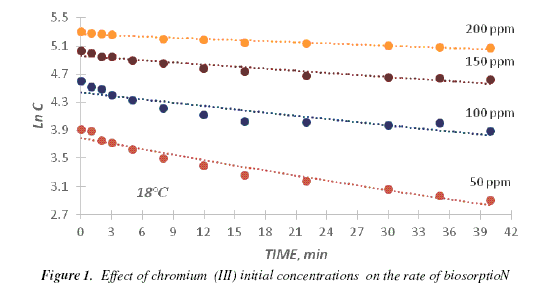
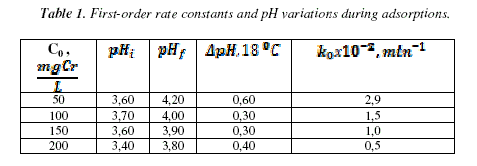
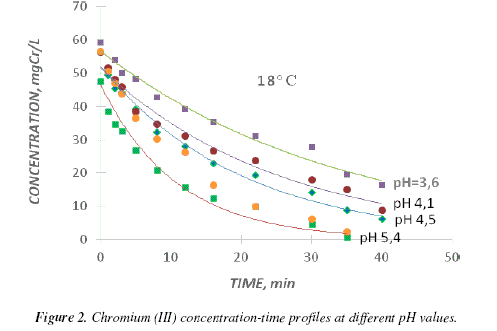
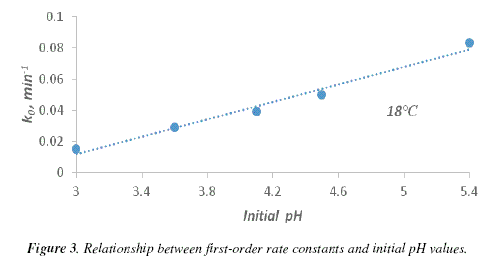
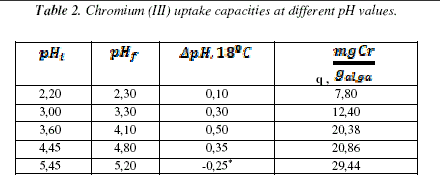
<body><![CDATA[<p align="justify"><font face="Verdana" size="2">Thus, plotting of ln (C/C<sub>o</sub>) versus time will give straight lines whose slopes produce first-order rate constants, k</font><font face="Verdana" size="2"><sub>o</sub></font>.</p>     <p align="center"><a name="f1"></a><img src="/img/revistas/rbq/v32n3/a03_figura05.GIF" width="548" height="290"></p>     <p align="justify"><font face="Verdana" size="2">A set of concentration-time profiles of Cr(III) is shown in <a href="#f1">Figure 1</a>. These ones start at different chromium initial concentrations in the range from 50 to 150 mg Cr/L. The plotting does not include data of 25 and 200 mg Cr/L. In the case of 25 mg Cr/L, the first points follow the exponential function but there is a total adsorption subsequently. At the 200 mg Cr/L concentration, the system did not obey the first order kinetics because a fast saturation occurs. The kinetic assays were also started at different pH values, because the salt concentration determines the acidity and their respective pH values. An increase of pH has been observed after each assay. It means that hydrogen ion concentrations play an important role and affects how chromium cations are adsorbed. <a href="#t1">Table 1</a> shows the calculated rate constants of first order and pH variations measured as <img src="/img/revistas/rbq/v32n3/a03_figura06.GIF" width="35" height="21">.</font></p>     <p align="center"><a name="t1"></a><img src="/img/revistas/rbq/v32n3/a03_figura07.GIF" width="477" height="166"></p>     <p align="justify"><font face="Verdana" size="2">A second set of data involving pH as main variable are shown in the <a href="#f2">Figure 2</a>. In this case, 50 mg Cr/L was chosen as constant. Although the pH range was between 2.50 and 5.40, at pH below 2.5 the system does not function well. With systems between 3.60 and 5.40, every run starts around the same point at t = 0, then each run has different slope or first order rate constant. This plot shows again how important is the pH value to determine the quantity of chromium adsorbed. In the chosen pH range, at pH lower than 2.50 the adsorption is negligible and at pH 5.40 the uptake is maximum.</font></p>     <p align="center"><a name="f2"></a><img src="/img/revistas/rbq/v32n3/a03_figura08.GIF" width="497" height="331"></p>     <p align="justify"><font face="Verdana" size="2">This pH value cannot be surpassed due to chromium hydroxide precipitation. <a href="#t2">Table 2</a> shows experimental variations of pH with respect to the initial pH as <img src="/img/revistas/rbq/v32n3/a03_figura06.GIF" width="35" height="21">  and calculated first order rate constants. <a href="#f3">Figure 3</a> shows a linear relationship between initial pH values and rate constants. This plot indicates that the adsorption process is fast at high pH than at low pH, in the established range.</font></p>     <p align="center"><a name="f3"></a><img src="/img/revistas/rbq/v32n3/a03_figura09.GIF" width="503" height="266"></p>     <p align="justify"><font face="Verdana" size="2">A third set of measurements were developed in order to determine the uptake capacity per weight of dry alga, when a chromium solution and algae were put in contact up to equilibrium conditions. Because the absorption yield varies with pH, data were obtained adjusting pH in the range, as described in the experimental section. Under these conditions, 100 ml of chromium solutions each 100 mg Cr/L and 0.2000&plusmn;0.0002 g of dry alga were mixed thoroughly. At equilibrium, a material balance gives the following expression for calculating the uptake capacity of Cr (III).</font></p>     <p align="center"><a name="ec6"></a><img src="/img/revistas/rbq/v32n3/a03_figura12.GIF" width="418" height="30"></p>     ]]></body>
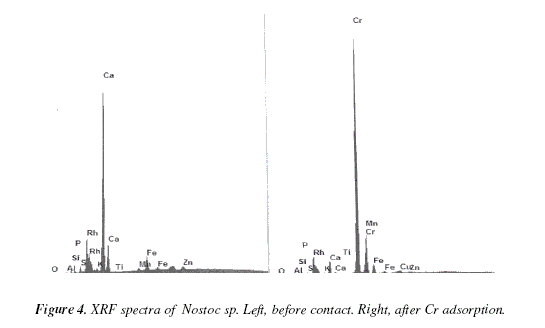
<body><![CDATA[<p align="justify"><font face="Verdana" size="2">where q: Adsorption capacity, mg Cr/g alga, C<sub>o</sub>: Initial concentration , mg Cr/L, C<sub>e</sub>: Chromium concentration at equilibrium, mg Cr/L, V: Volume of solution, L and m: Weight of dry alga. <a href="#t2">Table 2</a> shows how q varies as function of pH and also can be seen that there is a maximum of adsorption at high pH and a minimum at low pH. <a href="T2">Table 2</a> shows how pH also affects the absorption capacity of chromium (III), confirming data arising from kinetic runs. A negative <img src="/img/revistas/rbq/v32n3/a03_figura06.GIF" width="35" height="21">  can be attributed to the change of chromium speciation in solution.</font></p>     <p align="center"><a name="t2"></a><img src="/img/revistas/rbq/v32n3/a03_figura10.GIF" width="440" height="183"></p>     <p align="justify"><font face="Verdana" size="2">The spectra of X-Ray Fluorescence spectra illustrated (<a href="#f4">Figure 4)</a> show how the cation exchange would be operating in the processes, while the calcium ions are released, the chromium cations enter, provoking the adsorption phenomenon</font></p>     <p align="center"><font size="2" face="Verdana"><a name="f4"></a><img src="/img/revistas/rbq/v32n3/a03_figura11.GIF" width="545" height="328"></font></p>     <p align="center">&nbsp;</p>     <p align="justify"><font face="Verdana" size="3"><b>EXPERIMENTAL</b></font></p>     <p align="justify"><font face="Verdana" size="2"><i>Sampling and sample treatment</i></font></p>     <p align="justify"><font face="Verdana" size="2">Algae samples were collected near Peñas a town close to La Paz, Bolivia. This place belongs to the Lake Titicaca basin. About one half a kilogram of raw alga has been washed with tap water firstly, then, with distilled water. Water was poured and the sample was dried at room temperature during five days. In order to obtain rehydrated samples with constant humidity, 0.2000 g of alga was weighted using an analytical balance. To determine rehydration times, these ones were mixed with water using a magnetic stirrer. Humidity determinations were carried out on a moisture analyzer AND model MX-50, from which within half an hour, samples achieved near 89% of humidity as maximum. Reagents.- A stock 500 mg/L solution of chromium nitrate in distilled water was prepared from nonahydrated chromium nitrate, Cr(NO<sub>3</sub>)<sub>3</sub>.9H<sub>2</sub>O analytical grade, supplied by Riedel de Haen AG. Appropriate dilutions were made in order to study the effect of initial concentrations, from 25 mg Cr/L to 200 mg Cr/L. The pH effect has been measured with a 50 mg Cr/L solutions in which pH were changed by adding small amounts of HCl 1M or NaOH 1M solutions. Potassium chromate (Riedel de Haen) analytical grade, has been used to prepare atomic absorption calibration stock solution.</font></p>     <p align="justify"><font face="Verdana" size="2"><i>Kinetic experiments</i></font></p>     <p align="justify"><font face="Verdana" size="2">All kinetic experiments were run with 100 mL solutions of chromium nitrate contained into a 250 ml glass beaker at 18&plusmn;1&deg;C. A standard potentiometric pH meter provided with a silver/silver chloride electrode was used. Buffer solutions of pH 4.0 and 7.0 were calibrators. The solutions were stirred using magnet rods and magnetic stirrers. The</font></p>     ]]></body>
<body><![CDATA[<p align="justify"><font face="Verdana" size="2">initial concentration of chromium was analyzed at t=0, before each assay. When a solution is ready, 0.2000 &plusmn; 0.0010 grams of wet alga was poured into the beaker thus starting the contact and counting on digital chronometers. Aliquot of 1 mL were withdrawn at measurable time intervals in minutes. Fractions were diluted in order to measure chromium concentration by A AS. The chromium analyses were carried out on a Perkin Elmer Analyst 200 spectrometer with acetylene-air flame. The metal adsorption capacity per weight of alga has been determined at the same conditions of kinetic assays, however, due to that the metal adsorption depends on pH, this one was adj usted as before. One hour of shaking was enough for reaching equilibrium. Both phases were separated and chromium contents in the remaining solutions were determined. The algae phases were washed thoroughly with distilled water, then, dried at atmospheric temperature. Every dried alga sample was pressed using a hydraulic press in order to obtain pellets. Chromium content in the pellets have been measured by XRF spectrometry, using polyethylene containers provided with thin films of Spectrolene 4¡am as sample supports. The XRF spectra were obtained on a Spectrometer of Energy Dispersive X-Ray Fluorescence, Xenemetrix, X-Calibur, X 2600. The instrumental conditions were as follows; Filter: none, emission current: 50 uA, high voltage: 20 kV, and energy range: 40 keV.</font></p>     <p align="justify">&nbsp;</p>     <p align="justify"><font face="Verdana" size="3"><b>CONCLUSIONS</b></font></p>     <p align="justify"><font face="Verdana" size="2"><i>Nostoc sp. </i>works well as biosorbent of trivalent chromium cation. The effect of initial concentrations shows that, most of the processes follow first order kinetics. However, neither high concentration of chromium, nor so low concentration of it, obeys first-order kinetics. The most important effect of the pH was measured between 2.5 and 5.4. The upper limit of pH is affected by Cr hydroxide precipitation. Since protons can be adsorbed or released, the acidity plays an important role, because a competition of metal ions with hydrogen ions would be present to achieve active sites. At low pH, surface charge will become positive, inhibiting the approach of positively charged metal ions. Processes follow first-order kinetics, in a similar way for other kind of algae, where metal ion adsorption obeys the so called pseudo first order Lagergren model which assumes that metal ions are adsorbed on the biosorbent surface. Although different functional groups are present on the algae, at least, two types of mechanisms would be operating, these are, ion exchange and metal complex formation. On the other hand, metal speciation in solution; would affect the biosorption because it depends upon pH. A high adsorption occurs at pH 5.4 where the measured capacity is 29 mg Cr/dry alga, in average.</font></p>     <p align="justify">&nbsp;</p>     <p align="justify"><font face="Verdana" size="3"><b>ACKNOWLEDGEMENTS</b></font></p>     <p align="justify"><font face="Verdana" size="2">We are grateful to Jorge Quintanilla A., head of Hydrochemistry Area-I.I.Q., Universidad Mayor de San Andrés and coworkers, for providing AAS and XRF spectrometer facilities.</font></p>     <p align="justify">&nbsp;</p>     <p align="justify"><font face="Verdana" size="3"><b>REFERENCES</b></font></p>     <!-- ref --><p align="justify"><font face="Verdana" size="2">1.&nbsp; &nbsp; &nbsp;Brinza, L., Dring, M.J., Gavrilescu, M. <b>2007, </b>Environmental Engineering and Management Journal, <i>6,237.</i></font>&nbsp;&nbsp;&nbsp;&nbsp;&nbsp;&nbsp;&nbsp;&nbsp;[&#160;<a href="javascript:void(0);" onclick="javascript: window.open('/scielo.php?script=sci_nlinks&ref=685778&pid=S0250-5460201500030000300001&lng=','','width=640,height=500,resizable=yes,scrollbars=1,menubar=yes,');">Links</a>&#160;]<!-- end-ref --><!-- ref --><p align="justify"><font face="Verdana" size="2">2.&nbsp; &nbsp; &nbsp;Davis, T.A., Volesky, B.,Mucci,A. <b>2003, </b>Water Research, <i>37, </i>4311.</font>&nbsp;&nbsp;&nbsp;&nbsp;&nbsp;&nbsp;&nbsp;&nbsp;[&#160;<a href="javascript:void(0);" onclick="javascript: window.open('/scielo.php?script=sci_nlinks&ref=685779&pid=S0250-5460201500030000300002&lng=','','width=640,height=500,resizable=yes,scrollbars=1,menubar=yes,');">Links</a>&#160;]<!-- end-ref --><!-- ref --><p align="justify"><font face="Verdana" size="2">3.&nbsp; &nbsp; &nbsp;Helder, S. <b>2014, </b>Sch. Acad. J. Biosci., 2, 825.</font>&nbsp;&nbsp;&nbsp;&nbsp;&nbsp;&nbsp;&nbsp;&nbsp;[&#160;<a href="javascript:void(0);" onclick="javascript: window.open('/scielo.php?script=sci_nlinks&ref=685780&pid=S0250-5460201500030000300003&lng=','','width=640,height=500,resizable=yes,scrollbars=1,menubar=yes,');">Links</a>&#160;]<!-- end-ref --><!-- ref --><p align="justify"><font face="Verdana" size="2">4.&nbsp; &nbsp; &nbsp;Chekroun, K.B., Baghour, M. <b>2013, </b>J.Mater. Environ. Sci., <i>4, </i>873.</font>&nbsp;&nbsp;&nbsp;&nbsp;&nbsp;&nbsp;&nbsp;&nbsp;[&#160;<a href="javascript:void(0);" onclick="javascript: window.open('/scielo.php?script=sci_nlinks&ref=685781&pid=S0250-5460201500030000300004&lng=','','width=640,height=500,resizable=yes,scrollbars=1,menubar=yes,');">Links</a>&#160;]<!-- end-ref --><!-- ref --><p align="justify"><font face="Verdana" size="2">5.&nbsp; &nbsp; &nbsp;Sweetly, D.J. <b>2014, </b>Intl. J. of Pharmaceutical &amp;Biological Archives, 5, 17.</font>&nbsp;&nbsp;&nbsp;&nbsp;&nbsp;&nbsp;&nbsp;&nbsp;[&#160;<a href="javascript:void(0);" onclick="javascript: window.open('/scielo.php?script=sci_nlinks&ref=685782&pid=S0250-5460201500030000300005&lng=','','width=640,height=500,resizable=yes,scrollbars=1,menubar=yes,');">Links</a>&#160;]<!-- end-ref --><!-- ref --><p align="justify"><font face="Verdana" size="2">6.&nbsp; &nbsp; &nbsp;Abdel-Ghani, N.T., El-Chaghaby, G.A. <b>2014, </b>Intl. Journal of Latest Research in Science and Technology, <i>3, </i>24.</font>&nbsp;&nbsp;&nbsp;&nbsp;&nbsp;&nbsp;&nbsp;&nbsp;[&#160;<a href="javascript:void(0);" onclick="javascript: window.open('/scielo.php?script=sci_nlinks&ref=685783&pid=S0250-5460201500030000300006&lng=','','width=640,height=500,resizable=yes,scrollbars=1,menubar=yes,');">Links</a>&#160;]<!-- end-ref --><!-- ref --><p align="justify"><font face="Verdana" size="2">7.&nbsp; &nbsp; &nbsp;Kang, O.L., et al. <b>2011, </b>Journal of Environmental Sciences, <i>23, </i>918.</font>&nbsp;&nbsp;&nbsp;&nbsp;&nbsp;&nbsp;&nbsp;&nbsp;[&#160;<a href="javascript:void(0);" onclick="javascript: window.open('/scielo.php?script=sci_nlinks&ref=685784&pid=S0250-5460201500030000300007&lng=','','width=640,height=500,resizable=yes,scrollbars=1,menubar=yes,');">Links</a>&#160;]<!-- end-ref --><!-- ref --><p align="justify"><font face="Verdana" size="2">8.&nbsp; &nbsp; &nbsp;Vilar, V.J.P., Botelho C.M.S.,Boaventura, R.A.R. <b>2007, </b>Journal of Hazardous Materials, <i>149, </i>643.</font>&nbsp;&nbsp;&nbsp;&nbsp;&nbsp;&nbsp;&nbsp;&nbsp;[&#160;<a href="javascript:void(0);" onclick="javascript: window.open('/scielo.php?script=sci_nlinks&ref=685785&pid=S0250-5460201500030000300008&lng=','','width=640,height=500,resizable=yes,scrollbars=1,menubar=yes,');">Links</a>&#160;]<!-- end-ref --><!-- ref --><p align="justify"><font face="Verdana" size="2">9.&nbsp; &nbsp; &nbsp;Chojnacka, K. <b>2007, </b>American Journal of Agricultural and Biological Sciences, 2, 218.</font>&nbsp;&nbsp;&nbsp;&nbsp;&nbsp;&nbsp;&nbsp;&nbsp;[&#160;<a href="javascript:void(0);" onclick="javascript: window.open('/scielo.php?script=sci_nlinks&ref=685786&pid=S0250-5460201500030000300009&lng=','','width=640,height=500,resizable=yes,scrollbars=1,menubar=yes,');">Links</a>&#160;]<!-- end-ref --><!-- ref --><p align="justify"><font face="Verdana" size="2">10.&nbsp; &nbsp; Abirami, s., Srisudha S., Gunasekaran,P. <b>2013, </b>Intl. Journal of Biological &amp; Pharmaceutical Research, <i>4, </i>115.</font>&nbsp;&nbsp;&nbsp;&nbsp;&nbsp;&nbsp;&nbsp;&nbsp;[&#160;<a href="javascript:void(0);" onclick="javascript: window.open('/scielo.php?script=sci_nlinks&ref=685787&pid=S0250-5460201500030000300010&lng=','','width=640,height=500,resizable=yes,scrollbars=1,menubar=yes,');">Links</a>&#160;]<!-- end-ref --><!-- ref --><p align="justify"><font face="Verdana" size="2">11.&nbsp; &nbsp; Michalak, I., et al. <b>2007, </b>American Journal of Agricultural and Biological Sciences, 2, 284.</font>&nbsp;&nbsp;&nbsp;&nbsp;&nbsp;&nbsp;&nbsp;&nbsp;[&#160;<a href="javascript:void(0);" onclick="javascript: window.open('/scielo.php?script=sci_nlinks&ref=685788&pid=S0250-5460201500030000300011&lng=','','width=640,height=500,resizable=yes,scrollbars=1,menubar=yes,');">Links</a>&#160;]<!-- end-ref --><!-- ref --><p align="justify"><font face="Verdana" size="2">12.&nbsp; &nbsp; Saravanan, A.,M., Bundha, V., Manimekalai, R., Krishnan, S. <b>2009, </b>Indian Journal of Science and Technology, 2, 53.</font>&nbsp;&nbsp;&nbsp;&nbsp;&nbsp;&nbsp;&nbsp;&nbsp;[&#160;<a href="javascript:void(0);" onclick="javascript: window.open('/scielo.php?script=sci_nlinks&ref=685789&pid=S0250-5460201500030000300012&lng=','','width=640,height=500,resizable=yes,scrollbars=1,menubar=yes,');">Links</a>&#160;]<!-- end-ref --><!-- ref --><p align="justify"><font face="Verdana" size="2">13.&nbsp; &nbsp; Yahya, S.K., et al. <b>2012, </b>Colloids and Interfases B: Biointerfases, <i>94, </i>362.</font>&nbsp;&nbsp;&nbsp;&nbsp;&nbsp;&nbsp;&nbsp;&nbsp;[&#160;<a href="javascript:void(0);" onclick="javascript: window.open('/scielo.php?script=sci_nlinks&ref=685790&pid=S0250-5460201500030000300013&lng=','','width=640,height=500,resizable=yes,scrollbars=1,menubar=yes,');">Links</a>&#160;]<!-- end-ref --><!-- ref --><p align="justify"><font face="Verdana" size="2">14.&nbsp; &nbsp; Manikandan,N., Prasath, S.S., Prakash, S. <b>2011, </b>Indian Journal of Geo-Marine Science, <i>40, </i>121.</font>&nbsp;&nbsp;&nbsp;&nbsp;&nbsp;&nbsp;&nbsp;&nbsp;[&#160;<a href="javascript:void(0);" onclick="javascript: window.open('/scielo.php?script=sci_nlinks&ref=685791&pid=S0250-5460201500030000300014&lng=','','width=640,height=500,resizable=yes,scrollbars=1,menubar=yes,');">Links</a>&#160;]<!-- end-ref --><!-- ref --><p align="justify"><font face="Verdana" size="2">15.&nbsp; &nbsp; Ghasemi, M., Keshtkar, A.R.,Dabbagh, R., Safdari, S.J. <b>2011, </b>Iran J. Environ. Health. Sci. Eng., 2011, <i>8, </i>65.</font>&nbsp;&nbsp;&nbsp;&nbsp;&nbsp;&nbsp;&nbsp;&nbsp;[&#160;<a href="javascript:void(0);" onclick="javascript: window.open('/scielo.php?script=sci_nlinks&ref=685792&pid=S0250-5460201500030000300015&lng=','','width=640,height=500,resizable=yes,scrollbars=1,menubar=yes,');">Links</a>&#160;]<!-- end-ref --><!-- ref --><p align="justify"><font face="Verdana" size="2">16.&nbsp; &nbsp; Omale, P.E., Okeniyi, S.O., Faruruwa, M.D.,Ngokat, A.B. <b>2014, </b>Global Journal of Pure and Applied Chemistry Research, 2, 1.</font>&nbsp;&nbsp;&nbsp;&nbsp;&nbsp;&nbsp;&nbsp;&nbsp;[&#160;<a href="javascript:void(0);" onclick="javascript: window.open('/scielo.php?script=sci_nlinks&ref=685793&pid=S0250-5460201500030000300016&lng=','','width=640,height=500,resizable=yes,scrollbars=1,menubar=yes,');">Links</a>&#160;]<!-- end-ref --><!-- ref --><p align="justify"><font face="Verdana" size="2">17.&nbsp; &nbsp; Aytas, S., Gunduz, E., Gok, C. <b>2013, </b>Clean-Soil, Air, Water, <i>41, </i>1.</font>&nbsp;&nbsp;&nbsp;&nbsp;&nbsp;&nbsp;&nbsp;&nbsp;[&#160;<a href="javascript:void(0);" onclick="javascript: window.open('/scielo.php?script=sci_nlinks&ref=685794&pid=S0250-5460201500030000300017&lng=','','width=640,height=500,resizable=yes,scrollbars=1,menubar=yes,');">Links</a>&#160;]<!-- end-ref --><!-- ref --><p align="justify"><font face="Verdana" size="2">18.&nbsp; &nbsp; Shethy, N.K., et al. <b>2011, </b>J. Ecosys. Ecograph., <i>1, </i>1.</font>&nbsp;&nbsp;&nbsp;&nbsp;&nbsp;&nbsp;&nbsp;&nbsp;[&#160;<a href="javascript:void(0);" onclick="javascript: window.open('/scielo.php?script=sci_nlinks&ref=685795&pid=S0250-5460201500030000300018&lng=','','width=640,height=500,resizable=yes,scrollbars=1,menubar=yes,');">Links</a>&#160;]<!-- end-ref --><!-- ref --><p align="justify"><font face="Verdana" size="2">19.&nbsp; &nbsp; Rayfur, M. <b>2013, </b>Ecol. Chem. Eng. S., <i>20, </i>23.</font>&nbsp;&nbsp;&nbsp;&nbsp;&nbsp;&nbsp;&nbsp;&nbsp;[&#160;<a href="javascript:void(0);" onclick="javascript: window.open('/scielo.php?script=sci_nlinks&ref=685796&pid=S0250-5460201500030000300019&lng=','','width=640,height=500,resizable=yes,scrollbars=1,menubar=yes,');">Links</a>&#160;]<!-- end-ref --><!-- ref --><p align="justify"><font face="Verdana" size="2">20.&nbsp; &nbsp; Sasaki, H. , et al. <b>2013, </b>Microbes Environ., <i>28, </i>466.</font>&nbsp;&nbsp;&nbsp;&nbsp;&nbsp;&nbsp;&nbsp;&nbsp;[&#160;<a href="javascript:void(0);" onclick="javascript: window.open('/scielo.php?script=sci_nlinks&ref=685797&pid=S0250-5460201500030000300020&lng=','','width=640,height=500,resizable=yes,scrollbars=1,menubar=yes,');">Links</a>&#160;]<!-- end-ref --> ]]></body><back>
<ref-list>
<ref id="B1">
<label>1</label><nlm-citation citation-type="journal">
<person-group person-group-type="author">
<name>
<surname><![CDATA[Brinza]]></surname>
<given-names><![CDATA[L.]]></given-names>
</name>
<name>
<surname><![CDATA[Dring]]></surname>
<given-names><![CDATA[M.J.]]></given-names>
</name>
<name>
<surname><![CDATA[Gavrilescu]]></surname>
<given-names><![CDATA[M.]]></given-names>
</name>
</person-group>
<source><![CDATA[Environmental Engineering and Management Journal]]></source>
<year></year>
<volume>6</volume>
<page-range>237</page-range></nlm-citation>
</ref>
<ref id="B2">
<label>2</label><nlm-citation citation-type="journal">
<person-group person-group-type="author">
<name>
<surname><![CDATA[Davis]]></surname>
<given-names><![CDATA[T.A.]]></given-names>
</name>
<name>
<surname><![CDATA[Volesky]]></surname>
<given-names><![CDATA[B.]]></given-names>
</name>
<name>
<surname><![CDATA[Mucci]]></surname>
<given-names><![CDATA[A.]]></given-names>
</name>
</person-group>
<source><![CDATA[Water Research]]></source>
<year></year>
<volume>37</volume>
<page-range>4311</page-range></nlm-citation>
</ref>
<ref id="B3">
<label>3</label><nlm-citation citation-type="journal">
<person-group person-group-type="author">
<name>
<surname><![CDATA[Helder]]></surname>
<given-names><![CDATA[S.]]></given-names>
</name>
</person-group>
<source><![CDATA[Sch. Acad. J. Biosci.]]></source>
<year></year>
<volume>2</volume>
<page-range>825</page-range></nlm-citation>
</ref>
<ref id="B4">
<label>4</label><nlm-citation citation-type="journal">
<person-group person-group-type="author">
<name>
<surname><![CDATA[Chekroun]]></surname>
<given-names><![CDATA[K.B.]]></given-names>
</name>
<name>
<surname><![CDATA[Baghour]]></surname>
<given-names><![CDATA[M.]]></given-names>
</name>
</person-group>
<source><![CDATA[J.Mater. Environ. Sci.]]></source>
<year></year>
<volume>4</volume>
<page-range>873</page-range></nlm-citation>
</ref>
<ref id="B5">
<label>5</label><nlm-citation citation-type="journal">
<person-group person-group-type="author">
<name>
<surname><![CDATA[Sweetly]]></surname>
<given-names><![CDATA[D.J.]]></given-names>
</name>
</person-group>
<source><![CDATA[Intl. J. of Pharmaceutical & Biological Archives]]></source>
<year></year>
<volume>5</volume>
<page-range>17</page-range></nlm-citation>
</ref>
<ref id="B6">
<label>6</label><nlm-citation citation-type="journal">
<person-group person-group-type="author">
<name>
<surname><![CDATA[Abdel-Ghani]]></surname>
<given-names><![CDATA[N.T.]]></given-names>
</name>
<name>
<surname><![CDATA[El-Chaghaby]]></surname>
<given-names><![CDATA[G.A.]]></given-names>
</name>
</person-group>
<source><![CDATA[Intl. Journal of Latest Research in Science and Technology]]></source>
<year></year>
<volume>3</volume>
<page-range>24</page-range></nlm-citation>
</ref>
<ref id="B7">
<label>7</label><nlm-citation citation-type="journal">
<person-group person-group-type="author">
<name>
<surname><![CDATA[Kang]]></surname>
<given-names><![CDATA[O.L.]]></given-names>
</name>
</person-group>
<source><![CDATA[Journal of Environmental Sciences]]></source>
<year></year>
<volume>23</volume>
<page-range>918</page-range></nlm-citation>
</ref>
<ref id="B8">
<label>8</label><nlm-citation citation-type="journal">
<person-group person-group-type="author">
<name>
<surname><![CDATA[Vilar]]></surname>
<given-names><![CDATA[V.J.P.]]></given-names>
</name>
<name>
<surname><![CDATA[Botelho]]></surname>
<given-names><![CDATA[C.M.S.]]></given-names>
</name>
<name>
<surname><![CDATA[Boaventura]]></surname>
<given-names><![CDATA[R.A.R.]]></given-names>
</name>
</person-group>
<source><![CDATA[Journal of Hazardous Materials]]></source>
<year></year>
<volume>149</volume>
<page-range>643</page-range></nlm-citation>
</ref>
<ref id="B9">
<label>9</label><nlm-citation citation-type="journal">
<person-group person-group-type="author">
<name>
<surname><![CDATA[Chojnacka]]></surname>
<given-names><![CDATA[K.]]></given-names>
</name>
</person-group>
<source><![CDATA[American Journal of Agricultural and Biological Sciences]]></source>
<year></year>
<volume>2</volume>
<page-range>218</page-range></nlm-citation>
</ref>
<ref id="B10">
<label>10</label><nlm-citation citation-type="journal">
<person-group person-group-type="author">
<name>
<surname><![CDATA[Abirami]]></surname>
<given-names><![CDATA[s.]]></given-names>
</name>
<name>
<surname><![CDATA[Srisudha]]></surname>
<given-names><![CDATA[S.]]></given-names>
</name>
<name>
<surname><![CDATA[Gunasekaran]]></surname>
<given-names><![CDATA[P.]]></given-names>
</name>
</person-group>
<source><![CDATA[Intl. Journal of Biological & Pharmaceutical Research]]></source>
<year></year>
<volume>4</volume>
<page-range>115</page-range></nlm-citation>
</ref>
<ref id="B11">
<label>11</label><nlm-citation citation-type="journal">
<person-group person-group-type="author">
<name>
<surname><![CDATA[Michalak]]></surname>
<given-names><![CDATA[I.]]></given-names>
</name>
</person-group>
<source><![CDATA[American Journal of Agricultural and Biological Sciences]]></source>
<year></year>
<page-range>2</page-range><page-range>284</page-range></nlm-citation>
</ref>
<ref id="B12">
<label>12</label><nlm-citation citation-type="journal">
<person-group person-group-type="author">
<name>
<surname><![CDATA[Saravanan]]></surname>
<given-names><![CDATA[A.,M.]]></given-names>
</name>
<name>
<surname><![CDATA[Bundha]]></surname>
<given-names><![CDATA[V.]]></given-names>
</name>
<name>
<surname><![CDATA[Manimekalai]]></surname>
<given-names><![CDATA[R.]]></given-names>
</name>
<name>
<surname><![CDATA[Krishnan]]></surname>
<given-names><![CDATA[S.]]></given-names>
</name>
</person-group>
<source><![CDATA[Indian Journal of Science and Technology]]></source>
<year></year>
<volume>2</volume>
<page-range>53</page-range></nlm-citation>
</ref>
<ref id="B13">
<label>13</label><nlm-citation citation-type="journal">
<person-group person-group-type="author">
<name>
<surname><![CDATA[Yahya]]></surname>
<given-names><![CDATA[S.K.]]></given-names>
</name>
</person-group>
<source><![CDATA[Colloids and Interfases B: Biointerfases]]></source>
<year></year>
<volume>94</volume>
<numero>362</numero>
<issue>362</issue>
</nlm-citation>
</ref>
<ref id="B14">
<label>14</label><nlm-citation citation-type="journal">
<person-group person-group-type="author">
<name>
<surname><![CDATA[Manikandan]]></surname>
<given-names><![CDATA[N.]]></given-names>
</name>
<name>
<surname><![CDATA[Prasath]]></surname>
<given-names><![CDATA[S.S.]]></given-names>
</name>
<name>
<surname><![CDATA[Prakash]]></surname>
<given-names><![CDATA[S.]]></given-names>
</name>
</person-group>
<source><![CDATA[Indian Journal of Geo-Marine Science]]></source>
<year></year>
<volume>40</volume>
<page-range>121</page-range></nlm-citation>
</ref>
<ref id="B15">
<label>15</label><nlm-citation citation-type="journal">
<person-group person-group-type="author">
<name>
<surname><![CDATA[Ghasemi]]></surname>
<given-names><![CDATA[M.]]></given-names>
</name>
<name>
<surname><![CDATA[Keshtkar]]></surname>
<given-names><![CDATA[A.R.]]></given-names>
</name>
<name>
<surname><![CDATA[Dabbagh]]></surname>
<given-names><![CDATA[R.]]></given-names>
</name>
<name>
<surname><![CDATA[Safdari]]></surname>
<given-names><![CDATA[S.J.]]></given-names>
</name>
</person-group>
<source><![CDATA[Iran J. Environ. Health. Sci. Eng.]]></source>
<year></year>
<volume>8</volume>
<page-range>65</page-range></nlm-citation>
</ref>
<ref id="B16">
<label>16</label><nlm-citation citation-type="journal">
<person-group person-group-type="author">
<name>
<surname><![CDATA[Omale]]></surname>
<given-names><![CDATA[P.E.]]></given-names>
</name>
<name>
<surname><![CDATA[Okeniyi]]></surname>
<given-names><![CDATA[S.O.]]></given-names>
</name>
<name>
<surname><![CDATA[Faruruwa]]></surname>
<given-names><![CDATA[M.D.]]></given-names>
</name>
<name>
<surname><![CDATA[Ngokat]]></surname>
<given-names><![CDATA[A.B.]]></given-names>
</name>
</person-group>
<source><![CDATA[Global Journal of Pure and Applied Chemistry Research]]></source>
<year></year>
<volume>2</volume>
<page-range>1</page-range></nlm-citation>
</ref>
<ref id="B17">
<label>17</label><nlm-citation citation-type="journal">
<person-group person-group-type="author">
<name>
<surname><![CDATA[Aytas]]></surname>
<given-names><![CDATA[S.]]></given-names>
</name>
<name>
<surname><![CDATA[Gunduz]]></surname>
<given-names><![CDATA[E]]></given-names>
</name>
<name>
<surname><![CDATA[Gok]]></surname>
<given-names><![CDATA[C]]></given-names>
</name>
</person-group>
<source><![CDATA[Clean-Soil, Air, Water]]></source>
<year></year>
<volume>41</volume>
<numero>1</numero>
<issue>1</issue>
</nlm-citation>
</ref>
<ref id="B18">
<label>18</label><nlm-citation citation-type="journal">
<person-group person-group-type="author">
<name>
<surname><![CDATA[Shethy]]></surname>
<given-names><![CDATA[N.K.]]></given-names>
</name>
</person-group>
<source><![CDATA[J. Ecosys. Ecograph]]></source>
<year></year>
<volume>1</volume>
<numero>1</numero>
<issue>1</issue>
</nlm-citation>
</ref>
<ref id="B19">
<label>19</label><nlm-citation citation-type="journal">
<person-group person-group-type="author">
<name>
<surname><![CDATA[Rayfur]]></surname>
<given-names><![CDATA[M.]]></given-names>
</name>
</person-group>
<source><![CDATA[Ecol. Chem. Eng. S.]]></source>
<year></year>
<volume>20</volume>
<numero>23</numero>
<issue>23</issue>
</nlm-citation>
</ref>
<ref id="B20">
<label>20</label><nlm-citation citation-type="journal">
<person-group person-group-type="author">
<name>
<surname><![CDATA[Sasaki]]></surname>
<given-names><![CDATA[H.]]></given-names>
</name>
</person-group>
<source><![CDATA[Microbes Environ.]]></source>
<year></year>
<volume>28</volume>
<page-range>466</page-range></nlm-citation>
</ref>
</ref-list>
</back>
</article>