<?xml version="1.0" encoding="ISO-8859-1"?><article xmlns:mml="http://www.w3.org/1998/Math/MathML" xmlns:xlink="http://www.w3.org/1999/xlink" xmlns:xsi="http://www.w3.org/2001/XMLSchema-instance">
<front>
<journal-meta>
<journal-id>0250-5460</journal-id>
<journal-title><![CDATA[Revista Boliviana de Química]]></journal-title>
<abbrev-journal-title><![CDATA[Rev. Bol. Quim]]></abbrev-journal-title>
<issn>0250-5460</issn>
<publisher>
<publisher-name><![CDATA[Universidad Mayor de San Andrés]]></publisher-name>
</publisher>
</journal-meta>
<article-meta>
<article-id>S0250-54602014000200005</article-id>
<title-group>
<article-title xml:lang="en"><![CDATA[MECHANISTIC VIEWS OF STEREOSELECTIVE SYNTHESIS OF TRI-AND TETRA-SUBSTITUTED ALKENES, PART I: THE ORGANIC CHEMISTRY NOTEBOOK SERIES, A DIDACTICAL APPROACH, N°3]]></article-title>
</title-group>
<contrib-group>
<contrib contrib-type="author">
<name>
<surname><![CDATA[Bravo]]></surname>
<given-names><![CDATA[José A]]></given-names>
</name>
</contrib>
<contrib contrib-type="author">
<name>
<surname><![CDATA[Vila]]></surname>
<given-names><![CDATA[José L]]></given-names>
</name>
</contrib>
</contrib-group>
<aff id="A">
<institution><![CDATA[,  ]]></institution>
<addr-line><![CDATA[ ]]></addr-line>
</aff>
<pub-date pub-type="pub">
<day>31</day>
<month>12</month>
<year>2014</year>
</pub-date>
<pub-date pub-type="epub">
<day>31</day>
<month>12</month>
<year>2014</year>
</pub-date>
<volume>31</volume>
<numero>2</numero>
<fpage>61</fpage>
<lpage>67</lpage>
<copyright-statement/>
<copyright-year/>
<self-uri xlink:href="http://www.scielo.org.bo/scielo.php?script=sci_arttext&amp;pid=S0250-54602014000200005&amp;lng=en&amp;nrm=iso"></self-uri><self-uri xlink:href="http://www.scielo.org.bo/scielo.php?script=sci_abstract&amp;pid=S0250-54602014000200005&amp;lng=en&amp;nrm=iso"></self-uri><self-uri xlink:href="http://www.scielo.org.bo/scielo.php?script=sci_pdf&amp;pid=S0250-54602014000200005&amp;lng=en&amp;nrm=iso"></self-uri><abstract abstract-type="short" xml:lang="en"><p><![CDATA[As underlined in two previous papers in: "The Organic Chemistry Notebook Series, a Didactical Approach", the presentation of synthesis works in a verbal and graphical succinct manner, needs a didactical approach. Isomerically pure tri- and tetra-substituted alkenes are difficult to obtain as shown in several publications. We used a series of reactions to synthesize tri- and tetra-substituted alkenes as reviewed by W. Carruthers, and we have proposed didactical and mechanistic views for the reviewed reactions.]]></p></abstract>
<kwd-group>
<kwd lng="en"><![CDATA[Organic Chemistry]]></kwd>
<kwd lng="en"><![CDATA[Stereoselective synthesis]]></kwd>
<kwd lng="en"><![CDATA[Alkenes]]></kwd>
<kwd lng="en"><![CDATA[Addition reaction]]></kwd>
<kwd lng="en"><![CDATA[Mechanisms of Reactions]]></kwd>
</kwd-group>
</article-meta>
</front><body><![CDATA[ <p align="right"><font size="2" face="Verdana"><b>ARTICULO ORIGINAL</b> </font></p>     <p align="right">&nbsp;</p>     <p align="center"><font face="Verdana" size="4"><b>MECHANISTIC VIEWS OF STEREOSELECTIVE SYNTHESIS OF TRI-AND TETRA-SUBSTITUTED ALKENES, PART I; THE ORGANIC CHEMISTRY NOTEBOOK SERIES, A DIDACTICAL APPROACH, N&deg;3</b></font></p>     <p align="center">&nbsp;</p>     <p align="center">&nbsp;</p>     <p align="center"><font face="Verdana" size="2">José A. Bravo*, José L. Vila</font>    <br> <font face="Verdana" size="2">Department of Chemistry, Instituto de Investigaciones en Productos Naturales IIPN, Universidad Mayor de San Andrés UMSA, P.O. Box 303, Tel. 59122792238, La Paz, Bolivia    <br> *Corresponding author: <a href="mailto:jabravo@umsa.bo">jabravo@umsa.bo</a></font></p>     <p align="justify">&nbsp;</p>     <p align="justify">&nbsp;</p> <hr>     ]]></body>
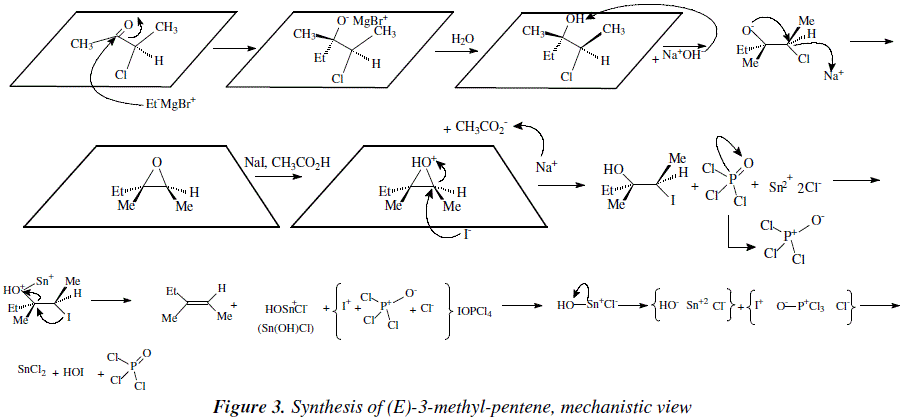
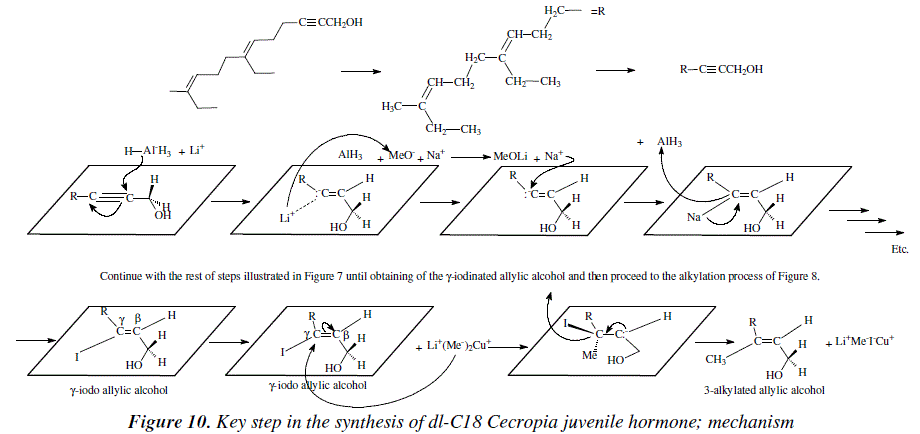
<body><![CDATA[<p align="justify"><font face="Verdana" size="2"><b>Abstract</b></font></p>     <p align="justify"><font face="Verdana" size="2">As underlined in two previous papers in: &quot;The Organic Chemistry Notebook Series, a Didactical Approach&quot;, the presentation of synthesis works in a verbal and graphical succinct manner, needs a didactical approach. Isomerically pure tri- and tetra-substituted alkenes are difficult to obtain as shown in several publications. We used a series of reactions to synthesize tri- and tetra-substituted alkenes as reviewed by W. Carruthers, and we have proposed didactical and mechanistic views for the reviewed reactions.</font></p>     <p align="justify"><font face="Verdana" size="2"><b>Keywords: </b><i>Organic Chemistry, Stereoselective synthesis, Alkenes, Addition reaction, Mechanisms of Reactions.</i></font></p> <hr>     <p align="justify">&nbsp;</p>     <p align="justify">&nbsp;</p>     <p align="justify"><b><font face="Verdana" size="3">ANALYSIS AND MECHANISTIC PROPOSALS</font></b></p>     <p align="justify"><font face="Verdana" size="2">As academics we are concerned with the didactical importance of covering the needs of debutant students in organic synthesis. This is a third study in: &quot;The Organic Chemistry Notebook Series, a Didactical Approach&quot; [1,2]. The present article is an analytical and didactical approach to stereoselective synthesis of tri- and tetra-substituted alkenes as reviewed by W. Carruthers [3]. Tri- and tetra-substituted alkenes are difficult to obtain. Authors [3,4] signaled that the substrate a-chloro-aldehyde or -ketone, in its way to alkene, finds its critical step when reacting with Grignard reagent. Also, the most reactive conformation for the substrate is when the carbonyl group and the carbon-chlorine are antiparallel dipoles [3,4]. This conformation allows an addition of Grignard reagent very stereo-selectively and from the side less hindered by R<sup>1</sup> and R<sup>2</sup> groups, on the a-carbon atom with respect to carbonyl [3,4]. The nucleophilic attacking group R<sup>4</sup> orients itself in an <i>anti </i>disposition with respect to the most hindering group between R<sup>1</sup> and R<sup>2</sup> [3,4]. The derived chlorohydrin is then submitted to stereoselective reactions to afford the alkene where three of the double bond substituents come from the alfa-chloro-aldehyde, -ketone and the fourth one comes from Grignard reagent [3,4]. <a href="#f1">Figure 1</a> shows the corresponding mechanistic view.</font></p>     <p align="center"><a name="f1"></a><img src="/img/revistas/rbq/v31n2/a05_figura01.gif" width="897" height="158"></p>     <p align="justify"><font face="Verdana" size="2">As an example let us examine the synthesis of (E)-3-methyl-2-pentene [3,4] (<a href="#f2">Figure 2</a>), and let us propose the corresponding mechanistic view (<a href="#f3">Figure 3</a>).</font></p>     <p align="center"><a name="f2"></a><img src="/img/revistas/rbq/v31n2/a05_figura02.gif" width="920" height="170"></p>     ]]></body>
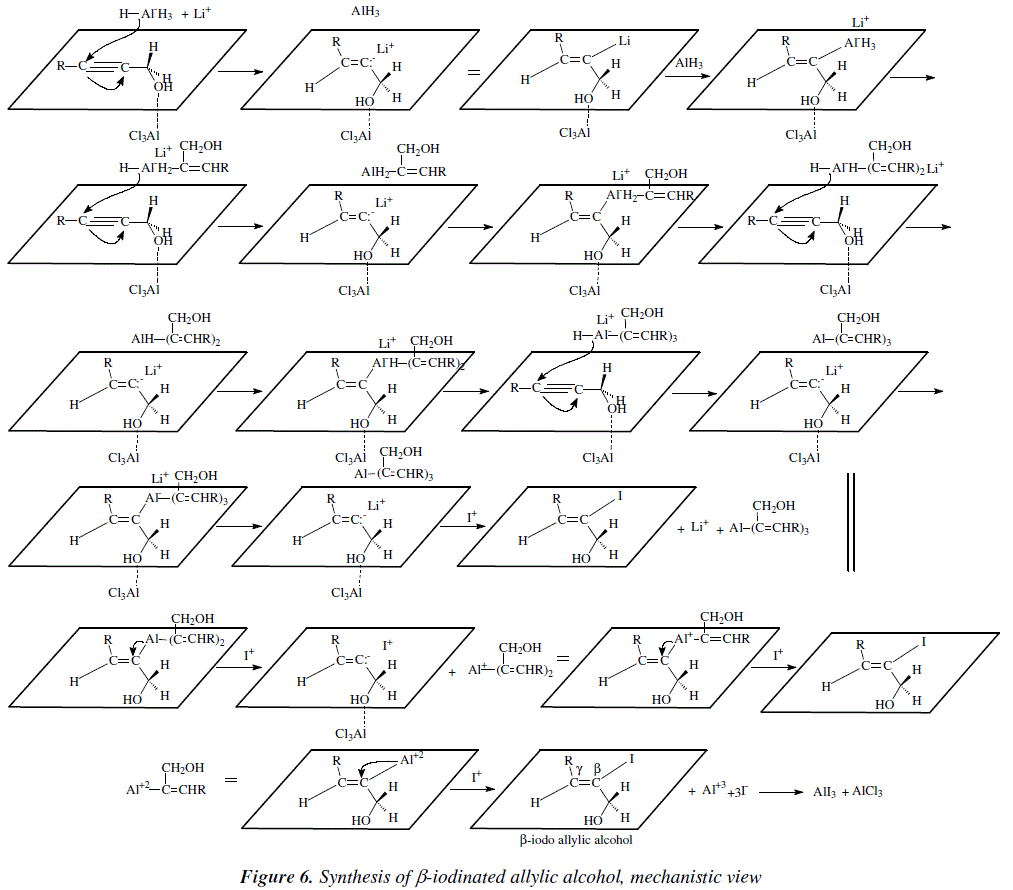
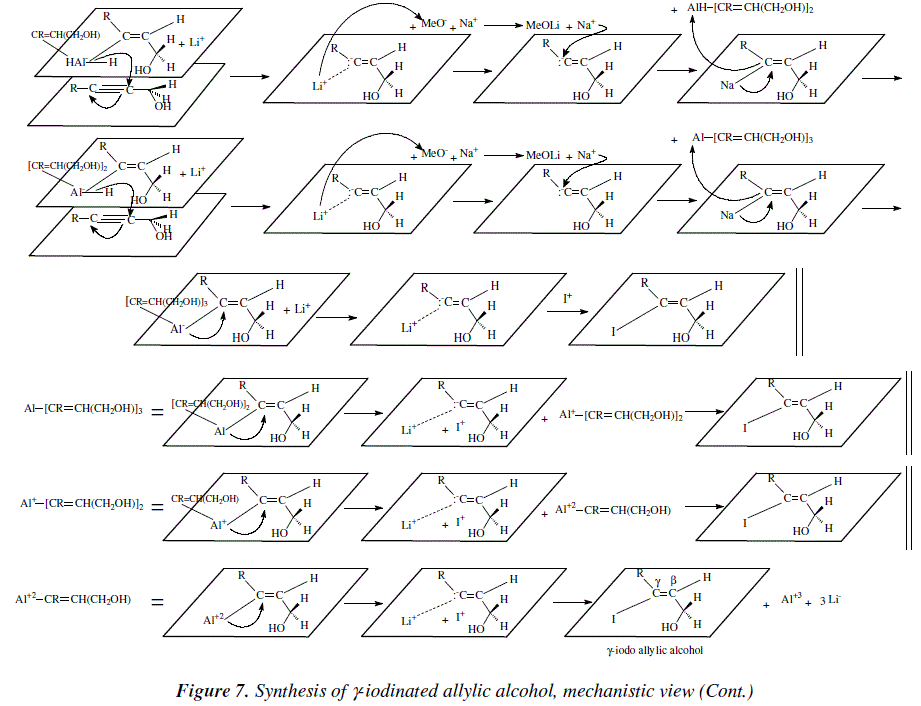
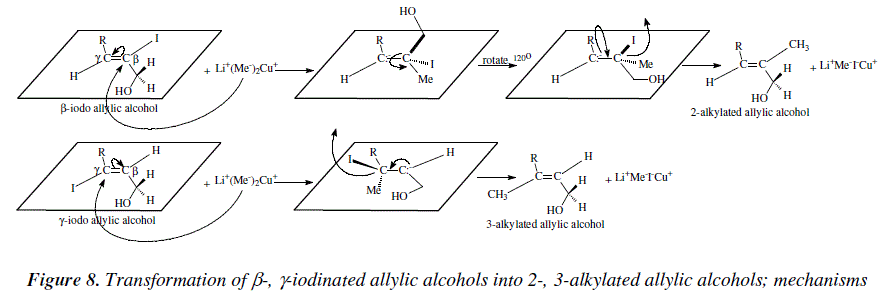
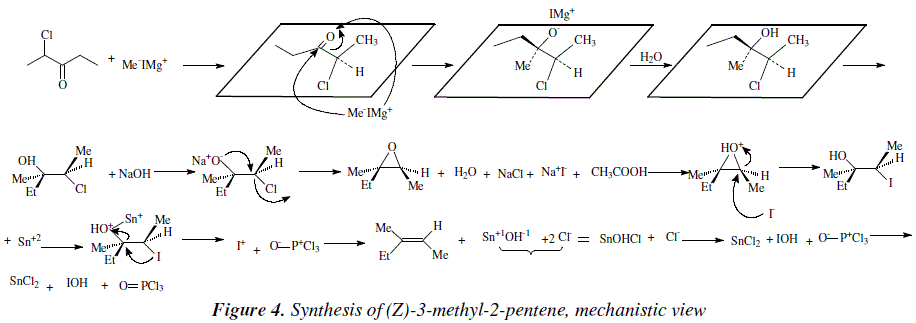
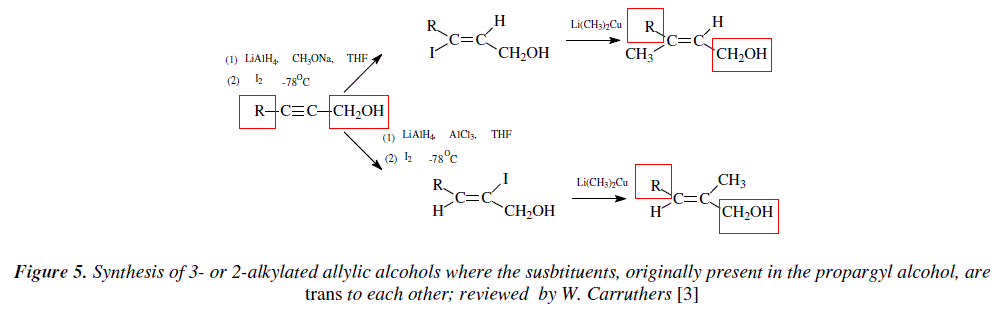
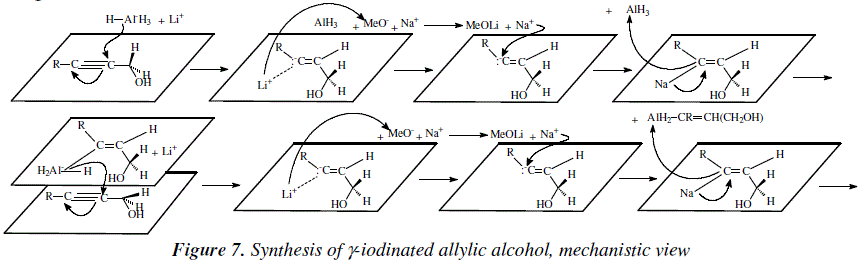
<body><![CDATA[<p align="center"><a name="f3"></a><img src="/img/revistas/rbq/v31n2/a05_figura03.gif" width="904" height="420"></p>     <p align="justify"><font face="Verdana" size="2">Similarly, a series of stereo-selective reactions with methylmagnesium iodide (Grignard reagent) onto substrate 2-chloropentane-3-one gave rise to (Z)-3-methyl-2-pentene [3,4] as shown in the mechanism of <a href="#f4">Figure 4</a>. These reaction series are an elegant way to obtain pure stereo-isomers.</font></p>     <p align="center"><a name="f4"></a><img src="/img/revistas/rbq/v31n2/a05_figura04.gif" width="916" height="323"></p>     <p align="justify"><font face="Verdana" size="2">A different reaction to afford the stereo-specific obtaining of 2- or 3-alkylated allylic alcohol from a propargylic alcohol is achieved by reduction of propargylic alcohol into <img src="/img/revistas/rbq/v31n2/a01_figura02.gif" width="12" height="17">- or <img src="/img/revistas/rbq/v31n2/a05_figura05.gif" width="13" height="17">-iodoallylic alcohols with aluminium hydride reagent (modified) and ulterior reaction of the reduction product with iodine [3,5], <a href="#f5">Figure 5</a>.</font></p>     <p align="center"><a name="f5"></a><img src="/img/revistas/rbq/v31n2/a05_figura06.gif" width="1000" height="310"></p>     <p align="justify"><font face="Verdana" size="2">Reduction is done with presence of NaOMe and the final product is only <img src="/img/revistas/rbq/v31n2/a05_figura05.gif" width="13" height="17">-iodoallylic alcohol. If reduction is carried out with LiAlH<sub>4</sub> in the presence of AlCl<sub>3</sub>, final iodination gives final <img src="/img/revistas/rbq/v31n2/a01_figura02.gif" width="12" height="17">-iodoallylic alcohol exclusively.</font></p>     <p align="justify"><font face="Verdana" size="2">The resulting iodo compounds with LiR<sub>2</sub>Cu afford the corresponding substituted allylic alcohol, where the original substituents of the propargyl alcohol, are now <i>trans </i>to each other (Figure 5) [3,5]. The explicit mechanism for these reactions are shown on <a href="#f6">Figure 6</a> and 7. <a href="#f6">Figure 6</a> shows the mechanism for the synthesis of <img src="/img/revistas/rbq/v31n2/a01_figura02.gif" width="12" height="17">-iodinated, allylic alcohol.</font></p>     <p align="center"><img src="/img/revistas/rbq/v31n2/a05_figura07.gif" width="1013" height="890"></p>     <p align="justify"><font face="Verdana" size="2">For the <img src="/img/revistas/rbq/v31n2/a05_figura05.gif" width="13" height="17">-iodinated allylic alcohol, NaOCH<sub>3</sub> is employed (<a href="#f5">Figure 5</a>) [3,5]. The corresponding mechanism is shown in <a href="#f7">Figure 7</a>.</font></p>     <p align="center"><a name="f7"></a><img src="/img/revistas/rbq/v31n2/a05_figura08.gif" width="860" height="263"></p>     ]]></body>
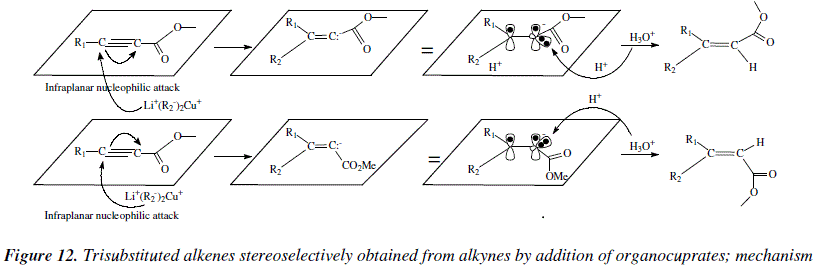
<body><![CDATA[<p align="center"><a name="f7"></a><img src="/img/revistas/rbq/v31n2/a05_figura09.gif" width="921" height="706"></p>     <p align="justify"><font face="Verdana" size="2">The <img src="/img/revistas/rbq/v31n2/a05_figura05.gif" width="13" height="17">-iodinated and <img src="/img/revistas/rbq/v31n2/a01_figura02.gif" width="12" height="17">-iodinated allylic alcohols are easily transformed by action of lithium dimethylcuprate over substrates to afford 2-, 3-alkylated allylic alcohols as shown in <a href="#f8">Figure 8</a>.</font></p>     <p align="center"><img src="/img/revistas/rbq/v31n2/a05_figura10.gif" width="890" height="296"></p>     <p align="justify"><font face="Verdana" size="2">This method found application in the stereo-specific C=C bond formation in the synthesis of trisubstituted derivatives. This was the case for the key step in the synthesis of the <i>dl-C18 Cecropia </i>juvenile hormone, as reviewed by W. Carruthers [3,6], <a href="#f9">Figure 9</a>.</font></p>     <p align="center"><a name="f9"></a><img src="/img/revistas/rbq/v31n2/a05_figura11.gif" width="822" height="153"></p>     <p align="justify"><font face="Verdana" size="2"><a href="#f10">Figure 10</a> is the mechanism corresponding to the key step in the synthesis of <i>dl-C18 Cecropia </i>juvenile hormone.</font></p>     <p align="center"><a name="f10"></a><img src="/img/revistas/rbq/v31n2/a05_figura12.gif" width="920" height="434"></p>     <p align="justify"><font face="Verdana" size="2">Organocopper and organoborane reagents are employed to obtain stereoselectively tri- and tetra-substituted alkenes by addition on alkynes [3,7]. Organocuprates lead to <img src="/img/revistas/rbq/v31n2/a01_figura02.gif" width="12" height="17"><img src="/img/revistas/rbq/v31n2/a01_figura02.gif" width="12" height="17">-dialkylacrylic esters by reaction with <img src="/img/revistas/rbq/v31n2/a05_figura13.gif" width="16" height="16"><img src="/img/revistas/rbq/v31n2/a01_figura02.gif" width="12" height="17">-acetylenic esters (<a href="#f11">Figure 11</a>) [3]. The structure of each stereoisomer depends on the temperature and the solvent [3]. High yield of <img src="/img/revistas/rbq/v31n2/a01_figura02.gif" width="12" height="17">,<img src="/img/revistas/rbq/v31n2/a01_figura02.gif" width="12" height="17">-dialkylacrylic ester is achieved at -78&deg;C in THF [3]. Contrasting with reactions employing propargyl alcohols, this reaction produces alkenes in which the substituents in the acetylenic precursor are <i>cis </i>to each other in the alkene [3].</font></p>     <p align="center"><a name="f11"></a><img src="/img/revistas/rbq/v31n2/a05_figura14.gif" width="935" height="138"></p>     <p align="justify"><font face="Verdana" size="2">The mechanistic views conducting to alkenes by this method are exposed in <a href="#f12">Figure 12</a>.</font></p>     ]]></body>
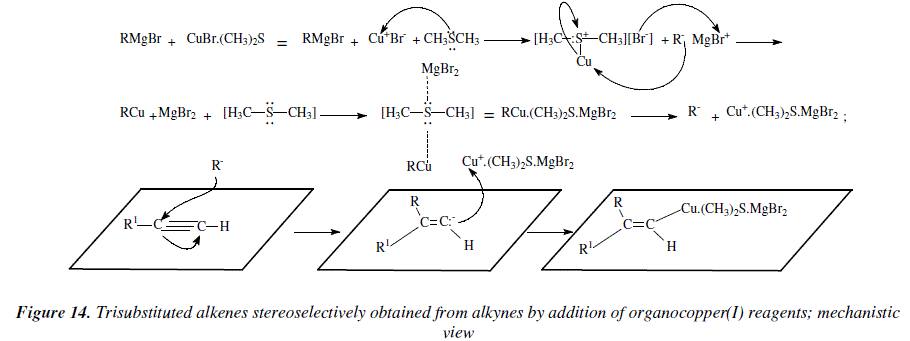
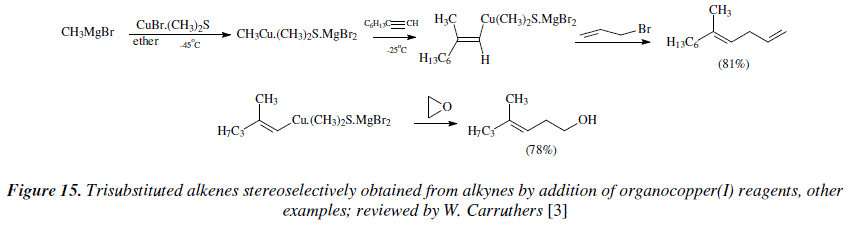
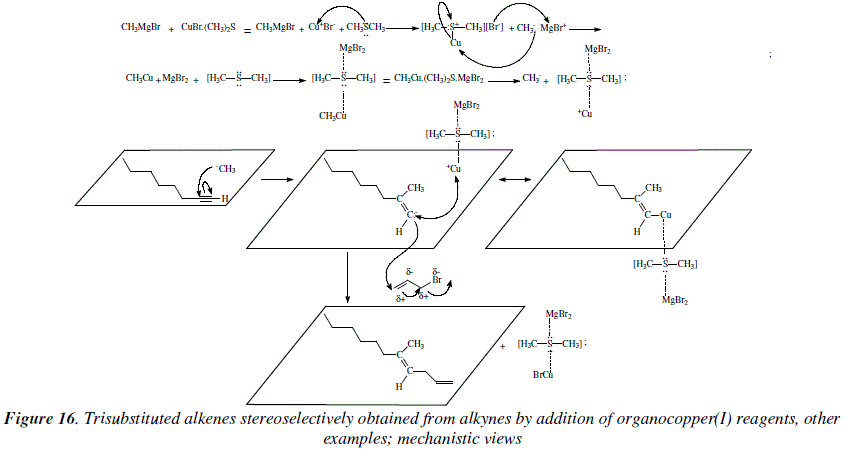
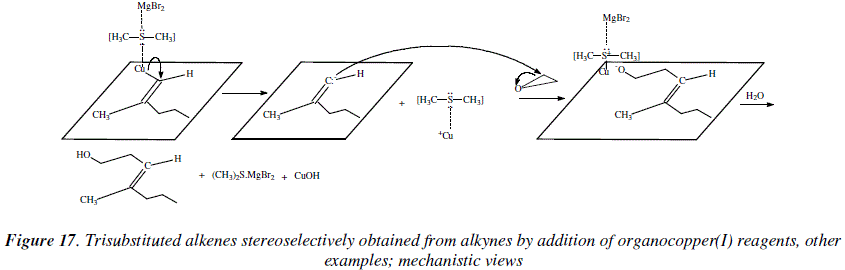
<body><![CDATA[<p align="center"><a name="f12"></a><img src="/img/revistas/rbq/v31n2/a05_figura15.gif" width="816" height="271"></p>     <p align="justify"><font face="Verdana" size="2">Organocopper(I) reagents add readily to terminal alkynes giving rise to 1-alkenylcopper(I) compounds [3]. These organocopper(I) reagents are RCu.Alkyl copper(I) compounds that can be obtained from Grignard reagents and an equimolar quantity of copper(I) bromide or copper(I) bromide-dimethylsulphide complex [3]. Copper adds to the alkyne on the terminal carbon, adding the alkyl group of the alkylcopper(I) reagent, in a <i>syn </i>manner [3]. This kind of products, alkenylcopper(I) compounds, react with electrophiles like alkyl halides, <img src="/img/revistas/rbq/v31n2/a05_figura13.gif" width="16" height="16"><img src="/img/revistas/rbq/v31n2/a01_figura02.gif" width="12" height="17">-unsaturated ketones and epoxides to afford trisubstituted alkenes with almost complete retention of configuration [3,7,8]. See <a href="#f13">Figure 13</a>. The elaborated mechanism is shown in <a href="#f14">Figure 14</a>.</font></p>     <p align="center"><a name="f13"></a><img src="/img/revistas/rbq/v31n2/a05_figura16.gif" width="891" height="112"></p>     <p align="center"><a name="f14"></a><img src="/img/revistas/rbq/v31n2/a05_figura17.gif" width="910" height="341"></p>     <p align="justify"><font face="Verdana" size="2">The method was employed as shown in the examples of <a href="#f15">Figure 15</a>.</font></p>     <p align="center"><a name="f15"></a><img src="/img/revistas/rbq/v31n2/a05_figura18.gif" width="848" height="225"></p>     <p align="justify"><font face="Verdana" size="2">The corresponding mechanistic views are exposed in <a href="#f16">Figures 16</a> and <a href="#f17">17</a>.</font></p>     <p align="center"><a name="f16"></a><img src="/img/revistas/rbq/v31n2/a05_figura19.gif" width="845" height="455"></p>     <p align="center"><a name="f17"></a><img src="/img/revistas/rbq/v31n2/a05_figura20.gif" width="845" height="270"></p>     <p align="justify"><font face="Verdana" size="2">Alkenyl iodides also react in the presence of Pd(PPh<sub>3</sub>) as catalyst to give conjugated dienes [3,9], <a href="#f18">Figure 18</a>.</font></p>     ]]></body>
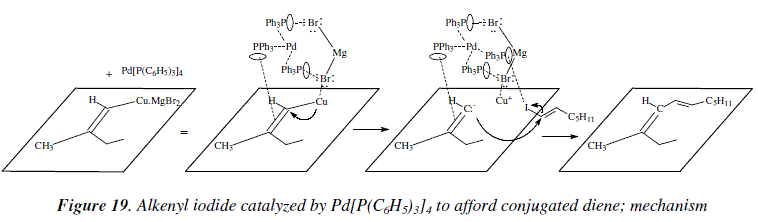
<body><![CDATA[<p align="center"><a name="f18"></a><img src="/img/revistas/rbq/v31n2/a05_figura21.gif" width="795" height="132"></p>     <p align="justify"><font face="Verdana" size="2">The corresponding mechanism is exposed in <a href="#f19">Figure 19</a>.</font></p>     <p align="center"><a name="f19"></a><img src="/img/revistas/rbq/v31n2/a05_figura22.gif" width="758" height="222"></p>     <p align="justify">&nbsp;</p>     <p align="justify"><font face="Verdana" size="3"><b>ACKNOWLEDGEMENTS</b></font></p>     <p align="justify"><font face="Verdana" size="2">Authors express their gratitude to Prof. Eduardo Palenque from the Physics Department, Universidad Mayor de San Andrés, for bibliographic support.</font></p>     <p align="justify">&nbsp;</p>     <p align="justify"><font face="Verdana" size="3"><b>REFERENCES</b></font></p>     <!-- ref --><p align="justify"><font face="Verdana" size="2">1.&nbsp; &nbsp; &nbsp;Bravo, J. <b>2005, </b><i>Bol. J. ofChem., 23, </i>1-10. (</font><a href="http://www.bolivianchemistyournal.org" target="_blank"><font size="2" face="Verdana">http://www.bolivianchemistyournal.org</font></a><font size="2" face="Verdana">, 2005).</font>&nbsp;&nbsp;&nbsp;&nbsp;&nbsp;&nbsp;&nbsp;&nbsp;[&#160;<a href="javascript:void(0);" onclick="javascript: window.open('/scielo.php?script=sci_nlinks&ref=684451&pid=S0250-5460201400020000500001&lng=','','width=640,height=500,resizable=yes,scrollbars=1,menubar=yes,');">Links</a>&#160;]<!-- end-ref --><!-- ref --><p align="justify"><font face="Verdana" size="2">2.&nbsp; &nbsp; &nbsp;Bravo, J.A., Mollinedo, P., Peñarrieta, J.M., Vila, J.L. <b>2013, </b><i>Bol. J. ofChem., 30, </i>24-41 (</font><font face="Verdana" size="2" color="#0000E4"><A href=http://www.bolivianchemistryjournal.org target="_blank">http://www.bolivianchemistryjournal.org</A></font><font face="Verdana" size="2">, 2013)</font>&nbsp;&nbsp;&nbsp;&nbsp;&nbsp;&nbsp;&nbsp;&nbsp;[&#160;<a href="javascript:void(0);" onclick="javascript: window.open('/scielo.php?script=sci_nlinks&ref=684452&pid=S0250-5460201400020000500002&lng=','','width=640,height=500,resizable=yes,scrollbars=1,menubar=yes,');">Links</a>&#160;]<!-- end-ref --><!-- ref --><p align="justify"><font face="Verdana" size="2">3.&nbsp; &nbsp; &nbsp;Carruthers, W. Some Modern Methods of Organic Synthesis, Cambridge University Press, 3<sup>rd</sup> ed., <b>1987, </b>Worcester, U.K., pp. 148-156.</font>&nbsp;&nbsp;&nbsp;&nbsp;&nbsp;&nbsp;&nbsp;&nbsp;[&#160;<a href="javascript:void(0);" onclick="javascript: window.open('/scielo.php?script=sci_nlinks&ref=684453&pid=S0250-5460201400020000500003&lng=','','width=640,height=500,resizable=yes,scrollbars=1,menubar=yes,');">Links</a>&#160;]<!-- end-ref --><!-- ref --><p align="justify"><font face="Verdana" size="2">4.&nbsp; &nbsp; &nbsp;Conforth, J.W., Conforth, R.H., Mathew, K.K. <b>1959, </b><i>J. Chem. Soc., </i>112.</font>&nbsp;&nbsp;&nbsp;&nbsp;&nbsp;&nbsp;&nbsp;&nbsp;[&#160;<a href="javascript:void(0);" onclick="javascript: window.open('/scielo.php?script=sci_nlinks&ref=684454&pid=S0250-5460201400020000500004&lng=','','width=640,height=500,resizable=yes,scrollbars=1,menubar=yes,');">Links</a>&#160;]<!-- end-ref --><!-- ref --><p align="justify"><font face="Verdana" size="2">5.&nbsp; &nbsp; &nbsp;Corey, E.J., Katzenellenbogen, J.A., Posner, G.H. <b>1967, </b><i>J. Am. Chem. Soc., 102, </i>1433.</font>&nbsp;&nbsp;&nbsp;&nbsp;&nbsp;&nbsp;&nbsp;&nbsp;[&#160;<a href="javascript:void(0);" onclick="javascript: window.open('/scielo.php?script=sci_nlinks&ref=684455&pid=S0250-5460201400020000500005&lng=','','width=640,height=500,resizable=yes,scrollbars=1,menubar=yes,');">Links</a>&#160;]<!-- end-ref --><!-- ref --><p align="justify"><font face="Verdana" size="2">6.&nbsp; &nbsp; &nbsp;Corey, E.J., Katzenellenbogen J.A., Gilman N.W., Roman, S.A., Erickson, B.W. <b>1968, </b><i>J. Am. Chem. Soc., 90, </i>5618.</font>&nbsp;&nbsp;&nbsp;&nbsp;&nbsp;&nbsp;&nbsp;&nbsp;[&#160;<a href="javascript:void(0);" onclick="javascript: window.open('/scielo.php?script=sci_nlinks&ref=684456&pid=S0250-5460201400020000500006&lng=','','width=640,height=500,resizable=yes,scrollbars=1,menubar=yes,');">Links</a>&#160;]<!-- end-ref --><!-- ref --><p align="justify"><font face="Verdana" size="2">7.&nbsp; &nbsp; &nbsp;Carruthers, W. In Comprehensive Organometallic Chemistry, eds. Wilkinson, G., Stone F.G.A., Abel, E.W., Vol. 7, Pergamon Press, <b>1982, </b>Oxford, U.K., pp. 716.</font>&nbsp;&nbsp;&nbsp;&nbsp;&nbsp;&nbsp;&nbsp;&nbsp;[&#160;<a href="javascript:void(0);" onclick="javascript: window.open('/scielo.php?script=sci_nlinks&ref=684457&pid=S0250-5460201400020000500007&lng=','','width=640,height=500,resizable=yes,scrollbars=1,menubar=yes,');">Links</a>&#160;]<!-- end-ref --><!-- ref --><p align="justify"><font face="Verdana" size="2">8.&nbsp; &nbsp; &nbsp;Marfat, A., McGuirk, P.R., Helquist, P. <b>1979, </b><i>J. Org. Chem., 44, </i>3888.</font>&nbsp;&nbsp;&nbsp;&nbsp;&nbsp;&nbsp;&nbsp;&nbsp;[&#160;<a href="javascript:void(0);" onclick="javascript: window.open('/scielo.php?script=sci_nlinks&ref=684458&pid=S0250-5460201400020000500008&lng=','','width=640,height=500,resizable=yes,scrollbars=1,menubar=yes,');">Links</a>&#160;]<!-- end-ref --><!-- ref --><p align="justify"><font face="Verdana" size="2">9.&nbsp; &nbsp; &nbsp;Jabri, N., Alexakis, A., Normant, J.F. <b>1982, </b><i>Tetraedron Lett. 23, </i>1589.</font>&nbsp;&nbsp;&nbsp;&nbsp;&nbsp;&nbsp;&nbsp;&nbsp;[&#160;<a href="javascript:void(0);" onclick="javascript: window.open('/scielo.php?script=sci_nlinks&ref=684459&pid=S0250-5460201400020000500009&lng=','','width=640,height=500,resizable=yes,scrollbars=1,menubar=yes,');">Links</a>&#160;]<!-- end-ref --><p align="justify">&nbsp;</p>      ]]></body><back>
<ref-list>
<ref id="B1">
<label>1</label><nlm-citation citation-type="book">
<person-group person-group-type="author">
<name>
<surname><![CDATA[Bravo]]></surname>
<given-names><![CDATA[J]]></given-names>
</name>
</person-group>
<source><![CDATA[]]></source>
<year>2005</year>
<page-range>1-10</page-range><publisher-name><![CDATA[Bol. J. ofChem]]></publisher-name>
</nlm-citation>
</ref>
<ref id="B2">
<label>2</label><nlm-citation citation-type="book">
<person-group person-group-type="author">
<name>
<surname><![CDATA[Bravo]]></surname>
<given-names><![CDATA[J.A]]></given-names>
</name>
<name>
<surname><![CDATA[Mollinedo]]></surname>
<given-names><![CDATA[P]]></given-names>
</name>
<name>
<surname><![CDATA[Peñarrieta]]></surname>
<given-names><![CDATA[J.M]]></given-names>
</name>
<name>
<surname><![CDATA[Vila]]></surname>
<given-names><![CDATA[J.L]]></given-names>
</name>
</person-group>
<source><![CDATA[]]></source>
<year>2013</year>
<page-range>24-41</page-range><publisher-name><![CDATA[Bol. J. ofChem]]></publisher-name>
</nlm-citation>
</ref>
<ref id="B3">
<label>3</label><nlm-citation citation-type="book">
<person-group person-group-type="author">
<name>
<surname><![CDATA[Carruthers]]></surname>
<given-names><![CDATA[W]]></given-names>
</name>
</person-group>
<source><![CDATA[Some Modern Methods of Organic Synthesis]]></source>
<year>1987</year>
<edition>3</edition>
<page-range>148-156</page-range><publisher-name><![CDATA[Cambridge University Press]]></publisher-name>
</nlm-citation>
</ref>
<ref id="B4">
<label>4</label><nlm-citation citation-type="book">
<person-group person-group-type="author">
<name>
<surname><![CDATA[Conforth]]></surname>
<given-names><![CDATA[J.W.]]></given-names>
</name>
<name>
<surname><![CDATA[Conforth]]></surname>
<given-names><![CDATA[R.H]]></given-names>
</name>
<name>
<surname><![CDATA[Mathew]]></surname>
<given-names><![CDATA[K.K]]></given-names>
</name>
</person-group>
<source><![CDATA[]]></source>
<year>1959</year>
<page-range>112</page-range><publisher-name><![CDATA[J. Chem. Soc]]></publisher-name>
</nlm-citation>
</ref>
<ref id="B5">
<label>5</label><nlm-citation citation-type="book">
<person-group person-group-type="author">
<name>
<surname><![CDATA[Corey]]></surname>
<given-names><![CDATA[E.J]]></given-names>
</name>
<name>
<surname><![CDATA[Katzenellenbogen]]></surname>
<given-names><![CDATA[J.A]]></given-names>
</name>
<name>
<surname><![CDATA[Posner]]></surname>
<given-names><![CDATA[G.H]]></given-names>
</name>
</person-group>
<source><![CDATA[]]></source>
<year>1967</year>
<page-range>1433</page-range><publisher-name><![CDATA[J. Am. Chem. Soc]]></publisher-name>
</nlm-citation>
</ref>
<ref id="B6">
<label>6</label><nlm-citation citation-type="book">
<person-group person-group-type="author">
<name>
<surname><![CDATA[Corey]]></surname>
<given-names><![CDATA[E.J]]></given-names>
</name>
<name>
<surname><![CDATA[Katzenellenbogen]]></surname>
<given-names><![CDATA[J.A]]></given-names>
</name>
<name>
<surname><![CDATA[Gilman]]></surname>
<given-names><![CDATA[N.W]]></given-names>
</name>
<name>
<surname><![CDATA[Roman]]></surname>
<given-names><![CDATA[S.A]]></given-names>
</name>
<name>
<surname><![CDATA[Erickson]]></surname>
<given-names><![CDATA[B.W]]></given-names>
</name>
</person-group>
<source><![CDATA[]]></source>
<year>1968</year>
<page-range>5618</page-range><publisher-name><![CDATA[J. Am. Chem. Soc]]></publisher-name>
</nlm-citation>
</ref>
<ref id="B7">
<label>7</label><nlm-citation citation-type="book">
<person-group person-group-type="author">
<name>
<surname><![CDATA[Carruthers]]></surname>
<given-names><![CDATA[W]]></given-names>
</name>
</person-group>
<source><![CDATA[In Comprehensive Organometallic Chemistry]]></source>
<year>1982</year>
<page-range>716</page-range><publisher-name><![CDATA[Pergamon Press]]></publisher-name>
</nlm-citation>
</ref>
<ref id="B8">
<label>8</label><nlm-citation citation-type="book">
<person-group person-group-type="author">
<name>
<surname><![CDATA[Marfat]]></surname>
<given-names><![CDATA[A]]></given-names>
</name>
<name>
<surname><![CDATA[McGuirk]]></surname>
<given-names><![CDATA[P.R]]></given-names>
</name>
<name>
<surname><![CDATA[Helquist]]></surname>
<given-names><![CDATA[P]]></given-names>
</name>
</person-group>
<source><![CDATA[]]></source>
<year>1979</year>
<page-range>3888</page-range><publisher-name><![CDATA[J. Org. Chem]]></publisher-name>
</nlm-citation>
</ref>
<ref id="B9">
<label>9</label><nlm-citation citation-type="book">
<person-group person-group-type="author">
<name>
<surname><![CDATA[Jabri]]></surname>
<given-names><![CDATA[N]]></given-names>
</name>
<name>
<surname><![CDATA[Alexakis]]></surname>
<given-names><![CDATA[A]]></given-names>
</name>
<name>
<surname><![CDATA[Normant]]></surname>
<given-names><![CDATA[J.F]]></given-names>
</name>
</person-group>
<source><![CDATA[]]></source>
<year>1982</year>
<page-range>1589</page-range><publisher-name><![CDATA[Tetraedron Lett]]></publisher-name>
</nlm-citation>
</ref>
</ref-list>
</back>
</article>