<?xml version="1.0" encoding="ISO-8859-1"?><article xmlns:mml="http://www.w3.org/1998/Math/MathML" xmlns:xlink="http://www.w3.org/1999/xlink" xmlns:xsi="http://www.w3.org/2001/XMLSchema-instance">
<front>
<journal-meta>
<journal-id>0250-5460</journal-id>
<journal-title><![CDATA[Revista Boliviana de Química]]></journal-title>
<abbrev-journal-title><![CDATA[Rev. Bol. Quim]]></abbrev-journal-title>
<issn>0250-5460</issn>
<publisher>
<publisher-name><![CDATA[Universidad Mayor de San Andrés]]></publisher-name>
</publisher>
</journal-meta>
<article-meta>
<article-id>S0250-54602013000200008</article-id>
<title-group>
<article-title xml:lang="en"><![CDATA[STUDIES ON BINARY COMPLEXES OF ZINC (II), CADMIUM (II) AND IRON (II) WITH NORVALINEIN SOLUTION]]></article-title>
</title-group>
<contrib-group>
<contrib contrib-type="author">
<name>
<surname><![CDATA[Tewari]]></surname>
<given-names><![CDATA[Brij B.]]></given-names>
</name>
<xref ref-type="aff" rid="A01"/>
</contrib>
</contrib-group>
<aff id="A01">
<institution><![CDATA[,University of Guyana Faculty of Natural Sciences Department of Chemistry]]></institution>
<addr-line><![CDATA[ ]]></addr-line>
</aff>
<pub-date pub-type="pub">
<day>00</day>
<month>00</month>
<year>2013</year>
</pub-date>
<pub-date pub-type="epub">
<day>00</day>
<month>00</month>
<year>2013</year>
</pub-date>
<volume>30</volume>
<numero>2</numero>
<fpage>153</fpage>
<lpage>155</lpage>
<copyright-statement/>
<copyright-year/>
<self-uri xlink:href="http://www.scielo.org.bo/scielo.php?script=sci_arttext&amp;pid=S0250-54602013000200008&amp;lng=en&amp;nrm=iso"></self-uri><self-uri xlink:href="http://www.scielo.org.bo/scielo.php?script=sci_abstract&amp;pid=S0250-54602013000200008&amp;lng=en&amp;nrm=iso"></self-uri><self-uri xlink:href="http://www.scielo.org.bo/scielo.php?script=sci_pdf&amp;pid=S0250-54602013000200008&amp;lng=en&amp;nrm=iso"></self-uri><abstract abstract-type="short" xml:lang="en"><p><![CDATA[A method involving the use of Paper Electrophorectic Technique (PET) is described for the study of binary complex system in solution . This method is based on the movement of a spot of metal ion in an electric field at various pHs of background electrolyte. A graph of pH versus mobility was used to obtain information on the binary complexes and to calculate its stability constants. The stability constants of Zn(II) - Norvaline, Cd(II) - Norvaline and Fe(II) -Norvaline complexes are found to be (4.68 ± 0.02, 2.82 ± 0.07), (4.32 ± 0.01, 2.89 ± 0.09) and (4.05 ± 0.02, 2.74 ± 0.05), respectively at ionic strength of 0.1 Mol L-1 and a temperature of 35°C.]]></p></abstract>
<kwd-group>
<kwd lng="en"><![CDATA[Paper electrophoretic technique]]></kwd>
<kwd lng="en"><![CDATA[binary complexes]]></kwd>
<kwd lng="en"><![CDATA[Norvaline]]></kwd>
<kwd lng="en"><![CDATA[Stability Constants]]></kwd>
</kwd-group>
</article-meta>
</front><body><![CDATA[ <p align="right"><b><font size="2" face="VERdana">ARTICULO ORIGINAL </font></b></p>     <p align="right">&nbsp;</p>     <p align="center"><font face="Verdana" size="4"><strong>STUDIES ON BINARY COMPLEXES OF ZINC (II), CADMIUM (II)     <br> AND IRON (II) WITH NORVALINEIN SOLUTION</strong></font></p>     <p align="center">&nbsp;</p>     <p align="center">&nbsp;</p>     <p align="center"><b><font face="Verdana" size="2"><i>Brij B.Tewari</i></font></b>    <br> <font face="Verdana" size="2">Department of Chemistry, Faculty of Natural Sciences, University of Guyana, P. O. Box: 101110, Georgetown, Guyana*    <br> Corresponding author: </font><font face="Verdana" size="2" color="#0000E4"><u><a href="mailto: irma-pardoter&aacute;n@hotmail.com">brijtew@yahoo.com</a></u></font><font size="2" face="VERdana"><b>    <br> Received</b>: 17 09 2013</font></p>     ]]></body>
<body><![CDATA[<p align="center">&nbsp;</p>     <p align="center">&nbsp;</p> <hr>     <p align="left"><font face="Verdana" size="2"><b>Keywords: </b><i>Paper electrophoretic technique, binary complexes, Norvaline, Stability Constants </i></font></p>     <p align="left"><font face="Verdana" size="2"><b>ABSTRACT</b></font></p>     <p align="justify"><font face="Verdana" size="2">A method involving the use of Paper Electrophorectic Technique (PET) is described for the study of binary complex system in solution . This method is based on the movement of a spot of metal ion in an electric field at various pHs of background electrolyte. A graph of pH versus mobility was used to obtain information on the binary complexes and to calculate its stability constants. The stability constants of Zn(II) - Norvaline, Cd(II) - Norvaline and Fe(II) -Norvaline complexes are found to be (4.68 &plusmn; 0.02, 2.82 &plusmn; 0.07), (4.32 &plusmn; 0.01, 2.89 &plusmn; 0.09) and (4.05 &plusmn; 0.02, 2.74 &plusmn; 0.05), respectively at ionic strength of 0.1 Mol L<sup>-1</sup> and a temperature of 35&deg;C.</font></p> <hr>     <p>&nbsp;</p>     <p>&nbsp;</p>     <p><font face="Verdana" size="3"><b>INTRODUCTION</b></font></p>     <p align="justify"><font face="Verdana" size="2">The role of binary and mixed - ligand complexes in biological processes is well known [1]. A significant development on the determination of stability constants of complexes were made by Jokl [2]. Banerjea classified iron and zinc as essential metals and cadmium as toxic metal [3]. Kiso [4] has done comprehensive study on paper electrophoretic migration of metal complexes. The zinc(II), cadmium(II) and iron (II) have significant biomedical applications but are toxic at higher concentration [5-7]. Novaline has several applications in biochemical system [8-9]. The electrophoretic technique usually suffers from number of defects [10], but technique in present work is free from all these defects. Publications [11, 12] from our laboratory described a new method for the study of metal complexes. A search of literature indicated few reports on Zn (II)/Cd (II) - norvaline complexes but no report on Fe(II) - norvaline complexes. In view of this, attempts were made to establish optimum conditions for metal(II) -norvaline complex formation. In addition, present paper describes an paper electrophoretic method for the determination of the stability constants of Zn(II)/Cd(II)/Fe(II) - norvaline complexes.</font></p>     <p>&nbsp;</p>     ]]></body>
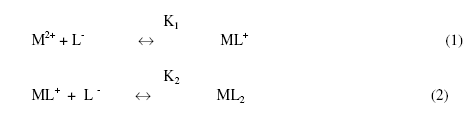
<body><![CDATA[<p><font face="Verdana" size="3"><b>RESULTS</b></font></p>     <p align="justify"><font face="Verdana" size="2">The ionophoretic mobility of metal spot against pH gives a curve with a number of plateaus is shown in Figure 1. The every plateau indicates the formation of a certain complex species. A plateau is obviously indication of pH range where speed is practically constant. The first one in the beginning corresponds to a region in which metal ions are uncomplexed. This region of low pH, concentration of [CH<sub>3</sub> CH<sub>2</sub> CH<sub>2</sub> CH (NH<sub>3</sub><sup>+</sup>) COOH] species of norvaline is maximum and this species is non-complexing. Beyond this range, metal ion spots have progressively decreasing mobility, complexation of metal ions should be taking place with anionic species of norvaline whose concentration increases progressively with the increase of pH. Figure 1 reveals that Zn(II), Cd(II) and Fe(II) metal ions form their first complex movement towards negative electrode. Hence one [CH<sub>3</sub> CH<sub>2</sub> CH<sub>2</sub> CH (NH<sub>2</sub>) COO-] must have combined with Zn(II), Cd(II) and Fe(II) metal ions to give [Zn {CH<sub>3</sub> CH<sub>2</sub> CH<sub>2</sub> CH (NH<sub>2</sub>) COO}]<sup>+</sup>, [Cd {CH<sub>3</sub> CH<sub>2 </sub>CH<sub>2</sub> CH (NH<sub>2</sub>) COO}] <sup>+</sup> and [Fe {CH<sub>3</sub> CH<sub>2</sub> CH<sub>2</sub> CH (NH<sub>2</sub> (COO}] <sup>+</sup> complex cation, respectively. With further increase of pH, mobility in both the metal ions decreases giving rise to third plateau with zero mobility </font><font face="Verdana" size="2">indicate its neutral nature. The third plateau in each case is due (1:2) metal - ligand complex. </font><font face="Verdana" size="2">Hence, two [CH<sub>3</sub> CH<sub>2</sub> CH<sub>2</sub> CH (NH<sub>2</sub>) COO-] must have combined with Zn(II), Cd(II) and Fe(II) metal ion to give. [Zn {CH<sub>3</sub> CH<sub>2</sub> CH<sub>2</sub> CH (NH<sub>2</sub>) COO}<sub>2</sub>], [Cd {CH<sub>3</sub> CH<sub>2</sub> CH<sub>2</sub> CH (NH<sub>2</sub>) COO}<sub>2</sub>] and [Fe {CH<sub>3</sub> CH<sub>2</sub> CH<sub>2</sub> CH (NH<sub>2</sub></font> <font face="Verdana" size="2">(COO}<sub>2</sub>] metal complexes. In view of above observation the complexation of metal ions with novaline anion [L-] may be represented as:</font></p>     <p align="center"><img src="/img/revistas/rbq/v30n2/a08_figura01.gif" width="475" height="117"></p>     <p align="justify"><font face="Verdana" size="2">Where M<sup>2+</sup> = Zn<sup>2+</sup>, Cd<sup>2+</sup> and Fe<sup>2+</sup> metal cations, [L<sup>-</sup>] = norvaline anion, K1 and K<sub>2</sub> first and second stability constant, respectively.</font></p>     <p align="justify"><font face="Verdana" size="2">The metal spot on the paper is thus a combination of uncomplexed metal ions, 1:1 complex and 1:2 complex. The spot is moving under the influence of electric field the overall mobility is given by equation.</font></p>     <p align="center"><img src="/img/revistas/rbq/v30n2/a08_figura02.gif" width="527" height="69"></p>     <p>&nbsp;</p>     <p align="justify"><font face="Verdana" size="2">Where u<sub>0</sub>, u<sub>1</sub> and u<sub>2</sub> = mobilities of uncomplexed metal ions, 1:1 and 1:2 metal complexes, respectively.</font></p>     <p align="justify"><font face="Verdana" size="2">Concentration of norvaline anion [L<sup>-</sup>] at pH of interest is calculated by using analytical concentration and dissociation constants of pure norvaline (k1 = 10<sup>2</sup>.<sup>31</sup>; k<sub>2</sub> = 10<sup>9</sup>.<sup>65</sup>). The concentration of chelating norvaline anion [L<sup>-</sup>] is calculated from equation,</font></p>     <p align="center"><img src="/img/revistas/rbq/v30n2/a08_figura03.gif" width="591" height="75"></p>     ]]></body>
<body><![CDATA[<p align="justify"><font face="Verdana" size="2">Where, [L<sub>T</sub>] = total concentration of norvaline (0.01 mol L<sup>-1</sup>), k1 and k<sub>2</sub> = first and second dissociation constant, respectively. The first stability constant (K1) = 1/[CH<sub>3</sub> CH<sub>2</sub> CH<sub>2</sub> CH (NH<sub>2</sub>) COO<sup>-</sup>].</font></p>     <p align="justify"><font face="Verdana" size="2">The second stability constant (K<sub>2</sub>) of second complex can be calculated by taking into consideration the region between second and third plateau of mobility curve. Their calculated values are given in Table 1.</font></p>     <p>&nbsp;</p>     <p><font face="Verdana" size="3"><b>DISCUSSION</b></font></p>     <p><font face="Verdana" size="2">Table 1 reveals that stability constant follows the order:</font></p>     <p align="center"><img src="/img/revistas/rbq/v30n2/a08_figura04.gif" width="366" height="22"></p>     <p align="justify"><font face="Verdana" size="2">The high stability constant values of the zinc(II) - norvaline complexes indicate strong bonding between the zinc(II) cation and norvaline anion in comparison to Cd(II) / Fe(II) - norvaline complexes. Strong bonding between zinc(II) - norvaline complexes may be ascribed to the greater affinity of zinc(II) for the oxygen donor ligands. According to standard deviation (statistics), the precision of the method is limited to that of paper electrophoresis, and uncertainty of the result is &plusmn; 2%. Hence, it cannot immediately replace the most reliable methods, even though it is a new approach deserving further development.</font></p>     <p align="justify"><font face="Verdana" size="2">It can be concluded from the present study that norvaline may be used to reduce the level of zinc(II), cadmium(II) and iron(II) in biological systems. The simple electrophoretic technique has thus proved to be helpful in deciding whether a mixed complex system is formed, and if it is formed its stability constants can readily be calculated. The stability constants of metal complexes can be very easily calculated by this technique, therefore the present method is advantageous over other methods (viz polargraphic, potentiometric, solubility, etc.).</font></p>     <p>&nbsp;</p>     <p><font face="Verdana" size="3"><b>EXPERIMENTAL</b></font></p>     ]]></body>
<body><![CDATA[<p><font face="Verdana" size="2"><i><b>Apparatus</b></i></font></p>     <p align="justify"><font face="Verdana" size="2">A systronics (Naroda, India) model 604, electrophoresis system was used. The details of apparatus are as described inliterature [11, 12].</font></p>     <p><font face="Verdana" size="2"><i><b>Chemicals</b></i></font></p>     <p align="justify"><font face="Verdana" size="2">Solutions of zinc(II), cadmium(II) and iron(II) perchlorate were prepared by preliminary precipitation of metal carbonates from 0.1 M solution of sodium carbonate (chemically pure grade, BDH, Poole, UK), which were washed with boiling water and treated with calculated amounts of 1% AR grade perchloric acid. These were boiled on a water bath and filtered. The metal contents of the filtrates were determined, and the final concentration was kept at 5.0 x 10<sup>-3</sup> M [13]. Metal spots were detected on the paper using dithizone in carbon tetrachloride for zinc(II) and 0.1% solution of 1 - (2 - pyridylazo) - 2 - naphthol (PAN) (E. Merck, Darmstadt, Germany) in ethanol was used for detecting the cadmium(II) and iron(II) metal ions. A 0.005 M glucose (BDH, AnalaR) solution was prepared in water and used as an electro-osmotic indicator for the correction due to electro - osmosis. A saturated aqueous solution (0.9 ml) of silver nitrate was diluted with acetone to 20 ML. Glucose was detected by spraying with this silver nitrate solution and then with 2% ethanolic sodium hydroxide, when a black spot was formed.</font></p>     <p><font face="Verdana" size="2"><i><b>Background electrolyte (BGE)</b></i></font></p>     <p align="justify"><font face="Verdana" size="2">The BGE in the present study consists of 0.1 M perchloric acid and 0.01 M norvaline stock solutions of standardized as usual. Stock solution of 9.0 M perchloric acid, 2.0 M sodium hydroxide and 0.5 M norvaline were prepared from AnalaR samples (BDH, Poole, UK)</font></p>     <p><font face="Verdana" size="2"><i><b>Procedure</b></i></font></p>     <p align="justify"><font face="Verdana" size="2">The hollow base plate in the instrument was made horizontal with a spirit level. A 150 mL volume of background electrolyte was placed in each tank of electrophoretic apparatus. Paper strips (Whatman No. 1, 30 x 1 cm) in triplicate were then spotted with 0.1 <i>\iL </i>metal ion solutions and glucose in the centre with a micropipette and were subsequently placed on the base and sandwiched under the upper hollow metallic plate with the ends of strips lying in the two sides of the tank solution. A 200 V potential difference was then applied between the tank solutions and electrophoresis was carried out for 1 h. Subsequently the strips were removed and the spots were detected. The average of triplicate strips was noted for calculations and the movement of the glucose spot was used as a correction factor. It was found that the variation in the movement was about &plusmn;2%. The mobilities were calculated by dividing the distance by the potential gradient and are expressed in cm<sup>2</sup> V<sup>-1</sup> min<sup>-1</sup></font></p>     <p>&nbsp;</p>     <p><font face="Verdana" size="3"><b>REFERENCES</b></font></p>     ]]></body>
<body><![CDATA[<!-- ref --><p><font face="Verdana" size="2">1.&nbsp; &nbsp; &nbsp;BECK, M. T. <i>Chemistry of Complex Equilibria. </i>London, Van Nastrand, 1970</font>&nbsp;&nbsp;&nbsp;&nbsp;&nbsp;&nbsp;&nbsp;&nbsp;[&#160;<a href="javascript:void(0);" onclick="javascript: window.open('/scielo.php?script=sci_nlinks&ref=682696&pid=S0250-5460201300020000800001&lng=','','width=640,height=500,resizable=yes,scrollbars=1,menubar=yes,');">Links</a>&#160;]<!-- end-ref --><!-- ref --><p><font face="Verdana" size="2">2.&nbsp; &nbsp; &nbsp;JOKL, V. <i>J. Chromatogr., </i>1964 ,<b>13, </b>71.</font>&nbsp;&nbsp;&nbsp;&nbsp;&nbsp;&nbsp;&nbsp;&nbsp;[&#160;<a href="javascript:void(0);" onclick="javascript: window.open('/scielo.php?script=sci_nlinks&ref=682697&pid=S0250-5460201300020000800002&lng=','','width=640,height=500,resizable=yes,scrollbars=1,menubar=yes,');">Links</a>&#160;]<!-- end-ref --><!-- ref --><p><font face="Verdana" size="2">3.&nbsp; &nbsp; &nbsp;BANERJEA, D. <i>Everyman's Sci. </i>1995, 29, 176.</font>&nbsp;&nbsp;&nbsp;&nbsp;&nbsp;&nbsp;&nbsp;&nbsp;[&#160;<a href="javascript:void(0);" onclick="javascript: window.open('/scielo.php?script=sci_nlinks&ref=682698&pid=S0250-5460201300020000800003&lng=','','width=640,height=500,resizable=yes,scrollbars=1,menubar=yes,');">Links</a>&#160;]<!-- end-ref --><!-- ref --><p><font face="Verdana" size="2">4.&nbsp; &nbsp; &nbsp;KISO, Y. <i>Zone Electrophoresis, </i>New Attempts of Ionics, Nankado, Japan, 1972.</font>&nbsp;&nbsp;&nbsp;&nbsp;&nbsp;&nbsp;&nbsp;&nbsp;[&#160;<a href="javascript:void(0);" onclick="javascript: window.open('/scielo.php?script=sci_nlinks&ref=682699&pid=S0250-5460201300020000800004&lng=','','width=640,height=500,resizable=yes,scrollbars=1,menubar=yes,');">Links</a>&#160;]<!-- end-ref --><!-- ref --><p><font face="Verdana" size="2">5.&nbsp; &nbsp; &nbsp;LINCOLNS, F. <i>Australian Biochemist, </i>2004, 35(3), 13.</font>&nbsp;&nbsp;&nbsp;&nbsp;&nbsp;&nbsp;&nbsp;&nbsp;[&#160;<a href="javascript:void(0);" onclick="javascript: window.open('/scielo.php?script=sci_nlinks&ref=682700&pid=S0250-5460201300020000800005&lng=','','width=640,height=500,resizable=yes,scrollbars=1,menubar=yes,');">Links</a>&#160;]<!-- end-ref --><!-- ref --><p><font face="Verdana" size="2">6.&nbsp; &nbsp; &nbsp;BERNARD, A. <i>Indian J. Med. Res. </i>2008,<b>128, </b>557.</font>&nbsp;&nbsp;&nbsp;&nbsp;&nbsp;&nbsp;&nbsp;&nbsp;[&#160;<a href="javascript:void(0);" onclick="javascript: window.open('/scielo.php?script=sci_nlinks&ref=682701&pid=S0250-5460201300020000800006&lng=','','width=640,height=500,resizable=yes,scrollbars=1,menubar=yes,');">Links</a>&#160;]<!-- end-ref --><!-- ref --><p><font face="Verdana" size="2">7.&nbsp; &nbsp; &nbsp;HE, X. <i>The Open Biomed. Eng. J., </i>2011, 5, 47.</font>&nbsp;&nbsp;&nbsp;&nbsp;&nbsp;&nbsp;&nbsp;&nbsp;[&#160;<a href="javascript:void(0);" onclick="javascript: window.open('/scielo.php?script=sci_nlinks&ref=682702&pid=S0250-5460201300020000800007&lng=','','width=640,height=500,resizable=yes,scrollbars=1,menubar=yes,');">Links</a>&#160;]<!-- end-ref --><!-- ref --><p><font face="Verdana" size="2">8.&nbsp; &nbsp; &nbsp;RYAN, A. J., GHUMAN, J., ZUNSJAIN, P. A., CHUANG, C., CURRY, S. <i>J. Struct. Biol. </i>2011,<b>174 </b>(1) 84.</font>&nbsp;&nbsp;&nbsp;&nbsp;&nbsp;&nbsp;&nbsp;&nbsp;[&#160;<a href="javascript:void(0);" onclick="javascript: window.open('/scielo.php?script=sci_nlinks&ref=682703&pid=S0250-5460201300020000800008&lng=','','width=640,height=500,resizable=yes,scrollbars=1,menubar=yes,');">Links</a>&#160;]<!-- end-ref --><!-- ref --><p><font face="Verdana" size="2">9.&nbsp; &nbsp; &nbsp;Ming X. - F., Rajapakse, A. G., Carvas J. M., Ruffieux J., Yang, Z <i>BMC Cardiovascular Disorder, </i>2009, 9 (12), 1.</font>&nbsp;&nbsp;&nbsp;&nbsp;&nbsp;&nbsp;&nbsp;&nbsp;[&#160;<a href="javascript:void(0);" onclick="javascript: window.open('/scielo.php?script=sci_nlinks&ref=682704&pid=S0250-5460201300020000800009&lng=','','width=640,height=500,resizable=yes,scrollbars=1,menubar=yes,');">Links</a>&#160;]<!-- end-ref --><!-- ref --><p><font face="Verdana" size="2">10.&nbsp; &nbsp;SHAW, D. J. <i>Electrophoresis, </i>Academic Press, London, 1969.</font>&nbsp;&nbsp;&nbsp;&nbsp;&nbsp;&nbsp;&nbsp;&nbsp;[&#160;<a href="javascript:void(0);" onclick="javascript: window.open('/scielo.php?script=sci_nlinks&ref=682705&pid=S0250-5460201300020000800010&lng=','','width=640,height=500,resizable=yes,scrollbars=1,menubar=yes,');">Links</a>&#160;]<!-- end-ref --><!-- ref --><p><font face="Verdana" size="2">11.&nbsp; &nbsp;TEWARI, B. B. <i>S. Afr. J. Chem. </i>2010, 63, 1.</font>&nbsp;&nbsp;&nbsp;&nbsp;&nbsp;&nbsp;&nbsp;&nbsp;[&#160;<a href="javascript:void(0);" onclick="javascript: window.open('/scielo.php?script=sci_nlinks&ref=682706&pid=S0250-5460201300020000800011&lng=','','width=640,height=500,resizable=yes,scrollbars=1,menubar=yes,');">Links</a>&#160;]<!-- end-ref --><!-- ref --><p><font face="Verdana" size="2">12.&nbsp; &nbsp;TEWARI, B. B. <i>J. Chem. Eng. Data, </i>2010, 55, 1779.</font>&nbsp;&nbsp;&nbsp;&nbsp;&nbsp;&nbsp;&nbsp;&nbsp;[&#160;<a href="javascript:void(0);" onclick="javascript: window.open('/scielo.php?script=sci_nlinks&ref=682707&pid=S0250-5460201300020000800012&lng=','','width=640,height=500,resizable=yes,scrollbars=1,menubar=yes,');">Links</a>&#160;]<!-- end-ref --><!-- ref --><p><font face="Verdana" size="2">13.&nbsp; &nbsp;KOLTHOF, L. M., BELCHER, R., <i>Volumetric Analysis, </i>Vol. 3, Interscience Publishers Inc. New York, USA, 1957.</font>&nbsp;&nbsp;&nbsp;&nbsp;&nbsp;&nbsp;&nbsp;&nbsp;[&#160;<a href="javascript:void(0);" onclick="javascript: window.open('/scielo.php?script=sci_nlinks&ref=682708&pid=S0250-5460201300020000800013&lng=','','width=640,height=500,resizable=yes,scrollbars=1,menubar=yes,');">Links</a>&#160;]<!-- end-ref --><!-- ref --><p><font face="Verdana" size="2">14.&nbsp; &nbsp;SILLEN, L. G., MARTELL, A. E. Stability Constants of Metal Ion Complexes, Special Publication No. 17, Chemical Society London, 1974, pp. 462-463.</font>&nbsp;&nbsp;&nbsp;&nbsp;&nbsp;&nbsp;&nbsp;&nbsp;[&#160;<a href="javascript:void(0);" onclick="javascript: window.open('/scielo.php?script=sci_nlinks&ref=682709&pid=S0250-5460201300020000800014&lng=','','width=640,height=500,resizable=yes,scrollbars=1,menubar=yes,');">Links</a>&#160;]<!-- end-ref --><p>&nbsp;</p>      ]]></body><back>
<ref-list>
<ref id="B1">
<label>1</label><nlm-citation citation-type="">
<person-group person-group-type="author">
<name>
<surname><![CDATA[BECK]]></surname>
<given-names><![CDATA[M. T.]]></given-names>
</name>
</person-group>
<source><![CDATA[Chemistry of Complex Equilibria]]></source>
<year>1970</year>
<publisher-loc><![CDATA[London ]]></publisher-loc>
</nlm-citation>
</ref>
<ref id="B2">
<label>2</label><nlm-citation citation-type="">
<person-group person-group-type="author">
<name>
<surname><![CDATA[JOKL]]></surname>
<given-names><![CDATA[V. J.]]></given-names>
</name>
</person-group>
<source><![CDATA[Chromatogr]]></source>
<year>1964</year>
<page-range>71</page-range></nlm-citation>
</ref>
<ref id="B3">
<label>3</label><nlm-citation citation-type="">
<person-group person-group-type="author">
<name>
<surname><![CDATA[BANERJEA]]></surname>
<given-names><![CDATA[D]]></given-names>
</name>
</person-group>
<source><![CDATA[Everyman's Sci]]></source>
<year>1995</year>
<page-range>29</page-range><page-range>176</page-range></nlm-citation>
</ref>
<ref id="B4">
<label>4</label><nlm-citation citation-type="">
<person-group person-group-type="author">
<name>
<surname><![CDATA[KISO]]></surname>
<given-names><![CDATA[Y]]></given-names>
</name>
</person-group>
<source><![CDATA[Zone Electrophoresis]]></source>
<year>1972</year>
</nlm-citation>
</ref>
<ref id="B5">
<label>5</label><nlm-citation citation-type="">
<person-group person-group-type="author">
<name>
<surname><![CDATA[LINCOLNS]]></surname>
<given-names><![CDATA[F]]></given-names>
</name>
</person-group>
<source><![CDATA[Australian Biochemist]]></source>
<year>2004</year>
<page-range>13</page-range></nlm-citation>
</ref>
<ref id="B6">
<label>6</label><nlm-citation citation-type="journal">
<person-group person-group-type="author">
<name>
<surname><![CDATA[BERNARD]]></surname>
<given-names><![CDATA[A]]></given-names>
</name>
</person-group>
<article-title xml:lang="en"><![CDATA[Indian]]></article-title>
<source><![CDATA[J. Med. Res.]]></source>
<year>2008</year>
<page-range>128</page-range><page-range>557</page-range></nlm-citation>
</ref>
<ref id="B7">
<label>7</label><nlm-citation citation-type="journal">
<person-group person-group-type="author">
<name>
<surname><![CDATA[HE]]></surname>
<given-names><![CDATA[X]]></given-names>
</name>
</person-group>
<article-title xml:lang="en"><![CDATA[The Open Biomed]]></article-title>
<source><![CDATA[Eng. J.]]></source>
<year>2011</year>
<page-range>5</page-range><page-range>47</page-range></nlm-citation>
</ref>
<ref id="B8">
<label>8</label><nlm-citation citation-type="journal">
<person-group person-group-type="author">
<name>
<surname><![CDATA[RYAN]]></surname>
<given-names><![CDATA[A. J.]]></given-names>
</name>
<name>
<surname><![CDATA[GHUMAN]]></surname>
<given-names><![CDATA[J]]></given-names>
</name>
<name>
<surname><![CDATA[ZUNSJAIN]]></surname>
<given-names><![CDATA[P. A.]]></given-names>
</name>
<name>
<surname><![CDATA[CHUANG]]></surname>
<given-names><![CDATA[C]]></given-names>
</name>
<name>
<surname><![CDATA[CURRY]]></surname>
<given-names><![CDATA[S]]></given-names>
</name>
</person-group>
<source><![CDATA[J. Struct. Biol.]]></source>
<year>2011</year>
<volume>174</volume>
<numero>1</numero>
<issue>1</issue>
<page-range>84</page-range></nlm-citation>
</ref>
<ref id="B9">
<label>9</label><nlm-citation citation-type="journal">
<person-group person-group-type="author">
<name>
<surname><![CDATA[Ming]]></surname>
<given-names><![CDATA[X. - F.]]></given-names>
</name>
<name>
<surname><![CDATA[Rajapakse]]></surname>
<given-names><![CDATA[A. G.]]></given-names>
</name>
<name>
<surname><![CDATA[Carvas]]></surname>
<given-names><![CDATA[J. M.]]></given-names>
</name>
<name>
<surname><![CDATA[Ruffieux]]></surname>
<given-names><![CDATA[J]]></given-names>
</name>
<name>
<surname><![CDATA[Yang]]></surname>
<given-names><![CDATA[Z]]></given-names>
</name>
</person-group>
<source><![CDATA[BMC Cardiovascular Disorder]]></source>
<year>2009</year>
<volume>9</volume>
<numero>12</numero>
<issue>12</issue>
<page-range>1</page-range></nlm-citation>
</ref>
<ref id="B10">
<label>10</label><nlm-citation citation-type="book">
<person-group person-group-type="author">
<name>
<surname><![CDATA[SHAW]]></surname>
<given-names><![CDATA[D. J.]]></given-names>
</name>
</person-group>
<source><![CDATA[Electrophoresis]]></source>
<year>1969</year>
<publisher-loc><![CDATA[London ]]></publisher-loc>
<publisher-name><![CDATA[Academic Press]]></publisher-name>
</nlm-citation>
</ref>
<ref id="B11">
<label>11</label><nlm-citation citation-type="journal">
<person-group person-group-type="author">
<name>
<surname><![CDATA[TEWARI]]></surname>
<given-names><![CDATA[B. B. S.]]></given-names>
</name>
</person-group>
<source><![CDATA[Afr. J. Chem.]]></source>
<year>2010</year>
<numero>63</numero>
<issue>63</issue>
<page-range>1</page-range></nlm-citation>
</ref>
<ref id="B12">
<label>12</label><nlm-citation citation-type="journal">
<person-group person-group-type="author">
<name>
<surname><![CDATA[TEWARI]]></surname>
<given-names><![CDATA[B. B.]]></given-names>
</name>
</person-group>
<source><![CDATA[J. Chem. Eng. Data]]></source>
<year>2010</year>
<page-range>1779</page-range></nlm-citation>
</ref>
<ref id="B13">
<label>13</label><nlm-citation citation-type="book">
<person-group person-group-type="author">
<name>
<surname><![CDATA[KOLTHOF]]></surname>
<given-names><![CDATA[L. M.]]></given-names>
</name>
<name>
<surname><![CDATA[BELCHER]]></surname>
<given-names><![CDATA[R]]></given-names>
</name>
</person-group>
<source><![CDATA[Volumetric Analysis]]></source>
<year>1957</year>
<publisher-loc><![CDATA[New York ]]></publisher-loc>
<publisher-name><![CDATA[Interscience Publishers Inc.]]></publisher-name>
</nlm-citation>
</ref>
<ref id="B14">
<label>14</label><nlm-citation citation-type="">
<person-group person-group-type="author">
<name>
<surname><![CDATA[SILLEN]]></surname>
<given-names><![CDATA[L. G.]]></given-names>
</name>
<name>
<surname><![CDATA[MARTELL]]></surname>
<given-names><![CDATA[A. E.]]></given-names>
</name>
</person-group>
<source><![CDATA[Stability Constants of Metal Ion Complexes]]></source>
<year>1974</year>
<page-range>462-463</page-range><publisher-loc><![CDATA[London ]]></publisher-loc>
</nlm-citation>
</ref>
</ref-list>
</back>
</article>


