<?xml version="1.0" encoding="ISO-8859-1"?><article xmlns:mml="http://www.w3.org/1998/Math/MathML" xmlns:xlink="http://www.w3.org/1999/xlink" xmlns:xsi="http://www.w3.org/2001/XMLSchema-instance">
<front>
<journal-meta>
<journal-id>0250-5460</journal-id>
<journal-title><![CDATA[Revista Boliviana de Química]]></journal-title>
<abbrev-journal-title><![CDATA[Rev. Bol. Quim]]></abbrev-journal-title>
<issn>0250-5460</issn>
<publisher>
<publisher-name><![CDATA[Universidad Mayor de San Andrés]]></publisher-name>
</publisher>
</journal-meta>
<article-meta>
<article-id>S0250-54602013000200006</article-id>
<title-group>
<article-title xml:lang="en"><![CDATA[METABOLITES FROM PRUMNOPITYS EXIGUA DE LAUBENF]]></article-title>
</title-group>
<contrib-group>
<contrib contrib-type="author">
<name>
<surname><![CDATA[Dávila]]></surname>
<given-names><![CDATA[Marcelo]]></given-names>
</name>
</contrib>
<contrib contrib-type="author">
<name>
<surname><![CDATA[Olov]]></surname>
<given-names><![CDATA[Sterner]]></given-names>
</name>
<xref ref-type="aff" rid="A01"/>
</contrib>
<contrib contrib-type="author">
<name>
<surname><![CDATA[Hinojosa]]></surname>
<given-names><![CDATA[Nelson]]></given-names>
</name>
<xref ref-type="aff" rid="A02"/>
</contrib>
</contrib-group>
<aff id="A01">
<institution><![CDATA[,Lund University aCentre for Analysis and Synthesis ]]></institution>
<addr-line><![CDATA[Lund Sweden]]></addr-line>
</aff>
<aff id="A02">
<institution><![CDATA[,bCentro de Tecnología Agroindustrial Facultad de Ciencias y Tecnología Universidad Mayor de San Simón]]></institution>
<addr-line><![CDATA[Cochabamba ]]></addr-line>
<country>Bolivia</country>
</aff>
<pub-date pub-type="pub">
<day>00</day>
<month>00</month>
<year>2013</year>
</pub-date>
<pub-date pub-type="epub">
<day>00</day>
<month>00</month>
<year>2013</year>
</pub-date>
<volume>30</volume>
<numero>2</numero>
<fpage>142</fpage>
<lpage>145</lpage>
<copyright-statement/>
<copyright-year/>
<self-uri xlink:href="http://www.scielo.org.bo/scielo.php?script=sci_arttext&amp;pid=S0250-54602013000200006&amp;lng=en&amp;nrm=iso"></self-uri><self-uri xlink:href="http://www.scielo.org.bo/scielo.php?script=sci_abstract&amp;pid=S0250-54602013000200006&amp;lng=en&amp;nrm=iso"></self-uri><self-uri xlink:href="http://www.scielo.org.bo/scielo.php?script=sci_pdf&amp;pid=S0250-54602013000200006&amp;lng=en&amp;nrm=iso"></self-uri><abstract abstract-type="short" xml:lang="en"><p><![CDATA[ABSTRACT A chemical investigation of the chloroform extract of the leaves of Prumnopitys exigua afforded two methylenedioxybenzene compounds. The structure and relative configuration of the isolated compounds, of which one is known and one is new, were established by NMR spectroscopy and HRMS.]]></p></abstract>
<abstract abstract-type="short" xml:lang="es"><p><![CDATA[RESUMEN La investigación química del extracto de cloroformo de las hojas de Prumnopitys exigua proporcionó dos compuestos metilenedioxibenzenicos. La estructura química y configuración relativa de los compuestos aislados fueron establecidas por espectroscopía de NMR y HRMS.]]></p></abstract>
<kwd-group>
<kwd lng="en"><![CDATA[Isoflavone]]></kwd>
<kwd lng="en"><![CDATA[lignan]]></kwd>
<kwd lng="en"><![CDATA[methylenedioxybenzene]]></kwd>
<kwd lng="en"><![CDATA[Prumnopitys exigua]]></kwd>
</kwd-group>
</article-meta>
</front><body><![CDATA[ <p align="right"><b><font size="2" face="VERdana">ARTICULO ORIGINAL </font></b></p>     <p align="center">&nbsp;</p>     <p align="center"><b><font face="VERdana" size="4">METABOLITES FROM <i>PRUMNOPITYS EXIGUA </i>DE LAUBENF</font></b></p>     <p align="center">&nbsp;</p>     <p align="center">&nbsp;</p>     <p align="center"><font face="VERdana" size="2"><i><b>Marcelo Dávila<sup>ab</sup> ; OlovSterner<sup>a</sup>; Nelson Hinojosa<sup>b,</sup> <sup>*</sup></b></i></font><b>    <br>     <font face="VERdana" size="2"><sup>a</sup>Centre for Analysis and Synthesis, Lund University, P.O. Box 124, SE-221 00, Lund, Sweden; <sup>b</sup>Centro de Tecnología Agroindustrial, Facultad de Ciencias y Tecnología, Universidad Mayor de San Simón, Cochabamba, Bolivia.</font></b>    <br> <font face="VERdana" size="2">*Corresponding author: </font><font face="VERdana" size="2" color="#0000E4"><u>hinojosanel@yahoo.com.ar</u></font>    <br> <font size="2" face="VERdana"><b>Received</b> 12 11 2013</font></p>     <p align="center">&nbsp;</p>     ]]></body>
<body><![CDATA[<p align="center">&nbsp;</p> <hr>     <p align="justify"><font face="Times New Roman" size="2"><b><font face="VERdana">Keywords: </font></b><font face="VERdana"><i>Isoflavone, lignan, methylenedioxybenzene, Prumnopitys exigua. </i></font></font></p>     <p align="justify"><font face="VERdana" size="2"><b>ABSTRACT</b></font></p>     <p align="justify"><font face="VERdana" size="2">A chemical investigation of the chloroform extract of the leaves of <i>Prumnopitys exigua </i>afforded two methylenedioxybenzene compounds. The structure and relative configuration of the isolated compounds, of which one is known and one is new, were established by NMR spectroscopy and HRMS.</font></p> <hr>     <p><font face="VERdana" size="2"><b>RESUMEN</b></font></p>     <p><font face="VERdana" size="2">La investigación química del extracto de cloroformo de las hojas de <i>Prumnopitys exigua </i>proporcionó dos compuestos metilenedioxibenzenicos. La estructura química y configuración relativa de los compuestos aislados fueron establecidas por espectroscopía de NMR y HRMS.</font></p> <hr>     <p>&nbsp;</p>     <p>&nbsp;</p>     <p><font face="VERdana" size="3"><b>INTRODUCTION</b></font></p>     <p align="justify"><font face="VERdana" size="2">Bolivia occupies 6% of the surface of South America. Its geographical position combined with the many different environments and landscapes has given Bolivia an extremely rich biodiversity. Bolivia is considered to be one of the most forest-rich countries of the world [1] and to have more than 20 000 species of plants [2], and it is estimated that between 20 and 25% of the plants from Bolivia are endemic [3]. As part of our interest in the secondary metabolites of Bolivian plants, a phytochemical investigation of <i>Prumnopitys exigua </i>was performed. <i>P.exigua </i>is a conifer evergreen tree belonging to the Podocarpaceae family, it grows in the Sub-Andean Amazonian Forest and is known as &quot;pino colorado&quot; by the natives of the region [4, 5]. The only current known use is as energy source and timber [6, 7], and literature survey showed that no phytochemical study of this plant was ever reported. From a chloroform extract of the leaves two methylendioxybenzene derivatives were isolated, and characterized by spectroscopic techniques.</font></p>     ]]></body>
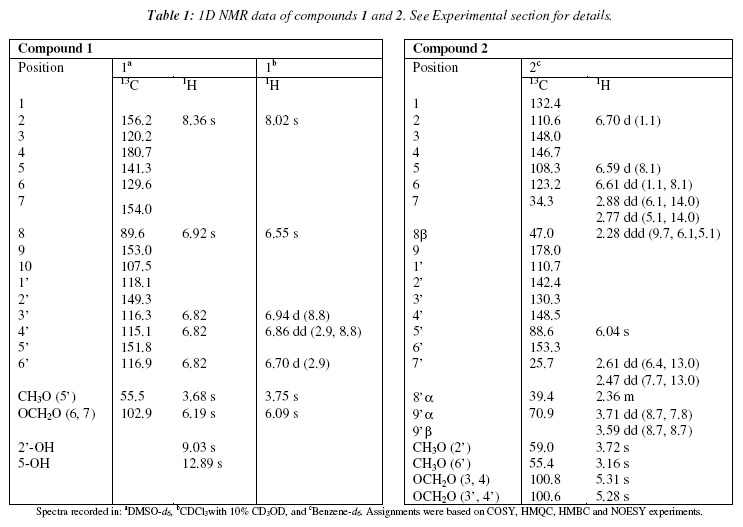
<body><![CDATA[<p>&nbsp;</p>     <p><font face="VERdana" size="3"><b>RESULTS AND DISCUSSION</b></font><font face="VERdana" size="2"><b></b></font></p>     <p align="justify"><font face="VERdana" size="2">The structures of compounds 1 and 2 (<a href="#f1">Figure 1</a>) were elucidated by <sup>1</sup>H NMR and <sup>13</sup>C NMR spectra and 2D COSY, NOESY, HMQC and HMBC experiments, as well as by HRMS-ESI experiments.</font></p>     <p align="justify"><font face="VERdana" size="2">Compound 1 was isolated as a yellow powder. The HRMS-ESI and the 1D NMR data established that the elemental composition of 1 is C1<sub>7</sub>H1<sub>2</sub>O<sub>7</sub>, and that it has twelve degrees of unsaturation. The <sup>1</sup>H NMR spectrum recorded in <i>DMSO-d<sub>6</sub> </i>(see Table 1 for 1D NMR data) displays a singlet at 5 8.36, that is characteristic for 2-H in an isoflavone [8, 9]. This gives HMBC correlations to C-4, C-9 and C-1'. The sharp signal at 5 12.89 is a chelated hydroxyl proton, a common proton signal of 5-hydroxyisoflavones [10], assigned as 5-OH by the HMBC correlations from the hydroxyl proton to C-5, C-6 and C-10. A sharp singlet at 5 6.19 integrating for two protons attached to the carbon at 5 102.9, was attributed to a methylenedioxy group [11, 12]. The HMBC correlations between these protons and C-6 as well as C-7 establish the position of the methylenedioxygroup. The singlet at 5 6.92 represents consequently the only aromatic proton in ring A, its position at C-8 was demonstrated by the HMBC couplings from 8-H to C-6, C-7, C-9 and C-10. With the above-mentioned HMBC correlation between 2-H and C-9, the chromenone part of the molecule is now established, and C-1' must be part of the B-ring. This contains three aromatic protons, which signals unfortunately overlap at 5 6.82 in the 1H NMR spectrum recorded in <i>DMSO-d<sub>6</sub>, </i>a methoxy group (5 3.68) and a hydroxyl group (exchangeable proton at 5 9.03). HMBC correlations were observed between the hydroxy proton and</font> <font face="VERdana" size="2">C-1', C-2' and C-3', demonstrating that the hydroxylated B-ring carbon is next to C-1'. The methoxy protons give a long-range correlation to C-5'. Additional information was obtained from the <sup>1</sup>H NMR spectrum recorded in chloroform-d with 10% methanol-d4 (Table 1), as the spectrum allowed the identification of the aromatic spin system of the B-ring. Besides the singlet assigned to C-8, the three proton signals of the B-ring are now resolved at 5 6.86 (1H, dd, J=8.8 and 2.9 Hz), 5 6.94 (1H, d, J=8.8 Hz), and 5 6.70 (1H, d, J=2.9;Hz). The B-ring is consequently 1,2,5-trisubstituted, and a NOESY correlation between 2-H and 5 6.70 (6'-H) determines the B-ring as shown in Figure 1. In addition, NOESY correlations between the methoxy protons and 4'-H as well as 6'-H confirm the suggested structure of compound 1. 1 is consequently the isoflavone 5,2'-dihydroxy-5'-methoxy-6,7-methylenedioxy isoflavone (tetranin B), that recently was reported from <i>Salsola tetrandra </i>[13].</font></p>     <p align="center"><a name="f1"></a><img src="/img/revistas/rbq/v30n2/a06_figura01.gif" width="471" height="244"></p>     <p align="center">&nbsp;</p>     <p align="justify"><font face="VERdana" size="2">Compound 2 was isolated as a yellowish oil. The HRMS-ESI suggested that the elemental composition is C22H22O8 which was confirmed by <sup>1</sup>H NMR and <sup>13</sup>C NMR data (see <a href="#t1">Table 1</a>) displaying signals for 22 protons and 22 carbons, and 2 consequently has twelve degrees of unsaturation. The ATR-IR spectrum suggested the presence of a y-lactone (1767 cm-<sup>1</sup>) and a methylenedioxy group (932 cm<sup>-1</sup>). The NMR data show that 2 in fact have two methylenedioxy groups, with two singlets at 5 5.28 and 5.31 both integrating for two protons and correlated with the carbon signals at 5 100.6 and 100.8 in the HMQC spectrum. The NMR data also suggest the presence of six carbon-carbon double bonds, or two benzene rings, and one carbonyl group, which makes 2 pentacyclic, as well as two methoxy groups, three additional methylene groups, and two saturated methine groups.</font></p>     <p align="justify"><font face="VERdana" size="2">The methylenedioxy moiety giving rise to the<sup>1</sup>H NMR signal at 5.31 ppm (2H, m; 5<sub>C</sub> 100.8) is attached to an aromatic ring, specifically to C-3 and C-4, which was demonstrated by HMBC correlations. Three of the unsaturated protons, 2-H, 5-H and 6-H, are obviously part of an aromatic spin system, as indicated by the <i><sup>1</sup>H-1H </i>coupling constants as well as the COSY correlations. Both 2-H and 6-H give HMBC signals to the benzylic carbon <i>C-7, </i>while 7-H<sub>2</sub> give HMBC correlations to C-1, C-2 and C-6. Additional HMBC correlations from 6-H to C-2 and C-4, from 2-H to C-3, C-4 and C-6, and from 5-H to C-1, C-3 and C-4 determine the structure of the first benzene. The <sup>1</sup>H spin system 7-H<sub>2</sub> - 8-H - 8'-H - 7'-H<sub>2</sub> and 9'-H<sub>2</sub> is demonstrated by the COSY correlations as well as the <i><sup>1</sup>H-<sup>1</sup>H </i>coupling constants. C-9' (8<sub>C</sub> 70.9) is oxygenated and the HMBC correlations from 9'-H<sub>2</sub> to the carbonyl group C-9 as well as from 7-H<sub>2</sub>, 8-H and 8'-H to C-9 settle this part of the molecule as a lactone. Also the second methylenedioxy group at 5 5.28 (2H, m; 5<sub>C</sub> 100.6) is located at an aromatic ring attached to C-3' and C-4'. 7'-H<sub>2</sub> give HMBC correlations to C-1', C-2' and C-6' while the protons of the two methoxy groups give HMBC correlations to C-2' and C-6'. 5'-H gives HMBC correlations with C-1', C-3', C-4' and C-6', and C-3', C-4' and C-5' are consequently the remaining constituents of the second benzene.</font></p>     <p align="justify"><font face="VERdana" size="2">The relative configuration at the lactone ring was assigned by the analysis of the NOESY correlations. Strong correlations were observed from 7'-H<sub>2</sub> to 9'-H(3 and 8-H(3 protons, favoring the trans configuration. Additionally, correlations between 7-H<sub>2</sub> and 8'-Ha, and from H-2/H-6 to 8'-Ha were observed, suggesting again the <i>trans </i>configuration. The absence of a NOESY correlation between 7-H<sub>2</sub> and 7'-H<sub>2</sub> (as expected in a <i>cis </i>configuration) confirmed the <i>trans </i>configuration. Consequently, the structure of compound 2 was shown to be (8(3,8'a)-3,4:3',4'-bis-methylendioxy-2',6' dimethoxy lignano-9,9'-lactone, a new natural product.</font></p>     <p align="center"><a name="t1"></a><img src="/img/revistas/rbq/v30n2/a06_figura02.gif" width="743" height="527"></p>     ]]></body>
<body><![CDATA[<p align="center">&nbsp;</p>     <p align="justify"><font face="VERdana" size="3"><b>EXPERIMENTAL</b></font></p>     <p align="justify"><font face="VERdana" size="2"><i>General experimental procedures</i></font></p>     <p align="justify"><font face="VERdana" size="2">The optical rotation was measured with a Perkin-Elmer 341 polarimeter at 20&deg;C. The ATR-IR spectrum was obtained with a Bruker-Alpha-P spectrometer. The HRMS-ESI spectra were recorded with a Waters Q-TOF Micro system, using H<sub>3</sub>PO<sub>4</sub> for calibration and as internal standard. <sup>1</sup>H NMR (500 MHz) and <sup>13</sup>C NMR (125 MHz) as well as 2D spectra were measured with a Bruker DRX500 spectrometer; in DMSO-d<sub>6</sub> (solvent residual signals at 52.50 and 39.52), in mixture of 10% methanol-d<sub>4</sub> in chloroform-d (solvent residual signals at 5 7.26 and 77.16) and in benzene-d<sub>6</sub> (solvent residual signals at 5 7.16 and 128.06). Chemical shift (5) are given in ppm, and coupling constants <i>(J) </i>in Hertz. Vacuum liquid chromatography (VLC) was carried out using TLC grade silica gel (Merck), while column chromatography (CC) was run on silica gel 60 (230-400 mesh, Merck). TLC analyses were carried out on silica gel GF<sub>2</sub>5<sub>4</sub> pre-coated plates (Merck); chromatograms were visualized under a UV lamp (254 nm) and by spraying with vanillin (6%)-sulfuric acid (1.5%)-ethanol solution, followed by heating.</font></p>     <p align="justify"><font face="Times New Roman" size="2"><i><font face="VERdana">Plant material</font></i></font></p>     <p align="justify"><font face="VERdana" size="2">The whole aerial part of <i>Prumnopitys exigua </i>de Laubenf was collected in April 2010 at the region of &quot;Monte Punco&quot;, which belongs to the Carrasco province, this region is located at 2930 meters above sea level, and 180 km to the south of Cochabamba city (Bolivia). The collecting and identification of the plant was made by Lic. Modesto Zárate, a research scientist at the National Herbarium &quot;Herbario Nacional Martin Cardenas&quot; (Cochabmba-Bolivia). A voucher specimen (MZ-3336) has been stored at the &quot;Herbario Nacional Martin Cardenas&quot;.</font></p>     <p align="justify"><font face="VERdana" size="2"><i>Extraction and isolation</i></font></p>     <p align="justify"><font face="VERdana" size="2">The air-dried powdered plant material (200g) was successively extracted with hexane during 12 h and subsequently with chloroform for another 12 h, at room temperature. The extracts were concentrated under reduced pressure. Part of the chloroform extract (2.5g) was submitted to VLC on silica gel eluted with a stepwise gradient of heptane-ethyl acetate (90:10, 80:20 and 70:30) to afford six main fractions (1-6). Fraction 6 was submitted to VLC eluted with toluene-ethyl acetate (30:1 and 90:10) to give ten subfractions (A-J). Subfraction D was precipitated with methanol to give a yellow precipitate to yield compound 1 (3mg). Subfraction A (250mg) was subjected to VLC using mixtures of heptane-ethyl acetate (30:1, 90:10 and 80:20) to give 3 fractions. The third of these (60 mg) was filtered through a mixture of silica gel and activated charcoal (100:3), and eluted with toluene-ethyl acetate (80:20) to give two fractions, of which the first fraction was subjected to CC eluted with heptane-ethyl acetate (80:20) to give five fractions. Fraction 5 consisted of pure compound 2 (6 mg).</font></p>     <p align="justify"><font face="VERdana" size="2"><i>5,2'-dihydroxy-5'-methoxy-6,7-methylenedioxy isoflavone </i>1. Compound 1 was obtained as an yellowish powder; mp 218-220 <sup>&deg;</sup>C.1H (at 500 MHz) and <sup>13</sup>C NMR (at 125 MHz) 1D NMR data are shown in Table 1. HRMS-ESI, calculated for C1<sub>7</sub>H<sub>12</sub>O<sub>7</sub> (M+H)<sup>+</sup>: 329.0661. Found: 329.0659.</font></p>     <p align="justify"><font face="VERdana" size="2"><i>(8j3,8'ce)-3,4:3',4' -bis-methylendioxy-2',6' dimethoxy lignano-9,9'-lactone 2. </i>Compound 2 was obtained as an yellowish oil; [oc]<sub>D</sub><sup>20</sup> -29 (c 0.22, CHCl<sub>3</sub>); ATR-IR v&#094; (cm-<sup>1</sup>): 932, 1039, 1075, 1124,1192, 1247,1445, 1482, 1629, 1767, 2778, 2909; 1H (at 500 MHz) and <sup>13</sup>C NMR (at 125 MHz) 1D NMR data are shown in Table 1. HRMS-ESI, calculated for C22H22O8 (M+H)<sup>+</sup>: 415.1393. Found: 415.1373.</font></p>     ]]></body>
<body><![CDATA[<p align="justify">&nbsp;</p>     <p align="justify"><font face="VERdana" size="3"><b>ACKNOWLEDGMENTS</b></font></p>     <p align="justify"><font face="VERdana" size="2">The authors gratefully acknowledge financial support from Swedish International Development Cooperation Agency (SIDA). We thank Lic. Modesto Zárate at the National Herbarium &quot;Herbario Nacional Martin Cardenas, for the taxonomic determination of the plant material.</font></p>     <p align="justify">&nbsp;</p>     <p align="justify"><b><font face="VERdana" size="3">REFERENCES</font></b></p>     <!-- ref --><p align="justify"><font face="VERdana" size="2">[I]&nbsp; &nbsp;IBISCH, P. L.</font> <font face="VERdana" size="2"><i>Bolivia is a megadiversity country and developing country. </i>1998, Springer, Berlin, p 215.</font>&nbsp;&nbsp;&nbsp;&nbsp;&nbsp;&nbsp;&nbsp;&nbsp;[&#160;<a href="javascript:void(0);" onclick="javascript: window.open('/scielo.php?script=sci_nlinks&ref=682394&pid=S0250-5460201300020000600001&lng=','','width=640,height=500,resizable=yes,scrollbars=1,menubar=yes,');">Links</a>&#160;]<!-- end-ref --><!-- ref --><p align="justify"><font face="VERdana" size="2">[2] IBISCH, P. L., BECK, S. G.</font> <font face="VERdana" size="2"><i>Espermatófitas. </i>2003, Editorial FAN, Santa Cruz de la Sierra, Bolivia, p 103.</font>&nbsp;&nbsp;&nbsp;&nbsp;&nbsp;&nbsp;&nbsp;&nbsp;[&#160;<a href="javascript:void(0);" onclick="javascript: window.open('/scielo.php?script=sci_nlinks&ref=682395&pid=S0250-5460201300020000600002&lng=','','width=640,height=500,resizable=yes,scrollbars=1,menubar=yes,');">Links</a>&#160;]<!-- end-ref --><!-- ref --><p align="justify"><font face="VERdana" size="2">[3] ARAUJO, N., MÜLLER, R., NOWICKI, C., IBISCH, P.</font> <font face="Times New Roman" size="2"><i><font face="VERdana">Análisis de Vacios de Representitividad del Sistema Nacional de Areas Protegidas. </font></i><font face="VERdana">2005, Fundación Amigos de la Naturaleza (FAN).Asociación</font></font> <font face="VERdana" size="2">Boliviana para la Conservación (TROPICO). Centro de Estudios y Proyectos (CEP). Agencia Nórdica para el Desarrollo y la Ecología, La Paz.</font>&nbsp;&nbsp;&nbsp;&nbsp;&nbsp;&nbsp;&nbsp;&nbsp;[&#160;<a href="javascript:void(0);" onclick="javascript: window.open('/scielo.php?script=sci_nlinks&ref=682396&pid=S0250-5460201300020000600003&lng=','','width=640,height=500,resizable=yes,scrollbars=1,menubar=yes,');">Links</a>&#160;]<!-- end-ref --><!-- ref --><p align="justify"><font face="VERdana" size="2">[4] ZÁRATE, M., GOITIA, D., LAZARTE, G.</font> <font face="VERdana" size="2">Revista Boliviana de Ecología y Conservación Ambiental, 1999, 5, 51.</font>&nbsp;&nbsp;&nbsp;&nbsp;&nbsp;&nbsp;&nbsp;&nbsp;[&#160;<a href="javascript:void(0);" onclick="javascript: window.open('/scielo.php?script=sci_nlinks&ref=682397&pid=S0250-5460201300020000600004&lng=','','width=640,height=500,resizable=yes,scrollbars=1,menubar=yes,');">Links</a>&#160;]<!-- end-ref --><!-- ref --><p align="justify"><font face="VERdana" size="2">[5] MERCADO, M.</font> <font face="VERdana" size="2">Revista Boliviana de Ecología y Conservación Ambiental, 1998, 4, 55.</font>&nbsp;&nbsp;&nbsp;&nbsp;&nbsp;&nbsp;&nbsp;&nbsp;[&#160;<a href="javascript:void(0);" onclick="javascript: window.open('/scielo.php?script=sci_nlinks&ref=682398&pid=S0250-5460201300020000600005&lng=','','width=640,height=500,resizable=yes,scrollbars=1,menubar=yes,');">Links</a>&#160;]<!-- end-ref --><!-- ref --><p align="justify"><font face="VERdana" size="2">[6] CÁRDENAS, M.</font> <font face="VERdana" size="2">Revista de Agricultura de Ciencias Agropecuarias -UMSS., 1968, (11), 15.</font>&nbsp;&nbsp;&nbsp;&nbsp;&nbsp;&nbsp;&nbsp;&nbsp;[&#160;<a href="javascript:void(0);" onclick="javascript: window.open('/scielo.php?script=sci_nlinks&ref=682399&pid=S0250-5460201300020000600006&lng=','','width=640,height=500,resizable=yes,scrollbars=1,menubar=yes,');">Links</a>&#160;]<!-- end-ref --><!-- ref --><p align="justify"><font face="VERdana" size="2">[7] VARGAS, I., LAWRENCE, A., OTAZU, M. E.</font> <font face="VERdana" size="2"><i>Arboles y arbustos para sistemas agroforestales en los Valles Interandinos de Santa Cruz, Bolivia, guía de campo., </i>2000, Editorial FAN, Santa</font> <font face="VERdana" size="2">Cruz de la Sierra, Bolivia, p 136.</font>&nbsp;&nbsp;&nbsp;&nbsp;&nbsp;&nbsp;&nbsp;&nbsp;[&#160;<a href="javascript:void(0);" onclick="javascript: window.open('/scielo.php?script=sci_nlinks&ref=682400&pid=S0250-5460201300020000600007&lng=','','width=640,height=500,resizable=yes,scrollbars=1,menubar=yes,');">Links</a>&#160;]<!-- end-ref --><!-- ref --><p align="justify"><font face="VERdana" size="2">[8] SINGH, S., PANDEY, V. B., SINGH, T. D.</font> <font face="VERdana" size="2">Natural Product Research, 2011, 26, 16.</font>&nbsp;&nbsp;&nbsp;&nbsp;&nbsp;&nbsp;&nbsp;&nbsp;[&#160;<a href="javascript:void(0);" onclick="javascript: window.open('/scielo.php?script=sci_nlinks&ref=682401&pid=S0250-5460201300020000600008&lng=','','width=640,height=500,resizable=yes,scrollbars=1,menubar=yes,');">Links</a>&#160;]<!-- end-ref --><!-- ref --><p align="justify"><font face="VERdana" size="2">[9] NAZIR, N., KOUL, S., AHMAD QURISHI, M., CHANDRA TANEJA, S., PURNIMA, B., NABIQAZI, G.</font> <font face="VERdana" size="2">J. Asian Nat. Prod. Res., 2008,10, 1137.</font>&nbsp;&nbsp;&nbsp;&nbsp;&nbsp;&nbsp;&nbsp;&nbsp;[&#160;<a href="javascript:void(0);" onclick="javascript: window.open('/scielo.php?script=sci_nlinks&ref=682402&pid=S0250-5460201300020000600009&lng=','','width=640,height=500,resizable=yes,scrollbars=1,menubar=yes,');">Links</a>&#160;]<!-- end-ref --><!-- ref --><p align="justify"><font face="VERdana" size="2">[10]    UMEHARA, K., NEMOTO, K., MATSUSHITA, A., TERADA, E., MONTHAKANTIRAT, O., DE-EKNAMKUL, W., MIYASE, T.,</font> <font face="VERdana" size="2">WARASHINA, T., DEGAWA, M., NOGUCHI, H.</font> <font face="VERdana" size="2">J. Nat. Prod., 2009, 72, 2163.</font>&nbsp;&nbsp;&nbsp;&nbsp;&nbsp;&nbsp;&nbsp;&nbsp;[&#160;<a href="javascript:void(0);" onclick="javascript: window.open('/scielo.php?script=sci_nlinks&ref=682403&pid=S0250-5460201300020000600010&lng=','','width=640,height=500,resizable=yes,scrollbars=1,menubar=yes,');">Links</a>&#160;]<!-- end-ref --><!-- ref --><p align="justify"><font face="VERdana" size="2">[11]&nbsp; &nbsp;IBRAHIM, S. R. M., MOHAMED, G. A., AL-MUSAYEIB, N. M. Molecules, 2012,17, 2587.</font>&nbsp;&nbsp;&nbsp;&nbsp;&nbsp;&nbsp;&nbsp;&nbsp;[&#160;<a href="javascript:void(0);" onclick="javascript: window.open('/scielo.php?script=sci_nlinks&ref=682404&pid=S0250-5460201300020000600011&lng=','','width=640,height=500,resizable=yes,scrollbars=1,menubar=yes,');">Links</a>&#160;]<!-- end-ref --><!-- ref --><p align="justify"><font face="VERdana" size="2">[12] WOLLENWEBER, E., STEVENS, J. F., KLIMO, K., KNAUFT, J., FRANK, N., GERHÄUSER, C.</font> <font face="VERdana" size="2">Planta Med, 2003,69, 15.</font>&nbsp;&nbsp;&nbsp;&nbsp;&nbsp;&nbsp;&nbsp;&nbsp;[&#160;<a href="javascript:void(0);" onclick="javascript: window.open('/scielo.php?script=sci_nlinks&ref=682405&pid=S0250-5460201300020000600012&lng=','','width=640,height=500,resizable=yes,scrollbars=1,menubar=yes,');">Links</a>&#160;]<!-- end-ref --><!-- ref --><p align="justify"><font face="VERdana" size="2">[13] BEYAOUI, A., CHAARI, A., GHOUILA, H., ALIHAMZA, M., BEN JANNET, H.</font> <font face="VERdana" size="2">Natural Products Research 2011, 26, 235.</font>&nbsp;&nbsp;&nbsp;&nbsp;&nbsp;&nbsp;&nbsp;&nbsp;[&#160;<a href="javascript:void(0);" onclick="javascript: window.open('/scielo.php?script=sci_nlinks&ref=682406&pid=S0250-5460201300020000600013&lng=','','width=640,height=500,resizable=yes,scrollbars=1,menubar=yes,');">Links</a>&#160;]<!-- end-ref --><p>&acute;</p>      ]]></body><back>
<ref-list>
<ref id="B1">
<label>I</label><nlm-citation citation-type="book">
<person-group person-group-type="author">
<name>
<surname><![CDATA[IBISCH]]></surname>
<given-names><![CDATA[P. L.]]></given-names>
</name>
</person-group>
<source><![CDATA[Bolivia is a megadiversity country and developing country]]></source>
<year>1998</year>
<page-range>215</page-range><publisher-loc><![CDATA[Berlin ]]></publisher-loc>
<publisher-name><![CDATA[Springer]]></publisher-name>
</nlm-citation>
</ref>
<ref id="B2">
<label>2</label><nlm-citation citation-type="book">
<person-group person-group-type="author">
<name>
<surname><![CDATA[IBISCH]]></surname>
<given-names><![CDATA[P. L.]]></given-names>
</name>
<name>
<surname><![CDATA[BECK]]></surname>
<given-names><![CDATA[S. G]]></given-names>
</name>
</person-group>
<source><![CDATA[Espermatófitas]]></source>
<year>2003</year>
<page-range>103</page-range><publisher-loc><![CDATA[Santa Cruz de la Sierra ]]></publisher-loc>
<publisher-name><![CDATA[FAN]]></publisher-name>
</nlm-citation>
</ref>
<ref id="B3">
<label>3</label><nlm-citation citation-type="">
<person-group person-group-type="author">
<name>
<surname><![CDATA[ARAUJO]]></surname>
<given-names><![CDATA[N]]></given-names>
</name>
<name>
<surname><![CDATA[MÜLLER]]></surname>
<given-names><![CDATA[R]]></given-names>
</name>
<name>
<surname><![CDATA[NOWICKI]]></surname>
<given-names><![CDATA[C]]></given-names>
</name>
<name>
<surname><![CDATA[IBISCH]]></surname>
<given-names><![CDATA[P]]></given-names>
</name>
</person-group>
<source><![CDATA[Análisis de Vacios de Representitividad del Sistema Nacional de Areas Protegidas]]></source>
<year>2005</year>
<publisher-loc><![CDATA[La Paz ]]></publisher-loc>
</nlm-citation>
</ref>
<ref id="B4">
<label>4</label><nlm-citation citation-type="">
<person-group person-group-type="author">
<name>
<surname><![CDATA[ZÁRATE]]></surname>
<given-names><![CDATA[M]]></given-names>
</name>
<name>
<surname><![CDATA[GOITIA]]></surname>
<given-names><![CDATA[D]]></given-names>
</name>
<name>
<surname><![CDATA[LAZARTE]]></surname>
<given-names><![CDATA[G]]></given-names>
</name>
</person-group>
<source><![CDATA[Revista Boliviana de Ecología y Conservación Ambiental]]></source>
<year>1999</year>
<page-range>5, 51</page-range></nlm-citation>
</ref>
<ref id="B5">
<label>5</label><nlm-citation citation-type="">
<person-group person-group-type="author">
<name>
<surname><![CDATA[MERCADO]]></surname>
<given-names><![CDATA[M.]]></given-names>
</name>
</person-group>
<source><![CDATA[Revista Boliviana de Ecología y Conservación Ambiental]]></source>
<year>1998</year>
<page-range>4, 55</page-range></nlm-citation>
</ref>
<ref id="B6">
<label>6</label><nlm-citation citation-type="book">
<person-group person-group-type="author">
<name>
<surname><![CDATA[CÁRDENAS]]></surname>
<given-names><![CDATA[M]]></given-names>
</name>
</person-group>
<source><![CDATA[Revista de Agricultura de Ciencias Agropecuarias]]></source>
<year>1968</year>
<page-range>15</page-range><publisher-name><![CDATA[UMSS]]></publisher-name>
</nlm-citation>
</ref>
<ref id="B7">
<label>7</label><nlm-citation citation-type="book">
<person-group person-group-type="author">
<name>
<surname><![CDATA[VARGAS]]></surname>
<given-names><![CDATA[I.]]></given-names>
</name>
<name>
<surname><![CDATA[LAWRENCE]]></surname>
<given-names><![CDATA[A]]></given-names>
</name>
<name>
<surname><![CDATA[OTAZU]]></surname>
<given-names><![CDATA[M. E.]]></given-names>
</name>
</person-group>
<source><![CDATA[Arboles y arbustos para sistemas agroforestales en los Valles Interandinos de Santa Cruz, Bolivia, guía de campo.]]></source>
<year>2000</year>
<page-range>136</page-range><publisher-loc><![CDATA[Santa Cruz de la Sierra ]]></publisher-loc>
<publisher-name><![CDATA[FAN]]></publisher-name>
</nlm-citation>
</ref>
<ref id="B8">
<label>8</label><nlm-citation citation-type="">
<person-group person-group-type="author">
<name>
<surname><![CDATA[SINGH]]></surname>
<given-names><![CDATA[S]]></given-names>
</name>
<name>
<surname><![CDATA[PANDEY]]></surname>
<given-names><![CDATA[V. B]]></given-names>
</name>
<name>
<surname><![CDATA[SINGH]]></surname>
<given-names><![CDATA[T. D]]></given-names>
</name>
</person-group>
<source><![CDATA[Natural Product Research]]></source>
<year>2011</year>
<page-range>26, 16</page-range></nlm-citation>
</ref>
<ref id="B9">
<label>9</label><nlm-citation citation-type="">
<person-group person-group-type="author">
<name>
<surname><![CDATA[NAZIR]]></surname>
<given-names><![CDATA[N]]></given-names>
</name>
<name>
<surname><![CDATA[KOUL]]></surname>
<given-names><![CDATA[S]]></given-names>
</name>
<name>
<surname><![CDATA[AHMAD QURISHI]]></surname>
<given-names><![CDATA[M]]></given-names>
</name>
<name>
<surname><![CDATA[CHANDRA TANEJA]]></surname>
<given-names><![CDATA[S]]></given-names>
</name>
<name>
<surname><![CDATA[PURNIMA]]></surname>
<given-names><![CDATA[B.]]></given-names>
</name>
<name>
<surname><![CDATA[NABIQAZI]]></surname>
<given-names><![CDATA[G. J.]]></given-names>
</name>
</person-group>
<source><![CDATA[Asian Nat. Prod. Res]]></source>
<year>2008</year>
<page-range>10, 1137</page-range></nlm-citation>
</ref>
<ref id="B10">
<label>10</label><nlm-citation citation-type="">
<person-group person-group-type="author">
<name>
<surname><![CDATA[UMEHARA]]></surname>
<given-names><![CDATA[K.]]></given-names>
</name>
<name>
<surname><![CDATA[NEMOTO]]></surname>
<given-names><![CDATA[K]]></given-names>
</name>
<name>
<surname><![CDATA[MATSUSHITA]]></surname>
<given-names><![CDATA[A]]></given-names>
</name>
<name>
<surname><![CDATA[TERADA]]></surname>
<given-names><![CDATA[E]]></given-names>
</name>
<name>
<surname><![CDATA[MONTHAKANTIRAT]]></surname>
<given-names><![CDATA[O]]></given-names>
</name>
<name>
<surname><![CDATA[DE-EKNAMKUL]]></surname>
<given-names><![CDATA[W]]></given-names>
</name>
<name>
<surname><![CDATA[MIYASE]]></surname>
<given-names><![CDATA[T]]></given-names>
</name>
<name>
<surname><![CDATA[WARASHINA]]></surname>
<given-names><![CDATA[T.]]></given-names>
</name>
<name>
<surname><![CDATA[DEGAWA]]></surname>
<given-names><![CDATA[M]]></given-names>
</name>
<name>
<surname><![CDATA[NOGUCHI]]></surname>
<given-names><![CDATA[H. J]]></given-names>
</name>
</person-group>
<source><![CDATA[Nat. Prod]]></source>
<year>2009</year>
<page-range>72, 2163</page-range></nlm-citation>
</ref>
<ref id="B11">
<label>11</label><nlm-citation citation-type="">
<person-group person-group-type="author">
<name>
<surname><![CDATA[IBRAHIM]]></surname>
<given-names><![CDATA[S. R. M]]></given-names>
</name>
<name>
<surname><![CDATA[MOHAMED]]></surname>
<given-names><![CDATA[G. A]]></given-names>
</name>
<name>
<surname><![CDATA[AL-MUSAYEIB]]></surname>
<given-names><![CDATA[N. M]]></given-names>
</name>
</person-group>
<source><![CDATA[Molecules]]></source>
<year>2012</year>
<page-range>17, 2587</page-range></nlm-citation>
</ref>
<ref id="B12">
<label>12</label><nlm-citation citation-type="">
<person-group person-group-type="author">
<name>
<surname><![CDATA[WOLLENWEBER]]></surname>
<given-names><![CDATA[E.]]></given-names>
</name>
<name>
<surname><![CDATA[STEVENS]]></surname>
<given-names><![CDATA[J. F]]></given-names>
</name>
<name>
<surname><![CDATA[KLIMO]]></surname>
<given-names><![CDATA[K]]></given-names>
</name>
<name>
<surname><![CDATA[KNAUFT]]></surname>
<given-names><![CDATA[J.]]></given-names>
</name>
<name>
<surname><![CDATA[FRANK]]></surname>
<given-names><![CDATA[N]]></given-names>
</name>
<name>
<surname><![CDATA[GERHÄUSER]]></surname>
<given-names><![CDATA[C.]]></given-names>
</name>
</person-group>
<source><![CDATA[Planta Med]]></source>
<year>2003</year>
<page-range>69, 15</page-range></nlm-citation>
</ref>
<ref id="B13">
<label>13</label><nlm-citation citation-type="">
<person-group person-group-type="author">
<name>
<surname><![CDATA[BEYAOUI]]></surname>
<given-names><![CDATA[A]]></given-names>
</name>
<name>
<surname><![CDATA[CHAARI]]></surname>
<given-names><![CDATA[A]]></given-names>
</name>
<name>
<surname><![CDATA[GHOUILA]]></surname>
<given-names><![CDATA[H]]></given-names>
</name>
<name>
<surname><![CDATA[ALIHAMZA]]></surname>
<given-names><![CDATA[M]]></given-names>
</name>
<name>
<surname><![CDATA[BEN JANNET]]></surname>
<given-names><![CDATA[H.]]></given-names>
</name>
</person-group>
<source><![CDATA[Natural Products Research]]></source>
<year>2011</year>
<page-range>26, 235</page-range></nlm-citation>
</ref>
</ref-list>
</back>
</article>