<?xml version="1.0" encoding="ISO-8859-1"?><article xmlns:mml="http://www.w3.org/1998/Math/MathML" xmlns:xlink="http://www.w3.org/1999/xlink" xmlns:xsi="http://www.w3.org/2001/XMLSchema-instance">
<front>
<journal-meta>
<journal-id>0250-5460</journal-id>
<journal-title><![CDATA[Revista Boliviana de Química]]></journal-title>
<abbrev-journal-title><![CDATA[Rev. Bol. Quim]]></abbrev-journal-title>
<issn>0250-5460</issn>
<publisher>
<publisher-name><![CDATA[Universidad Mayor de San Andrés]]></publisher-name>
</publisher>
</journal-meta>
<article-meta>
<article-id>S0250-54602013000200005</article-id>
<title-group>
<article-title xml:lang="es"><![CDATA[FLAVONOIDS FROM BACCHARIS POLYCEPHALA WEDDELL]]></article-title>
</title-group>
<contrib-group>
<contrib contrib-type="author">
<name>
<surname><![CDATA[Dávila]]></surname>
<given-names><![CDATA[Marcelo]]></given-names>
</name>
</contrib>
<contrib contrib-type="author">
<name>
<surname><![CDATA[Sterner]]></surname>
<given-names><![CDATA[Olov]]></given-names>
</name>
<xref ref-type="aff" rid="A01"/>
</contrib>
<contrib contrib-type="author">
<name>
<surname><![CDATA[Hinojosa]]></surname>
<given-names><![CDATA[Nelson]]></given-names>
</name>
<xref ref-type="aff" rid="A02"/>
</contrib>
</contrib-group>
<aff id="A01">
<institution><![CDATA[,Lund University, P.O. Box Centre for Analysis and Synthesis ]]></institution>
<addr-line><![CDATA[ ]]></addr-line>
</aff>
<aff id="A02">
<institution><![CDATA[,Universidad Mayor de San Simón, Cochabamba, Bolivia. Centro de Tecnología Agroindustrial, Facultad de Ciencias y Tecnología, ]]></institution>
<addr-line><![CDATA[Cochabamba ]]></addr-line>
<country>Bolivia.</country>
</aff>
<pub-date pub-type="pub">
<day>00</day>
<month>00</month>
<year>2013</year>
</pub-date>
<pub-date pub-type="epub">
<day>00</day>
<month>00</month>
<year>2013</year>
</pub-date>
<volume>30</volume>
<numero>2</numero>
<fpage>137</fpage>
<lpage>141</lpage>
<copyright-statement/>
<copyright-year/>
<self-uri xlink:href="http://www.scielo.org.bo/scielo.php?script=sci_arttext&amp;pid=S0250-54602013000200005&amp;lng=en&amp;nrm=iso"></self-uri><self-uri xlink:href="http://www.scielo.org.bo/scielo.php?script=sci_abstract&amp;pid=S0250-54602013000200005&amp;lng=en&amp;nrm=iso"></self-uri><self-uri xlink:href="http://www.scielo.org.bo/scielo.php?script=sci_pdf&amp;pid=S0250-54602013000200005&amp;lng=en&amp;nrm=iso"></self-uri><abstract abstract-type="short" xml:lang="en"><p><![CDATA[ABSTRACT Six flavonoids were obtained in a phytochemical investigation of the aerial parts of Baccharis polycephala. The structures of the natural products were established by NMR, ATR-IR spectroscopy and high resolution mass spectroscopy as 5,7,4'-trihydroxyflavanone (1), 5,7-dihydroxy-4'-methoxyflavanone (2), 5-hydroxy-4',7-dimethoxyflavanone (3), 5,7,4'-trihydroxyflavonol (4), 5,7-dihydroxy-4'-methoxyflavonol (5) and 5,7-dihydroxy-4'-methoxyflavone (6). The presence of the isolated compounds in Baccharis polycephala is reported for the first time]]></p></abstract>
<abstract abstract-type="short" xml:lang="es"><p><![CDATA[RESUMEN En el presente estudio fitoquímico seis flavonoides fueron aislados de las partes aéreas de Baccharis polycephala. Sus estructuras químicas fueron determinadas por métodos espectroscópicos de NMR, ATR-IR y HRMS. Los compuestos aislados son: 5,7,4'-trihidroxiflavanona (1), 5,7-dihidroxi-4'-metoxiflavanona (2), 5-hidroxi-4',7-dimetoxiflavanona (3), 5,7,4'-trihidroxiflavonol (4), 5,7-dihidroxi-4'-metoxiflavonol (5) y 5,7-dihidroxi-4'-metoxiflavonoide (6), estos son reportados en Baccharis polycephala por primera vez]]></p></abstract>
<kwd-group>
<kwd lng="en"><![CDATA[Flavonoid, Baccharispolycephala Weddell]]></kwd>
<kwd lng="en"><![CDATA[5,7,4'-trihydroxyflavanone]]></kwd>
<kwd lng="en"><![CDATA[5,7-dihydroxy]]></kwd>
<kwd lng="en"><![CDATA[4'-methoxyflavanone]]></kwd>
<kwd lng="en"><![CDATA[5-hydroxy-4']]></kwd>
<kwd lng="en"><![CDATA[7-dimethoxyflavanone]]></kwd>
<kwd lng="en"><![CDATA[5,7,4'-trihydroxyflavonol]]></kwd>
<kwd lng="en"><![CDATA[5-7-dihydroxy]]></kwd>
<kwd lng="en"><![CDATA[4'-methoxyflavonol]]></kwd>
<kwd lng="en"><![CDATA[5,7-dihydroxy]]></kwd>
<kwd lng="en"><![CDATA[4 '-methoxyflavone]]></kwd>
</kwd-group>
</article-meta>
</front><body><![CDATA[ <p align="right"><font size="2" face="Verdana"><strong>ARTICULO </strong></font><strong><font size="2" face="Verdana">ORIGINAL</font></strong> </p>     <p align="right">&nbsp;</p>     <p align="center"><strong><font face="Verdana" size="4">FLAVONOIDS FROM <i>BACCHARIS POLYCEPHALA </i>WEDDELL</font></strong></p>     <p align="center">&nbsp;</p>     <p align="center">&nbsp;</p>     <p align="center"><font face="Verdana" size="2">Marcelo Dávila<sup>a,b</sup>; Olov Sterner<sup>a</sup>; Nelson Hinojosa<sup>b,</sup> <sup>*    <br> </sup></font><font face="Verdana" size="2"><sup>a</sup>Centre for Analysis and Synthesis, Lund University, P.O. Box 124, SE-221 00, Lund, Sweden; <sup>b</sup>Centro de Tecnología Agroindustrial, Facultad de Ciencias y Tecnología, Universidad Mayor de San Simón, Cochabamba, Bolivia.    <br> </font><font face="Verdana" size="2">*Corresponding author: </font><font face="Verdana" size="2" color="#0000E4"><u>hinojosanel@yahoo.com.ar</u></font>    <br> <font size="2" face="Verdana"><strong>Received </strong>12 10 2013</font></p>     <p align="center">&nbsp;</p>     ]]></body>
<body><![CDATA[<p align="center">&nbsp;</p> <hr>     <p align="justify"><font face="Verdana" size="2"><b>Keywords: </b>Flavonoid, Baccharispolycephala Weddell, 5,7,4'-trihydroxyflavanone, 5,7-dihydroxy-4'-methoxyflavanone, 5-hydroxy-4', 7-dimethoxyflavanone, 5,7,4'-trihydroxyflavonol, 5-7-dihydroxy-4'-methoxyflavonol, 5,7-dihydroxy-4 '-methoxyflavone.</font></p>     <p align="justify"><font face="Verdana" size="2"><b>ABSTRACT</b></font></p>     <p align="justify"><font face="Verdana" size="2">Six flavonoids were obtained in a phytochemical investigation of the aerial parts of <i>Baccharis polycephala. </i>The structures of the natural products were established by NMR, ATR-IR spectroscopy and high resolution mass spectroscopy as 5,7,4'-trihydroxyflavanone (1), 5,7-dihydroxy-4'-methoxyflavanone (2), 5-hydroxy-4',7-dimethoxyflavanone (3), 5,7,4'-trihydroxyflavonol (4), 5,7-dihydroxy-4'-methoxyflavonol (5) and 5,7-dihydroxy-4'-methoxyflavone (6). The presence of the isolated compounds in <i>Baccharis polycephala </i>is reported for the first time.</font></p> <hr>     <p align="justify"><font face="Verdana" size="2"><b>RESUMEN</b></font></p>     <p align="justify"><font face="Verdana" size="2">En el presente estudio fitoquímico seis flavonoides fueron aislados de las partes aéreas de <i>Baccharis polycephala. </i>Sus estructuras químicas fueron determinadas por métodos espectroscópicos de NMR, ATR-IR y HRMS. Los compuestos aislados son: 5,7,4'-trihidroxiflavanona (1), 5,7-dihidroxi-4'-metoxiflavanona (2), 5-hidroxi-4',7-dimetoxiflavanona (3), 5,7,4'-trihidroxiflavonol (4), 5,7-dihidroxi-4'-metoxiflavonol (5) y 5,7-dihidroxi-4'-metoxiflavonoide (6), estos son reportados en <i>Baccharis polycephala </i>por primera vez.</font></p> <hr>     <p align="justify">&nbsp;</p>     <p align="justify">&nbsp;</p>     <p align="justify"><font face="Verdana" size="3"><b>INTRODUCTION</b></font></p>     <p align="justify"><font face="Verdana" size="2">Flavonoids are important compounds isolated from a wide range of plants. Diets with high content in flavonoids are associated with positive health effects and the prevention for several diseases. Many flavonoids have been shown to possess potentially useful biological activities, such as antibacterial, antifungal, and antiviral activity [1]. Additionally, pharmacological studies have demonstrated the anti-inflammatory effects [2] and antioxidant capacity [3] of several flavonoids, and some have been demonstrated to possess cytotoxic properties and anticancer activity [4, 5]. The American genus <i>Baccharis </i>comprises more than 500 species of which many have been investigated and shown to be rich sources of various flavonoids [6]. <i>Baccharis </i>species are widely used in traditional medicine, all over America, and the list of the reported traditional uses is long [6-8]. For example, <i>Baccharis articulata </i>(Lam.) Pers. (Carquejilla) is traditionally used as a diuretic and digestive in Brazil, Uruguay and Argentina, as well as is used the <i>Baccharis conferta </i>H.B.K. (Quauhizquiztli) in the region of Veracruz, Mexico. <i>Baccharis obtusifolia </i>HBK, <i>Baccharis latifolia </i>(R. et P.) Pers., <i>Baccharis pentlandii </i>D.C. and <i>Baccharis subulata </i>Wedd. are used to treat rheumatism, liver diseases, wounds and ulcers. In the course of our continuous studies of Bolivian plants, a phytochemical investigation of <i>Baccharis polycephala </i>was performed. No previous investigation regarding the contents of secondary metabolites of this species has been reported in the literature. <i>B. polycephala </i>is a shrub growing in the mountainous region of Bolivia and Argentina [9], and the fractionation of an extract led to the isolation and characterization of six flavonoids.</font></p>     ]]></body>
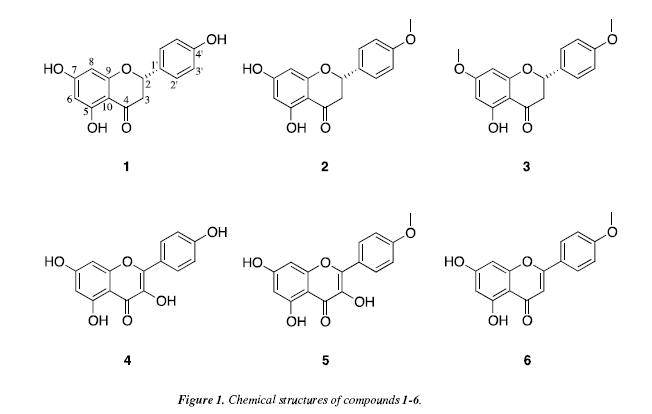
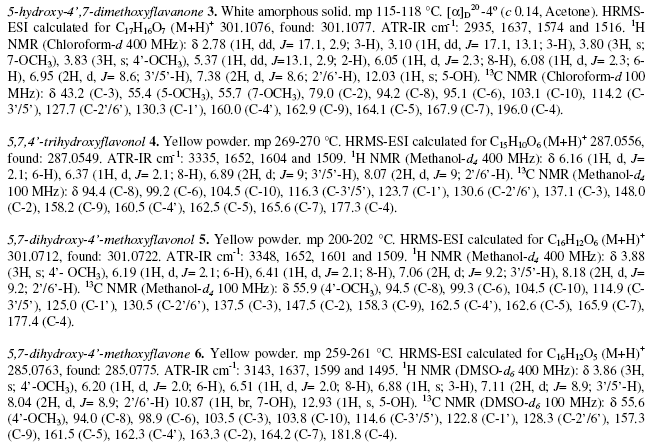
<body><![CDATA[<p align="justify">&nbsp;</p>     <p align="justify"><font face="Verdana" size="3"><b>RESULTS AND DISCUSSION</b></font></p>     <p align="justify"><font face="Verdana" size="2">The dried aerial parts of <i>Baccharis polycephala </i>were ground and extracted with first hexane, then chloroform and finally ethanol, and TLC analyses suggested that the secondary metabolites are present in the chloroform extract. This was fractionated by vacuum liquid chromatography, column chromatography and centrifugal preparative chromatography, as described in the experimental part, eventually affording the six pure compounds shown in Figure 1. The structures of compounds 1-6 (<a href="#f1">Figure 1</a>) were established by a combination of <sup>1</sup>H and <sup>13</sup>C NMR spectroscopy, </font><font face="Verdana" size="2">both 1D and 2D experiments, ATR-IR spectroscopy, and high resolution ESI mass spectrometry. Compound 1 was obtained as yellow oil. Its molecular formula C1<sub>5</sub>H<sub>12</sub>O<sub>5</sub> was established on the basis of the ESI-HRMS data, and as the <sup>13</sup>C NMR spectrum only displayed 13 signals it was assumed that 1 contains two pairs of equivalent carbons. 1 consequently has ten degrees of unsaturation. The ATR-IR spectrum showed bands at 1637, 1518 and 3306 cm<sup>-1 </sup>indicating the presence of a conjugated carbonyl group, an aromatic ring and hydroxyl group, respectively. The <sup>1</sup>H NMR spectrum (recorded in CD<sub>3</sub>OD) revealed the presence of three-proton spin system at 5 5.34 (1H, dd, J=13, <img src="/img/revistas/rbq/v30n2/a04_figura09.gif" width="438" height="19"> which are typical proton signals of a flavanone [10]. The aryl substituent at C-2 is obviously para-substituted, and this was indicated by the second order pattern of protons <img src="/img/revistas/rbq/v30n2/a04_figura10.gif" width="419" height="22"> respectively. HMBC correlations from 2-H to C-1' and C-2’/6', from 2’/6'-H to C-2, C-2’/6' and C-4', as well as from 3’/5'-H to C-1', C-3’/5' and C-4' confirm that the C-2 substituent is 4-hydroxyphenyl and that 1 in fact is a flavanone. The remaining benzene ring has two protons at 5 5.90 (1H, d, J=2.1; 8-H) and 5 5.88 (1H, d, J=2.1; 6-H) and is consequently 1,2,3,5-tetrasubtituted. HMBC correlations from 6-H to C-5, <i>C-7, </i>C-8 and C-10, as well as from 8-H to C-6, <i>C-7, </i>C-9 and C-10 establish that 1 is 5,7,4' -trihydroxyflavanone, known as Naringenin and previously reported from <i>Euphorbia tuckeyana </i>[11]. The NMR data of compounds 2 and 3 (recorded in CDCl<sub>3</sub>) are similar to those of 1, except that 2 has one and 3 two methoxy groups. The ESI-HRMS data show that the elemental composition of 2 and 3 are C1<sub>6</sub>H<sub>14</sub>O<sub>5</sub> and C1<sub>7</sub>H<sub>16</sub>O<sub>5</sub>, respectively. The same NMR experiments as discussed above were carried out with 2 and 3, showing that both are flavanones oxygenated in positions 5, 7 and 4'. As a confirmation, the chelated 5-OH is visible in the <sup>1</sup>H NMR spectra (recorded CDCl<sub>3</sub>) of both compounds at just above 12 ppm. HMBC correlations from the methoxy protons to C-4' in 2 and to <i>C-7 </i>as well as C-4' in 3 demonstrate that 2 is 5,7-dihydroxy-4'-methoxyflavanone while 3 is 5-hydroxy-4',7-dimethoxyflavanone. 2 was isolated from <i>Artemisa campestris subsp. maritima </i>[12], while 3 has previously been reported from an <i>Aniba </i>species [13].</font></p>     <p align="center"><a name="f1"></a><img src="/img/revistas/rbq/v30n2/a04_figura08.gif" width="652" height="414"></p>     <p align="justify"><font face="Verdana" size="2">Compound 4 contains only unsaturated carbons according to the NMR data (recorded in CD<sub>3</sub>OD), which are typical for a flavonol. According to ESI-HRMS experiments, 4 has the elemental composition C15H<sub>10</sub>O<sub>6</sub>, which is in agreement with a trihydroxylated flavonol. The <sup>1</sup>H NMR spectrum showed two signals for meta-coupled protons at 5 6.37 (1H, d, J=2.1; 8-H) and 5 6.16 (1H, d, J=2.1; 6-H) with the corresponding HMBC correlations discussed for 1 above, indicating that ring A has hydroxyl groups in positions 5 and 7. Two doublets at 5 8.07 (2H, d, J=9; 2’/6'-H) </font><font face="Verdana" size="2">and 5 6.89 (2H, d, J=9; 3’/5'-H) suggest the presence of a typical AA'BB' coupling system, in this case a <i>para-</i>hydroxy substituted ring B. Compound 4 was therefore found to be 5,7,4'-trihydroxyflavonol, identical to Kaempferol previously isolated from <i>Polygonatum polyanthemum </i>[14]. The NMR data of compound 5 (recorded in CD<sub>3</sub>OD) is similar to those of 4, except for the presence of a methoxy group in 5. Consequently, the elemental composition of 5 should be C1<sub>6</sub>H<sub>12</sub>O<sub>6</sub> and this was confirmed by ESI-HRMS experiments. </font><font face="Verdana" size="2">The position of the methoxy group was determined by the HMBC correlation from the methoxy protons to C-4', and 5 is 5,7-dihydroxy-4'-methoxyflavonol. 5 has previously been reported from a <i>Hippophae </i>species [15].The 1D NMR data of compound 6 do not suggest that it is a flavanone or flavonol, although it appears to be a flavonoid. The elemental composition of 6 was determined to be C1<sub>6</sub>H<sub>12</sub>O<sub>5</sub>, from ESI-HRMS experiments and the 1D NMR spectra recorded in DMSO-d<sub>6</sub>.    <br> </font><font face="Verdana" size="2">The <sup>1</sup>H NMR spectrum showed a signal at<img src="/img/revistas/rbq/v30n2/a04_figura11.gif" width="80" height="15"> characteristic for a proton at C-3 in flavones. The presence of a doublet at<img src="/img/revistas/rbq/v30n2/a04_figura12.gif" width="132" height="19">(both with J=2.0) was attributed to the protons at 6-H and 8-H in ring A, while doublets at 5 7.11 (2H; 3’/5'-H) and 5 8.04 (2H; 2’/6'-H) (both with J=8.9) were attributed to the AA'BB' spin system in ring B. HMBC correlations from 3-H to C-4, C-10 and C-1', from 2’/6'-H to C-2 and C-4', as well as from 3’/5'-H to C-1' and C-4' determine the structure of 6, which consequently is 5,7-dihydroxy-4'-methoxyflavone. 6 has previously been reported from <i>Cirsium japonicum </i>[16]. All data reported for the six compounds are in agreement with those in this investigation.</font></p>     <p align="justify">&nbsp;</p>     <p align="justify"><strong><font face="Verdana" size="3">EXPERIMENTAL</font></strong></p>     <p align="justify"><font face="Verdana" size="2"><i>General experimental procedures</i></font></p>     <p align="justify"><font face="Verdana" size="2">The optical rotations were measured with a Perkin-Elmer 341 polarimeter at 20&deg;C. Infrared spectral data were collected on a Bruker-Alpha-P ATR-IR spectrometer. ESI-HRMS spectra were recorded using Waters Q-TOF Micro system spectrometer, using H<sub>3</sub>PO<sub>4</sub> for calibration and as internal standard. <sup>1</sup>H NMR (400 MHz) and <sup>13</sup>C NMR (100 MHz) were measured with a Bruker DRX400 spectrometer; the spectra were recorded in chloroform-d (solvent residual signals at 5<sub>H</sub> 7.26 and 5<sub>C</sub> 77.16), methanol-d4 (solvent residual signals at 5<sub>H</sub> 3.31 and 5<sub>C</sub> 49.00) and DMSO-<i>d<sub>6</sub> </i>(solvent residual signals at 5<sub>H</sub> 2.50 and 5<sub>C</sub> 39.52). The chemical shift (5) are given in ppm, and coupling constants (J) in Hz. Vacuum liquid chromatography (VLC) and centrifugal preparative TLC (CTLC) separations were carried out using TLC grade silica gel (Merck), while column chromatography (CC) were run on silica gel 60 (230-400 mesh, Merck). TLC analyses were carried out on silica gel GF<sub>25</sub>4 precoated plates (Merck); chromatograms were visualized under a UV lamp (254 nm) and by spraying with vanillin (6%)-sulfuric acid (1.5%)-ethanol solution, followed by heating.</font></p>     ]]></body>



<body><![CDATA[<p align="justify"><font face="Verdana" size="2"><i>Plant material</i></font></p>     <p align="justify"><font face="Verdana" size="2">The whole aerial parts of <i>Baccharis polycephala </i>Weddell were collected from south mountainous region of Cochabamba-Bolivia at 3500 m of altitude in April 2008. A voucher specimen (MZ-1860) was deposited at National Herbarium &quot;Herbario Nacional Martin Cardenas&quot;.</font></p>     <p align="justify"><font face="Verdana" size="2"><i>Extraction and isolation</i></font></p>     <p align="justify"><font face="Verdana" size="2">The plant material was air-dried at room temperature, finely grounded (300 g) and successively extracted, with solvents of ascending polarity at room temperature for 24 hours each solvent (hexane, chloroform and ethanol). From all crude extracts, only the chloroformic extract was further subjected to isolation. The chloroformic extract was concentrated under reduced pressure to give a dark brown mass (5 g). This extract was suspended in dichloromethane, a precipitate (fraction A) was observed. After filtering, the supernatant was evaporated in vacuum to give fraction B. Fraction A (1 g) was subjected to VLC eluted with toluene-acetone (8:2) to give three fractions (A1-3). A yellow precipitate was observed in fraction A1. After filtering, A1 (107 mg) was subjected to CTLC (Chromatotron) using toluene-acetone (9:1) to afford 4 (6 mg). Separation on fraction B (4 g) was performed by VLC, eluted with heptane-EtOAc (9:1) to give six main fractions (B1-6). Then, the yellow mixture in fraction B4 (200 mg) was further separated into eight fractions (B4A-H) by CC eluted with CHCl<sub>3</sub>-MeOH (1:1) to give 2 (1.5 mg) (fraction B4D). Compound 3 (2 mg) was obtained from fraction B4B by CC with toluene-heptane (8:2) as eluent. Compound 6 (3 mg) was precipitated from fraction B6. The mother liquid of fraction B6 (2 g) was separated </font><font face="Verdana" size="2">by VLC using CHCl<sub>3</sub>-MeOH (30:1) to give five sub-fractions (B6A-E). Compounds 5 (5 mg) and 1 (7 mg) were obtained from sub-fraction B6C (100 mg) by CC with CHCl<sub>3</sub>-MeOH (1:1) as eluent.</font></p>     <p align="center"><img src="/img/revistas/rbq/v30n2/a04_figura13.gif" width="644" height="105"></p>     <p align="center"><img src="/img/revistas/rbq/v30n2/a04_figura14.gif" width="664" height="445"></p>     <p align="justify">&nbsp;</p>     <p align="justify"><strong><font face="Verdana" size="3">ACKNOWLEDGMENTS</font></strong></p>     <p align="justify"><font face="Verdana" size="2">The authors gratefully acknowledge financial support from Swedish International Development Cooperation Agency (SIDA). We thank Lic. Modesto Zárate from the National Herbarium &quot;Herbario Nacional Martin Cardenas, for the taxonomic determination of the plant material.</font></p>     <p align="justify">&nbsp;</p>     ]]></body>
<body><![CDATA[<p align="justify"><strong><font face="Verdana" size="3">REFERENCES</font></strong></p>     <p align="justify"><font face="Verdana" size="2">[I]&nbsp; CUSHNIE, T. P. T., LAMB, A. J. </font><font face="Verdana" size="2">International Journal of Antimicrobial Agents, 2005, 26, 343.</font></p>     <p align="justify"><font face="Verdana" size="2">[2] GUARDIA, T., ROTELLI, A. E., JUAREZ, A. O., PELZER, L. E. Il Farmaco, 2001,56, 683.</font></p>     <!-- ref --><p align="justify"><font face="Verdana" size="2">[3] SEYOUM, A., ASRES, K., EL-FIKY, F. K. Phytochemistry, 2006, 67, 2058.</font>&nbsp;&nbsp;&nbsp;&nbsp;&nbsp;&nbsp;&nbsp;&nbsp;[&#160;<a href="javascript:void(0);" onclick="javascript: window.open('/scielo.php?script=sci_nlinks&ref=682314&pid=S0250-5460201300020000500003&lng=','','width=640,height=500,resizable=yes,scrollbars=1,menubar=yes,');">Links</a>&#160;]<!-- end-ref --><!-- ref --><p align="justify"><font face="Verdana" size="2">[4] HARBORNE, J. B., WILLIAMS, C. A. Phytochemistry, 2000, 55, 481.</font>&nbsp;&nbsp;&nbsp;&nbsp;&nbsp;&nbsp;&nbsp;&nbsp;[&#160;<a href="javascript:void(0);" onclick="javascript: window.open('/scielo.php?script=sci_nlinks&ref=682315&pid=S0250-5460201300020000500004&lng=','','width=640,height=500,resizable=yes,scrollbars=1,menubar=yes,');">Links</a>&#160;]<!-- end-ref --><!-- ref --><p align="justify"><font face="Verdana" size="2">[5] KANADASWAMI, C., LEE, L. T., LEE, P. P. H., HWANG, J. J., KE, F. C., HUANG, Y. T., LEE, M. T. In Vivo, 2005,19, 895.</font>&nbsp;&nbsp;&nbsp;&nbsp;&nbsp;&nbsp;&nbsp;&nbsp;[&#160;<a href="javascript:void(0);" onclick="javascript: window.open('/scielo.php?script=sci_nlinks&ref=682316&pid=S0250-5460201300020000500005&lng=','','width=640,height=500,resizable=yes,scrollbars=1,menubar=yes,');">Links</a>&#160;]<!-- end-ref --><!-- ref --><p align="justify"><font face="Verdana" size="2">[6] ABAD, M. J., BERMEJO, P. ARKIVOC, 2007, 76.</font>&nbsp;&nbsp;&nbsp;&nbsp;&nbsp;&nbsp;&nbsp;&nbsp;[&#160;<a href="javascript:void(0);" onclick="javascript: window.open('/scielo.php?script=sci_nlinks&ref=682317&pid=S0250-5460201300020000500006&lng=','','width=640,height=500,resizable=yes,scrollbars=1,menubar=yes,');">Links</a>&#160;]<!-- end-ref --><!-- ref --><p align="justify"><font face="Verdana" size="2">[7] ABAD, M. J., BESSA, A. L., BALLARIN, B., ARAGON, O., GONZALES, E., BERMEJO, P. J. Ethnopharmacol., 2006,<b>103, </b>338.</font>&nbsp;&nbsp;&nbsp;&nbsp;&nbsp;&nbsp;&nbsp;&nbsp;[&#160;<a href="javascript:void(0);" onclick="javascript: window.open('/scielo.php?script=sci_nlinks&ref=682318&pid=S0250-5460201300020000500007&lng=','','width=640,height=500,resizable=yes,scrollbars=1,menubar=yes,');">Links</a>&#160;]<!-- end-ref --><!-- ref --><p align="justify"><font face="Verdana" size="2">[8] MORALES, G., PAREDES, A., SIERRA, P., LOYOLA, L. A. Molecules, 2008,<b>13, </b>790.</font>&nbsp;&nbsp;&nbsp;&nbsp;&nbsp;&nbsp;&nbsp;&nbsp;[&#160;<a href="javascript:void(0);" onclick="javascript: window.open('/scielo.php?script=sci_nlinks&ref=682319&pid=S0250-5460201300020000500008&lng=','','width=640,height=500,resizable=yes,scrollbars=1,menubar=yes,');">Links</a>&#160;]<!-- end-ref --><!-- ref --><p align="justify"><font face="Verdana" size="2">[9]  </font><a href="http://www.tropicos.org" target="_blank"><font face="Verdana" size="2" color="#0000E4">http://www.tropicos.org</font></a><font face="Verdana" size="2" color="#0000E4"><A href=http://www.tropicos.org></A> </font><font face="Verdana" size="2">TROPICOS.ORG. Tropicos.org. Missouri Botanical Garden, (20 Sep 2012).</font>&nbsp;&nbsp;&nbsp;&nbsp;&nbsp;&nbsp;&nbsp;&nbsp;[&#160;<a href="javascript:void(0);" onclick="javascript: window.open('/scielo.php?script=sci_nlinks&ref=682320&pid=S0250-5460201300020000500009&lng=','','width=640,height=500,resizable=yes,scrollbars=1,menubar=yes,');">Links</a>&#160;]<!-- end-ref --><!-- ref --><p align="justify"><font face="Verdana" size="2">[10] KOTESWARA RAO, Y., VIMALAMMA, G., VENKATA RAO, C., TZENG, Y.-M. Phytochemistry, 2004, 65, 2317.</font>&nbsp;&nbsp;&nbsp;&nbsp;&nbsp;&nbsp;&nbsp;&nbsp;[&#160;<a href="javascript:void(0);" onclick="javascript: window.open('/scielo.php?script=sci_nlinks&ref=682321&pid=S0250-5460201300020000500010&lng=','','width=640,height=500,resizable=yes,scrollbars=1,menubar=yes,');">Links</a>&#160;]<!-- end-ref --><!-- ref --><p align="justify"><font face="Verdana" size="2">[11]&nbsp; DUARTE, N., LAGE, H., FERREIRA, M.-J. U. Planta Med, 2008, 74, 61.</font>&nbsp;&nbsp;&nbsp;&nbsp;&nbsp;&nbsp;&nbsp;&nbsp;[&#160;<a href="javascript:void(0);" onclick="javascript: window.open('/scielo.php?script=sci_nlinks&ref=682322&pid=S0250-5460201300020000500011&lng=','','width=640,height=500,resizable=yes,scrollbars=1,menubar=yes,');">Links</a>&#160;]<!-- end-ref --><!-- ref --><p align="justify"><font face="Verdana" size="2">[12] VASCONCELOS, J. M. J., SILVA, A. M. S., CAVALEIRO, J. A. S. Phytochemistry, 1998, 49, 1421.</font>&nbsp;&nbsp;&nbsp;&nbsp;&nbsp;&nbsp;&nbsp;&nbsp;[&#160;<a href="javascript:void(0);" onclick="javascript: window.open('/scielo.php?script=sci_nlinks&ref=682323&pid=S0250-5460201300020000500012&lng=','','width=640,height=500,resizable=yes,scrollbars=1,menubar=yes,');">Links</a>&#160;]<!-- end-ref --><!-- ref --><p align="justify"><font face="Verdana" size="2">[13] ROSSI, M. H., YOSHIDA, M., SOARES MAIA, J. G. Phytochemistry, 1997, 45, 1263.</font>&nbsp;&nbsp;&nbsp;&nbsp;&nbsp;&nbsp;&nbsp;&nbsp;[&#160;<a href="javascript:void(0);" onclick="javascript: window.open('/scielo.php?script=sci_nlinks&ref=682324&pid=S0250-5460201300020000500013&lng=','','width=640,height=500,resizable=yes,scrollbars=1,menubar=yes,');">Links</a>&#160;]<!-- end-ref --><!-- ref --><p align="justify"><font face="Verdana" size="2">[14] GVAZAVA, L., KIKOLADZE, V. Chem. Nat. Compd., 2011, 47, 818.</font>&nbsp;&nbsp;&nbsp;&nbsp;&nbsp;&nbsp;&nbsp;&nbsp;[&#160;<a href="javascript:void(0);" onclick="javascript: window.open('/scielo.php?script=sci_nlinks&ref=682325&pid=S0250-5460201300020000500014&lng=','','width=640,height=500,resizable=yes,scrollbars=1,menubar=yes,');">Links</a>&#160;]<!-- end-ref --><!-- ref --><p align="justify"><font face="Verdana" size="2">[15] PANDURANGAN, N., BOSE, C., BANERJI, A. Biorg. Med. Chem. Lett., 2011, 21, 5328.</font>&nbsp;&nbsp;&nbsp;&nbsp;&nbsp;&nbsp;&nbsp;&nbsp;[&#160;<a href="javascript:void(0);" onclick="javascript: window.open('/scielo.php?script=sci_nlinks&ref=682326&pid=S0250-5460201300020000500015&lng=','','width=640,height=500,resizable=yes,scrollbars=1,menubar=yes,');">Links</a>&#160;]<!-- end-ref --><!-- ref --><p align="justify"><font face="Verdana" size="2">[16] PENG,W. Chem. Nat. Compd., 2011, 47, 279.</font>&nbsp;&nbsp;&nbsp;&nbsp;&nbsp;&nbsp;&nbsp;&nbsp;[&#160;<a href="javascript:void(0);" onclick="javascript: window.open('/scielo.php?script=sci_nlinks&ref=682327&pid=S0250-5460201300020000500016&lng=','','width=640,height=500,resizable=yes,scrollbars=1,menubar=yes,');">Links</a>&#160;]<!-- end-ref --><p align="justify">&nbsp;</p>      ]]></body><back>
<ref-list>
<ref id="B1">
<label>1</label><nlm-citation citation-type="">
<person-group person-group-type="author">
<name>
<surname><![CDATA[CUSHNIE]]></surname>
<given-names><![CDATA[T. P. T]]></given-names>
</name>
<name>
<surname><![CDATA[LAMB]]></surname>
<given-names><![CDATA[A. J]]></given-names>
</name>
</person-group>
<source><![CDATA[International Journal of Antimicrobial Agents]]></source>
<year>2005</year>
<page-range>26, 343</page-range></nlm-citation>
</ref>
<ref id="B2">
<label>2</label><nlm-citation citation-type="">
<person-group person-group-type="author">
<name>
<surname><![CDATA[GUARDIA]]></surname>
<given-names><![CDATA[T]]></given-names>
</name>
<name>
<surname><![CDATA[ROTELLI]]></surname>
<given-names><![CDATA[A. E]]></given-names>
</name>
<name>
<surname><![CDATA[JUAREZ]]></surname>
<given-names><![CDATA[A. O]]></given-names>
</name>
<name>
<surname><![CDATA[PELZER]]></surname>
<given-names><![CDATA[L. E]]></given-names>
</name>
</person-group>
<source><![CDATA[Farmaco]]></source>
<year>2001</year>
<page-range>56, 683</page-range></nlm-citation>
</ref>
<ref id="B3">
<label>3</label><nlm-citation citation-type="">
<person-group person-group-type="author">
<name>
<surname><![CDATA[SEYOUM]]></surname>
<given-names><![CDATA[A]]></given-names>
</name>
<name>
<surname><![CDATA[ASRES]]></surname>
<given-names><![CDATA[K]]></given-names>
</name>
<name>
<surname><![CDATA[EL-FIKY]]></surname>
<given-names><![CDATA[F. K]]></given-names>
</name>
</person-group>
<source><![CDATA[Phytochemistry]]></source>
<year>2006</year>
<page-range>67, 2058</page-range></nlm-citation>
</ref>
<ref id="B4">
<label>4</label><nlm-citation citation-type="">
<person-group person-group-type="author">
<name>
<surname><![CDATA[HARBORNE]]></surname>
<given-names><![CDATA[J. B]]></given-names>
</name>
<name>
<surname><![CDATA[WILLIAMS]]></surname>
<given-names><![CDATA[C. A]]></given-names>
</name>
</person-group>
<source><![CDATA[Phytochemistry]]></source>
<year>2000</year>
<page-range>55, 481</page-range></nlm-citation>
</ref>
<ref id="B5">
<label>5</label><nlm-citation citation-type="">
<person-group person-group-type="author">
<name>
<surname><![CDATA[KANADASWAMI]]></surname>
<given-names><![CDATA[C]]></given-names>
</name>
<name>
<surname><![CDATA[LEE]]></surname>
<given-names><![CDATA[L. T]]></given-names>
</name>
<name>
<surname><![CDATA[LEE, P]]></surname>
<given-names><![CDATA[P. H]]></given-names>
</name>
<name>
<surname><![CDATA[HWANG]]></surname>
<given-names><![CDATA[J. J]]></given-names>
</name>
<name>
<surname><![CDATA[KE,]]></surname>
<given-names><![CDATA[F. C]]></given-names>
</name>
<name>
<surname><![CDATA[HUANG]]></surname>
<given-names><![CDATA[Y. T]]></given-names>
</name>
<name>
<surname><![CDATA[LEE]]></surname>
<given-names><![CDATA[M. T]]></given-names>
</name>
</person-group>
<source><![CDATA[In Vivo]]></source>
<year>2005</year>
<page-range>19, 895</page-range></nlm-citation>
</ref>
<ref id="B6">
<label>6</label><nlm-citation citation-type="">
<person-group person-group-type="author">
<name>
<surname><![CDATA[ABAD]]></surname>
<given-names><![CDATA[M. J]]></given-names>
</name>
<name>
<surname><![CDATA[BERMEJO]]></surname>
<given-names><![CDATA[P]]></given-names>
</name>
<name>
<surname><![CDATA[ARKIVOC]]></surname>
</name>
</person-group>
<source><![CDATA[]]></source>
<year>2007</year>
<page-range>76</page-range></nlm-citation>
</ref>
<ref id="B7">
<label>7</label><nlm-citation citation-type="">
<person-group person-group-type="author">
<name>
<surname><![CDATA[ABAD]]></surname>
<given-names><![CDATA[M. J]]></given-names>
</name>
<name>
<surname><![CDATA[BESSA]]></surname>
<given-names><![CDATA[A. L]]></given-names>
</name>
<name>
<surname><![CDATA[BALLARIN]]></surname>
<given-names><![CDATA[B]]></given-names>
</name>
<name>
<surname><![CDATA[ARAGON]]></surname>
<given-names><![CDATA[O]]></given-names>
</name>
<name>
<surname><![CDATA[GONZALES]]></surname>
<given-names><![CDATA[E]]></given-names>
</name>
<name>
<surname><![CDATA[BERMEJO]]></surname>
<given-names><![CDATA[P. J]]></given-names>
</name>
</person-group>
<source><![CDATA[Ethnopharmacol]]></source>
<year>2006</year>
<month>,</month>
<page-range>103, 338</page-range></nlm-citation>
</ref>
<ref id="B8">
<label>8</label><nlm-citation citation-type="">
<person-group person-group-type="author">
<name>
<surname><![CDATA[MORALES]]></surname>
<given-names><![CDATA[G]]></given-names>
</name>
<name>
<surname><![CDATA[PAREDES]]></surname>
<given-names><![CDATA[A]]></given-names>
</name>
<name>
<surname><![CDATA[SIERRA]]></surname>
<given-names><![CDATA[P]]></given-names>
</name>
<name>
<surname><![CDATA[LOYOLA]]></surname>
<given-names><![CDATA[L. A]]></given-names>
</name>
</person-group>
<source><![CDATA[Molecules]]></source>
<year></year>
</nlm-citation>
</ref>
<ref id="B9">
<label>9</label><nlm-citation citation-type="">
<source><![CDATA[Missouri Botanical Garden]]></source>
<year></year>
</nlm-citation>
</ref>
<ref id="B10">
<label>10</label><nlm-citation citation-type="">
<person-group person-group-type="author">
<name>
<surname><![CDATA[KOTESWARA RAO]]></surname>
<given-names><![CDATA[Y.]]></given-names>
</name>
<name>
<surname><![CDATA[VIMALAMMA]]></surname>
<given-names><![CDATA[G]]></given-names>
</name>
<name>
<surname><![CDATA[VENKATA RAO]]></surname>
<given-names><![CDATA[C]]></given-names>
</name>
<name>
<surname><![CDATA[TZENG, Y]]></surname>
<given-names><![CDATA[M]]></given-names>
</name>
</person-group>
<source><![CDATA[Phytochemistry]]></source>
<year>2004</year>
<page-range>65, 2317</page-range></nlm-citation>
</ref>
<ref id="B11">
<label>11</label><nlm-citation citation-type="">
<person-group person-group-type="author">
<name>
<surname><![CDATA[DUARTE]]></surname>
<given-names><![CDATA[N]]></given-names>
</name>
<name>
<surname><![CDATA[LAGE]]></surname>
<given-names><![CDATA[H]]></given-names>
</name>
<name>
<surname><![CDATA[FERREIRA]]></surname>
<given-names><![CDATA[M.-J. U.]]></given-names>
</name>
</person-group>
<source><![CDATA[Planta Med]]></source>
<year>2008</year>
<page-range>74, 61.</page-range></nlm-citation>
</ref>
<ref id="B12">
<label>12</label><nlm-citation citation-type="">
<person-group person-group-type="author">
<name>
<surname><![CDATA[VASCONCELOS]]></surname>
<given-names><![CDATA[J. M. J]]></given-names>
</name>
<name>
<surname><![CDATA[SILVA]]></surname>
<given-names><![CDATA[A. M. S]]></given-names>
</name>
<name>
<surname><![CDATA[CAVALEIRO]]></surname>
<given-names><![CDATA[J. A. S]]></given-names>
</name>
</person-group>
<source><![CDATA[Phytochemistry]]></source>
<year>1998</year>
<page-range>49, 1421</page-range></nlm-citation>
</ref>
<ref id="B13">
<label>13</label><nlm-citation citation-type="">
<person-group person-group-type="author">
<name>
<surname><![CDATA[ROSSI]]></surname>
<given-names><![CDATA[M. H.,]]></given-names>
</name>
<name>
<surname><![CDATA[YOSHIDA]]></surname>
<given-names><![CDATA[M]]></given-names>
</name>
<name>
<surname><![CDATA[SOARES MAIA]]></surname>
<given-names><![CDATA[J. G]]></given-names>
</name>
</person-group>
<source><![CDATA[Phytochemistry]]></source>
<year>1997</year>
<page-range>45, 1263</page-range></nlm-citation>
</ref>
<ref id="B14">
<label>14</label><nlm-citation citation-type="">
<person-group person-group-type="author">
<name>
<surname><![CDATA[GVAZAVA]]></surname>
<given-names><![CDATA[L]]></given-names>
</name>
<name>
<surname><![CDATA[KIKOLADZE]]></surname>
<given-names><![CDATA[V]]></given-names>
</name>
</person-group>
<source><![CDATA[Chem. Nat. Compd]]></source>
<year>2011</year>
<page-range>47, 818</page-range></nlm-citation>
</ref>
<ref id="B15">
<label>15</label><nlm-citation citation-type="">
<person-group person-group-type="author">
<name>
<surname><![CDATA[PANDURANGAN]]></surname>
<given-names><![CDATA[N]]></given-names>
</name>
<name>
<surname><![CDATA[BOSE]]></surname>
<given-names><![CDATA[C]]></given-names>
</name>
<name>
<surname><![CDATA[BANERJI,]]></surname>
<given-names><![CDATA[A]]></given-names>
</name>
</person-group>
<source><![CDATA[Biorg. Med. Chem. Lett]]></source>
<year>2011</year>
<page-range>21, 5328</page-range></nlm-citation>
</ref>
<ref id="B16">
<label>16</label><nlm-citation citation-type="">
<person-group person-group-type="author">
<name>
<surname><![CDATA[PENG]]></surname>
<given-names><![CDATA[W]]></given-names>
</name>
</person-group>
<source><![CDATA[Chem. Nat. Compd]]></source>
<year>2011</year>
<page-range>47, 279</page-range></nlm-citation>
</ref>
</ref-list>
</back>
</article>