<?xml version="1.0" encoding="ISO-8859-1"?><article xmlns:mml="http://www.w3.org/1998/Math/MathML" xmlns:xlink="http://www.w3.org/1999/xlink" xmlns:xsi="http://www.w3.org/2001/XMLSchema-instance">
<front>
<journal-meta>
<journal-id>0250-5460</journal-id>
<journal-title><![CDATA[Revista Boliviana de Química]]></journal-title>
<abbrev-journal-title><![CDATA[Rev. Bol. Quim]]></abbrev-journal-title>
<issn>0250-5460</issn>
<publisher>
<publisher-name><![CDATA[Universidad Mayor de San Andrés]]></publisher-name>
</publisher>
</journal-meta>
<article-meta>
<article-id>S0250-54602013000100011</article-id>
<title-group>
<article-title xml:lang="en"><![CDATA[FURANOEREMOPHILANES FROM SENECIO CLIVICOLUS WEDDELL]]></article-title>
</title-group>
<contrib-group>
<contrib contrib-type="author">
<name>
<surname><![CDATA[Davila]]></surname>
<given-names><![CDATA[MarceCo]]></given-names>
</name>
</contrib>
<contrib contrib-type="author">
<name>
<surname><![CDATA[Sterner]]></surname>
<given-names><![CDATA[Olov]]></given-names>
</name>
</contrib>
<contrib contrib-type="author">
<name>
<surname><![CDATA[Hinojosa]]></surname>
<given-names><![CDATA[Nelson]]></given-names>
</name>
</contrib>
</contrib-group>
<aff id="A">
<institution><![CDATA[,  ]]></institution>
<addr-line><![CDATA[ ]]></addr-line>
</aff>
<pub-date pub-type="pub">
<day>00</day>
<month>00</month>
<year>2013</year>
</pub-date>
<pub-date pub-type="epub">
<day>00</day>
<month>00</month>
<year>2013</year>
</pub-date>
<volume>30</volume>
<numero>1</numero>
<fpage>80</fpage>
<lpage>83</lpage>
<copyright-statement/>
<copyright-year/>
<self-uri xlink:href="http://www.scielo.org.bo/scielo.php?script=sci_arttext&amp;pid=S0250-54602013000100011&amp;lng=en&amp;nrm=iso"></self-uri><self-uri xlink:href="http://www.scielo.org.bo/scielo.php?script=sci_abstract&amp;pid=S0250-54602013000100011&amp;lng=en&amp;nrm=iso"></self-uri><self-uri xlink:href="http://www.scielo.org.bo/scielo.php?script=sci_pdf&amp;pid=S0250-54602013000100011&amp;lng=en&amp;nrm=iso"></self-uri><abstract abstract-type="short" xml:lang="en"><p><![CDATA[A phytochemical investigation of the dried aerial parts of Senecio clivicolus Weddell led to the isolation of four furanoeremophilane sesquiterpenes. Their structures and relative configuration were established by NMR and HRMS-ESI analyses, and by comparison with data reported in the literature. Their presence in S. clivicolus is reported for the first time]]></p></abstract>
<kwd-group>
<kwd lng="en"><![CDATA[Furanoeremophilanes]]></kwd>
<kwd lng="en"><![CDATA[Senecio clivicoulus]]></kwd>
</kwd-group>
</article-meta>
</front><body><![CDATA[ <p align="center">&nbsp;</p>     <p align="center"><font face="verdana" size="4"><b>FURANOEREMOPHILANES FROM <i>SENECIO CLIVICOLUS </i>WEDDELL</b></font></p>     <p align="center">&nbsp;</p>     <p align="center">&nbsp;</p>     <p align="center"><font face="verdana" size="2"><i>MarceCo Davila<sup>a,b</sup>; Olov Sterner<sup>a</sup>; Nelson Hinojosa<sup>b*</sup></i></font></p>     <p align="center">&nbsp;</p>     <p align="center">&nbsp;</p> <hr>     <p align="justify"><font face="verdana" size="2"><b>Keywords:  </b><i>Furanoeremophilanes, Senecio clivicoulus </i></font></p>     <p align="justify"><font face="verdana" size="2"><b>ABSTRACT</b></font></p>     <p align="justify"><font face="verdana" size="2">A phytochemical investigation of the dried aerial parts of <i>Senecio clivicolus </i>Weddell led to the isolation of four furanoeremophilane sesquiterpenes. Their structures and relative configuration were established by NMR and HRMS-ESI analyses, and by comparison with data reported in the literature. Their presence in <i>S. clivicolus </i>is reported for the first time.</font></p> <hr>     ]]></body>
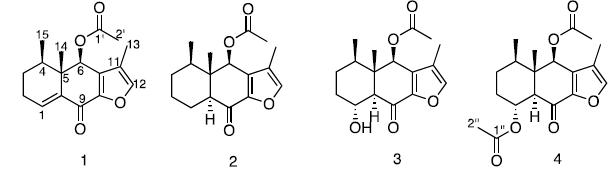
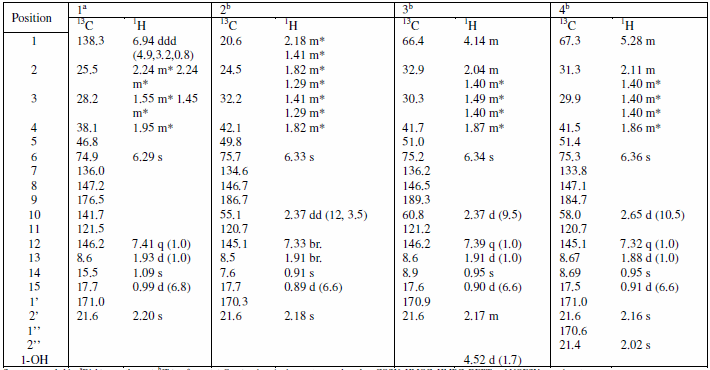
<body><![CDATA[<p>&nbsp;</p>     <p>&nbsp;</p>     <p><b><font face="verdana" size="3">INTRODUCCIÓN</font></b></p>     <p align="justify"><font face="verdana" size="2">Senecio represent the largest genus of the family Asteraceae and has more than 1500 species [1]. Senecio species are used in traditional medicine for many purposes, such as a remedy for gastric-ulcer and stomach pain [2], chest pain, cough, fever and running nose [3, 4]. In the north región of Argentina <i>S. graveolens </i>is used to counteract mountain sickness, digestive and cough suppressant[5]. Of the 114 species of <i>Senecio </i>reported to grow in Bolivia [6], <i>Senecio clivicolus </i>is a perennial shrub growing in the mountainous regions. The leaves of <i>S. clivicolus </i>have been used to relieve the stomach pain [7] and as a anti-diarrhea remedy [8]. Moreover, the extract has been reported to be used to treat skin fungal infections[9].Only one phytochemical investigation of <i>S. clivicolus </i>has been reported so far [10], in which alpha-farnesene, germacrene D and 1-pentadecene were isolated and characterized. This study reports the isolation and chemical characterization of four furanoeremophilanes (Figure 1) from an ethanol extract of the dried aerial parts of <i>S. clivicolus: </i>decompostin (1), 6<img src="/img/revistas/rbq/v30n1/a11_figura02.gif" width="10" height="16">-acetoxy-9-oxo-10<img src="/img/revistas/rbq/v30n1/a11_figura01.gif" width="12" height="11">H-furanoeremophilane (2), 1<img src="/img/revistas/rbq/v30n1/a11_figura01.gif" width="12" height="11">-hydroxy-6<img src="/img/revistas/rbq/v30n1/a11_figura02.gif" width="10" height="16">-acetoxy-9-oxo-10<img src="/img/revistas/rbq/v30n1/a11_figura01.gif" width="12" height="11">H-furanoeremophilane (3) and la-acetoxy-6<img src="/img/revistas/rbq/v30n1/a11_figura02.gif" width="10" height="16">-acetoxy-9-oxo-10<img src="/img/revistas/rbq/v30n1/a11_figura01.gif" width="12" height="11">H-furanoeremophilane <b>(4).</b></font></p>     <p align="center"><img src="/img/revistas/rbq/v30n1/a11_figura03.gif" width="612" height="175"></p>     <p align="center"><b><font face="verdana" size="2"><i>Figure 1</i></font></b><font face="verdana" size="2"><i>. Structures of compounds 1-4.</i></font></p>     <p align="justify">&nbsp;</p>     <p align="justify"><font face="verdana" size="3"><b>RESULTADOS Y DISCUSIÓN</b></font></p>     <p align="justify"><font face="verdana" size="2">The elemental composition of compound 1 was determined to be C<sub>17</sub>H<sub>20</sub>O<sub>4</sub>, based on the ID NMR spectra (<sup>1</sup>H and <sup>13</sup>C NMR data for all four compounds are given in <a href="#t1">Table 1</a>) as well as HRMS-ESI data. 1 consequently has eight degrees of unsaturation, and as the NMR data show the presence of three carbon-carbon double bonds and two carbonyl groups 1 is tricyclic. In the <sup>X</sup>H NMR spectrum a signal corresponding to a furan ring protón was observed at <img src="/img/revistas/rbq/v30n1/a11_figura04.gif" width="11" height="15"> 7.41 (1H, q, 7=1.0; 12-H), which in the COSY spectrum correlates with the methyl signal at <img src="/img/revistas/rbq/v30n1/a11_figura04.gif" width="11" height="15"> 1.93 (3H, d, 7=1.0; 13-H<sub>3</sub>). In addition to this, and besides a methyl group obviously belonging to an acetyl group (5 2.20, 3H, s), the protón spectrum indicated the presence of another two methyls by the signáis at 5 1.09 (3H, s; 14-H<sub>3</sub>) and 50.99 (3H, d, 7=6.8; I5-H3). COSY and HMBC correlations from these as well as 1-H (5 6.94, 1H, ddd, 7=4.9, 3.2, 0.8) close </font><font face="verdana" size="2">the left ring, and show that the acetoxy substituted C-6 is next to C-5 and that the carbonyl group C-9 is adjacent to C-10. HMBC correlations from 6-H, 12-H and 13-H<sub>3</sub> reveal all components of the furan ring, and the final bond between C-8 and C-9 is inevitable. The relative configuration of 1 was elucidated based on the NOESY correlations observed between H-6 and H-4 as well as between 14-H<sub>3</sub> and 15-H<sub>3</sub>. The structure of compound 1 isolated here is identical to decompostin, previously reported from <i>Cacalia decomposita[íí] </i>and <i>Psacalium beamanii[l2]. </i>The HRMS-ESI of compound 2 indicated that its elemental composition is C<sub>17</sub>H<sub>22</sub>O<sub>4</sub>, 2 consequently has one unsaturation less than 1. Comparison of the spectroscopic data of 1 and 2 revealed that the C-l/C-10 double bond in 1 is a single bond in 2, and COSY as well as HMBC correlations established the structure. The relative configuration of 2 was determined based on NOESY correlations between the three protons 4-H, 6-H and 10-H, and 2 was found to be identical to 6<img src="/img/revistas/rbq/v30n1/a11_figura02.gif" width="10" height="16">-acetoxy-9-oxo-10ai/-furanoeremophilane, previously reported from <i>S. chilensis and S. patagonicus[13]. </i>However, the <sup>13</sup>C NMR data reported [13] are significantly different from those recorded here, indicating that it is necessary to correct the chemical shifts for C-l, C-2, C-3, C-14 and C-15 in the literature. The NMR data of compound3 (C17H22O5 according to HRMS-ESI) and 4 (C<sub>19</sub>H<sub>24</sub>O<sub>6</sub> according to HRMS-ESI) are similar to those of compoundsl and 2, with the exception for the signáis assigned to C-l and C-10. In both 3 and 4 C-l is oxygenated while C-10 is protonated, and extensive 2D NMR experiments show that, compared to 1, the C-l/C-10 double bond had added water in 3 and acetic acid in 4. NOESY correlations were observed between 1-H and 14-H<sub>3</sub>, as well as between 4-H, 6-H and 10-H in both compounds, establishing their relative configuration. Based on these data the structures were established as la-hydroxy-6<img src="/img/revistas/rbq/v30n1/a11_figura02.gif" width="10" height="16">-acetoxy-9-oxo-10<img src="/img/revistas/rbq/v30n1/a11_figura01.gif" width="12" height="11">-furanoeremophilane 3 and loc-acetoxy-6p-acetoxy-9-oxo-10a//-furanoeremophilane 4. Compounds 3 and 4 have previously been reported from <i>S. santelisis[l4].</i></font></p>     <p align="center"><a name="t1"></a><img src="/img/revistas/rbq/v30n1/a11_figura05.gif" width="710" height="370"></p>     ]]></body>
<body><![CDATA[<p align="center"><font face="verdana" size="2"><i>Table 1:<sup>13</sup>C- and <sup>1</sup>H-NMR data of compounds 1-4.</i></font></p>     <p align="justify"><font face="verdana" size="2">Spectra recorded in: <sup>a</sup>Dichloromethane-d<sub>2</sub> <sup>b</sup>Chloroform-d. * Overlapping. Assignments were based on COSY,HMQC, HMBC, DEPT and NOESY experiments</font></p>     <p align="justify">&nbsp;</p>     <p align="justify"><font face="verdana" size="2"><b><font size="3">EXPERIMENTAL</font></b></font></p>     <p align="justify"><font face="verdana" size="2"><i>General experimental procedures</i></font></p>     <p align="justify"><font face="verdana" size="2">The optical rotations were measured with a Perkin-Elmer 341 polarimeter at 20&deg;C. HRMS-ESI spectra were recorded with a Waters Q-TOF Micro system spectrometer, using H<sub>3</sub>PO<sub>4</sub> for calibration and as internal standard. <sup>1</sup>H NMR (400 MHz) and <sup>13</sup>C NMR (100 MHz) were measured with a Bruker DRX400 spectrometer; the spectra were recorded in chloroform-d (solvent residual signáis at <img src="/img/revistas/rbq/v30n1/a11_figura04.gif" width="11" height="15"><sub>H</sub> 7.26 and <img src="/img/revistas/rbq/v30n1/a11_figura04.gif" width="11" height="15"><sub>C</sub> 77.16) and dichloromethane-d<sub>2</sub> (solvent residual signáis at <img src="/img/revistas/rbq/v30n1/a11_figura04.gif" width="11" height="15"><sub>H</sub> 5.32 and <img src="/img/revistas/rbq/v30n1/a11_figura04.gif" width="11" height="15"><sub>C</sub> 53.84). The chemical shifts (<img src="/img/revistas/rbq/v30n1/a11_figura04.gif" width="11" height="15">) are given in ppm, and coupling constants (<i>J</i>) in Hz. Vacuum liquid chromatography (VLC) and centrifugal preparative TLC (CTLC) separations were carried out using TLC</font> <font face="verdana" size="2">grade silica gel (Merck), while column chromatography were run on silica gel 60 (230-400 mesh, Merck). TLC analyses were carried out on silica gel GF<sub>2</sub>5<sub>4</sub> pre-coated plates (Merck); chromatograms were visualized under a UV lamp (254 nm) and by spraying with vanillin (6%)-sulfuric acid (1.5%)-ethanol solution, followed by heating.</font></p>     <p align="justify"><font face="verdana" size="2"><i>Plant material</i></font></p>     <p align="justify"><font face="verdana" size="2">The whole aerial parts of <i>Senecio clivicolus </i>Weddell were collected from south of Cochabamba-Bolivia at 2900 meters above sea level in April 2008. A voucher specimen (MZ-3741) was deposited at National Herbarium &quot;Herbario Nacional Martin Cárdenas&quot; at Cochabamba-Bolivia.</font></p>     <p align="justify"><font face="verdana" size="2"><i>Extraction and isolation</i></font></p>     <p align="justify"><font face="verdana" size="2">The air-dried powdered plant material (500 g) was extracted with 95% ethanol (3x1 L) for 3 days at room temperature. Removal of the solvent from the fíltrate under reduces pressure provided an extract (70 g). Part of the extract was suspended in ethanol-water (80:20) and successively partitioned with hexane and chloroform. The chloroform fraction (15 g) was precipitated with ethyl acétate to yield a dark brown precipítate (550 mg) and a dark liquid, which was subjected to vacuum liquid chromatography on silica gel using heptane-ethyl acétate (80:20) as solvent. Ten main fractions were collected (1-10). Fraction 4 (570 mg) was precipitated with methanol to give a yellow precipítate that was purified by centrifugal preparative TLC with heptane-ethyl acétate (80:20) to yield compound 1 (15 mg). Fraction 3 (3.37 g) was precipitated with methanol to give compound 2 (20 mg). Furthermore, fraction 7 (350 mg) was washed with heptane and then subjected to column chromatography on silica gel eluted with toluene-diethyl ether (25:3.5) to give six fractions (A-F). Compound 3 (5 mg) was purified from fraction F by column chromatography using a mixture of heptane-ethyl acétate (70:30) as the eluent. Finally, fraction C contains compound 4 (60 mg).</font></p>     ]]></body>
<body><![CDATA[<p align="justify"><font face="verdana" size="2"><i>Decompostin </i>(1).</font></p>     <p align="justify"><font face="verdana" size="2">1&nbsp; was obtained as a white amorphous solid. mp 195-198 &deg;C. [<img src="/img/revistas/rbq/v30n1/a11_figura01.gif" width="12" height="11">]<sub>D</sub><sup>20</sup> -60&deg; (c 0.60, CHC1<sub>3</sub>).  <sup>1</sup>H NMR (CD<sub>2</sub>C1<sub>2</sub> 400 MHz) and <sup>13</sup>C NMR (CD<sub>2</sub>C1<sub>2</sub>100 MHz), see <a href="#t1">Table 1</a>. HRMS-ESI calculated for C<sub>17</sub>H<sub>20</sub>O<sub>4</sub> (M+H)<sup>+</sup> 289.1440. Found: 289.1445.</font></p>     <p align="justify"><font face="verdana" size="2"><i>6<img src="/img/revistas/rbq/v30n1/a11_figura02.gif" width="10" height="16">-acetoxy-9-oxo-10</i><img src="/img/revistas/rbq/v30n1/a11_figura01.gif" width="12" height="11"><i>H-furanoeremophilane </i>(2).</font></p>     <p align="justify"><font face="verdana" size="2">2&nbsp;was obtained as a white amorphous solid. mp 147-150 &deg;C. [<img src="/img/revistas/rbq/v30n1/a11_figura01.gif" width="12" height="11">]<sub>D</sub><sup>20</sup> -72&deg; (c 0.70, CHC1<sub>3</sub>) <sup>X</sup>H NMR (CDC1<sub>3</sub> 400 MHz) and <sup>13</sup>C NMR (CDC1<sub>3</sub> 100 MHz), see <a href="#t1">Table 1</a>. HRMS-ESI calculated for C<sub>17</sub>H<sub>22</sub>O<sub>4</sub> (M+H)<sup>+</sup> 291.1596. Found: 291.1586.</font></p>     <p align="justify"><font face="verdana" size="2"><i>1 a-hydroxy-6jB-acetoxy-9-oxo-10aH-furanoeremophilane </i>(3).</font></p>     <p align="justify"><font face="verdana" size="2">3&nbsp;was obtained as a yellowish oil. [oc]<sub>D</sub><sup>20</sup> -12&deg; (c 0.20, CHC1<sub>3</sub>) *H NMR (CDC1<sub>3</sub> 400 MHz) and <sup>13</sup>C NMR (CDC1<sub>3</sub>100 MHz), see Table 1. HRMS-ESI calculated for Ci<sub>7</sub>H<sub>22</sub>O<sub>5</sub> (M+H)<sup>+</sup> 307.1545. Found: 307.1555.</font></p>     <p align="justify"><font face="verdana" size="2"><i>1 <img src="/img/revistas/rbq/v30n1/a11_figura01.gif" width="12" height="11">-acetoxy-6<img src="/img/revistas/rbq/v30n1/a11_figura02.gif" width="10" height="16">-acetoxy-9-oxo-10<img src="/img/revistas/rbq/v30n1/a11_figura01.gif" width="12" height="11">H-furanoeremophilane </i>(4).</font></p>     <p align="justify"><font face="verdana" size="2">4&nbsp;was obtained as a white amorphous solid. mp 149-151 &deg;C. [oc]<sub>D</sub><sup>2O</sup>-84&deg; (c 0.37, CHC1<sub>3</sub>). *H NMR (CDC1<sub>3</sub> 400 MHz) and <sup>13</sup>C NMR (CDC1<sub>3</sub> 100 MHz), see Table 1. HRMS-ESI calculated for C<sub>19</sub>H<sub>24</sub>O<sub>6</sub> (M+H)<sup>+</sup> 349.1651. Found: 349.1654.</font></p>     <p align="justify"><font face="verdana" size="2"><b>ACKNOWLEDGMENTS</b></font></p>     <p align="justify"><font face="verdana" size="2">The authors gratefully acknowledge financial support from Swedish International Development Cooperation Agency (SIDA). We thank Lie. Modesto Zarate from the National Herbarium &quot;Herbario Nacional Martin Cárdenas&quot;, for the taxonomic determination of the plant material.</font></p>     ]]></body>
<body><![CDATA[<p align="justify">&nbsp;</p>     <p align="justify"><font face="verdana" size="3"><b>NOTAS</b></font></p>     <p align="justify"><font face="verdana" size="2"><sup>a</sup>Centre for Analysis and Synthesis, Lund University, P.O. Box 124, SE-221 00, Lund, Sweden.; </font></p>     <p align="justify"><font face="verdana" size="2"><sup>b</sup>Centro de Tecnolog&iacute;a Agroindustrial, Facultad de Ciencias y Tecnolog&iacute;a, Universidad Mayor de San Sim&oacute;n, P.O. Box, Cochabamba, Bolivia.</font></p>     <p align="justify"><font size="2" face="verdana">Correspond&Iacute;ng author: </font><font face="verdana" size="2" color="#0000E4"><u>hinoiosanel@vahoo.com.ar</u></font></p>     <p align="justify"><font face="verdana" size="2"><b></b></font></p>     <p align="justify"><font face="verdana" size="3"><b>REFERENCES</b></font></p>     <p align="justify"><font face="verdana" size="2">[I]&nbsp; &nbsp;MOHAMED, A. E.-H. H., AHMED, A.    <br>    J. Nat. Prod., 2005, 68, 439.</font></p>     <p align="justify"><font face="verdana" size="2">[2] HARIPRASATH, L., RAMAN, J., NANJIAN, R.</font> <font face="verdana" size="2">    ]]></body>
<body><![CDATA[<br> J. Ethnopharmacol., 2012,<b>140, </b>145.</font></p>     <p align="justify"><font face="verdana" size="2">[3] GU, J.-Q., WANG, Y., FRANZBLAU, S. G., MONTENEGRO, G., TIMMERMANN, B. N.</font>    <br>   <font face="verdana" size="2">J. Nat. Prod., 2004, 67, 1483.</font></p>     <p align="justify"><font face="verdana" size="2">[4] YORK, T., DE WET, H., VAN VUUREN, S. F.</font>    <br>   <font face="verdana" size="2">J. Ethnopharmacol., 2011,<b>135, </b>696.</font></p>     <p align="justify"><font face="verdana" size="2">[5] PÉREZ, C, AGNESE, A. M, CABRERA, J. L.</font>    <br>   <font face="verdana" size="2">J. Ethnopharmacol., 1999, 66, 91.</font></p>     <p align="justify"><font face="verdana" size="2">[6] CABRERA, A. L.</font>    <br>   <font face="verdana" size="2">Darwiniana (San Isidro), 1985, 26, 79.</font></p>     <p align="justify"><font face="verdana" size="2">[7] VANDEBROEK, I., THOOMAS, E., AMETRAC,</font>    ]]></body>
<body><![CDATA[<br>   <font face="verdana" size="2"><i>Las plantas medicinales para la atención primaria de la salud. El conocimiento de ocho médicos tradicionales de Apillapampa</i></font> <font face="verdana" size="2"><i>(Bolivia). </i>Industrias Gráficas Serrano, Cochabamba-Bolivia: 2003; p 260.</font></p>     <p align="justify"><font face="verdana" size="2">[8] FOURNET, A., BARRIOS, A. A., MUÑOZ, V.</font>    <br>   <font face="verdana" size="2">J. Ethnopharmacol., 1994, <b>41, </b>19.</font></p>     <p align="justify"><font face="verdana" size="2">[9] BUSTAMANTE, G. Z., ESCALANTE, L. A., MEJIA, U. V., VALDIVIA, M. O., SORIA, I. J.,</font>    <br>   <font face="verdana" size="2"><i>Estudio etnobotánico y actividad antimicrobiana de las plantas medicinales de los valles bajos de Cochabamba. </i>Universidad Mayor de</font> <font face="verdana" size="2">San Simón, Cochabamba-Bolivia: 2001; p 78.</font></p>     <p align="justify"><font face="verdana" size="2">[10] BOHLMANN, F., ZDERO, C.</font>    <br>   <font face="verdana" size="2">Phytochemistry, 1979,18, 125.</font></p>     <!-- ref --><p align="justify"><font face="verdana" size="2">[11]&nbsp; &nbsp;RODRÍGUEZ-HAHN, L., GUZMÁN, A., ROMO, J. Tetrahedron, 1968, 24, 477.</font>&nbsp;&nbsp;&nbsp;&nbsp;&nbsp;&nbsp;&nbsp;&nbsp;[&#160;<a href="javascript:void(0);" onclick="javascript: window.open('/scielo.php?script=sci_nlinks&ref=682019&pid=S0250-5460201300010001100011&lng=','','width=640,height=500,resizable=yes,scrollbars=1,menubar=yes,');">Links</a>&#160;]<!-- end-ref --><p align="justify"><font face="verdana" size="2">[12] PÉREZ-CASTORENA, A. L., ARCINIEGAS, A., VILLASEÑOR, J. L., ROMO DE VIVAR, A.</font>    <br>   <font face="verdana" size="2">Journal of the Mexican Chemical Society, 2004, 48, 21.</font></p>     ]]></body>
<body><![CDATA[<p align="justify"><font face="verdana" size="2">[13] VILLARROEL, L., TORRES, R., GAVIN, J., REINA, M., DE LA FUENTE, G.</font>    <br>   <font face="verdana" size="2">J. Nat. Prod., 1991,54, 588.</font></p>     <p align="justify"><font face="verdana" size="2">[14] ARIAS CASSARA, M. L., BORKOSKY, S. A., SIERRA, M. G., BARDON, A., YBARRA, M. I.</font>    <br>   <font face="verdana" size="2">Chemistry &amp; biodiversity, 2010, 7, 1745.</font></p>     <p align="justify">&nbsp;</p>      ]]></body><back>
<ref-list>
<ref id="B1">
<label>1</label><nlm-citation citation-type="journal">
<person-group person-group-type="author">
<name>
<surname><![CDATA[A]]></surname>
<given-names><![CDATA[MOHAMED]]></given-names>
</name>
<name>
<surname><![CDATA[E.-H]]></surname>
<given-names><![CDATA[H.]]></given-names>
</name>
<name>
<surname><![CDATA[AHMED]]></surname>
<given-names><![CDATA[A]]></given-names>
</name>
</person-group>
<source><![CDATA[J. Nat. Prod.]]></source>
<year>2005</year>
<page-range>68, 439</page-range></nlm-citation>
</ref>
<ref id="B2">
<label>2</label><nlm-citation citation-type="journal">
<person-group person-group-type="author">
<name>
<surname><![CDATA[HARIPRASATH]]></surname>
<given-names><![CDATA[L]]></given-names>
</name>
<name>
<surname><![CDATA[RAMAN]]></surname>
<given-names><![CDATA[J]]></given-names>
</name>
<name>
<surname><![CDATA[NANJIAN]]></surname>
<given-names><![CDATA[R]]></given-names>
</name>
</person-group>
<source><![CDATA[J. Ethnopharmacol]]></source>
<year>2012</year>
<page-range>140, 145</page-range></nlm-citation>
</ref>
<ref id="B3">
<label>3</label><nlm-citation citation-type="journal">
<person-group person-group-type="author">
<name>
<surname><![CDATA[GU]]></surname>
<given-names><![CDATA[J-Q]]></given-names>
</name>
<name>
<surname><![CDATA[WANG]]></surname>
<given-names><![CDATA[Y]]></given-names>
</name>
<name>
<surname><![CDATA[FRANZBLAU]]></surname>
<given-names><![CDATA[S G]]></given-names>
</name>
<name>
<surname><![CDATA[MONTENEGRO]]></surname>
<given-names><![CDATA[G]]></given-names>
</name>
<name>
<surname><![CDATA[TIMMERMANN]]></surname>
<given-names><![CDATA[B N]]></given-names>
</name>
</person-group>
<source><![CDATA[J. Nat. Prod.]]></source>
<year>2004</year>
<page-range>67, 1483</page-range></nlm-citation>
</ref>
<ref id="B4">
<label>4</label><nlm-citation citation-type="journal">
<person-group person-group-type="author">
<name>
<surname><![CDATA[YORK]]></surname>
<given-names><![CDATA[T]]></given-names>
</name>
<name>
<surname><![CDATA[DE WET]]></surname>
<given-names><![CDATA[H]]></given-names>
</name>
<name>
<surname><![CDATA[VAN VUUREN]]></surname>
<given-names><![CDATA[S F]]></given-names>
</name>
</person-group>
<source><![CDATA[J. Ethnopharmacol.]]></source>
<year>2011</year>
<page-range>135, 696</page-range></nlm-citation>
</ref>
<ref id="B5">
<label>5</label><nlm-citation citation-type="journal">
<person-group person-group-type="author">
<name>
<surname><![CDATA[PÉREZ]]></surname>
<given-names><![CDATA[C]]></given-names>
</name>
<name>
<surname><![CDATA[AGNESE]]></surname>
<given-names><![CDATA[A]]></given-names>
</name>
<name>
<surname><![CDATA[M. CABRERA]]></surname>
<given-names><![CDATA[J L]]></given-names>
</name>
</person-group>
<source><![CDATA[J. Ethnopharmacol.]]></source>
<year>1999</year>
<page-range>66, 91</page-range></nlm-citation>
</ref>
<ref id="B6">
<label>6</label><nlm-citation citation-type="journal">
<person-group person-group-type="author">
<name>
<surname><![CDATA[CABRERA]]></surname>
<given-names><![CDATA[A L]]></given-names>
</name>
</person-group>
<source><![CDATA[Darwiniana (San Isidro)]]></source>
<year>1985</year>
<page-range>26, 79</page-range></nlm-citation>
</ref>
<ref id="B7">
<label>7</label><nlm-citation citation-type="book">
<person-group person-group-type="author">
<name>
<surname><![CDATA[VANDEBROEK]]></surname>
<given-names><![CDATA[I]]></given-names>
</name>
<name>
<surname><![CDATA[THOOMAS]]></surname>
<given-names><![CDATA[E]]></given-names>
</name>
<name>
<surname><![CDATA[AMETRAC]]></surname>
</name>
</person-group>
<source><![CDATA[Las plantas medicinales para la atención primaria de la salud. El conocimiento de ocho médicos tradicionales de Apillapampa (Bolivia)]]></source>
<year>2003</year>
<page-range>260</page-range><publisher-loc><![CDATA[Cochabamba ]]></publisher-loc>
<publisher-name><![CDATA[Industrias Gráficas Serrano]]></publisher-name>
</nlm-citation>
</ref>
<ref id="B8">
<label>8</label><nlm-citation citation-type="journal">
<person-group person-group-type="author">
<name>
<surname><![CDATA[FOURNET]]></surname>
<given-names><![CDATA[A]]></given-names>
</name>
<name>
<surname><![CDATA[BARRIOS]]></surname>
<given-names><![CDATA[A A]]></given-names>
</name>
<name>
<surname><![CDATA[MUÑOZ]]></surname>
<given-names><![CDATA[V]]></given-names>
</name>
</person-group>
<source><![CDATA[J. Ethnopharmacol.]]></source>
<year>1994</year>
<page-range>41, 19</page-range></nlm-citation>
</ref>
<ref id="B9">
<label>9</label><nlm-citation citation-type="book">
<person-group person-group-type="author">
<name>
<surname><![CDATA[BUSTAMANTE]]></surname>
<given-names><![CDATA[G. Z]]></given-names>
</name>
<name>
<surname><![CDATA[ESCALANTE]]></surname>
<given-names><![CDATA[L. A.]]></given-names>
</name>
<name>
<surname><![CDATA[MEJIA]]></surname>
<given-names><![CDATA[U. V]]></given-names>
</name>
<name>
<surname><![CDATA[VALDIVIA]]></surname>
<given-names><![CDATA[M. O]]></given-names>
</name>
<name>
<surname><![CDATA[SORIA]]></surname>
<given-names><![CDATA[I. J]]></given-names>
</name>
</person-group>
<source><![CDATA[Estudio etnobotánico y actividad antimicrobiana de las plantas medicinales de los valles bajos de Cochabamba]]></source>
<year>2001</year>
<page-range>78</page-range><publisher-loc><![CDATA[Cochabamba ]]></publisher-loc>
<publisher-name><![CDATA[Universidad Mayor de San Simón]]></publisher-name>
</nlm-citation>
</ref>
<ref id="B10">
<label>10</label><nlm-citation citation-type="journal">
<person-group person-group-type="author">
<name>
<surname><![CDATA[BOHLMANN]]></surname>
<given-names><![CDATA[F]]></given-names>
</name>
<name>
<surname><![CDATA[ZDERO]]></surname>
<given-names><![CDATA[C]]></given-names>
</name>
</person-group>
<source><![CDATA[Phytochemistry]]></source>
<year>1979</year>
<page-range>18, 125</page-range></nlm-citation>
</ref>
<ref id="B11">
<label>11</label><nlm-citation citation-type="journal">
<person-group person-group-type="author">
<name>
<surname><![CDATA[RODRÍGUEZ-HAHN]]></surname>
<given-names><![CDATA[L]]></given-names>
</name>
<name>
<surname><![CDATA[GUZMÁN]]></surname>
<given-names><![CDATA[A]]></given-names>
</name>
<name>
<surname><![CDATA[ROMO]]></surname>
<given-names><![CDATA[J]]></given-names>
</name>
</person-group>
<source><![CDATA[Tetrahedron]]></source>
<year>1968</year>
<page-range>24, 477</page-range></nlm-citation>
</ref>
<ref id="B12">
<label>12</label><nlm-citation citation-type="journal">
<person-group person-group-type="author">
<name>
<surname><![CDATA[PÉREZ-CASTORENA]]></surname>
<given-names><![CDATA[A L]]></given-names>
</name>
<name>
<surname><![CDATA[ARCINIEGAS]]></surname>
<given-names><![CDATA[A]]></given-names>
</name>
<name>
<surname><![CDATA[VILLASEÑOR]]></surname>
<given-names><![CDATA[J L]]></given-names>
</name>
<name>
<surname><![CDATA[ROMO DE VIVAR]]></surname>
<given-names><![CDATA[A]]></given-names>
</name>
</person-group>
<source><![CDATA[Journal of the Mexican Chemical Society]]></source>
<year>2004</year>
<page-range>48, 21</page-range></nlm-citation>
</ref>
<ref id="B13">
<label>13</label><nlm-citation citation-type="journal">
<person-group person-group-type="author">
<name>
<surname><![CDATA[VILLARROEL]]></surname>
<given-names><![CDATA[L]]></given-names>
</name>
<name>
<surname><![CDATA[TORRES]]></surname>
<given-names><![CDATA[R]]></given-names>
</name>
<name>
<surname><![CDATA[GAVIN]]></surname>
<given-names><![CDATA[J]]></given-names>
</name>
<name>
<surname><![CDATA[REINA]]></surname>
<given-names><![CDATA[M]]></given-names>
</name>
<name>
<surname><![CDATA[DE LA FUENTE]]></surname>
<given-names><![CDATA[G]]></given-names>
</name>
</person-group>
<source><![CDATA[J. Nat. Prod.]]></source>
<year>1991</year>
<page-range>54, 588</page-range></nlm-citation>
</ref>
<ref id="B14">
<label>14</label><nlm-citation citation-type="journal">
<person-group person-group-type="author">
<name>
<surname><![CDATA[ARIAS CASSARA]]></surname>
<given-names><![CDATA[M L]]></given-names>
</name>
<name>
<surname><![CDATA[BORKOSKY]]></surname>
<given-names><![CDATA[S A]]></given-names>
</name>
<name>
<surname><![CDATA[SIERRA]]></surname>
<given-names><![CDATA[M G]]></given-names>
</name>
<name>
<surname><![CDATA[BARDON]]></surname>
<given-names><![CDATA[A]]></given-names>
</name>
<name>
<surname><![CDATA[YBARRA]]></surname>
<given-names><![CDATA[M I]]></given-names>
</name>
</person-group>
<source><![CDATA[Chemistry & biodiversity]]></source>
<year>2010</year>
<page-range>7, 1745</page-range></nlm-citation>
</ref>
</ref-list>
</back>
</article>