<?xml version="1.0" encoding="ISO-8859-1"?><article xmlns:mml="http://www.w3.org/1998/Math/MathML" xmlns:xlink="http://www.w3.org/1999/xlink" xmlns:xsi="http://www.w3.org/2001/XMLSchema-instance">
<front>
<journal-meta>
<journal-id>0250-5460</journal-id>
<journal-title><![CDATA[Revista Boliviana de Quνmica]]></journal-title>
<abbrev-journal-title><![CDATA[Rev. Bol. Quim]]></abbrev-journal-title>
<issn>0250-5460</issn>
<publisher>
<publisher-name><![CDATA[Universidad Mayor de San Andrιs]]></publisher-name>
</publisher>
</journal-meta>
<article-meta>
<article-id>S0250-54602011000100005</article-id>
<title-group>
<article-title xml:lang="en"><![CDATA[Spectroscopic studies of lichen depsides and depsidones]]></article-title>
</title-group>
<contrib-group>
<contrib contrib-type="author">
<name>
<surname><![CDATA[VilaΉ]]></surname>
<given-names><![CDATA[Jose]]></given-names>
</name>
<xref ref-type="aff" rid="A01"/>
</contrib>
<contrib contrib-type="author">
<name>
<surname><![CDATA[MollinedoΉ]]></surname>
<given-names><![CDATA[Patricia]]></given-names>
</name>
<xref ref-type="aff" rid="A02"/>
</contrib>
<contrib contrib-type="author">
<name>
<surname><![CDATA[Sterner²]]></surname>
<given-names><![CDATA[Olov]]></given-names>
</name>
<xref ref-type="aff" rid="A02"/>
</contrib>
</contrib-group>
<aff id="A01">
<institution><![CDATA[,Universidad Mayor de San Andrιs Carrera de Ciencias Quνmicas Instituto de Investigaciones en Productos Naturales]]></institution>
<addr-line><![CDATA[La Paz ]]></addr-line>
<country>Bolivia</country>
</aff>
<aff id="A02">
<institution><![CDATA[,Lund University Division of Organic Chemistry ]]></institution>
<addr-line><![CDATA[Lund ]]></addr-line>
<country>Sweden</country>
</aff>
<pub-date pub-type="pub">
<day>00</day>
<month>00</month>
<year>2011</year>
</pub-date>
<pub-date pub-type="epub">
<day>00</day>
<month>00</month>
<year>2011</year>
</pub-date>
<volume>28</volume>
<numero>1</numero>
<fpage>28</fpage>
<lpage>34</lpage>
<copyright-statement/>
<copyright-year/>
<self-uri xlink:href="http://www.scielo.org.bo/scielo.php?script=sci_arttext&amp;pid=S0250-54602011000100005&amp;lng=en&amp;nrm=iso"></self-uri><self-uri xlink:href="http://www.scielo.org.bo/scielo.php?script=sci_abstract&amp;pid=S0250-54602011000100005&amp;lng=en&amp;nrm=iso"></self-uri><self-uri xlink:href="http://www.scielo.org.bo/scielo.php?script=sci_pdf&amp;pid=S0250-54602011000100005&amp;lng=en&amp;nrm=iso"></self-uri><abstract abstract-type="short" xml:lang="en"><p><![CDATA[ABSTRACT A structural study of depsides and depsidones by ΉH NMR and 13C NMR spectroscopy, in which assignments of all carbons/protons of compounds isolated from various lichens (Thamnolia vermicularis, Baeomyces roseus and Everniastrum cirrhatum) is reported. The compounds studied include thamnolic acid, decarboxythamnolic acid, baeomycesic acid, salazinic acid and atranorin. The assignments are based on variuos 1D and 2D NMR experiments, e.g. DEPT, COSY, HMQC and HMBC]]></p></abstract>
<kwd-group>
<kwd lng="en"><![CDATA[Lichen]]></kwd>
<kwd lng="en"><![CDATA[depside]]></kwd>
<kwd lng="en"><![CDATA[depsidone]]></kwd>
<kwd lng="en"><![CDATA[structure determination]]></kwd>
</kwd-group>
</article-meta>
</front><body><![CDATA[ <p align=right><font size="2" face="Verdana, Arial, Helvetica, sans-serif"><b>ARTICULO ORIGINAL</b></font></p>     <p align=center><font size="4" face="Verdana, Arial, Helvetica, sans-serif"><b> Spectroscopic   studies of lichen depsides and depsidones</b></font></p>     <p align=center><font size="2" face="Verdana, Arial, Helvetica, sans-serif"><b>Jose Vila<sup>1</sup>, Patricia Mollinedo<sup>1</sup>, Olov Sterner<sup>2</sup></b></font></p>      <p align=left><font size="2" face="Verdana, Arial, Helvetica, sans-serif"><sup>1</sup>Instituto de Investigaciones en Productos Naturales, Carrera de Ciencias Quνmicas, 2Ί piso Edificio Facultativo FCPN, calle 27 y calle Andrιs Bello, Campus Universitario Cota  Cota, Universidad Mayor de San Andrιs, La Paz-Bolivia. </font></p>     <p align=left><font size="2" face="Verdana, Arial, Helvetica, sans-serif"><sup>2</sup>Division of Organic Chemistry, Lund University, PO Box 124, 221 00 Lund Sweden</font></p> <hr>     <p align=justify><font size="2" face="Verdana, Arial, Helvetica, sans-serif">&nbsp;</font><font size="2" face="Verdana, Arial, Helvetica, sans-serif"><b>Keywords:</b> Lichen, depside, depsidone, structure determination</font></p>      <p align="justify"><font size="2" face="Verdana, Arial, Helvetica, sans-serif">&nbsp;</font></p>      <p align="justify"><font size="2" face="Verdana, Arial, Helvetica, sans-serif"><b>ABSTRACT</b></font></p>      <p align="justify"><font size="2" face="Verdana, Arial, Helvetica, sans-serif">A structural study of depsides and depsidones by <sup>1</sup>H NMR and <sup>13</sup>C NMR spectroscopy, in which assignments of all carbons/protons of compounds isolated from various lichens (<i>Thamnolia vermicularis, Baeomyces roseus and Everniastrum cirrhatum</i>) is reported. The compounds studied include thamnolic acid, decarboxythamnolic acid, baeomycesic acid, salazinic acid and atranorin. The assignments are based on variuos 1D and 2D NMR experiments, e.g. DEPT, COSY, HMQC and HMBC. </font></p>  <h6 align="justify"><font size="2" face="Verdana, Arial, Helvetica, sans-serif">&nbsp;</font></h6>      <p align="justify"><font size="2" face="Verdana, Arial, Helvetica, sans-serif">Corresponding author: <a href="mailto:pattymollinedo@gmail.com">pattymollinedo@gmail.com</a></font></p>  <hr>     ]]></body>
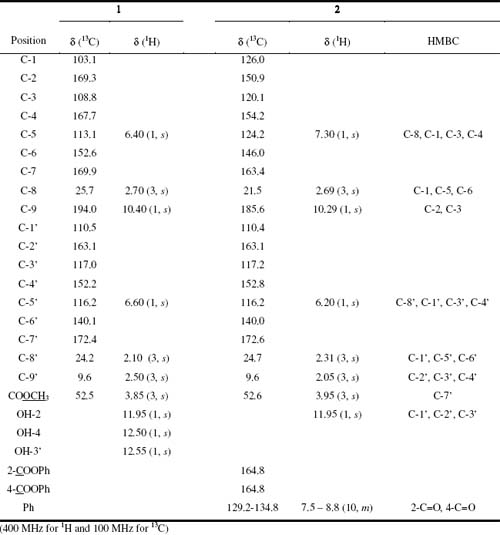
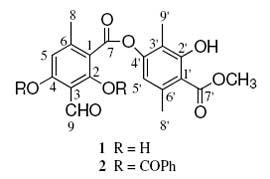
<body><![CDATA[<p align="justify"><b><font size="2" face="Verdana, Arial, Helvetica, sans-serif">INTRODUCTION</font></b></p>  <h5 align="justify">&nbsp;</h5>      <p align="justify"><font size="2" face="Verdana, Arial, Helvetica, sans-serif">Lichens are complex organism consisting of a symbiotic association of an alga and a fungus.<a href="#_edn1" name="_ednref1" title=""><i><b>[1]</b></i></a><i><sup>,</sup></i><a href="#_edn2" name="_ednref2" title=""><i><b>[2]</b></i></a><i><sup>,</sup></i><a href="#_edn3" name="_ednref3" title=""><i><b>[3]</b></i></a> The people in Bolivia have for centuries used herbal medicine for different purposes, one is based on the lichen <i>Thamnolia vermicularis</i> and used for the treatment of cough and hoarseness.<a href="#_edn4" name="_ednref4" title=""><i><b>[4]</b></i></a> Depsides and depsidones are important groups of secondary metabolites of lichens that often are present in high concentrations, and besides their medicinal properties they are also believed to be important for the ability of the lichens to defend themselves to the oxidative stress caused by solar irradiation. As part of a general study of depsides and depsidones, we collected three different species of lichens, <i>Thamnolia vermicularis</i>,<i> Baeomyces roseus </i>and <i>Everniastrum cirrhatum</i>, from the area of Pongo 3800 m.a.s.l. (La Paz  Bolivia). From <i>Everniastrum cirrhatum</i>, atranorin (<b>1</b>) was found to be the main component while salazinic acid (<b>3</b>) is a minor compound. Decarboxythamnolic acid (<b>5</b>) was isolated as a minor component and thamnolic acid (<b>6</b>) as the main component from<i> Thamnolia vermicularis</i>, while baeomycesic acid (<b>7</b>) was isolated as a main component from <i>Baeomyesis roseus</i>. A new derivate of atranorin was prepared and characterized by NMR spectroscopy. A previous NMR investigation reported assignments of <sup>13</sup>C NMR of depsides, depsidones and depsones.<a href="#_edn5" name="_ednref5" title=""><b><i><b>[5]</b></i></b></a><sup>,</sup><a href="#_edn6" name="_ednref6" title=""><i><b>[6]</b></i></a> However, as this was carried out without the use of two-dimensional NMR techniques some assignments of thamnolic acid, baeomycesic acid and hexaacetylsalazinic acid are incorrect. The correct shifts are presented in this investigation.</font></p>      <p align="justify"><font size="2" face="Verdana, Arial, Helvetica, sans-serif">&nbsp;</font></p>      <p align="justify"><font size="2" face="Verdana, Arial, Helvetica, sans-serif"><b>RESULTS, DISCUSSION</b></font></p>      <p align="justify"><font size="2" face="Verdana, Arial, Helvetica, sans-serif">&nbsp;</font></p>      <p align="justify"><font size="2" face="Verdana, Arial, Helvetica, sans-serif">Atranorin (<b>1</b>) was isolated from <i>Everniastrum cirrhatum,</i> and was obtained as white crystals (m.p. 197-198 <sup>o</sup>C from CH<sub>2</sub>Cl<sub>2</sub>-EtOAc mixture). The molecular formula C<sub>19</sub>O<sub>8</sub>H<sub>18 </sub>was deduced from the analysis of FABMS and NMR data. The <sup>1</sup>H NMR spectrum of <b>1 </b>displayed signals for three methyl groups at d 2.11 <i>s</i>, d 2.59 <i>s</i>, d 2.71 s and one group methoxyl at d 4.05 <i>s</i>. Two aromatic protons at d 6.44 s and d 6.56 <i>s</i> and four signals at d 10.39, d 11.95, d 12.53 and d 12.59 were also observed. The analysis of the <sup>13</sup>C NMR spectrum data of <b>1</b> with the aid of HMQC and HMBC spectrum permitted the complete structure assignment of <i>para</i>-depside as atranorin (Table 1). 2,4-bis(Benzoyloxy)-atranorin (<b>2</b>) was obtained by esterfication of <b>1</b> with benzoyl chloride in chloroform and in the presence of pyridine. The <sup>1</sup>H NMR spectrum of <b>2</b> show signals of four methyl groups at d 2.05 <i>s</i>, d 2.31 <i>s</i>, d 2.69 <i>s</i> and oxygenated methyl at d 3.95 <i>s</i>, as well as two proton aromatic at d 6.20 <i>s</i> and d 7.30 <i>s</i>. Other signals in the aromatic region corresponding to the two phenyl groups; at d 7.55 <i>m</i> (4H), d 7.75 <i>m</i> (2H) and d 8.25 <i>m</i> (4H), an aldehyde proton at d 10.29 <i>s</i> and a hydrogen bonding OH proton at d 11.95 <i>s</i>. The <sup>13</sup>C NMR spectrum indicated the presence of four methyl, two protonated unsaturated carbons and twelve non-protonated, as well as two carbonyl groups at 164.8 ppm, corresponding to a <i>para</i>-depside skeleton, in addition to the signals of the two phenyls. After the assignment of all protons to their respective carbons from HMQC experiments, a HMBC experiment was performed to complete the structural elucidation of <b>2</b>. In this, cross correlation peaks were observed between H-5 (d 7.30, <i>s</i>, 1H) and C-8, C-1, C-3 and C-4; from H-8 (d 2.69, <i>s</i>, 3H) and C-1, C-5 and C-6; from H-8 (d 2.31, <i>s</i>, 3H) and C-1, C-5 and C-6; from H-9 (d 2.05, <i>s</i>, 3H) and C-2, C-3 and C-4; from H-5 (d 6.20, <i>s</i>, 1H) and C-8, C-1, C-3 and C-4; from the methoxyl protons (d 3.95, <i>s</i>, 3H) and C-7; and from the aldehyde proton H-9 (d 10.29, <i>s</i>, 1H) and C-2 and C-3. In addition, correlations were observed between the 2-OH proton (d 11.95, <i>s</i>, 1H) and C-1, C-2 and C-3. The HMBC correlations are summarized in Table 1. Thus, the structure of compound <b>2</b> was established as 2,4-bis(benzoyloxy)-atranorin.</font></p>      <p align="justify"><font size="2" face="Verdana, Arial, Helvetica, sans-serif"><b>&nbsp;</b></font></p>      <p align=justify><font size="2" face="Verdana, Arial, Helvetica, sans-serif"><b><i>Table 1</i></b><i>. <sup>13</sup>C and <sup>1</sup>H NMR data for Atranorin <b>1</b> and 2,4-bis(benzoyloxy)-atranorin <b>2</b> and HMBC for <b>2</b></i></font></p>      <p align="center"><img src="/img/revistas/rbq/v28n1/tab1a05.jpg" width="500" height="535"></p>      <p align="justify"><font size="2" face="Verdana, Arial, Helvetica, sans-serif">&nbsp;</font></p>      ]]></body>
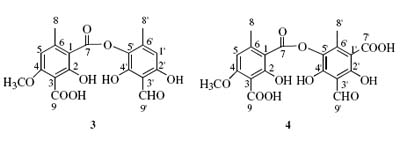
<body><![CDATA[<p align="justify"><font size="2" face="Verdana, Arial, Helvetica, sans-serif">The elemental composition of decarboxythamnolic acid (<b>3</b>) was suggested to be C<sub>18</sub>H<sub>16</sub>O<sub>9</sub>, from FABMS ([M+1] at <i>m/z</i> 377), <sup>1</sup>H NMR and <sup>13</sup>C NMR data. The <sup>1</sup>H NMR spectrum (DMSO-d<sub>6</sub>) showed signals for three methyl groups with singlets at d 2.28 <i>s</i>, d 2.50 <i>s</i> and d 3.90 <i>s</i>, two aromatic protons at d 6.38 <i>s,</i> d 6.65 <i>s</i>, as well as an aldehyde proton at d 10.23 <i>s</i>. The <sup>13</sup>C NMR and DEPT-135 spectra confirmed the presence of eighteen carbons, three methyls, three protonated unsaturated carbons and twelve non-protonated.</font></p>      <p align=center><img src="/img/revistas/rbq/v28n1/fig1a05.jpg" width="270" height="179"></p>      <p align="justify"><font size="2" face="Verdana, Arial, Helvetica, sans-serif">The complete structural elucidation of <b>3</b> was achieved by analysis of the HMBC. Pertinent HMBC     correlations were observed between protons and carbons: from H-8 (d     2.50, <i>s</i>, 3H) with C-1 (d 112.4), C-5 (d 106.3) and C-6 (d 145.1), between H-5 (d 6.65, <i>s</i>, 1H) and C-1 (d 112.4), C-3 (d 105.8) and C-8 (d 22.3), between H-8 (d 2.28, <i>s</i>, 3H) and C-1 (d 108.2), C-5 (d 129.4) and C-6 (d 143.4), between H-1 (d 6.38, <i>s</i>, 1H) and C-8 (d 17.9), C-3 (d 109.8), C-5 (d 129.4) and C-2 (d 159.9), between H-9 (d 10.23, <i>s</i>, 1H) and C-4 (d 154.0) and betwwen CH<sub>3</sub>O (d 3.90, <i>s</i>, 3H) and C-4 (d 161.5). The     structure was established on the basis of the above data as <i>meta</i>-depside decarboxythamnolic acid (Table 2). The elemental composition of thamnolic acid (<b>4</b>) was determined to be     C<sub>19</sub>H<sub>16</sub>O<sub>11</sub> from FABMS ([M+1] at <i>m/z</i> 421) and <sup>1</sup>H NMR and <sup>13</sup>C NMR. The <sup>1</sup>H NMR (DMSO-d<sub>6</sub>) spectrum showed signals for three     methyl groups at with singlets d 2.45 <i>s</i>,     d 2.50 <i>s</i> and d 3.86 <i>s</i>,     an aromatic proton at d     ]]></body>
<body><![CDATA[6.13 <i>s,</i> and an aldehyde proton at d 10.4 <i>s</i>. The <sup>13</sup>C NMR and DEPT-135 spectra confirmed the presence of nineteen carbon atoms three methyls, two protonated     unsaturated carbons and fourteen non-protonated. In the HMBC spectrum     correlations were observed between H-8 (d 2.50, <i>s</i>, 3H) and C-1 (d 112.5), C-5 (d 106.5)     and C-6 (d 145.4), between H-5 (d 6.15, <i>s</i>,     1H) and C-1 (d 112.5), C-3 (d 105.5) and C-8 (d 22.3), between H-8 (d 2.45, <i>s</i>,     3H) and C-1 (d     16.4), C-5 (d     129.9) and C-6 (d     143.9). Further correlations were observed between H-9 (d 10.30, <i>s</i>, 1H) and C-4 (d 157.3), C-5 (d 129.9), and C-3 (d 109.5), and between CH<sub>3</sub>O (d 3.86, <i>s</i>, 3H) and C-4 (d 161.7). There were still four     signals of carbons additional remaining in the <sup>13</sup>C RMN spectrum at d 161.0, d 157.3, d 166.8 and d 164.5.     ]]></body>
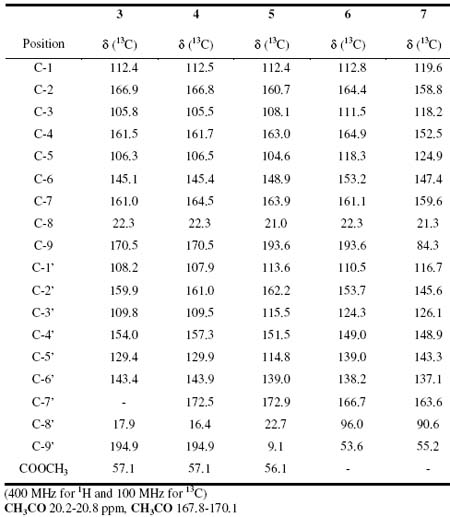
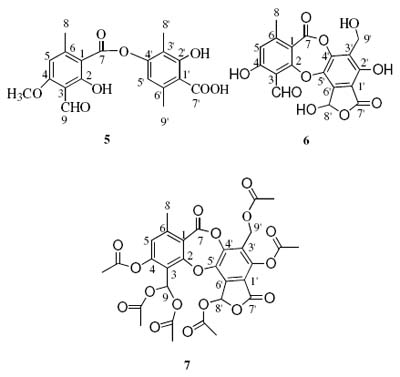
<body><![CDATA[These signals were compared with the compound<b> 3</b>,     because decarboxythamnolic acid showed similar chemical shift of carbon atoms     which the compound <b>3</b> and were assigned to: C-2 (d 161.0), C-4 (d 157.3),     C-2 (d 166.8) and C-7 (d 164.5), <b>4</b> could be     identified as <i>meta</i>-depside thamnolic acid (Table 2). Baeomycesic acid (<b>5</b>) was obtained as a     solid. The elemental composition C<sub>19</sub>H<sub>18</sub>O<sub>8</sub> was     deduced from FABMS ([M+1] at <i>m/z</i>     375) and NMR data analysis. The <sup>1</sup>H NMR (DMSO-d<sub>6</sub>) spectrum     contained seven signals, three of them are methyl groups at d 2.02 <i>s</i>, d 2.47 <i>s</i> and d 2.51 <i>s</i>, and one methoxy group at d 3.96 <i>s</i>. Two aromatic protons at d     6.45 <i>s</i>, d 6.69 <i>s</i>, a proton from aldehyde     ]]></body>
<body><![CDATA[group at d 10.21 <i>s</i>. The <sup>13</sup>C NMR spectrum indicated the presence of nineteen carbons atoms. These observations were     consistent with C<sub>19</sub>H<sub>18</sub>O<sub>8</sub>, the analysis of the <sup>13</sup>C NMR spectrum revealed the presence of four methyls, three protonated unsaturated carbons and twelve non-protonated. The complete     structural elucidation of <b>5</b> was achieved by analysis of the HMQC and HMBC. Important HMBC cross correlation peaks were observed     between the following protons and carbons: d 2.49 (3H, <i>s</i>, H-8) and C-1 (d 112.4), C-5 (d 104.6) and C-6 (d 148.9); d 6.69 (1H, <i>s</i>, H-5) and C-1 (d 112.4) and C-8 (d 21.0); d 2.51 (3H, <i>s</i>, H-8) and C-1 (d 113.6), C-5 (d 114.8) and C-6 (d 139.0); d 2.05 (3H, <i>s</i>, H-9) and C-2 (d 162.2), C-3 (d 115.5) and C-4 (d 151.5); d 6.45 (1H, <i>s</i>, H-5) and C-1 (d 113.6), C-3 (d 115.5), C-4 (d 151.5) and C-8 (d 22.7); d 10.21 (1H, <i>s</i>, H-9) and C-2 (d 160.7) and C-3 (d 108.1); and CH<sub>3</sub>O d 3.96 (3H, <i>s</i>) and C-4 (d 163.0), were observed. The structure was established     as the <i>para</i>-depside baeomycesic acid (Table 2).The FABMS of salazinic acid (<b>6</b>)     showed a molecular ion at ([m+1] at <i>m/z</i> 389), while the <sup>1</sup>H     NMR and <sup>13</sup>C NMR spectra indicated that the molecular formula should     be C<sub>18</sub>H<sub>12</sub>O<sub>10</sub>. The <sup>1</sup>H NMR (DMSO-d<sub>6</sub>)     spectrum showed signals for one methyl group at d 2.51 <i>s</i>, one CH<sub>2</sub>OH group at d 4.58 <i>s</i> and two signals at d 6.81 <i>s</i> and d 6.78 <i>s</i>,     as well as an aldehyde proton at d 10.23 <i>s</i>.     ]]></body>
<body><![CDATA[The <sup>13</sup>C NMR and DEPT-135 experiment spectrum indicated the presence of eighteen carbons atoms,     the compound had thirteen non-protonated unsaturated carbons, three protonated unsaturated carbons, one mono-protonated saturated carbon and one di-protonated saturated carbon, in addition to a methyl. The analysis of HMQC, COSY and HMBC     spectra permitted the complete structure assignment of the depsidone salazinic acid (<b>6</b>), previously isolated from <i>Parmotrema delicatulum</i><a     href="#_edn7" name="_ednref7" title=""><i><b>[7]</b></i></a> (Table 2). The acetylation of <b>6</b> with acetic anhydride in pyridine gave     hexaacetylsalazinic acid <b>(7)</b>     as the sole product. The elemental composition of <b>7</b> was suggested by FABMS ([M+1] <i>m/z</i> 659), the sodium adduct [M+Na] was also     observed at m/z 681 and NMR data to be C<sub>30</sub>H<sub>26</sub>O<sub>17</sub>.     The <sup>1</sup>H NMR (CDCl<sub>3</sub>) spectrum showed signals between d 1.9  2.7 for seven methyl     groups, one methylen group at d 5.1 (H-8a, <i>d</i>, <i>J</i>=7.0 Hz) and d 5.4 (H-8b, <i>d</i>, <i>J</i>=7.0 Hz), an aromatic proton at d 6.9 <i>s</i> and two methine     protons at d 7.8 <i>s</i> and d 7.95 <i>s. </i>The <sup>13</sup>C NMR and DEPT-135 spectra indicated the presence of thirty carbons atoms, consistent     ]]></body>
<body><![CDATA[with the element composition C<sub>30</sub>H<sub>26</sub>O<sub>17</sub>, the     presence of seven methyl groups and eight carbonyl groups was also indicated.     The complete structural elucidation of <b>7</b>was achieved by analysis of the     COSY and HMBC spectra. HMBC correlations were observed between d 2.57 (3H, <i>s</i>, H-8) and C-1 (d 119.6), C-5 (d 124.9) and C-6 (d 147.4); d 5.08 (1H, <i>d</i>, Ha-9) correlated with C-2 (d 145.6), C-3 (d 126.1), C-4 (d 148.9) and one carbonyl carbon; d 5.48 (1H, <i>d</i>, Hb-9) correlated with C-2 (d 145.6); d 7.99 (1H, <i>s</i>, H-9) correlated to C-2 (d 158.8), C-4 (d 152.5) and two carbonyl     carbons; the aromatic proton d 6.97 (1H, <i>s</i>, H-5) correlated with C-8 (d 21.3), C-1 (d 119.6), C-3 (d 118.2) and C-4 (d 152.5), d 7.89 (1H, <i>s</i>, H-8) correlated with C-7 (d 163.6) and one carbonyl     carbon. The methyl groups appear at <sup>13</sup>C spectrum data at d 20.9, 20.8, 20.7, 20.7, 20.6     and 20.4, the carbonyl groups at d 170.5, 169.1, 169.0, 168.9, 168.3 and 168.1. In the <sup>1</sup>H     spectrum data at d     2.43, 2.35, 2.21, 2.14, 2.09 and 1.95 (Table 2). The structure was established     as hexaacetylsalazinic acid, confirming that the compound salazinic acid was     ]]></body>
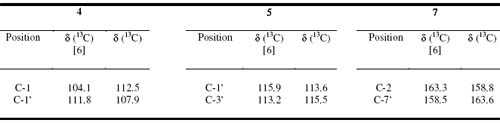
<body><![CDATA[isolated from <i>Everniastrum     cirrhatum</i>.</font></p>     <p align="justify"><font size="2" face="Verdana, Arial, Helvetica, sans-serif">&nbsp;</font></p>      <p align=justify><font size="2" face="Verdana, Arial, Helvetica, sans-serif"><b><i>Table 2.</i></b><i> <sup>13</sup>C chemical shifts of decarboxythamnolic acid <b>3</b>, thamnolic acid <b>4</b>, baeomycesic acid <b>5</b>, salazinic acid<b> 6</b> and hexaacetylsalazinic acid <b>7</b></i></font></p>      <p align=center><img src="/img/revistas/rbq/v28n1/tab2a05.jpg" width="450" height="517"></p>      <p align=justify>&nbsp;</p>      <p align="center"><img src="/img/revistas/rbq/v28n1/fig2a05.jpg" width="400" height="141"></p>      <p align=center><img src="/img/revistas/rbq/v28n1/fig3a05.jpg" width="400" height="377"></p>      <p align="justify">&nbsp;</p>      <p align="justify"><font size="2" face="Verdana, Arial, Helvetica, sans-serif">A comparison the assignment of the <sup>13</sup>C signals of compounds <b>4</b>, <b>5</b> and <b>7</b> was made with those reported in the literature<sup>6</sup> and we found several differences (the chemical shifts of C-1 and C-1 in <b>4</b>, C-1 and C-3 in <b>5</b>, and C-2 and C-7 in <b>7</b>). The correct assignment of the <sup>13</sup>C shifts of the indicated carbons in compounds <b>4</b>,<b> 5</b> and <b>7</b> are therefore summarized in Table 3.</font></p>      ]]></body>
<body><![CDATA[<p align="justify"><font size="2" face="Verdana, Arial, Helvetica, sans-serif"><b>&nbsp;</b></font></p>      <p align=justify><font size="2" face="Verdana, Arial, Helvetica, sans-serif"><b><i>Table 3</i></b><i>. Comparison of <sup>13</sup>C data of different chemical shift of <b>4</b>, <b>5</b> and <b>7 </b>with respect [6]</i></font></p>      <p align="center"><font size="2" face="Verdana, Arial, Helvetica, sans-serif">&nbsp;</font><img src="/img/revistas/rbq/v28n1/tab3a05.jpg" width="500" height="123"></p>      <p align="justify">&nbsp;</p>      <p align="justify"><font size="2" face="Verdana, Arial, Helvetica, sans-serif"><b>&nbsp;</b></font><font size="2" face="Verdana, Arial, Helvetica, sans-serif"><b>EXPERIMENTAL</b></font></p>      <p align="justify"><font size="2" face="Verdana, Arial, Helvetica, sans-serif"><i>General</i></font></p>      <p align="justify"><font size="2" face="Verdana, Arial, Helvetica, sans-serif">The mass spectra (FAB) were recorded with a Jeol SX 102 spectrometer, 1H NMR (400 MHz) and 13C NMR (100 MHz), on a Bruker DRX 400 instrument. UV spectra were recorded with a Varian Cary 2290 specrometer.</font></p>      <p align="justify"><font size="2" face="Verdana, Arial, Helvetica, sans-serif"> </font></p>      <p align="justify"><font size="2" face="Verdana, Arial, Helvetica, sans-serif"><i>Plant material</i></font></p>      <p align="justify"><font size="2" face="Verdana, Arial, Helvetica, sans-serif"><i>Everniastrum cirrhatum, Baeomyces roseus</i> and <i>Thamnolia vermicularis</i> were collected in the Pongo region 3800 m.a.s.l. (La Paz  Bolivia) in December 2002. The material was identified by department of Botany Herbario Nacional de Bolivia.</font></p>      ]]></body>
<body><![CDATA[<p align="justify"><font size="2" face="Verdana, Arial, Helvetica, sans-serif">&nbsp;</font></p>      <p align="justify"><font size="2" face="Verdana, Arial, Helvetica, sans-serif"><i>Extraction and Isolation</i></font></p>      <p align="justify"><font size="2" face="Verdana, Arial, Helvetica, sans-serif"><i>Everniastrum cirrhatum</i> was cleaned, dried at room temperature for 48 h and powdered. This material (156.0 g) was extracted with acetone (1 L) at room temperature for 72 h and concentrated in vacuo to yield the crude extrac (21.6 g) which was washed three times with CH<sub>2</sub>CL<sub>2</sub> (500 mL) and EtOAc (500 mL). The soluble part was concentred under reduced pressure and subjected to chromatography. Atranorin (9.0 g) was obtained as the major product extract afforded a white solid <b>1</b> (9.0 g), which was recrystallized from ethyl acetate. From the CH<sub>2</sub>Cl<sub>2</sub>-EtOAc insoluble parts the depsidone <b>6</b> (8.4 g) was obtained. </font></p>      <p align="justify"><font size="2" face="Verdana, Arial, Helvetica, sans-serif"><i>Acetylation</i> of <b>1</b>. Compound <b>1</b> (400 mg) was dissolved in pure CHCl<sub>3</sub> (8 mL). At room temperature and under stirring benzoyl chloride (902 mg) was dropped in followed by pyridine (2.5 mL). The reaction mixture was stirred for 3 h at room temperature and washed with water. Dried over Na<sub>2</sub>SO<sub>4</sub> and evaporated. The residue was chromatographed with hexane/CHCl<sub>3</sub> (1:0 to 0:1), 163 mg of <b>2</b> were obtained.  </font></p>      <p align="justify"><font size="2" face="Verdana, Arial, Helvetica, sans-serif"><i>Acetylation</i> of <b>6</b>. Compound <b>6 </b>(100 mg) in acetic anhydride (2.0 mL) and two drops of H<sub>2</sub>SO<sub>4</sub> for 24 h at room temperature under stirring. After the usual work-up, 60 mg of <b>7</b> were obtained.</font></p>      <p align="justify"><font size="2" face="Verdana, Arial, Helvetica, sans-serif"><i>Baeomyces roseus</i> was cleaned, dried at room temperature for 48 h and powdered. This material (36.0 g) was extracted with acetone at room temperature for 72 h and concentrated in vacuo to yield the crude extrac (2.6 g) which was recrystallized from acetone to gave a yellow solid <b>5</b>.</font></p>      <p align="justify"><font size="2" face="Verdana, Arial, Helvetica, sans-serif"><i>Thamnolia vermicularis </i>was cleaned, dried at room temperature for 48 h and powdered. This material (20.0 g) was extracted with acetone at room temperature for 120 h and concentrated in vacuo to yield the crude extrac (1.4 g) which was washed several times with Acetone each one (200 mL). This extract was subjected to CC on silica gel eluted with CH<sub>2</sub>Cl<sub>2</sub>-Acetone mixtures of increasing polarity. Two compounds were obtained, two <i>meta</i>-depsides <b>3 </b>(89 mg) and <b>4 </b>(1200 mg).</font></p>      <p align="justify"><font size="2" face="Verdana, Arial, Helvetica, sans-serif"><i>Atranorin </i><b>(1)</b> m.p. 197-198°C; FABMS <i>m/z</i> [M+1]<sup>+  </sup>375 for C<sub>19</sub>O<sub>8</sub>H<sub>18; </sub><sup>1</sup>H NMR (CDCl<sub>3</sub>) and <sup>13</sup>C NMR (CDCl<sub>3</sub>) see table 1.</font></p>      <p align="justify"><font size="2" face="Verdana, Arial, Helvetica, sans-serif"><i>2,4-bis(benzoyloxy)-atranorin</i> <b>(2)</b>; m.p. 171-172 °C; FABMS <i>m/z</i> [M+1]<sup>+</sup> 583 for C<sub>33</sub>H<sub>26</sub>O<sub>10</sub>; <sup>1</sup>H NMR (CDCl<sub>3</sub>) and <sup>13</sup>C NMR (CDCl<sub>3</sub>) see table 1</font></p>      <p align="justify"><font size="2" face="Verdana, Arial, Helvetica, sans-serif"><i>Decarboxythamnolic acid</i> (<b>3)</b>, m.p. 216°C; FABMS <i>m/z</i> [M+1]<sup>+ </sup>377 for C<sub>18</sub>H<sub>16</sub>O<sub>9</sub>; <sup>1</sup>H NMR (DMSO-d<sub>6</sub>): d 2.50 (3H, <i>s</i>, H-8), 6.65 (1H, <a name="OLE_LINK74"><i>s</i></a>, H-5), 2.28 (3H, <i>s</i>, H-8), 6.38 (1H, <i>s</i>, H-1), 10.23 (1H, <i>s</i>, H-9), 3.90 (3H, <i>s</i>, OMe-C-4); <sup>13</sup>C NMR (DMSO-d<sub>6</sub>): (C-1) 112.4, (C-2) 166.9, (C-3) 105.8, (C-4) 161.5, (C-5) 106.3, (C-6) 145.1, (C-7) 161.0, (C-8) 22.3, (C-9) 170.5, (C-1) 108.2, (C-2) 159.9, (C-3) 109.8, (C-4) 154.0, (C-5) 129.4, (C-6) 143.4, (C-8) 17.9, (C-9) 194.9, (OCH<sub>3</sub>) 57.1.</font></p>      ]]></body>
<body><![CDATA[<p align="justify">&nbsp;</p>     <p align="justify"><font size="2" face="Verdana, Arial, Helvetica, sans-serif"><i>Thamnolic acid</i> (<b>4)</b>, m.p. 224°C, FABMS <i>m/z</i> [M+1]<sup>+ </sup>421 for C<sub>19</sub>H<sub>16</sub>O<sub>11</sub>; <sup>1</sup>H NMR (DMSO-d<sub>6</sub>): d 2.50 (3H, <i>s</i>, H-8), 6.13   (1H, <i>s</i>, H-5), 2.45 (3H, <i>s</i>, H-8), 10.4 (1H, <i>s</i>, H-9), 3.86 (3H, <i>s</i>, OMe-C-4); <sup>13</sup>C   NMR (DMSO-d<sub>6</sub>):    (C-1) 112.5, (C-2) 166.8, (C-3) 105.5, (C-4) 161.7, (C-5) 106.5, (C-6) 145.4,   (C-7) 164.5, (C-8)  22.3, (C-9) 170.5, (C-1) 107.9, (C-2) 161.0, (C-3) 109.5, (C-4) 157.3, (C-5) 129.9, (C-6) 143.9, (C-7) 172.5, (C-8) 16.4, (C-9) 194.9, (OCH<sub>3</sub>) 57.1.</font></p>     <p align="justify"><font size="2" face="Verdana, Arial, Helvetica, sans-serif">&nbsp;</font></p>      <p align="justify"><font size="2" face="Verdana, Arial, Helvetica, sans-serif"><i>Baeomycesic acid</i> (<b>5)</b> m.p. 233 °C, FABMS <i>m/z</i> [M+1]<sup>+ </sup>375 for C<sub>19</sub>H<sub>18</sub>O<sub>8</sub>; <sup>1</sup>H NMR (DMSO-d<sub>6</sub>): d 2.47 (3H, <i>s</i>, H-8), 6.69 (1H, <i>s</i>, H-5), 2.51 (3H, <i>s</i>, H-8), 2.02 (3H, <i>s</i>, H-9), 6.45 (1H, <i>s</i>, H-5), 10.21 (1H, <i>s</i>, H-9), 3.96 (3H, <i>s</i>, OMe-C-4). <sup>13</sup>C NMR (DMSO-d<sub>6</sub>):  (C-1) 112.4, (C-2) 160.7, (C-3) 108.1, (C-4) 163.0, (C-5) 104.6, (C-6) 148.9, (C-7) 163.9, (C-8) 21.0, (C-9) 193.6, (C-1) 113.6, (C-2) 162.2, (C-3) 115.5, (C-4) 151.5, (C-5) 114.8, (C-6) 139.0, (C-7) 172.9, (C-8) 22.7, (C-9) 9.1, (OCH<sub>3</sub>) 56.1.</font></p>      <p align="justify"><font size="2" face="Verdana, Arial, Helvetica, sans-serif">&nbsp;</font></p>      <p align="justify"><font size="2" face="Verdana, Arial, Helvetica, sans-serif"><i>Salazinic acid</i> (<b>6)</b> (11.1 g), m.p. 281-282 <sup>o</sup>C; FABMS <i>m/z</i> [M+1]<sup>+</sup> 389 for C<sub>18</sub>H<sub>12</sub>O<sub>10</sub>; <sup>1</sup>H NMR (DMSO-d<sub>6</sub>); d 2.51 (3H, <i>s</i>, Me-9), 4.58 (2H, <i>s, </i>CH<sub>2</sub>-9), 6.78 (1H, <i>s</i>, H-8), 6.81 (1H, <i>s</i>, H-5), 10.23 (1H, <i>s,</i> CHO-8). <sup> 13</sup>C NMR (DMSO-d<sub>6</sub>): d (1) 112.8, (2) 164.4, (3) 111.5, (4) 164.9, (5) 118.3, (6) 153.2, (7) 161.1, (8) 22.3, (9) 193.6, (1) 110.5, (2) 153.7, (3) 124.3, (4) 149.0, (5) 139.0, (6) 138.2, (7) 166.7, (8) 96.0, (9) 53.6.</font></p>      <p align="justify"><font size="2" face="Verdana, Arial, Helvetica, sans-serif">&nbsp;</font></p>      <p align="justify"><font size="2" face="Verdana, Arial, Helvetica, sans-serif"><i>Hexaacetilsalazinic</i> <i>acid</i> (<b>7)</b>; m.p. 374°C; FABMS <i>m/z</i> [M+Na]<sup>+</sup> 681 [658+23] for C<sub>30</sub>H<sub>26</sub>O<sub>17</sub>; <sup>1</sup>H NMR (CDCl<sub>3</sub>): d 2.55 (3H, <i>s</i>, H-8), 5.10 (1H, <i>d, </i>CH<sub>2</sub>-8), 5.4 (1H, <i>d</i>, CH<sub>2</sub>-8), 7.80 (1H, <i>s</i>, H-8), 6.90 (1H, <i>s</i>, H-5), 7.95.0 (1H, <i>s,</i> H-8). <sup>13</sup>C NMR (CDCl<sub>3</sub>):d  (1) 119.6, (2) 158.8, (3) 118.2, (4) 152.5, (5) 124.9, (6) 147.4, (7) 159.6, (8) 22.3, (9) 84.3, (1) 116.7, (2) 145.6, (3) 126.1, (4) 148.9, (5) 143.3, (6) 137.1, (7) 163.6, (8) 90.6, (9) 55.2.</font></p>      <p align="justify"><font size="2" face="Verdana, Arial, Helvetica, sans-serif">&nbsp;</font></p>      <p align="justify"><font size="2" face="Verdana, Arial, Helvetica, sans-serif"><b>Acknowledgements</b></font></p>      ]]></body>
<body><![CDATA[<p align="justify"><font size="2" face="Verdana, Arial, Helvetica, sans-serif">The authors wish to express their gratitude to the Swedish International Development Cooperation Agency (Sida) for financial support.</font></p>      <p align="justify"><font size="2" face="Verdana, Arial, Helvetica, sans-serif"><b>&nbsp;</b></font></p>      <p align="justify"><font size="2" face="Verdana, Arial, Helvetica, sans-serif"><b>REFERENCES </b></font></p>      <p align="justify">&nbsp;</p>      <!-- ref --><p align="justify"><font size="2" face="Verdana, Arial, Helvetica, sans-serif">1. <a href="#_ednref1" name="_edn1" title=""></a>Purvis, W. <i>Lichens, </i>Smithsonian Institution, Washington,D.C in association with The Natural History Museum, Press: London 2000.</font>&nbsp;&nbsp;&nbsp;&nbsp;&nbsp;&nbsp;&nbsp;&nbsp;[&#160;<a href="javascript:void(0);" onclick="javascript: window.open('/scielo.php?script=sci_nlinks&ref=674352&pid=S0250-5460201100010000500001&lng=','','width=640,height=500,resizable=yes,scrollbars=1,menubar=yes,');">Links</a>&#160;]<!-- end-ref --><p align="justify"><font size="2" face="Verdana, Arial, Helvetica, sans-serif">2. <a      href="#_ednref2" name="_edn2" title=""></a>Hale, M., <i>&ldquo;The Biology of lichens&rdquo;</i> Third Edition, Ed. Spottiswoode Ballantyne Ltd., Press: London 1983.</font></p>     <!-- ref --><p align="justify"><font size="2" face="Verdana, Arial, Helvetica, sans-serif">3.&nbsp;   <a href="#_ednref3" name="_edn3" title=""></a>Dayan, F., Romangi, J., <i>Pesticide Outlook</i> 2001, 229-232.</font>&nbsp;&nbsp;&nbsp;&nbsp;&nbsp;&nbsp;&nbsp;&nbsp;[&#160;<a href="javascript:void(0);" onclick="javascript: window.open('/scielo.php?script=sci_nlinks&ref=674354&pid=S0250-5460201100010000500003&lng=','','width=640,height=500,resizable=yes,scrollbars=1,menubar=yes,');">Links</a>&#160;]<!-- end-ref --><!-- ref --><p align="justify"><font size="2" face="Verdana, Arial, Helvetica, sans-serif">4.&nbsp;   <a href="#_ednref4" name="_edn4" title=""></a>Macia, M., Garcia, E., Vidaurre, P., <i>Journal Ethnopharmacology </i> 2005, 97, 337-350.</font>&nbsp;&nbsp;&nbsp;&nbsp;&nbsp;&nbsp;&nbsp;&nbsp;[&#160;<a href="javascript:void(0);" onclick="javascript: window.open('/scielo.php?script=sci_nlinks&ref=674355&pid=S0250-5460201100010000500004&lng=','','width=640,height=500,resizable=yes,scrollbars=1,menubar=yes,');">Links</a>&#160;]<!-- end-ref --><!-- ref --><p align="justify"><font size="2" face="Verdana, Arial, Helvetica, sans-serif">5. <a      href="#_ednref5" name="_edn5" title=""></a>Sundholm, G., Huneck, S., <i>Letter to Chemica Scripta </i>1980, 16, 197-200.</font>&nbsp;&nbsp;&nbsp;&nbsp;&nbsp;&nbsp;&nbsp;&nbsp;[&#160;<a href="javascript:void(0);" onclick="javascript: window.open('/scielo.php?script=sci_nlinks&ref=674356&pid=S0250-5460201100010000500005&lng=','','width=640,height=500,resizable=yes,scrollbars=1,menubar=yes,');">Links</a>&#160;]<!-- end-ref --><!-- ref --><p align="justify"><font size="2" face="Verdana, Arial, Helvetica, sans-serif">6. <a      href="#_ednref6" name="_edn6" title=""></a>Sundholm, G., Huneck, S., <i>Letter to Chemica Scripta </i>1981, 18, 233-236.</font>&nbsp;&nbsp;&nbsp;&nbsp;&nbsp;&nbsp;&nbsp;&nbsp;[&#160;<a href="javascript:void(0);" onclick="javascript: window.open('/scielo.php?script=sci_nlinks&ref=674357&pid=S0250-5460201100010000500006&lng=','','width=640,height=500,resizable=yes,scrollbars=1,menubar=yes,');">Links</a>&#160;]<!-- end-ref --><!-- ref --><p align="justify"><font size="2" face="Verdana, Arial, Helvetica, sans-serif">7.   <a href="#_ednref7" name="_edn7" title=""></a>Eifler-Lima, V., Sperry, A., Sinbandhit, S., Boustie, J., Tomasi, S., Schenkel, E., <i>Magnetic Resonance in Chemistry</i> 2000, 38, 472-474.</font>&nbsp;&nbsp;&nbsp;&nbsp;&nbsp;&nbsp;&nbsp;&nbsp;[&#160;<a href="javascript:void(0);" onclick="javascript: window.open('/scielo.php?script=sci_nlinks&ref=674358&pid=S0250-5460201100010000500007&lng=','','width=640,height=500,resizable=yes,scrollbars=1,menubar=yes,');">Links</a>&#160;]<!-- end-ref --> ]]></body><back>
<ref-list>
<ref id="B1">
<label>1</label><nlm-citation citation-type="book">
<person-group person-group-type="author">
<name>
<surname><![CDATA[Purvis]]></surname>
<given-names><![CDATA[W]]></given-names>
</name>
</person-group>
<source><![CDATA[Lichens]]></source>
<year>2000</year>
<publisher-loc><![CDATA[London^eWashington,D.C Washington,D.C]]></publisher-loc>
<publisher-name><![CDATA[in association with The Natural History Museum, Press]]></publisher-name>
</nlm-citation>
</ref>
<ref id="B2">
<label>2</label><nlm-citation citation-type="book">
<person-group person-group-type="author">
<name>
<surname><![CDATA[Hale]]></surname>
<given-names><![CDATA[M]]></given-names>
</name>
</person-group>
<source><![CDATA[The Biology of lichens]]></source>
<year>1983</year>
<edition>Third Edition</edition>
<publisher-loc><![CDATA[London ]]></publisher-loc>
<publisher-name><![CDATA[Ed. Spottiswoode Ballantyne Ltd., Press]]></publisher-name>
</nlm-citation>
</ref>
<ref id="B3">
<label>3</label><nlm-citation citation-type="journal">
<person-group person-group-type="author">
<name>
<surname><![CDATA[Dayan]]></surname>
<given-names><![CDATA[F]]></given-names>
</name>
<name>
<surname><![CDATA[Romangi]]></surname>
<given-names><![CDATA[J]]></given-names>
</name>
</person-group>
<source><![CDATA[Pesticide Outlook]]></source>
<year>2001</year>
<page-range>229-232</page-range></nlm-citation>
</ref>
<ref id="B4">
<label>4</label><nlm-citation citation-type="journal">
<person-group person-group-type="author">
<name>
<surname><![CDATA[Macia]]></surname>
<given-names><![CDATA[M]]></given-names>
</name>
<name>
<surname><![CDATA[Garcia]]></surname>
<given-names><![CDATA[E]]></given-names>
</name>
<name>
<surname><![CDATA[Vidaurre]]></surname>
<given-names><![CDATA[P]]></given-names>
</name>
</person-group>
<source><![CDATA[Journal Ethnopharmacology]]></source>
<year>2005</year>
<volume>97</volume>
<page-range>337-350</page-range></nlm-citation>
</ref>
<ref id="B5">
<label>5</label><nlm-citation citation-type="journal">
<person-group person-group-type="author">
<name>
<surname><![CDATA[Sundholm]]></surname>
<given-names><![CDATA[G]]></given-names>
</name>
<name>
<surname><![CDATA[Huneck]]></surname>
<given-names><![CDATA[S]]></given-names>
</name>
</person-group>
<source><![CDATA[Letter to Chemica Scripta]]></source>
<year>1980</year>
<volume>16</volume>
<page-range>197-200</page-range></nlm-citation>
</ref>
<ref id="B6">
<label>6</label><nlm-citation citation-type="journal">
<person-group person-group-type="author">
<name>
<surname><![CDATA[Sundholm]]></surname>
<given-names><![CDATA[G]]></given-names>
</name>
<name>
<surname><![CDATA[Huneck]]></surname>
<given-names><![CDATA[S]]></given-names>
</name>
</person-group>
<source><![CDATA[Letter to Chemica Scripta]]></source>
<year>1981</year>
<volume>18</volume>
<page-range>233-236</page-range></nlm-citation>
</ref>
<ref id="B7">
<label>7</label><nlm-citation citation-type="journal">
<person-group person-group-type="author">
<name>
<surname><![CDATA[Eifler-Lima]]></surname>
<given-names><![CDATA[V]]></given-names>
</name>
<name>
<surname><![CDATA[Sperry]]></surname>
<given-names><![CDATA[A]]></given-names>
</name>
<name>
<surname><![CDATA[Sinbandhit]]></surname>
<given-names><![CDATA[S]]></given-names>
</name>
<name>
<surname><![CDATA[Boustie]]></surname>
<given-names><![CDATA[J]]></given-names>
</name>
<name>
<surname><![CDATA[Tomasi]]></surname>
<given-names><![CDATA[S]]></given-names>
</name>
<name>
<surname><![CDATA[Schenkel]]></surname>
<given-names><![CDATA[E]]></given-names>
</name>
</person-group>
<source><![CDATA[Magnetic Resonance in Chemistry]]></source>
<year>2000</year>
<volume>38</volume>
<page-range>472-474</page-range></nlm-citation>
</ref>
</ref-list>
</back>
</article>