<?xml version="1.0" encoding="ISO-8859-1"?><article xmlns:mml="http://www.w3.org/1998/Math/MathML" xmlns:xlink="http://www.w3.org/1999/xlink" xmlns:xsi="http://www.w3.org/2001/XMLSchema-instance">
<front>
<journal-meta>
<journal-id>0250-5460</journal-id>
<journal-title><![CDATA[Revista Boliviana de Química]]></journal-title>
<abbrev-journal-title><![CDATA[Rev. Bol. Quim]]></abbrev-journal-title>
<issn>0250-5460</issn>
<publisher>
<publisher-name><![CDATA[Universidad Mayor de San Andrés]]></publisher-name>
</publisher>
</journal-meta>
<article-meta>
<article-id>S0250-54602010000200006</article-id>
<title-group>
<article-title xml:lang="en"><![CDATA[MAIN COMPONENTS OF THE ESSENTIAL OIL OF MENTA NATIVE]]></article-title>
</title-group>
<contrib-group>
<contrib contrib-type="author">
<name>
<surname><![CDATA[Bascope,]]></surname>
<given-names><![CDATA[Marcelo]]></given-names>
</name>
<xref ref-type="aff" rid="A01"/>
</contrib>
<contrib contrib-type="author">
<name>
<surname><![CDATA[Alejo]]></surname>
<given-names><![CDATA[Lucio]]></given-names>
</name>
<xref ref-type="aff" rid="A01"/>
</contrib>
<contrib contrib-type="author">
<name>
<surname><![CDATA[terner]]></surname>
<given-names><![CDATA[Olov]]></given-names>
</name>
<xref ref-type="aff" rid="A01"/>
</contrib>
</contrib-group>
<aff id="A01">
<institution><![CDATA[,Lund University Division of Organic Chemistry ]]></institution>
<addr-line><![CDATA[Lund ]]></addr-line>
<country>Sweden</country>
</aff>
<aff id="A02">
<institution><![CDATA[,Universidad Mayor de San Simón Centro de Tecnología Agroindustrial ]]></institution>
<addr-line><![CDATA[Cochabamba ]]></addr-line>
<country>Bolivia</country>
</aff>
<pub-date pub-type="pub">
<day>05</day>
<month>12</month>
<year>2010</year>
</pub-date>
<pub-date pub-type="epub">
<day>05</day>
<month>12</month>
<year>2010</year>
</pub-date>
<volume>27</volume>
<numero>2</numero>
<fpage>104</fpage>
<lpage>106</lpage>
<copyright-statement/>
<copyright-year/>
<self-uri xlink:href="http://www.scielo.org.bo/scielo.php?script=sci_arttext&amp;pid=S0250-54602010000200006&amp;lng=en&amp;nrm=iso"></self-uri><self-uri xlink:href="http://www.scielo.org.bo/scielo.php?script=sci_abstract&amp;pid=S0250-54602010000200006&amp;lng=en&amp;nrm=iso"></self-uri><self-uri xlink:href="http://www.scielo.org.bo/scielo.php?script=sci_pdf&amp;pid=S0250-54602010000200006&amp;lng=en&amp;nrm=iso"></self-uri><abstract abstract-type="short" xml:lang="en"><p><![CDATA[&#946;-Thujone (1), sabinene (2), and sabinol (3) were identified as the major constituents of the essential oil of “Menta native” (identification in progress), with &#946;-Thujone being present at a concentration higher than 90 %. The compounds were identified by NMR techniques and quantified by GC means. Remarkable is the fact that the isomer &#945;-thujone is absent in the essential oil, plants containing &#945;-Thujone and &#946;-thujone are important herbal medicines and food additives, and their essential oils are appreciated in the commercial market]]></p></abstract>
<abstract abstract-type="short" xml:lang="es"><p><![CDATA[&#946;-Thujona (1), sabineno (2), y sabinol (3) se identificaron como los componentes mayoritarios del aceite esencial de “Menta Nativa” (identificación en progreso), con &#946;-Thujona estando presente a una concentración mayor al 90 %. Los compuestos han sido identificados por técnicas de RMN y cuantificados por cromatografia Gaseosa. Es notorio el hecho que el isomero &#945;-Thujona esta ausente en el aceite esencial, Plantas conteniendo &#945;-Thujona y &#946;-thujona son importantes medicinas hierbales y aditivos alimenticios, sus aceites esenciales son apreciados en el mercado comercial]]></p></abstract>
<kwd-group>
<kwd lng="en"><![CDATA[Menta nativa]]></kwd>
<kwd lng="en"><![CDATA[-Thujone]]></kwd>
<kwd lng="en"><![CDATA[-thujone cyathea]]></kwd>
<kwd lng="en"><![CDATA[sabinol]]></kwd>
<kwd lng="en"><![CDATA[sabinene]]></kwd>
</kwd-group>
</article-meta>
</front><body><![CDATA[ <p align="right"><font face="Verdana, Arial, Helvetica, sans-serif"><b><font size="4">ARTICULO ORIGINAL </font></b></font></p>     <p align=left style='text-align:center;line-height:150%'><b><font size="4" face="Verdana, Arial, Helvetica, sans-serif">M</font></b><font size="4" face="Verdana, Arial, Helvetica, sans-serif"><b><span lang=EN-US style='line-height:150%'>AIN COMPONENTS OF THE ESSENTIAL OIL OF MENTA NATIVE</span></b></font></p>     <p align=justify style='text-align:center;line-height:150%'><font size="2" face="Verdana, Arial, Helvetica, sans-serif"><i><span lang=ES-BO style='line-height:150%'><b>Marcelo Bascope,<sup>a,b*</sup> Lucio Alejo<sup>b</sup> and Olov Sterner<sup>a,</sup></b></span></i></font></p>      <p align=justify style='text-align:center'><font size="2" face="Verdana, Arial, Helvetica, sans-serif"><sup><span lang=ES-BO>a</span></sup><span lang=ES-BO>Division of Organic Chemistry, Lund University, P.O.Box 124, S-22100 Lund, Sweden.</span> </font></p>     <p align=justify style='text-align:center'><font size="2" face="Verdana, Arial, Helvetica, sans-serif"><sup>b</sup>Centro de   Tecnología Agroindustrial, Universidad Mayor de San Simón, Cochabamba Bolivia.</font></p> <hr style="margin-bottom: 0cm"> <font size="2" face="Verdana, Arial, Helvetica, sans-serif"><b><span lang=EN-US>Keywords:</span></b><span lang=EN-US> Menta nativa, </span>&#945;<span lang=EN-US>-Thujone, </span>&#946;<span lang=EN-US>-thujone<span style='color:#333333'> cyathea</span>, sabinol, sabinene</span></font>     <p align="justify"><b><font size="2" face="Verdana, Arial, Helvetica, sans-serif"><span lang=EN-US>ABSTRACT</span></font></b></p>      <p align="justify" style='margin-right:5.6pt;text-align:justify'><font size="2" face="Verdana, Arial, Helvetica, sans-serif">&#946;<span lang=EN-US>-Thujone (<b>1</b>), sabinene (<b>2</b>), and sabinol (<b>3</b>) were identified as the major constituents of the essential oil of “Menta native” (identification in progress), with  </span>&#946;<span lang=EN-US>-Thujone being present at a concentration higher than 90 %. The compounds were identified by NMR techniques and quantified by GC means. Remarkable is the fact that the isomer </span>&#945;<span lang=EN-US>-thujone is absent in the essential oil, plants containing </span>&#945;<span lang=EN-US>-Thujone and </span>&#946;<span lang=EN-US>-thujone are important herbal medicines and food additives, and their essential oils are appreciated in the commercial market.</span></font></p>      <p align="justify" style='margin:0cm;margin-bottom:.0001pt;text-align:justify'><font size="2" face="Verdana, Arial, Helvetica, sans-serif"><span lang=EN-US>Corresponding author: </span><a href="mailto:Marcelo.bascope@organic.lu.se"><span lang=EN-US>Marcelo.bascope@hotmail.com</span></a></font></p>  <hr>     <p align="justify" style='margin-right:5.6pt;text-align:justify'><font size="2" face="Verdana, Arial, Helvetica, sans-serif"><b>RESUMEN.</b></font></p>      <p align="justify" style='text-align:justify'><font size="2" face="Verdana, Arial, Helvetica, sans-serif">&#946;-Thujona (<b>1</b>), sabineno (<b>2</b>), y sabinol (<b>3</b>) se identificaron como los componentes mayoritarios del aceite esencial de “Menta Nativa” (identificación en progreso), con &#946;-Thujona estando presente a una concentración mayor al 90 %. Los compuestos han sido identificados por técnicas de RMN y cuantificados por cromatografia Gaseosa. Es notorio el hecho que el isomero &#945;-Thujona esta ausente en el aceite esencial, Plantas conteniendo  &#945;-Thujona y &#946;-thujona son importantes medicinas hierbales y aditivos alimenticios, sus aceites esenciales son apreciados en el mercado comercial.</font></p>  <hr>     ]]></body>
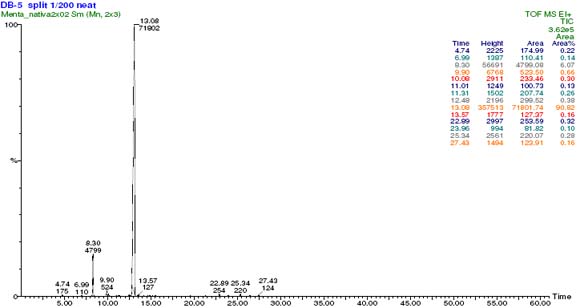
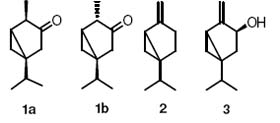
<body><![CDATA[<p align="justify"><font size="2" face="Verdana, Arial, Helvetica, sans-serif"><span lang=EN-US><b>INTRODUCTION</b></span></font></p>     <p align="justify" style="margin-bottom: .0001pt"><font size="2" face="Verdana, Arial, Helvetica, sans-serif"><span lang=EN-US>During the exploration of potential vegetal sources   for the extraction of essential oils, we found that the aerial parts of “Menta   native” (identification in progress) give a yellowish oil with strong mint   fragrance. Preliminary GC studies of the essential oil shows the presence of   one major component accounting for 90 % of the oil, and we decided to identify   the components by NMR. We report in this paper the identification and structure   determination of; </span>&#946;<span lang=EN-US>-thujone, sabinene, and sabinol as the     major components of the essential oil of “menta native”. Plants containing </span>&#945;<span lang=EN-US>-thujone       and </span>&#946;<span lang=EN-US>-thujone are important herbal medicines and food         additives<sup>1.2.3.</sup>, therefore their essential oils are appreciated in         the commercial market. Both monoterpenes are isomers with different         stereochemistry of the C-4 methyl group. </span>&#945;<span lang=EN-US>-Thujone is considered to be the principal           active ingredient of wormwood oil and toxic principle of absinthe4. The content           of </span>&#946;<span lang=EN-US>-thujone often exceeds that of </span>&#945;<span lang=EN-US>-thujone depending on the plant source, but the </span>&#946;<span lang=EN-US> isomer is considered to be less toxic<sup>5</sup>.</span></font></p>     <p align="center" style="margin-bottom: .0001pt"><img src="/img/revistas/rbq/v27n2/fig1a16.jpg" width="280" height="123"></p>     <p align="justify" style="margin-bottom: .0001pt"><font size="2" face="Verdana, Arial, Helvetica, sans-serif"><b><i><span lang=EN-US>Figure 1</span></i></b><i><span lang=EN-US>. monoterpenoids from the family of the thujane   skeleton</span>.</i></font></p>     <p align="justify" style='margin:0cm;margin-bottom:.0001pt;text-align:justify'><font size="2" face="Verdana, Arial, Helvetica, sans-serif"><span lang=EN-US>&nbsp;</span></font></p>      <p align="justify" style='margin:0cm;margin-bottom:.0001pt;text-align:justify'>&nbsp;</p>     <p align="justify" style='margin:0cm;margin-bottom:.0001pt;text-align:justify'><font size="2" face="Verdana, Arial, Helvetica, sans-serif"><b><span lang=ES-BO>RESULTS, DISCUSSION</span></b></font></p>     <p align="justify" style='margin:0cm;margin-bottom:.0001pt;text-align:justify'><font size="2" face="Verdana, Arial, Helvetica, sans-serif"><span lang=EN-US>&nbsp;</span></font></p>      <p align="justify" style='margin:0cm;margin-bottom:.0001pt;text-align:justify'><font size="2" face="Verdana, Arial, Helvetica, sans-serif"><span lang=EN-US>The steam distilled oil of “Menta native” was analyzed by GC means, the chromatogram clearly shows three main constituent, whit concentrations of; 90.8, 6.1 and 0.7 % respectively, the remaining 3.6 % were 12 peaks which we didn’t consider important for the characterization of the oil. The essential oil of was submitted to chromatography on straight phase, using hexane as eluent. The fractions were joined in three groups; fractions before the main constituent, containing the main component, and fractions after the main component. Its proton spectrum shows two proton signals (6-H<sub>2</sub>) at </span>&#948;<span lang=EN-US> -0.09 ppm (dd, J=5.7, 4.10 Hz, H6-</span>&#946;<span lang=EN-US>) and </span>&#948;<span lang=EN-US> 0.54 ppm (ddd, J=2.0, 5.7, 7.8 Hz, H6-</span>&#945;<span lang=EN-US>) typical from a cyclopropyl ring. The <sup>13</sup>CNMR spectrum indicates a carbonyl group at </span>&#948;<span lang=EN-US> 217.6 ppm, but no double bonds. Analysis of the 2D NMR spectra lead us to the structure of thujone, either <b>1a</b> or <b>1b</b>, and the stereochemistry was deduced from comparison of the experimental data with those reported in the <a name="_Ref128298214">literature <sup>6</sup></a>, see Table 1. The main component of the essential oil of “Menta native“ was consequently identified as </span>&#946;<span lang=EN-US>-Thujone (<b>1b</b>).</span></font></p>      <p align="justify" style='margin:0cm;margin-bottom:.0001pt;text-align:justify'><font size="2" face="Verdana, Arial, Helvetica, sans-serif"><span lang=EN-US>&nbsp;</span></font></p>      ]]></body>
<body><![CDATA[<p align="center" style='margin:0cm;margin-bottom:.0001pt;text-align:justify'><img src="/img/revistas/rbq/v27n2/fig2a16.jpg" width="580" height="308"><font size="2" face="Verdana, Arial, Helvetica, sans-serif"><span lang=EN-US>&nbsp;</span></font></p>      <p align="justify" style='margin:0cm;text-align:justify'>&nbsp;</p>     <p align="justify" style='margin:0cm;text-align:justify'><font size="2" face="Verdana, Arial, Helvetica, sans-serif"><b><i><span lang=EN-US>Figure 2.</span></i></b><i><span lang=EN-US> Gas chromatogram of the essential oil of the aerial parts of “Menta   native”, showing mainly one constituent.</span></i></font></p>     <p align="justify" style='margin:0cm;text-align:justify'>&nbsp;</p>     <p align="justify" style='margin:0cm; text-align:justify; margin-bottom: .0001pt;'><font size="2" face="Verdana, Arial, Helvetica, sans-serif"><span lang=EN-US>Compounds <b>2</b> and <b>3</b> present two geminal   protons in an exocyclic double bond, in both situations the geminal protons do   not present noticeable coupling, and they show up in the spectra as broader   singlets than expected. The typical coupling constants for geminal double bonds   vary between -4 and 4 Hz, and the range is reduced to -2.5 to 2.5 Hz for   monosubstituted ethylenes whit no electronegative groups in the substituent,   this reduced range explains the fact that the proton signals are observed as   broad singlets. Other compounds containing exocyclic double bonds show the   similar behaivor; Achilleol A<sup>7</sup>, Nakamurol A<sup>8</sup> and Annulide.<sup>9</sup>   Compound <b>2</b> has two proton signals with the chemical shift </span>&#948;<span lang=EN-US>   4.80 ppm (br s, H10 a) and </span>&#948;<span lang=EN-US> 4.62 ppm (br s H10 b) corresponding to a       exocyclic double bond C-10 </span>&#948;<span lang=EN-US> 101.5, two methyl groups at C-8, C-9 </span>&#948;<span lang=EN-US>       19.76 and 19.67 ppm with protons </span>&#948;<span lang=EN-US> .95 ppm (d, J=6.8, Hz, 3H) and </span>&#948;<span lang=EN-US>       0.88 ppm (d, J=6.8, Hz, 3H) respectively. A proton signal for H-6 at </span>&#948;<span lang=EN-US>       0.65 (d, J=5.4 Hz, 2H) and C-6 at </span>&#948;<span lang=EN-US> 16.0 ppm suggest the cyclopropyl moiety.               Deep analysis of 2D NMR lead us to suggest the formula<b> 2</b> which later was               confirmed by literature reports<sup>10</sup><a name="_Ref128298218"></a>.               Compound <b>3</b> present the same features of compound <b>2</b> and an               additional proton signal at </span>&#948;<span lang=EN-US> 4.40 ppm (d, J=7.4 Hz, H-1) and a <sup>13</sup>C NMR signal at </span>&#948;<span lang=EN-US> 75.1 ppm suggesting the presence of an hydroxyl group                 at the position 1. After analysis of 2D NMR we suggested the structure<b> 3</b> which later was confirmed with literature reports.  Noticeable is the high                 concentration of </span>&#946;<span lang=EN-US>-thujone in the essential oil and the                   relative absence of </span>&#945;<span lang=EN-US>–thujone, whose presence couldn’t be                     confirmed, Revision of commercial sources of the thujone isomers shows that it                     is possible to find </span>&#945;<span lang=EN-US>-thujone with a high purity but not </span>&#946;<span lang=EN-US>-thujone,                       where the best source is wormwood oil with 35 % content of </span>&#946;<span lang=EN-US>-thujone                         and 3-2 % of </span>&#945;<span lang=EN-US>–thujone. This  essential oil is therefore                           an attractive source for the </span>&#946;<span lang=EN-US> isomer.</span></font></p>     <p align="justify" style='margin:0cm; text-align:justify; margin-bottom: .0001pt;'>&nbsp;</p>     <p align="center" style='margin:0cm; text-align:justify; margin-bottom: .0001pt;'><font size="2" face="Verdana, Arial, Helvetica, sans-serif"><b><i>T<span lang=EN-US>able 1</span></i></b><i><span lang=EN-US>. H and <sup>13</sup> C NMR of </span>&#945;<span lang=EN-US>-thujone and </span>&#946;<span lang=EN-US>-thujone</span></i><span lang=EN-US>&nbsp;</span></font></p>     <p align="center" style='margin:0cm;margin-bottom:.0001pt;text-align:justify'><img src="../img/tab1a16.jpg" width="580" height="183"></p>      <p align="justify">&nbsp;</p>     <p align="justify"><font size="2" face="Verdana, Arial, Helvetica, sans-serif"><b><span lang=ES-BO>EXPERIMENTAL SECTION </span></b></font></p>     ]]></body>
<body><![CDATA[<p align="justify"><font size="2" face="Verdana, Arial, Helvetica, sans-serif"><span lang=EN-US>General GC analisys were performed using an Agilent Tecnologies Model 6890N Gas chromatograph, equipped with a DB-5 fused silica column (25x0.25 mm i.d., film thickness 0.25</span>&#956;<span lang=EN-US>m). Oven temperature was held at 60 C for 2 min and was raised up to 250 C at a rate of 5 C/min, where it was kept for 20 min. Injector temperature was 250 C and helium was used as carrier gas with a flow of 1.0 ml/min. The detector used was micromass GCT. <sup>1</sup>H (400 MHz) and <sup>13</sup>C NMR (100 MHz) spectra were recorded at room temperature with a Bruker DRX500 spectrometer with an inverse multinuclear 5 mm probehead equipped with a shielded gradient coil. The spectra were recorded in CDCl<sub>3</sub>, and the solvent signals (7.26 and 77.0 ppm, respectively) were used as reference. The chemical shifts (</span>&#948;<span lang=EN-US>) are given in ppm, and the coupling constants (<i>J</i>) in Hz. COSY, HMQC and HMBC experiments were recorded with gradient enhancements using sine shaped gradient pulses. For the 2D heteronuclear correlation spectroscopy the refocusing delays were optimised for <sup>1</sup><i>J</i><sub>CH </sub>= 145 Hz and <sup>n</sup><i>J</i><sub>CH </sub>= 10 Hz. The raw data were transformed and the spectra were evaluated with the standard Bruker XWIN-NMR software (rev. 010101).</span></font></p>      <p align="justify" style='text-align:justify'><font size="2" face="Verdana, Arial, Helvetica, sans-serif"><i><span lang=EN-US>Plant material</span></i></font></p>      <p align="justify" style='text-align:justify'><font size="2" face="Verdana, Arial, Helvetica, sans-serif"><span lang=EN-US>The aerial parts of “Menta native” were collected in the location of Sapanani - Cochabamaba, Bolivia, during January 2003. The identification is in process, by the National herbarium Martin Cardenas Cochabamba, a voucher of the specimen is also deposited at the Centro de Tecnologia Agroindustrial.</span></font><font size="2" face="Verdana, Arial, Helvetica, sans-serif"><span lang=EN-US>&nbsp;</span></font></p>      <p align="justify" style='text-align:justify'><font size="2" face="Verdana, Arial, Helvetica, sans-serif"><i><span lang=EN-US>Isolation procedure</span></i></font></p>      <p align="justify" style='text-align:justify'><font size="2" face="Verdana, Arial, Helvetica, sans-serif"><span lang=EN-US>Fresh aerial parts of “menta nativa” were subjected to hydro-distillation during 5 h. Steam was generated in a laboratory boiler to produce saturated steam at atmospheric pressure (565 mm Hg). Steam was conducted trough an isolated 10 lts cone chamber were the sample was placed.  The oil was dried over anhydrous calcium chloride and stored at low temperature before analysis. The yield was 0.5 %. Each fraction was further purified by flash chromatography.</span></font></p>      <p align="justify" style='text-align:justify'><font size="2" face="Verdana, Arial, Helvetica, sans-serif"><b>ACKNOWLEDGEMENTS</b></font></p>      <p align="justify"><font size="2" face="Verdana, Arial, Helvetica, sans-serif"><span lang=EN-US>The authors are grateful to the Swedish International Development Agency (Sida) and its research division SAREC, for the economical support of this work.</span></font></p>      <p align="justify"><font size="2" face="Verdana, Arial, Helvetica, sans-serif"><b><span lang=EN-US>REFERENCES.</span></b></font></p>      <!-- ref --><p align="justify" style='text-align:justify'><font size="2" face="Verdana, Arial, Helvetica, sans-serif"><span lang=EN-US>1. Gruenwald, J.; Brendler, T.; Jaenicke, C., Eds. <i>PDR for Herbal Medicines</i>; Medical Economics: Montvale, NJ, 1998; pp 1181-1183.</span></font>&nbsp;&nbsp;&nbsp;&nbsp;&nbsp;&nbsp;&nbsp;&nbsp;[&#160;<a href="javascript:void(0);" onclick="javascript: window.open('/scielo.php?script=sci_nlinks&ref=673002&pid=S0250-5460201000020000600001&lng=','','width=640,height=500,resizable=yes,scrollbars=1,menubar=yes,');">Links</a>&#160;]<!-- end-ref --><p align="justify"><font size="2" face="Verdana, Arial, Helvetica, sans-serif"><span lang=EN-US>2. Anonymous. Medicinal herbs: NTP extracts the facts. <i>Environ. Health Perspect</i>. 1999, <i>107</i>, A604-A605.</span></font></p>      ]]></body>
<body><![CDATA[<!-- ref --><p align="justify" style='margin-left:.75pt;text-indent:-.75pt'><font size="2" face="Verdana, Arial, Helvetica, sans-serif"><span lang=EN-US>3. Blumenthal, M., Ed.; American Botanical Council: Austin, TX, 1998; pp 664-665.</span></font>&nbsp;&nbsp;&nbsp;&nbsp;&nbsp;&nbsp;&nbsp;&nbsp;[&#160;<a href="javascript:void(0);" onclick="javascript: window.open('/scielo.php?script=sci_nlinks&ref=673004&pid=S0250-5460201000020000600003&lng=','','width=640,height=500,resizable=yes,scrollbars=1,menubar=yes,');">Links</a>&#160;]<!-- end-ref --><!-- ref --><p align="justify"><font size="2" face="Verdana, Arial, Helvetica, sans-serif"><span lang=EN-US>4. Arnold,W.N.J. Am. Med. Assoc. 260, 3042-3044</span></font>&nbsp;&nbsp;&nbsp;&nbsp;&nbsp;&nbsp;&nbsp;&nbsp;[&#160;<a href="javascript:void(0);" onclick="javascript: window.open('/scielo.php?script=sci_nlinks&ref=673005&pid=S0250-5460201000020000600004&lng=','','width=640,height=500,resizable=yes,scrollbars=1,menubar=yes,');">Links</a>&#160;]<!-- end-ref --><!-- ref --><p align="justify"><font size="2" face="Verdana, Arial, Helvetica, sans-serif"><span lang=EN-US>5. Hold, K; Sirisoma, N; Ikeda, T; Narahashi, T; Casida, J: Ï&nbsp; <u>PNAS</u> 97.8 (2000): 3826-31.</span></font>&nbsp;&nbsp;&nbsp;&nbsp;&nbsp;&nbsp;&nbsp;&nbsp;[&#160;<a href="javascript:void(0);" onclick="javascript: window.open('/scielo.php?script=sci_nlinks&ref=673006&pid=S0250-5460201000020000600005&lng=','','width=640,height=500,resizable=yes,scrollbars=1,menubar=yes,');">Links</a>&#160;]<!-- end-ref --><!-- ref --><p align="justify" style='text-align:justify'><font size="2" face="Verdana, Arial, Helvetica, sans-serif"><span lang=EN-US>6. Sirisoma, Nilantha S.; Hoeld, Karin M.; Casida, John E. Journal of Agricultural and Food Chemistry (2001),  49(4),  1915-1921.</span></font>&nbsp;&nbsp;&nbsp;&nbsp;&nbsp;&nbsp;&nbsp;&nbsp;[&#160;<a href="javascript:void(0);" onclick="javascript: window.open('/scielo.php?script=sci_nlinks&ref=673007&pid=S0250-5460201000020000600006&lng=','','width=640,height=500,resizable=yes,scrollbars=1,menubar=yes,');">Links</a>&#160;]<!-- end-ref --><!-- ref --><p align="justify" style='text-align:justify'><font size="2" face="Verdana, Arial, Helvetica, sans-serif">7. Barrero, A. F.; Alvarez-Manzaneda Roldan, E. J.; Alvarez-Manzaneda R., R. <span lang=ES-BO>Achilleol A: Tetrahedron Letters (1989),  30(25),  3351-2.</span></font>&nbsp;&nbsp;&nbsp;&nbsp;&nbsp;&nbsp;&nbsp;&nbsp;[&#160;<a href="javascript:void(0);" onclick="javascript: window.open('/scielo.php?script=sci_nlinks&ref=673008&pid=S0250-5460201000020000600007&lng=','','width=640,height=500,resizable=yes,scrollbars=1,menubar=yes,');">Links</a>&#160;]<!-- end-ref --><!-- ref --><p align="justify"><font size="2" face="Verdana, Arial, Helvetica, sans-serif"><span lang=ES-BO>8. Shoji, Noboru; Umeyama, Akemi; Teranaka, Miyuki; Arihara, Shigenobu.    </span><span lang=EN-US>Journal of Natural Products  (1996),  59(4),  448-50.</span></font>&nbsp;&nbsp;&nbsp;&nbsp;&nbsp;&nbsp;&nbsp;&nbsp;[&#160;<a href="javascript:void(0);" onclick="javascript: window.open('/scielo.php?script=sci_nlinks&ref=673009&pid=S0250-5460201000020000600008&lng=','','width=640,height=500,resizable=yes,scrollbars=1,menubar=yes,');">Links</a>&#160;]<!-- end-ref --><p align="justify" style='text-align:justify'><font size="2" face="Verdana, Arial, Helvetica, sans-serif"><span lang=EN-US>9. Brown, Geoffrey D.   Annulide, a sesquiterpene lactone from Artemisia annua. Phytochemistry (1993),  32(2), 391-3.</span></font></p>      <!-- ref --><p align="justify"><font size="2" face="Verdana, Arial, Helvetica, sans-serif"><span lang=EN-US>10. Ferreira, M. J. P.; Emerenciano, V. P.; Linia, G. A. R.; Romoff, P.; Macari, P. A. T.; Rodrigues, G. V. Progress in Nuclear Magnetic Resonance Spectroscopy  (1998),  33(3,4),  153-20.</span></font>&nbsp;&nbsp;&nbsp;&nbsp;&nbsp;&nbsp;&nbsp;&nbsp;[&#160;<a href="javascript:void(0);" onclick="javascript: window.open('/scielo.php?script=sci_nlinks&ref=673011&pid=S0250-5460201000020000600010&lng=','','width=640,height=500,resizable=yes,scrollbars=1,menubar=yes,');">Links</a>&#160;]<!-- end-ref --> ]]></body><back>
<ref-list>
<ref id="B1">
<label>1</label><nlm-citation citation-type="">
<person-group person-group-type="author">
<name>
<surname><![CDATA[Gruenwald]]></surname>
<given-names><![CDATA[J]]></given-names>
</name>
<name>
<surname><![CDATA[Brendler]]></surname>
<given-names><![CDATA[T]]></given-names>
</name>
<name>
<surname><![CDATA[Jaenicke]]></surname>
<given-names><![CDATA[C]]></given-names>
</name>
</person-group>
<source><![CDATA[Eds. PDR for Herbal Medicines: Medical Economics]]></source>
<year>1998</year>
<page-range>1181-1183</page-range><publisher-loc><![CDATA[Montvale^eNJ NJ]]></publisher-loc>
</nlm-citation>
</ref>
<ref id="B2">
<label>2</label><nlm-citation citation-type="journal">
<person-group person-group-type="author">
<name>
</name>
</person-group>
<source><![CDATA[Environ. Health Perspect]]></source>
<year>1999</year>
<volume>107</volume>
<page-range>A604-A605</page-range></nlm-citation>
</ref>
<ref id="B3">
<label>3</label><nlm-citation citation-type="book">
<person-group person-group-type="author">
<name>
<surname><![CDATA[Blumenthal]]></surname>
<given-names><![CDATA[M]]></given-names>
</name>
</person-group>
<source><![CDATA[]]></source>
<year>1998</year>
<page-range>664-665</page-range><publisher-loc><![CDATA[Austin^eTX TX]]></publisher-loc>
<publisher-name><![CDATA[Ed.; American Botanical Council]]></publisher-name>
</nlm-citation>
</ref>
<ref id="B4">
<label>4</label><nlm-citation citation-type="journal">
<person-group person-group-type="author">
<name>
<surname><![CDATA[Arnold]]></surname>
<given-names><![CDATA[W]]></given-names>
</name>
</person-group>
<source><![CDATA[N.J. Am. Med. Assoc]]></source>
<year></year>
<volume>260</volume>
<page-range>3042-3044</page-range></nlm-citation>
</ref>
<ref id="B5">
<label>5</label><nlm-citation citation-type="journal">
<person-group person-group-type="author">
<name>
<surname><![CDATA[Hold]]></surname>
<given-names><![CDATA[K]]></given-names>
</name>
<name>
<surname><![CDATA[Sirisoma]]></surname>
<given-names><![CDATA[N]]></given-names>
</name>
<name>
<surname><![CDATA[Ikeda]]></surname>
<given-names><![CDATA[T]]></given-names>
</name>
<name>
<surname><![CDATA[Narahashi]]></surname>
<given-names><![CDATA[T]]></given-names>
</name>
<name>
<surname><![CDATA[Casida]]></surname>
<given-names><![CDATA[J]]></given-names>
</name>
</person-group>
<source><![CDATA[Ï PNAS]]></source>
<year>2000</year>
<volume>97</volume>
<numero>8</numero>
<issue>8</issue>
<page-range>3826-31</page-range></nlm-citation>
</ref>
<ref id="B6">
<label>6</label><nlm-citation citation-type="journal">
<person-group person-group-type="author">
<name>
<surname><![CDATA[Sirisoma]]></surname>
</name>
<name>
<surname><![CDATA[Nilantha]]></surname>
<given-names><![CDATA[S]]></given-names>
</name>
<name>
<surname><![CDATA[Hoeld]]></surname>
</name>
<name>
<surname><![CDATA[Karin]]></surname>
<given-names><![CDATA[M]]></given-names>
</name>
<name>
<surname><![CDATA[Casida]]></surname>
<given-names><![CDATA[John E]]></given-names>
</name>
</person-group>
<source><![CDATA[Journal of Agricultural and Food Chemistry]]></source>
<year>2001</year>
<volume>49</volume>
<numero>4</numero>
<issue>4</issue>
<page-range>1915-1921</page-range></nlm-citation>
</ref>
<ref id="B7">
<label>7</label><nlm-citation citation-type="journal">
<person-group person-group-type="author">
<name>
<surname><![CDATA[Barrero]]></surname>
<given-names><![CDATA[A. F]]></given-names>
</name>
<name>
<surname><![CDATA[Alvarez-Manzaneda Roldan]]></surname>
<given-names><![CDATA[E]]></given-names>
</name>
<name>
<surname><![CDATA[Alvarez-Manzaneda]]></surname>
<given-names><![CDATA[R]]></given-names>
</name>
<name>
<surname><![CDATA[Achilleol]]></surname>
<given-names><![CDATA[R]]></given-names>
</name>
</person-group>
<source><![CDATA[Tetrahedron Letters]]></source>
<year>1989</year>
<volume>30</volume>
<numero>25</numero>
<issue>25</issue>
<page-range>3351-2</page-range></nlm-citation>
</ref>
<ref id="B8">
<label>8</label><nlm-citation citation-type="journal">
<person-group person-group-type="author">
<name>
<surname><![CDATA[Shoji]]></surname>
<given-names><![CDATA[Noboru]]></given-names>
</name>
<name>
<surname><![CDATA[Umeyama]]></surname>
<given-names><![CDATA[Akemi]]></given-names>
</name>
<name>
<surname><![CDATA[Teranaka]]></surname>
<given-names><![CDATA[Miyuki]]></given-names>
</name>
<name>
<surname><![CDATA[Arihara]]></surname>
<given-names><![CDATA[Shigenobu]]></given-names>
</name>
</person-group>
<source><![CDATA[Journal of Natural Products]]></source>
<year>1996</year>
<volume>59</volume>
<numero>4</numero>
<issue>4</issue>
<page-range>448-50</page-range></nlm-citation>
</ref>
<ref id="B9">
<label>9</label><nlm-citation citation-type="journal">
<source><![CDATA[Phytochemistry]]></source>
<year>1993</year>
<volume>32</volume>
<numero>2</numero>
<issue>2</issue>
<page-range>391-3</page-range></nlm-citation>
</ref>
<ref id="B10">
<label>10</label><nlm-citation citation-type="journal">
<person-group person-group-type="author">
<name>
<surname><![CDATA[Ferreira]]></surname>
<given-names><![CDATA[M. J. P]]></given-names>
</name>
<name>
<surname><![CDATA[Emerenciano]]></surname>
<given-names><![CDATA[V. P]]></given-names>
</name>
<name>
<surname><![CDATA[Linia]]></surname>
<given-names><![CDATA[G. A. R]]></given-names>
</name>
<name>
<surname><![CDATA[Romoff]]></surname>
<given-names><![CDATA[P]]></given-names>
</name>
<name>
<surname><![CDATA[Macari]]></surname>
<given-names><![CDATA[P. A. T]]></given-names>
</name>
<name>
<surname><![CDATA[Rodrigues]]></surname>
<given-names><![CDATA[G. V]]></given-names>
</name>
</person-group>
<source><![CDATA[Progress in Nuclear Magnetic Resonance Spectroscopy]]></source>
<year>1998</year>
<volume>33</volume>
<numero>3,4</numero>
<issue>3,4</issue>
<page-range>153-20</page-range></nlm-citation>
</ref>
</ref-list>
</back>
</article>