<?xml version="1.0" encoding="ISO-8859-1"?><article xmlns:mml="http://www.w3.org/1998/Math/MathML" xmlns:xlink="http://www.w3.org/1999/xlink" xmlns:xsi="http://www.w3.org/2001/XMLSchema-instance">
<front>
<journal-meta>
<journal-id>0250-5460</journal-id>
<journal-title><![CDATA[Revista Boliviana de Química]]></journal-title>
<abbrev-journal-title><![CDATA[Rev. Bol. Quim]]></abbrev-journal-title>
<issn>0250-5460</issn>
<publisher>
<publisher-name><![CDATA[Universidad Mayor de San Andrés]]></publisher-name>
</publisher>
</journal-meta>
<article-meta>
<article-id>S0250-54602009000100005</article-id>
<title-group>
<article-title xml:lang="en"><![CDATA[COMPLEX FORMATION OF SOME DIVALENT METAL IONS WITH OXYGEN DONOR LIGANDS]]></article-title>
</title-group>
<contrib-group>
<contrib contrib-type="author">
<name>
<surname><![CDATA[Tewari]]></surname>
<given-names><![CDATA[Brij B]]></given-names>
</name>
<xref ref-type="aff" rid="A01"/>
</contrib>
</contrib-group>
<aff id="A01">
<institution><![CDATA[,University of Guyana Faculty of Natural Sciences Department of Chemistry]]></institution>
<addr-line><![CDATA[Georgetown ]]></addr-line>
<country>Guyana</country>
</aff>
<pub-date pub-type="pub">
<day>00</day>
<month>08</month>
<year>2009</year>
</pub-date>
<pub-date pub-type="epub">
<day>00</day>
<month>08</month>
<year>2009</year>
</pub-date>
<volume>26</volume>
<numero>1</numero>
<fpage>30</fpage>
<lpage>36</lpage>
<copyright-statement/>
<copyright-year/>
<self-uri xlink:href="http://www.scielo.org.bo/scielo.php?script=sci_arttext&amp;pid=S0250-54602009000100005&amp;lng=en&amp;nrm=iso"></self-uri><self-uri xlink:href="http://www.scielo.org.bo/scielo.php?script=sci_abstract&amp;pid=S0250-54602009000100005&amp;lng=en&amp;nrm=iso"></self-uri><self-uri xlink:href="http://www.scielo.org.bo/scielo.php?script=sci_pdf&amp;pid=S0250-54602009000100005&amp;lng=en&amp;nrm=iso"></self-uri><abstract abstract-type="short" xml:lang="en"><p><![CDATA[Complexation reaction of a-aminobutyric acid with beryllium(II) and cobalt(II) have been studied in solution phase using paper electrophoretic technique. This method is based on the movement of a spot of metal ion in an electric field at various pH&#8217;s of the background electrolyte. A plot of overall mobility of metal / complex ion versus pH was used to obtain information on the binary complexes and to calculate stability constants. The stability constant of the ML and ML2 complexes of beryllium(II) - a-aminobutyric and cobalt(II) - a-aminobutyric acid have been found to be (7.19 ± 0.05, 6.81 ± 0.13) and (4.47 ± 0.04, 2.81 ± 0.09) (logarithm stability constant values), respectively at 35°C and ionic strength 0.1 M]]></p></abstract>
<kwd-group>
<kwd lng="en"><![CDATA[Paper electrophoretic technique]]></kwd>
<kwd lng="en"><![CDATA[overall mobility]]></kwd>
<kwd lng="en"><![CDATA[beryllium(II)]]></kwd>
<kwd lng="en"><![CDATA[complexes]]></kwd>
<kwd lng="en"><![CDATA[cobalt(II) complexes]]></kwd>
<kwd lng="en"><![CDATA[a-aminobutyric acid]]></kwd>
<kwd lng="en"><![CDATA[stability constant]]></kwd>
</kwd-group>
</article-meta>
</front><body><![CDATA[ <p align=right><font size="2" face="Verdana, Arial, Helvetica, sans-serif"><b><font size="2"><b><font face="Verdana, Arial, Helvetica, sans-serif">ARTICULO ORIGINAL</font></b></font></b></font></p>     <p align=right>&nbsp;</p>     <p align=center><font size="2" face="Verdana, Arial, Helvetica, sans-serif"><b><font size="4">COMPLEX FORMATION OF SOME   DIVALENT METAL IONS </font></b></font><font size="4" face="Verdana, Arial, Helvetica, sans-serif"><b>WITH OXYGEN DONOR LIGANDS</b></font></p>     <p align=center>&nbsp;</p>     <p align=center>&nbsp;</p>     <p align=center><font size="2" face="Verdana, Arial, Helvetica, sans-serif"><b>Brij B. Tewari</b></font></p>     <p align=center>&nbsp;</p>     <p align=center><font size="2" face="Verdana, Arial, Helvetica, sans-serif"><sup>&nbsp;</sup></font><font size="2" face="Verdana, Arial, Helvetica, sans-serif">Department of Chemistry, Faculty of Natural Sciences, University of Guyana, P. O. Box: 101110, Georgetown, Guyana, </font><font size="2" face="Verdana, Arial, Helvetica, sans-serif">Tel: 592-222-6002; Fax: 592-222-3596</font></p>     <p align=center>&nbsp;</p>     <p align=center>&nbsp;</p> <hr> <font size="2" face="Verdana, Arial, Helvetica, sans-serif"><b>Keywords:</b> Paper electrophoretic technique; overall mobility;   beryllium(II) complexes; cobalt(II) complexes; a-aminobutyric acid, stability constant.</font>     ]]></body>
<body><![CDATA[<p><b><font size="2" face="Verdana, Arial, Helvetica, sans-serif">ABSTRACT</font></b></p>     <p align="justify"><font size="2" face="Verdana, Arial, Helvetica, sans-serif">Complexation reaction of a-aminobutyric acid with beryllium(II) and cobalt(II)   have been studied in solution phase using paper electrophoretic technique.&nbsp;   This method is based on the movement of a spot of metal ion in an electric   field at various pH&rsquo;s of the background electrolyte.&nbsp; A plot of overall   mobility of metal / complex ion versus pH was used to obtain information on the   binary complexes and to calculate stability constants.&nbsp; The stability constant   of the ML and ML<sub>2</sub> complexes of beryllium(II) - a-aminobutyric and cobalt(II) - a-aminobutyric acid have been found to be (7.19 &plusmn;     0.05,&nbsp; 6.81 &plusmn; 0.13) and (4.47 &plusmn; 0.04, 2.81 &plusmn; 0.09)&nbsp; (logarithm stability constant values), respectively at 35&deg;C and ionic strength 0.1 M.</font></p>     <p><font size="2" face="Verdana, Arial, Helvetica, sans-serif">Corresponding author: <a href="mailto:brijtew@yahoo.com">brijtew@yahoo.com</a></font></p> <hr>     <p>&nbsp;</p>     <p>&nbsp;</p>     <p><font size="3" face="Verdana, Arial, Helvetica, sans-serif"><b>INTRODUCTION</b></font></p> <font size="2" face="Verdana, Arial, Helvetica, sans-serif">For a mononuclear binary complex, if a central atom   (central group) M (the &lsquo;metal&rsquo;) and a ligand L have been defined, then in the   following expressions K<sub>n</sub> is the stepwise formation constant, and &#946;<sub>n</sub> is the     cumulative formation constant for the complex ML<sub>n</sub>.&nbsp; They can both be referred to as stability constants (stepwise and cumulative) [1].</font>     <p align=center><font size="2" face="Verdana, Arial, Helvetica, sans-serif">K<sub>n</sub> = K (ML<sub>n-1</sub>&nbsp; +&nbsp; L = ML<sub>n</sub>)</font></p>     <p align=center><font size="2" face="Verdana, Arial, Helvetica, sans-serif">&#946;<sub>n </sub>= K(M + nL =   ML<sub>n</sub>)</font></p>     <p align="justify"><font size="2" face="Verdana, Arial, Helvetica, sans-serif">Metal complexes play an important role in various   biological systems, hence the formation, stability and reactivity of these   complexes have been an active field of research [2,3].&nbsp; The inhalation of   beryllium compounds lead to a fatal scarring of the lungs known as Chronic   Beryllium Disease (CBD).&nbsp; CBD is treatable, but not curable.&nbsp; Treatment may   involve use of steroids to reduce inflammation, which may slow the progress of   CBD by reducing the buildup of scar tissue and delaying permanent lung damage.&nbsp;   The common symptoms of CBD include shortness of breath upon exertion, weight   loss, cough, fatigue, chest pain, anorexia, and overall weakness.&nbsp;   Immunological and genetic influences on development of CBD have been   identified.&nbsp;&nbsp; Cobalt is an integral part of vitamin B<sub>12</sub>.&nbsp; Cobalt can   be toxic to humans when consumed in excessive quantities.&nbsp; Excesses can cause   polycythemia, bone marrow hyperplasia, pancreatic failure or congestive heart   failure and cardiomyopathy.&nbsp; The synthetic isotope <sup>60</sup>Co is used   extensively as a tracer and in cancer radiotheraphy.&nbsp; Long &ndash; term vitamin B<sub>12</sub> deficiency can result in demyelination of large nerve trunks and the spinal   cord, in reduced white blood cells, and in pernicious anemia.&nbsp; Foods containing   cobalt include meat, milk, eggs, fish and cabbage.&nbsp; Cobalt supplements may be   necessary for strict vegetarian diets.&nbsp; Beryllium and cobalt ions are well   known for their biomedical application and toxicity. [4-20].&nbsp; a-aminobutyric acid is a naturally occurring amino     acids which do not occur in proteins.&nbsp; It is found in animal and plant     tissues.&nbsp; It has significant application in biological systems [21-28].&nbsp; Kiso     [29] has done comprehensive study on paper electrophorectic migration of metal complexes.</font></p>     <p align="justify"><font size="2" face="Verdana, Arial, Helvetica, sans-serif">The Paper   Electrophoretic Technique usually suffers from a number of defects.&nbsp;   Temperature during electrophoresis, capillary flow on paper, electro-osmosis   and adsorption affect the mobility of charged moieties [30].&nbsp; The present   technique is almost free from these destroying factors and very convenient in   use.&nbsp; It gives results in fair agreement with accepted literature values.&nbsp;   Publications [31-33] from our laboratory described a new method for the study   of metal complexes.&nbsp; A search of literature indicated few reports on Cu(II) - a-aminobutyric acid complex but no report on Be(II) -a-aminobutyric acid complex.&nbsp; In view of this, attempts     were made to establish the optimum conditions for metal(II) - a-aminobutyric acid complex formation.&nbsp; In addition,       present paper describes on paper electrophoretic method for the determination of the nature and stability constants of Be(II)/Co(II) - a-aminobutyric acid complexes.</font></p>     ]]></body>
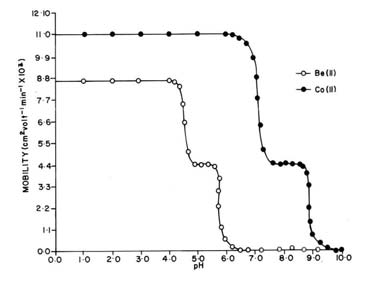
<body><![CDATA[<p align="justify">&nbsp;</p>     <p align="justify"><font size="3" face="Verdana, Arial, Helvetica, sans-serif"><b>RESULTS</b></font></p>     <p align="justify"><font size="2" face="Verdana, Arial, Helvetica, sans-serif">Literature reveals that an ionic species of amino   acids are the sole coordinating species in complex formation with metal ion   [34, 35].&nbsp; Hence a metal ion spot on the paper strip show a variation in   composition of different ionic species of the amino acids in the background   electrolyte.&nbsp; So the mobility of metal ion spot would depend upon the pH of the   background electrolyte.&nbsp; Mobility of metal ion complexes against pH gives a   curve containing three plateus in each case of Be<sup>2+</sup> and Co<sup>2+</sup> metal ions (<a href="#f1">Figure 1</a>).&nbsp; The first plateau in each case at low pH region,   represents uncomplexed metal ion, while the remaining ones indicate metal   complexes.&nbsp; In the low pH range a-aminobutyric     acid is present as a non-complexing species [CH<sub>3</sub> &ndash; CH<sub>2</sub> &ndash;     CH (NH<sub>3</sub><sup>+</sup>) COO<sup>-</sup>].&nbsp; Beyond this range metal ion spots have       progressively decreasing mobility and hence complexation of metal ions should       be taking place with anionic species of a-aminobutyric         acid [CH<sub>3</sub> &ndash; CH<sub>2</sub> &ndash; CH (NH<sub>2</sub>) COO<sup>-</sup>], the concentration of which increases progressively with increase of pH.</font></p>     <p align="center"><a name="f1"></a><img src="/img/revistas/rbq/v26n1/graf1a05.gif" width="370" height="293"></p>     <p><font size="2" face="Verdana, Arial, Helvetica, sans-serif">&nbsp;&nbsp;&nbsp;&nbsp;&nbsp;&nbsp;&nbsp;&nbsp;&nbsp;&nbsp;&nbsp;&nbsp;&nbsp;&nbsp;&nbsp;&nbsp;&nbsp;&nbsp;&nbsp;&nbsp;&nbsp;&nbsp;&nbsp;&nbsp;&nbsp;&nbsp;&nbsp;&nbsp;&nbsp;&nbsp;&nbsp;&nbsp;&nbsp;&nbsp;&nbsp;&nbsp;&nbsp;&nbsp;&nbsp;&nbsp;&nbsp;&nbsp;&nbsp;&nbsp;&nbsp;&nbsp;&nbsp;&nbsp;&nbsp; &nbsp;&nbsp;</font></p>     <p><font size="2" face="Verdana, Arial, Helvetica, sans-serif"><b><i>Fig. 1.</i></b><i> Mobility curve for the metal(II) - a-aminobutyric acid systems.</i><i>&nbsp;<img border=0 width=37 height=15 id="Picture 40" src="v26n1a05_archivos/image003.jpg">&nbsp;&nbsp;= Be(II) - a-aminobutyric acid&nbsp; <img border=0 width=42 height=17 id="Picture 10" src="v26n1a05_archivos/image004.jpg">&nbsp;= Co(II) - a-aminobutyric   acid.&nbsp; pHs were maintained by addition of sodium hydroxide.&nbsp;&nbsp; Ionic strength = 0.1 M, temperature = 35&ordm;C.&nbsp; The paper strips were spotted with 0.1 &micro;l of sample solutions and glucose   (for making osmotic corrections).</i></font></p>     <p align="justify"><font size="2" face="Verdana, Arial, Helvetica, sans-serif"><a href="#f1">Figure 1</a> reveals a second plateau in each case with   positive mobility indicating the formation of 1:1 complex of cationic nature.&nbsp;   Further increase of pH gives rise to a third plateau with zero mobility in each   case indicating the formation of 1:2 complexes of neutral nature.&nbsp; This is   possible only when two anionic species of a-aminobutyric     acid combined with divalent metal cations.&nbsp; In general, the complexation of     metal ions with a-aminobutyric acid anion may be represented as</font></p>     <p align=center><img src="/img/revistas/rbq/v26n1/for0a05.gif" width="400" height="113"></p>     <p align="justify"><font size="2" face="Verdana, Arial, Helvetica, sans-serif">wherein M<sup>2+</sup> is Be<sup>2+</sup> and Co<sup>2+</sup> metal ions; [L<sup>-</sup>] is a-aminobutyric acid   anion [CH<sub>3</sub> &ndash; CH<sub>2</sub> &ndash; CH (NH<sub>2</sub>) COO<sup>-</sup>];   K<sub>1</sub> and K<sub>2</sub> are the first and second stability constants, respectively.</font></p>     <p align="justify"><font size="2" face="Verdana, Arial, Helvetica, sans-serif">The metal spot on the paper is thus a combination of   uncomplexed metal ions, 1:1 and 1:2 metal complexes.&nbsp; The spot is moving under   the influence of electric field, the overall mobility is given by equation of   Jokl [36].</font></p>     ]]></body>
<body><![CDATA[<p align="center"><img src="/img/revistas/rbq/v26n1/for1a05.gif" width="363" height="70"></p>     <p align="justify"><font size="2" face="Verdana, Arial, Helvetica, sans-serif">Wherein [H<sub>p</sub>L]<sup>x</sup> is the   concentration of general complex species, &#946;<sub>xp</sub> is the overall mobility constant of the complex; U<sub>xp</sub> is the speed of the general complex [M (H<sub>p</sub>L)<sup>x</sup>] present in     the combination.&nbsp; On taking into consideration different equilibria, the above     equation is transformed into the following form.</font></p>     <p align="justify"><font size="2" face="Verdana, Arial, Helvetica, sans-serif">&nbsp;</font></p>     <p align=center><font size="2" face="Verdana, Arial, Helvetica, sans-serif">U<sub>0</sub> + u<sub>1</sub> K<sub>1</sub> [L<sup>-</sup>] + U<sub>2</sub> K<sub>1</sub> K<sub>2</sub> [L<sup>-</sup>]<sup>2</sup></font></p>     <p align=center><font size="2" face="Verdana, Arial, Helvetica, sans-serif">U =&nbsp;&nbsp;&nbsp;&nbsp;_____________________________&nbsp; &nbsp;   (4)</font></p>     <p align=center><font size="2" face="Verdana, Arial, Helvetica, sans-serif">1 + K<sub>1</sub> [L<sup>-</sup>] + K<sub>1</sub> K<sub>2</sub> [L<sup>-</sup>]<sup>2</sup></font></p>     <p><font size="2" face="Verdana, Arial, Helvetica, sans-serif">&nbsp;</font></p>     <p align="justify"><font size="2" face="Verdana, Arial, Helvetica, sans-serif">Wherein u<sub>0</sub>, u<sub>1</sub> and u<sub>2</sub> are mobilities of uncomplexed metal ions, 1:1 metal complex and 1:2 metal   complex, respectively. Eq. (4) was used for the determination of the stability   constants of metal complexes with a-aminobutyric     acid.</font></p>     <p align="justify"><font size="2" face="Verdana, Arial, Helvetica, sans-serif">The dissociation constant of pure a-aminobutyric acid (k<sub>1</sub> = 10 <sup>2.30</sup>;   k<sub>2</sub> = 10<sup>9.63</sup>) was determined by the same paper   electrophoretic technique.&nbsp; The mode of dissociation of pure a-aminobutyric acid may be represented as:</font></p>     <p align=center><font size="2" face="Verdana, Arial, Helvetica, sans-serif">[CH<sub>2</sub> (OH) CH<sub>2</sub> CH (NH<sub>3</sub><sup>+</sup>)   COOH]</font></p>     ]]></body>
<body><![CDATA[<p align=center><font size="2" face="Verdana, Arial, Helvetica, sans-serif">-H<sup>+</sup>&nbsp;&nbsp;&nbsp; E&nbsp;&nbsp;&nbsp;&nbsp; ka<sub>1</sub></font></p>     <p align=center><font size="2" face="Verdana, Arial, Helvetica, sans-serif">[CH<sub>2</sub> (OH) CH<sub>2</sub> CH (NH<sub>3</sub><sup>+</sup>)   COO<sup>-</sup>]</font></p>     <p align=center><font size="2" face="Verdana, Arial, Helvetica, sans-serif">-H<sup>+</sup>&nbsp;&nbsp;&nbsp;&nbsp; E&nbsp;&nbsp;&nbsp;&nbsp; ka<sub>2</sub></font></p>     <p align=center><font size="2" face="Verdana, Arial, Helvetica, sans-serif">[CH<sub>2</sub> (OH) CH<sub>2</sub> CH (NH<sub>2</sub>)   COO<sup>-</sup>]</font></p>     <p><font size="2" face="Verdana, Arial, Helvetica, sans-serif">&nbsp;</font></p>     <p><font size="2" face="Verdana, Arial, Helvetica, sans-serif">For calculating first stability constant, K<sub>1</sub> the region between first and second plateau is relevant.&nbsp; The overall mobility   will be equal to the arithmetic mean of the mobility of uncomplexed metal ion,   u<sub>0</sub>, and that of first complex, u<sub>1</sub> at a pH where K<sub>1</sub> = 1/[L<sup>-</sup>].</font></p>     <p><font size="2" face="Verdana, Arial, Helvetica, sans-serif">First stability constant K<sub>1</sub>, can be   calculated with the help of concentration of homoserine anion and protonation   constant of pure homoserine.&nbsp; The concentration of ligating homoserine species   [L<sup>-</sup>] is calculated with the help of equation.</font></p>     <p align="center"><font size="2" face="Verdana, Arial, Helvetica, sans-serif"><img src="/img/revistas/rbq/v26n1/for2a05.gif" width="400" height="67"></font></p>     <p align="justify"><font size="2" face="Verdana, Arial, Helvetica, sans-serif">Where [L<sub>T</sub>] = is the total concentration of   ligand homoserine (0.01 M); k<sub>1</sub> and k<sub>2</sub> are the   dissociation constants of pure a-aminobutyric acid,     respectively.&nbsp; The second stability constant K<sub>2</sub>, of 1:2 complex can     be calculated by taking into consideration the region between second and third     plateau of the mobility curve.&nbsp; The calculated values of first and second stability constants are given in <a href="#t1">Table 1</a>.</font><font size="2" face="Verdana, Arial, Helvetica, sans-serif">&nbsp;</font></p>     <p align="justify">&nbsp;</p>     ]]></body>
<body><![CDATA[<p align=center><font size="2" face="Verdana, Arial, Helvetica, sans-serif"><b><i><a name="t1"></a>Table 1</i></b><i>. Stability constants of binary complexes of   beryllium(II) and cobalt(II) with a-aminobutyric     acid.</i></font><font size="2" face="Verdana, Arial, Helvetica, sans-serif">&nbsp;</font></p> <table width=416 border=1 align="center" cellpadding=0 cellspacing=0>     <tr>       <td width=86>    <p align=center><font size="2" face="Verdana, Arial, Helvetica, sans-serif"><b>Metal</b></font></p>               <p align=center><font size="2" face="Verdana, Arial, Helvetica, sans-serif"><b>Ions</b></font></p></td>       <td width=112 valign=top>    <p align=center><font size="2" face="Verdana, Arial, Helvetica, sans-serif"><b>Complexes</b></font></p></td>       <td width=102>    <p align=center><font size="2" face="Verdana, Arial, Helvetica, sans-serif"><b>Stability constants</b></font></p></td>       <td width=116>    <p align=center><font size="2" face="Verdana, Arial, Helvetica, sans-serif"><b>Logarithm stability</b></font></p>               <p align=center><font size="2" face="Verdana, Arial, Helvetica, sans-serif"><b>constant values</b></font></p></td>     </tr>     <tr>       <td width=86>    <p align=center><font size="2" face="Verdana, Arial, Helvetica, sans-serif">Beryllium(II)</font></p></td>       <td width=112>    <p align=center><font size="2" face="Verdana, Arial, Helvetica, sans-serif">ML<sup>+</sup></font></p>               <p align=center><font size="2" face="Verdana, Arial, Helvetica, sans-serif">&nbsp;</font></p>             ]]></body>
<body><![CDATA[<p align=center><font size="2" face="Verdana, Arial, Helvetica, sans-serif">ML<sub>2</sub></font></p></td>       <td width=102>    <p align=center><font size="2" face="Verdana, Arial, Helvetica, sans-serif">K<sub>1</sub></font></p>               <p align=center><font size="2" face="Verdana, Arial, Helvetica, sans-serif">&nbsp;</font></p>             <p align=center><font size="2" face="Verdana, Arial, Helvetica, sans-serif">K<sub>2</sub></font></p></td>       <td width=116>    <p align=center><font size="2" face="Verdana, Arial, Helvetica, sans-serif">7.19 &plusmn; 0.05</font></p>               <p align=center><font size="2" face="Verdana, Arial, Helvetica, sans-serif">&nbsp;</font></p>             <p align=center><font size="2" face="Verdana, Arial, Helvetica, sans-serif">6.81 &plusmn; 0.18</font></p></td>     </tr>     <tr>       <td width=86>    <p align=center><font size="2" face="Verdana, Arial, Helvetica, sans-serif">Cobalt(II)</font></p></td>       <td width=112>    <p align=center><font size="2" face="Verdana, Arial, Helvetica, sans-serif">ML<sup>+</sup></font></p>               <p align=center><font size="2" face="Verdana, Arial, Helvetica, sans-serif"><sup>&nbsp;</sup></font></p>             ]]></body>
<body><![CDATA[<p align=center><font size="2" face="Verdana, Arial, Helvetica, sans-serif">&nbsp;</font></p>             <p align=center><font size="2" face="Verdana, Arial, Helvetica, sans-serif">ML<sub>2</sub></font></p></td>       <td width=102>    <p align=center><font size="2" face="Verdana, Arial, Helvetica, sans-serif">K<sub>1</sub></font></p>               <p align=center><font size="2" face="Verdana, Arial, Helvetica, sans-serif"><sub>&nbsp;</sub></font></p>             <p align=center><font size="2" face="Verdana, Arial, Helvetica, sans-serif">&nbsp;</font></p>             <p align=center><font size="2" face="Verdana, Arial, Helvetica, sans-serif">K<sub>2</sub></font></p></td>       <td width=116 valign=top>    <p align=center><font size="2" face="Verdana, Arial, Helvetica, sans-serif">4.47 &plusmn; 0.04</font></p>               <p align=center><font size="2" face="Verdana, Arial, Helvetica, sans-serif">4.26 [41]*</font></p>             <p align=center><font size="2" face="Verdana, Arial, Helvetica, sans-serif">4.21 [42]*</font></p>             <p align=center><font size="2" face="Verdana, Arial, Helvetica, sans-serif">2.81 &plusmn; 0.09</font></p>             ]]></body>
<body><![CDATA[<p align=center><font size="2" face="Verdana, Arial, Helvetica, sans-serif">3.42 [41]*</font></p>             <p align=center><font size="2" face="Verdana, Arial, Helvetica, sans-serif">3.50 [42]*</font></p></td>     </tr> </table>     <p align="center"><font size="2" face="Verdana, Arial, Helvetica, sans-serif">Ionic strength = 0.1 M; temperature = 35&ordm;C; a-aminobutyric acid = [CH<sub>3</sub> &ndash; CH<sub>2</sub> &ndash;   CH (NH<sub>2</sub>) COO<sup>-</sup>]; &nbsp;M = metal cations; L = ligand (a-aminobutyric acid); * = literature values.</font></p>     <p align="center">&nbsp;</p>     <p><font size="3" face="Verdana, Arial, Helvetica, sans-serif"><b>DISCUSSION</b></font></p>     <p align="justify"><font size="2" face="Verdana, Arial, Helvetica, sans-serif">It is clear from Table 1 that first and second   stability constants of both beryllium(II) and cobalt(II) complexes follow the order.</font></p>     <p align=center><font size="2" face="Verdana, Arial, Helvetica, sans-serif">Log K<sub>1</sub> &gt; log K<sub>2</sub> </font></p>     <p align="justify"><font size="2" face="Verdana, Arial, Helvetica, sans-serif">The corresponding second stability constant values are   found to be lower for both complexes.&nbsp; It is therefore inferred that   coordinating tendency of a ligand decreases with the higher state of   aggregation [37,38].&nbsp; </font></p>     <p align="justify"><font size="2" face="Verdana, Arial, Helvetica, sans-serif">It is also clear from Table 1 that beryllium(II) - a-aminobutyric acid complexes have high stability   constant value in comparison to cobalt(II) &ndash; a-aminobutyric     acid.&nbsp; Therefore it can be inferred that beryllium(II) cation has greater     affinity with oxygen donor ligand in comparison to cobalt(II) anion.</font></p>     <p align="justify"><font size="2" face="Verdana, Arial, Helvetica, sans-serif">The stability constants of metal complexes can be very   easily calculated by this technique, therefore present method has significant   advantages over other methods (viz: polargraphic, potentiometric, solubility   etc.) reported in chemical literature for the determination of stability   constants of metal complexes.</font></p>     ]]></body>
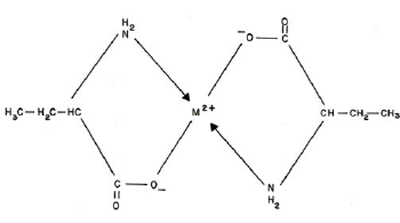
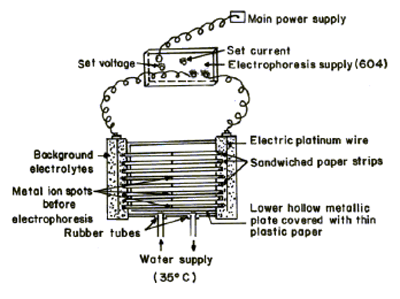
<body><![CDATA[<p align="justify"><font size="2" face="Verdana, Arial, Helvetica, sans-serif">The present paper ionophoretic technique is limited to   charged species and the precision of method is not as which as other   physiochemical methods. However, uncertainty in the result is &plusmn;5%.&nbsp; No doubt it   can not replace the most reliable methods even though it is a new approach   deserving further development.</font></p>     <p align="justify"><font size="2" face="Verdana, Arial, Helvetica, sans-serif">To examine the possibility of hydrolysis of   beryllium(II) at higher pH, experiments have been performed at two   concentrations of the ligand: 0.01 M and 0.001 M.&nbsp; The mobility curves show that the plateaus at lower ligand concentration are shifted   towards higher pH range, but the calculated stability constants are found to be   the same in the two cases.&nbsp; Thus the constant obtained is independent of the pH   indicating that hydrolysis of beryllium(II) can be ignored here. </font></p>     <p align="justify"><font size="2" face="Verdana, Arial, Helvetica, sans-serif">The proposed structure for the ML<sub>2</sub> complexes may be given as:</font></p>     <p align="center"><font size="2" face="Verdana, Arial, Helvetica, sans-serif"><b>&nbsp;<img src="/img/revistas/rbq/v26n1/graf2a05.gif" width="400" height="223"></b></font></p>     <p align="center">&nbsp;</p>     <p><font size="2" face="Verdana, Arial, Helvetica, sans-serif"><b><font size="3">EXPERIMENTAL   SECTION</font></b></font><font size="3" face="Verdana, Arial, Helvetica, sans-serif"><b>&nbsp;</b></font><font size="2" face="Verdana, Arial, Helvetica, sans-serif"><b></b></font></p>     <p><font size="2" face="Verdana, Arial, Helvetica, sans-serif"><i><b>Instruments</b></i></font></p>     <p align="justify"><font size="2" face="Verdana, Arial, Helvetica, sans-serif">Systronics (Naroda, India) paper elelctrophoresis   equipment horizontalcum-vertical type, model 604, has been used.&nbsp; The apparatus   consisted of a PVC moulded double tank vessel.&nbsp; In our laboratory significant   changes in the instrument has been made.&nbsp; Two hollow rectangular plates covered   with think polythene sheets have been used through which thermostated water is   run for controlling the temperature.&nbsp; The tank is closed with a transparent PVC   moulded lid.&nbsp; The whole assembly is tight, which prevent moisture changes,   which may upset the equilibria in a paper strip.&nbsp; This assembly design thus   keeps to a minimum the disturbing effects of evaporation from the unwanted   liquid flow in the paper.&nbsp; Each electrolyte tank contains a separate electrode   chamber.&nbsp; The auxiliary unit is specially designed to operate either voltage   mode or on current mode.</font></p>     <p align="justify"><font size="2" face="Verdana, Arial, Helvetica, sans-serif">Elico (Hyderabad, India) model L<sub>1-10 </sub>having   glass and calomel electrode assembly and working on 220 Volts/ 50 Hz   established a.c. mains, were employed for pH measurements.&nbsp; The electrophoresis   cell showing sandwiched paper strips and water supply is shown in Figure 2.</font></p>     <p><font size="2" face="Verdana, Arial, Helvetica, sans-serif"><i><b>Chemicals</b></i></font></p>     ]]></body>
<body><![CDATA[<p><font size="2" face="Verdana, Arial, Helvetica, sans-serif"><i><b>Water</b></i></font></p>     <p align="justify"><font size="2" face="Verdana, Arial, Helvetica, sans-serif">Distilled water was redistilled over alkaline   permanganate.&nbsp; The resulting distillate cooled in well Stoppard Pyrex flask.&nbsp;   This was used for preparing solutions and for dilution throughout their   studies.</font></p>     <p align="justify"><font size="2" face="Verdana, Arial, Helvetica, sans-serif"><i><b>Metal Solutions</b></i></font></p>     <p align="justify"><font size="2" face="Verdana, Arial, Helvetica, sans-serif">Metal   perchlorate solutions were prepared by the precipitation of metal carbonates   from their nitrates with sodium carbonate, which were washed with boiling water   and treated with calculated amounts of 1% perchloric acid.&nbsp; There were heated   and filtered.&nbsp; Beryllium perchlorate solution was standardised by gravimetric   method.&nbsp; 25 ml of beryllium perchlorate was taken in beaker and to it ammonia   solution was added dropwise until the hydroxide commence to precipitate.&nbsp;   Redissolved the precipitate by adding a few drops of 0.1 M hydrochloric acid.&nbsp; Approximate 1 mg of ammonium chloride, sufficient amount of EDTA solution   was added to it to complex all other trace metal ions (if present).&nbsp; Again a   little amount of ammonia solution was added to it and the contents filtered   through a gravimetric filter paper.&nbsp; Placed the paper on a silica crucible,   dried, and then heated it by a flame throw over.&nbsp; Cooled the crucible in a   coved magnesium perchlorate and weighed immediately when cooled.&nbsp; Cobalt(ii)   perchlorate solution standardized by volumetric method.&nbsp; Cobalt(II) solution   was taken in a conical vessel to which standard EDTA solution was added in   known excess and to it were then added 5 ml buffer pH 5, and 3-5 drops of   1-(2-pyridylazo-2-naphthol (PAN indicator).&nbsp; The solution was diluted to 60   ml.&nbsp; The unused EDTA was titrated against standard copper(II) perchlorate   solution until the colour changed first to violet.&nbsp; A few drops of the EDTA   solution was then added to restore the yellow colour .&nbsp; The amount of Co(II)   was known from the amount of EDTA consumed by it.&nbsp; The metal contents of the   filtrates were determined and final concentration was kept at 5.0 x 10<sup>-3 M [39,40]. </sup></font></p>     <p align="justify"><font size="2" face="Verdana, Arial, Helvetica, sans-serif"><i><b>Detecting reagents for metal ions and electro-osmotic indicator</b></i></font></p>     <p align="justify"><font size="2" face="Verdana, Arial, Helvetica, sans-serif">A 0.1% (w/v) solution of 1 &ndash; (2 &ndash; pyridylazo) &ndash; 2 &ndash;   naphthol (PAN) (Merck, Darmstadt, Germany) in ethanol was used for detecting   the metal ions.&nbsp; 5.0 x 10⁻³ M glucose (BDH, AnalaR) solutions was prepared     in water and used as an electro-osmotic indicator for the correction due to     electro-osmosis.&nbsp; A saturated aqueous solution (0.9 ml) of silver nitrate was     diluted with acetone to 20 ml.&nbsp; Glucose was detected by spraying with this     silver nitrate solution and then with 2% ethanolic sodium hydroxide, when a     black spot was formed.&nbsp; The paper strips showing position of metal ion spots     after electrophoresis is shown in <a href="#f2">Figure 2</a>.</font></p>     <p align="center"><a name="f2"></a><img src="/img/revistas/rbq/v26n1/graf3a05.gif" width="400" height="299"></p>     <p align="center"><font size="2" face="Verdana, Arial, Helvetica, sans-serif"><b><i>Fig. 2</i></b><i> Electrophoresis cell showing sandwiched paper strips.</i></font></p>     <p><font size="2" face="Verdana, Arial, Helvetica, sans-serif"><i><b>Background electrolyte</b></i></font></p>     <p align="justify"><font size="2" face="Verdana, Arial, Helvetica, sans-serif">Stock solution of 5.0 M perchloric acid was prepared by its 70% solution (SDS, Analytical &ndash; Reagent grade), 2.0 M sodium hydroxide (Analytical &ndash; Reagent grade) and 0.5 a-aminobutyric   acid (BDH, Poole, UK) solutions were prepared.&nbsp; Each solution were standardized   using an appropriate method.&nbsp; The background electrolyte used in the study of   binary complexes were 0.1 M perchloric acid and 0.01 M a-aminobutyric acid.&nbsp; The binary system was maintained     at various pHs by the addition of sodium hydroxide.</font></p>     ]]></body>
<body><![CDATA[<p align="justify"><font size="2" face="Verdana, Arial, Helvetica, sans-serif"><i><b>Procedure</b></i></font></p>     <p align="justify"><font size="2" face="Verdana, Arial, Helvetica, sans-serif">Whatman No. 1 filter paper for chromatography was used   for the purpose of electrophoresis.&nbsp; For recording observation of particular   metal ion, two paper strips were spotted with the metal ion solution along with   additional two spotted with glucose using 1.0 &micro;l pipette and then mounted on   the insulated plate.&nbsp; Each of the two electrolyte vessels were filled with 150   ml of background electrolyte containing 0.1 M perchloric acid and 0.01 M a-aminobutyric acid.</font></p>     <p align="justify"><font size="2" face="Verdana, Arial, Helvetica, sans-serif">The paper   becomes moistened with the background electrolyte solutions due to diffusion.&nbsp;   The second insulated plate was placed on paper strips and then thermostated   water (35<sup>0</sup>C) was circulated into the plates to keep the temperature   constant.&nbsp; The lid was then placed on the instrument to make it air tight.&nbsp; It   was left for 10 minutes to insure wetting of strips.&nbsp; Subsequently a direct 220   V potential was applied between the electrodes.&nbsp; Electrophoresis was carried   out for 60 minutes after with the strips were removed from the tank and dried.&nbsp;   The metal ion and glucose spots were detected by specific reagents.&nbsp; The   leading and tailing edge were measured from marked center point and the mean   taken.&nbsp; The distance moved by glucose spot was subtracted (in case of migration   toward anode) to obtain correct path length.&nbsp; Migration towards anode and   cathode were designated by negative and positive signs respectively.</font></p>     <p align="justify"><font size="2" face="Verdana, Arial, Helvetica, sans-serif">Electrophoretic observation of metal ions were   recorded at various pH values of the background electrolyte obtained by adding   NaOH solution, the ionic strength being maintained at 0.1 M.&nbsp; The observed mobility of migrant was calculated by using the formula:</font></p>     <p align="justify"><font size="2" face="Verdana, Arial, Helvetica, sans-serif">&nbsp;</font></p>     <p align=center><font size="2" face="Verdana, Arial, Helvetica, sans-serif">d</font></p>     <p align=center><font size="2" face="Verdana, Arial, Helvetica, sans-serif">U&nbsp; =_______________&nbsp; </font></p>     <p align=center><font size="2" face="Verdana, Arial, Helvetica, sans-serif">x&nbsp;&nbsp; &middot;&nbsp;&nbsp;&nbsp; t</font></p>     <p><font size="2" face="Verdana, Arial, Helvetica, sans-serif">&nbsp;</font></p>     <p><font size="2" face="Verdana, Arial, Helvetica, sans-serif">After applying the correction factor the observed   mobility is given as:</font></p>     ]]></body>
<body><![CDATA[<p><font size="2" face="Verdana, Arial, Helvetica, sans-serif">&nbsp;</font></p>     <p align=center><font size="2" face="Verdana, Arial, Helvetica, sans-serif">d &plusmn; d<sub>G</sub></font></p>     <p align=center><font size="2" face="Verdana, Arial, Helvetica, sans-serif">U&nbsp; =__________________&nbsp; </font></p>     <p align=center><font size="2" face="Verdana, Arial, Helvetica, sans-serif">x&nbsp;&nbsp; &middot;&nbsp;&nbsp;&nbsp; t</font></p>     <p><font size="2" face="Verdana, Arial, Helvetica, sans-serif">&nbsp;</font></p>     <p align="justify"><font size="2" face="Verdana, Arial, Helvetica, sans-serif">Where U = mobility of metal ion / complex ion; d =   mean of duplicate distance travelled by metal ion / complex ion; d<sub>G</sub> = mean of duplicate distance travelled by glucose spot; x = field strength; t =   time for electrophoresis.</font></p>     <p align="justify"><font size="2" face="Verdana, Arial, Helvetica, sans-serif">The protonation constants of pure a-aminobutyric acid were determined by the same paper   electrophoretic technique.&nbsp; The two paper strips were spotted with pure a-aminobutyric acid along with two other spotted     glucose using 0.1 M perchloric acid only as a background electrolyte.&nbsp; The     electrophoresis was carried out for 60 minutes as for metal ions.&nbsp; The     electrophoretic speed was calculated.</font></p>     <p align="justify"><font size="2" face="Verdana, Arial, Helvetica, sans-serif">The speeds of the metal ion/amino acid are reported   with pH values.&nbsp; The individual speeds of the duplicate spots were found to be   fairly equal.&nbsp; A plot of mobility against pH is shown in <a href="#f3">Figure 3</a>.</font></p>     <p align="center"><a name="f3"></a><img src="/img/revistas/rbq/v26n1/graf4a05.gif" width="400" height="254"><font size="2" face="Verdana, Arial, Helvetica, sans-serif"><b>&nbsp;</b></font></p>     <p align="center"><font size="2" face="Verdana, Arial, Helvetica, sans-serif"><b>&nbsp;</b></font><font size="2" face="Verdana, Arial, Helvetica, sans-serif"><b><i>Fig. 3</i></b><i> Paper strips showing position of metal ion spots after electrophoresis</i></font></p>     ]]></body>
<body><![CDATA[<p align="center">&nbsp;</p>     <p><font size="3" face="Verdana, Arial, Helvetica, sans-serif"><b>CONCLUDING REMARKS</b></font></p>     <p><font size="2" face="Verdana, Arial, Helvetica, sans-serif">Following conclusion can be drawn from the present   study.</font></p>     <p><font size="2" face="Verdana, Arial, Helvetica, sans-serif">1.Beryllium(II) and   cobalt(II) are toxic and essential metal ions respectively.</font></p>     <p><font size="2" face="Verdana, Arial, Helvetica, sans-serif">2.Beryllium(II) and   cobalt(II) are significant for biological systems but as such they are toxic,   the a-aminobutyric acid may be used to reduce     the level of these metal ions in the biological system.</font></p>     <p><font size="2" face="Verdana, Arial, Helvetica, sans-serif">3.The ML<sub>2</sub> complexes are found to have low stability constants values and less stable in   comparison to ML complexes.&nbsp; </font></p>     <p><font size="2" face="Verdana, Arial, Helvetica, sans-serif">4.Beryllium(II) - a-aminobutyric   acid complexes are found to have high stability constant values in comparison   to cobalt(II) - a-aminobutyric acid complexes.</font></p>     <p><font size="2" face="Verdana, Arial, Helvetica, sans-serif">5.The present simple   electrophoretic technique has thus proved to be helpful in deciding whether a   complex system is formed or not, and if it is formed its stability can also be   determined.</font></p>     <p><font size="2" face="Verdana, Arial, Helvetica, sans-serif">6.Biologically important   beryllium(II) and cobalt(II) complexes with a-aminobutyric     acid can be prepared on large scale at particular pH of background electrolyte     solution.</font></p>     <p>&nbsp;</p>     ]]></body>
<body><![CDATA[<p><font size="3" face="Verdana, Arial, Helvetica, sans-serif"><b>REFERENCES</b></font></p>     <p><font size="2" face="Verdana, Arial, Helvetica, sans-serif">&nbsp;1. IUPAC, <i>Compendium of Chemical Terminology</i>, O. B. 11, 2<sup>nd</sup> Edition, 1997.</font></p>     <!-- ref --><p><font size="2" face="Verdana, Arial, Helvetica, sans-serif">&nbsp;2. SHERMAN S. E., LIPPARD S. J., <i>Chem.   Rev</i>. <b>87</b> 1153.</font>&nbsp;&nbsp;&nbsp;&nbsp;&nbsp;&nbsp;&nbsp;&nbsp;[&#160;<a href="javascript:void(0);" onclick="javascript: window.open('/scielo.php?script=sci_nlinks&ref=668576&pid=S0250-5460200900010000500002&lng=','','width=640,height=500,resizable=yes,scrollbars=1,menubar=yes,');">Links</a>&#160;]<!-- end-ref --><!-- ref --><p><font size="2" face="Verdana, Arial, Helvetica, sans-serif">&nbsp;3. BHATTACHARYA, P. K., <i>J. Sci. Ind.   Res</i>., 1981, <b>40</b>, 382.</font>&nbsp;&nbsp;&nbsp;&nbsp;&nbsp;&nbsp;&nbsp;&nbsp;[&#160;<a href="javascript:void(0);" onclick="javascript: window.open('/scielo.php?script=sci_nlinks&ref=668577&pid=S0250-5460200900010000500003&lng=','','width=640,height=500,resizable=yes,scrollbars=1,menubar=yes,');">Links</a>&#160;]<!-- end-ref --><!-- ref --><p><font size="2" face="Verdana, Arial, Helvetica, sans-serif">&nbsp;4. ALDERIGHT, L., GANS, P., IENCO, A., PETERS,   D., SABATINI, A., VACCA, A., <i>Coord. </i><i>Chem. Rev</i>., 1999, <b>184</b> , 311.</font>&nbsp;&nbsp;&nbsp;&nbsp;&nbsp;&nbsp;&nbsp;&nbsp;[&#160;<a href="javascript:void(0);" onclick="javascript: window.open('/scielo.php?script=sci_nlinks&ref=668578&pid=S0250-5460200900010000500004&lng=','','width=640,height=500,resizable=yes,scrollbars=1,menubar=yes,');">Links</a>&#160;]<!-- end-ref --><!-- ref --><p><font size="2" face="Verdana, Arial, Helvetica, sans-serif">&nbsp;5. FRANKEL, R. D., FORSYTH, J. M., <i>Science</i>,   1979, <b>204</b>, 622.</font>&nbsp;&nbsp;&nbsp;&nbsp;&nbsp;&nbsp;&nbsp;&nbsp;[&#160;<a href="javascript:void(0);" onclick="javascript: window.open('/scielo.php?script=sci_nlinks&ref=668579&pid=S0250-5460200900010000500005&lng=','','width=640,height=500,resizable=yes,scrollbars=1,menubar=yes,');">Links</a>&#160;]<!-- end-ref --><!-- ref --><p><font size="2" face="Verdana, Arial, Helvetica, sans-serif">&nbsp;6. JAKUBOWSKI, M., TRZCINKA-OCHOCKA, M., <i>J.   Occup. </i><i>Health</i>, 2005, <b>47 (1),</b> 22.</font>&nbsp;&nbsp;&nbsp;&nbsp;&nbsp;&nbsp;&nbsp;&nbsp;[&#160;<a href="javascript:void(0);" onclick="javascript: window.open('/scielo.php?script=sci_nlinks&ref=668580&pid=S0250-5460200900010000500006&lng=','','width=640,height=500,resizable=yes,scrollbars=1,menubar=yes,');">Links</a>&#160;]<!-- end-ref --><p><font size="2" face="Verdana, Arial, Helvetica, sans-serif">&nbsp;7. PANESSA &ndash; WARREN, B., J., WARREN, J.   B., WONG, S. S., MISEWICH, J.A., <i>J. Phys: Condens, Matter</i>, 2006, <b>18</b>,   52185.</font></p>     <p><font size="2" face="Verdana, Arial, Helvetica, sans-serif">&nbsp;8. KLEIN, R., SCHWENK, M., HEINRICH &ndash;   RAMM, R., TEMPLETON, D. M., <i>Pure Appl. Chem</i>., 2004, <b>76 (6),</b> 1269.</font></p>     <!-- ref --><p><font size="2" face="Verdana, Arial, Helvetica, sans-serif">&nbsp;9.</font><font size="2" face="Verdana, Arial, Helvetica, sans-serif"> GILI, P., MEREROS, A., <i>Rev. Soc. Quim. Mexico</i>, 2000, <b>44(1),</b> 104.</font>&nbsp;&nbsp;&nbsp;&nbsp;&nbsp;&nbsp;&nbsp;&nbsp;[&#160;<a href="javascript:void(0);" onclick="javascript: window.open('/scielo.php?script=sci_nlinks&ref=668583&pid=S0250-5460200900010000500009&lng=','','width=640,height=500,resizable=yes,scrollbars=1,menubar=yes,');">Links</a>&#160;]<!-- end-ref --><!-- ref --><p><font size="2" face="Verdana, Arial, Helvetica, sans-serif">10. KANAI, T., ENDO, M., MANOHARA, S.,   MIYAHARA, N., KOYAMA-ITO, H., TOMURA, H., MITSUFUJI, N., FUTAMI, Y., FUKUMURA,   A., HIRAOKA, T., FURUSAWA, Y., ANDO, K., SUZUKI, M., SUGA, F., KAWACHI, K., <i>Int.     J. Radiat. Oncol. Biol. Phys.,</i> 1999, <b>44(1),</b> 201.</font>&nbsp;&nbsp;&nbsp;&nbsp;&nbsp;&nbsp;&nbsp;&nbsp;[&#160;<a href="javascript:void(0);" onclick="javascript: window.open('/scielo.php?script=sci_nlinks&ref=668584&pid=S0250-5460200900010000500010&lng=','','width=640,height=500,resizable=yes,scrollbars=1,menubar=yes,');">Links</a>&#160;]<!-- end-ref --><!-- ref --><p><font size="2" face="Verdana, Arial, Helvetica, sans-serif">11.&nbsp;WITSCHI, H. P., ALDRIDGE W. N., <i>Biochem   J.,</i> 1968, <b>106</b>, 811.</font>&nbsp;&nbsp;&nbsp;&nbsp;&nbsp;&nbsp;&nbsp;&nbsp;[&#160;<a href="javascript:void(0);" onclick="javascript: window.open('/scielo.php?script=sci_nlinks&ref=668585&pid=S0250-5460200900010000500011&lng=','','width=640,height=500,resizable=yes,scrollbars=1,menubar=yes,');">Links</a>&#160;]<!-- end-ref --><!-- ref --><p><font size="2" face="Verdana, Arial, Helvetica, sans-serif">12. RAMOS, R.G., OLDEN, K., <i>Int. J.   Environ. Res. Public Health</i>, 2008, <b>5(1),</b> 4.</font>&nbsp;&nbsp;&nbsp;&nbsp;&nbsp;&nbsp;&nbsp;&nbsp;[&#160;<a href="javascript:void(0);" onclick="javascript: window.open('/scielo.php?script=sci_nlinks&ref=668586&pid=S0250-5460200900010000500012&lng=','','width=640,height=500,resizable=yes,scrollbars=1,menubar=yes,');">Links</a>&#160;]<!-- end-ref --><!-- ref --><p><font size="2" face="Verdana, Arial, Helvetica, sans-serif">13. EGGEMAN, A. S., PETFORD-LONG, A. K.,   DOBSON, R. J., WIGGINS, J., BROMWICH, T., DUMIN-BORKOWSKI, R., KASAMA, T., <i>J.     Magn. </i><i>Magn. Mater</i>., 2006, <b>301</b>, 336.</font>&nbsp;&nbsp;&nbsp;&nbsp;&nbsp;&nbsp;&nbsp;&nbsp;[&#160;<a href="javascript:void(0);" onclick="javascript: window.open('/scielo.php?script=sci_nlinks&ref=668587&pid=S0250-5460200900010000500013&lng=','','width=640,height=500,resizable=yes,scrollbars=1,menubar=yes,');">Links</a>&#160;]<!-- end-ref --><!-- ref --><p><font size="2" face="Verdana, Arial, Helvetica, sans-serif">14. ATWATER, J. E., ARSE, J. R., JOBANOVIC,   G. N., WHEELER, R. R., SORNCHAMNI, T., <i>Mater. Res. Bull.</i> 2003, <b>38</b>,   395.</font>&nbsp;&nbsp;&nbsp;&nbsp;&nbsp;&nbsp;&nbsp;&nbsp;[&#160;<a href="javascript:void(0);" onclick="javascript: window.open('/scielo.php?script=sci_nlinks&ref=668588&pid=S0250-5460200900010000500014&lng=','','width=640,height=500,resizable=yes,scrollbars=1,menubar=yes,');">Links</a>&#160;]<!-- end-ref --><!-- ref --><p><font size="2" face="Verdana, Arial, Helvetica, sans-serif">15. GAD, N., <i>Res. J. Agri. Biol. Sci</i>,   2005, <b>1(3),</b> 270.</font>&nbsp;&nbsp;&nbsp;&nbsp;&nbsp;&nbsp;&nbsp;&nbsp;[&#160;<a href="javascript:void(0);" onclick="javascript: window.open('/scielo.php?script=sci_nlinks&ref=668589&pid=S0250-5460200900010000500015&lng=','','width=640,height=500,resizable=yes,scrollbars=1,menubar=yes,');">Links</a>&#160;]<!-- end-ref --><p><font size="2" face="Verdana, Arial, Helvetica, sans-serif">16. KOVALA &ndash; DEMERTZI, D., HADJIKAKOU, S.   K., DEMERTZIS, M.A., DELIGIANAKIS, Y., <i>J. Inorg. </i><i>Biochem.,</i> 1998, <b>69(4),</b> 223.</font></p>     <!-- ref --><p><font size="2" face="Verdana, Arial, Helvetica, sans-serif">17.WALSH, C., BEGLEY, T., WALTS, A., <i>Pure   &amp; Appl. Chem</i>., 1987, <b>59(3</b>), 295.</font>&nbsp;&nbsp;&nbsp;&nbsp;&nbsp;&nbsp;&nbsp;&nbsp;[&#160;<a href="javascript:void(0);" onclick="javascript: window.open('/scielo.php?script=sci_nlinks&ref=668591&pid=S0250-5460200900010000500017&lng=','','width=640,height=500,resizable=yes,scrollbars=1,menubar=yes,');">Links</a>&#160;]<!-- end-ref --><!-- ref --><p><font size="2" face="Verdana, Arial, Helvetica, sans-serif">18. STEVENS, H., JANSEN, H. M. L.,   DEREUCK, J., LEMMERLING, M. A., STRIJCKMANS, K., GOETHALS, P., LEMAHIEU, I., DE   JONG, B. M., ILLEMEEN, A. T. M. W., KORF, J., <i>J. Neurol. Sci.,</i> 1999, <b>171</b>,   11.</font>&nbsp;&nbsp;&nbsp;&nbsp;&nbsp;&nbsp;&nbsp;&nbsp;[&#160;<a href="javascript:void(0);" onclick="javascript: window.open('/scielo.php?script=sci_nlinks&ref=668592&pid=S0250-5460200900010000500018&lng=','','width=640,height=500,resizable=yes,scrollbars=1,menubar=yes,');">Links</a>&#160;]<!-- end-ref --><!-- ref --><p><font size="2" face="Verdana, Arial, Helvetica, sans-serif">19. BENZAMIN-III, E., REZNIK, A.,   BENZAMIN, E., WILLIAMS, A. L., <i>Int. J. Environ. Res. Public Health</i>,   2007, <b>4(3),</b> 203.</font>&nbsp;&nbsp;&nbsp;&nbsp;&nbsp;&nbsp;&nbsp;&nbsp;[&#160;<a href="javascript:void(0);" onclick="javascript: window.open('/scielo.php?script=sci_nlinks&ref=668593&pid=S0250-5460200900010000500019&lng=','','width=640,height=500,resizable=yes,scrollbars=1,menubar=yes,');">Links</a>&#160;]<!-- end-ref --><!-- ref --><p><font size="2" face="Verdana, Arial, Helvetica, sans-serif">20.EMAN, A., GAD, N. BADRAN, N. W.,   Aust. <i>J. Basic Appl. Sci</i>., 2007, <b>1(2),</b> 73.</font>&nbsp;&nbsp;&nbsp;&nbsp;&nbsp;&nbsp;&nbsp;&nbsp;[&#160;<a href="javascript:void(0);" onclick="javascript: window.open('/scielo.php?script=sci_nlinks&ref=668594&pid=S0250-5460200900010000500020&lng=','','width=640,height=500,resizable=yes,scrollbars=1,menubar=yes,');">Links</a>&#160;]<!-- end-ref --><!-- ref --><p><font size="2" face="Verdana, Arial, Helvetica, sans-serif">21.VUCKOVIC, G., TANASKOVIC, S. B.,   MIODRAGOVIC, S. M., STANIC, V., <i>J. Serb. Chem. Soc</i>. 2007, <b>72(2),</b> 1295.</font>&nbsp;&nbsp;&nbsp;&nbsp;&nbsp;&nbsp;&nbsp;&nbsp;[&#160;<a href="javascript:void(0);" onclick="javascript: window.open('/scielo.php?script=sci_nlinks&ref=668595&pid=S0250-5460200900010000500021&lng=','','width=640,height=500,resizable=yes,scrollbars=1,menubar=yes,');">Links</a>&#160;]<!-- end-ref --><!-- ref --><p><font size="2" face="Verdana, Arial, Helvetica, sans-serif">22.JOHNSON, T. W., KOSTIC, N. M., <i>J.   Serb. Chem. Soc</i>. 2004, <b>69(4),</b> 887.</font>&nbsp;&nbsp;&nbsp;&nbsp;&nbsp;&nbsp;&nbsp;&nbsp;[&#160;<a href="javascript:void(0);" onclick="javascript: window.open('/scielo.php?script=sci_nlinks&ref=668596&pid=S0250-5460200900010000500022&lng=','','width=640,height=500,resizable=yes,scrollbars=1,menubar=yes,');">Links</a>&#160;]<!-- end-ref --><!-- ref --><p><font size="2" face="Verdana, Arial, Helvetica, sans-serif">23.MICKELSON, J. W., JACOBSEN, E. J.,   CARTER, D. B., Im, H. K., SCHREUR, R. J., SETHY, V. H., TANG, A. H., McGHEE, J.   E., PETKE, J. D., <i>J. Med. </i><i>Chem</i>. 1996, <b>39</b>, 4654.</font>&nbsp;&nbsp;&nbsp;&nbsp;&nbsp;&nbsp;&nbsp;&nbsp;[&#160;<a href="javascript:void(0);" onclick="javascript: window.open('/scielo.php?script=sci_nlinks&ref=668597&pid=S0250-5460200900010000500023&lng=','','width=640,height=500,resizable=yes,scrollbars=1,menubar=yes,');">Links</a>&#160;]<!-- end-ref --><!-- ref --><p><font size="2" face="Verdana, Arial, Helvetica, sans-serif">24.YIN, M., SVED, A. F., <i>Hypertension</i>,   1996, <b>27</b>, 1291.</font>&nbsp;&nbsp;&nbsp;&nbsp;&nbsp;&nbsp;&nbsp;&nbsp;[&#160;<a href="javascript:void(0);" onclick="javascript: window.open('/scielo.php?script=sci_nlinks&ref=668598&pid=S0250-5460200900010000500024&lng=','','width=640,height=500,resizable=yes,scrollbars=1,menubar=yes,');">Links</a>&#160;]<!-- end-ref --><!-- ref --><p><font size="2" face="Verdana, Arial, Helvetica, sans-serif">25.FUHRMAN, J. A., BELL, T. M., <i>Mar.   Ecol. Prog. Ser</i>., 1985, <b>25</b>, 13.</font>&nbsp;&nbsp;&nbsp;&nbsp;&nbsp;&nbsp;&nbsp;&nbsp;[&#160;<a href="javascript:void(0);" onclick="javascript: window.open('/scielo.php?script=sci_nlinks&ref=668599&pid=S0250-5460200900010000500025&lng=','','width=640,height=500,resizable=yes,scrollbars=1,menubar=yes,');">Links</a>&#160;]<!-- end-ref --><!-- ref --><p><font size="2" face="Verdana, Arial, Helvetica, sans-serif">26.KISUMI, M., KATO, J., KOMATSUBARA, S.,   CHIBATA, <i>J., Appl. Microbiol</i>., 1971, <b>21(4),</b> 569.</font>&nbsp;&nbsp;&nbsp;&nbsp;&nbsp;&nbsp;&nbsp;&nbsp;[&#160;<a href="javascript:void(0);" onclick="javascript: window.open('/scielo.php?script=sci_nlinks&ref=668600&pid=S0250-5460200900010000500026&lng=','','width=640,height=500,resizable=yes,scrollbars=1,menubar=yes,');">Links</a>&#160;]<!-- end-ref --><!-- ref --><p><font size="2" face="Verdana, Arial, Helvetica, sans-serif">27.KEPPLER, O. T., HORSTKORTE, R., PAWLITA,   M., SCHMIDT, C., REUTTER, W., <i>Glycobiol</i>, 2001, <b>11(2),</b> 11 R.</font>&nbsp;&nbsp;&nbsp;&nbsp;&nbsp;&nbsp;&nbsp;&nbsp;[&#160;<a href="javascript:void(0);" onclick="javascript: window.open('/scielo.php?script=sci_nlinks&ref=668601&pid=S0250-5460200900010000500027&lng=','','width=640,height=500,resizable=yes,scrollbars=1,menubar=yes,');">Links</a>&#160;]<!-- end-ref --><!-- ref --><p><font size="2" face="Verdana, Arial, Helvetica, sans-serif">28.KOROLKIEWICZ, R., SLIWINSKI, W.,   REKOWSKI, P., HALAMA-BOROWIEC, A., MUCHA, P., SZCZUROWICZ, A., KOROLKIEWICZ, K.   Z., <i>Pharmacol. </i><i>Res.,</i> 1997, <b>35(1),</b> 7.</font>&nbsp;&nbsp;&nbsp;&nbsp;&nbsp;&nbsp;&nbsp;&nbsp;[&#160;<a href="javascript:void(0);" onclick="javascript: window.open('/scielo.php?script=sci_nlinks&ref=668602&pid=S0250-5460200900010000500028&lng=','','width=640,height=500,resizable=yes,scrollbars=1,menubar=yes,');">Links</a>&#160;]<!-- end-ref --><!-- ref --><p><font size="2" face="Verdana, Arial, Helvetica, sans-serif">29.KISO, Y., <i>Zone Electrophoresis,   New Attempts of Ionics</i>, Nankodo, 1972.</font>&nbsp;&nbsp;&nbsp;&nbsp;&nbsp;&nbsp;&nbsp;&nbsp;[&#160;<a href="javascript:void(0);" onclick="javascript: window.open('/scielo.php?script=sci_nlinks&ref=668603&pid=S0250-5460200900010000500029&lng=','','width=640,height=500,resizable=yes,scrollbars=1,menubar=yes,');">Links</a>&#160;]<!-- end-ref --><!-- ref --><p><font size="2" face="Verdana, Arial, Helvetica, sans-serif">30.McDONALD, H. J., <i>Ionography, Electrophoresis   in Stabilized Media</i>, Year Book Publications, Chicago, 1975.</font>&nbsp;&nbsp;&nbsp;&nbsp;&nbsp;&nbsp;&nbsp;&nbsp;[&#160;<a href="javascript:void(0);" onclick="javascript: window.open('/scielo.php?script=sci_nlinks&ref=668604&pid=S0250-5460200900010000500030&lng=','','width=640,height=500,resizable=yes,scrollbars=1,menubar=yes,');">Links</a>&#160;]<!-- end-ref --><!-- ref --><p><font size="2" face="Verdana, Arial, Helvetica, sans-serif">31.TEWARI, B. B., <i>Trans. SAEST</i>,   1995, <b>30(2),</b> 76.</font>&nbsp;&nbsp;&nbsp;&nbsp;&nbsp;&nbsp;&nbsp;&nbsp;[&#160;<a href="javascript:void(0);" onclick="javascript: window.open('/scielo.php?script=sci_nlinks&ref=668605&pid=S0250-5460200900010000500031&lng=','','width=640,height=500,resizable=yes,scrollbars=1,menubar=yes,');">Links</a>&#160;]<!-- end-ref --><!-- ref --><p><font size="2" face="Verdana, Arial, Helvetica, sans-serif">32.TEWARI, B. B., <i>Trans. SAEST</i>,   1995, <b>30(3),</b> 100.</font>&nbsp;&nbsp;&nbsp;&nbsp;&nbsp;&nbsp;&nbsp;&nbsp;[&#160;<a href="javascript:void(0);" onclick="javascript: window.open('/scielo.php?script=sci_nlinks&ref=668606&pid=S0250-5460200900010000500032&lng=','','width=640,height=500,resizable=yes,scrollbars=1,menubar=yes,');">Links</a>&#160;]<!-- end-ref --><!-- ref --><p><font size="2" face="Verdana, Arial, Helvetica, sans-serif">33.TEWARI, B. B., <i>Bull. Korean Chem.   Soc.</i>, 2002, <b>23(5),</b> 705.</font>&nbsp;&nbsp;&nbsp;&nbsp;&nbsp;&nbsp;&nbsp;&nbsp;[&#160;<a href="javascript:void(0);" onclick="javascript: window.open('/scielo.php?script=sci_nlinks&ref=668607&pid=S0250-5460200900010000500033&lng=','','width=640,height=500,resizable=yes,scrollbars=1,menubar=yes,');">Links</a>&#160;]<!-- end-ref --><!-- ref --><p><font size="2" face="Verdana, Arial, Helvetica, sans-serif">34.HOJO, Y., SUGIURA, Y., TANAKA,H., <i>J. Inorg. </i><i>Nucl. Chem</i>., 1977, <b>39</b>, 1859.</font>&nbsp;&nbsp;&nbsp;&nbsp;&nbsp;&nbsp;&nbsp;&nbsp;[&#160;<a href="javascript:void(0);" onclick="javascript: window.open('/scielo.php?script=sci_nlinks&ref=668608&pid=S0250-5460200900010000500034&lng=','','width=640,height=500,resizable=yes,scrollbars=1,menubar=yes,');">Links</a>&#160;]<!-- end-ref --><!-- ref --><p><font size="2" face="Verdana, Arial, Helvetica, sans-serif">35.WALKER, D. M., WILLIAMS, R. W., <i>J.   Chem. Soc. Dalton</i>, <b>1974</b>, 1186.</font>&nbsp;&nbsp;&nbsp;&nbsp;&nbsp;&nbsp;&nbsp;&nbsp;[&#160;<a href="javascript:void(0);" onclick="javascript: window.open('/scielo.php?script=sci_nlinks&ref=668609&pid=S0250-5460200900010000500035&lng=','','width=640,height=500,resizable=yes,scrollbars=1,menubar=yes,');">Links</a>&#160;]<!-- end-ref --><!-- ref --><p><font size="2" face="Verdana, Arial, Helvetica, sans-serif">36.JOKL, V., <i>J. Chromatogr</i>., <b>1964</b>,   432.</font>&nbsp;&nbsp;&nbsp;&nbsp;&nbsp;&nbsp;&nbsp;&nbsp;[&#160;<a href="javascript:void(0);" onclick="javascript: window.open('/scielo.php?script=sci_nlinks&ref=668610&pid=S0250-5460200900010000500036&lng=','','width=640,height=500,resizable=yes,scrollbars=1,menubar=yes,');">Links</a>&#160;]<!-- end-ref --><!-- ref --><p><font size="2" face="Verdana, Arial, Helvetica, sans-serif">37.JOSHI, J. D., Bhattacharya, P. K., <i>J.   Indian Chem. Soc</i>., 1980, <b>57</b>, 336.</font>&nbsp;&nbsp;&nbsp;&nbsp;&nbsp;&nbsp;&nbsp;&nbsp;[&#160;<a href="javascript:void(0);" onclick="javascript: window.open('/scielo.php?script=sci_nlinks&ref=668611&pid=S0250-5460200900010000500037&lng=','','width=640,height=500,resizable=yes,scrollbars=1,menubar=yes,');">Links</a>&#160;]<!-- end-ref --><!-- ref --><p><font size="2" face="Verdana, Arial, Helvetica, sans-serif">38.JOSHI, J. D., Bhattacharya, P. K., <i>J.   Indian Chem. Soc</i>., 1973, <b>50</b>, 344.</font>&nbsp;&nbsp;&nbsp;&nbsp;&nbsp;&nbsp;&nbsp;&nbsp;[&#160;<a href="javascript:void(0);" onclick="javascript: window.open('/scielo.php?script=sci_nlinks&ref=668612&pid=S0250-5460200900010000500038&lng=','','width=640,height=500,resizable=yes,scrollbars=1,menubar=yes,');">Links</a>&#160;]<!-- end-ref --><!-- ref --><p><font size="2" face="Verdana, Arial, Helvetica, sans-serif">39.KOLTHOFF, I. M., BELCHER, R., <i>Volumetric   Analysis</i>, Vol. 3, 1957, Intersciences Publisher Inc., New York.</font>&nbsp;&nbsp;&nbsp;&nbsp;&nbsp;&nbsp;&nbsp;&nbsp;[&#160;<a href="javascript:void(0);" onclick="javascript: window.open('/scielo.php?script=sci_nlinks&ref=668613&pid=S0250-5460200900010000500039&lng=','','width=640,height=500,resizable=yes,scrollbars=1,menubar=yes,');">Links</a>&#160;]<!-- end-ref --><!-- ref --><p><font size="2" face="Verdana, Arial, Helvetica, sans-serif">40.VOGEL, A. I., <i>Text Book of   Quantitative Inorganic Analysis</i>: Including Elementary Instrumental   Analysis, 4<sup>th</sup> Edition, 1978, Longmans, London.</font>&nbsp;&nbsp;&nbsp;&nbsp;&nbsp;&nbsp;&nbsp;&nbsp;[&#160;<a href="javascript:void(0);" onclick="javascript: window.open('/scielo.php?script=sci_nlinks&ref=668614&pid=S0250-5460200900010000500040&lng=','','width=640,height=500,resizable=yes,scrollbars=1,menubar=yes,');">Links</a>&#160;]<!-- end-ref --><!-- ref --><p><font size="2" face="Verdana, Arial, Helvetica, sans-serif">41.PERRIN, D. D., Stability Constants of   Metal Ion Complexes, Part B, Organic Ligands, IUPAC Series No. 22, 1979,   Pergamon Press, Oxford: 313.</font>&nbsp;&nbsp;&nbsp;&nbsp;&nbsp;&nbsp;&nbsp;&nbsp;[&#160;<a href="javascript:void(0);" onclick="javascript: window.open('/scielo.php?script=sci_nlinks&ref=668615&pid=S0250-5460200900010000500041&lng=','','width=640,height=500,resizable=yes,scrollbars=1,menubar=yes,');">Links</a>&#160;]<!-- end-ref --><p><font size="2" face="Verdana, Arial, Helvetica, sans-serif">42.SILLEN, L. G., MARTELL, A. E.,   Stability Constants of Meal Ion Complexes, Special Publication No. 17, 1974,   Chemical Society London</font><font size="2" face="Verdana, Arial, Helvetica, sans-serif">:333</font></p>      ]]></body><back>
<ref-list>
<ref id="B1">
<label>1</label><nlm-citation citation-type="journal">
<collab>IUPAC</collab>
<source><![CDATA[Compendium of Chemical Terminology]]></source>
<year>1997</year>
<volume>11</volume>
</nlm-citation>
</ref>
<ref id="B2">
<label>2</label><nlm-citation citation-type="journal">
<person-group person-group-type="author">
<name>
<surname><![CDATA[SHERMAN]]></surname>
<given-names><![CDATA[S. E]]></given-names>
</name>
<name>
<surname><![CDATA[LIPPARD]]></surname>
<given-names><![CDATA[S. J]]></given-names>
</name>
</person-group>
<source><![CDATA[Chem. Rev.]]></source>
<year></year>
<volume>87</volume>
<page-range>1153</page-range></nlm-citation>
</ref>
<ref id="B3">
<label>3</label><nlm-citation citation-type="journal">
<person-group person-group-type="author">
<name>
<surname><![CDATA[BHATTACHARYA]]></surname>
<given-names><![CDATA[P. K.]]></given-names>
</name>
</person-group>
<source><![CDATA[J. Sci. Ind. Res.]]></source>
<year>1981</year>
<volume>40</volume>
<page-range>382</page-range></nlm-citation>
</ref>
<ref id="B4">
<label>4</label><nlm-citation citation-type="journal">
<person-group person-group-type="author">
<name>
<surname><![CDATA[ALDERIGHT]]></surname>
<given-names><![CDATA[L.]]></given-names>
</name>
<name>
<surname><![CDATA[GANS]]></surname>
<given-names><![CDATA[P.]]></given-names>
</name>
<name>
<surname><![CDATA[IENCO]]></surname>
<given-names><![CDATA[A.]]></given-names>
</name>
<name>
<surname><![CDATA[PETERS]]></surname>
<given-names><![CDATA[D.]]></given-names>
</name>
<name>
<surname><![CDATA[SABATINI]]></surname>
<given-names><![CDATA[A.]]></given-names>
</name>
<name>
<surname><![CDATA[VACCA]]></surname>
<given-names><![CDATA[A.]]></given-names>
</name>
</person-group>
<source><![CDATA[Coord. Chem. Rev.]]></source>
<year>1999</year>
<volume>184</volume>
<page-range>311</page-range></nlm-citation>
</ref>
<ref id="B5">
<label>5</label><nlm-citation citation-type="journal">
<person-group person-group-type="author">
<name>
<surname><![CDATA[FRANKEL]]></surname>
<given-names><![CDATA[R. D]]></given-names>
</name>
<name>
<surname><![CDATA[FORSYTH]]></surname>
<given-names><![CDATA[J. M.]]></given-names>
</name>
</person-group>
<source><![CDATA[Science]]></source>
<year>1979</year>
<volume>204</volume>
<page-range>622</page-range></nlm-citation>
</ref>
<ref id="B6">
<label>6</label><nlm-citation citation-type="journal">
<person-group person-group-type="author">
<name>
<surname><![CDATA[JAKUBOWSKI]]></surname>
<given-names><![CDATA[M.]]></given-names>
</name>
<name>
<surname><![CDATA[TRZCINKA-OCHOCKA]]></surname>
<given-names><![CDATA[M.]]></given-names>
</name>
</person-group>
<source><![CDATA[J. Occup. Health]]></source>
<year>2005</year>
<volume>47</volume>
<numero>1</numero>
<issue>1</issue>
<page-range>22</page-range></nlm-citation>
</ref>
<ref id="B7">
<label>7</label><nlm-citation citation-type="journal">
<person-group person-group-type="author">
<name>
<surname><![CDATA[PANESSA - WARREN]]></surname>
<given-names><![CDATA[B.]]></given-names>
</name>
<name>
<surname><![CDATA[WARREN]]></surname>
<given-names><![CDATA[J. B.]]></given-names>
</name>
<name>
<surname><![CDATA[WONG]]></surname>
<given-names><![CDATA[S. S.]]></given-names>
</name>
<name>
<surname><![CDATA[MISEWICH]]></surname>
<given-names><![CDATA[J.A.]]></given-names>
</name>
</person-group>
<source><![CDATA[J. Phys: Condens, Matter]]></source>
<year>2006</year>
<volume>18</volume>
<page-range>52185</page-range></nlm-citation>
</ref>
<ref id="B8">
<label>8</label><nlm-citation citation-type="journal">
<person-group person-group-type="author">
<name>
<surname><![CDATA[KLEIN]]></surname>
<given-names><![CDATA[R.]]></given-names>
</name>
<name>
<surname><![CDATA[SCHWENK]]></surname>
<given-names><![CDATA[M.]]></given-names>
</name>
<name>
<surname><![CDATA[HEINRICH - RAMM]]></surname>
<given-names><![CDATA[R.]]></given-names>
</name>
<name>
<surname><![CDATA[TEMPLETON]]></surname>
<given-names><![CDATA[D. M.]]></given-names>
</name>
</person-group>
<source><![CDATA[Pure Appl. Chem.]]></source>
<year>2004</year>
<volume>76</volume>
<numero>6</numero>
<issue>6</issue>
<page-range>1269</page-range></nlm-citation>
</ref>
<ref id="B9">
<label>9</label><nlm-citation citation-type="journal">
<person-group person-group-type="author">
<name>
<surname><![CDATA[GILI]]></surname>
<given-names><![CDATA[P.]]></given-names>
</name>
<name>
<surname><![CDATA[MEREROS]]></surname>
<given-names><![CDATA[A.]]></given-names>
</name>
</person-group>
<source><![CDATA[Rev. Soc. Quim. Mexico]]></source>
<year>2000</year>
<volume>44</volume>
<numero>1</numero>
<issue>1</issue>
<page-range>104</page-range></nlm-citation>
</ref>
<ref id="B10">
<label>10</label><nlm-citation citation-type="journal">
<person-group person-group-type="author">
<name>
<surname><![CDATA[KANAI]]></surname>
<given-names><![CDATA[T.]]></given-names>
</name>
<name>
<surname><![CDATA[ENDO]]></surname>
<given-names><![CDATA[M.]]></given-names>
</name>
<name>
<surname><![CDATA[MANOHARA]]></surname>
<given-names><![CDATA[S.]]></given-names>
</name>
<name>
<surname><![CDATA[MIYAHARA]]></surname>
<given-names><![CDATA[N.]]></given-names>
</name>
<name>
<surname><![CDATA[KOYAMA-ITO]]></surname>
<given-names><![CDATA[H.]]></given-names>
</name>
<name>
<surname><![CDATA[TOMURA]]></surname>
<given-names><![CDATA[H.]]></given-names>
</name>
<name>
<surname><![CDATA[MITSUFUJI]]></surname>
<given-names><![CDATA[N.]]></given-names>
</name>
<name>
<surname><![CDATA[FUTAMI]]></surname>
<given-names><![CDATA[Y.]]></given-names>
</name>
<name>
<surname><![CDATA[FUKUMURA]]></surname>
<given-names><![CDATA[A.]]></given-names>
</name>
<name>
<surname><![CDATA[HIRAOKA]]></surname>
<given-names><![CDATA[T.]]></given-names>
</name>
<name>
<surname><![CDATA[FURUSAWA]]></surname>
<given-names><![CDATA[Y.]]></given-names>
</name>
<name>
<surname><![CDATA[ANDO]]></surname>
<given-names><![CDATA[K.]]></given-names>
</name>
<name>
<surname><![CDATA[SUZUKI]]></surname>
<given-names><![CDATA[M.]]></given-names>
</name>
<name>
<surname><![CDATA[SUGA]]></surname>
<given-names><![CDATA[F.]]></given-names>
</name>
<name>
<surname><![CDATA[KAWACHI]]></surname>
<given-names><![CDATA[K.]]></given-names>
</name>
</person-group>
<source><![CDATA[Int. J. Radiat. Oncol. Biol. Phys.]]></source>
<year>1999</year>
<volume>44</volume>
<numero>1</numero>
<issue>1</issue>
<page-range>201</page-range></nlm-citation>
</ref>
<ref id="B11">
<label>11</label><nlm-citation citation-type="journal">
<person-group person-group-type="author">
<name>
<surname><![CDATA[WITSCHI]]></surname>
<given-names><![CDATA[H. P.]]></given-names>
</name>
<name>
<surname><![CDATA[ALDRIDGE]]></surname>
<given-names><![CDATA[W. N.]]></given-names>
</name>
</person-group>
<source><![CDATA[Biochem J.]]></source>
<year>1968</year>
<volume>106</volume>
<page-range>811</page-range></nlm-citation>
</ref>
<ref id="B12">
<label>12</label><nlm-citation citation-type="journal">
<person-group person-group-type="author">
<name>
<surname><![CDATA[RAMOS]]></surname>
<given-names><![CDATA[R.G.]]></given-names>
</name>
<name>
<surname><![CDATA[OLDEN]]></surname>
<given-names><![CDATA[K.]]></given-names>
</name>
</person-group>
<source><![CDATA[Int. J. Environ. Res. Public Health]]></source>
<year>2008</year>
<volume>5</volume>
<numero>1</numero>
<issue>1</issue>
<page-range>4</page-range></nlm-citation>
</ref>
<ref id="B13">
<label>13</label><nlm-citation citation-type="journal">
<person-group person-group-type="author">
<name>
<surname><![CDATA[EGGEMAN]]></surname>
<given-names><![CDATA[A. S.]]></given-names>
</name>
<name>
<surname><![CDATA[PETFORD-LONG]]></surname>
<given-names><![CDATA[A. K.]]></given-names>
</name>
<name>
<surname><![CDATA[DOBSON]]></surname>
<given-names><![CDATA[R. J.]]></given-names>
</name>
<name>
<surname><![CDATA[WIGGINS]]></surname>
<given-names><![CDATA[J.]]></given-names>
</name>
<name>
<surname><![CDATA[BROMWICH]]></surname>
<given-names><![CDATA[T.]]></given-names>
</name>
<name>
<surname><![CDATA[DUMIN-BORKOWSKI]]></surname>
<given-names><![CDATA[R.]]></given-names>
</name>
<name>
<surname><![CDATA[KASAMA]]></surname>
<given-names><![CDATA[T.]]></given-names>
</name>
</person-group>
<source><![CDATA[J. Magn. Magn. Mater.]]></source>
<year>2006</year>
<volume>301</volume>
<page-range>336</page-range></nlm-citation>
</ref>
<ref id="B14">
<label>14</label><nlm-citation citation-type="journal">
<person-group person-group-type="author">
<name>
<surname><![CDATA[ATWATER]]></surname>
<given-names><![CDATA[J. E.]]></given-names>
</name>
<name>
<surname><![CDATA[ARSE]]></surname>
<given-names><![CDATA[J. R.]]></given-names>
</name>
<name>
<surname><![CDATA[JOBANOVIC]]></surname>
<given-names><![CDATA[G. N.]]></given-names>
</name>
<name>
<surname><![CDATA[WHEELER]]></surname>
<given-names><![CDATA[R. R.]]></given-names>
</name>
<name>
<surname><![CDATA[SORNCHAMNI]]></surname>
<given-names><![CDATA[T.]]></given-names>
</name>
</person-group>
<source><![CDATA[Mater. Res. Bull.]]></source>
<year>2003</year>
<volume>38</volume>
<page-range>395</page-range></nlm-citation>
</ref>
<ref id="B15">
<label>15</label><nlm-citation citation-type="journal">
<person-group person-group-type="author">
<name>
<surname><![CDATA[GAD]]></surname>
<given-names><![CDATA[N]]></given-names>
</name>
</person-group>
<source><![CDATA[Res. J. Agri. Biol. Sci]]></source>
<year>2005</year>
<volume>1</volume>
<numero>3</numero>
<issue>3</issue>
<page-range>270</page-range></nlm-citation>
</ref>
<ref id="B16">
<label>16</label><nlm-citation citation-type="journal">
<person-group person-group-type="author">
<name>
<surname><![CDATA[KOVALA - DEMERTZI]]></surname>
<given-names><![CDATA[D]]></given-names>
</name>
<name>
<surname><![CDATA[HADJIKAKOU]]></surname>
<given-names><![CDATA[S. K]]></given-names>
</name>
<name>
<surname><![CDATA[DEMERTZIS]]></surname>
<given-names><![CDATA[M.A]]></given-names>
</name>
<name>
<surname><![CDATA[DELIGIANAKIS]]></surname>
<given-names><![CDATA[Y]]></given-names>
</name>
</person-group>
<source><![CDATA[J. Inorg. Biochem.]]></source>
<year>1998</year>
<volume>69</volume>
<numero>4</numero>
<issue>4</issue>
<page-range>223</page-range></nlm-citation>
</ref>
<ref id="B17">
<label>17</label><nlm-citation citation-type="journal">
<person-group person-group-type="author">
<name>
<surname><![CDATA[WALSH]]></surname>
<given-names><![CDATA[C.]]></given-names>
</name>
<name>
<surname><![CDATA[BEGLEY]]></surname>
<given-names><![CDATA[T.]]></given-names>
</name>
<name>
<surname><![CDATA[WALTS]]></surname>
<given-names><![CDATA[A.]]></given-names>
</name>
</person-group>
<source><![CDATA[Pure & Appl. Chem.]]></source>
<year>1987</year>
<volume>59</volume>
<numero>3</numero>
<issue>3</issue>
<page-range>295</page-range></nlm-citation>
</ref>
<ref id="B18">
<label>18</label><nlm-citation citation-type="journal">
<person-group person-group-type="author">
<name>
<surname><![CDATA[STEVENS]]></surname>
<given-names><![CDATA[H.]]></given-names>
</name>
<name>
<surname><![CDATA[JANSEN]]></surname>
<given-names><![CDATA[H. M. L.]]></given-names>
</name>
<name>
<surname><![CDATA[DEREUCK]]></surname>
<given-names><![CDATA[J.]]></given-names>
</name>
<name>
<surname><![CDATA[LEMMERLING]]></surname>
<given-names><![CDATA[M. A.]]></given-names>
</name>
<name>
<surname><![CDATA[STRIJCKMANS]]></surname>
<given-names><![CDATA[K.]]></given-names>
</name>
<name>
<surname><![CDATA[GOETHALS]]></surname>
<given-names><![CDATA[P.]]></given-names>
</name>
<name>
<surname><![CDATA[LEMAHIEU]]></surname>
<given-names><![CDATA[I.]]></given-names>
</name>
<name>
<surname><![CDATA[DE JONG]]></surname>
<given-names><![CDATA[B. M.]]></given-names>
</name>
<name>
<surname><![CDATA[ILLEMEEN]]></surname>
<given-names><![CDATA[A. T. M. W.]]></given-names>
</name>
<name>
<surname><![CDATA[KORF]]></surname>
<given-names><![CDATA[J.]]></given-names>
</name>
</person-group>
<source><![CDATA[J. Neurol. Sci.]]></source>
<year>1999</year>
<volume>171</volume>
<page-range>11</page-range></nlm-citation>
</ref>
<ref id="B19">
<label>19</label><nlm-citation citation-type="journal">
<person-group person-group-type="author">
<name>
<surname><![CDATA[BENZAMIN-III]]></surname>
<given-names><![CDATA[E.]]></given-names>
</name>
<name>
<surname><![CDATA[REZNIK]]></surname>
<given-names><![CDATA[A.]]></given-names>
</name>
<name>
<surname><![CDATA[BENZAMIN]]></surname>
<given-names><![CDATA[E.]]></given-names>
</name>
<name>
<surname><![CDATA[WILLIAMS]]></surname>
<given-names><![CDATA[A. L.]]></given-names>
</name>
</person-group>
<source><![CDATA[Int. J. Environ. Res. Public Health]]></source>
<year>2007</year>
<volume>4</volume>
<numero>3</numero>
<issue>3</issue>
<page-range>203</page-range></nlm-citation>
</ref>
<ref id="B20">
<label>20</label><nlm-citation citation-type="journal">
<person-group person-group-type="author">
<name>
<surname><![CDATA[EMAN]]></surname>
<given-names><![CDATA[A.]]></given-names>
</name>
<name>
<surname><![CDATA[GAD]]></surname>
<given-names><![CDATA[N.]]></given-names>
</name>
<name>
<surname><![CDATA[BADRAN]]></surname>
<given-names><![CDATA[N. W.]]></given-names>
</name>
</person-group>
<source><![CDATA[Aust. J. Basic Appl. Sci.]]></source>
<year>2007</year>
<volume>1</volume>
<numero>2</numero>
<issue>2</issue>
<page-range>73</page-range></nlm-citation>
</ref>
<ref id="B21">
<label>21</label><nlm-citation citation-type="journal">
<person-group person-group-type="author">
<name>
<surname><![CDATA[VUCKOVIC]]></surname>
<given-names><![CDATA[G.]]></given-names>
</name>
<name>
<surname><![CDATA[TANASKOVIC]]></surname>
<given-names><![CDATA[S. B.]]></given-names>
</name>
<name>
<surname><![CDATA[MIODRAGOVIC]]></surname>
<given-names><![CDATA[S. M.]]></given-names>
</name>
<name>
<surname><![CDATA[STANIC]]></surname>
<given-names><![CDATA[V.]]></given-names>
</name>
</person-group>
<source><![CDATA[J. Serb. Chem. Soc.]]></source>
<year>2007</year>
<volume>72</volume>
<numero>2</numero>
<issue>2</issue>
<page-range>1295</page-range></nlm-citation>
</ref>
<ref id="B22">
<label>22</label><nlm-citation citation-type="journal">
<person-group person-group-type="author">
<name>
<surname><![CDATA[JOHNSON]]></surname>
<given-names><![CDATA[T. W.]]></given-names>
</name>
<name>
<surname><![CDATA[KOSTIC]]></surname>
<given-names><![CDATA[N. M.]]></given-names>
</name>
</person-group>
<source><![CDATA[J. Serb. Chem. Soc.]]></source>
<year>2004</year>
<volume>69</volume>
<numero>4</numero>
<issue>4</issue>
<page-range>887</page-range></nlm-citation>
</ref>
<ref id="B23">
<label>23</label><nlm-citation citation-type="journal">
<person-group person-group-type="author">
<name>
<surname><![CDATA[MICKELSON]]></surname>
<given-names><![CDATA[J. W.]]></given-names>
</name>
<name>
<surname><![CDATA[JACOBSEN]]></surname>
<given-names><![CDATA[E. J.]]></given-names>
</name>
<name>
<surname><![CDATA[CARTER]]></surname>
<given-names><![CDATA[D. B.]]></given-names>
</name>
<name>
<surname><![CDATA[Im]]></surname>
<given-names><![CDATA[H. K.]]></given-names>
</name>
<name>
<surname><![CDATA[SCHREUR]]></surname>
<given-names><![CDATA[R. J.]]></given-names>
</name>
<name>
<surname><![CDATA[SETHY]]></surname>
<given-names><![CDATA[V. H.]]></given-names>
</name>
<name>
<surname><![CDATA[TANG]]></surname>
<given-names><![CDATA[A. H.]]></given-names>
</name>
<name>
<surname><![CDATA[McGHEE]]></surname>
<given-names><![CDATA[J. E.]]></given-names>
</name>
<name>
<surname><![CDATA[PETKE]]></surname>
<given-names><![CDATA[J. D.]]></given-names>
</name>
</person-group>
<source><![CDATA[J. Med. Chem.]]></source>
<year>1996</year>
<volume>39</volume>
<page-range>4654</page-range></nlm-citation>
</ref>
<ref id="B24">
<label>24</label><nlm-citation citation-type="journal">
<person-group person-group-type="author">
<name>
<surname><![CDATA[YIN]]></surname>
<given-names><![CDATA[M.]]></given-names>
</name>
<name>
<surname><![CDATA[SVED]]></surname>
<given-names><![CDATA[A. F.]]></given-names>
</name>
</person-group>
<source><![CDATA[Hypertension]]></source>
<year>1996</year>
<volume>27</volume>
<page-range>1291</page-range></nlm-citation>
</ref>
<ref id="B25">
<label>25</label><nlm-citation citation-type="journal">
<person-group person-group-type="author">
<name>
<surname><![CDATA[FUHRMAN]]></surname>
<given-names><![CDATA[J. A.]]></given-names>
</name>
<name>
<surname><![CDATA[BELL]]></surname>
<given-names><![CDATA[T. M.]]></given-names>
</name>
</person-group>
<source><![CDATA[Mar. Ecol. Prog. Ser]]></source>
<year>1985</year>
<volume>25</volume>
<page-range>13</page-range></nlm-citation>
</ref>
<ref id="B26">
<label>26</label><nlm-citation citation-type="journal">
<person-group person-group-type="author">
<name>
<surname><![CDATA[KISUMI]]></surname>
<given-names><![CDATA[M.]]></given-names>
</name>
<name>
<surname><![CDATA[KATO]]></surname>
<given-names><![CDATA[J.]]></given-names>
</name>
<name>
<surname><![CDATA[KOMATSUBARA]]></surname>
<given-names><![CDATA[S.]]></given-names>
</name>
<name>
<surname><![CDATA[CHIBATA]]></surname>
</name>
</person-group>
<source><![CDATA[J., Appl. Microbiol.]]></source>
<year>1971</year>
<volume>21</volume>
<numero>4</numero>
<issue>4</issue>
<page-range>569</page-range></nlm-citation>
</ref>
<ref id="B27">
<label>27</label><nlm-citation citation-type="journal">
<person-group person-group-type="author">
<name>
<surname><![CDATA[KEPPLER]]></surname>
<given-names><![CDATA[O. T.]]></given-names>
</name>
<name>
<surname><![CDATA[HORSTKORTE]]></surname>
<given-names><![CDATA[R.]]></given-names>
</name>
<name>
<surname><![CDATA[PAWLITA]]></surname>
<given-names><![CDATA[M.]]></given-names>
</name>
<name>
<surname><![CDATA[SCHMIDT]]></surname>
<given-names><![CDATA[C.]]></given-names>
</name>
<name>
<surname><![CDATA[REUTTER]]></surname>
<given-names><![CDATA[W.]]></given-names>
</name>
</person-group>
<source><![CDATA[Glycobiol]]></source>
<year>2001</year>
<volume>11</volume>
<numero>2</numero>
<issue>2</issue>
<page-range>11</page-range></nlm-citation>
</ref>
<ref id="B28">
<label>28</label><nlm-citation citation-type="journal">
<person-group person-group-type="author">
<name>
<surname><![CDATA[KOROLKIEWICZ]]></surname>
<given-names><![CDATA[R.]]></given-names>
</name>
<name>
<surname><![CDATA[SLIWINSKI]]></surname>
<given-names><![CDATA[W.]]></given-names>
</name>
<name>
<surname><![CDATA[REKOWSKI]]></surname>
<given-names><![CDATA[P.]]></given-names>
</name>
<name>
<surname><![CDATA[HALAMA-BOROWIEC]]></surname>
<given-names><![CDATA[A.]]></given-names>
</name>
<name>
<surname><![CDATA[MUCHA]]></surname>
<given-names><![CDATA[P.]]></given-names>
</name>
<name>
<surname><![CDATA[SZCZUROWICZ]]></surname>
<given-names><![CDATA[A.]]></given-names>
</name>
<name>
<surname><![CDATA[KOROLKIEWICZ]]></surname>
<given-names><![CDATA[K. Z.]]></given-names>
</name>
</person-group>
<source><![CDATA[Pharmacol. Res.]]></source>
<year>1997</year>
<volume>35</volume>
<numero>1</numero>
<issue>1</issue>
<page-range>7</page-range></nlm-citation>
</ref>
<ref id="B29">
<label>29</label><nlm-citation citation-type="">
<person-group person-group-type="author">
<name>
<surname><![CDATA[KISO]]></surname>
<given-names><![CDATA[Y.]]></given-names>
</name>
</person-group>
<source><![CDATA[Zone Electrophoresis: New Attempts of Ionics]]></source>
<year>1972</year>
<publisher-loc><![CDATA[Nankodo ]]></publisher-loc>
</nlm-citation>
</ref>
<ref id="B30">
<label>30</label><nlm-citation citation-type="book">
<person-group person-group-type="author">
<name>
<surname><![CDATA[McDONALD]]></surname>
<given-names><![CDATA[H. J.]]></given-names>
</name>
</person-group>
<source><![CDATA[Ionography, Electrophoresis in Stabilized Media]]></source>
<year>1975</year>
<publisher-loc><![CDATA[Chicago ]]></publisher-loc>
<publisher-name><![CDATA[Year Book Publications]]></publisher-name>
</nlm-citation>
</ref>
<ref id="B31">
<label>31</label><nlm-citation citation-type="journal">
<person-group person-group-type="author">
<name>
<surname><![CDATA[TEWARI]]></surname>
<given-names><![CDATA[B. B.]]></given-names>
</name>
</person-group>
<source><![CDATA[Trans. SAEST]]></source>
<year>1995</year>
<volume>30</volume>
<numero>2</numero>
<issue>2</issue>
<page-range>76</page-range></nlm-citation>
</ref>
<ref id="B32">
<label>32</label><nlm-citation citation-type="journal">
<person-group person-group-type="author">
<name>
<surname><![CDATA[TEWARI]]></surname>
<given-names><![CDATA[B. B.]]></given-names>
</name>
</person-group>
<source><![CDATA[Trans. SAEST]]></source>
<year>1995</year>
<volume>30</volume>
<numero>3</numero>
<issue>3</issue>
<page-range>100</page-range></nlm-citation>
</ref>
<ref id="B33">
<label>33</label><nlm-citation citation-type="journal">
<person-group person-group-type="author">
<name>
<surname><![CDATA[TEWARI]]></surname>
<given-names><![CDATA[B. B.]]></given-names>
</name>
</person-group>
<source><![CDATA[Bull. Korean Chem. Soc.]]></source>
<year>2002</year>
<volume>23</volume>
<numero>5</numero>
<issue>5</issue>
<page-range>705</page-range></nlm-citation>
</ref>
<ref id="B34">
<label>34</label><nlm-citation citation-type="journal">
<person-group person-group-type="author">
<name>
<surname><![CDATA[HOJO]]></surname>
<given-names><![CDATA[Y.]]></given-names>
</name>
<name>
<surname><![CDATA[SUGIURA]]></surname>
<given-names><![CDATA[Y.]]></given-names>
</name>
<name>
<surname><![CDATA[TANAKA]]></surname>
<given-names><![CDATA[H.]]></given-names>
</name>
</person-group>
<source><![CDATA[J. Inorg. Nucl. Chem.]]></source>
<year>1977</year>
<volume>39</volume>
<page-range>1859</page-range></nlm-citation>
</ref>
<ref id="B35">
<label>35</label><nlm-citation citation-type="journal">
<person-group person-group-type="author">
<name>
<surname><![CDATA[WALKER]]></surname>
<given-names><![CDATA[D. M.]]></given-names>
</name>
<name>
<surname><![CDATA[WILLIAMS]]></surname>
<given-names><![CDATA[R. W.]]></given-names>
</name>
</person-group>
<source><![CDATA[J. Chem. Soc. Dalton]]></source>
<year>1974</year>
<page-range>1186</page-range></nlm-citation>
</ref>
<ref id="B36">
<label>36</label><nlm-citation citation-type="journal">
<person-group person-group-type="author">
<name>
<surname><![CDATA[JOKL]]></surname>
<given-names><![CDATA[V.]]></given-names>
</name>
</person-group>
<source><![CDATA[J. Chromatogr.]]></source>
<year>1964</year>
<page-range>432</page-range></nlm-citation>
</ref>
<ref id="B37">
<label>37</label><nlm-citation citation-type="journal">
<person-group person-group-type="author">
<name>
<surname><![CDATA[JOSHI]]></surname>
<given-names><![CDATA[J. D.]]></given-names>
</name>
<name>
<surname><![CDATA[Bhattacharya]]></surname>
<given-names><![CDATA[P. K.]]></given-names>
</name>
</person-group>
<source><![CDATA[J. Indian Chem. Soc.]]></source>
<year>1980</year>
<volume>57</volume>
<page-range>336</page-range></nlm-citation>
</ref>
<ref id="B38">
<label>38</label><nlm-citation citation-type="journal">
<person-group person-group-type="author">
<name>
<surname><![CDATA[JOSHI]]></surname>
<given-names><![CDATA[J. D.]]></given-names>
</name>
<name>
<surname><![CDATA[Bhattacharya]]></surname>
<given-names><![CDATA[P. K.]]></given-names>
</name>
</person-group>
<source><![CDATA[J. Indian Chem. Soc.]]></source>
<year>1973</year>
<volume>50</volume>
<page-range>344</page-range></nlm-citation>
</ref>
<ref id="B39">
<label>39</label><nlm-citation citation-type="book">
<person-group person-group-type="author">
<name>
<surname><![CDATA[KOLTHOFF]]></surname>
<given-names><![CDATA[I. M.]]></given-names>
</name>
<name>
<surname><![CDATA[BELCHER]]></surname>
<given-names><![CDATA[R.]]></given-names>
</name>
</person-group>
<source><![CDATA[Volumetric Analysis, Vol. 3]]></source>
<year>1957</year>
<publisher-loc><![CDATA[New York ]]></publisher-loc>
<publisher-name><![CDATA[Intersciences Publisher Inc.]]></publisher-name>
</nlm-citation>
</ref>
<ref id="B40">
<label>40</label><nlm-citation citation-type="">
<person-group person-group-type="author">
<name>
<surname><![CDATA[VOGEL]]></surname>
<given-names><![CDATA[A. I.]]></given-names>
</name>
</person-group>
<source><![CDATA[Text Book of Quantitative Inorganic Analysis: Including Elementary Instrumental Analysis]]></source>
<year>1978</year>
<edition>4th Edition</edition>
<publisher-loc><![CDATA[Longmans^eLondon London]]></publisher-loc>
</nlm-citation>
</ref>
<ref id="B41">
<label>41</label><nlm-citation citation-type="book">
<person-group person-group-type="author">
<name>
<surname><![CDATA[PERRIN]]></surname>
<given-names><![CDATA[D. D.]]></given-names>
</name>
</person-group>
<source><![CDATA[Stability Constants of Metal Ion Complexes, Part B, Organic Ligands: IUPAC Series No. 22]]></source>
<year>1979</year>
<page-range>313</page-range><publisher-loc><![CDATA[Oxford ]]></publisher-loc>
<publisher-name><![CDATA[Pergamon Press]]></publisher-name>
</nlm-citation>
</ref>
<ref id="B42">
<label>42</label><nlm-citation citation-type="journal">
<person-group person-group-type="author">
<name>
<surname><![CDATA[SILLEN]]></surname>
<given-names><![CDATA[L. G.]]></given-names>
</name>
<name>
<surname><![CDATA[MARTELL]]></surname>
<given-names><![CDATA[A. E.]]></given-names>
</name>
</person-group>
<source><![CDATA[Stability Constants of Meal Ion Complexes, Special Publication Chemical Society London]]></source>
<year>1974</year>
<volume>17</volume>
<page-range>333</page-range></nlm-citation>
</ref>
</ref-list>
</back>
</article>