<?xml version="1.0" encoding="ISO-8859-1"?><article xmlns:mml="http://www.w3.org/1998/Math/MathML" xmlns:xlink="http://www.w3.org/1999/xlink" xmlns:xsi="http://www.w3.org/2001/XMLSchema-instance">
<front>
<journal-meta>
<journal-id>0250-5460</journal-id>
<journal-title><![CDATA[Revista Boliviana de Química]]></journal-title>
<abbrev-journal-title><![CDATA[Rev. Bol. Quim]]></abbrev-journal-title>
<issn>0250-5460</issn>
<publisher>
<publisher-name><![CDATA[Universidad Mayor de San Andrés]]></publisher-name>
</publisher>
</journal-meta>
<article-meta>
<article-id>S0250-54602008000100008</article-id>
<title-group>
<article-title xml:lang="en"><![CDATA[CONTENT OF TRACE ELEMENTS IN FOUR ANDEAN VEGETABLE SPECIES OF BOLIVIA]]></article-title>
</title-group>
<contrib-group>
<contrib contrib-type="author">
<name>
<surname><![CDATA[Chuquimia]]></surname>
<given-names><![CDATA[Felipe]]></given-names>
</name>
<xref ref-type="aff" rid="A01"/>
</contrib>
<contrib contrib-type="author">
<name>
<surname><![CDATA[Alvarado]]></surname>
<given-names><![CDATA[J Antonio]]></given-names>
</name>
<xref ref-type="aff" rid="A02"/>
</contrib>
<contrib contrib-type="author">
<name>
<surname><![CDATA[Peñarrieta]]></surname>
<given-names><![CDATA[J Mauricio]]></given-names>
</name>
<xref ref-type="aff" rid="A03"/>
</contrib>
<contrib contrib-type="author">
<name>
<surname><![CDATA[Bergenståhl]]></surname>
<given-names><![CDATA[Björn]]></given-names>
</name>
<xref ref-type="aff" rid="A04"/>
</contrib>
<contrib contrib-type="author">
<name>
<surname><![CDATA[kesson]]></surname>
<given-names><![CDATA[Björn]]></given-names>
</name>
<xref ref-type="aff" rid="A05"/>
</contrib>
</contrib-group>
<aff id="A01">
<institution><![CDATA[,Universidad Mayor de San Andrés Instituto de Investigaciones Químicas ]]></institution>
<addr-line><![CDATA[La Paz ]]></addr-line>
<country>Bolivia</country>
</aff>
<aff id="A02">
<institution><![CDATA[,Universidad Mayor de San Andrés Instituto de Investigaciones Químicas ]]></institution>
<addr-line><![CDATA[La Paz ]]></addr-line>
<country>Bolivia</country>
</aff>
<aff id="A03">
<institution><![CDATA[,Universidad Mayor de San Andrés Instituto de Investigaciones Químicas ]]></institution>
<addr-line><![CDATA[La Paz ]]></addr-line>
<country>Bolivia</country>
</aff>
<aff id="A04">
<institution><![CDATA[,Lund University Food technology ]]></institution>
<addr-line><![CDATA[Lund ]]></addr-line>
<country>Sweden</country>
</aff>
<aff id="A05">
<institution><![CDATA[,Lund University Pure and Applied Biochemistry Biomedical Nutrition]]></institution>
<addr-line><![CDATA[Lund ]]></addr-line>
<country>Sweden</country>
</aff>
<pub-date pub-type="pub">
<day>00</day>
<month>12</month>
<year>2008</year>
</pub-date>
<pub-date pub-type="epub">
<day>00</day>
<month>12</month>
<year>2008</year>
</pub-date>
<volume>25</volume>
<numero>1</numero>
<fpage>53</fpage>
<lpage>58</lpage>
<copyright-statement/>
<copyright-year/>
<self-uri xlink:href="http://www.scielo.org.bo/scielo.php?script=sci_arttext&amp;pid=S0250-54602008000100008&amp;lng=en&amp;nrm=iso"></self-uri><self-uri xlink:href="http://www.scielo.org.bo/scielo.php?script=sci_abstract&amp;pid=S0250-54602008000100008&amp;lng=en&amp;nrm=iso"></self-uri><self-uri xlink:href="http://www.scielo.org.bo/scielo.php?script=sci_pdf&amp;pid=S0250-54602008000100008&amp;lng=en&amp;nrm=iso"></self-uri><abstract abstract-type="short" xml:lang="en"><p><![CDATA[In the present work the determination of iron, zinc and copper of four vegetable species of the Andean region of Bolivia was carried out. The plants are: the rhizomes of chijura (Stangea rhizantha); the roots of the cactus achacana (Neowerdermannia vorwerckii), the white basal leaves in form of rose of siki (Hipochoeris meyeniana var.brachylepis) and the shaft of the flower of amañoke (Ombrophytum subterraneum Asplund), the eatable part of a Balanophoraceae that parasites on the roots of thola (Lepidophillum quadrangulare) and it is also used as a medicine. The selected plants are used as foodstuffs, in particular in times of famine. The quantification by AAS was carried out in triplicate. Several interesting results regarding the trace element content of the studied species were obtained. All the species presented high Fe values, and the highest values were obtained for chijura (10.9 mg/100 g). Regarding Zn, achacana presented the higher value (2.6 mg/100 g), amañoke gave (1.5 mg/100 g) and chijura gave (1.8 mg/100 g). Regarding the content of Cu, amañoke stands out with 0.46 mg/100 g.]]></p></abstract>
<abstract abstract-type="short" xml:lang="es"><p><![CDATA[En el trabajo presente se llevó a cabo la cuantificación de hierro, cinc y cobre de cuatro especies de la verdura de la región andina de Bolivia. Las plantas estudiadas fueron: los rizomas de chijura (Stangea rhizantha); las raíces del cactus achacana (Neowerdermannia vorwerckii), el blanco de las hojas basales en forma de rosa de la planta de siki (Hipochoeris meyeniana var.brachylepis) y el tallo de la flor de amañoke (Ombrophytum subterraneum Asplund), la parte comestible de una balanoforacea que parásita las raíces de thola (Lepidophillum quadrangulare) y que también se usa como medicina. Las plantas seleccionadas se usan como comestibles, en particular en tiempos de hambre. La cuantificación por AAS se llevó a cabo por triplicado. Varios resultados interesantes con respecto al contenido de elementos traza de las especies estudiadas se obtuvieron. Todas las especies presentaron valores altos de Fe, y los valores más altos se obtuvieron para la chijura (10.9 mg/100 g). Con respecto a Zn, la achacana (2.6 mg/100 g) presentó el valores más alto, el amañoke dio (1.5 mg/100 g) y la chijura dio (1.8 mg/100 g). Con respecto al contenido de Cu, el amañoke destaca con 0.46 mg/100g.]]></p></abstract>
<kwd-group>
<kwd lng="en"><![CDATA[Neowerdermannia vorwerckii]]></kwd>
<kwd lng="en"><![CDATA[Hipochoeris meyeniana]]></kwd>
<kwd lng="en"><![CDATA[brachylepis]]></kwd>
<kwd lng="en"><![CDATA[Ombrophytum subterraneum Asplund]]></kwd>
<kwd lng="en"><![CDATA[Lepidophillum quadrangulare]]></kwd>
<kwd lng="en"><![CDATA[trace elements]]></kwd>
<kwd lng="en"><![CDATA[Bolivia]]></kwd>
<kwd lng="en"><![CDATA[food chemistry]]></kwd>
<kwd lng="en"><![CDATA[andean species]]></kwd>
</kwd-group>
</article-meta>
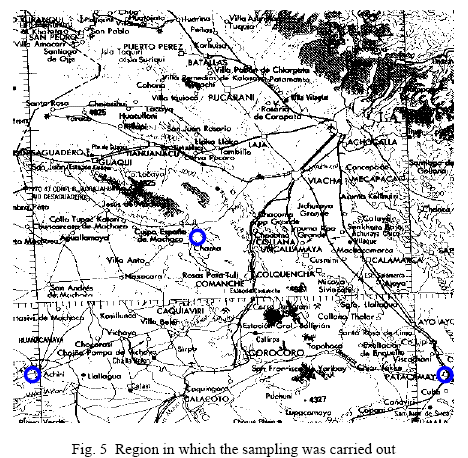
</front><body><![CDATA[ <P   align="center" ><font size="4" face="Verdana, Arial, Helvetica, sans-serif"><strong>CONTENT OF TRACE ELEMENTS IN FOUR ANDEAN VEGETABLE SPECIES OF BOLIVIA </strong></font></P >    <P   align="center" ><strong><font size="2" face="Verdana, Arial, Helvetica, sans-serif"><I>Felipe Chuquimia</I><Sup><I>1</I></Sup><I>, J Antonio Alvarado</I><Sup><I>1*</I></Sup><I>, J Mauricio Pe&ntilde;arrieta</I><Sup><I>1,2,3</I></Sup><I>, Bj&ouml;rn Bergenst&aring;hl</I><Sup><I>3</I></Sup><I>, Bj&ouml;rn &#506;kesson</I><Sup><I>2 </I></Sup></font></strong><font size="2" face="Verdana, Arial, Helvetica, sans-serif"><Sup><I></I></Sup></font></P >     <P align="justify"   ><font size="1" face="Verdana, Arial, Helvetica, sans-serif"><Sup>1</Sup>Instituto de Investigaciones Qu&iacute;micas, Universidad Mayor de San Andr&eacute;s, La Paz, Bolivia, <Sup>    <br> 2</Sup>Biomedical Nutrition, Pure and Applied Biochemistry, Lund University, Lund, Sweden,<Sup>    <br> 3</Sup>Food Technology, Lund University, Lund, Sweden </font></P > <hr noshade>     <P   align="justify" ><font size="2" face="Verdana, Arial, Helvetica, sans-serif"><B>Key Words: </B><I>Neowerdermannia vorwerckii</I>, <I>Hipochoeris meyeniana</I> var. <I>brachylepis</I>, <I>Ombrophytum subterraneum Asplund</I>, <I>Lepidophillum quadrangulare</I>, trace elements, Bolivia, food chemistry, andean species </font></P > <strong><font size="2" face="Verdana, Arial, Helvetica, sans-serif">ABSTRACT </font></strong>     <P   align="justify" ><font size="2" face="Verdana, Arial, Helvetica, sans-serif">In the present work the determination of iron, zinc and copper of four vegetable species of the Andean region of Bolivia was carried out. The plants are: the rhizomes of chijura (<I>Stangea rhizantha</I>); the roots of the cactus achacana (<I>Neowerdermannia vorwerckii</I>), the white basal leaves in form of rose of siki (<I>Hipochoeris meyeniana </I>var.<I>brachylepis</I>) and the shaft of the flower of ama&ntilde;oke (<I>Ombrophytum subterraneum Asplund</I>), the eatable part of a <I>Balanophoraceae</I> that parasites on the roots of thola (Lepidophillum quadrangulare) and it is also used as a medicine. The selected plants are used as foodstuffs, in particular in times of famine. The quantification by AAS was carried out in triplicate. Several interesting results regarding the trace element content of the studied species were obtained. All the species presented high Fe values, and the highest values were obtained for chijura (10.9 mg/100 g). Regarding Zn, achacana presented the higher value (2.6 mg/100 g), ama&ntilde;oke gave (1.5 mg/100 g) and chijura gave (1.8 mg/100 g). Regarding the content of Cu, ama&ntilde;oke stands out with 0.46 mg/100 g./ <I>En el trabajo presente se llev&oacute; a cabo la cuantificaci&oacute;n de hierro, cinc y cobre de cuatro especies de la verdura de la regi&oacute;n andina de Bolivia. Las plantas estudiadas fueron: los rizomas de chijura (Stangea rhizantha); las ra&iacute;ces del cactus achacana (Neowerdermannia vorwerckii), el blanco de las hojas basales en forma de rosa de la planta de siki (Hipochoeris meyeniana var.brachylepis) y el tallo de la flor de ama&ntilde;oke (Ombrophytum subterraneum Asplund), la parte comestible de una balanoforacea que par&aacute;sita las ra&iacute;ces de thola (Lepidophillum quadrangulare) y que tambi&eacute;n se usa como medicina. Las plantas seleccionadas se usan como comestibles, en particular en tiempos de hambre. La cuantificaci&oacute;n por AAS se llev&oacute; a cabo por triplicado. Varios resultados interesantes con respecto al contenido de elementos traza de las especies estudiadas se obtuvieron. Todas las especies presentaron valores altos de Fe, y los valores m&aacute;s altos se obtuvieron para la chijura (10.9 mg/100 g). Con respecto a Zn, la achacana </I></font></P >     <P   align="justify" ><font size="2" face="Verdana, Arial, Helvetica, sans-serif"><I>(2.6 mg/100 g) present&oacute; el valores m&aacute;s alto, el ama&ntilde;oke dio (1.5 mg/100 g) y la chijura dio (1.8 mg/100 g). Con respecto al contenido de Cu, el ama&ntilde;oke destaca con 0.46 mg/100 g </I></font></P >    <P   align="justify" ><font size="2" face="Verdana, Arial, Helvetica, sans-serif">Corresponding author: <U><a href="mailto:jaalvkir@gmail.com">jaalvkir@gmail.com</a> </U></font></P > <hr noshade> <strong><font size="3" face="Verdana, Arial, Helvetica, sans-serif">    <br> INTRODUCTION </font></strong>     ]]></body>
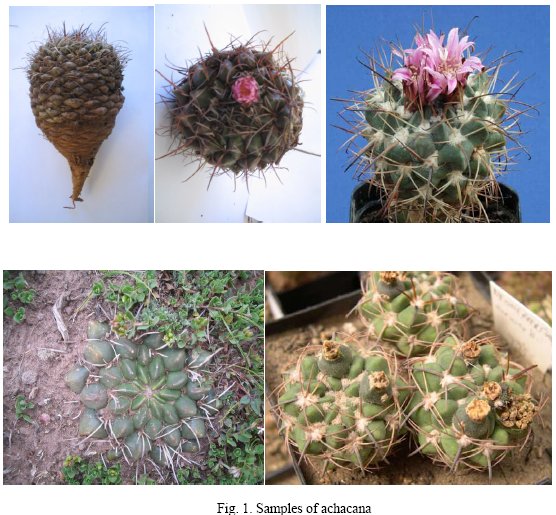
<body><![CDATA[<P   align="justify" ><font size="2" face="Verdana, Arial, Helvetica, sans-serif">In the high Andean region adverse, prolonged and recurrent climatic events as the ENSO, Event of &ldquo;El Ni&ntilde;o&quot; had and has tragic incidence, generating demographic descent, opening place to epidemics due to the shortage of foods and, product of it, the search of alternative foods that could satiate the population's hunger. The inhabitants of the Puna appealed as foods in these times of shortage to the species considered in the present study. <sup>[1]</sup> This work studies the content of minerals in the ash of four high Andean species: <I>Neowerdermannia vorwerckii, Ombrophytum subterraneum, Hipochoeris meyeniana var.brachylepis and  Stangea rhizantha</I>. The determination by AAS <sup>[2]</sup> was carried out by triplicate. </font></P > <H5   align="justify" ><font size="2" face="Verdana, Arial, Helvetica, sans-serif">    <br> ACHACANA. GENERAL ASPECTS </font></H5 >    <P   align="justify" ><font size="2" face="Verdana, Arial, Helvetica, sans-serif"><strong>Botanic Name</strong>: <I>Neowerdermannia vorwerckii </I></font></P >     <P   align="justify" ><font size="2" face="Verdana, Arial, Helvetica, sans-serif"><B>Family:</B> Cact&aacute;ceae </font></P ><H5   align="justify" ><font size="2" face="Verdana, Arial, Helvetica, sans-serif"><B>Common name:</B> Achacana </font></H5 >     <P   align="center" ><img src="/img/revistas/rbq/v25n1/figura_a9_01.jpg" width="556" height="515"></P >     <P   align="justify" ><font size="2" face="Verdana, Arial, Helvetica, sans-serif">The name of &quot;achacana&quot; corresponds to the cactus, <I>Neowerdermannia vorwerckii, </I>which presents as a characteristic spheroid and flat shaft, that in the dry season present itself buried being hardly perceptible, while in spring and summer stand out until a height of 6 cm. There are not many research works that provide us the proximal composition of this cactus. The root of the achacana is peeled and is consumed in the Bolivian departments of Oruro and Potos&iacute;. It is a wild species that grows in areas where the agriculture is difficult because the climate, the lack of water and the adverse topographical conditions.<sup>[3]</sup> </font></P > <H5   align="justify" ><font size="2" face="Verdana, Arial, Helvetica, sans-serif">    <br> AMA&Ntilde;OKE. GENERAL ASPECTS </font></H5 >     <P   align="justify" ><font size="2" face="Verdana, Arial, Helvetica, sans-serif">Botanic name: <I>Ombrophytum subterraneum Asplund </I></font></P >     <P   align="justify" ><font size="2" face="Verdana, Arial, Helvetica, sans-serif"><B> Family:</B> Balanophoraceae </font></P >     <P   align="justify" ><font size="2" face="Verdana, Arial, Helvetica, sans-serif"><B>Common names:</B> ama&ntilde;oke, &ntilde;oke, amalloque<Sup>7</Sup>. </font></P >     ]]></body>
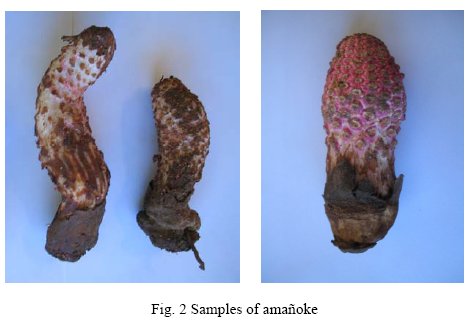
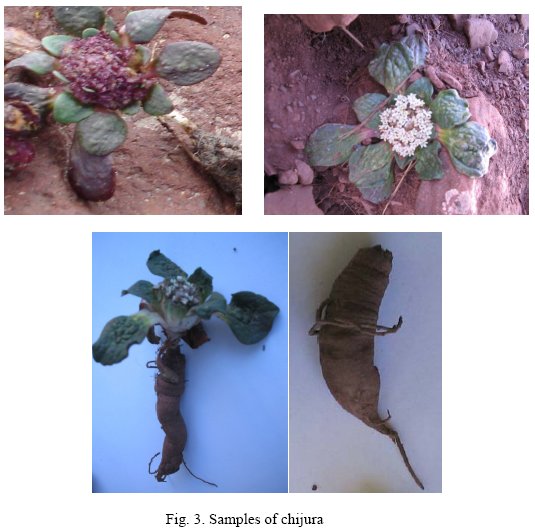
<body><![CDATA[<P   align="center" ><img src="/img/revistas/rbq/v25n1/figura_a9_02.jpg" width="470" height="324"></P >     <P   align="justify" ><font size="2" face="Verdana, Arial, Helvetica, sans-serif">The ama&ntilde;oke is an underground balanophoraceae that was described by the Swedish botanist Eric Asplund under the name of <I>Juelia subterr&aacute;nea</I> Asplund in a study carried out starting from the visit of this botanist to the population of Corocoro (La Paz). The botanist La Barre rescued its name of &quot;ama&ntilde;oke&quot;. At the present time the most widespread name in the Bolivian Highland, is &quot;&ntilde;oke&quot; of possible aymara origin, while in the quechua language spoken currently in Cochabamba it is designated with the word &quot;amalloke&quot;.<sup>[4]</sup></font></P >     <P align="justify"   ><font size="2" face="Verdana, Arial, Helvetica, sans-serif">This plant is very sought-by the native doctors, <I>callawayas</I> that assign it medicinal properties as remedy for heart, lung and stomach affections. It is very appreciated and eaten raw in the Andean regions. </font></P >     <P align="justify"   ><font size="2" face="Verdana, Arial, Helvetica, sans-serif"><B>    <br> CHIJURA. GENERAL ASPECTS </B></font></P >     <P align="justify"   ><font size="2" face="Verdana, Arial, Helvetica, sans-serif"><B>Nombre Botanic name: </B><I>Stangea rhizantha </I></font></P >     <P align="justify"   ><font size="2" face="Verdana, Arial, Helvetica, sans-serif"><B>Family:</B> Valerianaceae </font></P >     <P align="justify"   ><font size="2" face="Verdana, Arial, Helvetica, sans-serif"><B>Common name:</B> Chijura, condorallu <sup>[5]</sup>, chicuro <sup>[6]</sup>.</font><font face="Verdana, Arial, Helvetica, sans-serif"></font></P >     <P align="center"   ><img src="/img/revistas/rbq/v25n1/figura_a9_03.jpg" width="535" height="532"></P > <font face="Verdana, Arial, Helvetica, sans-serif">    <P align="justify"   ><font size="2">The chijura is used in human feeding, it is peeled and the raw or cooked rhizome is eaten. In February, the rhizome is sweeter and is prepared together with potato varieties. In times of shortage, the rhizome can serve as a substitute of potatoes.<sup>[5]</sup>. </font></P >     ]]></body>
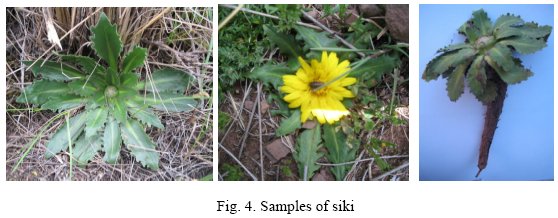
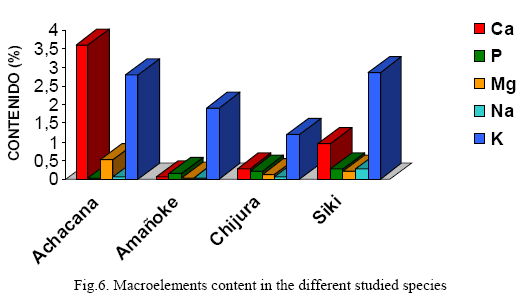
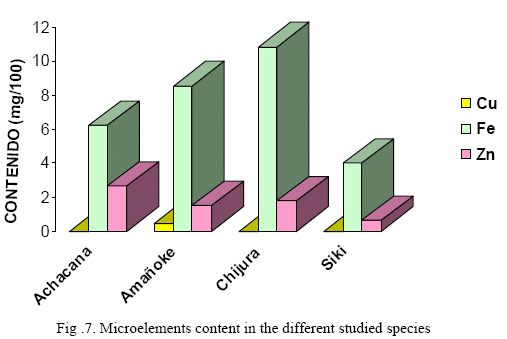
<body><![CDATA[<P align="justify"   ><font size="2"><B>    <br> SIKI. GENERAL ASPECTS </B></font></P >     <P align="justify"   ><font size="2"><B>Botanic Name: </B><I>Hipochoeris meyeniana var.brachylepis </I></font></P >     <P align="justify"   ><font size="2"><B>Family:</B> Asteraceae </font></P >     <P align="justify"   ><font size="2"><B>Common names:</B> siki, ponqayo siki, jake siki.<sup>[5]</sup></font></P > <font size="2">     <P   align="center" ><img src="/img/revistas/rbq/v25n1/figura_a9_04.jpg" width="558" height="218"></P >     <P   align="justify" >It is a geophite plant, it developes in summer or with the arrival of the rains; when the leaves begins to dry off, the flowers appear. It is used in human feeding in the central Andean region of Bolivia. The white bases of the leaves are the eatable part. <sup>[5]</sup> </P > <strong><font size="3">    <br> RESULTS AND DISCUSSION </font></strong>     <P   align="justify" >The results are expressed in dry base. In the studied species, stands out the content of K: the siki contains 2,87% and the achacana 2,79%. The siki has macroelements and microelements content values that overcome those of the other studied species, except the content of Ca 3,6%; Mg 0,53% and Zn 2,64 mg/100 g in the achacana. It stands out the presence of 0,46 mg/100 g of Cu in the ama&ntilde;oke. As soon as it we refer to the Fe it is observed that the chijura presents the higher value of 10,87 mg/100 g, as it is shown in the following table: </P >     <P   align="center" ><img src="/img/revistas/rbq/v25n1/tabla_a9_01.gif" width="512" height="225"></P > </font></font>     ]]></body>
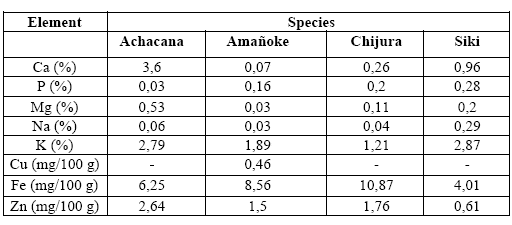
<body><![CDATA[<P   align="center" ><img src="/img/revistas/rbq/v25n1/figura_a9_06.gif" width="523" height="299"></P >     <P   align="justify" ><font size="2" face="Verdana, Arial, Helvetica, sans-serif">Analyzing the presence of these elements in the studied species stands out the content of potassium. In reference to the content of sodium, the siki shows a considerable value in comparison to the vegetables species of usual consume. The other species showed relatively low values in sodium content. It can be considered that achacana and siki are a good source of minerals. </font></P >     <P   align="center" ><img src="/img/revistas/rbq/v25n1/figura_a9_07.gif" width="507" height="339"></P >     <P   align="justify" ><font size="2" face="Verdana, Arial, Helvetica, sans-serif">At level of trace elements stands out the copper content in the ama&ntilde;oke.</font></P >     <P   align="justify" ><font size="3"><strong><font face="Verdana, Arial, Helvetica, sans-serif">    <br> EXPERIMENTAL SECTION </font></strong></font></P >     <P   align="justify" ><font size="2" face="Verdana, Arial, Helvetica, sans-serif"><I>Hipochoeris meyeniana var.brachylepis </I>y<I> Neowerdermannia vorwerckii </I>were collected in the town Chama, county Ingavi of the department of La Paz (<a href="#f5">Fig. 5</a>) in February and March of 2007 respectively. (<a href="#f5">Fig. 5</a>) in February and March of 2007 respectively. <I>Ombrophytum subterraneum </I>was collected in the town of Patacamaya, county Aroma of the department of La Paz (Fig. 5) in April of 2007. <I>Stangea rhizantha </I>was collected in the town of Achiri, county Pacajes of the department of La Paz (<a href="#f5">Fig. 5</a>) in February of 2007. </font></P > <font face="Verdana, Arial, Helvetica, sans-serif"></font><font face="Verdana, Arial, Helvetica, sans-serif"> </font>    <P   align="center" ><font face="Verdana, Arial, Helvetica, sans-serif"><a name="f5"></a><img src="/img/revistas/rbq/v25n1/figura_a9_05.gif" width="468" height="458"></font></P >     <P   align="justify" ><font face="Verdana, Arial, Helvetica, sans-serif"><strong><font size="3">MINERALS DETERMINATION </font></strong></font></P > <font face="Verdana, Arial, Helvetica, sans-serif"></font>    <P   align="justify" ><font size="2" face="Verdana, Arial, Helvetica, sans-serif">For the determination of Ca, Fe, Mg, Zn, K, Na and Cu previous acid treatment of the ashes Atomic Absorption Spectrophotometry was used, <sup>[2]</sup>. For the determination of P was used UV-visible spectrophotometry, previous incineration and acid dissolution of the sample. The spectrophotometric evaluation was based on the formation of the blue complex of molybdenum between P and ammonium molibdate, with a maximum absorbance of 700 nm of wave length.</font></P >     ]]></body>
<body><![CDATA[<P   align="justify" ><font size="2" face="Verdana, Arial, Helvetica, sans-serif"><strong>ACKNOWLEDGMENT </strong></font></P > <font face="Verdana, Arial, Helvetica, sans-serif"></font>    <P   align="justify" ><font size="2" face="Verdana, Arial, Helvetica, sans-serif">We express our gratefulness to the UMSA-Universidad Mayor de San Andr&eacute;s, La Paz, Bolivia  and to the Swedish Agency for International Development (SIDA-ASDI/SAREC) for their collaboration to the Project &quot;<I>Antioxidantes en Alimentos de Bolivia</I>&quot; without which had not been possible the present work.</font></P >     <P   align="justify" ><font size="3" face="Verdana, Arial, Helvetica, sans-serif"><strong>REFERENCES </strong></font></P >  <OL   type="1" >   <LI   align="justify" ><font size="2" face="Verdana, Arial, Helvetica, sans-serif">Tapia M., (1990) Cultivos andinos subexplotados y su aporte en la alimentaci&oacute;n; FAO/RLALC. Lima, Per&uacute;      </P >   </font></LI >   <LI   align="justify" ><font size="2" face="Verdana, Arial, Helvetica, sans-serif">A.O.A.C. (1990) &ldquo;Official Methods of Analysis of the Assoc. of Off. Anal. Chemists&rdquo;. Eilliam Horritz, Editor. &ldquo;AOAC&rdquo; Vol. 1, Met. 975.03 15th Ed.     </P >   </font></LI >   <LI   align="justify" ><font size="2" face="Verdana, Arial, Helvetica, sans-serif">Calder&oacute;n J. (1987) &ldquo;La Achacana (<I>Neowerdermannia vorwerckii</I>) Determinaci&oacute;n de sus nutrientes&rdquo;<I>. </I>Revista Ecol&oacute;gica en Bolivia. Instituto de Ecolog&iacute;a, <B>10</B>, 65-70 La Paz, Bolivia.      </P >   </font></LI >   <LI   align="justify" ><font size="2" face="Verdana, Arial, Helvetica, sans-serif">C&aacute;rdenas M. (1969) &ldquo;Manual de plantas econ&oacute;micas de Bolivia&rdquo;, Imprenta Icthus, Cochabamba, Bolivia.     </P >   </font></LI >   <LI   align="justify" ><font size="2" face="Verdana, Arial, Helvetica, sans-serif">Pestalozzi H.U. (1998) &ldquo;Flora Ilustrada Altoandina&rdquo;, Herbario Nacional de Bolivia, Cochabamba.     </P >   </font></LI >   <LI   align="justify" ><font size="2" face="Verdana, Arial, Helvetica, sans-serif">Buend&iacute;a L., Artica L. (2005) &ldquo;Obtenci&oacute;n de oligofructanos a partir de la ra&iacute;z de chicuro y evaluaci&oacute;n de sus caracter&iacute;sticas f&iacute;sico-qu&iacute;micas&rdquo;. http://www.uncp.edu.pe/Facultades/Industrias/investigacion/2005_13.htm     </P >   </font></LI > </OL >      ]]></body><back>
<ref-list>
<ref id="B1">
<label>1</label><nlm-citation citation-type="book">
<person-group person-group-type="author">
<name>
<surname><![CDATA[Tapia]]></surname>
<given-names><![CDATA[M]]></given-names>
</name>
</person-group>
<source><![CDATA[Cultivos andinos subexplotados y su aporte en la alimentación]]></source>
<year>1990</year>
<publisher-loc><![CDATA[Lima ]]></publisher-loc>
<publisher-name><![CDATA[FAO/RLALC]]></publisher-name>
</nlm-citation>
</ref>
<ref id="B2">
<label>2</label><nlm-citation citation-type="book">
<collab>A.O.A.C</collab>
<source><![CDATA[Official Methods of Analysis of the Assoc. of Off. Anal. Chemists]]></source>
<year>1990</year>
<edition>15</edition>
<publisher-name><![CDATA[Eilliam Horritz, Editor]]></publisher-name>
</nlm-citation>
</ref>
<ref id="B3">
<label>3</label><nlm-citation citation-type="journal">
<person-group person-group-type="author">
<name>
<surname><![CDATA[Calderón]]></surname>
<given-names><![CDATA[J]]></given-names>
</name>
</person-group>
<source><![CDATA[La Achacana (Neowerdermannia vorwerckii) Determinación de sus nutrientes. Revista Ecológica en Bolivia. Instituto de Ecología]]></source>
<year>1987</year>
<volume>10</volume>
<page-range>65-70</page-range></nlm-citation>
</ref>
<ref id="B4">
<label>4</label><nlm-citation citation-type="book">
<person-group person-group-type="author">
<name>
<surname><![CDATA[Cárdenas]]></surname>
<given-names><![CDATA[M]]></given-names>
</name>
</person-group>
<source><![CDATA[Manual de plantas económicas de Bolivia]]></source>
<year>1969</year>
<publisher-loc><![CDATA[Cochabamba ]]></publisher-loc>
<publisher-name><![CDATA[Imprenta Icthus]]></publisher-name>
</nlm-citation>
</ref>
<ref id="B5">
<label>5</label><nlm-citation citation-type="book">
<person-group person-group-type="author">
<name>
<surname><![CDATA[Pestalozzi]]></surname>
<given-names><![CDATA[H.U]]></given-names>
</name>
</person-group>
<source><![CDATA[Flora Ilustrada Altoandina]]></source>
<year>1998</year>
<publisher-loc><![CDATA[Cochabamba ]]></publisher-loc>
<publisher-name><![CDATA[Herbario Nacional de Bolivia]]></publisher-name>
</nlm-citation>
</ref>
<ref id="B6">
<label>6</label><nlm-citation citation-type="">
<person-group person-group-type="author">
<name>
<surname><![CDATA[Buendía]]></surname>
<given-names><![CDATA[L]]></given-names>
</name>
<name>
<surname><![CDATA[Artica]]></surname>
<given-names><![CDATA[L]]></given-names>
</name>
</person-group>
<source><![CDATA[Obtención de oligofructanos a partir de la raíz de chicuro y evaluación de sus características físico-químicas]]></source>
<year>2005</year>
</nlm-citation>
</ref>
</ref-list>
</back>
</article>