<?xml version="1.0" encoding="ISO-8859-1"?><article xmlns:mml="http://www.w3.org/1998/Math/MathML" xmlns:xlink="http://www.w3.org/1999/xlink" xmlns:xsi="http://www.w3.org/2001/XMLSchema-instance">
<front>
<journal-meta>
<journal-id>0250-5460</journal-id>
<journal-title><![CDATA[Revista Boliviana de Química]]></journal-title>
<abbrev-journal-title><![CDATA[Rev. Bol. Quim]]></abbrev-journal-title>
<issn>0250-5460</issn>
<publisher>
<publisher-name><![CDATA[Universidad Mayor de San Andrés]]></publisher-name>
</publisher>
</journal-meta>
<article-meta>
<article-id>S0250-54602008000100006</article-id>
<title-group>
<article-title xml:lang="en"><![CDATA[REVIEW REVERSIBLE ELECTROPORATION OF VEGETABLE TISSUES - METABOLIC CONSEQUENCES AND APPLICATIONS]]></article-title>
</title-group>
<contrib-group>
<contrib contrib-type="author">
<name>
<surname><![CDATA[Gómez Galindo]]></surname>
<given-names><![CDATA[Federico]]></given-names>
</name>
<xref ref-type="aff" rid="A01"/>
</contrib>
</contrib-group>
<aff id="A01">
<institution><![CDATA[,Universidade do Minho Centro de Egenharia Biológica Instiute for Biotechnology and Bioengineering]]></institution>
<addr-line><![CDATA[Braga ]]></addr-line>
<country>Portugal</country>
</aff>
<pub-date pub-type="pub">
<day>00</day>
<month>12</month>
<year>2008</year>
</pub-date>
<pub-date pub-type="epub">
<day>00</day>
<month>12</month>
<year>2008</year>
</pub-date>
<volume>25</volume>
<numero>1</numero>
<fpage>30</fpage>
<lpage>35</lpage>
<copyright-statement/>
<copyright-year/>
<self-uri xlink:href="http://www.scielo.org.bo/scielo.php?script=sci_arttext&amp;pid=S0250-54602008000100006&amp;lng=en&amp;nrm=iso"></self-uri><self-uri xlink:href="http://www.scielo.org.bo/scielo.php?script=sci_abstract&amp;pid=S0250-54602008000100006&amp;lng=en&amp;nrm=iso"></self-uri><self-uri xlink:href="http://www.scielo.org.bo/scielo.php?script=sci_pdf&amp;pid=S0250-54602008000100006&amp;lng=en&amp;nrm=iso"></self-uri><abstract abstract-type="short" xml:lang="en"><p><![CDATA[This review explores recent findings on gross metabolic responses of vegetable tissue induced by the application of pulsed electric field as well as discusses potential industrial applications of reversible electroporation.]]></p></abstract>
<abstract abstract-type="short" xml:lang="es"><p><![CDATA[Este artículo explora recientes investigaciones sobre respuestas metabólicas de tejidos vegetales inducidas por la aplicación de pulsos eléctricos. También se discuten potenciales aplicaciones industriales de la electroporación reversible.]]></p></abstract>
<kwd-group>
<kwd lng="en"><![CDATA[pulse electric field]]></kwd>
<kwd lng="en"><![CDATA[metabolic stress]]></kwd>
<kwd lng="en"><![CDATA[cell membrane]]></kwd>
<kwd lng="en"><![CDATA[cell wall]]></kwd>
<kwd lng="en"><![CDATA[cryoprotection./ pulsos eléctricos]]></kwd>
<kwd lng="es"><![CDATA[estrés metabólico]]></kwd>
<kwd lng="es"><![CDATA[membrana celular]]></kwd>
<kwd lng="es"><![CDATA[pared celular]]></kwd>
<kwd lng="es"><![CDATA[crioprotección]]></kwd>
</kwd-group>
</article-meta>
</front><body><![CDATA[ <P   align="center" ><font size="2" face="Verdana, Arial, Helvetica, sans-serif"><strong><font size="4">REVIEW </font></strong></font><font size="4"><strong>    <br>     <font face="Verdana, Arial, Helvetica, sans-serif">REVERSIBLE ELECTROPORATION OF VEGETABLE TISSUES - METABOLIC CONSEQUENCES AND APPLICATIONS </font></strong></font></P >     <P   align="center" ><strong><font size="2" face="Verdana, Arial, Helvetica, sans-serif"><I>Federico G&oacute;mez Galindo </I></font></strong><font size="2" face="Verdana, Arial, Helvetica, sans-serif"><I></I></font></P >     <P   align="justify" ><font size="1" face="Verdana, Arial, Helvetica, sans-serif">IBB-Institute for Biotechnology and Bioengineering, Centro de Engenharia Biol&oacute;gica, Universidade do Minho, Campus de  Gualtar, 4710-057 Braga, Portugal</font></P > <hr noshade>     <P   align="justify" ><font size="2" face="Verdana, Arial, Helvetica, sans-serif"><B>Key Words: </B>pulse electric field, metabolic stress, cell membrane, cell wall, cryoprotection./ <I>pulsos el&eacute;ctricos, estr&eacute;s metab&oacute;lico, membrana celular, pared celular, crioprotecci&oacute;n.</I></font></P >     <P   align="justify" ><font size="2" face="Verdana, Arial, Helvetica, sans-serif"><strong>ABSTRACT</strong> </font></P >     <P   align="justify" ><font size="2" face="Verdana, Arial, Helvetica, sans-serif">This review explores recent findings on gross metabolic responses of vegetable tissue induced by the application of pulsed electric field as well as discusses potential industrial applications of reversible electroporation./ <I>Este art&iacute;culo explora recientes investigaciones sobre respuestas metab&oacute;licas de tejidos vegetales inducidas por la aplicaci&oacute;n de pulsos el&eacute;ctricos. Tambi&eacute;n se discuten potenciales aplicaciones industriales de la electroporaci&oacute;n reversible.</I></font></P >     <P   align="justify" ><font size="2" face="Verdana, Arial, Helvetica, sans-serif"> Corresponding author:</font></P > <hr noshade>     <P   align="justify" ><strong><font size="3" face="Verdana, Arial, Helvetica, sans-serif">INTRODUCTION </font></strong></P >     <P   align="justify" ><font size="2" face="Verdana, Arial, Helvetica, sans-serif">The application of pulsed electric fields (PEF) to living cells causes a transient increase in the transmembrane potential difference, modifying the plasma membrane organization and bringing it locally to a permeable state <sup>(1)</sup>. The application of PEF may cause lethal damage to cells, or induce sublethal stress by transient permeabilization of cell membranes and electrophoretic movement of charged species between cellular compartments <sup>(2)</sup>. </font></P >     ]]></body>
<body><![CDATA[<P   align="justify" ><font size="2" face="Verdana, Arial, Helvetica, sans-serif">The technique is, in its lethal version, at very high field strength, used for the inactivation of microorganisms in foods <sup>(3,4)</sup> and can, at lower field strength, be used for the improvement of extraction yield <sup>(5,6)</sup> or increased rate of drying <sup>(7,8)</sup>. In its non-lethal version, the permeabilization may evade affecting cell viability. This is, under the name electrotransformation, routinely used for gene transfer with walled as well as wall-less systems <sup>(9)</sup>. </font></P >     <P   align="justify" ><font size="2" face="Verdana, Arial, Helvetica, sans-serif">When cell viabilily is kept after the application of the electric field, physiological responses are still largely unknown. It has been reported that PEF affects metabolism, including an oxidative burst with the consequent generation of reactive oxygen species (ROS) <sup>(1,10)</sup>, and the stimulation of the production of secondary metabolites such as increased yields of a cytostatic compound in cell culture of <I>Taxus chinensis </I><sup>(11)</sup> and of antioxidants and phytoesterols from oil seeds and fruits <sup>(12,13)</sup>. </font></P >     <P   align="justify" ><font size="2" face="Verdana, Arial, Helvetica, sans-serif">To our knowledge, little attention has been given to the application of PEF-induced stress to postharvest processing. Traditionally, postharvest processing is mainly concerned with slowing down or inactivating metabolic processes in the harvested product. Apart from the effects of ripening and senescence, reports on the active plant metabolism including stress-induced physiological events are not common in the literature. Recently, G&oacute;mez Galindo et al. <sup>(14)</sup> reviewed the importance and prospects of plant stress in postharvest treatments. Observed metabolic stress consequences include potato sweetening in cold storage, chilling damage of tomato and potato tissue suberization following industrial peeling. As most stresses include an oxidative burst and concomitant antioxidant defenses, the general utilization of stresses has been proposed as a means of increasing the plant tissue antioxidant levels in both preharvest <sup>(15)</sup> and postharvest <sup>(16)</sup>. </font></P >     <P   align="justify" ><font size="2" face="Verdana, Arial, Helvetica, sans-serif">Inducing stress by chemical means is not an attractive proposition for a healthy food product. Physical intervention, apart from ionizing radiation, is likely to be a more acceptable candidate. However, unlike chemical stress, temperature or pressure stress can not be easily targeted. The induction of sublethal stress by the application of PEF is likely to be a potential industrial alternative for metabolic stimulation, being unique as a stress regarding its primary effect on cell membranes and by causing a homogeneous effect over the whole treated tissue. Therefore, research is needed at first to find appropriate conditions (e.g. pulse shape and polarity, number, width, interpulse time) for PEF-induced metabolic stimulation. These conditions can then be refined upon an understanding of physiological responses. </font></P >    <P   align="justify" ><font size="2" face="Verdana, Arial, Helvetica, sans-serif">This review explores recent findings on gross metabolic responses of potato tissue induced by the application of PEF as well as discusses potential industrial applications of reversible electroporation.</font></P >     <P   align="justify" ><strong><font size="3" face="Verdana, Arial, Helvetica, sans-serif">    <br> METABOLIC CONSEQUENCES </font></strong></P >     <P   align="justify" ><font size="2" face="Verdana, Arial, Helvetica, sans-serif">With the application of PEF, opening of pores in the plasma membrane will result in the efflux and influx of polar molecules. After the pulse application, the resealing process is accompanied by oxidative stress with the consequent production of ROS <sup>(2)</sup>. H<sub>2</sub>O<sub>2</sub> is a major constituent of ROS production upon stress <sup>(17,18)</sup>. Recent studies, however, suggest that oxygen consuming pathways such as respiration and production of H<sub>2</sub>O<sub>2</sub> are not the only metabolic responses to PEF. G&oacute;mez Galindo et al <sup>(19)</sup> demonstrated that PEF induces complex metabolic responses that may involve several aspects such as energy release from the movement of ionic species, ATP hydrolysis to rebuild gradients of charges across cell membranes and/or other physiological events taking place during electropermeabilization as well as long after resealing. Isothernal calorimetry studies on metabolic responses also showed evidence that this response is strongly influenced by the intensity and width of the pulse. It has been suggested <sup>(19)</sup> that the complex metabolic responses of plant tissues upon PEF-induced stress are strongly influenced by the size and the persistence of the created pores. The size and the distribution of the pores will depend on the pulsing conditions. Certain PEF conditions may create many small, transient pores (around 1.5-nm radius), that would relax and reseal in a time scale of ns <sup>(20, 21)</sup>, with stronger PEF conditions, the distribution of pore sizes would include larger pores (around 50-nm radius) which tend to reseal more slowly (&gt;1 s in some cases) or not at all <sup>(21)</sup>. It is possible that the metabolic work that the cell needs to do when dealing with the formation of small or large pores is different and may depend on the extent of polar compounds migrating upon electroporation as well as the amount of energy required for resealing and further recovery. </font></P >     <P   align="justify" ><font size="2" face="Verdana, Arial, Helvetica, sans-serif">Other striking results on metabolic consequences of PEF-induced stress, suggests that PEF affects the cell wall organization. G&oacute;mez Galindo et al. <sup>(22)</sup> reported kinetic studies of the labeling of plasma membrane with the fluorescent dye FM1-43. This amphipathic styryl dye has a divalent cationic head group and a lipophilic tail, and it reversibly partitions into the outer leaflet of the cell membrane. FM1-43 fluoresces weakly in an aqueous environment, and its quantum yield increases by two orders of magnitude on interaction in the lipid membrane <sup>(23)</sup>. </font></P >     <P   align="justify" ><font size="2" face="Verdana, Arial, Helvetica, sans-serif">Kinetic studies on plant cells have shown that after application of FM1-43, staining of the plasma membrane is immediate and the cell wall does not act as a barrier that can significantly slow the staining process <sup>(24)</sup> . However, it was shown through chemical treatment of the cell wall, that the diffusion of FM1-43 towards the cell membrane is slower if cell wall porosity decreases and, therefore, FM1-43 was tested as a marker for assessing cell wall permeability changes after the application of PEF. </font></P >     ]]></body>
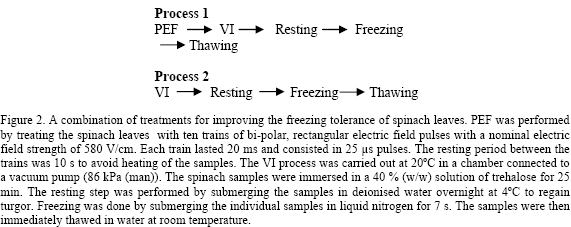
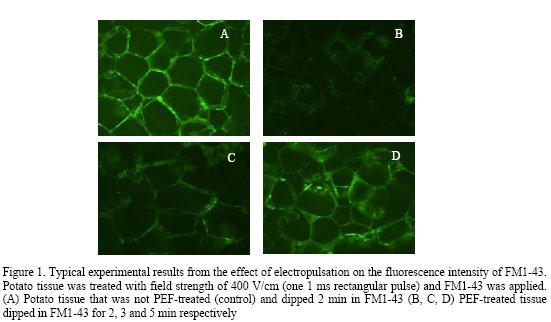
<body><![CDATA[<P   align="justify" ><font size="2" face="Verdana, Arial, Helvetica, sans-serif">In <a href="#f1">Figure 1a-d</a>, typical microscopic observations of the fluorescent interaction of the dye with the cell membrane after PEF application are shown. Figures 1a and b show a dramatic decrease of the fluorescence intensity of the PEFtreated sample in comparison with that of the control. The fluorescence intensity is progressively restored when increasing the dipping time of the potato slice in FM1-43 from 2 to 5 min (<a href="#f1">Figures 1c, d</a>), showing that PEF treatment has affected the rate of diffusion of the dye through the extracellular space, slowing the staining process. </font></P >     <P   align="center" ><a name="f1"></a><img src="/img/revistas/rbq/v25n1/figura_a6_01.jpg" width="551" height="322"></P >     <P   align="justify" ><font size="2" face="Verdana, Arial, Helvetica, sans-serif">Through further kinetic studies, G&oacute;mez et al <sup>(22)</sup> concluded that electropulsation, in the range of 100 to 500 V/cm (one 1 ms rectangular pulse), slows the diffusion of the dye FM1-43 through the cell wall of potato tissue, suggesting a significant decrease in cell wall permeability at nanometer scale. Experimental evidence linked those changes with the production of H<sub>2</sub>O<sub>2</sub>  by cell wall associated peroxidases. </font></P >     <P   align="justify" ><font size="2" face="Verdana, Arial, Helvetica, sans-serif">These results suggest that, in vegetables with the metabolic capacity to induce cell wall structural changes upon stress, the application of PEF under the studied conditions would not only open pores in the cell membrane but also induce the reduction of cell wall porosity. The observed phenomena may affect the processing properties and composition of plant products extracted or otherwise processed using pulsed electric fields. Furthermore, the implications of these structural changes for industrial processes aiming at transferring substances inside cells with the aid of PEF should be further explored.</font></P >     <P   align="justify" ><font size="3" face="Verdana, Arial, Helvetica, sans-serif"><strong>    <br> INDUSTRIAL APPLICATIONS </strong></font></P >     <P   align="justify" ><font size="2" face="Verdana, Arial, Helvetica, sans-serif">Attempts to transfer substances inside fruit and vegetables tissues through electroporation are not common in the literature. Recently, however, Yeu Phoon et al. <sup>(25)</sup> reported the successful insertion of trehalose as cryoprotectant in spinach leaves. </font></P >     <P   align="justify" ><font size="2" face="Verdana, Arial, Helvetica, sans-serif">Attempts have been made to improve the resistance of horticultural products to freezing damage by treating the tissues with cryoprotectants. Industrial techniques, such a vacuum impregnation (VI), have been used to promote compositional changes on porous tissues (e.g. apples), by filling porous fractions of the product with an external solution of the cryoprotectant. Resistance to freezing damage has then been improved through the reduction of freezable water <sup>(26)</sup>. However, when applying VI, the solution containing the cryoprotectant is located in the apoplast, whereas in nature, cryoprotectants accumulate inside the cell conferring their protective effects to the plant tissues. </font></P >     <P   align="justify" ><font size="2" face="Verdana, Arial, Helvetica, sans-serif">Sugars could be forced inside the cells through osmotic dehydration, by immersing the tissue in a hypertonic solution. To accelerate the mass transfer during this operation, pulsed electric fields (PEF) have been used to affect plasma membrane permeability properties <sup>(27, 28)</sup>. However, these operations will induce permanent damage on cell membrane properties and cell death <sup>(29)</sup>, consequences that will not provide cryoprotection to the tissue.</font></P >     <P   align="justify" ><font size="2" face="Verdana, Arial, Helvetica, sans-serif">The impregnation of a cryoprotectant solution inside the cells of spinach leaves, reported by Yeu Phoon et al. <sup>(25)</sup> through a combination of VI and PEF, showed a substantial improvement of their freezing tolerance. <a href="#f2">Figure 2</a> shows the processing steps that were tested. The success of the operation was assessed by vital staining with fluorescein </font><font size="2" face="Verdana, Arial, Helvetica, sans-serif">diacetate (FDA) and a wilting test consisting in simply holding the centre of the sample with a small pincer and observing whether the leaves would bend or not. </font></P >     ]]></body>
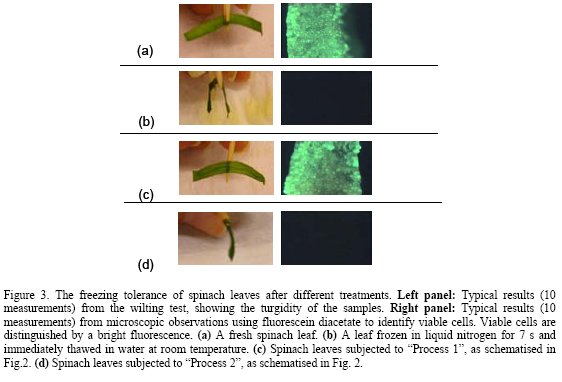
<body><![CDATA[<P   align="center" ><a name="f2"></a><img src="/img/revistas/rbq/v25n1/figura_a6_02.gif" width="571" height="227"></P >     <P   align="justify" ><font size="2" face="Verdana, Arial, Helvetica, sans-serif"><a href="#f3">Figure 3</a> shows the results where it is demonstrated that the tested procedure (Process 1 in Figure 2) resulted in viable, turgid spinach leaves. </font></P >     <P   align="center" ><a name="f3"></a><img src="/img/revistas/rbq/v25n1/figura_a6_03.jpg" width="562" height="382"></P >     <P   align="justify" ><font size="2" face="Verdana, Arial, Helvetica, sans-serif">A comparison between process 1 and 2 in <a href="#f2">Figure 2</a> reveals that improving the freezing tolerance of spinach leaves could be achieved only when the VI process was used in combination with PEF.</font></P >     <P   align="justify" ><font size="2" face="Verdana, Arial, Helvetica, sans-serif">    <br>   <font size="3"><strong>FUTURE PERSPECTIVES </strong></font></font></P >     <P   align="justify" ><font size="2" face="Verdana, Arial, Helvetica, sans-serif">Recent investigations on reversible electropermeabilization of vegetable tissues have resulted in striking results as well as in interesting questions. Much remains to be done on: </font></P >     <p><font size="2" face="Verdana, Arial, Helvetica, sans-serif">(1) Effect of transient loss of internal compartmentalisation on cellular composition, structure and metabolic activity. </font></p>     <p><font size="2" face="Verdana, Arial, Helvetica, sans-serif">(2) Defense-related consequences of PEF-induced stress (e.g. activation of metabolic pathways). </font></p>     <p><font size="2" face="Verdana, Arial, Helvetica, sans-serif">(3) </font><font size="2" face="Verdana, Arial, Helvetica, sans-serif">Cell wall structural changes and their effects on physical (e.g. texture) and processing properties of vegetable tissues. </font></p>     ]]></body>
<body><![CDATA[<p><font size="2" face="Verdana, Arial, Helvetica, sans-serif">(4) </font><font size="2" face="Verdana, Arial, Helvetica, sans-serif">Transport phenomena of exogenous substances (e.g. trehalose) at the cellular level upon PEF application. </font></p>     <P   align="justify" ><font size="2" face="Verdana, Arial, Helvetica, sans-serif">The use of new analytical techniques such as metabolic profiling and novel microscopic techniques such as digital holography would contribute to expand our knowledge in the field.</font></P >     <P   align="justify" ><font size="2" face="Verdana, Arial, Helvetica, sans-serif"><strong>    <br>   <font size="3"> ACKNOWLEDGEMENTS </font></strong></font></P >     <P   align="justify" ><font size="2" face="Verdana, Arial, Helvetica, sans-serif">This study was supported by grants from the Portuguese Foundation of Science and Technology.</font></P >     <P   align="justify" ><font size="3" face="Verdana, Arial, Helvetica, sans-serif"><strong>REFERENCES </strong></font></P > <ol>       <li><font size="2" face="Verdana, Arial, Helvetica, sans-serif">SABRI, N., PELISSIER, B., &amp; TEISSI&Eacute;, J. Electropermeabilization of intact maize cells induces an oxidative stress. European Journal of Biochem istry, 1996, 238, 737-743.</font>    <br>         <br>   </li>       <li><font size="2" face="Verdana, Arial, Helvetica, sans-serif">EISSI&Eacute;, J., GOLZIO, M., &amp; ROLS, M.P. Mechanisms of cell membrane electropermeabilization: A minireview of our present (lack of ?) knowledge. Biochimica and. Biophysica Acta &ndash; General Subjects, 2005, 1724, 270-280.     </P >   </font></li>       ]]></body>
<body><![CDATA[<li><font size="2" face="Verdana, Arial, Helvetica, sans-serif">G&Oacute;NGORA-NIETO, M.M., PEDROW, P.D., SWANSON, B.G., &amp; BARBOSA-C&Aacute;NOVAS, G.B. Energy analysis of liquid whole egg pasteurized by pulsed electric fields. Journal of Food Engineering, 2003, 57, 209-216.     </P >   </font></li>       <li><font size="2" face="Verdana, Arial, Helvetica, sans-serif">TOEPFL, S. HEINZ, V., &amp; KNORR, D. High intensity pulsed electric fields applied for food preservation. Chemical Engineering Process, 2007, 46, 537-546.     </P >   </font></li>       <li><font size="2" face="Verdana, Arial, Helvetica, sans-serif">FINCAN, M., DE VITO, F., &amp; DEJMEK, P. Pulsed electric field treatment for solid-liquid extraction of red beetroot pigment. Journal of Food Engineerring, 2004, 64, 381-388.     </P >   </font></li>       <li><font size="2" face="Verdana, Arial, Helvetica, sans-serif">CHALERMCHAT, Y., &amp; DEJMEK, P. Effect of pulsed electric field pretreatment on solid-liquid expression from potato tissue. Journal of Food Engineering, 2005, 71, 164-169.     </P >   </font></li>       <li><font size="2" face="Verdana, Arial, Helvetica, sans-serif">ADE-OMOWAYE, B.I.O., RASTOGI, N.K., ANGERSBACH, A., &amp; KNORR, D. Combined effects of pulsed electric field pre-treatment and partial osmotic dehydration on air drying behaviour of red bell pepper. Journal of Food Engineering, 2003, 60, 89-98.     </P >   </font></li>       <li><font size="2" face="Verdana, Arial, Helvetica, sans-serif">LEBOVKA, N.I., SHYNKARYK, N.V., &amp; VOROBIEV, E. Pulsed electric field enhanced drying of potato tissue. Journal of Food Engineering, 2007, 78, 606-613.     </P >   </font></li>       <li><font size="2" face="Verdana, Arial, Helvetica, sans-serif">GANEVA, V., GALUTZOV, B., &amp; TEISSIE, J. Electric field mediated loading of macromolecules in intact yeast cells is critically controlled at the wall level. Biochimica and Biophysica Acta, 1995, 1240, 229-236.     </P >   </font></li>       <li><font size="2" face="Verdana, Arial, Helvetica, sans-serif">GABRIEL, B., &amp; TEISSI&Eacute;, J. Generation of reactive oxygen species induced by electropermeabilization of Chinese hamster ovary cells and their consequence on cell viability. European Journal of Biochemistry, 1994, 223, 25-33.     </P >   </font></li>       <li><font size="2" face="Verdana, Arial, Helvetica, sans-serif">YE, H., HUANG, L.L., CHEN, S.D., &amp; ZHONG, J.J. Pulsed electric field stimulates plant secondary metabolism in suspension cultures of <I>Taxus chinensis</I>. Biotechnology and Bioengineering, 2004, 88, 788-795.      </P >   </font></li>       <li><font size="2" face="Verdana, Arial, Helvetica, sans-serif">GUDERJAN, M., ELEZ-MART&Iacute;NEZ, P., &amp; KNORR, D. Application of pulsed electric fields at oil yield and content of functional food ingredients at the production of rapeseed oil. Innovative Food Science and Emerging Technologies, 2007, 8, 55-62.     </P >   </font></li>       ]]></body>
<body><![CDATA[<li><font size="2" face="Verdana, Arial, Helvetica, sans-serif">GUNDERJAN, M., TOPFL, S., ANGERSBACH, A., &amp; KNORR, D. Impact of pulsed electric field treatment on the recovery and quality of plant oils. Journal of Food Engineering, 2005, 67, 281-287.     </P >   </font></li>       <li><font size="2" face="Verdana, Arial, Helvetica, sans-serif">G&Oacute;MEZ GALINDO, F., SJ&Ouml;HOLM, I., RASMUSSON, A.G., WIDELL, S., &amp; KAACK, K. Plant stress physiology: opportunities and challenges for the food industry. Critical Reviews in Food Science and Nutrition, 2007, 47, 729-763.     </P >   </font></li>       <li><font size="2" face="Verdana, Arial, Helvetica, sans-serif">ATKINSON, C.J., NESTBY, R., FORD, Y.Y., &amp; Dodds, P.A.A. Enhancing beneficial antioxidants in fruits: A plant physiological perspective. Biofactors, 2005, 23, 229-234.     </P >   </font></li>       <li><font size="2" face="Verdana, Arial, Helvetica, sans-serif">SCHREINER, M., &amp; HUYSKENS-KEIL, S. Phytochemicals in fruit and vegetables: Health promotion and postharvest elicitors. Critical Reviews in Plant Science, 2006, 25, 267-278.      </P >   </font></li>       <li><font size="2" face="Verdana, Arial, Helvetica, sans-serif">BRADLEY, D.J., KJELBOM, P., &amp; LAMB, C.J. Elicitor and wound-induced oxidative cross-linking of a proline-rich plant cell wall protein: a novel, rapid defense response. Cell, 1992, 70, 21-30.     </P >   </font></li>       <li><font size="2" face="Verdana, Arial, Helvetica, sans-serif">WOJTASZEK, P. Oxidative burst: an early plant response to pathogen infection. Biochemica, 1997, 322, 681-692.      </P >   </font></li>       <li><font size="2" face="Verdana, Arial, Helvetica, sans-serif">G&Oacute;MEZ GALINDO, F., WADS&Ouml;, L., VICENTE, A., &amp; DEJMEK, P. Exploring metabolic responses of potato tissue induced by electric pulses. 2008, Submitted for publication.     </P >   </font></li>       <li><font size="2" face="Verdana, Arial, Helvetica, sans-serif">JOSHI, R.P., HU, Q., &amp; SCHOENBACH, K.H. Simulation of electroporation dynamics and shape deformations in biological cells subjected to high voltage pulses. IEEE Transactions of Plasma Science, 2002, 30, 1536-1546.     </P >   </font></li>       <li><font size="2" face="Verdana, Arial, Helvetica, sans-serif">JI, Z., KENNEDY, S., BOOSKE, J.H., &amp; HAGNESS, S.C. Experimental studies of persistent poration dynamics of cell membranes induced by electric pulses. IEEE Transactions of Plasma Science, 2006, 34, 1416-1424.     </P>   </font></li>       <li><font size="2" face="Verdana, Arial, Helvetica, sans-serif"> G&Oacute;MEZ GALINDO, F., VERNIER, P.T., DEJMEK, P., VICENTE, A., &amp; GUNDERSEN, M. Pulsed electric field reduces the permeability of potato cell wall. Bioelectromagnetics, 2008, in press.</font>    ]]></body>
<body><![CDATA[<br>         <br>   </li>       <li><font size="2" face="Verdana, Arial, Helvetica, sans-serif">SCHOTE, U, &amp; SEELING, J. Interaction of the neuronal marker dye FM1-43 with lipid membranes. Thermodynamics and lipid ordering. Biochimica and Biophysica Acta, 1998, 1415, 135-146.</font>    <br>         <br>   </li>       <li><font size="2" face="Verdana, Arial, Helvetica, sans-serif"> BOLTE, S., TALBOT, C., BOUTTE, Y., CATRICE, O., READ, N.D., &amp; SATIAT-JEUNEMAITRE, B.          FM-dyes as experimental probes for dissecting vesicle trafficking in living plant cells. Journal of Microscopy, 2004, 214, 159-173.    </font>    <br>       <br>   </li>       <li><FONT size="2" face="Verdana, Arial, Helvetica, sans-serif">YEU PHOON, P., G&Oacute;MEZ GALINDO, F., VICENTE, A., &amp; DEJMEK, P. Pulsed electric field in combination with vacuum impregnation with trehalose improves the freezing tolerance of spinach leaves. Journal of Food Engineering, 2008, in press.</font>    <br>   </li>       ]]></body>
<body><![CDATA[<li><font size="2" face="Verdana, Arial, Helvetica, sans-serif">MART&Iacute;NEZ-MONZ&Oacute;, J., MART&Iacute;NEZ-NAVARRETE, N., CHIRALT, A., &amp; FITO, P. Mechanical and structural changes in apple (var. Granny smith) due to vacuum impregnation with cryoprotectants. Journal of Food Science<I>, </I>1998, 63, 499-503.      </P >   </font></li>       <li><font size="2" face="Verdana, Arial, Helvetica, sans-serif">ADE-OMOWAYE, B.I.O., RASTOGI, N:K:, ANGERSBACH, A., &amp; KNORR, D. Osmotic dehydration of bell peppers: influence of high intensity electric field pulses and elevated temperature treatment. Journal of Food Engineering, 2002, 54, 35-43.     </P >   </font></li>       <li><font size="2" face="Verdana, Arial, Helvetica, sans-serif">TAIWO, K., ESHTIAGHI, M.N., ADE-OMOWAYE, B.I.O., &amp; KNORR, D. Osmotic dehydration of strawberry halves: influence of osmotic agents and pre-treatment methods on mass transfer and product characteristics. International Journal of Food Science and Technology, 2003, 38<I>, </I>693-707.      </P >   </font></li>       <li><font size="2" face="Verdana, Arial, Helvetica, sans-serif">MAVROUDIS, N. Mass transport in apple tissue &ndash; effects on tissue structure and osmotic processing conditions. PhD Thesis, Food Engineering Department, Lund University, Sweden2003     </P >   </font></li>     </ol>      ]]></body><back>
<ref-list>
<ref id="B1">
<label>1</label><nlm-citation citation-type="journal">
<person-group person-group-type="author">
<name>
<surname><![CDATA[SABRI]]></surname>
<given-names><![CDATA[N]]></given-names>
</name>
<name>
<surname><![CDATA[PELISSIER]]></surname>
<given-names><![CDATA[B]]></given-names>
</name>
<name>
<surname><![CDATA[TEISSIÉ]]></surname>
<given-names><![CDATA[J]]></given-names>
</name>
</person-group>
<article-title xml:lang="en"><![CDATA[Electropermeabilization of intact maize cells induces an oxidative stress]]></article-title>
<source><![CDATA[European Journal of Biochemistry]]></source>
<year>1996</year>
<volume>238</volume>
<page-range>737-743</page-range></nlm-citation>
</ref>
<ref id="B2">
<label>2</label><nlm-citation citation-type="journal">
<person-group person-group-type="author">
<name>
<surname><![CDATA[TEISSIÉ]]></surname>
<given-names><![CDATA[J]]></given-names>
</name>
<name>
<surname><![CDATA[GOLZIO]]></surname>
<given-names><![CDATA[M]]></given-names>
</name>
<name>
<surname><![CDATA[ROLS]]></surname>
<given-names><![CDATA[MP]]></given-names>
</name>
</person-group>
<article-title xml:lang="en"><![CDATA[Mechanisms of cell membrane electropermeabilization: A minireview of our present (lack of ?) knowledge]]></article-title>
<source><![CDATA[Biochimica and Biophysica Acta - General Subjects]]></source>
<year>2005</year>
<volume>1724</volume>
<page-range>270-280</page-range></nlm-citation>
</ref>
<ref id="B3">
<label>3</label><nlm-citation citation-type="journal">
<person-group person-group-type="author">
<name>
<surname><![CDATA[GÓNGORA-NIETO]]></surname>
<given-names><![CDATA[MM]]></given-names>
</name>
<name>
<surname><![CDATA[PEDROW]]></surname>
<given-names><![CDATA[PD]]></given-names>
</name>
<name>
<surname><![CDATA[SWANSON]]></surname>
<given-names><![CDATA[BG]]></given-names>
</name>
<name>
<surname><![CDATA[BARBOSA-CÁNOVAS]]></surname>
<given-names><![CDATA[GB]]></given-names>
</name>
</person-group>
<article-title xml:lang="en"><![CDATA[Energy analysis of liquid whole egg pasteurized by pulsed electric fields]]></article-title>
<source><![CDATA[Journal of Food Engineering]]></source>
<year>2003</year>
<volume>57</volume>
<page-range>209-216</page-range></nlm-citation>
</ref>
<ref id="B4">
<label>4</label><nlm-citation citation-type="journal">
<person-group person-group-type="author">
<name>
<surname><![CDATA[TOEPFL]]></surname>
<given-names><![CDATA[S. HEINZ, V]]></given-names>
</name>
<name>
<surname><![CDATA[& KNORR]]></surname>
<given-names><![CDATA[D]]></given-names>
</name>
</person-group>
<article-title xml:lang="en"><![CDATA[High intensity pulsed electric fields applied for food preservation]]></article-title>
<source><![CDATA[Chemical Engineering Process]]></source>
<year>2007</year>
<volume>46</volume>
<page-range>537-546</page-range></nlm-citation>
</ref>
<ref id="B5">
<label>5</label><nlm-citation citation-type="journal">
<person-group person-group-type="author">
<name>
<surname><![CDATA[FINCAN]]></surname>
<given-names><![CDATA[M]]></given-names>
</name>
<name>
<surname><![CDATA[DE VITO]]></surname>
<given-names><![CDATA[F]]></given-names>
</name>
<name>
<surname><![CDATA[& DEJMEK]]></surname>
<given-names><![CDATA[P]]></given-names>
</name>
</person-group>
<article-title xml:lang="en"><![CDATA[Pulsed electric field treatment for solid-liquid extraction of red beetroot pigment]]></article-title>
<source><![CDATA[Journal of Food Engineerring]]></source>
<year>2004</year>
<volume>64</volume>
<page-range>381-388</page-range></nlm-citation>
</ref>
<ref id="B6">
<label>6</label><nlm-citation citation-type="journal">
<person-group person-group-type="author">
<name>
<surname><![CDATA[CHALERMCHAT]]></surname>
<given-names><![CDATA[Y]]></given-names>
</name>
<name>
<surname><![CDATA[& DEJMEK]]></surname>
<given-names><![CDATA[P]]></given-names>
</name>
</person-group>
<article-title xml:lang="en"><![CDATA[Effect of pulsed electric field pretreatment on solid-liquid expression from potato tissue]]></article-title>
<source><![CDATA[Journal of Food Engineering]]></source>
<year>2005</year>
<volume>71</volume>
<page-range>164-169</page-range></nlm-citation>
</ref>
<ref id="B7">
<label>7</label><nlm-citation citation-type="journal">
<person-group person-group-type="author">
<name>
<surname><![CDATA[ADE-OMOWAYE]]></surname>
<given-names><![CDATA[B.I.O]]></given-names>
</name>
<name>
<surname><![CDATA[RASTOGI]]></surname>
<given-names><![CDATA[N.K]]></given-names>
</name>
<name>
<surname><![CDATA[ANGERSBACH]]></surname>
<given-names><![CDATA[A]]></given-names>
</name>
<name>
<surname><![CDATA[& KNORR]]></surname>
<given-names><![CDATA[D]]></given-names>
</name>
</person-group>
<article-title xml:lang="en"><![CDATA[Combined effects of pulsed electric field pre-treatment and partial osmotic dehydration on air drying behaviour of red bell pepper]]></article-title>
<source><![CDATA[Journal of Food Engineering]]></source>
<year>2003</year>
<volume>60</volume>
<page-range>89-98</page-range></nlm-citation>
</ref>
<ref id="B8">
<label>8</label><nlm-citation citation-type="journal">
<person-group person-group-type="author">
<name>
<surname><![CDATA[LEBOVKA]]></surname>
<given-names><![CDATA[N.I]]></given-names>
</name>
<name>
<surname><![CDATA[SHYNKARYK]]></surname>
<given-names><![CDATA[N.V]]></given-names>
</name>
<name>
<surname><![CDATA[& VOROBIEV]]></surname>
<given-names><![CDATA[E]]></given-names>
</name>
</person-group>
<article-title xml:lang="en"><![CDATA[Pulsed electric field enhanced drying of potato tissue]]></article-title>
<source><![CDATA[Journal of Food Engineering]]></source>
<year>2007</year>
<volume>78</volume>
<page-range>606-613</page-range></nlm-citation>
</ref>
<ref id="B9">
<label>9</label><nlm-citation citation-type="journal">
<person-group person-group-type="author">
<name>
<surname><![CDATA[GANEVA]]></surname>
<given-names><![CDATA[V]]></given-names>
</name>
<name>
<surname><![CDATA[GALUTZOV]]></surname>
<given-names><![CDATA[B]]></given-names>
</name>
<name>
<surname><![CDATA[& TEISSIE]]></surname>
<given-names><![CDATA[J]]></given-names>
</name>
</person-group>
<article-title xml:lang="en"><![CDATA[Electric field mediated loading of macromolecules in intact yeast cells is critically controlled at the wall level]]></article-title>
<source><![CDATA[Biochimica and Biophysica Acta]]></source>
<year>1995</year>
<volume>1240</volume>
<page-range>229-236</page-range></nlm-citation>
</ref>
<ref id="B10">
<label>10</label><nlm-citation citation-type="journal">
<person-group person-group-type="author">
<name>
<surname><![CDATA[GABRIEL]]></surname>
<given-names><![CDATA[B]]></given-names>
</name>
<name>
<surname><![CDATA[& TEISSIÉ]]></surname>
<given-names><![CDATA[J]]></given-names>
</name>
</person-group>
<article-title xml:lang="en"><![CDATA[Generation of reactive oxygen species induced by electropermeabilization of Chinese hamster ovary cells and their consequence on cell viability]]></article-title>
<source><![CDATA[European Journal of Biochemistry]]></source>
<year>1994</year>
<volume>223</volume>
<page-range>25-33</page-range></nlm-citation>
</ref>
<ref id="B11">
<label>11</label><nlm-citation citation-type="journal">
<person-group person-group-type="author">
<name>
<surname><![CDATA[YE]]></surname>
<given-names><![CDATA[H]]></given-names>
</name>
<name>
<surname><![CDATA[HUANG]]></surname>
<given-names><![CDATA[LL]]></given-names>
</name>
<name>
<surname><![CDATA[CHEN]]></surname>
<given-names><![CDATA[SD]]></given-names>
</name>
<name>
<surname><![CDATA[ZHONG]]></surname>
<given-names><![CDATA[JJ]]></given-names>
</name>
</person-group>
<article-title xml:lang="en"><![CDATA[Pulsed electric field stimulates plant secondary metabolism in suspension cultures of Taxus chinensis]]></article-title>
<source><![CDATA[Biotechnology and Bioengineering]]></source>
<year>2004</year>
<volume>88</volume>
<page-range>788-795</page-range></nlm-citation>
</ref>
<ref id="B12">
<label>12</label><nlm-citation citation-type="journal">
<person-group person-group-type="author">
<name>
<surname><![CDATA[GUDERJAN]]></surname>
<given-names><![CDATA[M]]></given-names>
</name>
<name>
<surname><![CDATA[ELEZ-MARTÍNEZ]]></surname>
<given-names><![CDATA[P]]></given-names>
</name>
<name>
<surname><![CDATA[KNORR]]></surname>
<given-names><![CDATA[D]]></given-names>
</name>
</person-group>
<article-title xml:lang="en"><![CDATA[Application of pulsed electric fields at oil yield and content of functional food ingredients at the production of rapeseed oil]]></article-title>
<source><![CDATA[Innovative Food Science and Emerging Technologies]]></source>
<year>2007</year>
<volume>8</volume>
<page-range>55-62</page-range></nlm-citation>
</ref>
<ref id="B13">
<label>13</label><nlm-citation citation-type="journal">
<person-group person-group-type="author">
<name>
<surname><![CDATA[GUNDERJAN]]></surname>
<given-names><![CDATA[M]]></given-names>
</name>
<name>
<surname><![CDATA[TOPFL]]></surname>
<given-names><![CDATA[S]]></given-names>
</name>
<name>
<surname><![CDATA[ANGERSBACH]]></surname>
<given-names><![CDATA[A]]></given-names>
</name>
<name>
<surname><![CDATA[KNORR]]></surname>
<given-names><![CDATA[D]]></given-names>
</name>
</person-group>
<article-title xml:lang="en"><![CDATA[Impact of pulsed electric field treatment on the recovery and quality of plant oils]]></article-title>
<source><![CDATA[Journal of Food Engineering]]></source>
<year>2005</year>
<volume>67</volume>
<page-range>281-287</page-range></nlm-citation>
</ref>
<ref id="B14">
<label>14</label><nlm-citation citation-type="journal">
<person-group person-group-type="author">
<name>
<surname><![CDATA[GÓMEZ GALINDO]]></surname>
<given-names><![CDATA[F]]></given-names>
</name>
<name>
<surname><![CDATA[SJÖHOLM]]></surname>
<given-names><![CDATA[I]]></given-names>
</name>
<name>
<surname><![CDATA[RASMUSSON]]></surname>
<given-names><![CDATA[AG]]></given-names>
</name>
<name>
<surname><![CDATA[WIDELL]]></surname>
<given-names><![CDATA[S]]></given-names>
</name>
<name>
<surname><![CDATA[KAACK]]></surname>
<given-names><![CDATA[K]]></given-names>
</name>
</person-group>
<article-title xml:lang="en"><![CDATA[Plant stress physiology: opportunities and challenges for the food industry]]></article-title>
<source><![CDATA[Critical Reviews in Food Science and Nutrition]]></source>
<year>2007</year>
<volume>47</volume>
<page-range>729-763</page-range></nlm-citation>
</ref>
<ref id="B15">
<label>15</label><nlm-citation citation-type="journal">
<person-group person-group-type="author">
<name>
<surname><![CDATA[ATKINSON]]></surname>
<given-names><![CDATA[CJ]]></given-names>
</name>
<name>
<surname><![CDATA[NESTBY]]></surname>
<given-names><![CDATA[R]]></given-names>
</name>
<name>
<surname><![CDATA[FORD]]></surname>
<given-names><![CDATA[YY]]></given-names>
</name>
<name>
<surname><![CDATA[Dodds]]></surname>
<given-names><![CDATA[PAA]]></given-names>
</name>
</person-group>
<article-title xml:lang="en"><![CDATA[Enhancing beneficial antioxidants in fruits: A plant physiological perspective]]></article-title>
<source><![CDATA[Biofactors]]></source>
<year>2005</year>
<volume>23</volume>
<page-range>229-234</page-range></nlm-citation>
</ref>
<ref id="B16">
<label>16</label><nlm-citation citation-type="journal">
<person-group person-group-type="author">
<name>
<surname><![CDATA[SCHREINER]]></surname>
<given-names><![CDATA[M]]></given-names>
</name>
<name>
<surname><![CDATA[HUYSKENS-KEIL]]></surname>
<given-names><![CDATA[S]]></given-names>
</name>
</person-group>
<article-title xml:lang="en"><![CDATA[Phytochemicals in fruit and vegetables: Health promotion and postharvest elicitors]]></article-title>
<source><![CDATA[Critical Reviews in Plant Science]]></source>
<year>2006</year>
<volume>25</volume>
<page-range>267-278</page-range></nlm-citation>
</ref>
<ref id="B17">
<label>17</label><nlm-citation citation-type="journal">
<person-group person-group-type="author">
<name>
<surname><![CDATA[BRADLEY]]></surname>
<given-names><![CDATA[DJ]]></given-names>
</name>
<name>
<surname><![CDATA[KJELBOM]]></surname>
<given-names><![CDATA[P]]></given-names>
</name>
<name>
<surname><![CDATA[LAMB]]></surname>
<given-names><![CDATA[CJ]]></given-names>
</name>
</person-group>
<article-title xml:lang="en"><![CDATA[Elicitor and wound-induced oxidative cross-linking of a proline-rich plant cell wall protein: a novel, rapid defense response]]></article-title>
<source><![CDATA[Cell]]></source>
<year>1992</year>
<volume>70</volume>
<page-range>21-30</page-range></nlm-citation>
</ref>
<ref id="B18">
<label>18</label><nlm-citation citation-type="journal">
<person-group person-group-type="author">
<name>
<surname><![CDATA[WOJTASZEK]]></surname>
<given-names><![CDATA[P]]></given-names>
</name>
</person-group>
<article-title xml:lang="en"><![CDATA[Oxidative burst: an early plant response to pathogen infection]]></article-title>
<source><![CDATA[Biochemica]]></source>
<year>1997</year>
<volume>322</volume>
<page-range>681-692</page-range></nlm-citation>
</ref>
<ref id="B19">
<label>19</label><nlm-citation citation-type="book">
<person-group person-group-type="author">
<name>
<surname><![CDATA[GÓMEZ GALINDO]]></surname>
<given-names><![CDATA[F]]></given-names>
</name>
<name>
<surname><![CDATA[WADSÖ]]></surname>
<given-names><![CDATA[L]]></given-names>
</name>
<name>
<surname><![CDATA[VICENTE]]></surname>
<given-names><![CDATA[A]]></given-names>
</name>
<name>
<surname><![CDATA[DEJMEK]]></surname>
<given-names><![CDATA[P]]></given-names>
</name>
</person-group>
<source><![CDATA[Exploring metabolic responses of potato tissue induced by electric pulses]]></source>
<year>2008</year>
<publisher-name><![CDATA[Submitted for publication]]></publisher-name>
</nlm-citation>
</ref>
<ref id="B20">
<label>20</label><nlm-citation citation-type="journal">
<person-group person-group-type="author">
<name>
<surname><![CDATA[JOSHI]]></surname>
<given-names><![CDATA[RP]]></given-names>
</name>
<name>
<surname><![CDATA[HU]]></surname>
<given-names><![CDATA[Q]]></given-names>
</name>
<name>
<surname><![CDATA[SCHOENBACH]]></surname>
<given-names><![CDATA[KH]]></given-names>
</name>
</person-group>
<article-title xml:lang="en"><![CDATA[Simulation of electroporation dynamics and shape deformations in biological cells subjected to high voltage pulses]]></article-title>
<source><![CDATA[IEEE Transactions of Plasma Science]]></source>
<year>2002</year>
<volume>30</volume>
<page-range>1536-1546</page-range></nlm-citation>
</ref>
<ref id="B21">
<label>21</label><nlm-citation citation-type="journal">
<person-group person-group-type="author">
<name>
<surname><![CDATA[JI]]></surname>
<given-names><![CDATA[Z]]></given-names>
</name>
<name>
<surname><![CDATA[KENNEDY]]></surname>
<given-names><![CDATA[S]]></given-names>
</name>
<name>
<surname><![CDATA[BOOSKE]]></surname>
<given-names><![CDATA[JH]]></given-names>
</name>
<name>
<surname><![CDATA[HAGNESS]]></surname>
<given-names><![CDATA[SC]]></given-names>
</name>
</person-group>
<article-title xml:lang="en"><![CDATA[Experimental studies of persistent poration dynamics of cell membranes induced by electric pulses]]></article-title>
<source><![CDATA[IEEE Transactions of Plasma Science]]></source>
<year>2006</year>
<volume>34</volume>
<page-range>1416-1424</page-range></nlm-citation>
</ref>
<ref id="B22">
<label>22</label><nlm-citation citation-type="book">
<person-group person-group-type="author">
<name>
<surname><![CDATA[GÓMEZ GALINDO]]></surname>
<given-names><![CDATA[F]]></given-names>
</name>
<name>
<surname><![CDATA[VERNIER]]></surname>
<given-names><![CDATA[PT]]></given-names>
</name>
<name>
<surname><![CDATA[DEJMEK]]></surname>
<given-names><![CDATA[P]]></given-names>
</name>
<name>
<surname><![CDATA[VICENTE]]></surname>
<given-names><![CDATA[A]]></given-names>
</name>
<name>
<surname><![CDATA[GUNDERSEN]]></surname>
<given-names><![CDATA[M]]></given-names>
</name>
</person-group>
<source><![CDATA[Pulsed electric field reduces the permeability of potato cell wall. Bioelectromagnetics]]></source>
<year>2008</year>
<publisher-name><![CDATA[in press]]></publisher-name>
</nlm-citation>
</ref>
<ref id="B23">
<label>23</label><nlm-citation citation-type="journal">
<person-group person-group-type="author">
<name>
<surname><![CDATA[SCHOTE]]></surname>
<given-names><![CDATA[U]]></given-names>
</name>
<name>
<surname><![CDATA[SEELING]]></surname>
<given-names><![CDATA[J]]></given-names>
</name>
</person-group>
<article-title xml:lang="en"><![CDATA[Interaction of the neuronal marker dye FM1-43 with lipid membranes]]></article-title>
<source><![CDATA[Thermodynamics and lipid ordering. Biochimica and Biophysica Acta]]></source>
<year>1998</year>
<volume>1415</volume>
<page-range>135-146</page-range></nlm-citation>
</ref>
<ref id="B24">
<label>24</label><nlm-citation citation-type="journal">
<person-group person-group-type="author">
<name>
<surname><![CDATA[BOLTE]]></surname>
<given-names><![CDATA[S]]></given-names>
</name>
<name>
<surname><![CDATA[TALBOT]]></surname>
<given-names><![CDATA[C]]></given-names>
</name>
<name>
<surname><![CDATA[BOUTTE]]></surname>
<given-names><![CDATA[Y]]></given-names>
</name>
<name>
<surname><![CDATA[CATRICE]]></surname>
<given-names><![CDATA[O]]></given-names>
</name>
<name>
<surname><![CDATA[READ]]></surname>
<given-names><![CDATA[ND]]></given-names>
</name>
<name>
<surname><![CDATA[SATIAT-JEUNEMAITRE]]></surname>
<given-names><![CDATA[B]]></given-names>
</name>
</person-group>
<article-title xml:lang="en"><![CDATA[FM-dyes as experimental probes for dissecting vesicle trafficking in living plant cells]]></article-title>
<source><![CDATA[Journal of Microscopy]]></source>
<year>2004</year>
<volume>214</volume>
<page-range>159-173</page-range></nlm-citation>
</ref>
<ref id="B25">
<label>25</label><nlm-citation citation-type="book">
<person-group person-group-type="author">
<name>
<surname><![CDATA[YEU PHOON]]></surname>
<given-names><![CDATA[P]]></given-names>
</name>
<name>
<surname><![CDATA[GÓMEZ GALINDO]]></surname>
<given-names><![CDATA[F]]></given-names>
</name>
<name>
<surname><![CDATA[VICENTE]]></surname>
<given-names><![CDATA[A]]></given-names>
</name>
<name>
<surname><![CDATA[DEJMEK]]></surname>
<given-names><![CDATA[P]]></given-names>
</name>
</person-group>
<source><![CDATA[Pulsed electric field in combination with vacuum impregnation with trehalose improves the freezing tolerance of spinach leaves. Journal of Food Engineering]]></source>
<year>2008</year>
<publisher-name><![CDATA[in press]]></publisher-name>
</nlm-citation>
</ref>
<ref id="B26">
<label>26</label><nlm-citation citation-type="journal">
<person-group person-group-type="author">
<name>
<surname><![CDATA[MARTÍNEZ-MONZÓ]]></surname>
<given-names><![CDATA[J]]></given-names>
</name>
<name>
<surname><![CDATA[MARTÍNEZ-NAVARRETE]]></surname>
<given-names><![CDATA[N]]></given-names>
</name>
<name>
<surname><![CDATA[CHIRALT]]></surname>
<given-names><![CDATA[A]]></given-names>
</name>
<name>
<surname><![CDATA[FITO]]></surname>
<given-names><![CDATA[P]]></given-names>
</name>
</person-group>
<article-title xml:lang="en"><![CDATA[Mechanical and structural changes in apple (var Granny smith) due to vacuum impregnation with cryoprotectants]]></article-title>
<source><![CDATA[Journal of Food Science]]></source>
<year>1998</year>
<volume>63</volume>
<page-range>499-503</page-range></nlm-citation>
</ref>
<ref id="B27">
<label>27</label><nlm-citation citation-type="journal">
<person-group person-group-type="author">
<name>
<surname><![CDATA[ADE-OMOWAYE]]></surname>
<given-names><![CDATA[BIO]]></given-names>
</name>
<name>
<surname><![CDATA[RASTOGI]]></surname>
<given-names><![CDATA[NK]]></given-names>
</name>
<name>
<surname><![CDATA[ANGERSBACH]]></surname>
<given-names><![CDATA[A]]></given-names>
</name>
<name>
<surname><![CDATA[KNORR]]></surname>
<given-names><![CDATA[D]]></given-names>
</name>
</person-group>
<article-title xml:lang="en"><![CDATA[Osmotic dehydration of bell peppers: influence of high intensity electric field pulses and elevated temperature treatment]]></article-title>
<source><![CDATA[Journal of Food Engineering]]></source>
<year>2002</year>
<volume>54</volume>
<page-range>35-43</page-range></nlm-citation>
</ref>
<ref id="B28">
<label>28</label><nlm-citation citation-type="journal">
<person-group person-group-type="author">
<name>
<surname><![CDATA[TAIWO]]></surname>
<given-names><![CDATA[K]]></given-names>
</name>
<name>
<surname><![CDATA[ESHTIAGHI]]></surname>
<given-names><![CDATA[MN]]></given-names>
</name>
<name>
<surname><![CDATA[ADE-OMOWAYE]]></surname>
<given-names><![CDATA[BIO]]></given-names>
</name>
<name>
<surname><![CDATA[KNORR]]></surname>
<given-names><![CDATA[D]]></given-names>
</name>
</person-group>
<article-title xml:lang="en"><![CDATA[Osmotic dehydration of strawberry halves: influence of osmotic agents and pre-treatment methods on mass transfer and product characteristics]]></article-title>
<source><![CDATA[International Journal of Food Science and Technology]]></source>
<year>2003</year>
<volume>38</volume>
<page-range>693-707</page-range></nlm-citation>
</ref>
<ref id="B29">
<label>29</label><nlm-citation citation-type="">
<person-group person-group-type="author">
<name>
<surname><![CDATA[MAVROUDIS]]></surname>
<given-names><![CDATA[N]]></given-names>
</name>
</person-group>
<source><![CDATA[Mass transport in apple tissue - effects on tissue structure and osmotic processing conditions]]></source>
<year></year>
</nlm-citation>
</ref>
</ref-list>
</back>
</article>