<?xml version="1.0" encoding="ISO-8859-1"?><article xmlns:mml="http://www.w3.org/1998/Math/MathML" xmlns:xlink="http://www.w3.org/1999/xlink" xmlns:xsi="http://www.w3.org/2001/XMLSchema-instance">
<front>
<journal-meta>
<journal-id>0250-5460</journal-id>
<journal-title><![CDATA[Revista Boliviana de Química]]></journal-title>
<abbrev-journal-title><![CDATA[Rev. Bol. Quim]]></abbrev-journal-title>
<issn>0250-5460</issn>
<publisher>
<publisher-name><![CDATA[Universidad Mayor de San Andrés]]></publisher-name>
</publisher>
</journal-meta>
<article-meta>
<article-id>S0250-54602008000100005</article-id>
<title-group>
<article-title xml:lang="en"><![CDATA[MORE INVESTIGATIONS IN POTENT ACTIVITY AND RELATIONSHIP STRUCTURE OF THE LICHEN ANTIBIOTIC (+)-USNIC ACID AND ITS DERIVATE DIBENZOYLUSNIC ACID]]></article-title>
</title-group>
<contrib-group>
<contrib contrib-type="author">
<name>
<surname><![CDATA[Melgarejo]]></surname>
<given-names><![CDATA[Marcela]]></given-names>
</name>
<xref ref-type="aff" rid="A01"/>
</contrib>
<contrib contrib-type="author">
<name>
<surname><![CDATA[Sterner]]></surname>
<given-names><![CDATA[Olov]]></given-names>
</name>
<xref ref-type="aff" rid="A02"/>
</contrib>
<contrib contrib-type="author">
<name>
<surname><![CDATA[Vila Castro]]></surname>
<given-names><![CDATA[José]]></given-names>
</name>
<xref ref-type="aff" rid="A03"/>
</contrib>
<contrib contrib-type="author">
<name>
<surname><![CDATA[Mollinedo]]></surname>
<given-names><![CDATA[Patricia]]></given-names>
</name>
<xref ref-type="aff" rid="A04"/>
</contrib>
</contrib-group>
<aff id="A01">
<institution><![CDATA[,San Andrés University Chemistry Investigations Institute Laboratory of Natural Products]]></institution>
<addr-line><![CDATA[La Paz ]]></addr-line>
<country>Bolivia</country>
</aff>
<aff id="A02">
<institution><![CDATA[,Lund University Division of Organic Chemistry ]]></institution>
<addr-line><![CDATA[Lund ]]></addr-line>
<country>Sweden</country>
</aff>
<aff id="A03">
<institution><![CDATA[,San Andrés University Chemistry Investigations Institute Laboratory of Natural Products]]></institution>
<addr-line><![CDATA[La Paz ]]></addr-line>
<country>Bolivia</country>
</aff>
<aff id="A04">
<institution><![CDATA[,San Andrés University Chemistry Investigations Institute Laboratory of Natural Products]]></institution>
<addr-line><![CDATA[La Paz ]]></addr-line>
<country>Bolivia</country>
</aff>
<pub-date pub-type="pub">
<day>00</day>
<month>12</month>
<year>2008</year>
</pub-date>
<pub-date pub-type="epub">
<day>00</day>
<month>12</month>
<year>2008</year>
</pub-date>
<volume>25</volume>
<numero>1</numero>
<fpage>24</fpage>
<lpage>29</lpage>
<copyright-statement/>
<copyright-year/>
<self-uri xlink:href="http://www.scielo.org.bo/scielo.php?script=sci_arttext&amp;pid=S0250-54602008000100005&amp;lng=en&amp;nrm=iso"></self-uri><self-uri xlink:href="http://www.scielo.org.bo/scielo.php?script=sci_abstract&amp;pid=S0250-54602008000100005&amp;lng=en&amp;nrm=iso"></self-uri><self-uri xlink:href="http://www.scielo.org.bo/scielo.php?script=sci_pdf&amp;pid=S0250-54602008000100005&amp;lng=en&amp;nrm=iso"></self-uri><abstract abstract-type="short" xml:lang="en"><p><![CDATA[By reacting R-(+)-usnic acid (1) with benzoyl chloride in presence of pyridine gave the dibenzoylusnic acid (2). The antibacterial activity and relationship structure of acid usnic an old lichen drug and its derivate dibenzoylusnic acid was studied against nine ATCC bacteria and one bacterium clinical isolate.]]></p></abstract>
<abstract abstract-type="short" xml:lang="es"><p><![CDATA[Mediante la reacción del R-(+)-acido úsnico con cloruro de benzoilo en presencia de piridina se obtuvo el acido dibenzoilusnico. Se estudio la relación de actividad antibacteriana y estructura del R-(+)-acido úsnico y su derivado el acido dibenzoilúsnico contra nueve bacterias ATCC y una bacteria clínicamente aislada.]]></p></abstract>
<kwd-group>
<kwd lng="en"><![CDATA[lichens]]></kwd>
<kwd lng="en"><![CDATA[usnic acid]]></kwd>
<kwd lng="en"><![CDATA[dibenzoylusnic acid]]></kwd>
<kwd lng="en"><![CDATA[antibacterial activity]]></kwd>
<kwd lng="en"><![CDATA[relationship structure]]></kwd>
<kwd lng="en"><![CDATA[ditch diffusion method]]></kwd>
</kwd-group>
</article-meta>
</front><body><![CDATA[ <P align="center"   ><font size="4" face="Verdana, Arial, Helvetica, sans-serif"><b>MORE INVESTIGATIONS IN POTENT ACTIVITY AND RELATIONSHIP     <br> STRUCTURE OF THE LICHEN ANTIBIOTIC (+)-USNIC ACID AND ITS DERIVATE DIBENZOYLUSNIC ACID </b></font></P >     <P   align="center" ><b><font size="2" face="Verdana, Arial, Helvetica, sans-serif"><font size="2" face="Verdana, Arial, Helvetica, sans-serif"><I>*Marcela Melgarejo</I><Sup><I>1, 2</I></Sup><I>, Olov Sterner</I><Sup><I>2</I></Sup><I>, Jos&eacute; Vila Castro</I><Sup><I>1</I></Sup><I>, Patricia Mollinedo</I><Sup><I>1 </I></Sup></font><FONT size="2"><Sup><I></I></Sup></font></b></P >     <P align="justify"   ><font size="1" face="Verdana, Arial, Helvetica, sans-serif"><Sup>1</Sup> Laboratory of Natural Products, Chemistry Investigations Institute, San Andr&eacute;s University, Street 27 Cota Cota, P.O. Box 303 La Paz-Bolivia,    <br> <Sup>2</Sup> Division of Organic Chemistry, Lund University, P. O. Box 124, SE-221 00 Lund, Sweden </font></P > <hr noshade>     <P align="justify"   ><font size="2" face="Verdana, Arial, Helvetica, sans-serif"><B>Key Words: </B>lichens, usnic acid, dibenzoylusnic acid, antibacterial activity, relationship structure, ditch diffusion method. </font></P > <b><font size="2" face="Verdana, Arial, Helvetica, sans-serif">ABSTRACT </font></b>     <P align="justify"   ><font size="2" face="Verdana, Arial, Helvetica, sans-serif">By reacting R-(+)-usnic acid <B>(1) </B>with benzoyl chloride in presence of pyridine gave the dibenzoylusnic acid <B>(2)</B>. The antibacterial activity and relationship structure of acid usnic an old lichen drug and its derivate dibenzoylusnic acid was studied against nine ATCC bacteria and one bacterium clinical isolate./ <I>Mediante la reacci&oacute;n del R-(+)-acido &uacute;snico con cloruro de benzoilo en presencia de piridina se obtuvo el acido dibenzoilusnico. Se estudio la relaci&oacute;n de actividad antibacteriana y estructura del R-(+)-acido &uacute;snico y su derivado el acido dibenzoil&uacute;snico contra nueve bacterias ATCC y una bacteria cl&iacute;nicamente aislada. </I></font></P >     <P align="justify"   ><font size="2" face="Verdana, Arial, Helvetica, sans-serif">Corresponding author: <U><a href="mailto:Marcela.Melgarejo@organic.lu.se">Marcela.Melgarejo@organic.lu.se</a> </U></font></P > <hr noshade>     <p><font size="3" face="Verdana, Arial, Helvetica, sans-serif"><b>    <br> INTRODUCTION </b></font></p>     ]]></body>
<body><![CDATA[<P align="justify"><font size="2" face="Verdana, Arial, Helvetica, sans-serif">The ever more frequent overuse of antibiotics, in the treatment of bacterial infections, is bringing on an increase of pathogen microorganisms that become resistant to common treatments. Consequently, it is necessary to increase the administered doses or to provide new products<Sup>1</Sup>.     <br>   Medicinal chemists are still actively seeking new and improved antibacterial agents to combat the worrying ability of bacteria to acquire resistance to current drugs. For example, 60 % of <I>Streptococcus pneumoniae </I>strains are resistant to &beta;-lactams and 60 % of <I>Staphylococcus aureus</I> strains are resistant to <B>methicillin</B>. The last resort in treating <I>S. aureus</I> infections is<B> vancomycin</B>, but resistance is beginning to appear to that antibiotic as well. Some strains of <I>Enterococcus faecalis </I>appearing in urinary and wound infections are resistant to all known antibiotics and are untreatable. If resistance continues to grow, medicine could be plunged back to the 1930s<Sup>2</Sup>.    <br> The many functional groups of R-(+)-usnic acid (<B>1) </B>make the molecule a good target for structural modi&#64257;cation. The compound reacts with amines, hydrazines and acyl hydrazides to form condensation products, undergoes <FONT color="#111111">esterification<FONT color="#000000">, and gives numerous degradation derivatives and forms dihydrousnic acid on reduction. Usnic acid salts are usually unstable. A large number of publications dating from 1962 to 1985 bear witness to the extensive work of Japanese researchers on the chemistry of usnic acid and reaction mechanisms (Takani and Takahashi, 1985, last in series). In another excellent series, Canadian scientists (Kutney et al., 1984, last in series) described preparation of numerous usnic acid biodegradation products and intermediate derivates as well as conversion of usnic acid to isousnic acid through base-catalyzed rearrangement<Sup>3, 4, 5</Sup>.    <br> </font>In relation to a study aimed at the <FONT color="#111111">relationship structure of the R-(+)-usnic acid <B>(1)</B> and its derivate <FONT color="#000000">dibenzoylusnic acid <B>(2) </B>endowed with antibacterial activity present here the results obtained investigating the R-(+)-usnic acid <B>(1)</B> as a lead compound.</font></font></font></font></P >     <P align="justify"   ><font size="2" face="Verdana, Arial, Helvetica, sans-serif"><b>Lichens </b></font></P >     <P align="justify"   ><font size="2" face="Verdana, Arial, Helvetica, sans-serif">Lichens, symbiotic organisms of fungi and algae, synthesize numerous metabolites, the &ldquo;lichen substances&rdquo;, which comprise aliphatic, cycloaliphatic, aromatic, and terpenic compounds. Lichens have been used in Traditional Medicine in many countries over a considerable period time. Lichens and their metabolites have a manifold biological activity: antiviral, antibiotic, allergenic, plant growth inhibitory, antiherbivore, and enzyme inhibitory. Their efficacy is due to the synthesis of unique secondary compounds<Sup>6</Sup>. </font></P >     <P align="justify"   ><font size="2" face="Verdana, Arial, Helvetica, sans-serif"><B>Chemistry and activity of Acid usnic </B></font></P >     <P align="justify"   ><font size="2" face="Verdana, Arial, Helvetica, sans-serif">R-(+)-usnic acid <B>(1)</B> is a naturally occurring compound and very active lichen substance that is used in pharmaceutical preparations. It can be obtained from different lichens species<Sup>7</Sup>. It is a product of the secondary metabolism of the fungal partner and it exists in two en-antiomers. Both the R-(+) and S-(&minus;) forms are known<Sup>8</Sup>.A severe limitation to its practical use is its low solubility in organic solvents and in water. Accordingly, an interest arises in the preparation of derivatives maintaining the antibiotic activity or improve the antibiotic activity but characterized by more favorable solubility.      <br> Biological and medical papers on lichens started to appear after the end of the World War II. The most investigated lichen substance is the secondary metabolite, usnic acid, universally known as an antibiotic<Sup>9</Sup>.     <br> With the aim to obtain a derivative of usnic acid for pharmacological evaluation, the preparation of the dibenzoylusnic acid <B>(2)</B> for the relationship structure and <FONT color="#201D1E">antibacterial activity studies <FONT color="#000000">were investigated starting from R-(+)-usnic acid <b>(1)</b>. </font></font></font>    ]]></body>
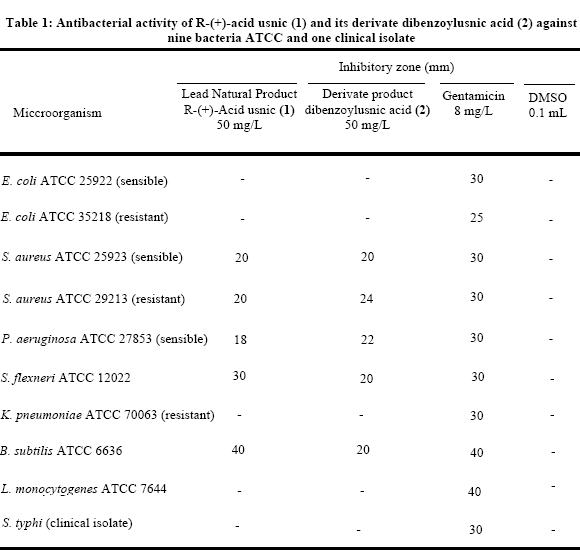
<body><![CDATA[<br> </P >      <p><font size="3" face="Verdana, Arial, Helvetica, sans-serif"><b>RESULTS</b> </font></p>       <P align="justify"   ><font size="2" face="Verdana, Arial, Helvetica, sans-serif"><strong>Structure elucidation</strong> </font></P >       <P align="justify"   ><font size="2" face="Verdana, Arial, Helvetica, sans-serif">R-(+)-usnic acid (<B>1</B>) was obtained yellow crystals. The FABMS of <B>(1) </B>showed a protonated molecular ion at ([M+1] <I>m/z </I>345), while<Sup> 1</Sup>H NMR and <Sup>13</Sup>C NMR spectra indicated the presence of 16 protons and 18 carbon atoms. This was consistent with the molecular formula C<sub>18</sub>H<sub>16</sub>O<sub>7</sub>. The <Sup>1</Sup>H NMR (CDCl<sub>3</sub>) spectrum of <B>(1) </B>displayed signals for four methyl groups at &delta; 1.77 <I>s</I>, &delta; 2.14 <I>s</I>, &delta; 2.67 s, <FONT color="#000000"></B>&delta; 2.68 s, an aromatic proton at &delta; 5.98 <I>s </I>and at &delta; 11.10 s. The <Sup>13</Sup>C NMR spectrum revealed the presence of eighteen carbon atoms four methyls, thirteen non-protonated unsaturated carbons and one protonated unsaturated carbon. In the HMBC spectrum correlations peaks were observed between the following protons and carbons: In the HMBC spectrum, &delta; 5.98 (1H, s, H-4) correlated with C-4a (&delta; 179.8) and C-9b (&delta; 59.5); &delta; 2.68 (3H, s, CH<sub>3</sub>CO-6) with C-6 (&delta; 101.9) and CO (&delta; 200.8); &delta; 2.67 (3H, s, CH<sub>3</sub>CO-2) with C-2 (&delta; 105.7) and CO (&delta; 202.2); &delta; 1.77 (3H, s, CH<sub>3</sub>-9b) with C-9b (&delta; 59.5), C-4a (&delta; 179.8), C-8 (&delta; 109.7) and C-1 (&delta; 198.5); &delta; 2.14 (3H, s, CH<sub>3</sub>-8) with C-8 (&delta; 109.7), C-9 (&delta; 157.9) and C-7 (&delta; 164.3); &delta; 11.10 (1H, s, OH-9) with C-8 (&delta; 109.7) and C9 (&delta; 157.9). The structure elucidation of R-(+)-usnic acid was confirmed with comparison with literature data<Sup>3,10</Sup>(<a href="#f1">Fig 1</a>). </font></font></P >       <P align="justify"   >&nbsp;</P >       <p align="center"><font size="2" face="Verdana, Arial, Helvetica, sans-serif"><a name="f1"></a><img src="/img/revistas/rbq/v25n1/figura_a5_01.gif" width="578" height="294"></font></p>     <P align="justify"   ><font size="2" face="Verdana, Arial, Helvetica, sans-serif">The compound <B>(1) </B>was esterified with benzoyl chloride in presence of chloroform and pyridine gave the dibenzoylusnic acid (<B>2</B>). The <Sup>1</Sup>H NMR (CDCl<sub>3</sub>) spectrum of <B>(2) </B>showed signals of three methyl groups at &delta; 1.74 s, &delta; 1.96 <I>s </I>and &delta; 2.49 s; the presence of vinyl protons at &delta; 5.12 (1H, <I>d</I>=1.76 Hz) and &delta; 5.45 (1H, <I>d</I>=1.76 Hz); the signals of aromatic protons were observed between at &delta; 7.0 - 8.0 ppm, and two singlets were observed at &delta; 5.92 <I>s </I>and at &delta; 10.41 s. The elemental composition of <B>(2) </B>was determined to be C<sub>32</sub>H<sub>24</sub>O<sub>9</sub> from its FABMS and <Sup>1</Sup>H and <Sup>13</Sup>C-NMR data. In the HMBC spectrum correlations were observed between &delta; 1.74 (3H, s, CH<sub>3</sub>-9b) and C-9b (&delta; 61.0), C-1 (&delta; 201.2), C-4a (&delta; 174.2) and C-9a (&delta; 104.3); between &delta; 1.96 (3H, s, CH<sub>3</sub>-8) and C-8 (&delta; 109.3), C-9 (&delta; 157.8) and C-7 (&delta; 164.2); between &delta; 2.49 (3H, s, CH<sub>3</sub>CO-6) and C-6 (&delta; 102.1), CO (&delta; 200.9) and C-9a (&delta; 104.3); between &delta; 5.12 (1H, <I>d</I>=1.76 Hz) and &delta; 5.45 (1H, <I>d</I>=1.76 Hz) with C-2 (&delta; 114.9), CH2 (&delta; 110.2), C (&delta; 135.0); between &delta; 5.92 (1H, s, H-4) and C-9b (&delta; 61.0), C-4a (&delta; 174.2), C-2 (&delta; 114.9) and C-3 (&delta; 165.4) and between &delta; 10.41 (1H, s, OH- ) and C-9a (&delta; 104.3) and C-9 (&delta; 157.8), a significant correlation between &delta; 7.91 (2H, <I>d</I>, Ar) and CO (&delta; 163.3) and 46.between &delta; 7.72 (2H, d, Ar) and CO (&delta; 164.7). The structure (<B>2) </B>was established as dibenzoylusnic acid<Sup>7 </Sup>(<a href="#f1">Fig. 1</a>) </font></P > <strong><font size="2" face="Verdana, Arial, Helvetica, sans-serif"><FONT color="#111111">Antibacterial Activity </font></font></strong>     <P align="justify"   ><font size="2" face="Verdana, Arial, Helvetica, sans-serif">We investigated the <FONT color="#201D1E">antibacterial activity and relationship structure of R-(+)-<FONT color="#000000">usnic acid <B>(1) </B>and its derivate      dibenzoylusnic acid <B>(2)</B> against nine bacteria ATCC and one clinical isolate.          <br> The results obtained in the agar diffusion studies are shown in <a href="#t1">Table 1</a>.</font></font></font></P >     <P align="center"   ><a name="t1"></a><img src="/img/revistas/rbq/v25n1/tabla_a5_01.gif" width="580" height="553"></P >     ]]></body>
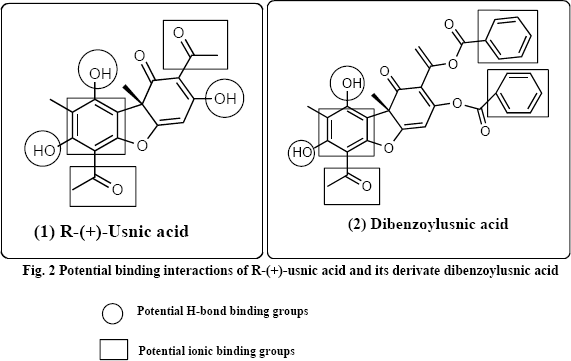
<body><![CDATA[<P align="justify"   ><font size="2" face="Verdana, Arial, Helvetica, sans-serif"><B>Structure-Activity Relationships </B></font></P >     <P align="justify"   ><font size="2" face="Verdana, Arial, Helvetica, sans-serif">The natural product R-(+)-usnic acid <B>(1)</B> like a lead compound and its derivate <FONT color="#111111">dibenzoylusnic acid <B>(2) </B>have a variety of functional groups present in their structures and the <a href="#f1">Fig. 2 </a> shows the potential binding interactions that are possible with a target-binding site. </font></font></P > <H5   align="center" ><a name="f2"></a><img src="/img/revistas/rbq/v25n1/figura_a5_02.gif" width="571" height="361"></H5 > <strong><font size="3" face="Verdana, Arial, Helvetica, sans-serif">DISCUSSION </font></strong>     <P align="justify"   ><font size="2" face="Verdana, Arial, Helvetica, sans-serif">The antibacterial activity of the R-(+)-usnic acid <B>(1)</B> and its derivate <FONT color="#111111">dibenzoylusnic acid <B>(2) <FONT color="#000000"></B>against <I>Escherichia coli </I>ATCC 25922 (sensible), <I>Escherichia coli</I> ATCC 35218 (resistant), <I>Staphylococcus aureus</I> ATCC 25923 (sensible), <I>Staphylococcus aureus</I> ATCC 29213 (resistant), <I>Pseudomona aeruginosa</I> ATCC 27853 (sensible), <I>Shigella flexneri </I>ATCC 12022, <I>Klebsiella pneumoniae </I>ATCC 70063 (resistant), <I>Bacillus subtilis </I>ATCC 6636, <I>Listeria monocytogenes </I>ATCC 7644 and <I>Salmonella typhi </I>(clinical isolate) is shown in <a href="#t1">Table 1</a>.    <br> The R-(+)-usnic acid <B>(1)</B> and its derivate <FONT color="#111111">dibenzoylusnic acid <B>(2) <FONT color="#000000"></B>showed inhibitory activity against <I>Staphylococcus aureus </I>ATCC 25923 (sensible), <I>Staphylococcus aureus</I> ATCC 29213 (resistant), <I>Pseudomona aeruginosa</I> ATCC 27853 (sensible), <I>Shigella flexneri </I>ATCC 12022 and <I>Bacillus subtilis</I> ATCC 6636.    <br> The R-(+)-usnic acid <B>(1)</B> and its derivate dibenzoylusnic acid <B>(2) <FONT color="#000000"></B>showed similar inhibitory activity against <I>Staphylococcus aureus </I>ATCC 25923 (sensible).     <br> The R-(+)-usnic acid <B>(1)</B> showed less inhibitory activity with a little difference against <I>Staphylococcus aureus</I> ATCC 29213 (resistant) and <I>Pseudomona aeroginosa </I>(sensible) than its derivate <FONT color="#111111">dibenzoylusnic acid <B>(2). </B>    <br> The R-(+)-usnic acid <B>(1) </B>showed more considerably inhibitory activity against <I>Shigella flexneri </I>ATCC 12022 and <I>Bacillus subtilis </I>ATCC 6636 than its derivate dibenzoylusnic acid <B>(2). </B>The R-(+)-usnic acid <B>(1)</B> and its derivate dibenzoylusnic acid <B>(2) </B>did not show any inhibitory activity against <I>Escherichia coli</I> ATCC 25922 (sensible), <I>Escherichia coli</I> ATCC 35218 (resistant), <I>Klebsiella pneumoniae</I> ATCC 70063 (resistant),<I> Listeria monocytogenes </I>ATCC 7644 and <I>Salmonella typhi</I> (<FONT color="#111111">clinical isolate<FONT color="#000000">).</font></font></font></P >     <P align="justify"   ><font color="#000000" size="2" face="Verdana, Arial, Helvetica, sans-serif">    <br> </font><font size="3"><strong><font face="Verdana, Arial, Helvetica, sans-serif">CONCLUSIONS </font></strong></font></P >     <P align="justify"   ><font size="2" face="Verdana, Arial, Helvetica, sans-serif">It can be conclude that the derivate dibenzoylusnic acid <B>(2)</B> shows a similar inhibitory activity against <I>Staphylococcus aureus</I> ATCC 25923 (sensible), significantly lowered antibacterial activity against <I>Staphylococcus aureus</I> ATCC 29213 (resistant) and <I>Pseudomona aeroginosa </I>(sensible), then the modification with an esterification of R-(+)-usnic acid <B>(1)</B> has been important.     ]]></body>
<body><![CDATA[<br> It can be conclude too that the derivate dibenzoylusnic acid <B>(2)</B> shows less considerably inhibitory activity against <I>Shigella flexneri </I>ATCC 12022 and <I>Bacillus subtilis </I>ATCC 6636, then the modification with an esterification of R(+)-usnic acid <B>(1)</B> has not been important.    <br> </font><font size="2" face="Verdana, Arial, Helvetica, sans-serif">The R-(+)-usnic acid <B>(1)</B> and its derivate dibenzoylusnic acid <B>(2)</B> are pharmacophore that have groups which are important for the antibacterial activity.     <br> The antibacterial activity of the R-(+)-usnic acid <B>(1)</B> and its derivate dibenzoylusnic acid <B>(2)</B> against <FONT color="#000000">gram (+) and gram (-) bacteria indicates that both are compounds of broad spectrum.    <br> Despite a shortage of clinical trials, it can be concluded that scienti&#64257;c investigations justify to some extent reputed medicinal effects of R-(+)-usnic acid <B>(1)</B> and derivates.    <br>  Inhibitory activity of R-(+)-usnic acid <B>(1)</B> and its derivate <FONT color="#111111">dibenzoylusnic acid <B>(2) </B>against Gram-positive and Gramnegative bacteria, including antibiotic-resistant pathogenic strains, de&#64257;nitely seems to merit further study. It should also be remembered that derivatization to potentate antimicrobial activity has in some cases been successful despite a limited number of studies. Results obtained for other types of biological activity could also prove worthy of further pursuit, as could comparison of derivate structure&ndash;activity relationships between the R-(+)-acid usnic <B>(1)</B> and other derivates. Furthermore, R-(+)-usnic acid <B>(1)</B> could serve as a lead structure for exploitation in novel therapeutic areas.</font></font></font></P >     <P align="justify"   ><font color="#111111" size="2" face="Verdana, Arial, Helvetica, sans-serif">    <br> </font><strong><font size="3" face="Verdana, Arial, Helvetica, sans-serif">GENERAL EXPERIMENTAL PROCEDURES MATERIALS AND METHODS</font></strong></P >     <P align="justify"   ><strong><font size="2" face="Verdana, Arial, Helvetica, sans-serif">General </font></strong></P >     <P align="justify"   ><font size="2" face="Verdana, Arial, Helvetica, sans-serif">All melting points were recorded with a Reichter microscope. The UV and IR spectra were recorded with a Varian Cary 2290 and a Perkin-Elmer 298 spectrometer, respectively. <Sup>1</Sup>H NMR (400 MHz) and <Sup>13</Sup>C NMR (100 MHz) spectra were recorded in CDCl3 and MeOD usin a Bruker DRX400 spectrometer with an inverse multinuclear 5-mm probe head equipped with a shielded gradient coil. COSY, HMQC and HMBC experiments were recorded with gradient enhancements using-sine-shape gradient pulses. EIMS were recorded with a JEOL SX102 spectrometer at 70 eV. Column chromatography was\run on Merk silica gel 60 and TLC was carried out on Silica gel GF254.</font></P >     <P align="justify"   ><strong><font size="2" face="Verdana, Arial, Helvetica, sans-serif">Plant Material, Extraction and Isolation </font></strong></P >     ]]></body>
<body><![CDATA[<P align="justify"   ><font size="2" face="Verdana, Arial, Helvetica, sans-serif">The <I>Alectoria ochroleuca </I>material was dried and powdered, 56.0 g were extracted with acetone at room temperature. During the extraction, yellow crystals of R-(+)-usnic acid (<B>1</B>) separated out. They were recrystallized from CH<sub>2</sub>Cl<sub>2</sub>, precipitated by the addition of methanol yielding 5.1 g corresponding to 9.1 % of the materials dry. The compound<B>(1)</B> was esterified with benzoil chloride in presence of  chloroform and pyridine for 24 h at 18<Sup>o</Sup>C to give the dibenzoylusnic acid (<B>2</B>).     <br> <I>R-(+)-Usnic acid</I> (<B>1</B>) <Sup>13</Sup>C NMR (CDCl<sub>3</sub>, 100 MHz); &delta; 198.5 (C-1), &delta; 105.7 (C-2), &delta; 202.2 (C-2-O<U>C</U>CH3), &delta; 28.3 (C-2-OC<U>C</U>H<sub>3</sub>), &delta; 192.1 (C-3), &delta; 98.4 (C-4), &delta; 179.8 (C-4a), &delta; 101.9 (C-6), &delta; 200.8 (C-6-O<U>C</U>CH<sub>3</sub>), &delta; 31.7 (C-6-OC<U>C</U>H<sub>3</sub>), &delta; 155.6 (C6a), &delta; 164.3 (C-7), &delta; 109.7 (C-8), &delta; 7.9 (C-8-<U>C</U>H3), &delta; 157.9 (C-9), &delta; 105.7 (C-9a), &delta; 59.5 (C-9b), &delta; 32.6 (C-9b-<U>C</U>H<sub>3</sub>). <FONT color="#111111"><I>dibenzoylusnic acid</I> (<B>2</B>)<Sup>13</Sup>C NMR (CDCl<sub>3</sub>, 100 MHz); &delta; 201.2 (C-1), &delta; 114.9 (C-2), &delta; 200.9 (C-2-OCCH<sub>3</sub>), &delta; 165.4 (C-3), &delta; </font></font><font size="2" face="Verdana, Arial, Helvetica, sans-serif">96.9 (C-4), &delta; 174.2 (C-4a), &delta; 102.1 (C-6), &delta; 200.9 (C-6-O<U>C</U>CH<sub>3</sub>), &delta; 31.7 (C-6-OC<U>C</U>H<sub>3</sub>), &delta; 133.9 (C-6a), &delta; 164.2 (C-7), &delta; 109.3 (C-8), &delta; 8.0 (C-8-<U>C</U>H<sub>3</sub>), &delta; 157.8 (C-9), &delta; 104.3 (C-9a), &delta; 61.0 (C-9b), &delta; 31.4 (C-9b-<U>C</U>H<sub>3</sub>), &delta; 135.0 (C-2-<U>C</U>), &delta; 110.2 (C-2-C-<U>C</U>H<sub>2</sub>), &delta; 164.7 (C-2-C-O<U>C</U>OPh), &delta; 163.3 (C-3-O-<U>C</U>OPh)</font></P >     <P align="justify"   ><strong><font size="2" face="Verdana, Arial, Helvetica, sans-serif">Test microorganisms </font></strong></P >     <P align="justify"   ><font size="2" face="Verdana, Arial, Helvetica, sans-serif">The microbial strains studied were <I>Escherichia coli</I> ATCC 25922 (sensible), <I>Escherichia coli</I> ATCC 35218 (resistant), <I>Staphylococcus aureus</I> ATCC 25923 (sensible), <I>Staphylococcus aureus</I> ATCC 29213 (resistant), <I>Pseudomona aeruginosa </I>ATCC 27853 (sensible), <I>Shigella flexneri</I> ATCC 12022, <I>Klebsiella pneumoniae</I> ATCC 70063 (resistant), <I>Bacillus subtilis</I> ATCC 6636, <I>Listeria monocytogenes </I>ATCC 7644 and <I>Salmonella typhi</I> (<FONT color="#111111">clinical isolate<FONT color="#000000">) and were obtained from INLASA (Instituto Nacional de Laboratorios en Salud) of Bolivia.</font></font></font></P >     <P align="justify"   ><font color="#000000" size="2" face="Verdana, Arial, Helvetica, sans-serif">    <br> </font><strong><font size="2" face="Verdana, Arial, Helvetica, sans-serif">Antibacterial assay</font></strong></P >     <P align="justify"   ><strong><font size="2" face="Verdana, Arial, Helvetica, sans-serif">Agar ditch diffusion method </font></strong></P >     <P align="justify"   ><font size="2" face="Verdana, Arial, Helvetica, sans-serif">Fresh pure bacteria suspensions were obtained from overnight cultures in Muller Hinton Broth (BBL<Sup>TM </Sup>trademark of Becton, Dickinson and Company) cultivated at 37&deg;C for 24 h. The bacterial suspensions were adjusted to an inoculum size 10<Sup>8 </Sup>cells/mL for inoculation of the agar plates. After the medium (Difco Bacto Mueller Hinton Medium) was solidified in the plates, the test strain (0,2 mL) was inoculated into the media. Care was taken to ensure proper homogenization. The suspensions were spread on the medium. Four ditches were made in the plates with the help of a cup-borer (13 mm). For the in vitro studies compounds were dissolved in 100 &micro;L of dimethyl sulfoxide (DMSO). One ditch was used with 100 uL of dimethyl sulfoxide (DMSO) as solvent control, and on other one ditch was used with 100 uL of gentamicin as antibacterial control. The test compounds, the DMSO and the gentamicin were introduced in each ditch and the plates were incubated at 37&deg;C for 24 h. Microbial growth was determined by measuring the diameter of the zone of inhibition<Sup>11,12</Sup>. <FONT color="#111111">All tests were performed in duplicate 3. </font></font></P >     <P align="justify"   ><font color="#111111" size="2" face="Verdana, Arial, Helvetica, sans-serif">    <br> </font><font size="3"><strong><font face="Verdana, Arial, Helvetica, sans-serif">ACKNOWLEDGMENT </font></strong></font></P >     ]]></body>
<body><![CDATA[<P align="justify"   ><font size="2" face="Verdana, Arial, Helvetica, sans-serif">The authors express their gratitude to the Swedish International Development Cooperation Agency (SIDA) for            developing this research.            Chemistry Department of Lund University.  Chemistry Investigations Institute-San Andr&eacute;s University.</font></P >     <P align="justify"   ><font size="2" face="Verdana, Arial, Helvetica, sans-serif">    <!-- ref --><br>     <font size="3"><strong>REFERENCES</strong></font></font></P > <OL   type="1" >   <LI   ><font size="2" face="Verdana, Arial, Helvetica, sans-serif"> Saenz, M. T., Garcia, M. D., Rowe, J. G., Fitoterapia, 77, <B>(2006)</B>, 156-159.      </P >   </font></LI >   <LI   ><font size="2" face="Verdana, Arial, Helvetica, sans-serif"> Graham L. Patrick, An Introduction to Medicinal Chemistry, Third Edition, <B>2005</B>.      </P >   </font></LI >   <LI   ><font size="2" face="Verdana, Arial, Helvetica, sans-serif"> Ing&oacute;lfsd&oacute;ttir, K., Phytochemistry, 61 <B>(2002)</B>, 729-736.      </P >   </font></LI >   <LI   ><font size="2" face="Verdana, Arial, Helvetica, sans-serif"> Takani, M., Takahashi, K., Chem. Pharm. , 33, <B>(1985)</B>, 2772-2777.      </P >   </font></LI >   <LI   ><font size="2" face="Verdana, Arial, Helvetica, sans-serif"> Kutney, J. P., Leman, J. D., Salisbury, P. J., Yee, T., S&aacute;nchez, I. H., Can. J. Chem., 62, <B>(1984)</B>, 821-823.      </P >   </font></LI >   <LI   ><font size="2" face="Verdana, Arial, Helvetica, sans-serif">Huneck, S., Naturwissenschaften, 86, (1999), 559-570.      </P >   </font></LI >   <LI   ><font size="2" face="Verdana, Arial, Helvetica, sans-serif"> Emanuela Erba, Donato Pocar, Luisa Maria Rossi, Il Farmaco, 53, <B>(1998)</B>, 718&ndash;720.     </P >   </font></LI >   <LI   ><font size="2" face="Verdana, Arial, Helvetica, sans-serif">Hunek S., Hezz W., Grisebach H., Kirby G. W., Progress in the Chemistry of Organic Natural Products, 29, <B>(1971)</B>, 209.      </P >   </font></LI >   <LI   ><font size="2" face="Verdana, Arial, Helvetica, sans-serif"> Moreno Cocchietto, Nicola Skert, Pier Luigi Nimis, Gianni Sava, Naturwissenschaften, 89, <B>(2002)</B>, 137-146.      </P >   </font></LI >   <LI   ><font size="2" face="Verdana, Arial, Helvetica, sans-serif"> Rashid, M., Majid, M., Quader, M., Fitoterapia, 70, <B>(1999)</B>, 113-115.      </P >   </font></LI >   <LI   ><font size="2" face="Verdana, Arial, Helvetica, sans-serif"> Perez C, Paul M., Bazerque P., Antibiotic assay by agar ditch diffusion method, Acta Biol. Med. Exp. , 15, <B>(1990)</B>, 113-115.      </P >   </font></LI >   <LI   ><font size="2" face="Verdana, Arial, Helvetica, sans-serif"> Murria P. R., Baron E. J., Pfaller M.A., Tenover F.C., Yolbe R.H., Manual of Clinical Microbiology, 7th ed., Washington: ASM, <B>(1999)</B>, 1527-1539.      </P >   </font></LI > </OL >     &nbsp;&nbsp;&nbsp;&nbsp;&nbsp;&nbsp;&nbsp;&nbsp;[&#160;<a href="javascript:void(0);" onclick="javascript: window.open('/scielo.php?script=sci_nlinks&ref=665609&pid=S0250-5460200800010000500009&lng=','','width=640,height=500,resizable=yes,scrollbars=1,menubar=yes,');">Links</a>&#160;]<!-- end-ref --> ]]></body><back>
<ref-list>
<ref id="B1">
<label>1</label><nlm-citation citation-type="journal">
<person-group person-group-type="author">
<name>
<surname><![CDATA[Saenz]]></surname>
<given-names><![CDATA[M. T]]></given-names>
</name>
<name>
<surname><![CDATA[Garcia]]></surname>
<given-names><![CDATA[M. D]]></given-names>
</name>
<name>
<surname><![CDATA[Rowe]]></surname>
<given-names><![CDATA[J. G]]></given-names>
</name>
</person-group>
<source><![CDATA[Fitoterapia]]></source>
<year>2006</year>
<volume>77</volume>
<page-range>156-159</page-range></nlm-citation>
</ref>
<ref id="B2">
<label>2</label><nlm-citation citation-type="book">
<person-group person-group-type="author">
<name>
<surname><![CDATA[Graham L]]></surname>
<given-names><![CDATA[Patrick]]></given-names>
</name>
</person-group>
<source><![CDATA[Introduction to Medicinal Chemistry]]></source>
<year>2005</year>
<publisher-name><![CDATA[Third Edition]]></publisher-name>
</nlm-citation>
</ref>
<ref id="B3">
<label>3</label><nlm-citation citation-type="journal">
<person-group person-group-type="author">
<name>
<surname><![CDATA[Ingólfsdóttir]]></surname>
<given-names><![CDATA[K]]></given-names>
</name>
</person-group>
<source><![CDATA[Phytochemistry]]></source>
<year>2002</year>
<volume>61</volume>
<page-range>729-736</page-range></nlm-citation>
</ref>
<ref id="B4">
<label>4</label><nlm-citation citation-type="journal">
<person-group person-group-type="author">
<name>
<surname><![CDATA[Takani]]></surname>
<given-names><![CDATA[M]]></given-names>
</name>
<name>
<surname><![CDATA[Takahashi]]></surname>
<given-names><![CDATA[K]]></given-names>
</name>
</person-group>
<source><![CDATA[Chem. Pharm]]></source>
<year>1985</year>
<volume>33</volume>
<page-range>2772-2777</page-range></nlm-citation>
</ref>
<ref id="B5">
<label>5</label><nlm-citation citation-type="journal">
<person-group person-group-type="author">
<name>
<surname><![CDATA[Kutney]]></surname>
<given-names><![CDATA[J. P]]></given-names>
</name>
<name>
<surname><![CDATA[Leman]]></surname>
<given-names><![CDATA[J. D]]></given-names>
</name>
<name>
<surname><![CDATA[Salisbury]]></surname>
<given-names><![CDATA[P. J]]></given-names>
</name>
<name>
<surname><![CDATA[Yee]]></surname>
<given-names><![CDATA[T]]></given-names>
</name>
<name>
<surname><![CDATA[Sánchez]]></surname>
<given-names><![CDATA[I. H]]></given-names>
</name>
</person-group>
<source><![CDATA[Can. J. Chem]]></source>
<year>1984</year>
<volume>62</volume>
<page-range>821-823</page-range></nlm-citation>
</ref>
<ref id="B6">
<label>6</label><nlm-citation citation-type="journal">
<person-group person-group-type="author">
<name>
<surname><![CDATA[Huneck]]></surname>
<given-names><![CDATA[S]]></given-names>
</name>
</person-group>
<source><![CDATA[Naturwissenschaften]]></source>
<year>1999</year>
<volume>86</volume>
<page-range>559-570</page-range></nlm-citation>
</ref>
<ref id="B7">
<label>7</label><nlm-citation citation-type="journal">
<person-group person-group-type="author">
<name>
<surname><![CDATA[Erba]]></surname>
<given-names><![CDATA[Emanuela]]></given-names>
</name>
<name>
<surname><![CDATA[Pocar]]></surname>
<given-names><![CDATA[Donato]]></given-names>
</name>
<name>
<surname><![CDATA[Rossi]]></surname>
<given-names><![CDATA[Luisa Maria]]></given-names>
</name>
</person-group>
<source><![CDATA[Il Farmaco]]></source>
<year>1998</year>
<volume>53</volume>
<page-range>718-720</page-range></nlm-citation>
</ref>
<ref id="B8">
<label>8</label><nlm-citation citation-type="journal">
<person-group person-group-type="author">
<name>
<surname><![CDATA[Hunek]]></surname>
<given-names><![CDATA[S]]></given-names>
</name>
<name>
<surname><![CDATA[Hezz]]></surname>
<given-names><![CDATA[W]]></given-names>
</name>
<name>
<surname><![CDATA[Grisebach]]></surname>
<given-names><![CDATA[H]]></given-names>
</name>
<name>
<surname><![CDATA[Kirby]]></surname>
<given-names><![CDATA[G. W]]></given-names>
</name>
</person-group>
<source><![CDATA[Progress in the Chemistry of Organic Natural Products]]></source>
<year>1971</year>
<volume>29</volume>
<page-range>209</page-range></nlm-citation>
</ref>
<ref id="B9">
<label>9</label><nlm-citation citation-type="journal">
<person-group person-group-type="author">
<name>
<surname><![CDATA[Moreno]]></surname>
<given-names><![CDATA[Cocchietto]]></given-names>
</name>
<name>
<surname><![CDATA[Skert]]></surname>
<given-names><![CDATA[Nicola]]></given-names>
</name>
<name>
<surname><![CDATA[Nimis]]></surname>
<given-names><![CDATA[Pier Luigi]]></given-names>
</name>
<name>
<surname><![CDATA[Sava]]></surname>
<given-names><![CDATA[Gianni]]></given-names>
</name>
</person-group>
<source><![CDATA[Naturwissenschaften]]></source>
<year>2002</year>
<volume>89</volume>
<page-range>137-146</page-range></nlm-citation>
</ref>
<ref id="B10">
<label>10</label><nlm-citation citation-type="journal">
<person-group person-group-type="author">
<name>
<surname><![CDATA[Rashid]]></surname>
<given-names><![CDATA[M]]></given-names>
</name>
<name>
<surname><![CDATA[Majid]]></surname>
<given-names><![CDATA[M]]></given-names>
</name>
<name>
<surname><![CDATA[Quader]]></surname>
<given-names><![CDATA[M]]></given-names>
</name>
</person-group>
<source><![CDATA[Fitoterapia]]></source>
<year>1999</year>
<volume>70</volume>
<page-range>113-115</page-range></nlm-citation>
</ref>
<ref id="B11">
<label>11</label><nlm-citation citation-type="journal">
<person-group person-group-type="author">
<name>
<surname><![CDATA[Perez]]></surname>
<given-names><![CDATA[C]]></given-names>
</name>
<name>
<surname><![CDATA[Paul]]></surname>
<given-names><![CDATA[M]]></given-names>
</name>
<name>
<surname><![CDATA[Bazerque]]></surname>
<given-names><![CDATA[P]]></given-names>
</name>
</person-group>
<source><![CDATA[Antibiotic assay by agar ditch diffusion method, Acta Biol. Med. Exp]]></source>
<year>1990</year>
<volume>15</volume>
<page-range>113-115</page-range></nlm-citation>
</ref>
<ref id="B12">
<label>12</label><nlm-citation citation-type="">
<person-group person-group-type="author">
<name>
<surname><![CDATA[Murria]]></surname>
<given-names><![CDATA[P. R]]></given-names>
</name>
<name>
<surname><![CDATA[Baron]]></surname>
<given-names><![CDATA[E. J]]></given-names>
</name>
<name>
<surname><![CDATA[Pfaller]]></surname>
<given-names><![CDATA[M.A]]></given-names>
</name>
<name>
<surname><![CDATA[Tenover]]></surname>
<given-names><![CDATA[F.C]]></given-names>
</name>
<name>
<surname><![CDATA[Yolbe]]></surname>
<given-names><![CDATA[R.H]]></given-names>
</name>
</person-group>
<source><![CDATA[Manual of Clinical Microbiology]]></source>
<year>1999</year>
<edition>7th</edition>
<page-range>1527-1539</page-range><publisher-loc><![CDATA[^eWashington Washington]]></publisher-loc>
</nlm-citation>
</ref>
</ref-list>
</back>
</article>