<?xml version="1.0" encoding="ISO-8859-1"?><article xmlns:mml="http://www.w3.org/1998/Math/MathML" xmlns:xlink="http://www.w3.org/1999/xlink" xmlns:xsi="http://www.w3.org/2001/XMLSchema-instance">
<front>
<journal-meta>
<journal-id>0250-5460</journal-id>
<journal-title><![CDATA[Revista Boliviana de Química]]></journal-title>
<abbrev-journal-title><![CDATA[Rev. Bol. Quim]]></abbrev-journal-title>
<issn>0250-5460</issn>
<publisher>
<publisher-name><![CDATA[Universidad Mayor de San Andrés]]></publisher-name>
</publisher>
</journal-meta>
<article-meta>
<article-id>S0250-54602007000100013</article-id>
<title-group>
<article-title xml:lang="en"><![CDATA[Proximal Composition and Mineral contents of Six Varieties of Cassava (MANNIHOT ESCULENTA, CRANTZ), FROM BOLIVIA]]></article-title>
</title-group>
<contrib-group>
<contrib contrib-type="author">
<name>
<surname><![CDATA[Rojas]]></surname>
<given-names><![CDATA[C. Carola]]></given-names>
</name>
</contrib>
<contrib contrib-type="author">
<name>
<surname><![CDATA[Nair]]></surname>
<given-names><![CDATA[Baboo]]></given-names>
</name>
</contrib>
<contrib contrib-type="author">
<name>
<surname><![CDATA[Herbas]]></surname>
<given-names><![CDATA[Adelina]]></given-names>
</name>
</contrib>
<contrib contrib-type="author">
<name>
<surname><![CDATA[Bergenståhl]]></surname>
<given-names><![CDATA[Björn]]></given-names>
</name>
</contrib>
</contrib-group>
<aff id="A01">
<institution><![CDATA[,Lund University Food Technology ]]></institution>
<addr-line><![CDATA[Lund ]]></addr-line>
<country>Sweden</country>
</aff>
<aff id="A02">
<institution><![CDATA[,Lund University Applied Nutrition ]]></institution>
<addr-line><![CDATA[Lund ]]></addr-line>
<country>Sweden</country>
</aff>
<aff id="A03">
<institution><![CDATA[,Universidad Mayor de San Simón Centro de Alimentos y Productos Naturales ]]></institution>
<addr-line><![CDATA[Cochabamba ]]></addr-line>
<country>Bolivia</country>
</aff>
<pub-date pub-type="pub">
<day>00</day>
<month>00</month>
<year>2007</year>
</pub-date>
<pub-date pub-type="epub">
<day>00</day>
<month>00</month>
<year>2007</year>
</pub-date>
<volume>24</volume>
<numero>1</numero>
<fpage>71</fpage>
<lpage>77</lpage>
<copyright-statement/>
<copyright-year/>
<self-uri xlink:href="http://www.scielo.org.bo/scielo.php?script=sci_arttext&amp;pid=S0250-54602007000100013&amp;lng=en&amp;nrm=iso"></self-uri><self-uri xlink:href="http://www.scielo.org.bo/scielo.php?script=sci_abstract&amp;pid=S0250-54602007000100013&amp;lng=en&amp;nrm=iso"></self-uri><self-uri xlink:href="http://www.scielo.org.bo/scielo.php?script=sci_pdf&amp;pid=S0250-54602007000100013&amp;lng=en&amp;nrm=iso"></self-uri><abstract abstract-type="short" xml:lang="en"><p><![CDATA[ABSTRACT Six varieties of Cassava (Yucca) from Chapare (Provincia of Cochabamba-Bolivia) have been studied and a proximal analysis has been carried out]]></p></abstract>
<kwd-group>
<kwd lng="en"><![CDATA[Cassava]]></kwd>
<kwd lng="en"><![CDATA[analysis]]></kwd>
<kwd lng="en"><![CDATA[proximal]]></kwd>
<kwd lng="en"><![CDATA[starch]]></kwd>
<kwd lng="en"><![CDATA[minerals]]></kwd>
</kwd-group>
</article-meta>
</front><body><![CDATA[ <p align=right><font size="2"><strong><font face="Verdana, Arial, Helvetica, sans-serif"><b>ARTÍCULO ORIGINAL</b></font></strong></font></p>     <p align=center><font size="4"><b><font face="Verdana, Arial, Helvetica, sans-serif">Proximal Composition and     Mineral contents of Six Varieties of Cassava (<i>MANNIHOT ESCULENTA, </i>CRANTZ), FROM BOLIVIA </font></b></font></p>     <p align=center><strong><font size="3" face="Verdana, Arial, Helvetica, sans-serif">C. Carola     Rojas<sup>1,3</sup>, Baboo Nair<sup>2</sup>, Adelina Herbas<sup>3</sup> and     Björn Bergenståhl<sup>1</sup></font></strong></p>     <p align=center><font size="2"><sup><font face="Verdana, Arial, Helvetica, sans-serif">1</font></sup><font face="Verdana, Arial, Helvetica, sans-serif">Food     Technology, Lund University, P.O Box 124, SE-221 00 Lund, Sweden, <sup>2</sup>Applied     Nutrition, Lund University, P.O Box 124,     SE-221 00 Lund, Sweden, <sup>3</sup>Centro de Alimentos y Productos Naturales,     Universidad Mayor de San Simón, Cochabamba, Bolivia</font></font></p>     <p><font size="2" face="Verdana, Arial, Helvetica, sans-serif"><br clear=all> </font></p> <hr size="1">      <p><font size="2" face="Verdana, Arial, Helvetica, sans-serif"><b>ABSTRACT</b> </font></p>     <p><font size="2" face="Verdana, Arial, Helvetica, sans-serif">Six     varieties of Cassava (Yucca) from Chapare (Provincia of Cochabamba-Bolivia)     have been studied and a proximal analysis has been carried out.</font></p>     <p><font size="2" face="Verdana, Arial, Helvetica, sans-serif"><b>Words Key: </b>Cassava, analysis,     proximal, starch, minerals.</font></p>  <hr size="1">      <p>&nbsp;</p>     <p>&nbsp;</p>     ]]></body>
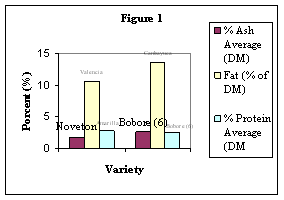
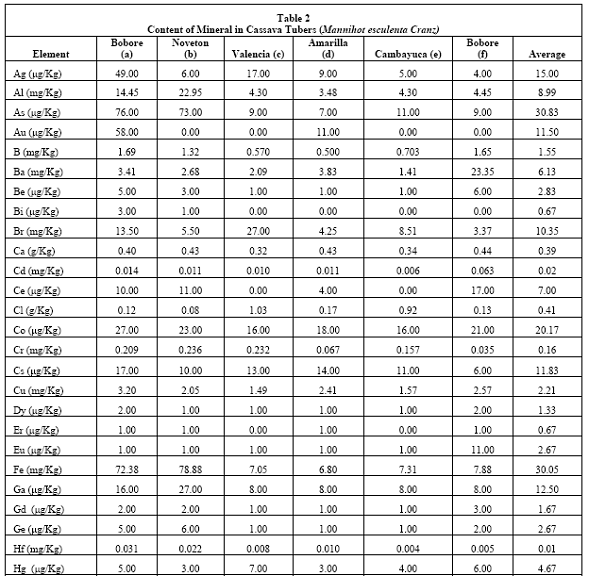
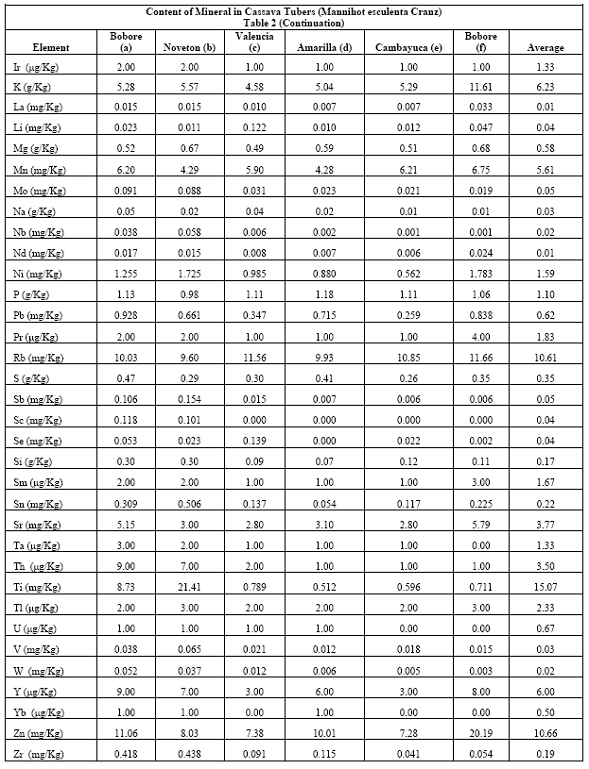
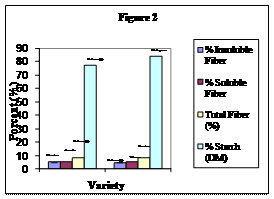
<body><![CDATA[<p><font size="2" face="Verdana, Arial, Helvetica, sans-serif"><b>INTRODUCTION</b></font></p>     <p><font size="2" face="Verdana, Arial, Helvetica, sans-serif">In recent     years, the Bolivia’s government has tried to develop in the tropical region of     Cochabamba, Chapare. This region is tropical and is considered a very rich in     natural resources; fruits, vegetables and roots. One of the main crops in this     area is sweet cassava (<i>Mannihot esculenta </i>Crantz) </font></p>     <p><font size="2" face="Verdana, Arial, Helvetica, sans-serif">The cassava’s production has a     vital importance from a social and economic perspective according to regional     plans of development. It has an importance to the local farmers both as a crop     for consumption within the household as well as a crop for trade. </font></p>     <p><font size="2" face="Verdana, Arial, Helvetica, sans-serif">Cassava is     a tropical, perennial plant originating from Latin     America. Cassava has been domesticated and insert in the New World tropics in     the late fifteenth century (18).</font></p>     <p><font size="2" face="Verdana, Arial, Helvetica, sans-serif">Cassava is     a root that has many attributes that makes very interesting for the farmers.     Cassava is insensitive to drought, it is not demanding in fertilization, it is     insensitive to pests, it is not laborious to farm and it gives a high yield.     However, it is a crop with a primarily high content of carbohydrates and the     protein content is low.</font></p>     <p><font size="2" face="Verdana, Arial, Helvetica, sans-serif">In the     tropical regions, cassava is the most important root crop and as a source of     energy for human consumption it ranks fourth after rice, sugar cane and maize.     It is a major carbohydrate food for an estimated 500 million people and in     tropical Africa (19). </font></p>     <p><font size="2" face="Verdana, Arial, Helvetica, sans-serif">Cassava     can be divided in two different principal types; sweet and bitter cassava,     depending on the cyanide content. Bitter cassava has a bitter taste and high     cyanide content. These varieties need to be detoxified before consumption     through different types of treatments. In Bolivia the sweet variety with low     cyanide content dominates and it can be consumed either fresh (boiled, baked,     fried or pounded) or in numerous processed forms (18). Cassava is of growing     importance as animal feed and as a raw material for producing starch. Over the     last 20 years, there has been mounting recognition of the contributions that     cassava can make to increasing incomes and generating employment opportunities     in the rural economy (19).</font></p>     <p><font size="2" face="Verdana, Arial, Helvetica, sans-serif">The cassava root is easily deteriorated by     atmospheric contact after harvest. One way to overcome these problems is to     process the cassava roots into dry form. The main objective of this study is to     characterize six common varieties of cassava found in Chapare, with the purpose     of choosing the appropriate variety to work with to develop new products from     it with more added values in a short term.</font></p>     <p><font size="2" face="Verdana, Arial, Helvetica, sans-serif"><b>RESULTS AND DISCUSSION</b></font></p>     <p><font size="2" face="Verdana, Arial, Helvetica, sans-serif">Six     varieties of cassava from Bolivia (Bobore (a), Noveton (b), Valencia (c),     Amarilla (d) Cambayuca (e) and Bobore (f)), were analyzed. The proximate composition     (% based on DM) is given in Table 1 and in the Figures 1 and 2.</font></p>     ]]></body>
<body><![CDATA[<p align=center><font size="2" face="Verdana, Arial, Helvetica, sans-serif"><img width=273 height=190 src="/img/revistas/rbq/v24n1/image01_13.gif" v:shapes="_x0000_i1025"> </font></p>     <p align=center><font size="2" face="Verdana, Arial, Helvetica, sans-serif"><img width=265 height=190 src="/img/revistas/rbq/v24n1/image02_13.gif" v:shapes="_x0000_i1026"> </font></p>     <p><font size="2" face="Verdana, Arial, Helvetica, sans-serif">The starch     content was ranging from 71.6 % to 84%, with an average of 75%. Valencia showed     the lowest value, with 71.6%, and the Cambayuca variety was displayed the     highest content of starch with 84%.</font></p>     <p><font size="2" face="Verdana, Arial, Helvetica, sans-serif">The total     fiber content ranged from 7.4 % 8.5%, with an     average around 8.2%. The lowest value was obtained for the variety Bobore,     7.4%. These values were higher than the reported by Kay (1) (1%) but similar     than the values reported by Dominguez (10) and Ravindran (11), with 7.3% and     8.5% respectively. Potato has much less fibres, 1.6% was obtained by Karuna et     al (12). The insoluble fiber fraction range between 2.7% and 5.1% with an     average of 3.7%. The highest value was 5.1% obtained for the Bobore (a)     variety. The soluble fiber fraction range between 3.3% and 5.5%, with an     average of 4.5%. The highest reported value was for was for the Valencia     variety with 5.5%.</font></p>     <p><font size="2" face="Verdana, Arial, Helvetica, sans-serif">The crude     protein content, in the present study, ranged from 1.5% to 2.8% and in average     2%. The Valencia and Cambayuca varieties deviates with low protein content. The     results are in agreement with the values reported for cassava by Kay (1).     Cassava has a very low protein content, for instance potato contains much more     protein, typical around 10% (based on DM) (12).</font></p>     <p><font size="2" face="Verdana, Arial, Helvetica, sans-serif">The lipid     content shows values between 0.6% and 1.4% with an average of 1.0%. The Noveton     variety, had the lowest quantity 0.6%, and the Cambayuca variety showed the     highest value 1.4%, Figure 1. The results agrees well with the previous study     by Dominguez (10) and Ravindran et <i>al. </i>(11)     who found that the lipid values varied between 0.8% and 1.4%. Lipids reported     for other roots, like potato (Karuna D. et <i>al.</i>)     (12), is comparable, about 1.0%, to cassava in this study.</font></p>     <p><font size="2" face="Verdana, Arial, Helvetica, sans-serif">The ash     content goes from 1.5% until 2.7%, in all varieties studied. Ash of Bobore     (IBTA Chimore) variety reached 2.7 %, becoming almost twice in comparison with     the other varieties like is showed in the Figure 1. Kay (1) has reported ash     content in cassava in a lower range (the range was 0.5-1.5% DM</font></p>     <p><font size="2" face="Verdana, Arial, Helvetica, sans-serif">The     mineral content in all the varieties, were analysed and it is summarized in the     Table 1.</font></p>     <p><font size="2" face="Verdana, Arial, Helvetica, sans-serif">All the     results are compared with the elemental composition of the earth crust by     Rimbac (21) in Figure 3. Looking at the data Figure 3, we can divide the     mineral content in three groups: one of overrepresented elements in the cassava     samples in comparison with the earth crust, this group includes K, P, Zn, Br,     Cl, S, B and Rb. The second group that contain “well represented elements” with     similar concentration in the cassava root as in the crust of the earth: Ca, Mg,     Ba, Sr, Cu, Au and Ni. The third group is a large number of elements that have     an appearance in cassava far below their presence in the earth crust- “under     represented elements”. This group includes elements like Na, Fe, Si, Sn, Mo, Cd     and the heavy metals like Pb and Hg. </font></p>     <p align=center><font size="2" face="Verdana, Arial, Helvetica, sans-serif"><img width=272 height=182 src="/img/revistas/rbq/v24n1/image03_13.gif" v:shapes="_x0000_i1027"></font></p>     ]]></body>
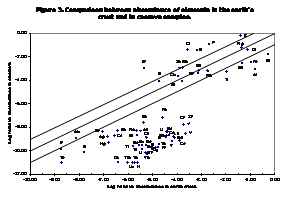
<body><![CDATA[<p><font size="2" face="Verdana, Arial, Helvetica, sans-serif">The first     group, the enriched elements, it partly represents elements with a clear     physiological role in the plant: K, P, Zn, S, and Cl. We may assume that the     plant together with these elements absorbs other elements with similarities in     the fundamental chemistry (e. g. ion radius, charge, hydroxide formation etc).     A few of these coabsorbed elements belongs to group 1 (overrepresented     elements), but most to group 2 (Well represented elements). K has an ionic     radius of 1.3 Å. We can assume that Rb (ion radius 1.4Å) is accumulated in the     same process. Similarly Au ions (ion radius 1.4Å) may be selectively     accumulated and thereby occur at a surprisingly high concentration (Group 2).     Zinc (2+, 0.7 Å) can be assumed to be selectively absorbed as it has an     essential role in a number of enzymes as superoxiddismutas, alcoholdehydrogenas     and carboanhydrase in plants (22). Cu, Ni and Mn have similar radius and are     also quite abundant in the plant. Mg (2+, radius 0.65 Å) and Ca (2+, radius     0.9) also have important biological roles in the plant and with them follows     also a number of similar elements. Sr and Ba can be assumed to follow with the     Ca and are also quite abundant. </font></p>     <p><font size="2" face="Verdana, Arial, Helvetica, sans-serif">The third     group (“under represented elements”) contains a list of elements appearing with     a much lower frequency in the plant than in the crust. Sodium is actively     avoided by the cellular tissue. Maybe Li and Ag is reduced due to its     similarity in ion radius to Na (about 1 Å or less). Many of the elements in     group three appears in the nature as oxides with very low solubility (Fe, Ni,     Co, Si, Ti, Al, Mo, Sn, Cr). Other elements are poorly represented as they     appears as highly insoluble sulfides (for instance Bi, Ag, Hg, Sb, Cd,     Pb,V,Ge), carbonates (Pb, Ce, La, Th, Y, Nd), phosphates (Ce, Er, Yb, Dy, La,     Th, Y, Nd), silicates (Be, Cs, In, Gd, Ho, La, Nd, Zr, Y, Sc, Li, Ha) or as     metal salts (for instance W, Te, Se, As). These poorly soluble elements can be     expected to occur to a relatively low extent.  </font></p>     <p><font size="2" face="Verdana, Arial, Helvetica, sans-serif"><b>EXPERIMENTAL</b></font></p>     <p><font size="2" face="Verdana, Arial, Helvetica, sans-serif">The varieties investigated were: Bobore (a), Noveton     (b), Valencia (c), Amarilla (d) and Cambayuca (e). The samples (escept the     Bobore sample) were all obtained from “Estación Experimental la Jota”, (It is located in the     Municipio de Chimoré of Chapare to 190 Km of the Cochabamba city). The  Bobore sample (f) were obtained from “Chimore Experimental Plantations” of IBTA-Chapare (Geographical location!).</font></p>     <p><font size="2" face="Verdana, Arial, Helvetica, sans-serif"><b>Equipments</b></font></p>     <p><font size="2" face="Verdana, Arial, Helvetica, sans-serif">-&nbsp;&nbsp;&nbsp; Miller (Cyclotec 1093, Tecator AB,     Höganäs, Sweden)</font></p>     <p><font size="2" face="Verdana, Arial, Helvetica, sans-serif">-&nbsp;&nbsp;&nbsp; Kjeldahl semi micro automatic     analys system,  Kjeltec Auto System     (Tecator AB, Höganäs, Sweden)</font></p>     <p><font size="2" face="Verdana, Arial, Helvetica, sans-serif">-&nbsp;&nbsp;&nbsp; Fiber     analyzer Fibertec 1020 (M6) (Tecator AB, Höganäs, Sweden)</font></p>     <p><font size="2" face="Verdana, Arial, Helvetica, sans-serif">-&nbsp;&nbsp;&nbsp; UV     Spectrophotometer (Lambda 2 series 3742, Perkin Elmer)</font></p>     <p><font size="2" face="Verdana, Arial, Helvetica, sans-serif">-&nbsp;&nbsp;&nbsp; Inductively     coupled plasma- atomic emission spectrometry, ICP AES Optima 3000 DV (Perkin     Elmer)</font></p>     ]]></body>
<body><![CDATA[<p><font size="2" face="Verdana, Arial, Helvetica, sans-serif">Inductively     coupled plasma- Mass spectrometry,ICP MS Elan 6000 (Perkin Elmer)</font></p>     <p><font size="2" face="Verdana, Arial, Helvetica, sans-serif"><b>Row Material.</b></font></p>     <p><font size="2" face="Verdana, Arial, Helvetica, sans-serif">Initially,     the cassava roots were peeled and the roots were cut with knife into small     pieces. The pieces were dried using a freeze drying equipment. The operation     conditions were:    -47   °C and final pressure was 0.3 mbar. The dried material was ground into flour by using a standard mill</font></p>     <p><font size="2" face="Verdana, Arial, Helvetica, sans-serif">(Cyclotec 1093, Tecator, Sweden). The particle     size was 40-60 mesh. Then, the flour samples were stored in a cool room, the     temperature was T° = 8 °C.</font></p>     <p><font size="2" face="Verdana, Arial, Helvetica, sans-serif"><b>Proximal Composition</b></font></p>     <p><font size="2" face="Verdana, Arial, Helvetica, sans-serif">Moisture,     ash and crude fat of the samples were assayed according to the methodology of     the American Association of Cereal Chemists (AACC, method 44-15A (8)). Protein     in flour was determined using Kjeldahl method using the Kjeltec Auto System.</font></p>     <p><font size="2" face="Verdana, Arial, Helvetica, sans-serif"><b>Determination     of dietary fiber.</b></font></p>     <p><font size="2" face="Verdana, Arial, Helvetica, sans-serif">Soluble and insoluble dietary fiber content     was determined enzymaticaly method as described by Asp (19). The dietary fiber     values were corrected for protein and ash.</font></p>     <p><font size="2" face="Verdana, Arial, Helvetica, sans-serif"><b>Determination     of total Starch with KOH.</b></font></p>     <p><font size="2" face="Verdana, Arial, Helvetica, sans-serif">Starch     determination was by method of Holm (3). It was achieved an incubation with     Termamyl (Novo A/S, Copenhagen, Denmark) and amyloglucosidase (Boehringer Nr     1202367 3500U/25 ml). </font></p>     ]]></body>
<body><![CDATA[<p><font size="2" face="Verdana, Arial, Helvetica, sans-serif"><b>2.6. Mineral Content.</b></font></p>     <p><font size="2" face="Verdana, Arial, Helvetica, sans-serif">Mineral     content of six varieties of cassava were analyzed by Ecology Department in Lund     University.</font></p>     <p><font size="2" face="Verdana, Arial, Helvetica, sans-serif"><br clear=all> </font></p>     <p><font size="2" face="Verdana, Arial, Helvetica, sans-serif">The     technique, which was used, is the following: </font></p>     <p><font size="2" face="Verdana, Arial, Helvetica, sans-serif">   0.2 g of sample was weighed; after, 5 ml concentrated acid and 5 ml water was added   to the sample. Then, the sample was run in a microwave oven for two hours.   After digestion, each sample was diluted to 50 ml with deionized water. Some of   the elements (Ca, Fe, K, Mg, Na, P, and S) were analyzed with ICP AES, the rest with ICP MS.</font></p>     <p align="center"><font size="2" face="Verdana, Arial, Helvetica, sans-serif"><img width=527 height=232 src="/img/revistas/rbq/v24n1/image04-13.gif" v:shapes="_x0000_i1028"></font></p>     <p align="center"><font size="2" face="Verdana, Arial, Helvetica, sans-serif"><img width=589 height=576 src="/img/revistas/rbq/v24n1/image05_13.gif" v:shapes="_x0000_i1029"> </font></p>     <p align="center"><font size="2" face="Verdana, Arial, Helvetica, sans-serif"><img width=589 height=769 src="/img/revistas/rbq/v24n1/image06_13.gif" v:shapes="_x0000_i1030"> </font></p>     <p><font size="2" face="Verdana, Arial, Helvetica, sans-serif"><br clear=all>   <br clear=all>   <br clear=all> </font></p>     <p><font size="2" face="Verdana, Arial, Helvetica, sans-serif"><b>CONCLUSION.</b></font></p>     ]]></body>
<body><![CDATA[<p><font size="2" face="Verdana, Arial, Helvetica, sans-serif">From the six varieties studied it is possible to conclude that:</font></p>     <p><font size="2" face="Verdana, Arial, Helvetica, sans-serif">The starch   content of the 6 varieties was in the same range, between 71.6% to 84% with an   average of 75% . The total fiber content varied between 7.4% and 8.5%, with an   average of 8.2%. The values of total lipids varied between 0.6% and 1.4%.</font></p>     <p><font size="2" face="Verdana, Arial, Helvetica, sans-serif">In the ash     varied between 1.5% and 2.7%. The elemental composition can be compared with     the composition of the crust of the earth. Certain elements are important and     occur at high ratio, other </font></p>     <p><font size="2" face="Verdana, Arial, Helvetica, sans-serif">elements     resemble of the important ones and thereby </font></p>     <p><font size="2" face="Verdana, Arial, Helvetica, sans-serif">also are     enriched in the tissues. A majority of the elements occurs less commonly in the     tissue of the plant as they not are enriched or as they are poorly soluble.</font></p>     <p><font size="2" face="Verdana, Arial, Helvetica, sans-serif"><b>ACKNOWLEDGEMENTS.</b></font></p>     <p><font size="2" face="Verdana, Arial, Helvetica, sans-serif">The study     was supported by Swedish International Development Agency (SIDA/SAREC) in the     project between Universidad Mayor de San Simon (Bolivia), and Lund University     (Sweden). </font></p>     <p><font size="2" face="Verdana, Arial, Helvetica, sans-serif"><b>REFERENCES</b></font></p>     <!-- ref --><p><font size="2" face="Verdana, Arial, Helvetica, sans-serif">1. KAY,     CHRISTOPHER WHEATLEY, GREGORY J. SCOTT, RUPERT BEST &amp; SIERT WIERSEMA.     Métodos para agregar valor     a raíces y tubérculos alimenticios, manual para el desarrollo de productos, Centro     Internacional de Agricultura Tropical (CIAT). Cali, CO. 1997.</font>&nbsp;&nbsp;&nbsp;&nbsp;&nbsp;&nbsp;&nbsp;&nbsp;[&#160;<a href="javascript:void(0);" onclick="javascript: window.open('/scielo.php?script=sci_nlinks&ref=663834&pid=S0250-5460200700010001300001&lng=','','width=640,height=500,resizable=yes,scrollbars=1,menubar=yes,');">Links</a>&#160;]<!-- end-ref --><!-- ref --><p><font size="2" face="Verdana, Arial, Helvetica, sans-serif">2. Subcommittee on the Tenth     Edition of the Recommended Dietary Allowances, Food and Nutrition Board,     Commission on Life Sciences, National Research Council.Recommended     dietary allowances (10<sup>th</sup> ed.) Na tional Academy Press ,Washington,     D.C. 1989</font>&nbsp;&nbsp;&nbsp;&nbsp;&nbsp;&nbsp;&nbsp;&nbsp;[&#160;<a href="javascript:void(0);" onclick="javascript: window.open('/scielo.php?script=sci_nlinks&ref=663835&pid=S0250-5460200700010001300002&lng=','','width=640,height=500,resizable=yes,scrollbars=1,menubar=yes,');">Links</a>&#160;]<!-- end-ref --><!-- ref --><p><font size="2" face="Verdana, Arial, Helvetica, sans-serif">3. HOLM,     J., BJÖRCK, I., DREWS, A., &amp; ASP, N.-G. A rapid method for analysis of     starch. Starch/Stärke, 1986, 38 (16), 224-226.</font>&nbsp;&nbsp;&nbsp;&nbsp;&nbsp;&nbsp;&nbsp;&nbsp;[&#160;<a href="javascript:void(0);" onclick="javascript: window.open('/scielo.php?script=sci_nlinks&ref=663836&pid=S0250-5460200700010001300003&lng=','','width=640,height=500,resizable=yes,scrollbars=1,menubar=yes,');">Links</a>&#160;]<!-- end-ref --><!-- ref --><p><font size="2" face="Verdana, Arial, Helvetica, sans-serif">4. Kumpulainen,     J.T., Trace elements, natural antioxidants and contaminants in European     foods and diets proceedings. FAO Rome (Italy), 1996 </font>&nbsp;&nbsp;&nbsp;&nbsp;&nbsp;&nbsp;&nbsp;&nbsp;[&#160;<a href="javascript:void(0);" onclick="javascript: window.open('/scielo.php?script=sci_nlinks&ref=663837&pid=S0250-5460200700010001300004&lng=','','width=640,height=500,resizable=yes,scrollbars=1,menubar=yes,');">Links</a>&#160;]<!-- end-ref --><!-- ref --><p><font size="2" face="Verdana, Arial, Helvetica, sans-serif">5.  CRC Handbook of Chemistry and Physics 49<sup>th</sup> edition, Ed. Robert C. Weast. The Chemical Rubber CO, Cleveland, Ohio, 1968.</font>&nbsp;&nbsp;&nbsp;&nbsp;&nbsp;&nbsp;&nbsp;&nbsp;[&#160;<a href="javascript:void(0);" onclick="javascript: window.open('/scielo.php?script=sci_nlinks&ref=663838&pid=S0250-5460200700010001300005&lng=','','width=640,height=500,resizable=yes,scrollbars=1,menubar=yes,');">Links</a>&#160;]<!-- end-ref --><!-- ref --><p><font size="2" face="Verdana, Arial, Helvetica, sans-serif">6. GILLIAN     YSART, PATRICK MILLER, HELEN CREWS, PAUL ROBB, MALCOLM BAXTER, CHRISTIAN DE L`     ARGY, SIMON LOFTHOUSE, CHRISTINE SARGENT &amp; NIGEL HARRISON).  Dietary exposure estimates of 30 elements     from the UK Total Diet Study. Food Additives and Contaminant, 1999, 16,     391-403.</font>&nbsp;&nbsp;&nbsp;&nbsp;&nbsp;&nbsp;&nbsp;&nbsp;[&#160;<a href="javascript:void(0);" onclick="javascript: window.open('/scielo.php?script=sci_nlinks&ref=663839&pid=S0250-5460200700010001300006&lng=','','width=640,height=500,resizable=yes,scrollbars=1,menubar=yes,');">Links</a>&#160;]<!-- end-ref --><!-- ref --><p><font size="2" face="Verdana, Arial, Helvetica, sans-serif">7. PROSKY,     Determination of Dietary fiber.  J.Assoc.     off Ana. Chem, 1985,  68, 4, 5.</font>&nbsp;&nbsp;&nbsp;&nbsp;&nbsp;&nbsp;&nbsp;&nbsp;[&#160;<a href="javascript:void(0);" onclick="javascript: window.open('/scielo.php?script=sci_nlinks&ref=663840&pid=S0250-5460200700010001300007&lng=','','width=640,height=500,resizable=yes,scrollbars=1,menubar=yes,');">Links</a>&#160;]<!-- end-ref --><p><font size="2" face="Verdana, Arial, Helvetica, sans-serif">8. RAYMOND J. TARLETON., Approved Methods of the American Association of     cereal Chemistry Method 44-15A, 1993, 1- 4.American Association of Cereal     Chemistry, Inc Minnesota, 1976</font></p>     <!-- ref --><p><font size="2" face="Verdana, Arial, Helvetica, sans-serif">9. W.VAN OKKUM, R. H. DE VOS,     TH. MUYS &amp; J.A. WESSTRA. Minerals and trace elements     in total diets in the Netherlands. British  Journal of Nutrition, 1989, 61, 7-15.</font>&nbsp;&nbsp;&nbsp;&nbsp;&nbsp;&nbsp;&nbsp;&nbsp;[&#160;<a href="javascript:void(0);" onclick="javascript: window.open('/scielo.php?script=sci_nlinks&ref=663842&pid=S0250-5460200700010001300009&lng=','','width=640,height=500,resizable=yes,scrollbars=1,menubar=yes,');">Links</a>&#160;]<!-- end-ref --><!-- ref --><p><font size="2" face="Verdana, Arial, Helvetica, sans-serif">10.     DOMINGUEZ, P.L. Búsqueda y optimización de fuentes nacionales que posibiliten     el incremento del volumen de desperdicios y subproductos alimenticios disponibles. Instituto de investigación Porcinas, 1985, 29.</font>&nbsp;&nbsp;&nbsp;&nbsp;&nbsp;&nbsp;&nbsp;&nbsp;[&#160;<a href="javascript:void(0);" onclick="javascript: window.open('/scielo.php?script=sci_nlinks&ref=663843&pid=S0250-5460200700010001300010&lng=','','width=640,height=500,resizable=yes,scrollbars=1,menubar=yes,');">Links</a>&#160;]<!-- end-ref --><!-- ref --><p><font size="2" face="Verdana, Arial, Helvetica, sans-serif">11.     RAVINDRAN, V., KORNEGAY, WEBB JR., K.E. &amp; RAJAGURU, A.S.B. Nutrient     characterization of some feedstuffs of Sri Lanka. J. Nut.     Agric. Soc., 1982, 19, 19-32.</font>&nbsp;&nbsp;&nbsp;&nbsp;&nbsp;&nbsp;&nbsp;&nbsp;[&#160;<a href="javascript:void(0);" onclick="javascript: window.open('/scielo.php?script=sci_nlinks&ref=663844&pid=S0250-5460200700010001300011&lng=','','width=640,height=500,resizable=yes,scrollbars=1,menubar=yes,');">Links</a>&#160;]<!-- end-ref --><!-- ref --><p><font size="2" face="Verdana, Arial, Helvetica, sans-serif">12. KARUNA D. KULKARNI, NOEL     GOVINDEN &amp; DILIP KULKARNI. Production and use of raw potato     flour in Mauritian traditional foods. The United Nations University Press, Food     and Nutrition bulletin, 1996, 17, </font>&nbsp;&nbsp;&nbsp;&nbsp;&nbsp;&nbsp;&nbsp;&nbsp;[&#160;<a href="javascript:void(0);" onclick="javascript: window.open('/scielo.php?script=sci_nlinks&ref=663845&pid=S0250-5460200700010001300012&lng=','','width=640,height=500,resizable=yes,scrollbars=1,menubar=yes,');">Links</a>&#160;]<!-- end-ref --><p>&nbsp;</p>     <p><font size="2" face="Verdana, Arial, Helvetica, sans-serif">13. Bolivia: Proyecciones de    la Población por Provincias y Municipios, según Sexo y Grupos de Edad 2000- 2010, <a href="http://www.ine.gov.bo/asp/PublicacionesTodas.asp">Instituto Nacional de Estadística de Bolivia</a>. www.ine.gov.bo. 1997</font></p>     <!-- ref --><p><font size="2" face="Verdana, Arial, Helvetica, sans-serif">14. S.R.A.     ADEWUSI, T.V. OJUMU &amp; O.S.FALADE. The effect of processing on total organic     acids content and mineral available of simulated cassava-vegetable diets. <i>Plant Foods for Human Nutrition, </i>1999,     53, 367-380.</font>&nbsp;&nbsp;&nbsp;&nbsp;&nbsp;&nbsp;&nbsp;&nbsp;[&#160;<a href="javascript:void(0);" onclick="javascript: window.open('/scielo.php?script=sci_nlinks&ref=663848&pid=S0250-5460200700010001300014&lng=','','width=640,height=500,resizable=yes,scrollbars=1,menubar=yes,');">Links</a>&#160;]<!-- end-ref --><!-- ref --><p><font size="2" face="Verdana, Arial, Helvetica, sans-serif">15. SW Souci, W     Fachmann,H Kraut . Food Composition and Nutrition     Tables Fifth Edition <i>Medpharm Scientific     Publishers</i> Stuttgart, 1994.</font>&nbsp;&nbsp;&nbsp;&nbsp;&nbsp;&nbsp;&nbsp;&nbsp;[&#160;<a href="javascript:void(0);" onclick="javascript: window.open('/scielo.php?script=sci_nlinks&ref=663849&pid=S0250-5460200700010001300015&lng=','','width=640,height=500,resizable=yes,scrollbars=1,menubar=yes,');">Links</a>&#160;]<!-- end-ref --><!-- ref --><p><font size="2" face="Verdana, Arial, Helvetica, sans-serif">16.     Determination of Kjendahl in forage and Straw using the Kjeltec auto system and     Se-Catalyst* <i>Manual of operation tecator,     Application note ASN 31/81, TECATOR AB, Höganäa.</i>, 1981</font>&nbsp;&nbsp;&nbsp;&nbsp;&nbsp;&nbsp;&nbsp;&nbsp;[&#160;<a href="javascript:void(0);" onclick="javascript: window.open('/scielo.php?script=sci_nlinks&ref=663850&pid=S0250-5460200700010001300016&lng=','','width=640,height=500,resizable=yes,scrollbars=1,menubar=yes,');">Links</a>&#160;]<!-- end-ref --><!-- ref --><p><font size="2" face="Verdana, Arial, Helvetica, sans-serif"> 17. M.&nbsp;Schuhmacher,     M.&nbsp;A.&nbsp;Bosque, J.&nbsp;L.&nbsp;Domingo and J.&nbsp;Corbella,  Dietary intake of lead and cadmium from foods in     Tarragons Province, Spain, <i><a href="http://www.springerlink.com/content/101156/?p=161782e6b634435990191f94932c2c3c&amp;pi=0">Bulletin of Environmental Contamination and Toxicology</a></i>, 1991, 46  </font>&nbsp;&nbsp;&nbsp;&nbsp;&nbsp;&nbsp;&nbsp;&nbsp;[&#160;<a href="javascript:void(0);" onclick="javascript: window.open('/scielo.php?script=sci_nlinks&ref=663851&pid=S0250-5460200700010001300017&lng=','','width=640,height=500,resizable=yes,scrollbars=1,menubar=yes,');">Links</a>&#160;]<!-- end-ref --><!-- ref --><p><font size="2" face="Verdana, Arial, Helvetica, sans-serif">18. BERNARDO OSPINA, I.A.,     HERNAN CEBALLOS.    La Yuca     en el Tercer Milenio, Sistemas        Modernos de Producción, Procesamiento, Utilización y     Comercialización. <i>CIAT</i>. 2002</font>&nbsp;&nbsp;&nbsp;&nbsp;&nbsp;&nbsp;&nbsp;&nbsp;[&#160;<a href="javascript:void(0);" onclick="javascript: window.open('/scielo.php?script=sci_nlinks&ref=663852&pid=S0250-5460200700010001300018&lng=','','width=640,height=500,resizable=yes,scrollbars=1,menubar=yes,');">Links</a>&#160;]<!-- end-ref --><!-- ref --><p><font size="2" face="Verdana, Arial, Helvetica, sans-serif">19. R.J.     HILLOCKS, J.M. THRESH AND A.C. BELLOTI. Cassava: Biology, production and     utilization. <i>CAB International </i>2002,     Chapter 3, 41 and 50</font>&nbsp;&nbsp;&nbsp;&nbsp;&nbsp;&nbsp;&nbsp;&nbsp;[&#160;<a href="javascript:void(0);" onclick="javascript: window.open('/scielo.php?script=sci_nlinks&ref=663853&pid=S0250-5460200700010001300019&lng=','','width=640,height=500,resizable=yes,scrollbars=1,menubar=yes,');">Links</a>&#160;]<!-- end-ref --><!-- ref --><p><font size="2" face="Verdana, Arial, Helvetica, sans-serif">20.  Asp     NG, Johansson CG, Hallmer H, Siljestrom M. <a href="http://apps.isiknowledge.com:80/WoS/CIW.cgi?SID=Q1knIOF7o3DI4Nl@CPL&amp;Func=Abstract&amp;doc=1/4">Rapid  enzymatic assay of insoluble and soluble dietary fiber. </a>.<i>Journal of Agricultural and Food Chemistry</i> 1983 31 476-482 </font>&nbsp;&nbsp;&nbsp;&nbsp;&nbsp;&nbsp;&nbsp;&nbsp;[&#160;<a href="javascript:void(0);" onclick="javascript: window.open('/scielo.php?script=sci_nlinks&ref=663854&pid=S0250-5460200700010001300020&lng=','','width=640,height=500,resizable=yes,scrollbars=1,menubar=yes,');">Links</a>&#160;]<!-- end-ref --><!-- ref --><p><font size="2" face="Verdana, Arial, Helvetica, sans-serif">21. Rimbach, G., Markant. A., Pallauf J and Krämer     K., Zink-update eines essentiellen spurelements, Z. <i>Ernährungswiss</i>. 1996, 35, 123-142</font>&nbsp;&nbsp;&nbsp;&nbsp;&nbsp;&nbsp;&nbsp;&nbsp;[&#160;<a href="javascript:void(0);" onclick="javascript: window.open('/scielo.php?script=sci_nlinks&ref=663855&pid=S0250-5460200700010001300021&lng=','','width=640,height=500,resizable=yes,scrollbars=1,menubar=yes,');">Links</a>&#160;]<!-- end-ref --> ]]></body><back>
<ref-list>
<ref id="B1">
<label>1</label><nlm-citation citation-type="book">
<person-group person-group-type="author">
<name>
<surname><![CDATA[KAY]]></surname>
<given-names><![CDATA[CHRISTOPHER WHEATLEY]]></given-names>
</name>
<name>
<surname><![CDATA[SCOTT]]></surname>
<given-names><![CDATA[GREGORY J]]></given-names>
</name>
<name>
<surname><![CDATA[BEST]]></surname>
<given-names><![CDATA[RUPERT]]></given-names>
</name>
<name>
<surname><![CDATA[WIERSEMA]]></surname>
<given-names><![CDATA[SIERT]]></given-names>
</name>
</person-group>
<source><![CDATA[Métodos para agregar valor a raíces y tubérculos alimenticios, manual para el desarrollo de productos]]></source>
<year>1997</year>
<publisher-loc><![CDATA[Cali^eCO CO]]></publisher-loc>
<publisher-name><![CDATA[Centro Internacional de Agricultura Tropical (CIAT)]]></publisher-name>
</nlm-citation>
</ref>
<ref id="B2">
<label>2</label><nlm-citation citation-type="book">
<source><![CDATA[Subcommittee on the Tenth Edition of the Recommended Dietary Allowances, Food and Nutrition Board, Commission on Life Sciences, National Research Council.Recommended dietary allowances]]></source>
<year>1989</year>
<edition>10th ed.</edition>
<publisher-loc><![CDATA[D.C^eWashington Washington]]></publisher-loc>
<publisher-name><![CDATA[Na tional Academy Press]]></publisher-name>
</nlm-citation>
</ref>
<ref id="B3">
<label>3</label><nlm-citation citation-type="journal">
<person-group person-group-type="author">
<name>
<surname><![CDATA[HOLM]]></surname>
<given-names><![CDATA[J]]></given-names>
</name>
<name>
<surname><![CDATA[BJÖRCK]]></surname>
<given-names><![CDATA[I]]></given-names>
</name>
<name>
<surname><![CDATA[DREWS]]></surname>
<given-names><![CDATA[A]]></given-names>
</name>
<name>
<surname><![CDATA[ASP]]></surname>
<given-names><![CDATA[N.-G. A]]></given-names>
</name>
</person-group>
<article-title xml:lang="en"><![CDATA[rapid method for analysis of starch]]></article-title>
<source><![CDATA[Starch/Stärke]]></source>
<year>1986</year>
<volume>38</volume>
<numero>16</numero>
<issue>16</issue>
<page-range>224-226</page-range></nlm-citation>
</ref>
<ref id="B4">
<label>4</label><nlm-citation citation-type="book">
<person-group person-group-type="author">
<name>
<surname><![CDATA[Kumpulainen]]></surname>
<given-names><![CDATA[J.T]]></given-names>
</name>
</person-group>
<source><![CDATA[Trace elements, natural antioxidants and contaminants in European foods and diets proceedings]]></source>
<year>1996</year>
<publisher-loc><![CDATA[Rome^eItaly Italy]]></publisher-loc>
<publisher-name><![CDATA[FAO]]></publisher-name>
</nlm-citation>
</ref>
<ref id="B5">
<label>5</label><nlm-citation citation-type="book">
<source><![CDATA[CRC Handbook of Chemistry and Physics]]></source>
<year>1968</year>
<edition>49th edition</edition>
<publisher-loc><![CDATA[Ohio ]]></publisher-loc>
<publisher-name><![CDATA[Ed. Robert C. Weast. The Chemical Rubber CO, Cleveland]]></publisher-name>
</nlm-citation>
</ref>
<ref id="B6">
<label>6</label><nlm-citation citation-type="journal">
<person-group person-group-type="author">
<name>
<surname><![CDATA[YSART]]></surname>
<given-names><![CDATA[GILLIAN]]></given-names>
</name>
<name>
<surname><![CDATA[MILLER]]></surname>
<given-names><![CDATA[PATRICK]]></given-names>
</name>
<name>
<surname><![CDATA[CREWS]]></surname>
<given-names><![CDATA[HELEN]]></given-names>
</name>
<name>
<surname><![CDATA[ROBB]]></surname>
<given-names><![CDATA[PAUL]]></given-names>
</name>
<name>
<surname><![CDATA[BAXTER]]></surname>
<given-names><![CDATA[MALCOLM]]></given-names>
</name>
<name>
<surname><![CDATA[DE L` ARGY]]></surname>
<given-names><![CDATA[CHRISTIAN]]></given-names>
</name>
<name>
<surname><![CDATA[LOFTHOUSE]]></surname>
<given-names><![CDATA[SIMON]]></given-names>
</name>
<name>
<surname><![CDATA[SARGENT]]></surname>
<given-names><![CDATA[CHRISTINE]]></given-names>
</name>
<name>
<surname><![CDATA[HARRISON]]></surname>
<given-names><![CDATA[NIGEL]]></given-names>
</name>
</person-group>
<article-title xml:lang="en"><![CDATA[Dietary exposure estimates of 30 elements from the UK Total Diet Study]]></article-title>
<source><![CDATA[Food Additives and Contaminant]]></source>
<year>1999</year>
<volume>16</volume>
<page-range>391-403</page-range></nlm-citation>
</ref>
<ref id="B7">
<label>7</label><nlm-citation citation-type="journal">
<person-group person-group-type="author">
<name>
<surname><![CDATA[PROSKY]]></surname>
</name>
</person-group>
<article-title xml:lang="en"><![CDATA[Determination of Dietary fiber]]></article-title>
<source><![CDATA[J.Assoc. off Ana. Chem]]></source>
<year>1985</year>
<volume>68</volume>
<page-range>4, 5</page-range></nlm-citation>
</ref>
<ref id="B8">
<label>8</label><nlm-citation citation-type="journal">
<person-group person-group-type="author">
<name>
<surname><![CDATA[TARLETON]]></surname>
<given-names><![CDATA[RAYMOND J]]></given-names>
</name>
</person-group>
<article-title xml:lang="en"><![CDATA[Approved Methods of the American Association of cereal Chemistry Method 44-15A, 1976]]></article-title>
<source><![CDATA[American Association of Cereal Chemistry, Inc]]></source>
<year>1993</year>
<volume>1</volume>
<numero>4</numero>
<issue>4</issue>
</nlm-citation>
</ref>
<ref id="B9">
<label>9</label><nlm-citation citation-type="journal">
<person-group person-group-type="author">
<name>
<surname><![CDATA[VAN OKKUM]]></surname>
<given-names><![CDATA[W]]></given-names>
</name>
<name>
<surname><![CDATA[DE VOS]]></surname>
<given-names><![CDATA[R. H]]></given-names>
</name>
<name>
<surname><![CDATA[MUYS]]></surname>
<given-names><![CDATA[TH]]></given-names>
</name>
<name>
<surname><![CDATA[WESSTRA]]></surname>
<given-names><![CDATA[J.A]]></given-names>
</name>
</person-group>
<article-title xml:lang="en"><![CDATA[Minerals and trace elements in total diets in the Netherlands]]></article-title>
<source><![CDATA[British Journal of Nutrition]]></source>
<year>1989</year>
<volume>61</volume>
<page-range>7-15</page-range></nlm-citation>
</ref>
<ref id="B10">
<label>10</label><nlm-citation citation-type="book">
<person-group person-group-type="author">
<name>
<surname><![CDATA[DOMINGUEZ]]></surname>
<given-names><![CDATA[P.L]]></given-names>
</name>
</person-group>
<source><![CDATA[Búsqueda y optimización de fuentes nacionales que posibiliten el incremento del volumen de desperdicios y subproductos alimenticios disponibles]]></source>
<year>1985</year>
<page-range>29</page-range><publisher-name><![CDATA[Instituto de investigación Porcinas]]></publisher-name>
</nlm-citation>
</ref>
<ref id="B11">
<label>11</label><nlm-citation citation-type="journal">
<person-group person-group-type="author">
<name>
<surname><![CDATA[RAVINDRAN]]></surname>
<given-names><![CDATA[V]]></given-names>
</name>
<name>
<surname><![CDATA[KORNEGAY]]></surname>
<given-names><![CDATA[WEBB JR., K.E]]></given-names>
</name>
<name>
<surname><![CDATA[RAJAGURU]]></surname>
<given-names><![CDATA[A.S.B]]></given-names>
</name>
</person-group>
<article-title xml:lang="en"><![CDATA[Nutrient characterization of some feedstuffs of Sri Lanka]]></article-title>
<source><![CDATA[J. Nut. Agric. Soc]]></source>
<year>1982</year>
<volume>19</volume>
<page-range>19-32</page-range></nlm-citation>
</ref>
<ref id="B12">
<label>12</label><nlm-citation citation-type="journal">
<person-group person-group-type="author">
<name>
<surname><![CDATA[KARUNA]]></surname>
<given-names><![CDATA[D]]></given-names>
</name>
<name>
<surname><![CDATA[KULKARNI]]></surname>
<given-names><![CDATA[NOEL GOVINDEN]]></given-names>
</name>
<name>
<surname><![CDATA[KULKARNI]]></surname>
<given-names><![CDATA[DILIP]]></given-names>
</name>
</person-group>
<article-title xml:lang="en"><![CDATA[Production and use of raw potato flour in Mauritian traditional foods]]></article-title>
<source><![CDATA[The United Nations University Press, Food and Nutrition bulletin]]></source>
<year>1996</year>
<volume>17</volume>
</nlm-citation>
</ref>
<ref id="B13">
<label>13</label><nlm-citation citation-type="">
<collab>Instituto Nacional de Estadística de Bolivia</collab>
<source><![CDATA[Proyecciones de la Población por Provincias y Municipios, según Sexo y Grupos de Edad 2000- 2010]]></source>
<year>1997</year>
</nlm-citation>
</ref>
<ref id="B14">
<label>14</label><nlm-citation citation-type="journal">
<person-group person-group-type="author">
<name>
<surname><![CDATA[ADEWUSI]]></surname>
<given-names><![CDATA[S.R.A]]></given-names>
</name>
<name>
<surname><![CDATA[OJUMU]]></surname>
<given-names><![CDATA[T.V]]></given-names>
</name>
<name>
<surname><![CDATA[FALADE]]></surname>
<given-names><![CDATA[O.S]]></given-names>
</name>
</person-group>
<article-title xml:lang="en"><![CDATA[The effect of processing on total organic acids content and mineral available of simulated cassava-vegetable diets]]></article-title>
<source><![CDATA[Plant Foods for Human Nutrition]]></source>
<year>1999</year>
<volume>53</volume>
<page-range>367-380</page-range></nlm-citation>
</ref>
<ref id="B15">
<label>15</label><nlm-citation citation-type="book">
<person-group person-group-type="author">
<name>
<surname><![CDATA[Souci]]></surname>
<given-names><![CDATA[SW]]></given-names>
</name>
<name>
<surname><![CDATA[Fachmann]]></surname>
<given-names><![CDATA[W]]></given-names>
</name>
<name>
<surname><![CDATA[Kraut]]></surname>
<given-names><![CDATA[H]]></given-names>
</name>
</person-group>
<source><![CDATA[Food Composition and Nutrition Tables Fifth Edition]]></source>
<year>1994</year>
<publisher-loc><![CDATA[^eStuttgart Stuttgart]]></publisher-loc>
<publisher-name><![CDATA[Medpharm Scientific Publishers]]></publisher-name>
</nlm-citation>
</ref>
<ref id="B16">
<label>16</label><nlm-citation citation-type="book">
<source><![CDATA[Determination of Kjendahl in forage and Straw using the Kjeltec auto system and Se-Catalyst: Manual of operation tecator, Application note ASN 31/81]]></source>
<year>1981</year>
<publisher-loc><![CDATA[Höganäa ]]></publisher-loc>
<publisher-name><![CDATA[TECATOR AB]]></publisher-name>
</nlm-citation>
</ref>
<ref id="B17">
<label>17</label><nlm-citation citation-type="journal">
<person-group person-group-type="author">
<name>
<surname><![CDATA[Schuhmacher]]></surname>
<given-names><![CDATA[M]]></given-names>
</name>
<name>
<surname><![CDATA[Bosque]]></surname>
<given-names><![CDATA[M. A]]></given-names>
</name>
<name>
<surname><![CDATA[Domingo]]></surname>
<given-names><![CDATA[J. L]]></given-names>
</name>
<name>
<surname><![CDATA[Corbella]]></surname>
<given-names><![CDATA[J]]></given-names>
</name>
</person-group>
<article-title xml:lang="en"><![CDATA[Dietary intake of lead and cadmium from foods in Tarragons Province, Spain]]></article-title>
<source><![CDATA[Bulletin of Environmental Contamination and Toxicology]]></source>
<year>1991</year>
<volume>46</volume>
</nlm-citation>
</ref>
<ref id="B18">
<label>18</label><nlm-citation citation-type="book">
<person-group person-group-type="author">
<name>
<surname><![CDATA[OSPINA]]></surname>
<given-names><![CDATA[BERNARDO]]></given-names>
</name>
<name>
<surname><![CDATA[CEBALLOS]]></surname>
<given-names><![CDATA[I.A., HERNAN]]></given-names>
</name>
</person-group>
<source><![CDATA[La Yuca en el Tercer Milenio, Sistemas: Modernos de Producción, Procesamiento, Utilización y Comercialización]]></source>
<year>2002</year>
<publisher-name><![CDATA[CIAT]]></publisher-name>
</nlm-citation>
</ref>
<ref id="B19">
<label>19</label><nlm-citation citation-type="book">
<person-group person-group-type="author">
<name>
<surname><![CDATA[HILLOCKS]]></surname>
<given-names><![CDATA[R.J]]></given-names>
</name>
<name>
<surname><![CDATA[THRESH]]></surname>
<given-names><![CDATA[J.M]]></given-names>
</name>
<name>
<surname><![CDATA[BELLOTI]]></surname>
<given-names><![CDATA[A.C]]></given-names>
</name>
</person-group>
<source><![CDATA[Cassava: Biology, production and utilization]]></source>
<year>2002</year>
<page-range>Chapter 3, 41 and 50</page-range><publisher-name><![CDATA[CAB International]]></publisher-name>
</nlm-citation>
</ref>
<ref id="B20">
<label>20</label><nlm-citation citation-type="journal">
<person-group person-group-type="author">
<name>
<surname><![CDATA[Asp]]></surname>
<given-names><![CDATA[NG]]></given-names>
</name>
<name>
<surname><![CDATA[Johansson]]></surname>
<given-names><![CDATA[CG]]></given-names>
</name>
<name>
<surname><![CDATA[Hallmer]]></surname>
<given-names><![CDATA[H]]></given-names>
</name>
<name>
<surname><![CDATA[Siljestrom]]></surname>
<given-names><![CDATA[M]]></given-names>
</name>
</person-group>
<article-title xml:lang="en"><![CDATA[Rapid enzymatic assay of insoluble and soluble dietary fiber.]]></article-title>
<source><![CDATA[Journal of Agricultural and Food Chemistry]]></source>
<year>1983</year>
<volume>31</volume>
<page-range>476-482</page-range></nlm-citation>
</ref>
<ref id="B21">
<label>21</label><nlm-citation citation-type="journal">
<person-group person-group-type="author">
<name>
<surname><![CDATA[Rimbach]]></surname>
<given-names><![CDATA[G]]></given-names>
</name>
<name>
<surname><![CDATA[Markant]]></surname>
<given-names><![CDATA[A]]></given-names>
</name>
<name>
<surname><![CDATA[Pallauf]]></surname>
<given-names><![CDATA[J]]></given-names>
</name>
<name>
<surname><![CDATA[Krämer]]></surname>
<given-names><![CDATA[K]]></given-names>
</name>
</person-group>
<article-title xml:lang="en"><![CDATA[Zink-update eines essentiellen spurelements]]></article-title>
<source><![CDATA[Z. Ernährungswiss]]></source>
<year>1996</year>
<volume>35</volume>
<page-range>123-142</page-range></nlm-citation>
</ref>
</ref-list>
</back>
</article>