<?xml version="1.0" encoding="ISO-8859-1"?><article xmlns:mml="http://www.w3.org/1998/Math/MathML" xmlns:xlink="http://www.w3.org/1999/xlink" xmlns:xsi="http://www.w3.org/2001/XMLSchema-instance">
<front>
<journal-meta>
<journal-id>0250-5460</journal-id>
<journal-title><![CDATA[Revista Boliviana de Química]]></journal-title>
<abbrev-journal-title><![CDATA[Rev. Bol. Quim]]></abbrev-journal-title>
<issn>0250-5460</issn>
<publisher>
<publisher-name><![CDATA[Universidad Mayor de San Andrés]]></publisher-name>
</publisher>
</journal-meta>
<article-meta>
<article-id>S0250-54602006000100008</article-id>
<title-group>
<article-title xml:lang="en"><![CDATA[ANTIBACTERIAL ACTIVITY OF FOUR NATURAL PRODUCTS FROM A BOLIVIAN HIGHLANDS PLANT]]></article-title>
</title-group>
<contrib-group>
<contrib contrib-type="author">
<name>
<surname><![CDATA[Melgarejo]]></surname>
<given-names><![CDATA[Marcela]]></given-names>
</name>
<xref ref-type="aff" rid="A01"/>
</contrib>
<contrib contrib-type="author">
<name>
<surname><![CDATA[Mollinedo]]></surname>
<given-names><![CDATA[Patricia]]></given-names>
</name>
<xref ref-type="aff" rid="A01"/>
</contrib>
<contrib contrib-type="author">
<name>
<surname><![CDATA[Vila Castro]]></surname>
<given-names><![CDATA[José]]></given-names>
</name>
<xref ref-type="aff" rid="A01"/>
</contrib>
</contrib-group>
<aff id="A01">
<institution><![CDATA[,Universidad Mayor de San Andrés Instituto de Investigaciones Químicas Laboratory of Natural Products]]></institution>
<addr-line><![CDATA[La Paz ]]></addr-line>
<country>Bolivia</country>
</aff>
<pub-date pub-type="pub">
<day>00</day>
<month>00</month>
<year>2006</year>
</pub-date>
<pub-date pub-type="epub">
<day>00</day>
<month>00</month>
<year>2006</year>
</pub-date>
<volume>23</volume>
<numero>1</numero>
<fpage>40</fpage>
<lpage>43</lpage>
<copyright-statement/>
<copyright-year/>
<self-uri xlink:href="http://www.scielo.org.bo/scielo.php?script=sci_arttext&amp;pid=S0250-54602006000100008&amp;lng=en&amp;nrm=iso"></self-uri><self-uri xlink:href="http://www.scielo.org.bo/scielo.php?script=sci_abstract&amp;pid=S0250-54602006000100008&amp;lng=en&amp;nrm=iso"></self-uri><self-uri xlink:href="http://www.scielo.org.bo/scielo.php?script=sci_pdf&amp;pid=S0250-54602006000100008&amp;lng=en&amp;nrm=iso"></self-uri><abstract abstract-type="short" xml:lang="en"><p><![CDATA[The study was conducted to evaluate the antibacterial potential activity of four natural compounds isolated from different higher plants collected from Pazña (Oruro - Bolivia) on the Bolivian Altiplano. Antibacterial activity was evaluated against ten bacterial strains. Agar ditch diffusion method was used to study the antibacterial activity of these compounds. Three of these four compounds exhibited considerable antibacterial activity.]]></p></abstract>
<kwd-group>
<kwd lng="en"><![CDATA[Highlands (altiplano)]]></kwd>
<kwd lng="en"><![CDATA[phenolic compounds]]></kwd>
<kwd lng="en"><![CDATA[antibacterial activity and ditch-diffusion method]]></kwd>
</kwd-group>
</article-meta>
</front><body><![CDATA[ <p align="right"><font size="2" face="Verdana, Arial, Helvetica, sans-serif"><b>ART&Iacute;CULO ORIGINAL</b></font></p>     <p align="justify">&nbsp;</p>     <p align="center"><font size="4" face="Verdana, Arial, Helvetica, sans-serif"><b>ANTIBACTERIAL   ACTIVITY OF FOUR NATURAL PRODUCTS FROM A BOLIVIAN HIGHLANDS PLANT</b></font></p>     <p align="center">&nbsp;</p>     <p align="center">&nbsp;</p>     <p align=center><b><font size="2" face="Verdana, Arial, Helvetica, sans-serif"><i>Marcela Melgarejo, * Patricia Mollinedo, José Vila Castro</i></font></b></p>     <p align="center"><font size="2" face="Verdana, Arial, Helvetica, sans-serif">Laboratory of Natural Products, Instituto de Investigaciones Químicas, Universidad   Mayor de San Andrés, calle 27 y calle Andrés Bello, Cota Cota, P.O.Box 303, La Paz-Bolivia</font>    <br> <font size="2" face="Verdana, Arial, Helvetica, sans-serif">*Corresponding author: <a href="mailto:fitoquim@megalink.com">fitoquim@megalink.com</a></font></p>     <p align="center">&nbsp;</p>     <p align="center">&nbsp;</p> <hr noshade>     ]]></body>
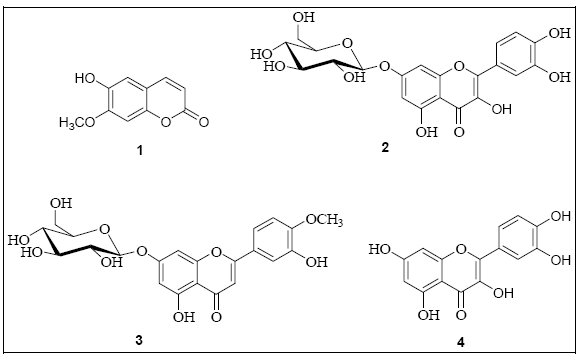
<body><![CDATA[<p align="justify"><font size="2" face="Verdana, Arial, Helvetica, sans-serif"><b>ABSTRACT</b></font></p>     <p align="justify"><font size="2" face="Verdana, Arial, Helvetica, sans-serif">The study was conducted to evaluate the antibacterial potential activity of four natural compounds   isolated from different higher plants   collected from Pazña (Oruro   - Bolivia) on the Bolivian Altiplano. Antibacterial activity was evaluated against ten bacterial strains. Agar   ditch diffusion method was used to study the antibacterial activity of these compounds. Three of these four compounds exhibited considerable antibacterial activity.</font></p>     <p align="justify"><font size="2" face="Verdana, Arial, Helvetica, sans-serif"><b>Key words: </b>Highlands (altiplano), phenolic compounds, antibacterial activity and ditch-diffusion method.</font></p> <hr noshade>     <p align="justify">&nbsp;</p>     <p align="justify">&nbsp;</p>     <p align="justify"><font size="3" face="Verdana, Arial, Helvetica, sans-serif"><b>INTRODUCTION</b></font></p>     <p align="justify"><font size="2" face="Verdana, Arial, Helvetica, sans-serif">Nature has been a source of medicinal   agents for thousands   of years and an impressive number of modern drugs have been isolated from natural sources, many of them based   on their use in traditional   medicine. Medicinal plants have been used for years in daily life to treat disease all over the world<sup>1</sup>.</font></p>     <p align="justify"><font size="2" face="Verdana, Arial, Helvetica, sans-serif">Plants produce a diverse range of   bioactive molecules,   making them an important source of medicinal   compounds; playing a dominant role in the maintenance   of human health since ancient times<sup>2</sup>. Over 50 % of all modern   clinical drugs are natural product,   and 30 % more are based on the squeleton of natural product<sup>3</sup>.Then natural products play an important role in drug development programs in the pharmaceutical industry<sup>4</sup>.</font></p>     <p align="justify"><font size="2" face="Verdana, Arial, Helvetica, sans-serif">Bolivia is one of the first 15th   mega-diverse countries of the   world, it has 199 ecosystems and it harbours a great number of fauna species and flora. It occupies the sixth place in extension of tropical forests and the eleventh place covering forests.</font></p>     <p align="justify"><font size="2" face="Verdana, Arial, Helvetica, sans-serif">The ancestral knowledge of the use of the nature has allowed its inhabitants to cure its own illnesses   for many years such as gastrointestinal   illnesses, however   it is necessary the study of these medicinal properties   in order to contribute to the scientific knowledge and improving the use of these vegetal species.</font></p>     ]]></body>
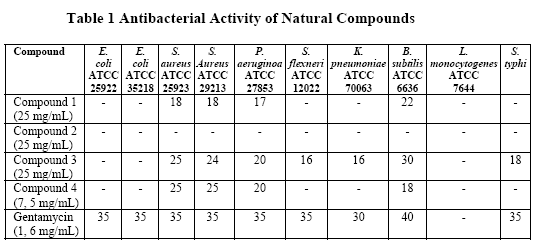
<body><![CDATA[<p align="justify"><font size="2" face="Verdana, Arial, Helvetica, sans-serif">One of the illnesses with more death   rate, especially in children, are the infections caused by enterobacterias another factor that is   important of point out it is the   resistance that these bacterias have developed. Many of the common medications   do not work, then third generation antibiotics it is necessary to use, therefore the search of new alternative treatment is urgent and important of carrying out.</font></p>     <p align="justify"><font size="2" face="Verdana, Arial, Helvetica, sans-serif">Traditional medicine (TRM) has   contributed to human   health for more than three thousand years. However, efforts to understand and document the contribution of the various forms of TRM in a comprehensive manner have been less than successful,   except in a few situations. As a result, we lack sufficient sound information   on the safety and efficacy of TRM and its   possible true complementary role and harmonization with conventional forms of medicine<sup>5</sup>.</font></p>     <p align="justify"><font size="2" face="Verdana, Arial, Helvetica, sans-serif">Plants with possible antimicrobial activity should be tested against an appropriate microbial model to confirm   the activity and to ascertain the parameters associated   with it. The effects of plant extracts on bacteria have been studied by   a very large number of researchers in   different countries around the world<sup>6-8</sup>. Few works has been done based on ethnomedicinal   plants in Bolivia with biological essays. Interest in a large number of traditional natural products has increased<sup>9</sup>.   It has been suggested that aqueous and ethanolic extracts from plants used in allopathic medicine are potential sources of antiviral, antitumoral and antimicrobial agents<sup>10,11</sup>.</font></p>     <p align="justify">&nbsp;</p>     <p align="justify"><font size="3" face="Verdana, Arial, Helvetica, sans-serif"><b>RESULTS AND DISCUSSION</b></font></p>     <p align="justify"><font size="2" face="Verdana, Arial, Helvetica, sans-serif">Four natural compounds isolated from   different higher plants were assayed: 6-hidroxy-7-methoxycoumarin <b>(1)</b> isolated  from <i>Parastrephia</i> <i>lepidophylla; </i>quercetin 7-&#1054;-&#946;-D-glucopyranoside <b>(2)</b>,   isolated from <i>Cheilanthes     pruinata<sup>14-16</sup>; </i>5, 7, 3' -trihydroxy-4' -methoxyflavone-7-O-glucopyranoside <b>(3)</b>, isolated from <i>Astragalus arequipensis<sup>17</sup>     </i>and quercetin <b>(4)</b>, isolated from <i>Hymenoyis robusta<sup>18</sup>.</i></font></p>     <p align="center"><font size="2" face="Verdana, Arial, Helvetica, sans-serif"><img src="/img/revistas/rbq/v23n1/a08_esquema_00.gif" width="579" height="357"></font></p>     <p align="justify"><font size="2" face="Verdana, Arial, Helvetica, sans-serif"><b>Antibacterial activity</b></font></p>     <p align="justify"><font size="2" face="Verdana, Arial, Helvetica, sans-serif">The antibacterial activity of the four   natural compounds against <i>Escherichia     coli </i>ATCC 25922, <i>Escherichia coli </i>ATCC 35218, <i>Staphylococcus aureus </i>ATCC   25923, <i>Staphylococcus aureus </i>ATCC 29213, <i>Pseudomona aeruginosa </i>ATCC 27853, <i>Shigella flexneri </i>ATCC 12022, <i>Klebsiella pneumoniae </i>ATCC 70063, <i>Bacillus subtilis </i>ATCC 6636, <i>Listeria monocytogenes </i>ATCC 7644 and <i>Salmonella typhi </i>is shown in <a href="#t1">Table 1</a>.</font></p>     <p align="justify"><font size="2" face="Verdana, Arial, Helvetica, sans-serif"><a name="t1"></a></font></p>     ]]></body>
<body><![CDATA[<p align="center"><font size="2" face="Verdana, Arial, Helvetica, sans-serif"><img src="/img/revistas/rbq/v23n1/a08_tabla_01.gif" width="534" height="244"></font></p>     <p align="justify"><font size="2" face="Verdana, Arial, Helvetica, sans-serif">Compound <b>(1)</b>  showed inhibitory   activity  against <i>Staphylococcus aureus </i>ATCC 25923, <i>Staphylococcus aureus </i>ATCC 29213, <i>Pseudomona aeruginosa </i>ATCC 27853 and <i>Bacillus subtilis </i>ATCC 6636.</font></p>      <p align="justify"><font size="2" face="Verdana, Arial, Helvetica, sans-serif">The compound <b>(2)</b> did not show any activity against any of the bacterial strains.</font></p>     <p align="justify"><font size="2" face="Verdana, Arial, Helvetica, sans-serif">The compound <b>(3)</b> showed inhibitory activity against <i>Staphylococcus aureus </i>ATCC 25923, <i>Staphylococcus</i> <i>aureus </i>ATCC 29213, <i>Pseudomona aeruginosa </i>ATCC 27853, <i>Shigella flexneri </i>ATCC 12022, <i>Klebsiella pneumoniae </i>ATCC 70063, <i>Bacillus subtilis </i>ATCC 6636 and <i>Salmonella typhi. </i>The antibacterial activity of this compound against gram-positive and gram-negative bacteria indicates that it is compound of broad spectrum.</font></p>     <p align="justify"><font size="2" face="Verdana, Arial, Helvetica, sans-serif">The compound <b>(4)</b> showed inhibitory   activity against <i>Staphylococcus aureus </i>ATCC 25923, <i>Staphylococcus aureus </i>ATCC 29213, <i>Pseudomona aeruginosa </i>ATCC 27853 and <i>Bacillus subtilis </i>ATCC 6636.</font></p>     <p align="justify"><font size="2" face="Verdana, Arial, Helvetica, sans-serif">The compound <b>(4)</b> showed considerably   more antibacterial potent against <i>Staphylococcus     aureus </i>ATCC 25923, <i>Staphylococcus aureus </i>ATCC 29213, <i>Pseudomona       aeruginosa </i>ATCC 27853 and <i>Bacillus subtilis </i>ATCC 6636 than compound   3, because the concentration used was less.</font></p>     <p align="justify">&nbsp;</p>     <p align="justify"><font size="3" face="Verdana, Arial, Helvetica, sans-serif"><b>EXPERIMENTAL</b></font></p>     <p align="justify"><font size="2" face="Verdana, Arial, Helvetica, sans-serif"><b>Microorganisms test</b></font></p>     <p align="justify"><font size="2" face="Verdana, Arial, Helvetica, sans-serif">The microbial strains studied are <i>Escherichia coli </i>ATCC 25922 (sensible), <i>Escherichia   coli </i>ATCC 35218   (resistant), <i>Staphylococcus aureus </i>ATCC 25923 (sensible), <i>Staphylococcus     aureus </i>ATCC 29213   (resistant), <i>Pseudomona aeruginosa </i>ATCC 27853 (sensible) , <i>Shigella flexneri </i>ATCC 12022, <i>Klebsiella pneumoniae </i>ATCC 70063 (resistant), <i>Bacillus subtilis </i>ATCC 6636, <i>Listeria monocytogenes </i>ATCC   7644 and <i>Salmonella typhi </i>(sensible).</font></p>     ]]></body>
<body><![CDATA[<p align="justify"><font size="2" face="Verdana, Arial, Helvetica, sans-serif"><b>Antibacterial assay</b></font></p>     <p align="justify"><font size="2" face="Verdana, Arial, Helvetica, sans-serif"><b>Agar ditch diffusion method</b></font></p>     <p align="justify"><font size="2" face="Verdana, Arial, Helvetica, sans-serif">Bacterial suspensions were obtained   from overnight cultures in Muller   Hinton Broth ( BBL<sup>T</sup>M trademark of   Becton, Dickinson and Company) cultivated at 37°C   for 24 h. The bacterial suspensions were adjusted to an inoculum size 10<sup>8</sup>   cells/mL for inoculation of the agar plates.</font></p>     <p align="justify"><font size="2" face="Verdana, Arial, Helvetica, sans-serif">After the medium (Difco Bacto Mueller   Hinton Medium)   was solidified in the plates, the test strain (0, 2 mL) was inoculated into the   media. Care was taken to ensure proper homogenization. A ditch was made in the   plates with the help of a cup-borer (13 mm). The test compound was introduced   into the well and   the plates were incubated at 37°C for 24 h. Microbial growth was determined by measuring the diameter of the zone of   inhibition<sup>12,13</sup>.   </font></p>     <p align="justify"><font size="2" face="Verdana, Arial, Helvetica, sans-serif">For the in vitro studies compounds were dissolved in 200 &mu;L of dimethyl sulfoxide (DMSO).</font></p>     <p align="justify"><font size="2" face="Verdana, Arial, Helvetica, sans-serif">DMSO was taken as solvent control. Gentamycin was taken as antibacterial control.</font></p>     <p align="justify">&nbsp;</p>     <p align="justify"><font size="3" face="Verdana, Arial, Helvetica, sans-serif"><b>CONCLUSIONS</b></font></p>     <p align="justify"><font size="2" face="Verdana, Arial, Helvetica, sans-serif">Three of these four compounds exhibited considerable antibacterial   activity. The most susceptible bacteria were <i>Staphylococcus aureus </i>ATCC 25923, <i>Staphylococcus aureus </i>ATCC   29213, <i>Pseudomona aeruginosa </i>ATCC 27853 and <i>Bacillus subtilis </i>ATCC 6636. The less susceptible bacteria were <i>Shigella flexneri </i>ATCC 12022, <i>Klebsiella pneumoniae </i>ATCC 70063 and <i>Salmonella typhi. </i>The most resistant bacteria were <i>Escherichia coli </i>ATCC 25922, <i>Escherichia coli </i>ATCC 35218 and <i>Listeria monocytogenes </i>ATCC 7644.</font></p>     <p align="justify"><font size="2" face="Verdana, Arial, Helvetica, sans-serif">The emergence of multiple-drug-resistant strains of   bacteria, the indiscriminate use of antibiotics and the increasing   susceptibility of individuals with acquired immunodeficiency   syndrome (AIDS) to infection from Mycobacterium induce an urgent need for development of new strategies to treat bacterial infections.</font></p>     ]]></body>
<body><![CDATA[<p align="justify"><font size="2" face="Verdana, Arial, Helvetica, sans-serif">From the above results it can be concluded that these compounds have great potential as antimicrobial against microorganisms and that they can be used   in the treatment of infectious   diseases caused by resistant   microorganisms. Such biological assays natural compounds isolated from Bolivian plants have to be studied.</font></p>     <p align="justify"><font size="2" face="Verdana, Arial, Helvetica, sans-serif">Furthermore, the results of the present study of these compounds know with antibacterial activity that could serve as selective agents for the   maintenance of human health and   provide biochemical tools for the study other infectious diseases in our country.</font></p>     <p align="justify">&nbsp;</p>     <p align="justify"><font size="3" face="Verdana, Arial, Helvetica, sans-serif"><b>ACKNOWLEDGMENTS</b></font></p>     <p align="justify"><font size="2" face="Verdana, Arial, Helvetica, sans-serif">Technicians and Professors of the he Laboratory of Natural   Products of the Instituto de Investigaciones Químicas are sincerely acknowledged.</font></p>     <p align="justify">&nbsp;</p>     <p align="justify"><font size="3" face="Verdana, Arial, Helvetica, sans-serif"><b>REFERENCES</b></font></p>     <!-- ref --><p align="justify"><font size="2" face="Verdana, Arial, Helvetica, sans-serif"><sup>1</sup>. R. NAIR, T. KALARIYA,   Sumitra CHANDA. Antibacterial   Activity of Some Selected Indian Medicinal.  Flora.Turkish <i>Journal of Biology,  </i>29, (2005), 41-47.</font>&nbsp;&nbsp;&nbsp;&nbsp;&nbsp;&nbsp;&nbsp;&nbsp;[&#160;<a href="javascript:void(0);" onclick="javascript: window.open('/scielo.php?script=sci_nlinks&ref=661229&pid=S0250-5460200600010000800001&lng=','','width=640,height=500,resizable=yes,scrollbars=1,menubar=yes,');">Links</a>&#160;]<!-- end-ref --><!-- ref --><p align="justify"><font size="2" face="Verdana, Arial, Helvetica, sans-serif"><sup>2</sup>. Farombi EO. African indigenous plants with   chemotherapeutic potentials and biotechnological   approach to the production of bioactive   prophylactic   agent. African J. Biotech 2: 662-671. 2003.</font>&nbsp;&nbsp;&nbsp;&nbsp;&nbsp;&nbsp;&nbsp;&nbsp;[&#160;<a href="javascript:void(0);" onclick="javascript: window.open('/scielo.php?script=sci_nlinks&ref=661230&pid=S0250-5460200600010000800002&lng=','','width=640,height=500,resizable=yes,scrollbars=1,menubar=yes,');">Links</a>&#160;]<!-- end-ref --><!-- ref --><p align="justify"><font size="2" face="Verdana, Arial, Helvetica, sans-serif"><sup>3</sup>. Stuffness M, Douros   J. Current status of the NCI   plant and animal product program, J. Nat. Prod. 45: 1-14, 1982.</font>&nbsp;&nbsp;&nbsp;&nbsp;&nbsp;&nbsp;&nbsp;&nbsp;[&#160;<a href="javascript:void(0);" onclick="javascript: window.open('/scielo.php?script=sci_nlinks&ref=661231&pid=S0250-5460200600010000800003&lng=','','width=640,height=500,resizable=yes,scrollbars=1,menubar=yes,');">Links</a>&#160;]<!-- end-ref --><!-- ref --><p align="justify"><font size="2" face="Verdana, Arial, Helvetica, sans-serif"><sup>4</sup>. Baker JT, Borris RP,   Carte B et al. Natural product   drug discovery and development: New perspective on   onternational collaboration. J. Nat. Prod.   58:   1325-1357,2001.</font>&nbsp;&nbsp;&nbsp;&nbsp;&nbsp;&nbsp;&nbsp;&nbsp;[&#160;<a href="javascript:void(0);" onclick="javascript: window.open('/scielo.php?script=sci_nlinks&ref=661232&pid=S0250-5460200600010000800004&lng=','','width=640,height=500,resizable=yes,scrollbars=1,menubar=yes,');">Links</a>&#160;]<!-- end-ref --><p align="justify"><font size="2" face="Verdana, Arial, Helvetica, sans-serif"><sup>5</sup>. Kawaguchi Yuji,   Director, WHO CENTRE FOR   HEALTH DEVELOPMENT INTERNATIONAL   SYMPOSIUM ON TRADITIONAL MEDICINE.   Better Science, Policy and Services for Health Development: 11-16.</font></p>     <!-- ref --><p align="justify"><font size="2" face="Verdana, Arial, Helvetica, sans-serif"><sup>6</sup>. Reddy  PS,   Jamil  K,    Madhusudhan  P  et  al.   Antibacterial activity of isolates   from Piper nigrum   and Taxus baccata. Pharmaceutical   Biol. 39: 236-238, 2001.</font>&nbsp;&nbsp;&nbsp;&nbsp;&nbsp;&nbsp;&nbsp;&nbsp;[&#160;<a href="javascript:void(0);" onclick="javascript: window.open('/scielo.php?script=sci_nlinks&ref=661234&pid=S0250-5460200600010000800006&lng=','','width=640,height=500,resizable=yes,scrollbars=1,menubar=yes,');">Links</a>&#160;]<!-- end-ref --><!-- ref --><p align="justify"><font size="2" face="Verdana, Arial, Helvetica, sans-serif"><i><sup>7.</sup> </i>Erdogrul OT. Antibacterial activities of some plant extracts used in folk medicine. Pharmaceutical Biol.40: 269-273, 2002.</font>&nbsp;&nbsp;&nbsp;&nbsp;&nbsp;&nbsp;&nbsp;&nbsp;[&#160;<a href="javascript:void(0);" onclick="javascript: window.open('/scielo.php?script=sci_nlinks&ref=661235&pid=S0250-5460200600010000800007&lng=','','width=640,height=500,resizable=yes,scrollbars=1,menubar=yes,');">Links</a>&#160;]<!-- end-ref --><!-- ref --><p align="justify"><font size="2" face="Verdana, Arial, Helvetica, sans-serif"><sup>8</sup>. Ates   DA, Erdogrul OT. Antimicrobial activities of various medicinal and commercial plant extracts. Turk J. Biol. 27: 157-162, 2003.   </font>&nbsp;&nbsp;&nbsp;&nbsp;&nbsp;&nbsp;&nbsp;&nbsp;[&#160;<a href="javascript:void(0);" onclick="javascript: window.open('/scielo.php?script=sci_nlinks&ref=661236&pid=S0250-5460200600010000800008&lng=','','width=640,height=500,resizable=yes,scrollbars=1,menubar=yes,');">Links</a>&#160;]<!-- end-ref --><!-- ref --><p align="justify"><font size="2" face="Verdana, Arial, Helvetica, sans-serif"><sup>9</sup>. Taylor RSL,   Manandhar NP, Hudson JB et al.   Antiviral activities of Nepalese   medicinal plants. J. Ethnopharmacol 52: 157-163, 1996.</font>&nbsp;&nbsp;&nbsp;&nbsp;&nbsp;&nbsp;&nbsp;&nbsp;[&#160;<a href="javascript:void(0);" onclick="javascript: window.open('/scielo.php?script=sci_nlinks&ref=661237&pid=S0250-5460200600010000800009&lng=','','width=640,height=500,resizable=yes,scrollbars=1,menubar=yes,');">Links</a>&#160;]<!-- end-ref --><!-- ref --><p align="justify"><font size="2" face="Verdana, Arial, Helvetica, sans-serif"><sup>10</sup>. Chung TH, Kim MK et al. Investigation of Korean   plant extracts for potential phytotherapeutic   agents   against B-virus Hepatitis.   Phytotherapy Res. 9: 429-434, 1995.</font>&nbsp;&nbsp;&nbsp;&nbsp;&nbsp;&nbsp;&nbsp;&nbsp;[&#160;<a href="javascript:void(0);" onclick="javascript: window.open('/scielo.php?script=sci_nlinks&ref=661238&pid=S0250-5460200600010000800010&lng=','','width=640,height=500,resizable=yes,scrollbars=1,menubar=yes,');">Links</a>&#160;]<!-- end-ref --><!-- ref --><p align="justify"><font size="2" face="Verdana, Arial, Helvetica, sans-serif"><sup>11</sup>. Vlietinck AJ, Van Hoof L, Totté J. et al. Screening   of hundred Rwandese medicinal plants for   antimicrobial and antiviral properties.  J. Ethnopaharmacol 46: 31-47, 1995.</font>&nbsp;&nbsp;&nbsp;&nbsp;&nbsp;&nbsp;&nbsp;&nbsp;[&#160;<a href="javascript:void(0);" onclick="javascript: window.open('/scielo.php?script=sci_nlinks&ref=661239&pid=S0250-5460200600010000800011&lng=','','width=640,height=500,resizable=yes,scrollbars=1,menubar=yes,');">Links</a>&#160;]<!-- end-ref --><!-- ref --><p align="justify"><font size="2" face="Verdana, Arial, Helvetica, sans-serif"><sup>12</sup>. Perez C, Paul M,   Bazerque P. Antibiotic assay by   agar ditch diffusion method. Acta   Biol. Med. Exp., 15: 113-115, 1990.</font>&nbsp;&nbsp;&nbsp;&nbsp;&nbsp;&nbsp;&nbsp;&nbsp;[&#160;<a href="javascript:void(0);" onclick="javascript: window.open('/scielo.php?script=sci_nlinks&ref=661240&pid=S0250-5460200600010000800012&lng=','','width=640,height=500,resizable=yes,scrollbars=1,menubar=yes,');">Links</a>&#160;]<!-- end-ref --><!-- ref --><p align="justify"><font size="2" face="Verdana, Arial, Helvetica, sans-serif"><sup>13</sup>. Murria PR, Baron EJ,   Pfaller MA, Tenover FC,   Yolbe RH. Manual of Clinical   Microbiology. 7th ed. Washington: ASM; 1999. p. 1527-39.</font>&nbsp;&nbsp;&nbsp;&nbsp;&nbsp;&nbsp;&nbsp;&nbsp;[&#160;<a href="javascript:void(0);" onclick="javascript: window.open('/scielo.php?script=sci_nlinks&ref=661241&pid=S0250-5460200600010000800013&lng=','','width=640,height=500,resizable=yes,scrollbars=1,menubar=yes,');">Links</a>&#160;]<!-- end-ref --><p align="justify"><font size="2" face="Verdana, Arial, Helvetica, sans-serif"><sup>14</sup>. Salatino, M., Prado,   J., Biochemical Systematic and Ecology 1988, 26: 761-769.</font></p>     <!-- ref --><p align="justify"><font size="2" face="Verdana, Arial, Helvetica, sans-serif"><sup>15</sup>. Kelamanson, J.,   Jager, A., Van Staden, J., Journal of Ethnopharmacology 2000, 69: 241-246.</font>&nbsp;&nbsp;&nbsp;&nbsp;&nbsp;&nbsp;&nbsp;&nbsp;[&#160;<a href="javascript:void(0);" onclick="javascript: window.open('/scielo.php?script=sci_nlinks&ref=661243&pid=S0250-5460200600010000800015&lng=','','width=640,height=500,resizable=yes,scrollbars=1,menubar=yes,');">Links</a>&#160;]<!-- end-ref --><!-- ref --><p align="justify"><font size="2" face="Verdana, Arial, Helvetica, sans-serif"><sup>16</sup>. Grierson, D., Afolayan, A., Journal of Ethnopharmacology 1999, 66: 103-106.</font>&nbsp;&nbsp;&nbsp;&nbsp;&nbsp;&nbsp;&nbsp;&nbsp;[&#160;<a href="javascript:void(0);" onclick="javascript: window.open('/scielo.php?script=sci_nlinks&ref=661244&pid=S0250-5460200600010000800016&lng=','','width=640,height=500,resizable=yes,scrollbars=1,menubar=yes,');">Links</a>&#160;]<!-- end-ref --><!-- ref --><p align="justify"><font size="2" face="Verdana, Arial, Helvetica, sans-serif"><sup>17</sup>. Vila Castro JL., Natural products from   Bolivian plants. 2006, 20-21.</font>&nbsp;&nbsp;&nbsp;&nbsp;&nbsp;&nbsp;&nbsp;&nbsp;[&#160;<a href="javascript:void(0);" onclick="javascript: window.open('/scielo.php?script=sci_nlinks&ref=661245&pid=S0250-5460200600010000800017&lng=','','width=640,height=500,resizable=yes,scrollbars=1,menubar=yes,');">Links</a>&#160;]<!-- end-ref --><!-- ref --><p align="justify"><font size="2" face="Verdana, Arial, Helvetica, sans-serif"><sup>18</sup>. Vila Castro JL., Natural products from Bolivian plants. 2006, 31-32.</font>&nbsp;&nbsp;&nbsp;&nbsp;&nbsp;&nbsp;&nbsp;&nbsp;[&#160;<a href="javascript:void(0);" onclick="javascript: window.open('/scielo.php?script=sci_nlinks&ref=661246&pid=S0250-5460200600010000800018&lng=','','width=640,height=500,resizable=yes,scrollbars=1,menubar=yes,');">Links</a>&#160;]<!-- end-ref --><p align="justify">&nbsp;</p>      ]]></body><back>
<ref-list>
<ref id="B1">
<label>1</label><nlm-citation citation-type="journal">
<person-group person-group-type="author">
<name>
<surname><![CDATA[NAIR]]></surname>
<given-names><![CDATA[R.]]></given-names>
</name>
<name>
<surname><![CDATA[KALARIYA]]></surname>
<given-names><![CDATA[T.]]></given-names>
</name>
<name>
<surname><![CDATA[CHANDA]]></surname>
<given-names><![CDATA[Sumitra]]></given-names>
</name>
</person-group>
<article-title xml:lang="en"><![CDATA[Antibacterial Activity of Some Selected Indian Medicinal. Flora.Turkish]]></article-title>
<source><![CDATA[Journal of Biology]]></source>
<year>2005</year>
<volume>29</volume>
<page-range>41-47</page-range></nlm-citation>
</ref>
<ref id="B2">
<label>2</label><nlm-citation citation-type="journal">
<person-group person-group-type="author">
<name>
<surname><![CDATA[Farombi]]></surname>
<given-names><![CDATA[EO]]></given-names>
</name>
</person-group>
<article-title xml:lang="en"><![CDATA[African indigenous plants with chemotherapeutic potentials and biotechnological approach to the production of bioactive prophylactic agent]]></article-title>
<source><![CDATA[African J. Biotech]]></source>
<year>2003</year>
<volume>2</volume>
<page-range>662-671</page-range></nlm-citation>
</ref>
<ref id="B3">
<label>3</label><nlm-citation citation-type="journal">
<person-group person-group-type="author">
<name>
<surname><![CDATA[Stuffness]]></surname>
<given-names><![CDATA[M]]></given-names>
</name>
<name>
<surname><![CDATA[Douros]]></surname>
<given-names><![CDATA[J]]></given-names>
</name>
</person-group>
<article-title xml:lang="en"><![CDATA[Current status of the NCI plant and animal product program]]></article-title>
<source><![CDATA[J. Nat. Prod.]]></source>
<year>1982</year>
<volume>45</volume>
<page-range>1-14</page-range></nlm-citation>
</ref>
<ref id="B4">
<label>4</label><nlm-citation citation-type="journal">
<person-group person-group-type="author">
<name>
<surname><![CDATA[Baker]]></surname>
<given-names><![CDATA[JT]]></given-names>
</name>
<name>
<surname><![CDATA[Borris]]></surname>
<given-names><![CDATA[RP]]></given-names>
</name>
<name>
<surname><![CDATA[Carte]]></surname>
<given-names><![CDATA[B]]></given-names>
</name>
</person-group>
<article-title xml:lang="en"><![CDATA[Natural product drug discovery and development: New perspective on onternational collaboration]]></article-title>
<source><![CDATA[J. Nat. Prod.]]></source>
<year>2001</year>
<volume>58</volume>
<page-range>1325-1357</page-range></nlm-citation>
</ref>
<ref id="B5">
<label>5</label><nlm-citation citation-type="book">
<person-group person-group-type="author">
<name>
<surname><![CDATA[Kawaguchi]]></surname>
<given-names><![CDATA[Yuji]]></given-names>
</name>
</person-group>
<source><![CDATA[Better Science, Policy and Services for Health Development]]></source>
<year></year>
<page-range>11-16</page-range><publisher-name><![CDATA[WHO CENTRE FOR HEALTH DEVELOPMENT INTERNATIONAL SYMPOSIUM ON TRADITIONAL MEDICINE]]></publisher-name>
</nlm-citation>
</ref>
<ref id="B6">
<label>6</label><nlm-citation citation-type="journal">
<person-group person-group-type="author">
<name>
<surname><![CDATA[Reddy]]></surname>
<given-names><![CDATA[PS]]></given-names>
</name>
<name>
<surname><![CDATA[Jamil]]></surname>
<given-names><![CDATA[K]]></given-names>
</name>
<name>
<surname><![CDATA[Madhusudhan]]></surname>
<given-names><![CDATA[P]]></given-names>
</name>
</person-group>
<article-title xml:lang="en"><![CDATA[Antibacterial activity of isolates from Piper nigrum and Taxus baccata]]></article-title>
<source><![CDATA[Pharmaceutical Biol.]]></source>
<year>2001</year>
<volume>39</volume>
<page-range>236-238</page-range></nlm-citation>
</ref>
<ref id="B7">
<label>7</label><nlm-citation citation-type="journal">
<person-group person-group-type="author">
<name>
<surname><![CDATA[Erdogrul]]></surname>
<given-names><![CDATA[OT]]></given-names>
</name>
</person-group>
<article-title xml:lang="en"><![CDATA[Antibacterial activities of some plant extracts used in folk medicine]]></article-title>
<source><![CDATA[Pharmaceutical Biol.]]></source>
<year>2002</year>
<volume>40</volume>
<page-range>269-273</page-range></nlm-citation>
</ref>
<ref id="B8">
<label>8</label><nlm-citation citation-type="journal">
<person-group person-group-type="author">
<name>
<surname><![CDATA[Ates]]></surname>
<given-names><![CDATA[DA]]></given-names>
</name>
<name>
<surname><![CDATA[Erdogrul]]></surname>
<given-names><![CDATA[OT]]></given-names>
</name>
</person-group>
<article-title xml:lang="en"><![CDATA[Antimicrobial activities of various medicinal and commercial plant extracts]]></article-title>
<source><![CDATA[Turk J. Biol.]]></source>
<year>2003</year>
<volume>27</volume>
<page-range>157-162</page-range></nlm-citation>
</ref>
<ref id="B9">
<label>9</label><nlm-citation citation-type="journal">
<person-group person-group-type="author">
<name>
<surname><![CDATA[Taylor]]></surname>
<given-names><![CDATA[RSL]]></given-names>
</name>
<name>
<surname><![CDATA[Manandhar]]></surname>
<given-names><![CDATA[NP]]></given-names>
</name>
<name>
<surname><![CDATA[Hudson]]></surname>
<given-names><![CDATA[JB]]></given-names>
</name>
</person-group>
<article-title xml:lang="en"><![CDATA[Antiviral activities of Nepalese medicinal plants]]></article-title>
<source><![CDATA[J. Ethnopharmacol]]></source>
<year>1996</year>
<volume>52</volume>
<page-range>157-163</page-range></nlm-citation>
</ref>
<ref id="B10">
<label>10</label><nlm-citation citation-type="journal">
<person-group person-group-type="author">
<name>
<surname><![CDATA[Chung]]></surname>
<given-names><![CDATA[TH]]></given-names>
</name>
<name>
<surname><![CDATA[Kim]]></surname>
<given-names><![CDATA[MK]]></given-names>
</name>
</person-group>
<article-title xml:lang="en"><![CDATA[Investigation of Korean plant extracts for potential phytotherapeutic agents against B-virus Hepatitis]]></article-title>
<source><![CDATA[Phytotherapy Res.]]></source>
<year>1995</year>
<volume>9</volume>
<page-range>429-434</page-range></nlm-citation>
</ref>
<ref id="B11">
<label>11</label><nlm-citation citation-type="journal">
<person-group person-group-type="author">
<name>
<surname><![CDATA[Vlietinck]]></surname>
<given-names><![CDATA[AJ]]></given-names>
</name>
<name>
<surname><![CDATA[Van Hoof]]></surname>
<given-names><![CDATA[L]]></given-names>
</name>
<name>
<surname><![CDATA[Totté]]></surname>
<given-names><![CDATA[J]]></given-names>
</name>
</person-group>
<article-title xml:lang="en"><![CDATA[Screening of hundred Rwandese medicinal plants for antimicrobial and antiviral properties]]></article-title>
<source><![CDATA[J. Ethnopaharmacol]]></source>
<year>1995</year>
<volume>46</volume>
<page-range>31-47</page-range></nlm-citation>
</ref>
<ref id="B12">
<label>12</label><nlm-citation citation-type="journal">
<person-group person-group-type="author">
<name>
<surname><![CDATA[Perez]]></surname>
<given-names><![CDATA[C]]></given-names>
</name>
<name>
<surname><![CDATA[Paul]]></surname>
<given-names><![CDATA[M]]></given-names>
</name>
<name>
<surname><![CDATA[Bazerque]]></surname>
<given-names><![CDATA[P]]></given-names>
</name>
</person-group>
<article-title xml:lang="en"><![CDATA[Antibiotic assay by agar ditch diffusion method]]></article-title>
<source><![CDATA[Acta Biol. Med. Exp..]]></source>
<year>1990</year>
<volume>15</volume>
<page-range>113-115</page-range></nlm-citation>
</ref>
<ref id="B13">
<label>13</label><nlm-citation citation-type="book">
<person-group person-group-type="author">
<name>
<surname><![CDATA[Murria]]></surname>
<given-names><![CDATA[PR]]></given-names>
</name>
<name>
<surname><![CDATA[Baron]]></surname>
<given-names><![CDATA[EJ]]></given-names>
</name>
<name>
<surname><![CDATA[Pfaller]]></surname>
<given-names><![CDATA[MA]]></given-names>
</name>
<name>
<surname><![CDATA[Tenover]]></surname>
<given-names><![CDATA[FC]]></given-names>
</name>
<name>
<surname><![CDATA[Yolbe]]></surname>
<given-names><![CDATA[RH]]></given-names>
</name>
</person-group>
<source><![CDATA[Manual of Clinical Microbiology]]></source>
<year>1999</year>
<edition>7</edition>
<page-range>1527-39</page-range><publisher-loc><![CDATA[Washington ]]></publisher-loc>
<publisher-name><![CDATA[ASM]]></publisher-name>
</nlm-citation>
</ref>
<ref id="B14">
<label>14</label><nlm-citation citation-type="journal">
<person-group person-group-type="author">
<name>
<surname><![CDATA[Salatino]]></surname>
<given-names><![CDATA[M]]></given-names>
</name>
<name>
<surname><![CDATA[Prado]]></surname>
<given-names><![CDATA[J]]></given-names>
</name>
</person-group>
<source><![CDATA[Biochemical Systematic and Ecology.]]></source>
<year>1988</year>
<volume>26</volume>
<page-range>761-769</page-range></nlm-citation>
</ref>
<ref id="B15">
<label>15</label><nlm-citation citation-type="journal">
<person-group person-group-type="author">
<name>
<surname><![CDATA[Kelamanson]]></surname>
<given-names><![CDATA[J]]></given-names>
</name>
<name>
<surname><![CDATA[Jager]]></surname>
<given-names><![CDATA[A]]></given-names>
</name>
<name>
<surname><![CDATA[Van Staden]]></surname>
<given-names><![CDATA[J]]></given-names>
</name>
</person-group>
<source><![CDATA[Journal of Ethnopharmacology]]></source>
<year>2000</year>
<volume>69</volume>
<page-range>241-246</page-range></nlm-citation>
</ref>
<ref id="B16">
<label>16</label><nlm-citation citation-type="journal">
<person-group person-group-type="author">
<name>
<surname><![CDATA[Grierson]]></surname>
<given-names><![CDATA[D]]></given-names>
</name>
<name>
<surname><![CDATA[Afolayan]]></surname>
<given-names><![CDATA[A]]></given-names>
</name>
</person-group>
<source><![CDATA[Journal of Ethnopharmacology]]></source>
<year>1999</year>
<volume>66</volume>
<page-range>103-106</page-range></nlm-citation>
</ref>
<ref id="B17">
<label>17</label><nlm-citation citation-type="journal">
<person-group person-group-type="author">
<name>
<surname><![CDATA[Vila Castro]]></surname>
<given-names><![CDATA[JL]]></given-names>
</name>
</person-group>
<source><![CDATA[Natural products from Bolivian plants.]]></source>
<year>2006</year>
<page-range>20-21</page-range></nlm-citation>
</ref>
<ref id="B18">
<label>18</label><nlm-citation citation-type="journal">
<person-group person-group-type="author">
<name>
<surname><![CDATA[Vila Castro]]></surname>
<given-names><![CDATA[JL]]></given-names>
</name>
</person-group>
<source><![CDATA[Natural products from Bolivian plants.]]></source>
<year>2006</year>
<page-range>31-32</page-range></nlm-citation>
</ref>
</ref-list>
</back>
</article>