<?xml version="1.0" encoding="ISO-8859-1"?><article xmlns:mml="http://www.w3.org/1998/Math/MathML" xmlns:xlink="http://www.w3.org/1999/xlink" xmlns:xsi="http://www.w3.org/2001/XMLSchema-instance">
<front>
<journal-meta>
<journal-id>0250-5460</journal-id>
<journal-title><![CDATA[Revista Boliviana de Química]]></journal-title>
<abbrev-journal-title><![CDATA[Rev. Bol. Quim]]></abbrev-journal-title>
<issn>0250-5460</issn>
<publisher>
<publisher-name><![CDATA[Universidad Mayor de San Andrés]]></publisher-name>
</publisher>
</journal-meta>
<article-meta>
<article-id>S0250-54602006000100004</article-id>
<title-group>
<article-title xml:lang="en"><![CDATA[SIMULTANEOUS DETERMINATION OF GLUCOSE, MALTOSE AND SUCROSE IN STARCH OF SIX VARIETIES OF CASSAVA]]></article-title>
</title-group>
<contrib-group>
<contrib contrib-type="author">
<name>
<surname><![CDATA[Rojas]]></surname>
<given-names><![CDATA[C. Carola C.]]></given-names>
</name>
<xref ref-type="aff" rid="A01"/>
</contrib>
<contrib contrib-type="author">
<name>
<surname><![CDATA[Nair]]></surname>
<given-names><![CDATA[Baboo]]></given-names>
</name>
<xref ref-type="aff" rid="A02"/>
</contrib>
<contrib contrib-type="author">
<name>
<surname><![CDATA[Herbas]]></surname>
<given-names><![CDATA[Adelina]]></given-names>
</name>
<xref ref-type="aff" rid="A03"/>
</contrib>
<contrib contrib-type="author">
<name>
<surname><![CDATA[Bergenståhl]]></surname>
<given-names><![CDATA[Björn]]></given-names>
</name>
<xref ref-type="aff" rid="A01"/>
</contrib>
</contrib-group>
<aff id="A01">
<institution><![CDATA[,Lund University Food Technology ]]></institution>
<addr-line><![CDATA[Lund ]]></addr-line>
<country>Sweden</country>
</aff>
<aff id="A02">
<institution><![CDATA[,Lund University Applied Nutrition ]]></institution>
<addr-line><![CDATA[Lund ]]></addr-line>
<country>Sweden</country>
</aff>
<aff id="A03">
<institution><![CDATA[,Universidad Mayor de San Simón Centro de Alimentos y Productos Naturales ]]></institution>
<addr-line><![CDATA[Cochabamba ]]></addr-line>
<country>Bolivia</country>
</aff>
<pub-date pub-type="pub">
<day>00</day>
<month>00</month>
<year>2006</year>
</pub-date>
<pub-date pub-type="epub">
<day>00</day>
<month>00</month>
<year>2006</year>
</pub-date>
<volume>23</volume>
<numero>1</numero>
<fpage>18</fpage>
<lpage>23</lpage>
<copyright-statement/>
<copyright-year/>
<self-uri xlink:href="http://www.scielo.org.bo/scielo.php?script=sci_arttext&amp;pid=S0250-54602006000100004&amp;lng=en&amp;nrm=iso"></self-uri><self-uri xlink:href="http://www.scielo.org.bo/scielo.php?script=sci_abstract&amp;pid=S0250-54602006000100004&amp;lng=en&amp;nrm=iso"></self-uri><self-uri xlink:href="http://www.scielo.org.bo/scielo.php?script=sci_pdf&amp;pid=S0250-54602006000100004&amp;lng=en&amp;nrm=iso"></self-uri><abstract abstract-type="short" xml:lang="en"><p><![CDATA[An enzymatic method has been developed to simultaneously determine glucose, maltose and sucrose in tubers The principle of the method is based on an enzymatic cleavage of these disaccharides and specific measurement the resulting glucose using an enzymatic procedure described by Holm (3). The study comprises two parts; the first one includes modifications of the pretreatment method to minimize errors due to ethanol used to precipitate polymeric material interfering with the activity of &#945;-glucosidase and invertase. In the second part the usability of the method has been probed by employing it on six samples of cassava that come from Chapare-Bolivia.]]></p></abstract>
<kwd-group>
<kwd lng="en"><![CDATA[Enzymatic hydrolysis]]></kwd>
<kwd lng="en"><![CDATA[analysis]]></kwd>
<kwd lng="en"><![CDATA[glucose]]></kwd>
<kwd lng="en"><![CDATA[maltose]]></kwd>
<kwd lng="en"><![CDATA[sucrose]]></kwd>
<kwd lng="en"><![CDATA[Cassava]]></kwd>
<kwd lng="en"><![CDATA[sugars determination is by using enzymatic]]></kwd>
</kwd-group>
</article-meta>
</front><body><![CDATA[ <P align="right"><font size="2" face="Verdana, Arial, Helvetica, sans-serif"><b>ART&Iacute;CULO ORIGINAL</b></font></P>     <P align="justify">&nbsp;</P>     <P align="center"><font size="4" face="Verdana, Arial, Helvetica, sans-serif"><b>SIMULTANEOUS DETERMINATION OF GLUCOSE, MALTOSE AND SUCROSE IN STARCH OF SIX VARIETIES OF <i>CASSAVA</i> </b></font></P>     <P align="center">&nbsp;</P>     <P align="center">&nbsp;</P>     <P align="center"><b><font size="2" face="Verdana, Arial, Helvetica, sans-serif"> C. Carola C. Rojas<Sup>1,3</Sup>, Baboo Nair<Sup>2</Sup>, Adelina Herbas<Sup>3</Sup>, Bj&ouml;rn Bergenst&aring;hl<Sup>1 </Sup></font></b><font size="2" face="Verdana, Arial, Helvetica, sans-serif"><Sup></Sup></font></P>     <P align="center"><font size="2" face="Verdana, Arial, Helvetica, sans-serif"><Sup>1</Sup>Food Technology, Lund University, P.O Box 124, SE-221 00 Lund, Sweden    <br> </font><font size="2" face="Verdana, Arial, Helvetica, sans-serif"><Sup>2</Sup>Applied Nutrition, Lund University, P.O Box 124, SE-221 00 Lund, Sweden </font>    <br>   <font size="2" face="Verdana, Arial, Helvetica, sans-serif"><Sup>3</Sup>Centro de Alimentos y Productos Naturales, Universidad Mayor de San Sim&oacute;n, Cochabamba,  Bolivia </font></P>     <P align="justify">&nbsp;</P>     ]]></body>
<body><![CDATA[<P align="justify">&nbsp;</P> <hr noshade>     <P align="justify"><font size="2" face="Verdana, Arial, Helvetica, sans-serif"><b>ABSTRACT</b> </font></P>     <P align="justify"><font size="2" face="Verdana, Arial, Helvetica, sans-serif"> An enzymatic method has been developed to simultaneously determine glucose, maltose and sucrose in tubers The principle of the method is based on an enzymatic cleavage of these disaccharides and specific measurement the resulting glucose using an enzymatic procedure described by Holm <sup>(3)</sup>.</font></P>     <P align="justify"><font size="2" face="Verdana, Arial, Helvetica, sans-serif">  The study comprises two parts; the first one   includes modifications of the pretreatment   method to minimize errors due to ethanol used to   precipitate polymeric material interfering with   the activity of </font><font size="3">&alpha;</font><font size="2" face="Verdana, Arial, Helvetica, sans-serif">-glucosidase and invertase. In the   second part the usability of the method has been   probed by employing it on six samples of   cassava that come from Chapare-Bolivia.</font></P>     <P align="justify"><font size="2" face="Verdana, Arial, Helvetica, sans-serif"><b>Key words: </b>Enzymatic hydrolysis, analysis, glucose, maltose, sucrose, <i>Cassava</i>. sugars determination is by using enzymatic </font></P> <hr noshade> <H5 align="justify">&nbsp;</H5> <H5 align="justify">&nbsp;</H5>     <p><b><font size="3" face="Verdana, Arial, Helvetica, sans-serif">INTRODUCTION </font></b> </p>     <p align="justify"><font size="2" face="Verdana, Arial, Helvetica, sans-serif">Cassava (<i>Mannihot esculenta</i> Crantz) is a tropical   root that has mainly carbohydrates in its   composition such as starch, glucose, sucrose and   fructose Huang <sup>(13)</sup>. Lewthwaite <sup>(8)</sup> and Takata   <sup>(11)</sup> have reported important changes in the   composition of potato saccharides during its   processing by showing variations in the sugars   concentration which is an essential variable to   determine the quality of the food. Reducing sugars   has been identified as critical in potato for the   tendency for acrylamide formation during heat processing of potato <sup>(14)</sup>.</font></p>     <p align="justify"><font size="2" face="Verdana, Arial, Helvetica, sans-serif">To determine the sugars content in plants and food,   different techniques have been developed such as   High Performance Liquid Cromatography (HPLC)     <sup>(4,7)</sup>; Gasses Cromatography (GC) <sup>(10)</sup>. However,   these techniques require considerable investments   for the equipments and also normally demand a   high cost of operation including larges periods of   time for the analysis. An alternative procedure for methods, in this case the procedure is relatively   simple and requires and UV-Vis   spectrophotometer. The enzymatic kits are   available for many sugars <sup>(1, 2, 9, 11, 5, 6)</sup> and   also some other assays set have been developed for   the determination of sugars (i.e.maltose,   saccharose) by D&ouml;rner <sup>(5)</sup>. Therefore, the main   objective of this study was to develop a simple   enzymatic method to determine the content of   sugars (glucose, maltose and sucrose) in order to   achieve a method with good performance in terms   of accuracy-precision, easy-handling and   simultaneous quick determination. The   methodology is applied on a determination of the   content of sugars in cassava of six varieties was   characterized.</font></p> <H5 align="justify">&nbsp;</H5>     <p><font size="3" face="Verdana, Arial, Helvetica, sans-serif"><b>RESULTS AND DISCUSSION</b></font> </p>     <p><font size="2" face="Verdana, Arial, Helvetica, sans-serif">  To evaluate the ethanol interference, a screening   with different concentrations of ethanol was   performed to determine glucose as well as maltose and sucrose response obtained</font></p>     ]]></body>
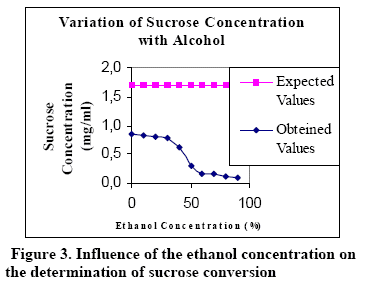
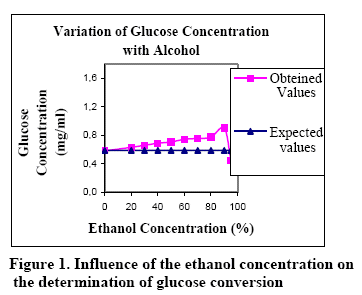
<body><![CDATA[<p align="justify"><font size="2" face="Verdana, Arial, Helvetica, sans-serif"><a href="#f1">Figures 1</a>, <a href="#f2">2</a> and <a href="#f3">3</a> show the relationship between   the ethanol concentration (in the final samples) and   conversion (end concentration of the sugar). </font></p>     <p align="justify"><a name="f1"></a></p>     <p align="center"><img src="/img/revistas/rbq/v23n1/a04_figura_01.gif" width="362" height="295"></p>     <p align="center"><a name="f2"></a></p>     <p align="center"><img src="/img/revistas/rbq/v23n1/a04_figura_02.gif" width="365" height="271"></p>     <p align="center"><a name="f3"></a></p>     <p align="center"><img src="/img/revistas/rbq/v23n1/a04_figura_03.gif" width="365" height="285"></p>     <p align="justify"><font size="2" face="Verdana, Arial, Helvetica, sans-serif">As   shown in the <a href="#f1">Figure 1</a>, the obtained glucose   response varies as a function of the ethanol   concentration. If compared the true values of   glucose concentration (expected values) vs the   obtained response (obtained values), it can be seen   that the difference is not significant (less than 2%)   up to 48% of ethanol in the final sample. As shown   in the <a href="#f2">Figure 2</a>, the obtained maltose response is   more sensitive against the ethanol concentration. If   compared the true values of maltose concentration   (expected values) versus the obtained response   (obtained values), it can be seen that the difference   is not significant (less than 2%) up to 30% of   ethanol in the final sample.</font></p>     <P align="justify"><font size="2" face="Verdana, Arial, Helvetica, sans-serif"> <a href="#f3">Figure 3</a> shows that there is a significant variation between the true values of sucrose (expected values) and the ones obtained by the analysis. This implies that there is a marked influence due to the presence of ethanol even when working at low concentrations. </font></P>     <P align="justify"><b><font size="2" face="Verdana, Arial, Helvetica, sans-serif">Simultaneous analysis of glucose, maltose and sucrose in samples of <i>cassava</i>. </font></b></P>     ]]></body>
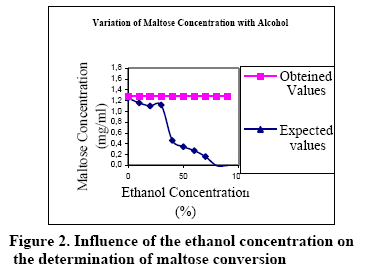
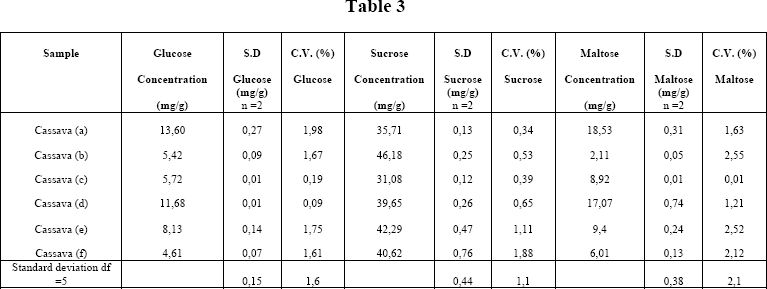
<body><![CDATA[<P align="justify"><font size="2" face="Verdana, Arial, Helvetica, sans-serif">Once the technique was standardized, six varieties of Bolivian <i>cassavas</i> were analyzed; the results are shown in <a href="#t3">Table 3</a></font></P>     <P align="justify"><a name="t3"></a></P>     <P align="center"><img src="/img/revistas/rbq/v23n1/a04_tabla_03.gif" width="767" height="289"></P>     <P align="justify"><font size="2" face="Verdana, Arial, Helvetica, sans-serif"> Therefore, an experimental design (See <a href="#t1">Table 1</a>) was performed to improve the sucrose conversion by modifying the conditions based on changes in incubation temperature, incubation time and initial concentration of the enzyme. </font></P>     <P align="justify"><a name="t1"></a></P>     <P align="center"><img src="/img/revistas/rbq/v23n1/a04_tabla_01.gif" width="389" height="294"></P>     <P align="justify"><font size="2" face="Verdana, Arial, Helvetica, sans-serif">According to <a href="#t1">table 1</a>, the appropriated conditions for the process to achieve best conversions were: </font><font size="2" face="Verdana, Arial, Helvetica, sans-serif">incubation time = 60 minutes, incubation Temperature = 24 &deg;C,V enzyme = 640 &mu;L (150 U/ml), C ethanol = 30%) </font></P>     <P align="justify">&nbsp;</P>     <P align="justify"><font size="2" face="Verdana, Arial, Helvetica, sans-serif"><b><i>Determination of maltose and sucrose concentration </i></b></font></P>     <P align="justify"><font size="2" face="Verdana, Arial, Helvetica, sans-serif"> Based on the experiments and corrections, the sugar concentrations were calculated with the empiric deduced equations of <a href="#t2">Table 2</a>. </font></P>     ]]></body>
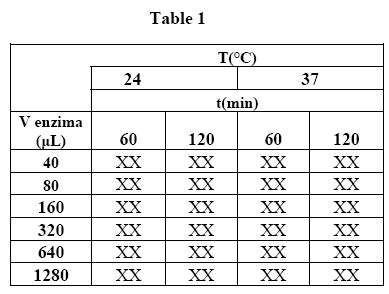
<body><![CDATA[<P align="justify"><a name="t2"></a></P>     <P align="center"><img src="/img/revistas/rbq/v23n1/a04_tabla_02.gif" width="630" height="236"></P>     <p><font size="2" face="Verdana, Arial, Helvetica, sans-serif"></font><font size="2" face="Verdana, Arial, Helvetica, sans-serif"> The results show a high variability in terms of glucose for the six varieties, from 5 to 14 mg/g DM of sample. The content of sucrose varies between 36 and 46 mg/g DM and the content of maltose varies between 2 to 19 mg/g DM </font> </p>     <p><i><b><font size="2" face="Verdana, Arial, Helvetica, sans-serif">   Precision of the method </font> </b></i></p>     <P align="justify"><font size="2" face="Verdana, Arial, Helvetica, sans-serif"> The precision of the method is analyzed from the data in <a href="#t3">Table 3</a>. with 2 replicates, standard deviations and coefficients of variance were calculated for the six varieties of <i>cassava</i>. The standard deviation for glucose is 0.15 mg/g and about twice times higher for sucrose and maltose wich is determined in two steps. The coefficient of error depends very much of the concentration (varies between 1 and 2%) and it is lowest for sucrose, present in a higher amount. </font></P> <b><font size="2" face="Verdana, Arial, Helvetica, sans-serif"> Method Specificity </font></b>     <P align="justify"><font size="2" face="Verdana, Arial, Helvetica, sans-serif"> The </font><font size="2"><font size="3">&alpha;</font></font><font size="2" face="Verdana, Arial, Helvetica, sans-serif">-Glucosidase hydrolyzes the terminal, nonreducing 1,4-linked </font><font size="2"><font size="3">&alpha;</font></font><font size="2" face="Verdana, Arial, Helvetica, sans-serif">-D-glucose residues with release of </font><font size="2"><font size="3">&alpha;</font></font><font size="2" face="Verdana, Arial, Helvetica, sans-serif">-D-glucose <sup>(15)</sup> </font></P>     <p>&nbsp;</p>     <p><b><font size="3" face="Verdana, Arial, Helvetica, sans-serif">EXPERIMENTAL </font></b> </p>     <P align="justify"><font size="2" face="Verdana, Arial, Helvetica, sans-serif"> <b>a) Substrates </b></font></P>     <P align="justify"><font size="2" face="Verdana, Arial, Helvetica, sans-serif"> The varieties of <i>Cassava</i> were: Bobore (a), Noveton (b), Valencia (c), Amarilla (d) and Cambayuca (e).Those come from &ldquo;Estaci&oacute;n Experimental la Jota&rdquo;, located in Chapare -Cochabamba -Bolivia The Bobore (f) sample comes from &ldquo;Chimore. Experimental Plantations&rdquo; IBTA-Chapare It is located in the Municipio de Chimor&eacute; of Chapare to 200 Km of the Cochabamba city). As a reference system potato starch p.a. was used. (Sigma-Aldrich) </font></P> <b><font size="2" face="Verdana, Arial, Helvetica, sans-serif"> b) Equipments </font></b>     ]]></body>
<body><![CDATA[<P align="justify"><font size="2" face="Verdana, Arial, Helvetica, sans-serif"> An analytical balance (Metler Toledo AE160), a water bath (Heto Birker&ouml;d, Type 02 PG623, N&deg; 7912, spectrophotometer (Perkin Elmer UV/VIS Lambda2). </font></P> <b><font size="2" face="Verdana, Arial, Helvetica, sans-serif"> c) Reagents </font></b>     <P align="justify"><font size="2" face="Verdana, Arial, Helvetica, sans-serif"> Reagents: anhydrous D-Glucose, Maltose Sucrose </font><font size="2" face="Verdana, Arial, Helvetica, sans-serif">p.a. Buffer Solutions: Acetate Buffer 0,1 M, pH 6,6, Acetate Buffer 0.1 M, pH 4.6 and Buffer Tris </font><font size="2" face="Verdana, Arial, Helvetica, sans-serif">0.5 M. pH 7. </font></P> <b><font size="2" face="Verdana, Arial, Helvetica, sans-serif"> d) Enzymes </font></b>     <P align="justify">   <font size="2"><font size="3">&alpha;</font></font><font size="2" face="Verdana, Arial, Helvetica, sans-serif">-amylase (Fungamyl 800L) (Novo Nordisk, Copenhagen, Denmark), </font><font size="2"><font size="3">&alpha;</font></font><font size="2" face="Verdana, Arial, Helvetica, sans-serif">-Glycosidase 240 U/ml (Sigma-Aldrich), Invertase 150 U/mg (Sigma-Aldrich) and Glucose Oxidase/peroxidase <sup>(3)</sup>, and Dihydrochloride like stain </font></P>     <b><font size="2" face="Verdana, Arial, Helvetica, sans-serif"> f) Analytical Procedure. </font></b>     <P align="justify"><font size="2" face="Verdana, Arial, Helvetica, sans-serif"> The method basically consists of determinations of the glucose concentration after different steps of the hydrolysis. Glucose concentration was evaluated from samples that contain maltose by using </font><font size="2"><font size="3">&alpha;</font></font><font size="2" face="Verdana, Arial, Helvetica, sans-serif">-glucosidase and sucrose by using invertase. The background concentration of glucose was determined by an initial glucose analyses. </font></P>     <P align="justify"><font size="2" face="Verdana, Arial, Helvetica, sans-serif"> <i><b>Standard Curve</b></i>. Initially, 50 mg of anhydrous Dglucose was dissolved in 1000 mL of ethanol (48%). Dilutions were prepared ranging form 0.01-0.05 mg/mL to obtain the standard curve. 4 mL of glucose oxidase/peroxidase enzyme solution was added then they were incubated for one hour at room temperature (20&deg;C). The wavelength used for the determination was 450 nm. </font></P>     <P align="justify"><font size="2" face="Verdana, Arial, Helvetica, sans-serif"> <i><b>Sample Preparation:</b></i> 1 g of milled vacuum dried sample (particle size&lt; 0.8 mm) ) was suspended in ethanol (46%) to make up 100 ml of suspension, the aim of the alcohol treatment is to precipitate all starch and proteins. The system was extracted in the shaker at room temperature during 40 min. Afterwards the suspension was filtrated by paper media filter 0.22 &micro;m. </font></P>     <P align="justify"><font size="2" face="Verdana, Arial, Helvetica, sans-serif"> <i><b>Glucose Analysis:</b></i> 1 mL of the filtered solution was mixed with 1 mL of buffert (pH 6) and 4 mL of glucose oxidase/peroxidase (5,6 g/100 ml) as described by Holm <sup>(3)</sup>. The mixture was incubated for one hour at room temperature and then the absorbance was read at 450 nm. </font></P>     <P align="justify"><font size="2" face="Verdana, Arial, Helvetica, sans-serif"> <i><b>Maltose Analysis:</b></i> 1 mL of the filtered solution was mixed with 1 mL of acetate buffer pH 6.6 and </font><font size="2" face="Verdana, Arial, Helvetica, sans-serif">0.2 mL of </font><font size="2"><font size="3">&alpha;</font></font><font size="2" face="Verdana, Arial, Helvetica, sans-serif">-glucosidase (240 U/ml), the mix was incubated for one hour at room temperature according to the procedure by Gutmann <sup>(6)</sup>. Afterwards, 0.1 mL of the obtained solution was mixed with 1.9 mL of water and 4 mL of glucose oxidase/peroxidase (5.6 g/100 ml) as described. Holm <sup>(3)</sup>.The incubation process was carried out for one hour at room temperature. The absorbance was read at 450nm. </font></P>     <P align="justify"><font size="2" face="Verdana, Arial, Helvetica, sans-serif"> <i><b>Sucrose Analysis:</b></i> 0.3 mL of the filtered solution was mixed with 1 mL of acetate buffer pH 4.6 and </font><font size="2" face="Verdana, Arial, Helvetica, sans-serif">0.640 mL of invertase (150U/ml), the mixture was incubated for one hour at room temperature; then, </font><font size="2" face="Verdana, Arial, Helvetica, sans-serif">0.5 mL of 0.5 M Tris-buffer pH 9 was added as described by D&ouml;mer <sup>(5)</sup>. Afterwards, 0.6 mL of the obtained solution mixed with 1.4 ml of water and 4 mL of glucose oxidase/peroxidase (5,6 g/100 ml) as described. Holm <sup>(3)</sup>. The incubation process was carried out for one hour at room temperature. The absorbance was read at 450 nm. </font></P> <b><i><font size="2" face="Verdana, Arial, Helvetica, sans-serif"> Interference corrections of the ethanol in the determinations: </font></i></b>     <P align="justify"><font size="2" face="Verdana, Arial, Helvetica, sans-serif"> The samples contain 46% of etanol during the extraction of sugars. It can be assumed that the etanol may inhipit the enzymatic reactions. Thus, the sensitivity of </font><font size="2"><font size="3">&alpha;</font></font><font size="2" face="Verdana, Arial, Helvetica, sans-serif">-glucosidase, invertase and glucose oxidase against ethanol was tested. </font></P> <i><b><font size="2" face="Verdana, Arial, Helvetica, sans-serif"> Improvement on the sucrose conversion: </font></b></i>     ]]></body>
<body><![CDATA[<P align="justify"><font size="2" face="Verdana, Arial, Helvetica, sans-serif"> In order to improve the invertase hydrolysis an experimental design was carried to evaluate the conversion by taking into account the temperature. Incubation time and enzyme concentration are considered as the variables with more influence in the process. </font></P>     <p>&nbsp;</p>     <p><b><font size="3" face="Verdana, Arial, Helvetica, sans-serif">CONCLUSION </font></b> </p>     <P align="justify"><font size="2" face="Verdana, Arial, Helvetica, sans-serif"> The presented method allows for measurements of the content of free glucose, maltose and sucrose in starch rich foods such as <i>cassava</i>. The method is quick, easy and reliable. However, in the analyses, the starch and proteins needs to be precipitated using ethanol. The study showed that the maximum concentration of ethanol to avoid interferences for determining free glucose, maltose and sucrose were 48%, 30%, 30% respectively. The conditions to perform the sucrose analysis need to be adjusted relative to previously published standard conditions <sup>(2)</sup>. </font></P>     <P align="justify">&nbsp;</P>     <P align="justify"><font size="3" face="Verdana, Arial, Helvetica, sans-serif"><b>ACKNOWLEDGEMENTS </b></font></P>     <P align="justify"><font size="2" face="Verdana, Arial, Helvetica, sans-serif"> The study was supported by Swedish International Development Agency (SIDA/SAREC) in the project &ldquo;Desarrollo de nuevos productos y mejoramiento de las tecnolog&iacute;as tradicionales de procesamiento de raices tropicales&rdquo;, between San Simon University (Bolivia) and Lund University (Sweden). </font></P>     <P align="justify">&nbsp;</P>     <P align="justify"><font size="3" face="Verdana, Arial, Helvetica, sans-serif"><b>REFERENCES </b></font></P>      <DT><font size="2" face="Verdana, Arial, Helvetica, sans-serif"> (1) BAUMANN VON G, G. K. &ldquo;Die Bestimmung von Zuckern in Fruchts&auml;ften - ein Vergleinch der enzymatischen mit der Luff - Schoorl Methode.&rdquo; Ind  Obst Gemuserewert, 1971,56, 165-170. </font></DT> <dd>&nbsp;</dd>     ]]></body>
<body><![CDATA[<!-- ref --><DT><font size="2" face="Verdana, Arial, Helvetica, sans-serif"> (2) BERGMEYER, H. U. Methoden der nzymatischen Analyse. Ed. H. U. Bergmeyer, Dieter Oesterhelt Angewandte Chemie International, 1975, Verlag Chemie GmbH, Weinheim</font></DT>     &nbsp;&nbsp;&nbsp;&nbsp;&nbsp;&nbsp;&nbsp;&nbsp;[&#160;<a href="javascript:void(0);" onclick="javascript: window.open('/scielo.php?script=sci_nlinks&ref=660397&pid=S0250-5460200600010000400002&lng=','','width=640,height=500,resizable=yes,scrollbars=1,menubar=yes,');">Links</a>&#160;]<!-- end-ref --><!-- ref --><p><font size="2" face="Verdana, Arial, Helvetica, sans-serif">(3) HOLM, J., BJ&Ouml;RCK, I., DREWS, A., &amp; ASP, N.-G. A rapid method for analysis of starch. Starch/St&auml;rke, 1986, 38 , 224-226. </font>&nbsp;&nbsp;&nbsp;&nbsp;&nbsp;&nbsp;&nbsp;&nbsp;[&#160;<a href="javascript:void(0);" onclick="javascript: window.open('/scielo.php?script=sci_nlinks&ref=660398&pid=S0250-5460200600010000400003&lng=','','width=640,height=500,resizable=yes,scrollbars=1,menubar=yes,');">Links</a>&#160;]<!-- end-ref --><p><font size="2" face="Verdana, Arial, Helvetica, sans-serif">   (4)</font><font size="2" face="Verdana, Arial, Helvetica, sans-serif"> JACK N. DAVIES, RONALD J. KEMPTON &ldquo;Changes in the individual sugars of tomato fruit during ripening.&rdquo; J. Sci. Food Agric, 1975, 26, 1103-1110. </font></p>     <p><font size="2" face="Verdana, Arial, Helvetica, sans-serif">   (5) </font><font size="2" face="Verdana, Arial, Helvetica, sans-serif"> Klaus M. D&ouml;rner &ldquo;Quantitative Determination of lactose, Maltose, and Sucrose in Urine&rdquo; European Journal of Pediatrics 1971, 26 , 45-52. </font></p>     <!-- ref --><p><font size="2" face="Verdana, Arial, Helvetica, sans-serif">   (6)</font><font size="2" face="Verdana, Arial, Helvetica, sans-serif">   GUTMANN, I. Methods of Enzymatic    Analysis.     Ed. HU Bergmeyer - New York: Academic Press,    1974.  </font>&nbsp;&nbsp;&nbsp;&nbsp;&nbsp;&nbsp;&nbsp;&nbsp;[&#160;<a href="javascript:void(0);" onclick="javascript: window.open('/scielo.php?script=sci_nlinks&ref=660401&pid=S0250-5460200600010000400006&lng=','','width=640,height=500,resizable=yes,scrollbars=1,menubar=yes,');">Links</a>&#160;]<!-- end-ref --><p><font size="2" face="Verdana, Arial, Helvetica, sans-serif">   (7)</font><font size="2" face="Verdana, Arial, Helvetica, sans-serif"> HAILA K, K. J., H&Auml;KKINEN U, TAHVONEN R.. &ldquo;Sugar and organic acid contents of vegetables consumed in Finland during 1988-1989.&rdquo; J Food Comp Anal 1992, 5, 100-107. </font></p>     <p><font size="2" face="Verdana, Arial, Helvetica, sans-serif">   (8)</font><font size="2" face="Verdana, Arial, Helvetica, sans-serif">   LEWTHWAITE, S. L. S., K. H.; TRIGGS, C. </font><font size="2" face="Verdana, Arial, Helvetica, sans-serif">   M.</font> <font size="2" face="Verdana, Arial, Helvetica, sans-serif">&ldquo;Free sugars composition of sweet potato cultivars after storage.&rdquo; Crop Hortc. Sci. 1997 25, 33-41. </font></p>     <p><font size="2" face="Verdana, Arial, Helvetica, sans-serif">   (9) </font><font size="2" face="Verdana, Arial, Helvetica, sans-serif"> MOELLERING H, G. W. &ldquo;Determination of citrate with citrate lyase&rdquo;. Anal Bichem, 1996, 17, 369-376. </font></p>     <p><font size="2" face="Verdana, Arial, Helvetica, sans-serif">   (10)</font><font size="2" face="Verdana, Arial, Helvetica, sans-serif"> MOLN&Aacute;R-PERL I, M. M.  &ldquo;Rapid method for the silultaneous GC quantitation of acids and sugars in fruits and vegetables.&rdquo; Food Add Contamin  1992, 9, 505-514. </font></p>     <p><font size="2" face="Verdana, Arial, Helvetica, sans-serif">   (11)</font><font size="2" face="Verdana, Arial, Helvetica, sans-serif"> TAKAHATA, Y. N., T. SATO, T. &ldquo;Changes in carbohydrates and enzyme activities of sweet potato lines during storage.&rdquo; J. Agric. Food Chem. 1995, 43, 1923-1928. </font></p>     ]]></body>
<body><![CDATA[<p><font size="2" face="Verdana, Arial, Helvetica, sans-serif">   (12) JOYCE S. VELTEROP, FEMKE VOS. &ldquo;A Rapid and Inexpensive Microplate Assay for the Enzymatic Determination of Glucose, Fructose, Sucrose, L - Malate and Citrate in Tomato (Lycopersicon esculentum) Extracts and in Orange Juice.&rdquo; Phytochemical Analysis, 2001, 12, 299-304. </font></p>     <p><font size="2" face="Verdana, Arial, Helvetica, sans-serif">   (13) </font><font size="2" face="Verdana, Arial, Helvetica, sans-serif">   Y. H. HUANG, D. H. P., A. W. KILILI, AND </font><font size="2" face="Verdana, Arial, Helvetica, sans-serif">   C.</font><font size="2" face="Verdana, Arial, Helvetica, sans-serif"> E. JOHNSON. &ldquo;Changes in invertase Activities and Reducing Sugar Content in Sweetpotato Stored at Different Temperatures&rdquo; Journal of Agricultural and Food Chemistry, 1999, 47, 4927-4931. </font></p>     <!-- ref --><p><font size="2" face="Verdana, Arial, Helvetica, sans-serif">   (14)</font><font size="2" face="Verdana, Arial, Helvetica, sans-serif"> BECALSKI A, LAU BPY , LEWIS D , </font><font size="2" face="Verdana, Arial, Helvetica, sans-serif">SEAMAN SW , Acrylamide in Foods: Occurrence, </font>&nbsp;&nbsp;&nbsp;&nbsp;&nbsp;&nbsp;&nbsp;&nbsp;[&#160;<a href="javascript:void(0);" onclick="javascript: window.open('/scielo.php?script=sci_nlinks&ref=660409&pid=S0250-5460200600010000400014&lng=','','width=640,height=500,resizable=yes,scrollbars=1,menubar=yes,');">Links</a>&#160;]<!-- end-ref --><!-- ref --><p><font size="2" face="Verdana, Arial, Helvetica, sans-serif">(15) MATSUSAKA, K.; CHIBA, S.; Sources, and Modeling. J.  Agricultural Food SHIMOMURA, T.;Purification and substrate Chem, 2003, 51: 802-808 specificity of brewer's yeast alpha-glucosidase, </font><font size="2" face="Verdana, Arial, Helvetica, sans-serif">Agric. Biol. Chem., 1977, 41, 1917-1923 </font>&nbsp;&nbsp;&nbsp;&nbsp;&nbsp;&nbsp;&nbsp;&nbsp;[&#160;<a href="javascript:void(0);" onclick="javascript: window.open('/scielo.php?script=sci_nlinks&ref=660410&pid=S0250-5460200600010000400015&lng=','','width=640,height=500,resizable=yes,scrollbars=1,menubar=yes,');">Links</a>&#160;]<!-- end-ref --><P align="justify">&nbsp;</P>      ]]></body><back>
<ref-list>
<ref id="B1">
<label>1</label><nlm-citation citation-type="journal">
<person-group person-group-type="author">
<name>
<surname><![CDATA[BAUMANN VON G]]></surname>
<given-names><![CDATA[G. K.]]></given-names>
</name>
</person-group>
<article-title xml:lang="de"><![CDATA[Die Bestimmung von Zuckern in Fruchtsäften - ein Vergleinch der enzymatischen mit der Luff: Schoorl Methode]]></article-title>
<source><![CDATA[Ind Obst Gemuserewert]]></source>
<year>1971</year>
<volume>56</volume>
<page-range>165-170</page-range></nlm-citation>
</ref>
<ref id="B2">
<label>2</label><nlm-citation citation-type="">
<person-group person-group-type="author">
<name>
<surname><![CDATA[BERGMEYER]]></surname>
<given-names><![CDATA[H. U.]]></given-names>
</name>
</person-group>
<article-title xml:lang="de"><![CDATA[Methoden der nzymatischen Analyse]]></article-title>
<person-group person-group-type="editor">
<name>
<surname><![CDATA[Bergmeyer]]></surname>
<given-names><![CDATA[H. U.]]></given-names>
</name>
</person-group>
<source><![CDATA[Dieter Oesterhelt Angewandte, Chemie International]]></source>
<year>1975</year>
<publisher-loc><![CDATA[Verlag ]]></publisher-loc>
</nlm-citation>
</ref>
<ref id="B3">
<label>3</label><nlm-citation citation-type="journal">
<person-group person-group-type="author">
<name>
<surname><![CDATA[HOLM]]></surname>
<given-names><![CDATA[J.]]></given-names>
</name>
<name>
<surname><![CDATA[BJÖRCK]]></surname>
<given-names><![CDATA[I.]]></given-names>
</name>
<name>
<surname><![CDATA[DREWS]]></surname>
<given-names><![CDATA[A.]]></given-names>
</name>
<name>
<surname><![CDATA[ASP]]></surname>
<given-names><![CDATA[N.-G.]]></given-names>
</name>
</person-group>
<article-title xml:lang="en"><![CDATA[A rapid method for analysis of starch]]></article-title>
<source><![CDATA[Starch/Stärke]]></source>
<year>1986</year>
<volume>38</volume>
<page-range>224-226</page-range></nlm-citation>
</ref>
<ref id="B4">
<label>4</label><nlm-citation citation-type="journal">
<person-group person-group-type="author">
<name>
<surname><![CDATA[DAVIES]]></surname>
<given-names><![CDATA[JACK N.]]></given-names>
</name>
<name>
<surname><![CDATA[KEMPTON]]></surname>
<given-names><![CDATA[RONALD J.]]></given-names>
</name>
</person-group>
<article-title xml:lang="en"><![CDATA[Changes in the individual sugars of tomato fruit during ripening]]></article-title>
<source><![CDATA[J. Sci. Food Agric]]></source>
<year>1975</year>
<volume>26</volume>
<page-range>1103-1110</page-range></nlm-citation>
</ref>
<ref id="B5">
<label>5</label><nlm-citation citation-type="journal">
<person-group person-group-type="author">
<name>
<surname><![CDATA[Dörner]]></surname>
<given-names><![CDATA[Klaus M.]]></given-names>
</name>
</person-group>
<article-title xml:lang="en"><![CDATA[Quantitative Determination of lactose, Maltose, and Sucrose in Urine]]></article-title>
<source><![CDATA[European Journal of Pediatrics]]></source>
<year>1971</year>
<volume>26</volume>
<page-range>45-52</page-range></nlm-citation>
</ref>
<ref id="B6">
<label>6</label><nlm-citation citation-type="book">
<person-group person-group-type="author">
<name>
<surname><![CDATA[GUTMANN]]></surname>
<given-names><![CDATA[I.]]></given-names>
</name>
</person-group>
<source><![CDATA[Methods of Enzymatic Analysis]]></source>
<year>1974</year>
<publisher-loc><![CDATA[New York ]]></publisher-loc>
<publisher-name><![CDATA[Academic Press]]></publisher-name>
</nlm-citation>
</ref>
<ref id="B7">
<label>7</label><nlm-citation citation-type="journal">
<person-group person-group-type="author">
<name>
<surname><![CDATA[HAILA K]]></surname>
<given-names><![CDATA[K. J.]]></given-names>
</name>
<name>
<surname><![CDATA[HÄKKINEN]]></surname>
<given-names><![CDATA[U]]></given-names>
</name>
<name>
<surname><![CDATA[TAHVONEN]]></surname>
<given-names><![CDATA[R]]></given-names>
</name>
</person-group>
<article-title xml:lang="en"><![CDATA[Sugar and organic acid contents of vegetables consumed in Finland during 1988-1989]]></article-title>
<source><![CDATA[J Food Comp Anal]]></source>
<year>1992</year>
<volume>5</volume>
<page-range>100-107</page-range></nlm-citation>
</ref>
<ref id="B8">
<label>8</label><nlm-citation citation-type="journal">
<person-group person-group-type="author">
<name>
<surname><![CDATA[LEWTHWAITE]]></surname>
<given-names><![CDATA[S. L. S.]]></given-names>
</name>
<name>
<surname><![CDATA[TRIGGS]]></surname>
<given-names><![CDATA[C. M.]]></given-names>
</name>
</person-group>
<article-title xml:lang="en"><![CDATA[Free sugars composition of sweet potato cultivars after storage]]></article-title>
<source><![CDATA[Crop Hortc. Sci.]]></source>
<year>1997</year>
<volume>25</volume>
<page-range>33-41</page-range></nlm-citation>
</ref>
<ref id="B9">
<label>9</label><nlm-citation citation-type="journal">
<person-group person-group-type="author">
<name>
<surname><![CDATA[MOELLERING H]]></surname>
<given-names><![CDATA[G. W.]]></given-names>
</name>
</person-group>
<article-title xml:lang="en"><![CDATA[Determination of citrate with citrate lyase]]></article-title>
<source><![CDATA[Anal Bichem]]></source>
<year>1996</year>
<volume>17</volume>
<page-range>369-376</page-range></nlm-citation>
</ref>
<ref id="B10">
<label>10</label><nlm-citation citation-type="journal">
<person-group person-group-type="author">
<name>
<surname><![CDATA[MOLNÁR-PERL I]]></surname>
<given-names><![CDATA[M. M.]]></given-names>
</name>
</person-group>
<article-title xml:lang="en"><![CDATA[Rapid method for the silultaneous GC quantitation of acids and sugars in fruits and vegetables]]></article-title>
<source><![CDATA[Food Add Contamin]]></source>
<year>1992</year>
<volume>9</volume>
<page-range>505-514</page-range></nlm-citation>
</ref>
<ref id="B11">
<label>11</label><nlm-citation citation-type="journal">
<person-group person-group-type="author">
<name>
<surname><![CDATA[TAKAHATA]]></surname>
<given-names><![CDATA[Y. N.]]></given-names>
</name>
<name>
<surname><![CDATA[T. SATO]]></surname>
<given-names><![CDATA[T.]]></given-names>
</name>
</person-group>
<article-title xml:lang="en"><![CDATA[Changes in carbohydrates and enzyme activities of sweet potato lines during storage]]></article-title>
<source><![CDATA[J. Agric. Food Chem.]]></source>
<year>1995</year>
<volume>43</volume>
<page-range>1923-1928</page-range></nlm-citation>
</ref>
<ref id="B12">
<label>12</label><nlm-citation citation-type="journal">
<person-group person-group-type="author">
<name>
<surname><![CDATA[VELTEROP]]></surname>
<given-names><![CDATA[JOYCE S.]]></given-names>
</name>
<name>
<surname><![CDATA[FEMKE]]></surname>
<given-names><![CDATA[VOS]]></given-names>
</name>
</person-group>
<article-title xml:lang="en"><![CDATA[A Rapid and Inexpensive Microplate Assay for the Enzymatic Determination of Glucose, Fructose, Sucrose, L - Malate and Citrate in Tomato (Lycopersicon esculentum) Extracts and in Orange Juice]]></article-title>
<source><![CDATA[Phytochemical Analysis]]></source>
<year>2001</year>
<volume>12</volume>
<page-range>299-304</page-range></nlm-citation>
</ref>
<ref id="B13">
<label>13</label><nlm-citation citation-type="journal">
<person-group person-group-type="author">
<name>
<surname><![CDATA[HUANG]]></surname>
<given-names><![CDATA[Y. H.]]></given-names>
</name>
<name>
<surname><![CDATA[A. W. KILILI]]></surname>
<given-names><![CDATA[D. H. P.]]></given-names>
</name>
<name>
<surname><![CDATA[JOHNSON]]></surname>
<given-names><![CDATA[C. E.]]></given-names>
</name>
</person-group>
<article-title xml:lang="en"><![CDATA[Changes in invertase Activities and Reducing Sugar Content in Sweetpotato Stored at Different Temperatures]]></article-title>
<source><![CDATA[Journal of Agricultural and Food Chemistry]]></source>
<year>1999</year>
<volume>47</volume>
<page-range>4927-4931</page-range></nlm-citation>
</ref>
<ref id="B14">
<label>14</label><nlm-citation citation-type="">
<person-group person-group-type="author">
<name>
<surname><![CDATA[BECALSKI]]></surname>
<given-names><![CDATA[A]]></given-names>
</name>
<name>
<surname><![CDATA[LAU]]></surname>
<given-names><![CDATA[BPY]]></given-names>
</name>
<name>
<surname><![CDATA[LEWIS]]></surname>
<given-names><![CDATA[D]]></given-names>
</name>
<name>
<surname><![CDATA[SEAMAN]]></surname>
<given-names><![CDATA[SW]]></given-names>
</name>
</person-group>
<article-title xml:lang="en"><![CDATA[Acrylamide in Foods: Occurrence]]></article-title>
<source><![CDATA[]]></source>
<year></year>
</nlm-citation>
</ref>
<ref id="B15">
<label>15</label><nlm-citation citation-type="journal">
<person-group person-group-type="author">
<name>
<surname><![CDATA[MATSUSAKA]]></surname>
<given-names><![CDATA[K.]]></given-names>
</name>
<name>
<surname><![CDATA[CHIBA]]></surname>
<given-names><![CDATA[S.]]></given-names>
</name>
</person-group>
<article-title xml:lang="en"><![CDATA[Sources, and Modeling]]></article-title>
<source><![CDATA[J. Agricultural Food]]></source>
<year></year>
</nlm-citation>
</ref>
</ref-list>
</back>
</article>