<?xml version="1.0" encoding="ISO-8859-1"?><article xmlns:mml="http://www.w3.org/1998/Math/MathML" xmlns:xlink="http://www.w3.org/1999/xlink" xmlns:xsi="http://www.w3.org/2001/XMLSchema-instance">
<front>
<journal-meta>
<journal-id>0250-5460</journal-id>
<journal-title><![CDATA[Revista Boliviana de Química]]></journal-title>
<abbrev-journal-title><![CDATA[Rev. Bol. Quim]]></abbrev-journal-title>
<issn>0250-5460</issn>
<publisher>
<publisher-name><![CDATA[Universidad Mayor de San Andrés]]></publisher-name>
</publisher>
</journal-meta>
<article-meta>
<article-id>S0250-54602006000100001</article-id>
<title-group>
<article-title xml:lang="en"><![CDATA[SECONDARY METABOLITES FROM CAESALPINIA PLUVIOSA]]></article-title>
</title-group>
<contrib-group>
<contrib contrib-type="author">
<name>
<surname><![CDATA[Flores]]></surname>
<given-names><![CDATA[Yonny]]></given-names>
</name>
<xref ref-type="aff" rid="A01"/>
</contrib>
<contrib contrib-type="author">
<name>
<surname><![CDATA[Vila]]></surname>
<given-names><![CDATA[Jose]]></given-names>
</name>
<xref ref-type="aff" rid="A01"/>
</contrib>
<contrib contrib-type="author">
<name>
<surname><![CDATA[Almanza]]></surname>
<given-names><![CDATA[Giovanna R.]]></given-names>
</name>
<xref ref-type="aff" rid="A01"/>
</contrib>
</contrib-group>
<aff id="A01">
<institution><![CDATA[,Universidad Mayor de San Andrés Carrera de Ciencias Químicas Instituto de Investigaciones Químicas]]></institution>
<addr-line><![CDATA[La Paz ]]></addr-line>
<country>Bolivia</country>
</aff>
<pub-date pub-type="pub">
<day>00</day>
<month>00</month>
<year>2006</year>
</pub-date>
<pub-date pub-type="epub">
<day>00</day>
<month>00</month>
<year>2006</year>
</pub-date>
<volume>23</volume>
<numero>1</numero>
<fpage>1</fpage>
<lpage>8</lpage>
<copyright-statement/>
<copyright-year/>
<self-uri xlink:href="http://www.scielo.org.bo/scielo.php?script=sci_arttext&amp;pid=S0250-54602006000100001&amp;lng=en&amp;nrm=iso"></self-uri><self-uri xlink:href="http://www.scielo.org.bo/scielo.php?script=sci_abstract&amp;pid=S0250-54602006000100001&amp;lng=en&amp;nrm=iso"></self-uri><self-uri xlink:href="http://www.scielo.org.bo/scielo.php?script=sci_pdf&amp;pid=S0250-54602006000100001&amp;lng=en&amp;nrm=iso"></self-uri><abstract abstract-type="short" xml:lang="en"><p><![CDATA[Two phenolic compounds, ethyl gallate and rhuschalcone VI, together with lupeol, betulinic acid and stigmasterol were isolated from the stem bark of Caesalpinia pluviosa D.C. Their structures were determined by spectroscopic means mainly by NMR experiments, completing all the NMR assignments of phenolic compounds. In addition, the extracts and pure compounds were evaluated against the bacteria Staphylococcus aureus, HPIA test and the antimalarial in vitro assay against Plasmodium falciparum, determining that CH2Cl2 extract and rhuschalcone VI showed good activity in the antibacterial and HPIA tests.]]></p></abstract>
<abstract abstract-type="short" xml:lang="es"><p><![CDATA[Dos compuestos fenólicos, galato de etilo y rhuschalcona VI, junto con lupeol, ácido betulínico y estigmasterol fueron aislados de la corteza de Caesalpinia pluviosa DC. Sus estructuras fueron determinadas por medios espectroscópicos, completando todos los asignamientos de RMN de los compuestos fenólicos. Además, los extractos y compuestos puros fueron evaluados contra la bacteria Staphylococcus aureus, la prueba HPIA y el ensayo antimalarico in vitro contra Plasmodium falciparum determinando que el extracto CH2Cl2 y rhuschalcone VI muestran buena actividad en las pruebas antibacterianas y HPIA.]]></p></abstract>
<kwd-group>
<kwd lng="en"><![CDATA[Caesalpinia pluviosa]]></kwd>
<kwd lng="en"><![CDATA[rhuschalcone VI]]></kwd>
<kwd lng="en"><![CDATA[ethyl gallate]]></kwd>
<kwd lng="en"><![CDATA[triterpenes]]></kwd>
<kwd lng="en"><![CDATA[antibacterial]]></kwd>
<kwd lng="en"><![CDATA[antimalarial]]></kwd>
<kwd lng="es"><![CDATA[Caesalpinia pluviosa]]></kwd>
<kwd lng="es"><![CDATA[rhuschalcona VI]]></kwd>
<kwd lng="es"><![CDATA[galato de etilo]]></kwd>
<kwd lng="es"><![CDATA[triterpenos]]></kwd>
<kwd lng="es"><![CDATA[antibacteriano]]></kwd>
<kwd lng="es"><![CDATA[antimalárico]]></kwd>
</kwd-group>
</article-meta>
</front><body><![CDATA[ <p align="right"><font size="2" face="Verdana, Arial, Helvetica, sans-serif"><b>ART&Iacute;CULO ORIGINAL</b></font></p>     <p align="right">&nbsp;</p>     <P align="center"><b><font size="4" face="Verdana, Arial, Helvetica, sans-serif"> SECONDARY METABOLITES FROM<i> CAESALPINIA PLUVIOSA</i> </font></b></P>     <P align="center">&nbsp;</P>     <P align="center">&nbsp; </P>     <P align="center"><font size="2"><b><font face="Verdana, Arial, Helvetica, sans-serif"> Yonny Flores, Jose Vila, Giovanna R. Almanza*</font></b></font></P>     <P align="center"><font size="2" face="Verdana, Arial, Helvetica, sans-serif"> Laboratorio de Productos Naturales, Instituto de Investigaciones Qu&iacute;micas, Carrera de Ciencias Qu&iacute;micas, Universidad Mayor de San Andr&eacute;s, Campus Universitario de Cota Cota c. 27, C. P. 303 La Paz, Bolivia </font>    <br>   <font size="2" face="Verdana, Arial, Helvetica, sans-serif">*Autor corresponsal: <A href="mailto:giovyalmanza@yahoo.com.ar"> giovyalmanza@yahoo.com.ar</A></font></P>     <P align="justify">&nbsp;</P>     <P align="justify">&nbsp;</P> <hr noshade>     ]]></body>
<body><![CDATA[<P align="justify"><font size="2" face="Verdana, Arial, Helvetica, sans-serif"><b>ABSTRACT </b></font></P>       <P align="justify"><font size="2" face="Verdana, Arial, Helvetica, sans-serif"> Two phenolic compounds, ethyl gallate and rhuschalcone VI, together with lupeol, betulinic acid and stigmasterol were isolated from the stem bark of <i>Caesalpinia pluviosa</i> D.C. Their structures were determined by spectroscopic means mainly by NMR experiments, completing all the NMR assignments of phenolic compounds. </font></P>     <P align="justify"><font size="2" face="Verdana, Arial, Helvetica, sans-serif"> In addition, the extracts and pure compounds were evaluated against the bacteria <i>Staphylococcus aureus</i>, HPIA test and the antimalarial <i>in vitro</i> assay against <i>Plasmodium falciparum</i>, determining that CH<Sub>2</Sub>Cl<Sub>2</Sub> extract and rhuschalcone VI showed good activity in the antibacterial and HPIA tests. </font></P>     <P align="justify"><font size="2" face="Verdana, Arial, Helvetica, sans-serif"><b>Key words:</b> <i>Caesalpinia pluviosa</i>, rhuschalcone VI, ethyl gallate, triterpenes, antibacterial, antimalarial.</font></P> <hr noshade>     <P align="justify"><font size="2" face="Verdana, Arial, Helvetica, sans-serif"><b>RESUMEN </b></font></P>     <P align="justify"><font size="2" face="Verdana, Arial, Helvetica, sans-serif"> Dos compuestos fen&oacute;licos, galato de etilo y rhuschalcona VI, junto con lupeol, &aacute;cido betul&iacute;nico y estigmasterol fueron aislados de la corteza de <i>Caesalpinia pluviosa</i> DC. Sus estructuras fueron determinadas por medios espectrosc&oacute;picos, completando todos los asignamientos de RMN de los compuestos fen&oacute;licos. </font></P>     <P align="justify"><font size="2" face="Verdana, Arial, Helvetica, sans-serif"> Adem&aacute;s, los extractos y compuestos puros fueron evaluados contra la bacteria <i>Staphylococcus aureus</i>, la prueba HPIA y el ensayo antimalarico <i>in vitro</i>  contra <i>Plasmodium falciparum</i> determinando que el extracto CH<Sub>2</Sub>Cl<Sub>2 </Sub>y rhuschalcone VI muestran buena actividad en las pruebas antibacterianas y HPIA. </font></P>     <P align="justify"><font size="2" face="Verdana, Arial, Helvetica, sans-serif"> <b>Palabras claves:</b> <i>Caesalpinia pluviosa</i>, rhuschalcona VI, galato de etilo, triterpenos, antibacteriano, antimal&aacute;rico </font></P> <hr noshade>     <P align="justify">&nbsp;</P>     <P align="justify">&nbsp;</P>     ]]></body>
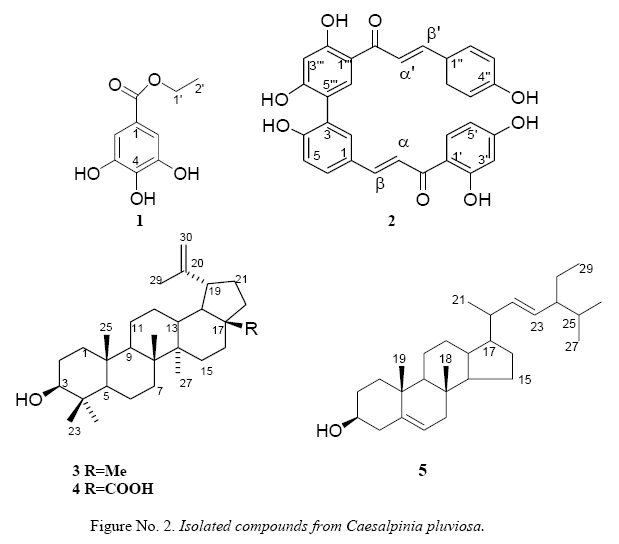
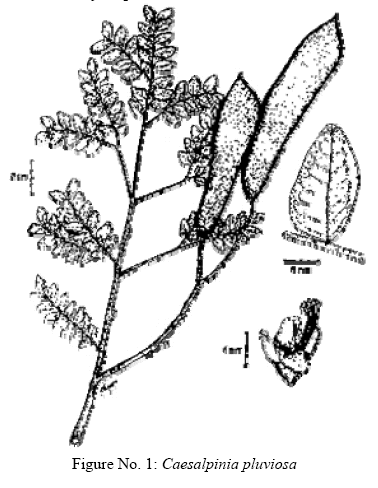
<body><![CDATA[<P align="justify"><font size="3" face="Verdana, Arial, Helvetica, sans-serif"> <b>INTRODUCTION</b> </font></P>     <P align="justify"><font size="2" face="Verdana, Arial, Helvetica, sans-serif"> <i>Caesalpiniaceae</i> is a large family distributed throughout Bolivia; it includes 26 genus with approximately 76 species <sup>[1]</sup>. <i>Caesalpinia pluviosa</i> D.C. is a tree that can grow until 20 meters tall, that is found in the Amazonian part of Bolivia. The decoction of its stem bark is used in the Bolivian folk medicine as a remedy for diarrhea <sup>[2]</sup>. According to literature, several <i>Caesalpinia</i> species have been studied phytochemically and pharmacologically, yielding cassane type diterpenes <sup>[3],[4],[5],[6]</sup> flavonoids <sup>[7],[8]</sup>, biflavonoids <sup>[9]</sup> and tannins.<sup>[10]</sup> </font></P>     <P align="justify"><font size="2" face="Verdana, Arial, Helvetica, sans-serif"> In this paper, we report the isolation and structural elucidation of two phenolic compounds, ethyl gallate (<b>1</b>) and rhuschalcone VI (<b>2</b>) from the stem bark of C. <i>pluviosa</i>, completing all their NMR assignments. In addition, we determine the presence of three triterpenic compounds: lupeol (<b>3</b>), betulinic acid (<b>4</b>) and stigmasterol (<b>5</b>), metabolites widely distributed in the Plant Kingdom. Finally, continuing the research of antibacterial and antimalarial natural products from Bolivian Plants, the extracts and pure compounds were evaluated against <i>Staphylococcus aureus</i>, <i>Plasmodium falciparum</i> and HPIA test.  </font></P>     <P align="center"><font size="2"><a name="f1" id="f1"></a></font></P>     <P align="center"><font size="2"><img src="/img/revistas/rbq/v23n1/a01_figura_01.gif" width="378" height="488"></font></P>     <P align="center"><a name="f2"></a></P>     <P align="center"><img src="/img/revistas/rbq/v23n1/a01_figura_02.gif" width="619" height="544"></P>     <P align="justify">&nbsp;</P>       <P align="justify"><font size="3" face="Verdana, Arial, Helvetica, sans-serif"> <b>RESULTS AND DISCUSSION </b></font></P>     <P align="justify"><font size="2" face="Verdana, Arial, Helvetica, sans-serif"> 1.67 kg of milled dried stem bark of C. <i>pluviosa</i> was extracted successively with petroleum ether and ethanol. The concentrated EtOH extract was further extracted with CH<Sub>2</Sub>Cl<Sub>2</Sub>: MeOH (9:1). Ethyl gallate (<b>1</b>) and rhuschalcone VI (<b>2</b>) were isolated from the CH<Sub>2</Sub>Cl<Sub>2</Sub>:MeOH fraction following diverse chromatographic techniques for instance flash chromatography, preparative chromatography and gel filtration. Lupeol (<b>3</b>), betulinic acid (<b>4</b>) and stigmasterol (<b>5</b>), were isolated from the petroleum ether extract. The structures of all compounds were established by spectroscopic means. For the triterpenoids and sterol the spectroscopic data were compared with those reported in the literature. </font></P>     ]]></body>
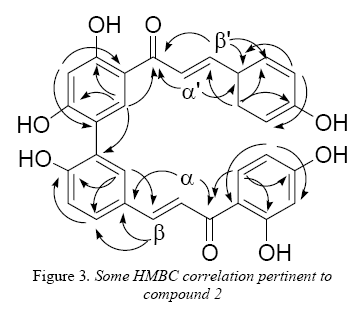
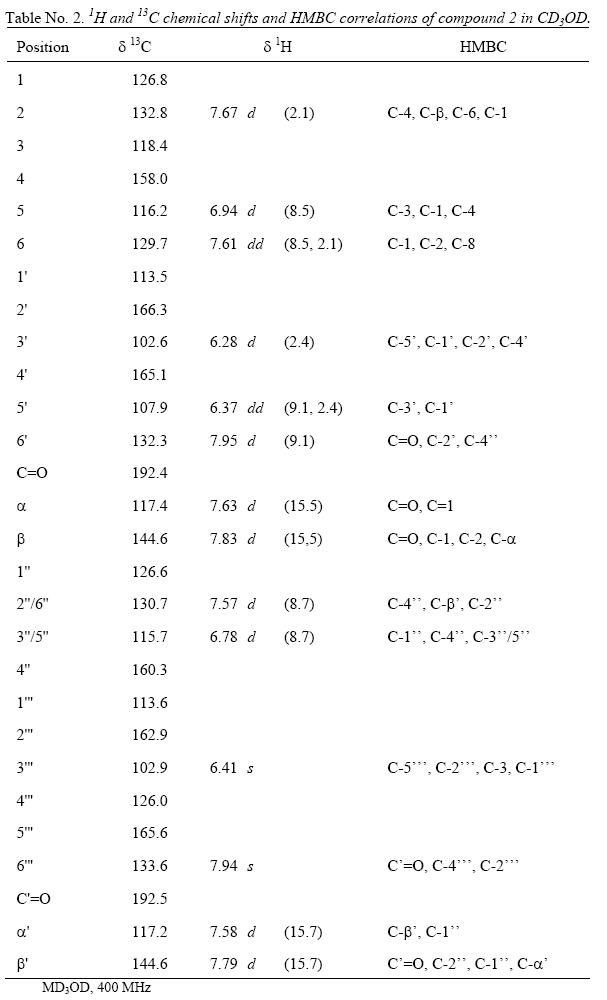
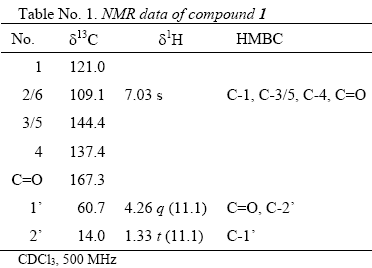
<body><![CDATA[<P align="justify"><font size="2" face="Verdana, Arial, Helvetica, sans-serif">Compound (<b>1</b>) was isolated as a white amorphous powder, and the molecular formula C<Sub>9</Sub>H<Sub>10</Sub>O<Sub>5 </Sub>was assigned by MS (<i>m/z</i> 199.1337, [M+H]<Sup>+</Sup>; calc. 199.0606) which is in agreement with the 1D NMR data. The <Sup>13</Sup>C NMR spectrum (<a href="#t1">Table No. 1</a>) exhibited 9 signals: one carbonyl, two aliphatic carbons and 6 aromatic carbons, three of them between 135 and 145 ppm suggesting a phenolic derivative. The <Sup>1</Sup>H NMR spectrum showed one aromatic signal at 7.03 ppm (2H, s) which suggest an aromatic system tetrasubstituted, two aliphatic protons at 4.26 ppm (2 H, <i>q</i>, 11.1 Hz) from a methylene group and at 1.33 ppm one aliphatic methyl group (3H, <i>t</i>, 11.1 Hz), both groups have correlation each other (<a href="#t1">Table No. 1</a>). Based on this data we suggested the structure of (<b>4</b>) which was confirmed by 2D NMR experiments. The HMBC experiment showed, among others, the correlation of the proton at 7.03 ppm with the aromatic carbons at 121.0 ppm, 144.4 ppm 137.4 ppm and with THE carboxyl carbon at 167.3 ppm. In addition, the correlation of the proton at 4.26 ppm with the carboxyl carbon joins the aliphatic system with the aromatic part, confirming that the molecule is ethyl gallate.  </font></P>     <P align="justify"><font size="2"><a name="t1" id="t1"></a></font></P>     <P align="center"><font size="2"><img src="/img/revistas/rbq/v23n1/a01_tabla_01.gif" width="372" height="268"></font></P>     <P align="justify">&nbsp;</P>     <P align="justify"><font size="2" face="Verdana, Arial, Helvetica, sans-serif">Compound (<b>2</b>) was isolated as a yellow powder, the HREIMS showed a molecular ion at <i>m/z</i> 511.1342 [M-H<Sup>+</Sup>]; calc. for 511.1387 which was consistent with the molecular formula C<Sub>30</Sub>H<Sub>22</Sub>O<Sub>10</Sub>. The <Sup>13</Sup>C NMR spectrum exhibited 30 signals: two carbonyls, and 28 olefinic and aromatic carbons, suggesting a biflavonoid structure <sup>[11]</sup>. The <Sup>1</Sup>H NMR spectrum together with the <Sup>1</Sup>H-<Sup>1</Sup>H COSY experiment allowed the identification of two set of <i>trans</i>-alkenes [<font face="Georgia, Times New Roman, Times, serif">&delta;</font> 7.83 (1H, <i>d</i>, 15.5 Hz) and 7.62 (1H, <i>d</i>, 15.5 Hz)] and [<font face="Georgia, Times New Roman, Times, serif">&delta;</font> 7.78 (1H, <i>d</i>, 15.7 Hz) and 7.58 (1H, <i>d</i>, 15.7 Hz)], one 4-oxyphenyl groups [<font face="Georgia, Times New Roman, Times, serif">&delta;</font> 7.56 (2H, <i>d</i>, 8.7 Hz), 6.78 (2H, <i>d</i>, 8.7 Hz)]; one 2,4-dioxyphenyl group [<font face="Georgia, Times New Roman, Times, serif">&delta;</font> 7.94 (1H, <i>d</i>, 9.0 Hz), 6.37 (1H, <i>dd</i>, 9.0, 2.4 Hz.), 6.27 (1H, <i>d</i>, 2.4 Hz)]; one tri-substituted aromatic rings [<font face="Georgia, Times New Roman, Times, serif">&delta;</font> 6.94 (1H, <i>d</i>, 8.5 Hz), 7.60 (1H, <i>dd</i>, 8.5, 2.1 Hz), 7.67 (1H, <i>d</i>, 2.1 Hz)]; and one tetra-substituted aromatic ring [<font face="Georgia, Times New Roman, Times, serif">&delta;</font> 7.95 (1H, <i>s</i>), 6.41 (1H, <i>s</i>)], the <Sup>1</Sup>H and <Sup>13</Sup>C NMR spectra are showed in <a href="#f3">Figure 3</a>. Full assignments of the proton and carbon NMR signals were made by use of HMQC and HMBC spectra to confirm the structure as rhuschalcone VI, previously reported by Mdee <i>et al</i>. <sup>[12]</sup>, Some  HMBC correlation are showed in the <a href="#f3">Figure 3</a>. </font></P>     <P align="justify"><font size="2"><a name="f3"></a></font></P>     <P align="center"><font size="2"><img src="/img/revistas/rbq/v23n1/a01_figura_03.gif" width="364" height="312"></font></P>     <P align="center"><a name="f4"></a></P>     <P align="center"><img src="/img/revistas/rbq/v23n1/a01_figura_04.gif" width="713" height="671"></P>     <P align="center"><a name="t2"></a></P>     ]]></body>
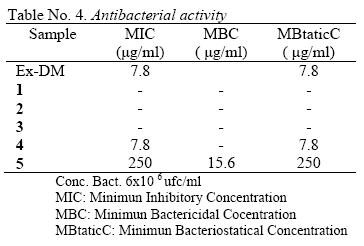
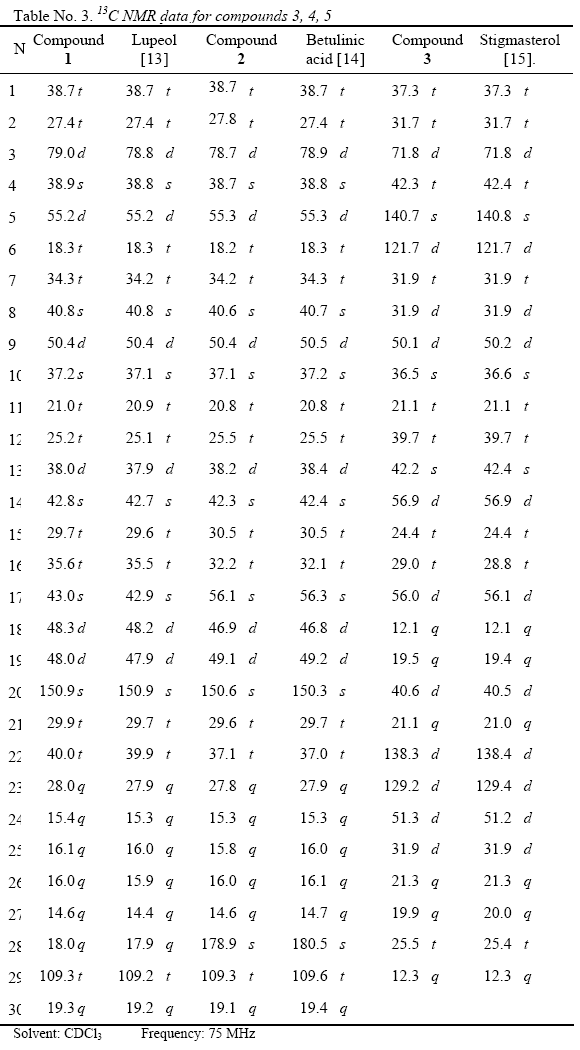
<body><![CDATA[<P align="center"><img src="/img/revistas/rbq/v23n1/a01_tabla_02.gif" width="607" height="1000"></P>     <P align="justify">&nbsp;</P>     <P align="justify"><font size="2" face="Verdana, Arial, Helvetica, sans-serif"> The comparison of physical and spectroscopic data for (<b>3</b>), (<b>4</b>), and (<b>5</b>) with those from literature made possible their identification as lupeol, betulinic acid and stigmasterol. <a href="#t3">Table No. 3</a> shows the comparison of the <Sup>13</Sup> C NMR data with those of the literature. </font></P>     <P align="justify"><font size="2"><a name="t3"></a></font></P>     <P align="center"><font size="2"><img src="/img/revistas/rbq/v23n1/a01_tabla_03.gif" width="580" height="1050"></font></P>       <P align="justify">&nbsp;</P>     <P align="justify"><font size="2" face="Verdana, Arial, Helvetica, sans-serif"> The antibacterial activity for dichloromethane extract and pure compounds was evaluated against <i>Staphylococcus aureus</i> (<a href="#t4">Table No. 4</a>). The results show that the compound <b>4</b> showed some bacteriostatic activity against <i>S. aureus</i>.  </font></P>     <P align="justify"><font size="2"><a name="t4"></a></font></P>     <P align="center"><font size="2"><img src="/img/revistas/rbq/v23n1/a01_tabla_04.gif" width="364" height="246"></font></P>     <P align="justify"><font size="2" face="Verdana, Arial, Helvetica, sans-serif">In addition, in a previous study <sup>[16]</sup> the stem bark ethanolic extract of <i>Caesalpinia pluviosa</i> D.C. showed activity on Chloroquine-resistant D2 strain of <i>P. falciparum</i> (IC<sub>50</sub> 15 &mu;g:ml against F32 strain and IC<sub>50</sub> 8.3 &mu;g:ml against D2 strain). </font></P>     ]]></body>
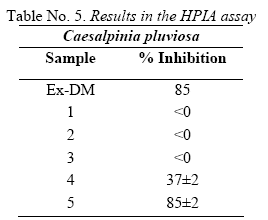
<body><![CDATA[<P align="justify"><font size="2" face="Verdana, Arial, Helvetica, sans-serif">In our study the dichloromethane fraction belonged of EtOH extract and pure compounds were tested in the haem polymerization inhibitory activity HPIA assay, a test used to follow the antimalarial activity <sup>[17]</sup>. <a href="#t5">Table No. 5</a> shows interesting RESULTS in the crude extract and compound <b>5</b>. </font></P>     <P align="justify"><font size="2"><a name="t5"></a></font></P>     <P align="center"><font size="2"><img src="/img/revistas/rbq/v23n1/a01_tabla_05.gif" width="268" height="220"></font></P>     <P align="justify">&nbsp;</P>     <P align="justify"><font size="2" face="Verdana, Arial, Helvetica, sans-serif">Finally based on the HPIA results the dichloromethane extract and compound 5 were tested against <i>Plasmodium falciparum</i> <i>in vitro</i>. Unfortunately the results show that the compound <b>5</b> is inactive as well as the extract. (<a href="#t6">Table No. 6</a>) </font></P>     <P align="justify"><font size="2"><a name="t6"></a></font></P>     <P align="center"><font size="2"><img src="/img/revistas/rbq/v23n1/a01_tabla_06.gif" width="347" height="191"></font></P>     <P align="justify">&nbsp;</P>     <P align="justify"><font size="3" face="Verdana, Arial, Helvetica, sans-serif"><b>EXPERIMENTAL  </b></font></P>     <P align="justify"><font size="2" face="Verdana, Arial, Helvetica, sans-serif"> The melting points (uncorrected) were recorded on a Sanyo Gallenkamp Melting Point Apparatus. Mass spectra (HREIMS) were measured in a Waters Micromass Q-TOF apparatus. <Sup>1</Sup>H and <Sup>13</Sup>C NMR spectra were recorded with a Varian 300 and two-dimensional experiments were done in a Bruker 500 using as solvents CDCl<Sub>3</Sub> and MD<Sub>3</Sub>OD; chemical shifts are reported in <font face="Georgia, Times New Roman, Times, serif">&delta;</font> units (ppm) and coupling constants (J) in Hz. Sephadex LH-20 was used for gel filtration; Silica gel (E.M. Merck,70-230 mesh) and silica gel G-60 (E.M. Merck) were used for Chromatography Column (CC) and Vacuum Liquid Chromatography (VLC), respectively, while aluminum plates impregnated with silica gel 60 F<Sub>254</Sub> (E.M. Merck) were used for analytical (0.25 mm) Thin Layer Chromatography (TLC) analyses. Spots on chromatograms were detected under UV light (254 and 365 nm) and by spraying the plates with 10% H<Sub>2</Sub>SO<Sub>4</Sub>, followed by heating. </font></P>     ]]></body>
<body><![CDATA[<P align="justify"><font size="2" face="Verdana, Arial, Helvetica, sans-serif"> <b>Plant material</b> The stem bark of <i>Caesalpinia pluviosa</i> D.C. was collected in September 1998 at San Buenaventura (North of La Paz, Bolivia) and identified by Lic. Lia de Michel, a botanist of the Bolivian National Herbarium (La Paz, Bolivia) where a voucher specimen is kept. </font></P>     <P align="justify"><font size="2" face="Verdana, Arial, Helvetica, sans-serif"> <b>Extraction and Isolation.</b> The dry and ground plant material (1667 g) was first extracted with 3 L of petroleum ether for 72 h at room temperature, the solution was filtered off and evaporated to yield the petroleum ether extract. The solid residue was macerated for 72 hours with 3 L ethanol, which after filtering and evaporation of the solvent gave the ethanolic extract. Finally, the ethanolic extract was extracted with 150 mL of a mixture (CH<Sub>2</Sub>Cl<Sub>2</Sub>:MeOH 9:1) this process was done for 4 times giving the CH<Sub>2</Sub>Cl<Sub>2</Sub> extract. The petroleum ether extract (6,7 g) was subjected to VLC on silica gel, eluting with increasing amounts of CH<Sub>2</Sub>Cl<Sub>2</Sub> in petroleum ether, followed by increased amounts of MeOH in CH<Sub>2</Sub>Cl<Sub>2</Sub> finalizing with MeOH, to give nine main fractions. Fractions 3, 4 and 5 where submitted to other chromatography techniques followed by recrystallization with MeOH giving the compounds <b>1</b> (22.3 mg), <b>2</b> (17.9 mg) and <b>3</b> (37.2 mg). The CH<Sub>2</Sub>Cl<Sub>2</Sub> extract was also submitted to a chromatographic analysis by VLC on silica gel followed by gel filtration on Sephadex LH-20 (CH<Sub>2</Sub>Cl<Sub>2</Sub>:MeOH 50% as eluent)  giving two compounds in pure form, compound <b>4</b> (20 mg) and compound <b>5</b> (45 mg).  </font></P>     <P align="justify"><font size="2" face="Verdana, Arial, Helvetica, sans-serif"> Compound <b>1</b> (Ethyl galleate) White crystals of mp. 213-215&ordm;C, <Sup>1</Sup>H and <Sup>13</Sup> C NMR see <a href="#t1">Table No. 1</a>.  </font></P>     <P align="justify"><font size="2" face="Verdana, Arial, Helvetica, sans-serif"> Compound <b>2</b> (Rhuschalcone VI) Amorphous yellow solid, mp 184-186&deg;C, <Sup>1</Sup>H and <Sup>13</Sup> C NMR see <a href="#t2">Table No. 2</a>. HREIMS <i>m/z</i> 511.1342, calc. for C<Sub>30</Sub>H<Sub>22</Sub>O<Sub>9</Sub>+H, 511.1387.</font></P>     <P align="justify"><font size="2" face="Verdana, Arial, Helvetica, sans-serif"> Compound <b>3</b> (Lupeol) White crystals of mp 214-216&deg;C, <Sup>1</Sup>H NMR (CDCl<Sub>3</Sub>, 500 MHz) <font face="Georgia, Times New Roman, Times, serif">&delta;</font> 4.57 <i>d</i> &amp; 4.69 d (H-29<Sub>A</Sub> and H-29<sub>B</sub>); 3.19 <i>dd</i> (H-3); 2.35 <i>ddd</i> (H-19); 1.89 <i>m</i> (H-13); 1.68 s (H-30); 1.03 <i>s</i> (H-26); 0.97 <i>s</i> (H-23); 0.94 <i>s</i> (H-27); 0.83 <i>s</i> (H-25); 0.79 <i>s</i> (H-24); 0.76 <i>s</i> (H-28) and 0.68 <i>t</i> (H-5).  C NMR see <a href="#t3">Table No. 3</a>. <Sup>13</Sup></font></P>     <P align="justify"><font size="2" face="Verdana, Arial, Helvetica, sans-serif"> Compound <b>4</b> (Betulinic acid) White crystals of mp. 316-318&ordm;C, <Sup>1</Sup>H NMR (CDCl<Sub>3</Sub>, 500 MHz) <font face="Georgia, Times New Roman, Times, serif">&delta;</font> 3.17 <i>dd</i> (H-3); 3.01 <i>m</i> (H-19); 0.94 <i>s</i> (H-23); 0.75 <i>s</i> (H-24); 0.85 <i>s</i> (H-25); 0.96 <i>s</i> (H-26); 1.00 <i>s</i> (H-27); 4.73 <i>d</i> (H-29<Sub>A</Sub>); 4.60 <i>d</i> (H-29<sub>B</sub>) and 1.69 <i>s</i> (H-30).  C NMR see <a href="#t3">Table No. 3</a>. <Sup>13</Sup></font></P>     <P align="justify"><font size="2" face="Verdana, Arial, Helvetica, sans-serif"> Compound <b>5</b> (Stigmasterol) White crystals of mp. 165-167&ordm;C, <Sup>1</Sup>H NMR (CDCl<Sub>3</Sub>, 500 MHz) <font face="Georgia, Times New Roman, Times, serif">&delta;</font> 3.52 <i>m</i> (H-3); 5.35 <i>d</i> (H-6); 0.67 <i>s</i> (H-18); 1.00 <i>s</i> (H-19); 0.92 <i>d</i> (H-21); 5.15 <i>m</i> (H-22); 5.01 <i>m</i> (H-23); 1.47 <i>m</i> (H-25); 0.86 <i>d</i> (H-26); 0.79 <i>d</i> (H-27) and 0.84 <i>d</i> (H-29). <Sup>13</Sup> C NMR see <a href="#t3">Table No. 3</a>. </font></P>     <P align="justify" ID="LinkTarget_273"><font size="2" face="Verdana, Arial, Helvetica, sans-serif"> <b>Parasites</b> </font></P>     <P align="justify"><font size="2" face="Verdana, Arial, Helvetica, sans-serif"> For the antimalarial <i>in vitro</i> evaluation, two strains of <i>Plasmodium falciparum</i>, F32 (sensible to chloroquine) and D2 (resistant to chloroquine), were used. </font></P>     <P align="justify" ID="LinkTarget_275"><font size="2" face="Verdana, Arial, Helvetica, sans-serif"> <b>Microorganisms </b></font></P>     ]]></body>
<body><![CDATA[<P align="justify"><font size="2" face="Verdana, Arial, Helvetica, sans-serif"> The antibacterial activity was tested against <i>Staphylococcus aureus</i> (ATCC-25923/6538). </font></P>     <P align="justify" ID="LinkTarget_277"><font size="2" face="Verdana, Arial, Helvetica, sans-serif"> <b>Biological tests </b></font></P>     <P align="justify"><font size="2" face="Verdana, Arial, Helvetica, sans-serif"> Methodologies employed for <i>in vitro</i> assays against protozoa are given in full details in a previous paper <sup>[16]</sup>. The protocol for HPIA test is described in <sup>[17]</sup>. The bacterial assays was done by dilution and the protocol is described in Gimenez <i>et al</i>., 1996 <sup>[18]</sup>. </font></P>     <P align="justify"><font size="2" face="Verdana, Arial, Helvetica, sans-serif"> <b>Minimal Inhibitory Concentration (MIC) </b></font></P>     <P align="justify"><font size="2" face="Verdana, Arial, Helvetica, sans-serif"> The MIC was determined by a microdilution technique using the Mueller Hinton (MHB-DIFCO) broth. The dilutions were prepared from a solution of 2 mg/ml where we added a bacterial population of 6x10<Sup>6</Sup> ufc/ml of each microorganism, placing in the microplate controls of bacterial growth (solvent and antibiotic). The plates were incubates at 37 &deg;C for16-18 hrs, after this period the plates was examined visually. The MIC is considered the lowest concentration of the sample that prevents visible growth. </font></P>     <P align="justify"><font size="2" face="Verdana, Arial, Helvetica, sans-serif"> Minimal Bactericidal Concentration (MBC) and Minimal Bacteriostatic Concentration (MbtaticaC) were determined by sub-culturing the negative samples of the previous technique. Since the bactericidal substances not always sterilize totally a bacterial population, the minimal concentration of the bacteriological agent that allows surviving less than 0.1% of original inocule is denominates Minimal Bactericidal Concentration (MBC). MBstaticC is defined as the lowest concentration that avoid the grow of the bacteria without sterilize the bacterial population [18]. </font></P>     <P align="justify">&nbsp;</P>     <P align="justify"><font size="3" face="Verdana, Arial, Helvetica, sans-serif"> <b>ACKNOWLEDGEMENTS </b></font></P>     <P align="justify"><font size="2" face="Verdana, Arial, Helvetica, sans-serif"> The authors are gratefully acknowledged to the Swedish Agency for International Development Cooperation (SIDA/Sarec) for the financial support of phytochemical studies; FONAMA (Fondo Nacional para el Medio Ambiente) for the financial support of the field trip and biological assays; Barcelona University and Lund University for the NMR spectra; IBBA (Instituto Boliviano de Biolog&iacute;a de la Altura) for the antibacterial assays; IIFB (Instituto de Investigaciones Qu&iacute;micas) for the antibacterial assays; LPB (Herbario Nacional de Bolivia) for the identification of plant material and IRD (Francoise Institute of Research for the Development) for the HPIA evaluation and recollection of plant material. </font></P>       <P align="justify">&nbsp;</P>     ]]></body>
<body><![CDATA[<P align="justify"><font size="3" face="Verdana, Arial, Helvetica, sans-serif"> <b>REFERENCES</b></font></P>     <!-- ref --><P align="justify"><font size="2" face="Verdana, Arial, Helvetica, sans-serif">[1]  Killeen, T., Garcia, E. and Beck, S., <i>Gu&iacute;a de &aacute;rboles de Bolivia</i> (1993), 395. </font>&nbsp;&nbsp;&nbsp;&nbsp;&nbsp;&nbsp;&nbsp;&nbsp;[&#160;<a href="javascript:void(0);" onclick="javascript: window.open('/scielo.php?script=sci_nlinks&ref=660859&pid=S0250-5460200600010000100001&lng=','','width=640,height=500,resizable=yes,scrollbars=1,menubar=yes,');">Links</a>&#160;]<!-- end-ref --><!-- ref --><P align="justify"><font size="2" face="Verdana, Arial, Helvetica, sans-serif"> [2] Bourdy G., La Paz: FONAMA 2000. </font>&nbsp;&nbsp;&nbsp;&nbsp;&nbsp;&nbsp;&nbsp;&nbsp;[&#160;<a href="javascript:void(0);" onclick="javascript: window.open('/scielo.php?script=sci_nlinks&ref=660860&pid=S0250-5460200600010000100002&lng=','','width=640,height=500,resizable=yes,scrollbars=1,menubar=yes,');">Links</a>&#160;]<!-- end-ref --><!-- ref --><P align="justify"><font size="2" face="Verdana, Arial, Helvetica, sans-serif"> [3] McPherson, D. D., Che, C.-T., Cordell G. A., Soejarto D. D., Pezzuto J. M. and Fong H. H. S.,  <i>Phytochemistry</i> (1986), 25, 167. </font>&nbsp;&nbsp;&nbsp;&nbsp;&nbsp;&nbsp;&nbsp;&nbsp;[&#160;<a href="javascript:void(0);" onclick="javascript: window.open('/scielo.php?script=sci_nlinks&ref=660861&pid=S0250-5460200600010000100003&lng=','','width=640,height=500,resizable=yes,scrollbars=1,menubar=yes,');">Links</a>&#160;]<!-- end-ref --><!-- ref --><P align="justify"><font size="2" face="Verdana, Arial, Helvetica, sans-serif"> [4] Kitagawa, I., Simanjuntak, P., Watano, T., Shibuya, H., Fujii, S.,Yamagata, Y., and Kobayashi, M., <i>Chem. Pharm. Bull</i> (1994), 42, 1798. </font>&nbsp;&nbsp;&nbsp;&nbsp;&nbsp;&nbsp;&nbsp;&nbsp;[&#160;<a href="javascript:void(0);" onclick="javascript: window.open('/scielo.php?script=sci_nlinks&ref=660862&pid=S0250-5460200600010000100004&lng=','','width=640,height=500,resizable=yes,scrollbars=1,menubar=yes,');">Links</a>&#160;]<!-- end-ref --><!-- ref --><P align="justify"><font size="2" face="Verdana, Arial, Helvetica, sans-serif"> [5] Roach J. S., McLean S., Reynolds W. F. and Tinto W. F., <i>J. Nat. Prod.</i> (2003), 66, 1378-1381.</font>&nbsp;&nbsp;&nbsp;&nbsp;&nbsp;&nbsp;&nbsp;&nbsp;[&#160;<a href="javascript:void(0);" onclick="javascript: window.open('/scielo.php?script=sci_nlinks&ref=660863&pid=S0250-5460200600010000100005&lng=','','width=640,height=500,resizable=yes,scrollbars=1,menubar=yes,');">Links</a>&#160;]<!-- end-ref --><!-- ref --><P align="justify"><font size="2" face="Verdana, Arial, Helvetica, sans-serif"> [6] Awale, S., Linn, T. Z., Tezuka, Y., Kalauni, S. K., Hari, B. A., Attamimi, F., Ueda, J. Y., and Kadota, S., <i>Chem. Pharm. Bull</i> (2006), 54(2) 213. </font>&nbsp;&nbsp;&nbsp;&nbsp;&nbsp;&nbsp;&nbsp;&nbsp;[&#160;<a href="javascript:void(0);" onclick="javascript: window.open('/scielo.php?script=sci_nlinks&ref=660864&pid=S0250-5460200600010000100006&lng=','','width=640,height=500,resizable=yes,scrollbars=1,menubar=yes,');">Links</a>&#160;]<!-- end-ref --><!-- ref --><P align="justify"><font size="2" face="Verdana, Arial, Helvetica, sans-serif"> [7] Namikoshi, M., Nakata, H., and Saitoh, T., <i>Phytochemistry</i> (1987), 26, 1831. </font>&nbsp;&nbsp;&nbsp;&nbsp;&nbsp;&nbsp;&nbsp;&nbsp;[&#160;<a href="javascript:void(0);" onclick="javascript: window.open('/scielo.php?script=sci_nlinks&ref=660865&pid=S0250-5460200600010000100007&lng=','','width=640,height=500,resizable=yes,scrollbars=1,menubar=yes,');">Links</a>&#160;]<!-- end-ref --><!-- ref --><P align="justify"><font size="2" face="Verdana, Arial, Helvetica, sans-serif"> [8] Srinivas, K. V. N. S., Rao, Y. K., Mahender, I., Biswanath, D.,. Rama Krishna, K. V. S., Hara Kishore, K., and. Murty, U. S. N.,  <i>Phytochemistry</i> (2003), 63,  789. </font>&nbsp;&nbsp;&nbsp;&nbsp;&nbsp;&nbsp;&nbsp;&nbsp;[&#160;<a href="javascript:void(0);" onclick="javascript: window.open('/scielo.php?script=sci_nlinks&ref=660866&pid=S0250-5460200600010000100008&lng=','','width=640,height=500,resizable=yes,scrollbars=1,menubar=yes,');">Links</a>&#160;]<!-- end-ref --><!-- ref --><P align="justify"><font size="2" face="Verdana, Arial, Helvetica, sans-serif"> [9] Bahia, M. V., Dos Santos, J. B., Juceni, P. D., David, J. M., <i>Journal of the Brazilian Chemical Society</i> (2005), 16,  1402. </font>&nbsp;&nbsp;&nbsp;&nbsp;&nbsp;&nbsp;&nbsp;&nbsp;[&#160;<a href="javascript:void(0);" onclick="javascript: window.open('/scielo.php?script=sci_nlinks&ref=660867&pid=S0250-5460200600010000100009&lng=','','width=640,height=500,resizable=yes,scrollbars=1,menubar=yes,');">Links</a>&#160;]<!-- end-ref --><!-- ref --><P align="justify"><font size="2" face="Verdana, Arial, Helvetica, sans-serif"> [10] Awasth,  K. K., Kumar, A., Misra, K., <i>Phytochemistry</i> (1980), 19, 1995. </font>&nbsp;&nbsp;&nbsp;&nbsp;&nbsp;&nbsp;&nbsp;&nbsp;[&#160;<a href="javascript:void(0);" onclick="javascript: window.open('/scielo.php?script=sci_nlinks&ref=660868&pid=S0250-5460200600010000100010&lng=','','width=640,height=500,resizable=yes,scrollbars=1,menubar=yes,');">Links</a>&#160;]<!-- end-ref --><P align="justify"><font size="2" face="Verdana, Arial, Helvetica, sans-serif"> [11] Geiger, H. In The Flavonoids, Harbone, J. B., Ed., Chapman &amp; Hall: London, (1994), 95. </font></P>     <!-- ref --><P align="justify"><font size="2" face="Verdana, Arial, Helvetica, sans-serif"> [12] Mdee, L. K., Yeboah, S. O. and Abegaz, B. M., <i>J. Nat. Prod.</i> (2003), 66, 599. </font>&nbsp;&nbsp;&nbsp;&nbsp;&nbsp;&nbsp;&nbsp;&nbsp;[&#160;<a href="javascript:void(0);" onclick="javascript: window.open('/scielo.php?script=sci_nlinks&ref=660870&pid=S0250-5460200600010000100012&lng=','','width=640,height=500,resizable=yes,scrollbars=1,menubar=yes,');">Links</a>&#160;]<!-- end-ref --><!-- ref --><P align="justify"><font size="2" face="Verdana, Arial, Helvetica, sans-serif"> [13] Reynolds, W. F., MacLean, S., Poplawski, J., Enriquez, R. G., Escobar, L., Leon, I., <i>Tetrahedron</i> (1986) 42, 3419 </font>&nbsp;&nbsp;&nbsp;&nbsp;&nbsp;&nbsp;&nbsp;&nbsp;[&#160;<a href="javascript:void(0);" onclick="javascript: window.open('/scielo.php?script=sci_nlinks&ref=660871&pid=S0250-5460200600010000100013&lng=','','width=640,height=500,resizable=yes,scrollbars=1,menubar=yes,');">Links</a>&#160;]<!-- end-ref --><!-- ref --><P align="justify"><font size="2" face="Verdana, Arial, Helvetica, sans-serif"> [14] Siddiqui, S., Hafeez, F., Begum, S. and Siddiqui, B. S. <i>J. Nat. Prod.</i> (1988), 51, 229. </font>&nbsp;&nbsp;&nbsp;&nbsp;&nbsp;&nbsp;&nbsp;&nbsp;[&#160;<a href="javascript:void(0);" onclick="javascript: window.open('/scielo.php?script=sci_nlinks&ref=660872&pid=S0250-5460200600010000100014&lng=','','width=640,height=500,resizable=yes,scrollbars=1,menubar=yes,');">Links</a>&#160;]<!-- end-ref --><!-- ref --><P align="justify"><font size="2" face="Verdana, Arial, Helvetica, sans-serif"> [15] Ito, A., Yasumoto, K., Kasai, R. and Yamasaki, K., <i>Phytochemistry</i> (1994), 36, 1465. </font>&nbsp;&nbsp;&nbsp;&nbsp;&nbsp;&nbsp;&nbsp;&nbsp;[&#160;<a href="javascript:void(0);" onclick="javascript: window.open('/scielo.php?script=sci_nlinks&ref=660873&pid=S0250-5460200600010000100015&lng=','','width=640,height=500,resizable=yes,scrollbars=1,menubar=yes,');">Links</a>&#160;]<!-- end-ref --><!-- ref --><P align="justify"><font size="2" face="Verdana, Arial, Helvetica, sans-serif"> [16] Baelmans, R., Deharo, E., Bourdy, G., Mu&ntilde;oz, V., Quenevo, C., Sauvain, M., Ginsburg, H., <i>Journal of Ethnopharmacology</i> (2000), 73, 271. </font>&nbsp;&nbsp;&nbsp;&nbsp;&nbsp;&nbsp;&nbsp;&nbsp;[&#160;<a href="javascript:void(0);" onclick="javascript: window.open('/scielo.php?script=sci_nlinks&ref=660874&pid=S0250-5460200600010000100016&lng=','','width=640,height=500,resizable=yes,scrollbars=1,menubar=yes,');">Links</a>&#160;]<!-- end-ref --><!-- ref --><P align="justify"><font size="2" face="Verdana, Arial, Helvetica, sans-serif"> [17]Baelmans, R., Deharo, E., Mu&ntilde;oz, V., Sauvain, M. and Ginsburg, H., <i>Experimental Parasitology</i> (1994), 96, (4), 243. </font>&nbsp;&nbsp;&nbsp;&nbsp;&nbsp;&nbsp;&nbsp;&nbsp;[&#160;<a href="javascript:void(0);" onclick="javascript: window.open('/scielo.php?script=sci_nlinks&ref=660875&pid=S0250-5460200600010000100017&lng=','','width=640,height=500,resizable=yes,scrollbars=1,menubar=yes,');">Links</a>&#160;]<!-- end-ref --><!-- ref --><P align="justify"><font size="2" face="Verdana, Arial, Helvetica, sans-serif"> [18] Gimenez, A., Balderrama, L., Morales, L., Bravo, J., Mu&ntilde;oz, V., Ruiz, E., Balanza, E., Garcia, E., Quintana, G., Vargas, L., Arrazola, Z., Saravia, E., Lopez, A., Suarez, E., Sauvain, M., Deharo, E.and Bergeron, S.; <i>Revista Boliviana de Quimica</i> (1996), 35. </font>&nbsp;&nbsp;&nbsp;&nbsp;&nbsp;&nbsp;&nbsp;&nbsp;[&#160;<a href="javascript:void(0);" onclick="javascript: window.open('/scielo.php?script=sci_nlinks&ref=660876&pid=S0250-5460200600010000100018&lng=','','width=640,height=500,resizable=yes,scrollbars=1,menubar=yes,');">Links</a>&#160;]<!-- end-ref --><P align="justify">&nbsp;</P>     ]]></body>
<body><![CDATA[ ]]></body><back>
<ref-list>
<ref id="B1">
<label>1</label><nlm-citation citation-type="">
<person-group person-group-type="author">
<name>
<surname><![CDATA[Killeen]]></surname>
<given-names><![CDATA[T]]></given-names>
</name>
<name>
<surname><![CDATA[Garcia]]></surname>
<given-names><![CDATA[E]]></given-names>
</name>
<name>
<surname><![CDATA[Beck]]></surname>
<given-names><![CDATA[S]]></given-names>
</name>
</person-group>
<source><![CDATA[Guía de árboles de Bolivia]]></source>
<year>1993</year>
<page-range>395</page-range></nlm-citation>
</ref>
<ref id="B2">
<label>2</label><nlm-citation citation-type="book">
<person-group person-group-type="author">
<name>
<surname><![CDATA[Bourdy]]></surname>
<given-names><![CDATA[G]]></given-names>
</name>
</person-group>
<source><![CDATA[]]></source>
<year>2000</year>
<publisher-loc><![CDATA[La Paz ]]></publisher-loc>
<publisher-name><![CDATA[FONAMA]]></publisher-name>
</nlm-citation>
</ref>
<ref id="B3">
<label>3</label><nlm-citation citation-type="journal">
<person-group person-group-type="author">
<name>
<surname><![CDATA[McPherson]]></surname>
<given-names><![CDATA[D. D.]]></given-names>
</name>
<name>
<surname><![CDATA[Che]]></surname>
<given-names><![CDATA[C.-T.]]></given-names>
</name>
<name>
<surname><![CDATA[Cordell]]></surname>
<given-names><![CDATA[G. A.]]></given-names>
</name>
<name>
<surname><![CDATA[Soejarto]]></surname>
<given-names><![CDATA[D. D.]]></given-names>
</name>
<name>
<surname><![CDATA[Pezzuto]]></surname>
<given-names><![CDATA[J. M.]]></given-names>
</name>
<name>
<surname><![CDATA[Fong]]></surname>
<given-names><![CDATA[H. H. S.]]></given-names>
</name>
</person-group>
<source><![CDATA[Phytochemistry]]></source>
<year>1986</year>
<volume>25</volume>
<page-range>167</page-range></nlm-citation>
</ref>
<ref id="B4">
<label>4</label><nlm-citation citation-type="journal">
<person-group person-group-type="author">
<name>
<surname><![CDATA[Kitagawa]]></surname>
<given-names><![CDATA[I]]></given-names>
</name>
<name>
<surname><![CDATA[Simanjuntak]]></surname>
<given-names><![CDATA[P]]></given-names>
</name>
<name>
<surname><![CDATA[Watano]]></surname>
<given-names><![CDATA[T]]></given-names>
</name>
<name>
<surname><![CDATA[Shibuya]]></surname>
<given-names><![CDATA[H]]></given-names>
</name>
<name>
<surname><![CDATA[Fujii]]></surname>
<given-names><![CDATA[S]]></given-names>
</name>
<name>
<surname><![CDATA[Yamagata]]></surname>
<given-names><![CDATA[Y]]></given-names>
</name>
<name>
<surname><![CDATA[Kobayashi]]></surname>
<given-names><![CDATA[M]]></given-names>
</name>
</person-group>
<source><![CDATA[Chem. Pharm. Bull]]></source>
<year>1994</year>
<month>17</month>
<day>98</day>
<volume>42</volume>
</nlm-citation>
</ref>
<ref id="B5">
<label>5</label><nlm-citation citation-type="journal">
<person-group person-group-type="author">
<name>
<surname><![CDATA[Roach]]></surname>
<given-names><![CDATA[J. S.]]></given-names>
</name>
<name>
<surname><![CDATA[McLean]]></surname>
<given-names><![CDATA[S.]]></given-names>
</name>
<name>
<surname><![CDATA[Reynolds]]></surname>
<given-names><![CDATA[W. F.]]></given-names>
</name>
<name>
<surname><![CDATA[Tinto]]></surname>
<given-names><![CDATA[W. F.]]></given-names>
</name>
</person-group>
<source><![CDATA[J. Nat. Prod.]]></source>
<year>2003</year>
<volume>66</volume>
<page-range>1378-1381</page-range></nlm-citation>
</ref>
<ref id="B6">
<label>6</label><nlm-citation citation-type="journal">
<person-group person-group-type="author">
<name>
<surname><![CDATA[Awale]]></surname>
<given-names><![CDATA[S.]]></given-names>
</name>
<name>
<surname><![CDATA[Linn]]></surname>
<given-names><![CDATA[T. Z.]]></given-names>
</name>
<name>
<surname><![CDATA[Tezuka]]></surname>
<given-names><![CDATA[Y.]]></given-names>
</name>
<name>
<surname><![CDATA[Kalauni]]></surname>
<given-names><![CDATA[S. K.]]></given-names>
</name>
<name>
<surname><![CDATA[Hari]]></surname>
<given-names><![CDATA[B. A.]]></given-names>
</name>
<name>
<surname><![CDATA[Attamimi]]></surname>
<given-names><![CDATA[F.]]></given-names>
</name>
<name>
<surname><![CDATA[Ueda]]></surname>
<given-names><![CDATA[J. Y.]]></given-names>
</name>
<name>
<surname><![CDATA[Kadota]]></surname>
<given-names><![CDATA[S.]]></given-names>
</name>
</person-group>
<source><![CDATA[Chem. Pharm. Bull]]></source>
<year>2006</year>
<volume>54</volume>
<numero>2</numero>
<issue>2</issue>
<page-range>213</page-range></nlm-citation>
</ref>
<ref id="B7">
<label>7</label><nlm-citation citation-type="journal">
<person-group person-group-type="author">
<name>
<surname><![CDATA[Namikoshi]]></surname>
<given-names><![CDATA[M]]></given-names>
</name>
<name>
<surname><![CDATA[Nakata]]></surname>
<given-names><![CDATA[H]]></given-names>
</name>
<name>
<surname><![CDATA[Saitoh]]></surname>
<given-names><![CDATA[T]]></given-names>
</name>
</person-group>
<source><![CDATA[Phytochemistry]]></source>
<year>1987</year>
<volume>26</volume>
<page-range>1831</page-range></nlm-citation>
</ref>
<ref id="B8">
<label>8</label><nlm-citation citation-type="journal">
<person-group person-group-type="author">
<name>
<surname><![CDATA[Srinivas]]></surname>
<given-names><![CDATA[K. V. N. S.]]></given-names>
</name>
<name>
<surname><![CDATA[Rao]]></surname>
<given-names><![CDATA[Y. K.]]></given-names>
</name>
<name>
<surname><![CDATA[Mahender]]></surname>
<given-names><![CDATA[I.]]></given-names>
</name>
<name>
<surname><![CDATA[Biswanath]]></surname>
<given-names><![CDATA[D.]]></given-names>
</name>
<name>
<surname><![CDATA[Rama Krishna]]></surname>
<given-names><![CDATA[K. V. S.]]></given-names>
</name>
<name>
<surname><![CDATA[Hara Kishore]]></surname>
<given-names><![CDATA[K.]]></given-names>
</name>
<name>
<surname><![CDATA[Murty]]></surname>
<given-names><![CDATA[U. S. N.]]></given-names>
</name>
</person-group>
<source><![CDATA[Phytochemistry]]></source>
<year>2003</year>
<volume>63</volume>
<page-range>789</page-range></nlm-citation>
</ref>
<ref id="B9">
<label>9</label><nlm-citation citation-type="journal">
<person-group person-group-type="author">
<name>
<surname><![CDATA[Bahia]]></surname>
<given-names><![CDATA[M. V.]]></given-names>
</name>
<name>
<surname><![CDATA[Dos Santos]]></surname>
<given-names><![CDATA[J. B.]]></given-names>
</name>
<name>
<surname><![CDATA[Juceni]]></surname>
<given-names><![CDATA[P. D.]]></given-names>
</name>
<name>
<surname><![CDATA[David]]></surname>
<given-names><![CDATA[J. M.]]></given-names>
</name>
</person-group>
<source><![CDATA[Journal of the Brazilian Chemical Society]]></source>
<year>2005</year>
<volume>16</volume>
<page-range>1402</page-range></nlm-citation>
</ref>
<ref id="B10">
<label>10</label><nlm-citation citation-type="journal">
<person-group person-group-type="author">
<name>
<surname><![CDATA[Awasth]]></surname>
<given-names><![CDATA[K. K.]]></given-names>
</name>
<name>
<surname><![CDATA[Kumar]]></surname>
<given-names><![CDATA[A.]]></given-names>
</name>
<name>
<surname><![CDATA[Misra]]></surname>
<given-names><![CDATA[K.]]></given-names>
</name>
</person-group>
<source><![CDATA[Phytochemistry]]></source>
<year>1980</year>
<month>19</month>
<day>95</day>
<volume>19</volume>
</nlm-citation>
</ref>
<ref id="B11">
<label>11</label><nlm-citation citation-type="book">
<person-group person-group-type="author">
<name>
<surname><![CDATA[Geiger]]></surname>
<given-names><![CDATA[H.]]></given-names>
</name>
</person-group>
<person-group person-group-type="editor">
<name>
<surname><![CDATA[Harbone]]></surname>
<given-names><![CDATA[J. B.]]></given-names>
</name>
</person-group>
<source><![CDATA[The Flavonoids]]></source>
<year>1994</year>
<page-range>95</page-range><publisher-loc><![CDATA[London ]]></publisher-loc>
<publisher-name><![CDATA[Chapman & Hall]]></publisher-name>
</nlm-citation>
</ref>
<ref id="B12">
<label>12</label><nlm-citation citation-type="journal">
<person-group person-group-type="author">
<name>
<surname><![CDATA[Mdee]]></surname>
<given-names><![CDATA[L. K.]]></given-names>
</name>
<name>
<surname><![CDATA[Yeboah]]></surname>
<given-names><![CDATA[S. O.]]></given-names>
</name>
<name>
<surname><![CDATA[Abegaz]]></surname>
<given-names><![CDATA[B. M.]]></given-names>
</name>
</person-group>
<source><![CDATA[J. Nat. Prod.]]></source>
<year>2003</year>
<volume>66</volume>
<page-range>599</page-range></nlm-citation>
</ref>
<ref id="B13">
<label>13</label><nlm-citation citation-type="journal">
<person-group person-group-type="author">
<name>
<surname><![CDATA[Reynolds]]></surname>
<given-names><![CDATA[W. F.]]></given-names>
</name>
<name>
<surname><![CDATA[MacLean]]></surname>
<given-names><![CDATA[S.]]></given-names>
</name>
<name>
<surname><![CDATA[Poplawski]]></surname>
<given-names><![CDATA[J.]]></given-names>
</name>
<name>
<surname><![CDATA[Enriquez]]></surname>
<given-names><![CDATA[R. G.]]></given-names>
</name>
<name>
<surname><![CDATA[Escobar]]></surname>
<given-names><![CDATA[L.]]></given-names>
</name>
<name>
<surname><![CDATA[Leon]]></surname>
<given-names><![CDATA[I.]]></given-names>
</name>
</person-group>
<source><![CDATA[Tetrahedron]]></source>
<year>1986</year>
<volume>42</volume>
<page-range>3419</page-range></nlm-citation>
</ref>
<ref id="B14">
<label>14</label><nlm-citation citation-type="journal">
<person-group person-group-type="author">
<name>
<surname><![CDATA[Siddiqui]]></surname>
<given-names><![CDATA[S.]]></given-names>
</name>
<name>
<surname><![CDATA[Hafeez]]></surname>
<given-names><![CDATA[F.]]></given-names>
</name>
<name>
<surname><![CDATA[Begum]]></surname>
<given-names><![CDATA[S.]]></given-names>
</name>
<name>
<surname><![CDATA[Siddiqui]]></surname>
<given-names><![CDATA[B. S.]]></given-names>
</name>
</person-group>
<source><![CDATA[J. Nat. Prod.]]></source>
<year>1988</year>
<volume>51</volume>
<page-range>229</page-range></nlm-citation>
</ref>
<ref id="B15">
<label>15</label><nlm-citation citation-type="journal">
<person-group person-group-type="author">
<name>
<surname><![CDATA[Ito]]></surname>
<given-names><![CDATA[A.]]></given-names>
</name>
<name>
<surname><![CDATA[Yasumoto]]></surname>
<given-names><![CDATA[K.]]></given-names>
</name>
<name>
<surname><![CDATA[Kasai]]></surname>
<given-names><![CDATA[R.]]></given-names>
</name>
<name>
<surname><![CDATA[Yamasaki]]></surname>
<given-names><![CDATA[K.]]></given-names>
</name>
</person-group>
<source><![CDATA[Phytochemistry]]></source>
<year>1994</year>
<volume>36</volume>
<page-range>1465</page-range></nlm-citation>
</ref>
<ref id="B16">
<label>16</label><nlm-citation citation-type="journal">
<person-group person-group-type="author">
<name>
<surname><![CDATA[Baelmans]]></surname>
<given-names><![CDATA[R.]]></given-names>
</name>
<name>
<surname><![CDATA[Deharo]]></surname>
<given-names><![CDATA[E.]]></given-names>
</name>
<name>
<surname><![CDATA[Bourdy]]></surname>
<given-names><![CDATA[G.]]></given-names>
</name>
<name>
<surname><![CDATA[Muñoz]]></surname>
<given-names><![CDATA[V.]]></given-names>
</name>
<name>
<surname><![CDATA[Quenevo]]></surname>
<given-names><![CDATA[C.]]></given-names>
</name>
<name>
<surname><![CDATA[Sauvain]]></surname>
<given-names><![CDATA[M.]]></given-names>
</name>
<name>
<surname><![CDATA[Ginsburg]]></surname>
<given-names><![CDATA[H.]]></given-names>
</name>
</person-group>
<source><![CDATA[Journal of Ethnopharmacology]]></source>
<year>2000</year>
<volume>73</volume>
<page-range>271</page-range></nlm-citation>
</ref>
<ref id="B17">
<label>17</label><nlm-citation citation-type="journal">
<person-group person-group-type="author">
<name>
<surname><![CDATA[Baelmans]]></surname>
<given-names><![CDATA[R.]]></given-names>
</name>
<name>
<surname><![CDATA[Deharo]]></surname>
<given-names><![CDATA[E.]]></given-names>
</name>
<name>
<surname><![CDATA[Muñoz]]></surname>
<given-names><![CDATA[V.]]></given-names>
</name>
<name>
<surname><![CDATA[Sauvain]]></surname>
<given-names><![CDATA[M.]]></given-names>
</name>
<name>
<surname><![CDATA[Ginsburg]]></surname>
<given-names><![CDATA[H.]]></given-names>
</name>
</person-group>
<source><![CDATA[Experimental Parasitology]]></source>
<year>1994</year>
<volume>96</volume>
<numero>4</numero>
<issue>4</issue>
<page-range>243</page-range></nlm-citation>
</ref>
<ref id="B18">
<label>18</label><nlm-citation citation-type="journal">
<person-group person-group-type="author">
<name>
<surname><![CDATA[Gimenez]]></surname>
<given-names><![CDATA[A.]]></given-names>
</name>
<name>
<surname><![CDATA[Balderrama]]></surname>
<given-names><![CDATA[L.]]></given-names>
</name>
<name>
<surname><![CDATA[Morales]]></surname>
<given-names><![CDATA[L.]]></given-names>
</name>
<name>
<surname><![CDATA[Bravo]]></surname>
<given-names><![CDATA[J.]]></given-names>
</name>
<name>
<surname><![CDATA[Muñoz]]></surname>
<given-names><![CDATA[V.]]></given-names>
</name>
<name>
<surname><![CDATA[Ruiz]]></surname>
<given-names><![CDATA[E.]]></given-names>
</name>
<name>
<surname><![CDATA[Balanza]]></surname>
<given-names><![CDATA[E.]]></given-names>
</name>
<name>
<surname><![CDATA[Garcia]]></surname>
<given-names><![CDATA[E.]]></given-names>
</name>
<name>
<surname><![CDATA[Quintana]]></surname>
<given-names><![CDATA[G.]]></given-names>
</name>
<name>
<surname><![CDATA[Vargas]]></surname>
<given-names><![CDATA[L.]]></given-names>
</name>
<name>
<surname><![CDATA[Arrazola]]></surname>
<given-names><![CDATA[Z.]]></given-names>
</name>
<name>
<surname><![CDATA[Saravia]]></surname>
<given-names><![CDATA[E.]]></given-names>
</name>
<name>
<surname><![CDATA[Lopez]]></surname>
<given-names><![CDATA[A.]]></given-names>
</name>
<name>
<surname><![CDATA[Suarez]]></surname>
<given-names><![CDATA[E.]]></given-names>
</name>
<name>
<surname><![CDATA[Sauvain]]></surname>
<given-names><![CDATA[M.]]></given-names>
</name>
<name>
<surname><![CDATA[Deharo]]></surname>
<given-names><![CDATA[E.]]></given-names>
</name>
<name>
<surname><![CDATA[Bergeron]]></surname>
<given-names><![CDATA[S.]]></given-names>
</name>
</person-group>
<source><![CDATA[Revista Boliviana de Quimica]]></source>
<year>1996</year>
<volume>35</volume>
</nlm-citation>
</ref>
</ref-list>
</back>
</article>