<?xml version="1.0" encoding="ISO-8859-1"?><article xmlns:mml="http://www.w3.org/1998/Math/MathML" xmlns:xlink="http://www.w3.org/1999/xlink" xmlns:xsi="http://www.w3.org/2001/XMLSchema-instance">
<front>
<journal-meta>
<journal-id>2077-2161</journal-id>
<journal-title><![CDATA[Ajayu Órgano de Difusión Científica del Departamento de Psicología UCBSP]]></journal-title>
<abbrev-journal-title><![CDATA[Ajayu]]></abbrev-journal-title>
<issn>2077-2161</issn>
<publisher>
<publisher-name><![CDATA[Universidad Cátolica Boliviana "San Pablo"]]></publisher-name>
</publisher>
</journal-meta>
<article-meta>
<article-id>S2077-21612019000100006</article-id>
<title-group>
<article-title xml:lang="es"><![CDATA[GOBERNANZA DE LA CALIDAD DE VIDA Y BIENESTAR SUBJETIVO]]></article-title>
<article-title xml:lang="en"><![CDATA[GOVERNANCE OF QUALITY OF LIFE AND WELL-BEING SUBJECTIVE]]></article-title>
</title-group>
<contrib-group>
<contrib contrib-type="author">
<name>
<surname><![CDATA[Martínez-Muñoz]]></surname>
<given-names><![CDATA[Enrique]]></given-names>
</name>
<xref ref-type="aff" rid="A01"/>
</contrib>
<contrib contrib-type="author">
<name>
<surname><![CDATA[Sánchez-Sánchez]]></surname>
<given-names><![CDATA[Arturo]]></given-names>
</name>
<xref ref-type="aff" rid="A02"/>
</contrib>
<contrib contrib-type="author">
<name>
<surname><![CDATA[García-Lirios]]></surname>
<given-names><![CDATA[Cruz]]></given-names>
</name>
<xref ref-type="aff" rid="A03"/>
</contrib>
</contrib-group>
<aff id="A01">
<institution><![CDATA[,Universidad Autónoma del Estado de Hidalgo  ]]></institution>
<addr-line><![CDATA[ ]]></addr-line>
</aff>
<aff id="A02">
<institution><![CDATA[,Universidad Autónoma de Tlaxcala  ]]></institution>
<addr-line><![CDATA[ ]]></addr-line>
</aff>
<aff id="A03">
<institution><![CDATA[,Universidad Autónoma del Estado de México  ]]></institution>
<addr-line><![CDATA[ ]]></addr-line>
</aff>
<pub-date pub-type="pub">
<day>00</day>
<month>03</month>
<year>2019</year>
</pub-date>
<pub-date pub-type="epub">
<day>00</day>
<month>03</month>
<year>2019</year>
</pub-date>
<volume>17</volume>
<numero>1</numero>
<fpage>121</fpage>
<lpage>139</lpage>
<copyright-statement/>
<copyright-year/>
<self-uri xlink:href="http://www.scielo.org.bo/scielo.php?script=sci_arttext&amp;pid=S2077-21612019000100006&amp;lng=en&amp;nrm=iso"></self-uri><self-uri xlink:href="http://www.scielo.org.bo/scielo.php?script=sci_abstract&amp;pid=S2077-21612019000100006&amp;lng=en&amp;nrm=iso"></self-uri><self-uri xlink:href="http://www.scielo.org.bo/scielo.php?script=sci_pdf&amp;pid=S2077-21612019000100006&amp;lng=en&amp;nrm=iso"></self-uri><abstract abstract-type="short" xml:lang="es"><p><![CDATA[Este trabajo se propuso establecer un modelo correlativo para discutir la importancia de otras variables en la investigación de la calidad de vida. Una vez que se especificaron las relaciones entre los factores derivados de la revisión de la literatura, se realizó un estudio de corte transversal con una muestra no probabilística de 245 estudiantes. Cuando se obtuvo la validez y confiabilidad del instrumento medido: satisfacción con la vida, capacidades esperadas, expectativas de oportunidad, relaciones de confianza, percepción de la justicia, evaluación del entorno, estándares de contexto y recursos percibidos, se probó un modelo estructural en el que se evaluó Disponibilidad de recursos correlacionados indirectamente con la satisfacción con la vida a través del contexto de estándares. Los resultados fueron comparados con los hallazgos reportados en el estado de conocimiento.]]></p></abstract>
<abstract abstract-type="short" xml:lang="en"><p><![CDATA[This work was proposed to establish a correlative model to discuss the importance of other variables in the investigation of the quality of life. Once the relationships between the factors derived from the literature review were specified, it conducted a cross sectional study with a non - probabilistic sample of 245 students. When the validity and reliability of the instrument measured was obtained: life satisfaction, expected capabilities, expectations of opportunity, trust relationships, perception of justice, assessment of the environment, standards of context and perceived resources, a structural model was tested in which the perceived availability of resources indirectly correlated to life satisfaction through standards context. The results were compared with findings reported in the state of knowledge.]]></p></abstract>
<abstract abstract-type="short" xml:lang="pt"><p><![CDATA[Este trabalho foi proposto para estabelecer um modelo correlativo para discutir a importância de outras variáveis na investigação da qualidade de vida. Estabelecidas as relações entre os fatores derivados da revisão da literatura, realizou - se um estudo transversal com uma amostra não probabilística de 245 estudantes. Quando se obteve a validade e confiabilidade do instrumento medido: satisfação com a vida, capacidades esperadas, expectativas de oportunidade, relações de confiança, percepção de justiça, avaliação do ambiente, padrões de contexto e recursos percebidos, testou-se um modelo estrutural em que a percepção disponibilidade de recursos indiretamente correlacionados à satisfação com a vida através do contexto dos padrões. Os resultados foram comparados com os achados relatados no estado do conhecimento.]]></p></abstract>
<kwd-group>
<kwd lng="es"><![CDATA[calidad de vida]]></kwd>
<kwd lng="es"><![CDATA[satisfacción con la vida]]></kwd>
<kwd lng="es"><![CDATA[normas grupales]]></kwd>
<kwd lng="es"><![CDATA[disponibilidad de recursos]]></kwd>
<kwd lng="es"><![CDATA[capacidades percibidas]]></kwd>
<kwd lng="en"><![CDATA[Quality of life]]></kwd>
<kwd lng="en"><![CDATA[life satisfaction]]></kwd>
<kwd lng="en"><![CDATA[group norms]]></kwd>
<kwd lng="en"><![CDATA[availability of resources]]></kwd>
<kwd lng="en"><![CDATA[perceived capabilities]]></kwd>
<kwd lng="pt"><![CDATA[Qualidade de vida]]></kwd>
<kwd lng="pt"><![CDATA[satisfação de vida]]></kwd>
<kwd lng="pt"><![CDATA[normas de grupo]]></kwd>
<kwd lng="pt"><![CDATA[disponibilidade de recursos]]></kwd>
<kwd lng="pt"><![CDATA[capacidades percebidas]]></kwd>
</kwd-group>
</article-meta>
</front><body><![CDATA[ <p align=right><font size="2" face="Verdana, Arial, Helvetica, sans-serif"><b>ART&Iacute;CULO</b></font></p>     <p align=right>&nbsp;</p>     <p align=center><b><font size="4" face="Verdana, Arial, Helvetica, sans-serif">GOBERNANZA  DE LA CALIDAD DE VIDA Y BIENESTAR SUBJETIVO</font></b></p>     <p align=center>&nbsp;</p>     <p align=center><b><font size="3" face="Verdana, Arial, Helvetica, sans-serif">GOVERNANCE  OF QUALITY OF LIFE AND WELL-BEING&nbsp;SUBJECTIVE</font></b></p>     <p align=center>&nbsp;</p>     <p align=center>&nbsp;</p>     <p align=center><b><font size="2" face="Verdana, Arial, Helvetica, sans-serif">Enrique Martínez-Muñoz<a href="#_ftn1" name="_ftnref1" title="">[1]</a>, Arturo Sánchez-Sánchez<a href="#_ftn2" name="_ftnref2" title="">[2]</a>, Cruz García-Lirios<a href="#_ftn3" name="_ftnref3" title="">[3]</a><a href="#_ftn3" name="_ftnref3" title=""></a></font></b></p>     <p align=center><font size="2" face="Verdana, Arial, Helvetica, sans-serif">Universidad Autónoma del Estado de Hidalgo</font></p>      <p align=center><font size="2" face="Verdana, Arial, Helvetica, sans-serif">Universidad Autónoma de Tlaxcala</font></p>      ]]></body>
<body><![CDATA[<p align=center><font size="2" face="Verdana, Arial, Helvetica, sans-serif">Universidad Autónoma del Estado de México</font></p>     <p align=center>&nbsp;</p>     <p align=center>&nbsp;</p> <hr noshade>     <p align="justify"><font size="2" face="Verdana, Arial, Helvetica, sans-serif"><b>Resumen:</b> este trabajo se propuso establecer un modelo correlativo para discutir la importancia de otras variables en la investigación de la calidad de vida. Una vez que se especificaron las relaciones entre los factores derivados de la revisión de la literatura, se realizó un estudio de corte transversal con una muestra no probabilística de 245 estudiantes. Cuando se obtuvo la validez y confiabilidad del instrumento medido: satisfacción con la vida, capacidades esperadas, expectativas de oportunidad, relaciones de confianza, percepción de la justicia, evaluación del entorno, estándares de contexto y recursos percibidos, se probó un modelo estructural en el que se evaluó Disponibilidad de recursos correlacionados indirectamente con la satisfacción con la vida a través del contexto de estándares. Los resultados fueron comparados con los hallazgos reportados en el estado de conocimiento.</font></p>      <p align="justify"><font size="2" face="Verdana, Arial, Helvetica, sans-serif"><b>Palabras clave:</b> calidad de vida, satisfacción con la vida, normas grupales, disponibilidad de recursos, capacidades percibidas.</font></p> <hr noshade>     <p align="justify"><font size="2" face="Verdana, Arial, Helvetica, sans-serif"><b>Abstract<i> –</i></b><i>This work was proposed&nbsp;to&nbsp;establish a correlative model to discuss the importance of other variables in the investigation of the quality of life.&nbsp;Once the relationships between the factors derived from the literature review were specified, it conducted a cross sectional study with a non&nbsp;-&nbsp;probabilistic sample of 245 students.&nbsp;When the validity and reliability of the instrument measured was obtained: life satisfaction, expected capabilities, expectations of opportunity, trust relationships, perception of justice, assessment of the environment, standards of context and perceived resources, a structural model was tested in which the perceived availability of resources indirectly correlated to life satisfaction through standards context.&nbsp;The results were compared with findings reported in the state of knowledge.</i></font></p>     <p align="justify"><font size="2" face="Verdana, Arial, Helvetica, sans-serif"><b>Keywords<i>–</i></b><i>Quality of life, life satisfaction, group norms, availability of resources, perceived capabilities.</i></font></p> <hr noshade>     <p align="justify"><font size="2" face="Verdana, Arial, Helvetica, sans-serif"><b>Resumo </b>- Este trabalho foi proposto para estabelecer um modelo correlativo para discutir a importância de outras variáveis na investigação da qualidade de vida. Estabelecidas as relações entre os fatores derivados da revisão da literatura, realizou - se um estudo transversal com uma amostra não probabilística de 245 estudantes. Quando se obteve a validade e confiabilidade do instrumento medido: satisfação com a vida, capacidades esperadas, expectativas de oportunidade, relações de confiança, percepção de justiça, avaliação do ambiente, padrões de contexto e recursos percebidos, testou-se um modelo estrutural em que a percepção disponibilidade de recursos indiretamente correlacionados à satisfação com a vida através do contexto dos padrões. Os resultados foram comparados com os achados relatados no estado do conhecimento.</font></p>     <p align="justify"><font size="2" face="Verdana, Arial, Helvetica, sans-serif"><b>Palavras-chave</b> - Qualidade de vida, satisfação de vida, normas de grupo, disponibilidade de recursos, capacidades percebidas.</font></p>  <hr noshade>     <p align="justify">&nbsp;</p>     ]]></body>
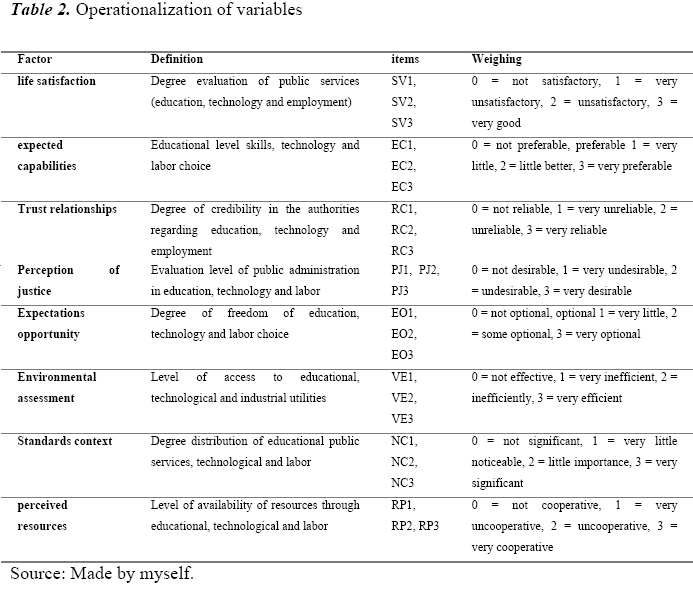
<body><![CDATA[<p align="justify">&nbsp;</p>     <p align="justify"><font size="3" face="Verdana, Arial, Helvetica, sans-serif"><b>Introduction</b></font></p>      <p align="justify"><font size="2" face="Verdana, Arial, Helvetica, sans-serif">The quality of life understood as satisfaction related to resources, values, norms, expectations, perceptions and capabilities is a central issue in the public health agenda for sustainable local development (García, 2013).</font></p>      <p align="justify"><font size="2" face="Verdana, Arial, Helvetica, sans-serif">Some studies on quality of life provide significant gender differences regarding transportation, employment and recreation (Baldi &amp; Garcia, 2010).Furthermore, when pondering as a perceptual system resources around the individual and in reference to&nbsp;the&nbsp;parent group, it is considered a style of personal well&nbsp;-&nbsp;being that is geared to social integration (Barranco, Delgado, Meli, &amp; Quintana, 2010).</font></p>      <p align="justify"><font size="2" face="Verdana, Arial, Helvetica, sans-serif">But quality of life is correlated with anxiety and depression in medical situations of uncertainty and deteriorating health (Machado, Anarte, &amp; Ruiz, 2010).&nbsp;That is, the quality of life is the result of the perception of scarcity of resources rather than the hopes generated from personal abilities.&nbsp;Opportunities seem&nbsp;to&nbsp;boil down to a minimum and thus the responsibility of self-increases and an improvement in expectations is observed through the links between the members of a social, family or school group.</font></p>      <p align="justify"><font size="2" face="Verdana, Arial, Helvetica, sans-serif">Grimaldo (2010) found eight alluding to the quality of life dimensions.&nbsp;This&nbsp;is the economic well&nbsp;-&nbsp;being, interpersonal relationship, family situation, neighborhood context, social capital and health.&nbsp;Therefore, the quality of life is a web of expectations that&nbsp;are&nbsp;based on a figurative nucleus to influence the decisions of resource allocation (Carreon &amp; Garcia, 2013).</font></p>      <p align="justify"><font size="2" face="Verdana, Arial, Helvetica, sans-serif">When the individual&nbsp;is&nbsp;undergoing one, health, family or interpersonal economic situation, often estimated that their quality of life has been substantially modified (Sadeghzadeh, 2012).&nbsp;Immediately aesthetic, emotional and rational expectations that drive actions that target the generation and update capabilities subject to the group to which&nbsp;it&nbsp;belongs or wants&nbsp;to&nbsp;belong (Derya, 2012) are activated.&nbsp;That is, the quality of life is&nbsp;a&nbsp;history of the formation of a group identity and sense of belonging anchored to freedom of choice, expectations of justice and collective mobilization.</font></p>      <p align="justify"><font size="2" face="Verdana, Arial, Helvetica, sans-serif">The quality of life in their perceptual phase generates emotions of distrust of authorities arising in dissident citizen actions (Carreon &amp; Garcia, 2013).&nbsp;Rather, the perception of quality of life, as to the notion of social justice, is linked to conventional styles of development that the individual has learned since childhood and now as an adult translates as reliability or confidence but realizing that the link is asymmetric with its authorities then mobilizes the resources needed for civil disobedience (Garcia, 2013).</font></p>      <p align="justify"><font size="2" face="Verdana, Arial, Helvetica, sans-serif">Tariq (2012) notes that the quality of life, in its dimension of life satisfaction, requires a set of indicators to guide not only the perception of the subject, but also collective action.&nbsp;A low level of life satisfaction is sufficient to activate the process of social dissent, but a high level of life satisfaction does not create collaborative, supportive or empathetic links (Carreon &amp; Garcia, 2013).</font></p>      <p align="justify"><font size="2" face="Verdana, Arial, Helvetica, sans-serif">However, low levels of life satisfaction, which suggests minimum standards of quality of life, promote the formation of support networks.&nbsp;This&nbsp;is the case for the new lesbian-gay or environmentalists, who by forming self&nbsp;-&nbsp;help groups cause greater SWB who only receive social movements abundance of resources (Carreon&nbsp;et&nbsp;al.,&nbsp;2013).</font></p>      ]]></body>
<body><![CDATA[<p align="justify"><font size="2" face="Verdana, Arial, Helvetica, sans-serif">As the quality of life is specific and limits to psychological factors, expectations of discontent, indignation and civil disobedience are increased, but also emerge social skills such as creativity and innovation of minority groups against ideological or pragmatic imposition of the majority (Abolfotouh&nbsp;et&nbsp;al.,&nbsp;2013).</font></p>      <p align="justify"><font size="2" face="Verdana, Arial, Helvetica, sans-serif">In short, the quality of life in economic, political, social, health, educational, employment and technological terms is a multidimensional construct (Quinceno &amp; Vinaccia, 2013).</font></p>      <p align="justify"><font size="2" face="Verdana, Arial, Helvetica, sans-serif"><b>Studies of quality of life and well-being&nbsp;subjective</b></font></p>      <p align="justify"><font size="2" face="Verdana, Arial, Helvetica, sans-serif">Relations between opportunities, skills, responsibility, fairness, reliability and life satisfaction aimed at mobilization can&nbsp;be&nbsp;realized in a model (see <a href="#t1">Table 1</a>).</font></p>      <p align="center"><a name="t1"></a><img src="/img/revistas/rap/v17n1/a06_tabla_01.gif" width="706" height="973"></p>     <p align="justify"><font size="2" face="Verdana, Arial, Helvetica, sans-serif">It is around 17 variables which links economic dependence between   social and personal factors, political, group influence life satisfaction. The   HCT warns that capacities would have a significant impact on life satisfaction,   since a high level of education is offset by a high satisfying lifestyle. Moreover,   if the connection between capabilities and satisfaction of real or symbolic   opportunities, then as indicated&nbsp;by&nbsp;the HDT human development is   complemented.</font></p>     <p align="justify"><font size="2" face="Verdana, Arial, Helvetica, sans-serif">However, the process involving freedom of choice, necessarily capabilities and life satisfaction, according to CRT, is subject to the availability of resources and their distribution among species.&nbsp;In the case of common resources there&nbsp;is&nbsp;a zero&nbsp;-&nbsp;sum tragedy in which the actors involved rather than cooperate and establish an administrative stewardship of resources, wantonly compete and suppress the possibility of growth of other species.&nbsp;That&nbsp;is why the availability of resources indirectly affects life satisfaction (Hypothesis 3) mode.</font></p>      <p align="justify"><font size="2" face="Verdana, Arial, Helvetica, sans-serif">Although the availability of resources pacesetter in the organization of human groups, is the state in reference to citizenship, as warns the SFT, who encourages the spread of resources.&nbsp;When the relationship between civil society and authorities is asymmetric, then the quality of life fades, but when there&nbsp;are&nbsp;bonds of trust then emerges life satisfaction.</font></p>      <p align="justify"><font size="2" face="Verdana, Arial, Helvetica, sans-serif">In another scenario, the link between citizenship and justice authorities raises expectations that undermine or ennoble responsibility.&nbsp;This is because, according&nbsp;to&nbsp;the DET, politics is concomitant with the economy.&nbsp;Higher levels of governance are observed in prosperous countries, while ungovernability underlying weak economies.&nbsp;That&nbsp;is why the expected justice directly affects the life satisfaction of citizens for their political system.</font></p>      <p align="justify"><font size="2" face="Verdana, Arial, Helvetica, sans-serif">The process of confidence, skills and life satisfaction is raised by the SFT.&nbsp;The relationship between society and development&nbsp;-&nbsp;oriented State has in the formation of human capital its main link.&nbsp;SFT proposes that development, unlike the growth but high standards of life satisfaction why, capabilities are an essential factor in the link between political reliability and personal life satisfaction.</font></p>      ]]></body>
<body><![CDATA[<p align="justify"><font size="2" face="Verdana, Arial, Helvetica, sans-serif">The indirect relationship between justice and satisfaction to be mediated by the capabilities supposed ecological development scenarios.&nbsp;The CRT notes that the connection between authorities and citizens defined by molar and molecular actions that affect individual satisfaction.</font></p>      <p align="justify"><font size="2" face="Verdana, Arial, Helvetica, sans-serif">Molars acts contrary to the molecular actions involve significant links that contrasts the individual in crisis situations.&nbsp;Meanwhile, the little meaningful relationships are understood as molecular events from which&nbsp;it&nbsp;is not possible&nbsp;to&nbsp;build a collective memory, social dissent and civil disobedience.</font></p>      <p align="justify"><font size="2" face="Verdana, Arial, Helvetica, sans-serif">Thus justice, considering a system of molar actions, influences life satisfaction while being regulated by the personal abilities.</font></p>      <p align="justify"><font size="2" face="Verdana, Arial, Helvetica, sans-serif">However, the CRT suggests that the opportunities which affect relations between reliability, justice, capabilities and satisfaction.&nbsp;Thus, freedom of choice to&nbsp;be&nbsp;linked with the political reliability and individual capacities impact on life satisfaction.&nbsp;This is because the trust between citizens and politicians depends on options of choice in employment.&nbsp;If there&nbsp;are&nbsp;job opportunities, then political reliability increases and generates high skills affect states of satisfaction.&nbsp;Or, the opportunities are disseminated as justice factors affecting the generation of job skills, while it is possible&nbsp;to&nbsp;observe the growth of personal satisfaction of life.</font></p>      <p align="justify"><font size="2" face="Verdana, Arial, Helvetica, sans-serif">However, freedom of choice involve decisions, demands and resources from which gestate opportunities.&nbsp;It is for this matter that the CRT maintains that the availability of resources, but above all, the dilemma of their distribution, impacts the development of communities or groups sharing scenarios and contexts.</font></p>      <p align="justify"><font size="2" face="Verdana, Arial, Helvetica, sans-serif">The story of a community or group seems&nbsp;to&nbsp;be undermined by networks of cooperation and trust while resource availability permits.&nbsp;In a situation of scarcity dilemmas and thus the tragedies of common entities emerge.&nbsp;In this sense, the CRT said that opportunities are the result of a&nbsp;shared&nbsp;responsibility between the parties involved.</font></p>      <p align="justify"><font size="2" face="Verdana, Arial, Helvetica, sans-serif">Thus, resource management indirectly affects satisfaction through opportunities, reliability, justice and abilities.&nbsp;In&nbsp;the&nbsp;first instance, the lack of resources would create a reduction in levels of public trust in the public administration, it&nbsp;would&nbsp;impact the choice options slowing consumption capacity.&nbsp;Once the purchasing power is compromised, citizen satisfaction levels are reduced to a minimum.&nbsp;In this vein, the shortage may also affect public perceptions of injustice, against the lack of government atingencia, choice capabilities are reduced to influence life satisfaction.</font></p>      <p align="justify"><font size="2" face="Verdana, Arial, Helvetica, sans-serif">In contrast, when the availability of resources is insufficient but widely perceived by the public, choice opportunities appear&nbsp;to&nbsp;act in the public trust and thus in decision making not only seeking personal or group satisfaction, but social.&nbsp;This&nbsp;is&nbsp;also a process of justice before the distribution of resources via public services.&nbsp;In this scenario, life satisfaction precedes choice options to&nbsp;be&nbsp;perceived as abundant transferred the effect of social justice to life satisfaction.</font></p>      <p align="justify"><font size="2" face="Verdana, Arial, Helvetica, sans-serif">Likewise, the relationship between environmental assessment (resources) and life satisfaction (needs obtained) understands the CRT as a direct and meaningful process.&nbsp;It is an asymmetrical relationship, as the shortage of resources with rising expectations raises a scenario that compromises the public confidence for their future rulers and capabilities of future civil society.</font></p>      <p align="justify"><font size="2" face="Verdana, Arial, Helvetica, sans-serif">The CRT notes that in the case of social norms regarding the administration and therefore, the distribution of resources, its relationship with satisfaction in being direct and meaningful comprises a structural reductionism, or, interaction with social justice and capacities implies the emergence of a democratic system of citizen opening partnership against the State.</font></p>      ]]></body>
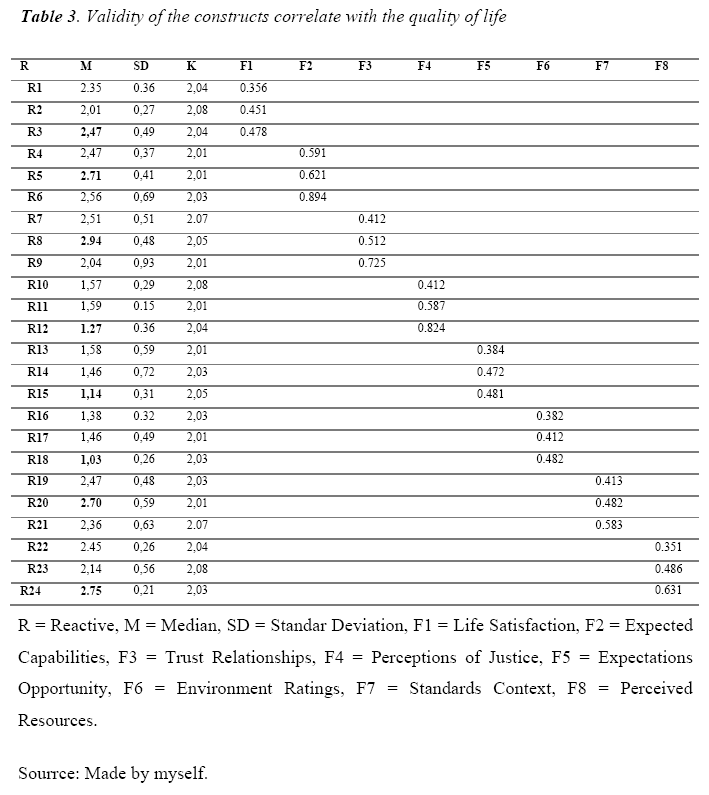
<body><![CDATA[<p align="justify"><font size="2" face="Verdana, Arial, Helvetica, sans-serif">Axes and trajectories of dependency relationships between the factors in the state of knowledge related to quality of life and subjective well-being be adjusted to the empirical observations in a study location in central Mexico.</font></p>      <p align="justify"><font size="2" face="Verdana, Arial, Helvetica, sans-serif">The dependency links that are specified in the model fit the observed data.&nbsp;That is, the perception of availability and commonality of resources impacts directly and indirectly on the life satisfaction of students.&nbsp;In the second case of indirect relationship, expectations of opportunity, trust, fairness and ability to reduce or increase the incidence of resources expected on life satisfaction, adjust their relations to specified data.</font></p>      <p align="justify"><font size="2" face="Verdana, Arial, Helvetica, sans-serif">Although the literature review explains the relations of dependence between the factors related to the quality of life and subjective well-being, the specificity of the context implies another type of interrelation since, the actors involved appear to be distinguished from those reported in the state of knowledge</font></p>     <p align="justify">&nbsp;</p>     <p align="justify"><font size="3" face="Verdana, Arial, Helvetica, sans-serif"><b>Method</b></font></p>      <p align="justify"><font size="2" face="Verdana, Arial, Helvetica, sans-serif">A cross&nbsp;-&nbsp;sectional study was conducted. A nonrandom selection of 245 students was conducted.&nbsp;The criterion of choice was having a paid, Internet service and have been enrolled in the school semester activity.&nbsp;They interviewed 120 women and 125 men (M = 20.13 years and SD = 2.36 years).&nbsp;Economic status to which the sample belongs was medium low with about $ 1,500 monthly household income (M = 950 USD and SD = 24.5 USD).</font></p>      <p align="justify"><font size="2" face="Verdana, Arial, Helvetica, sans-serif"><i>Education.</i>&nbsp;The participants declared&nbsp;their&nbsp;belonging to public universities (M = 2.13 years of study and SD = 0.47 years of study).&nbsp;67% of respondents had a scholarship or financial support (M = 100 USD and SD = 7.5 USD).&nbsp;Expenditure on tuition (300 USD semester), useful (250 USD semester), Internet (50 USD monthly) and transport (35 USD weekly) generate an estimated investment of $ 1,000&nbsp;every&nbsp;six months (M = 870 USD and DE = 15.67 USD).</font></p>      <p align="justify"><font size="2" face="Verdana, Arial, Helvetica, sans-serif"><i>Employment.</i>&nbsp;The 36% of the sample declared work before or after attending the school (M = 400 USD monthly and DE = $ 23.5 monthly).&nbsp;Of the respondents who work 78% said that their wages would rise substantially if complete its vocational training (M = $ 1,200 monthly expected and DE = $ 45.5 expected monthly).&nbsp;By contrast, 84% of respondents stated that their income would be lower if&nbsp;you&nbsp;only count with basic secondary education (M = 250 USD and SD = 14.6 USD).</font></p>      <p align="justify"><font size="2" face="Verdana, Arial, Helvetica, sans-serif"><i>Technology.</i>&nbsp;The 57% paid monthly Internet access from a landline (M = 470 USD monthly and DE = $ 15.7 per month) while 93% have mobile phone service (M = 140 USD monthly and DE = $ 10.2 monthly).&nbsp;Facebook (46%), Twitter (27%) and Google+ (14%) are the most used social networks for school purposes or job search.</font></p>      <p align="justify"><font size="2" face="Verdana, Arial, Helvetica, sans-serif">A questionnaire quality of life from the educational, technological and labor dimensions depending on the factors of resource availability, social reliability, social justice, opportunities for choice, selection skills and perceptions of satisfaction (see <a href="#t2">Table 2</a>) was built.</font></p>      ]]></body>
<body><![CDATA[<p align="center"><a name="t2"></a><img src="/img/revistas/rap/v17n1/a06_tabla_02.gif" width="693" height="595"></p>     <p align="justify"><font size="2" face="Verdana, Arial, Helvetica, sans-serif">The application of the surveys were conducted at the premises of   the Autonomous University of the State of Mexico, after processing to the   authorities of the institution.&nbsp;When solving the questionnaire,   respondents were instructed to write any questions they may have regarding the   survey.&nbsp;Once the information was collected was captured in the Statistical   Package for Social Sciences (SPSS version 25.0), to estimate the parameters in   multivariate analysis structural moments (AMOS, version 6.0).</font></p>     <p align="justify"><font size="2" face="Verdana, Arial, Helvetica, sans-serif"><i>Analysis.</i>&nbsp;An   analysis of normal considering the kurtosis parameter assuming reliability and   internal consistency or Cronbach's alpha was performed.&nbsp;Then we proceeded   to estimate the construct validity prior sphericity and suitability of the   instrument to the study sample.&nbsp;Next, bivariate correlations or multivariate   covariance were estimated to anticipate causal relationships in structural models, adjustment and waste.</font></p>     <p align="justify"><font size="2" face="Verdana, Arial, Helvetica, sans-serif"><i>Normality.</i>&nbsp;Kurtosis   parameter was used to determine the proximity of the responses to the mean and   standard deviation.&nbsp;Close to the unit values are assumed as evidence of normal distribution.</font></p>     <p align="justify"><font size="2" face="Verdana, Arial, Helvetica, sans-serif"><i>Reliability.</i>&nbsp;The   internal consistency of the reagents with respect to the scale was weighted   Cronbach&nbsp;'s&nbsp;alpha statistic.&nbsp;The above 0.60 and less than 0.90   test values were symmetrical relationships between reactants and psychological traits that measure sought.</font></p>     <p align="justify"><font size="2" face="Verdana, Arial, Helvetica, sans-serif"><i>Validity.</i>&nbsp;Alignment   with the Kaiser-Meyer-Olkin parameter in which values above 6.00   a requirement for the construct validity were considered&nbsp;to&nbsp;be   praised.&nbsp;Sphericity with Bartlett's test was also estimated, the   Chi-square and close to the unit level less than 0.050 significance value is   taken as a second request for exploratory factor analysis of principal   components with varimax rotation.&nbsp;The correlations between the item and   the factor above 0.300 were assumed as indicators of a construct.&nbsp;As for   the percentages of explained variance greater than 20% they were estimated as fit test model specifications regarding observation data.</font></p>     <p align="justify"><font size="2" face="Verdana, Arial, Helvetica, sans-serif"><i>Correlation.</i>&nbsp;Pearson's&nbsp;<i>r</i>&nbsp;parameter   was used to calculate the negative or positive relationships between the   factors in the construct validity.&nbsp;Those close to zero and unit values   were admitted as spurious and collinear   relationships.&nbsp;Instead, the values between the extremes were considered as probable associations dependence.</font></p>     <p align="justify"><font size="2" face="Verdana, Arial, Helvetica, sans-serif"><i>Covariance.</i>&nbsp;<i>Phi</i>&nbsp;estimate   was used to determine the association between a factor and another in reference   to other factors.&nbsp;As the correlation values identified as spurious, and dependence relationships collinear.</font></p>     <p align="justify"><font size="2" face="Verdana, Arial, Helvetica, sans-serif"><i>Structure.</i>&nbsp;<i>Phi</i>&nbsp;parameters   were used to estimate covariance, statistical regression&nbsp;<i>gamma</i>&nbsp;for   exogenous mediators and&nbsp;<i>beta</i>&nbsp;parameters for the regression of mediator’s   factors endogenous factors.&nbsp;Statistical&nbsp;<i>delta,</i>&nbsp;<i>epsilon</i>&nbsp;and&nbsp;<i>sigma</i>&nbsp;were   used to calculate the measurement errors of exogenous and endogenous indicators   as well as disturbance of endogenous factors.&nbsp;The criterion for   interpreting the values close to zero and unity&nbsp;was&nbsp;also assessed for the parameters in question.</font></p>     <p align="justify"><font size="2" face="Verdana, Arial, Helvetica, sans-serif"><i>Adjustment.</i>&nbsp;The   contrast of the model was carried out from estimating the goodness of fit index (GFI, for its acronym in English).&nbsp;Close to the unit values were judged show of acceptance of null hypothesis.</font></p>     ]]></body>
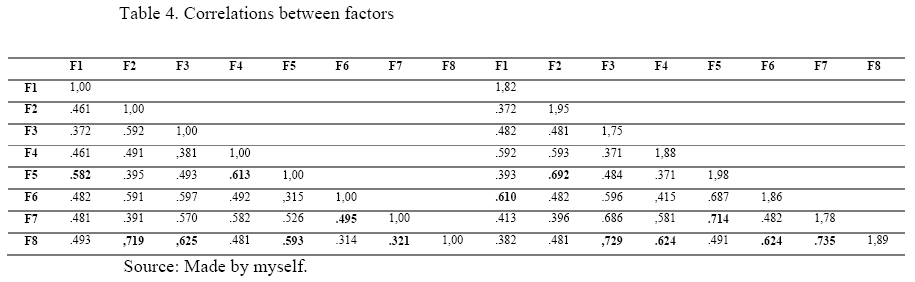
<body><![CDATA[<p align="justify"><font size="2" face="Verdana, Arial, Helvetica, sans-serif"><i>Residual.</i>&nbsp;The   contrast model also performed from the calculation of mean square error   approximation (RMSEA, for its acronym in English).&nbsp;The near zero values  were considered as evidence of fit of the model specified with respect to the data.</font></p>     <p align="justify">&nbsp;</p>     <p align="justify"><font size="3" face="Verdana, Arial, Helvetica, sans-serif"><b>Results</b></font></p>     <p align="justify"><font size="2" face="Verdana, Arial, Helvetica, sans-serif">Eight factors [KMO = 6.25 were established;&nbsp;X&nbsp;<sup>2</sup>&nbsp;=   14.25 (23 gl);&nbsp;p = 0.000] (see <a href="#t3">Table 3</a>) concerning life satisfaction   (items SV1, SV2, SV3 and 45% of the total variance explained), expected   capacity (EC1, EC2, EC3 and 37% of the total variance explained) trust   relationships (RC1, RC2, RC3 and 33% of the explained variance), perception of   justice (PJ1, PJ2, PJ3 and 31% of the explained variance), expectations of   opportunity (EO1, EO2, EO3 and 27% of the variance explained), assessments of   the environment (VE1, VE2, VE3 and 25% of the explained variance) standards   context (NC1, NC2, NC3 and 23% of the explained variance) and perceived resources (RP1, RP2, RP3 and 21 % of the explained variance).</font></p>     <p align="center"><a name="t3"></a><img src="/img/revistas/rap/v17n1/a06_tabla_03.gif" width="709" height="795"></p>     <p align="justify"><font size="2" face="Verdana, Arial, Helvetica, sans-serif">In the case of the descriptive results a tendency to positive   choices for answers to items of the factors of life satisfaction, expected   capabilities, relationships of trust, norms of context and perceived resources   and a negative prevalence is observed factors perception of justice, opportunity and ratings expectations of the environment.</font></p>     <p align="justify"><font size="2" face="Verdana, Arial, Helvetica, sans-serif">With regard to life satisfaction, the item SV3 (M = 2.47, SD =   0.49; C = 2.04) won the closest value to the &quot;very satisfactory&quot;   option while the item SV2 ( M = 2.01, SD = 0.27; C = 2.08) approached the   &quot;unsatisfactory&quot; option.&nbsp;That is, the survey sample   appears&nbsp;to&nbsp;guide their life satisfaction towards a close to full satisfaction educational, technological and labor scenario.</font></p>     <p align="justify"><font size="2" face="Verdana, Arial, Helvetica, sans-serif">For the expected capacity, the item CE3 (M = 2.71, SD = 0.41; C =   2.01) was around the &quot;very preferable&quot;.&nbsp;In contrast, the item   EC1 (M = 2.47, SD = 0.37; C = 2.01) approached the &quot;little better&quot;   option.&nbsp;In this sense, the survey sample seems&nbsp;to&nbsp;direct their responses to a nearby option to the efficient perception of their abilities.</font></p>     <p align="justify"><font size="2" face="Verdana, Arial, Helvetica, sans-serif">Meanwhile, in relationships of trust, the item RC2 (M = 2.94, SD =   0.48; C = 2.05), unlike the item RC3 (M = 2.04, SD = 0.93 C = 2.01) approached   the &quot;very reliable&quot; option.&nbsp;This suggests that confidence is perceived as a key element of relations between the surveyed sample.</font></p>     <p align="justify"><font size="2" face="Verdana, Arial, Helvetica, sans-serif">As for the perception of justice, the item PJ3 (M = 1.27, SD =   0.31; C = 2.05) compared to item PJ2 (M = 1.59, SD = 0.15; C = 2 01) to be   hanging around the &quot;highly undesirable&quot; alternative is a biased appreciation   of justice.&nbsp;This is because the injustice that the sample surveyed   perceived their authorities seems&nbsp;to&nbsp;be a central element in their life satisfaction.</font></p>     ]]></body>
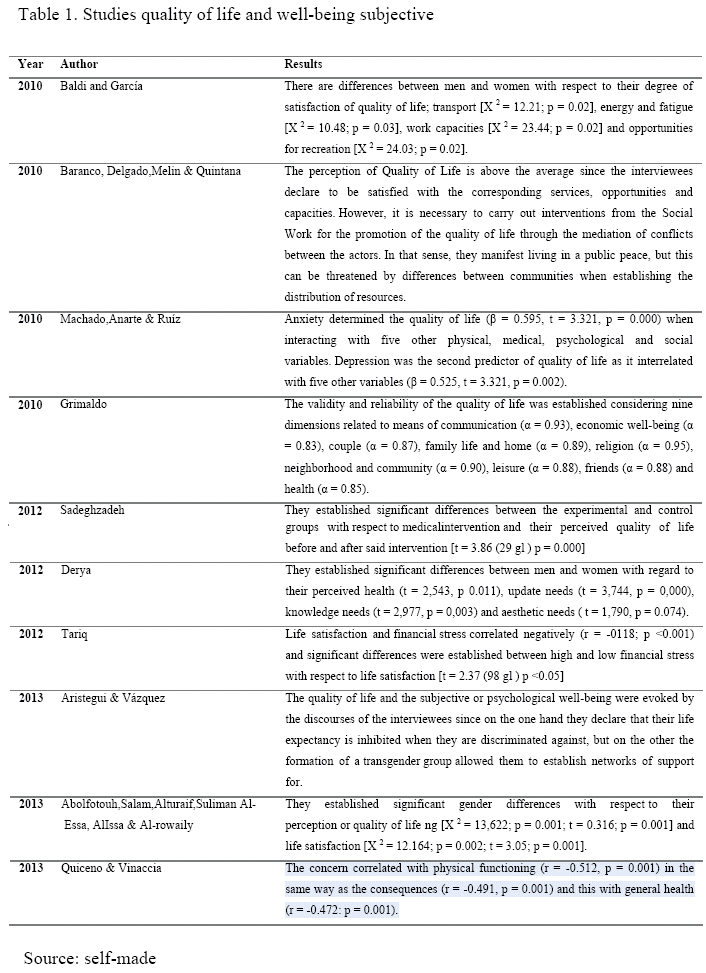
<body><![CDATA[<p align="justify"><font size="2" face="Verdana, Arial, Helvetica, sans-serif">In the case of the expectations of opportunity, the item EO3 (M =   1.14, SD = 0.31; C = 2.05) about&nbsp;the&nbsp;item EO2 (M = 1.38, SD = 0.59; C   = 2.01) reflects a trend towards &quot;very little optional&quot; option, which   suggests that the opportunities are valued as almost nil by the survey sample.</font></p> <font face="Verdana, Arial, Helvetica, sans-serif">     <p align="justify"><font size="2">It is the same case of valuations of the environment, as the item   VE3 (M = 1.03, SD = 0.26; C = 2.03) compared to item VE1 (M = 1.46, SD = 0.49 C   = 2,01) shows an inclination to &quot;very efficient&quot; option, which is the   result of considering public services as a system of unequal distribution among the survey sample.</font></p>     <p align="justify"><font size="2">As standards context item NC2 (M = 2.70, SD = 0.59; C = 2.01) in   contrast to the item NC3 (M = 2.35, SD = 0.63; C = 2.07) approached the   &quot;very significant&quot; option. This means that the conventions that guide   the actions of the individual to be evaluated positively prove the influence of the system on an indicator of the quality of life in the survey sample.</font></p>     <p align="justify"><font size="2">Finally, the factor of perceived resources, RP3 item (M = 2.75, SD   = 0.21; C = 2.03) compared with the item RP2 (M = 2.14, SD = 0, 56; C = 2.08)   reveals a &quot;very cooperative&quot; tendency on&nbsp;the&nbsp;part of the   survey sample.&nbsp;This means that the distribution of resources probably influences the perception of scarcity and hence the need to share.</font></p>     <p align="justify"><font size="2">The reliability of the factors 1 to 8 (alphas respective 0.72;   0.74; 0.79; 0.74; 0.78; 0.75; 0.71 and 0.75) expresses a regular consistency between items, since the overall reliability of the instrument was 0.69.</font></p>     <p align="justify"><font size="2">The association between factors (see <a href="#t4">Table 4</a>) shows that life   satisfaction and expectations of opportunity (r = 0.582), expected capabilities   and perceived resources (r = 0.719), relationships of trust and perceived   resources (r = 0.625), perception of justice and expectations of opportunity   (0.613), expectations of opportunity and perceived resources (0.509),   assessment of the environment and standards of context (0.495) and standards of   context and perceived resources (r = 0.321) assume that the specification of   relationships between factors could be estimated by a model, although it was   expected that would have negative relationships between perceptions of justice,   expectations of opportunity and ratings of the environment, since their means, deviations and kurtosis warned a negative prevalence regarding the positive trend of the other factors.</font></p>     <p align="center"><a name="t4"></a><img src="/img/revistas/rap/v17n1/a06_tabla_04.gif" width="915" height="282"></p> </font>     <p align="justify"><font size="2" face="Verdana, Arial, Helvetica, sans-serif">The analysis of covariance (see <a href="#t6">Table 6</a>) as well as the   correlations showed positive links between life satisfaction and ratings of the   environment (&#934; = 0.610), expected capabilities and expectations of opportunity (&#934; = 0.692),   relationships of trust and perceived resources (&#934; = 0.729), perception   of justice and perceived resources (&#934; = 0.624), expectations of timeliness and standards context (&#934; = 0.714), assessments   of the environment and perceived resources (&#934; = 0.624) and standards context and resources perceived (&#934; = 0.735).</font></p>     <p align="justify"><font size="2" face="Verdana, Arial, Helvetica, sans-serif"><a name=table05></a>Covariances brandished warn that the specified relationships seem   to establish a system of quality of life centered on life satisfaction,   expected capabilities, relationships of trust, norms of context and resources   collected more than perceptions of justice, expectations of opportunity and ratings of the environment.</font></p>     <p align="justify"><font size="2" face="Verdana, Arial, Helvetica, sans-serif">The model of structural relationships shows that the factor influencing   the perception of resources on life satisfaction is the standard of context (&#947; = 0.52), followed by   environmental assessment factor (&#947; = 0.37), expected capacities (&#946; = 0.31), relations of   trust (&#946; = 0.28) and perceived justice (&#946; = 0.24).&nbsp;That is,   the full satisfaction of actions relating to the academy, technology and   employment is influenced by the availability of resources received through   ingrained behaviors of students.&nbsp;This finding exalts an assumption of the   theory of common resources according to which the customs of groups internalize   resources as elements of community and identity (García, Carreon &amp;   Hernandez, 2014).&nbsp;This is because the conservation of resources due to   customs rooted in the sense of belonging is essential for personal, group or community satisfaction.</font></p>     ]]></body>
<body><![CDATA[<p align="justify"><font size="2" face="Verdana, Arial, Helvetica, sans-serif">The contrast of the dependency relationships [X&nbsp;<sup>2</sup>&nbsp;=   12,35 (12 gl);&nbsp;p = 0.000;&nbsp;GFI = 0.975;&nbsp;RMR = 0,000] evidence acceptance of the null hypothesis.</font></p>     <p align="justify">&nbsp;</p>     <p align="justify"><font size="3" face="Verdana, Arial, Helvetica, sans-serif"><b>Discussion</b></font></p>     <p align="justify"><font size="2" face="Verdana, Arial, Helvetica, sans-serif">Referring to the&nbsp;work of Machado&nbsp;et al.,&nbsp;(2010) in   which the dependency relationship between anxiety and low perceived quality of   life, this study found that the perceived availability of resources indirectly correlates of life satisfaction through standards demonstrated context.</font></p>     <p align="justify"><font size="2" face="Verdana, Arial, Helvetica, sans-serif">The quality of life has been considered two overriding dimensions:   subjective and physical, involved the relationship between availability of   resources and basic psychological processes that links groups would not affect the perception of satisfaction.</font></p>     <p align="justify"><font size="2" face="Verdana, Arial, Helvetica, sans-serif">Although in this study the relationship of trust and perception of   justice are variables related to the dynamics of groups to which the individual   belongs, its influence is less than the value of resources (public education,   technology and employment) and personal capacities (freedom of choice, skills   and knowledge), although the rules of context (ingrained behaviors) increase   the relationship between available resources and life   satisfaction.&nbsp;However, it is essential to include personal pathologies in   the model of dependency relationships to contrast their influence on life satisfaction.</font></p>     <p align="justify">&nbsp;</p>     <p align="justify"><font size="3" face="Verdana, Arial, Helvetica, sans-serif"><b>Conclusion</b></font></p>     <p align="justify"><font size="2" face="Verdana, Arial, Helvetica, sans-serif">Quality of life, in its dimension of satisfaction of public   education services, Internet and employment, in the sample of young people surveyed. </font></p>     <p align="justify"><font size="2" face="Verdana, Arial, Helvetica, sans-serif">The relationship&nbsp;indirect between perceived resources and the   satisfaction&nbsp;of life suggests that there are&nbsp;group and personal   factors that regulate the impact of a shortage perceived abundance of   resources, although&nbsp;the state of knowledge cautions that are   variables&nbsp;which&nbsp;they are associated&nbsp;with perceptions of satisfaction&nbsp;full of life.</font></p>     ]]></body>
<body><![CDATA[<p align="justify"><font size="2" face="Verdana, Arial, Helvetica, sans-serif">The satisfaction&nbsp;of life to interact with perceived   resources, assessments of the environment, standards of context,   perception&nbsp;of justice, trust relationships, opportunities and expected   capabilities&nbsp;can explain&nbsp;from frames you&nbsp;rich, but it must   include theory&nbsp;order and constructs economic&nbsp;or&nbsp;economic and   polítics,&nbsp;since their exclusion reduces the quality of life to the perception&nbsp;of respondents.</font></p>     <p align="justify">&nbsp;</p>     <p align="justify"><font size="3" face="Verdana, Arial, Helvetica, sans-serif"><b>References</b></font></p>     <!-- ref --><p align="justify"><font size="2" face="Verdana, Arial, Helvetica, sans-serif">Abolfotouh, M., Salam,   M., Alturaif, D., Suliman, W., Al-Essa, N., Al-Issa, H., &amp; Al-rowaily, M.   (2013).&nbsp;Predictors of quality of life and Glycemic Control Among Adults   with diabetes Arabia.&nbsp;<i>International Journal of Medicne and Medical Sciences, 46,</i>&nbsp;1360-1370.</font>&nbsp;&nbsp;&nbsp;&nbsp;&nbsp;&nbsp;&nbsp;&nbsp;[&#160;<a href="javascript:void(0);" onclick="javascript: window.open('/scielo.php?script=sci_nlinks&ref=752324&pid=S2077-2161201900010000600001&lng=','','width=640,height=500,resizable=yes,scrollbars=1,menubar=yes,');">Links</a>&#160;]<!-- end-ref --><p align="justify"><font size="2" face="Verdana, Arial, Helvetica, sans-serif">Arístegui, I., &amp;   Vazquez (2013).&nbsp;The impact of stigma and discrimination in the quality of life of transgender people living with HIV.&nbsp;<i>Hologrammatic, 19,</i>&nbsp;5-30.</font></p>     <!-- ref --><p align="justify"><font size="2" face="Verdana, Arial, Helvetica, sans-serif">Baldi, G., &amp;   Garcia, E. (2010).&nbsp;Perception of quality of life in a sample of invidividuos city of San Luis, Argentina.&nbsp;<i>Universities, 40,</i>&nbsp;17-26.</font>&nbsp;&nbsp;&nbsp;&nbsp;&nbsp;&nbsp;&nbsp;&nbsp;[&#160;<a href="javascript:void(0);" onclick="javascript: window.open('/scielo.php?script=sci_nlinks&ref=752326&pid=S2077-2161201900010000600003&lng=','','width=640,height=500,resizable=yes,scrollbars=1,menubar=yes,');">Links</a>&#160;]<!-- end-ref --><!-- ref --><p align="justify"><font size="2" face="Verdana, Arial, Helvetica, sans-serif">Barranco, C., Delgado,   M., Melin, C., &amp; Quintana, R. (2010).&nbsp;Social work in housing. Research on perceived quality of life&nbsp;<i>Biblio, 2,</i>&nbsp;102-113.</font>&nbsp;&nbsp;&nbsp;&nbsp;&nbsp;&nbsp;&nbsp;&nbsp;[&#160;<a href="javascript:void(0);" onclick="javascript: window.open('/scielo.php?script=sci_nlinks&ref=752327&pid=S2077-2161201900010000600004&lng=','','width=640,height=500,resizable=yes,scrollbars=1,menubar=yes,');">Links</a>&#160;]<!-- end-ref --><!-- ref --><p align="justify"><font size="2" face="Verdana, Arial, Helvetica, sans-serif">Benites, L. (2010).&nbsp;Autism, family and quality of life.&nbsp;<i>Culture, 24,</i>&nbsp;1-20.</font>&nbsp;&nbsp;&nbsp;&nbsp;&nbsp;&nbsp;&nbsp;&nbsp;[&#160;<a href="javascript:void(0);" onclick="javascript: window.open('/scielo.php?script=sci_nlinks&ref=752328&pid=S2077-2161201900010000600005&lng=','','width=640,height=500,resizable=yes,scrollbars=1,menubar=yes,');">Links</a>&#160;]<!-- end-ref --><!-- ref --><p align="justify"><font size="2" face="Verdana, Arial, Helvetica, sans-serif">Carreon, J., &amp;   Garcia, C. (2013).&nbsp;Theories of public safety and crime perception.&nbsp;<i>Margen, 71,</i>&nbsp;1-16.</font>&nbsp;&nbsp;&nbsp;&nbsp;&nbsp;&nbsp;&nbsp;&nbsp;[&#160;<a href="javascript:void(0);" onclick="javascript: window.open('/scielo.php?script=sci_nlinks&ref=752329&pid=S2077-2161201900010000600006&lng=','','width=640,height=500,resizable=yes,scrollbars=1,menubar=yes,');">Links</a>&#160;]<!-- end-ref --><!-- ref --><p align="justify"><font size="2" face="Verdana, Arial, Helvetica, sans-serif">Carreon, J., Garcia,   C., Morales, M., Hernandez, J., Rosas, J., &amp; Rivera, B. (2013).&nbsp;Sustainable local development in the public sphere.&nbsp;<i>Economy and Society, 18 (44),</i>&nbsp;35-48.</font>&nbsp;&nbsp;&nbsp;&nbsp;&nbsp;&nbsp;&nbsp;&nbsp;[&#160;<a href="javascript:void(0);" onclick="javascript: window.open('/scielo.php?script=sci_nlinks&ref=752330&pid=S2077-2161201900010000600007&lng=','','width=640,height=500,resizable=yes,scrollbars=1,menubar=yes,');">Links</a>&#160;]<!-- end-ref --><!-- ref --><p align="justify"><font size="2" face="Verdana, Arial, Helvetica, sans-serif">Derya, K.   (2012).&nbsp;Genders Differences on employee perceptions of quality indicators   for working life in five-star hotels in Turkey.&nbsp;<i>International Journal of Academic Research in Accounting, Finance and Management Sciences, 2,</i>&nbsp;195-203.</font>&nbsp;&nbsp;&nbsp;&nbsp;&nbsp;&nbsp;&nbsp;&nbsp;[&#160;<a href="javascript:void(0);" onclick="javascript: window.open('/scielo.php?script=sci_nlinks&ref=752331&pid=S2077-2161201900010000600008&lng=','','width=640,height=500,resizable=yes,scrollbars=1,menubar=yes,');">Links</a>&#160;]<!-- end-ref --><!-- ref --><p align="justify"><font size="2" face="Verdana, Arial, Helvetica, sans-serif">Ferragutti, G.   (2012).&nbsp;Governmentality and human capital.&nbsp;Towards an outline of   emergency conditions speeches on the information society, education and new technologies.<i>Practices and Discourses 1</i>&nbsp;(1)&nbsp;<i>,</i>&nbsp;1-16.</font>&nbsp;&nbsp;&nbsp;&nbsp;&nbsp;&nbsp;&nbsp;&nbsp;[&#160;<a href="javascript:void(0);" onclick="javascript: window.open('/scielo.php?script=sci_nlinks&ref=752332&pid=S2077-2161201900010000600009&lng=','','width=640,height=500,resizable=yes,scrollbars=1,menubar=yes,');">Links</a>&#160;]<!-- end-ref --><!-- ref --><p align="justify"><font size="2" face="Verdana, Arial, Helvetica, sans-serif">Garcia, C.   (2013).&nbsp;Local development, water vulnerability, job insecurity, migratory intensity and resilient identity.&nbsp;<i>Kairos,&nbsp;32</i>: 1-17.</font>&nbsp;&nbsp;&nbsp;&nbsp;&nbsp;&nbsp;&nbsp;&nbsp;[&#160;<a href="javascript:void(0);" onclick="javascript: window.open('/scielo.php?script=sci_nlinks&ref=752333&pid=S2077-2161201900010000600010&lng=','','width=640,height=500,resizable=yes,scrollbars=1,menubar=yes,');">Links</a>&#160;]<!-- end-ref --><!-- ref --><p align="justify"><font size="2" face="Verdana, Arial, Helvetica, sans-serif">Garcia, C. Carreon, J.,   &amp; Hernandez, J. (2014).&nbsp;Training of human capital in the civilization   of climate change.&nbsp;<i>International Journal of Social Science Research 10</i>&nbsp;(1), 107-125.</font>&nbsp;&nbsp;&nbsp;&nbsp;&nbsp;&nbsp;&nbsp;&nbsp;[&#160;<a href="javascript:void(0);" onclick="javascript: window.open('/scielo.php?script=sci_nlinks&ref=752334&pid=S2077-2161201900010000600011&lng=','','width=640,height=500,resizable=yes,scrollbars=1,menubar=yes,');">Links</a>&#160;]<!-- end-ref --><!-- ref --><p align="justify"><font size="2" face="Verdana, Arial, Helvetica, sans-serif">Grimaldo, M.   (2010).&nbsp;Adaptation of the Quality of Life Scale Orson &amp; Barnes for health professionals.&nbsp;<i>Culture, 24,</i>&nbsp;1-20.</font>&nbsp;&nbsp;&nbsp;&nbsp;&nbsp;&nbsp;&nbsp;&nbsp;[&#160;<a href="javascript:void(0);" onclick="javascript: window.open('/scielo.php?script=sci_nlinks&ref=752335&pid=S2077-2161201900010000600012&lng=','','width=640,height=500,resizable=yes,scrollbars=1,menubar=yes,');">Links</a>&#160;]<!-- end-ref --><!-- ref --><p align="justify"><font size="2" face="Verdana, Arial, Helvetica, sans-serif">Machado, A., Anarte,   M., &amp; Ruiz, M. (2010).&nbsp;Predictors of quality of life in patients with type 1 diabetes mellitus&nbsp;<i>Science and Health, 21,</i>&nbsp;35-47.</font>&nbsp;&nbsp;&nbsp;&nbsp;&nbsp;&nbsp;&nbsp;&nbsp;[&#160;<a href="javascript:void(0);" onclick="javascript: window.open('/scielo.php?script=sci_nlinks&ref=752336&pid=S2077-2161201900010000600013&lng=','','width=640,height=500,resizable=yes,scrollbars=1,menubar=yes,');">Links</a>&#160;]<!-- end-ref --><!-- ref --><p align="justify"><font size="2" face="Verdana, Arial, Helvetica, sans-serif">Melendro, E.   (2011).&nbsp;Ecosocial perspective in educational intervention with young   people excluded.&nbsp;A comparative study in Canada, Belgium and Spain.&nbsp;<i>Spanish Journal of Comparative Education, 17,</i>&nbsp;197-218.</font>&nbsp;&nbsp;&nbsp;&nbsp;&nbsp;&nbsp;&nbsp;&nbsp;[&#160;<a href="javascript:void(0);" onclick="javascript: window.open('/scielo.php?script=sci_nlinks&ref=752337&pid=S2077-2161201900010000600014&lng=','','width=640,height=500,resizable=yes,scrollbars=1,menubar=yes,');">Links</a>&#160;]<!-- end-ref --><!-- ref --><p align="justify"><font size="2" face="Verdana, Arial, Helvetica, sans-serif">Picazo, E., Gutierrez,   E., Infante, J., &amp; Cantu, P. (2011).&nbsp;Theory and Sustainable Human Development: Towards strengthening health as a universal right and freedom.&nbsp;<i>Social Studies, 19,</i>&nbsp;254-279</font>&nbsp;&nbsp;&nbsp;&nbsp;&nbsp;&nbsp;&nbsp;&nbsp;[&#160;<a href="javascript:void(0);" onclick="javascript: window.open('/scielo.php?script=sci_nlinks&ref=752338&pid=S2077-2161201900010000600015&lng=','','width=640,height=500,resizable=yes,scrollbars=1,menubar=yes,');">Links</a>&#160;]<!-- end-ref --><!-- ref --><p align="justify"><font size="2" face="Verdana, Arial, Helvetica, sans-serif">Quiceno, J., &amp;   Vinaccia, S. (2013).&nbsp;Resiliency, disease perception, belief, religious   spiritual coping and quality of life related to health in patients diagnosed with rheumatoid arthritis.&nbsp;<i>Psychology from the Caribbean, 30,</i>&nbsp;590-619.</font>&nbsp;&nbsp;&nbsp;&nbsp;&nbsp;&nbsp;&nbsp;&nbsp;[&#160;<a href="javascript:void(0);" onclick="javascript: window.open('/scielo.php?script=sci_nlinks&ref=752339&pid=S2077-2161201900010000600016&lng=','','width=640,height=500,resizable=yes,scrollbars=1,menubar=yes,');">Links</a>&#160;]<!-- end-ref --><!-- ref --><p align="justify"><font size="2" face="Verdana, Arial, Helvetica, sans-serif">Reyes, L.   (2010).&nbsp;The dilemma of common natural resources.&nbsp;<i>Management and Environment, 13,</i>&nbsp;71-80.</font>&nbsp;&nbsp;&nbsp;&nbsp;&nbsp;&nbsp;&nbsp;&nbsp;[&#160;<a href="javascript:void(0);" onclick="javascript: window.open('/scielo.php?script=sci_nlinks&ref=752340&pid=S2077-2161201900010000600017&lng=','','width=640,height=500,resizable=yes,scrollbars=1,menubar=yes,');">Links</a>&#160;]<!-- end-ref --><!-- ref --><p align="justify"><font size="2" face="Verdana, Arial, Helvetica, sans-serif">Sadeghzadeh, V. (2012).&nbsp;Improved   quality of life with cardiac rehabilitation in post myocardial infarction   Patients.&nbsp;<i>International Research Journal of Applied and Basic Sciences, 3,</i>&nbsp;394-401.</font>&nbsp;&nbsp;&nbsp;&nbsp;&nbsp;&nbsp;&nbsp;&nbsp;[&#160;<a href="javascript:void(0);" onclick="javascript: window.open('/scielo.php?script=sci_nlinks&ref=752341&pid=S2077-2161201900010000600018&lng=','','width=640,height=500,resizable=yes,scrollbars=1,menubar=yes,');">Links</a>&#160;]<!-- end-ref --><!-- ref --><p align="justify"><font size="2" face="Verdana, Arial, Helvetica, sans-serif">Tariq, Q.   (2012).&nbsp;Impact of financial stress on life satisfaction.&nbsp;<i>Asian Journal of Social Science &amp; Humanities, 1,</i>&nbsp;139-148.</font>&nbsp;&nbsp;&nbsp;&nbsp;&nbsp;&nbsp;&nbsp;&nbsp;[&#160;<a href="javascript:void(0);" onclick="javascript: window.open('/scielo.php?script=sci_nlinks&ref=752342&pid=S2077-2161201900010000600019&lng=','','width=640,height=500,resizable=yes,scrollbars=1,menubar=yes,');">Links</a>&#160;]<!-- end-ref --><p><font size="3"><b><font face="Verdana, Arial, Helvetica, sans-serif">NOTAS</font></b></font></p>     <p align="justify"><font size="2" face="Verdana, Arial, Helvetica, sans-serif"><a href="#_ftnref1" name="_ftn1" title="">[1]</a> Universidad Autónoma del Estado de Hidalgo: <a href="mailto:enrioquemarvar@gmail.com">enrioquemarvar@gmail.com</a> </font></p>        <p align="justify"><font size="2" face="Verdana, Arial, Helvetica, sans-serif"><a href="#_ftnref2" name="_ftn2" title="">[2]</a> Universidad Autónoma de Tlaxcala: <a href="mailto:artuross1@hotmail.com">artuross1@hotmail.com</a> </font></p>        <p align="justify"><font size="2" face="Verdana, Arial, Helvetica, sans-serif"><a href="#_ftnref3" name="_ftn3" title="">[3]</a> Universidad Autónoma del Estado de México: <a href="mailto:garcialirios@uaemex.mx">garcialirios@uaemex.mx</a> </font></p>     <p align="justify">&nbsp;</p>      ]]></body><back>
<ref-list>
<ref id="B1">
<nlm-citation citation-type="journal">
<person-group person-group-type="author">
<name>
<surname><![CDATA[Abolfotouh]]></surname>
<given-names><![CDATA[M.]]></given-names>
</name>
<name>
<surname><![CDATA[Salam]]></surname>
<given-names><![CDATA[M.]]></given-names>
</name>
<name>
<surname><![CDATA[Alturaif]]></surname>
<given-names><![CDATA[D.]]></given-names>
</name>
<name>
<surname><![CDATA[Suliman]]></surname>
<given-names><![CDATA[W.]]></given-names>
</name>
<name>
<surname><![CDATA[Al-Essa]]></surname>
<given-names><![CDATA[N.]]></given-names>
</name>
<name>
<surname><![CDATA[Al-Issa]]></surname>
<given-names><![CDATA[H.]]></given-names>
</name>
<name>
<surname><![CDATA[Al-rowaily]]></surname>
<given-names><![CDATA[M.]]></given-names>
</name>
</person-group>
<article-title xml:lang="en"><![CDATA[Predictors of quality of life and Glycemic Control Among Adults with diabetes Arabia]]></article-title>
<source><![CDATA[International Journal of Medicne and Medical Sciences]]></source>
<year>2013</year>
<volume>46</volume>
<page-range>1360-1370</page-range></nlm-citation>
</ref>
<ref id="B2">
<nlm-citation citation-type="journal">
<person-group person-group-type="author">
<name>
<surname><![CDATA[Arístegui]]></surname>
<given-names><![CDATA[I.]]></given-names>
</name>
<name>
<surname><![CDATA[Vazquez]]></surname>
<given-names><![CDATA[xxx.]]></given-names>
</name>
</person-group>
<article-title xml:lang="en"><![CDATA[The impact of stigma and discrimination in the quality of life of transgender people living with HIV]]></article-title>
<source><![CDATA[Hologrammatic]]></source>
<year>2013</year>
<volume>19</volume>
<page-range>5-30</page-range></nlm-citation>
</ref>
<ref id="B3">
<nlm-citation citation-type="journal">
<person-group person-group-type="author">
<name>
<surname><![CDATA[Baldi]]></surname>
<given-names><![CDATA[G.]]></given-names>
</name>
<name>
<surname><![CDATA[Garcia]]></surname>
<given-names><![CDATA[E.]]></given-names>
</name>
</person-group>
<article-title xml:lang="en"><![CDATA[Perception of quality of life in a sample of invidividuos city of San Luis, Argentina]]></article-title>
<source><![CDATA[Universities]]></source>
<year>2010</year>
<volume>40</volume>
<page-range>17-26</page-range></nlm-citation>
</ref>
<ref id="B4">
<nlm-citation citation-type="journal">
<person-group person-group-type="author">
<name>
<surname><![CDATA[Barranco]]></surname>
<given-names><![CDATA[C.]]></given-names>
</name>
<name>
<surname><![CDATA[Delgado]]></surname>
<given-names><![CDATA[M.]]></given-names>
</name>
<name>
<surname><![CDATA[Melin]]></surname>
<given-names><![CDATA[C.]]></given-names>
</name>
<name>
<surname><![CDATA[Quintana]]></surname>
<given-names><![CDATA[R.]]></given-names>
</name>
</person-group>
<article-title xml:lang="en"><![CDATA[Social work in housing]]></article-title>
<source><![CDATA[Research on perceived quality of life. Biblio]]></source>
<year>2010</year>
<volume>2</volume>
<page-range>102-113</page-range></nlm-citation>
</ref>
<ref id="B5">
<nlm-citation citation-type="journal">
<person-group person-group-type="author">
<name>
<surname><![CDATA[Benites]]></surname>
<given-names><![CDATA[L.]]></given-names>
</name>
</person-group>
<article-title xml:lang="en"><![CDATA[Autism, family and quality of life]]></article-title>
<source><![CDATA[Culture]]></source>
<year>2010</year>
<volume>24</volume>
<page-range>1-20</page-range></nlm-citation>
</ref>
<ref id="B6">
<nlm-citation citation-type="journal">
<person-group person-group-type="author">
<name>
<surname><![CDATA[Carreon]]></surname>
<given-names><![CDATA[J.]]></given-names>
</name>
<name>
<surname><![CDATA[Garcia]]></surname>
<given-names><![CDATA[C.]]></given-names>
</name>
</person-group>
<article-title xml:lang="en"><![CDATA[Theories of public safety and crime perception]]></article-title>
<source><![CDATA[Margen]]></source>
<year>2013</year>
<volume>71</volume>
<page-range>1-16</page-range></nlm-citation>
</ref>
<ref id="B7">
<nlm-citation citation-type="journal">
<person-group person-group-type="author">
<name>
<surname><![CDATA[Carreon]]></surname>
<given-names><![CDATA[J.]]></given-names>
</name>
<name>
<surname><![CDATA[Garcia]]></surname>
<given-names><![CDATA[C.]]></given-names>
</name>
<name>
<surname><![CDATA[Morales]]></surname>
<given-names><![CDATA[M.]]></given-names>
</name>
<name>
<surname><![CDATA[Hernandez]]></surname>
<given-names><![CDATA[J.]]></given-names>
</name>
<name>
<surname><![CDATA[Rosas]]></surname>
<given-names><![CDATA[J.]]></given-names>
</name>
<name>
<surname><![CDATA[Rivera]]></surname>
<given-names><![CDATA[B.]]></given-names>
</name>
</person-group>
<article-title xml:lang="en"><![CDATA[Sustainable local development in the public sphere]]></article-title>
<source><![CDATA[Economy and Society]]></source>
<year>2013</year>
<volume>18</volume>
<numero>44</numero>
<issue>44</issue>
<page-range>35-48</page-range></nlm-citation>
</ref>
<ref id="B8">
<nlm-citation citation-type="journal">
<person-group person-group-type="author">
<name>
<surname><![CDATA[Derya]]></surname>
<given-names><![CDATA[K.]]></given-names>
</name>
</person-group>
<article-title xml:lang="en"><![CDATA[Genders Differences on employee perceptions of quality indicators for working life in five-star hotels in Turkey]]></article-title>
<source><![CDATA[International Journal of Academic Research in Accounting, Finance and Management Sciences]]></source>
<year>2012</year>
<volume>2</volume>
<page-range>195-203</page-range></nlm-citation>
</ref>
<ref id="B9">
<nlm-citation citation-type="journal">
<person-group person-group-type="author">
<name>
<surname><![CDATA[Ferragutti]]></surname>
<given-names><![CDATA[G.]]></given-names>
</name>
</person-group>
<article-title xml:lang="en"><![CDATA[Governmentality and human capital. Towards an outline of emergency conditions speeches on the information society, education and new technologies]]></article-title>
<source><![CDATA[Practices and Discourses]]></source>
<year>2012</year>
<volume>1</volume>
<numero>1</numero>
<issue>1</issue>
<page-range>1-16</page-range></nlm-citation>
</ref>
<ref id="B10">
<nlm-citation citation-type="journal">
<person-group person-group-type="author">
<name>
<surname><![CDATA[Garcia]]></surname>
<given-names><![CDATA[C.]]></given-names>
</name>
</person-group>
<article-title xml:lang="en"><![CDATA[Local development, water vulnerability, job insecurity, migratory intensity and resilient identity]]></article-title>
<source><![CDATA[Kairos]]></source>
<year>2013</year>
<volume>32</volume>
<page-range>1-17</page-range></nlm-citation>
</ref>
<ref id="B11">
<label>Garcia, C</label><nlm-citation citation-type="journal">
<person-group person-group-type="author">
<name>
<surname><![CDATA[Carreon]]></surname>
<given-names><![CDATA[J.]]></given-names>
</name>
<name>
<surname><![CDATA[Hernandez]]></surname>
<given-names><![CDATA[J.]]></given-names>
</name>
</person-group>
<article-title xml:lang="en"><![CDATA[Training of human capital in the civilization of climate change]]></article-title>
<source><![CDATA[International Journal of Social Science Research]]></source>
<year>2014</year>
<volume>10</volume>
<numero>1</numero>
<issue>1</issue>
<page-range>107-125</page-range></nlm-citation>
</ref>
<ref id="B12">
<nlm-citation citation-type="journal">
<person-group person-group-type="author">
<name>
<surname><![CDATA[Grimaldo]]></surname>
<given-names><![CDATA[M.]]></given-names>
</name>
</person-group>
<article-title xml:lang="en"><![CDATA[Adaptation of the Quality of Life Scale Orson & Barnes for health professionals]]></article-title>
<source><![CDATA[Culture]]></source>
<year>2010</year>
<volume>24</volume>
<page-range>1-20</page-range></nlm-citation>
</ref>
<ref id="B13">
<nlm-citation citation-type="journal">
<person-group person-group-type="author">
<name>
<surname><![CDATA[Machado]]></surname>
<given-names><![CDATA[A.]]></given-names>
</name>
<name>
<surname><![CDATA[Anarte]]></surname>
<given-names><![CDATA[M.]]></given-names>
</name>
<name>
<surname><![CDATA[Ruiz]]></surname>
<given-names><![CDATA[M.]]></given-names>
</name>
</person-group>
<article-title xml:lang="en"><![CDATA[Predictors of quality of life in patients with type 1 diabetes mellitus]]></article-title>
<source><![CDATA[Science and Health]]></source>
<year>2010</year>
<volume>21</volume>
<page-range>35-47</page-range></nlm-citation>
</ref>
<ref id="B14">
<nlm-citation citation-type="journal">
<person-group person-group-type="author">
<name>
<surname><![CDATA[Melendro]]></surname>
<given-names><![CDATA[E.]]></given-names>
</name>
</person-group>
<article-title xml:lang="es"><![CDATA[Ecosocial perspective in educational intervention with young people excluded. A comparative study in Canada, Belgium and Spain]]></article-title>
<source><![CDATA[Spanish Journal of Comparative Education]]></source>
<year>2011</year>
<volume>17</volume>
<page-range>197-218</page-range></nlm-citation>
</ref>
<ref id="B15">
<nlm-citation citation-type="journal">
<person-group person-group-type="author">
<name>
<surname><![CDATA[Picazo]]></surname>
<given-names><![CDATA[E.]]></given-names>
</name>
<name>
<surname><![CDATA[Gutierrez]]></surname>
<given-names><![CDATA[E.]]></given-names>
</name>
<name>
<surname><![CDATA[Infante]]></surname>
<given-names><![CDATA[J.]]></given-names>
</name>
<name>
<surname><![CDATA[Cantu]]></surname>
<given-names><![CDATA[P.]]></given-names>
</name>
</person-group>
<article-title xml:lang="en"><![CDATA[Theory and Sustainable Human Development: Towards strengthening health as a universal right and freedom]]></article-title>
<source><![CDATA[Social Studies]]></source>
<year>2011</year>
<volume>19</volume>
<page-range>254-279</page-range></nlm-citation>
</ref>
<ref id="B16">
<nlm-citation citation-type="journal">
<person-group person-group-type="author">
<name>
<surname><![CDATA[Quiceno]]></surname>
<given-names><![CDATA[J.]]></given-names>
</name>
<name>
<surname><![CDATA[Vinaccia]]></surname>
<given-names><![CDATA[S.]]></given-names>
</name>
</person-group>
<article-title xml:lang="en"><![CDATA[Resiliency, disease perception, belief, religious spiritual coping and quality of life related to health in patients diagnosed with rheumatoid arthritis]]></article-title>
<source><![CDATA[Psychology from the Caribbean]]></source>
<year>2013</year>
<volume>30</volume>
<page-range>590-619</page-range></nlm-citation>
</ref>
<ref id="B17">
<nlm-citation citation-type="journal">
<person-group person-group-type="author">
<name>
<surname><![CDATA[Reyes]]></surname>
<given-names><![CDATA[L.]]></given-names>
</name>
</person-group>
<article-title xml:lang="en"><![CDATA[The dilemma of common natural resources]]></article-title>
<source><![CDATA[Management and Environment]]></source>
<year>2010</year>
<volume>13</volume>
<page-range>71-80</page-range></nlm-citation>
</ref>
<ref id="B18">
<nlm-citation citation-type="journal">
<person-group person-group-type="author">
<name>
<surname><![CDATA[Sadeghzadeh]]></surname>
<given-names><![CDATA[V.]]></given-names>
</name>
</person-group>
<article-title xml:lang="en"><![CDATA[Improved quality of life with cardiac rehabilitation in post myocardial infarction Patients]]></article-title>
<source><![CDATA[International Research Journal of Applied and Basic Sciences]]></source>
<year>2012</year>
<volume>3</volume>
<page-range>394-401</page-range></nlm-citation>
</ref>
<ref id="B19">
<nlm-citation citation-type="journal">
<person-group person-group-type="author">
<name>
<surname><![CDATA[Tariq]]></surname>
<given-names><![CDATA[Q.]]></given-names>
</name>
</person-group>
<article-title xml:lang="en"><![CDATA[Impact of financial stress on life satisfaction]]></article-title>
<source><![CDATA[Asian Journal of Social Science & Humanities]]></source>
<year>2012</year>
<volume>1</volume>
<page-range>139-148</page-range></nlm-citation>
</ref>
</ref-list>
</back>
</article>