<?xml version="1.0" encoding="ISO-8859-1"?><article xmlns:mml="http://www.w3.org/1998/Math/MathML" xmlns:xlink="http://www.w3.org/1999/xlink" xmlns:xsi="http://www.w3.org/2001/XMLSchema-instance">
<front>
<journal-meta>
<journal-id>1024-0675</journal-id>
<journal-title><![CDATA[Revista de la Sociedad Boliviana de Pediatría]]></journal-title>
<abbrev-journal-title><![CDATA[Rev. bol. ped.]]></abbrev-journal-title>
<issn>1024-0675</issn>
<publisher>
<publisher-name><![CDATA[Sociedad Boliviana de Pediatría]]></publisher-name>
</publisher>
</journal-meta>
<article-meta>
<article-id>S1024-06752016000100006</article-id>
<title-group>
<article-title xml:lang="es"><![CDATA[Acinetobacter un patógeno actual]]></article-title>
<article-title xml:lang="en"><![CDATA[An actual pathogen Acinetobacter]]></article-title>
</title-group>
<contrib-group>
<contrib contrib-type="author">
<name>
<surname><![CDATA[Rada Cuentas]]></surname>
<given-names><![CDATA[Jaime]]></given-names>
</name>
<xref ref-type="aff" rid="A01"/>
</contrib>
</contrib-group>
<aff id="A01">
<institution><![CDATA[,Hospital Municipal Boliviano Holandés Residencia Médica ]]></institution>
<addr-line><![CDATA[La Paz ]]></addr-line>
</aff>
<pub-date pub-type="pub">
<day>00</day>
<month>00</month>
<year>2016</year>
</pub-date>
<pub-date pub-type="epub">
<day>00</day>
<month>00</month>
<year>2016</year>
</pub-date>
<volume>55</volume>
<numero>1</numero>
<fpage>29</fpage>
<lpage>48</lpage>
<copyright-statement/>
<copyright-year/>
<self-uri xlink:href="http://www.scielo.org.bo/scielo.php?script=sci_arttext&amp;pid=S1024-06752016000100006&amp;lng=en&amp;nrm=iso"></self-uri><self-uri xlink:href="http://www.scielo.org.bo/scielo.php?script=sci_abstract&amp;pid=S1024-06752016000100006&amp;lng=en&amp;nrm=iso"></self-uri><self-uri xlink:href="http://www.scielo.org.bo/scielo.php?script=sci_pdf&amp;pid=S1024-06752016000100006&amp;lng=en&amp;nrm=iso"></self-uri><abstract abstract-type="short" xml:lang="es"><p><![CDATA[Acinetobacter (inmóvil) es un cocobacilo Gram (-) que durante las tres últimas décadas, emerge desde un organismo de patogenicidad cuestionable a un agente infeccioso importante en todos los hospitales del mundo, sobre todo en pacientes internados en Unidades de Cuidados Intensivos (UCI). En casi el 100% de las muestras de suelo y agua se logra cultivar Acinetobacter, también es aislado de muchos alimentos, varios de ellos congelados. En los hospitales por su cualidad de sobrevivir en objetos inanimados húmedos o secos es identificado en el aire, equipamiento nosocomial y material de uso médico. Asimismo, Acinetobacter se desarrolla a partir de numerosas fuentes humanas, incluida la piel, el esputo, la orina, las heces y secreciones vaginales. La transmisión de esta bacteria en los sistemas de salud se produce porque de rutina no se realiza, un apropiado lavado de manos y desinfección del mobiliario de los equipos médicos y superficies hospitalarias en áreas próximas al paciente. Acinetobacter produce el 3 a 7% de las neumonías hospitalarias y el 1 a 2% de las bacteriemias asociadas a catéteres intravasculares, sitios de infección quirúrgica, infecciones del tracto urinario y tiene la capacidad de producir infecciones supurativas en casi cualquier sistema del organismo. Al igual que otras infecciones oportunistas por gramnegativos, los múltiples mecanismos de resistencia han hecho difícil el tratamiento de este agente infeccioso. Por ello, la elección del tratamiento empírico debe basarse de acuerdo a la epidemiología local y en el riesgo que tiene el paciente para adquirir una cepa resistente. Entre las estrategias para evitar la resistencia antimicrobiana, se destaca la prevención de las infecciones asociadas con el personal de salud, optimización del diagnóstico, tratamiento antimicrobiano apropiado y precaución de la transmisión cruzada de patógenos resistentes. Por la habilidad que posee Acinetobacter para sobrevivir durante semanas en condiciones de sequedad, es esencial la desinfección rutinaria del equipo médico y superficies que fueron tocadas por el personal de salud para prevenir la transmisión al paciente susceptible.]]></p></abstract>
<abstract abstract-type="short" xml:lang="en"><p><![CDATA[Acinetobacter (still) is a Gram (-) cocobacillus during the last three decades, emerging to from a microorganism of questionable pathogenicity to an important infectious agent in hospitals around the world, especially in patients in intensive care units (ICU). In almost 100% of the samples of soil and water is achieved cultivating Acinetobacter, it is also isolated from many foods, several of them frozen. In hospitals for their quality to survive in wet or dry inanimate objects is identified in the air, nosocomial equipment and medical material. It also develops Acinetobacter from numerous human sources, including skin, sputum, urine, feces, and vaginal secretions. The transmission of these bacteria in health systems occurs because not routine, proper hand washing and disinfection of furniture medical equipment and hospital surfaces in areas near the patient is performed. Acinetobacter produces 3 to 7% of pneumonias and 1 to 2% nosocomial of bacteremia associated with intravascular catheters, surgical sites infection, urinary tract infections and has the ability to produce suppurative infections in almost any organ system. Like other opportunistic gram-negative infections, multiple resistance mechanisms have made it difficult treating this infectious agent. Therefore, the choice of empirical therapy should be based according to local epidemiology and risk having the patient to acquire a resistant strain. Strategies to prevent antimicrobial resistance, preventing associated with health personnel, optimization of diagnosis, appropriate antimicrobial therapy and caution of cross transmission of pathogens resistant infections stands. By Acinetobacter has the ability to survive for weeks in dry conditions, routine disinfection of medical equipment and surfaces that were touched by health personnel to prevent transmission to susceptible patient it is essential.]]></p></abstract>
<kwd-group>
<kwd lng="es"><![CDATA[Acinetobacter]]></kwd>
<kwd lng="es"><![CDATA[infecciones nosocomiales]]></kwd>
<kwd lng="es"><![CDATA[resistencia bacteriana]]></kwd>
<kwd lng="en"><![CDATA[Acinetobacter]]></kwd>
<kwd lng="en"><![CDATA[nosocomial infections]]></kwd>
<kwd lng="en"><![CDATA[bacterial resistance]]></kwd>
</kwd-group>
</article-meta>
</front><body><![CDATA[ <p align="right"><font face="Verdana" size="2"><b>ARTÍCULO DE REVISIÓN</b></font></p>     <p align="right">&nbsp;</p>     <p align="center"><font face="Verdana" size="4"><i><b>Acinetobacter un patógeno actual</b></i></font></p>     <p align="center">&nbsp;</p>     <p align="center"><font size="3"><b><font face="Verdana"><i>An actual pathogen Acinetobacter</i></font></b></font></p>     <p align="center">&nbsp;</p>     <p align="center">&nbsp;</p>     <p align="center"><font face="Verdana" size="2"><b>Dr. Jaime Rada Cuentas*</b></font></p>     <p align="center"><font face="Verdana" size="2">*   Coordinador de la Residencia M&eacute;dica de Pediatr&iacute;a del Hospital Municipal Boliviano Holand&eacute;s. </font></p>     <p align="center"><font face="Verdana" size="2"><b>Art&iacute;culo aceptado para su publicaci&oacute;n el 11/04/2016</b></font></p>     ]]></body>
<body><![CDATA[<p align="center">&nbsp;</p>     <p align="center">&nbsp;</p> <hr noshade>     <p align="left"><font face="Verdana" size="2"><b>Resumen</b></font></p>     <p align="justify"><font face="Verdana" size="2"><i>Acinetobacter </i>(inmóvil) es un cocobacilo Gram (-) que durante las tres últimas décadas, emerge desde un organismo de patogenicidad cuestionable a un agente infeccioso importante en todos los hospitales del mundo, sobre todo en pacientes internados en Unidades de Cuidados Intensivos (UCI). En casi el 100% de las muestras de suelo y agua se logra cultivar <i>Acinetobacter, </i>también es aislado de muchos alimentos, varios de ellos congelados. En los hospitales por su cualidad de sobrevivir en objetos inanimados húmedos o secos es identificado en el aire, equipamiento nosocomial y material de uso médico. Asimismo, <i>Acinetobacter </i>se desarrolla a partir de numerosas fuentes humanas, incluida la piel, el esputo, la orina, las heces y secreciones vaginales. La transmisión de esta bacteria en los sistemas de salud se produce porque de rutina no se realiza, un apropiado lavado de manos y desinfección del mobiliario de los equipos médicos y superficies hospitalarias en áreas próximas al paciente. <i>Acinetobacter </i>produce el 3 a 7% de las neumonías hospitalarias y el 1 a 2% de las bacteriemias asociadas a catéteres intravasculares, sitios de infección quirúrgica, infecciones del tracto urinario y tiene la capacidad de producir infecciones supurativas en casi cualquier sistema del organismo. Al igual que otras infecciones oportunistas por gramnegativos, los múltiples mecanismos de resistencia han hecho difícil el tratamiento de este agente infeccioso. Por ello, la elección del tratamiento empírico debe basarse de acuerdo a la epidemiología local y en el riesgo que tiene el paciente para adquirir una cepa resistente. Entre las estrategias para evitar la resistencia antimicrobiana, se destaca la prevención de las infecciones asociadas con el personal de salud, optimización del diagnóstico, tratamiento antimicrobiano apropiado y precaución de la transmisión cruzada de patógenos resistentes. Por la habilidad que posee <i>Acinetobacter </i>para sobrevivir durante semanas en condiciones de sequedad, es esencial la desinfección rutinaria del equipo médico y superficies que fueron tocadas por el personal de salud para prevenir la transmisión al paciente susceptible.</font></p>     <p align="justify"><font face="Verdana" size="2"><b>Palabras clave:</b></font></p>     <p align="justify"><font face="Verdana" size="2">Rev Soc Bol Ped 2016; 55 (1): 29-48: <i>Acinetobacter, </i>infecciones nosocomiales, resistencia bacteriana.</font></p> <hr noshade>     <p align="justify"><font face="Verdana" size="2"><b>Abstract</b></font></p>     <p align="justify"><font face="Verdana" size="2"><i>Acinetobacter </i>(still) is a Gram (-) cocobacillus during the last three decades, emerging to from a microorganism of questionable pathogenicity to an important infectious agent in hospitals around the world, especially in patients in intensive care units (ICU). In almost 100% of the samples of soil and water is achieved cultivating <i>Acinetobacter, </i>it is also isolated from many foods, several of them frozen. In hospitals for their quality to survive in wet or dry inanimate objects is identified in the air, nosocomial equipment and medical material. It also develops <i>Acinetobacter </i>from numerous human sources, including skin, sputum, urine, feces, and vaginal secretions. The transmission of these bacteria in health systems occurs because not routine, proper hand washing and disinfection of furniture medical equipment and hospital surfaces in areas near the patient is performed. <i>Acinetobacter </i>produces 3 to 7% of pneumonias and 1 to 2% nosocomial of bacteremia associated with intravascular catheters, surgical sites infection, urinary tract infections and has the ability to produce suppurative infections in almost any organ system. Like other opportunistic gram-negative infections, multiple resistance mechanisms have made it difficult treating this infectious agent. Therefore, the choice of empirical therapy should be based according to local epidemiology and risk having the patient to acquire a resistant strain. Strategies to prevent antimicrobial resistance, preventing associated with health personnel, optimization of diagnosis, appropriate antimicrobial therapy and caution of cross transmission of pathogens resistant infections stands. By <i>Acinetobacter </i>has the ability to survive for weeks in dry conditions, routine disinfection of medical equipment and surfaces that were touched by health personnel to prevent transmission to susceptible patient it is essential.</font></p>     <p align="justify"><font face="Verdana" size="2"><b>Key words:</b></font></p>     <p align="justify"><font face="Verdana" size="2">Rev Soc Bol Ped 2016; 55 (1): 29-48: <i>Acinetobacter, </i>nosocomial infections, bacterial resistance.</font></p> <hr noshade>     ]]></body>
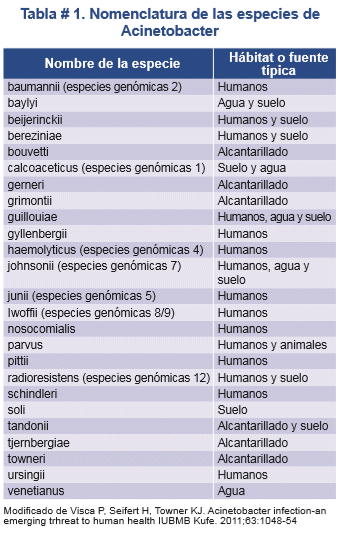
<body><![CDATA[<p>&nbsp;</p>     <p>&nbsp;</p>     <p align="justify"><font face="Verdana" size="3"><b>Introducción</b></font></p>     <p align="justify"><font face="Verdana" size="2"><i>Acinetobacter </i>(inmóvil) es un cocobacilo Gram (-) que durante las tres últimas décadas, emerge desde un organismo de patogenicidad cuestionable a un agente infeccioso importante en todos los hospitales del mundo. <sup>1</sup> <i>Acinetobacter </i>spp., es un agente causal importante de morbilidad y mortalidad infecciosa que afecta sobre todo a pacientes internados en Unidades de Cuidados Intensivos (UCI). <i>A. baumannii </i>es la especie aislada con más frecuencia y la de mayor importancia clínica, en los últimos 20 años.<sup>2</sup> Lo más alarmante de este microrganismo, es su habilidad de acumular diversos mecanismos de resistencia antimicrobiana y la emergencia de cepas resistentes a casi todos los antibióticos disponibles en el mercado.<sup>1</sup></font></p>     <p align="justify"><font face="Verdana" size="2"><i>Acinetobacter </i>fue descrito por primera vez en 1911 como <i>Micrococcus calcoaceticus</i>, desde entonces ha recibido diferentes nombres y recién desde los cincuentas recibe el nombre de <i>Acinetobacter. </i>Su hábitat natural son el agua y el suelo. También, es aislado de comidas, artrópodos y del ambiente. En humanos coloniza la piel, heridas y el tracto respiratorio y gastrointestinal.<sup>1</sup></font></p>     <p align="justify">&nbsp;</p>     <p align="justify"><font face="Verdana" size="3"><b>Microbiología</b></font></p>     <p align="justify"><font face="Verdana" size="2">Las especies ahora clasificadas como miembros del género <i>Acinetobacter </i>han sufrido una larga historia de cambios taxonómicos, lo cual ha impedido su estudio adecuado.<sup>2</sup></font></p>     <p align="justify"><font face="Verdana" size="2">Si bien, el género <i>Acinetobacter </i>se encuentra ubicuo en la naturaleza, con estudios de hibridación ADN-ADN se han identificado al menos 23 especies diferentes (genómicas o &quot;genoespecies&quot;) y 11 todavía no poseen un nombre definido (ver <a href="#T1">tabla 1</a>).<sup>3-4</sup> Actualmente, el género <i>Acinetobacter </i>se ubica en la familia <i>Moraxellaceae. </i>Los grupos 1 <i>(A. calcoaceticus), 2 (A. baumannii), </i>3 y 13, poseen características fenotípicas similares que los sistemas bioquímicos comerciales no fueron capaces de discriminar; por ello, Gerner-Smidt y colaboradores<sup>5</sup></font> <font face="Verdana" size="2">sugieren que estas especies conformen el complejo <i>A. calcoaceticus-A. baumannii. </i>Dentro de la especie <i>A. baumannii </i>se han definido, a su vez, 19 bio-tipos, siendo el 1, 2, 6 y 9 los más aislados en las muestras clínicas.<sup>5-6</sup></font></p>     <p align="justify"><a name="T1"></a></p>     ]]></body>
<body><![CDATA[<p align="center"><img src="/img/revistas/rbp/v55n1/a01_cuadro_08.gif" width="340" height="534"></p>     <p align="justify"><font face="Verdana" size="2">En la práctica hospitalaria habitual, la identificación precisa de las especies es innecesaria y la terminología (p.ej., complejo <i>A. calcoaceticus-A. baumannii) </i>cumple las necesidades tanto de médicos como de microbiólogos.<sup>3</sup> Sin embargo, con fines epidemiológicos, se realizan estudios adicionales con pruebas que incluyen: la electroforesis en gel de campo pulsado, los polimorfismos de longitud de fragmentos amplificados (LOFAP), la reacción en cadena de polimerasa de ADN polimórfico amplificado aleatoriamente (RAPD-PCR) o ribotipado, siguen siendo necesarias para la identificación exacta de las cepas.<sup>3</sup></font></p>     <p align="justify"><font face="Verdana" size="2"><i>Acinetobacter, </i>es un cocobacilo aerobio Gram (-), inmóvil, catalasa positivo, indol y oxidasa-negativos.<sup>3-4</sup> Tiene forma de bacilo durante la etapa de crecimiento rápido y de cocobacilo en la fase estacionaria. Generalmente se encuentra encapsulado, es aerobio y con tendencia a retener cristal violeta, por ello suelen ser identificados incorrectamente como cocos grampositivos. La versatilidad para aprovechar una variedad de fuentes de carbono y energía, le permite crecer en medios habituales de laboratorio y sobrevivir en la naturaleza. Las colonias son de 1 a 2 mm, no pigmentadas, pero se caracterizan por ser abombadas y mucoides con superficies que pueden ser lisas o tener depresiones. Su frecuente identificación errónea como <i>Neisseria </i>o <i>Moraxella </i>en la tinción de Gram se aclara fácilmente, mediante la reacción negativa a la oxidasa de <i>Acinetobacter. </i>Su incapacidad para reducir nitrato o desarrollarse en un medio anaeróbico, distingue a <i>Acinetobacter </i>de las enterobacterias. La hemólisis de los eritrocitos, la acidificación de la glucosa, el crecimiento a 44&deg;C y la variabilidad en el uso de las fuentes de carbono son algunas características genotípicas que se utilizaran para distinguir las cepas de <i>Acinetobacter.</i></font><font face="Verdana" size="2"><sup>3</sup></font></p>     <p align="justify"><font face="Verdana" size="2"><i>A. baumannii </i>es fenotípicamente indistinguible de <i>A. pitti </i>y <i>A. nosocomialis </i>que se caracterizan por infectar a pacientes previamente sanos. <i>A. lwoffii </i>y <i>A. radioresistans </i>colonizan la piel humana y causan infecciones en el hospedero inmunocomprometido. <i>A. calcoaceticus </i>y <i>A. johnsonii </i>se encuentran en el agua y el suelo. <i>A. baylyi </i>es aislado con frecuencia en los alcantarillados.<sup>7,</sup><sup>8-11</sup> <i>A.baumannii </i>hace algunos años emerge como un patógeno importante, exhibiendo un incremento constante de su resistencia antimicrobiana.<sup>1<i>2-</i>14</sup></font></p>     <p align="justify">&nbsp;</p>     <p align="justify"><font face="Verdana" size="3"><b>Epidemiología</b></font></p>     <p align="justify"><font face="Verdana" size="2">En casi el 100% de las muestras de suelo y agua se logra cultivar <i>Acinetobacter. </i>También es aislado de muchas fuentes, como leche pasteurizada, alimentos congelados, vegetales, carne de ave congelada y</font> <font face="Verdana" size="2">pescado. En los hospitales fue identificado en el aire nosocomial, humidificadores, agua de grifo, baños de dializado peritoneal, objetos que permiten micciones en la cama (pop. chata y pato), toallas, almohadas, cortinas, piscinas de hidroterapia, catéteres, de angiografía, respiradores mecánicos, bombas de infusión, laringoscopios, duodenoscopios, equipos con control digital, medicación con multidosis, fracción de proteínas plasmáticas y dispensadores de jabón que se comportan como verdaderos reservorios del microorganismo.<sup>3-4</sup> Puede sobrevivir en objetos inanimados húmedos o secos del ambiente hospitalario durante semanas o meses. De manera similar a las infecciones por <i>Staphylococcus aureus, </i>el movimiento de los pacientes y personal del nosocomio son los responsables de diseminar la infección y de provocar brotes prolongados.<sup>3-4</sup></font></p>     <p align="justify"><font face="Verdana" size="2"><i>Acinetobacter </i>se desarrolla a partir de numerosas fuentes humanas, incluida la piel, el esputo, la orina, las heces y secreciones vaginales. Es el microorganismo gramnegativo que con mayor frecuencia el personal hospitalario porta en la piel de forma persistente. Hasta el 25% de los adultos sanos de la comunidad presentan colonización cutánea y el 7% de los adultos y lactantes presentan colonización faríngea transitoria<sup>3</sup>. Asimismo, coloniza los tubos de traqueostomía de los pacientes internados.<sup>3</sup></font></p>     <p align="justify"><font face="Verdana" size="2">La resistencia de <i>Acinetobacter </i>a biocidas (p.ej., clorhexidina) se convierte en un problema cuando se realizan diluciones inapropiadas, si el tiempo de exposición es inadecuado o por la presencia de residuos biológicos y/o de <i>Acinetobacter </i>resistente a múltiples fármacos.<sup>3</sup></font></p>     <p align="justify"><font face="Verdana" size="2">Si bien, <i>Acinetobacter baumannii </i>es reconocido como el agente causal de varias enfermedades nosocomiales severas que incluyen: infecciones de piel y tejidos blandos, infección de heridas, tracto urinario y meningitis secundaria; las infecciones más importantes con elevada mortalidad son la neumonía asociada a ventilador y la bacteriemia.<sup>15</sup> Los factores de riesgo para desarrollar una infección nosocomial incluyen: duración de estancia hospitalaria mayor a 5</font> <font face="Verdana" size="2">días,<sup>3,16</sup> cirugía preliminar, heridas, infección previa (independiente del uso previo de antibióticos), colonización fecal con <i>Acinetobacter, </i>tratamiento con antibióticos de amplio espectro (cefalosporinas de tercera generación, fluoroquinolonas o carbepené</font><font face="Verdana" size="2">micos),<sup>3-4</sup> catéteres urinarios o intravenosos centrales permanentes, ingreso a una unidad de quemados, estancia prolongada en una UCI, nutrición parenteral, ventilación mecánica e inadecuada aplicación</font> <font face="Verdana" size="2">de los protocolos de control de infecciones.<sup>3-4</sup></font></p>     ]]></body>
<body><![CDATA[<p align="justify"><font face="Verdana" size="2">Con menor frecuencia se presentan infecciones por <i>Acinetobacter baumannii </i>adquiridas en la comunidad que incluyen, neumonía en el 85% de los casos y bacteriemia.<sup>15</sup> La neumonía adquirida en la comunidad (NAC) es más severa que la nosocomial y -en general- fulminante, falleciendo el 60% de los pacientes.<sup>15</sup> Entre los factores de riesgo para adquirir una NAC por <i>Acinetobacter </i>podemos mencionar: al alcoholismo, tabaquismo, a la enfermedad pulmonar crónica, diabetes mellitus y residencia en un país tropical en vías de desarrollo.<sup>3</sup></font></p>     <p align="justify"><font face="Verdana" size="2">La transmisión de <i>Acinetobacter </i>en los sistemas de salud se produce porque no se realiza de rutina, un apropiado lavado de manos y desinfección del mobiliario de los equipos médicos y superficies hospitalarias en áreas próximas al paciente.<sup>17-19</sup> La inadecuada desinfección provoca altos niveles de contaminación ambiental que se asocian directamente con la colonización e infección por <i>Acinetobacter.</i><sup>20</sup></font></p>     <p align="justify"><font face="Verdana" size="2"><i>Acinetobacter </i>produce el 3 a 7% de las neumonías hospitalarias y el 1 a <i>2% </i>de las bacteriemias asociadas a catéteres intravasculares, sitios de infección quirúrgica e infecciones del tracto urinario.<sup>20</sup></font></p>     <p align="justify"><font face="Verdana" size="2">La prevalencia de los aislamientos clínicos de <i>Acinetobacter </i>varía en cierto grado entre los países y sitios de donde se obtienen las muestras, la misma se ha incrementado -en general- en todo el mundo en las dos últimas décadas.<sup>3</sup></font></p>     <p align="justify"><font face="Verdana" size="2">El <i>A. baumannii </i>multidrogoresistente fue identificado como un patógeno relevante al provocar infec</font><font face="Verdana" size="2">ciones en lesiones traumáticas, de soldados durante los conflictos del Medio Este.<sup>21-23</sup> Su establecimiento como un agente causal en infecciones asociadas a los sistemas de salud y la falta de un potente agente antimicrobiano que logre combatirlo, constituye un problema emergente de salud pública.<sup>24</sup></font></p>     <p align="justify">&nbsp;</p>     <p align="justify"><font face="Verdana" size="3"><b>Patogenia</b></font></p>     <p align="justify"><font face="Verdana" size="2">A pesar que <i>Acinetobacter </i>spp., es considerado como un agente de baja patogenicidad, ciertas características le permiten aumentar la virulencia de cepas involucradas en infecciones.<sup>2</sup></font></p>     <p align="justify"><font face="Verdana" size="2">La patogenia de <i>A. baumannii </i>está relacionada con: a) su facultad de adherirse a superficies y <i>células epiteliales </i>humanas, utilizando sus fimbrias; b) sus cadenas de lipopolisacáridos, pese a no conocer el potencial endotóxico del lipopolisacárido de la pared bacteriana en humanos; c) la presencia de lípido A en la membrana celular externa; d) desarrollo de una biopelícula (&quot;biofilm&quot;) sobre las superficies y células humanas; e) su capacidad para sobrevivir en medios con limitada concentración de zinc dentro del hospedero; f) su virtud de desarrollarse en un pH ácido y a bajas temperaturas que le permite incrementar su habilidad para invadir tejidos desvitalizados; f) su prolongada viabilidad bajo condiciones de sequedad; g) la producción de bacteriocina que incrementa su sobrevida; h) la presencia de un polisacárido capsular formado por L-ramnosa, D-glucosa, D-ácido glucurónico y D-manosa, que vuelve a la cepa más hidrofílica, disminuyendo su adherencia a hidrocarbonos y ayuda a la bacteria a evadir la fagocitosis, aunque la hidrofobicidad puede ser mayor en cepas de <i>Acinetobacter </i>aisladas de catéteres o aparatos traqueales; i) su cápsula que inhibe la fagocitos; j) la producción de enzimas que pueden dañar tejidos lipídicos, como el butirato y caprilato esterasas, leucin aryl amidasa, gelatinasa y lipasa; k) la producción de sideróforos: l) la producción de aerobactinas y proteínas de la membrana externa dependientes de hierro, por algunas cepas de <i>A.</i></font> <font face="Verdana" size="2"><i>baumannii </i>que le permiten vivir en el cuerpo humano; m) su potencial para adquirir material genético de su entorno para incrementar su sobrevivencia y desarrollar un gran repertorio de mecanismos de resistencia antimicrobiana.<sup>2,25-30</sup></font></p>     <p align="justify"><font face="Verdana" size="2">Los neutrófilos reclutados juegan un papel preponderante en la respuesta inmune del hospedero contra la infección por <i>Acinetobacter.</i><sup>31-33</sup></font></p>     ]]></body>
<body><![CDATA[<p align="justify">&nbsp;</p>     <p align="justify"><font face="Verdana" size="3"><b>Importancia clínica</b></font></p>     <p align="justify"><font face="Verdana" size="2"><i>Acinetobacter </i>spp., tiene la capacidad de producir infecciones supurativas en casi cualquier sistema del organismo.<sup>34</sup></font></p>     <p align="justify"><font face="Verdana" size="2">Debido a su amplia distribución en la naturaleza y su capacidad para colonizar tejidos sanos o dañados, la interpretación del significado de aislamientos procedentes de muestras clínicas suele ser difícil, poder diferenciar entre una muestra de sangre contaminada y bacteriemia real, suele ser una tarea a veces difícil. El origen más común de las bacteriemias son las infecciones del tracto respiratorio, de heridas quirúrgicas o catéter intravascular, presentando la mayor tasa de bacteriemia nosocomial durante la segunda semana de hospitalización. Asimismo, <i>Acinetobacter </i>puede interpretarse erróneamente en la tinción de Gram, como otros microorganismos gramnegativos que se asocian con mayor frecuencia a síndromes clínicos particulares (p.ej., en LCR, <i>Neisseria meningitidis; </i>en el esputo, <i>Haemophilus influenzae). </i>El complejo <i>A. baumannii </i>es el patógeno aislado con mayor frecuencia y representa el 80% de todos los aislamientos clínicos de esta especie. Sin embargo, la identificación reiterada de especies distintas a <i>A. baumannii (A.ursingii y Acinetobacter </i>cepa RUH) en muestras clínicas, no debería descartarse con la calificación de contaminante.<sup>2-3</sup></font></p>     <p align="justify"><font face="Verdana" size="2"><b>Vía respiratoria</b></font></p>     <p align="justify"><font face="Verdana" size="2"><i>Acinetobacter </i>con mayor frecuencia infecta el sistema respiratorio debido a la colonización faríngea transitoria que ocurre en personas sanas y la tasa</font> <font face="Verdana" size="2">elevada de colonización en los tubos de traqueostomía.<sup>34</sup></font></p>     <p align="justify"><font face="Verdana" size="2">En niños sanos suele causar bronquiolitis y traqueo-bronquitis adquiridas en la comunidad.<sup>35</sup> Se describe neumonía adquirida en la comunidad (NAC) severa por <i>Acinetobacter </i>que se presenta durante los meses de calor y humedad en regiones tropicales.<sup>36-38</sup> La NAC en adultos, se presenta -en general- en hospederos con defensas disminuidas (p.ej., alcohólicos, fumadores, con diabetes mellitus, insuficiencia renal o enfermedad pulmonar subyacente).<sup>37,39-40</sup>Se asocia con una alta incidencia de bacteriemia, síndrome de insuficiencia respiratoria, sepsis, choque y muerte (mortalidad &#8805; 50%). La mortalidad de la NAC es más elevada que la infección adquirida en el hospital, aunque se desconocen las razones de esta presentación fulminante. Rara vez, la NAC por especies de <i>Acinetobacter </i>se presenta con imágenes de consolidación y abscesos pulmonares múltiples.<sup>37-38</sup></font></p>     <p align="justify"><font face="Verdana" size="2">El mayor impacto que ha producido <i>Acinetobacter </i>es haberse constituido como un agente causal importante de la neumonía nosocomial, que se caracteriza por ser de inicio tardío -en especial- en casos asociados a ventilación mecánica, provocando mayor mortalidad y una estancia hospitalaria prolongada.<sup>41-43</sup> Los factores predisponentes para desarrollar neumonía nosocomial incluyen: intubación endo-traqueal, traqueostomía, estancia en UCI, cirugía reciente, puntuación de APACHE II alta, enfermedad pulmonar subyacente y el tratamiento previo con antibióticos. Su propagación nosocomial en la UCI se produce a través de los equipos de ventilación mecánica, guantes, colonización del equipo de enfermería y personal de fisioterapia respiratoria, entre otros. Las neumonías nosocomiales por <i>Acinetobacter </i>son con frecuencia multilobulares y puede observarse cavitación, derrame pleural y formación de fístula broncopleural.<sup>44</sup></font></p>     <p align="justify"><font face="Verdana" size="2"><b>Bacteriemia</b></font></p>     <p align="justify"><font face="Verdana" size="2">Acinetobacter causa del 1% a <i>2% </i>de todas las bacteriemias y se asocian típicamente a catéteres intra</font><font face="Verdana" size="2">vasculares, el 63% son producidas por <i>A. baumannii, </i>20% por <i>A. nosocomialis </i>y 8% por <i>A. pitti. A. baumannii </i>provoca la mayor mortalidad por bacteriemia.<sup>45-47</sup> La bacteriemia nosocomial por <i>Acinetobacter, </i>se asocia con frecuencia a infecciones de las vías respiratorias y el uso de catéteres endovenosos (colonización o infección) y en menor proporción a las infecciones de las vías urinarias, heridas cutáneas y abdominales.<sup>40</sup> El choque séptico suele presentarse hasta en el 30% de pacientes con bacteriemia con una tasa de mortalidad del 17-46%.<sup>34,48 </sup>La producida por especias distintas a <i>A. baumannii </i>tiende a ser menos grave.<sup>3</sup></font></p>     ]]></body>
<body><![CDATA[<p align="justify"><font face="Verdana" size="2">La sepsis suele presentarse tardíamente en neonatos y lactantes hospitalizados por largos períodos de tiempo, con una tasa de mortalidad del 11%, los factores de riesgos que predisponen al desarrollo de bacteriemia en este grupo de pacientes son: el bajo peso al nacer, terapia antibiótica previa, ventilación mecánica y aire ambiental contaminado.<sup>2</sup></font></p>     <p align="justify"><font face="Verdana" size="2"><b>Genitourinarias</b></font></p>     <p align="justify"><font face="Verdana" size="2">A pesar de colonizar la vía urinaria inferior, <i>Acinetobacter </i>solo es invasivo en raras ocasiones, provocando el 1% de las infecciones del tracto urinario tanto cistitis como pielonefritis, en pacientes con sonda vesical permanente o nefrolitiasis. La mayoría de estas cepas poseen la habilidad de formar &quot;biofilms&quot; en los catéteres urinarios.<sup>34,49-50</sup></font></p>     <p align="justify"><font face="Verdana" size="2"><b>Infección intracraneal</b></font></p>     <p align="justify"><font face="Verdana" size="2">En pacientes sanos la meningitis por <i>Acinetobacter </i>es infrecuente.<sup>51</sup> Suele presentarse -en general- luego de un traumatismo craneoencefálico o intervención neuro-quirúrgica, incluyendo aquellos con tubos de drenaje ventricular. Su incidencia ha disminuido con el uso racional de antibióticos y la implementación de medidas para el control de infecciones.<sup>49,52</sup> Hasta un 30% de los pacientes con meningitis presentan un exantema petequial.<sup>39</sup></font></p>     <p align="justify"><font face="Verdana" size="2"><b>Tejidos blandos</b></font></p>     <p align="justify"><font face="Verdana" size="2"><i>Acinetobacter </i>es un patógeno importante de las heridas traumáticas (p.ej., heridas de guerra), incisiones postoperatorias y quemaduras, debido a su capacidad de desarrollar en tejido dañado o con cuerpos extraños. Las infecciones por <i>Acinetobacter </i>se hicieron patentes recientemente en desastres naturales como terremotos y tsunamis.<sup>16,53-54</sup> Puede causar celulitis asociada a catéter venoso permanente que se resuelve con la simple retirada de éste. Se ha descrito fascitis necrosante sinérgica con <i>Streptococcus pyogenes.</i><sup>34</sup></font></p>     <p align="justify"><font face="Verdana" size="2"><b>Miscelánea de infecciones</b></font></p>     <p align="justify"><font face="Verdana" size="2">La infección por <i>Acinetobacter </i>puede presentarse en cualquier sitio del organismo. Suele observarse en la esfera oftálmica: conjuntivitis, endoftalmitis,<sup>55 </sup>úlcera corneal secundaria a contaminación de lentes de contacto blandos y perforación corneal.<sup>56</sup> También, puede presentarse endocarditis de válvulas naturales y protésicas,<sup>57</sup> osteomielitis, artritis séptica, y abscesos pancreáticos o hepáticos.<sup>3</sup></font></p>     <p align="justify"><font face="Verdana" size="2"><b>Resistencia bacteriana</b></font></p>     ]]></body>
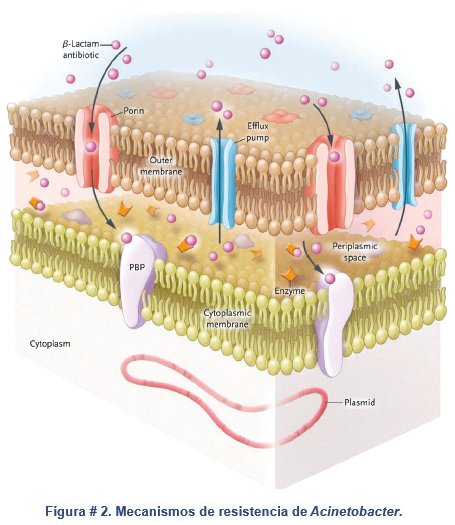
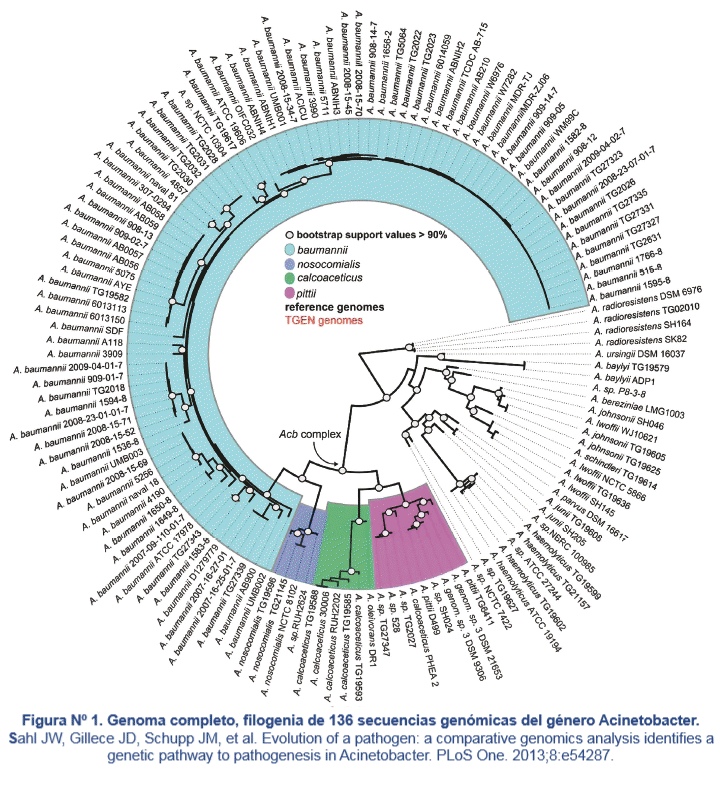
<body><![CDATA[<p align="justify"><font face="Verdana" size="2">Al igual que otras infecciones oportunistas por gramnegativos, el desarrollo de la resistencia antimicrobiana ha hecho difícil el tratamiento de <i>Acinetobacter. </i>A pesar de observarse diferencias importantes en: los patrones de resistencia antimicrobiana según las especies de <i>Acinetobacter, </i>el país o región donde es aislado; la tendencia global es un incremento de su resistencia.<sup>3</sup> En la actualidad, los aislamientos de <i>A. baumannii </i>con frecuencia son resistentes a todos los antibióticos disponibles.<sup>3,58-59</sup></font></p>     <p align="justify"><font face="Verdana" size="2">La habilidad de <i>A. baumannii </i>para adquirir mecanismos de resistencia fue un fenómeno observado a principios de los setentas. El desarrollo extremadamente rápido de resistencia antimicrobiana, se debe al uso masivo de antibióticos en los hospitales y a la gran habilidad que posee <i>A. baumannii</i></font> <font face="Verdana" size="2">para responder en forma rápida a estos desafíos.<sup>49 </sup>Específicamente, se informa la influencia que tiene el empleo de cefalosporinas de amplio espectro y quinolonas para inducir resistencia.<sup>60-62</sup> Uno de los principales problemas, fue la aparición de resistencia a carbepenémicos al adquirir carbapenemasas clase B y D.<sup>63-66</sup> El 30% de los <i>Acinetobacter </i>son MDR. Sin embargo, existen diferencias geográficas de resistencia.<sup>67-69</sup></font></p>     <p align="justify"><font face="Verdana" size="2"><i>Acinetobacter </i>posee múltiples mecanismos de resistencia, estrechamente relacionados con el incremento del tamaño del genoma (ver <a href="#F1">figura 1</a>).<sup>70-71 </sup></font></p>     <p align="justify"><a name="F1"></a></p>     <p align="center"><img src="/img/revistas/rbp/v55n1/a01_cuadro_09.gif" width="719" height="791"></p>     <p align="justify"><font face="Verdana" size="2">El genoma de <i>A. baumannii </i>contiene varios genes agrupados en islas de resistencia, cuya estructura facilita la adquisición de mecanismos de resistencia de otras especies de bacterias.<sup>72</sup> <i>Acinetobacter, </i>tiene mayor probabilidad para adquirir determinantes de resistencia en comparación con otras bacterias,</font> <font face="Verdana" size="2">gracias a su estrecha relación con varias especies de su género en el suelo y agua del ambiente que contienen un gran reservorio de genes, responsables de resistencia bacteriana.<sup>73</sup></font></p>     <p align="justify"><font face="Verdana" size="2">El mecanismo de resistencia antimicrobiana más frecuente de <i>Acinetobacter </i>se lleva cabo mediante la producción de ß-lactamasas. (ver <a href="#f2">figura 2</a>). El grupo Ambler 1 ß-lactamasas clase C no inducibles son codificadas cromosómicamente, como cefalos-porinasas que hidrolizan a las penicilinas y cefalos-porinas de primera, segunda y tercera generación. El porcentaje de hidrolisis por estas enzimas es me</font><font face="Verdana" size="2">nor para cefalosporinas de cuarta generación como el cefepime y carbapenémicos.<sup>74-75</sup></font></p>     <p align="justify"><a name="f2"></a></p>     <p align="center"><img src="/img/revistas/rbp/v55n1/a01_figura_11.jpg" width="455" height="525"></p> <table width="444" border="0" align="center">   <tr>     <td></td>   </tr>   <tr>     <td valign="top">    <p align="justify"><font face="Verdana" size="2">Al igual que otras bacterias Gram (-), posee una membrana externa y una membrana citoplasm&aacute;tica, un espacio peripl&aacute;smico donde residen &szlig;-lactamasas (carbapenemasas, &szlig;-lactamasas Ambler clase C, y &szlig;-lactamasas de espectro ampliado). Las prote&iacute;nas fijadoras de penicilina (PFP), localizadas a nivel de la membrana citoplasm&aacute;tica constituyen el blanco final de los antibi&oacute;ticos &szlig;-lact&aacute;micos. Para unirse a ellas en el espacio peripl&aacute;smico, los antibi&oacute;ticos deben atravesar la membrana externa a trav&eacute;s de los canales de porinas (prote&iacute;nas de la membrana externa). Si bien, los antibi&oacute;ticos &szlig;-lact&aacute;micos pueden unirse a las PFP, estos podr&iacute;an ser expulsados activamente de la estructura bacteriana por las bombas de expulsi&oacute;n. Acinetobacter puede albergar integrones y transposones, elementos gen&eacute;ticos sobre el cromosoma bacteriano o pl&aacute;smidos que pueden transportar m&uacute;ltiples cajas con genes de resistencia (v.g. &szlig;-lactamasas de espectro ampliado y metalo &szlig;-lactamasas). Modificado de la Referencia 42.</font></p>     </td>   </tr> </table>     ]]></body>
<body><![CDATA[<p align="justify"><font face="Verdana" size="2">En 1980 se manifiesta la emergencia y la rápida diseminación mundial de la clase Ambler 2be ß-lactamasas de espectro extendido (BLEE) con una actividad hidrolítica contra las penicilinas y todas las cefalosporinas, induciendo al uso de carbe-penémicos para tratar infecciones por cepas BLEE de <i>Acinetobacter. </i>La subsecuente emergencia de la clase Ambler D, grupo 2d oxacilinasas ha sido la responsable del incremento de resistencia a carbe-penémicos desde el año 2000.<sup>76-77</sup> La clase Ambler B, grupo 3 de las metalo-ß-lactamasas que si bien se manifiestan con menor frecuencia también, producen resistencia a carbepenémicos.<sup>78-80</sup></font></p>     <p align="justify"><font face="Verdana" size="2">La segunda causa más importante de resistencia antimicrobiana de <i>Acinetobacter </i>son las bombas de expulsión que confieren resistencia a antibióticos ß-lactámicos, cloranfenicol, macrólidos, tetraciclinas, tigeciclina, aminoglucósidos y ciertos antisépticos, (ver <a href="#f2">figura 2</a>)<sup>81-82</sup>. La presencia de mecanismos de resistencia antimicrobiana adicionales que trabajan en sintonía con las bombas de expulsión limitan las opciones terapéuticas.</font></p>     <p align="justify"><font face="Verdana" size="2">En las especies de <i>Acinetobacter, </i>la resistencia a aminoglucósidos está determinada por la presencia de enzimas (fosforilasas, acetilasas o adenilasas) que disminuyen la afinidad a estos antimicrobianos a la subunidad del ribosoma correspondiente.<sup>83-84 </sup>Sin embargo, se describió el gen armA ubicado en un transposón que codifica una metilasa del ARNr 16S que altera el sitio de acción y por consiguiente genera altos niveles de resistencia a todos los aminoglucósidos.<sup>85</sup></font></p>     <p align="justify"><font face="Verdana" size="2">La resistencia de <i>Acinetobacter </i>a las fluoroquinolonas es multifactorial, manifestándose ciertas mutaciones que determinan regiones de menor afinidad de las fluoroquinolonas a la DNA girasa y topoisomerasa IV; cuando se combinan con una sub-regulación de la bomba de expulsión A de ABC, se produce la resistencia.<sup>86-88</sup></font></p>     <p align="justify"><font face="Verdana" size="2">La resistencia a las polimixinas que incluyen a la colistina y polimixina B, se presenta por mutaciones genéticas que codifican a dos componentes del sistema regulador PmrA y PmrB y una reducción de lipopolisacáridos en la pared bacteriana de <i>Acinetobacter, </i>provocando una menor carga negativa con pérdida de la afinidad antimicrobiana.<sup>89-90</sup> Similar a la resistencia a carbapenémicos, se ha identificado heteroresistencia de <i>Acinetobacter </i>a polimixinas, observándose la emergencia de resistencia durante el tratamiento.<sup>89</sup> Sin embargo, para bien las cepas de <i>A. baumannii </i>resistentes a colistina producen un menor número de infecciones, lo cual potencia lentamente la diseminación de esta panresistencia.<sup>91-92</sup></font></p>     <p align="justify"><font face="Verdana" size="2"><i>Acinetobacter </i>adquiere el fenotipo multidrogo-resistente (MDR), a través de elementos genéticos mobiles (plásmidos, transposones e integrones).<sup>93-95</sup> La presencia de integrones clase I y II se asocia con múltiple resistencia a antibióticos.<sup>95-96 </sup>La mayoría de ellos es adquirido por contacto con bacterias presentes en su ambiente como las <i>Pseudomonas spp.<sup>97-99</sup></i></font></p>     <p align="justify">&nbsp;</p>     <p align="justify"><font face="Verdana" size="3"><b>Tratamiento</b></font></p>     <p align="justify"><font face="Verdana" size="2">Por el amplio rango de mecanismos de resistencia, la elección del tratamiento empírico debe basarse de acuerdo a la epidemiología local y en el riesgo que tiene el paciente para adquirir una cepa resistente. Antes de iniciar la terapia, debemos considerar que <i>Acinetobacter </i>puede colonizar la piel, faringe, vía digestiva, uretra, conjuntiva y vagina. Por ello, primero tenemos la obligación de considerar, si la cepa aislada en el cultivo se trata de una infección invasiva o solo se trata de una colonización, evitando el sobre uso de antibióticos.<sup>3-4</sup> Acinetobacter MDR se define como la resistencia a carbapenémicos o resistencia a tres clases de antimicrobianos<sup>100</sup> y pan-resistencia cuando incluye a polimixinas.<sup>91-92</sup></font></p>     <p align="justify"><font face="Verdana" size="2"><b>Antibióticos ß-lactámicos: </b>cuando <i>Acinetobacter </i>es susceptible, los &szlig;-lactámicos constituyen el tratamiento de elección por su efecto bactericida</font> <font face="Verdana" size="2">y amplia distribución en todo el organismo. Estas cepas susceptibles deben ser tratadas con cefalos-porinas de tercera o cuarta generación como la cefotaxime, ceftriaxone o cefepime, porque la presencia de ß-lactamasas intrínsecas inactivan las penicilinas, cefalosporinas de primera y segunda generación.<sup>101-103</sup></font></p>     ]]></body>
<body><![CDATA[<p align="justify"><font face="Verdana" size="2"><b>Carbapenémicos: </b>el imipenem y meropenem constituyen el tratamiento de elección para las infecciones severas por <i>A. baumannii. </i>Si bien, en un inicio aproximadamente el 90% de los aislamientos eran sensibles a carbepenémicos,<sup>58,104-105</sup> en los últimos años la susceptibilidad a imipenem a disminuido en Latinoamérica (60.6%) en relación a Europa (85.9%) y Norte América (88.6%).<sup>106</sup> La resistencia de <i>A. baumannii </i>a <i>carbapenémicos </i>se produce por varios mecanismos potenciales, incluyendo plásmidos o carbapenemasas codificadas cromosómicamente -en especial- <i>ß</i>-lactamasas clase D (OXA-23, OXA-24 u OXA-58), metalo-<i>ß</i>-lactamasas (<i>ß</i>-lactamasas clase B), bombas de expulsión, alteración en las proteínas fijadoras de penicilina, modificación <i>de cationes </i>o pérdida de proteínas de la membrana externa (porinas).<sup>107-108</sup> Más de uno de estos mecanismos de resistencia pueden estar presentes en la misma cepa, confiriéndole un alto nivel de resistencia.</font></p>     <p align="justify"><font face="Verdana" size="2"><b>Inhibidores de ß-Lactamasas: </b>El sulbactam posee actividad antimicrobiana intrínseca contra <i>A.</i></font><font face="Verdana" size="2"><i>baumannii </i>y es el inhibidor de <i>ß-lactamasas más activo.</i><sup>109</sup> La combinación de sulbactam con ampicilina, cefoperazona o penicilinas antipseudomonas no incrementa la actividad antimicrobiana contra A. <i>baumannii.</i><sup>110</sup> La emergencia de cepas de <i>Acinetobacter </i>resistente a carbepenémicos, permitió que los inhibidores de <i>ß</i>-lactamasas surjan como una opción terapéutica. El sulbactam combinado con ampicilina es efectivo para tratar infecciones invasivas como la neumonía, bacteriemia y meningitis.<sup>110-112</sup></font></p>     <p align="justify"><font face="Verdana" size="2"><b>Aminoglucósidos: </b>Estos antimicrobianos poseen una acción moderada contra <i>A. baumannii.</i><sup>105</sup> En todo el mundo la sensibilidad de <i>Acinetobacter spp.</i></font> <font face="Verdana" size="2">a amikacina es aproximadamente del 60%. Esta actividad es menor en las cepas de <i>A. baumannii </i>MDR en comparación con las que no MDR.<sup>69</sup> Si bien las pruebas de sensibilidad muestran cepas de <i>Acinetobacter </i>sensible a aminoglucósidos, su empleo está limitado por su deficiente penetración al tejido pulmonar y sistema nervioso central.<sup>113-116</sup></font></p>     <p align="justify"><font face="Verdana" size="2"><b>Tigeciclina y</b> <b>minociclina. </b>La minociclina, doxiciclina y en menor escala la tetraciclina han demostrado alto porcentaje de actividad antimicrobiana contra <i>A. baumannii. </i><sup>117</sup> La tigeciclina es una glicilciclina, derivado semisintético de la minociclina y bacteriostático para <i>A.baumannii.</i><sup>117</sup> Tiene la capacidad de evadir a la mayoría de los mecanismos de resistencia de las tetraciclinas. La tigeciclina combinada con otros antibióticos ha sido empleada con éxito en el tratamiento de <i>Acinetobacter </i>resistente a carbapenémicos. Sin embargo, su volumen de distribución y baja concentración sérica, evita su empleo en la bacteriemia, habiéndose informado el desarrollo de resistencia durante el tratamiento.<sup>118-122 </sup>La minociclina y derivados de la tetraciclina muestran actividad &quot;in vitro&quot; contra <i>Acinetobacter </i>resistente a carbapenémicos y combinadas con colistina poseen actividad bactericida.<sup>123-125</sup></font></p>     <p align="justify"><font face="Verdana" size="2"><b>Polimixinas: </b>Son polipéptidos catiónicos que interactúan con el lipopolisacárido de la bacteria gram-negativa. Han demostrado tener actividad bactericida contra <i>A. baumannii</i><sup>105,126-127</sup> y la resistencia contra estos agentes permanece baja incluyendo, cepas MDR y resistentes a carbepenémicos.<sup>128-130 </sup>Disponemos de dos agentes en este grupo de antimicrobianos: la colistina y polimixina B. Con frecuencia son utilizadas en el tratamiento de infecciones por <i>Acinetobacter </i>resistente a carbapenémicos. Las polimixinas han sido empleadas en el tratamiento de la meningitis nosocomial causada por <i>A. baumannii </i>MDR. Su efectividad clínica solo se alcanza con tratamiento endovenoso. Debido a su inadecuada penetración de la barrera hematoencefálica, colistina ha sido administrada por vía intraventricular o intratecal más colistina endovenosa.<sup>131-136</sup></font></p>     <p align="justify"><font face="Verdana" size="2">Los informes clínicos de pacientes infectados por <i>A.baumannii </i>resistente a polimixinas son escasos. Sin embargo, su mayor empleo en pacientes críticamente enfermos puede conducir a la emergencia de resistencia.<sup>137</sup> La aparición de resistencia se relaciona con el uso previo de colistina que incrementaría la emergencia de resistencia durante la terapia.<sup>138</sup> La resistencia innata a colistina es común en ciertas especies de <i>Acinetobacter </i>como el <i>A.junii.</i><sup>139</sup> En áreas con alta prevalencia de <i>Acinetobacter </i>resistente a carbapenémicos y sulbactam, las polimixinas deben ser consideradas como un componente de la terapia empírica en infecciones severas.<sup>101</sup></font></p>     <p align="justify"><font face="Verdana" size="2"><b>Fluoroquinolonas. </b>Poseen moderada actividad antimicrobiana contra <i>A.baumannii, </i>su sensibilidad global a ciprofloxacina es de 44%.<sup>105</sup> Sin embargo, la actividad de fluoroquinolonas contra cepas MDR o resistentes a imipenem es baja.<sup>105,133,140</sup></font></p>     <p align="justify"><font face="Verdana" size="2"><b>Tratamiento combinado. </b>El conocimiento de las infecciones por <i>A.baumannii </i>es sustentado por estudios realizados &quot;in vitro&quot; o animales. Aunque varias de las combinaciones utilizando colistina, rifampicina, carbapenémicos, sulbactam, minociclina y tigeciclina demostraron resultados promisorios en el laboratorio, la correlación con la evolución clínica está ausente por la falta de estudios controlados apropiados.<sup>125,141-146</sup> El tratamiento endovenoso de polimixinas más otros antimicrobianos, como rifampicina para infecciones nosocomiales por <i>A. baumannii </i>MDR produce una favorable respuesta clínica.<sup>148,147-151</sup> Sin embargo un estudio multicéntrico aleatorizado en pacientes infectados con <i>A.baumannii </i>MDR tratados con colistina o colistina más rifampicina demostró, que si bien la erradicación microbiológica fue más rápida con el esquema combinado no hubo diferencias en la mortalidad y tiempo de hospitalización.<sup>152</sup> Este estudio sugiere que la adición de rifampicina a la colistina cuando tratamos infecciones por <i>Acinetobacter </i>MDR, no está justificada de forma rutinaria y más bien nos muestra la importancia de contar con un estudio aleatorizado que determine si la terapia combinada</font> <font face="Verdana" size="2">es más beneficiosa. El uso de colistina en aerosol más colistina endovenosa u otros agentes antimicrobianos en neumonía por <i>A.baumannii </i>MDR brindan una respuesta clínica favorable.<sup>153-156</sup> Por los esquemas de tratamiento limitados, el clínico debe optimizar el uso de los antimicrobianos disponibles, usando infusiones prolongadas de antibióticos &szlig;-lactámicos para cepas con sensibilidad intermedia e instilación local de colistina cuando la vía endovenosa proporciona bajas concentraciones tisulares en el sitio de infección.<sup>157</sup> Las infusiones intermitentes de antibióticos ß-lactámicos, incrementan el tiempo de concentración de la droga por encima de la MIC.<sup>158</sup> La infusión continua permite alcanzar niveles valle altos de ß-lactámicos, que quizá permitan una mejor evolución de las infecciones por <i>Acinetobacter </i>menos sensible.<sup>159</sup> Existe ciertos resultados contradictorios por la ausencia de grupos de control, sobre la seguridad y efectividad de la colistina para tratar infecciones por <i>Acinetobacter </i>resistente a carbepenémicos.<sup>160-162</sup> La administración de colistina por vía intratecal es efectiva para el tratamiento de infección en el sistema nervioso central por <i>Acinetobacter </i>resistente.<sup>163</sup> La colistina en aerosol es segura y posiblemente eficaz para tratar la neumonía causada por <i>Acinetobacter </i>resistente.<sup>164-166</sup> Nuevas y prometedoras combinaciones de colistina con antibióticos activos contra Gram-positivos como los glucopéptidos o lipopéptidos han sido estudiados &quot;in vitro&quot; y en vivo.</font></p>     <p align="justify"><font face="Verdana" size="2">Finalmente, un triple esquema con colistina, un lipopéptido o glucopéptido y otro agente activo contra <i>A. baumannii </i>MDR como tigeciclina o carbepenémicos deben ser investigados en la práctica clínica. Sin embargo, se necesitan futuras investigaciones que proporcionen datos clínicos evidentes para apoyar estas combinaciones.<sup>167</sup></font></p>     <p align="justify">&nbsp;</p>     ]]></body>
<body><![CDATA[<p align="justify"><font face="Verdana" size="3"><b>Prevención</b></font></p>     <p align="justify"><font face="Verdana" size="2">Entre las estrategias para evitar la resistencia antimicrobiana, se destaca la prevención de las infecciones aso</font><font face="Verdana" size="2">ciadas con el personal de salud, optimización del diagnóstico, tratamiento de las infecciones considerando la adecuada elección, dosis y duración del tratamiento antimicrobiano, prevención de la transmisión cruzada de patógenos resistentes. El control de la resistencia antimicrobiana requiere el apoyo de la microbiología clínica, un programa activo de prevención de infecciones y un efectivo proceso de intercambio de información entre los microbiólogos, epidemiólogos y médicos.<sup>168</sup></font></p>     <p align="justify"><font face="Verdana" size="2">Por la habilidad que posee <i>Acinetobacter </i>para sobrevivir durante semanas en condiciones de sequedad, es esencial la desinfección rutinaria del equipo médico y superficies que fueron tocadas por el personal de salud para prevenir la transmisión al paciente susceptible (ver <a href="#t2">tabla 2</a>).<sup>169-174</sup></font></p>     <p align="justify"><a name="t2"></a></p>     <p align="center"><img src="/img/revistas/rbp/v55n1/a01_cuadro_10.gif" width="662" height="866"></p>     <p align="justify"><font face="Verdana" size="2">Si bien las medidas de limpieza y desinfección son importantes, el uso de la prueba de bioluminicencia con trifosfato de adenosina es más confiable que la inspección visual.<sup>175-176</sup> Clínicamente es relevante considerar la resistencia de microorganismos a los desinfectantes de uso rutinario, la misma no se ha informado en infecciones por <i>Acinetobacter. </i>La disminución de la susceptibilidad se ha identificado en cepas MDR, después que la bacteria ha sido repetidamente expuesta a desinfectantes.<sup>177-178</sup></font></p>     <p align="justify">&nbsp;</p>     <p align="justify"><font face="Verdana" size="3"><b>Referencias bibliográficas</b></font></p>     <!-- ref --><p align="justify"><font face="Verdana" size="2">1.&nbsp;Muñoz-Price LS, Weinstein RA. Acinetobacter infection. N Eng J Med 2008;358:1271-81.</font>&nbsp;&nbsp;&nbsp;&nbsp;&nbsp;&nbsp;&nbsp;&nbsp;[&#160;<a href="javascript:void(0);" onclick="javascript: window.open('/scielo.php?script=sci_nlinks&ref=438092&pid=S1024-0675201600010000600001&lng=','','width=640,height=500,resizable=yes,scrollbars=1,menubar=yes,');">Links</a>&#160;]<!-- end-ref --><!-- ref --><p align="justify"><font face="Verdana" size="2">2.&nbsp;Salazar de Vegasa EZ, Nieves B. Acinetobacter spp.: aspectos microbiológicos, clínicos y epidemiológicos. Rev Soc Venezol Microbiol 2005;25:64-71.</font>&nbsp;&nbsp;&nbsp;&nbsp;&nbsp;&nbsp;&nbsp;&nbsp;[&#160;<a href="javascript:void(0);" onclick="javascript: window.open('/scielo.php?script=sci_nlinks&ref=438093&pid=S1024-0675201600010000600002&lng=','','width=640,height=500,resizable=yes,scrollbars=1,menubar=yes,');">Links</a>&#160;]<!-- end-ref --><p align="justify"><font face="Verdana" size="2">3.&nbsp;Allen DM, Hartman BJ. Género <i>Acinetobacter. </i>En Mandell GL, Bennett JE, Dolin R, ed. Principios y práctica de enfermedades infecciosas. 7ma. Ed. Barcelona: Editorial, DRK edición 2009;vol 2: 2885-9.</font></p>     <p align="justify"><font face="Verdana" size="2">4.&nbsp;Phillips M. <i>Acinetobacter </i>species. In Mandell GL, Dolin R, Blaser MJ, eds. Principles and practices of infectious diseases. 8th. Ed. Philadelphia: Imprint Elsevier Inc. 2014;vol 2: 2551--8</font></p>     <!-- ref --><p align="justify"><font face="Verdana" size="2">5.&nbsp;Gerner-Smidt P. Ribotyping of the <i>Acinetobacter calcoaceticus-Acinetobacter baumannii </i>Complex. J Clin Microbiol 1992; 30: 2680-5.</font>&nbsp;&nbsp;&nbsp;&nbsp;&nbsp;&nbsp;&nbsp;&nbsp;[&#160;<a href="javascript:void(0);" onclick="javascript: window.open('/scielo.php?script=sci_nlinks&ref=438096&pid=S1024-0675201600010000600005&lng=','','width=640,height=500,resizable=yes,scrollbars=1,menubar=yes,');">Links</a>&#160;]<!-- end-ref --><!-- ref --><p align="justify"><font face="Verdana" size="2">6. Bouvet P, Grimont P. Identification and biotyping of clinical isolate of <i>Acinetobacter. </i>Ann Inst Pasteur Microbiol 1987; 138: 569-78.</font>&nbsp;&nbsp;&nbsp;&nbsp;&nbsp;&nbsp;&nbsp;&nbsp;[&#160;<a href="javascript:void(0);" onclick="javascript: window.open('/scielo.php?script=sci_nlinks&ref=438097&pid=S1024-0675201600010000600006&lng=','','width=640,height=500,resizable=yes,scrollbars=1,menubar=yes,');">Links</a>&#160;]<!-- end-ref --><!-- ref --><p align="justify"><font face="Verdana" size="2">7. Towner KJ. <i>Acinetobacter: </i>an old friend, but a new enemy. J Hosp Infect. 2009;73:355-63.</font>&nbsp;&nbsp;&nbsp;&nbsp;&nbsp;&nbsp;&nbsp;&nbsp;[&#160;<a href="javascript:void(0);" onclick="javascript: window.open('/scielo.php?script=sci_nlinks&ref=438098&pid=S1024-0675201600010000600007&lng=','','width=640,height=500,resizable=yes,scrollbars=1,menubar=yes,');">Links</a>&#160;]<!-- end-ref --><!-- ref --><p align="justify"><font face="Verdana" size="2">8. Fournier PE, Richet H. The epidemiology and control <i>of Acinetobacter baumannii </i>in health care facilities. Clin Infect Dis 2006;42:692-9.</font>&nbsp;&nbsp;&nbsp;&nbsp;&nbsp;&nbsp;&nbsp;&nbsp;[&#160;<a href="javascript:void(0);" onclick="javascript: window.open('/scielo.php?script=sci_nlinks&ref=438099&pid=S1024-0675201600010000600008&lng=','','width=640,height=500,resizable=yes,scrollbars=1,menubar=yes,');">Links</a>&#160;]<!-- end-ref --><!-- ref --><p align="justify"><font face="Verdana" size="2">9. La Scola B, Raoult D. <i>Acinetobacter baumannii </i>in human body louse. <i>Emerg Infect Dis. </i>2004; 10:1671-3.</font>&nbsp;&nbsp;&nbsp;&nbsp;&nbsp;&nbsp;&nbsp;&nbsp;[&#160;<a href="javascript:void(0);" onclick="javascript: window.open('/scielo.php?script=sci_nlinks&ref=438100&pid=S1024-0675201600010000600009&lng=','','width=640,height=500,resizable=yes,scrollbars=1,menubar=yes,');">Links</a>&#160;]<!-- end-ref --><!-- ref --><p align="justify"><font face="Verdana" size="2">10. Berlau J, Aucken H, Malnick H, Pitt T. Distribution <i>of Acinetobacter </i>species on skin of healthy humans. Eur J Clin Microbiol Infect Dis 1999;18:179-83.</font>&nbsp;&nbsp;&nbsp;&nbsp;&nbsp;&nbsp;&nbsp;&nbsp;[&#160;<a href="javascript:void(0);" onclick="javascript: window.open('/scielo.php?script=sci_nlinks&ref=438101&pid=S1024-0675201600010000600010&lng=','','width=640,height=500,resizable=yes,scrollbars=1,menubar=yes,');">Links</a>&#160;]<!-- end-ref --><!-- ref --><p align="justify"><font face="Verdana" size="2">11. Nemec A, Krizova L, Maixnerova M. Genotypic and phenotypic characterization of the <i>Acinetobacter calcoaceticus-Acinetobacter baumannii </i>complex with the proposal of <i>Acinetobacter pittii </i>sp. nov. (formerly <i>Acinetobacter </i>genomic species 3) and <i>Acinetobacter nosocomialis </i>sp. nov. (formerly <i>Acinetobacter </i>genomic species 13TU). Res Microbiol 2011; 162:393-404.</font>&nbsp;&nbsp;&nbsp;&nbsp;&nbsp;&nbsp;&nbsp;&nbsp;[&#160;<a href="javascript:void(0);" onclick="javascript: window.open('/scielo.php?script=sci_nlinks&ref=438102&pid=S1024-0675201600010000600011&lng=','','width=640,height=500,resizable=yes,scrollbars=1,menubar=yes,');">Links</a>&#160;]<!-- end-ref --><!-- ref --><p align="justify"><font face="Verdana" size="2">12. Zarrilli R, Pournaras  S,  Giannouli M, Tsakris A.Global evolution of multidrug-resistant <i>Acinetobacter baumannii </i>clonal lineages. Int J Antimicrob Agents 2013;41:11-19.</font>&nbsp;&nbsp;&nbsp;&nbsp;&nbsp;&nbsp;&nbsp;&nbsp;[&#160;<a href="javascript:void(0);" onclick="javascript: window.open('/scielo.php?script=sci_nlinks&ref=438103&pid=S1024-0675201600010000600012&lng=','','width=640,height=500,resizable=yes,scrollbars=1,menubar=yes,');">Links</a>&#160;]<!-- end-ref --><!-- ref --><p align="justify"><font face="Verdana" size="2">13. Sahl JW, Gillece JD, Schupp JM. Evolution of a pathogen: a comparative genomics analysis identifies a genetic pathway to pathogenesis in <i>Acinetobacter. PLoS One </i>2013; 8:e54287.</font>&nbsp;&nbsp;&nbsp;&nbsp;&nbsp;&nbsp;&nbsp;&nbsp;[&#160;<a href="javascript:void(0);" onclick="javascript: window.open('/scielo.php?script=sci_nlinks&ref=438104&pid=S1024-0675201600010000600013&lng=','','width=640,height=500,resizable=yes,scrollbars=1,menubar=yes,');">Links</a>&#160;]<!-- end-ref --><!-- ref --><p align="justify"><font face="Verdana" size="2">14. Diancourt L, Passet V, Nemec A. The population structure of <i>Acinetobacter baumannii: </i>expanding multiresistant clones from an ancestral susceptible genetic pool. <i>PLoS One. </i>2010;5:e10034.</font>&nbsp;&nbsp;&nbsp;&nbsp;&nbsp;&nbsp;&nbsp;&nbsp;[&#160;<a href="javascript:void(0);" onclick="javascript: window.open('/scielo.php?script=sci_nlinks&ref=438105&pid=S1024-0675201600010000600014&lng=','','width=640,height=500,resizable=yes,scrollbars=1,menubar=yes,');">Links</a>&#160;]<!-- end-ref --><!-- ref --><p align="justify"><font face="Verdana" size="2">15. Antunes LC, Visca P, Toener DJ. Acinetobacter baumannii: evolution of a global pathogen. Pathogens Dis 2014;71:292-301.</font>&nbsp;&nbsp;&nbsp;&nbsp;&nbsp;&nbsp;&nbsp;&nbsp;[&#160;<a href="javascript:void(0);" onclick="javascript: window.open('/scielo.php?script=sci_nlinks&ref=438106&pid=S1024-0675201600010000600015&lng=','','width=640,height=500,resizable=yes,scrollbars=1,menubar=yes,');">Links</a>&#160;]<!-- end-ref --><!-- ref --><p align="justify"><font face="Verdana" size="2">16. El-Saed A, Balkhy HH, Al-Dorzi HM, Khan R, Rishu A.H, Arabi YM. <i>Acinetobacter </i>is the most common pathogen associated with late-onset and recurrent ventilator-associated pneumonia in an adult intensive care unit in Saudi Arabia. Int J Infect Dis 2013; 17:e696-e701.</font>&nbsp;&nbsp;&nbsp;&nbsp;&nbsp;&nbsp;&nbsp;&nbsp;[&#160;<a href="javascript:void(0);" onclick="javascript: window.open('/scielo.php?script=sci_nlinks&ref=438107&pid=S1024-0675201600010000600016&lng=','','width=640,height=500,resizable=yes,scrollbars=1,menubar=yes,');">Links</a>&#160;]<!-- end-ref --><!-- ref --><p align="justify"><font face="Verdana" size="2">17. McGrath EJ, Chopra T, Abdel-Haq N, Preney K, Koo W, Asmar BI, et al. An outbreak of carbapenem-resistant <i>Acinetobacter baumannii </i>infection in a neonatal intensive care unit: investigation and control. Infect Control Hosp Epidemiol. 2011;32:34-41.</font>&nbsp;&nbsp;&nbsp;&nbsp;&nbsp;&nbsp;&nbsp;&nbsp;[&#160;<a href="javascript:void(0);" onclick="javascript: window.open('/scielo.php?script=sci_nlinks&ref=438108&pid=S1024-0675201600010000600017&lng=','','width=640,height=500,resizable=yes,scrollbars=1,menubar=yes,');">Links</a>&#160;]<!-- end-ref --><!-- ref --><p align="justify"><font face="Verdana" size="2">18. Markogiannakis A, Fildisis G, Tsiplakou S, Ikonomidis A, Koutsoukou A, Pournaras S, et al. Cross-transmission of multidrug-resistant <i>Acinetobacter</i></font> <font face="Verdana" size="2"><i>baumannii </i>clonal strains causing episodes of sepsis in a trauma intensive care unit. Infect Control Hosp Epidemiol 2008;29: 410-17.</font>&nbsp;&nbsp;&nbsp;&nbsp;&nbsp;&nbsp;&nbsp;&nbsp;[&#160;<a href="javascript:void(0);" onclick="javascript: window.open('/scielo.php?script=sci_nlinks&ref=438109&pid=S1024-0675201600010000600018&lng=','','width=640,height=500,resizable=yes,scrollbars=1,menubar=yes,');">Links</a>&#160;]<!-- end-ref --><!-- ref --><p align="justify"><font face="Verdana" size="2">19. Weber DJ, Rutala WA, Miller MB, Huslage K, Sickbert Bennett E. Role of hospital surfaces in the transmission of emerging health care-associated pathogens: norovirus, <i>Clostridium difficile, and Acinetobacter </i>species. Am J Infect Control 2010;38(5 suppl 1):S25-S33.</font>&nbsp;&nbsp;&nbsp;&nbsp;&nbsp;&nbsp;&nbsp;&nbsp;[&#160;<a href="javascript:void(0);" onclick="javascript: window.open('/scielo.php?script=sci_nlinks&ref=438110&pid=S1024-0675201600010000600019&lng=','','width=640,height=500,resizable=yes,scrollbars=1,menubar=yes,');">Links</a>&#160;]<!-- end-ref --><!-- ref --><p align="justify"><font face="Verdana" size="2">20. Denton M, Wilcox MH, Parnell P, Green D, Keer V, Hawkey PM, Evans I, Murphy P. Role of environmental cleaning in controlling an outbreak of <i>Acinetobacter baumannii </i>on a neurosurgical intensive care unit. <i>J  Hosp Infect. </i>2004;56:106-110.</font>&nbsp;&nbsp;&nbsp;&nbsp;&nbsp;&nbsp;&nbsp;&nbsp;[&#160;<a href="javascript:void(0);" onclick="javascript: window.open('/scielo.php?script=sci_nlinks&ref=438111&pid=S1024-0675201600010000600020&lng=','','width=640,height=500,resizable=yes,scrollbars=1,menubar=yes,');">Links</a>&#160;]<!-- end-ref --><!-- ref --><p align="justify"><font face="Verdana" size="2">21. Murray CK, Yun HC, Roop SA, Hospenthal DR, Gourdine E, Dooley DP. Bacteria recovered from patients admitted to a deployed U.S. military hospital in Baghdad, Iraq. Mil Med 2006;171:821-5.</font>&nbsp;&nbsp;&nbsp;&nbsp;&nbsp;&nbsp;&nbsp;&nbsp;[&#160;<a href="javascript:void(0);" onclick="javascript: window.open('/scielo.php?script=sci_nlinks&ref=438112&pid=S1024-0675201600010000600021&lng=','','width=640,height=500,resizable=yes,scrollbars=1,menubar=yes,');">Links</a>&#160;]<!-- end-ref --><!-- ref --><p align="justify"><font face="Verdana" size="2">22. Centers for Disease Control and Prevention. <i>Acinetobacter baumannii </i>infections among patients at military medical facilities treating US service members, 2002-2004. MMWR Morb Mortal Wkly Rep 2004;53:1063-6.</font>&nbsp;&nbsp;&nbsp;&nbsp;&nbsp;&nbsp;&nbsp;&nbsp;[&#160;<a href="javascript:void(0);" onclick="javascript: window.open('/scielo.php?script=sci_nlinks&ref=438113&pid=S1024-0675201600010000600022&lng=','','width=640,height=500,resizable=yes,scrollbars=1,menubar=yes,');">Links</a>&#160;]<!-- end-ref --><!-- ref --><p align="justify"><font face="Verdana" size="2">23. Davis KA, Moran KA, McAllister CK, Gray PJ. Multidrug-resistant <i>Acinetobacter </i>extremity infections insoldiers. Emerg Infect Dis 2005; 11:1218-24.</font>&nbsp;&nbsp;&nbsp;&nbsp;&nbsp;&nbsp;&nbsp;&nbsp;[&#160;<a href="javascript:void(0);" onclick="javascript: window.open('/scielo.php?script=sci_nlinks&ref=438114&pid=S1024-0675201600010000600023&lng=','','width=640,height=500,resizable=yes,scrollbars=1,menubar=yes,');">Links</a>&#160;]<!-- end-ref --><p align="justify"><font face="Verdana" size="2">24.&nbsp;BoucherHW, TalbotGH, Benjamin DK Jr, Bradley J, Guidos RJ, Jones RN, Murray BE, Bonomo RA, Gilbert D. 10 x '20 progress—development of new drugs active against gram-negative bacilli: an upda-te from the Infectious Diseases Society of America. Clin Infect Dis 2013;56:1685-94.</font></p>     <!-- ref --><p align="justify"><font face="Verdana" size="2">25. Penwell WF, Arivett BA, Actis LA. The <i>Acinetobacter baumannii ent A </i>gene located outside the acinetobactin cluster is critical for siderophore production, iron acquisition and virulence. <i>PLoSOne. </i>2012;7:e36493.</font>&nbsp;&nbsp;&nbsp;&nbsp;&nbsp;&nbsp;&nbsp;&nbsp;[&#160;<a href="javascript:void(0);" onclick="javascript: window.open('/scielo.php?script=sci_nlinks&ref=438116&pid=S1024-0675201600010000600025&lng=','','width=640,height=500,resizable=yes,scrollbars=1,menubar=yes,');">Links</a>&#160;]<!-- end-ref --><!-- ref --><p align="justify"><font face="Verdana" size="2">26. Cerqueira GM, Peleg AY. Insights into <i>Acinetobacter   baumannii   </i>pathogenicity.   <i>IUBMB  Life. </i>2011;63:1055-60.</font>&nbsp;&nbsp;&nbsp;&nbsp;&nbsp;&nbsp;&nbsp;&nbsp;[&#160;<a href="javascript:void(0);" onclick="javascript: window.open('/scielo.php?script=sci_nlinks&ref=438117&pid=S1024-0675201600010000600026&lng=','','width=640,height=500,resizable=yes,scrollbars=1,menubar=yes,');">Links</a>&#160;]<!-- end-ref --><!-- ref --><p align="justify"><font face="Verdana" size="2">27. Gaddy JA, Actis LA. Regulation of <i>Acinetobacter baumannii </i>biofilm formation. <i>Future Microbiol </i>2009;4:273-8.</font>&nbsp;&nbsp;&nbsp;&nbsp;&nbsp;&nbsp;&nbsp;&nbsp;[&#160;<a href="javascript:void(0);" onclick="javascript: window.open('/scielo.php?script=sci_nlinks&ref=438118&pid=S1024-0675201600010000600027&lng=','','width=640,height=500,resizable=yes,scrollbars=1,menubar=yes,');">Links</a>&#160;]<!-- end-ref --><!-- ref --><p align="justify"><font face="Verdana" size="2">28. Zimbler DL, Penwell WF, Gaddy JA, Menke S, Tomaras A, Connerly P, et al. Iron acquisition functions expressed by the human pathogen <i>Acinetobacter baumannii. </i>Biometals 2009;22:23-32.</font>&nbsp;&nbsp;&nbsp;&nbsp;&nbsp;&nbsp;&nbsp;&nbsp;[&#160;<a href="javascript:void(0);" onclick="javascript: window.open('/scielo.php?script=sci_nlinks&ref=438119&pid=S1024-0675201600010000600028&lng=','','width=640,height=500,resizable=yes,scrollbars=1,menubar=yes,');">Links</a>&#160;]<!-- end-ref --><!-- ref --><p align="justify"><font face="Verdana" size="2">29. Kramer A, Schwebke I, Kampf G. How long do nosocomial pathogenspersist on inanimate surfaces?. A systemic review. BMC Infect Dis. 2006;6:130-7.</font>&nbsp;&nbsp;&nbsp;&nbsp;&nbsp;&nbsp;&nbsp;&nbsp;[&#160;<a href="javascript:void(0);" onclick="javascript: window.open('/scielo.php?script=sci_nlinks&ref=438120&pid=S1024-0675201600010000600029&lng=','','width=640,height=500,resizable=yes,scrollbars=1,menubar=yes,');">Links</a>&#160;]<!-- end-ref --><!-- ref --><p align="justify"><font face="Verdana" size="2">30. Joly-Guillou M-L. Clinical impact and pathogenicity  of <i>Acinetobacter.   </i>Clin Microbiol  Infect 2005;11:868-73.</font>&nbsp;&nbsp;&nbsp;&nbsp;&nbsp;&nbsp;&nbsp;&nbsp;[&#160;<a href="javascript:void(0);" onclick="javascript: window.open('/scielo.php?script=sci_nlinks&ref=438121&pid=S1024-0675201600010000600030&lng=','','width=640,height=500,resizable=yes,scrollbars=1,menubar=yes,');">Links</a>&#160;]<!-- end-ref --><!-- ref --><p align="justify"><font face="Verdana" size="2">31. Tsuchiya T, Nakao N, Yamamoto S, Hirai Y, Miyamoto K, Tsujibo H. NK1.1(+) cells regulate neutrophil migration in mice with <i>Acinetobacter baumannii </i>pneumonia. Microbiol Immunol 2012;56:107-16.</font>&nbsp;&nbsp;&nbsp;&nbsp;&nbsp;&nbsp;&nbsp;&nbsp;[&#160;<a href="javascript:void(0);" onclick="javascript: window.open('/scielo.php?script=sci_nlinks&ref=438122&pid=S1024-0675201600010000600031&lng=','','width=640,height=500,resizable=yes,scrollbars=1,menubar=yes,');">Links</a>&#160;]<!-- end-ref --><!-- ref --><p align="justify"><font face="Verdana" size="2">32. Breslow JM. Innate immune responses to systemic <i>Acinetobacter baumannii </i>infection in mice: neutrophils, but not interleukin-17, mediate host resistance. Infect Immun 2011;79:3317-27.</font>&nbsp;&nbsp;&nbsp;&nbsp;&nbsp;&nbsp;&nbsp;&nbsp;[&#160;<a href="javascript:void(0);" onclick="javascript: window.open('/scielo.php?script=sci_nlinks&ref=438123&pid=S1024-0675201600010000600032&lng=','','width=640,height=500,resizable=yes,scrollbars=1,menubar=yes,');">Links</a>&#160;]<!-- end-ref --><!-- ref --><p align="justify"><font face="Verdana" size="2">33. Mortensen BL, SkaarEP. Host-microbe interactions that shape the pathogenesis of <i>Acinetobacter baumannii </i>infection. Cell Microbiol 2012;14:1336-44.</font>&nbsp;&nbsp;&nbsp;&nbsp;&nbsp;&nbsp;&nbsp;&nbsp;[&#160;<a href="javascript:void(0);" onclick="javascript: window.open('/scielo.php?script=sci_nlinks&ref=438124&pid=S1024-0675201600010000600033&lng=','','width=640,height=500,resizable=yes,scrollbars=1,menubar=yes,');">Links</a>&#160;]<!-- end-ref --><!-- ref --><p align="justify"><font face="Verdana" size="2">34. Glew RH, Moellering RC Jr, Kunz LJ. Infections with <i>Acinetobacter calcoaceticus (Herellea vaginicola): </i>Clinical and laboratory studies. Medicine (Baltimore) 1977;56:79-97.</font>&nbsp;&nbsp;&nbsp;&nbsp;&nbsp;&nbsp;&nbsp;&nbsp;[&#160;<a href="javascript:void(0);" onclick="javascript: window.open('/scielo.php?script=sci_nlinks&ref=438125&pid=S1024-0675201600010000600034&lng=','','width=640,height=500,resizable=yes,scrollbars=1,menubar=yes,');">Links</a>&#160;]<!-- end-ref --><!-- ref --><p align="justify"><font face="Verdana" size="2">35. O'Connell CJ, Hamilton R. Gram-negative rod infections: II. <i>Acinetobacter </i>infections in general hospital. N Y State J Med 1981;81:750-3.</font>&nbsp;&nbsp;&nbsp;&nbsp;&nbsp;&nbsp;&nbsp;&nbsp;[&#160;<a href="javascript:void(0);" onclick="javascript: window.open('/scielo.php?script=sci_nlinks&ref=438126&pid=S1024-0675201600010000600035&lng=','','width=640,height=500,resizable=yes,scrollbars=1,menubar=yes,');">Links</a>&#160;]<!-- end-ref --><!-- ref --><p align="justify"><font face="Verdana" size="2">36. Chen MZ, Hsueh PR, Lee LN, Lo FH, Lo KF, Ho PL. Severe community-acquired pneumonia due to</font> <font face="Verdana" size="2"><i>Acinetobacter baumannii. </i>Chest 2001;120:1072-7.</font>&nbsp;&nbsp;&nbsp;&nbsp;&nbsp;&nbsp;&nbsp;&nbsp;[&#160;<a href="javascript:void(0);" onclick="javascript: window.open('/scielo.php?script=sci_nlinks&ref=438127&pid=S1024-0675201600010000600036&lng=','','width=640,height=500,resizable=yes,scrollbars=1,menubar=yes,');">Links</a>&#160;]<!-- end-ref --><!-- ref --><p align="justify"><font face="Verdana" size="2">37. Leung WS, Chu CM, Tsang KY, Lo FH, Lo, KF, Ho PL. Fulminant community-acquired <i>Acinetobacter baumannii </i>pneumonia as a distinct clinical syndrome. Chest 2006; 129:102-9.</font>&nbsp;&nbsp;&nbsp;&nbsp;&nbsp;&nbsp;&nbsp;&nbsp;[&#160;<a href="javascript:void(0);" onclick="javascript: window.open('/scielo.php?script=sci_nlinks&ref=438128&pid=S1024-0675201600010000600037&lng=','','width=640,height=500,resizable=yes,scrollbars=1,menubar=yes,');">Links</a>&#160;]<!-- end-ref --><!-- ref --><p align="justify"><font face="Verdana" size="2">38. Ong CW, Lye DC, Khoo KL, Chua GS, Yeoh SF, Leo YS, et al. Severe community-acquired <i>Acinetobacter baumannii </i>pneumonia: an emerging highly lethal infectious disease in the Asia-Pacific. Respirology 2009; 14:1200-5.</font>&nbsp;&nbsp;&nbsp;&nbsp;&nbsp;&nbsp;&nbsp;&nbsp;[&#160;<a href="javascript:void(0);" onclick="javascript: window.open('/scielo.php?script=sci_nlinks&ref=438129&pid=S1024-0675201600010000600038&lng=','','width=640,height=500,resizable=yes,scrollbars=1,menubar=yes,');">Links</a>&#160;]<!-- end-ref --><!-- ref --><p align="justify"><font face="Verdana" size="2">39. Goodhart GL, Abrutyn E, Watson R. Community-acquired <i>Acinetobacter calcoaceticus </i>var <i>anitratus </i>pneumonia. JAMA 1977;238:1516-18.</font>&nbsp;&nbsp;&nbsp;&nbsp;&nbsp;&nbsp;&nbsp;&nbsp;[&#160;<a href="javascript:void(0);" onclick="javascript: window.open('/scielo.php?script=sci_nlinks&ref=438130&pid=S1024-0675201600010000600039&lng=','','width=640,height=500,resizable=yes,scrollbars=1,menubar=yes,');">Links</a>&#160;]<!-- end-ref --><!-- ref --><p align="justify"><font face="Verdana" size="2">40. Anstey NM, Currie BJ, Hassell M, Palmer D, Dwyer B, Seifert H. Community-acquired bacteremic <i>Acinetobacter </i>pneumonia in tropical Australia is caused by diverse strains of <i>Acinetobacter baumannii, </i>with carriage in the throat of at risk groups. J Clin Microbiol 2002;40:685-6.</font>&nbsp;&nbsp;&nbsp;&nbsp;&nbsp;&nbsp;&nbsp;&nbsp;[&#160;<a href="javascript:void(0);" onclick="javascript: window.open('/scielo.php?script=sci_nlinks&ref=438131&pid=S1024-0675201600010000600040&lng=','','width=640,height=500,resizable=yes,scrollbars=1,menubar=yes,');">Links</a>&#160;]<!-- end-ref --><!-- ref --><p align="justify"><font face="Verdana" size="2">41. National Nosocomial Infections Surveillance System. National Nosocomial Infections Surveillance (NNIS) System Reports, data summary from January 1992 through June 2004, issued Oct 2004. Am J Infect Control 2004;32:470-85.</font>&nbsp;&nbsp;&nbsp;&nbsp;&nbsp;&nbsp;&nbsp;&nbsp;[&#160;<a href="javascript:void(0);" onclick="javascript: window.open('/scielo.php?script=sci_nlinks&ref=438132&pid=S1024-0675201600010000600041&lng=','','width=640,height=500,resizable=yes,scrollbars=1,menubar=yes,');">Links</a>&#160;]<!-- end-ref --><!-- ref --><p align="justify"><font face="Verdana" size="2">42. Muñoz-Price LS, Weinstein RA. Acinetobacter infection. N Engl J Med 2008;358:1271-81.</font>&nbsp;&nbsp;&nbsp;&nbsp;&nbsp;&nbsp;&nbsp;&nbsp;[&#160;<a href="javascript:void(0);" onclick="javascript: window.open('/scielo.php?script=sci_nlinks&ref=438133&pid=S1024-0675201600010000600042&lng=','','width=640,height=500,resizable=yes,scrollbars=1,menubar=yes,');">Links</a>&#160;]<!-- end-ref --><!-- ref --><p align="justify"><font face="Verdana" size="2">43. Lambert ML, Suetens C, Savey A, Palomar M, Hiesmayr M, Morales I, et al. Clinical outcomes of health-care-associated infections and antimicrobial resistance in patients admitted to European intensive-care units: a cohort study. Lancet Infect Dis 2011;11:30-8.</font>&nbsp;&nbsp;&nbsp;&nbsp;&nbsp;&nbsp;&nbsp;&nbsp;[&#160;<a href="javascript:void(0);" onclick="javascript: window.open('/scielo.php?script=sci_nlinks&ref=438134&pid=S1024-0675201600010000600043&lng=','','width=640,height=500,resizable=yes,scrollbars=1,menubar=yes,');">Links</a>&#160;]<!-- end-ref --><!-- ref --><p align="justify"><font face="Verdana" size="2">44. Fagon J-Y, Chastre J, Domart Y, Trouillet JL, Gibert</font> <font face="Verdana" size="2">C.&nbsp;Mortality due to ventilator associated pneumonia or colonization with <i>Pseudomonas </i>or <i>Acinetobacter </i>species: Assessment by quantitative culture of samples obtained by protected specimen brush. Clin Infect Dis 1996;23:538-42.</font>&nbsp;&nbsp;&nbsp;&nbsp;&nbsp;&nbsp;&nbsp;&nbsp;[&#160;<a href="javascript:void(0);" onclick="javascript: window.open('/scielo.php?script=sci_nlinks&ref=438135&pid=S1024-0675201600010000600044&lng=','','width=640,height=500,resizable=yes,scrollbars=1,menubar=yes,');">Links</a>&#160;]<!-- end-ref --><!-- ref --><p align="justify"><font face="Verdana" size="2">45. Wisplinghoff H, Paulus T, Lugenheim M, Stefanik</font> <font face="Verdana" size="2">D,&nbsp;Higgins PG, Edmond MB, Wenzel RP, Seifert H. Nosocomial bloodstream infections due to <i>Acinetobacter baumannii, Acinetobacter pittii </i>and <i>Acinetobacter nosocomialis </i>in the United States. J Infect 2012;64:282-90.</font>&nbsp;&nbsp;&nbsp;&nbsp;&nbsp;&nbsp;&nbsp;&nbsp;[&#160;<a href="javascript:void(0);" onclick="javascript: window.open('/scielo.php?script=sci_nlinks&ref=438136&pid=S1024-0675201600010000600045&lng=','','width=640,height=500,resizable=yes,scrollbars=1,menubar=yes,');">Links</a>&#160;]<!-- end-ref --><!-- ref --><p align="justify"><font face="Verdana" size="2">46. Tsai HY, Cheng A, Liu CY, Huang YT, Lee YC, Liao CH, Hsueh PR. Bacteremia caused by <i>Acinetobacter junii </i>at a medical center in Taiwan, 2000-2010. Eur J Clin Microbiol Infect Dis 2012;31:2737-2743.</font>&nbsp;&nbsp;&nbsp;&nbsp;&nbsp;&nbsp;&nbsp;&nbsp;[&#160;<a href="javascript:void(0);" onclick="javascript: window.open('/scielo.php?script=sci_nlinks&ref=438137&pid=S1024-0675201600010000600046&lng=','','width=640,height=500,resizable=yes,scrollbars=1,menubar=yes,');">Links</a>&#160;]<!-- end-ref --><!-- ref --><p align="justify"><font face="Verdana" size="2">47. Ku SC, Hsueh PR, Yang PC, Luh Kt. Clinical and microbiological characteristics of bacteremia caused by <i>Acinetobacter lwoffii. </i>Eur J Clin Microbiol Infect Dis. 2000;19:501-505.</font>&nbsp;&nbsp;&nbsp;&nbsp;&nbsp;&nbsp;&nbsp;&nbsp;[&#160;<a href="javascript:void(0);" onclick="javascript: window.open('/scielo.php?script=sci_nlinks&ref=438138&pid=S1024-0675201600010000600047&lng=','','width=640,height=500,resizable=yes,scrollbars=1,menubar=yes,');">Links</a>&#160;]<!-- end-ref --><!-- ref --><p align="justify"><font face="Verdana" size="2">48. Seifert H, Strate A, Pulverer G. Nosocomial bacteremia due to <i>Acinetobacter baumannii. </i>Clinical features, epidemiology, and predictors of mortality.</font> <font face="Verdana" size="2"><i>Medicine (Baltimore). </i>1995;74:340-39.</font>&nbsp;&nbsp;&nbsp;&nbsp;&nbsp;&nbsp;&nbsp;&nbsp;[&#160;<a href="javascript:void(0);" onclick="javascript: window.open('/scielo.php?script=sci_nlinks&ref=438139&pid=S1024-0675201600010000600048&lng=','','width=640,height=500,resizable=yes,scrollbars=1,menubar=yes,');">Links</a>&#160;]<!-- end-ref --><!-- ref --><p align="justify"><font face="Verdana" size="2">49. Gaynes R, Edwards JR; National Nosocomial Infections Surveillance System. Overview of nosocomial infections caused by gram-negative bacilli. <i>Clin Infect Dis. 2005;41: </i>848-54.</font>&nbsp;&nbsp;&nbsp;&nbsp;&nbsp;&nbsp;&nbsp;&nbsp;[&#160;<a href="javascript:void(0);" onclick="javascript: window.open('/scielo.php?script=sci_nlinks&ref=438140&pid=S1024-0675201600010000600049&lng=','','width=640,height=500,resizable=yes,scrollbars=1,menubar=yes,');">Links</a>&#160;]<!-- end-ref --><!-- ref --><p align="justify"><font face="Verdana" size="2">50. Pour NK, Dusane DH, Dhakephalkar PK. Bio-film formation by <i>Acinetobacter baumannii </i>strains isolated from urinary tract infection and urinary catheters. <i>FEMS </i>Immunol Med Microbiol 2011;62:328-38.</font>&nbsp;&nbsp;&nbsp;&nbsp;&nbsp;&nbsp;&nbsp;&nbsp;[&#160;<a href="javascript:void(0);" onclick="javascript: window.open('/scielo.php?script=sci_nlinks&ref=438141&pid=S1024-0675201600010000600050&lng=','','width=640,height=500,resizable=yes,scrollbars=1,menubar=yes,');">Links</a>&#160;]<!-- end-ref --><!-- ref --><p align="justify"><font face="Verdana" size="2">51. Chang WN, Lu CH, Huang CR, Chuang YC. Community-acquired <i>Acinetobacter </i>meningitis in adults. Infection 2000;28:395-7.</font>&nbsp;&nbsp;&nbsp;&nbsp;&nbsp;&nbsp;&nbsp;&nbsp;[&#160;<a href="javascript:void(0);" onclick="javascript: window.open('/scielo.php?script=sci_nlinks&ref=438142&pid=S1024-0675201600010000600051&lng=','','width=640,height=500,resizable=yes,scrollbars=1,menubar=yes,');">Links</a>&#160;]<!-- end-ref --><!-- ref --><p align="justify"><font face="Verdana" size="2">52. Allen DM, Wong SY. <i>Acinetobacter<sub>:</sub> </i>A perspective. Singapore Med J 1990;31:511-14.</font>&nbsp;&nbsp;&nbsp;&nbsp;&nbsp;&nbsp;&nbsp;&nbsp;[&#160;<a href="javascript:void(0);" onclick="javascript: window.open('/scielo.php?script=sci_nlinks&ref=438143&pid=S1024-0675201600010000600052&lng=','','width=640,height=500,resizable=yes,scrollbars=1,menubar=yes,');">Links</a>&#160;]<!-- end-ref --><!-- ref --><p align="justify"><font face="Verdana" size="2">53. Maegele M, Gregor S, Steinhausen E, et al. The long-distance tertiary air transfer and care of tsunami victims: Injury patterns and microbiologic and psychologic aspects. Crit Care Med 2005;33:1136-40.</font>&nbsp;&nbsp;&nbsp;&nbsp;&nbsp;&nbsp;&nbsp;&nbsp;[&#160;<a href="javascript:void(0);" onclick="javascript: window.open('/scielo.php?script=sci_nlinks&ref=438144&pid=S1024-0675201600010000600053&lng=','','width=640,height=500,resizable=yes,scrollbars=1,menubar=yes,');">Links</a>&#160;]<!-- end-ref --><!-- ref --><p align="justify"><font face="Verdana" size="2">54. Oncul O, Keskin O, Acar HV, Kucukardali Y, Evrenkaya R, Atasoyu EM, et al. Hospital-acquired infections following the 1999 Marmara earthquake. J Hosp Infect 2002;51:47-51.</font>&nbsp;&nbsp;&nbsp;&nbsp;&nbsp;&nbsp;&nbsp;&nbsp;[&#160;<a href="javascript:void(0);" onclick="javascript: window.open('/scielo.php?script=sci_nlinks&ref=438145&pid=S1024-0675201600010000600054&lng=','','width=640,height=500,resizable=yes,scrollbars=1,menubar=yes,');">Links</a>&#160;]<!-- end-ref --><!-- ref --><p align="justify"><font face="Verdana" size="2">55. Peyman GA, Vastine DW, Diamond JG. Vitrectomy and intraocular gentamicin management <i>of Herellea </i>endophthalmitis after incomplete phacoemulsification. Am J Ophthalmol 1975;80: 764-5.</font>&nbsp;&nbsp;&nbsp;&nbsp;&nbsp;&nbsp;&nbsp;&nbsp;[&#160;<a href="javascript:void(0);" onclick="javascript: window.open('/scielo.php?script=sci_nlinks&ref=438146&pid=S1024-0675201600010000600055&lng=','','width=640,height=500,resizable=yes,scrollbars=1,menubar=yes,');">Links</a>&#160;]<!-- end-ref --><!-- ref --><p align="justify"><font face="Verdana" size="2">56. Wand M, Olive GM, Mangiaracine AB. Corneal perforation and iris prolapse due to <i>Mima polymorpha. </i>Arch Ophthalmol 1975;93:239-41.</font>&nbsp;&nbsp;&nbsp;&nbsp;&nbsp;&nbsp;&nbsp;&nbsp;[&#160;<a href="javascript:void(0);" onclick="javascript: window.open('/scielo.php?script=sci_nlinks&ref=438147&pid=S1024-0675201600010000600056&lng=','','width=640,height=500,resizable=yes,scrollbars=1,menubar=yes,');">Links</a>&#160;]<!-- end-ref --><!-- ref --><p align="justify"><font face="Verdana" size="2">57. Gradon JD, Chapnick EK, Lutwick LI. Infective endocarditis of a native valve due to <i>Acinetobacter: </i>Case report and review. Clin Infect Dis 1992;14:1145-8.</font>&nbsp;&nbsp;&nbsp;&nbsp;&nbsp;&nbsp;&nbsp;&nbsp;[&#160;<a href="javascript:void(0);" onclick="javascript: window.open('/scielo.php?script=sci_nlinks&ref=438148&pid=S1024-0675201600010000600057&lng=','','width=640,height=500,resizable=yes,scrollbars=1,menubar=yes,');">Links</a>&#160;]<!-- end-ref --><!-- ref --><p align="justify"><font face="Verdana" size="2">58. Van Looveren M, Goossens H: Antimicrobial resistance of <i>Acinetobacter </i>spp. in Europe. <i>Clin Microbiol Infect 2004; </i>10:684-704</font>&nbsp;&nbsp;&nbsp;&nbsp;&nbsp;&nbsp;&nbsp;&nbsp;[&#160;<a href="javascript:void(0);" onclick="javascript: window.open('/scielo.php?script=sci_nlinks&ref=438149&pid=S1024-0675201600010000600058&lng=','','width=640,height=500,resizable=yes,scrollbars=1,menubar=yes,');">Links</a>&#160;]<!-- end-ref --><!-- ref --><p align="justify"><font face="Verdana" size="2">59. Levin AS: Treatment of <i>Acinetobacter </i>spp. infections. <i>Expert Opin Pharmacother </i>2003;4:1289-96.</font>&nbsp;&nbsp;&nbsp;&nbsp;&nbsp;&nbsp;&nbsp;&nbsp;[&#160;<a href="javascript:void(0);" onclick="javascript: window.open('/scielo.php?script=sci_nlinks&ref=438150&pid=S1024-0675201600010000600059&lng=','','width=640,height=500,resizable=yes,scrollbars=1,menubar=yes,');">Links</a>&#160;]<!-- end-ref --><!-- ref --><p align="justify"><font face="Verdana" size="2">60. Mahgoub S, Ahmed J, Glatt AE. Underlying characteristics of patients harboring highly resistant</font> <font face="Verdana" size="2"><i>Acinetobacter baumannii. Am J Infect Control </i>2002;30:386-90</font>&nbsp;&nbsp;&nbsp;&nbsp;&nbsp;&nbsp;&nbsp;&nbsp;[&#160;<a href="javascript:void(0);" onclick="javascript: window.open('/scielo.php?script=sci_nlinks&ref=438151&pid=S1024-0675201600010000600060&lng=','','width=640,height=500,resizable=yes,scrollbars=1,menubar=yes,');">Links</a>&#160;]<!-- end-ref --><!-- ref --><p align="justify"><font face="Verdana" size="2">61. Kopterides P, Koletsi PK, Michalopoulos A, Falagas ME. Exposure to quinolones is associated with carbapenem resistance among colistin-susceptible <i>Acinetobacter baumannii </i>blood isolates. <i>Int J Antimicrob Agents </i>2007;30(5):409-14</font>&nbsp;&nbsp;&nbsp;&nbsp;&nbsp;&nbsp;&nbsp;&nbsp;[&#160;<a href="javascript:void(0);" onclick="javascript: window.open('/scielo.php?script=sci_nlinks&ref=438152&pid=S1024-0675201600010000600061&lng=','','width=640,height=500,resizable=yes,scrollbars=1,menubar=yes,');">Links</a>&#160;]<!-- end-ref --><!-- ref --><p align="justify"><font face="Verdana" size="2">62. Livermore D: The zeitgeist of resistance. <i>J Antimicrob Chemother </i>2007;60(Suppl. 1):59-61.</font>&nbsp;&nbsp;&nbsp;&nbsp;&nbsp;&nbsp;&nbsp;&nbsp;[&#160;<a href="javascript:void(0);" onclick="javascript: window.open('/scielo.php?script=sci_nlinks&ref=438153&pid=S1024-0675201600010000600062&lng=','','width=640,height=500,resizable=yes,scrollbars=1,menubar=yes,');">Links</a>&#160;]<!-- end-ref --><!-- ref --><p align="justify"><font face="Verdana" size="2">63. Landman D, Quale JM, Mayorga D, Adedeji A, Vangala K, Ravishankar J, et al. Citywide clonal outbreak of multiresistant <i>Acinetobacter baumannii </i>and <i>Pseudomonas aeruginosa </i>in Brooklyn, NY: the preantibiotic era has returned. <i>Arch Intern Med </i>2002;162,1515-20</font>&nbsp;&nbsp;&nbsp;&nbsp;&nbsp;&nbsp;&nbsp;&nbsp;[&#160;<a href="javascript:void(0);" onclick="javascript: window.open('/scielo.php?script=sci_nlinks&ref=438154&pid=S1024-0675201600010000600063&lng=','','width=640,height=500,resizable=yes,scrollbars=1,menubar=yes,');">Links</a>&#160;]<!-- end-ref --><!-- ref --><p align="justify"><font face="Verdana" size="2">64. Zarrilli R, Crispino M, Bagattini M, Barretta E, DiPopolo A, Triassi M, et al. Molecular epidemiology of sequential outbreaks of <i>Acinetobacter baumannii </i>in an intensive care unit shows the emergence of carbapenem resistance. <i>J Clin Microbiol </i>2004;42:946-53</font>&nbsp;&nbsp;&nbsp;&nbsp;&nbsp;&nbsp;&nbsp;&nbsp;[&#160;<a href="javascript:void(0);" onclick="javascript: window.open('/scielo.php?script=sci_nlinks&ref=438155&pid=S1024-0675201600010000600064&lng=','','width=640,height=500,resizable=yes,scrollbars=1,menubar=yes,');">Links</a>&#160;]<!-- end-ref --><!-- ref --><p align="justify"><font face="Verdana" size="2">65. Yum JH, Yi K, Lee H <i>et al</i>.Molecular characterization of metallo-ß-lactamase-producing <i>Acinetobacter baumannii </i>and <i>Acinetobacter </i>genomospecies 3 from Korea: identification of two new integrons carrying the <i>bla </i>(VIM-2) gene cassettes. <i>J Antimicrob Chemother </i>2002;49:837-40</font>&nbsp;&nbsp;&nbsp;&nbsp;&nbsp;&nbsp;&nbsp;&nbsp;[&#160;<a href="javascript:void(0);" onclick="javascript: window.open('/scielo.php?script=sci_nlinks&ref=438156&pid=S1024-0675201600010000600065&lng=','','width=640,height=500,resizable=yes,scrollbars=1,menubar=yes,');">Links</a>&#160;]<!-- end-ref --><!-- ref --><p align="justify"><font face="Verdana" size="2">66. Van Looveren M, Goossens H: Antimicrobial resistance <i>of Acinetobacter </i>spp. in Europe. <i>Clin Microbiol Infect </i>2004; 1:684-704</font>&nbsp;&nbsp;&nbsp;&nbsp;&nbsp;&nbsp;&nbsp;&nbsp;[&#160;<a href="javascript:void(0);" onclick="javascript: window.open('/scielo.php?script=sci_nlinks&ref=438157&pid=S1024-0675201600010000600066&lng=','','width=640,height=500,resizable=yes,scrollbars=1,menubar=yes,');">Links</a>&#160;]<!-- end-ref --><!-- ref --><p align="justify"><font face="Verdana" size="2">67. Halstead DC, Abid J, Dowzicky MJ. Antimicrobial susceptibility among <i>Acinetobacter calcoaceticus-baumannii </i>complex and Enterobacteriaceae collected as part of the Tigecycline Evaluation and Surveillance Trial. J Infect 2007; 55: 49-57.</font>&nbsp;&nbsp;&nbsp;&nbsp;&nbsp;&nbsp;&nbsp;&nbsp;[&#160;<a href="javascript:void(0);" onclick="javascript: window.open('/scielo.php?script=sci_nlinks&ref=438158&pid=S1024-0675201600010000600067&lng=','','width=640,height=500,resizable=yes,scrollbars=1,menubar=yes,');">Links</a>&#160;]<!-- end-ref --><!-- ref --><p align="justify"><font face="Verdana" size="2">68. Gales AC, Jones RN, Forward KR, Linares J, Sader HS, Verhoef J. Emerging importance of multidrug-resistant <i>Acinetobacter </i>species and <i>Stenotrophomonas maltophilia </i>as pathogens in seriously ill patients: geographic patterns, epidemiological features, and trends in the SENTRY Antimicrobial Surveillance Program (1997-1999). <i>Clin Infect Dis </i>2001; 32 (suppl2): S104-13.</font>&nbsp;&nbsp;&nbsp;&nbsp;&nbsp;&nbsp;&nbsp;&nbsp;[&#160;<a href="javascript:void(0);" onclick="javascript: window.open('/scielo.php?script=sci_nlinks&ref=438159&pid=S1024-0675201600010000600068&lng=','','width=640,height=500,resizable=yes,scrollbars=1,menubar=yes,');">Links</a>&#160;]<!-- end-ref --><!-- ref --><p align="justify"><font face="Verdana" size="2">69. Gales AC, Jones RN, Sader HS. Global assessment of the antimicrobial activity of polymyxin B against 54.731 clinical isolates of Gram-negative bacilli: report from the SENTRY antimicrobial surveillance programme (2001-2004). Clin Microbiol Infect 2006; 12:315-21.</font>&nbsp;&nbsp;&nbsp;&nbsp;&nbsp;&nbsp;&nbsp;&nbsp;[&#160;<a href="javascript:void(0);" onclick="javascript: window.open('/scielo.php?script=sci_nlinks&ref=438160&pid=S1024-0675201600010000600069&lng=','','width=640,height=500,resizable=yes,scrollbars=1,menubar=yes,');">Links</a>&#160;]<!-- end-ref --><!-- ref --><p align="justify"><font face="Verdana" size="2">70. Sahl JW, Gillece JD, Schupp JM. Evolution of a pathogen: a comparative genomics analysis identifies a genetic pathway to pathogenesis in <i>Acinetobacter. </i>PLoS One 2013;8:e54287.</font>&nbsp;&nbsp;&nbsp;&nbsp;&nbsp;&nbsp;&nbsp;&nbsp;[&#160;<a href="javascript:void(0);" onclick="javascript: window.open('/scielo.php?script=sci_nlinks&ref=438161&pid=S1024-0675201600010000600070&lng=','','width=640,height=500,resizable=yes,scrollbars=1,menubar=yes,');">Links</a>&#160;]<!-- end-ref --><!-- ref --><p align="justify"><font face="Verdana" size="2">71. Rice LB. Challenges in identifying new antimicrobial agents effective for treating infections with <i>Acinetobacter baumannii </i>and <i>Pseudomonas aeruginosa. Clin Infect Dis. </i>2006;43(suppl 2):S100-S105.</font>&nbsp;&nbsp;&nbsp;&nbsp;&nbsp;&nbsp;&nbsp;&nbsp;[&#160;<a href="javascript:void(0);" onclick="javascript: window.open('/scielo.php?script=sci_nlinks&ref=438162&pid=S1024-0675201600010000600071&lng=','','width=640,height=500,resizable=yes,scrollbars=1,menubar=yes,');">Links</a>&#160;]<!-- end-ref --><!-- ref --><p align="justify"><font face="Verdana" size="2">72. Fournier PE, Vallenet D, Barbe V. Comparative genomics of multidrug resistance in <i>Acinetobacter baumannii. </i>PLoS Genet 2006;2:e7.</font>&nbsp;&nbsp;&nbsp;&nbsp;&nbsp;&nbsp;&nbsp;&nbsp;[&#160;<a href="javascript:void(0);" onclick="javascript: window.open('/scielo.php?script=sci_nlinks&ref=438163&pid=S1024-0675201600010000600072&lng=','','width=640,height=500,resizable=yes,scrollbars=1,menubar=yes,');">Links</a>&#160;]<!-- end-ref --><!-- ref --><p align="justify"><font face="Verdana" size="2">73. Bonomo RA, Szabo D. Mechanisms of multidrug resistance <i>in Acinetobacter </i>species <i>and Pseudomonas aeruginosa. Clin Infect Dis. </i>2006;43(suppl 2):S49-S56</font>&nbsp;&nbsp;&nbsp;&nbsp;&nbsp;&nbsp;&nbsp;&nbsp;[&#160;<a href="javascript:void(0);" onclick="javascript: window.open('/scielo.php?script=sci_nlinks&ref=438164&pid=S1024-0675201600010000600073&lng=','','width=640,height=500,resizable=yes,scrollbars=1,menubar=yes,');">Links</a>&#160;]<!-- end-ref --><!-- ref --><p align="justify"><font face="Verdana" size="2">74. Jacoby GA. AmpC beta-lactamases. Clin Microbiol Rev 2009;22:161-82.</font>&nbsp;&nbsp;&nbsp;&nbsp;&nbsp;&nbsp;&nbsp;&nbsp;[&#160;<a href="javascript:void(0);" onclick="javascript: window.open('/scielo.php?script=sci_nlinks&ref=438165&pid=S1024-0675201600010000600074&lng=','','width=640,height=500,resizable=yes,scrollbars=1,menubar=yes,');">Links</a>&#160;]<!-- end-ref --><!-- ref --><p align="justify"><font face="Verdana" size="2">75. Heritier C, Poirel L, Nordmann P. Cephalosporinase over-expression resulting from insertion of ISAba1</font> <font face="Verdana" size="2">in <i>Acinetobacter baumannii. Clin Microbiol Infect </i>2006;12:123-30.</font>&nbsp;&nbsp;&nbsp;&nbsp;&nbsp;&nbsp;&nbsp;&nbsp;[&#160;<a href="javascript:void(0);" onclick="javascript: window.open('/scielo.php?script=sci_nlinks&ref=438166&pid=S1024-0675201600010000600075&lng=','','width=640,height=500,resizable=yes,scrollbars=1,menubar=yes,');">Links</a>&#160;]<!-- end-ref --><!-- ref --><p align="justify"><font face="Verdana" size="2">76. Poirel L, Bonnin RA, Nordmann P. Genetic basis of antibiotic resistance in pathogenic <i>Acinetobacter </i>species. <i>IUBMB Life </i>2011;63:1061-7.</font>&nbsp;&nbsp;&nbsp;&nbsp;&nbsp;&nbsp;&nbsp;&nbsp;[&#160;<a href="javascript:void(0);" onclick="javascript: window.open('/scielo.php?script=sci_nlinks&ref=438167&pid=S1024-0675201600010000600076&lng=','','width=640,height=500,resizable=yes,scrollbars=1,menubar=yes,');">Links</a>&#160;]<!-- end-ref --><!-- ref --><p align="justify"><font face="Verdana" size="2">77. Higgins PG, Dammhayn C, Hackel M, Seifert, H. Global spread of carbapenem-resistant Acinetobacter <i>baumannii. </i>J Antimicrob Chemother 2010;65:233-8.</font>&nbsp;&nbsp;&nbsp;&nbsp;&nbsp;&nbsp;&nbsp;&nbsp;[&#160;<a href="javascript:void(0);" onclick="javascript: window.open('/scielo.php?script=sci_nlinks&ref=438168&pid=S1024-0675201600010000600077&lng=','','width=640,height=500,resizable=yes,scrollbars=1,menubar=yes,');">Links</a>&#160;]<!-- end-ref --><!-- ref --><p align="justify"><font face="Verdana" size="2">78. Walsh TR, Toleman MA, Poirel L, Nordmann P. Metallo-beta-lactamases: the quietbefore the storm? Clin Microbiol Rev 2005; 18:306-25.</font>&nbsp;&nbsp;&nbsp;&nbsp;&nbsp;&nbsp;&nbsp;&nbsp;[&#160;<a href="javascript:void(0);" onclick="javascript: window.open('/scielo.php?script=sci_nlinks&ref=438169&pid=S1024-0675201600010000600078&lng=','','width=640,height=500,resizable=yes,scrollbars=1,menubar=yes,');">Links</a>&#160;]<!-- end-ref --><!-- ref --><p align="justify"><font face="Verdana" size="2">79. Ghazawi A, Sonnevend A, Bonnin RA, Poirel L, Nordmann P, Hashmey R, et al. NDM-2 carbapenemase-producing <i>Acinetobacter   baumannii   </i>in the United Arab Emirates. Clin Microbiol Infect 2012;18:E34-E36.</font>&nbsp;&nbsp;&nbsp;&nbsp;&nbsp;&nbsp;&nbsp;&nbsp;[&#160;<a href="javascript:void(0);" onclick="javascript: window.open('/scielo.php?script=sci_nlinks&ref=438170&pid=S1024-0675201600010000600079&lng=','','width=640,height=500,resizable=yes,scrollbars=1,menubar=yes,');">Links</a>&#160;]<!-- end-ref --><!-- ref --><p align="justify"><font face="Verdana" size="2">80. Nordmann P, Poirel L, Walsh TR. The emerging NDM carbapenemases. Trends Microbiol 2011;19:588-95.</font>&nbsp;&nbsp;&nbsp;&nbsp;&nbsp;&nbsp;&nbsp;&nbsp;[&#160;<a href="javascript:void(0);" onclick="javascript: window.open('/scielo.php?script=sci_nlinks&ref=438171&pid=S1024-0675201600010000600080&lng=','','width=640,height=500,resizable=yes,scrollbars=1,menubar=yes,');">Links</a>&#160;]<!-- end-ref --><!-- ref --><p align="justify"><font face="Verdana" size="2">81. Coyne S, Courvalin P, Perichon B. Efflux-mediated antibiotic resistance in <i>Acinetobacter </i>spp. Antimicrob Agents Chemother 2011;55:947-53.</font>&nbsp;&nbsp;&nbsp;&nbsp;&nbsp;&nbsp;&nbsp;&nbsp;[&#160;<a href="javascript:void(0);" onclick="javascript: window.open('/scielo.php?script=sci_nlinks&ref=438172&pid=S1024-0675201600010000600081&lng=','','width=640,height=500,resizable=yes,scrollbars=1,menubar=yes,');">Links</a>&#160;]<!-- end-ref --><!-- ref --><p align="justify"><font face="Verdana" size="2">82. Peleg AY, Adams J, Paterson DL. Tigecycline efflux as a mechanism for nonsusceptibility in Acinetobacter baumannii. Antimicrob Agents Chemother 2007;51:2065-9.</font>&nbsp;&nbsp;&nbsp;&nbsp;&nbsp;&nbsp;&nbsp;&nbsp;[&#160;<a href="javascript:void(0);" onclick="javascript: window.open('/scielo.php?script=sci_nlinks&ref=438173&pid=S1024-0675201600010000600082&lng=','','width=640,height=500,resizable=yes,scrollbars=1,menubar=yes,');">Links</a>&#160;]<!-- end-ref --><!-- ref --><p align="justify"><font face="Verdana" size="2">83. Zavascki AP, Carvalhaes CG, Picão RC. Multidrug-resistant <i>Pseudomonas aeruginosa </i>and <i>Acinetobacter baumannii: </i>resistance mechanisms and implications for therapy. Expert Rev Anti Infect Ther 2010;8:71-93.</font>&nbsp;&nbsp;&nbsp;&nbsp;&nbsp;&nbsp;&nbsp;&nbsp;[&#160;<a href="javascript:void(0);" onclick="javascript: window.open('/scielo.php?script=sci_nlinks&ref=438174&pid=S1024-0675201600010000600083&lng=','','width=640,height=500,resizable=yes,scrollbars=1,menubar=yes,');">Links</a>&#160;]<!-- end-ref --><!-- ref --><p align="justify"><font face="Verdana" size="2">84. Nemec A, Dolzani L, Brisse S, vandenBroek P, Dijkshoorn L. Diversity of aminoglycoside-resistance genes and their association with class 1 integrons among strains of pan-European <i>Acinetobacter baumannii </i>clones. J Med Microbiol 2004;53(pt 12): 1233-40.</font>&nbsp;&nbsp;&nbsp;&nbsp;&nbsp;&nbsp;&nbsp;&nbsp;[&#160;<a href="javascript:void(0);" onclick="javascript: window.open('/scielo.php?script=sci_nlinks&ref=438175&pid=S1024-0675201600010000600084&lng=','','width=640,height=500,resizable=yes,scrollbars=1,menubar=yes,');">Links</a>&#160;]<!-- end-ref --><!-- ref --><p align="justify"><font face="Verdana" size="2">85. Doi Y, Adams JM, Yamane K, Paterson DL. Identification of 16S rRNA methylase-producing <i>Acinetobacter baumannii </i>clinical strains in North America. Antimicrob Agents Chemother 2007;51:4209-10.</font>&nbsp;&nbsp;&nbsp;&nbsp;&nbsp;&nbsp;&nbsp;&nbsp;[&#160;<a href="javascript:void(0);" onclick="javascript: window.open('/scielo.php?script=sci_nlinks&ref=438176&pid=S1024-0675201600010000600085&lng=','','width=640,height=500,resizable=yes,scrollbars=1,menubar=yes,');">Links</a>&#160;]<!-- end-ref --><!-- ref --><p align="justify"><font face="Verdana" size="2">86. Lopes BS, Amyes SG. Insertion sequence disruption of adeR and ciprofloxacin resistance caused by efflux pumps and gyrA and parC mutations in <i>Acinetobacter baumannii. </i>Int J Antimicrob Agents 2013;41:117-21.</font>&nbsp;&nbsp;&nbsp;&nbsp;&nbsp;&nbsp;&nbsp;&nbsp;[&#160;<a href="javascript:void(0);" onclick="javascript: window.open('/scielo.php?script=sci_nlinks&ref=438177&pid=S1024-0675201600010000600086&lng=','','width=640,height=500,resizable=yes,scrollbars=1,menubar=yes,');">Links</a>&#160;]<!-- end-ref --><!-- ref --><p align="justify"><font face="Verdana" size="2">87. Vila J, Ruiz J, Goñi P. Mutation in the <i>gyrA </i>gene of quinolone-resistant clinical isolates of <i>Acinetobacter baumannii. </i>Antimicrob Agents Chemother 1995;39:1201-3.</font>&nbsp;&nbsp;&nbsp;&nbsp;&nbsp;&nbsp;&nbsp;&nbsp;[&#160;<a href="javascript:void(0);" onclick="javascript: window.open('/scielo.php?script=sci_nlinks&ref=438178&pid=S1024-0675201600010000600087&lng=','','width=640,height=500,resizable=yes,scrollbars=1,menubar=yes,');">Links</a>&#160;]<!-- end-ref --><!-- ref --><p align="justify"><font face="Verdana" size="2">88. Vila J, Ruiz J, Goñi P. Quinolone-resistance mutations in the topoisomerase IV <i>parC </i>gene <i>of Acinetobacter baumannii. </i>J Antimicrob Chemother 1997;39:757-62.</font>&nbsp;&nbsp;&nbsp;&nbsp;&nbsp;&nbsp;&nbsp;&nbsp;[&#160;<a href="javascript:void(0);" onclick="javascript: window.open('/scielo.php?script=sci_nlinks&ref=438179&pid=S1024-0675201600010000600088&lng=','','width=640,height=500,resizable=yes,scrollbars=1,menubar=yes,');">Links</a>&#160;]<!-- end-ref --><p align="justify"><font face="Verdana" size="2">89. Adams MD, Nickel GC, Bajaksouzian S, Lavender H, Murthy A. Jacobs MR, et al. Resistance to colistin in <i>Acinetobacter baumannii </i>associated with mutations in the PmrAB two-component system. Antimicrob Agents Chemother 2009;53:3628-34.</font></p>     <!-- ref --><p align="justify"><font face="Verdana" size="2">90. Cai Y, Chai D, Wang R, Liang, B.; Bai, N. Colistin resistance of <i>Acinetobacter baumannii: </i>clinical reports, mechanisms and antimicrobial strategies. J Antimicrob Chemother 2012;67:1607-15.</font>&nbsp;&nbsp;&nbsp;&nbsp;&nbsp;&nbsp;&nbsp;&nbsp;[&#160;<a href="javascript:void(0);" onclick="javascript: window.open('/scielo.php?script=sci_nlinks&ref=438181&pid=S1024-0675201600010000600090&lng=','','width=640,height=500,resizable=yes,scrollbars=1,menubar=yes,');">Links</a>&#160;]<!-- end-ref --><!-- ref --><p align="justify"><font face="Verdana" size="2">91. Lopez-Rojas R, Domínguez-Herrera J, McConnell MJ, Docobo F, Smani Y, Fernandez M. et al. Impaired virulence and in vivo fitness of colistin-resistant <i>Aci</i><i>netobacter baumannii. </i>J Infect Dis 2011;203:545-8.</font>&nbsp;&nbsp;&nbsp;&nbsp;&nbsp;&nbsp;&nbsp;&nbsp;[&#160;<a href="javascript:void(0);" onclick="javascript: window.open('/scielo.php?script=sci_nlinks&ref=438182&pid=S1024-0675201600010000600091&lng=','','width=640,height=500,resizable=yes,scrollbars=1,menubar=yes,');">Links</a>&#160;]<!-- end-ref --><!-- ref --><p align="justify"><font face="Verdana" size="2">92. Rolain JM, Roch A, Castanier M, Papazian L, Raoult D. <i>Acinetobacter baumannii </i>resistant to colistin with impaired virulence: a case report from France. J Infect Dis 2011;204:1146-7.</font>&nbsp;&nbsp;&nbsp;&nbsp;&nbsp;&nbsp;&nbsp;&nbsp;[&#160;<a href="javascript:void(0);" onclick="javascript: window.open('/scielo.php?script=sci_nlinks&ref=438183&pid=S1024-0675201600010000600092&lng=','','width=640,height=500,resizable=yes,scrollbars=1,menubar=yes,');">Links</a>&#160;]<!-- end-ref --><!-- ref --><p align="justify"><font face="Verdana" size="2">93. Segal H, Thomas R, Gay EB: Characterization of class 1 integron resistance gene cassettes and the identification of a novel IS-like element in <i>Acinetobacter baumannii.Plasmid </i>2003 ;49:169-78</font>&nbsp;&nbsp;&nbsp;&nbsp;&nbsp;&nbsp;&nbsp;&nbsp;[&#160;<a href="javascript:void(0);" onclick="javascript: window.open('/scielo.php?script=sci_nlinks&ref=438184&pid=S1024-0675201600010000600093&lng=','','width=640,height=500,resizable=yes,scrollbars=1,menubar=yes,');">Links</a>&#160;]<!-- end-ref --><!-- ref --><p align="justify"><font face="Verdana" size="2">94. De Vries J, Wackernagel W: Integration of foreign DNA during natural transformation <i>of Acinetobacter </i>spp. by homology-facilitated illegitimate recombination. <i>Proc Natl Acad Sci USA </i>2002;99:2094-9.</font>&nbsp;&nbsp;&nbsp;&nbsp;&nbsp;&nbsp;&nbsp;&nbsp;[&#160;<a href="javascript:void(0);" onclick="javascript: window.open('/scielo.php?script=sci_nlinks&ref=438185&pid=S1024-0675201600010000600094&lng=','','width=640,height=500,resizable=yes,scrollbars=1,menubar=yes,');">Links</a>&#160;]<!-- end-ref --><!-- ref --><p align="justify"><font face="Verdana" size="2">95. Poirel L, Menuteau O, Agoli N, Cattoen C, Nordmann P: Outbreak of extended-spectrum ß-lactamase VEB-1-producing isolates of <i>Acinetobacter baumannii </i>in a French hospital. <i>J Clin Microbiol </i>2003;41:3542-7.</font>&nbsp;&nbsp;&nbsp;&nbsp;&nbsp;&nbsp;&nbsp;&nbsp;[&#160;<a href="javascript:void(0);" onclick="javascript: window.open('/scielo.php?script=sci_nlinks&ref=438186&pid=S1024-0675201600010000600095&lng=','','width=640,height=500,resizable=yes,scrollbars=1,menubar=yes,');">Links</a>&#160;]<!-- end-ref --><!-- ref --><p align="justify"><font face="Verdana" size="2">96. Ruiz J, Navia MM, Casals C, Sierra JM, Jimenez De Anta MT, Vila J: Integron-mediated antibiotic multi-resistance in <i>Acinetobacter baumannii </i>clinical isolates from Spain. <i>Clin Microbiol Infect 2003; 9:907-11.</i></font>&nbsp;&nbsp;&nbsp;&nbsp;&nbsp;&nbsp;&nbsp;&nbsp;[&#160;<a href="javascript:void(0);" onclick="javascript: window.open('/scielo.php?script=sci_nlinks&ref=438187&pid=S1024-0675201600010000600096&lng=','','width=640,height=500,resizable=yes,scrollbars=1,menubar=yes,');">Links</a>&#160;]<!-- end-ref --><!-- ref --><p align="justify"><font face="Verdana" size="2">97. Oh JY, Kim KS, Jeong YW, Cho JW, Park JC, Lee JC: Epidemiological typing and prevalence of integrons in multiresistant <i>Acinetobacter </i>isolates. <i>APMIS </i>2002; 110:247-52.</font>&nbsp;&nbsp;&nbsp;&nbsp;&nbsp;&nbsp;&nbsp;&nbsp;[&#160;<a href="javascript:void(0);" onclick="javascript: window.open('/scielo.php?script=sci_nlinks&ref=438188&pid=S1024-0675201600010000600097&lng=','','width=640,height=500,resizable=yes,scrollbars=1,menubar=yes,');">Links</a>&#160;]<!-- end-ref --><!-- ref --><p align="justify"><font face="Verdana" size="2">98. Gallego L, Towner KJ: Carriage of class 1 integrons and antibiotic resistance in clinical isolates of <i>Acinetobacter baumannii </i>from northern Spain. <i>J Med Microbiol 2001; </i>50:71-7.</font>&nbsp;&nbsp;&nbsp;&nbsp;&nbsp;&nbsp;&nbsp;&nbsp;[&#160;<a href="javascript:void(0);" onclick="javascript: window.open('/scielo.php?script=sci_nlinks&ref=438189&pid=S1024-0675201600010000600098&lng=','','width=640,height=500,resizable=yes,scrollbars=1,menubar=yes,');">Links</a>&#160;]<!-- end-ref --><!-- ref --><p align="justify"><font face="Verdana" size="2">99. Gombac F, Riccio ML, Rossolini GM, Lagatolla C, Tonin E, MontiBragadin C, Lavenia A, Dolzani L. Molecular characterization of integrons in epidemiologically unrelated clinical isolates of <i>Acinetobacter baumannii </i>from Italian hospitals reveals a limited diversity of gene cassette arrays. <i>Antimicrob Agents Chemother </i>2002<sub>;</sub>46:3665-8.</font>&nbsp;&nbsp;&nbsp;&nbsp;&nbsp;&nbsp;&nbsp;&nbsp;[&#160;<a href="javascript:void(0);" onclick="javascript: window.open('/scielo.php?script=sci_nlinks&ref=438190&pid=S1024-0675201600010000600099&lng=','','width=640,height=500,resizable=yes,scrollbars=1,menubar=yes,');">Links</a>&#160;]<!-- end-ref --><!-- ref --><p align="justify"><font face="Verdana" size="2">100. Falagas ME, Koletsi PK, Bliziotis IA: The diversity of definitions of multidrug-resistant (MDR) and pan-drug-resistant (PDR) <i>Acinetobacter baumannii </i>and <i>Pseudomonas aeruginosa. J Med Microbiol 2006; </i>55:1619-29.</font>&nbsp;&nbsp;&nbsp;&nbsp;&nbsp;&nbsp;&nbsp;&nbsp;[&#160;<a href="javascript:void(0);" onclick="javascript: window.open('/scielo.php?script=sci_nlinks&ref=438191&pid=S1024-0675201600010000600100&lng=','','width=640,height=500,resizable=yes,scrollbars=1,menubar=yes,');">Links</a>&#160;]<!-- end-ref --><!-- ref --><p align="justify"><font face="Verdana" size="2">101. Towner KJ. <i>Acinetobacter: </i>an old friend, but a new enemy. J Hosp Infect 2009;73:355-63.</font>&nbsp;&nbsp;&nbsp;&nbsp;&nbsp;&nbsp;&nbsp;&nbsp;[&#160;<a href="javascript:void(0);" onclick="javascript: window.open('/scielo.php?script=sci_nlinks&ref=438192&pid=S1024-0675201600010000600101&lng=','','width=640,height=500,resizable=yes,scrollbars=1,menubar=yes,');">Links</a>&#160;]<!-- end-ref --><!-- ref --><p align="justify"><font face="Verdana" size="2">102. Rodriguez-Martinez JM, Nordmann P, Ronco E, Poirel L. Extended-spectrum cephalosporinase in <i>Acinetobacter baumannii. </i>Antimicrob Agents Chemother2010;54:3484-8.</font>&nbsp;&nbsp;&nbsp;&nbsp;&nbsp;&nbsp;&nbsp;&nbsp;[&#160;<a href="javascript:void(0);" onclick="javascript: window.open('/scielo.php?script=sci_nlinks&ref=438193&pid=S1024-0675201600010000600102&lng=','','width=640,height=500,resizable=yes,scrollbars=1,menubar=yes,');">Links</a>&#160;]<!-- end-ref --><!-- ref --><p align="justify"><font face="Verdana" size="2">103. Tian GB, Adams-Haduch JM, Taracila M, Bonomo RA, Wang HN, Doiet Y. Extended-spectrum AmpC cephalosporinase in <i>Acinetobacter baumannii: </i>ADC-56 confers resistance to cefepime. Antimicrob Agents Chemother 2011;55:4922-5.</font>&nbsp;&nbsp;&nbsp;&nbsp;&nbsp;&nbsp;&nbsp;&nbsp;[&#160;<a href="javascript:void(0);" onclick="javascript: window.open('/scielo.php?script=sci_nlinks&ref=438194&pid=S1024-0675201600010000600103&lng=','','width=640,height=500,resizable=yes,scrollbars=1,menubar=yes,');">Links</a>&#160;]<!-- end-ref --><!-- ref --><p align="justify"><font face="Verdana" size="2">104. Gales AC, Jones RN, Forward KR, Linares J, Sader HS, Verhoef J. Emerging importance of multidrug-<i>resistant Acinetobacter </i>species and <i>Stenotrophomonas maltophilia </i>as pathogens in seriously ill patients: geographic patterns, epidemiological features, and trends in the SENTRY Antimicrobial Surveillance Program (1997-1999).</font>&nbsp;&nbsp;&nbsp;&nbsp;&nbsp;&nbsp;&nbsp;&nbsp;[&#160;<a href="javascript:void(0);" onclick="javascript: window.open('/scielo.php?script=sci_nlinks&ref=438195&pid=S1024-0675201600010000600104&lng=','','width=640,height=500,resizable=yes,scrollbars=1,menubar=yes,');">Links</a>&#160;]<!-- end-ref --><!-- ref --><p align="justify"><font face="Verdana" size="2">105.&nbsp;Gales AC, Jones RN, Sader HS. Global assessment of theantimicrobial activity of polymyxin B against 54 731 clinical isolates of Gram-negative bacilli: report from the SENTRY antimicrobial surveillance programme (2001-2004). Clin Microbiol Infect 2006; 12:315-21.</font>&nbsp;&nbsp;&nbsp;&nbsp;&nbsp;&nbsp;&nbsp;&nbsp;[&#160;<a href="javascript:void(0);" onclick="javascript: window.open('/scielo.php?script=sci_nlinks&ref=438196&pid=S1024-0675201600010000600105&lng=','','width=640,height=500,resizable=yes,scrollbars=1,menubar=yes,');">Links</a>&#160;]<!-- end-ref --><!-- ref --><p align="justify"><font face="Verdana" size="2">106. Reinert RR, Low DE, Rossi F, Zhang X, Wattal C, Dowzicky MJ. Antimicrobial susceptibility among organisms from the Asia/Pacific Rim, Europe and Latin and North America collected as part of test and the invitro activity of tigecycline. J Antimicrob Chemother 2007;60: 1018-29.</font>&nbsp;&nbsp;&nbsp;&nbsp;&nbsp;&nbsp;&nbsp;&nbsp;[&#160;<a href="javascript:void(0);" onclick="javascript: window.open('/scielo.php?script=sci_nlinks&ref=438197&pid=S1024-0675201600010000600106&lng=','','width=640,height=500,resizable=yes,scrollbars=1,menubar=yes,');">Links</a>&#160;]<!-- end-ref --><!-- ref --><p align="justify"><font face="Verdana" size="2">107. Poirel L, Nordmann P. Carbapenem resistance in <i>Acinetobacter baumannii: </i>mechanisms and epidemiology. Clin Microbiol Infect 2006; 12: 826-36.</font>&nbsp;&nbsp;&nbsp;&nbsp;&nbsp;&nbsp;&nbsp;&nbsp;[&#160;<a href="javascript:void(0);" onclick="javascript: window.open('/scielo.php?script=sci_nlinks&ref=438198&pid=S1024-0675201600010000600107&lng=','','width=640,height=500,resizable=yes,scrollbars=1,menubar=yes,');">Links</a>&#160;]<!-- end-ref --><!-- ref --><p align="justify"><font face="Verdana" size="2">108. Gomes Chagas TP, Rangel Carvalho K, De Oliveira Santos IC, D'Alincourt Carvalho-Assef AP, Dutra Asensi M. Characterization of carbapenem-resistant Acinetobacter baumannii in Brazil (2008-2011): country wide spread of OXA-23-producing clones (CC15 and CC79). Diagn Microbiol Infect Dis 2014; 79: 468-72.</font>&nbsp;&nbsp;&nbsp;&nbsp;&nbsp;&nbsp;&nbsp;&nbsp;[&#160;<a href="javascript:void(0);" onclick="javascript: window.open('/scielo.php?script=sci_nlinks&ref=438199&pid=S1024-0675201600010000600108&lng=','','width=640,height=500,resizable=yes,scrollbars=1,menubar=yes,');">Links</a>&#160;]<!-- end-ref --><!-- ref --><p align="justify"><font face="Verdana" size="2">109. Rafailidis PI, Ioannidou EN, Falagas ME. Ampicillin/sulbactam: current status in severe bacterial infections. Drugs 2007; 67: 1829-49</font>&nbsp;&nbsp;&nbsp;&nbsp;&nbsp;&nbsp;&nbsp;&nbsp;[&#160;<a href="javascript:void(0);" onclick="javascript: window.open('/scielo.php?script=sci_nlinks&ref=438200&pid=S1024-0675201600010000600109&lng=','','width=640,height=500,resizable=yes,scrollbars=1,menubar=yes,');">Links</a>&#160;]<!-- end-ref --><!-- ref --><p align="justify"><font face="Verdana" size="2">110.&nbsp;Corbella X, Ariza J, Ardanuy C. Efficacy of sulbactam alone and in combination with ampicillin in nosocomial infections caused by multiresistant <i>Acinetobacter baumannii. </i>J Antimicrob Chemother 1998; 42: 793-802.</font>&nbsp;&nbsp;&nbsp;&nbsp;&nbsp;&nbsp;&nbsp;&nbsp;[&#160;<a href="javascript:void(0);" onclick="javascript: window.open('/scielo.php?script=sci_nlinks&ref=438201&pid=S1024-0675201600010000600110&lng=','','width=640,height=500,resizable=yes,scrollbars=1,menubar=yes,');">Links</a>&#160;]<!-- end-ref --><p align="justify"><font face="Verdana" size="2">111.&nbsp;Smolyakov R, Borer A, Riesenberg K, Schlaeffer F, Alkan M, Porath et al. Nosocomial multi-drug</font> <font face="Verdana" size="2">resistant <i>Acinetobacter baumannii </i>bloodstream infection: risk factors and outcome with ampicillin-sulbactam treatment. J Hosp Infect. 2003;54:32-38.</font></p>     <!-- ref --><p align="justify"><font face="Verdana" size="2">112. Jimenez-Mejias ME, Pachón J, Becerril B, Palomino-Nicás J, Rodriguez-Cobacho A, Revuelta M. Treatment of multidrug-resistant A<i>cinetobacter baumannii </i>meningitis with ampicillin/sulbactam. Clin Infect Dis 1997;24:932-5.</font>&nbsp;&nbsp;&nbsp;&nbsp;&nbsp;&nbsp;&nbsp;&nbsp;[&#160;<a href="javascript:void(0);" onclick="javascript: window.open('/scielo.php?script=sci_nlinks&ref=438203&pid=S1024-0675201600010000600112&lng=','','width=640,height=500,resizable=yes,scrollbars=1,menubar=yes,');">Links</a>&#160;]<!-- end-ref --><!-- ref --><p align="justify"><font face="Verdana" size="2">113. Akers KS, Chaney C, Barsoumian A, Beckius M, Zera W, Yu, X, et al. Aminoglycoside resistance and susceptibility testing errors in <i>Acinetobacter baumannii-calcoaceticus </i>complex. J Clin Microbiol. 2010; 48:1132-8.</font>&nbsp;&nbsp;&nbsp;&nbsp;&nbsp;&nbsp;&nbsp;&nbsp;[&#160;<a href="javascript:void(0);" onclick="javascript: window.open('/scielo.php?script=sci_nlinks&ref=438204&pid=S1024-0675201600010000600113&lng=','','width=640,height=500,resizable=yes,scrollbars=1,menubar=yes,');">Links</a>&#160;]<!-- end-ref --><!-- ref --><p align="justify"><font face="Verdana" size="2">114. Vidal L, Gafter-Gvili A, Borok S, Fraser A, Leibovici L, Paul M. Efficacy and safety of aminoglycoside monotherapy: systematic review and meta-analysis of randomized controlled trials. J Antimicrob Chemother 2007;60:247-57.</font>&nbsp;&nbsp;&nbsp;&nbsp;&nbsp;&nbsp;&nbsp;&nbsp;[&#160;<a href="javascript:void(0);" onclick="javascript: window.open('/scielo.php?script=sci_nlinks&ref=438205&pid=S1024-0675201600010000600114&lng=','','width=640,height=500,resizable=yes,scrollbars=1,menubar=yes,');">Links</a>&#160;]<!-- end-ref --><!-- ref --><p align="justify"><font face="Verdana" size="2">115. Panidis D, Markantonis SL, Boutzouka E, Karatzas S, Baltopoulos G. Penetration of gentamicin into the alveolar lining fluid of critically ill patients with ventilator-associated pneumonia. Chest 2005;128:545-52.</font>&nbsp;&nbsp;&nbsp;&nbsp;&nbsp;&nbsp;&nbsp;&nbsp;[&#160;<a href="javascript:void(0);" onclick="javascript: window.open('/scielo.php?script=sci_nlinks&ref=438206&pid=S1024-0675201600010000600115&lng=','','width=640,height=500,resizable=yes,scrollbars=1,menubar=yes,');">Links</a>&#160;]<!-- end-ref --><!-- ref --><p align="justify"><font face="Verdana" size="2">116. Jung S, Yu JK, Shin SH, Park KG, Jekarl DW, Han K, et al. False susceptibility to amikacin by VITEK 2 in <i>Acinetobacter baumannii </i>harboring armA. Ann Clin Lab Sci 2010;40:167-71.</font>&nbsp;&nbsp;&nbsp;&nbsp;&nbsp;&nbsp;&nbsp;&nbsp;[&#160;<a href="javascript:void(0);" onclick="javascript: window.open('/scielo.php?script=sci_nlinks&ref=438207&pid=S1024-0675201600010000600116&lng=','','width=640,height=500,resizable=yes,scrollbars=1,menubar=yes,');">Links</a>&#160;]<!-- end-ref --><!-- ref --><p align="justify"><font face="Verdana" size="2">117. Karageorgopoulos DE, Falagos ME. Current control and treatment of multidrug-resistant <i>Acinetobacter baumannii </i>infections. Lancet Infect Dis 2008;8:751-62.</font>&nbsp;&nbsp;&nbsp;&nbsp;&nbsp;&nbsp;&nbsp;&nbsp;[&#160;<a href="javascript:void(0);" onclick="javascript: window.open('/scielo.php?script=sci_nlinks&ref=438208&pid=S1024-0675201600010000600117&lng=','','width=640,height=500,resizable=yes,scrollbars=1,menubar=yes,');">Links</a>&#160;]<!-- end-ref --><!-- ref --><p align="justify"><font face="Verdana" size="2">118. Karageorgopoulos DE, Kelesidis T, Kelesidis I, Falagas ME. Tigecycline for the treatment of multidrug-resistant (including carbapenem-resistant) <i>Acinetobacter </i>infections: a review of the scientific evidence. J Antimicrob Chemother 2008;62: 45-55.</font>&nbsp;&nbsp;&nbsp;&nbsp;&nbsp;&nbsp;&nbsp;&nbsp;[&#160;<a href="javascript:void(0);" onclick="javascript: window.open('/scielo.php?script=sci_nlinks&ref=438209&pid=S1024-0675201600010000600118&lng=','','width=640,height=500,resizable=yes,scrollbars=1,menubar=yes,');">Links</a>&#160;]<!-- end-ref --><!-- ref --><p align="justify"><font face="Verdana" size="2">119. Muralidharan G, Micalizzi M, Speth J, Raible, D, Troy S. Pharmacokinetics of tigecycline after single and multiple doses in healthy subjects. Antimicrob Agents Chemother 2005;49: 220-9.</font>&nbsp;&nbsp;&nbsp;&nbsp;&nbsp;&nbsp;&nbsp;&nbsp;[&#160;<a href="javascript:void(0);" onclick="javascript: window.open('/scielo.php?script=sci_nlinks&ref=438210&pid=S1024-0675201600010000600119&lng=','','width=640,height=500,resizable=yes,scrollbars=1,menubar=yes,');">Links</a>&#160;]<!-- end-ref --><p align="justify"><font face="Verdana" size="2">120. Hornsey M, Loman N, Wareham DW, Ellington MJ, Pallen MJ, Turton JF, et al. Whole-genome comparison of two <i>Acinetobacter baumannii </i>isolates from a single patient, where resistance developed during tigecycline therapy. J Antimicrob Chemother 2011;66:1499-1503.</font></p>     <!-- ref --><p align="justify"><font face="Verdana" size="2">121. Chan JD, Graves JA, Dellit TH. Antimicrobial treatment and clinical outcomes of carbapenem-resistant <i>A cinetobacter baumannii </i>ventilator-associated pneumonia. J Intensive Care Med 2010;25:343-8.</font>&nbsp;&nbsp;&nbsp;&nbsp;&nbsp;&nbsp;&nbsp;&nbsp;[&#160;<a href="javascript:void(0);" onclick="javascript: window.open('/scielo.php?script=sci_nlinks&ref=438212&pid=S1024-0675201600010000600121&lng=','','width=640,height=500,resizable=yes,scrollbars=1,menubar=yes,');">Links</a>&#160;]<!-- end-ref --><!-- ref --><p align="justify"><font face="Verdana" size="2">122. Mullangi PK, Pankey GA. Tigecycline in critical care. Crit Care Clin 2008;24:365-75</font>&nbsp;&nbsp;&nbsp;&nbsp;&nbsp;&nbsp;&nbsp;&nbsp;[&#160;<a href="javascript:void(0);" onclick="javascript: window.open('/scielo.php?script=sci_nlinks&ref=438213&pid=S1024-0675201600010000600122&lng=','','width=640,height=500,resizable=yes,scrollbars=1,menubar=yes,');">Links</a>&#160;]<!-- end-ref --><!-- ref --><p align="justify"><font face="Verdana" size="2">123. Hawley JS, Murray CK, Griffith ME, McElmeel ML Fulcher LC, Hospenthal D.R, Jorgens JH. Susceptibility of <i>Acinetobacter </i>strains isolated from deployed U.S. military personnel. Antimicrob Agents Chemother 2007;51:376-8.</font>&nbsp;&nbsp;&nbsp;&nbsp;&nbsp;&nbsp;&nbsp;&nbsp;[&#160;<a href="javascript:void(0);" onclick="javascript: window.open('/scielo.php?script=sci_nlinks&ref=438214&pid=S1024-0675201600010000600123&lng=','','width=640,height=500,resizable=yes,scrollbars=1,menubar=yes,');">Links</a>&#160;]<!-- end-ref --><!-- ref --><p align="justify"><font face="Verdana" size="2">124. Bishburg E, Bishburg K. Minocycline—an old drug for a new century: emphasis on methicillin-resistant <i>Staphylococcus aureus </i>(MRSA) and <i>Acinetobacter baumannii. Int </i>J Antimicrob Agents 2009;34:395-401.</font>&nbsp;&nbsp;&nbsp;&nbsp;&nbsp;&nbsp;&nbsp;&nbsp;[&#160;<a href="javascript:void(0);" onclick="javascript: window.open('/scielo.php?script=sci_nlinks&ref=438215&pid=S1024-0675201600010000600124&lng=','','width=640,height=500,resizable=yes,scrollbars=1,menubar=yes,');">Links</a>&#160;]<!-- end-ref --><!-- ref --><p align="justify"><font face="Verdana" size="2">125. Liang W, Liu XF, Huang J. Activities of colistin and minocycline-based combinations against extensive drug resistant <i>Acinetobacter baumannii </i>isolates from intensive care unit patients. BMC Infect Dis 2011;11:109.</font>&nbsp;&nbsp;&nbsp;&nbsp;&nbsp;&nbsp;&nbsp;&nbsp;[&#160;<a href="javascript:void(0);" onclick="javascript: window.open('/scielo.php?script=sci_nlinks&ref=438216&pid=S1024-0675201600010000600125&lng=','','width=640,height=500,resizable=yes,scrollbars=1,menubar=yes,');">Links</a>&#160;]<!-- end-ref --><!-- ref --><p align="justify"><font face="Verdana" size="2">126. Henwood CJ, Gatward T, Warner M, James D, Stockdale MW, Spence RP, et al. Antibiotic resistance among clinical isolates of acinetobacter in the UK, and in vitro evaluation of tigecycline (GAR-936). J Antimicrob Chemother 2002;49: 479-87.</font>&nbsp;&nbsp;&nbsp;&nbsp;&nbsp;&nbsp;&nbsp;&nbsp;[&#160;<a href="javascript:void(0);" onclick="javascript: window.open('/scielo.php?script=sci_nlinks&ref=438217&pid=S1024-0675201600010000600126&lng=','','width=640,height=500,resizable=yes,scrollbars=1,menubar=yes,');">Links</a>&#160;]<!-- end-ref --><!-- ref --><p align="justify"><font face="Verdana" size="2">127. Insa R, Cercenado E, Goyanes MJ, Morente A, Bouza E. In vitro activity of tigecycline against clinical isolates <i>of Acinetobacter baumannii </i>and <i>Stenotrophomonas maltophilia. </i>J Antimicrob Chemother 2007; 59: 583-5.</font>&nbsp;&nbsp;&nbsp;&nbsp;&nbsp;&nbsp;&nbsp;&nbsp;[&#160;<a href="javascript:void(0);" onclick="javascript: window.open('/scielo.php?script=sci_nlinks&ref=438218&pid=S1024-0675201600010000600127&lng=','','width=640,height=500,resizable=yes,scrollbars=1,menubar=yes,');">Links</a>&#160;]<!-- end-ref --><!-- ref --><p align="justify"><font face="Verdana" size="2">128. Song JY, Kee SY, Hwang IS, Yamaguchi H, Abe S. In vitro activities of carbapenem/sulbactam combination, colistin, colistin/rifampicin combination and tigecycline against carbapenem-resistant <i>Acinetobacter baumannii. </i>J Antimicrob Chemother 2007; 60: 317-22.</font>&nbsp;&nbsp;&nbsp;&nbsp;&nbsp;&nbsp;&nbsp;&nbsp;[&#160;<a href="javascript:void(0);" onclick="javascript: window.open('/scielo.php?script=sci_nlinks&ref=438219&pid=S1024-0675201600010000600128&lng=','','width=640,height=500,resizable=yes,scrollbars=1,menubar=yes,');">Links</a>&#160;]<!-- end-ref --><!-- ref --><p align="justify"><font face="Verdana" size="2">129. Coelho JM, Turton JF, Kaufmann ME, Glover J, Woodford N, Warner M, et al. Occurrence of carbapenem-resistant <i>Acinetobacter baumannii </i>clones at multiple hospitals in London and southeast England. J Clin Microbiol 2006;44: 3623-7.</font>&nbsp;&nbsp;&nbsp;&nbsp;&nbsp;&nbsp;&nbsp;&nbsp;[&#160;<a href="javascript:void(0);" onclick="javascript: window.open('/scielo.php?script=sci_nlinks&ref=438220&pid=S1024-0675201600010000600129&lng=','','width=640,height=500,resizable=yes,scrollbars=1,menubar=yes,');">Links</a>&#160;]<!-- end-ref --><!-- ref --><p align="justify"><font face="Verdana" size="2">130. Scheetz MH, Qi C, Warren JR, Postelnick MJ, Zembower T, Obias A, et al. In vitro activities of various antimicrobials alone and in combination with tigecycline against carbapenem-intermediate or resistant <i>Acinetobacter baumannii. </i>Antimicrob Agents Chemother 2007; 51: 1621-6.</font>&nbsp;&nbsp;&nbsp;&nbsp;&nbsp;&nbsp;&nbsp;&nbsp;[&#160;<a href="javascript:void(0);" onclick="javascript: window.open('/scielo.php?script=sci_nlinks&ref=438221&pid=S1024-0675201600010000600130&lng=','','width=640,height=500,resizable=yes,scrollbars=1,menubar=yes,');">Links</a>&#160;]<!-- end-ref --><!-- ref --><p align="justify"><font face="Verdana" size="2">131. Falagas ME, Bliziotis IA, Tam VH. Intraventricular or intrathecal use of polymyxins in patients with Gram-negative meningitis: a systematic review of the available evidence. Int J Antimicrob Agents 2007; 29: 9-25.</font>&nbsp;&nbsp;&nbsp;&nbsp;&nbsp;&nbsp;&nbsp;&nbsp;[&#160;<a href="javascript:void(0);" onclick="javascript: window.open('/scielo.php?script=sci_nlinks&ref=438222&pid=S1024-0675201600010000600131&lng=','','width=640,height=500,resizable=yes,scrollbars=1,menubar=yes,');">Links</a>&#160;]<!-- end-ref --><!-- ref --><p align="justify"><font face="Verdana" size="2">132. Ng J, Gosbell IB, Kelly JA, Boyle MJ, Ferguson JK. Cure of multiresistant <i>Acinetobacter bauman</i></font><font face="Verdana" size="2"><i>nii </i>central nervous system infections with intraventricular or intrathecal colistin: case series and literature review. J Antimicrob Chemother 2006; 58: 1078-81.</font>&nbsp;&nbsp;&nbsp;&nbsp;&nbsp;&nbsp;&nbsp;&nbsp;[&#160;<a href="javascript:void(0);" onclick="javascript: window.open('/scielo.php?script=sci_nlinks&ref=438223&pid=S1024-0675201600010000600132&lng=','','width=640,height=500,resizable=yes,scrollbars=1,menubar=yes,');">Links</a>&#160;]<!-- end-ref --><!-- ref --><p align="justify"><font face="Verdana" size="2">133. Jimenez-Mejias ME, Pichardo-Guerrero C, Marquez-Rivas FJ, Martin-Lozano D, Prados T, Pachon J. Cerebrospinal fluid penetration and pharmacokinetic/pharmacodynamic parameters of intravenously administered colistin in a case of multidrug-resistant <i>Acinetobacter baumannii </i>meningitis. Eur J Clin Microbiol Infect Dis 2002; 21: 212-14.</font>&nbsp;&nbsp;&nbsp;&nbsp;&nbsp;&nbsp;&nbsp;&nbsp;[&#160;<a href="javascript:void(0);" onclick="javascript: window.open('/scielo.php?script=sci_nlinks&ref=438224&pid=S1024-0675201600010000600133&lng=','','width=640,height=500,resizable=yes,scrollbars=1,menubar=yes,');">Links</a>&#160;]<!-- end-ref --><!-- ref --><p align="justify"><font face="Verdana" size="2">134. Katragkou A, Roilides E. Successful treatment of multidrugresistant <i>Acinetobacter baumannii </i>central nervous system infections with colistin. J Clin Microbiol 2005; 43: 4916-17.</font>&nbsp;&nbsp;&nbsp;&nbsp;&nbsp;&nbsp;&nbsp;&nbsp;[&#160;<a href="javascript:void(0);" onclick="javascript: window.open('/scielo.php?script=sci_nlinks&ref=438225&pid=S1024-0675201600010000600134&lng=','','width=640,height=500,resizable=yes,scrollbars=1,menubar=yes,');">Links</a>&#160;]<!-- end-ref --><!-- ref --><p align="justify"><font face="Verdana" size="2">135. Paramythiotou E, Karakitsos D, Aggelopoulou H, Sioutos P, Samonis G, Karabinis A. Post-surgical meningitis due to multiresistant Acinetobacter baumannii. Eff ective treatment with intravenous and/or intraventricular colistin and therapeutic dilemmas. Med Mal Infect 2007; 37: 124-25.</font>&nbsp;&nbsp;&nbsp;&nbsp;&nbsp;&nbsp;&nbsp;&nbsp;[&#160;<a href="javascript:void(0);" onclick="javascript: window.open('/scielo.php?script=sci_nlinks&ref=438226&pid=S1024-0675201600010000600135&lng=','','width=640,height=500,resizable=yes,scrollbars=1,menubar=yes,');">Links</a>&#160;]<!-- end-ref --><!-- ref --><p align="justify"><font face="Verdana" size="2">136. Guardado AR, Blanco A, Asensi V, Perez F, Rial JC, Pintado V, et al. Multidrugresistant acinetobacter meningitis in neurosurgical patients with intraventricular catheters: assessment of different treatments.J Antimicrob Chemother 2008; 61: 908-13.</font>&nbsp;&nbsp;&nbsp;&nbsp;&nbsp;&nbsp;&nbsp;&nbsp;[&#160;<a href="javascript:void(0);" onclick="javascript: window.open('/scielo.php?script=sci_nlinks&ref=438227&pid=S1024-0675201600010000600136&lng=','','width=640,height=500,resizable=yes,scrollbars=1,menubar=yes,');">Links</a>&#160;]<!-- end-ref --><!-- ref --><p align="justify"><font face="Verdana" size="2">137. Rafailidis PI, Ioannidou EN, Falagas ME. Ampicillin/sulbactam: current status in severe bacterial infections. Drugs 2007; 67: 1829-49</font>&nbsp;&nbsp;&nbsp;&nbsp;&nbsp;&nbsp;&nbsp;&nbsp;[&#160;<a href="javascript:void(0);" onclick="javascript: window.open('/scielo.php?script=sci_nlinks&ref=438228&pid=S1024-0675201600010000600137&lng=','','width=640,height=500,resizable=yes,scrollbars=1,menubar=yes,');">Links</a>&#160;]<!-- end-ref --><!-- ref --><p align="justify"><font face="Verdana" size="2">138. Hawley JS, Murray CK, Jorgensen JH. Colistin heteroresistance in acinetobacter and its association with previous colistin therapy. <i>Antimicrob Agents Chemother. </i>2008;52: 351-2.</font>&nbsp;&nbsp;&nbsp;&nbsp;&nbsp;&nbsp;&nbsp;&nbsp;[&#160;<a href="javascript:void(0);" onclick="javascript: window.open('/scielo.php?script=sci_nlinks&ref=438229&pid=S1024-0675201600010000600138&lng=','','width=640,height=500,resizable=yes,scrollbars=1,menubar=yes,');">Links</a>&#160;]<!-- end-ref --><!-- ref --><p align="justify"><font face="Verdana" size="2">139. Nemec A, Dijkshoorn L. Variations in colistin susceptibility among different species of the genus Acinetobacter. J Antimicrob Chemother. 2010;65:367-9.</font>&nbsp;&nbsp;&nbsp;&nbsp;&nbsp;&nbsp;&nbsp;&nbsp;[&#160;<a href="javascript:void(0);" onclick="javascript: window.open('/scielo.php?script=sci_nlinks&ref=438230&pid=S1024-0675201600010000600139&lng=','','width=640,height=500,resizable=yes,scrollbars=1,menubar=yes,');">Links</a>&#160;]<!-- end-ref --><!-- ref --><p align="justify"><font face="Verdana" size="2">140. Halstead DC, Abid J, Dowzicky MJ. Antimicrobial susceptibility among Acinetobacter calcoaceticus-baumannii complex and Enterobacteriaceae collected as part of the Tigecycline Evaluation and Surveillance Trial. J Infect 2007; 55: 49-57.</font>&nbsp;&nbsp;&nbsp;&nbsp;&nbsp;&nbsp;&nbsp;&nbsp;[&#160;<a href="javascript:void(0);" onclick="javascript: window.open('/scielo.php?script=sci_nlinks&ref=438231&pid=S1024-0675201600010000600140&lng=','','width=640,height=500,resizable=yes,scrollbars=1,menubar=yes,');">Links</a>&#160;]<!-- end-ref --><!-- ref --><p align="justify"><font face="Verdana" size="2">141. Hornsey M, WarehamDW. Invivo efficacy of glyco-peptide-colistin combination therapies in a <i>Galleria mellonella </i>model <i>of Acinetobacter baumannii </i>infection. <i>Antimicrob Agents Chemother. </i>2011;55:3534-7</font>&nbsp;&nbsp;&nbsp;&nbsp;&nbsp;&nbsp;&nbsp;&nbsp;[&#160;<a href="javascript:void(0);" onclick="javascript: window.open('/scielo.php?script=sci_nlinks&ref=438232&pid=S1024-0675201600010000600141&lng=','','width=640,height=500,resizable=yes,scrollbars=1,menubar=yes,');">Links</a>&#160;]<!-- end-ref --><!-- ref --><p align="justify"><font face="Verdana" size="2">142. Tripodi MF, Durante-Mangoni E, Fortunato R, Utili R, Zarrilli R. Comparative activities of colistin, rifampicin, imipenem and sulbactam/ampicillin alone or in combination against epidemic multidrug-resistant <i>Acinetobacter baumannii </i>isolates producing</font> <font face="Verdana" size="2">OXA-58 carbapenemases. Int J Antimicrob Agents. 2007;30:537-40.</font>&nbsp;&nbsp;&nbsp;&nbsp;&nbsp;&nbsp;&nbsp;&nbsp;[&#160;<a href="javascript:void(0);" onclick="javascript: window.open('/scielo.php?script=sci_nlinks&ref=438233&pid=S1024-0675201600010000600142&lng=','','width=640,height=500,resizable=yes,scrollbars=1,menubar=yes,');">Links</a>&#160;]<!-- end-ref --><!-- ref --><p align="justify"><font face="Verdana" size="2">143. Pachón ME, Docobo F, Jiméne ME, Ibanez J, Garcia A, Pichardo C, et al. Efficacy of rifampin, in monotherapy and in combinations, in an experimental murine pneumonia model caused by panresistant <i>Acinetobacter baumannii </i>strains. Eur J Clin Microbiol Infect Dis. 2011;30:895-901.</font>&nbsp;&nbsp;&nbsp;&nbsp;&nbsp;&nbsp;&nbsp;&nbsp;[&#160;<a href="javascript:void(0);" onclick="javascript: window.open('/scielo.php?script=sci_nlinks&ref=438234&pid=S1024-0675201600010000600143&lng=','','width=640,height=500,resizable=yes,scrollbars=1,menubar=yes,');">Links</a>&#160;]<!-- end-ref --><!-- ref --><p align="justify"><font face="Verdana" size="2">144. Bassetti M, Repetto E, Righi E, Boni S, Diverio M, Molinari MP, et al. Colistin and rifampicin in the treatment of multidrug-resistant <i>Acinetobacter baumannii </i>infections. J Antimicrob Chemother 2008;61: 417-20.</font>&nbsp;&nbsp;&nbsp;&nbsp;&nbsp;&nbsp;&nbsp;&nbsp;[&#160;<a href="javascript:void(0);" onclick="javascript: window.open('/scielo.php?script=sci_nlinks&ref=438235&pid=S1024-0675201600010000600144&lng=','','width=640,height=500,resizable=yes,scrollbars=1,menubar=yes,');">Links</a>&#160;]<!-- end-ref --><!-- ref --><p align="justify"><font face="Verdana" size="2">145. Petrosillo N, Ioannidou E, Falagas ME. Colistin monotherapy vs. combination therapy: evidence from microbiological, animal and clinical studies. <i>Clin Microbiol Infect. </i>2008;14:816-27.</font>&nbsp;&nbsp;&nbsp;&nbsp;&nbsp;&nbsp;&nbsp;&nbsp;[&#160;<a href="javascript:void(0);" onclick="javascript: window.open('/scielo.php?script=sci_nlinks&ref=438236&pid=S1024-0675201600010000600145&lng=','','width=640,height=500,resizable=yes,scrollbars=1,menubar=yes,');">Links</a>&#160;]<!-- end-ref --><!-- ref --><p align="justify"><font face="Verdana" size="2">146. Shields RK, Kwak EJ, Potoski BA. High mortality rates among solid organ transplant recipients infected with extensively drug-resistant <i>Acinetobacter baumannii: </i>using in vitro antibiotic combination testing to identify the combination of a carbapenem and colistin as an effective treatment regimen. Diagn Microbiol InfectDis. 2011;70: 246-52.</font>&nbsp;&nbsp;&nbsp;&nbsp;&nbsp;&nbsp;&nbsp;&nbsp;[&#160;<a href="javascript:void(0);" onclick="javascript: window.open('/scielo.php?script=sci_nlinks&ref=438237&pid=S1024-0675201600010000600146&lng=','','width=640,height=500,resizable=yes,scrollbars=1,menubar=yes,');">Links</a>&#160;]<!-- end-ref --><!-- ref --><p align="justify"><font face="Verdana" size="2">147. Motaouakkil S, Charra B, Hachimi A, et al. Colistin and rifampicin in the treatment of nosocomial infections from multiresistant Acinetobacter <i>baumannii. </i>J Infect 2006; 53: 274-78.</font>&nbsp;&nbsp;&nbsp;&nbsp;&nbsp;&nbsp;&nbsp;&nbsp;[&#160;<a href="javascript:void(0);" onclick="javascript: window.open('/scielo.php?script=sci_nlinks&ref=438238&pid=S1024-0675201600010000600147&lng=','','width=640,height=500,resizable=yes,scrollbars=1,menubar=yes,');">Links</a>&#160;]<!-- end-ref --><!-- ref --><p align="justify"><font face="Verdana" size="2">148. Petrosillo N, Chinello P, Proietti MF, Cecchini L, Masala M, Franchi C, et al. Combined colistin and rifampicin therapy for carbapenem-resistant <i>Acinetobacter baumannii </i>infections: clinical outcome and adverse events. Clin Microbiol Infect 2005; 11: 682-3.</font>&nbsp;&nbsp;&nbsp;&nbsp;&nbsp;&nbsp;&nbsp;&nbsp;[&#160;<a href="javascript:void(0);" onclick="javascript: window.open('/scielo.php?script=sci_nlinks&ref=438239&pid=S1024-0675201600010000600148&lng=','','width=640,height=500,resizable=yes,scrollbars=1,menubar=yes,');">Links</a>&#160;]<!-- end-ref --><!-- ref --><p align="justify"><font face="Verdana" size="2">149. Kasiakou SK, Michalopoulos A, Soteriades ES, Samonis G, Sermaides GJ, Falagas ME. Combination therapy with intravenous colistin for management of infections due to multidrug-resistant Gram-negative bacteria in patients without cystic fibrosis. Antimicrob Agents Chemother 2005; 49: 3136-46.</font>&nbsp;&nbsp;&nbsp;&nbsp;&nbsp;&nbsp;&nbsp;&nbsp;[&#160;<a href="javascript:void(0);" onclick="javascript: window.open('/scielo.php?script=sci_nlinks&ref=438240&pid=S1024-0675201600010000600149&lng=','','width=640,height=500,resizable=yes,scrollbars=1,menubar=yes,');">Links</a>&#160;]<!-- end-ref --><!-- ref --><p align="justify"><font face="Verdana" size="2">150. Ouderkirk JP, Nord JA, Turett GS, Kislak JW. Polymyxin B nephrotoxicity and efficacy against nosocomial infections caused by multiresistant Gram-negative bacteria. Antimicrob Agents Chemother 2003; 47: 2659-62.</font>&nbsp;&nbsp;&nbsp;&nbsp;&nbsp;&nbsp;&nbsp;&nbsp;[&#160;<a href="javascript:void(0);" onclick="javascript: window.open('/scielo.php?script=sci_nlinks&ref=438241&pid=S1024-0675201600010000600150&lng=','','width=640,height=500,resizable=yes,scrollbars=1,menubar=yes,');">Links</a>&#160;]<!-- end-ref --><p align="justify"><font face="Verdana" size="2">151. Sobieszczyk ME, Furuya EY, Hay CM, Pancholi R DellaLatta P, Hammer SM, et al. Combination therapy with polymyxin B for the treatment of multidrug-resistant Gramnegative respiratory tract infections. J Antimicrob Chemother 2004;54: 566-69.</font></p>     <!-- ref --><p align="justify"><font face="Verdana" size="2">152. Durante-Mangoni E, Signoriello G, Andini R, Mattei A, De Cristoforo M, Murino P et al. Colistin and rifampicin compared with colistin alone for the treatment of serious infections due to extensively drug-resistant <i>Acinetobacter baumannii: </i>a multi-center, randomized clinical trial. Clin Infect Dis 2013;57:349-58.</font>&nbsp;&nbsp;&nbsp;&nbsp;&nbsp;&nbsp;&nbsp;&nbsp;[&#160;<a href="javascript:void(0);" onclick="javascript: window.open('/scielo.php?script=sci_nlinks&ref=438243&pid=S1024-0675201600010000600152&lng=','','width=640,height=500,resizable=yes,scrollbars=1,menubar=yes,');">Links</a>&#160;]<!-- end-ref --><!-- ref --><p align="justify"><font face="Verdana" size="2">153. Berlana D, Llop JM, Fort E, Badia MB, Jodar R. Use of colistin in the treatment of multiple-drug-resistant Gram-negative infections. Am J Health Syst Pharm 2005; 62: 39-47.</font>&nbsp;&nbsp;&nbsp;&nbsp;&nbsp;&nbsp;&nbsp;&nbsp;[&#160;<a href="javascript:void(0);" onclick="javascript: window.open('/scielo.php?script=sci_nlinks&ref=438244&pid=S1024-0675201600010000600153&lng=','','width=640,height=500,resizable=yes,scrollbars=1,menubar=yes,');">Links</a>&#160;]<!-- end-ref --><!-- ref --><p align="justify"><font face="Verdana" size="2">154. Michalopoulos A, Fotakis D, Virtzili S, Vletsas C, Raftopoulou S, Mastora Z, et al. Aerosolized colistin as adjunctive treatment of ventilator-associated pneumonia due to multidrug-resistant Gram-negative bacteria: a prospective study. Respir Med 2008; 102: 407-12.</font>&nbsp;&nbsp;&nbsp;&nbsp;&nbsp;&nbsp;&nbsp;&nbsp;[&#160;<a href="javascript:void(0);" onclick="javascript: window.open('/scielo.php?script=sci_nlinks&ref=438245&pid=S1024-0675201600010000600154&lng=','','width=640,height=500,resizable=yes,scrollbars=1,menubar=yes,');">Links</a>&#160;]<!-- end-ref --><!-- ref --><p align="justify"><font face="Verdana" size="2">155. Falagas ME, Kasiakou SK, Kofteridis DP, Roditakis G, Samonis G. Effectiveness and nephrotoxicity of intravenous colistin for treatment of patients with infections due to polymyxin-only susceptible (POS) Gram-negative bacteria. Eur J Clin Microbiol Infect Dis 2006; 25: 596-9.</font>&nbsp;&nbsp;&nbsp;&nbsp;&nbsp;&nbsp;&nbsp;&nbsp;[&#160;<a href="javascript:void(0);" onclick="javascript: window.open('/scielo.php?script=sci_nlinks&ref=438246&pid=S1024-0675201600010000600155&lng=','','width=640,height=500,resizable=yes,scrollbars=1,menubar=yes,');">Links</a>&#160;]<!-- end-ref --><!-- ref --><p align="justify"><font face="Verdana" size="2">156. Michalopoulos A, Kasiakou SK, Mastora Z, Rellos K, Kapaskelis AM, Falagas ME. Aerosolized colistin for the treatment of nosocomial pneumonia due to multidrug resistant Gram-negative bacteria in patients without cystic fi brosis. Crit Care 2005; 9: R53-59.</font>&nbsp;&nbsp;&nbsp;&nbsp;&nbsp;&nbsp;&nbsp;&nbsp;[&#160;<a href="javascript:void(0);" onclick="javascript: window.open('/scielo.php?script=sci_nlinks&ref=438247&pid=S1024-0675201600010000600156&lng=','','width=640,height=500,resizable=yes,scrollbars=1,menubar=yes,');">Links</a>&#160;]<!-- end-ref --><!-- ref --><p align="justify"><font face="Verdana" size="2">157. Peleg AY, Hooper DC. Hospital-acquired infections due to gram-negative bacteria. N Engl J Med 2010;362:1804-13.</font>&nbsp;&nbsp;&nbsp;&nbsp;&nbsp;&nbsp;&nbsp;&nbsp;[&#160;<a href="javascript:void(0);" onclick="javascript: window.open('/scielo.php?script=sci_nlinks&ref=438248&pid=S1024-0675201600010000600157&lng=','','width=640,height=500,resizable=yes,scrollbars=1,menubar=yes,');">Links</a>&#160;]<!-- end-ref --><!-- ref --><p align="justify"><font face="Verdana" size="2">158. Cooper TW, Pass SE, Brouse SD, Hall RG. Can pharmacokinetic and pharmacodynamic principles be applied to the treatment of multidrug-resistant <i>Acinetobacter? </i>Ann Pharmacother 2011;45 (2):229-40</font>&nbsp;&nbsp;&nbsp;&nbsp;&nbsp;&nbsp;&nbsp;&nbsp;[&#160;<a href="javascript:void(0);" onclick="javascript: window.open('/scielo.php?script=sci_nlinks&ref=438249&pid=S1024-0675201600010000600158&lng=','','width=640,height=500,resizable=yes,scrollbars=1,menubar=yes,');">Links</a>&#160;]<!-- end-ref --><!-- ref --><p align="justify"><font face="Verdana" size="2">159. Roberts JA, Kirkpatrick CM, Roberts MS, Robertson TA, Dalley AJ, Lipman, J. Meropenem dosing in critically ill patients with sepsis and without renal dysfunction: intermittent bolus versus continuous administration? Monte Carlo dosing simulations and subcutaneous tissue distribution. J Antimicrob Chemother 2009;64:142-50.</font>&nbsp;&nbsp;&nbsp;&nbsp;&nbsp;&nbsp;&nbsp;&nbsp;[&#160;<a href="javascript:void(0);" onclick="javascript: window.open('/scielo.php?script=sci_nlinks&ref=438250&pid=S1024-0675201600010000600159&lng=','','width=640,height=500,resizable=yes,scrollbars=1,menubar=yes,');">Links</a>&#160;]<!-- end-ref --><!-- ref --><p align="justify"><font face="Verdana" size="2">160. Dalfino L, Puntillo F, Mosca A, Monno R, Spada ML, Coppolecchia S, et al. High-dose, extended-interval colistin administration in critically ill patients: is this the right dosing strategy? Apreliminary study. Clin Infect Dis 2012;54:1720-6.</font>&nbsp;&nbsp;&nbsp;&nbsp;&nbsp;&nbsp;&nbsp;&nbsp;[&#160;<a href="javascript:void(0);" onclick="javascript: window.open('/scielo.php?script=sci_nlinks&ref=438251&pid=S1024-0675201600010000600160&lng=','','width=640,height=500,resizable=yes,scrollbars=1,menubar=yes,');">Links</a>&#160;]<!-- end-ref --><!-- ref --><p align="justify"><font face="Verdana" size="2">161. Plachouras D, Karvanen M, Friberg LE, Papadomichelakis E, Antoniadou A, Tsangaris I, et al. Popula</font><font face="Verdana" size="2">tion pharmacokinetic analysis of colistin methane-sulfonate and colistin after intravenous administration in critically ill patients with infections caused by gram-negative bacteria. Antimicrob Agents Chemother 2009;53:3430-6.</font>&nbsp;&nbsp;&nbsp;&nbsp;&nbsp;&nbsp;&nbsp;&nbsp;[&#160;<a href="javascript:void(0);" onclick="javascript: window.open('/scielo.php?script=sci_nlinks&ref=438252&pid=S1024-0675201600010000600161&lng=','','width=640,height=500,resizable=yes,scrollbars=1,menubar=yes,');">Links</a>&#160;]<!-- end-ref --><!-- ref --><p align="justify"><font face="Verdana" size="2">162. Kalin G, Alp E, Coskun R. Use of high-dose IV and aerosolized colistin for the treatment of multidrug-resistant <i>Acinetobacter baumannii </i>ventilator-associated pneumonia: do we really need this treatment? J Infect Chemother 2012;18:872-7.</font>&nbsp;&nbsp;&nbsp;&nbsp;&nbsp;&nbsp;&nbsp;&nbsp;[&#160;<a href="javascript:void(0);" onclick="javascript: window.open('/scielo.php?script=sci_nlinks&ref=438253&pid=S1024-0675201600010000600162&lng=','','width=640,height=500,resizable=yes,scrollbars=1,menubar=yes,');">Links</a>&#160;]<!-- end-ref --><!-- ref --><p align="justify"><font face="Verdana" size="2">163. Khawcharoenporn T, Apisarnthanarak A, Mundy LM. Intrathecal colistin for drug-resistant <i>Acinetobacter baumannii </i>central nervous system infection: a case series and systematic review. <i>Clin Microbiol Infect. </i>2010;16:888-94.</font>&nbsp;&nbsp;&nbsp;&nbsp;&nbsp;&nbsp;&nbsp;&nbsp;[&#160;<a href="javascript:void(0);" onclick="javascript: window.open('/scielo.php?script=sci_nlinks&ref=438254&pid=S1024-0675201600010000600163&lng=','','width=640,height=500,resizable=yes,scrollbars=1,menubar=yes,');">Links</a>&#160;]<!-- end-ref --><!-- ref --><p align="justify"><font face="Verdana" size="2">164. Celik IH, Oguz SS, Demirel G, Erdeve O, Dilmen U. Outcome of ventilator-associated pneumonia due to multidrug-resistant <i>Acinetobacter baumannii </i>and <i>Pseudomonas aeruginosa </i>treated with aerosolized colistin in neonates: a retrospective chart review. Eur J Pediatr 2012;171:311-6.</font>&nbsp;&nbsp;&nbsp;&nbsp;&nbsp;&nbsp;&nbsp;&nbsp;[&#160;<a href="javascript:void(0);" onclick="javascript: window.open('/scielo.php?script=sci_nlinks&ref=438255&pid=S1024-0675201600010000600164&lng=','','width=640,height=500,resizable=yes,scrollbars=1,menubar=yes,');">Links</a>&#160;]<!-- end-ref --><!-- ref --><p align="justify"><font face="Verdana" size="2">165. Lu Q, Luo R, Bodin L, Yang J, Zahr N, Aubry A, et al. Efficacy of high-dose nebulized colistin in ventilator-associated pneumonia caused by multidrug-resistant <i>Pseudomonas aeruginosa </i>and <i>Acinetobacter baumannii. </i>Anesthesiology 2012;117:1335-47.</font>&nbsp;&nbsp;&nbsp;&nbsp;&nbsp;&nbsp;&nbsp;&nbsp;[&#160;<a href="javascript:void(0);" onclick="javascript: window.open('/scielo.php?script=sci_nlinks&ref=438256&pid=S1024-0675201600010000600165&lng=','','width=640,height=500,resizable=yes,scrollbars=1,menubar=yes,');">Links</a>&#160;]<!-- end-ref --><!-- ref --><p align="justify"><font face="Verdana" size="2">166.  Arnold HM, Sawyer AM, Kollef MH. Use of adjunctive aerosolized antimicrobial therapy in the treatment <i>of Pseudomonas aeruginosa </i>and <i>Acinetobacter baumannii </i>ventilator-associated pneumonia. Respir Care 2012;57: 1226-33</font>&nbsp;&nbsp;&nbsp;&nbsp;&nbsp;&nbsp;&nbsp;&nbsp;[&#160;<a href="javascript:void(0);" onclick="javascript: window.open('/scielo.php?script=sci_nlinks&ref=438257&pid=S1024-0675201600010000600166&lng=','','width=640,height=500,resizable=yes,scrollbars=1,menubar=yes,');">Links</a>&#160;]<!-- end-ref --><!-- ref --><p align="justify"><font face="Verdana" size="2">167. Claeys KC, Fiorvento AD, Rybak MJ. A Review of Novel Combinations of colistin and lipopeptide or glycopeptide antibiotics for the treatment of multidrug-resistant <i>Acinetobacter baumannii. </i>Infect Dis Ther (2014) 3:69-81</font>&nbsp;&nbsp;&nbsp;&nbsp;&nbsp;&nbsp;&nbsp;&nbsp;[&#160;<a href="javascript:void(0);" onclick="javascript: window.open('/scielo.php?script=sci_nlinks&ref=438258&pid=S1024-0675201600010000600167&lng=','','width=640,height=500,resizable=yes,scrollbars=1,menubar=yes,');">Links</a>&#160;]<!-- end-ref --><!-- ref --><p align="justify"><font face="Verdana" size="2">168. Fraimow HS, Tsigrelis C. Antimicrobial resistance in the intensive care unit: mechanisms, epidemiology, and management of specific resistant pathogens. Crit Care Clin 2011; 27:163-205.</font>&nbsp;&nbsp;&nbsp;&nbsp;&nbsp;&nbsp;&nbsp;&nbsp;[&#160;<a href="javascript:void(0);" onclick="javascript: window.open('/scielo.php?script=sci_nlinks&ref=438259&pid=S1024-0675201600010000600168&lng=','','width=640,height=500,resizable=yes,scrollbars=1,menubar=yes,');">Links</a>&#160;]<!-- end-ref --><!-- ref --><p align="justify"><font face="Verdana" size="2">169. Hong KB, Oh HS, Song JS. Investigation and control of an outbreak of imipenem-resistant <i>Acineto</i></font><font face="Verdana" size="2"><i>bacter baumannii </i>infection in a pediatric intensive care unit. Pediatr Infect Dis J 2012;31:685-90.</font>&nbsp;&nbsp;&nbsp;&nbsp;&nbsp;&nbsp;&nbsp;&nbsp;[&#160;<a href="javascript:void(0);" onclick="javascript: window.open('/scielo.php?script=sci_nlinks&ref=438260&pid=S1024-0675201600010000600169&lng=','','width=640,height=500,resizable=yes,scrollbars=1,menubar=yes,');">Links</a>&#160;]<!-- end-ref --><!-- ref --><p align="justify"><font face="Verdana" size="2">170. Denton M, Wilcox MH, Parnell P, Green D, Keer V, Hawkey PM, et al. Role of environmental cleaning in controlling an outbreak <i>of Acinetobacter baumannii </i>on a neurosurgical intensive care unit. J Hosp Infect 2004;56:106-10.</font>&nbsp;&nbsp;&nbsp;&nbsp;&nbsp;&nbsp;&nbsp;&nbsp;[&#160;<a href="javascript:void(0);" onclick="javascript: window.open('/scielo.php?script=sci_nlinks&ref=438261&pid=S1024-0675201600010000600170&lng=','','width=640,height=500,resizable=yes,scrollbars=1,menubar=yes,');">Links</a>&#160;]<!-- end-ref --><!-- ref --><p align="justify"><font face="Verdana" size="2">171. Otter JA, Yezli S, French GL. The role played by contaminated surfaces in the transmission of nosocomial pathogens. Infect Control Hosp Epidemiol. 2011;32:687-99.</font>&nbsp;&nbsp;&nbsp;&nbsp;&nbsp;&nbsp;&nbsp;&nbsp;[&#160;<a href="javascript:void(0);" onclick="javascript: window.open('/scielo.php?script=sci_nlinks&ref=438262&pid=S1024-0675201600010000600171&lng=','','width=640,height=500,resizable=yes,scrollbars=1,menubar=yes,');">Links</a>&#160;]<!-- end-ref --><!-- ref --><p align="justify"><font face="Verdana" size="2">172. Jawad A, Heritage J, Snelling AM. Influence of relative humidity and suspending menstrua on survival <i>of Acinetobacter </i>spp. on dry surfaces. J Clin Microbiol 1996;34: 2881-7.</font>&nbsp;&nbsp;&nbsp;&nbsp;&nbsp;&nbsp;&nbsp;&nbsp;[&#160;<a href="javascript:void(0);" onclick="javascript: window.open('/scielo.php?script=sci_nlinks&ref=438263&pid=S1024-0675201600010000600172&lng=','','width=640,height=500,resizable=yes,scrollbars=1,menubar=yes,');">Links</a>&#160;]<!-- end-ref --><!-- ref --><p align="justify"><font face="Verdana" size="2">173. Jawad A, Seifert H, Snelling AM, Heritage J, Hawkey PM. Survival <i>of Acinetobacter baumannii </i>on dry surfaces: comparison of outbreak and sporadic isolates. J Clin Microbiol 1998;36:1938- 41.</font>&nbsp;&nbsp;&nbsp;&nbsp;&nbsp;&nbsp;&nbsp;&nbsp;[&#160;<a href="javascript:void(0);" onclick="javascript: window.open('/scielo.php?script=sci_nlinks&ref=438264&pid=S1024-0675201600010000600173&lng=','','width=640,height=500,resizable=yes,scrollbars=1,menubar=yes,');">Links</a>&#160;]<!-- end-ref --><!-- ref --><p align="justify"><font face="Verdana" size="2">174. Kramer A, Schwebke I, Kampf G. How long do nosocomial pathogens persist on inanimate surfaces? A systematic review. BMC Infect Dis. 2006;6:130.</font>&nbsp;&nbsp;&nbsp;&nbsp;&nbsp;&nbsp;&nbsp;&nbsp;[&#160;<a href="javascript:void(0);" onclick="javascript: window.open('/scielo.php?script=sci_nlinks&ref=438265&pid=S1024-0675201600010000600174&lng=','','width=640,height=500,resizable=yes,scrollbars=1,menubar=yes,');">Links</a>&#160;]<!-- end-ref --><!-- ref --><p align="justify"><font face="Verdana" size="2">175. Cooper RA, Griffith CJ, Malik RE, Obee P, Looker N. Monitoring the effectiveness of cleaning in four British hospitals. Am J Infect Control 2007;35:338-41.</font>&nbsp;&nbsp;&nbsp;&nbsp;&nbsp;&nbsp;&nbsp;&nbsp;[&#160;<a href="javascript:void(0);" onclick="javascript: window.open('/scielo.php?script=sci_nlinks&ref=438266&pid=S1024-0675201600010000600175&lng=','','width=640,height=500,resizable=yes,scrollbars=1,menubar=yes,');">Links</a>&#160;]<!-- end-ref --><p align="justify"><font face="Verdana" size="2">176. Corbella X, Pujol M, Argerich MJ, Ayats J, Sendra M, Pena C, et al. Environmental sampling <i>of Acinetobacter baumannii: </i>moistened swabs versus moistened sterile gauze pads. Infect Control Hosp Epidemiol 1999;20:458-60.</font></p>     <!-- ref --><p align="justify"><font face="Verdana" size="2">177. Kawamura-Sato K, Wachino J, Kondo T, Ito H, Arakawa Y. Reduction of disinfectant bactericidal activities in clinically <i>isolated Acinetobacter </i>species in the presence of organic material. J Antimicrob Chemother 2008;61:568-76.</font>&nbsp;&nbsp;&nbsp;&nbsp;&nbsp;&nbsp;&nbsp;&nbsp;[&#160;<a href="javascript:void(0);" onclick="javascript: window.open('/scielo.php?script=sci_nlinks&ref=438268&pid=S1024-0675201600010000600177&lng=','','width=640,height=500,resizable=yes,scrollbars=1,menubar=yes,');">Links</a>&#160;]<!-- end-ref --><!-- ref --><p align="justify"><font face="Verdana" size="2">178. Kawamura-Sato K, Wachino J, Kondo T, Ito, H.; Arakawa, Y. Correlation between reduced susceptibility to disinfectants and multidrug resistance among clinical isolates of <i>Acinetobacter </i>species. J Antimicrob Chemother 2010;65:1975-83.</font>&nbsp;&nbsp;&nbsp;&nbsp;&nbsp;&nbsp;&nbsp;&nbsp;[&#160;<a href="javascript:void(0);" onclick="javascript: window.open('/scielo.php?script=sci_nlinks&ref=438269&pid=S1024-0675201600010000600178&lng=','','width=640,height=500,resizable=yes,scrollbars=1,menubar=yes,');">Links</a>&#160;]<!-- end-ref --><p align="justify">&nbsp;</p>      ]]></body><back>
<ref-list>
<ref id="B1">
<label>1</label><nlm-citation citation-type="journal">
<person-group person-group-type="author">
<name>
<surname><![CDATA[Muñoz-Price]]></surname>
<given-names><![CDATA[LS]]></given-names>
</name>
<name>
<surname><![CDATA[Weinstein]]></surname>
<given-names><![CDATA[RA]]></given-names>
</name>
</person-group>
<article-title xml:lang="en"><![CDATA[Acinetobacter infection]]></article-title>
<source><![CDATA[N Eng J Med]]></source>
<year>2008</year>
<volume>358</volume>
<page-range>1271-81</page-range></nlm-citation>
</ref>
<ref id="B2">
<label>2</label><nlm-citation citation-type="journal">
<person-group person-group-type="author">
<name>
<surname><![CDATA[Salazar de Vegasa]]></surname>
<given-names><![CDATA[EZ]]></given-names>
</name>
<name>
<surname><![CDATA[Nieves]]></surname>
<given-names><![CDATA[B]]></given-names>
</name>
</person-group>
<article-title xml:lang="es"><![CDATA[Acinetobacter spp.: aspectos microbiológicos, clínicos y epidemiológicos]]></article-title>
<source><![CDATA[Rev Soc Venezol Microbiol]]></source>
<year>2005</year>
<volume>25</volume>
<page-range>64-71</page-range></nlm-citation>
</ref>
<ref id="B3">
<label>3</label><nlm-citation citation-type="book">
<person-group person-group-type="author">
<name>
<surname><![CDATA[Allen]]></surname>
<given-names><![CDATA[DM]]></given-names>
</name>
<name>
<surname><![CDATA[Hartman]]></surname>
<given-names><![CDATA[BJ]]></given-names>
</name>
</person-group>
<article-title xml:lang="es"><![CDATA[Género Acinetobacter]]></article-title>
<person-group person-group-type="editor">
<name>
<surname><![CDATA[GL]]></surname>
<given-names><![CDATA[Mandell]]></given-names>
</name>
<name>
<surname><![CDATA[JE]]></surname>
<given-names><![CDATA[Bennett]]></given-names>
</name>
<name>
<surname><![CDATA[R]]></surname>
<given-names><![CDATA[Dolin]]></given-names>
</name>
</person-group>
<source><![CDATA[Principios y práctica de enfermedades infecciosas]]></source>
<year>2009</year>
<volume>2</volume>
<edition>7</edition>
<page-range>2885-9</page-range><publisher-loc><![CDATA[Barcelona ]]></publisher-loc>
<publisher-name><![CDATA[Editorial DRK]]></publisher-name>
</nlm-citation>
</ref>
<ref id="B4">
<label>4</label><nlm-citation citation-type="book">
<person-group person-group-type="author">
<name>
<surname><![CDATA[Phillips]]></surname>
<given-names><![CDATA[M]]></given-names>
</name>
</person-group>
<article-title xml:lang="en"><![CDATA[Acinetobacter species]]></article-title>
<person-group person-group-type="editor">
<name>
<surname><![CDATA[GL]]></surname>
<given-names><![CDATA[Mandell]]></given-names>
</name>
<name>
<surname><![CDATA[R]]></surname>
<given-names><![CDATA[Dolin]]></given-names>
</name>
<name>
<surname><![CDATA[MJ]]></surname>
<given-names><![CDATA[Blaser]]></given-names>
</name>
</person-group>
<source><![CDATA[Principles and practices of infectious diseases]]></source>
<year>2014</year>
<volume>2</volume>
<edition>8</edition>
<page-range>2551--8</page-range><publisher-loc><![CDATA[Philadelphia ]]></publisher-loc>
<publisher-name><![CDATA[Imprint Elsvier Inc.]]></publisher-name>
</nlm-citation>
</ref>
<ref id="B5">
<label>5</label><nlm-citation citation-type="journal">
<person-group person-group-type="author">
<name>
<surname><![CDATA[Gerner-Smidt]]></surname>
<given-names><![CDATA[P]]></given-names>
</name>
</person-group>
<article-title xml:lang="en"><![CDATA[Ribotyping of the Acinetobacter calcoaceticus-Acinetobacter baumannii Complex]]></article-title>
<source><![CDATA[J Clin Microbiol]]></source>
<year>1992</year>
<volume>30</volume>
<page-range>2680-5</page-range></nlm-citation>
</ref>
<ref id="B6">
<label>6</label><nlm-citation citation-type="journal">
<person-group person-group-type="author">
<name>
<surname><![CDATA[Bouvet]]></surname>
<given-names><![CDATA[P]]></given-names>
</name>
<name>
<surname><![CDATA[Grimont]]></surname>
<given-names><![CDATA[P]]></given-names>
</name>
</person-group>
<article-title xml:lang="en"><![CDATA[Identification and biotyping of clinical isolate of Acinetobacter]]></article-title>
<source><![CDATA[Ann Inst Pasteur Microbiol]]></source>
<year>1987</year>
<volume>138</volume>
<page-range>569-78</page-range></nlm-citation>
</ref>
<ref id="B7">
<label>7</label><nlm-citation citation-type="journal">
<person-group person-group-type="author">
<name>
<surname><![CDATA[Towner]]></surname>
<given-names><![CDATA[KJ]]></given-names>
</name>
</person-group>
<article-title xml:lang="en"><![CDATA[Acinetobacter: an old friend, but a new enemy]]></article-title>
<source><![CDATA[J Hosp Infect.]]></source>
<year>2009</year>
<volume>73</volume>
<page-range>355-63</page-range></nlm-citation>
</ref>
<ref id="B8">
<label>8</label><nlm-citation citation-type="journal">
<person-group person-group-type="author">
<name>
<surname><![CDATA[Fournier]]></surname>
<given-names><![CDATA[PE]]></given-names>
</name>
<name>
<surname><![CDATA[Richet]]></surname>
<given-names><![CDATA[H]]></given-names>
</name>
</person-group>
<article-title xml:lang="en"><![CDATA[The epidemiology and control of Acinetobacter baumannii in health care facilities]]></article-title>
<source><![CDATA[Clin Infect Dis]]></source>
<year>2006</year>
<volume>42</volume>
<page-range>692-9</page-range></nlm-citation>
</ref>
<ref id="B9">
<label>9</label><nlm-citation citation-type="journal">
<person-group person-group-type="author">
<name>
<surname><![CDATA[La Scola]]></surname>
<given-names><![CDATA[B]]></given-names>
</name>
<name>
<surname><![CDATA[Raoult]]></surname>
<given-names><![CDATA[D]]></given-names>
</name>
</person-group>
<article-title xml:lang="en"><![CDATA[Acinetobacter baumannii in human body louse]]></article-title>
<source><![CDATA[Emerg Infect Dis.]]></source>
<year>2004</year>
<volume>10</volume>
<page-range>1671-3</page-range></nlm-citation>
</ref>
<ref id="B10">
<label>10</label><nlm-citation citation-type="journal">
<person-group person-group-type="author">
<name>
<surname><![CDATA[Berlau]]></surname>
<given-names><![CDATA[J]]></given-names>
</name>
<name>
<surname><![CDATA[Aucken]]></surname>
<given-names><![CDATA[H]]></given-names>
</name>
<name>
<surname><![CDATA[Malnick]]></surname>
<given-names><![CDATA[H]]></given-names>
</name>
<name>
<surname><![CDATA[Pitt]]></surname>
<given-names><![CDATA[T]]></given-names>
</name>
</person-group>
<article-title xml:lang="en"><![CDATA[Distribution of Acinetobacter species on skin of healthy humans]]></article-title>
<source><![CDATA[Eur J Clin Microbiol Infect Dis]]></source>
<year>1999</year>
<volume>18</volume>
<page-range>179-83</page-range></nlm-citation>
</ref>
<ref id="B11">
<label>11</label><nlm-citation citation-type="journal">
<person-group person-group-type="author">
<name>
<surname><![CDATA[Nemec]]></surname>
<given-names><![CDATA[A]]></given-names>
</name>
<name>
<surname><![CDATA[Krizova]]></surname>
<given-names><![CDATA[L]]></given-names>
</name>
<name>
<surname><![CDATA[Maixnerova]]></surname>
<given-names><![CDATA[M]]></given-names>
</name>
</person-group>
<article-title xml:lang="en"><![CDATA[Genotypic and phenotypic characterization of the Acinetobacter calcoaceticus-Acinetobacter baumannii complex with the proposal of Acinetobacter pittii sp. nov. (formerly Acinetobacter genomic species 3) and Acinetobacter nosocomialis sp. nov. (formerly Acinetobacter genomic species 13TU)]]></article-title>
<source><![CDATA[Res Microbiol]]></source>
<year>2011</year>
<volume>162</volume>
<page-range>393-404</page-range></nlm-citation>
</ref>
<ref id="B12">
<label>12</label><nlm-citation citation-type="journal">
<person-group person-group-type="author">
<name>
<surname><![CDATA[Zarrilli]]></surname>
<given-names><![CDATA[R]]></given-names>
</name>
<name>
<surname><![CDATA[Pournaras]]></surname>
<given-names><![CDATA[S]]></given-names>
</name>
<name>
<surname><![CDATA[Giannouli]]></surname>
<given-names><![CDATA[M]]></given-names>
</name>
<name>
<surname><![CDATA[Tsakris]]></surname>
<given-names><![CDATA[A]]></given-names>
</name>
</person-group>
<article-title xml:lang="en"><![CDATA[Global evolution of multidrug-resistant Acinetobacter baumannii clonal lineages]]></article-title>
<source><![CDATA[Int J Antimicrob Agents]]></source>
<year>2013</year>
<volume>41</volume>
<page-range>11-19</page-range></nlm-citation>
</ref>
<ref id="B13">
<label>13</label><nlm-citation citation-type="journal">
<person-group person-group-type="author">
<name>
<surname><![CDATA[Sahl]]></surname>
<given-names><![CDATA[JW]]></given-names>
</name>
<name>
<surname><![CDATA[Gillece]]></surname>
<given-names><![CDATA[JD]]></given-names>
</name>
<name>
<surname><![CDATA[Schupp]]></surname>
<given-names><![CDATA[JM]]></given-names>
</name>
</person-group>
<article-title xml:lang="en"><![CDATA[Evolution of a pathogen: a comparative genomics analysis identifies a genetic pathway to pathogenesis in Acinetobacter]]></article-title>
<source><![CDATA[PLoS One]]></source>
<year>2013</year>
<volume>8</volume>
<page-range>e54287</page-range></nlm-citation>
</ref>
<ref id="B14">
<label>14</label><nlm-citation citation-type="journal">
<person-group person-group-type="author">
<name>
<surname><![CDATA[Diancourt]]></surname>
<given-names><![CDATA[L]]></given-names>
</name>
<name>
<surname><![CDATA[Passet]]></surname>
<given-names><![CDATA[V]]></given-names>
</name>
<name>
<surname><![CDATA[Nemec]]></surname>
<given-names><![CDATA[A]]></given-names>
</name>
</person-group>
<article-title xml:lang="en"><![CDATA[The population structure of Acinetobacter baumannii: expanding multiresistant clones from an ancestral susceptible genetic pool]]></article-title>
<source><![CDATA[PLoS One.]]></source>
<year>2010</year>
<volume>5</volume>
<page-range>e10034</page-range></nlm-citation>
</ref>
<ref id="B15">
<label>15</label><nlm-citation citation-type="journal">
<person-group person-group-type="author">
<name>
<surname><![CDATA[Antunes]]></surname>
<given-names><![CDATA[LC]]></given-names>
</name>
<name>
<surname><![CDATA[Visca]]></surname>
<given-names><![CDATA[P]]></given-names>
</name>
<name>
<surname><![CDATA[Toener]]></surname>
<given-names><![CDATA[DJ]]></given-names>
</name>
</person-group>
<article-title xml:lang="en"><![CDATA[Acinetobacter baumannii: evolution of a global pathogen]]></article-title>
<source><![CDATA[Pathogens Dis]]></source>
<year>2014</year>
<volume>71</volume>
<page-range>292-301</page-range></nlm-citation>
</ref>
<ref id="B16">
<label>16</label><nlm-citation citation-type="journal">
<person-group person-group-type="author">
<name>
<surname><![CDATA[El-Saed]]></surname>
<given-names><![CDATA[A]]></given-names>
</name>
<name>
<surname><![CDATA[Balkhy]]></surname>
<given-names><![CDATA[HH]]></given-names>
</name>
<name>
<surname><![CDATA[Al-Dorzi]]></surname>
<given-names><![CDATA[HM]]></given-names>
</name>
<name>
<surname><![CDATA[Khan]]></surname>
<given-names><![CDATA[R]]></given-names>
</name>
<name>
<surname><![CDATA[Rishu]]></surname>
<given-names><![CDATA[A.H]]></given-names>
</name>
<name>
<surname><![CDATA[Arabi]]></surname>
<given-names><![CDATA[YM]]></given-names>
</name>
</person-group>
<article-title xml:lang="en"><![CDATA[Acinetobacter is the most common pathogen associated with late-onset and recurrent ventilator-associated pneumonia in an adult intensive care unit in Saudi Arabia]]></article-title>
<source><![CDATA[Int J Infect Dis]]></source>
<year>2013</year>
<volume>17</volume>
<page-range>e696-e701</page-range></nlm-citation>
</ref>
<ref id="B17">
<label>17</label><nlm-citation citation-type="journal">
<person-group person-group-type="author">
<name>
<surname><![CDATA[McGrath]]></surname>
<given-names><![CDATA[EJ]]></given-names>
</name>
<name>
<surname><![CDATA[Chopra]]></surname>
<given-names><![CDATA[T]]></given-names>
</name>
<name>
<surname><![CDATA[Abdel-Haq]]></surname>
<given-names><![CDATA[N]]></given-names>
</name>
<name>
<surname><![CDATA[Preney]]></surname>
<given-names><![CDATA[K]]></given-names>
</name>
<name>
<surname><![CDATA[Koo]]></surname>
<given-names><![CDATA[W]]></given-names>
</name>
<name>
<surname><![CDATA[Asmar]]></surname>
<given-names><![CDATA[BI]]></given-names>
</name>
</person-group>
<article-title xml:lang="en"><![CDATA[An outbreak of carbapenem-resistant Acinetobacter baumannii infection in a neonatal intensive care unit: investigation and control]]></article-title>
<source><![CDATA[Infect Control Hosp Epidemiol.]]></source>
<year>2011</year>
<volume>32</volume>
<page-range>34-41</page-range></nlm-citation>
</ref>
<ref id="B18">
<label>18</label><nlm-citation citation-type="journal">
<person-group person-group-type="author">
<name>
<surname><![CDATA[Markogiannakis]]></surname>
<given-names><![CDATA[A]]></given-names>
</name>
<name>
<surname><![CDATA[Fildisis]]></surname>
<given-names><![CDATA[G]]></given-names>
</name>
<name>
<surname><![CDATA[Tsiplakou]]></surname>
<given-names><![CDATA[S]]></given-names>
</name>
<name>
<surname><![CDATA[Ikonomidis]]></surname>
<given-names><![CDATA[A]]></given-names>
</name>
<name>
<surname><![CDATA[Koutsoukou]]></surname>
<given-names><![CDATA[A]]></given-names>
</name>
<name>
<surname><![CDATA[Pournaras]]></surname>
<given-names><![CDATA[S]]></given-names>
</name>
</person-group>
<article-title xml:lang="en"><![CDATA[Crosstransmission of multidrug-resistant Acinetobacter baumannii clonal strains causing episodes of sepsis in a trauma intensive care unit]]></article-title>
<source><![CDATA[Infect Control Hosp Epidemiol]]></source>
<year>2008</year>
<volume>29</volume>
<page-range>410-17</page-range></nlm-citation>
</ref>
<ref id="B19">
<label>19</label><nlm-citation citation-type="journal">
<person-group person-group-type="author">
<name>
<surname><![CDATA[Weber]]></surname>
<given-names><![CDATA[DJ]]></given-names>
</name>
<name>
<surname><![CDATA[Rutala]]></surname>
<given-names><![CDATA[WA]]></given-names>
</name>
<name>
<surname><![CDATA[Miller]]></surname>
<given-names><![CDATA[MB]]></given-names>
</name>
<name>
<surname><![CDATA[Huslage]]></surname>
<given-names><![CDATA[K]]></given-names>
</name>
<name>
<surname><![CDATA[SickbertBennett]]></surname>
<given-names><![CDATA[E]]></given-names>
</name>
</person-group>
<article-title xml:lang="en"><![CDATA[Role of hospital surfaces in the transmission of emerging health care-associated pathogens: norovirus, Clostridium difficile, and Acinetobacter species]]></article-title>
<source><![CDATA[Am J Infect Control]]></source>
<year>2010</year>
<volume>38</volume>
<numero>5^s1</numero>
<issue>5^s1</issue>
<supplement>1</supplement>
<page-range>S25-S33</page-range></nlm-citation>
</ref>
<ref id="B20">
<label>20</label><nlm-citation citation-type="journal">
<person-group person-group-type="author">
<name>
<surname><![CDATA[Denton]]></surname>
<given-names><![CDATA[M]]></given-names>
</name>
<name>
<surname><![CDATA[Wilcox]]></surname>
<given-names><![CDATA[MH]]></given-names>
</name>
<name>
<surname><![CDATA[Parnell]]></surname>
<given-names><![CDATA[P]]></given-names>
</name>
<name>
<surname><![CDATA[Green]]></surname>
<given-names><![CDATA[D]]></given-names>
</name>
<name>
<surname><![CDATA[Keer]]></surname>
<given-names><![CDATA[V]]></given-names>
</name>
<name>
<surname><![CDATA[Hawkey]]></surname>
<given-names><![CDATA[PM]]></given-names>
</name>
<name>
<surname><![CDATA[Evans]]></surname>
<given-names><![CDATA[I]]></given-names>
</name>
<name>
<surname><![CDATA[Murphy]]></surname>
<given-names><![CDATA[P]]></given-names>
</name>
</person-group>
<article-title xml:lang="en"><![CDATA[Role of environmental cleaning in controlling an outbreak of Acinetobacter baumannii on a neurosurgical intensive care unit]]></article-title>
<source><![CDATA[J Hosp Infect.]]></source>
<year>2004</year>
<volume>56</volume>
<page-range>106-110</page-range></nlm-citation>
</ref>
<ref id="B21">
<label>21</label><nlm-citation citation-type="journal">
<person-group person-group-type="author">
<name>
<surname><![CDATA[Murray]]></surname>
<given-names><![CDATA[CK]]></given-names>
</name>
<name>
<surname><![CDATA[Yun]]></surname>
<given-names><![CDATA[HC]]></given-names>
</name>
<name>
<surname><![CDATA[Roop]]></surname>
<given-names><![CDATA[SA]]></given-names>
</name>
<name>
<surname><![CDATA[Hospenthal]]></surname>
<given-names><![CDATA[DR]]></given-names>
</name>
<name>
<surname><![CDATA[Gourdine]]></surname>
<given-names><![CDATA[E]]></given-names>
</name>
<name>
<surname><![CDATA[Dooley]]></surname>
<given-names><![CDATA[DP]]></given-names>
</name>
</person-group>
<article-title xml:lang="en"><![CDATA[Bacteria recovered from patients admitted to a deployed U.S. military hospital in Baghdad, Iraq]]></article-title>
<source><![CDATA[Mil Med]]></source>
<year>2006</year>
<volume>171</volume>
<page-range>821-5</page-range></nlm-citation>
</ref>
<ref id="B22">
<label>22</label><nlm-citation citation-type="journal">
<collab>Centers for Disease Control and Prevention</collab>
<article-title xml:lang="en"><![CDATA[Acinetobacter  baumannii infections among patients at military medical facilities treating US service members, 2002-2004]]></article-title>
<source><![CDATA[MMWR Morb Mortal Wkly Rep]]></source>
<year>2004</year>
<numero>53</numero>
<issue>53</issue>
<page-range>1063-6</page-range></nlm-citation>
</ref>
<ref id="B23">
<label>23</label><nlm-citation citation-type="journal">
<person-group person-group-type="author">
<name>
<surname><![CDATA[Davis]]></surname>
<given-names><![CDATA[KA]]></given-names>
</name>
<name>
<surname><![CDATA[Moran]]></surname>
<given-names><![CDATA[KA]]></given-names>
</name>
<name>
<surname><![CDATA[McAllister]]></surname>
<given-names><![CDATA[CK]]></given-names>
</name>
<name>
<surname><![CDATA[Gray]]></surname>
<given-names><![CDATA[PJ]]></given-names>
</name>
</person-group>
<article-title xml:lang="en"><![CDATA[Multidrug-resistant Acinetobacter extremity infections in soldiers]]></article-title>
<source><![CDATA[Emerg Infect Dis]]></source>
<year>2005</year>
<volume>11</volume>
<page-range>1218-24</page-range></nlm-citation>
</ref>
<ref id="B24">
<label>24</label><nlm-citation citation-type="journal">
<person-group person-group-type="author">
<name>
<surname><![CDATA[Boucher]]></surname>
<given-names><![CDATA[HW]]></given-names>
</name>
<name>
<surname><![CDATA[Talbot]]></surname>
<given-names><![CDATA[GH]]></given-names>
</name>
<name>
<surname><![CDATA[Benjamin]]></surname>
<given-names><![CDATA[DK Jr]]></given-names>
</name>
<name>
<surname><![CDATA[Bradley]]></surname>
<given-names><![CDATA[J]]></given-names>
</name>
<name>
<surname><![CDATA[Guidos]]></surname>
<given-names><![CDATA[RJ]]></given-names>
</name>
<name>
<surname><![CDATA[Jones]]></surname>
<given-names><![CDATA[RN]]></given-names>
</name>
<name>
<surname><![CDATA[Murray]]></surname>
<given-names><![CDATA[BE]]></given-names>
</name>
<name>
<surname><![CDATA[Bonomo]]></surname>
<given-names><![CDATA[RA]]></given-names>
</name>
<name>
<surname><![CDATA[Gilbert]]></surname>
<given-names><![CDATA[D]]></given-names>
</name>
</person-group>
<article-title xml:lang="en"><![CDATA[10 × ’20 progress-development of new drugs active against gram-negative bacilli: an update from the Infectious Diseases Society of America]]></article-title>
<source><![CDATA[Clin Infect Dis]]></source>
<year>2013</year>
<volume>56</volume>
<page-range>1685-94</page-range></nlm-citation>
</ref>
<ref id="B25">
<label>25</label><nlm-citation citation-type="journal">
<person-group person-group-type="author">
<name>
<surname><![CDATA[Penwell]]></surname>
<given-names><![CDATA[WF]]></given-names>
</name>
<name>
<surname><![CDATA[Arivett]]></surname>
<given-names><![CDATA[BA]]></given-names>
</name>
<name>
<surname><![CDATA[Actis]]></surname>
<given-names><![CDATA[LA]]></given-names>
</name>
</person-group>
<article-title xml:lang="en"><![CDATA[The Acinetobacter baumannii entA gene located outside the acinetobactin cluster is critical for siderophore production, iron acquisition and virulence]]></article-title>
<source><![CDATA[PLoS One.]]></source>
<year>2012</year>
<volume>7</volume>
<page-range>e36493</page-range></nlm-citation>
</ref>
<ref id="B26">
<label>26</label><nlm-citation citation-type="journal">
<person-group person-group-type="author">
<name>
<surname><![CDATA[Cerqueira]]></surname>
<given-names><![CDATA[GM]]></given-names>
</name>
<name>
<surname><![CDATA[Peleg]]></surname>
<given-names><![CDATA[AY]]></given-names>
</name>
</person-group>
<article-title xml:lang="en"><![CDATA[Insights into Acinetobacter baumannii pathogenicity]]></article-title>
<source><![CDATA[IUBMB Life.]]></source>
<year>2011</year>
<volume>63</volume>
<page-range>1055-60</page-range></nlm-citation>
</ref>
<ref id="B27">
<label>27</label><nlm-citation citation-type="journal">
<person-group person-group-type="author">
<name>
<surname><![CDATA[Gaddy]]></surname>
<given-names><![CDATA[JA]]></given-names>
</name>
<name>
<surname><![CDATA[Actis]]></surname>
<given-names><![CDATA[LA]]></given-names>
</name>
</person-group>
<article-title xml:lang="en"><![CDATA[Regulation of Acinetobacter baumannii biofilm formation]]></article-title>
<source><![CDATA[Future Microbiol]]></source>
<year>2009</year>
<volume>4</volume>
<page-range>273-8</page-range></nlm-citation>
</ref>
<ref id="B28">
<label>28</label><nlm-citation citation-type="journal">
<person-group person-group-type="author">
<name>
<surname><![CDATA[Zimbler]]></surname>
<given-names><![CDATA[DL]]></given-names>
</name>
<name>
<surname><![CDATA[Penwell]]></surname>
<given-names><![CDATA[WF]]></given-names>
</name>
<name>
<surname><![CDATA[Gaddy]]></surname>
<given-names><![CDATA[JA]]></given-names>
</name>
<name>
<surname><![CDATA[Menke]]></surname>
<given-names><![CDATA[S]]></given-names>
</name>
<name>
<surname><![CDATA[Tomaras]]></surname>
<given-names><![CDATA[A]]></given-names>
</name>
<name>
<surname><![CDATA[Connerly]]></surname>
<given-names><![CDATA[P]]></given-names>
</name>
</person-group>
<article-title xml:lang="en"><![CDATA[Iron acquisition functions expressed by the human pathogen Acinetobacter baumannii]]></article-title>
<source><![CDATA[Biometals]]></source>
<year>2009</year>
<volume>22</volume>
<page-range>23-32</page-range></nlm-citation>
</ref>
<ref id="B29">
<label>29</label><nlm-citation citation-type="journal">
<person-group person-group-type="author">
<name>
<surname><![CDATA[Kramer]]></surname>
<given-names><![CDATA[A]]></given-names>
</name>
<name>
<surname><![CDATA[Schwebke]]></surname>
<given-names><![CDATA[I]]></given-names>
</name>
<name>
<surname><![CDATA[Kampf]]></surname>
<given-names><![CDATA[G]]></given-names>
</name>
</person-group>
<article-title xml:lang="en"><![CDATA[How long do nosocomial pathogenspersist on inanimate surfaces? A systemic review]]></article-title>
<source><![CDATA[BMC Infect Dis.]]></source>
<year>2006</year>
<volume>6</volume>
<page-range>130-7</page-range></nlm-citation>
</ref>
<ref id="B30">
<label>30</label><nlm-citation citation-type="journal">
<person-group person-group-type="author">
<name>
<surname><![CDATA[Joly-Guillou]]></surname>
<given-names><![CDATA[M-L]]></given-names>
</name>
</person-group>
<article-title xml:lang="en"><![CDATA[Clinical impact and pathogenicity of Acinetobacter]]></article-title>
<source><![CDATA[Clin Microbiol Infect]]></source>
<year>2005</year>
<volume>11</volume>
<page-range>868-73</page-range></nlm-citation>
</ref>
<ref id="B31">
<label>31</label><nlm-citation citation-type="journal">
<person-group person-group-type="author">
<name>
<surname><![CDATA[Tsuchiya]]></surname>
<given-names><![CDATA[T]]></given-names>
</name>
<name>
<surname><![CDATA[Nakao]]></surname>
<given-names><![CDATA[N]]></given-names>
</name>
<name>
<surname><![CDATA[Yamamoto]]></surname>
<given-names><![CDATA[S]]></given-names>
</name>
<name>
<surname><![CDATA[Hirai]]></surname>
<given-names><![CDATA[Y]]></given-names>
</name>
<name>
<surname><![CDATA[Miyamoto]]></surname>
<given-names><![CDATA[K]]></given-names>
</name>
<name>
<surname><![CDATA[Tsujibo]]></surname>
<given-names><![CDATA[H]]></given-names>
</name>
</person-group>
<article-title xml:lang="en"><![CDATA[NK1.1(+) cells regulate neutrophil migration in mice with Acinetobacter baumannii pneumonia]]></article-title>
<source><![CDATA[Microbiol Immunol]]></source>
<year>2012</year>
<volume>56</volume>
<page-range>107-16</page-range></nlm-citation>
</ref>
<ref id="B32">
<label>32</label><nlm-citation citation-type="journal">
<person-group person-group-type="author">
<name>
<surname><![CDATA[Breslow]]></surname>
<given-names><![CDATA[JM]]></given-names>
</name>
</person-group>
<article-title xml:lang="en"><![CDATA[Innate immune responses to systemic Acinetobacter baumannii infection in mice: neutrophils, but not interleukin-17, mediate host resistance]]></article-title>
<source><![CDATA[Infect Immun]]></source>
<year>2011</year>
<volume>79</volume>
<page-range>3317-27</page-range></nlm-citation>
</ref>
<ref id="B33">
<label>33</label><nlm-citation citation-type="journal">
<person-group person-group-type="author">
<name>
<surname><![CDATA[Mortensen]]></surname>
<given-names><![CDATA[BL]]></given-names>
</name>
<name>
<surname><![CDATA[Skaar]]></surname>
<given-names><![CDATA[EP]]></given-names>
</name>
</person-group>
<article-title xml:lang="en"><![CDATA[Host-microbe interactions that shape the pathogenesis of Acinetobacter baumannii infection]]></article-title>
<source><![CDATA[Cell Microbiol]]></source>
<year>2012</year>
<volume>14</volume>
<page-range>1336-44</page-range></nlm-citation>
</ref>
<ref id="B34">
<label>34</label><nlm-citation citation-type="journal">
<person-group person-group-type="author">
<name>
<surname><![CDATA[Glew]]></surname>
<given-names><![CDATA[RH]]></given-names>
</name>
<name>
<surname><![CDATA[Moellering]]></surname>
<given-names><![CDATA[RC Jr]]></given-names>
</name>
<name>
<surname><![CDATA[Kunz]]></surname>
<given-names><![CDATA[LJ]]></given-names>
</name>
</person-group>
<article-title xml:lang="en"><![CDATA[Infections with Acinetobacter calcoaceticus (Herellea vaginicola): Clinical and laboratory studies]]></article-title>
<source><![CDATA[Medicine (Baltimore)]]></source>
<year>1977</year>
<volume>56</volume>
<page-range>79-97</page-range></nlm-citation>
</ref>
<ref id="B35">
<label>35</label><nlm-citation citation-type="journal">
<person-group person-group-type="author">
<name>
<surname><![CDATA[O’Connell]]></surname>
<given-names><![CDATA[CJ]]></given-names>
</name>
<name>
<surname><![CDATA[Hamilton]]></surname>
<given-names><![CDATA[R]]></given-names>
</name>
</person-group>
<article-title xml:lang="en"><![CDATA[Gram-negative rod infections: II. Acinetobacter infections in general hospital]]></article-title>
<source><![CDATA[N Y State J Med]]></source>
<year>1981</year>
<volume>81</volume>
<page-range>750-3</page-range></nlm-citation>
</ref>
<ref id="B36">
<label>36</label><nlm-citation citation-type="journal">
<person-group person-group-type="author">
<name>
<surname><![CDATA[Chen]]></surname>
<given-names><![CDATA[MZ]]></given-names>
</name>
<name>
<surname><![CDATA[Hsueh]]></surname>
<given-names><![CDATA[PR]]></given-names>
</name>
<name>
<surname><![CDATA[Lee]]></surname>
<given-names><![CDATA[LN]]></given-names>
</name>
<name>
<surname><![CDATA[Lo]]></surname>
<given-names><![CDATA[FH]]></given-names>
</name>
<name>
<surname><![CDATA[Lo]]></surname>
<given-names><![CDATA[KF]]></given-names>
</name>
<name>
<surname><![CDATA[Ho]]></surname>
<given-names><![CDATA[PL]]></given-names>
</name>
</person-group>
<article-title xml:lang="en"><![CDATA[Severe community-acquired pneumonia due to Acinetobacter baumannii]]></article-title>
<source><![CDATA[Chest]]></source>
<year>2001</year>
<volume>120</volume>
<page-range>1072-7</page-range></nlm-citation>
</ref>
<ref id="B37">
<label>37</label><nlm-citation citation-type="journal">
<person-group person-group-type="author">
<name>
<surname><![CDATA[Leung]]></surname>
<given-names><![CDATA[WS]]></given-names>
</name>
<name>
<surname><![CDATA[Chu]]></surname>
<given-names><![CDATA[CM]]></given-names>
</name>
<name>
<surname><![CDATA[Tsang]]></surname>
<given-names><![CDATA[KY]]></given-names>
</name>
<name>
<surname><![CDATA[Lo]]></surname>
<given-names><![CDATA[FH]]></given-names>
</name>
<name>
<surname><![CDATA[Lo]]></surname>
<given-names><![CDATA[KF]]></given-names>
</name>
<name>
<surname><![CDATA[Ho]]></surname>
<given-names><![CDATA[PL]]></given-names>
</name>
</person-group>
<article-title xml:lang="en"><![CDATA[Fulminant community-acquired Acinetobacter baumannii pneumonia as a distinct clinical syndrome]]></article-title>
<source><![CDATA[Chest]]></source>
<year>2006</year>
<volume>129</volume>
<page-range>102-9</page-range></nlm-citation>
</ref>
<ref id="B38">
<label>38</label><nlm-citation citation-type="journal">
<person-group person-group-type="author">
<name>
<surname><![CDATA[Ong]]></surname>
<given-names><![CDATA[CW]]></given-names>
</name>
<name>
<surname><![CDATA[Lye]]></surname>
<given-names><![CDATA[DC]]></given-names>
</name>
<name>
<surname><![CDATA[Khoo]]></surname>
<given-names><![CDATA[KL]]></given-names>
</name>
<name>
<surname><![CDATA[Chua]]></surname>
<given-names><![CDATA[GS]]></given-names>
</name>
<name>
<surname><![CDATA[Yeoh]]></surname>
<given-names><![CDATA[SF]]></given-names>
</name>
<name>
<surname><![CDATA[Leo]]></surname>
<given-names><![CDATA[YS]]></given-names>
</name>
</person-group>
<article-title xml:lang="en"><![CDATA[Severe community-acquired Acinetobacter baumannii pneumonia: an emerging highly lethal infectious disease in the Asia-Pacific]]></article-title>
<source><![CDATA[Respirology]]></source>
<year>2009</year>
<volume>14</volume>
<page-range>1200-5</page-range></nlm-citation>
</ref>
<ref id="B39">
<label>39</label><nlm-citation citation-type="journal">
<person-group person-group-type="author">
<name>
<surname><![CDATA[Goodhart]]></surname>
<given-names><![CDATA[GL]]></given-names>
</name>
<name>
<surname><![CDATA[Abrutyn]]></surname>
<given-names><![CDATA[E]]></given-names>
</name>
<name>
<surname><![CDATA[Watson]]></surname>
<given-names><![CDATA[R]]></given-names>
</name>
</person-group>
<article-title xml:lang="en"><![CDATA[Communityacquired Acinetobacter calcoaceticus var anitratus pneumonia]]></article-title>
<source><![CDATA[JAMA]]></source>
<year>1977</year>
<volume>238</volume>
<page-range>1516-18</page-range></nlm-citation>
</ref>
<ref id="B40">
<label>40</label><nlm-citation citation-type="journal">
<person-group person-group-type="author">
<name>
<surname><![CDATA[Anstey]]></surname>
<given-names><![CDATA[NM]]></given-names>
</name>
<name>
<surname><![CDATA[Currie]]></surname>
<given-names><![CDATA[BJ]]></given-names>
</name>
<name>
<surname><![CDATA[Hassell]]></surname>
<given-names><![CDATA[M]]></given-names>
</name>
<name>
<surname><![CDATA[Palmer]]></surname>
<given-names><![CDATA[D]]></given-names>
</name>
<name>
<surname><![CDATA[Dwyer]]></surname>
<given-names><![CDATA[B]]></given-names>
</name>
<name>
<surname><![CDATA[Seifert]]></surname>
<given-names><![CDATA[H]]></given-names>
</name>
</person-group>
<article-title xml:lang="en"><![CDATA[Community-acquired bacteremic Acinetobacter pneumonia in tropical Australia is caused by diverse strains of Acinetobacter baumannii, with carriage in the throat of at-risk groups]]></article-title>
<source><![CDATA[J Clin Microbiol]]></source>
<year>2002</year>
<volume>40</volume>
<page-range>685-6</page-range></nlm-citation>
</ref>
<ref id="B41">
<label>41</label><nlm-citation citation-type="journal">
<collab>National Nosocomial Infections Surveillance System</collab>
<article-title xml:lang="en"><![CDATA[National Nosocomial Infections Surveillance (NNIS) System Reports, data summary from January 1992 through June 2004, issued Oct 2004]]></article-title>
<source><![CDATA[Am J Infect Control]]></source>
<year>2004</year>
<numero>32</numero>
<issue>32</issue>
<page-range>470-85</page-range></nlm-citation>
</ref>
<ref id="B42">
<label>42</label><nlm-citation citation-type="journal">
<person-group person-group-type="author">
<name>
<surname><![CDATA[Muñoz-Price]]></surname>
<given-names><![CDATA[LS]]></given-names>
</name>
<name>
<surname><![CDATA[Weinstein]]></surname>
<given-names><![CDATA[RA]]></given-names>
</name>
</person-group>
<article-title xml:lang="en"><![CDATA[Acinetobacter infection]]></article-title>
<source><![CDATA[N Engl J Med]]></source>
<year>2008</year>
<volume>358</volume>
<page-range>1271-81</page-range></nlm-citation>
</ref>
<ref id="B43">
<label>43</label><nlm-citation citation-type="journal">
<person-group person-group-type="author">
<name>
<surname><![CDATA[Lambert]]></surname>
<given-names><![CDATA[ML]]></given-names>
</name>
<name>
<surname><![CDATA[Suetens]]></surname>
<given-names><![CDATA[C]]></given-names>
</name>
<name>
<surname><![CDATA[Savey]]></surname>
<given-names><![CDATA[A]]></given-names>
</name>
<name>
<surname><![CDATA[Palomar]]></surname>
<given-names><![CDATA[M]]></given-names>
</name>
<name>
<surname><![CDATA[Hiesmayr]]></surname>
<given-names><![CDATA[M]]></given-names>
</name>
<name>
<surname><![CDATA[Morales]]></surname>
<given-names><![CDATA[I]]></given-names>
</name>
</person-group>
<article-title xml:lang="en"><![CDATA[Clinical outcomes of health-care-associated infections and antimicrobial resistance in patients admitted to European intensive-care units: a cohort study]]></article-title>
<source><![CDATA[Lancet Infect Dis]]></source>
<year>2011</year>
<volume>11</volume>
<page-range>30-8</page-range></nlm-citation>
</ref>
<ref id="B44">
<label>44</label><nlm-citation citation-type="journal">
<person-group person-group-type="author">
<name>
<surname><![CDATA[Fagon]]></surname>
<given-names><![CDATA[J-Y]]></given-names>
</name>
<name>
<surname><![CDATA[Chastre]]></surname>
<given-names><![CDATA[J]]></given-names>
</name>
<name>
<surname><![CDATA[Domart]]></surname>
<given-names><![CDATA[Y]]></given-names>
</name>
<name>
<surname><![CDATA[Trouillet]]></surname>
<given-names><![CDATA[JL]]></given-names>
</name>
<name>
<surname><![CDATA[Gibert]]></surname>
<given-names><![CDATA[C]]></given-names>
</name>
</person-group>
<article-title xml:lang="en"><![CDATA[Mortality due to ventilator associated pneumonia or colonization with Pseudomonas or Acinetobacter species: Assessment by quantitative culture of samples obtained by protected specimen brush]]></article-title>
<source><![CDATA[Clin Infect Dis]]></source>
<year>1996</year>
<volume>23</volume>
<page-range>538-42</page-range></nlm-citation>
</ref>
<ref id="B45">
<label>45</label><nlm-citation citation-type="journal">
<person-group person-group-type="author">
<name>
<surname><![CDATA[Wisplinghoff]]></surname>
<given-names><![CDATA[H]]></given-names>
</name>
<name>
<surname><![CDATA[Paulus]]></surname>
<given-names><![CDATA[T]]></given-names>
</name>
<name>
<surname><![CDATA[Lugenheim]]></surname>
<given-names><![CDATA[M]]></given-names>
</name>
<name>
<surname><![CDATA[Stefanik]]></surname>
<given-names><![CDATA[D]]></given-names>
</name>
<name>
<surname><![CDATA[Higgins]]></surname>
<given-names><![CDATA[PG]]></given-names>
</name>
<name>
<surname><![CDATA[Edmond]]></surname>
<given-names><![CDATA[MB]]></given-names>
</name>
<name>
<surname><![CDATA[Wenzel]]></surname>
<given-names><![CDATA[RP]]></given-names>
</name>
<name>
<surname><![CDATA[Seifert]]></surname>
<given-names><![CDATA[H]]></given-names>
</name>
</person-group>
<article-title xml:lang="en"><![CDATA[Nosocomial bloodstream infections due to Acinetobacter baumannii, Acinetobacter pittii and Acinetobacter nosocomialis in the United States]]></article-title>
<source><![CDATA[J Infect]]></source>
<year>2012</year>
<volume>64</volume>
<page-range>282-90</page-range></nlm-citation>
</ref>
<ref id="B46">
<label>46</label><nlm-citation citation-type="journal">
<person-group person-group-type="author">
<name>
<surname><![CDATA[Tsai]]></surname>
<given-names><![CDATA[HY]]></given-names>
</name>
<name>
<surname><![CDATA[Cheng]]></surname>
<given-names><![CDATA[A]]></given-names>
</name>
<name>
<surname><![CDATA[Liu]]></surname>
<given-names><![CDATA[CY]]></given-names>
</name>
<name>
<surname><![CDATA[Huang]]></surname>
<given-names><![CDATA[YT]]></given-names>
</name>
<name>
<surname><![CDATA[Lee]]></surname>
<given-names><![CDATA[YC]]></given-names>
</name>
<name>
<surname><![CDATA[Liao]]></surname>
<given-names><![CDATA[CH]]></given-names>
</name>
<name>
<surname><![CDATA[Hsueh]]></surname>
<given-names><![CDATA[PR]]></given-names>
</name>
</person-group>
<article-title xml:lang="en"><![CDATA[Bacteremia caused by Acinetobacter junii at a medical center in Taiwan, 2000-2010]]></article-title>
<source><![CDATA[Eur J Clin Microbiol Infect Dis]]></source>
<year>2012</year>
<volume>31</volume>
<page-range>2737-2743</page-range></nlm-citation>
</ref>
<ref id="B47">
<label>47</label><nlm-citation citation-type="journal">
<person-group person-group-type="author">
<name>
<surname><![CDATA[Ku]]></surname>
<given-names><![CDATA[SC]]></given-names>
</name>
<name>
<surname><![CDATA[Hsueh]]></surname>
<given-names><![CDATA[PR]]></given-names>
</name>
<name>
<surname><![CDATA[Yang]]></surname>
<given-names><![CDATA[PC]]></given-names>
</name>
<name>
<surname><![CDATA[Luh]]></surname>
<given-names><![CDATA[Kt]]></given-names>
</name>
</person-group>
<article-title xml:lang="en"><![CDATA[Clinical and microbiological characteristics of bacteremia caused by Acinetobacter lwoffii]]></article-title>
<source><![CDATA[Eur J Clin Microbiol Infect Dis.]]></source>
<year>2000</year>
<volume>19</volume>
<page-range>501-505</page-range></nlm-citation>
</ref>
<ref id="B48">
<label>48</label><nlm-citation citation-type="journal">
<person-group person-group-type="author">
<name>
<surname><![CDATA[Seifert]]></surname>
<given-names><![CDATA[H]]></given-names>
</name>
<name>
<surname><![CDATA[Strate]]></surname>
<given-names><![CDATA[A]]></given-names>
</name>
<name>
<surname><![CDATA[Pulverer]]></surname>
<given-names><![CDATA[G]]></given-names>
</name>
</person-group>
<article-title xml:lang="en"><![CDATA[Nosocomial bacteremia due to Acinetobacter baumannii]]></article-title>
<source><![CDATA[Clinical features, epidemiology, and predictors of mortality. Medicine (Baltimore).]]></source>
<year>1995</year>
<volume>74</volume>
<page-range>340-39</page-range></nlm-citation>
</ref>
<ref id="B49">
<label>49</label><nlm-citation citation-type="journal">
<person-group person-group-type="author">
<name>
<surname><![CDATA[Gaynes]]></surname>
<given-names><![CDATA[R]]></given-names>
</name>
<name>
<surname><![CDATA[Edwards]]></surname>
<given-names><![CDATA[JR]]></given-names>
</name>
</person-group>
<article-title xml:lang="en"><![CDATA[National Nosocomial Infections Surveillance System. Overview of nosocomial infections caused by gram-negative bacilli]]></article-title>
<source><![CDATA[Clin Infect Dis.]]></source>
<year>2005</year>
<volume>41</volume>
<page-range>848-54</page-range></nlm-citation>
</ref>
<ref id="B50">
<label>50</label><nlm-citation citation-type="journal">
<person-group person-group-type="author">
<name>
<surname><![CDATA[Pour]]></surname>
<given-names><![CDATA[NK]]></given-names>
</name>
<name>
<surname><![CDATA[Dusane]]></surname>
<given-names><![CDATA[DH]]></given-names>
</name>
<name>
<surname><![CDATA[Dhakephalkar]]></surname>
<given-names><![CDATA[PK]]></given-names>
</name>
</person-group>
<article-title xml:lang="en"><![CDATA[Biofilm formation by Acinetobacter baumannii strains isolated from urinary tract infection and urinary catheters]]></article-title>
<source><![CDATA[FEMS Immunol Med Microbiol]]></source>
<year>2011</year>
<volume>62</volume>
<page-range>328-38</page-range></nlm-citation>
</ref>
<ref id="B51">
<label>51</label><nlm-citation citation-type="journal">
<person-group person-group-type="author">
<name>
<surname><![CDATA[Chang]]></surname>
<given-names><![CDATA[WN]]></given-names>
</name>
<name>
<surname><![CDATA[Lu]]></surname>
<given-names><![CDATA[CH]]></given-names>
</name>
<name>
<surname><![CDATA[Huang]]></surname>
<given-names><![CDATA[CR]]></given-names>
</name>
<name>
<surname><![CDATA[Chuang]]></surname>
<given-names><![CDATA[YC]]></given-names>
</name>
</person-group>
<article-title xml:lang="en"><![CDATA[Community-acquired Acinetobacter meningitis in adults]]></article-title>
<source><![CDATA[Infection]]></source>
<year>2000</year>
<volume>28</volume>
<page-range>395-7</page-range></nlm-citation>
</ref>
<ref id="B52">
<label>52</label><nlm-citation citation-type="journal">
<person-group person-group-type="author">
<name>
<surname><![CDATA[Allen]]></surname>
<given-names><![CDATA[DM]]></given-names>
</name>
<name>
<surname><![CDATA[Wong]]></surname>
<given-names><![CDATA[SY]]></given-names>
</name>
</person-group>
<article-title xml:lang="en"><![CDATA[Acinetobacter: A perspective]]></article-title>
<source><![CDATA[Singapore Med J]]></source>
<year>1990</year>
<volume>31</volume>
<page-range>511-14</page-range></nlm-citation>
</ref>
<ref id="B53">
<label>53</label><nlm-citation citation-type="journal">
<person-group person-group-type="author">
<name>
<surname><![CDATA[Maegele]]></surname>
<given-names><![CDATA[M]]></given-names>
</name>
<name>
<surname><![CDATA[Gregor]]></surname>
<given-names><![CDATA[S]]></given-names>
</name>
<name>
<surname><![CDATA[Steinhausen]]></surname>
<given-names><![CDATA[E]]></given-names>
</name>
</person-group>
<article-title xml:lang="en"><![CDATA[The long-distance tertiary air transfer and care of tsunami victims: Injury patterns and microbiologic and psychologic aspects]]></article-title>
<source><![CDATA[Crit Care Med]]></source>
<year>2005</year>
<volume>33</volume>
<page-range>1136-40</page-range></nlm-citation>
</ref>
<ref id="B54">
<label>54</label><nlm-citation citation-type="journal">
<person-group person-group-type="author">
<name>
<surname><![CDATA[Oncul]]></surname>
<given-names><![CDATA[O]]></given-names>
</name>
<name>
<surname><![CDATA[Keskin]]></surname>
<given-names><![CDATA[O]]></given-names>
</name>
<name>
<surname><![CDATA[Acar]]></surname>
<given-names><![CDATA[HV]]></given-names>
</name>
<name>
<surname><![CDATA[Kucukardali]]></surname>
<given-names><![CDATA[Y]]></given-names>
</name>
<name>
<surname><![CDATA[Evrenkaya]]></surname>
<given-names><![CDATA[R]]></given-names>
</name>
<name>
<surname><![CDATA[Atasoyu]]></surname>
<given-names><![CDATA[EM]]></given-names>
</name>
</person-group>
<article-title xml:lang="en"><![CDATA[Hospital-acquired infections following the 1999 Marmara earthquake]]></article-title>
<source><![CDATA[J Hosp Infect]]></source>
<year>2002</year>
<volume>51</volume>
<page-range>47-51</page-range></nlm-citation>
</ref>
<ref id="B55">
<label>55</label><nlm-citation citation-type="journal">
<person-group person-group-type="author">
<name>
<surname><![CDATA[Peyman]]></surname>
<given-names><![CDATA[GA]]></given-names>
</name>
<name>
<surname><![CDATA[Vastine]]></surname>
<given-names><![CDATA[DW]]></given-names>
</name>
<name>
<surname><![CDATA[Diamond]]></surname>
<given-names><![CDATA[JG]]></given-names>
</name>
</person-group>
<article-title xml:lang="en"><![CDATA[Vitrectomy and intraocular gentamicin management of Herellea endophthalmitis after incomplete phacoemulsification]]></article-title>
<source><![CDATA[Am J Ophthalmol]]></source>
<year>1975</year>
<volume>80</volume>
<page-range>764-5</page-range></nlm-citation>
</ref>
<ref id="B56">
<label>56</label><nlm-citation citation-type="journal">
<person-group person-group-type="author">
<name>
<surname><![CDATA[Wand]]></surname>
<given-names><![CDATA[M]]></given-names>
</name>
<name>
<surname><![CDATA[Olive]]></surname>
<given-names><![CDATA[GM]]></given-names>
</name>
<name>
<surname><![CDATA[Mangiaracine]]></surname>
<given-names><![CDATA[AB]]></given-names>
</name>
</person-group>
<article-title xml:lang="en"><![CDATA[Corneal perforation and iris prolapse due to Mima polymorpha]]></article-title>
<source><![CDATA[Arch Ophthalmol]]></source>
<year>1975</year>
<volume>93</volume>
<page-range>239-41</page-range></nlm-citation>
</ref>
<ref id="B57">
<label>57</label><nlm-citation citation-type="journal">
<person-group person-group-type="author">
<name>
<surname><![CDATA[Gradon]]></surname>
<given-names><![CDATA[JD]]></given-names>
</name>
<name>
<surname><![CDATA[Chapnick]]></surname>
<given-names><![CDATA[EK]]></given-names>
</name>
<name>
<surname><![CDATA[Lutwick]]></surname>
<given-names><![CDATA[LI]]></given-names>
</name>
</person-group>
<article-title xml:lang="en"><![CDATA[Infective endocarditis of a native valve due to Acinetobacter: Case report and review]]></article-title>
<source><![CDATA[Clin Infect Dis]]></source>
<year>1992</year>
<volume>14</volume>
<page-range>1145-8</page-range></nlm-citation>
</ref>
<ref id="B58">
<label>58</label><nlm-citation citation-type="journal">
<person-group person-group-type="author">
<name>
<surname><![CDATA[Van Looveren]]></surname>
<given-names><![CDATA[M]]></given-names>
</name>
<name>
<surname><![CDATA[Goossens]]></surname>
<given-names><![CDATA[H]]></given-names>
</name>
</person-group>
<article-title xml:lang="en"><![CDATA[Antimicrobial resistance of Acinetobacter spp. in Europe]]></article-title>
<source><![CDATA[Clin Microbiol Infect]]></source>
<year>2004</year>
<volume>10</volume>
<page-range>684-704</page-range></nlm-citation>
</ref>
<ref id="B59">
<label>59</label><nlm-citation citation-type="journal">
<person-group person-group-type="author">
<name>
<surname><![CDATA[Levin]]></surname>
<given-names><![CDATA[AS]]></given-names>
</name>
</person-group>
<article-title xml:lang="en"><![CDATA[Treatment of Acinetobacter spp. infections]]></article-title>
<source><![CDATA[Expert Opin Pharmacother]]></source>
<year>2003</year>
<volume>4</volume>
<page-range>1289-96</page-range></nlm-citation>
</ref>
<ref id="B60">
<label>60</label><nlm-citation citation-type="journal">
<person-group person-group-type="author">
<name>
<surname><![CDATA[Mahgoub]]></surname>
<given-names><![CDATA[S]]></given-names>
</name>
<name>
<surname><![CDATA[Ahmed]]></surname>
<given-names><![CDATA[J]]></given-names>
</name>
<name>
<surname><![CDATA[Glatt]]></surname>
<given-names><![CDATA[AE]]></given-names>
</name>
</person-group>
<article-title xml:lang="en"><![CDATA[Underlying characteristics of patients harboring highly resistant Acinetobacter baumannii]]></article-title>
<source><![CDATA[Am J Infect Control]]></source>
<year>2002</year>
<volume>30</volume>
<page-range>386-90</page-range></nlm-citation>
</ref>
<ref id="B61">
<label>61</label><nlm-citation citation-type="journal">
<person-group person-group-type="author">
<name>
<surname><![CDATA[Kopterides]]></surname>
<given-names><![CDATA[P]]></given-names>
</name>
<name>
<surname><![CDATA[Koletsi]]></surname>
<given-names><![CDATA[PK]]></given-names>
</name>
<name>
<surname><![CDATA[Michalopoulos]]></surname>
<given-names><![CDATA[A]]></given-names>
</name>
<name>
<surname><![CDATA[Falagas]]></surname>
<given-names><![CDATA[ME]]></given-names>
</name>
</person-group>
<article-title xml:lang="en"><![CDATA[Exposure to quinolones is associated with carbapenem resistance among colistin-susceptible Acinetobacter baumannii blood isolates]]></article-title>
<source><![CDATA[Int J Antimicrob Agents]]></source>
<year>2007</year>
<volume>30</volume>
<numero>5</numero>
<issue>5</issue>
<page-range>409-14</page-range></nlm-citation>
</ref>
<ref id="B62">
<label>62</label><nlm-citation citation-type="journal">
<person-group person-group-type="author">
<name>
<surname><![CDATA[Livermore]]></surname>
<given-names><![CDATA[D]]></given-names>
</name>
</person-group>
<article-title xml:lang="en"><![CDATA[The zeitgeist of resistance]]></article-title>
<source><![CDATA[J Antimicrob Chemother]]></source>
<year>2007</year>
<volume>60</volume>
<numero>^s1</numero>
<issue>^s1</issue>
<supplement>1</supplement>
<page-range>59-61</page-range></nlm-citation>
</ref>
<ref id="B63">
<label>63</label><nlm-citation citation-type="journal">
<person-group person-group-type="author">
<name>
<surname><![CDATA[Landman]]></surname>
<given-names><![CDATA[D]]></given-names>
</name>
<name>
<surname><![CDATA[Quale]]></surname>
<given-names><![CDATA[JM]]></given-names>
</name>
<name>
<surname><![CDATA[Mayorga]]></surname>
<given-names><![CDATA[D]]></given-names>
</name>
<name>
<surname><![CDATA[Adedeji]]></surname>
<given-names><![CDATA[A]]></given-names>
</name>
<name>
<surname><![CDATA[Vangala]]></surname>
<given-names><![CDATA[K]]></given-names>
</name>
<name>
<surname><![CDATA[Ravishankar]]></surname>
<given-names><![CDATA[J]]></given-names>
</name>
</person-group>
<article-title xml:lang="en"><![CDATA[Citywide clonal outbreak of multiresistant Acinetobacter baumannii and Pseudomonas aeruginosa in Brooklyn, NY: the preantibiotic era has returned]]></article-title>
<source><![CDATA[Arch Intern Med]]></source>
<year>2002</year>
<volume>162</volume>
<page-range>1515-20</page-range></nlm-citation>
</ref>
<ref id="B64">
<label>64</label><nlm-citation citation-type="journal">
<person-group person-group-type="author">
<name>
<surname><![CDATA[Zarrilli]]></surname>
<given-names><![CDATA[R]]></given-names>
</name>
<name>
<surname><![CDATA[Crispino]]></surname>
<given-names><![CDATA[M]]></given-names>
</name>
<name>
<surname><![CDATA[Bagattini]]></surname>
<given-names><![CDATA[M]]></given-names>
</name>
<name>
<surname><![CDATA[Barretta]]></surname>
<given-names><![CDATA[E]]></given-names>
</name>
<name>
<surname><![CDATA[DiPopolo]]></surname>
<given-names><![CDATA[A]]></given-names>
</name>
<name>
<surname><![CDATA[Triassi]]></surname>
<given-names><![CDATA[M]]></given-names>
</name>
</person-group>
<article-title xml:lang="en"><![CDATA[Molecular epidemiology of sequential outbreaks of Acinetobacter baumannii in an intensive care unit shows the emergence of carbapenem resistance]]></article-title>
<source><![CDATA[J Clin Microbiol]]></source>
<year>2004</year>
<volume>42</volume>
<page-range>946-53</page-range></nlm-citation>
</ref>
<ref id="B65">
<label>65</label><nlm-citation citation-type="journal">
<person-group person-group-type="author">
<name>
<surname><![CDATA[Yum]]></surname>
<given-names><![CDATA[JH]]></given-names>
</name>
<name>
<surname><![CDATA[Yi]]></surname>
<given-names><![CDATA[K]]></given-names>
</name>
<name>
<surname><![CDATA[Lee]]></surname>
<given-names><![CDATA[H]]></given-names>
</name>
</person-group>
<article-title xml:lang="en"><![CDATA[Molecular characterization of metallo-ß-lactamase-producing Acinetobacter baumannii and Acinetobacter genomospecies 3 from Korea: identification of two new integrons carrying the bla (VIM-2) gene cassettes]]></article-title>
<source><![CDATA[J Antimicrob Chemother]]></source>
<year>2002</year>
<volume>49</volume>
<page-range>837-40</page-range></nlm-citation>
</ref>
<ref id="B66">
<label>66</label><nlm-citation citation-type="journal">
<person-group person-group-type="author">
<name>
<surname><![CDATA[Van Looveren]]></surname>
<given-names><![CDATA[M]]></given-names>
</name>
<name>
<surname><![CDATA[Goossens]]></surname>
<given-names><![CDATA[H]]></given-names>
</name>
</person-group>
<article-title xml:lang="en"><![CDATA[Antimicrobial resistance of Acinetobacter spp in Europe]]></article-title>
<source><![CDATA[Clin Microbiol Infect]]></source>
<year>2004</year>
<volume>1</volume>
<page-range>684-704</page-range></nlm-citation>
</ref>
<ref id="B67">
<label>67</label><nlm-citation citation-type="journal">
<person-group person-group-type="author">
<name>
<surname><![CDATA[Halstead]]></surname>
<given-names><![CDATA[DC]]></given-names>
</name>
<name>
<surname><![CDATA[Abid]]></surname>
<given-names><![CDATA[J]]></given-names>
</name>
<name>
<surname><![CDATA[Dowzicky]]></surname>
<given-names><![CDATA[MJ]]></given-names>
</name>
</person-group>
<article-title xml:lang="en"><![CDATA[Antimicrobial susceptibility among Acinetobacter calcoaceticusbaumannii complex and Enterobacteriaceae collected as part of the Tigecycline Evaluation and Surveillance Trial]]></article-title>
<source><![CDATA[J Infect]]></source>
<year>2007</year>
<volume>55</volume>
<page-range>49-57</page-range></nlm-citation>
</ref>
<ref id="B68">
<label>68</label><nlm-citation citation-type="journal">
<person-group person-group-type="author">
<name>
<surname><![CDATA[Gales]]></surname>
<given-names><![CDATA[AC]]></given-names>
</name>
<name>
<surname><![CDATA[Jones]]></surname>
<given-names><![CDATA[RN]]></given-names>
</name>
<name>
<surname><![CDATA[Forward]]></surname>
<given-names><![CDATA[KR]]></given-names>
</name>
<name>
<surname><![CDATA[Linares]]></surname>
<given-names><![CDATA[J]]></given-names>
</name>
<name>
<surname><![CDATA[Sader]]></surname>
<given-names><![CDATA[HS]]></given-names>
</name>
<name>
<surname><![CDATA[Verhoef]]></surname>
<given-names><![CDATA[J]]></given-names>
</name>
</person-group>
<article-title xml:lang="en"><![CDATA[Emerging importance of multidrugresistant Acinetobacter species and Stenotrophomonas maltophilia as pathogens in seriously ill patients: geographic patterns, epidemiological features, and trends in the SENTRY Antimicrobial Surveillance Program (1997-1999)]]></article-title>
<source><![CDATA[Clin Infect Dis]]></source>
<year>2001</year>
<volume>32</volume>
<numero>^s2</numero>
<issue>^s2</issue>
<supplement>2</supplement>
<page-range>S104-13</page-range></nlm-citation>
</ref>
<ref id="B69">
<label>69</label><nlm-citation citation-type="journal">
<person-group person-group-type="author">
<name>
<surname><![CDATA[Gales]]></surname>
<given-names><![CDATA[AC]]></given-names>
</name>
<name>
<surname><![CDATA[Jones]]></surname>
<given-names><![CDATA[RN]]></given-names>
</name>
<name>
<surname><![CDATA[Sader]]></surname>
<given-names><![CDATA[HS]]></given-names>
</name>
</person-group>
<article-title xml:lang="en"><![CDATA[Global assessment of the antimicrobial activity of polymyxin B against 54.731 clinical isolates of Gram-negative bacilli: report from the SENTRY antimicrobial surveillance programme (2001-2004)]]></article-title>
<source><![CDATA[Clin Microbiol Infect]]></source>
<year>2006</year>
<volume>12</volume>
<page-range>315-21</page-range></nlm-citation>
</ref>
<ref id="B70">
<label>70</label><nlm-citation citation-type="journal">
<person-group person-group-type="author">
<name>
<surname><![CDATA[Sahl]]></surname>
<given-names><![CDATA[JW]]></given-names>
</name>
<name>
<surname><![CDATA[Gillece]]></surname>
<given-names><![CDATA[JD]]></given-names>
</name>
<name>
<surname><![CDATA[Schupp]]></surname>
<given-names><![CDATA[JM]]></given-names>
</name>
</person-group>
<article-title xml:lang="en"><![CDATA[Evolution of a pathogen: a comparative genomics analysis identifies a genetic pathway to pathogenesis in Acinetobacter]]></article-title>
<source><![CDATA[PLoS One]]></source>
<year>2013</year>
<volume>8</volume>
<page-range>e54287</page-range></nlm-citation>
</ref>
<ref id="B71">
<label>71</label><nlm-citation citation-type="journal">
<person-group person-group-type="author">
<name>
<surname><![CDATA[Rice]]></surname>
<given-names><![CDATA[LB]]></given-names>
</name>
</person-group>
<article-title xml:lang="en"><![CDATA[Challenges in identifying new antimicrobial agents effective for treating infections with Acinetobacter baumannii and Pseudomonas aeruginosa]]></article-title>
<source><![CDATA[Clin Infect Dis.]]></source>
<year>2006</year>
<volume>43</volume>
<numero>^s2</numero>
<issue>^s2</issue>
<supplement>2</supplement>
<page-range>S100-S105</page-range></nlm-citation>
</ref>
<ref id="B72">
<label>72</label><nlm-citation citation-type="journal">
<person-group person-group-type="author">
<name>
<surname><![CDATA[Fournier]]></surname>
<given-names><![CDATA[PE]]></given-names>
</name>
<name>
<surname><![CDATA[Vallenet]]></surname>
<given-names><![CDATA[D]]></given-names>
</name>
<name>
<surname><![CDATA[Barbe]]></surname>
<given-names><![CDATA[V]]></given-names>
</name>
</person-group>
<article-title xml:lang="en"><![CDATA[Comparative genomics of multidrug resistance in Acinetobacter baumannii]]></article-title>
<source><![CDATA[PLoS Genet]]></source>
<year>2006</year>
<volume>2</volume>
<page-range>e7</page-range></nlm-citation>
</ref>
<ref id="B73">
<label>73</label><nlm-citation citation-type="journal">
<person-group person-group-type="author">
<name>
<surname><![CDATA[Bonomo]]></surname>
<given-names><![CDATA[RA]]></given-names>
</name>
<name>
<surname><![CDATA[Szabo]]></surname>
<given-names><![CDATA[D]]></given-names>
</name>
</person-group>
<article-title xml:lang="en"><![CDATA[Mechanisms of multidrug resistance in Acinetobacter species and Pseudomonas aeruginosa]]></article-title>
<source><![CDATA[Clin Infect Dis.]]></source>
<year>2006</year>
<volume>43</volume>
<numero>^s2</numero>
<issue>^s2</issue>
<supplement>2</supplement>
<page-range>S49-S56</page-range></nlm-citation>
</ref>
<ref id="B74">
<label>74</label><nlm-citation citation-type="journal">
<person-group person-group-type="author">
<name>
<surname><![CDATA[Jacoby]]></surname>
<given-names><![CDATA[GA]]></given-names>
</name>
</person-group>
<article-title xml:lang="en"><![CDATA[AmpC beta-lactamases]]></article-title>
<source><![CDATA[Clin Microbiol Rev]]></source>
<year>2009</year>
<volume>22</volume>
<page-range>161-82</page-range></nlm-citation>
</ref>
<ref id="B75">
<label>75</label><nlm-citation citation-type="journal">
<person-group person-group-type="author">
<name>
<surname><![CDATA[Heritier]]></surname>
<given-names><![CDATA[C]]></given-names>
</name>
<name>
<surname><![CDATA[Poirel]]></surname>
<given-names><![CDATA[L]]></given-names>
</name>
<name>
<surname><![CDATA[Nordmann]]></surname>
<given-names><![CDATA[P]]></given-names>
</name>
</person-group>
<article-title xml:lang="en"><![CDATA[Cephalosporinase over-expression resulting from insertion of ISAba1 in Acinetobacter baumannii]]></article-title>
<source><![CDATA[Clin Microbiol Infect]]></source>
<year>2006</year>
<volume>12</volume>
<page-range>123-30</page-range></nlm-citation>
</ref>
<ref id="B76">
<label>76</label><nlm-citation citation-type="journal">
<person-group person-group-type="author">
<name>
<surname><![CDATA[Poirel]]></surname>
<given-names><![CDATA[L]]></given-names>
</name>
<name>
<surname><![CDATA[Bonnin]]></surname>
<given-names><![CDATA[RA]]></given-names>
</name>
<name>
<surname><![CDATA[Nordmann]]></surname>
<given-names><![CDATA[P]]></given-names>
</name>
</person-group>
<article-title xml:lang="en"><![CDATA[Genetic basis of antibiotic resistance in pathogenic Acinetobacter species]]></article-title>
<source><![CDATA[IUBMB Life]]></source>
<year>2011</year>
<volume>63</volume>
<page-range>1061-7</page-range></nlm-citation>
</ref>
<ref id="B77">
<label>77</label><nlm-citation citation-type="journal">
<person-group person-group-type="author">
<name>
<surname><![CDATA[Higgins]]></surname>
<given-names><![CDATA[PG]]></given-names>
</name>
<name>
<surname><![CDATA[Dammhayn]]></surname>
<given-names><![CDATA[C]]></given-names>
</name>
<name>
<surname><![CDATA[Hackel]]></surname>
<given-names><![CDATA[M]]></given-names>
</name>
<name>
<surname><![CDATA[Seifert]]></surname>
<given-names><![CDATA[H]]></given-names>
</name>
</person-group>
<article-title xml:lang="en"><![CDATA[Global spread of carbapenem-resistant Acinetobacter baumannii]]></article-title>
<source><![CDATA[J Antimicrob Chemother]]></source>
<year>2010</year>
<volume>65</volume>
<page-range>233-8</page-range></nlm-citation>
</ref>
<ref id="B78">
<label>78</label><nlm-citation citation-type="journal">
<person-group person-group-type="author">
<name>
<surname><![CDATA[Walsh]]></surname>
<given-names><![CDATA[TR]]></given-names>
</name>
<name>
<surname><![CDATA[Toleman]]></surname>
<given-names><![CDATA[MA]]></given-names>
</name>
<name>
<surname><![CDATA[Poirel]]></surname>
<given-names><![CDATA[L]]></given-names>
</name>
<name>
<surname><![CDATA[Nordmann]]></surname>
<given-names><![CDATA[P]]></given-names>
</name>
</person-group>
<article-title xml:lang="en"><![CDATA[Metallo-beta-lactamases: the quiet before the storm?]]></article-title>
<source><![CDATA[Clin Microbiol Rev]]></source>
<year>2005</year>
<volume>18</volume>
<page-range>306-25</page-range></nlm-citation>
</ref>
<ref id="B79">
<label>79</label><nlm-citation citation-type="journal">
<person-group person-group-type="author">
<name>
<surname><![CDATA[Ghazawi]]></surname>
<given-names><![CDATA[A]]></given-names>
</name>
<name>
<surname><![CDATA[Sonnevend]]></surname>
<given-names><![CDATA[A]]></given-names>
</name>
<name>
<surname><![CDATA[Bonnin]]></surname>
<given-names><![CDATA[RA]]></given-names>
</name>
<name>
<surname><![CDATA[Poirel]]></surname>
<given-names><![CDATA[L]]></given-names>
</name>
<name>
<surname><![CDATA[Nordmann]]></surname>
<given-names><![CDATA[P]]></given-names>
</name>
<name>
<surname><![CDATA[Hashmey]]></surname>
<given-names><![CDATA[R]]></given-names>
</name>
</person-group>
<article-title xml:lang="en"><![CDATA[NDM-2 carbapenemase-producing Acinetobacter baumannii in the United Arab Emirates]]></article-title>
<source><![CDATA[Clin Microbiol Infect]]></source>
<year>2012</year>
<volume>18</volume>
<page-range>E34-E36</page-range></nlm-citation>
</ref>
<ref id="B80">
<label>80</label><nlm-citation citation-type="journal">
<person-group person-group-type="author">
<name>
<surname><![CDATA[Nordmann]]></surname>
<given-names><![CDATA[P]]></given-names>
</name>
<name>
<surname><![CDATA[Poirel]]></surname>
<given-names><![CDATA[L]]></given-names>
</name>
<name>
<surname><![CDATA[Walsh]]></surname>
<given-names><![CDATA[TR]]></given-names>
</name>
</person-group>
<article-title xml:lang="en"><![CDATA[The emerging NDM carbapenemases]]></article-title>
<source><![CDATA[Trends Microbiol]]></source>
<year>2011</year>
<volume>19</volume>
<page-range>588-95</page-range></nlm-citation>
</ref>
<ref id="B81">
<label>81</label><nlm-citation citation-type="journal">
<person-group person-group-type="author">
<name>
<surname><![CDATA[Coyne]]></surname>
<given-names><![CDATA[S]]></given-names>
</name>
<name>
<surname><![CDATA[Courvalin]]></surname>
<given-names><![CDATA[P]]></given-names>
</name>
<name>
<surname><![CDATA[Perichon]]></surname>
<given-names><![CDATA[B]]></given-names>
</name>
</person-group>
<article-title xml:lang="en"><![CDATA[Efflux-mediated antibiotic resistance in Acinetobacter spp.]]></article-title>
<source><![CDATA[Antimicrob Agents Chemother]]></source>
<year>2011</year>
<volume>55</volume>
<page-range>947-53</page-range></nlm-citation>
</ref>
<ref id="B82">
<label>82</label><nlm-citation citation-type="journal">
<person-group person-group-type="author">
<name>
<surname><![CDATA[Peleg]]></surname>
<given-names><![CDATA[AY]]></given-names>
</name>
<name>
<surname><![CDATA[Adams]]></surname>
<given-names><![CDATA[J]]></given-names>
</name>
<name>
<surname><![CDATA[Paterson]]></surname>
<given-names><![CDATA[DL]]></given-names>
</name>
</person-group>
<article-title xml:lang="en"><![CDATA[Tigecycline efflux as a mechanism for nonsusceptibility in Acinetobacter baumannii]]></article-title>
<source><![CDATA[Antimicrob Agents Chemother]]></source>
<year>2007</year>
<volume>51</volume>
<page-range>2065-9</page-range></nlm-citation>
</ref>
<ref id="B83">
<label>83</label><nlm-citation citation-type="journal">
<person-group person-group-type="author">
<name>
<surname><![CDATA[Zavascki]]></surname>
<given-names><![CDATA[AP]]></given-names>
</name>
<name>
<surname><![CDATA[Carvalhaes]]></surname>
<given-names><![CDATA[CG]]></given-names>
</name>
<name>
<surname><![CDATA[Picão]]></surname>
<given-names><![CDATA[RC]]></given-names>
</name>
</person-group>
<article-title xml:lang="en"><![CDATA[Multidrugresistant Pseudomonas aeruginosa and Acinetobacter baumannii: resistance mechanisms and implications for therapy]]></article-title>
<source><![CDATA[Expert Rev Anti Infect Ther]]></source>
<year>2010</year>
<volume>8</volume>
<page-range>71-93</page-range></nlm-citation>
</ref>
<ref id="B84">
<label>84</label><nlm-citation citation-type="journal">
<person-group person-group-type="author">
<name>
<surname><![CDATA[Nemec]]></surname>
<given-names><![CDATA[A]]></given-names>
</name>
<name>
<surname><![CDATA[Dolzani]]></surname>
<given-names><![CDATA[L]]></given-names>
</name>
<name>
<surname><![CDATA[Brisse]]></surname>
<given-names><![CDATA[S]]></given-names>
</name>
<name>
<surname><![CDATA[vandenBroek]]></surname>
<given-names><![CDATA[P]]></given-names>
</name>
<name>
<surname><![CDATA[Dijkshoorn]]></surname>
<given-names><![CDATA[L]]></given-names>
</name>
</person-group>
<article-title xml:lang="en"><![CDATA[Diversity of aminoglycoside-resistance genes and their association with class 1 integrons among strains of pan-European Acinetobacter baumannii clones]]></article-title>
<source><![CDATA[J Med Microbiol]]></source>
<year>2004</year>
<volume>53</volume>
<numero>pt 12</numero>
<issue>pt 12</issue>
<page-range>1233-40</page-range></nlm-citation>
</ref>
<ref id="B85">
<label>85</label><nlm-citation citation-type="journal">
<person-group person-group-type="author">
<name>
<surname><![CDATA[Doi]]></surname>
<given-names><![CDATA[Y]]></given-names>
</name>
<name>
<surname><![CDATA[Adams]]></surname>
<given-names><![CDATA[JM]]></given-names>
</name>
<name>
<surname><![CDATA[Yamane]]></surname>
<given-names><![CDATA[K]]></given-names>
</name>
<name>
<surname><![CDATA[Paterson]]></surname>
<given-names><![CDATA[DL]]></given-names>
</name>
</person-group>
<article-title xml:lang="en"><![CDATA[Identification of 16S rRNA methylase-producing Acinetobacter baumannii clinical strains in North America]]></article-title>
<source><![CDATA[Antimicrob Agents Chemother]]></source>
<year>2007</year>
<volume>51</volume>
<page-range>4209-10</page-range></nlm-citation>
</ref>
<ref id="B86">
<label>86</label><nlm-citation citation-type="journal">
<person-group person-group-type="author">
<name>
<surname><![CDATA[Lopes]]></surname>
<given-names><![CDATA[BS]]></given-names>
</name>
<name>
<surname><![CDATA[Amyes]]></surname>
<given-names><![CDATA[SG]]></given-names>
</name>
</person-group>
<article-title xml:lang="en"><![CDATA[Insertion sequence disruption of adeR and ciprofloxacin resistance caused by efflux pumps and gyrA and parC mutations in Acinetobacter baumannii]]></article-title>
<source><![CDATA[Int J Antimicrob Agents]]></source>
<year>2013</year>
<volume>41</volume>
<page-range>117-21</page-range></nlm-citation>
</ref>
<ref id="B87">
<label>87</label><nlm-citation citation-type="journal">
<person-group person-group-type="author">
<name>
<surname><![CDATA[Vila]]></surname>
<given-names><![CDATA[J]]></given-names>
</name>
<name>
<surname><![CDATA[Ruiz]]></surname>
<given-names><![CDATA[J]]></given-names>
</name>
<name>
<surname><![CDATA[Goñi]]></surname>
<given-names><![CDATA[P]]></given-names>
</name>
</person-group>
<article-title xml:lang="en"><![CDATA[Mutation in the gyrA gene of quinolone-resistant clinical isolates of Acinetobacter baumannii]]></article-title>
<source><![CDATA[Antimicrob Agents Chemother]]></source>
<year>1995</year>
<volume>39</volume>
<page-range>1201-3</page-range></nlm-citation>
</ref>
<ref id="B88">
<label>88</label><nlm-citation citation-type="journal">
<person-group person-group-type="author">
<name>
<surname><![CDATA[Vila]]></surname>
<given-names><![CDATA[J]]></given-names>
</name>
<name>
<surname><![CDATA[Ruiz]]></surname>
<given-names><![CDATA[J]]></given-names>
</name>
<name>
<surname><![CDATA[Goñi]]></surname>
<given-names><![CDATA[P]]></given-names>
</name>
</person-group>
<article-title xml:lang="en"><![CDATA[Quinolone-resistance mutations in the topoisomerase IV parC gene of Acinetobacter baumannii]]></article-title>
<source><![CDATA[J Antimicrob Chemother]]></source>
<year>1997</year>
<volume>39</volume>
<page-range>757-62</page-range></nlm-citation>
</ref>
<ref id="B89">
<label>89</label><nlm-citation citation-type="journal">
<person-group person-group-type="author">
<name>
<surname><![CDATA[Adams]]></surname>
<given-names><![CDATA[MD]]></given-names>
</name>
<name>
<surname><![CDATA[Nickel]]></surname>
<given-names><![CDATA[GC]]></given-names>
</name>
<name>
<surname><![CDATA[Bajaksouzian]]></surname>
<given-names><![CDATA[S]]></given-names>
</name>
<name>
<surname><![CDATA[Lavender]]></surname>
<given-names><![CDATA[H]]></given-names>
</name>
<name>
<surname><![CDATA[Murthy]]></surname>
<given-names><![CDATA[A.]]></given-names>
</name>
<name>
<surname><![CDATA[Jacobs]]></surname>
<given-names><![CDATA[MR]]></given-names>
</name>
</person-group>
<article-title xml:lang="en"><![CDATA[Resistance to colistin in Acinetobacter baumannii associated with mutations in the PmrAB two-component system]]></article-title>
<source><![CDATA[Antimicrob Agents Chemother]]></source>
<year>2009</year>
<volume>53</volume>
<page-range>3628-34</page-range></nlm-citation>
</ref>
<ref id="B90">
<label>90</label><nlm-citation citation-type="journal">
<person-group person-group-type="author">
<name>
<surname><![CDATA[Cai]]></surname>
<given-names><![CDATA[Y]]></given-names>
</name>
<name>
<surname><![CDATA[Chai]]></surname>
<given-names><![CDATA[D]]></given-names>
</name>
<name>
<surname><![CDATA[Wang]]></surname>
<given-names><![CDATA[R]]></given-names>
</name>
<name>
<surname><![CDATA[Liang]]></surname>
<given-names><![CDATA[B.]]></given-names>
</name>
<name>
<surname><![CDATA[Bai]]></surname>
<given-names><![CDATA[N]]></given-names>
</name>
</person-group>
<article-title xml:lang="en"><![CDATA[Colistin resistance of Acinetobacter baumannii: clinical reports, mechanisms and antimicrobial strategies]]></article-title>
<source><![CDATA[J Antimicrob Chemother]]></source>
<year>2012</year>
<volume>67</volume>
<page-range>1607-15</page-range></nlm-citation>
</ref>
<ref id="B91">
<label>91</label><nlm-citation citation-type="journal">
<person-group person-group-type="author">
<name>
<surname><![CDATA[Lopez-Rojas]]></surname>
<given-names><![CDATA[R]]></given-names>
</name>
<name>
<surname><![CDATA[Domínguez-Herrera]]></surname>
<given-names><![CDATA[J]]></given-names>
</name>
<name>
<surname><![CDATA[McConnell]]></surname>
<given-names><![CDATA[MJ]]></given-names>
</name>
<name>
<surname><![CDATA[Docobo]]></surname>
<given-names><![CDATA[F]]></given-names>
</name>
<name>
<surname><![CDATA[Smani]]></surname>
<given-names><![CDATA[Y]]></given-names>
</name>
<name>
<surname><![CDATA[Fernandez]]></surname>
<given-names><![CDATA[M]]></given-names>
</name>
</person-group>
<article-title xml:lang="en"><![CDATA[Impaired virulence and in vivo fitness of colistin-resistant Acinetobacter baumannii]]></article-title>
<source><![CDATA[J Infect Dis]]></source>
<year>2011</year>
<volume>203</volume>
<page-range>545-8</page-range></nlm-citation>
</ref>
<ref id="B92">
<label>92</label><nlm-citation citation-type="journal">
<person-group person-group-type="author">
<name>
<surname><![CDATA[Rolain]]></surname>
<given-names><![CDATA[JM]]></given-names>
</name>
<name>
<surname><![CDATA[Roch]]></surname>
<given-names><![CDATA[A]]></given-names>
</name>
<name>
<surname><![CDATA[Castanier]]></surname>
<given-names><![CDATA[M]]></given-names>
</name>
<name>
<surname><![CDATA[Papazian]]></surname>
<given-names><![CDATA[L]]></given-names>
</name>
<name>
<surname><![CDATA[Raoult]]></surname>
<given-names><![CDATA[D]]></given-names>
</name>
</person-group>
<article-title xml:lang="en"><![CDATA[Acinetobacter baumannii resistant to colistin with impaired virulence: a case report from France]]></article-title>
<source><![CDATA[J Infect Dis]]></source>
<year>2011</year>
<volume>204</volume>
<page-range>1146-7</page-range></nlm-citation>
</ref>
<ref id="B93">
<label>93</label><nlm-citation citation-type="journal">
<person-group person-group-type="author">
<name>
<surname><![CDATA[Segal]]></surname>
<given-names><![CDATA[H]]></given-names>
</name>
<name>
<surname><![CDATA[Thomas]]></surname>
<given-names><![CDATA[R]]></given-names>
</name>
<name>
<surname><![CDATA[Gay]]></surname>
<given-names><![CDATA[EB]]></given-names>
</name>
</person-group>
<article-title xml:lang="en"><![CDATA[Characterization of class 1 integron resistance gene cassettes and the identification of a novel IS-like element in Acinetobacter baumannii]]></article-title>
<source><![CDATA[Plasmid]]></source>
<year>2003</year>
<volume>49</volume>
<page-range>169-78</page-range></nlm-citation>
</ref>
<ref id="B94">
<label>94</label><nlm-citation citation-type="journal">
<person-group person-group-type="author">
<name>
<surname><![CDATA[De Vries]]></surname>
<given-names><![CDATA[J]]></given-names>
</name>
<name>
<surname><![CDATA[Wackernagel]]></surname>
<given-names><![CDATA[W]]></given-names>
</name>
</person-group>
<article-title xml:lang="en"><![CDATA[Integration of foreign DNA during natural transformation of Acinetobacter spp. by homology-facilitated illegitimate recombination]]></article-title>
<source><![CDATA[Proc Natl Acad Sci USA]]></source>
<year>2002</year>
<volume>99</volume>
<page-range>2094-9</page-range></nlm-citation>
</ref>
<ref id="B95">
<label>95</label><nlm-citation citation-type="journal">
<person-group person-group-type="author">
<name>
<surname><![CDATA[Poirel]]></surname>
<given-names><![CDATA[L]]></given-names>
</name>
<name>
<surname><![CDATA[Menuteau]]></surname>
<given-names><![CDATA[O]]></given-names>
</name>
<name>
<surname><![CDATA[Agoli]]></surname>
<given-names><![CDATA[N]]></given-names>
</name>
<name>
<surname><![CDATA[Cattoen]]></surname>
<given-names><![CDATA[C]]></given-names>
</name>
<name>
<surname><![CDATA[Nordmann]]></surname>
<given-names><![CDATA[P]]></given-names>
</name>
</person-group>
<article-title xml:lang="en"><![CDATA[Outbreak of extended-spectrum ß-lactamase VEB-1-producing isolates of Acinetobacter baumannii in a French hospital]]></article-title>
<source><![CDATA[J Clin Microbiol]]></source>
<year>2003</year>
<volume>41</volume>
<page-range>3542-7</page-range></nlm-citation>
</ref>
<ref id="B96">
<label>96</label><nlm-citation citation-type="journal">
<person-group person-group-type="author">
<name>
<surname><![CDATA[Ruiz]]></surname>
<given-names><![CDATA[J]]></given-names>
</name>
<name>
<surname><![CDATA[Navia]]></surname>
<given-names><![CDATA[MM]]></given-names>
</name>
<name>
<surname><![CDATA[Casals]]></surname>
<given-names><![CDATA[C]]></given-names>
</name>
<name>
<surname><![CDATA[Sierra]]></surname>
<given-names><![CDATA[JM]]></given-names>
</name>
<name>
<surname><![CDATA[Jimenez De Anta]]></surname>
<given-names><![CDATA[MT]]></given-names>
</name>
<name>
<surname><![CDATA[Vila]]></surname>
<given-names><![CDATA[J]]></given-names>
</name>
</person-group>
<article-title xml:lang="en"><![CDATA[Integron-mediated antibiotic multiresistance in Acinetobacter baumannii clinical isolates from Spain]]></article-title>
<source><![CDATA[Clin Microbiol Infect]]></source>
<year>2003</year>
<volume>9</volume>
<page-range>907-11</page-range></nlm-citation>
</ref>
<ref id="B97">
<label>97</label><nlm-citation citation-type="journal">
<person-group person-group-type="author">
<name>
<surname><![CDATA[Oh]]></surname>
<given-names><![CDATA[JY]]></given-names>
</name>
<name>
<surname><![CDATA[Kim]]></surname>
<given-names><![CDATA[KS]]></given-names>
</name>
<name>
<surname><![CDATA[Jeong]]></surname>
<given-names><![CDATA[YW]]></given-names>
</name>
<name>
<surname><![CDATA[Cho]]></surname>
<given-names><![CDATA[JW]]></given-names>
</name>
<name>
<surname><![CDATA[Park]]></surname>
<given-names><![CDATA[JC]]></given-names>
</name>
<name>
<surname><![CDATA[Lee]]></surname>
<given-names><![CDATA[JC]]></given-names>
</name>
</person-group>
<article-title xml:lang="en"><![CDATA[Epidemiological typing and prevalence of integrons in multiresistant Acinetobacter isolates]]></article-title>
<source><![CDATA[APMIS]]></source>
<year>2002</year>
<volume>110</volume>
<page-range>247-52</page-range></nlm-citation>
</ref>
<ref id="B98">
<label>98</label><nlm-citation citation-type="journal">
<person-group person-group-type="author">
<name>
<surname><![CDATA[Gallego]]></surname>
<given-names><![CDATA[L]]></given-names>
</name>
<name>
<surname><![CDATA[Towner]]></surname>
<given-names><![CDATA[KJ]]></given-names>
</name>
</person-group>
<article-title xml:lang="en"><![CDATA[Carriage of class 1 integrons and antibiotic resistance in clinical isolates of Acinetobacter baumannii from northern Spain]]></article-title>
<source><![CDATA[J Med Microbiol]]></source>
<year>2001</year>
<volume>50</volume>
<page-range>71-7</page-range></nlm-citation>
</ref>
<ref id="B99">
<label>99</label><nlm-citation citation-type="journal">
<person-group person-group-type="author">
<name>
<surname><![CDATA[Gombac]]></surname>
<given-names><![CDATA[F]]></given-names>
</name>
<name>
<surname><![CDATA[Riccio]]></surname>
<given-names><![CDATA[ML]]></given-names>
</name>
<name>
<surname><![CDATA[Rossolini]]></surname>
<given-names><![CDATA[GM]]></given-names>
</name>
<name>
<surname><![CDATA[Lagatolla]]></surname>
<given-names><![CDATA[C]]></given-names>
</name>
<name>
<surname><![CDATA[Tonin]]></surname>
<given-names><![CDATA[E]]></given-names>
</name>
<name>
<surname><![CDATA[MontiBragadin]]></surname>
<given-names><![CDATA[C]]></given-names>
</name>
<name>
<surname><![CDATA[Lavenia]]></surname>
<given-names><![CDATA[A]]></given-names>
</name>
<name>
<surname><![CDATA[Dolzani]]></surname>
<given-names><![CDATA[L]]></given-names>
</name>
</person-group>
<article-title xml:lang="en"><![CDATA[Molecular characterization of integrons in epidemiologically unrelated clinical isolates of Acinetobacter baumannii from Italian hospitals reveals a limited diversity of gene cassette arrays]]></article-title>
<source><![CDATA[Antimicrob Agents Chemother]]></source>
<year>2002</year>
<volume>46</volume>
<page-range>3665-8</page-range></nlm-citation>
</ref>
<ref id="B100">
<label>100</label><nlm-citation citation-type="journal">
<person-group person-group-type="author">
<name>
<surname><![CDATA[Falagas]]></surname>
<given-names><![CDATA[ME]]></given-names>
</name>
<name>
<surname><![CDATA[Koletsi]]></surname>
<given-names><![CDATA[PK]]></given-names>
</name>
<name>
<surname><![CDATA[Bliziotis]]></surname>
<given-names><![CDATA[IA]]></given-names>
</name>
</person-group>
<article-title xml:lang="en"><![CDATA[The diversity of definitions of multidrug-resistant (MDR) and pandrug-resistant (PDR) Acinetobacter baumannii and Pseudomonas aeruginosa]]></article-title>
<source><![CDATA[J Med Microbiol]]></source>
<year>2006</year>
<volume>55</volume>
<page-range>1619-29</page-range></nlm-citation>
</ref>
<ref id="B101">
<label>101</label><nlm-citation citation-type="journal">
<person-group person-group-type="author">
<name>
<surname><![CDATA[Towner]]></surname>
<given-names><![CDATA[KJ]]></given-names>
</name>
</person-group>
<article-title xml:lang="en"><![CDATA[Acinetobacter: an old friend, but a new enemy]]></article-title>
<source><![CDATA[J Hosp Infect]]></source>
<year>2009</year>
<volume>73</volume>
<page-range>355-63</page-range></nlm-citation>
</ref>
<ref id="B102">
<label>102</label><nlm-citation citation-type="journal">
<person-group person-group-type="author">
<name>
<surname><![CDATA[Rodriguez-Martinez]]></surname>
<given-names><![CDATA[JM]]></given-names>
</name>
<name>
<surname><![CDATA[Nordmann]]></surname>
<given-names><![CDATA[P]]></given-names>
</name>
<name>
<surname><![CDATA[Ronco]]></surname>
<given-names><![CDATA[E]]></given-names>
</name>
<name>
<surname><![CDATA[Poirel]]></surname>
<given-names><![CDATA[L]]></given-names>
</name>
</person-group>
<article-title xml:lang="en"><![CDATA[Extended-spectrum cephalosporinase in Acinetobacter baumannii]]></article-title>
<source><![CDATA[Antimicrob Agents Chemother]]></source>
<year>2010</year>
<volume>54</volume>
<page-range>3484-8</page-range></nlm-citation>
</ref>
<ref id="B103">
<label>103</label><nlm-citation citation-type="journal">
<person-group person-group-type="author">
<name>
<surname><![CDATA[Tian]]></surname>
<given-names><![CDATA[GB]]></given-names>
</name>
<name>
<surname><![CDATA[Adams-Haduch]]></surname>
<given-names><![CDATA[JM]]></given-names>
</name>
<name>
<surname><![CDATA[Taracila]]></surname>
<given-names><![CDATA[M]]></given-names>
</name>
<name>
<surname><![CDATA[Bonomo]]></surname>
<given-names><![CDATA[RA]]></given-names>
</name>
<name>
<surname><![CDATA[Wang]]></surname>
<given-names><![CDATA[HN]]></given-names>
</name>
<name>
<surname><![CDATA[Doiet]]></surname>
<given-names><![CDATA[Y]]></given-names>
</name>
</person-group>
<article-title xml:lang="en"><![CDATA[Extended-spectrum AmpC cephalosporinase in Acinetobacter baumannii: ADC-56 confers resistance to cefepime]]></article-title>
<source><![CDATA[Antimicrob Agents Chemother]]></source>
<year>2011</year>
<volume>55</volume>
<page-range>4922-5</page-range></nlm-citation>
</ref>
<ref id="B104">
<label>104</label><nlm-citation citation-type="">
<person-group person-group-type="author">
<name>
<surname><![CDATA[AC]]></surname>
<given-names><![CDATA[Gales]]></given-names>
</name>
<name>
<surname><![CDATA[RN]]></surname>
<given-names><![CDATA[Jones]]></given-names>
</name>
<name>
<surname><![CDATA[KR]]></surname>
<given-names><![CDATA[Forward]]></given-names>
</name>
<name>
<surname><![CDATA[J]]></surname>
<given-names><![CDATA[Linares]]></given-names>
</name>
<name>
<surname><![CDATA[HS]]></surname>
<given-names><![CDATA[Sader]]></given-names>
</name>
<name>
<surname><![CDATA[J]]></surname>
<given-names><![CDATA[Verhoef]]></given-names>
</name>
</person-group>
<source><![CDATA[Emerging importance of multidrugresistant Acinetobacter species and Stenotrophomonas maltophilia as pathogens in seriously ill patients: geographic patterns, epidemiological features, and trends in the SENTRY Antimicrobial Surveillance Program (1997-1999)]]></source>
<year></year>
</nlm-citation>
</ref>
<ref id="B105">
<label>105</label><nlm-citation citation-type="journal">
<person-group person-group-type="author">
<name>
<surname><![CDATA[Gales]]></surname>
<given-names><![CDATA[AC]]></given-names>
</name>
<name>
<surname><![CDATA[Jones]]></surname>
<given-names><![CDATA[RN]]></given-names>
</name>
<name>
<surname><![CDATA[Sader]]></surname>
<given-names><![CDATA[HS]]></given-names>
</name>
</person-group>
<article-title xml:lang="en"><![CDATA[Global assessment of theantimicrobial activity of polymyxin B against 54 731 clinical isolates of Gram-negative bacilli: report from the SENTRY antimicrobial surveillance programme (2001-2004)]]></article-title>
<source><![CDATA[Clin Microbiol Infect]]></source>
<year>2006</year>
<volume>12</volume>
<page-range>315-21</page-range></nlm-citation>
</ref>
<ref id="B106">
<label>106</label><nlm-citation citation-type="journal">
<person-group person-group-type="author">
<name>
<surname><![CDATA[Reinert]]></surname>
<given-names><![CDATA[RR]]></given-names>
</name>
<name>
<surname><![CDATA[Low]]></surname>
<given-names><![CDATA[DE]]></given-names>
</name>
<name>
<surname><![CDATA[Rossi]]></surname>
<given-names><![CDATA[F]]></given-names>
</name>
<name>
<surname><![CDATA[Zhang]]></surname>
<given-names><![CDATA[X]]></given-names>
</name>
<name>
<surname><![CDATA[Wattal]]></surname>
<given-names><![CDATA[C]]></given-names>
</name>
<name>
<surname><![CDATA[Dowzicky]]></surname>
<given-names><![CDATA[MJ]]></given-names>
</name>
</person-group>
<article-title xml:lang="en"><![CDATA[Antimicrobial susceptibility among organisms from the Asia/Pacific Rim, Europe and Latin and North America collected as part of test and the in vitro activity of tigecycline]]></article-title>
<source><![CDATA[J Antimicrob Chemother]]></source>
<year>2007</year>
<volume>60</volume>
<page-range>1018-29</page-range></nlm-citation>
</ref>
<ref id="B107">
<label>107</label><nlm-citation citation-type="journal">
<person-group person-group-type="author">
<name>
<surname><![CDATA[Poirel]]></surname>
<given-names><![CDATA[L]]></given-names>
</name>
<name>
<surname><![CDATA[Nordmann]]></surname>
<given-names><![CDATA[P]]></given-names>
</name>
</person-group>
<article-title xml:lang="en"><![CDATA[Carbapenem resistance in Acinetobacter baumannii: mechanisms and epidemiology]]></article-title>
<source><![CDATA[Clin Microbiol Infect]]></source>
<year>2006</year>
<volume>12</volume>
<page-range>826-36</page-range></nlm-citation>
</ref>
<ref id="B108">
<label>108</label><nlm-citation citation-type="journal">
<person-group person-group-type="author">
<name>
<surname><![CDATA[Gomes Chagas]]></surname>
<given-names><![CDATA[TP]]></given-names>
</name>
<name>
<surname><![CDATA[Rangel Carvalho]]></surname>
<given-names><![CDATA[K]]></given-names>
</name>
<name>
<surname><![CDATA[De Oliveira Santos]]></surname>
<given-names><![CDATA[IC]]></given-names>
</name>
<name>
<surname><![CDATA[D’Alincourt Carvalho-Assef]]></surname>
<given-names><![CDATA[AP]]></given-names>
</name>
<name>
<surname><![CDATA[Dutra Asensi]]></surname>
<given-names><![CDATA[M]]></given-names>
</name>
</person-group>
<article-title xml:lang="en"><![CDATA[Characterization of carbapenem-resistant Acinetobacter baumannii in Brazil (2008-2011): country wide spread of OXA-23-producing clones (CC15 and CC79)]]></article-title>
<source><![CDATA[Diagn Microbiol Infect Dis]]></source>
<year>2014</year>
<volume>79</volume>
<page-range>468-72</page-range></nlm-citation>
</ref>
<ref id="B109">
<label>109</label><nlm-citation citation-type="journal">
<person-group person-group-type="author">
<name>
<surname><![CDATA[Rafailidis]]></surname>
<given-names><![CDATA[PI]]></given-names>
</name>
<name>
<surname><![CDATA[Ioannidou]]></surname>
<given-names><![CDATA[EN]]></given-names>
</name>
<name>
<surname><![CDATA[Falagas]]></surname>
<given-names><![CDATA[ME]]></given-names>
</name>
</person-group>
<article-title xml:lang="en"><![CDATA[Ampicillin/ sulbactam: current status in severe bacterial infections]]></article-title>
<source><![CDATA[Drugs]]></source>
<year>2007</year>
<volume>67</volume>
<page-range>1829-49</page-range></nlm-citation>
</ref>
<ref id="B110">
<label>110</label><nlm-citation citation-type="journal">
<person-group person-group-type="author">
<name>
<surname><![CDATA[Corbella]]></surname>
<given-names><![CDATA[X]]></given-names>
</name>
<name>
<surname><![CDATA[Ariza]]></surname>
<given-names><![CDATA[J]]></given-names>
</name>
<name>
<surname><![CDATA[Ardanuy]]></surname>
<given-names><![CDATA[C]]></given-names>
</name>
</person-group>
<article-title xml:lang="en"><![CDATA[Efficacy of sulbactam alone and in combination with ampicillin in nosocomial infections caused by multiresistant Acinetobacter baumannii]]></article-title>
<source><![CDATA[J Antimicrob Chemother]]></source>
<year>1998</year>
<volume>42</volume>
<page-range>793-802</page-range></nlm-citation>
</ref>
<ref id="B111">
<label>111</label><nlm-citation citation-type="journal">
<person-group person-group-type="author">
<name>
<surname><![CDATA[Smolyakov]]></surname>
<given-names><![CDATA[R]]></given-names>
</name>
<name>
<surname><![CDATA[Borer]]></surname>
<given-names><![CDATA[A]]></given-names>
</name>
<name>
<surname><![CDATA[Riesenberg]]></surname>
<given-names><![CDATA[K]]></given-names>
</name>
<name>
<surname><![CDATA[Schlaeffer]]></surname>
<given-names><![CDATA[F]]></given-names>
</name>
<name>
<surname><![CDATA[Alkan]]></surname>
<given-names><![CDATA[M]]></given-names>
</name>
<name>
<surname><![CDATA[Porath]]></surname>
<given-names><![CDATA[x]]></given-names>
</name>
</person-group>
<article-title xml:lang="en"><![CDATA[Nosocomial multi-drug resistant Acinetobacter baumannii bloodstream infection: risk factors and outcome with ampicillinsulbactam treatment]]></article-title>
<source><![CDATA[J Hosp Infect.]]></source>
<year>2003</year>
<volume>54</volume>
<page-range>32-38</page-range></nlm-citation>
</ref>
<ref id="B112">
<label>112</label><nlm-citation citation-type="journal">
<person-group person-group-type="author">
<name>
<surname><![CDATA[Jimenez-Mejias]]></surname>
<given-names><![CDATA[ME]]></given-names>
</name>
<name>
<surname><![CDATA[Pachón]]></surname>
<given-names><![CDATA[J]]></given-names>
</name>
<name>
<surname><![CDATA[Becerril]]></surname>
<given-names><![CDATA[B]]></given-names>
</name>
<name>
<surname><![CDATA[Palomino-Nicás]]></surname>
<given-names><![CDATA[J]]></given-names>
</name>
<name>
<surname><![CDATA[Rodriguez-Cobacho]]></surname>
<given-names><![CDATA[A]]></given-names>
</name>
<name>
<surname><![CDATA[Revuelta]]></surname>
<given-names><![CDATA[M]]></given-names>
</name>
</person-group>
<article-title xml:lang="en"><![CDATA[Treatment of multidrug-resistant Acinetobacter baumannii meningitis with ampicillin/sulbactam]]></article-title>
<source><![CDATA[Clin Infect Dis]]></source>
<year>1997</year>
<volume>24</volume>
<page-range>932-5</page-range></nlm-citation>
</ref>
<ref id="B113">
<label>113</label><nlm-citation citation-type="journal">
<person-group person-group-type="author">
<name>
<surname><![CDATA[Akers]]></surname>
<given-names><![CDATA[KS]]></given-names>
</name>
<name>
<surname><![CDATA[Chaney]]></surname>
<given-names><![CDATA[C]]></given-names>
</name>
<name>
<surname><![CDATA[Barsoumian]]></surname>
<given-names><![CDATA[A]]></given-names>
</name>
<name>
<surname><![CDATA[Beckius]]></surname>
<given-names><![CDATA[M]]></given-names>
</name>
<name>
<surname><![CDATA[Zera]]></surname>
<given-names><![CDATA[W]]></given-names>
</name>
<name>
<surname><![CDATA[Yu]]></surname>
<given-names><![CDATA[X]]></given-names>
</name>
</person-group>
<article-title xml:lang="en"><![CDATA[Aminoglycoside resistance and susceptibility testing errors in Acinetobacter baumannii-calcoaceticus complex]]></article-title>
<source><![CDATA[J Clin Microbiol.]]></source>
<year>2010</year>
<volume>48</volume>
<page-range>1132-8</page-range></nlm-citation>
</ref>
<ref id="B114">
<label>114</label><nlm-citation citation-type="journal">
<person-group person-group-type="author">
<name>
<surname><![CDATA[Vidal]]></surname>
<given-names><![CDATA[L]]></given-names>
</name>
<name>
<surname><![CDATA[Gafter-Gvili]]></surname>
<given-names><![CDATA[A]]></given-names>
</name>
<name>
<surname><![CDATA[Borok]]></surname>
<given-names><![CDATA[S]]></given-names>
</name>
<name>
<surname><![CDATA[Fraser]]></surname>
<given-names><![CDATA[A]]></given-names>
</name>
<name>
<surname><![CDATA[Leibovici]]></surname>
<given-names><![CDATA[L]]></given-names>
</name>
<name>
<surname><![CDATA[Paul]]></surname>
<given-names><![CDATA[M]]></given-names>
</name>
</person-group>
<article-title xml:lang="en"><![CDATA[Efficacy and safety of aminoglycoside monotherapy: systematic review and meta-analysis of randomized controlled trials]]></article-title>
<source><![CDATA[J Antimicrob Chemother]]></source>
<year>2007</year>
<volume>60</volume>
<page-range>247-57</page-range></nlm-citation>
</ref>
<ref id="B115">
<label>115</label><nlm-citation citation-type="journal">
<person-group person-group-type="author">
<name>
<surname><![CDATA[Panidis]]></surname>
<given-names><![CDATA[D]]></given-names>
</name>
<name>
<surname><![CDATA[Markantonis]]></surname>
<given-names><![CDATA[SL]]></given-names>
</name>
<name>
<surname><![CDATA[Boutzouka]]></surname>
<given-names><![CDATA[E]]></given-names>
</name>
<name>
<surname><![CDATA[Karatzas]]></surname>
<given-names><![CDATA[S]]></given-names>
</name>
<name>
<surname><![CDATA[Baltopoulos]]></surname>
<given-names><![CDATA[G]]></given-names>
</name>
</person-group>
<article-title xml:lang="en"><![CDATA[Penetration of gentamicin into the alveolar lining fluid of critically ill patients with ventilator-associated pneumonia]]></article-title>
<source><![CDATA[Chest]]></source>
<year>2005</year>
<volume>128</volume>
<page-range>545-52</page-range></nlm-citation>
</ref>
<ref id="B116">
<label>116</label><nlm-citation citation-type="journal">
<person-group person-group-type="author">
<name>
<surname><![CDATA[Jung]]></surname>
<given-names><![CDATA[S]]></given-names>
</name>
<name>
<surname><![CDATA[Yu]]></surname>
<given-names><![CDATA[JK]]></given-names>
</name>
<name>
<surname><![CDATA[Shin]]></surname>
<given-names><![CDATA[SH]]></given-names>
</name>
<name>
<surname><![CDATA[Park]]></surname>
<given-names><![CDATA[KG]]></given-names>
</name>
<name>
<surname><![CDATA[Jekarl]]></surname>
<given-names><![CDATA[DW]]></given-names>
</name>
<name>
<surname><![CDATA[Han]]></surname>
<given-names><![CDATA[K]]></given-names>
</name>
</person-group>
<article-title xml:lang="en"><![CDATA[False susceptibility to amikacin by VITEK 2 in Acinetobacter baumannii harboring armA]]></article-title>
<source><![CDATA[Ann Clin Lab Sci]]></source>
<year>2010</year>
<volume>40</volume>
<page-range>167-71</page-range></nlm-citation>
</ref>
<ref id="B117">
<label>117</label><nlm-citation citation-type="journal">
<person-group person-group-type="author">
<name>
<surname><![CDATA[Karageorgopoulos]]></surname>
<given-names><![CDATA[DE]]></given-names>
</name>
<name>
<surname><![CDATA[Falagos]]></surname>
<given-names><![CDATA[ME]]></given-names>
</name>
</person-group>
<article-title xml:lang="en"><![CDATA[Current control and treatment of multidrug-resistant Acinetobacter baumannii infections]]></article-title>
<source><![CDATA[Lancet Infect Dis]]></source>
<year>2008</year>
<volume>8</volume>
<page-range>751-62</page-range></nlm-citation>
</ref>
<ref id="B118">
<label>118</label><nlm-citation citation-type="journal">
<person-group person-group-type="author">
<name>
<surname><![CDATA[Karageorgopoulos]]></surname>
<given-names><![CDATA[DE]]></given-names>
</name>
<name>
<surname><![CDATA[Kelesidis]]></surname>
<given-names><![CDATA[T]]></given-names>
</name>
<name>
<surname><![CDATA[Kelesidis]]></surname>
<given-names><![CDATA[I]]></given-names>
</name>
<name>
<surname><![CDATA[Falagas]]></surname>
<given-names><![CDATA[ME]]></given-names>
</name>
</person-group>
<article-title xml:lang="en"><![CDATA[Tigecycline for the treatment of multidrug-resistant (including carbapenem-resistant) Acinetobacter infections: a review of the scientific evidence]]></article-title>
<source><![CDATA[J Antimicrob Chemother]]></source>
<year>2008</year>
<volume>62</volume>
<page-range>45-55</page-range></nlm-citation>
</ref>
<ref id="B119">
<label>119</label><nlm-citation citation-type="journal">
<person-group person-group-type="author">
<name>
<surname><![CDATA[Muralidharan]]></surname>
<given-names><![CDATA[G]]></given-names>
</name>
<name>
<surname><![CDATA[Micalizzi]]></surname>
<given-names><![CDATA[M]]></given-names>
</name>
<name>
<surname><![CDATA[Speth]]></surname>
<given-names><![CDATA[J]]></given-names>
</name>
<name>
<surname><![CDATA[Raible]]></surname>
<given-names><![CDATA[D]]></given-names>
</name>
<name>
<surname><![CDATA[Troy]]></surname>
<given-names><![CDATA[S]]></given-names>
</name>
</person-group>
<article-title xml:lang="en"><![CDATA[Pharmacokinetics of tigecycline after single and multiple doses in healthy subjects]]></article-title>
<source><![CDATA[Antimicrob Agents Chemother]]></source>
<year>2005</year>
<volume>49</volume>
<page-range>220-9</page-range></nlm-citation>
</ref>
<ref id="B120">
<label>120</label><nlm-citation citation-type="journal">
<person-group person-group-type="author">
<name>
<surname><![CDATA[Hornsey]]></surname>
<given-names><![CDATA[M]]></given-names>
</name>
<name>
<surname><![CDATA[Loman]]></surname>
<given-names><![CDATA[N]]></given-names>
</name>
<name>
<surname><![CDATA[Wareham]]></surname>
<given-names><![CDATA[DW]]></given-names>
</name>
<name>
<surname><![CDATA[Ellington]]></surname>
<given-names><![CDATA[MJ]]></given-names>
</name>
<name>
<surname><![CDATA[Pallen]]></surname>
<given-names><![CDATA[MJ]]></given-names>
</name>
<name>
<surname><![CDATA[Turton]]></surname>
<given-names><![CDATA[JF]]></given-names>
</name>
</person-group>
<article-title xml:lang="en"><![CDATA[Whole-genome comparison of two Acinetobacter baumannii isolates from a single patient, where resistance developed during tigecycline therapy]]></article-title>
<source><![CDATA[J Antimicrob Chemother]]></source>
<year>2011</year>
<volume>66</volume>
<page-range>1499- 1503</page-range></nlm-citation>
</ref>
<ref id="B121">
<label>121</label><nlm-citation citation-type="journal">
<person-group person-group-type="author">
<name>
<surname><![CDATA[Chan]]></surname>
<given-names><![CDATA[JD]]></given-names>
</name>
<name>
<surname><![CDATA[Graves]]></surname>
<given-names><![CDATA[JA]]></given-names>
</name>
<name>
<surname><![CDATA[Dellit]]></surname>
<given-names><![CDATA[TH]]></given-names>
</name>
</person-group>
<article-title xml:lang="en"><![CDATA[Antimicrobial treatment and clinical outcomes of carbapenem-resistant Acinetobacter baumannii ventilator-associated pneumonia]]></article-title>
<source><![CDATA[J Intensive Care Med]]></source>
<year>2010</year>
<volume>25</volume>
<page-range>343-8</page-range></nlm-citation>
</ref>
<ref id="B122">
<label>122</label><nlm-citation citation-type="journal">
<person-group person-group-type="author">
<name>
<surname><![CDATA[Mullangi]]></surname>
<given-names><![CDATA[PK]]></given-names>
</name>
<name>
<surname><![CDATA[Pankey]]></surname>
<given-names><![CDATA[GA]]></given-names>
</name>
</person-group>
<article-title xml:lang="en"><![CDATA[Tigecycline in critical care]]></article-title>
<source><![CDATA[Crit Care Clin]]></source>
<year>2008</year>
<volume>24</volume>
<page-range>365-75</page-range></nlm-citation>
</ref>
<ref id="B123">
<label>123</label><nlm-citation citation-type="journal">
<person-group person-group-type="author">
<name>
<surname><![CDATA[Hawley]]></surname>
<given-names><![CDATA[JS]]></given-names>
</name>
<name>
<surname><![CDATA[Murray]]></surname>
<given-names><![CDATA[CK]]></given-names>
</name>
<name>
<surname><![CDATA[Griffith]]></surname>
<given-names><![CDATA[ME]]></given-names>
</name>
<name>
<surname><![CDATA[McElmeel]]></surname>
<given-names><![CDATA[ML Fulcher LC]]></given-names>
</name>
<name>
<surname><![CDATA[Hospenthal]]></surname>
<given-names><![CDATA[D.R]]></given-names>
</name>
<name>
<surname><![CDATA[Jorgens]]></surname>
<given-names><![CDATA[JH]]></given-names>
</name>
</person-group>
<article-title xml:lang="en"><![CDATA[Susceptibility of Acinetobacter strains isolated from deployed U.S. military personnel]]></article-title>
<source><![CDATA[Antimicrob Agents Chemother]]></source>
<year>2007</year>
<volume>51</volume>
<page-range>376-8</page-range></nlm-citation>
</ref>
<ref id="B124">
<label>124</label><nlm-citation citation-type="journal">
<person-group person-group-type="author">
<name>
<surname><![CDATA[Bishburg]]></surname>
<given-names><![CDATA[E]]></given-names>
</name>
<name>
<surname><![CDATA[Bishburg]]></surname>
<given-names><![CDATA[K]]></given-names>
</name>
</person-group>
<article-title xml:lang="en"><![CDATA[Minocycline-an old drug for a new century: emphasis on methicillin-resistant Staphylococcus aureus (MRSA) and Acinetobacter baumannii]]></article-title>
<source><![CDATA[Int J Antimicrob Agents]]></source>
<year>2009</year>
<volume>34</volume>
<page-range>395-401</page-range></nlm-citation>
</ref>
<ref id="B125">
<label>125</label><nlm-citation citation-type="journal">
<person-group person-group-type="author">
<name>
<surname><![CDATA[Liang]]></surname>
<given-names><![CDATA[W]]></given-names>
</name>
<name>
<surname><![CDATA[Liu]]></surname>
<given-names><![CDATA[XF]]></given-names>
</name>
<name>
<surname><![CDATA[Huang]]></surname>
<given-names><![CDATA[J]]></given-names>
</name>
</person-group>
<article-title xml:lang="en"><![CDATA[Activities of colistin- and minocycline-based combinations against extensive drug resistant Acinetobacter baumannii isolates from intensive care unit patients]]></article-title>
<source><![CDATA[BMC Infect Dis]]></source>
<year>2011</year>
<volume>11</volume>
<page-range>109</page-range></nlm-citation>
</ref>
<ref id="B126">
<label>126</label><nlm-citation citation-type="journal">
<person-group person-group-type="author">
<name>
<surname><![CDATA[Henwood]]></surname>
<given-names><![CDATA[CJ]]></given-names>
</name>
<name>
<surname><![CDATA[Gatward]]></surname>
<given-names><![CDATA[T]]></given-names>
</name>
<name>
<surname><![CDATA[Warner]]></surname>
<given-names><![CDATA[M]]></given-names>
</name>
<name>
<surname><![CDATA[James]]></surname>
<given-names><![CDATA[D]]></given-names>
</name>
<name>
<surname><![CDATA[Stockdale]]></surname>
<given-names><![CDATA[MW]]></given-names>
</name>
<name>
<surname><![CDATA[Spence]]></surname>
<given-names><![CDATA[RP]]></given-names>
</name>
</person-group>
<article-title xml:lang="en"><![CDATA[Antibiotic resistance among clinical isolates of acinetobacter in the UK, and in vitro evaluation of tigecycline (GAR-936)]]></article-title>
<source><![CDATA[J Antimicrob Chemother]]></source>
<year>2002</year>
<volume>49</volume>
<page-range>479-87</page-range></nlm-citation>
</ref>
<ref id="B127">
<label>127</label><nlm-citation citation-type="journal">
<person-group person-group-type="author">
<name>
<surname><![CDATA[Insa]]></surname>
<given-names><![CDATA[R]]></given-names>
</name>
<name>
<surname><![CDATA[Cercenado]]></surname>
<given-names><![CDATA[E]]></given-names>
</name>
<name>
<surname><![CDATA[Goyanes]]></surname>
<given-names><![CDATA[MJ]]></given-names>
</name>
<name>
<surname><![CDATA[Morente]]></surname>
<given-names><![CDATA[A]]></given-names>
</name>
<name>
<surname><![CDATA[Bouza]]></surname>
<given-names><![CDATA[E]]></given-names>
</name>
</person-group>
<article-title xml:lang="en"><![CDATA[In vitro activity of tigecycline against clinical isolates of Acinetobacter baumannii and Stenotrophomonas maltophilia]]></article-title>
<source><![CDATA[J Antimicrob Chemother]]></source>
<year>2007</year>
<volume>59</volume>
<page-range>583-5</page-range></nlm-citation>
</ref>
<ref id="B128">
<label>128</label><nlm-citation citation-type="journal">
<person-group person-group-type="author">
<name>
<surname><![CDATA[Song]]></surname>
<given-names><![CDATA[JY]]></given-names>
</name>
<name>
<surname><![CDATA[Kee]]></surname>
<given-names><![CDATA[SY]]></given-names>
</name>
<name>
<surname><![CDATA[Hwang]]></surname>
<given-names><![CDATA[IS]]></given-names>
</name>
<name>
<surname><![CDATA[Yamaguchi]]></surname>
<given-names><![CDATA[H]]></given-names>
</name>
<name>
<surname><![CDATA[Abe]]></surname>
<given-names><![CDATA[S]]></given-names>
</name>
</person-group>
<article-title xml:lang="en"><![CDATA[In vitro activities of carbapenem/sulbactam combination, colistin, colistin/rifampicin combination and tigecycline against carbapenem-resistant Acinetobacter baumannii]]></article-title>
<source><![CDATA[J Antimicrob Chemother]]></source>
<year>2007</year>
<volume>60</volume>
<page-range>317-22</page-range></nlm-citation>
</ref>
<ref id="B129">
<label>129</label><nlm-citation citation-type="journal">
<person-group person-group-type="author">
<name>
<surname><![CDATA[Coelho]]></surname>
<given-names><![CDATA[JM]]></given-names>
</name>
<name>
<surname><![CDATA[Turton]]></surname>
<given-names><![CDATA[JF]]></given-names>
</name>
<name>
<surname><![CDATA[Kaufmann]]></surname>
<given-names><![CDATA[ME]]></given-names>
</name>
<name>
<surname><![CDATA[Glover]]></surname>
<given-names><![CDATA[J]]></given-names>
</name>
<name>
<surname><![CDATA[Woodford]]></surname>
<given-names><![CDATA[N]]></given-names>
</name>
<name>
<surname><![CDATA[Warner]]></surname>
<given-names><![CDATA[M]]></given-names>
</name>
</person-group>
<article-title xml:lang="en"><![CDATA[Occurrence of carbapenem-resistant Acinetobacter baumannii clones at multiple hospitals in London and southeast England]]></article-title>
<source><![CDATA[J Clin Microbiol]]></source>
<year>2006</year>
<volume>44</volume>
<page-range>3623-7</page-range></nlm-citation>
</ref>
<ref id="B130">
<label>130</label><nlm-citation citation-type="journal">
<person-group person-group-type="author">
<name>
<surname><![CDATA[Scheetz]]></surname>
<given-names><![CDATA[MH]]></given-names>
</name>
<name>
<surname><![CDATA[Qi]]></surname>
<given-names><![CDATA[C]]></given-names>
</name>
<name>
<surname><![CDATA[Warren]]></surname>
<given-names><![CDATA[JR]]></given-names>
</name>
<name>
<surname><![CDATA[Postelnick]]></surname>
<given-names><![CDATA[MJ]]></given-names>
</name>
<name>
<surname><![CDATA[Zembower]]></surname>
<given-names><![CDATA[T]]></given-names>
</name>
<name>
<surname><![CDATA[Obias]]></surname>
<given-names><![CDATA[A]]></given-names>
</name>
</person-group>
<article-title xml:lang="en"><![CDATA[In vitro activities of various antimicrobials alone and in combination with tigecycline against carbapenem-intermediate or -resistant Acinetobacter baumannii]]></article-title>
<source><![CDATA[Antimicrob Agents Chemother]]></source>
<year>2007</year>
<volume>51</volume>
<page-range>1621-6</page-range></nlm-citation>
</ref>
<ref id="B131">
<label>131</label><nlm-citation citation-type="journal">
<person-group person-group-type="author">
<name>
<surname><![CDATA[Falagas]]></surname>
<given-names><![CDATA[ME]]></given-names>
</name>
<name>
<surname><![CDATA[Bliziotis]]></surname>
<given-names><![CDATA[IA]]></given-names>
</name>
<name>
<surname><![CDATA[Tam]]></surname>
<given-names><![CDATA[VH]]></given-names>
</name>
</person-group>
<article-title xml:lang="en"><![CDATA[Intraventricular or intrathecal use of polymyxins in patients with Gram-negative meningitis: a systematic review of the available evidence]]></article-title>
<source><![CDATA[Int J Antimicrob Agents]]></source>
<year>2007</year>
<volume>29</volume>
<page-range>9-25</page-range></nlm-citation>
</ref>
<ref id="B132">
<label>132</label><nlm-citation citation-type="journal">
<person-group person-group-type="author">
<name>
<surname><![CDATA[Ng]]></surname>
<given-names><![CDATA[J]]></given-names>
</name>
<name>
<surname><![CDATA[Gosbell]]></surname>
<given-names><![CDATA[IB]]></given-names>
</name>
<name>
<surname><![CDATA[Kelly]]></surname>
<given-names><![CDATA[JA]]></given-names>
</name>
<name>
<surname><![CDATA[Boyle]]></surname>
<given-names><![CDATA[MJ]]></given-names>
</name>
<name>
<surname><![CDATA[Ferguson]]></surname>
<given-names><![CDATA[JK]]></given-names>
</name>
</person-group>
<article-title xml:lang="en"><![CDATA[Cure of multiresistant Acinetobacter baumannii central nervous system infections with intraventricular or intrathecal colistin: case series and literature review]]></article-title>
<source><![CDATA[J Antimicrob Chemother]]></source>
<year>2006</year>
<volume>58</volume>
<page-range>1078-81</page-range></nlm-citation>
</ref>
<ref id="B133">
<label>133</label><nlm-citation citation-type="journal">
<person-group person-group-type="author">
<name>
<surname><![CDATA[Jimenez-Mejias]]></surname>
<given-names><![CDATA[ME]]></given-names>
</name>
<name>
<surname><![CDATA[Pichardo-Guerrero]]></surname>
<given-names><![CDATA[C]]></given-names>
</name>
<name>
<surname><![CDATA[Marquez-Rivas]]></surname>
<given-names><![CDATA[FJ]]></given-names>
</name>
<name>
<surname><![CDATA[Martin-Lozano]]></surname>
<given-names><![CDATA[D]]></given-names>
</name>
<name>
<surname><![CDATA[Prados]]></surname>
<given-names><![CDATA[T]]></given-names>
</name>
<name>
<surname><![CDATA[Pachon]]></surname>
<given-names><![CDATA[J]]></given-names>
</name>
</person-group>
<article-title xml:lang="en"><![CDATA[Cerebrospinal fluid penetration and pharmacokinetic/pharmacodynamic parameters of intravenously administered colistin in a case of multidrug-resistant Acinetobacter baumannii meningitis]]></article-title>
<source><![CDATA[Eur J Clin Microbiol Infect Dis]]></source>
<year>2002</year>
<volume>21</volume>
<page-range>212-14</page-range></nlm-citation>
</ref>
<ref id="B134">
<label>134</label><nlm-citation citation-type="journal">
<person-group person-group-type="author">
<name>
<surname><![CDATA[Katragkou]]></surname>
<given-names><![CDATA[A]]></given-names>
</name>
<name>
<surname><![CDATA[Roilides]]></surname>
<given-names><![CDATA[E]]></given-names>
</name>
</person-group>
<article-title xml:lang="en"><![CDATA[Successful treatment of multidrugresistant Acinetobacter baumannii central nervous system infections with colistin]]></article-title>
<source><![CDATA[J Clin Microbiol]]></source>
<year>2005</year>
<volume>43</volume>
<page-range>4916-17</page-range></nlm-citation>
</ref>
<ref id="B135">
<label>135</label><nlm-citation citation-type="journal">
<person-group person-group-type="author">
<name>
<surname><![CDATA[Paramythiotou]]></surname>
<given-names><![CDATA[E]]></given-names>
</name>
<name>
<surname><![CDATA[Karakitsos]]></surname>
<given-names><![CDATA[D]]></given-names>
</name>
<name>
<surname><![CDATA[Aggelopoulou]]></surname>
<given-names><![CDATA[H]]></given-names>
</name>
<name>
<surname><![CDATA[Sioutos]]></surname>
<given-names><![CDATA[P]]></given-names>
</name>
<name>
<surname><![CDATA[Samonis]]></surname>
<given-names><![CDATA[G]]></given-names>
</name>
<name>
<surname><![CDATA[Karabinis]]></surname>
<given-names><![CDATA[A]]></given-names>
</name>
</person-group>
<article-title xml:lang="en"><![CDATA[Post-surgical meningitis due to multiresistant Acinetobacter baumannii]]></article-title>
<source><![CDATA[Effective treatment with intravenous and/or intraventricular colistin and therapeutic dilemmas. Med Mal Infect]]></source>
<year>2007</year>
<volume>37</volume>
<page-range>124-25</page-range></nlm-citation>
</ref>
<ref id="B136">
<label>136</label><nlm-citation citation-type="journal">
<person-group person-group-type="author">
<name>
<surname><![CDATA[Guardado]]></surname>
<given-names><![CDATA[AR]]></given-names>
</name>
<name>
<surname><![CDATA[Blanco]]></surname>
<given-names><![CDATA[A]]></given-names>
</name>
<name>
<surname><![CDATA[Asensi]]></surname>
<given-names><![CDATA[V]]></given-names>
</name>
<name>
<surname><![CDATA[Perez]]></surname>
<given-names><![CDATA[F]]></given-names>
</name>
<name>
<surname><![CDATA[Rial]]></surname>
<given-names><![CDATA[JC]]></given-names>
</name>
<name>
<surname><![CDATA[Pintado]]></surname>
<given-names><![CDATA[V]]></given-names>
</name>
</person-group>
<article-title xml:lang="en"><![CDATA[Multidrugresistant acinetobacter meningitis in neurosurgical patients with intraventricular catheters: assessment of different treatments]]></article-title>
<source><![CDATA[J Antimicrob Chemother]]></source>
<year>2008</year>
<volume>61</volume>
<page-range>908-13</page-range></nlm-citation>
</ref>
<ref id="B137">
<label>137</label><nlm-citation citation-type="journal">
<person-group person-group-type="author">
<name>
<surname><![CDATA[Rafailidis]]></surname>
<given-names><![CDATA[PI]]></given-names>
</name>
<name>
<surname><![CDATA[Ioannidou]]></surname>
<given-names><![CDATA[EN]]></given-names>
</name>
<name>
<surname><![CDATA[Falagas]]></surname>
<given-names><![CDATA[ME]]></given-names>
</name>
</person-group>
<article-title xml:lang="en"><![CDATA[Ampicillin/sulbactam: current status in severe bacterial infections]]></article-title>
<source><![CDATA[Drugs]]></source>
<year>2007</year>
<volume>67</volume>
<page-range>1829-49</page-range></nlm-citation>
</ref>
<ref id="B138">
<label>138</label><nlm-citation citation-type="journal">
<person-group person-group-type="author">
<name>
<surname><![CDATA[Hawley]]></surname>
<given-names><![CDATA[JS]]></given-names>
</name>
<name>
<surname><![CDATA[Murray]]></surname>
<given-names><![CDATA[CK]]></given-names>
</name>
<name>
<surname><![CDATA[Jorgensen]]></surname>
<given-names><![CDATA[JH]]></given-names>
</name>
</person-group>
<article-title xml:lang="en"><![CDATA[Colistin heteroresistance in acinetobacter and its association with previous colistin therapy]]></article-title>
<source><![CDATA[Antimicrob Agents Chemother]]></source>
<year>2008</year>
<volume>52</volume>
<page-range>351-2</page-range></nlm-citation>
</ref>
<ref id="B139">
<label>139</label><nlm-citation citation-type="journal">
<person-group person-group-type="author">
<name>
<surname><![CDATA[Nemec]]></surname>
<given-names><![CDATA[A]]></given-names>
</name>
<name>
<surname><![CDATA[Dijkshoorn]]></surname>
<given-names><![CDATA[L]]></given-names>
</name>
</person-group>
<article-title xml:lang="en"><![CDATA[Variations in colistin susceptibility among different species of the genus Acinetobacter]]></article-title>
<source><![CDATA[J Antimicrob Chemother.]]></source>
<year>2010</year>
<volume>65</volume>
<page-range>367-9</page-range></nlm-citation>
</ref>
<ref id="B140">
<label>140</label><nlm-citation citation-type="journal">
<person-group person-group-type="author">
<name>
<surname><![CDATA[Halstead]]></surname>
<given-names><![CDATA[DC]]></given-names>
</name>
<name>
<surname><![CDATA[Abid]]></surname>
<given-names><![CDATA[J]]></given-names>
</name>
<name>
<surname><![CDATA[Dowzicky]]></surname>
<given-names><![CDATA[MJ]]></given-names>
</name>
</person-group>
<article-title xml:lang="en"><![CDATA[Antimicrobial susceptibility among Acinetobacter calcoaceticusbaumannii complex and Enterobacteriaceae collected as part of the Tigecycline Evaluation and Surveillance Trial]]></article-title>
<source><![CDATA[J Infect]]></source>
<year>2007</year>
<volume>55</volume>
<page-range>49-57</page-range></nlm-citation>
</ref>
<ref id="B141">
<label>141</label><nlm-citation citation-type="journal">
<person-group person-group-type="author">
<name>
<surname><![CDATA[Hornsey]]></surname>
<given-names><![CDATA[M]]></given-names>
</name>
<name>
<surname><![CDATA[Wareham]]></surname>
<given-names><![CDATA[DW]]></given-names>
</name>
</person-group>
<article-title xml:lang="en"><![CDATA[In vivo efficacy of glycopeptide-colistin combination therapies in a Galleria mellonella model of Acinetobacter baumannii infection]]></article-title>
<source><![CDATA[Antimicrob Agents Chemother.]]></source>
<year>2011</year>
<volume>55</volume>
<page-range>3534-7</page-range></nlm-citation>
</ref>
<ref id="B142">
<label>142</label><nlm-citation citation-type="journal">
<person-group person-group-type="author">
<name>
<surname><![CDATA[Tripodi]]></surname>
<given-names><![CDATA[MF]]></given-names>
</name>
<name>
<surname><![CDATA[Durante-Mangoni]]></surname>
<given-names><![CDATA[E]]></given-names>
</name>
<name>
<surname><![CDATA[Fortunato]]></surname>
<given-names><![CDATA[R]]></given-names>
</name>
<name>
<surname><![CDATA[Utili]]></surname>
<given-names><![CDATA[R]]></given-names>
</name>
<name>
<surname><![CDATA[Zarrilli]]></surname>
<given-names><![CDATA[R]]></given-names>
</name>
</person-group>
<article-title xml:lang="en"><![CDATA[Comparative activities of colistin, rifampicin, imipenem and sulbactam/ampicillin alone or in combination against epidemic multidrug-resistant Acinetobacter baumannii isolates producing OXA-58 carbapenemases]]></article-title>
<source><![CDATA[Int J Antimicrob Agents.]]></source>
<year>2007</year>
<volume>30</volume>
<page-range>537-40</page-range></nlm-citation>
</ref>
<ref id="B143">
<label>143</label><nlm-citation citation-type="journal">
<person-group person-group-type="author">
<name>
<surname><![CDATA[Pachón]]></surname>
<given-names><![CDATA[ME]]></given-names>
</name>
<name>
<surname><![CDATA[Docobo]]></surname>
<given-names><![CDATA[F]]></given-names>
</name>
<name>
<surname><![CDATA[Jiméne]]></surname>
<given-names><![CDATA[ME]]></given-names>
</name>
<name>
<surname><![CDATA[Ibanez]]></surname>
<given-names><![CDATA[J]]></given-names>
</name>
<name>
<surname><![CDATA[Garcia]]></surname>
<given-names><![CDATA[A]]></given-names>
</name>
<name>
<surname><![CDATA[Pichardo]]></surname>
<given-names><![CDATA[C]]></given-names>
</name>
</person-group>
<article-title xml:lang="en"><![CDATA[Efficacy of rifampin, in monotherapy and in combinations, in an experimental murine pneumonia model caused by panresistant Acinetobacter baumannii strains]]></article-title>
<source><![CDATA[Eur J Clin Microbiol Infect Dis.]]></source>
<year>2011</year>
<volume>30</volume>
<page-range>895-901</page-range></nlm-citation>
</ref>
<ref id="B144">
<label>144</label><nlm-citation citation-type="journal">
<person-group person-group-type="author">
<name>
<surname><![CDATA[Bassetti]]></surname>
<given-names><![CDATA[M]]></given-names>
</name>
<name>
<surname><![CDATA[Repetto]]></surname>
<given-names><![CDATA[E]]></given-names>
</name>
<name>
<surname><![CDATA[Righi]]></surname>
<given-names><![CDATA[E]]></given-names>
</name>
<name>
<surname><![CDATA[Boni]]></surname>
<given-names><![CDATA[S]]></given-names>
</name>
<name>
<surname><![CDATA[Diverio]]></surname>
<given-names><![CDATA[M]]></given-names>
</name>
<name>
<surname><![CDATA[Molinari]]></surname>
<given-names><![CDATA[MP]]></given-names>
</name>
</person-group>
<article-title xml:lang="en"><![CDATA[Colistin and rifampicin in the treatment of multidrug-resistant Acinetobacter baumannii infections]]></article-title>
<source><![CDATA[J Antimicrob Chemother]]></source>
<year>2008</year>
<volume>61</volume>
<page-range>417-20</page-range></nlm-citation>
</ref>
<ref id="B145">
<label>145</label><nlm-citation citation-type="journal">
<person-group person-group-type="author">
<name>
<surname><![CDATA[Petrosillo]]></surname>
<given-names><![CDATA[N]]></given-names>
</name>
<name>
<surname><![CDATA[Ioannidou]]></surname>
<given-names><![CDATA[E]]></given-names>
</name>
<name>
<surname><![CDATA[Falagas]]></surname>
<given-names><![CDATA[ME]]></given-names>
</name>
</person-group>
<article-title xml:lang="en"><![CDATA[Colistin monotherapy vs. combination therapy: evidence from microbiological, animal and clinical studies]]></article-title>
<source><![CDATA[Clin Microbiol Infect.]]></source>
<year>2008</year>
<volume>14</volume>
<page-range>816-27</page-range></nlm-citation>
</ref>
<ref id="B146">
<label>146</label><nlm-citation citation-type="journal">
<person-group person-group-type="author">
<name>
<surname><![CDATA[Shields]]></surname>
<given-names><![CDATA[RK]]></given-names>
</name>
<name>
<surname><![CDATA[Kwak]]></surname>
<given-names><![CDATA[EJ]]></given-names>
</name>
<name>
<surname><![CDATA[Potoski]]></surname>
<given-names><![CDATA[BA]]></given-names>
</name>
</person-group>
<article-title xml:lang="en"><![CDATA[High mortality rates among solid organ transplant recipients infected with extensively drug-resistant Acinetobacter baumannii: using in vitro antibiotic combination testing to identify the combination of a carbapenem and colistin as an effective treatment regimen]]></article-title>
<source><![CDATA[Diagn Microbiol Infect Dis.]]></source>
<year>2011</year>
<volume>70</volume>
<page-range>246-52</page-range></nlm-citation>
</ref>
<ref id="B147">
<label>147</label><nlm-citation citation-type="journal">
<person-group person-group-type="author">
<name>
<surname><![CDATA[Motaouakkil]]></surname>
<given-names><![CDATA[S]]></given-names>
</name>
<name>
<surname><![CDATA[Charra]]></surname>
<given-names><![CDATA[B]]></given-names>
</name>
<name>
<surname><![CDATA[Hachimi]]></surname>
<given-names><![CDATA[A]]></given-names>
</name>
</person-group>
<article-title xml:lang="en"><![CDATA[Colistin and rifampicin in the treatment of nosocomial infections from multiresistant Acinetobacter baumannii]]></article-title>
<source><![CDATA[J Infect]]></source>
<year>2006</year>
<volume>53</volume>
<page-range>274-78</page-range></nlm-citation>
</ref>
<ref id="B148">
<label>148</label><nlm-citation citation-type="journal">
<person-group person-group-type="author">
<name>
<surname><![CDATA[Petrosillo]]></surname>
<given-names><![CDATA[N]]></given-names>
</name>
<name>
<surname><![CDATA[Chinello]]></surname>
<given-names><![CDATA[P]]></given-names>
</name>
<name>
<surname><![CDATA[Proietti]]></surname>
<given-names><![CDATA[MF]]></given-names>
</name>
<name>
<surname><![CDATA[Cecchini]]></surname>
<given-names><![CDATA[L]]></given-names>
</name>
<name>
<surname><![CDATA[Masala]]></surname>
<given-names><![CDATA[M]]></given-names>
</name>
<name>
<surname><![CDATA[Franchi]]></surname>
<given-names><![CDATA[C]]></given-names>
</name>
</person-group>
<article-title xml:lang="en"><![CDATA[Combined colistin and rifampicin therapy for carbapenem-resistant Acinetobacter baumannii infections: clinical outcome and adverse events]]></article-title>
<source><![CDATA[Clin Microbiol Infect]]></source>
<year>2005</year>
<volume>11</volume>
<page-range>682-3</page-range></nlm-citation>
</ref>
<ref id="B149">
<label>149</label><nlm-citation citation-type="journal">
<person-group person-group-type="author">
<name>
<surname><![CDATA[Kasiakou]]></surname>
<given-names><![CDATA[SK]]></given-names>
</name>
<name>
<surname><![CDATA[Michalopoulos]]></surname>
<given-names><![CDATA[A]]></given-names>
</name>
<name>
<surname><![CDATA[Soteriades]]></surname>
<given-names><![CDATA[ES]]></given-names>
</name>
<name>
<surname><![CDATA[Samonis]]></surname>
<given-names><![CDATA[G]]></given-names>
</name>
<name>
<surname><![CDATA[Sermaides]]></surname>
<given-names><![CDATA[GJ]]></given-names>
</name>
<name>
<surname><![CDATA[Falagas]]></surname>
<given-names><![CDATA[ME]]></given-names>
</name>
</person-group>
<article-title xml:lang="en"><![CDATA[Combination therapy with intravenous colistin for management of infections due to multidrug-resistant Gram-negative bacteria in patients without cystic fibrosis]]></article-title>
<source><![CDATA[Antimicrob Agents Chemother]]></source>
<year>2005</year>
<volume>49</volume>
<page-range>3136-46</page-range></nlm-citation>
</ref>
<ref id="B150">
<label>150</label><nlm-citation citation-type="journal">
<person-group person-group-type="author">
<name>
<surname><![CDATA[Ouderkirk]]></surname>
<given-names><![CDATA[JP]]></given-names>
</name>
<name>
<surname><![CDATA[Nord]]></surname>
<given-names><![CDATA[JA]]></given-names>
</name>
<name>
<surname><![CDATA[Turett]]></surname>
<given-names><![CDATA[GS]]></given-names>
</name>
<name>
<surname><![CDATA[Kislak]]></surname>
<given-names><![CDATA[JW]]></given-names>
</name>
</person-group>
<article-title xml:lang="en"><![CDATA[Polymyxin B nephrotoxicity and efficacy against nosocomial infections caused by multiresistant Gramnegative bacteria]]></article-title>
<source><![CDATA[Antimicrob Agents Chemother]]></source>
<year>2003</year>
<volume>47</volume>
<page-range>2659-62</page-range></nlm-citation>
</ref>
<ref id="B151">
<label>151</label><nlm-citation citation-type="journal">
<person-group person-group-type="author">
<name>
<surname><![CDATA[Sobieszczyk]]></surname>
<given-names><![CDATA[ME]]></given-names>
</name>
<name>
<surname><![CDATA[Furuya]]></surname>
<given-names><![CDATA[EY]]></given-names>
</name>
<name>
<surname><![CDATA[Hay]]></surname>
<given-names><![CDATA[CM]]></given-names>
</name>
<name>
<surname><![CDATA[Pancholi]]></surname>
<given-names><![CDATA[P]]></given-names>
</name>
<name>
<surname><![CDATA[DellaLatta]]></surname>
<given-names><![CDATA[P]]></given-names>
</name>
<name>
<surname><![CDATA[Hammer]]></surname>
<given-names><![CDATA[SM]]></given-names>
</name>
</person-group>
<article-title xml:lang="en"><![CDATA[Combination therapy with polymyxin B for the treatment of multidrugresistant Gramnegative respiratory tract infections]]></article-title>
<source><![CDATA[J Antimicrob Chemother]]></source>
<year>2004</year>
<volume>54</volume>
<page-range>566-69</page-range></nlm-citation>
</ref>
<ref id="B152">
<label>152</label><nlm-citation citation-type="journal">
<person-group person-group-type="author">
<name>
<surname><![CDATA[Durante-Mangoni]]></surname>
<given-names><![CDATA[E]]></given-names>
</name>
<name>
<surname><![CDATA[Signoriello]]></surname>
<given-names><![CDATA[G]]></given-names>
</name>
<name>
<surname><![CDATA[Andini]]></surname>
<given-names><![CDATA[R]]></given-names>
</name>
<name>
<surname><![CDATA[Mattei]]></surname>
<given-names><![CDATA[A]]></given-names>
</name>
<name>
<surname><![CDATA[De Cristoforo]]></surname>
<given-names><![CDATA[M]]></given-names>
</name>
<name>
<surname><![CDATA[Murino]]></surname>
<given-names><![CDATA[P]]></given-names>
</name>
</person-group>
<article-title xml:lang="en"><![CDATA[Colistin and rifampicin compared with colistin alone for the treatment of serious infections due to extensively drug-resistant Acinetobacter baumannii: a multicenter, randomized clinical trial]]></article-title>
<source><![CDATA[Clin Infect Dis]]></source>
<year>2013</year>
<volume>57</volume>
<page-range>349-58</page-range></nlm-citation>
</ref>
<ref id="B153">
<label>153</label><nlm-citation citation-type="journal">
<person-group person-group-type="author">
<name>
<surname><![CDATA[Berlana]]></surname>
<given-names><![CDATA[D]]></given-names>
</name>
<name>
<surname><![CDATA[Llop]]></surname>
<given-names><![CDATA[JM]]></given-names>
</name>
<name>
<surname><![CDATA[Fort]]></surname>
<given-names><![CDATA[E]]></given-names>
</name>
<name>
<surname><![CDATA[Badia]]></surname>
<given-names><![CDATA[MB]]></given-names>
</name>
<name>
<surname><![CDATA[Jodar]]></surname>
<given-names><![CDATA[R]]></given-names>
</name>
</person-group>
<article-title xml:lang="en"><![CDATA[Use of colistin in the treatment of multiple-drug-resistant Gram-negative infections]]></article-title>
<source><![CDATA[Am J Health Syst Pharm]]></source>
<year>2005</year>
<volume>62</volume>
<page-range>39-47</page-range></nlm-citation>
</ref>
<ref id="B154">
<label>154</label><nlm-citation citation-type="journal">
<person-group person-group-type="author">
<name>
<surname><![CDATA[Michalopoulos]]></surname>
<given-names><![CDATA[A]]></given-names>
</name>
<name>
<surname><![CDATA[Fotakis]]></surname>
<given-names><![CDATA[D]]></given-names>
</name>
<name>
<surname><![CDATA[Virtzili]]></surname>
<given-names><![CDATA[S]]></given-names>
</name>
<name>
<surname><![CDATA[Vletsas]]></surname>
<given-names><![CDATA[C]]></given-names>
</name>
<name>
<surname><![CDATA[Raftopoulou]]></surname>
<given-names><![CDATA[S]]></given-names>
</name>
<name>
<surname><![CDATA[Mastora]]></surname>
<given-names><![CDATA[Z]]></given-names>
</name>
</person-group>
<article-title xml:lang="en"><![CDATA[Aerosolized colistin as adjunctive treatment of ventilator-associated pneumonia due to multidrug-resistant Gram-negative bacteria: a prospective study]]></article-title>
<source><![CDATA[Respir Med]]></source>
<year>2008</year>
<volume>102</volume>
<page-range>407-12</page-range></nlm-citation>
</ref>
<ref id="B155">
<label>155</label><nlm-citation citation-type="journal">
<person-group person-group-type="author">
<name>
<surname><![CDATA[Falagas]]></surname>
<given-names><![CDATA[ME]]></given-names>
</name>
<name>
<surname><![CDATA[Kasiakou]]></surname>
<given-names><![CDATA[SK]]></given-names>
</name>
<name>
<surname><![CDATA[Kofteridis]]></surname>
<given-names><![CDATA[DP]]></given-names>
</name>
<name>
<surname><![CDATA[Roditakis]]></surname>
<given-names><![CDATA[G]]></given-names>
</name>
<name>
<surname><![CDATA[Samonis]]></surname>
<given-names><![CDATA[G]]></given-names>
</name>
</person-group>
<article-title xml:lang="en"><![CDATA[Effectiveness and nephrotoxicity of intravenous colistin for treatment of patients with infections due to polymyxin-onlysusceptible (POS) Gram-negative bacteria]]></article-title>
<source><![CDATA[Eur J Clin Microbiol Infect Dis]]></source>
<year>2006</year>
<volume>25</volume>
<page-range>596-9</page-range></nlm-citation>
</ref>
<ref id="B156">
<label>156</label><nlm-citation citation-type="journal">
<person-group person-group-type="author">
<name>
<surname><![CDATA[Michalopoulos]]></surname>
<given-names><![CDATA[A]]></given-names>
</name>
<name>
<surname><![CDATA[Kasiakou]]></surname>
<given-names><![CDATA[SK]]></given-names>
</name>
<name>
<surname><![CDATA[Mastora]]></surname>
<given-names><![CDATA[Z]]></given-names>
</name>
<name>
<surname><![CDATA[Rellos]]></surname>
<given-names><![CDATA[K]]></given-names>
</name>
<name>
<surname><![CDATA[Kapaskelis]]></surname>
<given-names><![CDATA[AM]]></given-names>
</name>
<name>
<surname><![CDATA[Falagas]]></surname>
<given-names><![CDATA[ME]]></given-names>
</name>
</person-group>
<article-title xml:lang="en"><![CDATA[Aerosolized colistin for the treatment of nosocomial pneumonia due to multidrug resistant Gram-negative bacteria in patients without cystic fi brosis]]></article-title>
<source><![CDATA[Crit Care]]></source>
<year>2005</year>
<volume>9</volume>
<page-range>R53-59</page-range></nlm-citation>
</ref>
<ref id="B157">
<label>157</label><nlm-citation citation-type="journal">
<person-group person-group-type="author">
<name>
<surname><![CDATA[Peleg]]></surname>
<given-names><![CDATA[AY]]></given-names>
</name>
<name>
<surname><![CDATA[Hooper]]></surname>
<given-names><![CDATA[DC]]></given-names>
</name>
</person-group>
<article-title xml:lang="en"><![CDATA[Hospital-acquired infections due to gram-negative bacteria]]></article-title>
<source><![CDATA[N Engl J Med]]></source>
<year>2010</year>
<volume>362</volume>
<page-range>1804- 13</page-range></nlm-citation>
</ref>
<ref id="B158">
<label>158</label><nlm-citation citation-type="journal">
<person-group person-group-type="author">
<name>
<surname><![CDATA[Cooper]]></surname>
<given-names><![CDATA[TW]]></given-names>
</name>
<name>
<surname><![CDATA[Pass]]></surname>
<given-names><![CDATA[SE]]></given-names>
</name>
<name>
<surname><![CDATA[Brouse]]></surname>
<given-names><![CDATA[SD]]></given-names>
</name>
<name>
<surname><![CDATA[Hall]]></surname>
<given-names><![CDATA[RG]]></given-names>
</name>
</person-group>
<article-title xml:lang="en"><![CDATA[Can pharmacokinetic and pharmacodynamic principles be applied to the treatment of multidrug-resistant Acinetobacter?]]></article-title>
<source><![CDATA[Ann Pharmacother]]></source>
<year>2011</year>
<volume>45</volume>
<numero>2</numero>
<issue>2</issue>
<page-range>229-40</page-range></nlm-citation>
</ref>
<ref id="B159">
<label>159</label><nlm-citation citation-type="journal">
<person-group person-group-type="author">
<name>
<surname><![CDATA[Roberts]]></surname>
<given-names><![CDATA[JA]]></given-names>
</name>
<name>
<surname><![CDATA[Kirkpatrick]]></surname>
<given-names><![CDATA[CM]]></given-names>
</name>
<name>
<surname><![CDATA[Roberts]]></surname>
<given-names><![CDATA[MS]]></given-names>
</name>
<name>
<surname><![CDATA[Robertson]]></surname>
<given-names><![CDATA[TA]]></given-names>
</name>
<name>
<surname><![CDATA[Dalley]]></surname>
<given-names><![CDATA[AJ]]></given-names>
</name>
<name>
<surname><![CDATA[Lipman]]></surname>
<given-names><![CDATA[J]]></given-names>
</name>
</person-group>
<article-title xml:lang="en"><![CDATA[Meropenem dosing in critically ill patients with sepsis and without renal dysfunction: intermittent bolus versus continuous administration? Monte Carlo dosing simulations and subcutaneous tissue distribution]]></article-title>
<source><![CDATA[J Antimicrob Chemother]]></source>
<year>2009</year>
<volume>64</volume>
<page-range>142-50</page-range></nlm-citation>
</ref>
<ref id="B160">
<label>160</label><nlm-citation citation-type="journal">
<person-group person-group-type="author">
<name>
<surname><![CDATA[Dalfino]]></surname>
<given-names><![CDATA[L]]></given-names>
</name>
<name>
<surname><![CDATA[Puntillo]]></surname>
<given-names><![CDATA[F]]></given-names>
</name>
<name>
<surname><![CDATA[Mosca]]></surname>
<given-names><![CDATA[A]]></given-names>
</name>
<name>
<surname><![CDATA[Monno]]></surname>
<given-names><![CDATA[R]]></given-names>
</name>
<name>
<surname><![CDATA[Spada]]></surname>
<given-names><![CDATA[ML]]></given-names>
</name>
<name>
<surname><![CDATA[Coppolecchia]]></surname>
<given-names><![CDATA[S]]></given-names>
</name>
</person-group>
<article-title xml:lang="en"><![CDATA[High-dose, extended-interval colistin administration in critically ill patients: is this the right dosing strategy? A preliminary study]]></article-title>
<source><![CDATA[Clin Infect Dis]]></source>
<year>2012</year>
<volume>54</volume>
<page-range>1720-6</page-range></nlm-citation>
</ref>
<ref id="B161">
<label>161</label><nlm-citation citation-type="journal">
<person-group person-group-type="author">
<name>
<surname><![CDATA[Plachouras]]></surname>
<given-names><![CDATA[D]]></given-names>
</name>
<name>
<surname><![CDATA[Karvanen]]></surname>
<given-names><![CDATA[M]]></given-names>
</name>
<name>
<surname><![CDATA[Friberg]]></surname>
<given-names><![CDATA[LE]]></given-names>
</name>
<name>
<surname><![CDATA[Papadomichelakis]]></surname>
<given-names><![CDATA[E]]></given-names>
</name>
<name>
<surname><![CDATA[Antoniadou]]></surname>
<given-names><![CDATA[A]]></given-names>
</name>
<name>
<surname><![CDATA[Tsangaris]]></surname>
<given-names><![CDATA[I]]></given-names>
</name>
</person-group>
<article-title xml:lang="en"><![CDATA[Population pharmacokinetic analysis of colistin methanesulfonate and colistin after intravenous administration in critically ill patients with infections caused by gram-negative bacteria]]></article-title>
<source><![CDATA[Antimicrob Agents Chemother]]></source>
<year>2009</year>
<volume>53</volume>
<page-range>3430-6</page-range></nlm-citation>
</ref>
<ref id="B162">
<label>162</label><nlm-citation citation-type="journal">
<person-group person-group-type="author">
<name>
<surname><![CDATA[Kalin]]></surname>
<given-names><![CDATA[G]]></given-names>
</name>
<name>
<surname><![CDATA[Alp]]></surname>
<given-names><![CDATA[E]]></given-names>
</name>
<name>
<surname><![CDATA[Coskun]]></surname>
<given-names><![CDATA[R]]></given-names>
</name>
</person-group>
<article-title xml:lang="en"><![CDATA[Use of high-dose IV and aerosolized colistin for the treatment of multidrugresistant Acinetobacter baumannii ventilator-associated pneumonia: do we really need this treatment?]]></article-title>
<source><![CDATA[J Infect Chemother]]></source>
<year>2012</year>
<volume>18</volume>
<page-range>872-7</page-range></nlm-citation>
</ref>
<ref id="B163">
<label>163</label><nlm-citation citation-type="journal">
<person-group person-group-type="author">
<name>
<surname><![CDATA[Khawcharoenporn]]></surname>
<given-names><![CDATA[T]]></given-names>
</name>
<name>
<surname><![CDATA[Apisarnthanarak]]></surname>
<given-names><![CDATA[A]]></given-names>
</name>
<name>
<surname><![CDATA[Mundy]]></surname>
<given-names><![CDATA[LM]]></given-names>
</name>
</person-group>
<article-title xml:lang="en"><![CDATA[Intrathecal colistin for drug-resistant Acinetobacter baumannii central nervous system infection: a case series and systematic review]]></article-title>
<source><![CDATA[Clin Microbiol Infect.]]></source>
<year>2010</year>
<volume>16</volume>
<page-range>888- 94</page-range></nlm-citation>
</ref>
<ref id="B164">
<label>164</label><nlm-citation citation-type="journal">
<person-group person-group-type="author">
<name>
<surname><![CDATA[Celik]]></surname>
<given-names><![CDATA[IH]]></given-names>
</name>
<name>
<surname><![CDATA[Oguz]]></surname>
<given-names><![CDATA[SS]]></given-names>
</name>
<name>
<surname><![CDATA[Demirel]]></surname>
<given-names><![CDATA[G]]></given-names>
</name>
<name>
<surname><![CDATA[Erdeve]]></surname>
<given-names><![CDATA[O]]></given-names>
</name>
<name>
<surname><![CDATA[Dilmen]]></surname>
<given-names><![CDATA[U]]></given-names>
</name>
</person-group>
<article-title xml:lang="en"><![CDATA[Outcome of ventilator-associated pneumonia due to multidrug-resistant Acinetobacter baumannii and Pseudomonas aeruginosa treated with aerosolized colistin in neonates: a retrospective chart review]]></article-title>
<source><![CDATA[Eur J Pediatr]]></source>
<year>2012</year>
<volume>171</volume>
<page-range>311-6</page-range></nlm-citation>
</ref>
<ref id="B165">
<label>165</label><nlm-citation citation-type="journal">
<person-group person-group-type="author">
<name>
<surname><![CDATA[Lu]]></surname>
<given-names><![CDATA[Q]]></given-names>
</name>
<name>
<surname><![CDATA[Luo]]></surname>
<given-names><![CDATA[R]]></given-names>
</name>
<name>
<surname><![CDATA[Bodin]]></surname>
<given-names><![CDATA[L]]></given-names>
</name>
<name>
<surname><![CDATA[Yang]]></surname>
<given-names><![CDATA[J]]></given-names>
</name>
<name>
<surname><![CDATA[Zahr]]></surname>
<given-names><![CDATA[N]]></given-names>
</name>
<name>
<surname><![CDATA[Aubry]]></surname>
<given-names><![CDATA[A]]></given-names>
</name>
</person-group>
<article-title xml:lang="en"><![CDATA[Efficacy of high-dose nebulized colistin in ventilator-associated pneumonia caused by multidrug-resistant Pseudomonas aeruginosa and Acinetobacter baumannii]]></article-title>
<source><![CDATA[Anesthesiology]]></source>
<year>2012</year>
<volume>117</volume>
<page-range>1335-47</page-range></nlm-citation>
</ref>
<ref id="B166">
<label>166</label><nlm-citation citation-type="journal">
<person-group person-group-type="author">
<name>
<surname><![CDATA[Arnold]]></surname>
<given-names><![CDATA[HM]]></given-names>
</name>
<name>
<surname><![CDATA[Sawyer]]></surname>
<given-names><![CDATA[AM]]></given-names>
</name>
<name>
<surname><![CDATA[Kollef]]></surname>
<given-names><![CDATA[MH]]></given-names>
</name>
</person-group>
<article-title xml:lang="en"><![CDATA[Use of adjunctive aerosolized antimicrobial therapy in the treatment of Pseudomonas aeruginosa and Acinetobacter baumannii ventilator-associated pneumonia]]></article-title>
<source><![CDATA[Respir Care]]></source>
<year>2012</year>
<volume>57</volume>
<page-range>1226-33</page-range></nlm-citation>
</ref>
<ref id="B167">
<label>167</label><nlm-citation citation-type="journal">
<person-group person-group-type="author">
<name>
<surname><![CDATA[Claeys]]></surname>
<given-names><![CDATA[KC]]></given-names>
</name>
<name>
<surname><![CDATA[Fiorvento]]></surname>
<given-names><![CDATA[AD]]></given-names>
</name>
<name>
<surname><![CDATA[Rybak]]></surname>
<given-names><![CDATA[MJ]]></given-names>
</name>
</person-group>
<article-title xml:lang="en"><![CDATA[A Review of Novel Combinations of colistin and lipopeptide or glycopeptide antibiotics for the treatment of multidrug-resistant Acinetobacter baumannii]]></article-title>
<source><![CDATA[Infect Dis Ther]]></source>
<year>2014</year>
<volume>3</volume>
<page-range>69-81</page-range></nlm-citation>
</ref>
<ref id="B168">
<label>168</label><nlm-citation citation-type="journal">
<person-group person-group-type="author">
<name>
<surname><![CDATA[Fraimow]]></surname>
<given-names><![CDATA[HS]]></given-names>
</name>
<name>
<surname><![CDATA[Tsigrelis]]></surname>
<given-names><![CDATA[C]]></given-names>
</name>
</person-group>
<article-title xml:lang="en"><![CDATA[Antimicrobial resistance in the intensive care unit: mechanisms, epidemiology, and management of specific resistant pathogens]]></article-title>
<source><![CDATA[Crit Care Clin]]></source>
<year>2011</year>
<volume>27</volume>
<page-range>163-205</page-range></nlm-citation>
</ref>
<ref id="B169">
<label>169</label><nlm-citation citation-type="journal">
<person-group person-group-type="author">
<name>
<surname><![CDATA[Hong]]></surname>
<given-names><![CDATA[KB]]></given-names>
</name>
<name>
<surname><![CDATA[Oh]]></surname>
<given-names><![CDATA[HS]]></given-names>
</name>
<name>
<surname><![CDATA[Song]]></surname>
<given-names><![CDATA[JS]]></given-names>
</name>
</person-group>
<article-title xml:lang="en"><![CDATA[Investigation and control of an outbreak of imipenem-resistant Acinetobacter baumannii infection in a pediatric intensive care unit]]></article-title>
<source><![CDATA[Pediatr Infect Dis J]]></source>
<year>2012</year>
<volume>31</volume>
<page-range>685-90</page-range></nlm-citation>
</ref>
<ref id="B170">
<label>170</label><nlm-citation citation-type="journal">
<person-group person-group-type="author">
<name>
<surname><![CDATA[Denton]]></surname>
<given-names><![CDATA[M]]></given-names>
</name>
<name>
<surname><![CDATA[Wilcox]]></surname>
<given-names><![CDATA[MH]]></given-names>
</name>
<name>
<surname><![CDATA[Parnell]]></surname>
<given-names><![CDATA[P]]></given-names>
</name>
<name>
<surname><![CDATA[Green]]></surname>
<given-names><![CDATA[D]]></given-names>
</name>
<name>
<surname><![CDATA[Keer]]></surname>
<given-names><![CDATA[V]]></given-names>
</name>
<name>
<surname><![CDATA[Hawkey]]></surname>
<given-names><![CDATA[PM]]></given-names>
</name>
</person-group>
<article-title xml:lang="en"><![CDATA[Role of environmental cleaning in controlling an outbreak of Acinetobacter baumannii on a neurosurgical intensive care unit]]></article-title>
<source><![CDATA[J Hosp Infect]]></source>
<year>2004</year>
<volume>56</volume>
<page-range>106-10</page-range></nlm-citation>
</ref>
<ref id="B171">
<label>171</label><nlm-citation citation-type="journal">
<person-group person-group-type="author">
<name>
<surname><![CDATA[Otter]]></surname>
<given-names><![CDATA[JA]]></given-names>
</name>
<name>
<surname><![CDATA[Yezli]]></surname>
<given-names><![CDATA[S]]></given-names>
</name>
<name>
<surname><![CDATA[French]]></surname>
<given-names><![CDATA[GL]]></given-names>
</name>
</person-group>
<article-title xml:lang="en"><![CDATA[The role played by contaminated surfaces in the transmission of nosocomial pathogens]]></article-title>
<source><![CDATA[Infect Control Hosp Epidemiol.]]></source>
<year>2011</year>
<volume>32</volume>
<page-range>687-99</page-range></nlm-citation>
</ref>
<ref id="B172">
<label>172</label><nlm-citation citation-type="journal">
<person-group person-group-type="author">
<name>
<surname><![CDATA[Jawad]]></surname>
<given-names><![CDATA[A]]></given-names>
</name>
<name>
<surname><![CDATA[Heritage]]></surname>
<given-names><![CDATA[J]]></given-names>
</name>
<name>
<surname><![CDATA[Snelling]]></surname>
<given-names><![CDATA[AM]]></given-names>
</name>
</person-group>
<article-title xml:lang="en"><![CDATA[Influence of relative humidity and suspending menstrua on survival of Acinetobacter spp. on dry surfaces]]></article-title>
<source><![CDATA[J Clin Microbiol]]></source>
<year>1996</year>
<volume>34</volume>
<page-range>2881-7</page-range></nlm-citation>
</ref>
<ref id="B173">
<label>173</label><nlm-citation citation-type="journal">
<person-group person-group-type="author">
<name>
<surname><![CDATA[Jawad]]></surname>
<given-names><![CDATA[A]]></given-names>
</name>
<name>
<surname><![CDATA[Seifert]]></surname>
<given-names><![CDATA[H]]></given-names>
</name>
<name>
<surname><![CDATA[Snelling]]></surname>
<given-names><![CDATA[AM]]></given-names>
</name>
<name>
<surname><![CDATA[Heritage]]></surname>
<given-names><![CDATA[J]]></given-names>
</name>
<name>
<surname><![CDATA[Hawkey]]></surname>
<given-names><![CDATA[PM]]></given-names>
</name>
</person-group>
<article-title xml:lang="en"><![CDATA[Survival of Acinetobacter baumannii on dry surfaces: comparison of outbreak and sporadic isolates]]></article-title>
<source><![CDATA[J Clin Microbiol]]></source>
<year>1998</year>
<volume>36</volume>
<page-range>1938- 41</page-range></nlm-citation>
</ref>
<ref id="B174">
<label>174</label><nlm-citation citation-type="journal">
<person-group person-group-type="author">
<name>
<surname><![CDATA[Kramer]]></surname>
<given-names><![CDATA[A]]></given-names>
</name>
<name>
<surname><![CDATA[Schwebke]]></surname>
<given-names><![CDATA[I]]></given-names>
</name>
<name>
<surname><![CDATA[Kampf]]></surname>
<given-names><![CDATA[G]]></given-names>
</name>
</person-group>
<article-title xml:lang="en"><![CDATA[How long do nosocomial pathogens persist on inanimate surfaces? A systematic review]]></article-title>
<source><![CDATA[BMC Infect Dis.]]></source>
<year>2006</year>
<volume>6</volume>
<page-range>130</page-range></nlm-citation>
</ref>
<ref id="B175">
<label>175</label><nlm-citation citation-type="journal">
<person-group person-group-type="author">
<name>
<surname><![CDATA[Cooper]]></surname>
<given-names><![CDATA[RA]]></given-names>
</name>
<name>
<surname><![CDATA[Griffith]]></surname>
<given-names><![CDATA[CJ]]></given-names>
</name>
<name>
<surname><![CDATA[Malik]]></surname>
<given-names><![CDATA[RE]]></given-names>
</name>
<name>
<surname><![CDATA[Obee]]></surname>
<given-names><![CDATA[P]]></given-names>
</name>
<name>
<surname><![CDATA[Looker]]></surname>
<given-names><![CDATA[N]]></given-names>
</name>
</person-group>
<article-title xml:lang="en"><![CDATA[Monitoring the effectiveness of cleaning in four British hospitals]]></article-title>
<source><![CDATA[Am J Infect Control]]></source>
<year>2007</year>
<volume>35</volume>
<page-range>338-41</page-range></nlm-citation>
</ref>
<ref id="B176">
<label>176</label><nlm-citation citation-type="journal">
<person-group person-group-type="author">
<name>
<surname><![CDATA[Corbella]]></surname>
<given-names><![CDATA[X]]></given-names>
</name>
<name>
<surname><![CDATA[Pujol]]></surname>
<given-names><![CDATA[M]]></given-names>
</name>
<name>
<surname><![CDATA[Argerich]]></surname>
<given-names><![CDATA[MJ]]></given-names>
</name>
<name>
<surname><![CDATA[Ayats]]></surname>
<given-names><![CDATA[J]]></given-names>
</name>
<name>
<surname><![CDATA[Sendra]]></surname>
<given-names><![CDATA[M]]></given-names>
</name>
<name>
<surname><![CDATA[Pena]]></surname>
<given-names><![CDATA[C]]></given-names>
</name>
</person-group>
<article-title xml:lang="en"><![CDATA[Environmental sampling of Acinetobacter baumannii: moistened swabs versus moistened sterile gauze pads]]></article-title>
<source><![CDATA[Infect Control Hosp Epidemiol]]></source>
<year>1999</year>
<volume>20</volume>
<page-range>458-60</page-range></nlm-citation>
</ref>
<ref id="B177">
<label>177</label><nlm-citation citation-type="journal">
<person-group person-group-type="author">
<name>
<surname><![CDATA[Kawamura-Sato]]></surname>
<given-names><![CDATA[K]]></given-names>
</name>
<name>
<surname><![CDATA[Wachino]]></surname>
<given-names><![CDATA[J]]></given-names>
</name>
<name>
<surname><![CDATA[Kondo]]></surname>
<given-names><![CDATA[T]]></given-names>
</name>
<name>
<surname><![CDATA[Ito]]></surname>
<given-names><![CDATA[H]]></given-names>
</name>
<name>
<surname><![CDATA[Arakawa]]></surname>
<given-names><![CDATA[Y]]></given-names>
</name>
</person-group>
<article-title xml:lang="en"><![CDATA[Reduction of disinfectant bactericidal activities in clinically isolated Acinetobacter species in the presence of organic material]]></article-title>
<source><![CDATA[J Antimicrob Chemother]]></source>
<year>2008</year>
<volume>61</volume>
<page-range>568-76</page-range></nlm-citation>
</ref>
<ref id="B178">
<label>178</label><nlm-citation citation-type="journal">
<person-group person-group-type="author">
<name>
<surname><![CDATA[Kawamura-Sato]]></surname>
<given-names><![CDATA[K]]></given-names>
</name>
<name>
<surname><![CDATA[Wachino]]></surname>
<given-names><![CDATA[J]]></given-names>
</name>
<name>
<surname><![CDATA[Kondo]]></surname>
<given-names><![CDATA[T]]></given-names>
</name>
<name>
<surname><![CDATA[Ito]]></surname>
<given-names><![CDATA[H.]]></given-names>
</name>
<name>
<surname><![CDATA[Arakawa]]></surname>
<given-names><![CDATA[Y]]></given-names>
</name>
</person-group>
<article-title xml:lang="en"><![CDATA[Correlation between reduced susceptibility to disinfectants and multidrug resistance among clinical isolates of Acinetobacter species]]></article-title>
<source><![CDATA[J Antimicrob Chemother]]></source>
<year>2010</year>
<volume>65</volume>
<page-range>1975-83</page-range></nlm-citation>
</ref>
</ref-list>
</back>
</article>