<?xml version="1.0" encoding="ISO-8859-1"?><article xmlns:mml="http://www.w3.org/1998/Math/MathML" xmlns:xlink="http://www.w3.org/1999/xlink" xmlns:xsi="http://www.w3.org/2001/XMLSchema-instance">
<front>
<journal-meta>
<journal-id>1012-2966</journal-id>
<journal-title><![CDATA[Gaceta Médica Boliviana]]></journal-title>
<abbrev-journal-title><![CDATA[Gac Med Bol]]></abbrev-journal-title>
<issn>1012-2966</issn>
<publisher>
<publisher-name><![CDATA[Facultad de Medicina de la Universidad Mayor de San Simón]]></publisher-name>
</publisher>
</journal-meta>
<article-meta>
<article-id>S1012-29662019000200021</article-id>
<title-group>
<article-title xml:lang="es"><![CDATA[Health Expenditure based on Insurance type and age prior to Implementation of universal health coverage in Bolivia]]></article-title>
<article-title xml:lang="en"><![CDATA[Gastos de salud según el tipo de seguro y la edad previa a la implementación de la cobertura universal de salud en Bolivia]]></article-title>
</title-group>
<contrib-group>
<contrib contrib-type="author">
<name>
<surname><![CDATA[Jaldin]]></surname>
<given-names><![CDATA[Juan Pablo]]></given-names>
</name>
<xref ref-type="aff" rid="A01"/>
</contrib>
<contrib contrib-type="author">
<name>
<surname><![CDATA[Arce Cardozo]]></surname>
<given-names><![CDATA[Rodrigo K.]]></given-names>
</name>
</contrib>
<contrib contrib-type="author">
<name>
<surname><![CDATA[Lourdes Pormento]]></surname>
<given-names><![CDATA[Maria Kezia]]></given-names>
</name>
</contrib>
</contrib-group>
<aff id="A01">
<institution><![CDATA[,San Andres University Medical School  ]]></institution>
<addr-line><![CDATA[ ]]></addr-line>
</aff>
<pub-date pub-type="pub">
<day>14</day>
<month>12</month>
<year>2019</year>
</pub-date>
<pub-date pub-type="epub">
<day>14</day>
<month>12</month>
<year>2019</year>
</pub-date>
<volume>42</volume>
<numero>2</numero>
<fpage>194</fpage>
<lpage>195</lpage>
<copyright-statement/>
<copyright-year/>
<self-uri xlink:href="http://www.scielo.org.bo/scielo.php?script=sci_arttext&amp;pid=S1012-29662019000200021&amp;lng=en&amp;nrm=iso"></self-uri><self-uri xlink:href="http://www.scielo.org.bo/scielo.php?script=sci_abstract&amp;pid=S1012-29662019000200021&amp;lng=en&amp;nrm=iso"></self-uri><self-uri xlink:href="http://www.scielo.org.bo/scielo.php?script=sci_pdf&amp;pid=S1012-29662019000200021&amp;lng=en&amp;nrm=iso"></self-uri></article-meta>
</front><body><![CDATA[ <p align="right"><font size="2" face="Verdana, Arial, Helvetica, sans-serif"><b>Cartas al editor </b></font></p>     <p align="center"><font size="4" face="Verdana, Arial, Helvetica, sans-serif"><b>Health Expenditure based on Insurance type   and age prior to Implementation of universal health coverage in Bolivia</b></font></p>     <p align="center">&nbsp;</p>     <p align="center"><font size="3" face="Verdana, Arial, Helvetica, sans-serif"><b>Gastos de salud   seg&uacute;n el tipo de seguro y la edad previa a la implementaci&oacute;n de la cobertura   universal de salud en Bolivia</b></font></p>     <p align="center">&nbsp;</p>     <p align="center"><font size="2" face="Verdana, Arial, Helvetica, sans-serif"><b>Juan Pablo Jaldin<sup>1</sup>,   Rodrigo K. Arce Cardozo<sup>2</sup>, Maria Kezia Lourdes Pormento<sup>3</sup></b></font></p>     <p align="center"><font size="2" face="Verdana, Arial, Helvetica, sans-serif"><sup>1</sup>Physician,   San Andres University   Medical School.<sup>2</sup>Physician,   NYU Langone Health, NYU School of Medicine, Department of Population   Health.<sup>3</sup>Physician,   Ateneo School of Medicine   and Public Health.*Correspondencia   a: Juan Pablo Jaldin</font><font size="2" face="Verdana, Arial, Helvetica, sans-serif">Correo     electr&oacute;nico: <a href="mailto:dr.jpjaldin@gmail.com">dr.jpjaldin@gmail.com</a></font></p>     <p align="center">&nbsp;</p>     <p align="justify"><b><font size="2" face="Verdana, Arial, Helvetica, sans-serif">Recibido el 08 de septiembre de 2019. </font></b></p>     <p align="justify"><b><font size="2" face="Verdana, Arial, Helvetica, sans-serif">Aceptado el 28   de septiembre de 2019.</font></b><font size="2" face="Verdana, Arial, Helvetica, sans-serif"></font></p>     ]]></body>
<body><![CDATA[<p align="justify"><font size="2" face="Verdana, Arial, Helvetica, sans-serif">&nbsp;&nbsp;</font></p> <hr align="JUSTIFY" />     <p align="justify"><font size="2" face="Verdana, Arial, Helvetica, sans-serif"><b>Ms. Editor:</b></font></p>     <p align="justify"><font size="2" face="Verdana, Arial, Helvetica, sans-serif">We would   like to present   a brief study report of the   health expenditure based on insurance   type and age prior to implementation of universal health coverage in Bolivia. This study will help   us to understand   better&nbsp; the health expenditure of the Bolivian   population continue investigations, and take actions in order to improve the   current health system. </font></p>     <p align="justify"><font size="2" face="Verdana, Arial, Helvetica, sans-serif"><b>Introduction</b></font></p>     <p align="justify"><font size="2" face="Verdana, Arial, Helvetica, sans-serif">In   February 2019, the Bolivian government approved the universal health coverage with the goal   of providing coverage to uninsured   population (62,1%). Although   there is literature available, which evaluates and describes the health system,   there is no information on demographic distribution of improved health   care services<sup>1</sup>.</font></p>     <p align="justify"><font size="2" face="Verdana, Arial, Helvetica, sans-serif">Assessment on the out   of pocket payment amount or the relationship   it has with, level of care,   considering newly approved health policies like &ldquo;the familiar, communitarian and   intercultural&rdquo; (SAFCI) program, benefits   expansion and creation of elderly government-based   insurance, and law 405 of health as a human right<sup>2</sup>.&nbsp;   International organizations have   tried to assess the differences   in other countries of the region<sup>3,4</sup>, but this research   is presented through cases and fails to assess the   health systems as a whole<sup>5</sup>.   It is for   this reason that will assess   the distribution of health expenditure   against health insurance in Bolivia and its relation to all   insured and uninsured.</font></p>     <p align="justify"><font size="2" face="Verdana, Arial, Helvetica, sans-serif"><b>Methods</b></font></p>     <p align="justify"><font size="2" face="Verdana, Arial, Helvetica, sans-serif">The Dataset analyzed is granted from   the National Institute of Statistic   (INE) of the Plurinational Government of Bolivia and public information, it includes the information   of 35,693 households. The Bolivian currency   was converted into american dollars   for the study   purposes. The survey was performed   from November 21 to December 13, 2013. The methodology of the survey   was face to face interview.</font></p>     <p align="justify"><font size="2" face="Verdana, Arial, Helvetica, sans-serif">Chi-Square   was used to see variations   between our groups of interest   using SPSS. Multivariate analysis evaluating the associations between the insurance   type of the   persons interviewed and the self-reported percentage of expenses in relation to income   provided. </font></p>     <p align="justify"><font size="2" face="Verdana, Arial, Helvetica, sans-serif"><b>Results</b></font></p>     ]]></body>
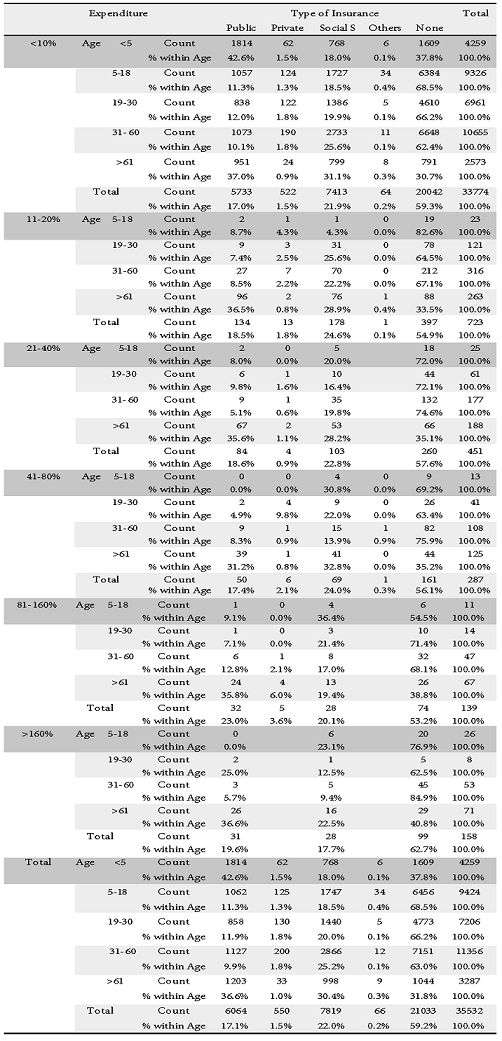
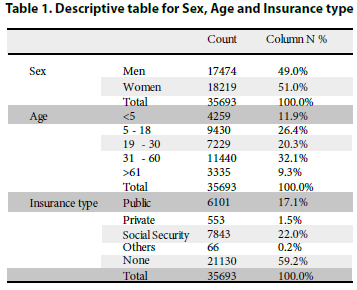
<body><![CDATA[<p align="justify"><font size="2" face="Verdana, Arial, Helvetica, sans-serif">Health expenditure is defined as the percentage of income   spent as household. The results show majority of respondents   do not have health insurance 59,2% (Table 1),   regardless of age, followed by   Social Security 22%, Public 17,1%, Private 1,5%, and Others 0,2%. Majority of respondents   spent less than 10% of their   income on health and came from the 5-18 years   old age group.   Those who spent &gt;160% had no insurance (Table 2). </font></p>     <p align="center"><img src="/img/revistas/gmb/v42n2/a20_tabla1.png" width="357" height="290" /></p>     <p align="center"><font size="2" face="Verdana, Arial, Helvetica, sans-serif"><b>Table 2.</b> Cross-tabulation of, Age, Type of Insurance, and Expenditure</font></p>     <p align="center"><img src="/img/revistas/gmb/v42n2/a20_tabla2.png" width="502" height="1041" /></p>     <p align="justify"><font size="2" face="Verdana, Arial, Helvetica, sans-serif"><b>Discussion</b></font></p>     <p align="justify"><font size="2" face="Verdana, Arial, Helvetica, sans-serif">The data shows   the public insurance has some success in mitigating the expenses in people less than 5 and more than 61 years old.   This could be due to prevalent   diseases according to age in both   groups, which can be shown in future research.&nbsp; In other groups the expenses are high even in the   insured, especially the social security insurance. This category has shown to have half   the expenses when compared to the   uninsured group after we adjust for   age.</font></p>     <p align="justify"><font size="2" face="Verdana, Arial, Helvetica, sans-serif">The number of uninsured   people remains considerably high and even as the health   expenditure of self-reported out of pocket payments   is small, this does not   take in to account the need   of services, the question remaining   open if the lower income segments   of the population   are not being able to afford   services they require or need. </font></p>     <p align="justify"><font size="2" face="Verdana, Arial, Helvetica, sans-serif">Further exploration on the conditionings that shape health   are still necessary to draw definitive   conclusions.</font></p>     <p align="justify"><font size="2" face="Verdana, Arial, Helvetica, sans-serif"><b>Keywords</b>:&nbsp; Out of   pocket health expenditure, health insurance, health expenditure</font></p> <hr align="JUSTIFY" />     <p align="justify">&nbsp;</p>     ]]></body>
<body><![CDATA[<p align="justify"><b><font size="3" face="Verdana, Arial, Helvetica, sans-serif">Bibliographic references </font></b></p>     <p align="justify"><font size="2" face="Verdana, Arial, Helvetica, sans-serif">1.&nbsp; Ledo C, Soria R. Sistema de Salud de Bolivia.   (Spanish). Health Syst Boliv Engl.   2011;53:S109-S119.</font></p>     <p align="justify"><font size="2" face="Verdana, Arial, Helvetica, sans-serif">2.   Alvarez FN, Leys M, M&eacute;rida   HER, Guzm&aacute;n GE. Primary health   care research in Bolivia: systematic review and analysis. Health Policy Plan. May 2015:czv013. doi:10.1093/heapol/czv013.</font></p>     <p align="justify"><font size="2" face="Verdana, Arial, Helvetica, sans-serif">3.   Woodhouse C, Lopez Camelo   J, Wehby GL. A Comparative Analysis of Prenatal Care and Fetal Growth in Eight South American Countries. PLoS ONE. 2014;9(3):e91292.   doi:10.1371/journal.pone.0091292.</font></p>     <p align="justify"><font size="2" face="Verdana, Arial, Helvetica, sans-serif">4.   Ram&iacute;rez Hita S. [Intercultural aspects of the health   system reform in Bolivia]. Rev Peru Med   Exp Salud P&uacute;blica. 2014;31(4):762-768.</font></p>     <p align="justify"><font size="2" face="Verdana, Arial, Helvetica, sans-serif">5. WHO   Ranking of Health System Performance. Science.   2001;293(5535):1595-1596.</font></p>      ]]></body><back>
<ref-list>
<ref id="B1">
<label>5</label><nlm-citation citation-type="journal">
<person-group person-group-type="author">
<name>
<surname><![CDATA[b]]></surname>
<given-names><![CDATA[n]]></given-names>
</name>
</person-group>
<article-title xml:lang="en"><![CDATA[WHO Ranking of Health System Performance]]></article-title>
<source><![CDATA[Science.]]></source>
<year>2001</year>
<volume>293</volume>
<numero>5535</numero>
<issue>5535</issue>
<page-range>1595-1596</page-range></nlm-citation>
</ref>
</ref-list>
</back>
</article>