<?xml version="1.0" encoding="ISO-8859-1"?><article xmlns:mml="http://www.w3.org/1998/Math/MathML" xmlns:xlink="http://www.w3.org/1999/xlink" xmlns:xsi="http://www.w3.org/2001/XMLSchema-instance">
<front>
<journal-meta>
<journal-id>0250-5460</journal-id>
<journal-title><![CDATA[Revista Boliviana de Química]]></journal-title>
<abbrev-journal-title><![CDATA[Rev. Bol. Quim]]></abbrev-journal-title>
<issn>0250-5460</issn>
<publisher>
<publisher-name><![CDATA[Universidad Mayor de San Andrés]]></publisher-name>
</publisher>
</journal-meta>
<article-meta>
<article-id>S0250-54602008000100009</article-id>
<title-group>
<article-title xml:lang="en"><![CDATA[DETERMINATION OF TOTAL PHENOLIC COMPOUNDS CONTENT AND THE ANTIOXIDANT CAPACITY OF ANDEAN TUBERS AND ROOTS (ISAÑO, OCA, ULLUCO AND ARRACACHA)]]></article-title>
</title-group>
<contrib-group>
<contrib contrib-type="author">
<name>
<surname><![CDATA[Salluca]]></surname>
<given-names><![CDATA[Trinidad G]]></given-names>
</name>
<xref ref-type="aff" rid="A01"/>
</contrib>
<contrib contrib-type="author">
<name>
<surname><![CDATA[Peñarrieta]]></surname>
<given-names><![CDATA[J. Mauricio]]></given-names>
</name>
<xref ref-type="aff" rid="A02"/>
</contrib>
<contrib contrib-type="author">
<name>
<surname><![CDATA[Alvarado]]></surname>
<given-names><![CDATA[J. Antonio]]></given-names>
</name>
<xref ref-type="aff" rid="A03"/>
</contrib>
<contrib contrib-type="author">
<name>
<surname><![CDATA[Bergenståhl]]></surname>
<given-names><![CDATA[Björn]]></given-names>
</name>
<xref ref-type="aff" rid="A04"/>
</contrib>
</contrib-group>
<aff id="A01">
<institution><![CDATA[,Universidad Mayor de San Andrés Instituto de Investigaciones Químicas ]]></institution>
<addr-line><![CDATA[La Paz ]]></addr-line>
<country>Bolivia</country>
</aff>
<aff id="A02">
<institution><![CDATA[,Universidad Mayor de San Andrés Instituto de Investigaciones Químicas ]]></institution>
<addr-line><![CDATA[La Paz ]]></addr-line>
<country>Bolivia</country>
</aff>
<aff id="A03">
<institution><![CDATA[,Universidad Mayor de San Andrés Instituto de Investigaciones Químicas ]]></institution>
<addr-line><![CDATA[La Paz ]]></addr-line>
<country>Bolivia</country>
</aff>
<aff id="A04">
<institution><![CDATA[,Lund University Food Technology ]]></institution>
<addr-line><![CDATA[Lund ]]></addr-line>
<country>Sweden</country>
</aff>
<pub-date pub-type="pub">
<day>00</day>
<month>12</month>
<year>2008</year>
</pub-date>
<pub-date pub-type="epub">
<day>00</day>
<month>12</month>
<year>2008</year>
</pub-date>
<volume>25</volume>
<numero>1</numero>
<fpage>59</fpage>
<lpage>62</lpage>
<copyright-statement/>
<copyright-year/>
<self-uri xlink:href="http://www.scielo.org.bo/scielo.php?script=sci_arttext&amp;pid=S0250-54602008000100009&amp;lng=en&amp;nrm=iso"></self-uri><self-uri xlink:href="http://www.scielo.org.bo/scielo.php?script=sci_abstract&amp;pid=S0250-54602008000100009&amp;lng=en&amp;nrm=iso"></self-uri><self-uri xlink:href="http://www.scielo.org.bo/scielo.php?script=sci_pdf&amp;pid=S0250-54602008000100009&amp;lng=en&amp;nrm=iso"></self-uri><abstract abstract-type="short" xml:lang="en"><p><![CDATA[Four species of Andean tubers, isaño (Tropaeolum tuberosum), oca (Oxalis tuberosa), ulluco (Ullucus tuberosus) and roots of arracacha (Arracacia xanthorrhiza), were studied for the quantification of the Total Antioxidant Capacity (TAC) and determination of Total Phenolic Compounds (TPH). The total antioxidant capacity was measured using ABTS and FRAP methods, and the total phenolics compounds were measured using the Folin & Ciocalteu reagent. The antioxidant capacity found in the tubers and root studied ranged from 0.35 to 11.8 &#956;mol trolox equiv/g dry sample, and phenolics ranged from 0.002 to 0.02 &#956;mol gallic acid equiv./g dry sample. In general black isaño tubers showed the highest values of antioxidant capacity and phenolic compounds compared with the other tubers.]]></p></abstract>
<abstract abstract-type="short" xml:lang="es"><p><![CDATA[Cuatro especies de tubérculos andinos, isaño (Tropaeolum tuberosum), oca (Oxalis tuberosa), ulluco (Ullucus tuberosus) y raíces de arracacha (Arracacia xanthorrhiza) fueron estudiados para la cuantificación de la capacidad antioxidante total (TAC) y la determinación de compuestos fenólicos totales (TPH). La capacidad antioxidante fue medida mediante el uso de los métodos ABTS y FRAP, los compuestos fenólicos fueron medidos mediante el uso del reactivo de Folin & Ciocalteau.La capacidad antioxidante encontrada en los tubérculos estudiados tienen un rango de 0.35 a 11.8 &#956;mol equiv. de trolox/g de muestra seca, el rango de compuestos fenolicos es de 0.002 a 0.02 &#956;mol equiv. de ácido gálico/g de muestra seca. En general el isaño oscuro muestra los valores mas altos de capacidad antioxidante y compuestos fenólicos comparados con los otros tubérculos.]]></p></abstract>
<kwd-group>
<kwd lng="en"><![CDATA[Andean tubers]]></kwd>
<kwd lng="es"><![CDATA[isaño]]></kwd>
<kwd lng="es"><![CDATA[oca]]></kwd>
<kwd lng="es"><![CDATA[ulluco]]></kwd>
<kwd lng="en"><![CDATA[roots of arracacha]]></kwd>
<kwd lng="en"><![CDATA[Total Antioxidant Capacity]]></kwd>
<kwd lng="en"><![CDATA[ABTS]]></kwd>
<kwd lng="en"><![CDATA[FRAP]]></kwd>
<kwd lng="en"><![CDATA[otal Phenolic Compounds]]></kwd>
</kwd-group>
</article-meta>
</front><body><![CDATA[ <P   align="center" ><font size="4" face="Verdana, Arial, Helvetica, sans-serif"><strong>DETERMINATION OF TOTAL PHENOLIC COMPOUNDS CONTENT AND THE ANTIOXIDANT CAPACITY OF ANDEAN TUBERS AND ROOTS (ISA&Ntilde;O, OCA, ULLUCO AND ARRACACHA) </strong></font></P >     <P   align="center" ><strong><font size="2" face="Verdana, Arial, Helvetica, sans-serif"><I>Trinidad G. Salluca</I><Sup><I>abc</I></Sup><I>, J. Mauricio Pe&ntilde;arrieta</I><Sup><I>abc</I></Sup><I>, J. Antonio Alvarado</I><Sup><I>a*</I></Sup><I> and Bj&ouml;rn Bergenst&aring;hl</I><Sup><I>c </I></Sup></font></strong><font size="2" face="Verdana, Arial, Helvetica, sans-serif"><Sup><I></I></Sup></font></P >     <P   align="justify" ><font size="1" face="Verdana, Arial, Helvetica, sans-serif"><Sup>a </Sup>Instituto de Investigaciones Qu&iacute;micas, Universidad Mayor de San Andr&eacute;s, La Paz-Bolivia,     <br>   <Sup>b </Sup>Biomedical Nutrition, Lund University, Lund-Sweden,     <br>     <Sup>c </Sup>Food Technology, Lund University, Lund-Sweden </font></P > <hr noshade>     <P   align="justify" ><font size="2" face="Verdana, Arial, Helvetica, sans-serif"><B>Key Words: </B>Andean tubers, isa&ntilde;o, oca, ulluco, roots of arracacha, Total Antioxidant Capacity, ABTS, FRAP, </font><font size="2" face="Verdana, Arial, Helvetica, sans-serif">Total Phenolic Compounds. </font></P >     <P   align="justify" ><font size="2" face="Verdana, Arial, Helvetica, sans-serif"><strong>ABSTRACT </strong></font></P >    <P   align="justify" ><font size="2" face="Verdana, Arial, Helvetica, sans-serif">Four species of Andean tubers, isa&ntilde;o (<I>Tropaeolum tuberosum</I>), oca (<I>Oxalis tuberosa</I>), ulluco (<I>Ullucus tuberosus</I>) and roots of arracacha (<I>Arracacia xanthorrhiza</I>), were studied for the quantification of  the Total Antioxidant Capacity (TAC) and determination of Total Phenolic Compounds (TPH). The total antioxidant capacity was measured using ABTS and FRAP methods, and the total phenolics compounds were measured using the Folin &amp; Ciocalteu reagent. The antioxidant capacity found in the tubers and root studied ranged from 0.35 to 11.8 &mu;mol trolox equiv/g dry sample, and phenolics ranged from 0.002 to 0.02 &mu;mol gallic acid equiv./g dry sample. In general black isa&ntilde;o tubers showed the highest values of antioxidant capacity and phenolic compounds compared with the other tubers./<I> Cuatro especies de tub&eacute;rculos andinos, isa&ntilde;o (Tropaeolum tuberosum), oca (Oxalis tuberosa), ulluco (Ullucus tuberosus) y ra&iacute;ces de arracacha (Arracacia xanthorrhiza) fueron estudiados para la cuantificaci&oacute;n de la capacidad antioxidante total (TAC) y la determinaci&oacute;n de compuestos fen&oacute;licos totales (TPH). La capacidad antioxidante fue medida mediante el uso de los m&eacute;todos ABTS y FRAP, los compuestos fen&oacute;licos fueron medidos mediante el uso del reactivo de Folin &amp; Ciocalteau.La capacidad antioxidante encontrada en los tub&eacute;rculos estudiados tienen un rango de 0.35 a 11.8 &mu;mol equiv. de trolox/g de muestra seca, el rango de compuestos fenolicos es de 0.002 a 0.02 &mu;mol equiv. de &aacute;cido g&aacute;lico/g de muestra seca. En general el isa&ntilde;o oscuro muestra los valores mas altos de capacidad antioxidante y compuestos fen&oacute;licos comparados con los otros tub&eacute;rculos. </I></font></P >     <P   align="justify" ><font size="2" face="Verdana, Arial, Helvetica, sans-serif">Corresponding author: <U><a href="mailto:jaalvkir@gmail.com">jaalvkir@gmail.com</a> </U></font></P > <hr noshade> <strong><font size="3" face="Verdana, Arial, Helvetica, sans-serif">    <br> INTRODUCTION </font></strong>     ]]></body>
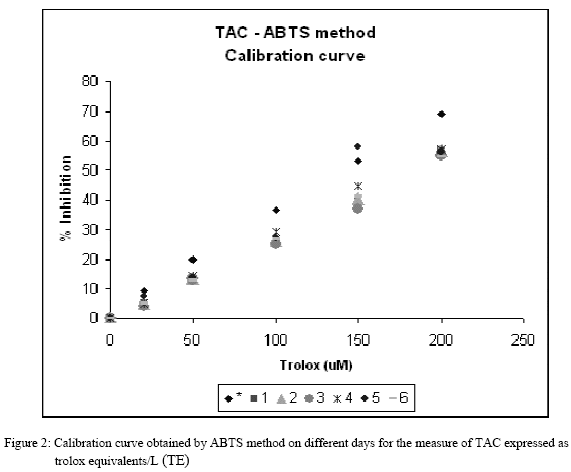
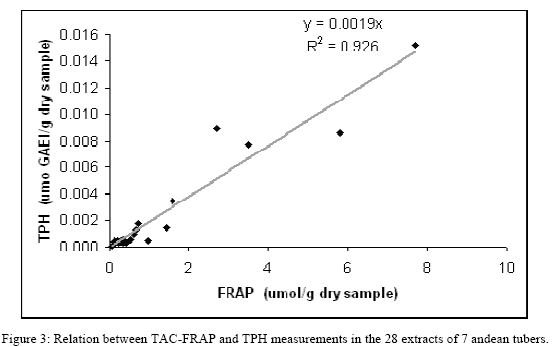
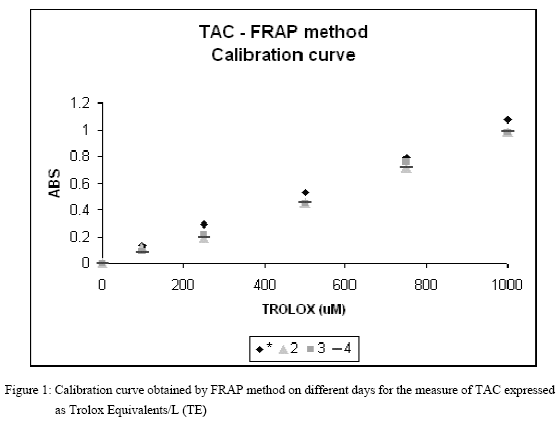
<body><![CDATA[<P   align="justify" ><font size="2" face="Verdana, Arial, Helvetica, sans-serif">The interest in natural antioxidants has increased considerably in recent years because many antioxidants exhibit beneficial biological effects, including antibacterial, antiviral, antiallergic, antithrombotic and because they are linked to lower incidence of cardiovascular disease and certain types of cancer disease <sup>[1]</sup>. The Andean habitants have been using tubers and roots such as isa&ntilde;o, oca, ulluco and arracacha for their medicinal and nutritional properties since remote times. The diversity of tubers growing in the Andean region at altitudes between 2000 and 4200 m above sea level shows a large variability in size, color, form, primary nutrient constituents and secondary metabolites <sup>[2, 3, 4]</sup>. Bolivia is well known for its ample diversity of genetic recourses of potential utility for the humanity. The traditions and the diversity of cultivation constitutes an important source of knowledge that must be systematized and utilized by means of different actions. Andean tubers have a big importance for the food supply and economy of the people living in the Andean region who eat isa&ntilde;o, oca, ulluco and arracacha both fresh and dry. The unfavorable climate at high altitudes only permits a limited number of cultivars. They are also used in folk medicine <sup>[5]</sup>. These mostly unproven medicinal properties could in part be attributed to the antioxidants present in these tubers. The objective of this study was to provide new data regarding Andean tubers and roots from Bolivia as a source of antioxidant compounds </font></P >     <p><strong><font size="3" face="Verdana, Arial, Helvetica, sans-serif">    <br> RESULTS AND DISCUSSION</font></strong></p>     <p><strong><font size="2" face="Verdana, Arial, Helvetica, sans-serif"><I>Total Antioxidant Capacity of Andean tubers </I></font> </strong></p>     <P   align="justify" ><font size="2" face="Verdana, Arial, Helvetica, sans-serif">The TAC values measured in the polar and non-polar extracts from seven samples by the ABTS and FRAP methods are shown in Table 1 and 2. The highest TAC value was observed in black isa&ntilde;o in the methanol extract. </font></P >     <P align="justify"   ><font size="2" face="Verdana, Arial, Helvetica, sans-serif">Intermediate values were found in yellow isa&ntilde;o, yellow oca, arracacha and dappled ulluco, and lowwer TAC values were demonstrated in pink oca and pink ulluco. For black isa&ntilde;o higher TAC values were obtained iin the polar fractions (methanol aand ethyl acetate) than in thee non-polar fractions (dichloromethane and petroleum ether) by the ABTS and FRAP methods. The TACC values of thee calibration curves showed good reproducibility (Figure <a href="#f1">1</a>,<a href="#f2">2</a>) by both meethods.  </font></P >     <P align="center"   ><a name="f1"></a><img src="/img/revistas/rbq/v25n1/figura_a10_01.gif" width="558" height="423"></P >     <P align="center"   ><a name="f2"></a><img src="/img/revistas/rbq/v25n1/figura_a10_02.gif" width="571" height="472"></P >     <P align="justify"   ><font size="2" face="Verdana, Arial, Helvetica, sans-serif">Data from FRAP displayed a linear correlation with TPH data for tthe 28 extracts (r =0.96; <a href="#f3">Figure 3</a>). </font></P >     <P align="center"   ><a name="f3"></a><img src="/img/revistas/rbq/v25n1/figura_a10_03.gif" width="552" height="347"></P >     ]]></body>
<body><![CDATA[<P align="justify"   ><font size="2" face="Verdana, Arial, Helvetica, sans-serif">Similar linear correlations have also been observed in previous studies <sup>[6]</sup>. The TACC values obtained for Andean tuber samples using the FRAP method were in most, but not in all cases, higher than those obtained with tthe ABTS method. In black isa&ntilde;o the highest values was found by the ABTS method in the methanol extract as well as in the total value of TAC. </font></P >     <P align="justify"   ><font size="2" face="Verdana, Arial, Helvetica, sans-serif">  FRAP and ABTS methods have been used for analysis of TAC in different kinds of foods and some data on tubers and roots are available <sup>[7, 8]</sup>. Previous TAC  values on tubers were approx. 0.27 &ndash; 3.03 &micro;mol/g fresh sample and 0.9 &ndash; 14.7 &micro;mol/g dry sample using ABTS and 0.322 &ndash; 1.57 &micro;mol/g fw and 1.0 - 7.6 &micro;mol/g dw by FRAP.</font></P >     <P align="justify"   ><font size="2" face="Verdana, Arial, Helvetica, sans-serif"><strong><I>Total Phennolic Compounnds of Andeann tubers </I></strong></font></P >     <P   align="justify" ><font size="2" face="Verdana, Arial, Helvetica, sans-serif">The content of Total Phenolic Compounds of the seven samples and twenty-eight extracts measured using the Folin &amp; Ciocalteau method is shown in Table 3. The highest value was obtained in black isa&ntilde;o in both the methanol and ethyl acetate extracts. In the present study the range of TPH determined in tuber pulp was 0.002-0.02 &micro;mol GAE/g dm expressed as the sum of the polar and non polar fractions. The values of Total Phenolic Compounds of the extracts showed a good linear correlation (<a href="#f3">Figure 3</a>) between TAC values obtained by FRAP (r =0.96) and by ABTS (r =0.78) methods.</font></P >     <P   align="justify" ><font size="3" face="Verdana, Arial, Helvetica, sans-serif">    <br>   <strong>EXPERIMENTAL SECTION</strong></font></P >     <P   align="justify" ><strong><font size="2" face="Verdana, Arial, Helvetica, sans-serif"><I>Chemicals </I></font></strong></P >     <P   align="justify" ><font size="2" face="Verdana, Arial, Helvetica, sans-serif">Trolox (6-hydroxy-2,5,7,8-tetramethyl-chroman-2-carboxylic acid, 97%.), TPTZ (2,4,6-tripyridyl-s-triazine), ABTS (2,2&rsquo;-azinobis-3-ethyl benzotiazoline-6-sulphonic acid, 98%), potassium persulfate, sodium acetate,  Folin-Ciocalteau reagent, gallic acid (98%) and sodium carbonate were purchased from Sigma-Aldrich (St. Louis, USA). The solvents used were: methanol, ethanol, dichloromethane, ethylacetate and petroleum ether.</font></P >     <P   align="justify" ><strong><font size="2" face="Verdana, Arial, Helvetica, sans-serif"><I>Plant material </I></font></strong></P >     <P   align="justify" ><font size="2" face="Verdana, Arial, Helvetica, sans-serif">Seven samples of andean tubers were purchased in the markets of La Paz, Bolivia in June 2006. The selected plants were ulluco (<I>Ullucus tuberosus</I>), arracacha (<I>Arracacia xanthorrhiza</I>), oca (<I>Oxalis tuberosa) </I>and isa&ntilde;o (<I>Tropaeolum tuberosum</I>). The seven varieties of samples were: two samples of oca (pink and yellow), two samples of Isa&ntilde;o (yellow with blach eyes and black), two samples of Ulluco (pink and dappled) and a sample of Arracha (yellow).</font></P >     ]]></body>
<body><![CDATA[<P   align="justify" ><strong><font size="2" face="Verdana, Arial, Helvetica, sans-serif"><I>Sample preparation </I></font></strong></P >     <P   align="justify" ><font size="2" face="Verdana, Arial, Helvetica, sans-serif">The collected tubers and root were washed and peeled and 800 g of fresh sample was dried at 30&deg;C during 24 hours. The dry samples (only dry pulp) were ground and sequentially soaked with petroleum ether, dichloromethane, ethyl acetate and methanol during 24 hrs for each solvent. TAC and TPH were measured in the seventy-eight concentrated extracts.</font></P >     <P   align="justify" ><strong><font size="2" face="Verdana, Arial, Helvetica, sans-serif"><I>Measurement of TAC </I></font></strong></P >     <P   align="justify" ><font size="2" face="Verdana, Arial, Helvetica, sans-serif">TAC was assessed by using the ABTS [2,2&rsquo;-azinobis (3-ethylbenzothiazoline-6-sulphonic acid)] method described by Re <I>et al.</I> <sup>[9]</sup> and a modification of the FRAP (Ferric Reducing Antioxidant Power) method described by Benzie &amp; Strain <sup>[10]</sup>. Both are spectrophotometric methods and the absorbance readings were performed on a double beam UV-Visible spectrophotometer Perkin Elmer model lambda 25 at 25&deg;C. As a standard compound Trolox (6-hydroxy2,5,7,8&ndash;tetramethyl-chroman-2-carboxylic acid) was used,  The stock solution contained 5 mmol/L of Trolox in ethanol, and was stored at 4&deg;C.</font></P >     <P   align="justify" ><font size="2" face="Verdana, Arial, Helvetica, sans-serif"><B><I>ABTS method</I></B><I>. </I></font></P >     <P   align="justify" ><font size="2" face="Verdana, Arial, Helvetica, sans-serif">The ABTS method is based on the oxidation of ABTS to the green ABTS&bull;+ radical cation after the addition of potassium persulphate (2.42 mmol/L) <sup>[11]</sup> for 12-16 hours at room temperature in the dark. On the day of analysis the ABTS&bull;+ solution was diluted with acetate buffer pH 5.0 to an absorbance of 0.70 (&plusmn;0.02) at 734 nm. After the addition of 1.0 of ABTS&bull;+  solution to 100 &micro;l of sample the mixture was stirred for 30 s and the absorbance at 734 nm and 25&deg;C was recorded for 6 min. The decrease in absorbance caused by the addition of sample was compared with that of a standard curve by use of Trolox (20-200 &micro;mol/L). </font></P >     <P   align="justify" ><font size="2" face="Verdana, Arial, Helvetica, sans-serif"><B><I>FRAP (ferric reducing/antioxidant power) method</I></B><I>. </I></font></P >     <P   align="justify" ><font size="2" face="Verdana, Arial, Helvetica, sans-serif">The FRAP method was used for the determination of total antioxidant capacity, based on the reduction of yellow Fe3+-TPTZ complex to the blue Fe2+ -TPTZ complex by electron donating substance under acidic condition. The FRAP reagent (900 &mu;l) containing TPTZ, FeCl3, and acetate buffer, was mixed with 90 &mu;l of distilled water and 30 &mu;l of the test sample or the blank (solvents used for extraction). Maximum absorbance values at 593 nm were recorded for 10 min at 25&deg;C. The final absorbance was compared with the standard curve (100 &ndash; 1000 &mu;mol/L). The data were expressed as &mu;mol trolox equivalents per gram of dry matter.</font></P >     <P   align="justify" ><strong><font size="2" face="Verdana, Arial, Helvetica, sans-serif"><I>Measurement of total phenolic compounds  </I></font></strong></P >     <P align="justify"   ><font size="2" face="Verdana, Arial, Helvetica, sans-serif">The phenolic compounds were determined using the Folin-Ciocalteu method, based on the reduction of 60 phosphor-wolframate-phosphomolybdate complex by phenolics to a blue reaction product <sup>[12, 13, 14]</sup>. The Folin-Ciocalteu reagent, diluted 10 times (2.5 ml) was mixed with 2 ml of saturated sodium carbonate (75 g/L) and 50 &mu;l of sample (supernatant) and homogenized for 10 s and heated for 30 min at 45&deg;C. The absorbance was measured at 765 nm after cooling at room temperature. The data were calculated by comparison between a standard curve (212-1062 &mu;mol gallic acid /L) and the absorbance of each sample. The data were expressed as &mu;mol gallic acid equivalents per gram of dry matter. </font></P > <font size="2" face="Verdana, Arial, Helvetica, sans-serif"><B><I>Statistical Analysis</I></B><I>. </I></font>     ]]></body>
<body><![CDATA[<P   align="justify" ><font size="2" face="Verdana, Arial, Helvetica, sans-serif">Results were expressed as mean values (standard deviation) of six replicates measured over three days of one extract. Linear correlation coefficient was calculated.</font></P >     <P   align="justify" ><font size="2" face="Verdana, Arial, Helvetica, sans-serif"><strong>ACKNOWLEDGEMENTS </strong></font></P >     <P   align="justify" ><font size="2" face="Verdana, Arial, Helvetica, sans-serif">The study was supported by the Swedish International Development Agency (SIDA/SAREC) in a collaborative project between Universidad Mayor de San Andr&eacute;s (Bolivia) and Lund University (Sweden).</font></P >     <P   align="justify" ><font size="2" face="Verdana, Arial, Helvetica, sans-serif">    <br>     <font size="3"><strong>REFERENCES </strong></font></font></P >     <P   align="justify" ><font size="2" face="Verdana, Arial, Helvetica, sans-serif">[1] Nilsson J, Pillai D, &Ouml;nning G, Persson C, Nilsson &Aring;, &Aring;kesson B. &ldquo;Comparison of the ABTS and FRAP methods to assess the total antioxidant capacity in extracts of fruit and vegetables.&rdquo; Molecular Nutrition and Food Research, 2005, 49: 239-246 </font></P >     <P   align="justify" ><font size="2" face="Verdana, Arial, Helvetica, sans-serif">[2] Le&oacute;n, J. <I>Bot&aacute;nica de los cultivos tropicales</I>. Herbario Nacional de Bolivia, Bolivia <B>1997</B>. </font></P >    <P   align="justify" ><font size="2" face="Verdana, Arial, Helvetica, sans-serif">[3] De Lucca, M. D.; Zalles, A. J. <I>Flora Medicinal Boliviana Diccionario Enciclop&eacute;dico</I>. Los Amigos del Libro, Cochabamba - Bolivia <B>1992</B>. </font></P >     <P   align="justify" ><font size="2" face="Verdana, Arial, Helvetica, sans-serif">[4] Vimos, C. N.; Nieto C.; Rivera M. <I>El Melloco Caracter&iacute;sticas, t&eacute;cnicas de cultivo y potencial en Ecuador</I>&rdquo;. Centro Internacional de Investigaci&oacute;n para el  Desarrollo, CIID de Canad&aacute;. <B>1997</B>.<a href="http://archive.idrc.ca/library/document/096951/index_s.html" target="_blank"><U>http://archive.idrc.ca/library/document/096951/index_s.html</U></a><U> </U></font></P >     <P   align="justify" ><font size="2" face="Verdana, Arial, Helvetica, sans-serif">[5] C&aacute;rdenas M. <I>Manual de Plantas Econ&oacute;micas de Bolivia</I>, Segunda Edici&oacute;n, Los amigos del libro. La Paz - Cochabamba - Bolivia <B>1989</B>. </font></P >     ]]></body>
<body><![CDATA[<P   align="justify" ><font size="2" face="Verdana, Arial, Helvetica, sans-serif">[6] Pe&ntilde;arrieta, M.; Alvarado, J. A.; &#506;kesson, B.; Bergenst&aring;hl, B. &ldquo;Total Antioxidant Capacity In Andean Food Species From Bolivia&rdquo;. <I>Revista Boliviana de Qu&iacute;mica </I><B>2005</B>, 22, 89-93. </font></P >    <P   align="justify" ><font size="2" face="Verdana, Arial, Helvetica, sans-serif">[7] Campos, D.; Noratto, G.; Chirinos,R.; Arbizu, C.; Roca, W.; Cisneros, L. &ldquo;Antioxidant capacity and secondary metabolites in four species of Andean tuber crops: native potato (<I>Solanum </I>sp.), mashua (<I>Tropaeolum tuberosum </I>Ruiz &amp; Pav &acute; on), Oca (<I>Oxalis tuberosa </I>Molina) and ulluco (<I>Ullucus tuberosus </I>Caldas)&rdquo;. <I>Journal of the Science of Food and Agriculture </I><B>2006</B>, 86, 1481&ndash;1488. </font></P >    <P   align="justify" ><font size="2" face="Verdana, Arial, Helvetica, sans-serif">[8] Halvorsen, B. L.; Holte, K.; Myhrstad, M.C.W.; Barikmo, I.; et al. &ldquo;A systematic screening of total antioxidants in dietary plants&rdquo;. <I>Journal of Nutrition </I><B>2002</B>, 132, 461-471. </font></P >    <P   align="justify" ><font size="2" face="Verdana, Arial, Helvetica, sans-serif">[9] Re, R.; Pellegrini, N.; Proteggente, A.; Pannala, A.; Yang, M.; Rice-Evans, C. &ldquo;Antioxidant activity applying an improved ABTS radical cation decolorization assay&rdquo;. <I>Free radical Biology &amp; Medicine </I><B>1999</B>, 26, 1231-1237. </font></P >    <P   align="justify" ><font size="2" face="Verdana, Arial, Helvetica, sans-serif">[10] Benzie, I.; Strain, J. J. &ldquo;The Ferric Reducing Ability of Plasma (FRAP) as a Measure of  Antioxidant Power: The FRAP Assay&rdquo;. <I>Analitycal Biochemestry </I><B>1996, </B>239, 70-76. </font></P >    <P   align="justify" ><font size="2" face="Verdana, Arial, Helvetica, sans-serif">[11] Scalzo, J.; Politi, A.; Pellegrini, N.; Mezzetti B.; Battino, M.&ldquo;Plant genotype affects total antioxidant capacity and phenolic contents in fruit&rdquo;. <I>Nutrition </I><B>2005, </B>21<B>, </B>207&ndash;213. </font></P >    <P   align="justify" ><font size="2" face="Verdana, Arial, Helvetica, sans-serif">[12] Kyoung, Ch. O.; Kim, D.; Smith, N.; Schroeder, D.; Taek, H. J.; Yong, L. Ch. &ldquo;Daily consumption of phenolics and total antioxidant capacity from fruit and vegetables in the American diet&rdquo;. <I>Journal of the Science of Food and Agriculture </I><B>2005</B>, 85, 1715&ndash;1724. </font></P >    <P   align="justify" ><font size="2" face="Verdana, Arial, Helvetica, sans-serif">[13] Bonoli, M.; Verardo, V.; Marconi, E.; Fiorenza, C. M. &ldquo;Antioxidant Phenols in Barley (Hordeum vulgare L.) Flour: Comparative Spectrophotometric Study among Extraction Methods of Free and Bound Phenolic Compounds&rdquo;. <I>Journal of the Science Food Chemistry </I><B>2004</B>, 84 5195-5200. </font></P >    <P   align="justify" ><font size="2" face="Verdana, Arial, Helvetica, sans-serif">[14] Singleton, V.L.; Rossi, J. A. Jr. &ldquo;Colorimetry of total phenolics with phosphomolybdic-phosphotungtic acid reagent&rdquo;. <I>American journal of Enology and Viticulture</I>, <B>1965</B>, 16, 144-158. </font></P >      ]]></body><back>
<ref-list>
<ref id="B1">
<label>1</label><nlm-citation citation-type="journal">
<person-group person-group-type="author">
<name>
<surname><![CDATA[Nilsson]]></surname>
<given-names><![CDATA[J]]></given-names>
</name>
<name>
<surname><![CDATA[Pillai]]></surname>
<given-names><![CDATA[D]]></given-names>
</name>
<name>
<surname><![CDATA[Önning]]></surname>
<given-names><![CDATA[G]]></given-names>
</name>
<name>
<surname><![CDATA[Persson]]></surname>
<given-names><![CDATA[C]]></given-names>
</name>
<name>
<surname><![CDATA[Nilsson]]></surname>
<given-names><![CDATA[Å]]></given-names>
</name>
<name>
<surname><![CDATA[Åkesson]]></surname>
<given-names><![CDATA[B]]></given-names>
</name>
</person-group>
<source><![CDATA[Comparison of the ABTS and FRAP methods to assess the total antioxidant capacity in extracts of fruit and vegetables. Molecular Nutrition and Food Research]]></source>
<year>2005</year>
<volume>49</volume>
<page-range>239-246</page-range></nlm-citation>
</ref>
<ref id="B2">
<label>2</label><nlm-citation citation-type="book">
<person-group person-group-type="author">
<name>
<surname><![CDATA[León]]></surname>
<given-names><![CDATA[J]]></given-names>
</name>
</person-group>
<source><![CDATA[Botánica de los cultivos tropicales]]></source>
<year>1997</year>
<publisher-loc><![CDATA[^eBolivia Bolivia]]></publisher-loc>
<publisher-name><![CDATA[Herbario Nacional de Bolivia]]></publisher-name>
</nlm-citation>
</ref>
<ref id="B3">
<label>3</label><nlm-citation citation-type="book">
<person-group person-group-type="author">
<name>
<surname><![CDATA[De Lucca]]></surname>
<given-names><![CDATA[M. D]]></given-names>
</name>
<name>
<surname><![CDATA[0alles]]></surname>
<given-names><![CDATA[A. J]]></given-names>
</name>
</person-group>
<source><![CDATA[Flora Medicinal Boliviana Diccionario Enciclopédico]]></source>
<year>1992</year>
<publisher-loc><![CDATA[Cochabamba ]]></publisher-loc>
<publisher-name><![CDATA[Los Amigos del Libro]]></publisher-name>
</nlm-citation>
</ref>
<ref id="B4">
<label>4</label><nlm-citation citation-type="book">
<person-group person-group-type="author">
<name>
<surname><![CDATA[Vimos]]></surname>
<given-names><![CDATA[C. N]]></given-names>
</name>
<name>
<surname><![CDATA[Nieto]]></surname>
<given-names><![CDATA[C]]></given-names>
</name>
<name>
<surname><![CDATA[Rivera]]></surname>
<given-names><![CDATA[M]]></given-names>
</name>
</person-group>
<source><![CDATA[El Melloco Características, técnicas de cultivo y potencial en Ecuador]]></source>
<year>1997</year>
<publisher-loc><![CDATA[^eCanadá Canadá]]></publisher-loc>
<publisher-name><![CDATA[Centro Internacional de Investigación para el Desarrollo]]></publisher-name>
</nlm-citation>
</ref>
<ref id="B5">
<label>5</label><nlm-citation citation-type="book">
<person-group person-group-type="author">
<name>
<surname><![CDATA[Cárdenas]]></surname>
<given-names><![CDATA[M]]></given-names>
</name>
</person-group>
<source><![CDATA[Manual de Plantas Económicas de Bolivia]]></source>
<year>1989</year>
<edition>2</edition>
<publisher-loc><![CDATA[La Paz ]]></publisher-loc>
<publisher-name><![CDATA[Edición, Los amigos del libro]]></publisher-name>
</nlm-citation>
</ref>
<ref id="B6">
<label>6</label><nlm-citation citation-type="journal">
<person-group person-group-type="author">
<name>
<surname><![CDATA[Peñarrieta]]></surname>
<given-names><![CDATA[M]]></given-names>
</name>
<name>
<surname><![CDATA[Alvarado]]></surname>
<given-names><![CDATA[JA]]></given-names>
</name>
<name>
<surname><![CDATA[kesson]]></surname>
<given-names><![CDATA[B]]></given-names>
</name>
<name>
<surname><![CDATA[Bergenståhl]]></surname>
<given-names><![CDATA[B]]></given-names>
</name>
</person-group>
<source><![CDATA[Total Antioxidant Capacity In Andean Food Species From Bolivia. Revista Boliviana de Química]]></source>
<year>2005</year>
<volume>22</volume>
<page-range>89-93</page-range></nlm-citation>
</ref>
<ref id="B7">
<label>7</label><nlm-citation citation-type="journal">
<person-group person-group-type="author">
<name>
<surname><![CDATA[Campos]]></surname>
<given-names><![CDATA[D]]></given-names>
</name>
<name>
<surname><![CDATA[Noratto]]></surname>
<given-names><![CDATA[G]]></given-names>
</name>
<name>
<surname><![CDATA[Chirinos]]></surname>
<given-names><![CDATA[R]]></given-names>
</name>
<name>
<surname><![CDATA[Arbizu]]></surname>
<given-names><![CDATA[C]]></given-names>
</name>
<name>
<surname><![CDATA[Roca]]></surname>
<given-names><![CDATA[W]]></given-names>
</name>
<name>
<surname><![CDATA[Cisneros]]></surname>
<given-names><![CDATA[L]]></given-names>
</name>
</person-group>
<article-title xml:lang="en"><![CDATA[Antioxidant capacity and secondary metabolites in four species of Andean tuber crops: native potato (Solanum sp]]></article-title>
<source><![CDATA[) mashua (Tropaeolum tuberosum Ruiz & Pav ´ on) Oca (Oxalis tuberosa Molina) and ulluco (Ullucus tuberosus Caldas). Journal of the Science of Food and Agricultura]]></source>
<year>2006</year>
<volume>86</volume>
<page-range>1481-1488</page-range></nlm-citation>
</ref>
<ref id="B8">
<label>8</label><nlm-citation citation-type="journal">
<person-group person-group-type="author">
<name>
<surname><![CDATA[Halvorsen]]></surname>
<given-names><![CDATA[B L]]></given-names>
</name>
<name>
<surname><![CDATA[Holte]]></surname>
<given-names><![CDATA[K]]></given-names>
</name>
<name>
<surname><![CDATA[Myhrstad]]></surname>
<given-names><![CDATA[MCW]]></given-names>
</name>
<name>
<surname><![CDATA[Barikmo]]></surname>
<given-names><![CDATA[I, et. al.]]></given-names>
</name>
</person-group>
<article-title xml:lang="en"><![CDATA[A systematic screening of total antioxidants in dietary plants]]></article-title>
<source><![CDATA[Journal of Nutrition]]></source>
<year>2002</year>
<volume>132</volume>
<page-range>461-471</page-range></nlm-citation>
</ref>
<ref id="B9">
<label>9</label><nlm-citation citation-type="journal">
<person-group person-group-type="author">
<name>
<surname><![CDATA[Re]]></surname>
<given-names><![CDATA[R]]></given-names>
</name>
<name>
<surname><![CDATA[Pellegrini]]></surname>
<given-names><![CDATA[N]]></given-names>
</name>
<name>
<surname><![CDATA[Proteggente]]></surname>
<given-names><![CDATA[A]]></given-names>
</name>
<name>
<surname><![CDATA[Pannala]]></surname>
<given-names><![CDATA[A]]></given-names>
</name>
<name>
<surname><![CDATA[Yang]]></surname>
<given-names><![CDATA[M]]></given-names>
</name>
<name>
<surname><![CDATA[Rice-Evans]]></surname>
<given-names><![CDATA[C]]></given-names>
</name>
</person-group>
<article-title xml:lang="en"><![CDATA[Antioxidant activity applying an improved ABTS radical cation decolorization assay]]></article-title>
<source><![CDATA[Free radical Biology & Medicine]]></source>
<year>1999</year>
<volume>26</volume>
<page-range>1231-1237</page-range></nlm-citation>
</ref>
<ref id="B10">
<label>10</label><nlm-citation citation-type="journal">
<person-group person-group-type="author">
<name>
<surname><![CDATA[Benzie]]></surname>
<given-names><![CDATA[I]]></given-names>
</name>
<name>
<surname><![CDATA[Strain]]></surname>
<given-names><![CDATA[J J]]></given-names>
</name>
</person-group>
<article-title xml:lang="en"><![CDATA[The Ferric Reducing Ability of Plasma (FRAP) as a Measure of Antioxidant Power: The FRAP Assay]]></article-title>
<source><![CDATA[Analitycal Biochemestry]]></source>
<year>1996</year>
<volume>239</volume>
<page-range>70-76</page-range></nlm-citation>
</ref>
<ref id="B11">
<label>11</label><nlm-citation citation-type="journal">
<person-group person-group-type="author">
<name>
<surname><![CDATA[Scalzo]]></surname>
<given-names><![CDATA[J]]></given-names>
</name>
<name>
<surname><![CDATA[Politi]]></surname>
<given-names><![CDATA[A]]></given-names>
</name>
<name>
<surname><![CDATA[Pellegrini]]></surname>
<given-names><![CDATA[N]]></given-names>
</name>
<name>
<surname><![CDATA[Mezzetti]]></surname>
<given-names><![CDATA[B]]></given-names>
</name>
<name>
<surname><![CDATA[Battino]]></surname>
<given-names><![CDATA[M]]></given-names>
</name>
</person-group>
<article-title xml:lang="en"><![CDATA[Plant genotype affects total antioxidant capacity and phenolic contents in fruit]]></article-title>
<source><![CDATA[Nutrition]]></source>
<year>2005</year>
<volume>21</volume>
<page-range>207-213</page-range></nlm-citation>
</ref>
<ref id="B12">
<label>12</label><nlm-citation citation-type="journal">
<person-group person-group-type="author">
<name>
<surname><![CDATA[Kyoung]]></surname>
<given-names><![CDATA[Ch O]]></given-names>
</name>
<name>
<surname><![CDATA[Kim]]></surname>
<given-names><![CDATA[D]]></given-names>
</name>
<name>
<surname><![CDATA[Smith]]></surname>
<given-names><![CDATA[N]]></given-names>
</name>
<name>
<surname><![CDATA[Schroeder]]></surname>
<given-names><![CDATA[D]]></given-names>
</name>
<name>
<surname><![CDATA[Taek]]></surname>
<given-names><![CDATA[H J]]></given-names>
</name>
<name>
<surname><![CDATA[Yong]]></surname>
<given-names><![CDATA[L Ch]]></given-names>
</name>
</person-group>
<article-title xml:lang="en"><![CDATA[Daily consumption of phenolics and total antioxidant capacity from fruit and vegetables in the American diet]]></article-title>
<source><![CDATA[Journal of the Science of Food and Agricultura]]></source>
<year>2005</year>
<volume>85</volume>
<page-range>1715-1724</page-range></nlm-citation>
</ref>
<ref id="B13">
<label>13</label><nlm-citation citation-type="journal">
<person-group person-group-type="author">
<name>
<surname><![CDATA[Bonoli]]></surname>
<given-names><![CDATA[M]]></given-names>
</name>
<name>
<surname><![CDATA[Verardo]]></surname>
<given-names><![CDATA[V]]></given-names>
</name>
<name>
<surname><![CDATA[Marconi]]></surname>
<given-names><![CDATA[E]]></given-names>
</name>
<name>
<surname><![CDATA[Fiorenza]]></surname>
<given-names><![CDATA[CM]]></given-names>
</name>
</person-group>
<source><![CDATA[Antioxidant Phenols in Barley (Hordeum vulgare L.) Flour: Comparative Spectrophotometric Study among Extraction Methods of Free and Bound Phenolic Compounds. Journal of the Science Food Chemistry]]></source>
<year>2004</year>
<volume>84</volume>
<page-range>5195- 5200</page-range></nlm-citation>
</ref>
<ref id="B14">
<label>14</label><nlm-citation citation-type="journal">
<person-group person-group-type="author">
<name>
<surname><![CDATA[Singleton]]></surname>
<given-names><![CDATA[VL]]></given-names>
</name>
<name>
<surname><![CDATA[Rossi]]></surname>
<given-names><![CDATA[J A]]></given-names>
</name>
</person-group>
<source><![CDATA[Jr Colorimetry of total phenolics with phosphomolybdic-phosphotungtic acid reagent. American journal of Enology and Viticulture]]></source>
<year>1965</year>
<volume>16</volume>
<page-range>144-158</page-range></nlm-citation>
</ref>
</ref-list>
</back>
</article>