<?xml version="1.0" encoding="ISO-8859-1"?><article xmlns:mml="http://www.w3.org/1998/Math/MathML" xmlns:xlink="http://www.w3.org/1999/xlink" xmlns:xsi="http://www.w3.org/2001/XMLSchema-instance">
<front>
<journal-meta>
<journal-id>0250-5460</journal-id>
<journal-title><![CDATA[Revista Boliviana de Química]]></journal-title>
<abbrev-journal-title><![CDATA[Rev. Bol. Quim]]></abbrev-journal-title>
<issn>0250-5460</issn>
<publisher>
<publisher-name><![CDATA[Universidad Mayor de San Andrés]]></publisher-name>
</publisher>
</journal-meta>
<article-meta>
<article-id>S0250-54602005000100011</article-id>
<title-group>
<article-title xml:lang="en"><![CDATA[OLEANANE-TYPE TRITERPENES AND DERIVATIVES FROM SEED COAT OF BOLIVIAN CHENOPODIUM QUINOA GENOTYPE &#8220;SALAR&#8221;]]></article-title>
</title-group>
<contrib-group>
<contrib contrib-type="author">
<name>
<surname><![CDATA[Flores]]></surname>
<given-names><![CDATA[Yonny]]></given-names>
</name>
<xref ref-type="aff" rid="A01"/>
</contrib>
<contrib contrib-type="author">
<name>
<surname><![CDATA[Díaz]]></surname>
<given-names><![CDATA[Carlos]]></given-names>
</name>
<xref ref-type="aff" rid="A01"/>
</contrib>
<contrib contrib-type="author">
<name>
<surname><![CDATA[Garay]]></surname>
<given-names><![CDATA[Fidel]]></given-names>
</name>
<xref ref-type="aff" rid="A01"/>
</contrib>
<contrib contrib-type="author">
<name>
<surname><![CDATA[Colque]]></surname>
<given-names><![CDATA[Osmar]]></given-names>
</name>
<xref ref-type="aff" rid="A03"/>
</contrib>
<contrib contrib-type="author">
<name>
<surname><![CDATA[Sterner]]></surname>
<given-names><![CDATA[Olov]]></given-names>
</name>
<xref ref-type="aff" rid="A02"/>
</contrib>
<contrib contrib-type="author">
<name>
<surname><![CDATA[Almanza]]></surname>
<given-names><![CDATA[Giovanna R.]]></given-names>
</name>
<xref ref-type="aff" rid="A01"/>
</contrib>
</contrib-group>
<aff id="A01">
<institution><![CDATA[,Universidad Mayor de San Andrés Instituto de Investigaciones Químicas Laboratorio de Productos Naturales]]></institution>
<addr-line><![CDATA[La Paz ]]></addr-line>
<country>Bolivia</country>
</aff>
<aff id="A02">
<institution><![CDATA[,Lund University Department of Organic Chemistry ]]></institution>
<addr-line><![CDATA[Lund ]]></addr-line>
<country>Sweden</country>
</aff>
<aff id="A03">
<institution><![CDATA[,Irupana Andean Organic Food S.A.  ]]></institution>
<addr-line><![CDATA[La Paz ]]></addr-line>
<country>Bolivia</country>
</aff>
<pub-date pub-type="pub">
<day>00</day>
<month>00</month>
<year>2005</year>
</pub-date>
<pub-date pub-type="epub">
<day>00</day>
<month>00</month>
<year>2005</year>
</pub-date>
<volume>22</volume>
<numero>1</numero>
<fpage>71</fpage>
<lpage>77</lpage>
<copyright-statement/>
<copyright-year/>
<self-uri xlink:href="http://www.scielo.org.bo/scielo.php?script=sci_arttext&amp;pid=S0250-54602005000100011&amp;lng=en&amp;nrm=iso"></self-uri><self-uri xlink:href="http://www.scielo.org.bo/scielo.php?script=sci_abstract&amp;pid=S0250-54602005000100011&amp;lng=en&amp;nrm=iso"></self-uri><self-uri xlink:href="http://www.scielo.org.bo/scielo.php?script=sci_pdf&amp;pid=S0250-54602005000100011&amp;lng=en&amp;nrm=iso"></self-uri><abstract abstract-type="short" xml:lang="en"><p><![CDATA[Bolivia is the first world exporter of quinoa (Chenopodium quinoa Willd) genotype &#8220;salar&#8221;. In its natural state quinoa has a coating of bitter-tasting (saponins), making it essentially unpalatable. Most of quinoa exported from Bolivia has been processed to remove this coating. These seed coat residues contain a high level of oleanane-type saponins. From those residues two oleanane-type triterpenes were found as the major sapogenins and their structures were identified as: oleanolic acid and deoxyphytolaccagenic acid in base of NMR means. Furthermore, two derivatives of oleanolic acid were obtained: 28-Omethyl and 3-O-acetyloleanolic acid. The importance of oleanolic acid content in this industrial residue is discussed.]]></p></abstract>
<abstract abstract-type="short" xml:lang="es"><p><![CDATA[Bolivia es el primer exportador de quinua (Chenopodium quinoa Willd) genotipo &#8220;salar&#8221; del mundo. En su estado natural las semillas de quinua tienen una cobertura amarga (saponinas), que causan un sabor desagradable. Por esto, la mayor parte de quinua exportada es previamente procesada para separar esta cobertura. Estos residuos de escarificación contienen un alto nivel de saponinas tipo oleanano. De estos residuos, dos triterpenos tipo oleanano fueron encontrados como sapogeninas mayoritarias y sus estructuras fueron identificadas como ácido oleanólico y ácido deoxifitolaccagénico, principalmente en base a técnicas de RMN. Además, dos derivados del ácido oleanólico fueron obtenidos: los ácidos 28-O-metil y 3O-acetiloleanólico. La importancia del contenido ácido oleanólico en estos residuos industriales es discutida.]]></p></abstract>
<kwd-group>
<kwd lng="en"><![CDATA[Chenopodium quinoa]]></kwd>
<kwd lng="en"><![CDATA[sapogenines]]></kwd>
<kwd lng="en"><![CDATA[oleanolic acid]]></kwd>
<kwd lng="en"><![CDATA[deoxyphytolaccagenic acid]]></kwd>
<kwd lng="en"><![CDATA[oleanolic acid derivatives]]></kwd>
<kwd lng="en"><![CDATA[Bolivian highland crops]]></kwd>
</kwd-group>
</article-meta>
</front><body><![CDATA[ <P align="right"><font size="2" face="Verdana, Arial, Helvetica, sans-serif"><b>ART&Iacute;CULO ORIGINAL</b></font></P>     <P align="justify">&nbsp;</P>     <P align="center"><font size="4"><b><font face="Verdana, Arial, Helvetica, sans-serif">OLEANANE-TYPE TRITERPENES AND DERIVATIVES FROM SEED COAT OF BOLIVIAN <i>CHENOPODIUM QUINOA</i> GENOTYPE &ldquo;SALAR&rdquo;  </font></b></font></P>     <P align="center">&nbsp;</P>     <P align="center">&nbsp;</P>     <P align="center"><b><font size="2" face="Verdana, Arial, Helvetica, sans-serif"> Yonny Flores <Sup>a,b</Sup>, Carlos D&iacute;az<Sup> a</Sup>, Fidel Garay<Sup> a</Sup>, Osmar Colque <Sup>c</Sup>, Olov Sterner <Sup>b</Sup> and Giovanna R. Almanza<Sup> a,* </Sup></font></b><font size="2" face="Verdana, Arial, Helvetica, sans-serif"><Sup></Sup></font></P>     <P align="center">   <font size="2" face="Verdana, Arial, Helvetica, sans-serif"><Sup>a</Sup>Laboratorio de Productos Naturales, Instituto de Investigaciones Qu&iacute;micas, Universidad Mayor de San Andr&eacute;s, Calle 27 Cota Cota, P.O.Box. 303 La Paz-Bolivia.</font>    <br>   <font size="2" face="Verdana, Arial, Helvetica, sans-serif"><Sup>b</Sup>Department of Organic Chemistry, Lund University, P.O.Box 124, SE-22100 Lund-Sweden. </font>    <br>   <font size="2" face="Verdana, Arial, Helvetica, sans-serif"><Sup>c</Sup>Irupana Andean Organic Food S.A., Av. Ecuador N&ordm; 2249, La Paz-Bolivia </font></P>     <P align="center"><font size="2" face="Verdana, Arial, Helvetica, sans-serif"> *Corresponding author: <A href="mailto:giovyalmanza@yahoo.com.ar"> giovyalmanza@yahoo.com.ar </A> </font></P>     ]]></body>
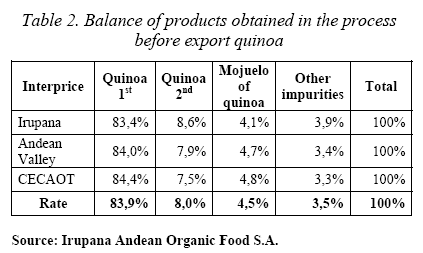
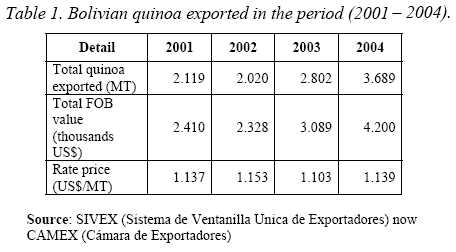
<body><![CDATA[<P align="center">&nbsp;</P>     <P align="center">&nbsp;</P> <hr noshade>     <P align="justify"><font size="2" face="Verdana, Arial, Helvetica, sans-serif"><b>ABSTRACT </b></font></P>      <P align="justify"><font size="2" face="Verdana, Arial, Helvetica, sans-serif"> Bolivia is the first world exporter of quinoa (<i>Chenopodium quinoa</i> Willd) genotype &ldquo;salar&rdquo;. In its natural state quinoa has a coating of bitter-tasting (saponins), making it essentially unpalatable. Most of quinoa exported from Bolivia has been processed to remove this coating. These seed coat residues contain a high level of oleanane-type saponins. From those residues two oleanane-type triterpenes were found as the major sapogenins and their structures were identified as: oleanolic acid and deoxyphytolaccagenic acid in base of NMR means. Furthermore, two derivatives of oleanolic acid were obtained: 28-Omethyl and 3-O-acetyloleanolic acid. The importance of oleanolic acid content in this industrial residue is discussed. </font></P>     <P align="justify"><font size="2" face="Verdana, Arial, Helvetica, sans-serif"><b>Key words:</b> Chenopodium quinoa, sapogenines, oleanolic acid, deoxyphytolaccagenic acid, oleanolic acid derivatives, Bolivian highland crops. </font></P> <hr noshade> <H5 align="justify"><font size="2" face="Verdana, Arial, Helvetica, sans-serif"> RESUMEN </font></H5>     <P align="justify"><font size="2" face="Verdana, Arial, Helvetica, sans-serif"> Bolivia es el primer exportador de quinua (<i>Chenopodium quinoa</i> Willd) genotipo &ldquo;salar&rdquo; del mundo. En su estado natural las semillas de quinua tienen una cobertura amarga (saponinas), que causan un sabor desagradable. Por esto, la mayor parte de quinua exportada es previamente procesada para separar esta cobertura. Estos residuos de escarificaci&oacute;n contienen un alto nivel de saponinas tipo oleanano. De estos residuos, dos triterpenos tipo oleanano fueron encontrados como sapogeninas mayoritarias y sus estructuras fueron identificadas como &aacute;cido olean&oacute;lico y &aacute;cido deoxifitolaccag&eacute;nico, principalmente en base a t&eacute;cnicas de RMN. Adem&aacute;s, dos derivados del &aacute;cido olean&oacute;lico fueron obtenidos: los &aacute;cidos 28-O-metil y 3O-acetilolean&oacute;lico. La importancia del contenido &aacute;cido olean&oacute;lico en estos residuos industriales es discutida. </font></P>   <hr noshade> <H5 align="justify">&nbsp;</H5> <H5 align="justify">&nbsp;</H5> <b><font size="3" face="Verdana, Arial, Helvetica, sans-serif">INTRODUCTION </font></b>     <P align="justify"><font size="2" face="Verdana, Arial, Helvetica, sans-serif"> Quinoa (<i>Chenopodium quinoa</i> Willd) is a pseudocereal which grows at elevations up to 5.000 m.a.s.l. in the Andean region of South America. Its grains have been used as food in the region since more than 5.000 years ago. For the Indian natives quinoa seeds have been more valuable than gold <sup>[1]</sup>. Nowadays, there is renewed interest in quinoa because it contains more protein than any other grain. In fact, it is considered a complete protein since it contains all eight essential amino acids <sup>[2]</sup>. For this reason it has a socioeconomic impact for the Andean people, particularly it is very important in Bolivia which is the main supplier country in the world.  </font></P>     <P align="justify"><font size="2" face="Verdana, Arial, Helvetica, sans-serif">This plant has an important genetic variation in agreement of its environmental conditions producing several genotypes grouped in five: &ldquo;Sure&ntilde;o&rdquo; which grows in the South of Chile; &ldquo;Yungue&ntilde;o&rdquo; which grows in &ldquo;Los Yungas&rdquo; beginning the Amazonic region; &ldquo;Valle&rdquo; which grows in the valleys of Colombia, Ecuador, Peru and Bolivia; &ldquo;Altiplano&rdquo; which grows in the border of Lake Titicaca and &ldquo;Salar&rdquo; which grows in the saline soils of the Bolivian Highlands. The last one is the most important since the economic point of view because it produces the biggest grains for export <sup>[3]</sup>. Those grains have high levels of saponins in their coat which are the responsible of their bitter flavour but also of the protection of this plant against noxious insects <sup>[4]</sup>. </font></P>     <P align="justify"><font size="2" face="Verdana, Arial, Helvetica, sans-serif">The bitter principles of quinoa must be removed before export or cooking. For export, the food Bolivian industries removed the seed coat by two processes: the first one is a mechanic process (dry way) where the grains are rubbed among them producing a residue called &ldquo;mojuelo&rdquo; in a percentage of 4.5%; the second process is done with water (wet way) to wash the last bitter impurities (Irupana Andean Organic Food S.A.). </font></P>     <P align="justify"><font size="2" face="Verdana, Arial, Helvetica, sans-serif">The increasing attention in these grains raised the exports of this product in Bolivia, with the consequent increase in the production of residues (<a href="#t1">Tables 1</a> and <a href="#t2">2</a>).</font></P>     ]]></body>
<body><![CDATA[<P align="justify"><a name="t1"></a></P>     <P align="center"><img src="/img/revistas/rbq/v22n1/a11_tabla_01.gif" width="456" height="252"></P>     <P align="center"><a name="t2"></a></P>     <P align="center"><img src="/img/revistas/rbq/v22n1/a11_tabla_02.gif" width="423" height="253"></P>     <P align="justify"><font size="2" face="Verdana, Arial, Helvetica, sans-serif"> The residues of the dry process were previously analyzed doing around 50% of saponins (source Irupana Andean Organic Food S.A.). Other studies <sup>[4,5,6]</sup> showed that one of the main sapogenins in seeds of quinoa is the oleanolic acid. On the other hand, the oleanolic acid was widely studied for several research groups determining that it is a valuable compound possessing several biological and pharmacological activities <sup>[7,8]</sup>. In fact, our research </font><font size="2" face="Verdana, Arial, Helvetica, sans-serif">group found that it is one of the major secondary metabolites in Bolivian Highland Plants which plays an important role against the environmental conditions <sup>[9]</sup>. For its pharmacologic properties the cost of oleanolic acid is going up, costing today approximately 60 U$D per 100 mg (97% pure) (Sigma Aldrich), being already commercialized in China as drug for liver disorders <sup>[7]</sup>. </font></P>     <P align="justify"><font size="2" face="Verdana, Arial, Helvetica, sans-serif"> All of those things made us to think in study the presence of sapogenines in the dry residues of quinoa real for export, genotype &ldquo;salar&rdquo;, to see their potential uses or benefices. In this sense, herein we report the separation and identification of two oleanane-type triterpenes: oleanolic acid (<b>1</b>) and deoxyphytolaccagenic acid (<b>2</b>), as well as the synthesis of two derivatives of the obtained oleanolic acid: 28-Omethyl and 3-O-acetyloleanolic acid, as one of the potential chemical uses of the oleanolic acid. </font></P>     <P align="justify"><a name="f1"></a></P>     <P align="center"><img src="/img/revistas/rbq/v22n1/a11_figura_01.gif" width="636" height="332"></P>     <P align="center">&nbsp;</P> <b><font size="3" face="Verdana, Arial, Helvetica, sans-serif"> RESULTS AND DISCUSSION</font></b>     <P align="justify"><font size="2" face="Verdana, Arial, Helvetica, sans-serif"> 1000 g of the industrial residue of <i>Chenopodium quinoa</i> Willd genotype &ldquo;salar&rdquo; was extracted with EtOH/H2O (75/25). The obtained EtOH extract was subjected to an acid hydrolysis with HCl giving 38 g of sapogenin extract. So, the total sapogenin content in this industrial residue is very high (3.8%), this result is in agreement with other studies that showed the high content of saponins in the seed coat of quinoa <sup>[4,6]</sup>. </font></P>     ]]></body>
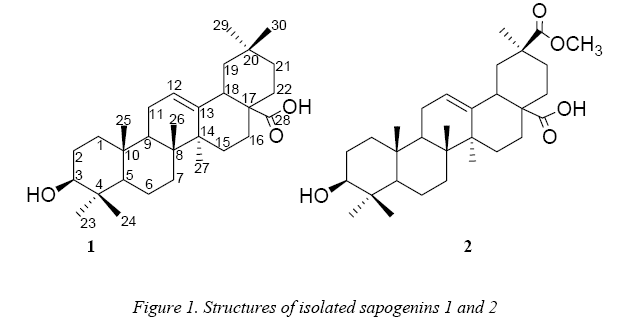
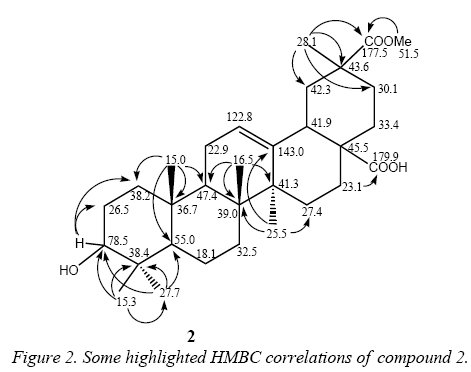
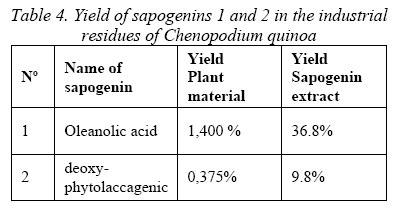
<body><![CDATA[<P align="justify"><font size="2" face="Verdana, Arial, Helvetica, sans-serif"> 3,8 g of sapogenin extract was subjected to a chromatographic analysis giving the isolation of two compounds: Compound <b>1</b> (1,4 g) and compound <b>2</b> (375 mg). Compound <b>1</b> was identified as oleanolic acid by comparison of NMR data (<a href="#t3">Table 3</a>) with bibliographic data <sup>[9]</sup>, as well as by comparison in TLC with authentic patrons of laboratory. </font></P>     <P align="justify"><a name="t3"></a></P>     <P align="center"><img src="/img/revistas/rbq/v22n1/a11_tabla_03.gif" width="571" height="934"></P>     <P align="justify"><font size="2" face="Verdana, Arial, Helvetica, sans-serif">Compound <b>2</b> showed similar <Sup>1</Sup>H and <Sup>13</Sup>C NMR spectra that compound <b>1</b>. In agreement of previous reports <sup>[6]</sup>   the major sapogenins in seeds of <i>Chenopodium quinoa</i>are: the oleanolic acid, hederagenine, 30-O-methylspergulagenate and phytolaccagenic acid. So, at the first time we though in these compounds but the  study of NMR data showed that the isolated compound</font><font size="2" face="Verdana, Arial, Helvetica, sans-serif"> was the deoxyphytolaccagenic acid 2.  </font></P>     <P align="justify"><font size="2" face="Verdana, Arial, Helvetica, sans-serif"><sup>13</sup>C NMR signals of compound 2 show a great </font><font size="2" face="Verdana, Arial, Helvetica, sans-serif">similarity with those of 1 except by the presence of an</font> <font size="2" face="Verdana, Arial, Helvetica, sans-serif">extra ester group at <font face="Georgia, Times New Roman, Times, serif">&delta;</font> 177.5 and 51.5. This ester group was located at C-30 because of its effect on carbons C-19, C-20, C-21 and C-30 (<a href="#t3">Table 3</a>). Particularly is highlighted the shifted downfield effect of the ester group in C-20, suggesting a direct substitution in this position. This substitution was confirmed by HMBC correlations (<a href="#f2">Figure 2</a>) which showed the long-range coupling of carbonyl C-30 (<font face="Georgia, Times New Roman, Times, serif">&delta;</font> 177.5) and the methyl protons at C-29 (<font face="Georgia, Times New Roman, Times, serif">&delta;</font> 28.1) which also coupled with the carbons C-19, C-20 and C-21 in the HMBC spectrum. This substitution just could be also located at C-4, but the long-range correlations among the methyl protons at C-23 (<font face="Georgia, Times New Roman, Times, serif">&delta;</font> 27.7) with the carbons C-3, C-4, C-5 and C24 finally confirmed the proposal structure. In addition, the <Sup>13</Sup>C NMR data was compared with bibliographic data <sup>[5]</sup>. </font></P>     <P align="justify"><a name="f2"></a></P>     <P align="center"><img src="/img/revistas/rbq/v22n1/a11_figura_02.gif" width="471" height="372"></P>     <P align="justify"><font size="2" face="Verdana, Arial, Helvetica, sans-serif"> We know that the export of quinoa in Bolivia is going up, arriving to 3.689 TM in 2004 (<a href="#t1">Table 1</a>) with the consequent increment in the production of residues (<a href="#t2">Table 2</a>). So, it is very important, since the environmental and economic point of view, to think in use the industrial residues. In this study of sapogenins present in the industrial residue called &ldquo;mojuelo&rdquo; we obtained a very good yield of oleanolic acid <b>1</b> (1,4% <a href="#t4">table 4</a>). </font></P>     <P align="justify"><a name="t4"></a></P>     <P align="center"><img src="/img/revistas/rbq/v22n1/a11_tabla_04.gif" width="402" height="210"></P>     ]]></body>
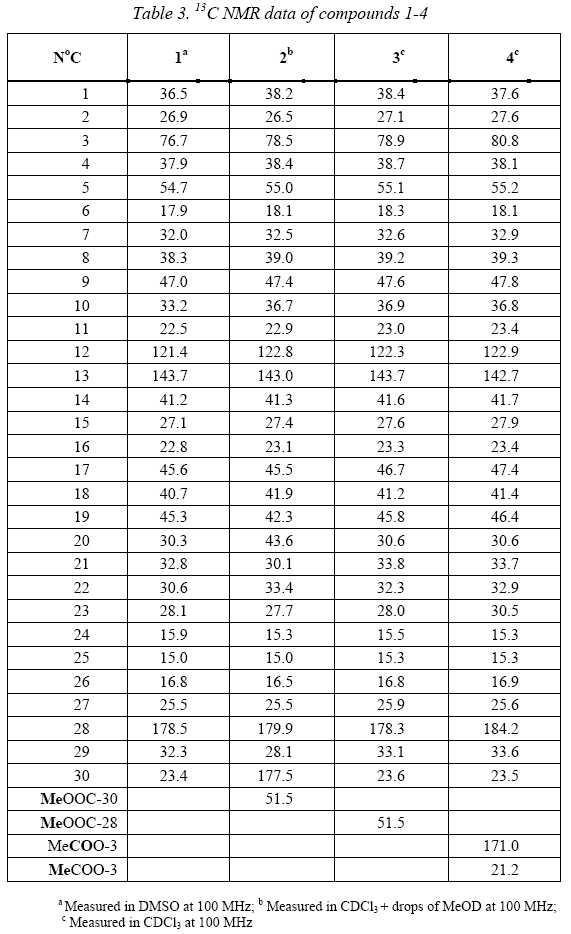
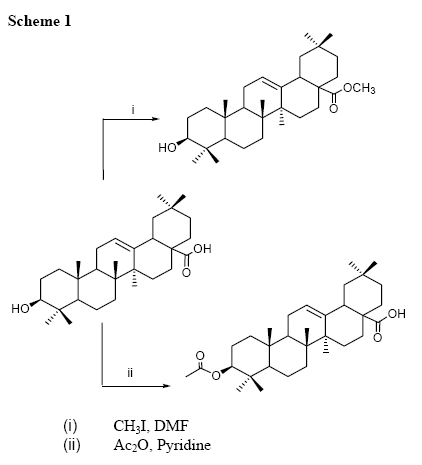
<body><![CDATA[<P align="justify"><font size="2" face="Verdana, Arial, Helvetica, sans-serif">The oleanolic acid <b>1</b> is an interesting and valuable secondary metabolite with several pharmacological activities <sup>[7,8,9]</sup>, nowadays commercialized in China as drug for liver disorders. The cost of the compound <b>1</b> depends on the purity, since 523 &euro;/g (97% pure) produced in lab until 54 &euro;/g industrially produced (85% pure) <sup>[10,11]</sup>. Our product has a high purity (more than 90 %), as the <Sup>1</Sup>H NMR spectrum shows (<a href="#f3">Figure 3</a>). So, the industrial residue of quinoa called &ldquo;mojuelo&rdquo; could be a good font to obtain this important compound with high purity. </font></P>     <P align="justify"><a name="f3"></a></P>     <P align="center"><img src="/img/revistas/rbq/v22n1/a11_figura_03.gif" width="700" height="902"></P>     <P align="justify"><font size="2" face="Verdana, Arial, Helvetica, sans-serif"> In addition, the oleanolic acid was submitted to several chemical modifications mainly to study the pharmacological effect of its derivatives <sup>[12,13]</sup>.. So, thinking in complement our chemical study of the compound <b>1</b>, we obtained the 28-<i>O</i>-methyl and 3-Oacetyl derivatives of oleanolic acid (<b>3</b> and <b>4</b>). </font></P>     <P align="center"><img src="/img/revistas/rbq/v22n1/a11_escheme_01.gif" width="422" height="465"></P>     <P align="justify"><font size="2" face="Verdana, Arial, Helvetica, sans-serif">The structures of derivatives <b>3</b> and <b>4</b> were identified based on the <Sup>1</Sup>H NMR (Figure 3) and <Sup>13</Sup>C NMR (<a href="#t3">Table 3</a>) spectra. So, <a href="#t3">table 3</a> shows that the <Sup>13</Sup>C NMR signals of compound <b>3</b> are very similar to those assigned for <b>1</b>, the little differences could be caused by the change of solvent, because the compound <b>3</b> was soluble in CDCl3 instead of <b>1</b> which was not soluble in it. The main difference in the NMR data was the presence of a methoxy group (MeO) at 51.5 ppm in <Sup>13</Sup>C and 3.58 ppm in <Sup>1</Sup>H NMR spectra. This methoxy group could be located in the hydroxyl group at C-3 or in the acid group at C-28. Its <Sup>1</Sup>H NMR spectrum did not show an effect of this group over H-3 (Figure 3), so it was located in the group at C-28. This substitution was confirmed with HMBC correlations whish showed a long range coupling between the methyl protons of the methoxy group and the carbonyl C-28 at <font face="Georgia, Times New Roman, Times, serif">&delta;</font> 178.3. </font></P>     <P align="justify"><font size="2" face="Verdana, Arial, Helvetica, sans-serif"> Compound <b>4</b> was clearly identified as 3-Oacetyloleanolic acid, because the <Sup>1</Sup>H NMR spectrum (<a href="#f3">Figure 3</a>) shows a high downfield shifted on H-3, so H-3 appears at <font face="Georgia, Times New Roman, Times, serif">&delta;</font> 4.5 as a typical proton geminal to an  acetate group, in addition one acetate methyl group is  observed at <font face="Georgia, Times New Roman, Times, serif">&delta;</font> 2.05, confirming the acetylation of </font><font size="2" face="Verdana, Arial, Helvetica, sans-serif"> compound <b>1</b>. The <Sup>13</Sup>C NMR data of <b>4</b> (<a href="#t3">Table 3</a>) is in</font> <font size="2" face="Verdana, Arial, Helvetica, sans-serif">agreement with the established structure showing also</font> <font size="2" face="Verdana, Arial, Helvetica, sans-serif">the downfield shifted effect on C-3 (<font face="Georgia, Times New Roman, Times, serif">&delta;</font> 80.8) and the</font> <font size="2" face="Verdana, Arial, Helvetica, sans-serif">acetyl group at <font face="Georgia, Times New Roman, Times, serif">&delta;</font> 171.0 and 21.2.</font></P>     <P align="justify">&nbsp;</P>     <P align="justify"><font size="3" face="Verdana, Arial, Helvetica, sans-serif"> <b>MATERIALS AND METHODS </b></font></P>     <P align="justify"><b><font size="2" face="Verdana, Arial, Helvetica, sans-serif">General Experimental Procedures.</font></b><font size="2" face="Verdana, Arial, Helvetica, sans-serif"></font></P>     ]]></body>
<body><![CDATA[<P align="justify"><font size="2" face="Verdana, Arial, Helvetica, sans-serif">Crude extracts were concentrated under vacuum (Labora Rota Evaporator), <Sup>1</Sup>H and <Sup>13</Sup>C NMR spectra</font> <font size="2" face="Verdana, Arial, Helvetica, sans-serif">and two-dimensional experiments were recorded in a Bruker DRX-400 NMR spectrometer, operating at 400   MHz for <Sup>1</Sup>H and 100 MHz for <Sup>13</Sup>C. The raw data were transformed and the spectra were evaluated with the  standard Bruker XWIN-NMR software package;  chemical shifts are reported in <font face="Georgia, Times New Roman, Times, serif">&delta;</font> units (ppm) and </font><font size="2" face="Verdana, Arial, Helvetica, sans-serif">coupling constants (<i>J</i>) in Hz, using DMSO d<sub>6</sub>, CDCl3 and MeOD as the deuterated solvents and their residual solvent signals as reference, <Sup>13</Sup>C-DEPT, HMQC, and HMBC experiments were carried out using the conventional pulse sequences described in the literature. The Vacuum Liquid Chromatography (VLC) was performed on silicagel G-60. The CC column chromatographies were performed on Silicagel 60 (70230 mesh) and TLC analyses were made on Silicagel F 254 (Merck) plates and visualized with sulphuric acid and heating. The organic solvents were used after purification by distillation, the other inorganic and organic reagents used were all commercially guaranteed. </font></P> <b><font size="2" face="Verdana, Arial, Helvetica, sans-serif"> Plant material </font></b>     <P align="justify"><font size="2" face="Verdana, Arial, Helvetica, sans-serif"> The plant material &ldquo;mojuelo de quinua real&rdquo; is an industrial residue of <i>Chenopodium quinoa</i> Willd genotype &ldquo;salar&rdquo; for export. This material was supplied by the Bolivian Industry Irupana Andean Organic Food </font><font size="2" face="Verdana, Arial, Helvetica, sans-serif">S. A.. The plant was collected in Bolivian Highlands near to &ldquo;Salar de Uyuni&rdquo; (Prov. Ladislao Cabrera, Oruro) at 3.725 m.a.s.l. of altitude. The residue was obtained by an industrial mechanic process to remove the seed coat of quinoa before export. It looks as fine white powder with bitter flavour. </font></P> <b><font size="2" face="Verdana, Arial, Helvetica, sans-serif"> Extraction and acid hydrolisis of saponins </font></b>     <P align="justify"><font size="2" face="Verdana, Arial, Helvetica, sans-serif"> The white powder of &ldquo;mojuelo de quinua real&rdquo; (1000g) was extracted by maceration with EtOH/H2O (75/25) for 72 h at room temperature with solvent renovation. The obtained extract was rotaevaporated until to obtain </font><font size="2" face="Verdana, Arial, Helvetica, sans-serif">1.6 L of a concentrated EtOH extract. The last extract was submitted to an acid hydrolysis adding 320 mL of HCl 2N, this solution was refluxed for 4h giving a reaction mixture constituted by two phases. After being cooled the two phases were separated and the solid phase was washed with H2O and then extracted with AcOEt. The AcOEt layer was dried with anhydrous Na<sub>2</sub>SO<sub>4</sub> and evaporated to dryness giving 38 g of sapogenin extract. </font></P> <b><font size="2" face="Verdana, Arial, Helvetica, sans-serif"> Isolation of sapogenins 1 and 2 </font></b>     <P align="justify"><font size="2" face="Verdana, Arial, Helvetica, sans-serif"> 3,8 g of the AcOEt sapogenin extract was subjected to VLC chromatography on Silicagel G-60 using mixtures of AcOEt and petrol ether, in increased order of polarity, to give 5 fractions (C-I to C-V). The fractions were compared by chromatography TLC with patron samples of oleanolic acid from the Lab showing that it was present in the fractions C-II and C-III. Fraction C-II was submitted to a crystallization process in MeOH giving 850 mg of compound <b>1</b>. Fraction CIII was submitted to a further CC chromatography on Silicagel 60 (70-230 mesh) eluted with AcOEt : petrol ether 50:50 giving, after purification by recrystallization in MeOH, 550 mg of compound <b>1</b> and 375 mg of compound <b>2</b> </font></P> <b><font size="2" face="Verdana, Arial, Helvetica, sans-serif"> Compound 1 </font></b>     <P align="justify"><font size="2" face="Verdana, Arial, Helvetica, sans-serif"> White needles: M.P. &gt; 312 &ordm;C; C<sub>30</sub>H<sub>48</sub>O<sub>3</sub>; FW 456,7; <Sup>1</Sup>H RMN (DMSO, 400 MHz) <font face="Georgia, Times New Roman, Times, serif">&delta;</font> 5.16 (1H, <i>t</i>, H-12), 2.99 (1H, <i>t</i>, H-3), 2.73 (1H, <i>dd</i>, H-18), 1.90 (1H, <i>ddd</i>, H16a), 1.81 (2H, <i>d</i>, H-11a y H-11b), 1.08 (3H, <i>s</i>, Me), </font><font size="2" face="Verdana, Arial, Helvetica, sans-serif">0.90 (3H, <i>s</i>, Me), 0.87 (6H, <i>s</i>, 2 x Me), 0.85 (3H, <i>s</i>,    Me), 0.73 (3H, <i>s</i>, Me), 0.68 (3H, <i>s</i>, Me);  RMN<Sup>13</Sup>C (DMSO, 100 MHz) see <a href="#t3">Table 3</a>.</font></P>     <P align="justify"><font size="2" face="Verdana, Arial, Helvetica, sans-serif"> <b>Compound 2 </b></font></P>     <P align="justify"><font size="2" face="Verdana, Arial, Helvetica, sans-serif"> White needles: M.P. &gt; 312 &ordm;C, C<sub>31</sub>H<sub>48</sub>O<sub>5</sub>; FW 500.71; <Sup>1</Sup>H RMN (CDCl<sub>3</sub>+CD<sub>3</sub>OD, 400 MHz) <font face="Georgia, Times New Roman, Times, serif">&delta;</font> 5.21 (1H, <i>t</i>, H12), 3.06 (1H, <i>dd</i>, H-3), 2.54 (1H, <i>dd</i>, H-18), 1.75 (1H, <i>ddd</i>, H-16a), 1.01 (6H, <i>s</i>, Me-29 and Me-24), 0.84 (3H, <i>s</i>, Me-27), 0.77 (6H, <i>s</i>, Me-25), 0.77 (6H, <i>s</i>, Me-26 and Me-23), 3,57 (3H, <i>s</i>, Me ester 30); RMN<Sup>13</Sup>C (CDCl<sub>3</sub>+MeOD, 100 MHz) see <a href="#t3">Table 3</a>. </font></P> <b><font size="2" face="Verdana, Arial, Helvetica, sans-serif"> Methylation of compound 1 </font></b>     <P align="justify"><font size="2" face="Verdana, Arial, Helvetica, sans-serif"> The methylation of compound <b>1</b> (200 mg) was done with CH<sub>3</sub>I in presence of DMF for 12 h at room temperature (22&ordm;C) giving a product. The product was purified by flash CC on Silicagel using CHCl<sub>3</sub> as solvent to give the methyl ester of oleanolic acid <b>3</b> (160 mg, 80%). </font></P>     <P align="justify"><font size="2" face="Verdana, Arial, Helvetica, sans-serif"> Derivative: Me ester, compound <b>3</b> </font></P>     <P align="justify"><font size="2" face="Verdana, Arial, Helvetica, sans-serif">White powder: M. P.: 197-199&deg;C; C<sub>31</sub>H<sub>50</sub>O<sub>3</sub>; FW 470.73; <Sup>1</Sup>H NMR (CDCl<sub>3</sub>, 400 MHz) <font face="Georgia, Times New Roman, Times, serif">&delta;</font> 5.26 (1H, t, H12), 3.20 (1H, <i>dd</i>, H-3), 2.84 (1H, <i>dd</i>, H-18), 1.11 (3H,<i> s</i>,Me), 0.97 (3H, <i>s</i>, Me), 0.91 (3H, <i>s</i>, Me), 0.89 (3H, <i>s</i>, M), 0.88 (3H, <i>s</i>, Me), 0.76 (3H, <i>s</i>, Me), 0.70 (3H, <i>s</i>, Me), 3,61 (3H, <i>s</i>, Me ester 30); <Sup>13</Sup>C NMR (CDCl<sub>3</sub>, 100 MHz) data see <a href="#t3">Table 3</a>. </font></P> <b><font size="2" face="Verdana, Arial, Helvetica, sans-serif"> Acetylation of compound 1 </font></b>     ]]></body>
<body><![CDATA[<P align="justify"><font size="2" face="Verdana, Arial, Helvetica, sans-serif"> The acetylation of compound <b>1</b> (200 mg) was done with pyridine (2 ml) and acetic anhydride (2 ml) at room temperature (22 &ordm;C) overnight and then evaporated to dryness after addition of toluene (3x5 ml). The product was purified by flash CC on Silicagel using CHCl<sub>3</sub> as solvent to give the acetyl-oleanolic acid 4 (120 mg 60%). </font></P>     <P align="justify"><font size="2" face="Verdana, Arial, Helvetica, sans-serif"> Derivative: Ac, compound <b>4</b> </font></P>     <P align="justify"><font size="2" face="Verdana, Arial, Helvetica, sans-serif">White powder: M.P. 165-167 &ordm;C; C<sub>32</sub>H<sub>50</sub>O<sub>4</sub>; FW 498.74; <Sup>1</Sup>H NMR (CDCl<sub>3</sub>, 400 MHz); <font face="Georgia, Times New Roman, Times, serif">&delta;</font> 5.24 (1H, <i>t</i>, H12), 4.47 (1H, <i>dd</i>, H-3), 2.79 (1H, <i>dd</i>, H-18), 1.12 (3H,  s,Me), 0.91 (3H, s, Me), 0.90 (3H, s, Me), 0.84 (3H, s, M), 0.83 (3H, s, Me), 0.79 (3H, s, Me), 0.72 (3H, s,  Me), 2.02 (3H, s, MeCOO); <Sup>13</Sup>C NMR (CDCl3, 100   MHz) data see <a href="#t3">Table 3</a>. </font></P>     <P align="justify">&nbsp;</P>     <P align="justify"><font size="3" face="Verdana, Arial, Helvetica, sans-serif"><b>ACKNOWLEDMENTS</b></font></P>     <P align="justify"><font size="2" face="Verdana, Arial, Helvetica, sans-serif">We are indebted to SIDA/Sarec for financial support of</font> <font size="2" face="Verdana, Arial, Helvetica, sans-serif">the project &ldquo;Research on Plant Biodiversity&rdquo; and</font> <font size="2" face="Verdana, Arial, Helvetica, sans-serif">we also would like to thank to Irupana Andean Organic </font><font size="2" face="Verdana, Arial, Helvetica, sans-serif">Food S.A. for all the information about quinoa business in Bolivia. </font></P> <H5 align="justify">&nbsp;</H5> <b><font size="3" face="Verdana, Arial, Helvetica, sans-serif">REFERENCES </font></b>      <!-- ref --><p><font size="2" face="Verdana, Arial, Helvetica, sans-serif"> 1. Tapia M.; Cultivos andinos subexplotados y su aporte a la alimentaci&oacute;n. FAO, Santiago de Chile, (1990) </font>&nbsp;&nbsp;&nbsp;&nbsp;&nbsp;&nbsp;&nbsp;&nbsp;[&#160;<a href="javascript:void(0);" onclick="javascript: window.open('/scielo.php?script=sci_nlinks&ref=659904&pid=S0250-5460200500010001100001&lng=','','width=640,height=500,resizable=yes,scrollbars=1,menubar=yes,');">Links</a>&#160;]<!-- end-ref --><!-- ref --><p><font size="2" face="Verdana, Arial, Helvetica, sans-serif">   2. Koziok M. J.; Chemical composition and nutritional evaluation of quinoa (<i>Chenopodium quinoa</i> Willd); Food Comp. Anal., 5, 35-68, (1992). </font>&nbsp;&nbsp;&nbsp;&nbsp;&nbsp;&nbsp;&nbsp;&nbsp;[&#160;<a href="javascript:void(0);" onclick="javascript: window.open('/scielo.php?script=sci_nlinks&ref=659905&pid=S0250-5460200500010001100002&lng=','','width=640,height=500,resizable=yes,scrollbars=1,menubar=yes,');">Links</a>&#160;]<!-- end-ref --><!-- ref --><p><font size="2" face="Verdana, Arial, Helvetica, sans-serif"> 3. Tapia M., Gandarillas H., Alandia S., Cardozo A, Mujica A., Ort&iacute;z R., Otaz&uacute; V., Rea J. y Zanabria E.; La quinua y la ka&ntilde;ihua. Serie cultivos andinos. CIID/IICA, Bogot&aacute;, (1979) </font>&nbsp;&nbsp;&nbsp;&nbsp;&nbsp;&nbsp;&nbsp;&nbsp;[&#160;<a href="javascript:void(0);" onclick="javascript: window.open('/scielo.php?script=sci_nlinks&ref=659906&pid=S0250-5460200500010001100003&lng=','','width=640,height=500,resizable=yes,scrollbars=1,menubar=yes,');">Links</a>&#160;]<!-- end-ref --><!-- ref --><p><font size="2" face="Verdana, Arial, Helvetica, sans-serif">   4. Mizui, F.; Kasai, R; Ohtani, K.;Tanaka, O.; Saponins from the bran of quinoa, <i>Chenopodium quinoa</i> Willd. II; Chem. Pharm. Bull, 38, 375-377, (1990) </font>&nbsp;&nbsp;&nbsp;&nbsp;&nbsp;&nbsp;&nbsp;&nbsp;[&#160;<a href="javascript:void(0);" onclick="javascript: window.open('/scielo.php?script=sci_nlinks&ref=659907&pid=S0250-5460200500010001100004&lng=','','width=640,height=500,resizable=yes,scrollbars=1,menubar=yes,');">Links</a>&#160;]<!-- end-ref --><!-- ref --><p><font size="2" face="Verdana, Arial, Helvetica, sans-serif">   5. Mizui, F.; Kasai, R; Ohtani, K.;Tanaka, O.; Saponins from the bran of quinoa, <i>Chenopodium quinoa</i> Willd. I; Chem. Pharm. Bull,36, 1415-1418, (1988) </font>&nbsp;&nbsp;&nbsp;&nbsp;&nbsp;&nbsp;&nbsp;&nbsp;[&#160;<a href="javascript:void(0);" onclick="javascript: window.open('/scielo.php?script=sci_nlinks&ref=659908&pid=S0250-5460200500010001100005&lng=','','width=640,height=500,resizable=yes,scrollbars=1,menubar=yes,');">Links</a>&#160;]<!-- end-ref --><!-- ref --><p><font size="2" face="Verdana, Arial, Helvetica, sans-serif">   6. Mastebroek H.D., Limburg H., Gilles T., Marvin H., Ocurrence of sapogenins in leaves and seeds of quinoa (<i>Chenopodium quinoa</i> Willd), J. Sci. Food Agric., 80, 152-156, (2000) </font>&nbsp;&nbsp;&nbsp;&nbsp;&nbsp;&nbsp;&nbsp;&nbsp;[&#160;<a href="javascript:void(0);" onclick="javascript: window.open('/scielo.php?script=sci_nlinks&ref=659909&pid=S0250-5460200500010001100006&lng=','','width=640,height=500,resizable=yes,scrollbars=1,menubar=yes,');">Links</a>&#160;]<!-- end-ref --><!-- ref --><p><font size="2" face="Verdana, Arial, Helvetica, sans-serif">   7. Liu J., J. Ethnopharmacol., 49, 57, (1995) </font>&nbsp;&nbsp;&nbsp;&nbsp;&nbsp;&nbsp;&nbsp;&nbsp;[&#160;<a href="javascript:void(0);" onclick="javascript: window.open('/scielo.php?script=sci_nlinks&ref=659910&pid=S0250-5460200500010001100007&lng=','','width=640,height=500,resizable=yes,scrollbars=1,menubar=yes,');">Links</a>&#160;]<!-- end-ref --><!-- ref --><p><font size="2" face="Verdana, Arial, Helvetica, sans-serif">   8. Hye Gwang Jeong, Inhibition of cytochrome P450 2E1 expression by oleanolic acid and its hepatoprotective effects against carbon tetrachloride-induced hepatic injury, Toxicology, 105 215-222, (1999) </font>&nbsp;&nbsp;&nbsp;&nbsp;&nbsp;&nbsp;&nbsp;&nbsp;[&#160;<a href="javascript:void(0);" onclick="javascript: window.open('/scielo.php?script=sci_nlinks&ref=659911&pid=S0250-5460200500010001100008&lng=','','width=640,height=500,resizable=yes,scrollbars=1,menubar=yes,');">Links</a>&#160;]<!-- end-ref --><!-- ref --><p><font size="2" face="Verdana, Arial, Helvetica, sans-serif">   9. Flores Y., Sterner O., G. R. Almanza, Oleanoic acid, presence and importance in highland bolivian plants, Rev. Bol. Quim. 21, 31-35, (2004) </font>&nbsp;&nbsp;&nbsp;&nbsp;&nbsp;&nbsp;&nbsp;&nbsp;[&#160;<a href="javascript:void(0);" onclick="javascript: window.open('/scielo.php?script=sci_nlinks&ref=659912&pid=S0250-5460200500010001100009&lng=','','width=640,height=500,resizable=yes,scrollbars=1,menubar=yes,');">Links</a>&#160;]<!-- end-ref --><p><font size="2" face="Verdana, Arial, Helvetica, sans-serif"> 10. Garc&iacute;a-Granados L&oacute;pez de Hierro A., Patent US1998000043318, Universidad de Granada, Spain, (2000) </font></p>     <!-- ref --><p><font size="2" face="Verdana, Arial, Helvetica, sans-serif"> 11. Gerold Gruenwald J., Patent US2001000024978, E. &amp; J. Gallo Winery, Germany (2004) </font>&nbsp;&nbsp;&nbsp;&nbsp;&nbsp;&nbsp;&nbsp;&nbsp;[&#160;<a href="javascript:void(0);" onclick="javascript: window.open('/scielo.php?script=sci_nlinks&ref=659914&pid=S0250-5460200500010001100011&lng=','','width=640,height=500,resizable=yes,scrollbars=1,menubar=yes,');">Links</a>&#160;]<!-- end-ref --><!-- ref --><p><font size="2" face="Verdana, Arial, Helvetica, sans-serif">   12. Chao-Mei Ma et al, Chemical Modification of Oleanane Type Triterpenoids and Their Activity Against HIV-1 Protease Dimerization, Chem. Pharm. Bull, 48 (11), 1681-1688, (2000) </font>&nbsp;&nbsp;&nbsp;&nbsp;&nbsp;&nbsp;&nbsp;&nbsp;[&#160;<a href="javascript:void(0);" onclick="javascript: window.open('/scielo.php?script=sci_nlinks&ref=659915&pid=S0250-5460200500010001100012&lng=','','width=640,height=500,resizable=yes,scrollbars=1,menubar=yes,');">Links</a>&#160;]<!-- end-ref --><!-- ref --><p><font size="2" face="Verdana, Arial, Helvetica, sans-serif">   13. Kashiwada Y., et al.; Anti-AIDS Agents 30. Anti-HIV Activity of Oleanolic Acid and Structurally Related Triterpenoids, J. Nat. Prod, 61, 1090-1095, (1988) </font>&nbsp;&nbsp;&nbsp;&nbsp;&nbsp;&nbsp;&nbsp;&nbsp;[&#160;<a href="javascript:void(0);" onclick="javascript: window.open('/scielo.php?script=sci_nlinks&ref=659916&pid=S0250-5460200500010001100013&lng=','','width=640,height=500,resizable=yes,scrollbars=1,menubar=yes,');">Links</a>&#160;]<!-- end-ref --><p>&nbsp;</p>     ]]></body>
<body><![CDATA[ ]]></body><back>
<ref-list>
<ref id="B1">
<label>1</label><nlm-citation citation-type="book">
<person-group person-group-type="author">
<name>
<surname><![CDATA[Tapia]]></surname>
<given-names><![CDATA[M.]]></given-names>
</name>
</person-group>
<source><![CDATA[Cultivos andinos subexplotados y su aporte a la alimentación]]></source>
<year>1990</year>
<publisher-loc><![CDATA[Santiago de Chile ]]></publisher-loc>
<publisher-name><![CDATA[FAO]]></publisher-name>
</nlm-citation>
</ref>
<ref id="B2">
<label>2</label><nlm-citation citation-type="journal">
<person-group person-group-type="author">
<name>
<surname><![CDATA[Koziok]]></surname>
<given-names><![CDATA[M. J.]]></given-names>
</name>
</person-group>
<article-title xml:lang="en"><![CDATA[Chemical composition and nutritional evaluation of quinoa (Chenopodium quinoa Willd)]]></article-title>
<source><![CDATA[Food Comp. Anal.]]></source>
<year>1992</year>
<volume>5</volume>
<page-range>35-68</page-range></nlm-citation>
</ref>
<ref id="B3">
<label>3</label><nlm-citation citation-type="book">
<person-group person-group-type="author">
<name>
<surname><![CDATA[Tapia]]></surname>
<given-names><![CDATA[M.]]></given-names>
</name>
<name>
<surname><![CDATA[Gandarillas]]></surname>
<given-names><![CDATA[H.]]></given-names>
</name>
<name>
<surname><![CDATA[Alandia]]></surname>
<given-names><![CDATA[S.]]></given-names>
</name>
<name>
<surname><![CDATA[Cardozo]]></surname>
<given-names><![CDATA[A]]></given-names>
</name>
<name>
<surname><![CDATA[Mujica]]></surname>
<given-names><![CDATA[A.]]></given-names>
</name>
<name>
<surname><![CDATA[Ortíz]]></surname>
<given-names><![CDATA[R.]]></given-names>
</name>
<name>
<surname><![CDATA[Otazú]]></surname>
<given-names><![CDATA[V.]]></given-names>
</name>
<name>
<surname><![CDATA[Rea]]></surname>
<given-names><![CDATA[J.]]></given-names>
</name>
<name>
<surname><![CDATA[Zanabria]]></surname>
<given-names><![CDATA[E.]]></given-names>
</name>
</person-group>
<source><![CDATA[La quinua y la kañihua]]></source>
<year>1979</year>
<publisher-loc><![CDATA[Bogotá ]]></publisher-loc>
<publisher-name><![CDATA[CIID/IICA]]></publisher-name>
</nlm-citation>
</ref>
<ref id="B4">
<label>4</label><nlm-citation citation-type="journal">
<person-group person-group-type="author">
<name>
<surname><![CDATA[Mizui]]></surname>
<given-names><![CDATA[F.]]></given-names>
</name>
<name>
<surname><![CDATA[Kasai]]></surname>
<given-names><![CDATA[R]]></given-names>
</name>
<name>
<surname><![CDATA[Ohtani]]></surname>
<given-names><![CDATA[K.]]></given-names>
</name>
<name>
<surname><![CDATA[Tanaka]]></surname>
<given-names><![CDATA[O.]]></given-names>
</name>
</person-group>
<article-title xml:lang="en"><![CDATA[Saponins from the bran of quinoa, Chenopodium quinoa Willd. II]]></article-title>
<source><![CDATA[Chem. Pharm. Bull]]></source>
<year>1990</year>
<volume>38</volume>
<page-range>375-377</page-range></nlm-citation>
</ref>
<ref id="B5">
<label>5</label><nlm-citation citation-type="journal">
<person-group person-group-type="author">
<name>
<surname><![CDATA[Mizui]]></surname>
<given-names><![CDATA[F.]]></given-names>
</name>
<name>
<surname><![CDATA[Kasai]]></surname>
<given-names><![CDATA[R]]></given-names>
</name>
<name>
<surname><![CDATA[Ohtani]]></surname>
<given-names><![CDATA[K.]]></given-names>
</name>
<name>
<surname><![CDATA[Tanaka]]></surname>
<given-names><![CDATA[O.]]></given-names>
</name>
</person-group>
<article-title xml:lang="en"><![CDATA[Saponins from the bran of quinoa, Chenopodium quinoa Willd. I]]></article-title>
<source><![CDATA[Chem. Pharm. Bull]]></source>
<year>1988</year>
<volume>36</volume>
<page-range>1415-1418</page-range></nlm-citation>
</ref>
<ref id="B6">
<label>6</label><nlm-citation citation-type="journal">
<person-group person-group-type="author">
<name>
<surname><![CDATA[Mastebroek]]></surname>
<given-names><![CDATA[H.D.]]></given-names>
</name>
<name>
<surname><![CDATA[Limburg]]></surname>
<given-names><![CDATA[H.]]></given-names>
</name>
<name>
<surname><![CDATA[Gilles]]></surname>
<given-names><![CDATA[T.]]></given-names>
</name>
<name>
<surname><![CDATA[Marvin]]></surname>
<given-names><![CDATA[H.]]></given-names>
</name>
</person-group>
<article-title xml:lang="en"><![CDATA[Ocurrence of sapogenins in leaves and seeds of quinoa (Chenopodium quinoa Willd)]]></article-title>
<source><![CDATA[J. Sci. Food Agric.]]></source>
<year>2000</year>
<volume>80</volume>
<page-range>152-156</page-range></nlm-citation>
</ref>
<ref id="B7">
<label>7</label><nlm-citation citation-type="journal">
<person-group person-group-type="author">
<name>
<surname><![CDATA[Liu]]></surname>
<given-names><![CDATA[J.]]></given-names>
</name>
</person-group>
<source><![CDATA[J. Ethnopharmacol.]]></source>
<year>1995</year>
<volume>49</volume>
<page-range>57</page-range></nlm-citation>
</ref>
<ref id="B8">
<label>8</label><nlm-citation citation-type="journal">
<person-group person-group-type="author">
<name>
<surname><![CDATA[Hye Gwang]]></surname>
<given-names><![CDATA[Jeong]]></given-names>
</name>
</person-group>
<article-title xml:lang="en"><![CDATA[Inhibition of cytochrome P450 2E1 expression by oleanolic acid and its hepatoprotective effects against carbon tetrachloride-induced hepatic injury]]></article-title>
<source><![CDATA[Toxicology]]></source>
<year>1999</year>
<volume>105</volume>
<page-range>215-222</page-range></nlm-citation>
</ref>
<ref id="B9">
<label>9</label><nlm-citation citation-type="journal">
<person-group person-group-type="author">
<name>
<surname><![CDATA[Flores]]></surname>
<given-names><![CDATA[Y.]]></given-names>
</name>
<name>
<surname><![CDATA[Sterner]]></surname>
<given-names><![CDATA[O.]]></given-names>
</name>
<name>
<surname><![CDATA[Almanza]]></surname>
<given-names><![CDATA[G. R.]]></given-names>
</name>
</person-group>
<article-title xml:lang="en"><![CDATA[Oleanoic acid, presence and importance in highland bolivian plants]]></article-title>
<source><![CDATA[Rev. Bol. Quim.]]></source>
<year>2004</year>
<volume>21</volume>
<page-range>31-35</page-range></nlm-citation>
</ref>
<ref id="B10">
<label>10</label><nlm-citation citation-type="book">
<person-group person-group-type="author">
<name>
<surname><![CDATA[García-Granados López de Hierro]]></surname>
<given-names><![CDATA[A.]]></given-names>
</name>
</person-group>
<source><![CDATA[]]></source>
<year>2000</year>
<publisher-loc><![CDATA[Spain ]]></publisher-loc>
<publisher-name><![CDATA[Universidad de Granada]]></publisher-name>
</nlm-citation>
</ref>
<ref id="B11">
<label>11</label><nlm-citation citation-type="book">
<person-group person-group-type="author">
<name>
<surname><![CDATA[Gerold Gruenwald]]></surname>
<given-names><![CDATA[J.]]></given-names>
</name>
</person-group>
<source><![CDATA[]]></source>
<year>2004</year>
<publisher-loc><![CDATA[Germany ]]></publisher-loc>
<publisher-name><![CDATA[E. & J. Gallo Winery]]></publisher-name>
</nlm-citation>
</ref>
<ref id="B12">
<label>12</label><nlm-citation citation-type="journal">
<person-group person-group-type="author">
<name>
<surname><![CDATA[Chao-Mei]]></surname>
<given-names><![CDATA[Ma]]></given-names>
</name>
</person-group>
<article-title xml:lang="en"><![CDATA[Chemical Modification of Oleanane Type Triterpenoids and Their Activity Against HIV-1 Protease Dimerization]]></article-title>
<source><![CDATA[Chem. Pharm. Bull]]></source>
<year>2000</year>
<volume>48</volume>
<numero>11</numero>
<issue>11</issue>
<page-range>1681-1688</page-range></nlm-citation>
</ref>
<ref id="B13">
<label>13</label><nlm-citation citation-type="journal">
<person-group person-group-type="author">
<name>
<surname><![CDATA[Kashiwada]]></surname>
<given-names><![CDATA[Y.]]></given-names>
</name>
</person-group>
<article-title xml:lang="en"><![CDATA[Anti-AIDS Agents 30. Anti-HIV Activity of Oleanolic Acid and Structurally Related Triterpenoids]]></article-title>
<source><![CDATA[J. Nat. Prod]]></source>
<year>1988</year>
<volume>61</volume>
<page-range>1090-1095</page-range></nlm-citation>
</ref>
</ref-list>
</back>
</article>