




 Español (pdf)
 Articulo en XML
 Referencias del artículo
 Traducción automática
 Enviar articulo por email
 Citado por SciELO
  Similares en
SciELO
Similares en
SciELO 
 Permalink

INTRODUCTION
Teaching English as a second language during the COVID-19 pandemic presented a significant challenge for educators. The abrupt shift from face-to-face instruction to virtual learning disrupted traditional teaching methods, compelling teachers to adopt new strategies and methodological alternatives to ensure the continuity of English instruction. WhatsApp emerged as a widely used tool during this period due to its accessibility, user-friendliness, and global recognition. As noted by Hwee and Kei (2022), this application became an essential resource for improving the quality of English teaching and learning in virtual classrooms.
The transition to virtual education required teachers to utilize technological devices and platforms with which many were unfamiliar. However, WhatsApp's popularity among educators, students, and parents facilitated its adoption as a communication and pedagogical tool. According to Baishya and Maheshwari (2019), WhatsApp is one of the most commonly used applications for teacher-student communication, allowing for the instant sharing of academic resources and information. In this context, Cetinkaya (2017) highlights that WhatsApp fosters cooperation, socialization, attention, and encouragement in the educational environment.
The increased reliance on mobile devices during the pandemic popularized methodologies such as mobile learning (M-learning). Vigil et al. (2020) emphasize that M-learning offers distinct advantages, particularly for vocabulary acquisition. Mobile devices enable teachers and students to exchange vocabulary and multimedia resources, such as videos and podcasts, which enhance English language learning through diverse formats.
WhatsApp has demonstrated several advantages over other electronic resources in education, including affordability, clarity, connectivity, and its ability to support real-time communication (Gon & Rawekar, 2017). Church and de Oliveira (2013) argue that WhatsApp's functionality-such as instant messaging to individuals or groups-makes it an effective tool for fostering clear and rapid communication.
Research also points to the positive educational impacts of WhatsApp. Rashed (2019) identifies three areas in which this tool enhances learning outcomes: (1) increased student motivation, as its use during lessons generates enthusiasm; (2) improved academic achievement, particularly in developing writing skills; and (3) stronger teacher-student relationships, as WhatsApp facilitates both group and individual interactions. Similarly, Asmara (2017) explored the challenges of teaching English in virtual classrooms using WhatsApp. The study found that while the application enhanced creativity, critical thinking, and learning autonomy among students, its dependence on internet connectivity posed challenges for sharing materials and submitting assignments. Asmara concluded that effective use of WhatsApp requires knowledge of its features, functionalities, and the specific needs of students.
Mei (2021) corroborates these findings, demonstrating that WhatsApp enhances student engagement and motivation due to its familiarity and ease of use. This view is supported by Loor et al. (2022), who argue that WhatsApp serves as both a communication and learning strategy for students, teachers, and parents in educational contexts.
Despite these benefits, the lack of training in using WhatsApp as a pedagogical tool often limits its application to communication rather than practical language-learning activities. Suarez et al. (2022) stress the importance of equipping teachers with the necessary skills to utilize WhatsApp effectively, as its proper implementation fosters a more interactive and collaborative learning environment.
The purpose of this study is to analyze the benefits of using WhatsApp for teaching English and its potential to enhance the teaching-learning process. Specifically, this research seeks to determine teachers' perceptions regarding the use of WhatsApp in virtual classes to teach English as a foreign language in a public school in Latacunga. The study addresses the following research question:
How did teachers use WhatsApp in virtual classes to teach English as a foreign language during the pandemic?
METHOD
This study was conducted using a qualitative and descriptive methodology to determine teachers' perceptions of the use of WhatsApp in virtual classes to teach English as a foreign language in a public school in Latacunga. The research design was a case study, focusing on understanding how teachers used WhatsApp during virtual classes amid the COVID-19 pandemic to support English language instruction. The study was carried out at the Educative Unit "Patria," a public school in Latacunga, Ecuador.
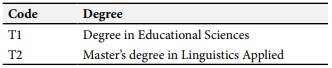
The participants in this research were two English teachers employed at the school. Teacher 1 held a degree in Educational Sciences with a specialization in English, while Teacher 2 had a master’s degree in linguistics applied to teaching English as a foreign language. ASs evidenced in Table 1.
Data were collected through a non-structured interview with the English teachers from the "Patria" Educative Unit. A face-to-face meeting was organized, during which teachers answered a questionnaire covering topics such as the use of WhatsApp in English as a Foreign Language (EFL) classrooms during virtual classes, the types of resources and activities used to teach English, and the development of English skills facilitated by WhatsApp during online learning.
A thematic analysis was employed to process the data. Researchers conducted an in-depth reading of the interview transcripts to interpret and classify the information into categories with key concepts. Codes were then assigned to the data to identify and extract relevant information provided by the participants.
Prior to conducting the interviews, the researchers obtained written informed consent from the participants, ensuring their permission to use the information for publication.
FINDINGS AND DISCUSSION
To address the research question of the study, what was the use of WhatsApp by teachers in virtual classrooms for teaching English as a foreign language during the COVID-19 pandemic? the researchers analyzed the unstructured interview conducted with the participants to extract the findings that inform the study. The analysis revealed several key categories that highlighted how teachers utilized WhatsApp in the English teaching process. These categories included: Feedback, Communication, Technological Resources Useful for Teaching English, Activities Sent via WhatsApp, Skills Practiced by Students Using WhatsApp, and the Usefulness of WhatsApp in Teaching and Learning English. Each of these categories is described in detail below:
Excerpts from teachers’ use of WhatsApp
Feedback
T1: Utilice el WhatsApp para reforzar de manera personal las tareas. Revisaba y mandaba a través del WhatsApp las correcciones que los estudiantes deben tener en cuenta. También para contactarme con los estudiantes que necesitaban más apoyo mediante videollamadas. De la misma manera, enviaba mediante notas de voz las correcciones de las tareas. [I used WhatsApp to reinforce the assignments. I would review and send via WhatsApp corrections that students should be aware of. Also to contact students who needed more support through video calls. In the same way, I sent homework corrections via voice notes].
T2: Para mejorar la escritura, yo tomaba una captura de pantalla de los textos que los estudiantes escribían y le daba instrucciones para que tome en cuenta la puntuación, vocabulario etc. [To improve the writing, I would take a screenshot of the texts that the students wrote and give them instructions to take into account punctuation, vocabulary, etc.]
In "Feedback," teachers reported using WhatsApp to provide feedback on students' tasks and writing assignments, as well as to make video calls for direct communication. These video calls allowed for conversations where teachers could provide feedback on specific content, helping students better understand the material and complete tasks correctly. This approach helped students feel more confident and motivated to learn. Soria et al. (2020) highlight that WhatsApp is an attractive tool for teachers to give feedback, as its popularity among students encourages participation without the fear of making mistakes, making the learning process more enjoyable. The authors also note that the type of feedback can vary based on the students' level and age, incorporating various formats such as images, emojis, voice notes, videos, and text. A study conducted at a South African university revealed that teachers used WhatsApp for providing feedback, resulting in positive outcomes. Students expressed that they preferred WhatsApp for class feedback due to its ease of use and faster communication. They felt more at ease using this tool in a less formal, comfortable setting (Bere & Rambe, 2016).
Communication
T1: Usé el WhatsApp para enviar guías y hojas de trabajo a todos mis estudiantes. [I used WhatsApp to send guides and worksheets for all my students.]
T1: WhatsApp fue una herramienta de apoyo que nos ha brindado la facilidad de comunicarnos rápidamente con los niños y padres de familia [WhatsApp was a support tool that has provided us the facility to communicate quickly with both children and parents.]
T2: A través de WhatsApp enviaba el link de la plataforma de zoom para que los estudiantes se puedan conectar a la clase. Como WhatsApp me permitía enviar archivos utilizaba este medio para enviar los trabajos de la guía y guías y comunicados pertinentes mediante WhatsApp [Through WhatsApp I would send the link to the zoom platform so that students could connect to the class. As WhatsApp allowed me to send files. I used this medium to send the work of the guide and relevant messages via WhatsApp.]
In "Communication", teachers reported that WhatsApp was a useful and easy tool for facilitating communication between teachers, students, and parents. It allowed for the sharing of class links, resources, and guides for home-based learning. However, the teachers and students did not use WhatsApp for interactive language learning or communication in English, as there were no activities designed to encourage the practice of the language or foster direct communication in English. This finding contrasts with the perspective of Wahyuni et al. (2019), who argue that WhatsApp is a vital tool for enhancing communication in the learning process. According to their study, WhatsApp helps students practice English through various materials shared by teachers, making communication easier and promoting sociability. This use of WhatsApp ultimately supports the improvement of the overall teaching and learning experience.
Practical technological resources in English
T1: El mejor apoyo que tuvimos fueron websites, videos de youtube, canciones que ayudaron a los estudiantes a seguir aprendiendo el inglés investigando más a fondo de que se trataba el tema de una manera más práctica y entretenida. The best support we had were websites, YouTube videos, songs that helped the students to continue learning English by researching more in depth what the topic was about in a more practical and entertaining way.
T2: Yo enviaba documentos, links de websites, videos y live worksheets para que los estudiantes practiquen el idioma. I sent documents, links to websites, videos and live worksheets for students to practice the language.
In "Practical Technological Resources in English", teachers reported using WhatsApp to send links, videos, live worksheets, websites, and songs to students. This approach was seen as efficient and quick, allowing teachers to easily provide additional materials to support students' learning. The resources shared through WhatsApp were offered asynchronously, giving students the opportunity to review the materials and stay engaged with the language on their own. Alhafeez (2017) suggests that WhatsApp is an effective tool for communication as it allows teachers to share various types of content, such as videos, audios, messages, voice notes, documents, and images, enabling students to independently review extra material and continue learning the language. Similarly, Salah and Sriram (2014) and Lebeničnik (2015) emphasize the indispensable role of technology in enhancing students' learning and fostering an interactive environment.
Activities sent by WhatsApp
T1: Yo diría que las actividades como realizar videos, audios, ayudaron a que ellos sigan en contacto con el idioma, se recibían las actividades en el chat grupal o de manera individual. Por ejemplo, si el tema era la comida, yo mandaba a realizar un pequeño video de los pasos, los ingredientes y todo relacionado al tema, que sea corto. [I would say that the activities, such as making videos and audios, helped them to stay in touch with the language. For example, if the topic was food, I would make a short video of the steps, ingredients and everything related to the topic.]
T2: Principalmente el trabajo en las live worksheets, porque los estudiantes trabajaban de manera autónoma y podían practicar las veces necesarias mediante estos links. [Mainly the work on the live worksheets, because the students worked autonomously and could practice as often as necessary using these links.]
T2: Mediante las notas de voz trabaje con mis estudiantes para que mejoren la pronunciación y la fluidez. La entonación no tanto, como hablantes nativos es complicada adquirir ese acento. Using voice notes I work with my students to improve their pronunciation and fluency. Intonation not so much, as native speakers it is difficult to acquire that accent.
In "Activities Sent by WhatsApp", the activities conducted through WhatsApp were generally simple and basic, and they did not facilitate meaningful interaction between teachers and students. The app was primarily used for giving instructions, communicating tasks, and receiving completed assignments, but it lacked the interactive elements necessary for language practice. Teachers were not familiar with how to design activities on WhatsApp that would promote skills such as discussion, oral presentations, or real-time question-and-answer exchanges, which are essential for fostering authentic English interaction. This limited use of WhatsApp may have been due to teachers' unfamiliarity with the platform's potential for language learning.
Wiramihardja and Uden (2020) argue that if teachers are not adequately trained in using WhatsApp for teaching English, the activities implemented through the app will not effectively meet students' learning objectives. Zayed (2016) highlights that well-designed WhatsApp activities can help build students' confidence and keep them engaged during class. However, in this study, teachers primarily used WhatsApp for communication and task distribution rather than as a tool for interactive learning. This contrasts with the findings of Williams, Birch, and Hancock (2012, cited in Chokri, 2015), who found that WhatsApp was effective in developing English language skills when used to send resources and assignments, and when combined with face-to-face learning in a blended learning model.
Skills students practice using WhatsApp
T1: Lastimosamente, el speaking fue la destreza más baja pues no teníamos contacto con los estudiantes como en las clases presenciales y esto no permitía una efectiva producción del idioma. En lo que más se trabajó fue en la escritura, la lectura y un porcentaje menor la habilidad de escuchar, pues ellos practicaban esta destreza solo escuchando la clase. Unfortunately, speaking was the lowest skill because we didn't have contact with the students as in face-to-face classes. This didn’t allow an effective production of the language. What we worked on the most was writing, reading and a smaller percentage of listening skill, as they practiced this skill only by listening to the class.
T2: Las habilidades que realmente se han manejado en esta modalidad virtual han sido la lectura, y la pronunciación para que mejoren su fluidez. Yo me encargaba de enviar textos en inglés para que los estudiantes puedan mejorar su comprensión lectora. Además, enviaba mensajes de voz leyendo un texto a los niños para que ellos sean capaces de escuchar y repetir dicho audio para mejorar su pronunciación, por ende yo poder testear sus avances. [The skills that have really been handled in this virtual modality have been reading, and pronunciation to improve their fluency. I was in charge of sending texts in English so that the students could improve their reading comprehension. I also sent voice messages reading a text to the children so that they would be able to listen and repeat the audio to improve their pronunciation, thus I could test their progress.]
T2: Los mensajes de voz sirvieron para que los estudiantes mejoren su pronunciación, pero no como un método de comunicación porque para ello necesitaremos tener una charla interactiva, pero no fue el caso. [The voice messages were useful for students to improve their pronunciation, but not as a method of communication because for that we will need to have an interactive chat, but this was not the case.]
Regarding the skills that students practiced using WhatsApp, the results indicated that the key language skills were not fully developed, as teachers lacked the knowledge and expertise to effectively use WhatsApp to enhance these skills. Although reading and pronunciation skills were somewhat better managed during virtual classes, the activities provided did not effectively promote comprehension or other language skills. Consequently, students' progress in learning English was limited due to teachers' lack of understanding of how to leverage WhatsApp as a tool for skill development. This finding contrasts with Ajid et al. (2018), who assert that WhatsApp can be an effective tool for developing English skills when used with appropriate strategies and activities that facilitate student learning.
Usefulness of WhatsApp in teaching and learning English
T1: Yo pienso que el WhatsApp es más informativo, por ello considero que los estudiantes no mejoran su gramática y vocabulario con la utilización de esta aplicación. [I think that WhatsApp is more informative, therefore I consider that students do not improve their grammar and vocabulary with the use of this application.]
T2: Más que efectiva considero que WhatsApp es una aplicación informativa, en el caso en que los estudiantes tengan su celular o WhatsApp en Ingles ahí podría ser más efectiva, ya que ahí podrán observar y aprender palabras técnicas, por otro lado, no considero que sea una herramienta tan efectiva para aprender inglés. [More than effective I consider that WhatsApp is an informative application, in the case that students have their cell phone or WhatsApp in English it could be more effective, because they can observe and learn technical words, on the other hand I do not consider that it is such an effective tool to learn English.]
According to the teachers' responses, WhatsApp was not perceived as an effective tool for developing English skills, as the application was primarily used to send information and resources to students. However, teachers did not design activities to assess whether students were using these resources correctly to support their learning. This suggests that WhatsApp was mainly used for informational purposes rather than as a practical tool for enhancing English language skills. This finding contrasts with Munir et al. (2021), who argued that WhatsApp has proven to motivate students to engage more actively in learning activities, ultimately improving their skills in the language.
CONCLUSIONS
This study aimed to explore teachers' perceptions regarding the use of WhatsApp for teaching English as a foreign language. The analysis of the qualitative data revealed that teachers had a generally negative perception of WhatsApp as an educational tool for teaching English during the pandemic. A significant limitation identified was teachers' lack of knowledge on how to effectively use the app to enhance students' linguistic competencies, particularly in oral and written communication. While WhatsApp was used to provide feedback on tasks, send assignments, and share resources, these activities were not monitored to ensure students' active participation or completion, which reduced their potential effectiveness in improving language skills.
Although teachers sent reading, writing, and pronunciation activities, these materials did not focus on developing comprehension or communicative abilities. Instead, the activities were primarily oriented towards practicing pronunciation without fostering the production of oral or written communication. WhatsApp was also used for administrative purposes, such as sending links and information about meetings, or to communicate with parents, but this did not contribute directly to the educational process.
Furthermore, the study highlighted that speaking and listening skills were not prioritized, as teachers believed these could only be developed through face-to-face interaction. These findings underscore the need for professional development and training for teachers, particularly in the use of WhatsApp and other digital tools, to effectively integrate them into language teaching.
In conclusion, although WhatsApp proved useful for facilitating quick communication between teachers, students, and parents, it was not an effective tool for teaching or practicing English communication skills due to teachers' limited understanding of its potential for educational purposes. To maximize its effectiveness, teachers require further training in utilizing WhatsApp for teaching language skills in both virtual and in-person environments.

