




Servicios Personalizados
Revista
Articulo
 Inglés (pdf)
 Articulo en XML
 Referencias del artículo
 Traducción automática
 Enviar articulo por email
Indicadores
-
 Citado por SciELO
 -
 Accesos
Links relacionados
-
 Similares en
SciELO
Similares en
SciELO
Compartir

 Permalink
Revista de Medio Ambiente y Mineria
versión impresa ISSN 2519-5352
REV. MAMYM vol.9 no.2 Oruro dic. 2024
ARTÍCULOS ORIGINALES
O meio ambiente subterrâneo, definição e utilidade na mineração do futuro/ underground environment, concept and utility of the future mining Vidal Navarro Torres
Ibero-american Network of Underground Environment and Sustainability
MASYS-CYTED; Federal University of Goiás, Brazil
Abstract
The general trend of mineral reserves will be of a lower grade in quality and be located deeper in the ground, this situation suggests that the future mining industry is including the exploitation of ever deeper deposits and the aspiration for an invisible, safe and environmental zero impact mine, that means deep underground sustainable mining.
In this future situation the new concept of the underground environment may be very important to contribute to an efficient and effective underground environment control of impacts and therefore contribute to sustainable management of the future deep mines.
Similarly to global or exterior environment, the underground environment is defined as the medium with non-biological environmental components (underground atmosphere air, groundwater and rock) and biological components(viruses, bacteria, including the man himself).
The future deep mining wil be characyerized by critical economic, health, safety and environmental situations, in this context the new underground environment concept can contribute decisively to achieve zero accidents, and underground environment protection.
Other important contribution of undegorund environmental concept is in sustainable future deep mining, based in the quatitative model called Envrionmental Sustainabiliy Index.
Keywords Undergorund, environment, deep, future, mining, sustainability
Resumen
La tendencia general de las reservas minerales será de menor grado en calidad y se localizarán a mayor profundidad en el subsuelo, esta situación sugiere que la futura industria minera pasa por la explotación de yacimientos cada vez más profundos y la aspiración a una mina invisible, segura y de impacto ambiental cero, es decir minería subterránea profunda sostenible.
En esta situación futura, el nuevo concepto de medio subterráneo puede ser muy importante para contribuir a un control eficiente y eficaz de los impactos en el medio subterráneo y, por tanto, contribuir a una gestión sostenible de las futuras minas profundas.
Al igual que el medio ambiente global o exterior, el medio subterráneo se define como el medio con componentes ambientales no biológicos (atmósfera subterránea, aire, aguas subterráneas y roca) y componentes biológicos (virus, bacterias, incluido el propio hombre).
La minería profunda del futuro se caracterizará por situaciones económicas, sanitarias, de seguridad y medioambientales críticas; en este contexto, el nuevo concepto de medio subterráneo puede contribuir decisivamente a lograr cero accidentes y a proteger el medio subterráneo.
Otra contribución importante del concepto de medio ambiente subterráneo es la sostenibilidad de la minería profunda del futuro, basada en el modelo cuantitativo denominado Índice de Sostenibilidad Medioambiental.
Palabras clave Minería subterránea, medio ambiente, minería profunda, futuro, sostenibilidad
1 | INTRODUCTION
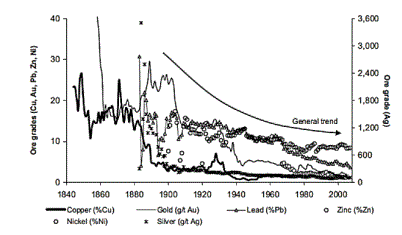
The general trend of mineral near suface reserves is to be gradually depleted and to be of a reduced the grade quality, likewise, the remaining deposits' trend is to be of a lower grade, to ocurrs in more remote locations, deeper in the ground and mixed with more impurities.
In a logn term period, there is a declining in average ore grades, as copper, gold, lead, zinc, uranium, nickel and sil ver (Fig. 1).
Source: Ficher Brian S. et al, 2012.
Figure 1.- Trends in average ore grades (Australia)
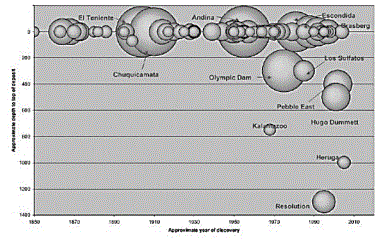
A historical study about the location of important mineral deposits in the world shows that the most important discoveries in the 1850s and 1980s were small to medium depth (0-600 m), but since 1980 and the last 33 years, discoveries, have been in large depths (800 to 1300 m) such as carbon, gold, uranium and copper (Fig.2).
Source: McGagh, 2010.
Figure 2.- Copper discoveries showing depth of deposits with greater than 4 Mt contained copper
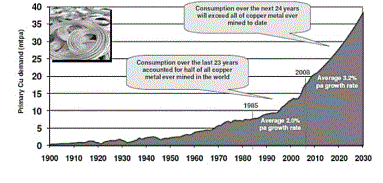
In parallel of the world population increase, the metal demand, for example copper, is projected to rise substantially with increasing industrialisation and urbanisation, from around 20 million tonnes perannum (mtpa) today to approaching double that figure in 2030 (Fig. 3).
The trends presented earlier illustrate that in the future humanity will increasingly need the minerals to their economic and social developments, and mining industry has been showing a gradual ore grade reduction in the surface deposits, and discovering reserves increasingly located in large deeps.
Source: Ficher Brian S. et al, 2012.
Figure 3.- World copper demand
This situation suggests that in the future, the mining industry is including the exploitation of ever deeper deposits and, in consequence, there is a need to apply the mining techniques with zero evironmental impacts and zero accidents, which means sustainable mining.
In this context the new concept of the underground environment may be extremely important to contribute forthe sustainable future deep mines. Therefore, it allows an efficient and effective control of the environmental impacts caused in the four environmental components: soil/rock, groundwater and surface water, underground atmosphere and humans, the latter being the most important biological component.
2 | OBjective
The overall goal is to characterize the future underground mining and approach the important contributions of the new concept of the underground environment for sustainable future deep mining. The specifics goals are to address:
The characteristics of future undergorund mining.
The difficult economical situation in deep mining.
The critical health and safety situations in future deep mining.
The need of susatainable future deep mining.
The new underground environmental concept.
The contributions of new undergorund environmental concepts for suatainable future deep mining.
The environmental sustainability index applied in future deep mining.
3 | The future deep mining and uderground environment
3.1 | The future deep mining
A future deep mining (1500 to 2000m) will be based in the following concepts:
high competitiveness through great actions in research, development and innovation, allowing a high comprehensive mechanization, automation, robotics and control systems in real time.
achieving zero accidents through the development of technology and promotion of innovations in organisation and safety culture.
contribute to sustainable mining, applying technologies of high efficiency and productivity, reducing energy consumption and CO2 emissions, and reducing the waste production by applying highly selective mining methods and pre-concentration.
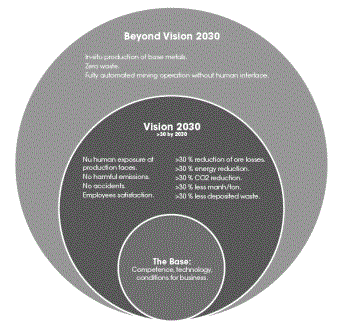
An example of the concept of the future deep mining is the vision from 2030 to > 2030 of the project Smart Mine of the Future (Fig. 4).
Source: MIFU Final Report, 2010.
Figure 4.- vision from 2030 to > 2030 of future deep mining
The future mining industry needs a new vision based on pioneering solutions and a modern structure that can exploit minerals at greater depths and promote both high productivity and safe working conditions. The future deep mining requiring requires highly
innovative and sustainable methods with low or zero underground environment impacts Dee p mining reduces dramatically the volume of surface transportation of ore and waste, minimising above ground installations and reducing the environmental impact.
The economical challenges in the future deep mining requires higly innovative solutions, low or zero impact of undeground environment and zero accidents (social issues), that means, applying, for example, the green maine concept (safety, eco-eficiency and sustanability) and lean mining mininum environmental impact (Fig. 5).
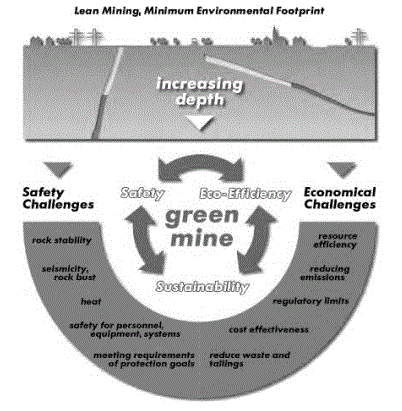
Sorce: I2Mine, 2013
Figure 5.- Sustanable future deep mining
New eco-efficient tecnologies concepts will be applied in all mining operations satges, as selective mining, minimum waste production, mininum water and energy consumption, minimum dust, ratiations and gases emissions, minimum groundwater contamination, eficient groundcontrol, etc. The health and safety aspects are critical. Dangerous situations include massive failures of pillars, seismicity, rock bursts, extreme temperatures, hazards by gases, dusts, chemicals and noise in the work environment.
The dangerous situation in undergorund mining can be illustrated with the mining fatality rate in the United States of America, Queensland-Australia and Chile during the decade from 1998 to 2007 (Fig. 6).
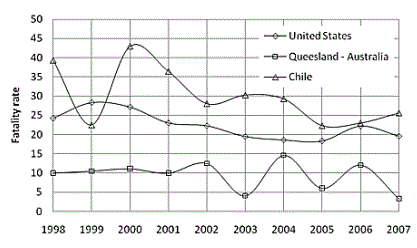
Source: Author
Figure 6.- Mining fatality rate compared between the
United States of America, Queensland-Australia and Chile.
Fure deep mining will only be achieved without the direct participation of humans in the operational area, and this condition will be based on full automation, semi-automation and remote control for all mining equipments.
Additionally, sustainable deep mining includes the concept of invisible mining, low or zero accidents and zero environmental impacts, similarly, it requires selective mining methods for reducing waste production, as the proposed Transformational Remote Ore Extraction System ROESTM (Fig. 7).
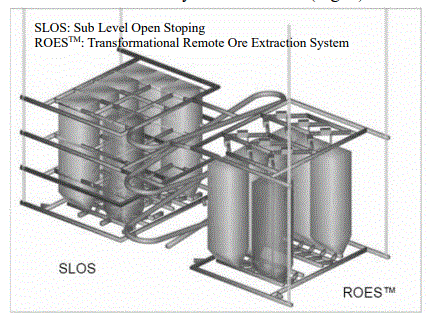
Source: Rowan G., 2007
Figure 7.- Transformational Remote Ore Extraction System ROESTM
These developments include rock mechanics and ground control solutions, incorporating health, safety and environmental issues.
The benefits of Transformational Remote Ore Extraction System ROESTM compared to Sub Level Open Stoping are:
Less than 50% the horizontal tunneling
Lower ventilation & services requirements for the same production
10% to 20% typical reduced mining costs
Remote drill and blast - Conveniently integrated with automated LHDs, trucks, etc.
Mine operation without concerns such as large excavations, mobile equipment, heat, dust & fumes
Reduction in 25% to 50% of the fatalities and serious injuries
The main features of the future deep mining are: (1), one control room; (2), no human presence in the production areas; (3), continuous mechanical excavation; (4), pre-concentration. (5), resource characterization - mineralogy; (6), resource characterization - structural control; and (7), final product (Fig. 8).
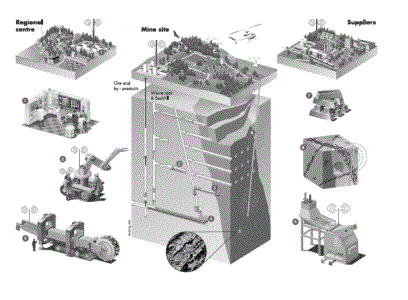
Source: MIFU Final Report, 2010.
Figure 8.- Features of future deep mining
1. The control room receives online processed information from the rocks, from the personnel and from the machinery and equipment (sensors, cameras and inage techniques) that make it possible to control and perfect complete operations from resource characterization to the final product.
2. No human presence in the production areas. All work processes and rock characterizations are remote or automated. Special robots will be developed for safe rescue operations.
3. Continuous flow is a key issue for lean mining and further automation. The future mine is a continuous process, which means that continuous mechanical operation is also used in hard rock types.
4. Waste rock is separated in the underground areato minimize energy for haulage and transport, as well as to reduce environmental impact on the surface.
5. Mineral characterization systems are in situ for product control (geometallurgy) and maximization of the inherent values.
6. Rock mass control in situ systems are used for geomechanical charactierization and also for stress and strain behavior control.
7. The final result with low rock waste components is possible due to the process of pre-concentration made in the underground environment.
3.2 | Underground environment concept
The accepted definition of the environment by the Stockholm Conference in 1972 is that the environment is a set of physical, chemical, biological and social factors likely to cause a direct or indirect, immediate or long-term consequences on living beings and human activities.
Kielly, G. (1999), questions what is the environment and indicates that the natural environment is composed of non-biological components (air, water, earth) and biological components (plants, animals, dead organisms). Continues by stating that the human is not only dependent on the living means but he depends on all the earth, and, in the same manner, depends on the conservation of the natural environment, the interaction between living organisms (including humans) and physic-chemical planet components. The physic-chemical (inert) and biological (living) are environmental factors that can be modified by human activities.
Conesa, F. V., 1997, defines environmental impact when an action or activity produces a change in some environmental component or subcomponent. This action can be included in an engineering project, a program, a plan, a law or any administrative action with environmental implications. When an environmental impact is negative it produces an environmental degradation that could be affect the human life, so it is necessary to apply preventive or corrective actions.
Similarly, the underground environment is a medium with non-biological environmental components (air, water and rock) and biological components (viruses, bacteria, including the human himself) (Fig. 9).
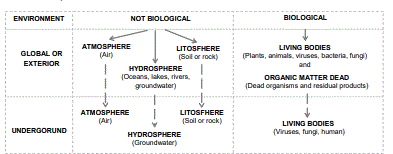
Source: Navarro Torres V.F et al, 2012.
Figure 9.- Comparative exterior or global and underground environmental components
The underground atmosphere is composed by the air from the global environment, taken through natural or artificial ways. The hydrosphere is represented by groundwater and the lithosphere by rock in underground openings and by soil and/or rock near surface.
The biological component consists mainly of humans, but also of viruses, bacteria and fungi that may result from the decomposition timber used in a support system.
Therefore, the underground environment is part of the global or exterior environment, not being an isolated or independent ecosystem (Fig. 10).
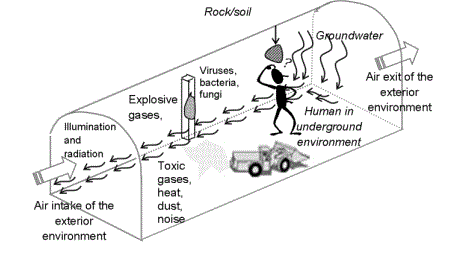
Source: Navarro Torres V.F et al, 2012.
Figure 10.- Underground environment as part of the global environment
In similarity to the environment settings reviews, underground environment can be conceptualized as the underground space where takes place the interaction of the four environmental domains, which are: underground atmosphere, groundwater, rock and biological components (mainly human). In the underground environment, human is the most important biological component and its action causes negative environmental effects (direct or indirect), in like manner, humans are responsible for immediate, medium and long-term impacts in the underground environment and outer consequences, as the subsidence, wastes, acid water, etc. Similarly to what happens in the global or exterior environment, when human actions (underground mining) changes the natural conditions, it causes environmental impacts that can have severe negative consequences for human life (Fig. 11).
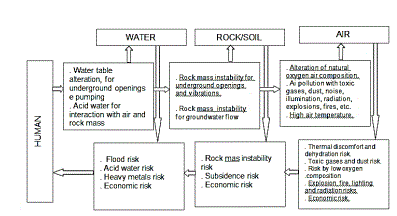
Source: Navarro Torres V.F et al, 2012.
Figure 11.- Physico-chemical environmental components and human interactions in undeground environment
3.2 | Underground environment concept utility in future mining
The new underground enivronmental concept is very important in the integral evaluation of possible environmental impacts of the four underground environment components.
It contributes to the characterization of the environmental impact situation based on national and international standards, and, on the other hand, identifies the environmental parameter or parameters that have higher impact, leading to seek appropriate preventive or corrective actions for optimal underground environmental protection. Since the future deep mining presents health and safety critical situations, this new approach can contribute decisively to achieve zero accidents through integral environmental impact and identify the parameter which has higher impact. One important contribution of underground environmental concept, in sustainable future deep mining, based in the quatitative model called Envrionmental Sustainabiliy Index. The main purpose of future deep mining is to obtain a sustainable production. This process should be aimed to achieve an adequate balance between financial, environmental and social factors. As a scientific contribution to an effective sustainable environmental management of future deep mining, an innovative numerical model has been developed (expressed in terms of an Environmental Sustainability Index (ESI)) to quantify the environmental sustainability situation. In a given time and space this parameter allows the definition of an environmental sustainability standard or a minimum permissible level of sustainability for future projects. This approach is based on four environmental indicators: (i) atmosphere quality, (ii) rock and soil subsidence, (iii) groundwater quality, and (iv) surface water quality. The main purpose of this index will be the establishment of acceptability criteria for new deep mining projects, as well as optimisation of studies for existing installations.
The developed ESI quantitative model is a function of four component indexes: Subsidence or Geotechnical Sustainability Index (SSI), Groundwater Sustainability Index (GWSI), Surface Water Sustainability Index (SWSI) and Atmosphere Sustainability Index (ASI). The calculation of these indexes considers the condition of sustainability of each pollutant based on threshold limit values, given by the existing standards.
The basic equation used for the calculation of the Environmental Sustainability Index (ESI) of deep mining is:
ESI = 0,25 (SSI + GWSI + SWSI + ASI)
The graphic representation of the results is given by Figure 12.
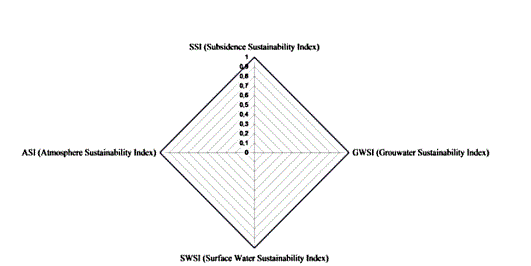
Source: Sheng Y., Navarro Torres V.F et al, 2013.
Figure 12.- Structure of Environmental Sustainability index of future deep mining
For the purpose of calculating the sustainability index (SI) of each component (SSI, GWSI, SWSI and ASI), the mathematical model uses the condition of sustainability of each element (X and/or X') based on the standard of sustainability or life quality given for the norms. Three sustainability criteria are taken for the state of the local environmental conditions (Fig. 13).

Source: Sheng Y., Navarro Torres V.F et al, 2013.
Figure 13.- Sustainability criterion
Sustainability criterion: X'< xi< X are admissible values, xi >X and xi=X1 are unsustainable values and xi < X' and xi = X1' are unsustainable values. Permissible minimum level of the ESI for future deep mining is proposed (Table 1). As the quality of the four environmental indicators (subsidence, groundwater, surface water and atmosphere) vary with time, the ESI for future deep minin will vary too.
Table 1.- Proposals of ESI UCG for sustainability conditions
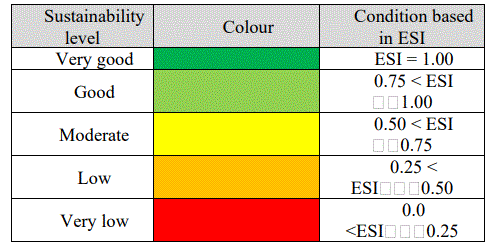
Source: Sheng Y., Navarro Torres V.F et al, 2013.
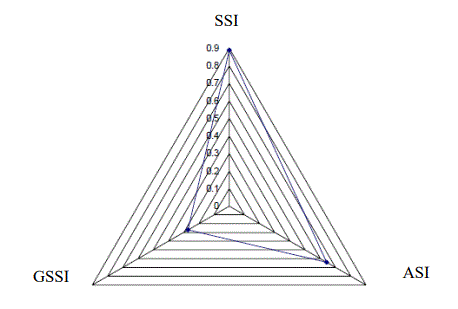
The developed ESI model was applied to Portuguese Panasqueira mine. Real mine data was incorporated in the environmental model, thus improving and enriching the already created basic ESI model. The three environmental indicators (Geotechnical Sustainability Index (GSI), Groundwater Sustainability Index (GWSI) and Atmosphere Sustainability Index (ASI)) were calculated for the specific case of studyconsidering the condition of sustainability of each pollutant based on the threshold limit values determined by the existing standards. Permissible minimum level of the Panasqueira mine was al so determined. The Geotechnical Sustainablity Index result 0.98 (Moderate), the Groundwater Sustainability Index result 0.27 (Very low), the Underground Atmosphere Sustainability Index result 0.54 (Low) and the (Fig. 14).
Source: Navarro Torres V.F et al, 2006.
Figure 14.- Environmental Sustainability Index in Panasqueira mine
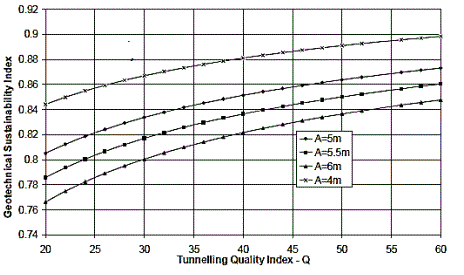
Simulations for inferior and superior values to the rock quality (Q) and the room size practised in the room and pillar stope of level 3, indicate that bigger sustainability corresponds to the best quality of the rock mass and lesser width of the room (Fig. 15).
Source: Navarro Torres V.F et al, 2006.
Figure 16.- Geotechnical Environmental Sustainability Index in Panasqueira mine
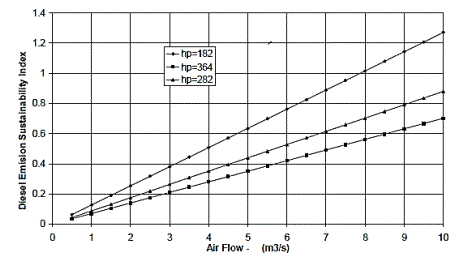
Other application of this Index is to the diesel emissions and the gas pollutions, simulated based on measured values results that show that there is bigger suatainability when there is bigger air flow and smaller power diesel equipment (LHD) (Fig. 17).
Source: Navarro Torres V.F et al, 2006.
Figure 17.- Diesel Emission Environmental Sustainability Index in Panasqueira mine
Bibliographic references
FICHER BRIAN S., SCHNITTGER S. Autonomous and Remote Operation Technologies in the Mining Industry. BAE Research Report 12.1, p. 56, 2012. [ Links ]
MCGAGH, J. Rio Tinto and step-change innovation drivers and progress', ASEG Conference, 22-26August, 2010. [ Links ]
ROWAN G. Advanced Mining Technologies. SCIRO Exploration & Mining. Qld Mining Industry Safety and Health Conference. Townsville, 2007. [ Links ]
KIELY, G. "Ingeniería ambiental - Fundamentos, entornos, tecnología y sistemas de gestión", McGraw - Hill, Madrid, Espanha, 1999. [ Links ]
CONESA FERNÁNDEZ, V. Guia metodológica para la evaluación del impacto ambiental, 3a Edição, Ediciones Mundi Prensa. Madrid, Espanha, 1997.
NAVARRO TORRES V. F. and DINIS DA GAMA C. Ingeniería Ambienta Subterránea y Aplicaciones. Roberto Villas Bôas Editor, Fundacion EMPREMIN Córdoba Argentina, 2012. [ Links ]
SHENG Y., NAVARRO TORRES V.F, et al, 2013. Interdisciplinary Studies on the Technical and Economic Feasibility of Deep Underground Coal Gasification with CO2Storage in Bulgaria. Scientifica paper in Press, 2013. [ Links ]
NAVARRO TORRES V. F. and DINIS DA GAMA C. Quantifying the Environmental Sustainability in Underground Mining. XV International Symposium on Mine Planning & Equipment Selection (MPES 2006), 20 - 22 September 2006, Torino - Italy, 2006 [ Links ]
Artículo recibido en: 22.10.2024
Artículo aceptado: 15.11.2024
Manejado por Elvys Trujillo L.

