




 Inglés (pdf)
 Articulo en XML
 Referencias del artículo
 Traducción automática
 Enviar articulo por email
 Citado por SciELO
  Similares en
SciELO
Similares en
SciELO 
 Permalink
1. Introdution
During the colonial centuries, what “we” would get to know as Bolivia and Potosí, specifically the later, operated as geopolitical and economic engine whose extractive circuits produced specific social stratifications and visual economies. This paper investigates how graphic signs, produced during counter-reformation institution, function as colonial pictorial production to express and reproduce this rhetoric that stood as an opposing ground against the Lutherans. These discourses highlight certain dynamics, materials, ideas, features, characteristics that work as signs that marginalize what in much broader, more complex senses, can also be applied to identities in Bolivia. The motivation is twofold: reclaim historical visual material as resources for critical design and develop an analytic method that exposes the coloniality of signification without erasing the het- erogeneity that persists in visual artifacts.
The study intersects visual semiotics and decolonial studies, integrating Umberto Eco’s ideas about the openness of texts, interpretation [1], [2], [3] Barthes’ denotative-connotative/ mythic framework [4] and Peirce’s triadic sign classification [9], while deploying decolonial critique [5], [6] and regional conceptual contributions from Rivera Cusicanqui’s ch’ixi and Zavaleta’s abigarramiento [10], to avoid Eurocentric flattening of hybridity and rethink mestizaje concepts.
2. Theoretical Framework
2.1. Semiotics and interpretation
The analytical core of this investigation is rooted in the establishment of a robust semiological framework, drawing principally from the canonical works of Peirce, Barthes and Eco. This theoretical triad provides the necessary tools to classify, interpret and critically examine the graphic signs within colonial paintings.
Peirce’s triadic model of the sign, which posits that a sign is something that stands for something else to someone in some capacity [9]. Operationalized through typology distinguishing between the icon, the index and the symbol. This taxonomy provides fundamental classification for visual elements, from depicted figures to ornamental.
Barthes’ semiological system, extends semiotic inquiry into the ideological sphere through two orders of signification. Denotation and connotation enable tracing how literal representations acquire cultural and political meanings [4]. His concept of “myth” proves pivotal by framing a second-order semiological system that naturalize historically constructed values. In the context of colonial art, recurring symbols like gold representing divine favor, or European features or emblematic gestures exemplify myths that reinforce hegemonic narratives. Barthes' process of demystification, provides a critical tool for exposing the ideological underpinnings of these naturalized signs. Absolutely Eco [1] complements these perspectives by emphasizing interpretative processes. His notion of the “open work” highlights polysemy and the active participation of the interpreter facilitated by what he calls the “encyclopedic competence”, the culturally acquired network of knowledge through which viewers construct meaning. Eco’s trichotomy of intentions, intentio auctoris, intentio operis and the intentio lectoris enable acknowledging the probable evangelizing colonial intent while simultaneously prioritizing contemporary decolonial perspective.
Additionally, Eco's distinction between semantic interpretation and critical (or semiotic) interpretation guides the research’s analytical methodology, aiming not only to generate new meanings, but to systematically explain how graphic and compositional structures facilitated hegemonic readings and to propose their reconfiguration from a decolonial perspective.
2.2. Decoloniality and decolonialism
The application of European technique in the production of art represents only a small part of an immense ideological heritage that continues to manifest in the reality of colonized minds. The decolonization of knowledge and being constitutes a critical and transformative process that involves the deconstruction of power structures, knowledge systems, and subjectivities imposed by colonial modernity [7], Mignolo’s, concept of epistemic disobedience encapsulates the methodological stance of this study: liberating knowledge that has been historically delegitimized by Eurocentric hegemony and Western modern rationality [8].
Yet this approach of Mignolo’s decoloniality is itself subject to Silvia Rivera’s critique [5,6], who argues that decolonization is a broader and more complex endeavor. Rivera focuses on the everyday practices within colonized realities, offering specific critiques aimed to identifying and decolonizing culture and politics by stripping forms of contemporary colonialism and combating their persistence in social, political, and mental structures. Rivera explains the sociology of the image as a phenomenon capable of endowing images with meanings that transcend their status as mere objects, charging them with a symbolic value that goes beyond mere visual denotation.
Rivera’s critique of “mestizaje” as an ideological construct that reinforces a specific ideology through linguistic usage that erases indigenous memory and enforces superficial homogenization. [5]. Her epistemological approach follows Aymara aphorism “qhip nayr uñtasis sarnaqapxañani” (“walking into the future while looking back at the past”), which means to seeing the past not as lost but as a moment to remember and learn from, she proposes this hermeneutic practice attentive to submerged historical and resistant to assimilationist narratives. This perspective informs the decolonial analytic stance adopt- ed here, which aims to expose the colonial reading protocols still embedded in visual communication.
2.3. Bolivia, Ch’ixi and Abigarrado
Understanding the heterogeneity of Bolivian society is essential for interpreting colonial visual production. Bolivian society is not homogeneous in any aspect, its history is characterized by the coexistence of multiple temporalities, cultural matrices and political orders. This complexity challenges reductionist narratives, such as defining Bolivian culture as a hybrid of two cultures, or as a syncretism, or fusion.
Rivera Cusicanqui’s [5] concept of ch’ixi offers an alternative interpretative model. Rather than fusion, ch’ixi refers to coexistence of the conglomerate of antagonistic elements that share the same space without fully blending. Like the “mottled grey,” visual effect from which the term originates, colonial artworks often represent visual examples of the illusion of elements unifying when viewed generally on the bases of what they are, and what they aren’t; this framework allows for a holistic analysis of the elements constituting a text, or in the case of this research, images such as colonial artworks and their European artistic conventions and pre-colonial sign systems coexist in tension, resisting assimilation into a single aesthetic logic.
Flowing from the same intellectual current and as a precursor to the concept coined by Rivera, René Zavaleta [6] Mercado, in the 1960s, used the concept of “abigarramiento” (motley or variegated society) to describe the particular nature of Bolivian society. This is concept borrowed from geology alludes to the heterogeneous mixture where incompatible social structures coexist. Like in the case of indigenous community life, colonial seigniorialism, and modern capitalism conflictively coexist.
Consequently, there is no unitary cultural identity, but a historical construction marked by heterogeneity: “in Bolivia there is no other homogeneity than that imposed by history, that is, by men in conscious and accumulated acts” [6]. Rivera’s ch’ixi thus formed from the inherent chaos of this heterogeneity, all those situations that have not been absorbed by the concept of “mestizo.” For ch’ixi, the emancipation of these much so different and chaotic signs that conform society and culture are, characteristic of Bolivian abigarrada culture. Rivera’s and Zavaleta’s contributions together enable a reading of colonial art that recognizes its internal conflicts rather than its supposed coherence, and they provide the conceptual grounding for analyzing how these contradictions persist in contemporary cultural and communicative practices.
2.4. Art and its Link to Design
The discussion begins by positioning art not merely as a technical skill but as a complex intellectual and communicative practice. Drawing on Pazos-López [11], who synthesizes perspectives from Schuster and Beisl, this study understands art as a medium that articulates emotional, intellectual, and symbolic dimensions in society, shaping social perception and collective memory. This understanding is crucial for analyzing colonial art of the Viceroyalty of Peru, whose meanings depend on both their formal structure and on the culturally embedded interpretative frameworks of the viewers.
The final component of this framework bridges art and graphic design. Following Costa [12], design is understood as a communicative practice nourished by culturally significant visual elements, such as hierarchical arrangements or symbolic color systems, to build messages coherent with the cultural identity of their context. Thus, mestizo baroque motifs, for instance, may be reinterpreted as modular elements for visual identities, while liturgical color palettes can transmit specific sensations in present day communication.
However, as Bonsiepe argues [13], the reuse of visual heritage in Latin America design must avoid superficial appropriation and instead foster projects grounded in local visual memory. From a decolonial perspective, this requires critically reinterpreting colonial signs rather than reproducing their original narratives. Through this approach, graphic design becomes a mediator between past and present, using historical visual repertoires as resources for culturally situated communication.
3. Methodology
3.1. Investigation
The investigation is characterized by a qualitative approach, focused on the collection and analysis of non-numerical data, which enables an in depth understanding of the complex relationships between graphic design, visual communication, and colonial cultural production. Given the limited prior research on semiotic and decolonial readings of Andean viceregal painting, the study assumes an exploratory scoped aimed at establishing conceptual and methodological foundations for future investigations.
The research design is non-experimental, as it analyzes pre-existing material without manipulating variables, and it is also transversal, since analysis is conducted at a single point in time on a defined corpus of colonial artworks. The methodological approach is based on the natural and historical context of the works, combining visual analysis with social, communicational, and historic art perspectives.
The core strategy is based on theoretical triangulation, under- stood as the complementary application of distinct but related analytical lenses. This triangulation integrates diverse multidisciplinary perspectives, as semiotic, interpretive, and decolonial frameworks, each contributing a specific dimension to the reading of the selected artworks. Together these perspectives allow for a multidimensional interpretation of visual meaning, preventing the analysis from being constrained by a single categorical system.
3.2. Data collection techniques and analytical strategy
Data collection was conducted using two different standardized technical datasheets for each artwork. The first of these instruments records essential information including the official title of the work, artist or attribution, creation date or period, technique and support, dimensions, current location, and the provenance of the image itself, citing the specific URL, repository, or bibliographic reference. This standardized documentation ensures consistent and verifiable data collection across the corpus of study.
The second datasheet consists upon a tri-axial analytical strategy articulates a procedural framework founded on theoretical triangulation, understood as the complementary application of diverse conceptual frameworks to a single object of study from multidisciplinary perspectives. This methodological resource enriches the interpretation of signs present in the selected colonial works, preventing analytical dependence on a single categorical system and acknowledging that the construction of visual meaning is a multidimensional process that extends beyond graphic design alone. The procedure integrates three fundamental analytical axes applied in a defined sequence.
The first axis, the semiotic framework, is based on the sign typology of Peirce [2] and the levels of signification proposed by Barthes [4], this phase involves: segmenting the artwork into significant visual units; classifying each unit according to iconic, indexical, or symbolic properties; describing denotative con- tent; and identifying connotative associations and potential visual myths.
The second axis, the interpretive framework, draws upon Umberto Eco’s concepts of the open work and encyclopedic competence [1], [2], [3]. This axis incorporates cultural and historical context as an essential component of the reading process, the procedure entails: situating the work within its historical, authorial, and functional context; reconstructing the colonial encyclopedic competence relevant to the signs; contrasting this with an interpretation from a contemporary horizon; and analyzing the differences and continuities between both readings.
The third axis, the decolonial framework, leverages contributions from Walter Mignolo and Silvia Rivera Cusicanqui [5], [6], [7], [8]. This axis examines power structures embedded in the images. The procedure involves: identifying signs that re-inforce colonial hierarchies and narratives; recognizing local or hybrid motifs integrated into the composition; analyzing the visual tensions, the ch’ixi, between European and Andean elements; and interpreting the political and cultural function of these tensions.
For each of the six works, the procedure follows a pre-established sequence: formal registration via the technical datasheet; semiotic analysis using Peirce [9] and Barthes [4]; cultural interpretation using Eco [3]; decolonial reading using Mignolo [7] and Rivera Cusicanqui [5]; and a final integrative synthesis that weaves together the three levels, highlighting convergences, divergences, and contributions to the investigation’s over- arching objective.
3.3. Selection of key works and Analytical framework
The selection of specific artworks for semiotic and decolonial analysis is grounded in the necessity to examine a corpus that embodies the complex cultural interplay definitive of the Vice-royalty of Peru. The six chosen paintings span the 16th to the 18th centuries and originate from within the vast territory of the former viceroyalty, a region whose contemporary nations, particularly Bolivia and Peru, share deep cultural and social similarities despite divergent political histories. This geographical and temporal delimitation focuses the study on a period of intense artistic production and stylistic transformation, from the initial influence of European Mannerism to the development of a distinctive Mestizo Baroque [14,15].
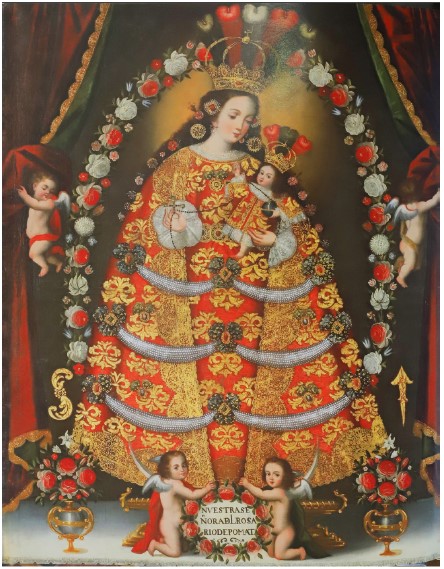
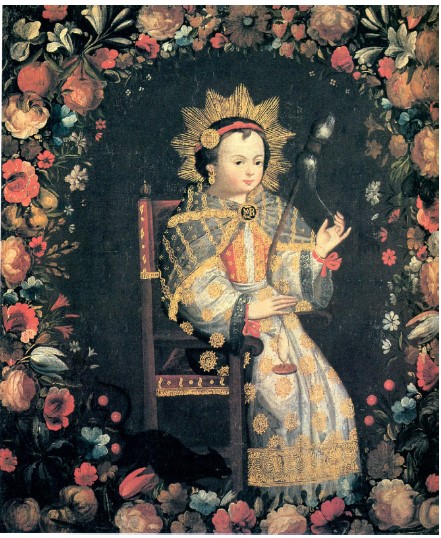
The selected works are La Virgen María niña hilando by Melchor Pérez de Holguín (17th century); Nuestra Señora de Pomata (Anonymous, 18th century); Bautismo de Cristo by Bernardo Bitti (16th century); Arcángel Asiel Timor Dei arcabucero (Anonymous, 17th century); San Gabriel Arcángel (Anonymous, 17th century); and Arcángel San Miguel by Diego de la Puente (17th century). Their selection is based on the- matic, stylistic, temporal, and territorial criteria. These paintings represent the development and reinterpretation of initial European styles, demonstrating how they evolved into a more regionally specific idiom. As religious and evangelizing works, they employed graphic signs such as virgins, angels, cherubs, and biblical scenes to communicate the new social order established through colonization.
Furthermore, these works were chosen not only for their application of European signs but also for the inclusion of elements foreign to European culture, whether through stylistic synthesis or the incorporation of Andean motifs. The semiotic study focuses on these applied elements, interpreting how they facilitated assimilation into colonial society and how they hold a place in the permanence of Bolivian culture today. The analytical framework for each work is executed through a structured procedure involving a technical data sheet, followed by a layered analysis.
Source: Image taken from Painting in Latin America 15501820 (p. 31), edited by L. E. Alcalá [18] and J. Brown [18], 2014, Yale University Press.
Figure 1: Virgen del Rosario de Pomata, Anónimo. Siglo XVIII
4. Analysis and results
4.1. Hegemonic rhetoric in colonial visual language
The most foundational discovery of this research is the systematic identification and detailed deconstruction of a coherent and repetitive hegemonic rhetoric woven into the very fabric of the Viceregal paintings. This is not a matter of isolated iconographic choices but a full-fledged use of power in grammar that operates through semiotic codes to naturalize the colonial order. The research employs the triadic model of Charles Sanders Peirce [9], categorizing signs as icons, indices, and symbols to dissect this grammar with precision, revealing its mechanisms across the selected corpus.
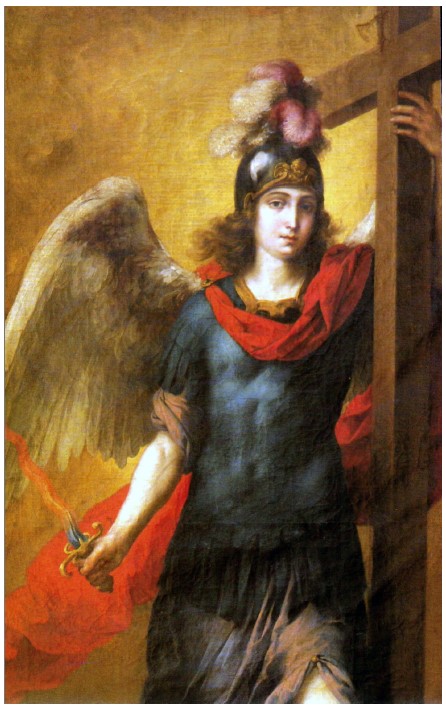
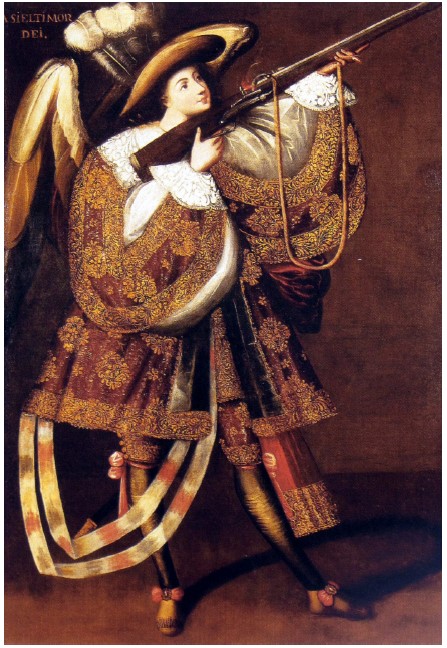
A paramount discovery is the operation of what can be termed as somatic sanctity. The investigation demonstrates that the representation of divine figures was consistently and uniformly racialized. In La Virgen del Rosario de Pomata, the Virgin and Child, along with the accompanying cherubs, all possess unequivocally Caucasian features and light skin. This is not merely an icon (a representation of a human form) but a powerful symbol. By convention, it establishes a code where holiness, purity, and divine favor are intrinsically linked to European somatic traits. This symbolic pattern is repeated with imposing authority in the paintings of the archangels. In San Miguel Arcángel by Diego de la Puente and the anonymous Asiel Timor Dei, the formidable celestial warriors defending the faith are depicted as European men. The analysis concludes that this was a deliberate ideological strategy. It created a visual hierarchy that alienated the indigenous and mestizo majority, implicitly teaching that to be close to God was to be, or to aspire to be, white. This functioned as a form of visual episteme erasing the possibility of indigenous or African features in the divine realm and reinforcing the social and racial pyramid of the colony.
Source: Image from ARCA: arte colonial, arcavl.uniandes. edu.co/artworks/20703
Figure 3: San Miguel Arcángel, Diego de la Puente. Between 1620 and 1660
Source: Image from ARCA: arte colonial, arcav1.uniandes.edu.co/artworks/651
Figure 4: Asiel Timor Dei (Arcángel arcabucero), Anónimo. Siglo XVII
Concurrently, the research uncovers a second, intertwined code of the aesthetics of Opulence. This code operates by creating a strong indexical and symbolic link between material wealth and divine power. The analysis of La Virgen del Rosario de Pomata is particularly revealing here. The Virgin’s entire figure is encased in a rigid, triangular mantle profusely decorated with gold. This gold is not just a color; it is an index that points directly to the mineral wealth of the Cerro Rico in Potosí. Furthermore, it functions as a symbol of divine majesty and favor. The myth (in the Barthesian sense) constructed here is that of a “divine and earthly wealth,” which naturalizes the idea that spiritual power manifests as and rewards material opulence. This symbolism sanctified the brutal economic engine of the colony. The immense silver and gold extracted through the forced labor of the mita system were visually re-codified in churches as the very substance of divinity, thereby masking the violence of extraction with a veil of celestial splendor.
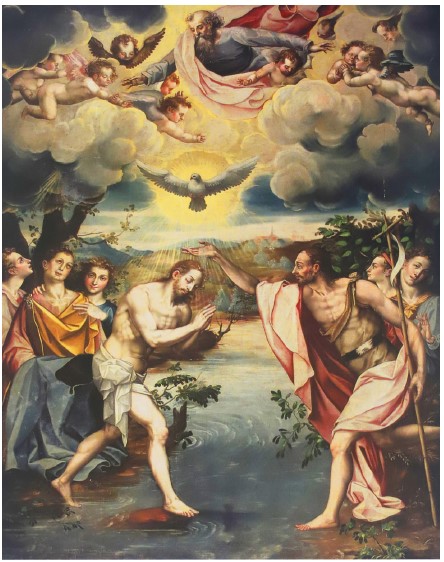
Source: Image taken from Painting in Latin America 15501820 (p. 31), edited by L. E. Alcalá [18] and J. Brown [18], 2014, Yale University Press.
Figure 5: Bautismo de Cristo, Bernardo Bitti. Between 1586 and 1592
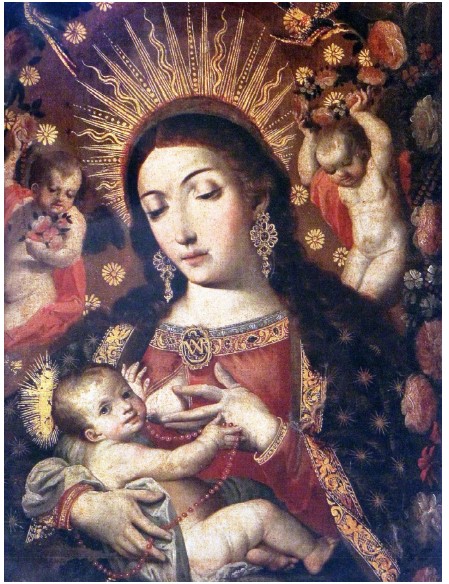
Source: Image from ARCA: arte colonial, arcav1.uniandes.edu.co/artworks/658
Figure 6: Virgen de la Leche, Melchor Pérez de Holguín. 1720
This rhetoric of opulence is also found in La Virgen María niña hilando by Pérez de Holguín, where the young girl, engaged in a humble task, is paradoxically clothed in luxurious, gold-trimmed garments. The analysis interprets this contrast as a reinforcement of a social myth: even in simplicity and labor, her inherent sacred status is marked by wealth. Similarly, in Virgen de la Leche by the same artist, the Virgin’s lavish attire and jewelry, contrasted with the nakedness of the Child, symbolize a power that is both spiritual and economic, offering protection rooted in unassailable privilege.
Finally, it is also identified a rhetoric of “militarized divinity” in the archangel paintings. Here, Peirce [8]’s categories reveal how divine power is framed as coercive and violent. In San Miguel Arcángel, the flaming sword is an index of divine justice and purgative violence. His armored posture is a symbol of the Church Militant. This is taken to its most explicit conclusion in Asiel Timor Dei, where the arcabuz (musket) becomes a complex symbol. It represents not only spiritual combat but also the very real technological superiority of the Europeans and the threat of violent enforcement of the new faith. The myth here is that of a faith that must be defended and imposed by force, a visual narrative that justified the violent suppression of indigenous religions and any resistance to colonial rule. Through this multilayered semiotic analysis, the investigation proves that these paintings were far more than religious art; they were active participants in constructing and maintaining a colonial worldview based on racial hierarchy, the sanctification of wealth extraction, and the threat of divine violence.
The application of this lens yields transformative readings. The most potent example is the analysis of the Arcángel arcabucero (archangel musketeer), Asiel Timor Dei. Under a mestizaje framework, this figure might be awkwardly classified as a hybrid. However, through the ch’ixi lens, it is revealed as a figure of profound and unresolved tension. The elements of a divine, celestial being belonging to a Christian cosmology and a steel firearm, the cutting-edge technology of European warfare and conquest, do not fuse. They coexist in a state of violent, jarring contrast. Not as a stylistic error, but as a stark visual representation of the colonial condition itself: a world where divine love and brutal force, salvation and threat, were inextricably and paradoxically linked. The painting becomes a ch’ixi artifact, its meaning residing precisely in the unblended coexistence of these contradictory realities.
This theoretical shift also reconfigures the understanding of works that appear more “European.” The investigation analyzes Bernardo Bitti’s Bautismo de Cristo, a painting of clear Mannerist lineage. A traditional reading might see it as purely European. However, the ch’ixi/abigarramiento perspective allows the research to pose a different question: What is absent or suppressed? The analysis focuses on the pragmatic effect of the artist’s stylistic choices, particularly the decision to depict all divine figures, God the Father, the Holy Spirit as a dove, and Jesus, all with European features. In the heart of the Andes, this consistent racial coding is itself a ch’ixi phenomenon: it is the forceful imposition of one cultural logic (the European) that exists in tense coexistence with the subjugated, invisible, yet persistent logic of the indigenous. The “purity” of Bitti’s style is thus revealed as an active act of exclusion, a violent simplification within a far more complex and abigarrado (motley) social field.
Furthermore, many of the paintings also show how much of a ch’ixi the entire system of pictorial production served as. Many of the selected works done during this period not only function to portray the values and point of view of the European culture and way of thinking. As mentioned before, from what is absent and missing we can also form interpretations as to how even gender roles were portrayed, whether it may be from any of the Virgin’s depictions or even by the fact that many artists remained anonymous, one can only infer why. Is important to note that through artistic production people would aspire to climb the social ladder, however, their anonymity goes to show that many artists weren’t considered worthy of recognition, may it be by themselves or by the standard of the society. This strong contrast can also be seen as to how even Bitti portrayed, in Bautismo de Cristo, the women surrounding and not taking the center stage of the same painting.
Furthermore, this framework illuminates the more subtle, perhaps even unconscious, forms of resistance and persistence in later works. In La Virgen del Rosario de Pomata, the rig- id, triangular mantle that encloses the Virgin is identified as a non-realistic, symbolic form. The ch’ixi perspective opens the door to interpreting this shape not just as a European symbol of majesty, but as a potential formal resonance with Andean Mountain deities (apus) or other geometric cosmologies. They may not have blended, but they coexisted in the same visual space, creating a layered object that could be read differently by different viewers within the abigarrada society. The ch’ixi lens thus allows the research to discover a visual field that is not binary (European vs. Indigenous) but a multidirectional space of unblended contrasts, forced impositions, subtle resistances, and unresolved dialogues. This reframing is crucial, as it provides a theoretical foundation for a Bolivian identity that is not a singular, fused entity, but a dynamic and pluralistic field of forces, which is the essential prerequisite for any truly decolonial project in art and design.
4.2. A Methodological Blueprint for Decolonial Resignification in Design
The ultimate and most transformative discovery of this investigation is not merely what it uncovers about the past, but the proactive, actionable methodology it provides for engaging with that past in the present. It moves beyond diagnostic critique to formulate a rigorous, tripartite methodological blueprint for the decolonial resignification of colonial visual heritage, positioning graphic design as a critical practice of cultural emancipation. This methodology, mirroring the analytical framework, is a structured process of analysis, critical interpretation, and active resignification of each qualitative element, each step leveraging the discoveries about the paintings to empower contemporary design praxis.
The first step, of analysis, requires the designer to adopt the role of a forensic semiotician. Here, the tools of Peirce [9] and Barthes [4], whose efficacy the study has proven, become a practical toolkit. The designer systematically dissects a source artwork, such as La Virgen del Rosario de Pomata, to isolate its hegemonic codes. They would categorize the gold adornments not just as decorative icons but as indices of Potosí’s mineral wealth and symbols of a divinity conflated with opulence. They would identify the Caucasian features of the figures as a recurring symbolic pattern of apparent sanctity. Similarly, in analyzing the Arcángel arcabucero, the designer would classify the musket not as a mere attribute but as a potent symbol of a militarized, coercive faith. This step is not about appreciation but reverse-engineering; it is the meticulous documentation of the colonial “source code” of power embedded within the visual form.
The second step, critical interpretation, guided by Umberto Eco [1]’s concepts, is where the designer activates their “encyclopedic competence” to challenge the historical intentio operis. This is the conscious practice of a decolonial gaze. The designer re-interprets the identified signs through a contemporary, critical lens, it’s important for this critical interpretation to be done with as much knowledge of the circumstances of the artistic and semiotic production of the time, by doing this the designer can deepen its encyclopedic competence in favor of different ways to portray a reality. The gold in La Virgen del Rosario de Pomata is no longer seen as divine radiance but is critically re-read as a record of extractive violence and exploited labor. The serene expression of La Virgen María niña hilando is questioned, and the painting is interpreted not as an ideal of pious childhood but as a normalization of gendered labor and the solitary imposition of social roles. The European features of the figures in Bitti’s Bautismo are understood not as a neutral aesthetic but as a tool of epistemic racialization that assigned divine authority to a specific ethnicity. This step liberates the designer from being a passive recipient of the artwork’s intended meaning, allowing them to generate a counter-narrative that exposes the coloniality within the beautiful façade.
The third and crucial step is the activee resignification. This is the creative and transformative stage where design praxis directly engages with decolonial theory, particularly the concept of ch’ixi. The designer moves from reading to rewriting, from critique to creation. This is not a rejection of the visual heritage but a strategic and conscious recycling of its formal components after they have been stripped of their hegemonic connotations. For example:
A designer could take the triangular compositional structure of the Virgins, identified in the analysis as a symbol of rigid, imposing majesty, and repurpose it. This powerful shape could be used to structure a collaborative portrait of a diverse, contemporary community, transforming a symbol of singular authority into one of collective unity.
The gold leaf, once a symbol of divine wealth extracted from the earth, could be reapplied to highlight ancestral knowledge, textual fragments from indigenous languages, or the patterns of traditional textiles. Its value is thus reassigned from material opulence to cultural wisdom.
The figure of the archangel could be resignified. Instead of a European male warrior, the designer could create a series of guardian figures embodying ch’ixi by combining the symbolic concept of protection with aesthetic elements from indigenous cultures, representing a defense of pluralistic identity rather than the imposition of a single creed.
This process transforms the colonial patrimony from a repository of oppressive symbols into an active, critical resource. The study thereby discovers that the path to a genuinely representative and emancipatory Bolivian visual identity does not lie in ignoring the colonial past or in slavishly importing foreign styles. Instead, it is found in this deliberate, knowledgeable, and creative act of decolonial recycling. It empowers the designer to become a cultural agent who can sift through the fragments of history and acknowledge those unblended threads of the ch’ixi and weave them into new visual statements that acknowledge a complex past while boldly articulating a more just, plural, and self-determined future.
5. Conclusion
This research demonstrates that colonial graphic in Viceregal paintings operated as deliberately constructed ideological devices that naturalized racial hierarchies through somatic sanctity, sacralized extractive economies rough aesthetics of opulence, and legitimized coercive evangelization through militarized divinity. By applying a structured semiotic-decolonial methodology, the study reveals that these images were not neutral devotional artifacts, but visual technologies designed to discipline perception and shape a colonial order that persists in cultural memory. The findings show that racialized representations of sanctity, gold as an index of extractive wealth, and weaponized angels as symbols of violent evangelization formed a coherent visual grammar of power that simultaneously concealed, normalized, and aestheticized domination. A major theoretical contribution of this study lies in the deployment of ch’ixi and abigarramiento as analytical frameworks. These Andean concepts make it possible to move beyond homogenizing categories such as mestizaje, which obscure the unresolved tensions and asymmetries inherent to colonial visual production. Instead, ch’ixi and abigarramiento illuminate how colonial images embody coexisting but unblended logics, such as European, Indigenous, Christian and Andean, revealing visual fields structures by contradiction, exclusion, and selective erasure. This approach reframes colonial paintings not as hybrids or syncretic outcomes but as cultural artifacts that expose the conflictive, layered nature of Andean coloniality.
The study’s primary methodological contribution is the articulation of a tripartite blueprint for decolonial resignification in design: (1) semiotic analysis, (2) critical interpretation, and (3) active resignification. This sequence equips designen with a rigorous operational framework that enables them to deconstruct colonial visual codes, critically reinterpret their historical functions, and reuse selected formal structures to create culturally situated and emancipatory contemporary visual narratives. Rather than reproducing hegemonic meanings or dismissing colonial imagery entirely, the methodology transforms historical visual heritage into a critical resource for epistemic disobedience and identity reconstruction. As such, the research positions graphic design as a field capable of participating in broader cultural and political processes of decolonialization. Limitations of this study should also be acknowledged. First, the corpus, while representative, remains limited to a selection of paintings; expanding the range of artworks could further validate and nuance findings. Second, the analysis relies on available reproductions, which sometimes restrict access to material details such as pigment, texture, or intervention history. Third, the interpretation is grounded in a specific decolonial framework that, although intentionally appropriate for the Andean context, could be enriched by dialogue with other Indigenous epistemologies or interdisciplinary perspectives such as anthropology of religion or political economy of art. Finally, as a qualitative and interpretative study, the findings reflect historically informed hermeneutics rather than exhaustive empirical generalization.
Despite these limitations, the study opens several promising avenues for future research. Further work may apply the semiotic-decolonial methodology to other Latin American visual traditions, such as muralism, popular religious iconography, or contemporary Indigenous graphic practices, to compare mechanisms of resistance, adaptation, and transformation across periods. Additional research could explore how decolonial resignification manifests in current Bolivian design projects, examining how designers operationalize ch’ixi and abirragamiento in branding, editorial design, or digital communication. Another research line involves investigating the pedagogical implications of integrating decolonial semiotics into design curricula, potentially shaping new generations of culturally grounded practitioners. Finally, interdisciplinary studies could assess how visual decolonization intersects with broader social, political, and epistemic transformation processes in plurinational contexts.
In summary, this research provides not only a critical re-reading of colonial visual culture but also a conceptual and methodological foundation for the decolonial transformation of contemporary design. By exposing the semiotic mechanisms of colonial power and proposing concrete frameworks for their resignification, the study contributes to ongoing debates on identity, visual communication, and cultural emancipation in Bolivia and the wider Latin American region.

