




 Inglés (pdf)
 Articulo en XML
 Referencias del artículo
 Traducción automática
 Enviar articulo por email
 Citado por SciELO
  Similares en
SciELO
Similares en
SciELO 
 Permalink
Introduction
Samaipata, located between the Amazon and the Andes, has long been a place of cultural encounter. The Incas named it 'Sabaypata': "We will stay there to rest", highlighting its historical significance as a welcoming and peaceful place. In the heart of Samaipata - la Plaza Principal - you find an engraved stone with the words: "Samaipata, 400 años integrando culturas (1618-2018)" (Samaipata 400 years integrating cultures).
According to the World Value Survey (2022), only 8% of the total population agrees with the statement that 'most people can be trusted', which shows low levels of generalized trust. In highly diverse societies like Bolivia, a plurinational state formed by multiple ethnicities, trust often remains restricted to close or familiar groups (such as family or one's own ethnic community), while trust toward outsiders or different groups tends to be weaker.
Samaipata has maintained an image of openness and diversity. As stated, Samaipata's magical atmosphere continues to attract people to visit and stay, particularly those driven by the "tranquil" lifestyle. However, when strolling around the streets, you also notice multiple for-sale signs, construction sites, and the "city" noise. Could migration and the shifting cultural landscape be interlinked? Is Samaipata becoming gentrified? Maybe the particularity of the town - seen in the imaginary of integrating cultures - could play an important role in adapting to the new reality of samaipateños. This leads us to the following problem statement:
How does the level of generalized trust mitigate the impacts of migration-related gentrification in Samaipata?
To complement our analysis, we will also investigate the following hypothesized links, based on our literature review:
The imagination of the place of encounter leads to more lifestyle migration, which is one of the drivers of rural gentrification in Samaipata.
Samaipata, being a place of encounter - as well as its level of ethnic diversity - leads to a higher level of generalized trust, which helps to cope with the effects of rural gentrification.
Theoretical Framework
Interpersonal Trust
Trust plays a key role in cooperation between individuals and groups by reducing uncertainty, reinforcing social norms, and facilitating the enforcement of sanctions against undesired behavior (Balliet & Van Lange, 2013). Additionally, studies by Akerlof (1970) and Greif (1993) highlight its positive impact on economic development by mitigating uncertainty and fostering collective action. However, Tabellini (2010) leaves open the question of how differences in trust emerge between regions. In the context of migration and gentrification, ethnic diversity is a crucial factor in understanding the development of trust in a community like Samaipata.
Determinants of Trust: Ethnic Diversity
Scholars debate the effect of ethnic diversity on trust, with some finding no impact and others suggesting diversity lowers trust (Painter & Flagg, 2020). Ethnic diversity refers to the coexistence of multiple ethnic or cultural groups differing in language, customs, or traditions (Putnam, 2000).
Allport's (1954) contact hypothesis argues that diversity fosters trust within societies by promoting tolerance and cooperation (Putnam, 2000). López (2017) found a positive correlation between immigration-driven diversity and generalized trust.
Its counterpart, the conflict hypothesis, suggests that diversity can reduce trust by fostering prejudice and hostility (Allport, 1954). Putnam (2007) emphasizes that trust develops culturally over time, with societies adapting to diversity in the long run (Painter & Flagg, 2020). The capacity to develop generalized trust is therefore based above all on long-term historical social composition and cultural experiences (Stolle, 2002).
Lifestyle Migration
Imagination plays a key role in migration, as people rarely move to completely unknown places (Salazar, 2014). The rural idyll- an idealized, peaceful rural life- motivates migration (Solana-Solana, 2010).
Lifestyle migration is driven by the pursuit of a desired way of life rather than career advancement. The motivation might also include affordable housing and an escape from the downsides of urban civilization (Benson, 2012; Salazar, 2014). However, despite seeking the rural idyll, lifestyle migrants may contribute to gentrification, gradually altering the very characteristics that attracted them (Nelson et. al. 2010).
Rural Gentrification
Gentrification refers to the replacement of the working class by the middle class in urban areas, leading to reinvestment, landscape change, and displacement (Guan & Cao, 2020). However, the conceptualization of gentrification needs to be localized to the specific place and community in which it's occurring.
The standard definition of gentrification, focused on economic inequalities, may overlook social, cultural, and historical factors (López-Morales et al., 2021). A more comprehensive definition of (rural) gentrification is presented by Solana-Solana (2010): "(...) gentrification is not only a displacement of social classes and persons, but also brings changes in leisure and retail activities, consumption patterns, and rising housing prices" (p. 508). In the Global South, gentrification also affects rural areas rich in natural resources and biodiversity (Salas, 2021).
Proposed Model
It chose an inductive approach, and therefore it has not based the research on an already set theory. Instead, it proposes the following model based on data and the literature review:
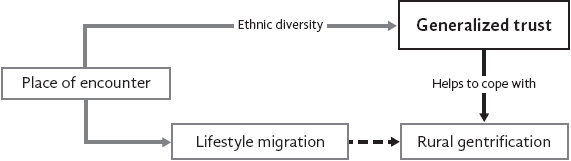
As portrayed in the literature review, we found that there are gaps in the research on rural gentrification in Latin America, the importance of generalized trust as a coping mechanism for rural gentrification, and the link between lifestyle migration and rural gentrification. Therefore, we propose a model with two hypothesized links:
The imaginary of the Place of Encounter leads to more lifestyle migration, which is one of the drivers of rural gentrification in Samaipata.
Samaipata, being a Place of Encounter - as well as its level of ethnic diversity - leads to a higher level of generalized trust, which helps to cope with the effects of rural gentrification.
The following section will define our central concepts presented in Figure 1.
Conceptualization
Our analysis begins with the concept of the Place of Encounter, describing Samaipata as historically shaped by migration, ethnic diversity, and the imaginary of integrating cultures and rural idyll. A part of Samaipata's imaginary is the rural idyll, an idealized view of rural areas as happier and tranquil (Solana-Solana, 2010).
Secondly, this imaginary drive is what we will call lifestyle migration. Migration is driven more by the desire for a fulfilling life in a peaceful rural town than by economic aspirations (Salazar, 2014).
Thirdly, it utilizes Solana-Solana's (2010) definition of rural gentrification, which, besides the displacement of social classes and persons, also includes changes in consumption patterns, leisure and retail activities, and especially housing prices.
Lastly, generalized trust increases the willingness to trust and cooperate with strangers (Stolle, 2002). This more extensive trust is linked to the shared moral values of a community and creates expectations of honest behavior from strangers (Fukuyama, 1995).
Methodology
In the following section, we will present our methodological approach, including our methods, which consist of both qualitative and quantitative methods. The data was collected within two weeks of field research in Samaipata, Bolivia.
Mixed Methods
For this report, we have used mixed methods and thereby combined quantitative and qualitative data to address our interdisciplinary research area. In our research, the quantitative part (survey and experiment) and qualitative part (interviews and observation) complement each other, creating a dialogue between the different types of data (Mertens, 2023). This plays into our inductive approach, where, based on a cyclical dialogue between our different observations, we propose a pattern that can create a functioning theory (Flick, 2018).
Ethnographic Fieldwork
As part of our qualitative methods, we have conducted ethnographic fieldwork to gain an understanding of the field site and the ongoing cultural and social processes in Samaipata. We engaged in this practice throughout the fieldwork, especially whenever we noticed a phenomenon related to gentrification, in the form of field notes and pictures. We also went on a trip to Mairana to observe the difference between the two towns.
Semi-Structured Interview
We conducted nine semi-structured interviews (Brinkmann, 2020) using a flexible guide with around 20 questions focused on experience, aspiration, and gentrification. The guide was adjusted before each interview. To capture diverse perspectives, we interviewed people of different nationalities, jobs, and experiences (Figure 2). Interviews lasted between 45 to 90 minutes, with at least two researchers present.
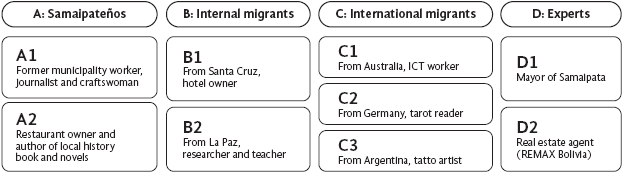
As the figure above shows, we have interviewed five migrants, both international and internal migrants, as well as two returnees, who were born in Samaipata. For this project, we have defined a migrant as someone who has been living in Samaipata for a minimum of three years.
For our sampling, we used the snowballing method, as one of our informants helped us reach other interview opportunities, who then gave us more contacts (Flick, 2018). Most of our interviews were conducted in Spanish and recorded. Later, they were transcribed and translated into English.
Survey
We investigated the gentrification process in Samaipata, focusing on housing prices (Nelson et. al, 2010). Lacking secondary data on price developments, we developed a survey where the respondents estimated the house prices 10 years ago, three years ago, today, and in 10 years. Additionally, we included a Likert-scale question about food prices as an indicator of general rising prices.
We conducted the survey one afternoon, gaining a total of 50 participants. Pairs of researchers collecting responses in both the center and periphery of Samaipata. Most questionnaires were filled out by researchers, though we had a QR code.
We used R to analyze housing prices. Considering the standard error, we reported the mean values using a bar plot, as presented in the analysis. We also had an interview with a real estate agent from REMAX Bolivia (Informant D2).
Experiment
To measure the level of generalized trust in Samaipata, we have conducted a conjoint survey experiment, which generates reliable measures of preferences and estimates causal effects of attributes on hypothetical choices (Bansak et al., 2021)1. We measured the level of trust using three scenarios that distinguish between attributes (their proximity of strangers to the community) of strangers who sell cars. Trying to combine the commonly used survey question: Can a person be trusted in general? (Chaudhuri & Gangadharan, 2007), With a regional representative cooperation decision, we came up with these questions:
Would you buy a used car from a stranger?
Would you buy a used car from a stranger who lives in Samaipata?
Would you buy a used car from a stranger who recently moved to Samaipata?
We asked 50 people that we randomly approached in Samaipata (experimental group) and Mairana (control group) two out of three questions in a random order and pair of scenarios to minimize possible biases (Cox, 2009). We used the citizens of Mairana as a control group, a neighboring town. As with the survey, it was a criterion that the participants had lived in Samaipata or Mairana for a minimum of three years. To measure the differences between the two groups, we ran a two-sample t-test in R.
Analysis and Coding
Based on our data, we created a coding table. This was based on Attride-Stirling's (2001) thematic network analysis with the notion of global and organizing themes. Based on this coding, we identified three broad categories: migration, gentrification, and trust.
Analysis
This section will analyze the development of imaginaries and lifestyle migration in Samaipata, explore the formation of its culture of generalized trust, provide an overview of economic and cultural gentrification in the area, and examine how it is interconnected with residents' strategies for coping with the economic and cultural impacts of gentrification.
Samaipata as a Place of Encounter
In Samaipata, the most prevalent imaginaries have been centered around "Integrating cultures for 400 years" and their diversity. According to C1, Samaipata has a large foreign population. Currently, Samaipata has more than 39 different nationalities (D1). The 2012 National Bolivian Census showed both towns had similar Quechua and Aymara populations, but Samaipata had a larger multilingual 170 residents speaking at least one foreign language, in stark contrast to just four individuals in Mairana (Instituto Nacional de Estadística, 2012).
Our interviewees placed the rural idyll around the ideas of "tranquility", "nature", and "climate" (A1, A2, B1, B2, C1, C2, C3). In addition to being a historical Place of Encounter, Samaipata has experienced an increase in both international and internal lifestyle migrants coming from different areas of Bolivia, mainly Santa Cruz (B1, B2, C2). This is shown in Figure 3, in which we map the different groups mentioned by our interviewees:
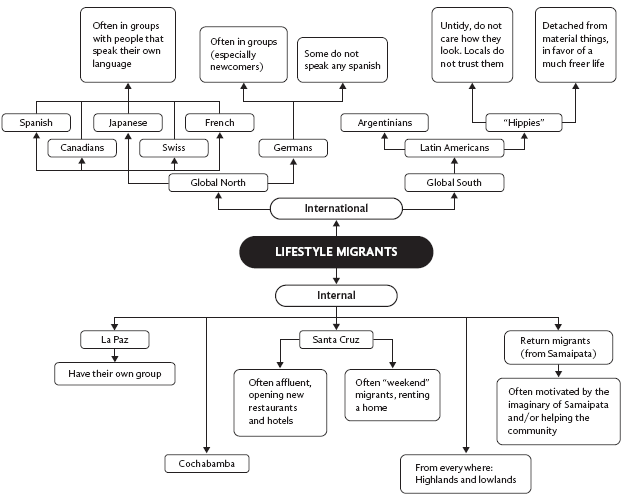
The migrants we encountered in Samaipata often possessed other characteristic traits of lifestyle migration, often possessed a higher level of economic and cultural capital, including knowledge of permaculture or education (A1, B2, C1, C3). For them, employment was not the main migration aspiration (A1, C1, C3).
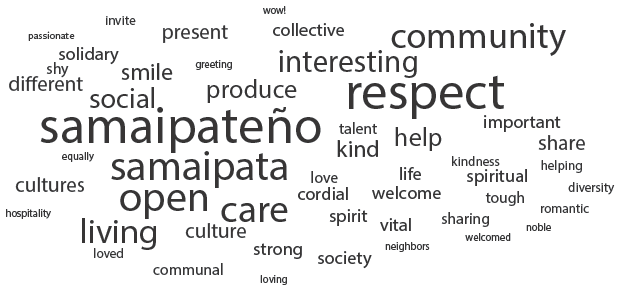
Thus, cultural diversity has become a distinct characteristic of Samaipata, as opposed to other Bolivian towns of similar size. Most of our interviewees view migration as something positive (A2, B1, B2, C1). The contact with people with different cultural backgrounds has been normalized. B2 points out that these different cultures are "the opposites [that] complement each other. [...] Like the yin andyang." In Samaipata, significant cultural integration and diversity are both a driver and a product of the imaginary, where local traditions can peacefully coexist with global influences (B2, C1). Some Interviewees expressed a lack of integration and different nationalities keeping to themselves (A1, C3). C3 states that to the local Samaipateño, she will always be an outsider and never completely accepted. Even so, the cultural diversity and integration become an important part of the Samaipateño imaginary, as seen below in the word cloud (Figure 4) (A1, B2, C1, C2, C3).
The migrants we encountered in Samaipata often possessed other characteristic traits of lifestyle migration, often possessed a higher level of economic and cultural capital, including knowledge of permaculture or education (A1, B2, C1, C3). For them, employment was not the main migration aspiration (A1, C1, C3).
Thus, cultural diversity has become a distinct characteristic of Samaipata, as opposed to other Bolivian towns of similar size. Most of our interviewees view migration as something positive (A2, B1, B2, C1). The contact with people with different cultural backgrounds has been normalized. B2 points out that these different cultures are "the opposites [that] complement each other. [...] Like the yin andyang." In Samaipata, significant cultural integration and diversity are both a driver and a product of the imaginary, where local traditions can peacefully coexist with global influences (B2, C1). Some Interviewees expressed a lack of integration and different nationalities keeping to themselves (A1, C3). C3 states that to the local Samaipateño, she will always be an outsider and never completely accepted. Even so, the cultural diversity and integration become an important part of the Samaipateño imaginary, as seen below in the word cloud (Figure 4) (A1, B2, C1, C2, C3).
Generalized trust in Samaipata
Table 1 Differences in the levels of generalized trust between residents of Samaipata and Mairana

According to the interviews, to become a Samaipateño, one must take active participation in the community, care for fellow residents, and do their part in strengthening the town's social support networks, but most importantly, love Samaipata (A1, B1). Many people visit Samaipata for tourism, but then they fall in love with the town and the energy and decide to stay. Our interviewees called this phenomenon "Samaitrampa" (C2, C3, D1, D2).
Our experiment found that Samaipata's citizens exhibited higher generalized trust compared to those in Mairana. Table 1 shows that Samaipateños were more likely to trust strangers, such as buying a car, than people in Mairana. The trust towards Samaipatan strangers approached statistical significance with a p-value of 0.067, indicating that Samaipateños are 46% more likely to trust a Samaipatan stranger than a person in Mairana.
Individuals from Samaipata show more trust in strangers, including migrants to their town, compared to those from Mairana or the national average, where only 8.5% of Bolivians trust strangers (Ortiz-Ospina & Roser, 2016). Samaipata's higher ethnic diversity supports the contact hypothesis (Allport, 1954). One interview says: "Samaipateños [...] have more trust for foreigners instead ofbeing unwelcoming" (B2). They are used to meeting strangers with different backgrounds, as they "have grown up with foreigners around" (C1).
Samaipateños' positive attitude towards migrants can also be linked to Putnam's (2007) distinction between short- and long-term effects of ethnic diversity on generalized trust. The Samaipatan community was able to translate the latest and significant influx of people into higher levels of generalized trust because of their long-existing migration history, and "up to now, [Samaipateños] have been able to coexist with everyone" (A2). Over time, Samaipateños have established social mechanisms and forms of solidarity that catalyze the positive effects of ethnic diversity on generalized trust.
The way Samaipateños developed generalized trust towards outgroup individuals - which Putnam (2000) refers to as "bridging" between groups - could be traced back to the overall benevolent and hospitable: the Place of Encounter. Samaipata is seen as a meeting place, where people embrace diversity while respecting and taking care of each other, even if they are strangers. C3 stated that strangers would be able to rely on the people from the town and expect kindness from them too, as "everyone is going to open some doors for you", and that a person in distress would be helped out. "You meet strangers who share and support each other like a family" (B1).
As stated, generalized trust arises when societies commonly agree upon a set of moral values. This can also be applied to Samaipata since most of the interviewees described a similar set of values that characterize the community and "what makes a Samaipateño". Samaipateños have community-based punishment mechanisms in place, which help regulate behavior and cooperation. As the Mayor put it: "Everyone is welcome to Samaipata. As long as there is that respect. And when there is no respect, we also make them respect us" (D1). He further comments that if someone arrives in Samaipata and causes harm, they will probably not become a part of the community. This shows how local social control operates: by sanctioning or excluding free riders, Samaipateños can trust that harmful behavior will not go unpunished. Such mechanisms reduce uncertainty in interactions and facilitate cooperation among residents and newcomers. A concrete example mentioned in the interviews refers to the so-called "Hippies," who were perceived as taking advantage of the town. As a result, they are not trusted and are excluded from economic activities, such as work opportunities (C3).
Rising prices and rural gentrification
Over the past years, there has been a noticeable transformation in housing prices and land use in Samaipata. This led to land repurposing, such as the opening of businesses (A1, B1, C1, C2). As a result, rural gentrification -for example, as reflected in increasing housing priceshas been largely driven by lifestyle migration. Locals are capitalizing on rising property values by selling land to newcomers.
As presented in Table 2, over the last 10 years, the average housing prices in Samaipata have doubled: from USD 44,040 to USD 98,228 for an average house near the town center. The average annual increase has been 20% indicating gentrification. This could indicate that during and after the pandemic, more people have been drawn to the rural idyll. We have not observed this displacement process in Samaipata among landowners. At the same time, many of our interviewees mentioned that gentrification has had a negative effect on both rent and food prices, which, coupled with the rising USD/Boliviano ratio, has had negative effects on the purchasing power of the local Samaipatan population (C1, C3, A1, A2).
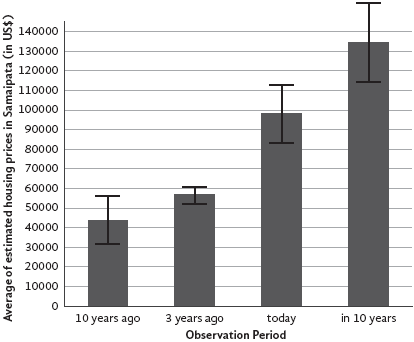
In Samaipata, "most ofthe benefactors are local Samaipatans selling their properties" (C1). The local real estate office reinforced the idea that locals have been strategically selling their properties at higher prices, stating that "it's the people from here who have taken advantage ofthesituation" (D2). The lifestyle migration influenced housing prices within the old town, as well as the price per square meter of land in the entire Samaipata area (C3, D2). The mayor offered a pragmatic view on property dynamics. He remarked that Samaipateños are more likely to sell property to foreigners as they do not question the prices they are offered (D1). A German migrant also stated that wealthy North Americans drive up property prices because they accept any price. Although this perspective reframes the locals' relocation as a matter of practicality rather than solely a negative consequence, Samaipateños described the rising prices as a recent phenomenon (A1, A2). "I think it is one ofthe most expensive towns in Bolivia. It is too expensive, [which] was not the case before" (A2).
In Samaipata, while gentrification is becoming the new normal, the influx of foreign currency and investments has caused housing prices, food, and rent to rise. 94% of survey respondents reported food price increases over the last decade, not only on national products, but there's been an influx of international products as well. Some sectors have seen economic benefits. Despite the economic development, many have struggled to keep up with rising living costs (C3). However, economic inequality has not worsened as expected, likely due to coping mechanisms like sharing food during periods of food scarcity or seeking free accommodation when unable to affordrent(B2, C3).
Shift in cultural landscape
Samaipata is undergoing a cultural shift. One example is the gastronomy and restaurant industry, which is adapting rapidly, such as increased demand for international and diverse food options (A2, C1). Samaipata's main square has become a hub for international leisure, offering "trendy" restaurants, bars, and jewelry stores. However, residents are rarely seen in such establi-shments, as they are specifically "made for gringos [foreigners]" (C3).
Mairana's town square serves as a community center, with local food stands and markets, while Samaipata has locals selling housing to migrants for tourism-related activities. The appeal of Samaipata became intrinsically tied to "thefact that [one] can get all the international comforts in a small town" (C1).
However, this transformation has affected local perceptions, as many feel Samaipara is losing its historical identity. Interviewees were concerned about Samaipata a) losing its "magic" and local culture (A1, A2, B2), b) historic architecture (A1, A2, B2, C1), and c) "sleepy" small town atmosphere as locas flee the chaos of development (C1, D2). One interviewee noted that Samaipateños feel displaced by the influx of migrants (A1). They said: "Samaipata has really grown by leaps and bounds, and personally, that scares me. Not because people come, but because there are no regulations" (A1). International migrants who feel the lack of regulation leads to the destruction of historic architecture because "[you] build a house the way you want to build it" (C1). While global cultural elements have been introduced, they have also eroded Samaipata's traditional charm, creating a tension between progress and preservation.
Trust and cooperation in Samaipata
Regarding the economic effects of gentrification, such as rising rent and land pricing, we have observed the mitigation mechanisms in the form of "agreements of reciprocity" between landowners and residents. For instance: "A community has different ways of making things work, like helping each other or caringfor other people, like, 'you cannot pay rent, but I have a space, so you can take my house and live there'" (B2).
Based on trust that enables these agreements of reciprocity, people can acquire goods without paying for them with conventional currency. The local coin "Samai" is used by Samaipateños as an informal way to exchange goods and services (B2).
Another example of reciprocal cooperation is the sharing of food, both through gifts and having communal cells in the markets (B2). Simply said: "Everybody's working together, and we have individual work, but we also have the communal basket" (B2). Trust, therefore, becomes an essential aspect of Samaipata's economy (B2). In a community where financial resources may become scarce due to price increases, the residents need to rely on their social networks for support. This system of exchange illustrates the community's reliance on trust and cooperation, with its benefits extending to migrants as well.
The agreements of reciprocity -which are solely enabled by trusting a stranger- are just one example of potential beneficial outcomes of trust that we have witnessed in Samaipata. Other instances of coping with hardships through cooperation and general solidarity can be found on digital platforms such as Facebook. Several people described a WhatsApp group chat with approximately 100 women who support each other, migrant or not. It is described as a space of solidarity and support, where women are welcomed and encouraged to ask for help with whatever they are struggling with, and community sharing events ("Gratiferias") (B2, C2, D2). Thus, if you need help, you can rely on the community (B2, C2). Samaipateños also come together to help victims of flooding (B2) or to organize "mingas", where volunteers repair houses, institutions, or schools (B1). Supposedly, there is less misery and inequality in Samaipata; one will not see anyone asking for money in the street, for instance, because people take care of each other (B2). As a result, agreements of reciprocity, food exchange, and community solidarity groups enable Samaipateños to cope with the adverse impacts of rural gentrification, such as poverty and displacement, that are common in other global regions affected by tourists.
Discussion
Our analysis show that Samaipata attracts people with its unique "magnetic" atmosphere, rooted in its history, imaginaries of a rural idyll and Place of Encounter (Salazar, 2010; Solana-Solana, 2010), and the availability of international and city comforts (Benson, 2012) These factors motivate lifestyle migration, which is closely linked to tourism and the business opportunities it creates. Samaipata has seen a growth in tourist offices, tours to cultural and natural heritage sites, hotels, and restaurants catering to tourists, mostly owned by international migrants. The expansion of the tourism sector has generated economic opportunities, especially for migrants from Santa Cruz, and has fueled the rural gentrification process in Samaipata (Nelson et al., 2010; López-Morales et al., 2021).
While Samaipata has not yet seen severe consequences of rural gentrification, such as widespread forced displacement, many residents are experiencing negative economic and cultural impacts. The rising costs of food and housing are accompanied by the erosion of traditional culture, influenced by Western trends (Solana-Solana, 2010; Salas, 2021). Long-time Samaipatans are selling their property at high prices and moving to the outskirts of Samaipata because it's cheaper. This shift commercializes town life, giving in to the needs of gentrifiers, making it more appealing to migrants (Nelson et al., 2010).
At the same time, for Samaipateños without land or who rely on agriculture, the impacts of gentrification could be more severe, increasing the risk of vulnerability and marginalization in the future (López-Morales et al., 2021). Those who have sold their properties might face future displacement as property values and living cost rises.
While the history and culture of migration to Samaipata have shaped the town's imaginaries as a rural idyll and Place of Encounter (Putnam, 2007), the ongoing influx of migrants has led to a high level of rural gentrification. This trend has the potential to push residents out of the town center, erode local culture, and transform the town into a place primarily designed for tourists and international migrants, especially since there is a lack of regulation that could preserve the town's identity (Guan & Cao, 2020). Arguably, this transformation can lead to a completely different imaginary, possibly even shattering the rural idyll of the town and challenging its historical culture of integration as Samaipateños might begin to reject the positive idea of migration. Thus, although Samaipateños have managed to navigate the economic impacts of migration-led gentrification so far, the question remains: ¿For how long can the positive imaginary and high level of generalized trust in Samaipata last? ¿Can the residents' coping mechanisms for gentrification be sustained over time if the process of migration continues at the same intensive rate?
Reflections and Limitations
This study faced limitations in terms of informants. As shown in Figure 2, most of our informants came from similar socio-economic backgrounds: people with 'available' time. When we tried to interview people in the periphery of Samaipata while conducting our quantitative data, most were busy working, limiting our understanding of the full impact of gentrification. Furthermore, by focusing on lifestyle migrants and not including those who migrate for work, we may have missed relevant groups such as indigenous people. As stated in the analysis, based on our data, we don't see any displacement. Even though we have been conscious of having a varied sampling of respondents for the survey, we might have missed some nuances, for example, those Samaipateños who rely heavily on agricultural production.
Related to the generalizability of our findings, we are aware that Samaipata marks a very odd place where a lot of dynamics -culturally, economically, and socially- seem to work differently than elsewhere. That is why we should be cautious about generalizing these findings, as we haven't been able to test our hypothesis of generalized trust as a coping mechanism for gentrification elsewhere.
Conclusion
So, ¿how does the level of generalized trust mitigate the impacts of migration-related gentrification in Samaipata? The town's high ethnic diversity results from migration based on imaginaries of a Place of Encounter. Rural gentrification in Samaipata, largely driven by lifestyle migrants, is causing massive shifts in the cultural and economic landscape due to emerging financial opportunities and the introduction of diverse cultural values and lifestyle preferences. However, despite the prevailing narrative suggesting that many Samaipateños are benefiting from this development, the gentrification process has already affected numerous residents, particularly in terms of the town's rising cost of living.
We observed several coping mechanisms that mitigate the adverse economic effects of gentrification, such as agreements of reciprocity founded on generalized trust. The higher level of trust offers clues on how Samaipateños might address more severe economic repercussions of gentrification in the future and help partially explain their ability to cope with the rising cost of living in the town. Meanwhile, the negative effects of the lifestyle migration to Samaipata are already noticeable with regard to the town's cultural identity. Despite the continued openness towards foreign influences, Samaipateños increasingly fear losing their cultural identity, and the rapid transformation of the town's community thus presents significant challenges, even for a place like Samaipata, which is accustomed to cultural integration processes.
At the same time, the bond between generalized trust and gentrification highlights a paradox. On one hand, trust allows cooperation and collective coping strategies that relieve economic pressures, strengthening community resilience. On the other hand, the very openness and welcoming attitudes that create generalized trust also facilitate the migration of outsiders into Samaipata and their cultural practices. This dual role of trust reveals both sides of the gentrification of social capital in contexts of rapid change: while it protects against material vulnerabilities, it also exposes the community to challenges in preserving cultural identity and continuity.

