




 Inglés (pdf)
 Articulo en XML
 Referencias del artículo
 Traducción automática
 Enviar articulo por email
 Citado por SciELO
  Similares en
SciELO
Similares en
SciELO  uBio
uBio 
 Permalink
INTRODUCTION
Bolivia is a non-metallic natural resources rich country1),(2),(3. In this regard, it is possible to highlight the occurrence of important deposits of clayey materials as well as, although less frequently, diatomites or diatomaceous sediments. Through research carried out at the Universidad Mayor de San Andrés, in strategic alliance with Agencia Boliviana de Energía Nuclear (ABEN), are attempting to atribute added value through their transformation into other types of materials, for example, zeolites4),(5),(6.
Zeolites form a family of hydrated alumino-silicates with numerous species closely related in composition, formation conditions and mode of occurrence7. Due to their structural characteristics and physical-chemical properties, they are widely used in industry8),(9. They occur naturally on the planet, but thus far, industrial applications have not been reported. However, the industry uses artificially produced species, and a far development of synthetic zeolites is permanently growing. These zeolites possess different characteristics, and they’re preferably based on silico-aluminate gels under specific conditions of temperature, time and pH.
The authors have precedingly, successfully developed the synthesis of zeolites obtaining varieties of the cancrinita, analcima and other types, using non-metallic natural resources such as montmorillonite, clays, feldspathic rocks and other materials, opening a new field of development and potential applications of these non-metallic products that is currently in full process3),(4),(5),(6.
On the other hand, diatomite (diatomitic rock, diatomaceous sediment, or diatomaceous material) is a rock or sediment of marine or lacustrine origin made up of skeletons (frustules) of algae called diatoms that eventually contain other detrital components such as clays, sands or volcanic ash, depending on the environment of formation. In Bolivia very few natural deposits of this category are described, therefore those reported1),(2 are important, whose samples are the subject of investigation in the present work.
As diatomite is mainly made up of amorphous silica, this characteristic can be applied as a suitable material for the synthesis of zeolites that have a Si:Al ratio greater than 5, for example mordenite.
Among the many applications of zeolites, industry demands a large quantity of mordenite zeolites for use as fertilizer carriers in plant fertilizers, and in the petrochemical industry, for use as catalytic carriers, among others. Thus, the study of how to obtain them in the laboratory and their structure is a very interesting scientific field, but above all, one with significant application potential.
Mordenite zeolite can be of sodium, potassium, or calcium, depending on the cation content. Its general chemical composition is: (Na2,Ca,K2)Al2Si10O24•7H2O.
Traditionally, in the synthesis of mordenite zeolite a hydrothermal process is applied that uses silico-aluminate compounds obtained from p.a. reagents with a high Si/Al ratio, carrying out strict control of temperature, pH and time. However, given that there are antecedents of the synthesis of zeolites from non-metallic resources4),(5),(6 using a natural precursor, in the present case, of the diatomite type, opens a field of interest in the synthesis of zeolites with Si/Al ratios greater than 5.
In this work, the synthesis process of zeolite mordenite obtained from a Bolivian natural resource of the diatomite type is described.
EXPERIMENTAL
The natural precursors used were diatomites obtained from Bella Vista region (Potosi) and another in the Charaña region (La Paz). These precursors were ground (200 mesh Tyler series, approximately 0.07366 mm equivalent diameter), treated and washed with sulfuric acid at (H2SO4/H2O, 1:1) to remove chloride and carbonate impurities, and then dried and used for the synthesis of zeolites.
The treated materials were subjected to a hydrothermal synthesis process in a closed system with a heat treatment corresponding to a heating with a ramp of 10°C/min up to 180°C, for a period of 48 hours according to Figure 1. The synthesis products of both the Bella Vista precursor and the Charaña sector were named respectively: DM1 and DCB1.
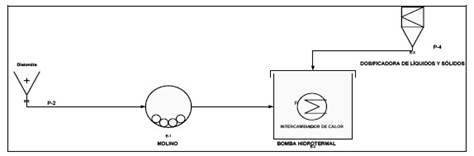
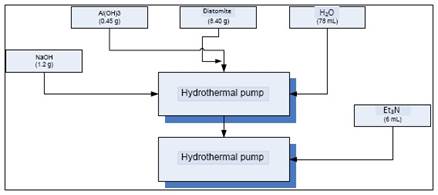
Figure 2 shows the synthesis scheme of the material, where the quantities of washed non-metallic material and the p.a. type reagents were used according to the following molar ratio:
10NaOH; 47SiO2; 2Al(OH)3; 14(C2H5)2N; 1437H2O
Addition of precursors followed the order: NaOH (99% MERCK), Al(OH)3 (99%, SIGMA-ALDRICH), Diatomite, distilled H2O and (C2H5)3N (99.0% SIGMA-ALDRICH), see Fig. 2.
The structural characterization of the starting precursors and the obtained products was carried out using the X-ray diffraction technique in a Rigaku-Geigerflex equipment between 2 and 60° with a scanning speed of 2.00 °/min with a Cu lamp (Kα= 1.5406A).
Characterization
The sample taken from Bella Vista sector corresponds to a diatomaceous material duly characterized2. Figure 3, (a) corresponds to the X-ray diffraction spectrum of the crude starting material, showing a high content of quartz, calcite (CaCO3), and halite (NaCl) as impurities; the diatomites do not register peaks because they are amorphous. (b) corresponds to the same sample, but washed with H2SO4, observing that the crystalline phases (in this case, impurities) were almost completely eliminated, thus converting it into a suitable material for mordenite synthesis.
RESULTS AND DISCUSSION
The X-ray diffraction spectra of the synthesis products called DM1 (Bella Vista) and DCB1 (Charaña) were run according to Figure 3.
The X-ray diffraction diffractograms shown in Figure 4 indicate that the natural starting precursors undergo a transformation into a zeolitic type material which was identified as the mordenite type zeolite.
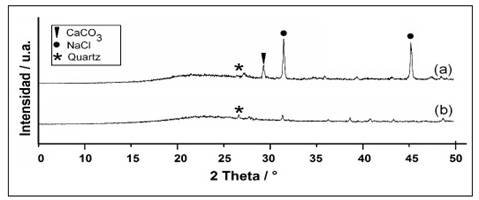
Figure 3 Rx diffraction spectrum corresponding to: a) Raw Bella Vista Precursor, b) Bella Vista Precursor washed with H2SO4.
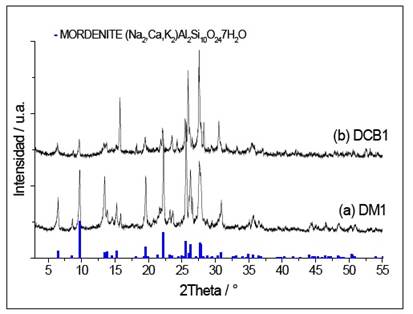
Figure 4 Rx diffraction spectra of the obtained products: (a) Washed Bella Vista precursor, (b) Raw Charaña precursor. In blue lines, the XRD reference pattern of mordenite.
Record (a) of Figure 4, Sample DM1, corresponds to the starting precursor treated and washed with sulfuric acid. The good development of peaks suggests a higher degree of crystallinity of the synthesized product, corresponding to peaks characteristic of mordenite. This means that during the synthesis process the precursor undergoes a transformation from an amorphous phase to a well-differentiated crystalline phase, as confirmed by the XRD results.
The results of Fig. 4 (b), sample DCB1 (Charaña), show that the synthesis product obtained also corresponds to the mordenite type phase, however, it is worth highlighting that the obtaining of this zeolitic phase is carried out using a precursor, Charaña diatomite, crude and without the previous acid washing treatment, which opens up a possibility of studying the application of this material.
CONCLUSIONS
- Mordenite synthesized from diatomites from the regions of Charaña (La Paz) and Bella Vista (Potosi), is of high purity, as deduced from the DRX spectra that demonstrate a high degree of crystallinity.
- Given the lack of natural zeolitic deposits in Bolivia, laboratory synthesis of mordenite is considered the beginning of a technical and economic feasibility study for its production on a larger scale, following its evaluation under experimental field conditions.
- The DRX results of sample DCB1 (Charaña) demonstrate that the synthesis product obtained also corresponds to the mordenite type phase, where the obtaining of these zeolitic phases from natural precursors is highlighted; in this case the raw Charaña diatomite without the respective acid washing treatment, which opens up the possibility of more development of this material.
Additional synthesis tests will be performed, first to optimize process performance under laboratory reactor conditions, and then to investigate scaling criteria that allow optimal operating conditions to be replicated at larger production scales (bench scale).

