




 Inglés (pdf)
 Articulo en XML
 Referencias del artículo
 Traducción automática
 Enviar articulo por email
 Citado por SciELO
  Similares en
SciELO
Similares en
SciELO  uBio
uBio 
 Permalink
INTRODUCTION
In recent years, there has been increasing concern about the widespread occurrence of endocrine-disrupting chemicals, pharmaceuticals, and personal care products in the aquatic environment. A wide range of coagulants and oxidants/disinfectants can be used for water and wastewater treatment. The most common oxidants/disinfectants used are chlorine oxide, ozone, chlorine and sodium hypochlorite, and coagulants used include ferric chloride, ferric sulfate, and aluminum sulfate. The most effective water treatment chemical reagent should ideally be able to remove colloidal materials, heavy metals, partially degrade and oxidize organic and inorganic impurities, and disinfect microorganisms. A potential chemical reagent meeting these criteria is green chemical (ferrate (VI) salts). It is an environmentally friendly treatment chemical that will not produce any harmful by-products in the treatment process. Ferrate (VI) ions are reduced to ferric III ions or ferric hydroxide and generate a coagulant in a single dosing and mixing unit process. Ferrate is an emerging water treatment chemical that can be used as an oxidant, coagulant and disinfectant. In the present work, potassium ferrate was synthesized, purified and characterized by spectral studies. Water samples were collected from GUYSUCO (ECD), DDL (ECD), Lodge (Georgetown) and UG (ECD), Guyana. The water quality parameters used to examine water quality, pre- and post-treatment, were turbidity, pH, dissolved solids, total hardness, chemical oxygen demand and iron content. The pre- and post-treatment procedures were useful in determining the treatment potential of synthesized ferrates. Potassium ferrate was found to be more stable and effective in water treatment. Oxidation, disinfection and coagulation processes have been widely used in the field of water treatment1. Several oxidants (e.g. Cl2, ClO2, O3, H2 O2) are applied for oxidative removal of chemical pollutants. A harmful by-products is formed from oxidation / disinfection of natural water with Cl2 or O32),(3. In ferrate (VI), the + 6 oxidation state of iron has gained increasing attention as a green, multi - purpose water treatment chemical, acting as an oxidant, coagulant, disinfectant because of high oxidizing power and the non - toxicity of the decomposition product of the ferrate4),(5),(6. Ferrate (VI) is a powerful oxidant and reduces to Fe3+

The standard potential of 2.20 V is very high, and it is the highest of any other oxidants used in water and wastewater treatment processes. The spontaneous reduction of Fe (VI) in water results in the formation of molecular oxygen. As a disinfectant Fe (VI) has been found to effectively inactivate bacteria (Escherichia coli sphaeratilus)7),(8 and viruses (f2 coliphase and QB coliphase)9),(10 in synthetic buffer solution and secondary effluents. Ferrate could play multiple roles in the treatment of drinking water and wastewaters11),(12),(13),(14. The multi-purpose uses of Fe (VI) in water treatment as oxidant, disinfectant and coagulant is shown in Scheme 1.
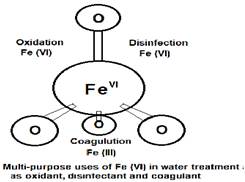
Scheme 1.
The three resonance hybrid structures of Fe (VI) ion in an aqueous solution are shown in Scheme 2.
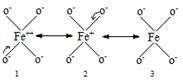
Scheme 2.
Iron commonly exists in the oxidation states of +2 ferrous and +3 ferric. Under strong oxidizing environments iron can process higher oxidation states, which may include +4, +5 and +6. Ferrates are inorganic oxyanion of iron in +6 oxidation state with a chemical formula of Fe O42- and are better known as Ferrate (VI) or iron (VI). Ndzungu et al.15 has aimed to synthesize calcium ferrate that can be utilized to treat water and wastewater through a facile wet oxidation process, with minimal increase in electrical conductivity. Due to disadvantages of ferrate (VI) such as oxidation selectivity and instability, it is necessary to develop the hyphenated techniques viz: Ferrate (VI) - photocatalytic synergistic coupling, ferrate (VI)-PAA synergistic coupling and ferrate (VI)-PMS synergistic coupling of ferrate (VI) has been presented by Yu et al.16.
Wang et al.17 has summarized the current views on the intrinsic properties of Fe (VI) with emphasis on the self -decay mechanism of Fe (VI). Present work also proposed the future research needs for the development of Fe (VI) technologies. The toxicity evaluation of antibiotics (sulfamethoxazole, erythromycin, ofloxacin, ciprofloxacin, tetracycline, oxytetracycline and trimethoprim) after their treatment with ferrate (VI) in water has been studied by Kovalakova et al.18. Dar et al.19 has provided a conclusive direction for synergetic oxidation technique to degrade the micro - pollutants especially pharmaceutical pollutants in contaminated water using ferrate (VI). The use of natural compounds such as amino acids to increase the removal efficiency of recalcitrant micropollutants such as carbamazepine by Fe (VI) has been examined by Sharma et al.20. Liu et al.21 has presented the first application of ferrate (VI) to decrease the generation of soluble lead in water contaminating PbO2(s), natural organic matters, iodide and bromide at pHs 6.0, 7.0 and 8.0. Comparison of ferrate production methods and assessment of its possible applications for water treatment has been described by Petkova et al.22. Encapsulation of solid potassium salt of ferrate circumvents the inherent drawbacks of the instability of ferrate under humid conditions has been investigated by Chen et al.23. Ghernaaut and Elboughdiri24 has discussed recent uses of ferrate (VI) mainly as killing agent. Ferrate oxidation as a potential method for the treatment of both organic and inorganic pollutants in drinking and real wastewater is discussed by Karim et al.25 Jiang et al.26 has investigated the practical feasibility of ferrate (VI) used as an alternate to the existing coagulant (e.g. Ferric chloride / sulfate) for both drinking water and domestic sewage treatment via series of pilot plant trials. Ferrate (VI) in the treatment of wastewaters: A new generation green chemical has been described by Tiwari and Lee27.
RESULTS
The synthesized potassium ferrate was observed to have dark purple to black in color with a percentage yield of 67.49 %
pH
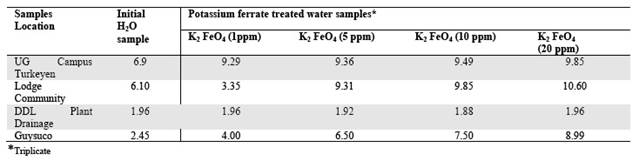
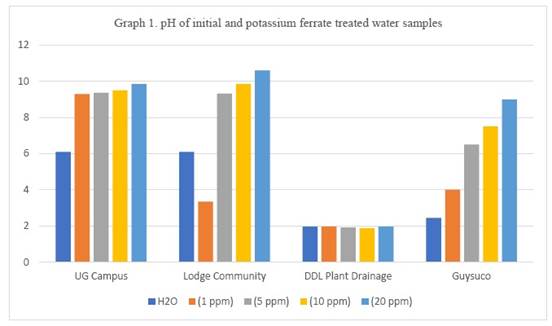
pH test results for initial and potassium ferrate (1ppm, 5 ppm, 10 ppm, 20 ppm) treated water samples from four different locations (Turkeyen, Lodge, DDL plant drainage, Guysuco) of the country (Guyana) are given in Table 1 and Graph I, respectively.
Dissolve Solids
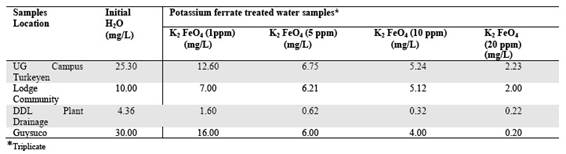
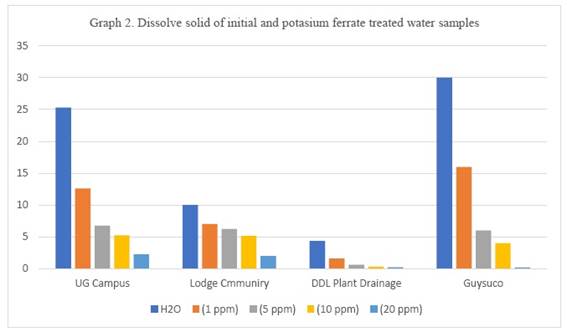
Dissolve solids (Inorganic and organic) test results for initial and potassium ferrate (1ppm, 5 ppm, 10 ppm, 20 ppm) treated water samples from four different locations (Turkeyen, Lodge, DDL plant drainage, Guysuco) of the country (Guyana) is given in Table 2 and Graph 2, respectively.
Water Hardness
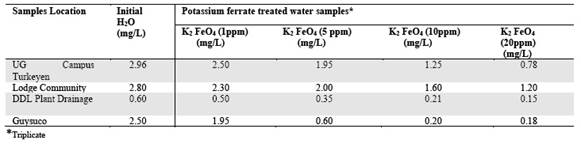
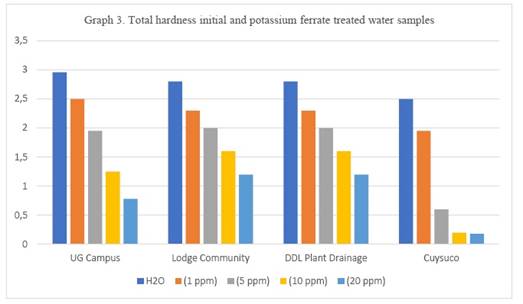
Water hardness test results for initial and potassium ferrate (1ppm, 5 ppm, 10 ppm, 20 ppm) treated water samples from four different locations (Turkeyen, Lodge, DDL plant drainage, Guysuco) of the country (Guyana) are given in Table 3 and Graph 3, respectively.
Iron test
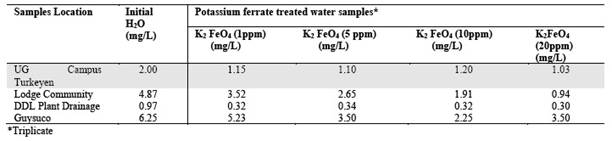
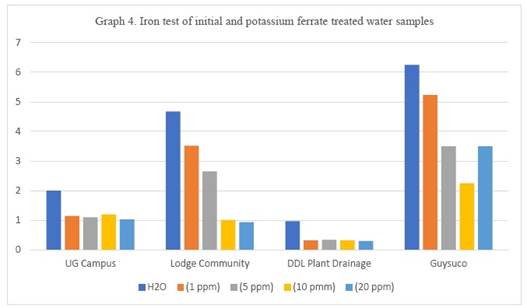
Iron test results for initial and potassium ferrate (1ppm, 5 ppm, 10 ppm, 20 ppm) treated water samples from four different locations (Viz. Turkeyen, Lodge, DDL plant drainage, Guysuco) of the country (Guyana) are given in Table 4 and Graph 4, respectively.
Turbidity
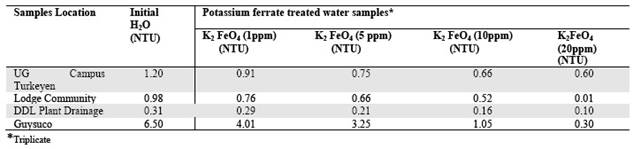
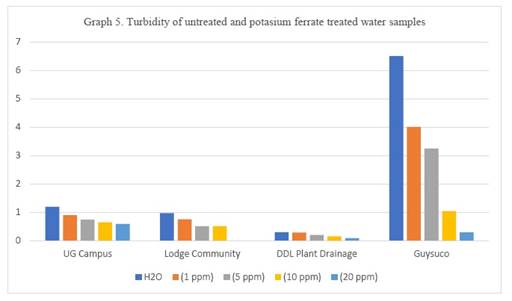
Turbidity test results for initial and potassium ferrate (1ppm, 5 ppm, 10 ppm, 20 ppm) treated water samples from four different locations (Viz. Turkeyen, Lodge, DDL plant drainage, Guysuco) of the country (Guyana) are given in Table 5 and Graph 5, respectively.
DISCUSSION
pH
pH of water is important as it will impact on pH - sensitive enzymes and acids in our body. Pollution, both domestic and industrial, affects the water’s pH. The aquatic life is mostly pH dependent. According to the results of UG Campus, Turkeyen samples have a gradual increase in pH as the amount of potassium ferrate increases from 1 ppm to 20 ppm, but still it was out of range of WHO standards (6;8 - 8.5 pH). For lodge community water drop in the pH was observed for water samples treated with 1 ppm potassium ferrate, while increase in pH was observed for water samples treated with 5, 10 and 20 ppm of potassium ferrate but none of them reach to WHO standard. The initial water samples collected from DDL plant drainage were acidic and significant change in pH values were observed by treating with various doses of potassium ferrate. Potassium ferrate doses 5 ppm and 10 ppm treatment is effective for Guysuco water samples which are in the range of WHO standards (6.5 - 8.5 pH).
Some of the water samples analyzed showed an increase in pH after treatment with potassium ferrate. This suggests that the basicity of solution has increased. This may be due to the formation of hydroxide ions during the reduction of ferrate ion as represented below

It is also observed from Table 1 that pH of water samples increases as the doses of potassium ferrate increases. Bar chart of pH test for untreated contaminated water samples are shown in Graph 1 and values are given in Table 1.
Dissolved Solid
Dissolved solids measure the mass of solid particles in water sources of total solids includes sewage, soil erosion, industrial discharges, road runoff fertilizers etc. Higher concentrations of suspended solids may serve as carriers of toxics, particularly in case of pesticide usages. The concentration of total dissolved solids affects the water balance in the cells, aquatic organism making it difficult to maintain the proper cell density. A bar chart for dissolved solids for untreated and potassium ferrate treated contaminated water samples is shown in Graph 2 and values are given in Table 2. It is observed from Table 2 that potassium ferrate is effective for the treatment of all water samples. It is also clear from Table 2 that number of dissolved solids decreases in each treated water sampled as the doses of potassium ferrate increases from 1ppm to 20 ppm.
Water Hardness
Hard water is making washing and bathing difficult, and it leaves lime and calcium deposits on the surfaces. A bar chart of the total hardness test for untreated and potassium ferrate treated contaminated water samples is shown in Graph 3 and values are given in Table 3. It is observed from Table 3 that water hardness decreases as the doses of potassium ferrate increase from 1 ppm to 20 ppm. It is also clear from Table 3 that uses of 20 ppm dose of potassium ferrate were found to be more effective for treatment of water samples in comparison to other lower doses of potassium ferrate used.
Iron test
Iron is an essential element in human nutrition with a minimum daily requirement of 10 to 50 mg/day. It is a vital oxygen transport mechanism in the blood of all vertebrate and some invertebrate animals. Ferrous Fe2+ and Ferric Fe3+ ions are primary forms of concern in aquatic environment, other forms may be either organic or inorganic wastewater streams. A bar chart of iron test for untreated and potassium ferrate treated contaminated water samples is shown in Graph 4 and values are given in Table 4. Guysuco and DDL plants drainage water samples were found to have maximum and minimum iron contents, respectively. A 20-ppm dose of potassium ferrate was found to be effective for the removal of iron from UG Campus, Lodge community and DDL plant drainage water samples. A10 ppm dose of potassium ferrate was found to be effective for the removal of iron content from Guysuco water samples. It is observed from Table 4 that in UG Campus and Lodge water samples values of iron content decreases as the dose of potassium ferrate increases, while Fluctuations are noted for DDL plant drainage and Guysuco samples.
Turbidity
Turbidity results from particularly suspended or dissolved substances in water that scatter light making the water appear cloudy. Excessive turbidity in drinking water is unappealing and can provide food and shelter for pathogens. Hence if not removed turbidity it can promote regrowth of pathogens in the distribution system, leading to waterborne disease-causing significant damage of gastroenteritis. A bar chart of turbidity test for untreated and potassium ferrate treated contaminated water samples is shown in Graph 5 and values are given in Table 5. A 20-ppm dose of potassium ferrate was found to be effective for the removal of turbidity in each water samples collected from different locations of Guyana. A gradual decrease in values of turbidity was observed as the doses of potassium ferrate increases from 1 ppm to 20 ppm. Most of the turbidity values are in the range of WHO (0> NTU) standered but few values are out of WHO range, which may be due to presence of other impurities rather than turbidity.
Chemical oxygen Demand (COD)
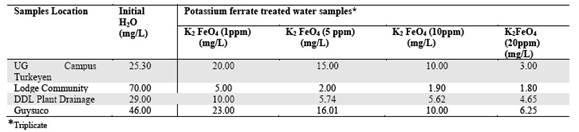
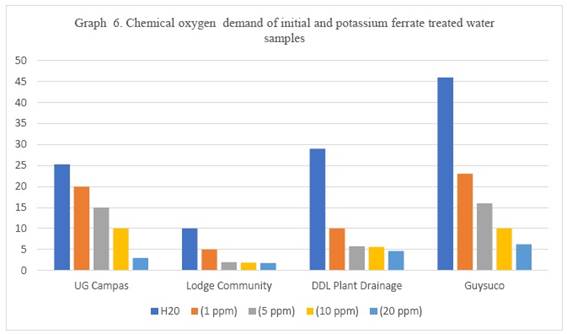
Chemical oxygen Demand measures the number of organic substances in water by measuring the number of oxidizing substances in water. A bar chart of COD for untreated and potassium ferrate treated contaminated water samples is shown in Graph 6 and values are given in Table 6. A 20-ppm amount of potassium ferrate is found to be effective for treating the water samples. It is observed from Table 6 that a gradual decrease in COD values were observed as the doses of potassium ferrate increases. Guysuco and Lodge community untreated water samples were found to have the highest and lowest COD values, respectively. The oxidizing power of Fe (VI) is higher than most common oxidizing reagents inclusive of chromate, ozone, hypochlorite and permanganate. Potassium ferrate has been known as a powerful oxidizing agent with reduction potential values 0.7 V and 2.2 V in basic and acidic solution, respectively. This oxidizing power of ferrate makes it a good option for water and wastewater treatment28.
When ferrate (VI) ion salts are dissolve in water, it causes the release of oxygen and sequestration of iron hydroxide. This property would lead to instability of ferrate (VI) and removes contaminants from the water and wastewater. When ferrate takes electrons from another chemical species, it is reduced and iron 6 + falls to 5 + then 4 + then 3 + (ferric ion) in the process acting as an oxidant, then coagulant, and finally as a flocculent. Ferrate is extremely superior in terms of performance over other disinfectants inclusive of ultraviolet light, hydrogen peroxide and chlorine and notable it can kill organism that tend to be resistance to chlorine. Therefore, ferrate has the potential to replace and work in many water and wastewater treatment facilities or units27. Ferrate (VI) can be considered as an advantage in utilizing this compound in treating wastewater. Interestingly, the presence of oxygen would prevent anaerobic condition in wastewater, thus inhibiting the production of odor-causing compounds such as hydrogen sulfide. Also, organic and inorganic odor-causing compounds are readily oxidized, thus inhibiting the emission of odor in wastewater facilities29.
CONCLUSIONS
The following conclusions can be drawn from the present studies.
1. pH of all water samples is increased with increase in amount of potassium ferrate. Therefore, it is helpful in adjusting the pH of water to accepted WHO standard (6.5 - 8.5).
2. Potassium ferrate is found to be effective in decreasing the number of dissolved solids in water samples.
3. For water treatment parameters (pH, dissolved solid, total hardness, iron, turbidity, COD) studies, the effectiveness of potassium ferrate increases as their amount increases.
4. Potassium ferrate is found effective to lower down the impurities dissolved solid, total hardness, iron, turbidity and COD in all water samples studied.
5. Ferrate (VI) is the best method to treat water and wastewater because it is simple to manufacture, has high yield and treats most parameters studied.
6. For commercialization purposes ferrate (VI) technology is expected to be the best in comparison to other water and wastewater treatment processes viz chlorine, hypochlorite, hydrogen peroxide, ozone, permanganate, perchlorate etc.
7. The reaction rate of ferrate (VI) is highly dependent on pH indicating it a selective oxidant.
8. For the reaction mechanism of ferrate (VI) both one electron and two electrons mechanism have been equivocally raised. Therefore, it can be used as a novel agent to treat water related issues.
EXPERIMENTAL
Materials
Ferric chloric, sodium hypochlorite, sodium hydroxide, ferric nitrate, potassium hydroxide, potassium permanganate, hexane, diethyl ether, petroleum sprit and ethanol were obtained from Aldrich.
Synthesis of potassium ferrate
Potassium ferrate was prepared according to the method reported in chemical literature30. Potassium ferrate was prepared by bubbling chlorine gas generated from concentrated HCl and KMnO4 through 500 mL of 0.1 M potassium hydroxide.
This was done in 5 minutes. A 15 mL of 0.1 M ferric nitrate was added to 60 mL of KClO with constant stirring. Solution was filtered, and crystals were washed 3 times with 20 mL of hexane and diethyl ether (1:1) mixture. Crystals were stored in desiccator. Reactions for the preparation of potassium ferrate was exothermic and vigorous with a very strong chlorine odor.

Purification of potassium ferrate
Synthesized potassium ferrate was purified according to method reported in chemical literature31. Potassium ferrate was washed with 13 mL of petroleum sprit. It was further washed with 3 to 5 times, 20 mL of 95 % ethanol. Stirred for 20 minutes, this washing is repeated for 3 times. Precipitate was dried and stored in a desiccator.
Characterization of potassium ferrate
Potassium ferrate was found to have purple to black in color. Visible spectra of synthesized potassium ferrate demonstrated typical ferrate (VI) characteristics absorption values 505 nm and 790 nm, which is consistent with literature32),(33. Infrared absorption peak for potassium ferrate were observed at 324 cm-1 and 800 cm-1 (807 cm-1), respectively. The literature values are provided in bracket28. The concentration of potassium ferrate was determined by titration against bromine oxide. Ferrate solution was prepared in arsenic trioxide. Methyl orange was used as an indicator, a yellow color appeared at the end point.

Collection of water samples:
Water samples were collected in 500 mL stopped bottles from four different location of the country (Guyana). The order of the water sampling is as follows:
1. University of Guyana, Turkeyen Campus (Turkeyen)
2. Greater Georgetown, Lodge Community (Lodge)
3. Demerara Distillery Ltd., East Bank Demerara Drainage (DDL Plant Drainage)
4. Guysuco Sugar Estate, East Coast Demerara Wastewater (Guysuco)
Method for testing water samples:
Water samples were tested via pre and post treatments with potassium ferrate for pH, dissolved solid, water hardness, iron, turbidity and chemical oxygen demand.
pH
pH Tests were done using the HACH HQ series portable meter. pH meter was calibrated prior to each use.
Dissolved solid
The total dissolved solid (organic and inorganic) tests were done by heating, cooling and weighting. A well - mixed sample 100 mL is evaporated in a weighted dish and dried to constant weight in an oven at 103 - 105°C, the increase in weight over that of the empty dish represents the total solids.
Water hardness
The total hardness of water samples was determined by titrating against disodium ethylene diamine tetra acetic acid. A 100 mL of the water sample and 1.0 mL of pH 10.0 buffer of Eriochrome black T - indicator was used. The green color appears at the end point.
Iron test
Iron tests for the untreated and treated water samples were done using the HACH DR / 2010 spectrophotometer. A sample of 10 mL was used for the iron test, 5 mL for zeroing the meter, the indicator phenanthroline was added to the remaining 5 mL water sample then read off.
Turbidity
Turbidity test for the untreated and treated water samples were done using the HACH Portable turbidity meter model 2100 P at environmental laboratory University of Guyana. It was calibrated with a standard range from 0.01 to 800 Nephelometric Turbidity Unit (NTU). After which 15 mL of the sample vial and read off.

